HAL Id: hal-01764527
https://hal.inria.fr/hal-01764527
Submitted on 12 Apr 2018
HAL is a multi-disciplinary open access
archive for the deposit and dissemination of
sci-entific research documents, whether they are
pub-lished or not. The documents may come from
teaching and research institutions in France or
L’archive ouverte pluridisciplinaire HAL, est
destinée au dépôt et à la diffusion de documents
scientifiques de niveau recherche, publiés ou non,
émanant des établissements d’enseignement et de
recherche français ou étrangers, des laboratoires
to TLS 1.3
Bruno Blanchet
To cite this version:
Bruno Blanchet. Composition Theorems for CryptoVerif and Application to TLS 1.3. [Research
Report] RR-9171, Inria Paris. 2018, pp.67. �hal-01764527�
0249-6399 ISRN INRIA/RR--9171--FR+ENG
RESEARCH
REPORT
N° 9171
April 2018for CryptoVerif and
Application to TLS 1.3
RESEARCH CENTRE PARIS
2 rue Simone Iff
Bruno Blanchet
Project-Team Prosecco
Research Report n° 9171 — April 2018 — 67 pages
Abstract: We present composition theorems for security protocols, to compose a key exchange protocol and a symmetric-key protocol that uses the exchanged key. Our results rely on the computational model of cryptography and are stated in the framework of the tool CryptoVerif. They support key exchange protocols that guarantee injective or non-injective authentication. They also allow random oracles shared between the composed protocols. To our knowledge, they are the first composition theorems for key exchange stated for a computational protocol verification tool, and also the first to allow such flexibility.
As a case study, we apply our composition theorems to a proof of TLS 1.3 Draft-18. This work fills a gap in a previous paper that informally claims a compositional proof of TLS 1.3, without formally justifying it.
et application à TLS 1.3
Résumé : Nous présentons des théorèmes de composition pour les protocoles cryptographiques, pour composer un protocole d’échange de clés et un protocole à clé symétrique qui utilise la clé échangée. Nous résultats reposent sur le modèle calculatoire de la cryptographie et sont formulés dans le cadre de l’outil CryptoVerif. Ils autorisent des protocoles d’échange de clés qui garantissent l’authentification injective ou non-injective. Ils autorisent aussi le partage d’oracles aléatoires entre les protocole composés. À notre connaissance, ils sont les premiers théorèmes de composition pour l’échange de clés formulés pour un outil de vérification de protocole dans le modèle calculatoire, et aussi les premiers à autoriser une telle flexibililté.
Comme étude de cas, nous appliquons nos théorèmes de composition à une preuve de TLS 1.3 brouillon 18. Ce travail fournit un élément manquant dans un article précédent qui donne informellement une preuve compositionnelle de TLS 1.3, sans la justifier formellement.
1
Introduction
The proof of security protocols is notoriously difficult. In particular, when security protocols grow in size, the complexity of their proof increases, and quickly becomes unmanageable. Com-position theorems are essential to tackle this problem: they allow one to prove small pieces of the considered protocol, and to compose these results in order to obtain a proof of the full protocol. In this paper, we consider the standard game-based computational model of cryptography, and we focus on the composition between a key exchange protocol and a symmetric key protocol that uses the key provided by the key exchange. We assume that the key exchange protocol runs between two participants A and B and is secure: the provided key is secret in the sense that keys provided in several sessions are indistinguishable from independent random keys; the protocol provides authentication of A to B, defined based on session identifiers; and A executes at most one session with a given session identifier. Then, we prove that the security properties of the symmetric key protocol carry over to the composed protocol. Moreover, we also prove that the security properties of the key exchange protocol are preserved in the composed protocol (except for the secrecy of the key on which we perform the composition). This point is important to be able to perform several compositions one after the other. We have two variants of our composition theorem: one in which authentication is injective, that is, each execution of B corresponds to a distinct execution of A; and one in which authentication is non-injective, that is, several executions of B may correspond to the same execution of A.
An originality of our composition theorems is that they are stated within the framework of a protocol verification tool, CryptoVerif [11, 12, 14], available at http://cryptoverif.inria. fr. We use the language of CryptoVerif to represent the cryptographic games; we use security properties proved by CryptoVerif as assumptions of our composition theorems. Therefore, we can easily use CryptoVerif to mechanize the proof of the protocol pieces that we compose.
Using such a framework to state composition theorems has several advantages. It strengthens the abilities of CryptoVerif: thanks to the composition theorems, we can obtain security proofs for bigger protocols. Moreover, CryptoVerif does not support loops. If we can break a protocol with loops into pieces without loops, we can verify them using CryptoVerif, and prove security of the whole protocol with loops by iteratively composing these pieces. Finally, CryptoVerif provides a rigorous framework for stating the composition theorems: it provides a formal language for games and for security properties, with a formal semantics. The hypotheses and conclusions of the composition theorems can then be stated precisely and concisely in that framework.
As a case study, we apply our composition theorems to TLS 1.3. More precisely, we revisit a previous analysis of TLS 1.3 Draft 18 by Bhargavan et al. [9,10]. This analysis splits TLS 1.3 into 3 pieces: the initial handshake, the handshake with pre-shared key, and the record protocol, and claims that security of TLS 1.3 can be obtained by composing these 3 pieces. However, it does not justify this composition formally. Our work fills this gap. TLS 1.3 is particularly well-suited as a case study to illustrate the power of our composition results. First, it is an important protocol, which is currently being standardized. The current draft, Draft 28 [35], is now final, and not very different from Draft 18. We expect that our composition results would apply in the same way to Draft 28, though the CryptoVerif models of the protocol pieces would require minor changes. Second, TLS 1.3 is well-designed to allow composition: the handshake produces traffic secrets used by the record protocol as well as a resumption secret used as a pre-shared key by the next handshake. The protocol pieces are cleanly separated, so that the only common secret between them is the symmetric key on which we perform the composition. Third, TLS 1.3 includes loops: it allows an unbounded number of handshakes with pre-shared key and an unbounded number of key updates in the record protocol. Therefore, it cannot be analyzed as a whole by CryptoVerif. The composition results allow us to break these loops and obtain security results for the full
protocol. Finally, TLS 1.3 includes a variety of compositions, and we provide theorems for all of them. While most compositions use a key exchange that provides injective authentication, TLS also includes 0-RTT (Round Trip Time) data, that is, data that the client sends to the server immediately after the first message of TLS (ClientHello). Such data can be replayed, and the corresponding key exchange only provides non-injective authentication. Furthermore, we also have to deal with altered ClientHello messages; in this case, only the server has the corresponding key, and that requires a variant of the composition result. Finally, for key updates in the record protocol, the key is simply computed from the previous key without a proper key exchange, so we can use a much simpler composition theorem in this case.
Related Work The line of work closest to ours is that of [16, 27, 29]. Brzuska et al. [16] prove a composition result similar to ours, in an informal game-based framework. Fischlin et al. [27, 29] extend this framework to multi-stage key exchange protocols, in which parties can establish multiple keys in different stages and use these keys between stages. They apply their results to the proof of QUIC [29] and of TLS 1.3 Draft 05, Draft DH [27], and Draft 10 [28]. In addition to recasting the composition result in CryptoVerif, we extend it in several ways. We prove that security properties of the key exchange protocol are preserved in the composition, so we can compose again using other keys. This point appears in [29, Remark, page 16 of the full version] without proof. We allow the composed protocols to share random oracles; this point does not appear in [16,27,29]. We prove a composition theorem for protocols that provide non-injective authentication, used for 0-RTT data in TLS 1.3. Although we do not consider several stages explicitly, our composition theorems support most compositions allowed by the multi-stage framework. (We detail the comparison in Section 5.4.)
Brzuska et al. [15] prove a composition theorem that allows the key exchange protocol to already use the key provided to the symmetric-key protocol, for example for key confirmation. TLS 1.3 is designed so that the same key is never both used in the key exchange and provided to the next protocol, so we did not need such a composition result in our case study. We believe that such a result could also be proved in our framework if desired.
Canetti and Krawczyk [19] prove security of the composition of a key exchange protocol with specific symmetric-key protocols that use MACs to achieve an authenticated channel or encrypt-then-MAC to achieve a secure channel.
Barthe et al. [4] develop generic proofs of reduction for one-round key-exchange protocols, such as Naxos and HMQV, in EasyCrypt. EasyCrypt is an interactive theorem prover specialized for building game-based security proofs. Thus, their approach provides another way of introducing modularity in machine-checked proofs of security.
Universal composability (UC) [17,18,20,32] is a framework that allows to compose protocols. However, proving UC-security requires stronger properties than the game-based framework that we use ( [16, Appendix A] details limitations of the UC framework). Delaune et al. [25] present a simulation-based framework that is an analogue of UC in the symbolic (Dolev-Yao) model of cryptography.
Composition theorems have also been proved in the Dolev-Yao model. Many of these theorems deal with the parallel composition of protocols that share secrets, for trace properties [22, 31], for resistance against guessing attacks for protocols that share passwords [26], and for privacy properties [2], using disjointness assumptions such as tagging or disjoint primitives to guarantee the independence of the protocols. Other results [3, 21] allow sequential composition, in partic-ular the composition of a key exchange protocol with a symmetric-key protocol that uses the exchanged key. Ciobâcă et al. [21] consider trace properties, while Arapinis et al. [3] extend the result to processes with else branches, to private channels, and to privacy properties. Mödersheim et al. [30,33,34] define notions of security for channels (insecure, authentic, confidential, secure),
and prove composition results between protocols that establish such channels and protocols that use them. They also rely on the Dolev-Yao model and use disjointness assumptions. We believe that the computational model has two advantages: it is more realistic than the Dolev-Yao model and the computational definitions compose nicely, so that we can avoid disjointness assumptions. Protocol composition logic [23,24] is a logic for proving security protocols that allows sequen-tial and parallel composition. It was inisequen-tially designed in the Dolev-Yao model [23] and adapted to the computational model [24].
Outline The next section provides a minimal reminder of the CryptoVerif framework. Sec-tion 3 presents the structure of our proof of TLS, so that we can use it as a motivaSec-tion for the composition theorems. Section 4 presents a very simple composition theorem, used for key updates in TLS 1.3, as a warm-up. Section 5 presents our main composition theorems. Section 6 summarizes their application to TLS, and Section 7 concludes. The appendix provides the proofs of all results and details on the TLS case study.
2
A Short Reminder on CryptoVerif
Processes, contexts, adversaries CryptoVerif mechanizes proofs by sequences of games, similar to those written on paper by cryptographers [8, 36]. It represents protocols and crypto-graphic games in a probabilistic process calculus. We refer the reader to [12, 14] for details on this process calculus. We explain the necessary constructs as they appear.
We use P , Q for processes. A context C is a process with one or several holes [ ]. We write C[P1, . . . , Pn] for the process obtained by replacing the holes of C with P1, . . . , Pn respectively.
An evaluation context is a context with one hole, generated by the following grammar:
C ::= evaluation context
[ ] hole
newChannel c; C channel restriction
Q | C parallel composition
C | Q parallel composition
The channel restriction newChannel c; Q restricts the channel name c, so that communications on this channel can occur only inside Q, and cannot be received outside Q or sent from outside Q. The parallel composition Q1| Q2 makes simultaneously available the processes defined in Q1
and Q2. We use evaluation contexts to represent adversaries.
Indistinguishability A process can execute events, by two constructs: event e(M1, . . . , Mn)
executes event e with arguments M1, . . . , Mn, and event_abort e executes event e without
argument and aborts the game. After finishing execution of a process, the system produces two results: the sequence of executed events E, and the information whether the game aborted (a = abort, that is, executed event_abort) or terminated normally (a = 0). These events and result can be used to distinguish games, so we introduce an additional algorithm, a distinguisher D that takes as input the sequence of events E and the result a, and returns true or false. We write Pr[Q : D] for the probability that the process Q executes events E and returns a result a such that D(E, a) = true.
Definition 1 (Indistinguishability). We write Q ≈V
p Q0 when, for all evaluation contexts C
acceptable for Q and Q0 with public variables V and all distinguishers D that run in time at most tD, | Pr[C[Q] : D] − Pr[C[Q0] : D]| ≤ p(C, tD).
Intuitively, Q ≈V
p Q0 means that an adversary has probability at most p of distinguishing
Q from Q0, when it can read the variables in the set V . When V is empty, we omit it. The probability p may depend on many parameters coming from the context C, that is why p takes as arguments the whole context C and the runtime of D. CryptoVerif always expresses the proba-bilities as formulas in which the only parameters that come from the context C are the maximum runtime of C, the maximum number of times C may send a message to each subprocess in Q (resp. Q0), and the lengths of bitstrings. This property allows us to simplify probability formulas
by abstracting away the precise context they use and retaining only the useful parameters. We denote by tC the maximum runtime of C, and use the same notation for processes P , Q, terms
M, and functions f. As usual in cryptographic proofs, we ignore very small runtimes.
The condition that C is acceptable for Q and Q0 with public variables V is a technical
condition that ensures that C[Q] and C[Q0] are well-formed. The public variables V are the
variables of Q and Q0 that C is allowed to read.
Indistinguishability is reflexive (Q ≈V
0 Q), symmetric (if Q ≈Vp Q0, then Q0 ≈Vp Q) and
transitive (if Q ≈V
p Q0 and Q0≈Vp0 Q00, then Q ≈Vp+p0 Q00). Moreover, Q ≈Vp Q0 implies C[Q] ≈V 0
p0
C[Q0] for all evaluation contexts C acceptable for Q and Q0 with public variables V and all V0⊆ V ∪ var(C), where var(C) is the set of variables of C and p0(C0, t
D) = p(C0[C[ ]], tD).
Secrecy Intuitively, in CryptoVerif, secrecy means that the adversary cannot distinguish be-tween the secrets and independent random values. This definition corresponds to the “real-or-random” definition of security [1]. As shown in [1], this notion is stronger than the one in which the adversary performs a single test query and some reveal queries. We recall the definition of se-crecy in CryptoVerif given in [13,14]. Let us first explain CryptoVerif constructs used in this defi-nition. The replication !i≤nQrepresents n copies of the process Q in parallel, indexed by i ∈ [1, n],
where n is named a replication bound. The current replication indices at a certain program point are the indices i of replications above that program point. In CryptoVerif, all variables defined under a replication are implicitly arrays indexed by the current replication indices: if Q defines a variable x under !i≤n, the value of x is in fact stored in x[i]. The definition of x is executed at
most once for each i, so that all values of x are stored in distinct array cells. When a variable is ac-cessed with current replication indices, we omit the indices, writing x for x[i]. The find construct reads these array cells: find u = i0 ≤ n suchthat defined(x
1[i0], . . . , xm[i0]) ∧ M then P else P0
looks for an index i0∈ [1, n]such that x
1[i0], . . . , xm[i0]are defined and M is true. When such an
index is found, it is stored in u, and process P is executed. Otherwise, process P0 is executed.
The term M may refer to x1[i0], . . . , xm[i0]and the process P may refer to x1[u], . . . , xm[u]since
these variables are guaranteed to be defined. The input c[i](x : T ); P receives a message on channel c[i]. If this message is in the set of bitstrings T (T stands for “type”), it is stored in x, and P is executed. Otherwise, the process blocks. The channel c[i] consists of a channel name c and indices, here i. Very often, these indices are the current replication indices at the input: the sender can then tell precisely to which copy of the process the message should be sent. Similarly, the output c[i]hMi; Q sends message M on channel c[i]. After the output, the control is passed to the receiver process, which continues execution. The process Q that follows the output consists of inputs, possibly under replications and parallel compositions; these inputs will be executed when a message is sent to them. Finally, the restriction new y : T ; P chooses uniformly a random element of T , stores it in y, and executes P .
We useueas an abbreviation for a sequence of variables: u = ue 1, . . . , um. We writeeu ≤enfor u1 : [1, n1], . . . , um : [1, nm] when u = ue 1, . . . , um and en = n1, . . . , nm. We say that a variable is defined under replications !ei≤ne whenei = i1, . . . , im,
e
n = n1, . . . , nm, and it is defined under
define that a context has replications !ei≤enabove the hole in a similar way. When
e
n = n1, . . . , nm,
we define Qen = n1× · · · × nm.
Definition 2 (Secrecy). Let x and V be such that x /∈ V . Suppose that the variable x has type T and is defined under replications !ei≤ne in Q. Let
Rx= cs0(); new b : bool ; cs0hi;
(!is≤nsc
s[is](u ≤e en); if defined(x[eu]) then
if b then cs[is]hx[u]i elsee
find u0s= i0s≤ ns suchthat defined(y[i0s],u[ie
0 s]) ∧u[ie 0 s] =eu then cs[is]hy[u 0 s]i else new y : T ; cs[is]hyi | c0
s(b0: bool ); if b = b0 then event_abort S else event_abort S)
where the channels cs0, cs, c0s, the variables eu, u
0
s, y, b, b0, and the events S,S do not occur in Q.
The process Qpreserves the secrecy of x with public variables V up to probability p when, for all evaluation contexts C acceptable for Q | Rxwith public variables V that do not contain S nor
S, Pr[C[Q | Rx] : S] − Pr[C[Q | Rx] : S] ≤ p(C).
The process Rxchooses a random bit b, and then allows the adversary to query the variable
x: if the adversary sends indices euon channel cs[is], and x[eu] is defined, then the process Rx
replies with the value of x[eu]when b is true, and with a random value when b is false. The find in Rx makes sure that, if the indices ue have already been queried, then the previous reply is sent; otherwise, a fresh random value y is chosen in the type T of x by new y : T , and sent as a reply. The replication !is≤ns in R
x allows the adversary to perform at most ns such queries;
ns is chosen large enough so that it is not a limitation. Finally, the adversary sends on channel
c0sits guess b0 for the bit b. If the guess is correct (b0 = b), then the process Rx executes event
S; otherwise, it executes event S. Intuitively, Q preserves the secrecy of x when the adversary cannot guess b, that is, it cannot distinguish whether the process outputs the value of the secret (b = true) or outputs independent random numbers (b = false).
Correspondences Correspondences [37] are properties of executed sequences of events, such as “if some event has been executed, then some other event has been executed”. They are typically used for formalizing authentication. Given a correspondence corr, we define a distinguisher D such that D(E, a) = true if and only if the sequence of events E satisfies the correspondence corr. We write this distinguisher simply corr, and write ¬corr for its negation.
Definition 3 (Correspondence). The process Q satisfies the correspondence corr with public variables V up to probability p if and only if, for all evaluation contexts C acceptable for Q with public variables V that do not contain events used in corr , Pr[C[Q] : ¬corr ] ≤ p(C).
We refer the reader to [11] for more details on the verification of correspondences in Cryp-toVerif. We have:
Lemma 1. If Q preserves the secrecy of x with public variables V up to probability p and C is an acceptable evaluation context for Q with public variables V , then for all V0 ⊆ V ∪ var(C), C[Q] preserves the secrecy of x with public variables V0up to probability p0such that p0(C0) = p(C0[C]). If Q satisfies a correspondence corr with public variables V up to probability p and C is an acceptable evaluation context for Q with public variables V that does not contain events used in corr , then for all V0⊆ V ∪ var(C), C[Q] satisfies corr with public variables V0 up to probability
Handshake without pre-shared key
Handshake with pre-shared key
Record protocol ems
ems
cats sats resumption_secret
cats sats
cets
resumption_secret
updated ts Figure 1: Structure of the composition
If Q ≈V ∪{x}p Q0 and Q preserves the secrecy of x with public variables V up to probability
p0, then Q0 preserves the secrecy of x with public variables V up to probability p00 such that p00(C) = p0(C) + 2 × p(C[[ ] | Rx], tS).
If Q ≈V
p Q0 and Q satisfies a correspondence corr with public variables V up to probability
p0, then Q0 satisfies corr with public variables V up to probability p00 such that p00(C) = p0(C) + p(C, tcorr).
Tables CryptoVerif also supports tables. Tables are lists of tuples shared between all hon-est participants of the protocol. The construct insert T bl(M1, . . . , Mn); P inserts element
(M1, . . . , Mn) in table T bl, then runs P . The construct get T bl(x1, . . . , xl) suchthat M in
P else P0 tries to retrieve an element (x1, . . . , xl) in the table T bl such that M is true. When
such an element is found, it executes P with (x1, . . . , xl)bound to that element. When no such
element is found, it executes P0. Equality tests = M
i are also allowed instead of variables xi; in
this case, the table element must contain the value of Mi at the i-th position.
3
Structure of the proof of TLS 1.3
Our proof of TLS 1.3 relies on a previous analysis of the pieces that we compose [9,10]. Figure 1 summarizes the structure of the composition. We provide a brief sketch of those previous results here; more details are given in Appendix B.1.
The initial handshake, without pre-shared key, provides 4 keys at the end of the protocol: the client traffic secret cats, used by the record protocol for messages from the client to the server; the server traffic secret sats, used by the record protocol for messages from the server to the client; the exporter master secret ems, used to compute exporters (secrets generated by TLS that can be used by applications or other protocols); and the resumption secret resumption_secret, used as pre-shared key in the next handshake. For all these keys, CryptoVerif proves in particular secrecy, forward secrecy (with respect to the compromise of long-term client and server keys), and authentication.
In this model, the adversary has access to oracles that allow him to compromise the long-term client and server keys. The security properties are proved provided the long-term key of the peer is not compromised yet at the end of the handshake. As explained in the definition of secrecy (Section 2), this model does not include reveal queries for session keys; instead, CryptoVerif
proves that all keys of the various sessions are indistinguishable from independent random keys, which is a stronger model [1].
The handshake with pre-shared key uses a pre-shared key and provides the same keys as above, with the same security properties. Additionally, it provides a client early traffic secret cets, computed after the first message of the protocol (ClientHello). The record protocol uses this traffic secret to send messages from the client to the server immediately after the ClientHello message, so-called 0-RTT data. The ClientHello message may be replayed and the server may also accept an altered ClientHello message, so CryptoVerif proves weaker properties about cets. When the ClientHello message is not altered, it proves in particular secrecy and non-injective authentication, since replays are possible. When the ClientHello message is altered, it essentially proves that the server has a value of cets that no one else has. In this case, the goal is to show that the record protocol that uses this value of cets never accepts messages.
Due to limitations of CryptoVerif, we cannot prove forward secrecy with respect to the com-promise of the pre-shared key in the case of a handshake with pre-shared key and Diffie-Hellman key exchange. Hence, all properties that we prove for the handshake with pre-shared key rely on the secrecy of the pre-shared key. In the analysis of this part of the protocol, we can then consider that the long-term signature keys of the client and the server are compromised, and let the adversary deal with certificates and signatures if they appear. Therefore, the only common secret between our models of the initial handshake and of the handshake with pre-shared key is the pre-shared key. Furthermore, the analysis of the initial handshake allows the compromise of these long-term signature keys at the end of the handshake, so the security properties that we prove for the initial handshake remain valid.
Finally, the record protocol uses a traffic secret to derive an updated traffic secret, used for key updates, and a key and an initialization vector, used for encrypting and decrypting messages with an authenticated encryption scheme. CryptoVerif proves secrecy of the updated traffic secret, injective message authentication, and message secrecy. (The adversary cannot distinguish which one of two sets of messages is encrypted, similarly to the property we mentioned for Sb 1
in Example 1.) We also consider two variants of the record protocol for 0-RTT. In the first variant, the receiver is replicated, so we have non-injective message authentication instead of the injective one. This variant is useful to support replays of unaltered ClientHello messages. In the second variant, the sender is additionally removed, and we show that the receiver never accepts a message. This variant is useful for altered ClientHello messages. The only common secret between the handshakes and the record protocol is the traffic secret.
The goal of our case study is to combine all these results in order to obtain security results for the full TLS 1.3 protocol.
4
The Most Basic Composition Theorem
As a warm-up, we present a very simple composition theorem, explained below.
Theorem 1. Let C be any context with one hole, without replications above the hole and without event_abort. Let Q1 be a process without event_abort. Let M be a term of type T . Let
S1= C[let k = M in c1hi; Q1]
S2= c2(); new k : T ; c3hi; Q2
where c1, c2, c3 do not occur elsewhere in S1, S2; k is the only variable common to S1 and S2;
S1 and S2 have no common channel, no common event, and no common table; and k does not
occur in C and Q1. Let c01 be a fresh channel. Let
S1: k(secret) S2: new k : T Q2 Scomposed: k Q2
Figure 2: Illustration of Theorem 1 Let Scomposed◦ be obtained from Scomposed by removing all events of S1.
1. If S1 preserves the secrecy of k with public variables V (k /∈ V ) up to probability p, then
there exists an evaluation context C0 such that, for any V1⊆ V ∪ (var(S1) \ {k}), we have
Scomposed◦ ≈V1
p0 C0[S2] and C0is acceptable for S2without public variables, contains no event,
runs in time at most tC+ tQ1, and does not alter the other parameters (replication bounds,
lengths of bitstrings), where p0(C1, tD) = p(C10) and C10 runs in time at most tC1+ tQ2+ tD
and its other parameters are the same as those of C1.
2. There exists an evaluation context C00 such that, for any V0 ⊆ var(Scomposed), we have
Scomposed ≈V
0
0 C00[S1] and C00 is acceptable for S1 with public variable k, contains the
events of S2, runs in time at most tQ2, and does not alter the other parameters.
Moreover, C0 is independent of Q2 and C00 is independent of C and Q1.
In this theorem, illustrated in Figure 2, we compose a system S1 that establishes a key k
with a system S2 that runs Q2 using a fresh random key k. The composed system runs S1 and
Q2using the key k provided by S1. (The letters Q and S both represent CryptoVerif processes,
in the same grammar. We use S for the systems that we compose and for the composed system, and Q for other processes.) Intuitively, the composition works because the secrecy of k allows us to replace k with a fresh random key. (An adversary cannot distinguish k from a fresh random key.) A detailed proof is provided in Appendix A.4. In contrast to the theorems of Section 5, in this theorem, S1 is not a key exchange protocol: a single participant establishes the key k, so
the composition is a lot easier.
The assumption that S1 does not contain event_abort is useful because, in the definition
of secrecy, when S1 aborts before a message is sent on cs, neither S nor S is executed, so the
adversary gets no advantage against the secrecy of k for these traces. However, these traces could still leak information on k that would break the composition. So we prevent S1 from aborting.
This is not a limitation in practice, because event_abort is typically introduced during security proofs, using Shoup’s lemma [13, 36], but does not occur in the initial protocol model.
The assumption that c1, c2, c3do not occur elsewhere in S1, S2guarantees that messages sent
to channel c2 (resp. received from c1, c3) really go to the input (resp. come from the output)
A (share a key k) B
(m0,m1)
−−−−−→
event send(mb) enc(mb,k,r)
−−−−−−−→ event recv(m
b)
Figure 3: A picture of system Sb 2
guarantees that S1defines k but does not use it. The other assumptions on S1and S2can easily
be obtained by renaming if necessary. The first conclusion of Theorem 1, S◦
composed≈ V1
p0 C0[S2], allows us to transfer security
prop-erties from S2 to the composed system Scomposed using Lemma 1. In this property, we need to
remove the events of S1, because events can leak information on k even when S1 preserves the
secrecy of k according to Definition 2.
Similarly, the second conclusion of Theorem 1, Scomposed ≈V
0
0 C00[S1], allows us to transfer
security properties from S1 to the composed system Scomposed, provided these properties are
proved with public variable k, because C00 uses k. These properties may allow us to compose
again Scomposed with another protocol.
In our TLS case study, we use this composition theorem to deal with key updates in the record protocol. The system S1 runs the record protocol and computes an updated traffic secret
from a traffic secret. This updated traffic secret is the key k in the composition theorem. The system S2 uses this key k to run the record protocol again. The composition theorem allows
us to obtain security properties for a record protocol that performs a key update. We compose again recursively to allow any number of key updates. The next example presents a simplified version of this situation, to illustrate the theorem more formally.
Example 1. Consider the system S2b defined by
S2b= c2(); new k : T ; c3hi;
(c4((m0: Tm, m1: Tm)); new r : Tr; event send(mb); c5henc(mb, k, r)i
| c6(y : bitstring); let i⊥(m) = dec(y, k) in event recv(m))
where all bitstrings in Tm have the same length. This system is illustrated in Figure 3. The
system Sb
2 chooses a key k, and then runs two participants, say A and B, in parallel. When
A receives two messages m0, m1 of the same length on channel c4, it sends the encryption of
mb under k on channel c5 and records this emission with the event send(mb). When B receives
a ciphertext on channel c6, it decrypts that ciphertext, stores the plaintext in m, and executes
event recv(m). (The decryption function dec returns ⊥ when it fails, and the function i⊥ is
the natural injection from bitstring to bitstring ∪ {⊥}, so that the equality i⊥(m) = dec(y, k)
holds when the decryption succeeds and m is the corresponding cleartext.) When (enc, dec) is an authenticated encryption scheme, we have S20 ≈p1 S
1
2, which means that the adversary can
distinguish whether m0 or m1 was encrypted with probability at most p1, and for b ∈ {0, 1}, S2b
satisfies the correspondence
corr = inj-event(recv(m)) =⇒ inj-event(send(m)) (1) up to probability p2 without public variables, which means that each execution of event recv(m)
is preceded by a distinct execution of event send(m), up to cases of probability at most p2. (The
encryption scheme.) By composing S1 with S2b, we obtain
Scomposedb = C[let k = M in c01hi; (Q1
| c4((m0: Tm, m1: Tm)); new r : Tr; event send(mb); c5henc(mb, k, r)i
| c6(y : bitstring); let i⊥(m) = dec(y, k) in event recv(m))]
Let Scomposedb,◦ be obtained from Sb
composed by removing all events of S1. Let V1 = var(S1) \ {k}.
By Theorem 1, we have Scomposedb,◦ ≈V1
p0 C0[S2b] for b ∈ {0, 1}. (The context C0 does not
de-pend on b because C0 is independent of Q2 in Theorem 1.) By Lemma 1, C0[S2b] satisfies the
correspondence (1) up to probability p02 with public variables V1, where p02(C1) = p2(C1[C0]),
and so Scomposedb,◦ satisfies (1) up to probability p002, where p002(C1) = p0(C1, tcorr) + p02(C1) =
p(C10) + p2(C100), C10 runs in time at most tC1 + tenc+ tdec+ tcorr, C
00
1 = C1[C0] runs in time
at most tC1 + tC0 = tC1 + tC+ tQ1, and their other parameters are the same as those of C1.
(The other parameters of C100 = C1[C0] are the same as those of C1 because C0 does not
al-ter these parameal-ters.) Therefore, Sb
composed also satisfies (1) up to probability p002, since S1
does not contain the events send and recv. Moreover, assuming S1 does not contain events,
we have Scomposed0 = Scomposed0,◦ ≈V1
p0 C0[S20] ≈ V1 p0 1 C 0[S1 2] ≈ V1 p0 S 1,◦ composed = S 1 composed where p01(C1, tD) = p1(C1[C0], tD), so by transitivity, Scomposed0 ≈ V1 2p0+p0 1 S1
composed: in the composed
system, the adversary can distinguish whether m0 or m1 was encrypted with probability at most
2p0+ p01.
5
Main Composition Results
This section presents our main composition theorems. We first need to introduce preliminary notions and lemmas.
5.1
Transferring Security Properties
We first generalize the notion of indistinguishability. The more general notion still allows us to transfer security properties from a process to another, as indistinguishability does by Lemma 1. Definition 4. We write Q→∼V,V
0
f,p Q0 if, and only if, for all evaluation contexts C acceptable for
Q with public variables V and all distinguishers D that run in time at most tD, C0= f (C) is an
evaluation context acceptable for Q0 with public variables V0 such that | Pr[C[Q] : D] − Pr[C0[Q0] :
D]| ≤ p(C, tD).
Intuitively, Q ∼
→V,V
0
f,p Q0means that, for each adversary against Q (represented by the context
C), there exists a modified adversary against Q0 (represented by the context C0 = f (C)) such that C[Q] and C0[Q0] behave similarly. (The difference between the probabilities Pr[C[Q] : D]
and Pr[C0[Q0] : D]is at most p(C, t D).)
Indistinguishability corresponds to the particular case in which f is the identity: f(C) = C. Being able to transform the context C by the function f is useful in composition proofs, in particular because the variables are not always numbered in the same way in the symmetric key protocol and in the composed system. In this case, f performs the renumbering of the variables.
The rest of this section shows that Q ∼
→V,V
0
f,p Q0 allows us to transfer indistinguishability,
Lemma 2. If Q01≈V0 p0 Q02, Q1 ∼ →V,V 0 f,p1 Q 0 1, and Q2 ∼ →V,V 0 f,p2 Q 0 2, then Q1≈Vp00 Q2, where p00(C, tD) = p1(C, tD) + p0(f (C), tD) + p2(C, tD).
Intuitively, if there is an adversary (represented by the context C), that can distinguish Q1
from Q2 with probability p00, then the properties Q1 ∼ →V,V 0 f,p1 Q 0 1 and Q2 ∼ →V,V 0 f,p2 Q 0 2 guarantee
that there is a modified adversary (represented by the context C0 = f (C)) that can distinguish
Q01 from Q02 with probability at least p00(C, tD) − p1(C, tD) − p2(C, tD). Since Q01 ≈V
0
p0 Q02, this
probability is at most p0(f (C), t
D), so we obtain Lemma 2. Lemma 3 is a similar result for
correspondences.
Lemma 3. If Q0 satisfies a correspondence corr with public variables V0 up to probability p0 and Q →∼V,V
0
f,p Q0, where f is such that when C does not contain events used by corr , neither
does f (C), then Q satisfies corr with public variables V up to probability p00, where p00(C) = p(C, tcorr) + p0(f (C)).
Definition 5. Assuming Q →∼V,V
0
f,p Q0, we say that f is secrecy-preserving for x0 7→ (x, fsec)
when we have: If Q0 preserves the secrecy of x0 with public variables V0\ {x0} up to probability
p0, x0 ∈ V0, and x ∈ V , then Q preserves the secrecy of x with public variables V \ {x} up to
probability p00, where p00(C0) = 2p(C0[[ ] | Rx], tS) + p0(fsec(C0)).
Definition 5 just defines that function f allows us to transfer secrecy properties. This property holds in particular when, for every evaluation context C0 acceptable for Q | Rx with public
variables V \{x}, there exist C0
0and C000such that f(C0[[ ] | Rx]) = C00[C000[ ] | Rx0]. This condition
guarantees that f preserves the form of contexts that we use to test secrecy C0[[ ] | Rx], just
allowing the addition of a context C00
0 before the secrecy test; this addition preserves secrecy by
Lemma 1. (This result is detailed in Lemma 10 in Appendix A.5.) In our composition proofs, we use this condition, as well as others detailed in the proofs themselves.
5.2
Hash Oracles
The systems S1 and S2 that we compose may use hash oracles. In this paper, we consider only
non-programmable random oracles. The systems S1 and S2 may share the same hash oracles,
which appear once in the composed system. To allow the sharing of oracles between S1and S2,
we must treat these oracles specially. In this section, we introduce notations and a lemma that allow us to do that.
We assume that there are L hash oracles (L ≥ 1), and use the following notations: for each l ≤ L, hlis a function of type Thkh,l× Th,l→ T 0 h,l, Qh= YL l=1! ih,l≤nh,lc h3,l[ih,l](xh,l: Th,l); ch4,l[ih,l]hhl(hkh,l, xh,l)i
Ch= ch1(); new hkh,1 : Thkh,1; . . . new hkh,L: Thkh,L; ch2hi; ([ ] | Qh)
The context Chfirst chooses the keys hkh,l(l ≤ L). This choice models the choice of the random
oracles themselves. It is triggered by the reception of a message on ch1and followed by an output
on ch2. Then, Ch runs the process Qh in parallel with the hole. The process Qh represents L
hash oracles: the l-th hash oracle can be called at most nh,ltimes; it receives its argument xh,lon
channel ch3,l[ih,l] (ih,l≤ nh,l) and returns the hash of xh,l on channel ch4,l[ih,l]. We use QLl=1Ql
to denote the parallel composition Q1 | . . . | QL. The context Ch is not an evaluation context
(because it always chooses the keys hkh,lbefore running the process in the hole). Let Q0hand Ch0
ch1, ch2, ch3,l, ch4,l into c0h1, ch20 , c0h3,l, c0h4,l respectively. Similarly, let Q00h and Ch00 be obtained
from Qhand Chby renaming the replication bounds nh,linto n00h,land the channels ch1, ch2, ch3,l,
ch4,l into c00h1, c00h2, c00h3,l, c00h4,l respectively. We say that a process is hash-well-formed when, for
all l ≤ L, it uses hkh,l only in terms of the form hl(hkh,l, M )for some term M, it does not use
the channels ch1, ch2, ch3,l, ch4,l, c0h1, c0h2, ch3,l0 , c0h4,l, c00h1, c00h2, c00h3,l, c00h4,l, and it does not use the
variables xh,l.
In the particular case in which there is no hash oracle (L = 0), we define Ch= Ch0 = Ch00= [ ],
the empty context.
Given a process Q, we write nh,l,Q for the maximum number of evaluations of hl(hkh,l, . . . )
in Q. The same notation applies to contexts C and terms M.
The next lemma is the main technical tool that we use to deal with hash oracles. It allows us to move the hash oracles under an evaluation context.
Lemma 4. If C is an evaluation context and C[Q] is hash-well-formed, then there exists an evaluation context C0 such that for all V such that V ∩ var(Ch) = ∅,
Ch[C[Q]] ≈V0 C0[Ch0[Q]]
where the context C0 is independent of Q, runs in time at most t
C, and for all l ≤ L, C0 calls
the l-th hash oracle in Ch0 at most nh,l,C times, so n0h,l= nh,l+ nh,l,C. (The symbol nh,l occur in
Ch and n0h,l occurs in C 0
h.) The other parameters of C
0 are the same as those of C.
In this lemma, the context C directly calls the hash functions hl, while the context C0performs
the same hash evaluations by calling the hash oracles defined by Q0
h inside Ch0. (The context C0
cannot call hl directly, because it does not have access to the keys hkh,l. The context C cannot
call the hash oracles of Ch because it is hash-well-formed, so it does not use the channels ch3,l
and ch4,l.)
5.3
Replication
When we compose a key exchange protocol S1with a protocol S2that uses the key, we typically
run n sessions of the key exchange, and each session produces a fresh key. Therefore, we need to consider n independent sessions of S2, each with a different fresh key. In this section, we show
how to infer security properties (indistinguishability, secrecy, correspondences) of a protocol that runs n independent sessions from the properties of a protocol that runs a single session. (In the vocabulary of [16], we consider that the protocol that uses the key is single-session reducible, and we obtain results similar to theirs for the reduction to a single session [16, Appendix B], but in the context of CryptoVerif.)
Let us consider a protocol Q that runs a single session. We can model a protocol that runs n sessions of Q by adding a replication at the top of Q: !i≤nQ. Then all variables defined in
Q implicitly have one more index, i, because they are defined under !i≤n. That allows us to
distinguish the variables used in different sessions. However, this is not sufficient: we want the adversary to be able to know to (resp. from) which session it sends (resp. receives) messages, so we add the replication index i to the channels of inputs and outputs in Q. Similarly, we can add the replication index i as argument of events in Q, to be able to relate events that belong to the same session. Considering the process Sb
2 of Example 1, that yields:
!i≤nc2[i](); new k : T ; c3[i]hi;
(c4[i]((m0: Tm, m1: Tm)); new r : Tr; event send(i, mb); c5[i]henc(mb, k, r)i
and this process satisfies the correspondence
inj-event(recv(i, m)) =⇒ inj-event(send(i, m))
that is, each execution of recv(i, m) is preceded by a distinct execution of send(i, m), up to cases of negligible probability. In this process, partnered sessions (which use the same key k) have the same replication index i. However, this property is not preserved by composition: in a key exchange protocol, partnered sessions are typically the ones that exchange the same messages, and they do not necessarily have the same replication index. This will also be true in the composed system. Partnered sessions can then be determined by a session identifier computed from the messages exchanged in the protocol, as in [1, 7, 16, 19]: partnered sessions have the same session identifier. In the composition, the session identifier will be determined by the key exchange protocol. Therefore, we consider that the protocol that uses the key receives the session identifier in a variable x, as follows:
!i≤nc2[i](x : Tsid); new k : T ; c3[i]hi;
(c4[i]((m0: Tm, m1: Tm)); new r : Tr; event send(x, mb); c5[i]henc(mb, k, r)i
| c6[i](y : bitstring); let i⊥(m) = dec(y, k) in event recv(x, m))
We use the session identifier x instead of the replication index i in events. The only missing ingredient in the above process is that the same session identifier should never be used twice, to avoid confusions between several sessions. The find construct allows us to verify that, by comparing x to the previously received session identifiers. This explanation leads us to the following definition:
Definition 6. Given a process P , and replication indices ei and a variable x that do not occur in P , we write AddIdxSid(ei ≤ en, x : Tsid, P ) for the process obtained by adding indices ei at the
beginning of each sequence of indices of channels in inputs and outputs and at the beginning of the indices of each variable defined in P (implicit when current replication indices are omitted), adding variable x at the beginning of each event and at the beginning of each insertion in a table, and adding the test = x at the beginning of each get in a table.
Given a correspondence corr , we write AddSid(Tsid, corr ) for the correspondence obtained by
choosing a fresh variable x of type Tsid and adding it at the beginning of each event in corr .
When Q is of the form Q = c(); P and the channels c and c0 and the replication indices ei do not occur in P , we define
AddReplSid(ei ≤n, ce 0, Tsid, Q) = !ei≤nec0[ei](x : T sid);
findu = ee i0≤en suchthat defined(x[ei0], x0[ei0]) ∧ x = x[ei0] then yield else let x0 = cst in AddIdxSid(ei ≤en, x : Tsid, P )
where x, x0, andu are fresh variables.e
The process AddReplSid(ei ≤ en, c0, Tsid, Q) is the replicated version of process Q = c(); P : it
corresponds to en copies of Q indexed byei ≤ en, as shown by the replication !
ei≤ne. However, it
additionally manages the session identifier and replication indices as detailed in the explanation above. The first input in AddReplSid(ei ≤ en, c0, Tsid, Q) receives the session identifier x, the
subsequent find checks that the same x is never used twice, so that there is a bijection between the value of x and the replication indicesei. (When the received session identifier x is equal to a previous one x[ei0] with which P was run, it just executes yield, which returns control to
the adversary. We record that P is run in sessionei by defining the variable x0[ei] as a constant value cst. The find requires that x0[ei0] be defined, which means that P was run in session
ei0. In particular,ei0 6=ei, because x0[ei] is not defined yet when the find is executed.) Finally, the process P that follows the input is executed, with the appropriate additions of the replication indicesei or the session identifier x to channels, variables, events, and tables, as defined by AddIdxSid(ei ≤n, x : Te sid, P ).
Lemmas 5 and 6 below show that indistinguishability, secrecy, and correspondence properties are preserved by adding a replication. The hash oracles, when present, are left outside the replication.
Lemma 5. Suppose that V ∩ var(Ch0) = ∅, Q = c(); P , Q0 = c(); P0, Q and Q0 are hash-well-formed and do not contain events, Q! = AddReplSid(ei ≤en, c
0, T
sid, Q), and Q0! = AddReplSid(ei ≤
e n, c0, T sid, Q0). If Ch0[Q] ≈ V p Ch0[Q0], then Ch[Q!] ≈Vp0 Ch[Q0!] where p0(C, tD) =Qen × p(C 0, t D)
and the context C0 runs in time at most tC+ (Qn − 1) × max(te Q, tQ0), calls the l-th hash oracle at most n0h,l= nh,l+ (Qen − 1) × max(nh,l,Q, nh,l,Q0) times where C calls the l-th hash oracle at most nh,l times, and the other parameters of C0 are the same as those of C.
Lemma 6. Suppose that V ∩ var(C0
h) = ∅, Q is a hash-well-formed process, and Q! =
AddReplSid(ei ≤n, ce 0, Tsid, Q).
1. If Ch0[Q] preserves the secrecy of x with public variables V up to probability p with x /∈ var(C0
h) and Q does not contain event_abort, then Ch[Q!] preserves the secrecy of x with
public variables V up to probability p0; and
2. if Ch0[Q] satisfies the correspondence corr with public variables V up to probability p, then Ch[Q!] satisfies the correspondence AddSid(Tsid, corr ) with public variables V up to
proba-bility p0; where p0(C) =Q
e
n × p(C0) and the context C0 runs in time at most t
C+ (Qn − 1)te Q, calls the l-th hash oracle at most n0
h,l= nh,l+ (Qn − 1)ne h,l,Q times where C calls the l-th hash oracle at most nh,l times, and the other parameters of C0 are the same as those of C.
Example 2. Letting S2!b = AddReplSid(i ≤ n, c02, Tsid, S2b), by Lemma 5, we obtain S2!0 ≈p0 1 S
1 2!
and by Lemma 6, S2!b satisfies the correspondence
inj-event(recv(x, m)) =⇒ inj-event(send(x, m))
up to probability p02without public variables, where p01(C, tD) = n×p1(C0, tD), p02(C) = n×p2(C0),
and C0 runs in time at most tC+ (n − 1) × tSb
2 and its other parameters are the same as those
of C. (Note that tS0
2 = tS12.)
5.4
Main Composition Theorem
Finally, we obtain our main composition theorem. We write P {M/x} for the process obtained from P by substituting M for x. We denote by C + tD a context that runs in time at most
tC+ tD and such that the other parameters of C + tD are the same as those of C.
Theorem 2(Main composition theorem). Let C be any context with two holes, with replications !ei≤ne above the first hole and !ei0≤en
0
above the second hole and without event_abort. Let Q1A
and Q1B be processes without event_abort. Let k, kA, kB be variables of type T . Let
Q1= C[event eA(sid(msggA), kA,ei); let k
0
A= kA in cA[ei]hMAi; Q1A,
Q2= c1(); new k : T ; c2hi; (Q2A| Q2B)
S1= Ch[Q1]
S2= Ch0[AddReplSid(ei ≤n, ce
0
1, Tsid, Q2)]
where Q1 and Q2 are hash-well-formed; msggA is a sequence of variables defined in C above the first hole and input or output by C above the first hole or by the output cA[ei]hMAi; msggB is a
sequence of variables input or output by C above the second hole; sid is a function that takes a sequence of messages and returns a session identifier of type Tsid; C, Q1A, Q1B, Q2A, and
Q2B make all their inputs and outputs on pairwise distinct channels with indices the current
replication indices; cA, cB, c1, c01, c2, kA0 , eA, eB do not occur elsewhere in S1, S2; S1 and S2 have
no common variable, no common channel, no common event, and no common table; S1 and S2
do not contain newChannel; and there is no defined condition in Q2.
Let Q02A = AddIdxSid(ei ≤n, x : Te sid, Q2A) and Q02B = AddIdxSid(ei0 ≤ne
0, x : T
sid, Q2B). Let
c0A, c0B be fresh channels. Let Qcomposed =
C[event eA(sid(msggA), kA,ei); c0A[ei]hMAi; (Q1A| Q02A{kA/k, sid(msggA)/x}),
event eB(sid(msggB), kB); c
0
B[ei0]hMBi; (Q1B| Q02B{kB/k, sid(msggB)/x})] Scomposed = Ch00[Qcomposed]
Let Scomposed◦ be obtained from Scomposed by removing all events of S1.
Let t1= tC+Qen × (tMA+ tQ1A) +
Q e
n0× (tMB+ tQ1B) be an upper bound on the runtime
of Q1, t2 = Qn × te Q2A +
Q e
n0 × tQ2B be an upper bound on the runtime of Q
0 2A and Q02B in Qcomposed, nh,l,1 = nh,l,C +Qn × (ne h,l,MA + nh,l,Q1A) + Q e n0 × (nh,l,MB + nh,l,Q1B), and nh,l,2=Qen × nh,l,Q2A+ Q e n0× nh,l,Q2B.
1. If S1preserves the secrecy of k0Awith public variables V (V ⊆ var(S1)\({kA, kA0 }∪var(Ch)))
up to probability p and satisfies the correspondences
inj-event(eB(sid , k)) =⇒ inj-event(eA(sid , k,ei)) (2)
event(eA(sid , k1,ei1)) ∧ event(eA(sid , k2,ei2)) =⇒ ei1= ei2 (3)
with public variables V ∪ {kA0 } up to probabilities p0 and p00 respectively, then there exists f
such that, for any V1⊆ V ∪ (var(Q2) \ ({k} ∪ var(Ch0))), we have Scomposed◦ ∼
→Vf,p1,V32 S2where
V2 = V1∩ var(Q2); p3(C3, tD) = p(C30 + tD) + p0(C30, tD) + p00(C30, tD) and, assuming C3
calls the l-th hash oracle n00h,l times, the context C30 runs in time at most tC3+ t2, calls the
l-th hash oracle at most nh,l= n00h,l+ nh,l,2times, and its other parameters are the same as
those of C3; f (C3) contains the same events as C3, runs in time at most tC3+ t1, calls the
l-th hash oracle at most n0h,l= n00h,l+ nh,l,1times, and its other parameters are the same as
those of C3; if y ∈ V2, then f is secrecy-preserving for y 7→ (y, fsec) where fsec(C3) has the
same parameters as f (C3).
2. There exists an evaluation context C40 such that, for any V0 ⊆ var(Scomposed) \ ({k0A} ∪
var(Ch00)), we have Scomposed ≈V
0
0 C40[S1] and C40 is acceptable for S1 with public variables
kA0 , kB, contains the events of S2, runs in time at most t2, calls the l-th hash oracle at most
nh,l,2 times, so nh,l= n00h,l+ nh,l,2, and does not alter the other parameters.
Moreover, f is independent of the details of Q2A and Q2B: it depends only on the channels
of Q2B, whether they are for input or for output, under which replications and with which type
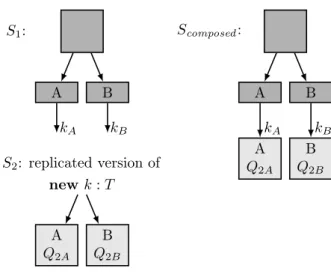
S1: A B kA kB S2: replicated version of new k : T A Q2A B Q2B Scomposed: A B A Q2A B Q2B kA kB
(S1may run several sessions of A and B.)
Figure 4: Illustration of Theorem 2
In this theorem, illustrated in Figure 4, the system S1is a key exchange protocol that provides
a key to two participants: A executes event eA and stores the key in kAand kA0 , and B executes
event eB and stores the key in kB. The system S2 creates a fresh key, and also involves two
participants: A executes Q2A and B executes Q2B. The composed system Scomposed combines
S1 and S2 so that A executes Q2A with the key kA and B executes Q2B with the key kB, after
the key exchange S1provides the key. These systems may share hash oracles, included in Ch, Ch0,
and C00
h. (These contexts use the same hash functions. The hash oracles are omitted in Figure 4.)
This theorem requires the key exchange to satisfy the following security properties. It must guarantee the secrecy of the key obtained by A, k0
A, and injective authentication of A and B, as
formalized by the correspondence (2). This correspondence means that each execution of event eB(msg, k)g is preceded by a distinct execution of event eA(msg, k,eg i)for someei, except in cases of probability at most p0. These two properties imply secrecy of the obtained key on B’s side,
since all keys that B has are also keys that A has. The correspondence (3) means that the event eA is executed at most once for each session identifier sid, since all such executions must have
the same replication indicesei. It allows us to use the session identifier sid as argument x to identify the session in the system S2. It is easy to prove in practice, both using CryptoVerif and
manually: it is sufficient to notice that sid contains fresh randomness in each execution of eA,
for instance a nonce or an ephemeral public key.
The assumption that S1and S2do not contain newChannel guarantees that all channels are
public. It is not a limitation in practice, because CryptoVerif does not support newChannel in protocol specifications; newChannel is used only in manual proofs. We require that the inputs and outputs use distinct channels with indices the current replication indices, to identify channels unambiguously. The assumption that there is no defined condition in Q2 facilitates a
renumbering of variables: the variables of Q2B have indiceseiin S2 butei0 in Scomposed. It is not
a strong limitation since most usages of find with defined conditions can also be encoded using tables, and tables are not affected by the renumbering of variables.
Like Theorem 1, the first conclusion of Theorem 2 allows us to transfer security properties proved on S2to Scomposed, this time by relying on Section 5.1. We cannot prove
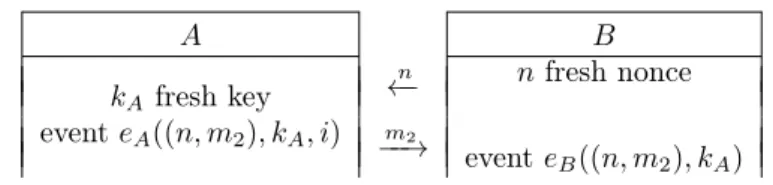
A B nfresh nonce n ←− kA fresh key event eA((n, m2), kA, i) m2 −−→ event e B((n, m2), kA) where m2= enc(concat(kA, n), klt, r0).
Figure 5: A simple key exchange protocol
may be public, the renumbering may affect the context as well. The second conclusion allows us to transfer security properties proved on S1 to Scomposed by Lemma 1, provided they are proved
with public variables including k0
A and kB, since C40 uses k0A and kB.
In our TLS case study, we apply this theorem to perform most compositions: the handshakes with the record protocol, using a traffic secret as common key, as well as the handshake with pre-shared key with itself and the initial handshake with the handshake with pre-shared key, using the pre-shared key as common key. However, this theorem does not apply for the client early traffic secret cets, because of the possibility of replays. (Theorem 3 deals with this case.) The next example illustrates the theorem on a simpler case.
Example 3. Let us suppose that there are no hash oracles and consider the following very simple key exchange protocol, also shown in Figure 5:
S1= c7(); new klt: T ; c8hi;
((!iA≤nAc
9[iA](n : Tnonce); new kA: T ; new r0: Tr; let m2= enc(concat(kA, n), klt, r0) in
event eA((n, m2), kA, iA); let kA0 = kA in cA[iA]hm2i)
|
(!iB≤nBc
10[iB](); new n : Tnonce; c11[iB]hni;
c12[iB](m2: bitstring); let i⊥(concat(kB, =n)) = dec(m2, klt) in
event eB((n, m2), kB); cB[iB]hi))
After an input on channel c7, this process generates a long-term key klt shared between A and
B, returns control to the adversary by outputting on channel c8, and runs the participants A
and B in parallel. The participant B (at the bottom) is run at most nB times. It waits for an
input on channel c10[iB], generates a fresh nonce n and sends it to A on channel c11[iB]. If the
session runs normally, the adversary forwards this nonce to channel c9[iA] for some iA, so that
A receives it, generates a fresh key kA, and computes the message m2 that is the encryption of
kA and n under klt. (The function concat is concatenation.) Then, A executes the event eA to
record that it accepts the key kA, in a session of session identifier (n, m2). (In this example, the
function sid is the pair.) It stores kA in k0A and sends message m2 on channel cA[iA]. If the
session runs normally, the adversary forwards this message to channel c12[iB], so that B receives
it, decrypts it, and in case of success, executes event eB to record that it terminates with key
kB= kA, in a session of session identifier (n, m2).
Assuming that (enc, dec) is an authenticated encryption scheme, CryptoVerif shows that S1
preserves the secrecy of k0A up to probability p and satisfies (2) and (3) with public variables k0A, kB up to probabilities p0 and p00 respectively, which depend on the probability of breaking the
encryption scheme.
check, and the composed system is Scomposedb = c7(); new klt: T ; c8hi;
((!iA≤nAc
9[iA](n : Tnonce); new kA: T ; new r0: Tr; let m2= enc(concat(kA, n), klt, r0) in
event eA((n, m2), kA, iA); c0A[iA]hm2i;
c4[iA]((m0: Tm, m1: Tm)); new r : Tr; event send((n, m2), mb); c5[iA]henc(mb, kA, r)i)
|
(!iB≤nBc
10[iB](); new n : Tnonce; c11[iB]hni;
c12[iB](m2: bitstring); let i⊥(concat(kB, =n)) = dec(m2, klt) in
event eB((n, m2), kB); c0B[iB]hi;
c6[iB](y : bitstring); let m = dec(y, kB) in event recv((n, m2), m)))
The composed protocol runs the key exchange as before, then it sends mb encrypted, as in S2.
However, in A, it executes event send with session identifier (n, m2) and encrypts with key kA.
In B, it executes event recv with session identifier (n, m2) and decrypts with key kB. These
values are provided by the key exchange protocol. (The processes Q1A and Q1B are the process 0
that does nothing, so we simply omit them.) Let Scomposedb,◦ be obtained from Sb
composed by removing events eA and eB. Let t1 = t2 =
nAtenc+nBtdec. By Theorem 2, item 1), for b ∈ {0, 1}, there exists f such that Scomposedb,◦ ∼
→∅,∅f,p3 S
b 2!
where p3(C3, tD) = p(C30 + tD) + p0(C30, tD) + p00(C30, tD), C30 runs in time at most tC3 + t2,
f (C3) runs in time at most tC3 + t1, and their other parameters are the same as those of C3.
Since f does not depend on the details of Sb
2, f does not depend on b. Since S02! ≈p0 1 S
1 2!,
by Lemma 2, Scomposed0,◦ ≈p4 S
1,◦
composed where p4(C, tD) = 2p3(C, tD) + p01(f (C), tD). Since S2!b
satisfies (1) up to probability p02, by Lemma 3, Scomposedb,◦ satisfies (1) up to probability p5(C) =
p3(C, tcorr) + p02(f (C)), and so does Scomposedb .
By Theorem 2, item 2), there exist evaluation contexts C40b such that Sb
composed ≈0 C40b[S1]
and C40b is acceptable for S1 with public variables kA0 , kB, runs in time at most t2, and does not
alter the other parameters. Since S1 satisfies (2) and (3) with public variables kA0 , kB up to
probabilities p0 and p00 respectively, by Lemma 1, C40b[S1] and Scomposedb satisfy (2) and (3) up to
probabilities p01(C) = p0(C[C40b]) and p001(C) = p00(C[C40b]) respectively. Therefore, we transferred security properties from S1 and S2!b to the composed system.
The properties required on S1are closely related to the security of a key exchange protocol as
defined in CryptoVerif [11]. As in [11], we require secrecy of the key obtained by A and injective authentication of A to B (2). The security of a key exchange includes mutual authentication, which is not needed for the composition. The correspondence (3) does not appear in [11]. Combined with (2), it implies that sessions that share the same session identifier have the same key:
event(eA(sid , kA,ei1)) ∧ event(eB(sid , kB)) =⇒ kA= kB (4)
a property included in the definition of a key exchange in CryptoVerif [11]. Indeed, if eA(sid , kA,
ei1)and eB(sid , kB)are executed, then eA(sid , kB,ei2)is also executed for someei2by (2), which
impliesei1= ei2 by (3), so the two events eA(sid , kA,ei1)and eA(sid , kB,ei2)are actually the same
event, so kA = kB. The converse is not true in general, because (2) and (4) put no constraints
in case event eB is not executed with the considered session identifier.
These properties are also closely related to the properties used in previous composition re-sults [16, 27, 29]. These rere-sults require key secrecy, as well as partnering or match security,
which provides guarantees similar to (2) and (3). In particular, [16, 29] require a public session matching algorithm, that is, the adversary knows which sessions are partnered. We also have this property: sessions are partnered when they have the same session identifier, and the session identifier is computed from public messagesmsggAandmsggB by the function sid. This property is relaxed in [27]: they allow to use keys of early stages (which are virtually revealed) in the session matching. In TLS 1.3, the handshake is encrypted, and the session matching should be done on the plaintext, so the handshake keys are indeed needed for the session matching. In the model we consider, instead of encrypting the handshake, the handshake keys are given to the adversary, so that it can encrypt and decrypt messages. The session matching can then be done with public data.
However, the required properties still differ from [16, 27, 29] in their presentation. We make explicit the distinction between the two participants of the protocol, and (3) requires that A executes at most one session with a given session identifier. By (2), we obtain that B also executes at most one session with a given identifier. In contrast, [16,27,29] require that there are at most two sessions with the same identifier, without distinguishing A and B. The correspondence (2) guarantees that these two sessions have the same key, which is also required by [16, 27, 29].
Our definition of the key exchange protocol S1 allows much flexibility. In contrast to [16,
27, 29], we do not assume that the key exchange protocol is a public-key protocol. In TLS 1.3, the handshake with pre-shared key indeed relies on a shared key, and may not need a long-term public key. We encode “corrupt” queries, used to corrupt long-long-term keys, for instance to model forward secrecy, inside the context C. That allows us to deal with protocols that satisfy forward secrecy or not, without explicit distinction, in contrast to what [16, 27, 29] do. That also allows us to support keys that are forward secret only from a certain stage, as well as temporary keys, used in several sessions but not leaked by “corrupt” queries because their lifetime is short, as in the multi-stage framework of [27, 29]. As in [27, 29], the key exchange may continue running after accepting a key: it may send messages MA and MB and execute
Q1Aand Q1B. We allow composition with keys that are established before the last key exchange
message, provided they are not used in the key exchange protocol. However, we cannot perform test queries on a stage-i key and still use it in the key exchange protocol; while [27, 29] allow that, they do not allow composition for such keys. (In their vocabulary, these keys are not final.) As in [27], the communication partner does not need to be known at the start of the protocol. Finally, we support key exchange protocols that guarantee mutual authentication, unilateral authentication, or no authentication, as [27,29]. This point may seem counter-intuitive, since (2) requires unilateral authentication. However, the security properties are obviously proved only when the partner is honest. Therefore, the system S1executes the events eA, eB and stores the
key in k0
A only when the partner is honest. (That can be tested using find or tables when the
partner is not authenticated.) Then, the correspondence (2) holds, and we can apply Theorem 2. When the partner is dishonest, we simply leak the key. Since no security property is desired in this case, we can trivially compose with any protocol that uses this key. This situation appears in TLS, when the client is not authenticated. In this case, the server considers that its partner is honest when the Diffie-Hellman share it receives has been sent by the honest client. This condition replaces client authentication and allows CryptoVerif to prove (2).
We give a proof sketch of Theorem 2 here. The full proof appears in Appendix A.9. Proof sketch. Let
G1= Ch00[C[event eA(sid(msggA), kA,ei);
findue00= ei000 ≤n suchthat defined(e msggA[ei000], k[ei000]) ∧ sid(msggA) = sid(msggA[ei
000]) then yield else
new k : T ; c0 [ei]hM