HAL Id: hal-00848790
https://hal.archives-ouvertes.fr/hal-00848790
Submitted on 29 Jul 2013
HAL is a multi-disciplinary open access
archive for the deposit and dissemination of
sci-entific research documents, whether they are
pub-lished or not. The documents may come from
teaching and research institutions in France or
abroad, or from public or private research centers.
L’archive ouverte pluridisciplinaire HAL, est
destinée au dépôt et à la diffusion de documents
scientifiques de niveau recherche, publiés ou non,
émanant des établissements d’enseignement et de
recherche français ou étrangers, des laboratoires
publics ou privés.
Drop coalescence on a single Plateau border
Alexandre Cohen, Nathalie Fraysse, Jean Rajchenbach, Médéric Argentina,
Yann Bouret, Christophe Raufaste
To cite this version:
Alexandre Cohen, Nathalie Fraysse, Jean Rajchenbach, Médéric Argentina, Yann Bouret, et al.. Drop
coalescence on a single Plateau border. EUFOAM 2012, Jul 2012, Lisbonne, Portugal. �hal-00848790�
EUFOAM 2012 Conference
Lisbon, Portugal, 8 – 11 July, 2012
Submitted for Eufoam 2012
DROP COALESCENCE ON A SINGLE PLATEAU BORDER
Alexandre Cohen, Nathalie Fraysse, Jean Rajchenbach, Christophe Raufaste
Laboratoire de Physique de la Matière Condensée, CNRS UMR 7336,
Université de Nice Sophia Antipolis, 06108 Nice Cedex2, France
[email protected]
The flow of liquids in unbounded geometry (i.e. without rigid boundary conditions) is encountered in jets and films. Another example is provided by the drainage of foams under gravity. The latter example has been largely investigated these last years [see e.g. Koehler, 2000; Cox, 2001; Pitois, 2005; Saint-Jalmes, 2006]. Most of previous studies consisted in macroscopic measurements performed at the scale of the foam sample. Experimental results were accounted for by effective-medium models based on the assumption of a low Reynolds number. Two main sources of dissipation have been recognized, either localised in Plateau borders or in vertices [Koehler, 2000], depending on the surface mobility of the surfactant [Saint-Jalmes, 2006]. On the other hand, only few experiments provided informations concerning the local flow at the scale of one elementary cell (i.e. one bubble) [Koehler, 2004; Pitois, 2005], and they all dealt with steady regimes. Our aim is to identify the different regimes of liquid transport in a Plateau border, not only by considering the steady regime but also transient flow.
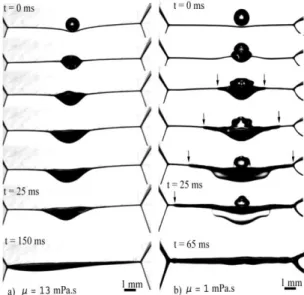
Our experimental configuration deals with an unique Plateau border positioned horizontally. The latter is supplied externally with a droplet of the same liquid, dropped from above. After some bounces, the droplet coalesces with the Plateau border and the whole process is recorded by means of a high-speed camera. We study various liquids with different bulk and surface viscosities and surface tension, and Plateau borders of different sections and different drop radii. According to these parameters, two main limiting regimes of coalescence are identified (Fig. 1). For large bulk viscosity or low surface mobility, the fluid in excess is slowly evacuated in the Plateau border according to a diffusion-like process (Fig. 1.a). In contrast, for liquids of low viscosity and high surface mobility, measurements show that the Plateau border swells in the vicinity of the drop and attains a constant thickness, with a sharp front separating the swollen and the unperturbed parts of the Plateau border. The front is seen to propagate with a constant velocity (Fig. 1.b). This velocity is shown to be controlled by a competition between capillary and inertial effects, without any noticeable effect of the viscosity. This last regime is reported here for the first time, and casts new insights on drainage and liquid flows in foams.
References
S. J. Cox et al, Journal of Physics: condensed matter, 13:4863-4869, 2001.
S. A. Koehler et al, Langmuir, 16:6327-6341, 2000. S. A. Koehler et al, Journal of Colloid and Interface Science, 276:439-449, 2004.
O. Pitois et al, Colloids and Surfaces A, 261:109-114, 2005. A. Saint-Jalmes, Soft Matter, 2:836-849, 2006.
EUFOAM2012 Topic: E
Preferred type of presentation: Oral
Figure 1: Drop coalescence and the subsequent liquid redistribution along a single Plateau border. Depending on the liquid bulk viscosity, two different regimes are observed: a) diffusion – like, b) propagation – like.