READ THESE TERMS AND CONDITIONS CAREFULLY BEFORE USING THIS WEBSITE. https://nrc-publications.canada.ca/eng/copyright
Vous avez des questions? Nous pouvons vous aider. Pour communiquer directement avec un auteur, consultez la première page de la revue dans laquelle son article a été publié afin de trouver ses coordonnées. Si vous n’arrivez pas à les repérer, communiquez avec nous à [email protected].
Questions? Contact the NRC Publications Archive team at
[email protected]. If you wish to email the authors directly, please see the first page of the publication for their contact information.
NRC Publications Archive
Archives des publications du CNRC
This publication could be one of several versions: author’s original, accepted manuscript or the publisher’s version. / La version de cette publication peut être l’une des suivantes : la version prépublication de l’auteur, la version acceptée du manuscrit ou la version de l’éditeur.
Access and use of this website and the material on it are subject to the Terms and Conditions set forth at
Effect of building mass on annual heating energy requirements
Mitalas, G. P.
https://publications-cnrc.canada.ca/fra/droits
L’accès à ce site Web et l’utilisation de son contenu sont assujettis aux conditions présentées dans le site LISEZ CES CONDITIONS ATTENTIVEMENT AVANT D’UTILISER CE SITE WEB.
NRC Publications Record / Notice d'Archives des publications de CNRC:
https://nrc-publications.canada.ca/eng/view/object/?id=cdfd29c9-9f43-4ffb-a51a-6f5f0f878c25
https://publications-cnrc.canada.ca/fra/voir/objet/?id=cdfd29c9-9f43-4ffb-a51a-6f5f0f878c25
Ser
TH1
~ 2 1 d
National Research
Conseil national
I
no.918
I
$
Council Canada
de recherches Canada
cop.
2
EFFECT
OF
BUILDING MASS ON ANNUAL HEATING
ENERGY
REQUIREMENTS
Reprinted,
with
permission,
from
Proceedings, Second
International
CIB
Symposium on
Energy
Conservation in
the Built
Environment
Session
2,
Copenhagen 1979
p.
7 - 1 6
DBR
Paper
No.
918
Divirton
of
Building R e d
1 NRC-
ClSTlBLDG.
RES.
L I B R A R Y
81-
06-
2
Price
$1.00
OTTAWA
NRCC
18486
This publication is being distributed by the Division of Building R e s e a r c h of the National R e s e a r c h Council of Cariada. It should not b e reproduced in whole o r in p a r t without p e r m i s s i o n of the original publisher. The Di- vision would b e glad to b e of a s s i s t a n c e i n obtaining s u c h permimaion.
Publications
of
the Division m a y b e obtained by m a i l - ing the a p p r o p r i a t e r e m i t t a n c e (a Bank, E x p r e s s , o rPoet Office Money O r d e r , o r a cheque, m a d e payable to the R e c e i v e r G e n e r a l of Canada, c r e d i t NRC) t o the
National R e s e a r c h Council of Canada. Ottawa.
K1A
OR6.
Stampa a r e not acceptable.
A l i s t of a l l publications of the Division i s available and m a y be obtained f r o m the Publications Section, Division of Building R e s e a r c h , National R e s e a r c h Council
of
---
----
---
----
---
Effrct of building mass on annual heating energy requirements
---
by G.P. Mitalas, Research Officer, Division of Building Research, National Research Council of Canada, Ottava K1A OR6, Canada.
Surmnary. Based entirely on cdmputer simulation, this study was carried out to determine the effect of the heat storage capacity of a building on its annual heating requirements. Specifically, the annual energy require- ments were computed for a large office building and for a single-family house for three Canadian annual reather cycles and for a range of building interior and exterior vall thermal storage capacities. The study
indicates that the thermal storage capacity of a building has a relatively m a l l influence on the annual energy requirement for heating.
-I---?'---l----
L'effet de la manse du Mtiment sur les besoins annuels dS6nergie themique
---L---"--~---U-d--LI---YI----
par G.P. Hitalas, Division des recherches sur le Mtiment, Conseil national de recherches du Canada
RLaund. ~ o n d d e entiirement sur une simulation-ordinateur, 116tude a etd
-
exdcut6e afin de dPterniner l'effet de la capacite d'ennnagasinage thernique d'un M t i w n t sur les besoins annuels en chauffaqe. Tout particuli~rement, les besoins annuels d'dnergie ont 6tP enregistres dans un grand inuneuble h bureaux et dans une maison individuelle; s o d s tous deun troir cycles de temgratures annuelles, dont la capacitd
d'mrmuqasinage thermique des murs int6rieurs et extdrieurs differait. L96tude dbnontre que la capacite d'emmagasinage thermique d'un Mtiment n'a que relativement peu d'influence our ses besoins annuels dePnergie pour 1e chauffage.
*-*I~~--~_I_________________--__t_r-_---~-C*I--~---*---I---*** Effect of building mass on annual heating energy requirements
---***----I-+_---t*---**---*---*---
The extent to which building mass acting toqether with various building operation factors and climate affects the annual heating requirements of a building has been evaluated. Changes in annual enerqy requirements for heatinq resulting from chanoes in mass were determined by cornouter simulation: a single-family residence was simulated using a special version* of the ENCORE-CANADA Computer Proqram (1); a large office building was simulated by an unpublished computer programw.
Computer simulations
The following factors were varied during the simulation study:
W - 2 :
-b!?!ldin$!
Single-family residence. The single-family house, a bungalow, was assumed to be well insulated and relatively tight, representative of the type of construction needed to meet new energy standards:
-
length, 11.3 m-
width, 8.5 m-
gross floor area, 90 m 2,- volume, 415 m 3
-
opaque exterior wall area, 71 m 2---*---_-_---*--*---*---*---
This special version of the program uses a simple method to calculate infiltration heat loss due to combined wind and stack effect (Ref. 2,
p. 4 1 6 ) . The conduction heat loss through the basement envelope below outside grade level is not included in the calculations of house heating requirements.
* *
Computer program to simulate large office buildinqs based on the calculation method$ outline? in "Procedures for Determining Heating and Cooling Loads for Computerizinq Energy Calculations-
Algorithms for Building Heat Transfer Subroutines", compiled and published by ASHRAETask Group on Energy Requirements for Heating and Cooling of Buildings, 1975.
-
glazed area, 21 n2 (5.1, 3.4, 4.1 and 8 . 4 n2 of double-glazed area in the four facades, respectively)-
basement wall area a k v e grade level, 19 mL 2-
opaque wall t:?amal resistance, 4.2 rn -K/W-
ceiling thermal resistance, 6.2 m2.~/w-
exposed basement wall thermal resistance 1.5 m2.K/W-
occupancy, family of four-
appliances (television, stove, lights, refrigerator, etc.) approximate average power, 1 . 4 kW-
air leakage characteristics-
average infiltration rate of 0.3 air changes/h (Note that this low leakage characteristic is possible with a "tight" house without a chimney.)Large office building. The large office building was assumed to be constructed of many identical storeys with the following features:
-
height of each storey, 3.6 n-
glazed area, half of exterior wall area double-glazed window-
each storey of the building consisting of nine zones: four are the four corners, four are the sides, and the ninth is the interior zone; the depth of the exterior zones was taken as 6 m, so that the ratio of glazed area to floor area of corner zones is 0.6 and of side zones, 0.3-
the annual heating energy supplied to each zone by the A-C terminalunits vas calculated (The energy to drive the A-C system, to heat and/ or cool ventilation air, and needed by building services was not
included in zone energy balance: infiltration heating loads were also taken to be zero since it was assumed, for simplicity of calculations, that the building was pressurized.)
-
occupancy, five days a week and eight hours a day2
-
occupancy sensible load 10 W/m during occupied period-
lights, light twwer 30 w/m2 during occupied period 2-
equipment power 4 w/m2 durin~: I-ccupied period and 1 w/m during unoccupied period.cllmnfn
Hourly t h t a of 1970 for Winnipeg, Ottawa and Vancouver were used for the calculations.
M e f z - ~ ~ , i " r e ~ $ g r _ ~ ~ ~ ~ ~ f ~ ~ ~ ~ ~ ~
The following interior constructions were considered: Light
-
150 kg/m- of floor surface area2
Heavy
-
6 0 0 kg/m of floor surface area2
Very Heavy
-
700 kg/m of floor silrface area.Mass of exterior wall was included in the interior mass if the insulat-
ing layer was on the outdoor side of the mass layer. For example, an
exterior wall of heavy construction (such as a 25 cm thick concrete vall) increases interior mass by abcut 200 kg/m2 for the p e r b e t e r zones and
thus chanycs interior co~struction from light to medium or from medium to
heavy and so on. When the insulating layer is on the interior side of the
heavy layer, however, the contribution of exterior wall mass t o the interior mass is considered to be negligible.
Single-family residence:
(i) Constant at 22.2'~
(ii) Daytime at 22.2'~ Nighttime at 18.3'~ Large office building:
Occupied Unoccupied
Period Period
Heating Cooling Heating Cooling
Schedule (i) 2 0 . 0 ~ ~ 23.9'~ 18.3'~ 25.6'~
Schedule ( ii) 21.7'~ 22.2'~ 2 0 . 0 ~ ~ 23.9'~
Schedule (iii) 2 0 . 0 ~ ~ 25.6'~ 15.6'~ 37.2'~
Schedule (iv) 22.2'~ 22.2'~ 22.2Oc 22.2'~
Throttling range in a11 cases was assumed to be 1.7 K.
oi!En_tasioc
Single-family residence. Three okientations were considered: major glazed facade facing south, west, or north.
Large office building. Orientation vas to the cardinal directions. Discussion of results
2lrslc_::~ilr-hou?$
The calculated annual heat requirements are listed in Table I for
different house interior masses, thermostat set-point schedules, orisn-
tations and locations. The r~umbars in the table indicate that any
variation of internal heat r:toraqe capacity (e.9.. variation in mass of the interior of the house) has a relatively small effect on annual house heating needs. For example. for the most sensitive case considered
orientation) the annual heatino requirement for light (L) and heavy ( H I
interior constructions differs by only about 5 per cent. In absolute terms, the difference in annual heating requirement is small: the larqest difference listed in Table I is about 300 kW-h.
In general, the thermostat set-point schedule and orientation have greater effect on annual house heating requirement than any change of interior mass from light to heavy. As wel1,the mass in the exterior wall has practically no effect on the house heating requirements if it does not contribute to interior mass. This was checked by numerous computer runs where the exterior wall insulatiok was considered to be on the indoor side
of the wall mass layer.
Larsco::ic_e_-?uiiai:g
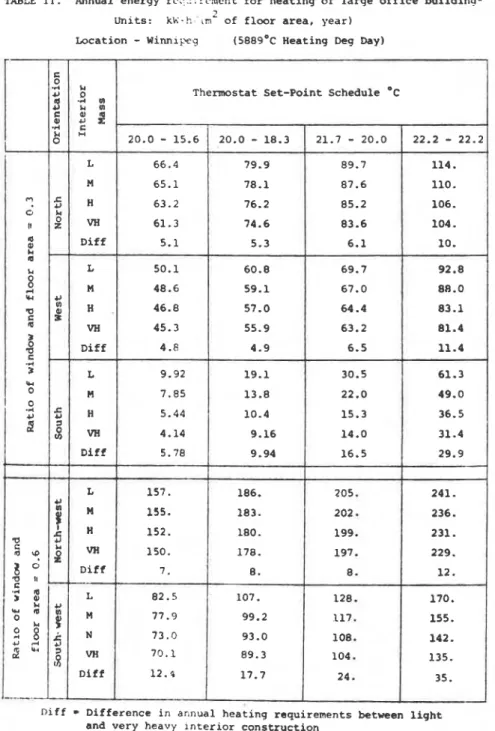
Tables I1 to IV give the calculated annual heating requirements for four thermostat set-point schedules, three orientations, two types of zone
(i.e., two window-to-floor area ratios), three locations and different values of interior mass. The values listed are the annual heating energy required to maintain the prescribed zone air temperatures. This heat is supplied bl. A-C terminal units (e.g., steam or water heating coils. induction terminal units, electric heaters, etc.). The enerqy needed to condition and deliver ventilation air and the energy that might be wasted in controlling the air-conditioning units is not included in these values.
The listed values show that the annual heating requirement of a zone depsnds on building mass, orientation, climate, thermostat set-points and window-floor area ratio. In particular, the low and high thermostat set- points for bating and cooling, respectively, have a significant effect on heating requirements. For example, the heating requirement is nearly Zero for a mouth zone in Vancouver with thermostat set-points of 20.0'~
-
1 5 . 6 ' ~ and 2 5 . 6 ' ~
-
36.7-C; the heating requirement is 26.7 kw-h/m2 for a conatant thermostat set-point of 2 2 . 2 ' ~ and light interior construction.Although the heat storage capa~-lty of a large office building does have an effect on the annual heat energy needed to maintain prescribed
temperature levels, it is usually of much less significance than the other factors that affect the total energy needs of the building. It is not poauible to derive a simple yet accurate calculation method to account for the mass effect in a specific building desiqn because this effect depends on SO many factors (e.g., type of building constr-uction. climate, building use). In cases where an el-cur-ate estimate is required, therefore, it has to be determined using computer programs for building energy use
estimation that are capable of accounting for all of these parameters. DOE-1 ( 3 ) and BLAST (4) are two examples of such programs.
Conc1usic.n
--.-
Results for single-family house simulations indicate that passive heat storage, resulting from heavy interior construction, does not influence the total annual heating requirements significantly.
Results for the office building analysis indicate that the impact of building mass on energy consumption is small. It is possible, however, that for a particular.case (e.g., very large windows and south orientation plus constant thermostat setting) the impact could be significant and it should therefore be taken into account in the prediction of building energy needs.
Acknowledgements
The author gratefully acknowledges the valuable contribution of
J.J.M. Lavoie in performing the computer runs and compiling the results. This paper is a contribution from the ~ivision of Building Research. National Research Council of Canada, and is published with the approval of the Director of the Division.
References
1. k.konrad and B.T. Larsen, ENCORE-CANADA Computet Program for the Study of Encrqy Consumption of Residential Buildings in Canada (preliminary version). Presented at the Third International Symposium on the Use of Computers for Environmental Engineering Related to Buildings, Banff, May 1978.
3. Handbook of Fundamentals, 1967 American Society of Heating, Refrigerating and Air-conditioninq Engineers.
3. ME-1, Energy Management Application Program. Program access and suplart Control Data's Cybernet Computer Center, 215 Moffett Park
u r i v u , Sunnyvale, California 94086.
4. Hittlr. D.C. BLAST, Buildins Loads Analysis and System Thermodynamics
I'ltwraa. Vole 1, User's Xanull, CEEDO-TR-77-35, CERL-TR-E-119, 1977
( U . S . Army Cor~struction Engineering Research Laboratory, Champaign, Illinois, USA),
TABLE I. Annual energy requirement for heating of single-family house* Units: kW-h/(?o:~se, yeari
Orientation
-
I . . I
I E.
1.
7
.!J!
.:
.
South westI
h'ort?. II
Thermostat Set-Point Schedule O C -
22.2-22.2118.3-22.2]22.2-22.2r18.3-22.2122.2-22.2l18.3-22.2i i
Diff
-
Difference in annual heating requirements between light and heavy interior constructionexcluding losaes through walls and floor below outside grade level house thermal model used is peculiar to colder climate and thus
L 2144
M 2094
H 2059
Diff 85
the values listed for Vancouver are relatively low 1671 1632 1577 94 6714 661 3 6501 213 11111 10981 10834 L M H Dif f L M ti Diff
/
307I
277 7892 7765 7663 229 12638 12478 12331 2548 2494 2467 8 1 8858 8766 8693 165 14031 13916 13807 224 1993 1957 1908 8 5 7663 7594 7508 155 12494 12398 12272 222 2841 2796 2762 79 9538 9469 9405 133 14713 14629 14541.
~ 2232 2207 2152 80 1 8294'
8260j
8182[
112 13129 13083 12978 172 151 ,1 i
TABLE 11. Annual energy rc<:::rcmcnt for heating of large office buildina* Units: kh..!: ini of floor area, year)
Location
-
W i n n l k ~ y (588g0c Heating Deg Day)-- -- - L 157. 186. 205. 241. 4J M
e
"
1 5 5 . 183. 202. 236.5
152. 180. 199. 231.L . 8
"
150. 178. 197. 229.8
Diff 7. 8. 8. 12.2
I1.s
E
L 82.5 107. 128. 170.""
"I
M 77.9 99.2 117. 155. N 73.0 93.0 108. 142.i - g
70.1 89.3 104. 135.I
1
DiffI
12.1I
17.71
24.1
35.1
Diff
-
Difference in arinual heating requirements betveen light, and very heavy interior constructionTABLE IV. Annual energy requirement for heatina of large office building* Units: kw-h/(mL of floor area, year)
Location
-
Vancouver (3007'~ Heating Deg Day)-.
5
.rl uAJ o Thermostat Set-Point Schedule OC
m 4 Y u r n
I
c a!.'
'
'
20.0-15.6 20.0-18.3 121.7-20.0 22.2-22.26
--
.
4 L 8.56 16.51
24.7 51.0 M 6.73 14.1::I.:
46.6 n.
5
u H 4.68 11.4 41.5 0 0 I1=
VH 3.34 10.21
16.7 39.8 m Diff 5.22 6.3 I &I
8.0 11.2 mi
L 4.99 15.2 36.2 rl M 3.911
12.7 31.3 U Yg
l n H 2.43 6.40,
9.98 25.5 l a g w 1.31 5.47 9.29 23.9b
2
Dif f 3.68 4.24 5.91 12.3 ..I 3 L 0.83 2.50 5.79 26.7 YI 0 M 0.40 1.44 3.37 17.9.
5
0.05 0.631
1.67 11.0 0.00 0.11:
1.06 7.47 0.83 2.39'
!
4.73 19.23 I L 31.5 51.2 1 67.2 1G6.7 29.1 63.1 98.1 H 26.7 91.3 24.8 43.2 57.3 86.28
Diff2
'I.
6.7 8.0 9.9 19.8'2
! '
L 12.2 23.8i
I
37.3 lu m 75.9 9.74 19.5 29.2 60.3 7.54 16.3 24.1 47.82 "
?
W 6.16 15.2 22.5 42.5 Diff 6.04 14.8 33.4!
Diff