HAL Id: hal-01129580
https://hal.archives-ouvertes.fr/hal-01129580
Submitted on 29 May 2020
HAL is a multi-disciplinary open access
archive for the deposit and dissemination of
sci-entific research documents, whether they are
pub-lished or not. The documents may come from
teaching and research institutions in France or
abroad, or from public or private research centers.
L’archive ouverte pluridisciplinaire HAL, est
destinée au dépôt et à la diffusion de documents
scientifiques de niveau recherche, publiés ou non,
émanant des établissements d’enseignement et de
recherche français ou étrangers, des laboratoires
publics ou privés.
Distributed under a Creative Commons Attribution - ShareAlike| 4.0 International
License
Insulin immuno-neutralization in fed chickens: effects on
liver and mucle transcriptome
Jean Simon, Dragan Milenkovic, Estelle Godet, Cédric Cabau, Anne Collin,
Sonia Metayer-Coustard, Nicole Rideau, Sophie Tesseraud, Michel Derouet,
Sabine Crochet, et al.
To cite this version:
Jean Simon, Dragan Milenkovic, Estelle Godet, Cédric Cabau, Anne Collin, et al.. Insulin
immuno-neutralization in fed chickens: effects on liver and mucle transcriptome. Physiological Genomics,
American Physiological Society, 2012, 44 (5), pp.283-292. �10.1152/physiolgenomics.00057.2011�.
�hal-01129580�
Insulin immuno-neutralization in fed chickens: effects on liver
and muscle transcriptome
Jean Simon,
1Dragan Milenkovic,
2Estelle Godet,
1Cedric Cabau,
3Anne Collin,
1Sonia Métayer-Coustard,
1Nicole Rideau,
1Sophie Tesseraud,
1Michel Derouet,
1Sabine Crochet,
1Estelle Cailleau-Audouin,
1Christelle Hennequet-Antier,
1Christian Gespach,
4Tom E. Porter,
5Michel J. Duclos,
1Joëlle Dupont,
6and Larry A. Cogburn
71Station de Recherches Avicoles,3Système d’Information des Animaux d’Elevage, and6Physiologie de la Reproduction et des
Comportements, Institut National de la Recherche Agronomique (INRA), Nouzilly;2Unité de Nutrition Humaine, INRA, Theix;
4Institut National de la Santé et de la Recherche Médicale, U673 and Université Pierre et Marie Curie Paris 6, Hôpital Saint
Antoine, Paris, France;5Department of Animal and Avian Sciences, University of Maryland, College Park, Maryland;
and7Department of Animal and Food Sciences, University of Delaware, Newark, Delaware
Submitted 7 April 2011; accepted in final form 27 December 2011 Simon J, Milenkovic D, Godet E, Cabau C, Collin A, Métayer-Coustard S, Rideau N, Tesseraud S, Derouet M, Crochet S, Cailleau-Audouin E, Hennequet-Antier C, Gespach C, Porter TE, Duclos MJ, Dupont J, Cogburn LA. Insulin immuno-neutralization
in fed chickens: effects on liver and muscle transcriptome. Physiol
Genomics 44: 283–292, 2012. First published January 3, 2012;
doi:10.1152/physiolgenomics.00057.2011.—Chickens mimic an insu-lin-resistance state by exhibiting several peculiarities with regard to plasma glucose level and its control by insulin. To gain insight into the role of insulin in the control of chicken transcriptome, liver and leg muscle transcriptomes were compared in fed controls and “diabetic” chickens, at 5 h after insulin immuno-neutralization, using 20.7K-chicken oligo-microarrays. At a level of false discovery rate⬍0.01, 1,573 and 1,225 signals were significantly modified by insulin priva-tion in liver and muscle, respectively. Microarray data agreed reason-ably well with qRT-PCR and some protein level measurements. Differentially expressed mRNAs with human ID were classified using Biorag analysis and Ingenuity Pathway Analysis. Multiple metabolic pathways, structural proteins, transporters and proteins of intracellular trafficking, major signaling pathways, and elements of the transcrip-tional control machinery were largely represented in both tissues. At least 42 mRNAs have already been associated with diabetes, insulin resistance, obesity, energy expenditure, or identified as sensors of metabolism in mice or humans. The contribution of the pathways presently identified to chicken physiology (particularly those not yet related to insulin) needs to be evaluated in future studies. Other challenges include the characterization of “unknown” mRNAs and the identification of the steps or networks, which disturbed tissue tran-scriptome so extensively, quickly after the turning off of the insulin signal. In conclusion, pleiotropic effects of insulin in chickens are further evidenced; major pathways controlled by insulin in mammals have been conserved despite the presence of unique features of insulin signaling in chicken muscle.
diabetes; gene expression; insulin-responsive genes; signaling path-ways and metabolism
IN ADDITION TO PROVIDING A
valuable source of human food,
chickens exhibit several physiological peculiarities,
particu-larly glucose metabolism and its endocrine control. For
exam-ple, chickens exhibit constitutively high glycemia (1.8 –2.0 g/l,
in the fasted status) despite the presence of an endogenous
hyperactive insulin circulating at rather “normal” levels (39).
Additional hallmarks of avian metabolism are the requirement
for a high dose of exogenous insulin to induce hypoglycemia
and the survival of chickens following administration of a large
dose of exogenous insulin, which would be lethal in mammals.
Although normal for the chicken, these characteristics mimic
Type 2 diabetes in mammals (11, 12). Furthermore, the
mech-anism of insulin signaling remains enigmatic or even
provoc-ative in chicken muscle. The early steps of insulin signaling
[i.e., tyrosine phosphorylation of insulin receptor beta-subunit
and substrate-1 and phosphatidylinositol-3 kinase (PI3K)
ac-tivity] appear insensitive to insulin status, whereas steps
down-stream of PI3K are accordingly sensitive to insulin (11, 12).
Insulin immuno-neutralization in young fed chickens (i.e., a
nutritional status with high demand in insulin) rapidly induces
large increases in plasma levels of glucose (up to 4.3 or 7.5 g/l
at 1 or 5 h, respectively), nonesterified fatty acids, and amino
acids. Acute insulin deprivation alters several steps in the
insulin signaling cascade and other components of the
endo-crine system: plasma glucagon, triiodothyronine (T3), and
insulin-like growth factor binding protein-1 (IGFBP1) levels
(11). Furthermore, several mRNAs coding for specific
tran-scription factors or metabolic enzymes, selected a priori as
potentially insulin sensitive, were altered at 5 h of insulin
privation in liver and skeletal muscle (leg muscle). Some of
these changes were insulin specific, since fasting for 5 h did not
induce the same alterations in gene expression as did insulin
deprivation. Therefore, insulin appears to also exert pleiotropic
effects in fed chickens, which had been previously doubtful
(12). Interestingly, the adenosine monophosphate kinase
(AMPK) system was not activated in liver or muscle following
insulin privation or fasting for 5 h. In other studies, the
recruitment of the AMPK system in response to fasting
re-quires a prolonged fasting time in the chicken (34). Together,
these findings suggest that our experimental model of
“diabe-tes” in the chicken is quite suitable for identification of the very
early changes in liver and muscle transcriptome before
devel-opment of long-term complications from insulin privation.
Until now, microarray analysis of Type 2 diabetes or obesity
have been studied mainly in rodent models or humans (42). In
the present study, microarray analysis were performed in
chicken liver and leg muscle samples from the insulin
immuno-neutralization experiment, which we described earlier (11), to
Address for reprint requests and other correspondence: J. Simon, Station de Recherches Avicoles, INRA, 37380 Nouzilly, France (e-mail: simon@tours. inra.fr).
Physiol Genomics 44: 283–292, 2012.
First published January 3, 2012; doi:10.1152/physiolgenomics.00057.2011.
1094-8341/12 Copyright©2012 the American Physiological Society 283
by 10.220.33.3 on April 25, 2017
http://physiolgenomics.physiology.org/
gain a greater insight into the role of insulin in control of gene
transcription in these two metabolic tissues and to evaluate
whether the insulin-dependent pathways established in
mam-mals have been conserved in the chicken. A dual benefit of this
new knowledge on insulin control of metabolism in the chicken
could be realized with genetic selection of leaner chickens as a
healthier human food by favoring protein accretion, at the
expense of lipogenesis and excessive body fatness.
MATERIALS AND METHODS
Chicken tissues and experimental conditions. Liver and leg muscle
tissues were issued from our earlier study (11), where experimental conditions are described in detail. All procedures were approved by the French Agricultural Agency and the Scientific Research Agency and conducted in accordance with the guidelines for Care and Use of Agricultural Animals in Agricultural Research and Teaching. Herein, changes in liver and leg muscle transcriptome were assessed in fed chickens at 5 h following insulin immuno-neutralization by compar-ing “diabetics,” insulin-deprived birds (n ⫽ 6), against the control group (n⫽ 6 birds), which received injections of normal guinea pig serum. Total tissue RNA was extracted using RNeasy kits (Qiagen) according to manufacturer’s protocol. RNA samples were further purified using a final ethanol precipitation and washing step. RNA quality was determined using Agilent apparatus (2100 Bioanalyzer). RNA samples exhibited RNA integrity number⬎8.
Fluorescent cDNA labeling. Two samples of 5g RNA/chicken/
tissue were reverse-transcribed with 1l of random primers and 1 l of oligo(dT) using the ChipShot Direct Labeling System kit (Pro-mega), and fluorescent cDNA labeling was performed with either Cy3- or Cy5-dCTP (GE Healthcare). Labeled cDNAs were purified by application to an equilibrated filter cartridge using the ChipShot Membrane Clean-up System (Promega) as recommended by the manufacturer. Quantities and labeling efficiencies of labeled cDNAs were determined by measuring absorbencies at 260, 550, and 650 nm using a ND-1000 spectrophotometer (Nanodrop).
Hybridizations of microarrays. Hybridizations were carried out
using the ChickenOligo 20.7K 70-mer microarray v1.0 oligo set, which was designed by the Roslin Institute/ARK Genomics and syn-thesized by Operon (http://www.operon.com/download/index.php) and spotted on Corning glass slides (lot 213) by the Centre de Res-sources Biologiques, Génomique des Animaux Domestiques (http:// crb-gadie.inra.fr/). Experimental conditions (“diabetics” vs. controls) were compared using six pairs of chickens (n ⫽ 6 chickens per experimental group) and a dye-swap hybridization design (i.e., cDNAs of each chicken pair were labeled and hybridized twice, inverting dye labeling). In all, 12 microarray slides were used for each tissue and simultaneously hybridized with a Ventana Hybridization System at 42°C for 8 h. Slides were subsequently washed twice in 2⫻ saline sodium citrate (SSC) and 0.1⫻ SSC at room temperature. The buffer remaining on the slide was removed by rapid centrifugation (4,000 g for 15 s). The fluorescence intensity was scanned using the Agilent Micro Array Scanner G2505B.
Image and data analysis. Images were analyzed as previously
described (3). The signal and background intensity values for each spot in both channels were obtained using ImaGene 6.0 software. Data were filtered using the ImaGene “empty spot” option, which automat-ically flags low-expressed and missing spots to be removed from the analyses. The MIAME compliant raw microarray data have been deposited in the ArrayExpress database at the European Bioinformat-ics Institute (http://www.ebi.ac.uk/arrayexpress/) under the accession number E-MEXP-3182. After base-2 logarithm transformation, data were corrected for systemic dye bias by Lowess normalization using GeneSight 4.1 software. Spot intensity ratios were then filtered in accordance with their variability among the six comparisons and genes (oligo spots) with high variability were removed from the
analysis. Statistical analyses were performed using open source R 2.1 software (http://www.r-project.org). The log2 ratio between “dia-betic” and control samples was analyzed with Student’s t-test and used to detect differentially expressed genes in the two experimental conditions. The probability values were adjusted using the Benjamini-Hochberg correction for multiple testing to control the rate of false positives [false discovery rate (FDR)⬍0.01]. Genes selected by these criteria are referred to as differentially expressed (DE) genes. At this level of FDR, no further arbitrary high cut-off for fold changes (FC) was applied. As shown in RESULTS, the abundance EGR1 mRNA
decreased in muscle following insulin deprivation as indicated by both qRT-PCR (P⬍ 0.03) and microarray (FC ⫽ 0.87) analyses, whereas liver IGFBP1 messenger increased (FC⫽ 1.33 in microarray and P ⬍ 0.0001 in qRT-PCR) which accounts for the elevated levels of IGF-BP1 protein in plasma.
qRT-PCR analysis. Supplemental qRT-PCR measurements were
performed for two additional genes (avUCP and SLC2A8) in muscle tissue to complement of the 24 genes previously verified in our original study (11). Primer sequences were: CTATGGGATGAGAGGGAC-CAAAG, forward (5=-3=) and GGAGAACCTCAACACGTTCCTTC, reverse (5=-3=) for avUCP and CTGGAGGAATACTGGGAGGC, for-ward (5=-3=) and CACCACCATCAACTGGACAA, reverse (5=-3=) for
SLC2A8. Conditions for retro-transcription, PCR reactions, and internal
references were identical to those previously used for the validation of our insulin immuno-neutralization model (11).
Assignment of DE genes to canonical pathways and visualization of gene interaction networks. To determine the major functional
path-ways altered by insulin privation, oligo probes having a corresponding human protein ID were classified using the Gene Ontology (GO) feature in Pathway Miner (http://www.biorag.org/index.php). Ingenu-ity Pathway Analysis (IPA) software (IngenuIngenu-ity Systems, http:// www.ingenuity.com/) was used to visualize the major gene interaction networks populated by DE genes in liver and muscle. The human protein identification (ID) corresponding to chicken orthologs and the chicken oligo (RIGG ID number) and log 2 FC (diabetics/controls) listed in Supplemental Table S1 (liver) and Supplemental Table S2 (muscle) were used as input data files for IPA.1Although dozens of
gene interaction networks were identified from microarray analysis of liver and muscle in insulin-deprived chickens, only a few representa-tive gene interaction pathways are presented below.
RESULTS AND DISCUSSION
From the 20.7K oligonucleotide probes spotted on the array,
intensity signals from 3,415 and 3,287 spots entered statistical
analyses for liver and muscle, respectively. Insulin privation
altered the abundance of 1,573 mRNAs in liver and 1,225 in
leg muscle of fed chickens, using an FDR
⬍0.01 as the
threshold for significance. The lists of DE genes and the log
ratio changes (FC, as diabetics/controls) are provided in
Sup-plemental Materials (SupSup-plemental Table S1 for liver and
Supplemental Table S2 for muscle). The lists contain several
ID numbers: the oligo IDs [Roslin Institute Gallus gallus
(RIGG number)] and when available, the Ensembl G. gallus
(ENSGALG) gene ID number and the corresponding human
gene and protein IDs. These IDs were obtained from Ensembl
(http://www.ensembl.org/index.html) with database versions
available in September 2008: 50.2h for chicken and 50.36l for
human genome. A total of 276 genes (oligo spots) in liver and
207 genes in muscle had no Ensembl gene ID or corresponding
human protein ID. Elucidation of the information provided by
these unknown or “orphan” RIGG oligos mRNAs awaits
prog-ress in resequencing and reassembly of the chicken genome.
1The online version of this article contains supplemental material.
by 10.220.33.3 on April 25, 2017
http://physiolgenomics.physiology.org/
Transcripts showing significant changes in their expression
level were split about equally into down- or upregulated groups
for both liver and muscle (Table 1). The FC ranges were also
about of the same magnitude among expression groups and
tissues.
Comparison between microarray data and qRT-PCR or
pro-tein level measurements. Liver FASN (FC
⫽ 0.46) and IGFBP1
(FC
⫽ 1.33) mRNAs were respectively down- and upregulated
following insulin privation, confirming previous qRT-PCR
analysis (11). And as we reported earlier (11), plasma IGFBP1
protein significantly increased. The decrease in abundance of
DIO2 transcript, which accounts for the decrease in plasma T
3was significant in the qRT-PCR, although the microarray data
did not reach the level of significance (FC
⫽ 0.94, FDR
⬍0.08). Other liver mRNAs, significantly different by
qRT-PCR analysis, either did not enter statistical analysis (EGR1,
PPARG, THRSPA) of microarray data or were not represented
by an oligo probe on the microarray (DIO3 and SREBP1).
Previous qRT-PCR analysis of 24 genes showed fewer
significant changes in muscle than in liver. Muscle microarray
data confirmed lower EGR1 messenger (FC
⫽ 0.87). The
increase in MURF1 messenger (E3 ubiquitin-protein ligase or
TRIM63), which did not reach the level of significance in
qRT-PCR analysis, was significant in microarray analysis.
Atrogin-1 (FBXO32, F-box only protein32) messenger, also
involved in protein degradation, significantly increased in
qRT-PCR but did not enter microarray analysis. A discrepancy
between qRT-PCR and microarray results was observed for
avian UCP gene messenger (avUCP, related to human UCP3):
an increase, although at the limit of significance, in qRT-PCR
vs. a large decrease in microarray analysis (FC
⫽ 0.72). One
hypothesis accounting for this discrepancy could be that
sev-eral UCP3 transcripts exist in the chicken as in the case of
humans. The oligo sequence printed on the microarray slide
corresponds to the last exon of the avUCP gene. New
qRT-PCR using primers designed within this exon confirmed
pre-vious qRT-PCR results (i.e., a slight increase, data not shown).
As a whole and apart from this unexplained discrepancy, our
previous qRT-PCR analysis (or protein measurements) and the
present microarray analysis are in good agreement for both
tissues (liver and leg muscle). Furthermore, some mRNAs
having an identified human counterpart were represented by
two chicken oligo probes. For five of them, results of the two
oligos agreed. For seven of them there was disagreement; some
of these discrepancies may come from the existence of several
transcripts.
Ingenuity Pathway and Pathway Miner analyses. To
visu-alize the major canonical pathways altered by insulin privation,
DE oligos having a corresponding human protein ID were first
classified using Pathway Miner at Biorag (http://www.biorag.
Table 1. Number of differentially expressed (FDR
⬍0.01) genes
found in liver and muscle after insulin immuno-neutralization
mRNAs
Liver Muscle
n FC Range n FC Range
Downregulated 850 0.91–0.48 619 0.91–0.53 Upregulated 723 2.42–1.10 606 1.65–1.11 Fold-change (FC) was determined as the ratio of “diabetics”/controls. FDR, false discovery rate.
Table 2. Ingenuity Pathway Analysis of biological processes altered by insulin deprivation in liver and muscle
Category Functional Annotation P Value # Molecules (genes)
Liver
Metabolic disease glucose metabolism disorder 8.71E-10 222
Endocrine disorders endocrine system disorder 4.59E-09 225
diabetes mellitus 1.16E-08 208
noninsulin-dependent diabetes mellitus 6.37E-10 138
insulin resistance 3.31E-03 23
experimentally-induced diabetes 4.10E-04 14
hypoglycemia 3.46E-03 11
Genetic disorder obesity 2.73E-04 39
Lipid metabolism metabolism of lipid 1.54E-06 73
Carbohydrate metabolism metabolic process of carbohydrate 8.50E-04 45
Protein synthesis metabolism of protein 1.10E-05 65
degradation of protein 4.45E-03 32
Amino acid metabolism modification of amino acids 1.11E-03 26
Cell-to-cell signaling and interaction adhesion of cells 4.76E-03 68
Muscle
Skeletal and muscular disorders skeletal and muscular disorder 1.26E-138 199
Metabolic disease metabolic disorder 1.07E-03 172
glucose metabolism disorder 2.09E-04 153
Endocrine system disorders endocrine system disorder 5.31E-04 155
diabetes mellitus 1.72E-04 147
insulin-dependent diabetes mellitus 1.77E-03 71 noninsulin-dependent diabetes mellitus 4.55E-03 84
insulin resistance 7.35E-05 11
Genetic disorder amyotrophic lateral sclerosis 1.79E-04 47
Lipid metabolism quantity of lipid 5.69E-03 43
Carbohydrate metabolism utilization of D-glucose 6.12E-03 5
Nucleic acid metabolism hydrolysis of GTP 6.31E-04 10
Cell-to-cell signaling and interaction adhesion of cells 5.78E-03 40
285
GENE EXPRESSION PROFILE IN “DIABETIC” CHICKENS
Physiol Genomics•doi:10.1152/physiolgenomics.00057.2011•www.physiolgenomics.org
by 10.220.33.3 on April 25, 2017
http://physiolgenomics.physiology.org/
org/index.php). The lists of these genes are given in
Supple-mental Table S3 for liver and SuppleSupple-mental Table S4 for
muscle. No assumption about cut-off limit was applied since
relatively small changes could have important physiological
consequences. For instance, as discussed earlier, an FC
in-crease of 1.33 of liver IGFBP1 messenger was associated with
a significant increase in plasma IGFBP1 protein levels in
“diabetic” chickens. Furthermore, the decrease in muscle
EGR1 messenger (FC 0.83) was confirmed by qRTP-CR
anal-ysis. Several genes may code for more than one protein; all
protein IDs were maintained even though some forms are
tissue specific in mammals and most likely in the chicken. In
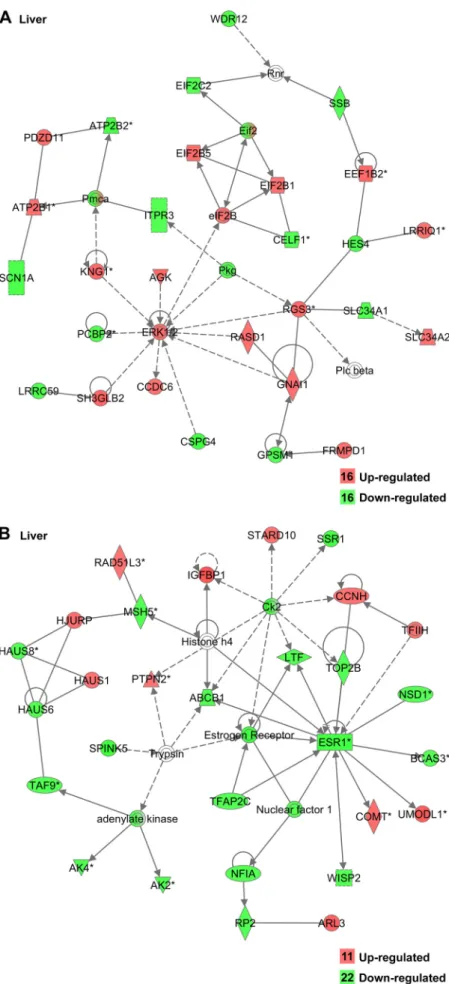
Fig. 1. Gene interaction network in liver (A) showing genes involved in lipid metabolism and in leg muscle (B) showing genes involved in cellular growth and gene expression after insulin immuno-neutralization in chickens. Upregulated genes are indicated in red and downregulated genes are indicated in green; the number of genes in each category are shown in the legend. Solid lines indicate a direct relationship between genes and dashed lines represent an indirect as-sociation determined by Ingenuity Pathway Analysis (IPA).
by 10.220.33.3 on April 25, 2017
http://physiolgenomics.physiology.org/
Fig. 2. Gene interaction network in liver after insulin immuno-neutralization in chicken showing genes involved in cell sig-naling (A) and the cell cycle (B). Upregulated genes are indi-cated in red, and downregulated genes are indiindi-cated in green; the number of genes in each category are shown in the legend. Solid lines indicate a direct relationship between genes and dashed lines represent an indirect association determined by IPA.
287
GENE EXPRESSION PROFILE IN “DIABETIC” CHICKENS
Physiol Genomics•doi:10.1152/physiolgenomics.00057.2011•www.physiolgenomics.org
by 10.220.33.3 on April 25, 2017
http://physiolgenomics.physiology.org/
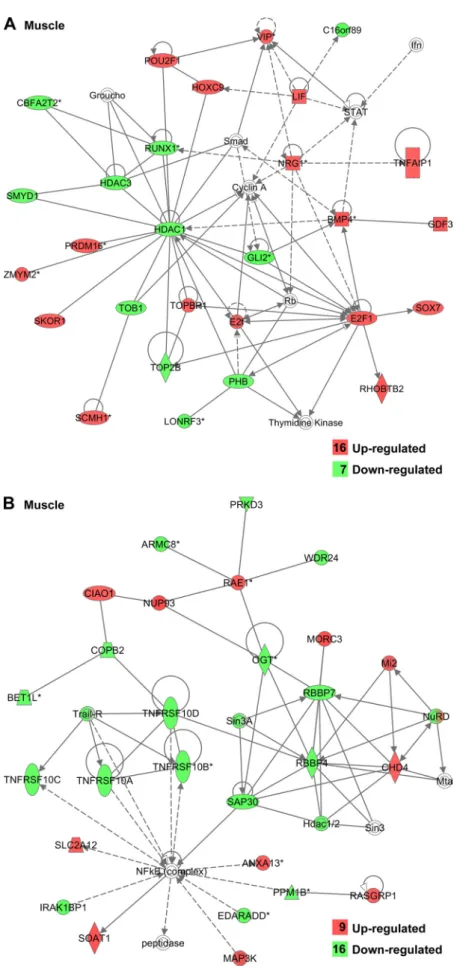
Fig. 3. Gene interaction network in leg muscle showing genes involved in the cell cycle (A) and cell apoptosis (B) after insulin immuno-neutralization in chickens revealed by IPA. Upregu-lated genes are indicated in red and downreguUpregu-lated genes are indicated in green; the number of genes in each category are shown in the legend. Solid lines indicate a direct relationship between genes and dashed lines represent an indirect
associa-tion determined by IPA. by 10.220.33.3 on April 25, 2017
http://physiolgenomics.physiology.org/
Fig. 4. G-coupled protein receptor/ligand gene interaction networks controlling cell signaling in liver (A) and leg muscle (B) after insulin immuno-neutralization in chickens. Upregulated genes are indicated in red, and downregulated genes are indicated in green; the number of genes in each category are shown in the legend. Solid lines indicate a direct relationship between genes and dashed lines represent an indirect association determined by IPA.
289
GENE EXPRESSION PROFILE IN “DIABETIC” CHICKENS
Physiol Genomics•doi:10.1152/physiolgenomics.00057.2011•www.physiolgenomics.org
by 10.220.33.3 on April 25, 2017
http://physiolgenomics.physiology.org/
addition, both liver and skeletal muscles are heterogeneous
organs, which allows for the possibility that some mRNAs
altered by insulin privation may come from cells different than
typical hepatocytes, myotubes, or myocytes. Future studies
will have to address these issues and to identify the presence of
potentially false positive results. Biorag classifies genes into
two main categories: either metabolic pathways or cellular and
regulatory pathways with subdivisions. The lists of the genes
involved in the major pathways are presented in Supplemental
Tables S5 and S6 for liver and Supplemental Tables S7 and S8
for muscle.
IPA software mapped a total of 1,846 pathway-eligible
genes from both liver and muscle to the Ingenuity Knowledge
Base (http://www.ingenuity.com/). And of these, 991 genes
were unique to liver, 741 DE genes were unique to muscle, and
114 DE genes were common to both tissues. IPA emphasized
the fact that major biological processes were altered by insulin
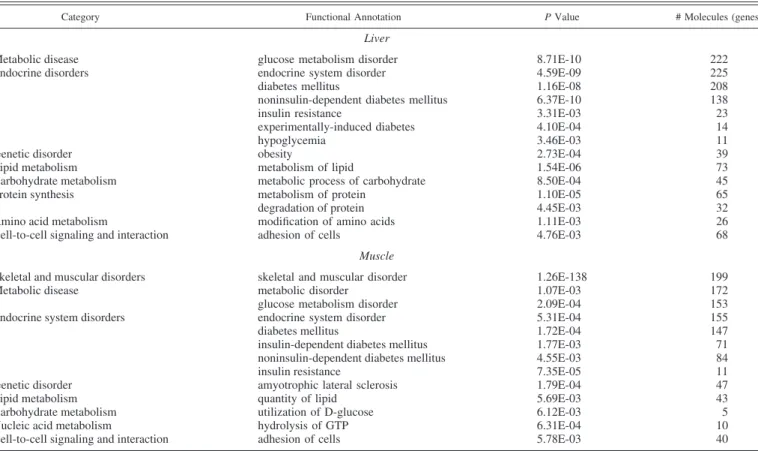
deprivation in both liver and muscle (Table 2). Table 2 also
shows the number of DE genes involved in the different
biological processes. In liver, large numbers of genes were
associated with metabolic disease (glucose metabolism
disor-der), endocrine disorders (diabetes mellitus), genetic disorder
(obesity), metabolism of lipid (Fig. 1A), carbohydrate and
protein, cell signaling (Fig. 2A), and cell cycle (Fig. 2B). In
muscle, the largest number of genes was related to skeletal and
muscular disorders, metabolic disease (glucose metabolism
disorder), endocrine system disorders (diabetes mellitus),
ge-netic disorder (amyotrophic lateral sclerosis), metabolism of
lipid, and cell adhesion (Figs. 1B and 3, A and B). IPA identified
numerous DE G protein-coupled receptors and growth factor
interactions in liver (n
⫽ 28) and leg muscle (n ⫽ 21; Fig. 4, A and
B, respectively).
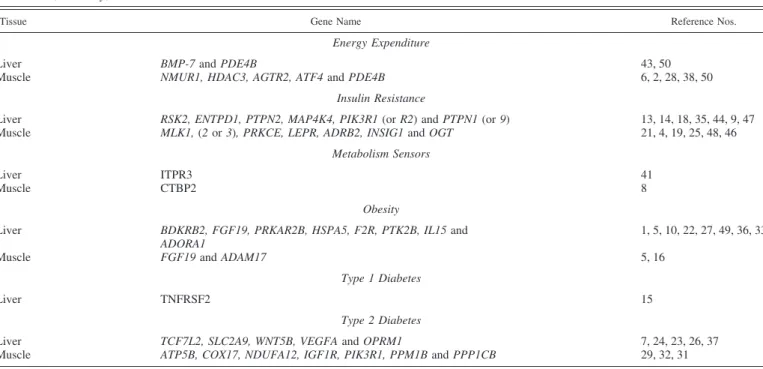
An extensive review of DE genes classified in the various
pathways revealed that at least 42 mRNAs have already been
related to diabetes or obesity or involved in energy expenditure
or sensing of metabolism in mice or humans (Table 3). It is
worthy to note that three mRNAs from the oxidative pathway
were decreased in muscle by the insulin deprivation: ATP
synthase subunit beta (ATP5B), cytochrome c oxidase copper
chaperone (COX17), and NADH dehydrogenase [ubiquinone]
1 alpha subcomplex subunit 12 (NDUFA12). These genes
belong to the “oxphos” gene complex (29, 32), which is less
expressed in muscles from diabetic patients and has been
identified following a gene set enrichment analysis of
microar-ray data. Usual analyses of the same data concluded that no
mRNAs were modified in muscles of diabetic humans.
Changes appear more pronounced in the present chicken
model, which could be accounted for by some physiological
characteristics of birds, i.e., their high body temperature, 42°C
(45), and high metabolic rate (20). In humans and mouse, the
expression of “oxphos” genes is most likely coordinated by the
transcription factors PGC-1A [peroxisome
proliferator-acti-vated receptor gamma, coactivaor 1alpha (PPARGC-1A)] and
nuclear respiratory factor 1 [NRF1 (29, 32, 40)]. Neither of
these factors appeared in the DE gene lists issued from the
present experiment and our earlier qRT-PCR analysis did not
reveal any alteration for PGC-1A messenger at 5 h of insulin
privation (11). Recent studies in humans have shown that
alteration in oxphos gene transcription in diabetic humans is
not a primary defect but results from dysregulation in
metab-olism (17).
Conclusions
Insulin privation rapidly and profoundly modifies global
gene transcription in liver and muscle of fed chickens, despite
several peculiarities observed in chicken for insulin sensitivity
in vivo and insulin signaling in muscle (11, 12). The high
number of genes altered by insulin deprivation may in part
depend on two physiological features of chicken metabolism:
Table 3. Differentially expressed genes known to be associated with energy expenditure, sensing of metabolism, insulin
resistance, obesity, or diabetes in mice or humans
Tissue Gene Name Reference Nos.
Energy Expenditure
Liver BMP-7 and PDE4B 43, 50
Muscle NMUR1, HDAC3, AGTR2, ATF4 and PDE4B 6, 2, 28, 38, 50
Insulin Resistance
Liver RSK2, ENTPD1, PTPN2, MAP4K4, PIK3R1 (or R2) and PTPN1 (or 9) 13, 14, 18, 35, 44, 9, 47 Muscle MLK1, (2 or 3), PRKCE, LEPR, ADRB2, INSIG1 and OGT 21, 4, 19, 25, 48, 46
Metabolism Sensors
Liver ITPR3 41
Muscle CTBP2 8
Obesity
Liver BDKRB2, FGF19, PRKAR2B, HSPA5, F2R, PTK2B, IL15 and ADORA1
1, 5, 10, 22, 27, 49, 36, 33
Muscle FGF19 and ADAM17 5, 16
Type 1 Diabetes
Liver TNFRSF2 15
Type 2 Diabetes
Liver TCF7L2, SLC2A9, WNT5B, VEGFA and OPRM1 7, 24, 23, 26, 37
Muscle ATP5B, COX17, NDUFA12, IGF1R, PIK3R1, PPM1B and PPP1CB 29, 32, 31
by 10.220.33.3 on April 25, 2017
http://physiolgenomics.physiology.org/
high body temperature [42°C, (45)] and high metabolic rate
(20). In both liver and muscle, changes concern components of
multiple metabolic pathways, structural proteins, transporters,
proteins of intracellular trafficking, major signaling pathways
and elements of the transcription control, transcription
machin-ery, and several other biological process. This further
demon-strates pleiotropic effects of insulin in the chicken, which are
most likely mediated through multiple gene networks. At least
42 DE genes identified by this study in chickens have already
been associated with energy expenditure, obesity, diabetes,
and/or insulin resistance or identified as metabolic sensors in
humans or mice. Therefore, major metabolic, cellular, and
regulatory pathways controlled by insulin have been conserved
despite some unique features of metabolic control in the
chicken. In contrast, a link between the level of gene
expres-sion and insulin does not exist for another large number of
mRNAs. Future progress in those fields might be helpful for
the comprehension of some aspects of diabetes in humans on a
comparative point of view. The gene knockout cannot be easily
achieved in the chicken; however, several nutritional or genetic
models that have been used for studies of insulin signaling
could be appropriate and fruitful. Other challenging questions
to answer concern the characterization of “unknown” or orphan
mRNAs and the identification of the steps or networks, which
so quickly permit such a large disturbance of the transcriptome
after the turning off of the insulin signal. In the latter issue, one
can hypothesize that insulin receptor and components of
insu-lin receptor signainsu-ling cascade themselves play a major role
within the nucleus. It has recently been shown that this
com-plex is recruited to the promoter region of two
insulin-induc-ible gene (EGR1 in HTC-IR cells and GCK in mice liver);
furthermore this complex is temporarily activated during the
expression of these genes (30).
ACKNOWLEDGMENTS
We gratefully thank Augustin Scalbert for microarray analysis performed in his group, Pascal Froment for helpful discussions, Christine Leroux and Marie Coisnon for advice and help during microarray hybridizations, Karine Hugot and her team at CRB-Gadie for the printing of the microarray slides, Nathaele Wacrenier-Cere for help in formatting of the bibliography, and K. Gérard for care of the chickens.
GRANTS
This study was made possible through funding from INRA-SRA-Nouzilly and, in part, INRA-Human Nutrition Group at Theix and USDA-IFAFS Grant 00-52100-9614 to L. A. Cogburn, project leader, T. E. Porter and J. Simon (coprincipal investigators). Microarray slides were provided by the Research Group of Yves Nys (SRA-INRA, Nouzilly, France).
DISCLOSURES
No conflicts of interest, financial or otherwise, are declared by the author(s).
AUTHOR CONTRIBUTIONS
Author contributions: J.S. and J.D. conception and design of research; J.S., D.M., E.G., A.C., S.M.-C., N.R., S.T., M.D., S.C., E.C.-A., C.G., T.E.P., and M.J.D. performed experiments; J.S., D.M., C.C., C.H.-A., J.D., and L.A.C. analyzed data; J.S., T.E.P., M.J.D., and L.A.C. interpreted results of experi-ments; J.S. and L.A.C. prepared figures; J.S. drafted manuscript; J.S. and L.A.C. edited and revised manuscript; J.S., D.M., E.G., C.C., A.C., S.M.-C., N.R., S.T., M.D., S.C., E.C.-A., C.H.-A., C.G., T.E.P., M.J.D., J.D., and L.A.C. approved final version of manuscript.
REFERENCES
1. Abe KC, Mori MA, Pesquero JB. Leptin deficiency leads to the regu-lation of kinin receptors expression in mice. Regul Pept 138: 56 –58, 2007.
2. Alenghat T, Meyers K, Mullican SE, Leitner K, Adeniji-Adele A,
Avila J, Bucan M, Ahima RS, Kaestner KH, Lazar MA. Nuclear
receptor corepressor and histone deacetylase 3 govern circadian metabolic physiology. Nature 456: 997–1000, 2008.
3. Auclair S, Milenkovic D, Besson C, Chauvet S, Gueux E, Morand C,
Mazur A, Scalbert A. Catechin reduces atherosclerotic lesion
develop-ment in apo E-deficient mice: a transcriptomic study. Atherosclerosis 204: e21–e27, 2009.
4. Barma P, Bhattacharya S, Bhattacharya A, Kundu R, Dasgupta S,
Biswas A, Roy SS. Lipid induced overexpression of NF-kappaB in
skeletal muscle cells is linked to insulin resistance. Biochim Biophys Acta 1792: 190 –200, 2009.
5. Bhatnagar S, Damron HA, Hillgartner FB. Fibroblast growth factor-19, a novel factor that inhibits hepatic fatty acid synthesis. J Biol Chem 284: 10023–10033, 2009.
6. Budhiraja S, Chugh A. Neuromedin U: physiology, pharmacology and therapeutic potential. Fundam Clin Pharmacol 23: 149 –157, 2009. 7. Cauchi S, Froguel P. TCF7L2 genetic defect and type 2 diabetes. Curr
Diab Rep 8: 149 –155, 2008.
8. Chinnadurai G. Transcriptional regulation by C-terminal binding pro-teins. Int J Biochem Cell Biol 39: 1593–1607, 2007.
9. Cho CY, Koo SH, Wang Y, Callaway S, Hedrick S, Mak PA, Orth AP,
Peters EC, Saez E, Montminy M, Schultz PG, Chanda SK.
Identifica-tion of the tyrosine phosphatase PTP-MEG2 as an antagonist of hepatic insulin signaling. Cell Metab 3: 367–378, 2006.
10. Cummings DE, Brandon EP, Planas JV, Motamed K, Idzerda RL,
McKnight GS. Genetically lean mice result from targeted disruption of
the RII beta subunit of protein kinase A. Nature 382: 622–626, 1996. 11. Dupont J, Tesseraud S, Derouet M, Collin A, Rideau N, Crochet S,
Godet E, Cailleau-Audouin E, Metayer-Coustard S, Duclos MJ, Gespach C, Porter TE, Cogburn LA, Simon J. Insulin
immuno-neutralization in chicken: effects on insulin signaling and gene expression in liver and muscle. J Endocrinol 197: 531–542, 2008.
12. Dupont J, Tesseraud S, Simon J. Insulin signaling in chicken liver and muscle. Gen Comp Endocrinol 163: 52–57, 2009.
13. El-Haschimi K, Dufresne SD, Hirshman MF, Flier JS, Goodyear LJ,
Bjorbaek C. Insulin resistance and lipodystrophy in mice lacking
ribo-somal S6 kinase 2. Diabetes 52: 1340 –1346, 2003.
14. Enjyoji K, Kotani K, Thukral C, Blumel B, Sun X, Wu Y, Imai M,
Friedman D, Csizmadia E, Bleibel W, Kahn BB, Robson SC. Deletion
of cd39/entpd1 results in hepatic insulin resistance. Diabetes 57: 2311– 2320, 2008.
15. Fas SC, Fritzsching B, Suri-Payer E, Krammer PH. Death receptor signaling and its function in the immune system. Curr Dir Autoimmun 9: 1–17, 2006.
16. Fiorentino L, Vivanti A, Cavalera M, Marzano V, Ronci M, Fabrizi
M, Menini S, Pugliese G, Menghini R, Khokha R, Lauro R, Urbani A, Federici M. Increased tumor necrosis factor alpha-converting enzyme
activity induces insulin resistance and hepatosteatosis in mice. Hepatology 51: 103–110, 2010.
17. Frederiksen CM, Hojlund K, Hansen L, Oakeley EJ, Hemmings B,
Abdallah BM, Brusgaard K, Beck-Nielsen H, Gaster M.
Transcrip-tional profiling of myotubes from patients with type 2 diabetes: no evidence for a primary defect in oxidative phosphorylation genes.
Diabe-tologia 51: 2068 –2077, 2008.
18. Galic S, Hauser C, Kahn BB, Haj FG, Neel BG, Tonks NK, Tiganis T. Coordinated regulation of insulin signaling by the protein tyrosine phos-phatases PTP1B and TCPTP. Mol Cell Biol 25: 819 –829, 2005. 19. Hennige AM, Stefan N, Kapp K, Lehmann R, Weigert C, Beck A,
Moeschel K, Mushack J, Schleicher E, Haring HU. Leptin
down-regulates insulin action through phosphorylation of serine-318 in insulin receptor substrate 1. FASEB J 20: 1206 –1208, 2006.
20. Holmes DJ, Fluckiger R, Austad SN. Comparative biology of aging in birds: an update. Exp Gerontol 36: 869 –883, 2001.
21. Jaeschke A, Davis RJ. Metabolic stress signaling mediated by mixed-lineage kinases. Mol Cell 27: 498 –508, 2007.
22. Kammoun HL, Chabanon H, Hainault I, Luquet S, Magnan C, Koike
T, Ferre P, Foufelle F. GRP78 expression inhibits insulin and ER
stress-induced SREBP-1c activation and reduces hepatic steatosis in mice.
J Clin Invest 119: 1201–1215, 2009.
23. Kanazawa A, Tsukada S, Sekine A, Tsunoda T, Takahashi A,
Kashi-wagi A, Tanaka Y, Babazono T, Matsuda M, Kaku K, Iwamoto Y, Kawamori R, Kikkawa R, Nakamura Y, Maeda S. Association of the
gene encoding wingless-type mammary tumor virus integration-site
fam-291
GENE EXPRESSION PROFILE IN “DIABETIC” CHICKENS
Physiol Genomics•doi:10.1152/physiolgenomics.00057.2011•www.physiolgenomics.org
by 10.220.33.3 on April 25, 2017
http://physiolgenomics.physiology.org/
ily member 5B (WNT5B) with type 2 diabetes. Am J Hum Genet 75: 832–843, 2004.
24. Keembiyehetty C, Augustin R, Carayannopoulos MO, Steer S,
Man-olescu A, Cheeseman CI, Moley KH. Mouse glucose transporter 9 splice
variants are expressed in adult liver and kidney and are up-regulated in diabetes. Mol Endocrinol 20: 686 –697, 2006.
25. Lessard SJ, Rivas DA, Chen ZP, van Denderen BJ, Watt MJ, Koch
LG, Britton SL, Kemp BE, Hawley JA. Impaired skeletal muscle
beta-adrenergic activation and lipolysis are associated with whole-body insulin resistance in rats bred for low intrinsic exercise capacity.
Endo-crinology 150: 4883–4891, 2009.
26. Lindenmeyer MT, Kretzler M, Boucherot A, Berra S, Yasuda Y,
Henger A, Eichinger F, Gaiser S, Schmid H, Rastaldi MP, Schrier RW, Schlondorff D, Cohen CD. Interstitial vascular rarefaction and
reduced VEGF-A expression in human diabetic nephropathy. J Am Soc
Nephrol 18: 1765–1776, 2007.
27. Luyendyk JP, Sullivan BP, Guo GL, Wang R. Tissue factor-deficiency and protease activated receptor-1-deficiency reduce inflammation elicited by diet-induced steatohepatitis in mice. Am J Pathol 176: 177–186, 2010. 28. Miyashita K, Itoh H, Tsujimoto H, Tamura N, Fukunaga Y, Sone M,
Yamahara K, Taura D, Inuzuka M, Sonoyama T, Nakao K. Natriuretic
peptides/cGMP/cGMP-dependent protein kinase cascades promote muscle mitochondrial biogenesis and prevent obesity. Diabetes 58: 2880 –2892, 2009.
29. Mootha VK, Lindgren CM, Eriksson KF, Subramanian A, Sihag S,
Lehar J, Puigserver P, Carlsson E, Ridderstrale M, Laurila E, Houstis N, Daly MJ, Patterson N, Mesirov JP, Golub TR, Tamayo P, Spiegel-man B, Lander ES, Hirschhorn JN, Altshuler D, Groop LC.
PGC-1alpha-responsive genes involved in oxidative phosphorylation are coor-dinately downregulated in human diabetes. Nat Genet 34: 267–273, 2003. 30. Nelson JD, LeBoeuf RC, Bomsztyk K. Direct recruitment of insulin receptor and ERK signaling cascade to insulin-inducible gene loci.
Dia-betes 60: 127–137, 2011.
31. Palsgaard J, Brons C, Friedrichsen M, Dominguez H, Jensen M,
Storgaard H, Spohr C, Torp-Pedersen C, Borup R, De Meyts P, Vaag A. Gene expression in skeletal muscle biopsies from people with type 2
diabetes and relatives: differential regulation of insulin signaling path-ways. PLoS One 4: e6575, 2009.
32. Patti ME, Butte AJ, Crunkhorn S, Cusi K, Berria R, Kashyap S,
Miyazaki Y, Kohane I, Costello M, Saccone R, Landaker EJ, Goldfine AB, Mun E, DeFronzo R, Finlayson J, Kahn CR, Mandarino LJ.
Coordinated reduction of genes of oxidative metabolism in humans with insulin resistance and diabetes: potential role of PGC1 and NRF1. Proc
Natl Acad Sci USA 100: 8466 –8471, 2003.
33. Peng Z, Borea PA, Varani K, Wilder T, Yee H, Chiriboga L,
Black-burn MR, Azzena G, Resta G, Cronstein BN. Adenosine signaling
contributes to ethanol-induced fatty liver in mice. J Clin Invest 119: 582–594, 2009.
34. Proszkowiec-Weglarz M, Richards MP, Ramachandran R, McMurtry
JP. Characterization of the AMP-activated protein kinase pathway in
chickens. Comp Biochem Physiol B Biochem Mol Biol 143: 92–106, 2006. 35. Puri V, Virbasius JV, Guilherme A, Czech MP. RNAi screens reveal novel metabolic regulators: RIP140, MAP4k4 and the lipid droplet
asso-ciated fat specific protein (FSP) 27. Acta Physiol (Oxf) 192: 103–115, 2008.
36. Quinn LS, Anderson BG, Strait-Bodey L, Stroud AM, Argiles JM. Oversecretion of interleukin-15 from skeletal muscle reduces adiposity.
Am J Physiol Endocrinol Metab 296: E191–E202, 2009.
37. Ruchat SM, Girard M, Weisnagel SJ, Bouchard C, Vohl MC, Perusse
L. Association between mu-opioid receptor-1 102T⬎C polymorphism and
intermediate type 2 diabetes phenotypes: results from the Quebec Family Study (QFS). Clin Exp Pharmacol Physiol 35: 1018 –1022, 2008. 38. Seo J, Fortuno ES 3rd, Suh JM, Stenesen D, Tang W, Parks EJ,
Adams CM, Townes T, Graff JM. Atf4 regulates obesity, glucose
homeostasis, and energy expenditure. Diabetes 58: 2565–2573, 2009. 39. Simon J, Rideau N, Taouis M, Dupont J. Plasma insulin levels are rather
similar in chicken and rat. Gen Comp Endocrinol 171: 267–268, 2011. 40. Skov V, Glintborg D, Knudsen S, Jensen T, Kruse TA, Tan Q,
Brusgaard K, Beck-Nielsen H, Hojlund K. Reduced expression of
nuclear-encoded genes involved in mitochondrial oxidative metabolism in skeletal muscle of insulin-resistant women with polycystic ovary syn-drome. Diabetes 56: 2349 –2355, 2007.
41. Srivastava M, Eidelman O, Leighton X, Glasman M, Goping G,
Pollard HB. Anx7 is required for nutritional control of gene expression in
mouse pancreatic islets of Langerhans. Mol Med 8: 781–797, 2002. 42. Sun G. Application of DNA microarrays in the study of human obesity
and type 2 diabetes. OMICS 11: 25–40, 2007.
43. Tseng YH, Kokkotou E, Schulz TJ, Huang TL, Winnay JN, Taniguchi
CM, Tran TT, Suzuki R, Espinoza DO, Yamamoto Y, Ahrens MJ, Dudley AT, Norris AW, Kulkarni RN, Kahn CR. New role of bone
morphogenetic protein 7 in brown adipogenesis and energy expenditure.
Nature 454: 1000 –1004, 2008.
44. Ueki K, Fruman DA, Yballe CM, Fasshauer M, Klein J, Asano T,
Cantley LC, Kahn CR. Positive and negative roles of p85 alpha and p85
beta regulatory subunits of phosphoinositide 3-kinase in insulin signaling.
J Biol Chem 278: 48453–48466, 2003.
45. Walter I, Hegarty B, Seebacher F. AMP-activated protein kinase con-trols metabolism and heat production during embryonic development in birds. J Exp Biol 213: 3167–3176, 2010.
46. Wu X, Wang J, Cui X, Maianu L, Rhees B, Rosinski J, So WV, Willi
SM, Osier MV, Hill HS, Page GP, Allison DB, Martin M, Garvey WT.
The effect of insulin on expression of genes and biochemical pathways in human skeletal muscle. Endocrine 31: 5–17, 2007.
47. Xue B, Kim YB, Lee A, Toschi E, Bonner-Weir S, Kahn CR, Neel BG,
Kahn BB. Protein-tyrosine phosphatase 1B deficiency reduces insulin
resistance and the diabetic phenotype in mice with polygenic insulin resistance. J Biol Chem 282: 23829 –23840, 2007.
48. Yang X, Ongusaha PP, Miles PD, Havstad JC, Zhang F, So WV,
Kudlow JE, Michell RH, Olefsky JM, Field SJ, Evans RM.
Phospho-inositide signalling links O-GlcNAc transferase to insulin resistance.
Nature 451: 964 –969, 2008.
49. Yu Y, Ross SA, Halseth AE, Hollenbach PW, Hill RJ, Gulve EA, Bond
BR. Role of PYK2 in the development of obesity and insulin resistance.
Biochem Biophys Res Commun 334: 1085–1091, 2005.
50. Zhang R, Maratos-Flier E, Flier JS. Reduced adiposity and high-fat diet-induced adipose inflammation in mice deficient for phosphodiesterase 4B. Endocrinology 150: 3076 –3082, 2009.
by 10.220.33.3 on April 25, 2017
http://physiolgenomics.physiology.org/