Publisher’s version / Version de l'éditeur: Encyclopedia of Magnetic Resonance, 2011-12-15
READ THESE TERMS AND CONDITIONS CAREFULLY BEFORE USING THIS WEBSITE. https://nrc-publications.canada.ca/eng/copyright
NRC Publications Archive
Archives des publications du CNRC
This publication could be one of several versions: author’s original, accepted manuscript or the publisher’s version. / La version de cette publication peut être l’une des suivantes : la version prépublication de l’auteur, la version acceptée du manuscrit ou la version de l’éditeur.
For the publisher’s version, please access the DOI link below./ Pour consulter la version de l’éditeur, utilisez le lien DOI ci-dessous.
https://doi.org/10.1002/9780470034590.emrstm1209
Access and use of this website and the material on it are subject to the Terms and Conditions set forth at
Quadrupolar NMR to investigate dynamics in solid materials
O’Dell, Luke A.; Ratcliffe, Christopher I.
https://publications-cnrc.canada.ca/fra/droits
L’accès à ce site Web et l’utilisation de son contenu sont assujettis aux conditions présentées dans le site LISEZ CES CONDITIONS ATTENTIVEMENT AVANT D’UTILISER CE SITE WEB.
NRC Publications Record / Notice d'Archives des publications de CNRC:
https://nrc-publications.canada.ca/eng/view/object/?id=f8fbbaef-785a-4259-a5a6-45fd612f4716 https://publications-cnrc.canada.ca/fra/voir/objet/?id=f8fbbaef-785a-4259-a5a6-45fd612f4716
Quadrupolar NMR to Investigate Dynamics in Solid Materials. emrstm1209
Luke A. O’Dell and Christopher I. Ratcliffe
Steacie Institute for Molecular Sciences, National Research Council of Canada, 100 Sussex Drive, Ottawa, Ontario K1A 0R6, Canada.
1. Introduction
Dynamics, be they vibrational, rotational or translational, are an important aspect of any solid, as they can play a major role in the overall properties of the material. NMR is perhaps the foremost technique for the study of rotational and translational motions in solid materials, and quadrupolar nuclei have a prominent role in such studies. 2H NMR in particular has been, and will continue to be, a very important tool for the study of molecular dynamics, since the isotope can replace 1H in countless inorganic and organic systems. 7Li has also received a lot of attention, largely for studying motion in ion conducting materials. With the increased interest in the last decade in quadrupolar nuclei with larger coupling constants (brought about by access to higher magnetic fields and constantly improving experimental techniques and probe technology), there are increasing numbers of reports of dynamics observed using other quadrupolar nuclei, especially 17O, but also 11B, 14N, 23Na, 27Al and 133Cs, and also some transition metals involved in tetrahedral oxide ions, such as 185,187Re and 55Mn.
Quadrupolar NMR studies of dynamics can yield structural information such as molecular orientation with respect to a crystallographic axis, or local symmetry, and this can sometimes be used to improve or direct structural refinements. It can distinguish between static and dynamic disorder among partially occupied sites, and can indicate phase transitions and perhaps give insight into possible mechanisms for these. More directly, the NMR studies can provide rotational rate constants or correlation times, which if studied as a function of temperature yield activation energies for the motions.
The underlying behavior which makes the observation of dynamic effects possible in NMR is the modulation of the resonance frequency, brought about by any motion which causes the electric field gradient (EFG) tensor, and hence the quadrupolar interaction tensor, to undergo changes in magnitude and/or orientation [1-4]. These changes can be effected either by motion of the nucleus itself or through motion of neighboring nuclei. Since most motions are stochastic processes they are usually described in terms of an auto-correlation function G(τ):
(1) where f(t) is a function of the position and orientation of a molecule at time t and the bar represents an ensemble average. In essence, G(τ) is a measure of the fraction of molecules whose position and orientation is unchanged after a time τ. If there is motion occurring, G(τ) will decrease over time and in most cases this decay can be modeled as an exponential function with a correlation time τc that is inversely related to the rate of motion:
(2)
For thermally activated processes, where the molecule must surmount an energy barrier to move between potential wells, τcis assumed to have an Arrhenius dependence on the activation energy (Ea) and on temperature (T):
(3) ) ( ) ( ) ( f t f t G c G
) exp ( RT Ea c c
0exp
interaction tensor. For example, a 180° rotation about any of the principal axes of the EFG tensor will leave it unchanged and will therefore have no effect, a situation which often arises for 2-fold molecular reorientations.
Different experimental approaches are generally used to probe motions on different timescales, e.g., two-dimensional exchange experiments for slow rates of motion, lineshape measurements for intermediate rates and relaxation measurements for fast rates. In this article, we will provide qualitative descriptions of the underlying mechanisms by which the NMR spectra of various quadrupolar nuclei can be affected by dynamics over an extremely wide range of timescales, as well as discussing the basic principles behind various experimental methods. In Sections 2-5, we focus on the quadrupolar nuclei 2H, 14N, 17O and 6/7Li respectively, which each exhibit different NMR properties and are therefore used in distinct ways to study dynamic processes. In Section 6, we consider the effects that dynamics can have on high-resolution, multiple-quantum experiments.
2. Deuterium
2.1 T2anisotropy and 2H spin-echo experiments
Deuterium is perhaps the most commonly exploited quadrupolar nucleus for studying molecular dynamics [5]. It is a spin I = 1 nucleus, thus the first-order quadrupolar interaction is typically the dominant perturbation and smaller interactions may often be ignored. Fortunately, the nucleus has a relatively small quadrupole moment (Q = 2.86 mbarn), and the quadrupolar splittings typically only range up to around 250 kHz. Such pattern widths can be uniformly excited and observed relatively easily on modern spectrometers, most commonly by using the quadrupolar echo pulse sequence (π/2x– τd– π/2y– τd– acquire), which allows the signal acquisition to begin at the echo top and thus avoids the spectral distortions due to equipment dead-time that are associated with single-pulse experiments. Furthermore, the electric field gradient (EFG) at the deuterium site, and therefore the quadrupolar interaction tensor itself, are often axially symmetric (ηQ = 0) with the unique axis aligned along a covalent bond (e.g., a C-H bond in an organic molecule). This can greatly simplify the interpretation of results, since the interaction is then described by only two parameters (CQ, and the angle θ
between the unique axis and B0). Less fortunately, the 2H isotope has a very low natural abundance (0.012 %), making isotopic enrichment necessary. This can, however, be considered an advantage in some cases, in that it allows the possibility of selective labeling, which, as well as aiding spectral resolution, can be used to probe specific sites in complex systems.
The most common method for extracting dynamic information using 2H NMR is to record the powder pattern from a stationary sample using a spin-echo experiment, and then to compare the resultant spectral lineshape to simulations which model a Markovian jump process with a specific geometry and jump rate k [6,7]. Powder lineshapes are generally sensitive to motional rates comparable to their linewidth. At slower rates (or in the absence of motion) the lineshape is characteristic of the static quadrupolar coupling tensor V. In the fast motion limit (FML) the lineshape is characteristic of an effective tensor Veff , which is the population weighted average of the static tensor components in a
common reference frame for all the sites visited during the motion:
(4)
where piis the population factor of site i and the static tensor components for site i are given by:
(5) where R is the Euler angle rotation matrix describing the coordinate transformation and VPAS is the static tensor in its principal axis system. Thus if the static tensor is known,
averaged FML lineshapes can be calculated easily for any plausible dynamic model and
n i i n i i p p 1 1 ) , , ( i eff V V 1 ) , , ( R R PAS V V used for the simulations will usually be based on knowledge of the molecular and crystal structure, e.g., a deuterium located on a methyl group might be expected to undergo C3 rotation. If the static and FML lineshapes are both available then a dynamic model (or models, if not unique) can be developed which is compatible with the observed averaging before calculating intermediate rate lineshapes, otherwise an educated guess has to be made.
The distorted 2H powder patterns that occur in the presence of intermediate motion are caused by anisotropy in the 2H transverse relaxation due to the modulation of the first-order quadrupolar interaction. For such a phenomenon to occur, two conditions must be fulfilled. First, the motion must alter the orientation or magnitude of one or more principal axes of the interaction tensor, in this case the 2H EFG. This alteration can be caused either by motion of the 2H itself, or by motion of surrounding atoms. Secondly, the timescale for the dynamics (k−1) must be comparable to the inter-pulse delay τ
din the spin-echo pulse sequence used (or comparable to CQ−1 in the limit of short τd values). When these conditions are fulfilled, the resonance frequencies of certain spins will change during the course of the spin-echo sequence and the corresponding signals will therefore fail to be refocused. The extent of this relaxation will be dependent on the jump rate, and also the relative orientations (with respect to B0) or magnitudes of the EFG principal axes at each jump site. The result is that the T2relaxation time will differ for each crystallite orientation, and will cause the powder pattern to depart significantly from the ideal first-order quadrupolar lineshape.
In typical 2H spin-echo experiments, both C
Q−1and τdare usually on the order of 10−5 s, thus 2H powder patterns are sensitive to motional timescales in the range 104to 107s−1. Motions occurring on timescales much longer than τ
dwill be too slow to induce anisotropic relaxation, and standard first-order lineshapes will be observed. In the fast motion regime, where the dynamics occur on timescales much shorter than τd, the spins will experience the FML EFG tensor, resulting in the observation of an ideal first-order pattern (or a narrow Lorentzian line for motions which average the EFG to zero). In the intermediate timescale, however, the shape of the 2H powder pattern is highly sensitive to both the rate and geometry of the dynamics. For thermally-activated dynamics, jump rates can be determined from these intermediate lineshapes over a range of temperatures
(with τd fixed) and then used to determine the activation energy via an Arrhenius plot. Alternatively, τdcan be varied at a constant temperature to observe the effects of the T2 anisotropy for a fixed jump rate over a range of timescales. Such experiments can potentially provide a broad range of quantitative information on molecular dynamics (number of jump sites, respective site orientations, jump rate constants, and activation energies).
Figure 1 shows some simulated 2H powder patterns for a methane molecule undergoing three different types of motion. For the C2rotation, the powder pattern shows the axially symmetric (ηQ = 0) quadrupolar pattern in the slow motion regime, which changes to a ηQ = 1 pattern in the fast limit. For the C3simulations, both the slow and FML lineshapes correspond to axially symmetric EFG tensors. Indeed, rotation around a single axis with C3 symmetry or higher will always result in an axially symmetric 2H spectrum in the FML. It should be noted here that the signal arising from the deuteron on the axis of C3 rotation, which is neglected in the simulations, will be unaffected by this motion since this rotation does not alter the EFG tensor for this spin. For the case of tetrahedral exchange, the EFG tensor is averaged completely for jump rates of 105s−1and higher, leaving a narrow Lorentzian lineshape.
One significant problem that can arise in using 2H T
2 anisotropy to probe dynamics in this way is the severe signal loss that occurs in the intermediate regime, where the transverse relaxation is extremely efficient. Figure 2 shows simulated echo intensities for the three dynamic modes in Figure 1, and the dramatic signal loss for jump rates of 104 to 106 s−1 (a decrease in intensity of up to an order of magnitude) is immediately apparent. As mentioned above, this intermediate region is where the lineshape shows the highest sensitivity to the dynamics. The resultant spectra can therefore exhibit rather low signal-to-noise ratios. Decreasing the echo delay τd can reduce this effect. Alternatively, signal enhancement techniques such as those discussed in the following sections can be used to provide a signal boost.
Figure 1 – Simulated 2H spin-echo powder patterns arising from spins undergoing
various types of Markovian jump processes as shown. Simulations were generated with the EXPRESS software [7], assuming an axially symmetric 2H EFG tensor (C
Q
= 100 kHz) and a quadrupolar-echo pulse sequence with a 50 μs inter-pulse delay. For the C3 rotation, the signal from the axial deuterium site is neglected. Spectral
Figure 2 – Normalized spin-echo intensities vs. jump rates for the simulations shown in Figure 1.
2.2 Magic angle spinning
In magic angle spinning (MAS) 2H NMR experiments, the first-order quadrupolar broadening is averaged, leaving a manifold of spinning sidebands for each unique deuterium site that can often be resolved on the basis of differences in the second-order quadrupolar and isotropic chemical shifts. Such a method can therefore increase both the sensitivity and resolution of 2H spectra. In studying dynamics, MAS also has the advantage of extending the range of motional timescales that can be probed [8]. In Figure 3, the manifold of spinning sidebands in simulated MAS spectra of a system undergoing C3rotation (as in Figure 1) is seen to be sensitive to a similar range of jump rates as the static powder pattern. On closer inspection, however, the widths of the sidebands themselves are seen to be sensitive to a greater range of jump rates. For example, the width of the most intense spinning sideband is noticeably different for jump rates of 102 and 103s−1, while these jump rates are indistinguishable on the basis of the
of resolution for sites with different isotropic shifts. Spinning sidebands may also provide more precise measurements of dynamics when the sample is spun at a small offset from the magic angle. In this case, a scaled quadrupolar interaction is re-introduced, giving each spinning sideband a characteristic shape that is dependent on the dynamics (particularly those occurring in the kHz regime) and may be simulated to extract this information [10].
Figure 3 – Simulated 2H MAS (left) and static QCPMG (right) spectra for the
system undergoing C3rotations shown in Figure 1 (the axial 2H is again neglected).
The MAS simulations used a rotor frequency of 12.5 kHz, and the QCPMG simulations have a spikelet separation of 10 kHz. For certain jump rates, horizontal expansions of the most intense sidebands/spikelets are also shown as indicated by the arrows. Simulations were generated using EXPRESS [7].
2.3 QCPMG
QCPMG is now a very commonly used signal enhancement pulse sequence in solid-state NMR. Several variations of this pulse sequence exist, the defining feature being a repeating loop containing a refocusing pulse and an acquisition period, allowing the spin-echo to be re-recorded over the full timescale of the transverse relaxation/dephasing. A Fourier transform of the echo train results in a spectrum consisting of narrow “spikelets” whose manifold reproduces the approximate shape of the powder pattern. The QCPMG experiment therefore samples a broader range of timescales than a single spin-echo, and so can extend the range of motional timescales that can be studied using 2H based on differences in the linewidths of the spikelets (see Figure 3) [11]. While both MAS and QCPMG offer significant increases in sensitivity, the most significant difference between the techniques is that QCPMG only ever results in a single spikelet manifold for all signals, thus does not offer the shift-based resolution advantage of MAS.
A recent study of methyl group rotation in the hydrophobic core of a protein provides an illustration of the advantages of QCPMG signal enhancement [12]. 2H spectra were recorded from a powder sample of protein at various cryogenic temperatures, with a single methyl group of a hydrophobic core residue selectively labeled with 2H (Figure 4). All three motional regimes were observed. In the FML (119 K), the methyl group rotation results in a relatively narrow spikelet manifold corresponding to a motionally-averaged EFG tensor. At 84 K, the spikelet manifold narrowed significantly and the amount of signal dropped, indicating motion on the intermediate timescale. At 31 K, a spikelet manifold corresponding to a relatively broad axial pattern was observed, indicating the freezing-out of the methyl rotation.
Figure 4 – 2H QCPMG spectra obtained at 11.7 T and at temperatures shown from
a powder sample of chicken villin headpiece subdomain (HP36), selectively 2
H-labeled at a single methyl group of residue L69. 1024, 3040, 512, and 128 scans were acquired for the spectra at 119, 84, 75 and 31 K respectively. Reproduced with permission from reference 12. Copyright 2010 American Chemical Society.
2.4 T1anisotropy and inversion recovery experiments
Dynamic modes such as those discussed in the previous sections are also capable of causing anisotropies in the (Zeeman) spin-lattice relaxation time T1Z [13]. Whereas transverse relaxation is induced by dynamics whose characteristic frequencies are on the order of the anisotropic interactions present (i.e., the CQin the case of 2H, which is on the order of 100 kHz), spin-lattice relaxation is caused by interactions fluctuating at or close to the Larmor frequency (~ 61 MHz for 2H at a field of 9.4 T). Specifically, T
1Z depends on the two spectral densities J1(ω0) and J2(2ω0) (which are themselves dependent on the motional correlation time and are orientation dependent under anisotropic motion), and 2H T
1Z measurements can therefore provide access to very fast motional rates (up to ~ 1011s−1):
(6)
The simplest way of observing T1Z anisotropy experimentally is using an inversion recovery pulse sequence of the form π – t1 – π/2 – acquire, where the magnetization is stored anti-parallel to B0for a variable recovery time t1, and subsequently observed using a π/2 pulse (or, more typically for 2H, a spin-echo sequence). Figure 5 shows a simulated T1Zanisotropy profile for the 2H C3rotation discussed above, at 9.4 T and with a jump rate of 109s−1. Such a jump rate is too fast to affect the spin-echo lineshape in a standard experiment, resulting in an axially symmetric FML powder pattern. In an inversion recovery experiment, however, the T1Zanisotropy can be measured by recording spectra over a range of t1values, and the shape of the T1Z anisotropy will be dependent on both the rate and geometry of the dynamics. We note that these simulations include only the effects of the C3dynamics, and neglect other possible causes of relaxation such as lattice vibrations, although in most cases the relaxation mechanism in 2H will be dominated by the quadrupolar interaction. T1behavior can also distinguish between dynamic models which give the same FML lineshape, e.g., Markovian jumps or smooth rotational diffusion about the C3axis.
It should also be noted that the anisotropy in the relaxation of quadrupolar order, in which a single transition is inverted, is also sensitive to dynamics. This state can be created using a Jeener-Broekaert pulse sequence [14]. For fast motions, this relaxation can provide complementary information to T1Z measurements since its associated relaxation time T1Qis dependent on only one spectral density J1(ω0) [7]:
(7) )) 2 ( 4 ) ( ( 2 3 1 0 2 0 1 2 2 1 C J J TZ Q )) ( ( 2 9 1 0 1 2 2 1 C J T Q Q
Figure 5 – Top: simulated T1anisotropy for a 2H system (CQ= 100 kHz, ηQ= 0, B0=
9.4 T) undergoing C3 rotation (as in Figure 1) with a jump rate of 109 s−1 (axial
deuteron is again neglected). Bottom: corresponding inversion recovery spectra with various recovery times. Simulations were generated using EXPRESS [7].
This allows both spectral densities to be quantified [15], and also makes T1Q relaxation a useful probe for quantifying very slow reorientations (~ 1 s−1), since it is less sensitive to rapid vibrational motions than T1Z [16]. Note also that the QCPMG retains longitudinal relaxation anisotropy while MAS does not [17], thus QCPMG can be useful in improving the sensitivity in such experiments.
2.5 Two-dimensional exchange experiments
The fitting of simulated spin-echo lineshapes or relaxation anisotropies to experimental 2H data usually necessitates some prior knowledge of the molecular structure in order to guess potential dynamic models. Two-dimensional exchange experiments provide an alternative approach where motional rates and geometries can be inferred solely from the experimental data [18]. An example spectrum is shown in Figure 6, obtained from dimethylsulfone. In this molecule, the methyl groups undergo rapid rotation such that the 2H powder pattern corresponds to an axially symmetric EFG tensor aligned along the S-C bond. The molecule also undergoes a slower two-site jump process about its C2symmetry axis that alters the orientation of this 2H EFG by 106°. In the exchange spectrum, the main peaks along the diagonal map out the static, axially-symmetric quadrupolar pattern, while the two-site jump process that occurs during the mixing period gives rise to off-diagonal ridges. Crucially, these ridges show characteristic shapes that depend explicitly on the motional geometry, allowing the flip angles and number of jump sites to be deduced directly from the spectrum [18].
Figure 6 – (a) Pulse sequence used to acquire the 2H two-dimensional exchange
spectrum (b) from dimethylsulfone (molecule shown inset). (c) Simulated spectrum taking into account the two-site 106° flipping mechanism. Reproduced with permission from reference 18. Copyright 1986 Elsevier.
3. Nitrogen-14
3.1 T2anisotropy and ultra-wideline powder patterns
The 14N isotope is also a spin I = 1 nucleus, and so the above techniques are in principle also applicable to this nucleus. Unfortunately, this nucleus has a quadrupole moment that is seven times larger than 2H (20.44 mbarn), thus the broadening due to the first-order quadrupolar interaction is usually extremely large (several MHz) and such broad spectra can be very difficult to observe [19]. Dynamics studies employing this nucleus are therefore rather scarce. Spin-echo experiments using standard excitation pulses have been carried out on systems where the nitrogen sites have a local symmetry that is close to tetrahedral, giving rise to small CQ values, such as in choline salts [20]. Motionally-averaged 14N quadrupolar splittings have also been observed in partially-oriented systems such as liquid crystals or lipid bilayers. Such splittings are often directly proportional to the ordering parameter describing the rotational dynamics present in these systems, but again, such cases generally involve nitrogen sites with symmetric environments and small CQ values. The majority of nitrogen sites feature CQ values in excess of 1 MHz, and these require more advanced experimental methods [19].
The jump rate for the molecular flipping mechanism in crystalline urea (CQ= 3.86 MHz and ηQ= 0.28) has recently been determined using ultra-wideline 14N NMR as k = 7 × 10³ s−1 at room temperature [21]. Frequency-swept pulses combined with QCPMG were used to excite a broad region of the powder pattern where the T2 anisotropy was most pronounced (Figure 7). This outermost region of the powder pattern corresponds to crystallite orientations in which the EFG principal axis V33 is parallel to B0, thus the molecular flipping in these crystallites does not alter the EFG orientation and the motion does not induce transverse relaxation for these spins. The outermost edges of the pattern are therefore selectively enhanced by the QCPMG protocol, as seen in the simulations in Figure 7. Fitting of these simulated lineshapes to the experimental spectra provided jump
rate constants in good agreement with those measured using other techniques, demonstrating that the simple approach described in Section 2.1 holds, at least to a good approximation, even for very large quadrupolar interactions.
Figure 7 – Simulated (left) and experimental (right) 14N spectra obtained from urea
at 21.1 T and at room temperature. The molecule is shown inset, along with the orientation of two of the 14N EFG principal axes (the third, V
33, is perpendicular to
the molecular plane). Simulations were made using EXPRESS [7] with a jump rate of 7 × 10³ s−1 and inter-pulse delays as shown. Experimental spectra (recorded at
3.2 Hole-burning methods
Saturation or inversion recovery methods are usually used to study very fast dynamics via their effect on the spin-lattice relaxation rate. However, they may also be used to probe very slow motions occurring at timescales on the order of the T1relaxation time itself. The hexamethylenetetramine (HMT) molecule (14N C
Q = 4.41 MHz, ηQ = 0) in its crystalline form undergoes tetrahedral jumps at a rate of ~10 s−1 at room temperature, moving the 14N EFG tensor between four orientations. Such motion is far too slow to be observed as a change in the shape of the 14N powder pattern, but its effects have been observed using saturation-recovery experiments applied to a narrow region of the ultra-wideline powder pattern (referred to as hole-burning) [22]. Specifically, a train of transition-selective pulses can be used to saturate a 4 kHz wide region of the powder pattern which can then be monitored over time using a conventional spin-echo pulse sequence. After a single train of pulses, a set of 14N spins corresponding to a specific set of EFG orientations is saturated. The EFG orientations of these saturated spins are then altered by the molecular reorientation, which also brings unsaturated magnetization (i.e., 14N spins previously at other EFG orientations) into the hole region. For the four-site jump process in HMT, three quarters of the magnetization is therefore quickly recovered due to the dynamics alone, followed by a much slower recovery of the remaining
Figure 8 - Recovery of a narrow region of saturated 14N magnetization in
hexamethylenetetramine (molecule shown inset) at 7.05 T as a function of time after (a) a single train of saturation pulses and (b) 16 saturation trains. Solid and dotted lines show fits derived from numerical expressions. Reproduced with permission from reference 22. Copyright 1997, American Institute of Physics.
magnetization by ordinary spin-lattice relaxation (Figure 8a). Note that the fraction of magnetization recovered in the initial stage provides an immediate quantification of the number of jump sites. Alternatively, all four sets of EFG orientations can be saturated, after which the recovery of magnetization occurs by spin-lattice relaxation only (Figure 8b).
3.3 T1measurements
T1relaxation times can be measured relatively easily from nitrogen sites with high symmetry or fast dynamics where the 14N quadrupolar interaction is absent or extremely small. For example, in ionic solids such as NaCN, the CN− ions can undergo rapid rotation and therefore exhibit very narrow linewidths despite the relatively high CQvalue of the stationary ion (~4 MHz). The rapid EFG fluctuations caused by this rotation lead to very efficient relaxation, and the departure from cubic symmetry caused by orientational disorder or defects present in the lattice can leave very small residual quadrupolar broadening which can be observed using the quadrupolar echo sequence. The spin-lattice relaxation cannot therefore be directly inferred from the natural linewidths (1/T2*), but correlation times for the rotation can still be easily ascertained from inversion recovery T1 measurements, allowing the very fast ion rotation rate (τ ≈ 10−10s) to be measured [23].
to access dynamics in systems which may not contain hydrogen. In this section we will consider 17O (I = 5/2) as an exemplary half-integer quadrupolar nucleus. Oxygen is clearly an element of considerable importance, so it is rather unfortunate that 17O has a very low natural abundance (0.038 %) and a relatively low gyromagnetic ratio (ν0= 54.2 MHz at 9.4 T). Isotopic enrichment is therefore usually required for studies of this nucleus. On the plus side, the nucleus has only a moderate quadrupole moment (−25.6 mbarn) and a reasonably large chemical shift range (~1000 ppm), meaning that solid-state spectra can often be obtained (under MAS) with a relatively high resolution, particularly at high magnetic field strengths.
17O CT NMR spectra obtained from powder materials under either static or MAS conditions show anisotropic broadening due to the second-order quadrupolar interaction (as well as chemical shift anisotropy in the case of static powders). These anisotropic interactions, like the first-order quadrupolar interaction for 2H, can be modulated by dynamic processes giving rise to anisotropic relaxation, altering the shape of the powder pattern and thus constituting a mechanism by which motional rate constants and geometries can be measured. Figure 9 shows simulated CT lineshapes for 17O spins in an MO4 unit undergoing various dynamic mechanisms. As with the 2H experiments discussed above, the 17O CT lineshapes are sensitive to motions at intermediate rates (~ 103 to 107 s−1) which are comparable to the size of the second-order quadrupolar interaction (CQ2/ν0). The satellite transitions (STs) are sensitive to motions at much faster rates (on the order of CQ). Note that the centerband and spinning sidebands in the MAS simulations consist of powder patterns due to incomplete averaging of the second-order quadrupolar interaction, and that these powder patterns are also sensitive to the dynamics.
Motions in the slow-regime do not affect the CT spectra, leaving standard second-order powder patterns. Interestingly, motions in the fast regime produce powder patterns that, while narrowed, do not correspond to typical second-order quadrupolar lineshapes and cannot be simulated using standard CT powder patterns [24]. This is because the second-order quadrupolar interaction features both second- and fourth-rank terms, which are weighted differently when averaged by fast motion [25]. Such fast-regime lineshapes can therefore only be reproduced using simulations which take the dynamics into account. A related observation, apparent by comparing Figures 9 and 1, is that fast
tetrahedral exchange does not completely average away the second-order quadrupolar interaction as it does for the first-order interaction. This is due to the fourth-rank anisotropy terms, which have lower symmetry. For motional rates on the order of CQ2/ν0, dynamics with icosahedral or higher symmetry are required for the anisotropic terms to become fully averaged, while the isotropic second-order quadrupolar shift, which has no angular dependence, will remain [25]. However, for much faster rates (on the order of ν0 or greater) both the anisotropic lineshape and the second order shift are averaged, so that eventually even averaging over tetrahedral sites will give a narrow lineshape at the true isotropic chemical shift [26]. It should be noted that the chemical shielding anisotropy is neglected from the simulations in Figure 9, which at high magnetic fields can be similar in size to the second-order quadrupolar broadening and can therefore also play a significant role in determining the shape of the motionally-averaged lineshape (except under MAS where this interaction is averaged out) [24]. As with 2H NMR, the use of inversion-recovery [27] or QCPMG methods [28] can increase the range of motional timescales accessible by central transition spectra.
Figure 9 – Simulated 17O central transition NMR spectra for various dynamic
modes of an MO4 unit shown at the top. Simulations were generated using
EXPRESS [7] for a 17O spin at 9.4 T with C
Q = 5 MHz and ηQ = 0. No chemical
shielding anisotropy was included. As before, the signal from the axial site in the C3
rotation model is neglected.
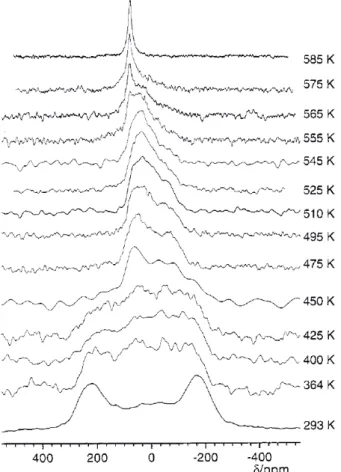
Figure 10 – Variable temperature 17O NMR obtained from a static powder sample
of Na3PO4at 7 T. Reproduced with permission from reference 29. Copyright 2001
American Chemical Society.
17O NMR has been used in this way to characterize the rotation of PO
43−anions in the low temperature phase of Na3PO4[29]. In this system the 17O EFG tensor was found to be axially symmetric and oriented along the P-O bond. The static 17O NMR spectrum
was observed to undergo dramatic changes in shape upon heating (Figure 10), leading ultimately to a motionally-narrowed Lorentzian lineshape at 585 K which was best acquired using non-selective excitation pulses. The anisotropic lineshapes over the temperature range 425 to 525 K were shown to fit most accurately to simulations in which the anions undergo preferred C3rotation around one P-O bond with much slower C3rotation around the remaining 3. This allowed the activation energy for this preferred rotation to be obtained, and the phosphate ion motion was then correlated with that of the Na+cations (which undergo translational diffusion, studied via two-dimensional nutation spectra) [29].
In another example, the dynamics of water molecules in ice and THF clathrate hydrate have been followed using 17O NMR lineshapes [30]. In this system, each O atom has a roughly tetrahedral arrangement of four hydrogen bonds, in which it is bonded directly to two H atoms and accepts H-bonds from two other water molecules. Interestingly, in this particular case the O atom itself does not move, but the surrounding EFG changes among six octahedral orientations due to movement of the H atoms. This may be contrasted with 2H which does move and the orientation of its EFG tensor changes among four tetrahedral orientations. For ice, 2H NMR lineshapes as a function of temperature show complete narrowing of the first-order lineshape to a pseudo-isotropic lineshape, corresponding to an effective CQ of zero [31]. 17O NMR, however, shows narrowing of the CT to a new anisotropic lineshape which is still present at the melting point, i.e., there is incomplete averaging of the second-order lineshape (Figure 11a). In THF clathrate hydrate the water dynamics are significantly faster, so that lineshapes similar to those seen in ice occur at a temperature about 40-50 K, and in this case further CT lineshape changes can be followed before melting occurs (Figure 11b). It is clear that although the lineshape initially averages towards the expected anisotropic lineshape, it then gradually becomes isotropic in shape, but this “isotropic” line retains a second-order shift as illustrated by the spectrum of the hydrate at 270 K where liquid
an “isotropic” lineshape is associated with the onset of averaging of the first-order interaction (νQ is only 964.5 kHz, where νQ= 3CQ/2I(2I-1) and 2νQ gives the total width of the powder lineshape for the ±1/2 ↔ ±3/2 satellite transitions), and retention of the full second-order shift indicates that the rate is still significantly slower than the resonance frequency (ν0 = 40.68 MHz). This same motion also has an effect on the 131Xe NMR lineshapes of xenon as a guest in clathrate hydrates [32], where the Xe is an example of a spectator nucleus subjected to changes in EFG due to motions of surrounding molecules. We note that dynamics have also been observed to cause the second-order shift to decrease to zero for 23Na in Na
3PO4/Na2SO4 solid solutions at high temperatures [33]. These examples demonstrate that care must be exercised in judging whether one has the true isotropic chemical shift for apparently isotropic CT lines of non-integer quadrupolar nuclei, and spectra obtained at multiple fields can be used to distinguish second-order shifts from true isotropic shifts.
260 K 250 240 230 220 210 200 190 180 160 150 140 0 1000 -1000 ppm 270 K 260 250 240 230 220 200 180 150 1000 0 -1000 ppm (a) (b) (c) 400 0 -400 ppm
Figure 11 –Static 1H-decoupled 17O NMR CT transition spectra as a function of
temperature at 7 T of (a) ice, (b) THF clathrate hydrate, (c) A spectrum obtained at about 270 K after partial melting of the THF hydrate. The liquid shows an isotropic chemical shift whereas the apparently “isotropic” hydrate line still also has a second-order quadrupolar shift [30].
4.2 Exchange experiments and spin-lattice relaxation
In systems where second-order quadrupolar broadening is minimal and individual oxygen sites are well resolved by MAS, exchange occurring on a similar timescale to the difference in resonance frequencies can be observed directly in one-dimensional spectra as a broadening (intermediate regime) or coalescence (fast regime) of the two peaks to an averaged position in the spectrum. Such a process has been used to observe the hopping of oxide ions between sites in α-Bi4V2O11 at rates on the order of 104 s−1 [34]. In the same study, it was also noted that spinning sidebands arising from 17O satellite transitions were also sensitive to dynamics, broadening and disappearing upon heating as motions on the order of the CQ or MAS frequency prevent their formation [34], a process analogous to the 2H experiments discussed in Section 2.2.
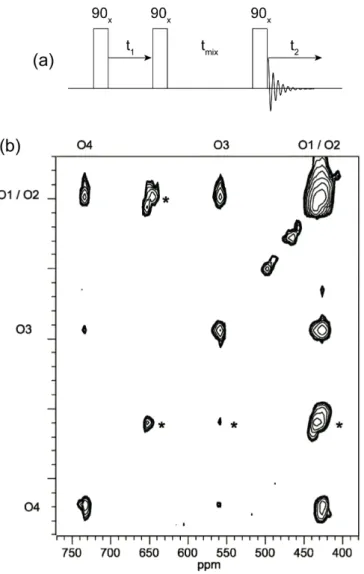
Slower exchange can be observed using two-dimensional exchange spectroscopy. An example of this is shown in Figure 12, where exchange between all four oxygen sites in an isotopically-enriched sample of ZrW2O8 is evidenced by the appearance of off-diagonal cross-peaks [35]. The mixing time used in this experiment was 50 ms, indicating that the WO4groups rotate on a timescale of ~ 10 s−1. Hopping rate constants can in principle be extracted via the relative intensities of the cross-peaks, but the quantification of jump rates and activation energies from such magnetization transfer experiments is complicated since both the dynamic exchange process and spin-lattice relaxation effects must be considered. The latter process is multi-exponential for half-integer quadrupolar nuclei due to the large number of spin states between which
Figure 12 – (a) The basic two-dimensional exchange (EXSY) pulse sequence, where t1-encoded chemical exchange occurs between longitudinal components of
magnetization during tmix. (b) A 17O EXSY spectrum obtained at 11.7 T from a
sample of 17O-enriched ZrW
2O8 at 57 °C and spinning at 14.5 kHz MAS.
Off-diagonal peaks indicate exchange between sites O3, O4 and O1/O2, the latter sites being unresolved. Asterisks indicate spinning sidebands. Reproduced from reference 35 by permission of the Royal Society of Chemistry.
For a spin I nucleus, the spin-lattice relaxation can be described by up to 2I distinct relaxation times arising from the 2I rate equations that define the transition
probabilities between the various energy levels [37]. For I > ½ nuclei experiencing a non-zero quadrupolar interaction, and assuming that the first-order quadrupolar interaction is the dominant relaxation mechanism, all Δm = 2 transitions and Δm = 1 satellite transitions will each contribute with transition probabilities aW2 and bW1 respectively, where a and b are factors specific to the two levels involved in the transition as well as the direction of the transition [37,38]. When the magnetic relaxation mechanism is dominant, relaxation is mediated only by Δm = 1 transitions, and the central and satellite transitions will each contribute transition probabilities dependent on a single rate process W. In both cases, the relaxation is typically multi-exponential. Usually these complex, general solutions can be simplified, for example in the case of a spin I = 5/2 nucleus undergoing quadrupolar relaxation the description of the spin-lattice relaxation can be reduced to just three relaxation times by assuming that the Boltzmann population differences between all adjacent levels are equal and also noting symmetries in the rate equations, e.g., the +5/2 ↔ +3/2 and −5/2 ↔ −3/2 transitions [37]. Note that W1 and W2 are functions of the EFG orientation as well as temperature, which further complicates the description of quadrupolar relaxation in powder samples.
5. Lithium
With the exception of Francium, all of the alkali metals have quadrupolar nuclei that can be studied relatively easily using solid-state NMR. The most commonly utilized alkali metal in NMR studies of dynamics is lithium, and this is due both to its favorable NMR properties and the importance of the Li+ ion in conducting materials. A 2007 review provides a very extensive overview of the various ways in which lithium NMR has been used to provide important information in such systems [39].
7Li has a spin I = 3/2, a high natural abundance (92.4 %) and a moderately sized quadrupole moment (−40.1 mbarn). The second isotope, 6Li, has a spin I = 1, but because of its very small quadrupole moment (−0.81 mbarn), this nucleus is also
conduction in Li3N has been studied using the second-order quadrupolar shift of 7Li and the relaxation rates of both 7Li and 6Li, with each set of results independently confirming a proposed conduction model [40].
The second-order quadrupolar shift for 6Li is negligible due to its very small quadrupole moment, thus this isotope is best for determining isotropic chemical shifts. Despite a small inherent chemical shift range (~ 10 ppm for diamagnetic materials), the second-order quadrupolar interaction is small for both isotopes, so MAS spectra with good resolution can often be obtained from both nuclei, and more advanced MAS methods can then be applied (e.g., 6Li exchange experiments have been used to characterize Li+hopping rates in Li4SiO4[41]). The resolution can be vastly improved in paramagnetic materials due to large hyperfine shifts induced by the Fermi contact interaction. Quadrupolar splittings are usually not resolved in 6Li spectra, but they may be resolved via the satellite transition spinning sidebands in 7Li MAS spectra. However, many lithium ion conductors exhibit disorder on the lithium sub-lattice so that even in the absence of motion the quadrupolar splittings will be smeared out by distributions in the quadrupolar parameters.
For natural abundance systems, MAS linewidths for 7Li may be broader than for 6Li due to homogeneous broadening caused by the homonuclear dipolar interaction, a phenomenon that may be reduced by 6Li enrichment. The linewidths can also be affected by motional narrowing as the sample temperature is increased. This is caused by the averaging of the dipolar and quadrupolar interactions as the ions become increasingly mobile, and the correlation time for the translational motion can be extracted from the linewidths Δν using the expression [39,42]:
(8) where ΔνRLis the rigid lattice linewidth (i.e., in the absence of motion) and α is a factor approximately equal to 1.
In general, T1 relaxation measurements can be used to probe dynamics occurring on the timescale of the Larmor frequency (106 to 108s−1), while T
1ρ, i.e., the relaxation 2 ) ( 2 tan ) ( . 2 1 ) ( RL c T T T
under a spin-lock field in the rotating frame, can be used to probe slower motions (104to 106 s−1). Extracting information on lithium ion conduction from T
1 relaxation data is complicated by various factors which lead to a departure from simple Bloembergen, Purcell and Pound theory. Such factors include anisotropy in the diffusion, structural disorder, and cooperative processes due to the Coulomb interaction, and usually theoretical models for the relaxation must be tailored for the system under study. A large number of examples of 6Li and 7Li relaxation measurements and analyses have been summarized elsewhere, also including applications of spin-echo alignment experiments using Jeener-Broekaert pulse sequences to study slow ionic motions [39]. The latter experiments, which involve monitoring the amplitudes of stimulated echoes over a range of mixing times, can provide access to jump rates in the range T1−1< k < T2−1, i.e., slow
Figure 13 – Lithium ion jump rates (τ−1) determined from a sample of Li
and ultra-slow motions on the order of 1 s−1. Figure 13 shows a plot of lithium ion jump rates measured from Li0.7TiS2 using three different relaxation mechanisms [43]. These various relaxation processes allowed the measurement of rates over a range of ten orders of magnitude, a remarkable illustration of the potential sensitivity of NMR relaxation to molecular dynamics.
Lithium ion mobility has also recently been probed in the Li3V2(PO4)3 system using 6Li{31P} REDOR (rotational echo double resonance) experiments under magic angle spinning [44]. The pulse sequence involves the observation of a spin-echo from the 6Li nuclei while rotor-synchronized π-pulses are applied to the 31P nuclei, recoupling the 6Li-31P dipolar interaction that is otherwise averaged by the sample rotation. Typically, the fraction of signal lost by recoupling is monitored as a function of the dipolar evolution time and the dipolar coupling strength is extracted by fitting the resultant REDOR curve. When dynamics are present, the measured dipolar couplings are reduced in magnitude. In the case of Li3V2(PO4)3, the exchange between the lithium sites was frozen out at low temperatures, leaving a “rattling” mode for the ions within voids in the crystal structure which resulted in a measurable reduction in 6Li-31P dipolar couplings that could be monitored over a range of temperatures as well as correlated with the local structures via multi-spin simulations [44].
6. Multiple Quantum Experiments.
Multi-dimensional pulse sequences which can achieve high-resolution spectra from quadrupolar nuclei, particularly MQ/STMAS and double quantum experiments, are now being widely applied. As might be expected, phenomena related directly to dynamic processes can be observed in such spectra, and the sensitivity of multiple-quantum experiments to molecular motions is becoming increasingly recognized. In this section we provide several examples for various quadrupolar nuclei.
6.1 Spin I = 1 double-quantum MAS experiments.
Double-quantum (DQ) transitions for I = 1 nuclei (+1 ↔ −1) show increased spectral resolution and no first-order quadrupolar broadening. This has been exploited in
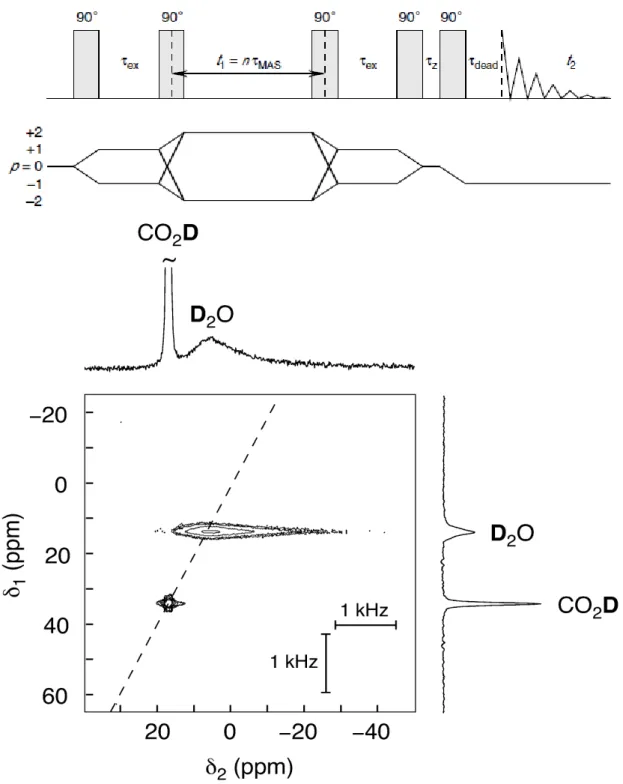
the case of 2H in a two-dimensional double-quantum MAS experiment to separate the single-quantum (SQ) spinning sideband patterns of chemically resolved deuterons, circumventing the need for selective deuteration. Broadening of the sidebands due to motions of specific deuterons can then be observed for jump rates in the 104 to 106 s−1 range [45]. This technique has been further refined to alias the SQ spinning sidebands into a single centre line by means of rotor synchronization. The resulting correlation of the SQ spectra with the DQ spectra provides a sensitive means of detecting the presence of dynamics on the μs timescale, as illustrated in Figure 14 for oxalic acid dihydrate [46]. The acid group 2H atoms are effectively static and appear as sharp lines in both SQ and DQ dimensions. The water deuterons, on the other hand, are dynamic and show a drastic broadening in the SQ dimension but a sharp line in the DQ dimension. Since the SQ static quadrupolar linewidth will be on the order of 250 kHz (much larger than a typical MAS rates) reorientational jumps on the μs timescale during the rotor period can change the SQ precession frequency by as much as 105 Hz, thereby interfering with the formation of an echo at the end of the rotor period. This reduces the echo intensity and shortens the train of rotary echoes, resulting in broadening. The static DQ linewidth with no quadrupolar broadening is likely to be only a few kHz; therefore any motional jumps will change the frequency by an amount much less than the MAS rate and there is no attenuation of the echo train, hence no broadening.
Figure 14. Two-dimensional rotor-synchronized 2H double-quantum MAS NMR.
Top: Pulse sequence and coherence pathways. Bottom: Spectrum of oxalic acid dihydrate-d at 9.4 T. In the double-quantum dimension both resonances are sharp,
whereas in the single-quantum dimension the D2O resonance is broadened by
dynamics. Reproduced from reference 46 with permission from Elsevier.
This particular technique can be more sensitive to certain types of motion than the static linewidth experiments described in Section 2.1. For example, the SQ-DQ correlation for hydroxyl-clinohumite (4Mg2SiO4.Mg(OD)2) at 314 K shows a SQ linewidth of 524 Hz and a DQ linewidth of only 77 Hz, indicative of dynamics on the μs timescale [47]. However, static 2H lineshape studies showed little indication of any motion in this system. This can be rationalized in terms of the motional geometry, which involves a re-orientation of the 2H EFG tensor by 177°. Since this is very close to 180° its effect on the static lineshape was very small, but the motion was clearly detected via the dynamic broadening of the spinning sidebands in the MAS experiment.
A similar phenomenon has been observed when comparing SQ and DQ linewidths for 14N in indirectly-detected 1H-14N HMQC type experiments [48]. The tripeptide Ala-Ala-Gly contains NH and NH3+ groups which show resolved 14N resonances in the DQ 14N/1H correlation spectrum. Significant broadening of the NH
3+ resonance occurs in the single-quantum dimension, while it remains sharp in the DQ spectrum, once again indicating motion, this time on the 100 ns timescale due to the larger quadrupolar linewidth of 14N.
6.2 MQMAS and STMAS experiments.
The now-common MQMAS technique [49] in the case of spin I = 3/2 nuclei correlates SQ central transitions (+1/2 ↔ −1/2) with triple quantum (TQ) transitions (+3/2 ↔ −3/2). In the two-dimensional spectra obtained the δ1= 3δ2diagonal represents the position of the isotropic chemical shift. Resonances with zero quadrupolar coupling will appear on this diagonal, whereas, in the absence of motion or when motions are slower than the Larmor frequency, those with non-zero couplings are shifted off the
reduced value corresponding to the effective averaged coupling for anisotropic motion. Consequently, if the off-diagonal peaks are observed to move towards the diagonal as temperature increases, or if the peak is closer to the diagonal than expected based on a known coupling constant, this is clear evidence of very rapid dynamics.
This is illustrated in Figure 15 for 11B MQMAS of the low temperature orthorhombic phase of the pseudo-spherical molecule ortho-carborane (C2B10H12) [26]. The B and C atoms form an icosahedron, but the presence of the two C atoms (in this case adjacent to each other) reduces the true symmetry, and consequently there are four chemically distinct types of B, though the peaks for two of these overlap. The MQMAS spectra show that the off-diagonal resonances move towards the diagonal as the temperature is increased (most evident by comparing the spectra at 223 K and 253 K). In fact, by 253 K the peak for B(9,12) lies directly on the diagonal, indicating an effective averaged coupling constant of zero, while the remaining peaks are still off-diagonal. This implies that the molecule is undergoing very rapid anisotropic motion. The room temperature cubic phase of this material behaves as a plastic crystal, and although MQMAS gave no signals from this phase, a triple-quantum (TQ) 11B-1H MAS correlation experiment demonstrated that all the B atoms undergo very rapid isotropic averaging, since the TQ shifts are all three times larger than the SQ 11B shifts observed in a routine 1H-decoupled MAS spectrum.
Figure 15. 1H-decoupled 11B MQMAS NMR of ortho-carborane in its low
temperature orthorhombic phase as a function of temperature. The dashed line indicates the δ1 = 3δ2 diagonal. Reproduced from reference 26 with permission
from Elsevier.
order broadening, but to our knowledge no clear experimental example corresponding to a single activated process is yet available.
For certain jump rates STMAS spectra can be subject to significant dynamic broadening, while the MQMAS spectra for the same material do not appear to suffer any line broadening effects. Examples can be seen in the 17O spectra of hydroxyl-chondrodite and hydroxyl-clinohumite [51,52] where proton hopping motions affect the 17O, and in the 27Al spectra of AlPO-14 materials [53] where calcined-dehydrated AlPO-14 shows sharp spectra but AlPO-14 as-prepared with isopropylamine shows strong broadening in only the STMAS spectra (Figure 16). The explanation for this behavior is similar to that given above for the 2H DQ experiments, where the SQ dimension is subject to the first-order quadrupolar interaction, and fast dynamic jumps interfere with the averaging of this interaction by MAS. In STMAS the satellite transition is subject to the first-order quadrupolar interaction but the STMAS CT transition and both the TQ and CT transitions in MQMAS are not.
Figure 16. Isotropic projections of 27Al MQMAS (TQ) and STMAS spectra of
calcined-dehydrated AlPO-14 (a,b) and AlPO-14-as-prepared with isopropylamine template (c,d), showing dynamic broadening in the STMAS spectrum (d). Reproduced with permission from reference 53. Copyright 2006 American Chemical Society.
7. Concluding Remarks
Quadrupolar NMR plays a vital role in the study of molecular and ionic dynamics in solids, often providing extensive information which cannot be obtained by other techniques, and which is important for understanding the physical properties of materials.
(a)
(b)
(c)
(d)
shift. This article has presented an overview of the current state of this area of research, and with much effort currently focused on the development of solid-state NMR of quadrupolar nuclei there will no doubt be numerous new instances of dynamic effects and new ways of probing them.
References
[1] Abragam A., The Principles of Nuclear Magnetism, Clarendon Press, Oxford, 1961, pp 111.
[2] Duer M.J., in Solid State NMR Spectroscopy Principles and Applications, Ed. Duer M.J., Blackwell Science, Oxford, 2002, Chp.6.
[3] Tycko R., in Nuclear Magnetic Resonance Probes of Molecular Dynamics, Ed. Tycko R., Kluwer Academic, Dordrecht, 1994, Chp.1
[4] Ratcliffe C. I., in “NMR Crystallography”, Eds. Harris R. K., Wasylishen R. E. and Duer M. J., John Wiley & Sons Ltd, Chichester, UK, (2009), Chp.24, 355-373 (also appears as emrstm 1040).
[5] Batchelder L.S., Deuterium NMR in Solids, Encyclopedia of Magnetic Resonance, Wiley, vol. 3, (1996) pp. 1574
[6] Meirovitch E. and Freed J.H., Chem. Phys. Lett. 64 (1979) 311-316 [7] Vold R.L. and Hoatson G.L., J. Magn. Reson. 198 (2009) 57-72
[8] Kristensen J.H., Bildsøe H., Jakobsen H.J. and Nielsen N.C., J. Magn. Reson. 100 (1992) 437-443
[9] Maricq M.M. and Waugh J.S., J. Chem. Phys. 70 (1979) 3300-3333
[10] Huang Y., Vold R.L. and Hoatson G.L., J. Chem. Phys. 124 (2006) 104504 [11] Larsen F.H., Jakobsen H.J., Ellis P.D. and Nielsen N.C., Chem. Phys. Lett. 292 (1998) 467-473
[12] Vugmeyster L., Ostrovsky D., Ford J.J. and Lipton A.S., J. Am. Chem. Soc. 132 (2010) 4038-4039
[13] Torchia D.A. and Szabo A., J. Magn. Reson. 49 (1982) 107-121 [14] Hoatson G.L., J. Magn. Reson. 94 (1991) 152-159
[15] Hoatson G.L., Vold R.L. and Tse T.Y., J. Chem. Phys. 100 (1994) 4756-4765 [16] Spiess H.W., J. Chem. Phys. 72 (1980) 6755-6762
[17] Vold R.L., Hoatson G.L., Vugmeyster L., Ostrovsky D. and De Castro P.J., Phys. Chem. Chem. Phys. 11 (2009) 7008-7012
[18] Schmidt C., Wefing S., Blumich B. and Spiess H.W., Chem. Phys. Lett. 130 (1986) 84-90
[19] O’Dell L.A., Prog. Nucl. Magn. Reson. Spec. DOI: 10.1016/j.pnmrs.2011.04.001 [20] Pratum T.K. and Klein M.P., J. Magn. Reson. 81 (1989) 350-370
[21] O’Dell L.A. and Ratcliffe C.I., Chem. Commun. 46 (2010) 6774-6776 [22] Hill E.A. and Yesinowski J.P., J. Chem. Phys. 107 (1997) 346-354
[23] Wasylishen R.E., Pettitt B.A. and Jeffrey K.R., J. Chem. Phys. 74 (1981) 6022-6026 [24] Kristensen J.H. and Farnan I., J. Chem. Phys. 114 (2001) 9608-9624
[25] Schurko R.W., Wi S. and Frydman L., J. Phys. Chem. A 106 (2002) 51-62 [26] Kurkiewicz T., Thrippleton M.J. and Wimperis S., Chem. Phys. Lett. 467 (2009) 412-416
[27] Kristensen J.H. and Farnan I., J. Magn. Reson. 158 (2002) 99-125 [28] Larsen F.H., J. Magn. Reson. 171 (2004) 293-304
[29] Witschas M., Eckert H., Freiheit H., Putnis A., Korus G. and Jansen M., J. Phys. Chem. A 105 (2001) 6808-6816
[30] Ba Y., Ripmeester J.A. and Ratcliffe C.I., Can. J. Chem. (2011) in press
[31] Wittebort R.J., Usha M.G., Ruben D.J., Wemmer D.E. and Pines A., J. Am. Chem. Soc. 110 (1988) 5668-5671
[32] Moudrakovski I.L., Ratcliffe C.I. and Ripmeester J.A., J. Am. Chem. Soc., 123 (2001) 2066-2067.
[33] Witschas M.and Eckert H., J. Phys. Chem. A 103 (1999) 10764-10775 [34] Kim N. and Grey C.P., Science 297 (2002) 1317-1320
[35] Hampson M.R., Hodgkinson P., Evans J.S.O., Harris R.K., King I.J., Allen S. and Fayon F., Chem. Commun. (2004) 392-393
98-[39] Böhmer R., Jeffrey K.R. and Vogel M., Prog. Nucl. Magn. Reson. Spec. 50 (2007) 87-174
[40] Brinkmann D., Mali M., Roos J., Messer R. and Birli H., Phys. Rev. B 26 (1982) 4810-4825
[41] Xu Z. and Stebbins J.F., Science 270 (1995) 1332-1334
[42] Bloembergen N., Purcell E.M. and Pound R.V., Phys. Rev. 73 (1948) 679-712 [43] Wilkening M. and Heitjans P., Solid State Ionics 177 (2006) 3031-3036
[44] Cahill L.S., Kirby C.W. and Goward G.R., J. Phys. Chem. C 112 (2008) 2215-2221 [45] Duer M.J. and Stourton C., J. Magn. Reson. 129 (1997) 44-52
[46] Cutajar M., Ashbrook S.E. and Wimperis S., Chem. Phys. Lett. 423 (2006) 276-281 [47] Griffin J.M., Miller A.J., Berry A.J., Wimperis S. and Ashbrook S.E., Phys. Chem.
Chem. Phys. 12 (2010) 2989-2998
[48] Cavadini S., Abraham A., Ulzega S. and Bodenhausen G., J.Am. Chem. Soc. 130 (2008) 10850-10851
[49] Frydman L., Harwood J.S., J.Am. Chem. Soc. 117 (1995) 5367-5368
[50] Kotecha M., Chaudhuri S., Grey C.P. and Frydman L., J. Am. Chem. Soc., 127 (2005) 16701-16712.
[51]Ashbrook S.E., Antonijevic S., Berry A.J. and Wimperis S., Chem. Phys. Lett., 364 (2002) 634-642.
[52] Griffin J.M., Wimperis S., Berry A.J., Pickard C.J. and Ashbrook S.E., J. Phys. Chem., 113 (2009) 465-471.
[53] Antonijevic S., Ashbrook S.E., Biedasek S., Walton R.I., Wimperis S. and Yang H., J. Am. Chem. Soc., 128 (2006) 8054-8062.
Brief biographies:
Luke A. O’Dell received his PhD from the University of Warwick, UK, in 2007. He subsequently carried out post-doctoral research in solid-state NMR with Prof. Mark Smith (Warwick) and Prof. Robert Schurko (University of Winsdor, Ontario, Canada), before joining the Steacie Institute for Molecular Sciences (NRC Canada) in 2009 as a
Research Associate. His current interests lie primarily in the development of solid-state NMR techniques for insensitive quadrupolar nuclei, particularly 14N.
Christopher Ian Ratcliffe. b 1951. B.Sc.(Hons.), 1972, Ph.D., 1975, University of Durham, UK. Trained in solid state NMR during post-doctoral work (University of British Columbia), and as a Research Associate at the National Research Council of Canada. He joined NRC in 1982 where he is currently a Senior Research Officer and leader of the Materials Structure and Function Program. Approx. 257 publications. Current research focus: hydrogen storage materials, nanoporous materials, nanoconfinement, applications of 129Xe NMR, order/disorder and dynamics in solids, host-guest materials, clathrate hydrates.
Contact Information : Luke O’Dell Phone: 1-613-990-1566 Email: [email protected] Chris Ratcliffe Phone : 1-613-991-1240; FAX : 1-613-998-7833 Email: [email protected]
Keywords: dynamics, quadrupolar nuclei, electric field gradients, reorientation, translation, MQMAS, STMAS