VII. ATOMIC BEAMS
Prof. J. R. Zacharias D. D. Babb D. S. Edmonds, Jr. Prof. J. G. King V. J. Bates E. P. Hilar
Prof. G. W. Stroke H. H. Brown, Jr. C. L. Searle Dr. R. F. C. Vessot B. DiBartolo R. Weiss
A. X-BAND MEASUREMENT OF ATMOSPHERIC REFRACTIVE INDEX FLUCTUATION
1. Design
Nonhomogeneity of the atmosphere caused by variations in temperature, pressure, and so forth, produces variations in refractive index over a microwave transmission path. Since the refractive index is the ratio of the velocity of light in vacuum to that in a given medium, the variations in refractive index are equivalent to velocity changes, and hence to changes in the electrical path length of the transmission link.
In the measurement of the gravitational red shift proposed by Professor J. R. Zacharias (1) of the Research Laboratory of Electronics, M. I. T., the frequency of a cesium clock located at the top of a mountain is to be compared with the frequency of a second cesium clock at the bottom of the mountain. To compare the frequencies of these two clocks, an X-band communication link will transmit a signal from the clock on top of the mountain to the bottom of the mountain, a distance of approximately one mile. Any variations in path length of the X-band communication link between the two clocks will, therefore, introduce errors in the final data. The development of an elec-tronic system to measure these variations in path length constitutes the major part of this report. The path-measuring system will start recording variations in path length at the beginning of the red-shift experiment, will run concurrently with the red-shift equipment for one week, and then will dictate the precise time for stopping the run -the time when -the path length is exactly as it was at -the beginning of -the experiment.
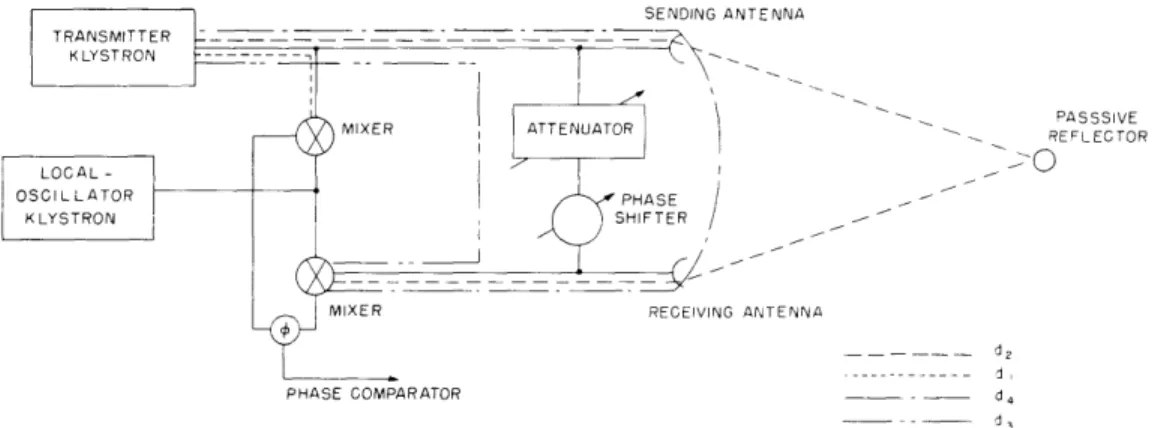
An X-band cw system has been developed to measure these atmospherically-caused variations in path length. The measurement is accomplished by recording the change in phase of a frequency-stabilized X-band signal transmitted over the path. To elimi-nate secondary communication links, and to keep all of the electronic equipment at one end of the link, a two-way system is used with a passive reflector at the isolated end (Fig. VII-1).
2. Error Evaluation
The desired phase information is obtained by comparing the transmitted signal with the signal returned from the passive reflector. Any changes in transmitter frequency
This research was supported in part by Purchase Order DDL-B222 with Lincoln Laboratory, which is supported by the Department of the Army, the Department of the Navy, and the Department of the Air Force under Contract AF 19(122)-458 with M. I. T.
SENDING ANTENNA
TRANSMITTER
--KLYSTRON
-PASSSIVE
MIXER ATTENUATO REFLECTOR
LOCAL- / ''O
OSCILLATOR PHASE
KLYSTRONi SHIFTER /
MIXER RECEIVING ANTENNA
PHASE COMPARATOR - d4
Fig. VII-1. Path-measuring system.
will cause a phase error in the measuring system. The magnitude of this phase error
p is given by
P d= -d1)cycles
where Sr is the frequency stability (fl - fo)/f 1; d2, d1 are the microwave path lengths of the transmitted and reference signals in meters; and NI is the wavelength of operation
corresponding to frequency fl.
A major difficulty in any cw system is the problem of spillover, the leakage of transmitted energy directly into the receiving antenna. The magnitude of this spillover signal is completely determined by the physical configuration of the transmitting and receiving antennas. Therefore, it dictates a large separation to reduce the spillover signal level to a value well below that of the received signal level. However, widely separating the antennas introduces an error in the two-way measurement, since the transmitted path is no longer identical with the reflected signal path. The data taken in the refractive-index and path-difference measurements (2, 3) brought out that the atmosphere is made up of random bunches of air of different refractive-index values. As the path separation increases, the probability of seeing the same inhomogeneous path decreases. These results dictate a close spacing of the transmitting and receiving antennas to minimize path discrepancies. In this path-measuring system the receiving and transmitting antennas, both 30-inch parabolic dishes, were mounted 5 feet apart; the receiving antenna was mounted approximately 0. 5 feet ahead of the transmitting antenna. The measured value of the spillover level for this physical configuration was
55 db down from the transmitted signal level, the reference level. As the received signal was expected to be 75-85 db down from the reference level, a spillover balancing
(VII. ATOMIC BEAMS)
In a spillover balancing system, an amount of transmitted signal is added to the received signal line, with the correct amplitude and phase to cancel the spillover signal. How-ever, if the transmitter frequency changes, this balancing technique will also introduce a phase error into the phase-measuring system. The magnitude of this phase error,
sp, was found to be
=sp - cycles
s
where y is the spillover signal level r is the received signal level
S is the transmitter frequency stability r
X is the wavelength of operation
d3 is the microwave path of the spillover balance signal d4 is the microwave path of the spillover signal.
To satisfy the stability requirements, the transmitter klystron was phase-locked to a 1-mc crystal oscillator (Fig. VII-2, Part A), in order to transfer the frequency stability of the 1-mc reference oscillator to the transmitter signal (4). Phase-locking the local-oscillator klystron to the same 1-mc reference oscillator permitted the use of low-frequency i-f amplifiers with virtually no frequency variations that would produce differential phase errors.
A block diagram of the complete path-measuring system is shown in Fig. VII-2. The reference oscillator for the phase-locking is a 1-mc Bureau of Standards oscillator with a stability of 1 x 10- 9 per day, and 1 X 10- 8 per week (5).
The maximum phase error caused by this degree of frequency stability is given by the sum of the two errors, p and sp. Hence
p s
S -
]
freq = (d - d) + -(d 4 - d3) cycles
freq 7 r 4 3
-8
For a frequency of 9190 mc, Sr 1 X 10 8
,
and with a spillover-to-signal ratio, y/r , equal to 320/18, we havefreq = 1. 105 X 10- 8 [(d2 - dl) + 17. 8 (d4 - d3)] degrees
However, temperature changes in the waveguide introduce a phase error in the path-measuring system. This error has been calculated as
temp
AT
1 + 2 2 cyclesK 99MT 9190 MC CRYSTALI AL MAGCIC 990MC 91903MC 2
TRANSMITTER * 0 5MC - C RSALILCA-OCIL ER EE
TRANSMITTER TEE MULTIPLIER MULTIPLIER TEE LOCAL-OSCILLATOR
KI YRTPAN II QTDAt A
(VII. ATOMIC BEAMS)
where AT is the temperature change in 'C
t is the thermal coefficient of expansion for brass d is the waveguide length
b is the waveguide width
X and X are the free-space and waveguide wavelengths, respectively. p
For the frequency of operation and the given experimental system, this error is
T = 2. 85 X 10- 3 AT(d 5 - dl) degrees
where d5 is the waveguide path of the transmitted and received signals, and d1 is the waveguide path of the reference signal.
The phase shift caused by a temperature change in the waveguide will also cause a
phase error in the spillover balance system, which is given by
-3
4T (d
5 - d3)(2. 85 AT X 10
- ) degrees 2 rs
where d5 is the waveguide path of the transmitted and received signals, d3 is the wave-guide path of the spillover balance signal, y is the spillover signal level, and rs is the received signal level.
In setting up an experimental system, therefore, the microwave paths dl and d3 should be made equal to d5 to minimize temperature-variation errors.
3. System Feasibility Test
Ideally, this system should be tested by measuring the path variations under the exact conditions imposed by the red-shift experiment. Unfortunately, this is beyond the scope of the present investigation. Also, there is no distant target, sufficiently
stationary and uncluttered for use as a reflector, which can be seen by the antennas in their present location. Therefore, to provide a means of checking the ability of the system to measure path variations, a passive reflector, which was 150 feet from the antennas, was continuously moved back and forth five inches. The only change brought about in the system by this shortening of the path was an increase in the received signal level.
The data taken in a typical run (Fig. VII-3) show the ability of the system to meas-ure electronically the physical movement of the reflector. The abrupt changes in the data (Fig. VII-3a) are caused by reversing the reflector mount. This test was con-ducted at a transmitter frequency of 9190. 5 me. The data show that there are approxi-mately 7. 75 cycles between the reversing points, or a physical path-length change of
10 inches. Since the system measures twice the actual physical movement of the reflector, these data check.
Fig. VII-3.
Electronic measurement of the physical
movement of the reflector.
r ~x>~v
~p4±-pz~±±f±±ipj--- 1 1'Fig. VII-4.
Measurement of unbalanced spillover signal (windy conditions).
Fig. VII-4.
Measurement of unbalanced spillover signal (windy conditions).
Fig. VII-5.
Measurement of unbalanced spillover
signal (calm wind conditions).
180. peak to peak
ISO' peak to peaP I-7 _7j
\AA
I-
A
VAL!
A
- - - I-~-- --- i i i 7 1 r i i i r~_f_~f_~t-_r r r I _1 .____T _ 4 4 --t-:1 "- I - If~~f-~t--t;t-t-(VII. ATOMIC BEAMS)
There is a slight faltering in the motor drive that occurs at approximately one-third of the distance from the switch point in the reverse direction only. This hesitation, barely perceptible to the eye, shows up quite well in the data. (See Fig. VII-3b.)
During the test it became apparent that the spillover signal was varying. To ascertain the cause of these variations, two runs were made on the phase of the unbalanced spillover signal. A phase shifter in the local-oscillator line to the received signal mixer was used to calibrate the measurement. The sinusoidal variations in the data (Fig. VII-4) are caused by this phase shifter and represented a 180' peak-to-peak
phase change.
The first run, made while a high gusty wind was blowing, shows a variation in phase of approximately 300. The amplitude variations of the spillover signal were monitored at the same time, but they showed a variation of less than 1 db. The second run was taken in relatively calm wind conditions, the variations in phase being of much smaller magnitude. (Note the effect of the zero drift in the dc amplifier in the data of Fig. VII-5, which can be seen by the shift in the calibration-signal location.) From the data taken on the spillover signal variation, it can be seen that the antennas are not
mounted sturdily enough. For the red-shift experiment, the two antennas will have to be imbedded in a mudbank, a concrete block, or similar material to minimize any physical motion. When the antennas are mounted, the spillover signal could be reduced by taking advantage of small depressions in the terrain, and so on.
Under somewhat idealized conditions, that is, without wind and with constant tem-perature, the system constructed for the feasibility test can measure path variations with an accuracy of 1° or 2' of phase at a frequency of 9192 mec. With sturdier antenna mounts, and not too stringent requirements on microwave path lengths, the experimental system described in this report can be used to measure the path variations of an X-band link with an accuracy of 50 of phase at a frequency of 9192 mc, with a 400 C temperature change and reasonable wind conditions.
V. J. Bates
References 1. J. R. Zacharias, private communication, 1956.
2. G. Birnbaum and H. E. Bussey, Amplitude, scale, and spectrum of refractive index inhomogeneities in the first 125 meters of the atmosphere, Proc. IRE 43,
1412-1418 (1955).
3. J. W. Herbstreit and M. C. Thompson, Measurements of phase over transmission paths with electrical lengths varying due to atmospheric turbulence, Proc. IRE 43,
1391-1401 (1955).
4. C. L. Searle and D. D. McRae, Stabilization of klystrons by phase locking to low-frequency quartz crystal oscillators, Quarterly Progress Report, Research Labora-tory of Electronics, M. I. T., April 15, 1956, p. 37.