HAL Id: hal-02381712
https://hal.archives-ouvertes.fr/hal-02381712
Submitted on 26 Nov 2019
HAL is a multi-disciplinary open access archive for the deposit and dissemination of sci-entific research documents, whether they are pub-lished or not. The documents may come from teaching and research institutions in France or abroad, or from public or private research centers.
L’archive ouverte pluridisciplinaire HAL, est destinée au dépôt et à la diffusion de documents scientifiques de niveau recherche, publiés ou non, émanant des établissements d’enseignement et de recherche français ou étrangers, des laboratoires publics ou privés.
Chitosan for direct bioflocculation of wastewater
Eric Lichtfouse, Nadia Morin-Crini, Marc Fourmentin, Hassiba Zemmouri,
Inara Oliveira Do Carmo Nascimento, Luciano Matos Queiroz, Mohd Yuhyi
Tadza, Lorenzo Picos-Corrales, Haiyan Pei, Lee D Wilson, et al.
To cite this version:
Eric Lichtfouse, Nadia Morin-Crini, Marc Fourmentin, Hassiba Zemmouri, Inara Oliveira Do Carmo Nascimento, et al.. Chitosan for direct bioflocculation of wastewater. Environmental Chemistry Letters, Springer Verlag, 2019, 17 (4), pp.1603 - 1621. �10.1007/s10311-019-00900-1�. �hal-02381712�
Environmental Chemistry Letters (2019) 17:1603– 1621 https://doi.org/10.1007/s10311-019-00900-1 Revised version
Chitosan for direct bioflocculation of wastewater
Eric Lichtfouse1 · Nadia Morin‑Crini2 · Marc Fourmentin3 · Hassiba Zemmouri4 ·
Inara Oliveira do Carmo Nascimento5 · Luciano Matos Queiroz5 · Mohd Yuhyi Mohd Tadza6 ·
Lorenzo A. Picos‑Corrales7 · Haiyan Pei8 · Lee D. Wilson9 · Grégorio Crini2
Abstract
Coagulation/flocculation is a major phenomenon occurring during industrial and municipal water treatment to remove suspended particles. Common coagulants are metal salts, whereas flocculants are synthetic organic polymers. Those mate-rials are appreciated for their high performance, low cost, ease of use, availability and efficiency. Nonetheless, their use has induced environmental health issues such as water pollution by metals and production of large amounts of sludges. As a consequence, alternative coagulants and flocculants, named biocoagulants and bioflocculants due to their biological origin and biodegradability, have been recently developed for water and wastewater treatment. In particular, chitosan and chitosan-based products have found applications as bioflocculants for the removal of particulate and dissolved pollutants by direct bioflocculation. Direct flocculation is done with water-soluble, ionic organic polymers without classical metal-based coagulants, thus limiting water pollution. Chitosan is a partially deacetylated polysaccharide obtained from chitin, a biopolymer extracted from shellfish sources. This polysaccharide exhibits a variety of physicochemical and functional properties resulting in numerous practical applications. Key findings show that chitosan removed more than 90% of solids and more than 95% of residual oil from palm oil mill effluents. Chitosan reduced efficiently the turbidity of agricultural wastewater and of seawater, below 0.4 NTU for the latter. 99% turbidity removal and 97% phosphate removal were observed over a wide pH range using 3-chloro-2-hydroxypropyl trimethylammonium chloride grafted onto carboxymethyl chitosan. Chitosan also removed 99% Microcystis aeruginosa cells and more than 50% of microcystins. Here, we review advantages and drawbacks of chitosan as bioflocculant. Then, we present examples in water and wastewater treatment, sludge dewatering and post-treatment of sanitary landfill leachate.
Keywords Chitosan · Bioflocculant · Direct bioflocculation · Wastewater treatment · Sludge dewatering
Introduction
Coagulation and flocculation are two frequently applied pro-cesses in the water treatment industry for solids removal, water clarification, drinking water treatment, decontami-nation of wastewaters, removal of target substances, i.e., phosphates, oils, color and odor, solids dewatering, sludge thickening and lime softening (Bratby 2006; Oladoja 2015; Morin-Crini and Crini 2017; Wei et al. 2018). Other appli-cations include the recovery of valuable products such as
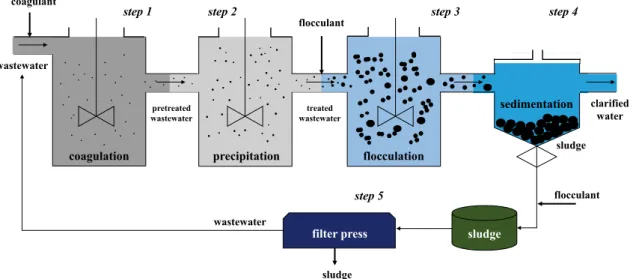
proteins and microalgae. Coagulation and flocculation involve chemical reagents to facilitate the removal of sus-pended and colloidal particles, this is often the first stage of solid–liquid separation in a wastewater treatment plant, named the pre-treatment step. Nonetheless, the coagula-tion–flocculation process can also be applied as a main treatment or even as a post-treatment. During wastewater treatment, coagulation and flocculation occur in two main successive steps (Fig. 1), namely a destabilization step and an aggregation step, respectively (Bratby 1980; Cox et al.
2007). These processes combine insoluble particles, e.g. sol-ids and colloe.g. sol-ids, dissolved organic matter, organics, inor-ganics and microorganisms into large aggregates, thereby facilitating their removal in subsequent sedimentation and filtration stages (Bratby 2006; Vajihinejad et al. 2019). Coagulation/flocculation is also a major phenomenon in
* Eric Lichtfouse
[email protected] * Grégorio Crini
sludge dewatering. Actually, sludges are a major challenge for the water treatment industry, in particular the minimiza-tion of sludge volume. Sludge dewatering separates sludge into liquid and solid components, aiming at waste minimiza-tion and cost efficiency for disposal or recycling.
There are actually two major classes of commercial chemicals for coagulation and flocculation: (1) inorganic and organic coagulants such as mineral additives, hydrolyz-ing metal salts, pre-hydrolyzed metals and polyelectrolytes; and (2) organic flocculants including cationic and anionic polyelectrolytes, nonionic polymers, amphoteric and hydro-phobically modified polymers, and naturally occurring floc-culants (Bratby 2006; Bolto and Gregory 2007). Coagulation is mainly induced by metal salts. Common metal coagulants fall into two categories: aluminum and iron. The most com-mon coagulants are aluminum sulfate, generally known as alum, polyaluminum chloride (PAC), ferric chloride, fer-ric sulfate and polyferfer-ric sulfate (PFS). Their cations con-tribute to colloidal destabilization because they specifically interact with and neutralize negatively charged colloids (Stechemesser and Dobiáš 2005; Bratby 2006). Their suc-cess arises not only from their effectiveness but also from their availability and low cost. Flocculants are classified into polymeric inbased materials and polymeric organic-based materials. Noteworthy, polyelectrolyte flocculants are in general linear or branched organic macromolecules. These materials can be synthetic or of natural origin. Synthetic macromolecules are produced using various monomers such
as acrylamide, acrylic acid or dimethyldiallylammonium chloride. Naturally occurring polymers include starches, celluloses, alginates, gums and other plant derivatives (Lev-ine 1981). The main flocculants used in industrial applica-tions are polyacrylamide-based products such as nonionic polyacrylamides, anionic acrylamide–acrylate copolymers, partially hydrolyzed polyacrylamides, cationic lylammonium chlorides and copolymers of the dimethyldial-lylammonium ion with acrylamide. Their main advantage is their ability to produce large, dense, compact flocs that are stronger and have good settling characteristics compared to those obtained by coagulation. Polymeric organic flocculants are also easy to handle and immediately soluble in aqueous systems. They reduce the sludge volume.
Nonetheless, the use of synthetic coagulants and floccu-lants poses environmental and health issues. For instance, the major issues are production of large volumes of toxic sludge, low biodegradability, pollution of water by met-als, which may threaten human health, e.g. aluminum salts are connected to Alzheimer’s disease, and dispersion of acrylamide oligomers, which is a health hazard because the acrylamide monomer is carcinogenic and neurotoxic to humans (Salehizadeh et al. 2018). For these reasons, alternative natural materials, named biocoagulants and bioflocculants, have been developed for wastewater treat-ment (Crini et al. 2019). In particular, chitosan, a partially deacetylated polysaccharide obtained from chitin, deserves particular attention. Chitosan is an amino-polysaccharide, coagulation sedimentation flocculation precipitation wastewater sludge clarified water pretreated
wastewater wastewatertreated flocculant coagulant
filter press sludge
sludge wastewater flocculant . . . . . . . . . . .. . . . . . . . . . . . . . . . . . . . . . . . . .. . . . . . ... . . . . . . .. . . . . . . . . . . . . . . . . . . . . . ... . ........
.
..
..
..
.
step 4 step 3 step 2 step 1 step 5Fig. 1 The coagulation/flocculation process in a physicochemical wastewater treatment plant. In the first step, an inorganic coagulant such as a metal salt is first added (step 1) to alter the physical state of dissolved and suspended solids, in order to induce complex pre-cipitates of metal hydroxides at the desired pH (step 2: precipitation), and to facilitate sedimentation (step 4). This is followed by the
addi-tion of coagulant aids or flocculants (step 3) to enhance the treat-ment efficiency and seditreat-mentation rate by mechanical aggregation of micro-flocs into visible, dense and rapid settling flocs. The filter press (last step 5) is an equipment allowing to filtrate sludge under pressure in order to separate the liquid (filtrate) and the solid phase (the cake)
it is non-toxic, biocompatible, biodegradable and classified as a green product (Morin-Crini et al. 2019). The cationic biopolymer chitosan has also drawn particular attention as a flocculating agent for application in water industries due to its eco-friendly character, low cost and outstanding performances.
From the end of the 2000s, Crini’s group proposed direct bioflocculation using low-cost chitosan as a novel approach to treat wastewater from pulp and paper plant (Crini et al.
2009a, b; Renault et al. 2009a, b, c, d). Their results indeed demonstrated that chitosan combines both functions of coag-ulation and flocccoag-ulation during industrial wastewater treat-ment. Crini thus spoke of two-in-one materials (Crini and Badot 2007; Crini et al. 2009a, b). Several recent reviews have demonstrated that direct bioflocculation is an effective and competitive approach, and that chitosan is a promis-ing bioflocculant for environmental and purification pur-poses (Chong 2012; Lee et al. 2014; Crini 2015; Bhalkaran and Wilson 2016; Laamanen et al. 2016; Yang et al. 2016; Kanmani et al. 2017; Ummalyma et al. 2017; Wang and Zhuang 2017; Desbrières and Guibal 2018; Pakdel and Pei-ghambardoust 2018; Song et al. 2018; Salehizadeh et al.
2018, Van Tran et al. 2018; Crini et al. 2019; Vidal and Moares 2019).
In this review, after a brief description of the main advan-tages and possible disadvanadvan-tages of using chitosan as a bio-flocculant, we highlight key results on chitosan applications such as water and wastewater treatment, sludge dewatering and post-treatment of sanitary landfill leachate. This article is an abridged version of the chapter published by Lichtfouse et al. (2019) in the series Sustainable Agriculture Reviews.
Application of chitosan as bioflocculant
Coagulation–flocculation versus direct flocculationPolymeric flocculants, especially cationic polymers, can be used for direct flocculation because they possess dual func-tions of coagulation and flocculation, i.e., neutralizing the negative charges and bridging aggregated destabilized par-ticles. Indeed, direct flocculation, i.e., without addition of coagulants, but using ionic polymers, offers the possibility to completely replace inorganic coagulants by water-soluble organic polymers in chemical pre-treatment, main treatment, or post-treatment. The selection between conventional coag-ulation–flocculation and direct flocculation is highly depend-ent on the type of wastewater. In general, the applications of direct flocculation using solely polymeric flocculants are mostly limited to organic-based wastewater containing high concentration of suspended and colloidal solids, such
as food, paper and pulp and textile effluents (Morin-Crini et al. 2019). Soros et al. (2019) recently proposed chitosan for turbidity reduction in drinking water to reduce microbes and organic matter. The authors concluded that chitosan is promising for turbidity reduction in low-resource settings, if chitosan treatment is combined with sedimentation and filtration.
Direct bioflocculation using chitosan
During the last two decades there has been a fast rise in the use of chitosan as bioflocculant, and in the development of new chitosan-based materials, e.g., grafted chitosans, composites and hybrid materials, for direct bioflocculation processes. The main potential applications are in water and wastewater treatment, sludge dewatering and harvesting of microalgae, and dissolved air flotation (Chong 2012; Lee et al. 2014; Yang et al. 2016; Morin-Crini et al. 2019; Vidal and Moares 2019). Table 1 describes the main char-acteristics and properties of chitosan applied to floccula-tion. Table 2 presents the main disadvantages of chitosan as bioflocculant.
Mechanism
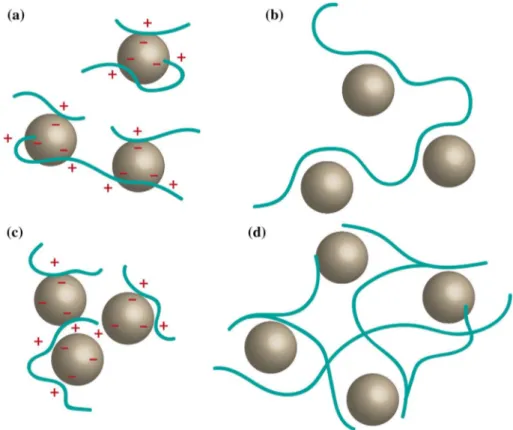
Similar to classical flocculation, bioflocculation by chi-tosan involves combining insoluble particles and dis-solved organic matter into larger aggregates, which can be then removed in subsequent sedimentation and filtration stages (Morin-Crini et al. 2019; Vidal and Moares 2019). Chitosan chains first destabilize suspended and colloi-dal particles in wastewater by forming micro-flocs in the coagulation step. Micro-flocs are then aggregated in the flocculation step, which requires an agitation that induces particles to clump, thus allowing solid removal in sub-sequent stages. The mechanism (Fig. 2) is mainly driven by charge neutralization and bridging mechanisms. Other mechanisms such as electrostatic patch and sweeping, adsorption, entrapment, complexation, chelation and pre-cipitation may also contribute to bioflocculation. Charge neutralization refers to the interaction of two particles with opposite charged ions, whereas sweep flocculation entails the enmeshment of particles in a growing precipitate. Polymer chains agglomerate particles by inter-particle bridging. This phenomenon involves the adsorption of particles onto polymer chains by forming particle–poly-mer–particle complexes. The loops and tails of adsorbed polymer chains protrude and attach to other particles in the aqueous solution, allowing bridging of particles. This explains that chitosan has the ability to enhance dis-solved pollutant removal such as metal ions. Electrostatic
patching is caused by the interaction of polymer chains of high charge density with oppositely-charged colloi-dal particles of low charge density. A polymer-colloicolloi-dal particle patch can then attach another colloidal particle if their charges are opposite. Overall, chitosan forms a bulky precipitate that enmeshes colloidal particles, this is the sweeping mechanism. These particles are then set-tled out or they flocculate together with the precipitate (Stechemesser and Dobiáš 2005; Abebe et al. 2016).
Chitosan for direct bioflocculation: potential
applications
Palm oil mill effluents
The main challenge of palm oil-producing countries is the production of palm oil mill effluents in large amounts. In Malaysia alone, approximately 50 to 75 million tons of Table 1 Properties of chitosan for flocculation-based applications
References Skjåk-Braek et al. (1989), Roberts (1992), No and Meyers (1995), Peters (1995), Goosen (1997), Kurita (1998, 2006), Ravi Kumar (2000), Domard and Domard (2001), Dutta et al. (2004), Vårum and Smidsrød (2004), Rinaudo (2006), Li et al. (2008), Crini et al. (2009a, b), de Alvarenga (2011), Sudha (2011), Nwe et al. (2011), Teng (2016), Nechita (2017), Morin-Crini et al. (2019), Vidal and Moraes (2019) Main characteristics and properties
Raw chitosan for water treatment applications: low-cost product. Chitin: is a renewable resource obtained from industrial by-products Non-toxic, biocompatible and biodegradable
Eco-friendly biopolymer; ecologically acceptable product
Linear amino-polysaccharide with high nitrogen content; weak base and powerful nucleophile Hydrophilic biopolymer with high reactivity
Reactive amino and hydroxyl groups for modification
Polyelectrolyte at acidic pH with high charge density: a polycationic biopolymer Ionic conductivity
Gelation ability, adhesivity, film-forming ability
Ability to form hydrogen bonds and other non-covalent interactions Ability to encapsulate, entrapment properties
Chelation, ion-exchange and adsorption properties
Removal of pollutants or pollutions, e.g. color, and odor, with outstanding performances Strong adsorption to negatively-charged surface of microalgae cells
Formation of salts with organic and inorganic acids Efficient against bacteria, viruses and fungi
Chitosan is less sensitive to pH changes than metal salts
Chitosan coagulates microalgae cells very effectively and produces larger flocs than polyaluminium chloride
Table 2 Drawbacks of chitosan-based bioflocculants for water and wastewater treatments applications
References No and Meyers (2000), Crini et al. (2009a, b), Renault et al. (2009a), Ujang et al. (2011), Lee et al. (2014), Yang et al. (2016), Sudha et al. (2017), Morin-Crini et al. (2019), Vidal and Moares (2019)
Technologies are still being developed: to be confirmed at scale up levels
Cost limitation: chitosan is considered cost prohibitive to purchase for use as a microalgae bioflocculant
Chitosan is not water soluble, it requires a weak acid treatment to be dissolved. Chitosan solubility depends on the degree of deacetylation and molecular weight
Variability in the chitosan characteristics and in the materials used; performances depend on type of raw chitosan, chitosan activation and chitosan-based materials
Chitosan is a very efficient flocculant but only at low pH: pH-dependent behavior
The amount used is in general high; chitosan concentration should be monitored to avoid re-stabilization. Re-stabilization is induced by an excess of cationic charges at high chitosan concentration
Possible clogging of filters at high concentration
Chitosan requires chemical modification to improve its performance, to decrease its pH sensitivity and to enlarge the field of its potential appli-cations; the efficiency depend on the functional groups grafted
Bioflocculation using chitosan is not universal to all pollutant types, e.g., it was found effective for green microalgae but gave poor results for cyanobacteria
palm oil mill effluents are produced annually (Ding et al.
2016). The effluent is a thick brownish colloidal mixture of various elements including water, oil and suspended particles (Bala et al. 2015). Freshly generated palm oil mill effluent is usually discharged between 80 and 90 °C and is acidic in nature, having an average pH value of about 4.5. This dark liquid typically contains substan-tial amounts of suspended solids, oil and grease, and shows high concentrations of biochemical and chemical oxygen demand (BOD, COD). Table 3 presents typical characteristics of raw and treated palm oil mill effluents.
Illegal discharge of raw or partially treated palm oil mill effluents into nearby water bodies or land is common and still being practiced, as this is the easiest and cheapest option for disposal (Tadza et al. 2015). However, due to stricter regulatory discharge limits and increasing environmental awareness, palm oil mill effluents are now treated prior to being discharged into the environment. Currently, integrated biological and physicochemical methods are commonly used for the treatment of raw effluents. Since the effluent is largely biodegradable, biological treatments appeared to be the most viable treatment methods. Therefore, open aerobic or anaer-obic ponding systems have been used widely. Yet, ironically, the final discharged effluents from conventional ponding sys-tems have often failed to conform to regulatory discharge limits (Rushdy et al. 2014; Bello and Raman 2017). Further-more, the lignin–tannin compounds, which are responsible
for the dark coloration of palm oil mill effluents, are recal-citrant to biological treatment and should be further treated using secondary treatments or polishing methods.
To date, the use of chitosan for the treatment of palm oil mill effluents is very limited. Chitosan and its derivatives have been found effective coagulation agents for treating Fig. 2 The bioflocculation
mechanism: a charge neutraliza-tion, b bridging, c electrostatic patching and d sweeping
Table 3 Characteristics of raw and treated palm oil mill effluents and discharge limits. COD: chemical oxygen demand; BOD: biochemical oxygen demand; TSS: total suspended solids
References Wu et al. (2010), Chan et al. (2011), MPOB (2012), Bello et al. (2013), Bala et al. (2015), Tadza et al. (2015, 2016), Saeed et al. (2016)
Parameters Unit Raw effluent Treated effluent Discharge limits pH 4.2 8.4 5.0–9.0 Temperature °C 85–90 25–30 45 COD mg/L 50,000 4500 – BOD mg/L 35,000 450 100 oil, grease mg/L 6000 – 50 TS mg/L 40,000 – 1500 TSS mg/L 18,000 130 400 NH4-N mg/L 180 20 100 PO43− mg/L 210 – – Turbidity NTU 430 100 – Color (PtCo) 32,000 250 –
both raw and treated palm oil mill effluents. For instance, Ahmad et al. (2005a, b) noted that powdered and flake chitosan is effective for the removal of solids (> 90%) and residual oil (> 95%) from palm oil mill effluents. The results showed that chitosan performed better compared to other natural absorbents such as bentonite, zeolite and activated carbon. The performance of chitosan was bet-ter than that of alum and polyaluminum chloride. The removal of residual oil and reduction in the total solid concentrations in palm oil mill effluents is pH depend-ent. The removal efficiency is lower with increasing pH. Yet, the strong acidic properties of palm oil mill effluents enhance the coagulation of the residue oil in the effluent. Under acidic conditions, chitosan induces a physicochemi-cal effect, serves as demulsifying agent and enhances the adsorption of oil and grease (Ahmad et al. 2005a). This is explained by the availability of protons, which increases the number of protonated amine groups of chitosan mol-ecules. On the other hand, adsorptive removal of heavy metals using chitosan alone has not been very successful.
Apart from raw powdered and flake chitosan, the deriva-tives of chitosan have also been used to treat palm oil mill effluents. This involves dissolving powdered chitosan with acid solutions (Ahmad et al. 2006; Torres et al. 2018). In some cases, chitosan is mixed with other oxidative chemi-cals such as ferric chloride, ferrous sulfate and hydrogen peroxide (Parthasarathy et al. 2016; Tadza et al. 2016). These investigations showed improved solids removal and significant increases in the removal efficiency of the chemi-cal oxygen demand compared to using powdered chitosan alone. For instance, chitosan coagulation coupled with hydrogen peroxide is a better alternative for the post-treat-ment of anaerobically digested palm oil mill effluents due to its improved treatment efficiency, environmental safety and availability. Although no explanation was made on the possible reasons for this observation, it is presumed that the neutral pH or the possible interaction between iron and chitosan lead to the reduction of active sites of the iron (Bello and Raman 2017).
Although chitosan has shown remarkable performances in treating palm oil mill effluents, palm oil mills have been still complaisant with ponding systems due to their simplicity and cost-effectiveness. Consequently, almost all reported chitosan studies were conducted under small-scale laboratory conditions. Feasibility studies are yet to be scaled up. Despite the potentials of chitosan, a lot of effort is thus required in upscaling to the industrial level. Another challenge is to recycle the sludge generated as a by-prod-uct of the coagulation process using chitosan. Here, Tadza et al. (2016) showed that the sludge displayed good fertility characteristics and may be considered as fertilizer or soil conditioners.
Effluents from the sugar industry
Pambi and Musonge (2015) studied the efficiency of chi-tosan as a coagulant for the treatment of the effluents from the sugar industry to remove both suspended solids, color and chemical oxygen demand. The sugar refinery consumes large amounts of water daily and approximately 47% of this water is discharged as wastewater. The treatment of effluents by chitosan was investigated under varying chitosan dos-age with a study of the effect of pH on impurity removal performance. Results show that an increase in the chitosan concentration increased the impurity removal efficiency. However, beyond an optimum coagulant concentration, no further improvement was observed. The optimum chitosan loading was 138 mg/L. The impurity content in the effluent was also found to influence the amount of chitosan loading required. High removal efficiencies were achieved under acidic conditions, due the cationic nature of chitosan. How-ever, the removal of the chemical oxygen demand was very low due to the fact that most of the matter present in the effluent was made of dissolved organics. The performance of chitosan was found to be pH dependent. For instance, the addition of sodium hydroxide raise the pH strongly decreased the performance of chitosan, due to its possible gelation under alkaline conditions. Furthermor, overdosing the coagulant destabilized the neutralized flocs and, in tun, impeded their settling. Here, the mechanism is explained as follows: first, the cationic charge of the protonated macro-molecule destabilized and neutralized the anionic charges of the impurities; second, there was a bridging of the mac-romolecules with the particles, leading to flocs formation; and finally, electrostatic patching occurs, as described above. Chitosan has thus a dual role, both as a coagulant and floc-culant, as a consequence of its charge density and relatively high molecular weight. The authors concluded that chitosan as low-cost biodegradable material is an ideal candidate to substitute conventional synthetic materials.
Agricultural wastewater
Chitosan can be an alternative for the treatment of effluents containing residual fertilizers and persistent pesticides that contaminate drinking water. As an example, organochlorines pesticides are highly hazardous and have chemical structures that are very difficult to degrade. In agriculture, there is a demand for efficient methods to be developed and applied at an industrial scale, as recently pointed out by Rani et al. (2017).
Rahmanifar and Moradi-Dehaghi (2014) tested the interaction of chitosan and permethrin, an organochlorine pesticide. Batch trials were performed at pH 7, shaking at 150 rpm for 45 min, with chitosan amounts ranging from 0.01 to 1.5 g, added to 25 mL of a 0.1 ppm permethrin
solution. The adsorption efficiency increased with adsor-bent concentration up to 0.5 g. Thereafter, increasing adsorbent concentrations did not improve substantially the removal, and nearly 50% removal was reached for dosages between 0.5 and 1.5 g. Yet, the entrapment of a model pes-ticide was markedly improved, near to 98%, using a nano-composite form of chitosan–AgO as adsorbent. In another contribution, the removal of pentachlorophenol, a common pesticide, from aqueous solutions, was assessed by compar-ing chitosan versus the modified chitosan: [chitosan-(2-hy-droxy-1-naphthaldehyde)] (Shankar et al. 2018). The effect of contact time on pesticide adsorption was studied, based on experiments in batch mode, under stirring, where 0.2 g of adsorbent was added to 200 mL of a synthetic solution con-taining the pesticide at 150 mg/L. Results showed fast initial removal, which was explained by the availability of vacant sites for adsorbent–pesticide interactions. After 60 min, the maximum adsorption capacity was almost reached for both biosorbents. The adsorption capacity exhibited by chitosan, of 24.4 mg/g at neutral pH, was enhanced by 94% using the modified chitosan. The adsorption capacity decreased by ris-ing the pH from 3.0 to 8.0, explained by higher contaminant solubility and pKa of 4.7, as well as for higher temperatures
in the range of +20–40 °C for the unmodified and modified forms of chitosan.
Model wastewaters containing the commercial pyre-throid and dithiocarbamate pesticides were treated for pes-ticide removal by employing chitosan (Ghimici et al. 2016). Results show a similar maximum removal efficiency, nearly 90%, for both pesticides. Chitosan showed good floccula-tion at low doses from 1 to 3.4 mg/L for α-cypermethrin, deltamethrin and mancozeb as active ingredients. Here, the analysis of zeta potential measurements suggested that the flocculation of particles took place mainly via charge neu-tralization. Noteworthy, the efficiency of the treatment may be very different using real agricultural effluents instead of synthetic samples. Indeed, real effluents contain many interferring organic and inorganic compounds. Nevertheless, Ruelas-Leyva et al. (2017) showed the high efficiency of chi-tosan for turbidity removal using samples of raw agricultural wastewater with 36 NTU and pH conditions close to 7.5. Their experiments involved direct bioflocculation starting with stirring at 100 rpm for 5 min, afterward 60 rpm for 30 min and then 30 min of undisturbed settling; the pH of samples was not manipulated. Results show that an increase in the chitosan concentration reduced the turbidity, and for concentrations higher than 10 mg/L, the turbidity was con-stant, below 5 NTU. In this study, the removal mechanism was sweep flocculation. To conclude, more experiments are required using chitosan for the remediation of raw agricul-tural wastewater, where the efficiency of the simultaneous removal of residual fertilizers and pesticides such as fungi-cides and herbifungi-cides should be addressed.
Pre‑treatment of seawater
One of the problems the desalination industry is the foul-ing that takes place due to the poor quality of the influent seawater received for treatment, especially when it rains. In such a situation, the seawater reaching the desalination plant displays a high turbidity. Altaher (2012) studied the removal of the turbidity of seawater by chitosan. The results demonstrated that chitosan dissolved in hydrochloric acid was efficient to remove turbidity from seawater in alkaline medium. The final turbidity of the seawater after treatment followed by conventional sand filtration was very low, of 0.433 NTU. The following conditions were used: optimum dose of 18 mg/L—compared to 1200 mg/L for alum—with 250 rpm of rapid stirring for 5 min and 30 min of slow stir-ring at 50 rpm followed by 30 min of settling. The turbidity removal efficiency of chitosan dissolved in HCl and chitosan dissolved in acetic acid, alum and ferric chloride was 97.6%, 86.9%, 98% and 90%, respectively. The turbidity removal efficiency of chitosan dissolved in hydrochloric acid was high compared to that obtained from chitosan dissolved in acetic acid. The performance of chitosan was better than that of ferrous sulfate, though similar to alum. The results were explained by charge neutralization and bridging mecha-nisms. The author also suggested that chitosan initially dis-solved in acid media could precipitate when diluted into alkaline solutions. This precipitation may be responsible for the removal of suspended solids by sweeping. Throughout the experiments, no pH adjustment was required since chi-tosan performed well even in the alkaline pH of sea water. The main effect on performance depends on the molecular weight of the chitosan. Altaher (2012) concluded that chi-tosan might be a potential replacement for metal coagulants due to its high turbidity removal efficiency even at high pH of treated water, availability and safe usage.
Amphoteric chitosan for phosphate removal
The fate and transport of oxoanion species such as orthophosphate Pi in aquatic environments are concerns for
human and ecosystem health due to the effects of eutrophi-cation and excessive algae growth, as described in detail elsewhere (Agbovi and Wilson 2017, 2018; Schindler et al. 2012). While the use of synthetic flocculants offers an approach for the controlled removal of anion species in water and wastewater, there are concerns on the toxic-ity and secondary pollution effects arising from the use of potentially harmful organics such as polyacrylamide and metal species such as aluminum sulfate or alum for coagu-lation–flocculation processes. Based on the inspiration from the seminal contributions reported by Crini and coworkers, along with Renault et al. (2009a, b), Wilson’ group has developed an interest in the potential use of chitosan as an
alternative biopolymer versus synthetic coagulant–flocculant systems. As outlined above, chitosan has been reported to have dual function as a coagulant or flocculant due to its polycationic character at pH conditions near or below its pKa of about 6.3, along with its unique properties as a biopoly-mer material. Combiopoly-mercially available chitosan typically has a degree of deacetylation of about 75–85%, and a variable
pKa of 5.5–6.5, which depends on its molecular weight and degree of deacetylation (Muzzarelli 1973). Depending on the pH of the medium, chitosan may possess amphoteric-like properties that are advantageous for applications in floccu-lation–coagulation processes. This is explained by the pro-tolytic equilibria of chitosan and the key role of inorganic or organic acid additives that favour chitosan dissolution in aqueous media. The unique polycation nature of chitosan has led to its application as a versatile flocculant–coagu-lant for the destabilization of colloidal dispersions, espe-cially dispessions with negative ionic charges or negative zeta potential (Wilson 2014), since a key step in the overall coagulation–flocculation process involves charge neutraliza-tion, as explained above.
From the viewpoint of water treatment processes, anion removal in water and wastewater treatment is a key chal-lenge that differs uniquely from the removal of cation spe-cies (Wilson et al. 2013; Steed and Atwood 2009). While the efficacy of soluble chitosan as a complexing agent for anions is well established for flocculation–coagulation processes, the conditions are often restricted to acidic pH values. The addition of acid species to aid dissolution of chitosan can be overcome via synthetic modification of chitosan amphoteric derivatives by functionalization of the –OH or –NHR (R=H or acetyl) groups of chitosan, according to its degree of dea-cetylation. One approach is to functionalize chitosan with
anionic groups such as –R’CO2H, –R’PO3H2 and –R’SO3H where R’=alkyl or aromatic linker of variable size, at the –NHR or –OH sites (Yang et al. 2016). To achieve a perma-nent cationic character that is pH independent, chitosan can be functionalized with quaternary ammonium groups such as –NR3+ where R=alkyl, at the –OH or –NHR sites (cf.
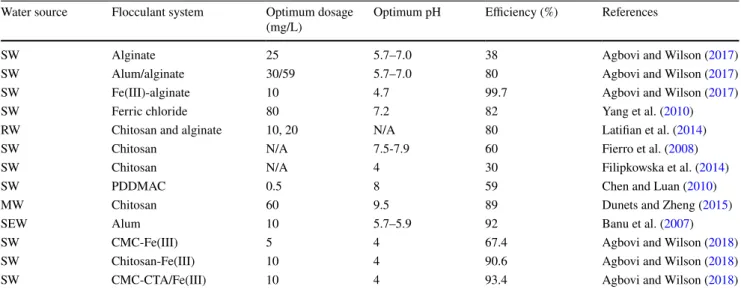
Tables 3.3 and 3.5 in Yang et al. 2016). A second strategy is to use mixtures of cationic and/or anionic flocculants along with or without an additive metal salt coagulant. Such types of mixtures confer “amphoteric” properties via blending of components into binary and ternary mixtures, as reported by Agbovi and Wilson (2017, 2018). Table 4 lists selected examples of biopolymer flocculants such as alginate, poly-diallyldimethyl-ammonium chloride, chitosan and its mod-ified forms, for the removal of orthophosphate Pi species
from synthetic and real wastewaters. Additional examples of chitosan-based amphoteric flocculants are described else-where (Muzzarelli 1988; Vårum and Smidsrød 2004, Meera and Emilia 2006; Prado and Matulewicz 2014; Quinlan et al.
2015; Besse et al. 2016; Kadokawa 2018).
According to Table 4, the efficacy of biopolymer floccu-lant–coagulant systems for the removal of orthophosphate
Pi is compared with the results reported by Wilson’s group (Agbovi et al. 2017; Agbovi and Wilson 2017, 2018) and others. While variable removal efficiency of orthophosphate
Pi was achieved, it is noted that the sole use of metal species, e.g., Al3+ or Fe3+, or biopolymer flocculants, such as
algi-nate or chitosan, shows differences according to the relative dosage and pH conditions. The combined use of metal ion species and its resulting influence on the adsorption prop-erties of chitosan has been described in a recent report by Rashid et al. (2018) in a study of the adsorption properties of chitosan with Reactive Black 5 and other dyes. In the case Table 4 Examples of phosphate removal from water and wastewater using different types of coagulant–flocculant systems. SW synthetic
waste-water, MW municipal wastewaste-water, RW real wastewaste-water, SEF secondary effluent wastewaste-water, PDDMAC polydiallyldimethyl-ammonium chloride Water source Flocculant system Optimum dosage
(mg/L) Optimum pH Efficiency (%) References
SW Alginate 25 5.7–7.0 38 Agbovi and Wilson (2017)
SW Alum/alginate 30/59 5.7–7.0 80 Agbovi and Wilson (2017)
SW Fe(III)-alginate 10 4.7 99.7 Agbovi and Wilson (2017)
SW Ferric chloride 80 7.2 82 Yang et al. (2010)
RW Chitosan and alginate 10, 20 N/A 80 Latifian et al. (2014)
SW Chitosan N/A 7.5-7.9 60 Fierro et al. (2008)
SW Chitosan N/A 4 30 Filipkowska et al. (2014)
SW PDDMAC 0.5 8 59 Chen and Luan (2010)
MW Chitosan 60 9.5 89 Dunets and Zheng (2015)
SEW Alum 10 5.7–5.9 92 Banu et al. (2007)
SW CMC-Fe(III) 5 4 67.4 Agbovi and Wilson (2018)
SW Chitosan-Fe(III) 10 4 90.6 Agbovi and Wilson (2018)
of polydiallyldimethyl-ammonium chloride, a relatively low flocculant dosage of 0.5 mg/L was used, where relatively high orthophosphate Pi is noted. The effective removal for
polydiallyldimethyl-ammonium chloride is explained by the high binding affinity between polyelectrolytes of opposite ionic charge. The dianion form of orthophosphate Pi exists
at this alkaline pH condition, according to the known pKa
values for orthophosphate, i.e., pKa,1 = 2.17, pKa,2 = 7.31 and pKa,3 = 12.36 (Wilson and Tewari 2018). In contrast, the flocculation of other systems in Table 7 reported by Agbovi and Wilson was carried out at pH 4–5, where the monoanion
Pi species prevails (Agbovi et al. 2017; Agbovi and Wilson
2017, 2018). The combined use of metal salt and biopolymer flocculant reveals enhanced removal of orthophosphate Pi, as
evidenced by the lower flocculant dosage when used along with metal salts (Table 4). This is consistent with a removal process that follows an electrostatic charge neutralization and an ion-binding adsorption mechanism (cf. Table 2.1; Yang et al. 2016).
The last few entries of Table 4 compare the orthophos-phate Pi removal for carboxymethyl–chitosan, chitosan and 3-chloro-2-hydroxypropyl trimethylammonium chlo-ride grafted in the absence of added kaolinite (turbidity). The design and chemical structure of these amphoteric biopolymer flocculants are shown in Scheme 1. The removal efficiency for the biopolymer-Fe(III) systems is listed in descending order: 3-chloro-2-hydroxypropyl tri-methylammonium chloride grafted onto carboxymethyl chitosan > chitosan > carboxymethyl chitosan, in accord-ance with the trends in the relative zeta potential of the biopolymers. In the presence of turbidity, with 400 mg/L kaolinite and initial orthophosphate Pi at 25 mg/L,
3-chloro-2-hydroxypropyl trimethylammonium chloride grafted onto carboxymethyl chitosan showed greater orthophosphate Pi removal versus chitosan and
carboxy-methyl chitosan at all pH conditions, where optimal tur-bidity removal of 99.2% and orthophosphate Pi removal of 97.8% were observed at pH 4, according to the experi-mental results shown in Fig. 3.
It can be concluded that enhanced removal of orthophos-phate can be achieved through synthetic modification of chitosan, especially in conjunction with Fe(III) coagu-lants in industrially-relevant wastewater conditions. The performance of amphoteric chitosan flocculants can be tuned for optimal performance at variable pH conditions in response to the type of waterborne contaminant species. Thus, the overviews provided herein and elsewhere (Wilson
2014; Bhalkaran and Wilson 2016) reveal the utility of such biopolymeric flocculants for wider applications aimed at oxoanion removal in water and wastewater treatment.
Treatment of cyanobacteria‑contaminated water
The proliferation of harmful cyanobacteria in river, lake and reservoir is a serious environmental issue because of cyanobacterial production of toxins, as well as taste and odor compounds that adversely affect aquatic ecosystems and humans (Schindler et al. 2012). Cyanobacteria threat-ens the safety of drinking water. Microcystins produced by
Microcystis aeruginosa, which is the most notorious
spe-cies in eutrophic surface waters, are hepatotoxins that pose a health threat for humans. Other algal organic matters could also compromise the safety of drinking water since they contain organic precursors leading to the development of
Scheme 1 Synthesis of carboxymethyl chitosan (CMC) and 3-chloro-2-hydroxypropyl trimethylammonium chloride grafted onto CMC (CTA-CMC) Adapted from Agbovi and Wilson (2018)
toxic disinfection by-products during chlorination. Gener-ally, most algal organic matters including microcystins are contained within cyanobacteria cells, except
Cylindrosper-mopsis raciborskii, which contains around 50% or less toxin
in cells (Newcombe 2009). In other words, if toxins stay in cells, the process is safer because cells will be trapped in the precipitate, whereas if cell membranes are damaged, toxins will escape in the aqueous solution and, in turn, pollute the effluent discharged in natural waters. Therefore, an efficient method to remove cyanobacterial cells without damaging the membrane is significant to drinking water treatment.
Coagulation using conventional coagulants is the most important process for algal removal in conventional drink-ing water treatment due to the short detention time and low capital cost. Even though the traditional coagulants, such as polymeric aluminum and ferric chloride, can remove cyano-bacteria cells without causing cell lysis (Xu et al. 2016), excess Al and Fe will lower water quality when plenty of tra-ditional coagulant is used to remove cyanobacteria. Further-more, the traditional coagulant is ineffective for the removal of extracellular microcystins. Recently, the increasing demand for environmental-friendly technologies has led to the search for natural, available and efficient materials to be used as coagulants. Chitosan, as a non-toxic and biodegrad-able coagulant/flocculant, has been extensively applied in water treatment and may be a suitable flocculant for cyano-bacterial cells removal in drinking water treatment plants. For instance, Pei et al. (2014) studied the effects of chitosan on the treatment of cyanobacteria-laden source water. The
results showed that chitosan can remove Microcystis
aer-uginosa cells efficiently without damaging the cells. In
adition, chitosan can absorb extracellular microcystins due to the presence of amino and hydroxyl groups in chitosan, which give chitosan a powerful adsorptive capacity. The impacts of chitosan dosage and flocculation stirring were systematically investigated on Microcystis aeruginosa and microcystins removal. Under optimized conditions, i.e., chi-tosan concentration: 7.31 mg/L, rapid mix speed: 227 rpm, rapid mix time: 2 min, slow mix speed: 19 rpm, and slow mix time: 12 min, 99% of Microcystis aeruginosa cells and 46.5% microcystins were removed.
Although chitosan is relatively cheap and displays many suitable characterics for coagulation, the cost of chitosan is still high compared with traditional inorganic coagulants. To address issues of cost, research efforts were directed at finding ways to reduce the dosage of chitosan. Pan et al. (2006) prepared a composite coagulant containing chitosan-modified local soils (chitosan/soil = 1:10; weight). Results show that a loading of 0.025 g/L chitosan-modified local soils removed 99% Microcystis aeruginosa cells (cell inten-sity 4.86 × 10⁹ cells/L) within 16 h for a field enclosure of
Taihu Lake. Pei et al. (2016) used a novel hydrogen-termi-nated porous Si wafer to enhance Microcystis aeruginosa removal by chitosan at a low dosage. It was found that mod-erate pre-oxidation by this wafer not only avoids the damage of Microcystis aeruginosa cell but also decreases the level of dissolved organic matter; hence, this led to a method for reducing the dosage of chitosan during coagulation. Fig. 3 Effect of pH on the
removal of orthophosphate Pi at variable flocculant dosage.
a 3-chloro-2-hydroxypropyl
trimethylammonium chloride grafted onto carboxymethyl chitosan, b chitosan and c carboxymethyl chitosan, where the initial concentration of Pi
is 25 mg/L. Reproduced with permission from Agbovi and Wilson (2018)
Another solution to reduce the dosage of chitosan during coagulation is to prepare a coagulant combining the advan-tages of bioflocculant with inorganic coagulant in water treatment. Ma et al. (2016a, b) studied the effect of a com-posite coagulant chitosan-aluminum chloride on removal of
Microcystis aeruginosa cells in cyanobacteria-laden
drink-ing water for treatment. Results showed that the composite coagulant can remove algal cells effectively for stronger entrapment and bridging ability, where negligible cell lysis was observed during the coagulation process. The optimal coagulation performance was obtained when the composite coagulant was set as 2.6 mg/L chitosan plus 7.5 mg/L alu-minum chloride, under which 97.8% of intact cells, 53.1% of extracellular microcystins and almost all extracellular organic matters were simultaneously removed.
Even though the dosage of chitosan was reduced during coagulation as explained above, chitosan water insolubil-ity—chitosan is soluble in weak acid solution—restricts its application in drinking water treatment processes. As a consequence, water-soluble chitosan derivatives have been synthesized recently. For example, Jin et al. (2017) studied the chitosan quaternary ammonium salt, a water-soluble chitosan derivative, for the removal of Microcystis
aerugi-nosa cells during coagulation. Results show that Microcystis aeruginosa cells can be removed efficiently without
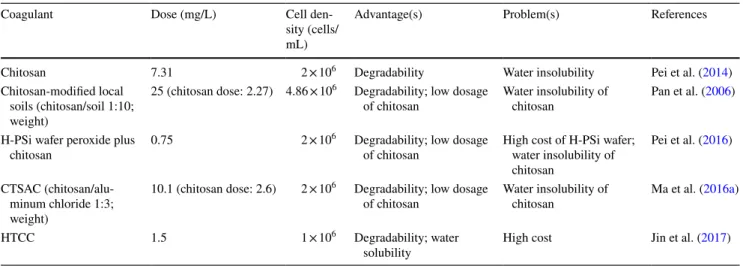
dam-age under optimum coagulation conditions: coagulant dos-age 1.5 mg/L, rapid mixing for 0.5 min at 5.04 g and slow mixing for 30 min at 0.20 g. Overall, as shown in Table 5, because chitosan and chitosan derivatives are non-toxic and biodegradable, they may be the promising coagulants for treatment of the cyanobacteria-laden source water. However, it is worth to note that their use for cyanobacterial removal is still at the laboratory research phase. A field pilot study on cyanobacteria removal by chitosan or chitosan deriva-tives should be done to obtain relevant operating parameters
in the drinking water treatment plant. It will be helpful in this application to treat the cyanobacteria-containing source water in the drinking water treatment plant. In addition, cheaper and better performance chitosan derivatives should be developed in the future. This also contributes to the wide range of applications of chitosan derivatives in drinking water treatment plant.
Sludge dewatering
A major environmental problem facing wastewater treat-ment is the high volume of produced sludge during sewage treatment. Sludge dewatering, disposal and management are major challenges in the water industries, in particular to reduce the costs of final disposal and transportation. Typi-cally, dewatering aims at reducing the weight and volume of the sludge. For this, the primary means of volume reduction is water removal. Depending on the operation and process used, sludge is usually a dilute suspension that generally contains a heterogeneous mixture of 50–80% of pollution in the form of a high-organic load, colloids, pathogenic germs, mineral particles, captions and metals (Zhai et al. 2012). As a consequence, if sludges are inadequately managed, they induce environmental pollution. Hence, the main target of sludge treatment is (1) to dewater as much as possible in the most economical way, (2) to eliminate smell by reducing the quantity of organic solids, and (3) to reduce the number of disease-causing microorganisms present in the solids. All such treatments are important for both economical and envi-ronmental reasons.
Sludge dewatering separates sludge into liquid and solid components for waste minimization. This requires an effi-cient conditioning step, and there are various technolo-gies involving biological, chemical and/or physical treat-ments. Notewothy, after treatment, both the liquid and solid Table 5 Comparison of chitosan and chitosan derivatives for the removal of Microcystis aeruginosa cells. H-PSi Hydrogen-terminated porous Si, CTSAC chitosan-aluminum chloride, HTCC chitosan quaternary ammonium salt
Coagulant Dose (mg/L) Cell
den-sity (cells/ mL)
Advantage(s) Problem(s) References
Chitosan 7.31 2 × 10⁶ Degradability Water insolubility Pei et al. (2014)
Chitosan-modified local soils (chitosan/soil 1:10; weight)
25 (chitosan dose: 2.27) 4.86 × 10⁶ Degradability; low dosage
of chitosan Water insolubility of chitosan Pan et al. (2006) H-PSi wafer peroxide plus
chitosan 0.75 2 × 10
6 Degradability; low dosage
of chitosan High cost of H-PSi wafer; water insolubility of chitosan
Pei et al. (2016) CTSAC
(chitosan/alu-minum chloride 1:3; weight)
10.1 (chitosan dose: 2.6) 2 × 10⁶ Degradability; low dosage
of chitosan Water insolubility of chitosan Ma et al. (2016a)
HTCC 1.5 1 × 10⁶ Degradability; water
components may contain contaminations. Indeed, the dewa-tering step is not intended to clean the liquid of the sludge. Generally, chemical methods are used to enhance sludge filtration and final dewatering efficiency. Chemical meth-ods involve the addition of, e.g., acids, alkalis, surfactants, coagulants and flocculants, to the sludge, in order to change its nature and to improve the dewatering performance. Coagulation/flocculation is commonly used for sludge con-ditioning when cost and efficiency are considered (Wei et al.
2018). During this treatment, sludge colloidal particles form large flocs and compacted cakes, which improve sedimenta-tion and dewatering performance by increasing the sludge dewatering rates and solid content (Qi et al. 2011; Suopa-järvi et al. 2013; Wei et al. 2018). The additives used can be classified into two main groups: mineral additives such as metal salts, and organic polymers of natural or synthetic origin. The synthetic polymers may be cationic, anionic or nonionic. In most cases, they are derived from oil-based and non-renewable raw materials (Suopajärvi et al. 2013). Some synthetic polymers often lead to secondary pollution and new environmental problems (Renault et al. 2009a). As a consequence, the sludge formed has a limited potential for recycling due to its non-biodegradability (Zahrim et al.
2011). Alternatively, natural polymers such as starches, celluloses and chitosan, and microbial materials such as bacteria, fungi and yeast, allow to reuse sludge as fertilizer and foster sludge proper handling and disposal (Bolto and Gregory 2007).
Depending on the nature of the solids to be treated, chem-ical conditioning can reduce the 90–99% incoming moisture content to 65–85% (Yu et al. 2008). Moisture content in sludge directly corresponds to the dewatering extent. Other factors can be also be tuned, used such as the capillary suc-tion time, in seconds, and the specific resistance in filtrasuc-tion, in m/kg (Christensen and Dick 1985; Ripperger et al. 2012). These parameters are widely measured for evaluating sludge dewaterability. In a capillary suction time test, a filtration force generated by the capillary action of an absorbent fil-ter paper is applied to the sample. The lower the capillary suction time, the higher the dewatering rate, i.e., the better sludge filtration properties. This test is simple, rapid and inexpensive because it does not require an external source of pressure or suction. The test of specific resistance in the filtration requires to be under vacuum. Noteworthy, the cap-illary suction time and the specific resistance in filtration are empirical parameters lacking accuracy. However, they rapidly provide an indication of a sample filtration capabil-ity, which is usually enough for operational controls.
Figures 4, 5, 6 and 7 show a typical example of results. The raw sludge originates from a municipal waste water treatment plant located at Beni-Messous, 15 km west of Algiers, Algeria. Sludge characteristics are described in Table 6. The following conditions were used: sludge
conditioning was carried out by flocculation using a conven-tional jar test with six ramps; samples of 100 mL in a 500-mL beaker were mixed with solutions containing different
0 10 20 30 40 50 60 0 1 2 3 4 5 6 CST (s) Polymer dosage (kg/t ds)
Sed CF802 Chitosan FeCl3
Fig. 4 Capillary suction time (CST) versus flocculant dosage. Floccu-lants: commercial cationic polymer Sedipur CF802 abbreviated Sed CF802, chitosan and ferric chloride FeCl3; the capillary suction time
parameter was evaluated according to the Standard Method 2710G (APHA, AWWA and WEF 1995) with a portable apparatus (Triton 304B, chromatography paper Whatman n°17)
0 1 2 3 4 5 6 7 8 0 1 2 3 4 5 SRF (10 12 m/kg) Polymer dosage (kg/t ds)
FeCl3 Chitosan Sed CF802
Fig. 5 Specific resistance to filtration (SRF) versus flocculant dosage. Flocculants: ferric chloride FeCl3, chitosan and a commercial cationic
polymer Sedipur CF802 abbreviated Sed CF802
0 2 4 6 8 10 12 14 16 18 20 0 1 2 3 4 5 6 Cake dr y solid content (%) Polymer dosage (kg/t ds)
Chitosan FeCl3 Sed CF802
Fig. 6 Cake dry solid content versus flocculant dosage. Flocculants: chitosan, ferric chloride FeCl3 and a commercial cationic polymer
amounts of conditioners, calculated on the basis of chemi-cal mass per unit mass of dry solids contents of the sludge (expressed in kilogram per ton of dry solids); the jar test was operated at 140 rpm for 20 s for intense mixing of the polyelectrolyte into the sludge, and then, stirring speed was reduced to 28 rpm for 2 min to promote floc growth. Dewa-tering sludge was processed using a standardized, labora-tory-scale, pressure filtration cell (APHA, AWWA and WEF
1995). After flocculation, conditioned sludge is immediately transferred into the filtration cell. An appropriate pressure of 10 kg/cm2 was applied. During the introduction of the
piston, a certain amount of filtrate can flow under the effect of gravity without pressing. The filtration time was set to 1 h. Collected filtrates were measured as function of time. Dry solids content (ds in %) of the cake, and filtrate turbidity were determined according to procedures given in Standard Methods (APHA, AWWA and WEF 1995). Chitosan effi-ciency was compared to synthetic cationic polymer Sedipur CF802 abbreviated Sed CF802, and ferric chloride FeCl3.
The capillary suction time is an empirical measure of the resistance applied by the sludge to the withdrawal of water. In Fig. 4, the results show that the capillary suction time has been reduced from 48 s in the raw sludge to 5 s and 6 s with optimal dosage, in the range of 2–3 and 1.5–3 kg/t ds
of Sed CF802 and chitosan, respectively. Beyond the opti-mal dosage, the capillary suction time increases again. Also, with sludge conditioned with 6 kg/t ds as optimal dose of FeCl3, capillary suction time was around 9 s. Indeed, the two cationic polyelectrolytes showed a good dewaterabil-ity. The low capillary suction time obtained using cationic polyelectrolytes is due to smaller flocs and sludge contain-ing less bound water. The sludges are therefore dewatered faster than those obtained with FeCl3. However, further increase in polyelectrolyte concentration increased the cap-illary suction time. This is associated with the overdosing phenomena caused by excess polyelectrolyte remaining in the liquid phase leading to the viscosity increase and then deteriorating the sludge dewaterability (Christensen et al.
1985). Otherwise, saturation of the colloidal surface with polymer is usually accompanied by a reversal of the surface charge. The optimal polymer dosage is commonly associated with partial coverage of the colloidal surface, accompanied by a minimum surface charge (Lee and Liu 2000).
Figure 5 depicts the evolution of specific resistance in filtration data as a function of dosage of each flocculant. Initially, the specific resistance in filtration value of uncon-ditioned sludge was 6.78 × 10¹² m/kg. The value decreased
when both cationic polyelectrolytes and FeCl3 were added. The optimum doses for Sed CF802 and chitosan were about 1.5–2 kg/t ds for both polyelectrolytes. Beyond the opti-mum value, the SRF increased again. SRF values of sludge conditioned with Sed CF802 and chitosan at the respective optimum doses were 0.634 × 10¹² m/kg and 0.932 × 10¹² m/
kg, respectively. On the other hand, 4.5 kg/t ds of FeCl3
has reduced specific resistance in filtration to 2 × 10¹² m/
kg. Through these results, the objective of this study was accomplished; adding flocculating agents improved the dewaterability of sludge, i.e., reduced the specific resist-ance in filtration. Chitosan as well as Sed CF802 and FeCl3
helped to increase the sludge particle size by agglomerat-ing the small fines of the sludge colloids, causagglomerat-ing blind-ing, and to form large flocs, which are easily separated from the water. Flocs agglomeration is explained by the specific resistance in filtration decrease and consequently the filter-ability improvement.
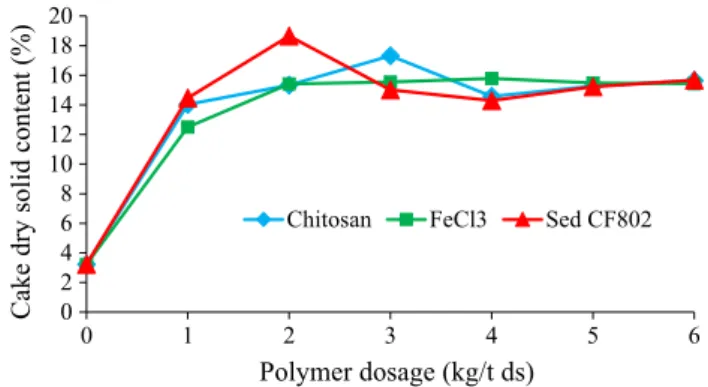
The evolution of the cake dryness according to the dose of each flocculant is presented in Fig. 6. A significant increase in dryness to 17.31% with 3 kg/t ds of chitosan has been recorded, and 2 kg/t ds of Sed CF802 increased cake dryness to 18.65%. The cakes formed with application of both poly-electrolytes were uniform, with the thicknesses of 0.5 cm. These results led to the conclusion that the performances of these two polymers were similar. Also, 15.78% of cake dryness was obtained using 4 kg/t ds of FeCl3. Obtaining
large flocs after flocculation was related to good settleability and filterability. However, the filterability did not depend on the size of the flocs. Filterability depended mainly on
0 10 20 30 40 50 60 70 80 90 100
Chitosan SedCF802 FeCl3
Tu
rbidity
removal
(%)
Polymer
Fig. 7 Turbidity removal versus flocculant dosage. Flocculants: chi-tosan, a commercial cationic polymer Sedipur CF802 abbreviated Sed CF802 and chloride FeCl3
Table 6 Characteristics of raw sludge before conditioning
Parameters Unit Value
pH 8.3
Total suspended solids g/L 3.3
Volatile suspended solids g/L 17
Dry solid content % 3.22
Capillary suction time s 48
Specific resistance to filtration 1012 m/kg 6.78
floc cohesion or their mechanical and bond strengths uniting the elementary particles that made up the formed cluster. The weakness of these links may result in a change of the structure of the filter cake, which becomes less porous, and consequently decreases the rate of filtration.
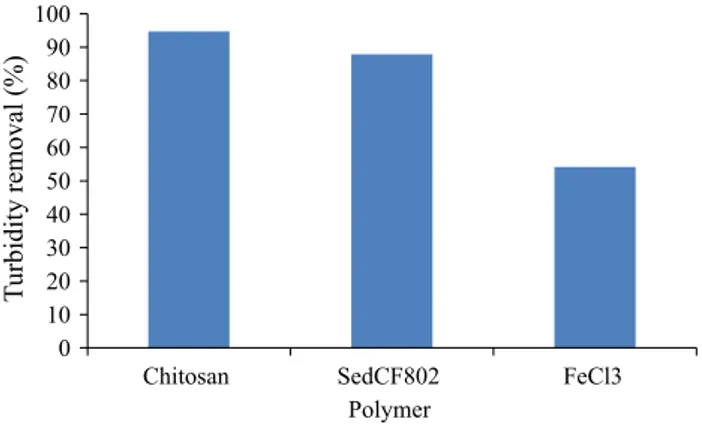
Figure 7 depicts the filtrate turbidity after filtration tests of flocculated sludges with different polymers. It shows that chitosan and Sed CF802 remove 94.68% and 87.85% of the turbidity, respectively, resulting in a maximum filtrate clean-ing with minimum nephelometric turbidity unit, and NTU values. 54.18% of turbidity abatement has been obtained using FeCl3. A better capture efficiency of some fine dis-persed particles in the aqueous phase is related to the lower residual turbidity of filtrate when both cationic polyelectro-lytes were used. These fine, dispersed particles of sludge were flocculated to form primary flocs due to electrostatic attraction. Lee and Liu (2000) have shown that the fine par-ticles should cause a decrease of cake porosity, and floccula-tion of sludge particles by the caand floccula-tionic polyelectrolyte could prevent fine particles from clogging up the filter. This also contributes to the enhanced dewaterability of sludge.
Sludge particles are most frequently positively or nega-tively charged. Chemical conditioners, often bearing oppo-site charges, are used to coagulate or flocculate sludge col-loids by charge neutralization, leading to the establishment of interactions between charged particles. The two main mechanisms of flocculation using organic polymers are the destabilization of the colloidal system by charge neutraliza-tion and the bridging of particles. Polymers adsorb on the surface of colloidal particles by chemical strength (chemi-cal bonding) or physi(chemi-cal forces, e.g., van der Waals forces, or both. The non-adsorbed side of polymers can then reach another particle to form a particle-particle bridge. Therefore, destabilization of sludge is explained by charge neutraliza-tion and/or particles bridging during the applicacharge neutraliza-tion of poly-electrolytes. The combined action of the mass and charge of the polymer helps to implement both bridging and charge neutralization (Gregory and Barany 2011). The bridges allows the polymer to get a large number of particles and to include particles into large flocks. Since chitosan is a cati-onic polyelectrolyte, in our case, the clotting mechanism is essentially done by a double effect: charge neutralization and bridging flocs. Chitosan is adsorbed on the surface of colloi-dal particles by attractive electrostatic interactions between the negative charges of the surface of the colloidal particles and the amine groups of the chitosan (Renault et al. 2009a,
b). These electrostatic interactions also promote adsorption (Gregory and Barany 2011), which explains the fact that the adsorbed amount of chitosan increases with the concentra-tion of added chitosan.
Results on the effect of the chitosan dose show that increasing chitosan levels above its optimum concentra-tion induces higher specific resistance in filtration and
lower content of cake dry solids. This phenomenon could be explained by the reversal of load and re-stabilization of colloidal particles that have been coagulated. This re-stabilization of loads depends on the zeta potential of the solution (Gregory and Barany 2011). In fact, chitosan, by its constitution, has a surplus of electrical charges and is solvated by water trapping colloidal particles, thus caus-ing turbidity. Indeed, these authors have reported that the excessive addition of polymer creates hyperconductive water where collisions between particles due to electric forces are intense; they disrupt completely the balance of the solution (Gregory and Barany 2011).
In conclusion, compared to a commercial synthetic poly-mer, chitosan has shown the same efficiency in terms of sludge conditioning. Chitosan, as a natural organic floccu-lant, may be a promising substitute for conventional floc-culants used so far in the field of sludge conditioning. The sole drawback of chitosan is its relatively high cost, which could be minimized by future technological developments.
Post‑treatment of sanitary landfill leachate
Landfill leachates have high concentrations of ammonia nitrogen, biodegradable organic matter, recalcitrant com-pounds such as humic substances, heavy metals and xeno-biotic organic compounds (Kjeldsen et al. 2002). A bio-logical treatment is commonly used to remove the bulk of biodegradable organic matter and ammonia nitrogen, due to its reliability, simplicity and high cost-effectiveness. As a complement to the biological treatment, the coagu-lation–flocculation process has been employed to reduce the concentration of recalcitrant organic matter and tox-icity of the landfill leachate (Renou et al. 2008; Ziyang et al. 2009). Nevertheless, chemical coagulants may have adverse effects on the environment. Hence, it is suggested that chitosan could be a better alternative (Verma et al.
2012; Ramli and Aziz 2015; Nascimento et al. 2016). Nascimento et al. (2016) carried out a determination of the optimum dosage and pH values for coagulation–floccula-tion of biologically treated leachate using chitosan as bioco-agulant for the removal of recalcitrant organic matter. The performance of chitosan was compared to aluminum sulfate, which is a metal coagulant widely used in wastewater treat-ment plants. The coagulant dosage investigated ranged from 700 to 1100 mg/L for chitosan and from 1300 to 1700 mg/L for alum; the pH value varied from 6.0 to 9.0 for chitosan and from 8.0 to 10.0 for alum. The gradient for rapid mix-ing, time for rapid mixmix-ing, gradient for flocculation mixing and flocculation time were held constant. Their values for chitosan and alum were 400 s−1 and 869 s−1 (gradient for
rapid mixing), 30 s and 10 s (time for rapid mixing), 30 s−1
and 30 s−1 (gradient for flocculation) and 10 min and 10 min
model and graphical optimization, the results showed that chitosan dosages below 700 mg/L and pH values between 6.0 and 6.5 or chitosan dosage near 900 mg/L and pH values between 8.0 and 8.5, lead to greater removal efficiencies of recalcitrant organic matter (50 to 80%); the highest turbid-ity removal (90%) was obtained at a lower dosage, less than 900 mg/L, with a pH between 6.5 and 9.5; and an alum dosage between 1542 and 1762 mg/L with a pH between 8.5 and 10.0 leads to greater removal efficiency values. Employing the response optimizer function (Minitab® 16
software), the maximum efficiency removal of true color (80%) and the turbidity removal (91%) were found using 960 mg/L of chitosan at pH 8.5; and using 1610 mg/L of alum at pH 9.5, the true color removal efficiency was 87% and the turbidity removal reached 81% (Nascimento et al.
2016). The authors explained that with decreasing solution pH, part of the humic substances in the leachate became insoluble, resulting in a reduced level of remaining organic matter. Consequently, the amount of chitosan required for destabilization of the colloidal system is lower. Moreover, at a pH of 6.0 or less, more than 90% of the amine groups are protonated. Thus, a lower dosage of chitosan is required for efficient coagulation–flocculation at lower pH. This can be explained by the acid–base properties of chitosan and the degree of dissociation of the polyelectrolyte (Guibal and Roussy 2007). The pKa of the amine groups is close to
6.3–6.4 for the fully dissociated chitosan with a deacetyla-tion degree of close to 90%. The authors concluded that the high sensitivity of the performance of chitosan in removing true color and turbidity levels opens up possibilities for chi-tosan use as a coagulant to aid in the removal of recalcitrant contaminants in landfill leachate.
Conclusion
Chitosan, a partially deacetylated polysaccharide obtained from chitin, has received considerable attention in recent years as a versatile bioflocculant. Its potential application as an efficient and eco-friendly material for environmental purposes has been well investigated. Chitosan can be used for water and wastewater treatment, sludge dewatering and post-treatment of sanitary landfill leachate. In general, the data published have shown comparable or better floccula-tion efficiency compared to the current commercial floc-culants, and thus, chitosan has strong potential in the near future. Although its performance was satisfactory and pilot plants were designed, the economic feasibility to design large-scale treatment plants still needs to be carried out. Special attention should be given to investigating the intrinsic characteristics of the chitosan biopolymer, i.e., degree of deacetylation and molecular weight, and of the various operating parameters, e.g., dosage, initial pH,
settling time, etc. In addition, more research is still needed to understand the mechanisms of flocculation in order to control flocs density and removal ability of pollutants.
References
Abebe LS, Chen XY, Sobsey MD (2016) Chitosan coagulation to improve microbial and turbidity removal by ceramic water fil-tration for household drinking water treatment. Int J Environ Res Public Health 13:3. https ://doi.org/10.3390/ijerp h1303 0269
Agbovi HK, Wilson LD (2017) Flocculation optimization of orthophosphate with FeCl3 and alginate using the
Box-Behnken response surface methodology. Ind Eng Chem Res 56:3145–3155. https ://doi.org/10.1021/acs.iecr.6b047 65
Agbovi HK, Wilson LD (2018) Design of amphoteric chitosan floc-culants for phosphate and turbidity removal in wastewater. Carbohydr Polym 189:360–370. https ://doi.org/10.1016/j.carbp ol.2018.02.024
Agbovi HK, Wilson LD, Tabil LG (2017) Biopolymer flocculants and oat hull biomass to aid the removal of orthophosphate in wastewater treatment. Ind Eng Chem Res 56:37–46. https ://doi. org/10.1021/acs.iecr.6b040 92
Ahmad AL, Sumathi S, Hameed BH (2005a) Adsorption of residue oil from palm oil mill effluent using powder and flake chitosan: equilibrium and kinetic studies. Water Res 39:2483–2494.
https ://doi.org/10.1016/j.watre s.2005.03.035
Ahmad AL, Sumathi S, Hameed BH (2005b) Residual oil and sus-pended solid removal using natural adsorbents chitosan, ben-tonite and activated carbon: a comparative study. Chem Eng J 108:179–185. https ://doi.org/10.1016/j.cej.2005.01.016
Ahmad AL, Sumathi S, Hameed BH (2006) Coagulation of resi-due oil and suspended solid in palm oil mill effluent by chi-tosan, alum and PAC. Chem Eng J 118:99–105. https ://doi. org/10.1016/j.cej.2006.02.001
Altaher H (2012) The use of chitosan as a coagulant in the pre-treatment of turbid sea water. J Hazard Mater 233–234:97–102.
https ://doi.org/10.1016/j.jhazm at.2012.06.061
APHA, AWWA and WEF (1995) Standard methods for the exami-nation of water and wastewater, 19th edition. American Pub-lic Health Association, American Water Works Association, Water Environment Federation. Washington, DC, pp 2–54 Bala JD, Lalung J, Ismail N (2015) Studies on the reduction of
organic load from palm oil mill effluent (POME) by bacte-rial strains. Int J Recycl Org Waste Agric 4:1–10. https ://doi. org/10.1007/s4009 3-014-0079-6
Banu RJ, Do KU, Yeom IT (2007) Phosphorus removal in low alka-linity secondary effluent using alum. Int J Environ Sci Technol 5:93–98. https ://doi.org/10.1007/BF033 26001
Bello MM, Raman AAA (2017) Trend and current practices of palm oil mill effluent polishing: application of advanced oxidation processes and their future perspectives. J Environ Manag 198:170–182. https ://doi.org/10.1016/j.jenvm an.2017.04.050
Bello MM, Nourouzi MM, Abdullah LC, Choong TS, Keshani S (2013) POME is treated for removal of color from biologi-cally treated POME in fixed bed column: applying wavelet neural network (WNN). J Hazard Mater 262:106–113. https :// doi.org/10.1016/j.jhazm at.2013.06.053
Besse V, Illy N, David G, Caillol S, Boutevin B (2016) A chitosan derivative containing both carboxylic acid and quaternary ammonium moieties for the synthesis of cyclic carbonates.