Publisher’s version / Version de l'éditeur:
Molecular Genetics and Genomics, pp. 1-18, 2016-01-19
READ THESE TERMS AND CONDITIONS CAREFULLY BEFORE USING THIS WEBSITE.
https://nrc-publications.canada.ca/eng/copyright
Vous avez des questions? Nous pouvons vous aider. Pour communiquer directement avec un auteur, consultez la
première page de la revue dans laquelle son article a été publié afin de trouver ses coordonnées. Si vous n’arrivez pas à les repérer, communiquez avec nous à [email protected].
Questions? Contact the NRC Publications Archive team at
[email protected]. If you wish to email the authors directly, please see the first page of the publication for their contact information.
NRC Publications Archive
Archives des publications du CNRC
This publication could be one of several versions: author’s original, accepted manuscript or the publisher’s version. / La version de cette publication peut être l’une des suivantes : la version prépublication de l’auteur, la version acceptée du manuscrit ou la version de l’éditeur.
For the publisher’s version, please access the DOI link below./ Pour consulter la version de l’éditeur, utilisez le lien DOI ci-dessous.
https://doi.org/10.1007/s00438-015-1156-x
Access and use of this website and the material on it are subject to the Terms and Conditions set forth at
Identification, duplication, evolution and expression analyses of
caleosins in Brassica plants and Arabidopsis subspecies
Shen, Yue; Liu, Mingzhe; Wang, Lili; Li, Zhuowei; Taylor, David C.; Li, Zhixi;
Zhang, Meng
https://publications-cnrc.canada.ca/fra/droits
L’accès à ce site Web et l’utilisation de son contenu sont assujettis aux conditions présentées dans le site LISEZ CES CONDITIONS ATTENTIVEMENT AVANT D’UTILISER CE SITE WEB.
NRC Publications Record / Notice d'Archives des publications de CNRC:
https://nrc-publications.canada.ca/eng/view/object/?id=f37a8f5d-b46d-49f5-ba0f-e42c14b87a96 https://publications-cnrc.canada.ca/fra/voir/objet/?id=f37a8f5d-b46d-49f5-ba0f-e42c14b87a96
DOI 10.1007/s00438-015-1156-x
ORIGINAL ARTICLE
Identification, duplication, evolution and expression analyses
of caleosins in Brassica plants and Arabidopsis subspecies
Yue Shen1,2 · Mingzhe Liu2 · Lili Wang2 · Zhuowei Li2 · David C. Taylor3 · Zhixi Li1 · Meng Zhang2
Received: 16 June 2015 / Accepted: 8 December 2015 © Springer-Verlag Berlin Heidelberg 2016
the first time. Segmental duplication was the main form of gene expansion. Alignment, motif and phylogenetic analy-ses showed that Brassica caleosins belong to either the H-family or the L-family with different motif structures and physicochemical properties. Our findings strongly sug-gest that L-caleosins are evolved from H-caleosins. Pre-dicted phosphorylation sites were differentially conserved in H-caleosin and L-caleosins, respectively. ‘RY-repeat’ elements and phytohormone-related cis-elements were identified in different caleosins, which suggest diverse physiological functions. Gene structure analysis indicated that most caleosins (38 out of 44) contained six exons and five introns and their intron phases were highly conserved. Structurally integrated caleosins, such as BrCLO3-3 and BrCLO4-2, showed high expression levels and may have important roles. Some caleosins, such as BrCLO2 and BoCLO8-2, lost motifs of the calcium binding domain, pro-line knot, potential phosphorylation sites and haem-binding sites. Combined with their low expression, it is suggested that these caleosins may have lost function.
Abstract Caleosins are a class of Ca2+ binding proteins that appear to be ubiquitous in plants. Some of the main proteins embedded in the lipid monolayer of lipid droplets, caleosins, play critical roles in the degradation of storage lipids during germination and in lipid trafficking. Some of them have been shown to have histidine-dependent perox-ygenase activity, which is believed to participate in stress responses in Arabidopsis. In the model plant Arabidopsis
thaliana, caleosins have been examined extensively. How-ever, little is known on a genome-wide scale about these proteins in other members of the Brassicaceae. In this study, 51 caleosins in Brassica plants and Arabidopsis
lyrata were investigated and analyzed in silico. Among them, 31 caleosins, including 7 in A. lyrata, 11 in Brassica
oleracea and 13 in Brassica napus, are herein identified for
Communicated by S. Hohmann.
Y. Shen and M. Liu have contributed equally to this publication.
Electronic supplementary material The online version of this
article (doi:10.1007/s00438-015-1156-x) contains supplementary material, which is available to authorized users.
* Zhixi Li [email protected] * Meng Zhang [email protected] Yue Shen [email protected] Mingzhe Liu [email protected] Lili Wang [email protected] Zhuowei Li [email protected] David C. Taylor [email protected] 1
College of Food Science and Engineering, Northwest A&F University, Yangling 712100, Shaanxi, People’s Republic of China
2 College of Agronomy, Northwest A&F University,
Yangling 712100, Shaanxi, People’s Republic of China
3
National Research Council of Canada, 110 Gymnasium Place, Saskatoon, SK S7N 0W9, Canada
Keywords Caleosin · Brassica · Characteristics ·
Evolution · Expression · Function
Introduction
In plants, neutral lipids provide energy and substrates/skel-etons for seedling establishment and development. Triacyl-glycerols (TAGs), the main component of neutral storage lipids, are packaged in organelles called lipid droplets. The lipid droplets are covered by a monolayer of phospholipid molecules in which proteins are embedded. These proteins can be divided into at least three families: oleosins, caleo-sins and steroleocaleo-sins (Chen et al. 1999; Chapman et al. 2012; Frandsen et al. 2001; Li-Beisson et al. 2013). Caleo-sins were so-named due to their ability to bind calcium and their oleosin-like structures; caleosins are considered as structural stabilizers of lipid droplets. In addition, reports have shown that caleosins are involved in other biological processes such as dormancy. Some caleosins have been identified as calcium-binding haem-oxygenases with perox-ygenase activity induced in stress responses (Hanano et al. 2006; Kim et al. 2011; Murphy 2009; Partridge and Mur-phy 2009; Poxleitner et al. 2006; Toorop et al. 2005). The model plant Arabidopsis thaliana (A. thaliana) and many high value Brassica crops belong to the Brassicaceae. These include major oil crops like canola, the world’s third largest source of plant oil (Lomascolo et al. 2012), mainly defined by two species: Brassica napus (B. napus) and Brassica
rapa (B. rapa) as well as vegetable crops like broccoli, cauliflower, Brussels sprouts, cabbage and kale, found in the Brassica oleracea (B. oleracea) family. The allotetra-ploid B. napus is the product of natural hybridization of the diploids B. rapa and B. oleracea about 7500 years ago (Chalhoub et al. 2014; Nagaharu 1935). The segregation of Arabidopsis and Brassica plants occurred in 12–20 MYA (Blanc et al. 2003; Town et al. 2006; Yang et al. 1999). A.
thaliana and its related subspecies Arabidopsis lyrata (A.
lyrata) diverged 10 MYA (Hu et al. 2011). Brassica plants experienced a specific whole-genome triplication process 5–15 MYA (Beilstein et al. 2010; Wang et al. 2011). The separation of B. rapa and B. oleracea occurred 4.6 MYA (Liu et al. 2014). Recent information provides an oppor-tunity to analyze the evolution of the caleosin gene family between B. napus and its progenitors.
The hairpin-like caleosins which are present in higher plants (Chen et al. 1999), fungi (Murphy 2009), and some of single-cell alga (Næsted et al. 2000; Murphy 2009), have three characteristic motifs: The hydrophilic N-terminal domain contains an EF-hand calcium-binding domain; the hydrophobic domain in the centre of the protein contains a proline knot; phosphorylation sites are located in the hydrophilic C-terminal domain (Kim et al. 2011).
Recently, detailed studies of caleosins in the model plant A. thaliana have been reported (Chapman et al. 2012; Murphy 2012). Some caleosins in B. rapa and B.
napus have also been identified. A 27-kDa-endoplasmic reticulum (ER)-localized caleosin and a 25-kDa-lipid droplet-localized caleosin have been identified from the embryos of B. napus (Hernandez-Pinzon et al. 2001) and seed-specific caleosins have been identified in high and low erucic acid cultivars of B. napus (Katavic et al. 2006). According to the sequences of AtCLO1–AtCLO3, nine caleosins had been identified from the ESTs library of B. napus, seven of which have been verified by means of proteomics (Jolivet et al. 2009). Hu et al. (2013) have identified 11 caleosins from B. rapa using bioinformatics, and performed a phylogenetic analysis. AtCLO3, maybe as a peroxygenase, involves in producing hydroxylated fatty acid derivatives which could have anti-fungal prop-erties (Partridge and Murphy 2009). Previous studies also indicated that a caleosin, designated RD20, participates in stress tolerance in Arabidopsis (Aubert et al. 2010; Blée et al. 2014), while PXG4, a class II caleosin in yeast, is a calcium-dependent membrane-associated hemoprotein catalyzing typical peroxygenase reactions (Blée et al. 2012).
Although some caleosins have been examined exten-sively in Arabidopsis, little is known on a genome-wide scale regarding these caleosins present in other plants of the Brassicaceae. The current investigation will provide additional information to understand their function and roles in plant development. In addition, many questions still remain: For example, are there any other caleosins in
B. rapa and B. napus? How many caleosins are present in the A. lyrata and B. oleracea genomes? What can we deter-mine regarding caleosin secondary structures, the evolution process, expression profiles and putative functions in these Brassicaceae?
A wealth of genomic information is available for A.
thaliana and its relative species A. lyrata (Hu et al. 2011; Arabidopsis genome initiative 2000). The sequencing of many plant genomes including B. napus, B. rapa and B.
oleracea have been completed in recent years (Chalhoub et al. 2014; Liu et al. 2014; Wang et al. 2011). Collectively, these databases provide a rich resource for the study of caleosins in these plants.
In this study, caleosins are identified from the genomes of A. lyrata (7), B. rapa (11), B. oleracea (11) and B.
napus (22), using sequences of eight known caleosins from A. thaliana as bioinformatic queries. Physical and chemical properties, the evolution process and expres-sion profiles of these caleosins are also analyzed. Func-tional predictions of four key caleosin genes, BnCLO1-2, BnCLO1-3, BnCLO3-3 and BnCLO3-4 from B. napus are reported.
Materials and methods
Identification and naming of the caleosins in A. lyrata and three Brassica crop species
In this research, both BLAST and key word searches were carried out in order to determine the number of caleo-sin genes in A. lyrata, B. napus, B. rapa and B. oleracea. Using sequences of eight known caleosin genes from A.
thaliana asqueries, a BLASTP analysis was carried out to search the target databases for sequences with an E value <10−10. The databases for B. rapa BRAD;
(http://brassi-cadb.org/brad/) (Cheng et al. 2011), B. oleracea Bol base v1.0 (http://119.97.203.210/bolbase/index.html) (Yu et al. 2013) and for A. lyrata Phytozome 10 (http://phytozome. jgi.doe.gov/pz/portal.html) (Goodstein et al. 2012) were probed in real time against the eight query sequences from
A. thaliana obtained from TAIR10.0 (http://www.arabi-dopsis.org/) (Lamesch et al. 2012). Key words in these searches were “PF05042” or “caleosin” or “IPR007736”. After obtaining the sequence matches, redundant infor-mation was removed manually. Then reciprocal BLASTX searches back to A. thaliana helped to verify the putative match sequences and those not corresponding to any of the eight caleosin genes in A. thaliana were discarded. The online tool InterProScan5 (http://www.ebi.ac.uk/interpro/ search/sequence-search) (Jones et al. 2014) on EBI was used to analyze whether there were domains belonging to the caleosin gene family (IPR007736) in the translated pro-teins from the selected sequences; those without any cale-osin-like domains were also omitted. This culling process at both the caleosin gene and protein levels resulted in the final list of B. rapa, B. oleracea and A. lyrata sequences addressed in this study.
In addition, caleosin sequences from B. napus were identified. Since a BLAST search could not be used to probe the B. napus database directly, putative nucleotide sequences were obtained from EMBL-EBI (European nucleotide archive, http://www.ebi.ac.uk/ena/browse) while the corresponding protein sequences were downloaded from the B. napus genome browser (BNGB, http://www. genoscope.cns.fr/brassicanapus/data/) (Chalhoub et al. 2014), and the names of the genes were entered manually. Local BLASTN and local BLASTP were used to search for caleosin sequences in a local database of B. napus with an
E value <10−10. Redundant data were deleted and recipro-cal database challenges were performed as above.
The selected caleosins were named after their homologs in A. thaliana. For instance, the CLO1 homolog gene of A.
thaliana was named as BrCLO1 in B. rapa. If there were multiple homologous genes identified, they were given the names BrCLO1-1, BrCLO1-2 etc.
There were both orthologs and paralogs of Arabidop-sis caleosin genes among the sets of genes we identified. Orthologs of B. rapa caleosin genes from A. thaliana are reported in the B. oleracea genome (Liu et al. 2014) and those from B. napus are reported in the B. napus genome (Chalhoub et al. 2014). Gene X from the genome of B.
napus is the ortholog of gene Y from the genome of B. rapa, while the latter is the ortholog of gene Z in the genome of Arabidopsis. By inference therefore, gene X from B. napus was regarded as the ortholog of gene Z in Arabidopsis. If there were no B. napus ortholog in B. rapa or if orthologs were not found in Arabidopsis, CLUSTALX was used to identify the gene paralogs in Arabidopsis. Because of the diversities between the caleosin gene names of B.
olera-cea in the B. napus genome, genes of B. oleracea as listed in the B. napus genome did not necessarily correspond to those in the B. oleracea genome. Thus, CLUSTALX was used to judge which B. napus genes are the Arabidopsis orthologs/paralogs when there were only orthologs in B.
oleracea in the absence of B. rapa orthologs.
Physicochemical property analysis of caleosins
Isoelectricpoints (pIs) and molecular weights of the puta-tive caleosin proteins were calculated with ExPASy (http:// web.expasy.org/compute_pi/) (Gasteiger et al. 2003) and the putative phosphorylation sites (including Tyr, Ser and Thr residues) were predicted with NetPhos 2.0 (http:// www.cbs.dtu.dk/services/NetPhos/) (Blom et al. 1999). MEME (http://meme-suite.org/) (Bailey et al. 2006) was used to analyze the ten motifs of these caleosin sequences. InterProScan5 and multiple alignment were used to eluci-date motifs. The hydropathic plot was drawed in ProtScale (http://web.expasy.org/protscale/) with Kyte and Doolit-tle mehod (1982) and the default setting. To test the pos-sible membrane associations/locations of the caleosins, the hydrophobicity and the folding tendencies of these proteins were predicted by online tool FoldIndex (Prilusky et al. 2005).
Multiple alignment, classification and phylogenetic analysis of caleosins
In order to discover if there were significant signature domains in these 51 caleosin proteins, Clustal 2.1 (Lar-kin et al. 2007) was used to carry out multiple align-ments. Shadow processing and its output were conducted with software Boxshade 3.21 (http://www.ch.embnet.org/ software/-B-OX_form.html) from the ExPASy database (Gasteiger et al. 2003).
To acquire more information regarding evolutionary relationships between the various caleosins, eight caleosin
sequences in Arabidopsis were also added to populate the phylogenetic tree. Both Neighbor Joining (NJ) and Maxi-mum Likelihood (ML) trees were built to guarantee the reliability of the trees. MEGA 6.06 (Tamura et al. 2013) was used to build the NJ tree; a Poisson model was chosen, and interspaces were deleted pair-wise, and bootstrapped 1000 times. PhyML 3.0 (http://www.atgcmontpellier.fr/ phyml/) (Guindon et al. 2010) was used to build the ML tree; the LG model was chosen, with a substitution rate of 6, alter mode SPR, and bootstrapped 100 times. The out-put of the assembled trees was obtained using MEGA 6.06 (Tamura et al. 2013).
Chromosomal location and duplication model of caleosin genes
The chromosomal locations and flanking genes of the cale-osins from A. lyrata, B. rapa and B. oleracea were obtained from their latest databases cited previously. Locations of B.
napus genes were obtained from the BNGB website (Chal-houb et al. 2014). The figure of gene locations was drawn using MapChart 2.2 (Voorrips 2002).
Two genes would be regarded as tandem duplications if there were less than five genes between these two genes (Ma and Zhao 2010). The definition of segmental dupli-cation was as reported in a previous study (Maher et al. 2006).
The Codeml of PAML module from PAL2NAL (http:// www.bork.embl.de/pal2nal/) (Goldman and Yang 1994; Suyama et al. 2006) was used as tool to calculate the caleosin Ka and Ks values. The formula T = Ks/2λ
(λ = 1.5 × 10⁻⁸ for Brassicaceae) (Blanc and Wolfe
2004) was used to calculate the probable age of segmental duplication.
Analysis of upstream cis-elements of B. napus caleosin genes
Two-thousand-bp upstream sequences before the start codon were downloaded from BNGB (Chalhoub et al. 2014). These sequences were uploaded to PLACE 30.0 (http://www.dna.affrc.go.jp/PLACE/) (Higo et al. 1999) and plantCARE (Lescot et al. 2002) to make upstream cis-element predictions.
Expression pattern analyses
Expression pattern analyses of the caleosins from the three Brassica crop families (B. rapa, B. oleracea and B. napus) were determined using public ESTs databases. RNA-seq analysis was also carried out for B. rapa and B. oleracea caleosins; because of the deficiency of the data in the B.
napus database, we were unable to obtain RNA-seq data.
ESTs data were from NCBI. The caleosin genes from the three Brassica species were used as queries to make a BLASTN alignment; the parameters were: identity >95 %,
E value <10−10, length ≥200 bp. Only ESTs of highest identity value and most similar in length were retained to prevent repetition. To discover the expression profile of those genes in different tissues, 10 and 12 libraries were summarized for B. rapa and B. napus (see Supplemen-tal Tables 2, 3, 4 and 5). Expression abundance for each gene was calibrated on the basis of transcripts per million (TPM).
RNA-seq data were obtained from the NCBI SRA database from SRP017757 (SRX213886- SRX213893) for B. rapa (Tong et al. 2013) and from SRP017530 (SRX209691–SRX209697) for B. oleracea. Gene sequences from these two Brassica species were used as probes to perform a BLASTN analysis in the relevant data-bases. Parameters: identity = 100 %; lengths were accord-ing to the sequenced length in databases. The data were calibrated as fragments per kilobase of exon/per million fragments mapped (FPKM) (see Supplemental Tables 2, 3, 4 and 5). The heatmaps were drawn with R script (R Devel-opment Core Team 2014), using the log2
-transformed-cali-brated data of expression values.
Gene structure analysis
The gene structure and intron-phase analyses were carried out using the software Gene Structure Display Server 2.0 (GSDS2.0) (Hu et al. 2015).
Results
Classification of caleosins in A. lyrata and three Brassica crop species
After the BLASTP and key word search in BRAD, Bol base v1.0 and Phytozome10 databases, 7, 11 and, 12 caleo-sin genes were obtained from the A. lyrata, B. rapa, and
B. oleracea genomes, respectively. Twenty-two caleosin genes were obtained from the B. napus genome after local BLASTN and local BLASTP searches. Those sequences were used as queries to search for the most similar genes in Arabidopsis. The gene Bol012293 from B. oleracea was deleted as its most similar gene was AT1G23260, which encodes a protein binding/ubiquitin-protein ligase instead of a caleosin. The significant caleosin domain IPR007736 was found in the sequences of the remaining 51 genes using InterProScan5, which indicated all of them are caleosins. In the end, the final number of caleosin genes was confirmed as 7, 11, 11 and 22 in A. lyrata, B. rapa, B. oleracea and B.
The names of these caleosins were assigned according to the results of ortholog analyses and the assembled phy-logenetic tree (Table 1). Caleosins in A. lyrata were named as AlCLO1 to AlCLO6 and AlCLO8, without AlCLO7; caleosins in B. rapa as BrCLO1 to BrCLO5 and BrCLO8, without BrCLO6 or BrCLO7; caleosins in B. oleracea were named as BoCLO1 to BoCLO4 and BoCLO8, with-out BoCLO5, BoCLO6 or BoCLO7; caleosins in B. napus were named as BnCLO1–BnCLO5 and BnCLO8, without BnCLO6 or BnCLO7.
Multiple alignments were made of the 51 caleosin pro-tein sequences from A. lyrata, B. rapa, B. oleracea and B.
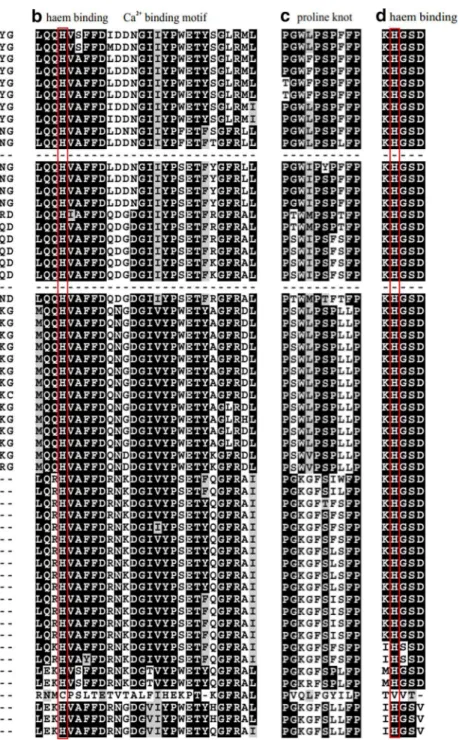
napus, and 8 caleosin protein sequences from A. thaliana (see Supplemental Figure 1). In order to demonstrate key motifs more clearly, the alignment of H-form insertions, Ca2+ binding motifs and proline knots are shown in Fig. 1. The results indicated that BrCLO2-2 and BrCLO8-2 have lost their EF-hand calcium-binding domain. The proline knot P-3X-PS-3X-P plays a vital role during anchoring of lipid droplets and BrCLO2-2 and BrCLO8-2 have also lost this motif. The first proline was replaced by a threonine residue in the proline knots of BoCLO1-2 and BnCLO1-3; the serine was replaced by a tyrosine in the proline knot of BnCLO2-2; the serine was replaced by a threonine resi-due in the proline knot of BnCLO8-3. The second proline becomes phenylalanine in all L-caleosins. Additionally serine becomes threonine in BrCLO4-1. The N-terminal of BoCLO3-1 was found to be extremely long (see Supple-mental Figure 1) as is reported for caleosins from mono-cotyledons (Chen et al. 2012). Previous research indicated that histidine plays the most significant role among haem-binding motifs (Allen et al. 2005). Hanano et al. (2006) indicated the haem-oxygenase activity of AtCLO1 relied on two highly conserved histidine sites, H70 and H138. Results showed that these two sites were highly conserved among all brassicaceous caleosins except for BrCLO2-2, BoCLO8-2 and AtCLO7 (Supplemental Fig. 1). BrCLO2-2 and BoCLO8-2 lost these two histidine sites because of the severe truncation of their N-termini. AtCLO7 showed changes in these two sites: H70 to C and H138 to V (Sup-plemental Fig. 1). The haem-binding motif may be viewed as crucial evidence to characterize whether or not a protein has a peroxygenase function.
Eight caleosins from A. thaliana were classified as H-caleosins and L-caleosins in a former study (Shen et al. 2014). According to multiple alignments, the N-termini of H-caleosins share an extra 29 amino acids (characterized as an H-form insertion) compared with L-caleosins (Shen et al. 2014). Among the 51 caleosins identified in this study, there are 30 H-caleosins and 18 L-caleosins, except for BrCLO2-2 and BoCLO8-2, both with entire N-ter-minal truncations and BoCLO2 with a largely truncated N-terminus. Homologous genes were found to be in the
same cluster; for instance, CLOX (X = 1–8) were found to be clustered. Results indicated that three caleosins which were hard to classify were clustered with H-caleo-sins and thus, they probably belongs to this class. There-fore, there are 33 H-caleosins and 18 L-caleosins among these 51 caleosins. The differences of the hydrophobicity and the fold patterns between the monolayer-located cale-osins and bilayer-located calecale-osins (using AtCLO1 and AtCLO3 as examples), were very small (Supplemental Figure 2), which did not provide enough information for definitively identifying the membrane locations of these caleosins.
Phosphorylation sites were predicted by NetPhos 2.0 (see Supplemental Figure 1). Results showed that among H-caleosins (using AlCLO1 as a standard), residues S140 and Y145 were found to be conserved except for strongly
truncated BrCLO2-2 and BoCLO8-2; S214 was conserved
except in BrCLO2-1 and AlCLO3. Among L-caleosins (using AlCLO4 as a standard), S65 and S106 were highly
conserved; S191 was conserved except for in AlCLO6,
BrCLO5, BnCLO5-1 and BnCLO5-2, while T169 was
con-served in all species except in CLO5.
Using AlCLO1 as a standard, residue F227 remained
unchanged, as did G90, R92, D146 and G149 among all caleo-sins found in those brassicaceous plants (except in the case of the highly truncated BrCLO2-2 and BoCLO8-2), which might indicate these sites play important roles in structure/ function of these caleosins. Similar sites were also con-firmed by another online prediction tool PlantPhos (Lee et al. 2011).
Motif and physicochemical property analyses of caleosins from A. lyrata and three Brassica crop species
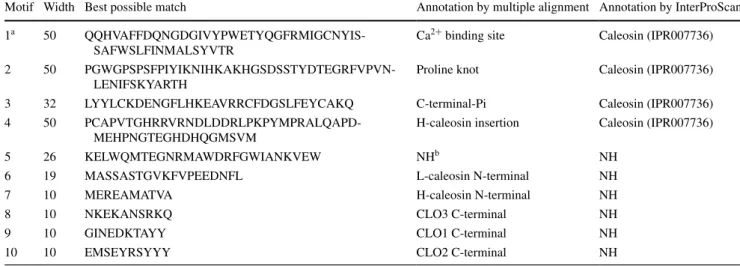
MEME was used to perform motif analyses of the 51 caleo-sins. The results (Fig. 2; Table 2) showed all motifs were specific to caleosins. The motif structure of H-caleosins is 7-4-1-2-5-3-variable C-terminal, while the L-caleosins has a 6-1-2-5-3 motif. The highly truncated BrCLO2-2 and BoCLO8-2 have no N-terminus and they have 7-4-1-2 central motifs. According to this result, and the deletion of their proline knot, they have probably lost their calcium-binding capacity and caleosin-anchoring-capability. In addition, BoCLO2 lost the N-terminal of its calcium-bind-ing domain (motifs 7-4) and part of its C-terminal (motif 5). BrCLO2-1 lost its C-terminal entirely (motifs 5-3-10); CLO5 in all species show a deficiency of upstream motif 6 of the calcium-binding domain.
Isoelectric points of the 51 caleosin proteins were also calculated. The result (Table 2) showed that all H-caleosins shared a pI lower than 6.0 in all species except in CLO8, while all L-caleosins shared a pI higher than 7.0. The
Table 1 Gene catalog of caleosin family in A. lyrata, B. rapa, B. oleracea and B. napus
Gene name Locus ID Alias Size (ORF, bp) Size (AA) pI Mw Type
A. lyrata AlCLO1 329010 738 245 5.81 28,056.07 H AlCLO2 495609 732 243 5.49 27,786.48 H AlCLO3 482279 720 239 5.44 26,998.51 H AlCLO8 894836 717 238 7.06 27,039.66 H AlCLO4 926397 588 195 9.23 21,976.98 L AlCLO5 472583 630 209 9.47 23,685.99 L AlCLO6 926398 591 196 9.05 22,062.02 L
B. rapa BrCLO1 *Bra026407a 738 245 5.81 28,129.11 H
BrCLO2-1 Bra002921 525 174 6.08 19,715.62 H BrCLO2-2 *Bra002920 264 87 5.04 10,370.67 H BrCLO3-1 *Bra005501 720 239 5.44 26,933.45 H BrCLO3-2 *Bra022936 720 239 5.1 26,952.4 H BrCLO3-3 *Bra021847 720 239 5.1 26,960.41 H BrCLO8 Bra020623 717 238 7.77 27,113.7 H BrCLO4-1 *Bra003948 579 192 8.41 21,500.32 L BrCLO4-2 Bra016195 579 192 7.79 21,634.42 L BrCLO4-3 *Bra007934 579 192 9.38 21,503.47 L BrCLO5 Bra012369 612 203 9.48 22,983.14 L
B. oleracea BoCLO1-1 Bol006498 738 245 5.65 28,078.05 H
BoCLO1-2 *Bol039674 738 245 5.81 28,133.1 H BoCLO2 *Bol038946 558 185 5.59 21,224.91 H BoCLO3-1 *Bol037013 960 319 NAb NA H BoCLO3-2 *Bol037934 720 239 5.11 26,928.35 H BoCLO3-3 *Bol027265 720 239 5.3 26,946.4 H BoCLO8-1 Bol001379 717 238 7.76 27,085.69 H BoCLO8-2 Bol016621 255 84 8.97 9804.19 H BoCLO4-1 Bol000440 579 192 7.13 21,635.41 L BoCLO4-2 *Bol017417 579 192 8.93 21,499.38 L BoCLO4-3 *Bol041428 579 192 9.44 21,517.54 L
B. napus BnCLO1-1 BnaC08g12280D CDX97363 738 245 5.65 28,062.05 H
BnCLO1-2 *BnaA01g15860D *CDX89307 738 245 5.81 28,129.11 H
BnCLO1-3 *BnaC01g18950D *CDX94289 738 245 5.97 28,103.12 H
BnCLO2-1 BnaA10g09480D CDY17314 735 244 5.74 27,970.78 H
BnCLO2-2 BnaC09g31660D CDY19900 735 244 5.9 28,216.14 H
BnCLO3-1 *BnaA03g15390D *CDX84691 720 239 5.19 26,875.32 H
BnCLO3-2 *BnaC03g18600D *CDX79524 720 239 5.18 26,822.26 H
BnCLO3-3 *BnaA04g19410D *CDY37727 720 239 5.11 26,928.35 H
BnCLO3-4 *BnaC04g43780D *CDY23744 720 239 5.11 26,928.35 H
BnCLO3-5 *BnaC04g11110D *CDY19488 720 239 5.3 26,946.4 H
BnCLO3-6 *BnaA05g10200D *CDY17168 720 239 5.44 26,963.47 H
BnCLO8-1 BnaA02g30970D CDY33890 717 238 7.77 27,113.7 H
BnCLO8-2 BnaC02g39270D CDY05610 717 238 7.76 27,085.69 H
BnCLO8-3 BnaC07g27360D CDX85425 717 238 7.72 27,127.81 H
BnCLO4-1 BnaC06g31770D CDY11562 579 192 7.13 21,635.41 L
BnCLO4-2 BnaA07g28790D CDX96268 579 192 7.79 21,634.42 L
BnCLO4-3 *BnaA07g23760D *CDX68336 696 231 8.92 25,983.68 L
BnCLO4-4 *BnaC06g24570D *CDY23488 597 198 9.28 22,401.66 L
BnCLO4-5 *BnaC02g20100D *CDY09468 579 192 9.44 21,517.54 L
BnCLO4-6 *BnaA02g15090D *CDY03728 579 192 9.38 21,503.47 L
BnCLO5-1 BnaA07g10050D CDY25777 612 203 9.32 22,950.02 L
BnCLO5-2 BnaC07g13170D CDY12477 612 203 9.32 22,990.08 L
a * means the gene of Brassica is the ortholog of corresponding caleosin in A. thaliana b NA means no available value
absence of a calculated pI for BoCLO3-1 was due to the un-sequenced 34 amino acids at its N-terminus.
Duplication analysis of the caleosin gene family of A. lyrata and three Brassica crop species
The location maps of B. rapa, B. oleracea and B. napus caleosin genes are shown in Fig. 3. A location map of A.
lyrata caleosins was unattainable for those genes only located on chromosome segments. All of the B. rapa cale-osins locate to chromosomes and show a distribution of Chr1.2.3.4.5.7.10; seven of the B. rapa caleosins locate on chromosomes (Chr1.4.6.7.9), while 4 others locate on chro-mosome segments. They show a uniform distribution on chromosomes in that most of the chromosomes only have a single (or at most 3) gene(s) on them.
According to the map, two pairs of genes BrCLO2-1 and BrCLO2-2 and AlCLO4 and AlCLO6 are products of tan-dem duplication.
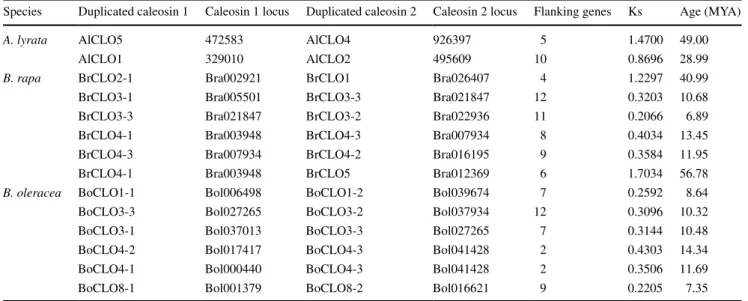
Nine of eleven B. rapa caleosins experienced segmen-tal duplication over times ranging from 56.78 MYA to 6.89 MYA. The earliest segmental duplication took place on BrCLO4-1 and BrCLO5, while the most recent occurred on BrCLO3-2 and BrCLO3-3. Ten of eleven B. oleracea caleosinsexperienced segmental duplication, but showed a narrower range of duplication age from 14.34 MYA to 7.35 MYA (Table 3).
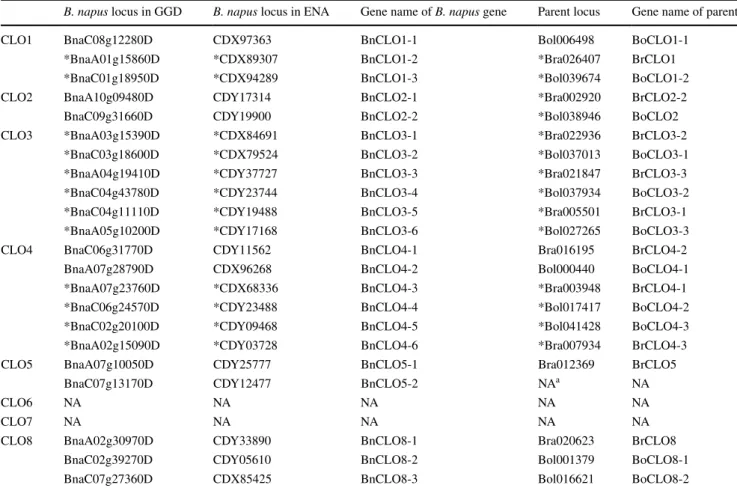
The natural hybridization of B. rapa and B. oleracea produced the allotetraploid B. napus (Chalhoub et al. 2014; Nagaharu 1935). Thus, the parents of B. napus caleosin genes could be determined by orthologs, phylo-genetic trees and the available B. napus chromosomal data (Table 4). All parental genes could be verified except for BnCLO5-2.
Phylogenetic analysis of caleosins in A. thaliana,
A. lyrata and three Brassica crop species
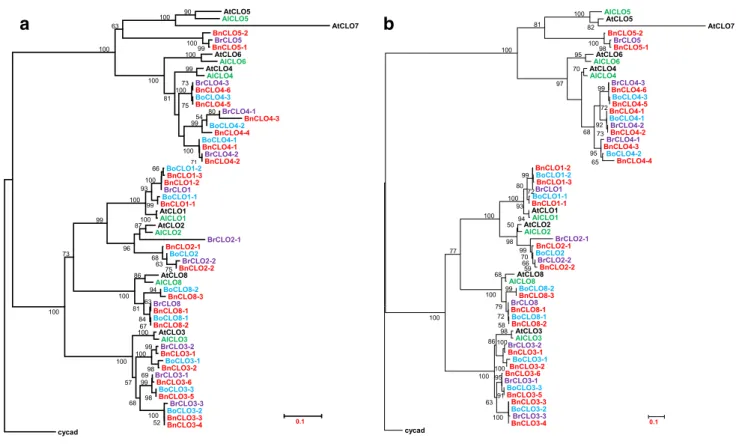
The phylogenetic trees (Fig. 4) were built using caleosin sequences from A. lyrata and three Brassica crops and 8 sequences from A. thaliana and one sequence from a cycad. Both NJ and ML trees shared a bootstrap value higher than 70 %. The similar topological structure of the two trees guaranteed a high fidelity. Two trees showed that the 59 brassicaceous caleosins could be classified into two fami-lies, H-caleosins and L-caleosins, with orthologs clustered separately, consistent with multiple alignments. Our phylo-genetic analyses also indicated the even older single caleo-sin from a cycad presented a closer relationship to H-caleo-sins, which conforms to the result that the cycad caleosin is an H-caleosin (Shen et al. 2014). This indicates L-caleosins emerged after the speciation of cycads and that the L-caleo-sins might therefore have arisen from H-caleoL-caleo-sins.
Expression analysis of Brassica caleosin genes
Due to insufficient data for A. lyrata, we were unable to perform expression analyses. Data for B. rapa, B.
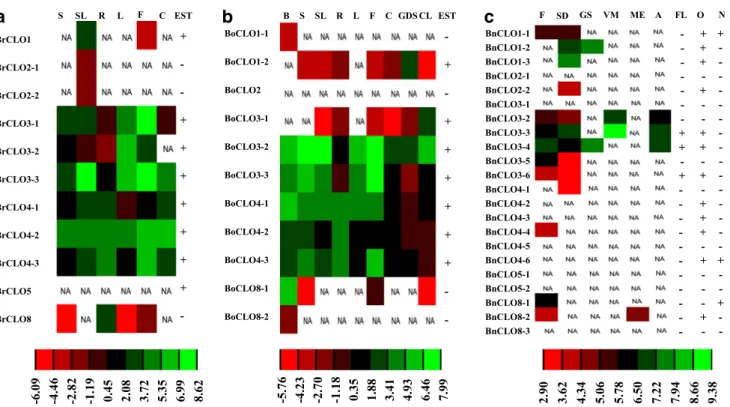
olera-cea and B. napus were obtained from public expression databases. EST data were accessible for all three spe-cies, while RNA-seq data of B. rapa and B. oleracea were also analyzed (Fig. 5, Supplemental Tables 2, 3, 4 and 5). There were limited EST data for B. oleracea. At least one expression datum was collected for each, except for BoCLO2, BnCLO2-1, BnCLO3-1, BnCLO4-5, BnCLO5-1, BnCLO5-2 and BnCLO8-3, which might indicate the lack of expression of these genes.
EST and RNA-seq data of B. rapa were collected, with an absence of data for buds in RNA-seq. The expression patterns obtained by EST and RNA-seq databases were consistent except for BrCLO4-3. BrCLO4-3 EST data showed the highest expression level in roots and no expres-sion in floral tissues, yet the RNA-seq data indicated it presented its highest expression level in floral tissues, with far lower levels in roots (see Supplemental Tables 2, 3, 4 and 5). BrCLO3-3 was the most highly expressed of the B. rapa caleosins and BrCLO3-1 ranked second. Their expression patterns were both floral-specific; no RNA-seq data was obtained for BrCLO5, but the EST data indi-cated its expression in buds; no EST data was obtained for BrCLO2-1 and BrCLO2-2, but their RNA-seq data showed an extremely low expression level; for BrCLO8, the low expression level in RNA-seq data and the deficiency of its EST might be evidence for a loss of function (Fig. 5a).
The EST data for B. oleracea was not comprehensive enough for us to draw a detailed map; it was only used as a reference for expression. The heatmap of gene expression was constructed primarily using RNA-seq data. BoCLO3-2 showed the highest expression level while BoCLO3-3 was second. There was not any expression data for BoCLO2. No EST data were collected for BoCLO1-1 and BoCLO8-2, while only a few RNA-seq data were collected (Fig. 5b).
ESTs data for B. napus was collected for heatmap
(Fig. 5c). Leaf, root, stem and whole-plant were not
included in the heatmap because there are no data available for these tissues among any of the B. napus caleosin genes. The lack of expression data for BnCLO2-1, BnCLO3-1, BnCLO4-5, BnCLO5-BnCLO3-1, BnCLO5-2 and BnCLO8-3 might indicate that they have extremely low expression levels. BnCLO3-3 and BnCLO3-4 exhibited the highest expression level followed by 2 and BnCLO1-3. We also discovered a meristem-specific expression for BnCLO3-3 and BnCLO3-4, and a seed-specific expression for BnCLO1-2 and BnCLO1-3.
To determine which of the orthologs or paralogs make a greater contribution to functional diversity among caleo-sin genes, the triplicated gene CLO3 was used as a typical
example to perform analysis. Synteny Block showed that BrCLO3-2 and BoCLO3-1, BrCLO3-3 and BoCLO3-2, as well as BrCLO3-1 and BoCLO3-3 are orthologs. An expression map showed that orthologs had more simi-lar expression levels than do paralogs, which means that
paralogs made greater contributions to functional diversity. Comparisons were made between B. napus genes and their progenitor parents. B. napus caleosin genes showed distinct expression diversities with their parents except BnCLO2 and its corresponding parents, BrCLO2 and BoCLO2.
Fig. 1 Alignment of H-form insertion (a), Ca2+ binding motif (b),
proline knot (c) and haem-binding motif (b, d) from caleosins in A.
thaliana, A. lyrata, B. rapa, B. oleracea and B. napus. Dashes
rep-resent gaps introduced in the sequences for optimal alignment, red
Cis-element analysis of crucial caleosin genes from B. napus
The promoter sequences of BnCLO1-2 and BnCLO1-3 consisting of 333 and 335 bp, respectively, were used as
they are both shorter than 2000 bp (the selection criterion). According to the results obtained using PLACE, an ABRERATCAL element (S000507) was found in BnCLO1-2, BnCLO1-3, BnCLO3-3 and BnCLO3-4. An RY-repeat element was found in BnCLO1-2, BnCLO1-3
Name Motif Location
AlCLO1 AlCLO2 AlCLO3 AlCLO8 AlCLO4 AlCLO5 AlCLO6 BrCLO1 BrCLO2-1 BrCLO2-2 BrCLO3-1 BrCLO3-2 BrCLO3-3 BrCLO8 BrCLO4-1 BrCLO4-2 BrCLO4-3 BrCLO5 BoCLO1-1 BoCLO2 BoCLO3-1 BoCLO3-2 BoCLO3-3 BoCLO8-1 BoCLO4-1 BoCLO4-2 BoCLO4-3 BoCLO1-2 BoCLO8-2 BnCLO1-1 BnCLO1-2 BnCLO1-3 BnCLO2-1 BnCLO2-2 BnCLO3-1 BnCLO3-2 BnCLO3-3 BnCLO3-4 BnCLO3-5 BnCLO3-6 BnCLO8-1 BnCLO8-2 BnCLO8-3 BnCLO4-1 BnCLO4-2 BnCLO4-3 BnCLO4-4 BnCLO4-5 BnCLO4-6 BnCLO5-1 BnCLO5-2
Fig. 2 Distribution of motifs in caleosins of A. lyrata, B. rapa, B. oleracea and B. napus. Sequences and annotations of motifs are provided in
Table 2
Table 2 Motif sequences and annotations
a Motif number refer to the motifs identified in Fig. 2 b
NH means no hits found
Motif Width Best possible match Annotation by multiple alignment Annotation by InterProScan
1a 50
QQHVAFFDQNGDGIVYPWETYQGFRMIGCNYIS-SAFWSLFINMALSYVTR
Ca2+ binding site Caleosin (IPR007736)
2 50
PGWGPSPSFPIYIKNIHKAKHGSDSSTYDTEGRFVPVN-LENIFSKYARTH
Proline knot Caleosin (IPR007736)
3 32 LYYLCKDENGFLHKEAVRRCFDGSLFEYCAKQ C-terminal-Pi Caleosin (IPR007736)
4 50
PCAPVTGHRRVRNDLDDRLPKPYMPRALQAPD-MEHPNGTEGHDHQGMSVM
H-caleosin insertion Caleosin (IPR007736)
5 26 KELWQMTEGNRMAWDRFGWIANKVEW NHb NH
6 19 MASSASTGVKFVPEEDNFL L-caleosin N-terminal NH
7 10 MEREAMATVA H-caleosin N-terminal NH
8 10 NKEKANSRKQ CLO3 C-terminal NH
9 10 GINEDKTAYY CLO1 C-terminal NH
and BnCLO3-4 (see Supplemental Table 6). Plant-CARE analysis showed that an RY-element is present in BnCLO3-4, while Skn-1 motifs were found in BnCLO1-2 and BnCLO1-3. Several phytohormone-related elements were found in BnCLO1-2, BnCLO1-3, BnCLO3-3 and BnCLO3-4. Additionally, some stress-related elements were found in BnCLO3-3 and BnCLO3-4, which was sup-ported by their resup-ported expressions patterns under stress (Supplemental Tables 2, 3, 4 and 5).
Gene structure analysis of caleosins
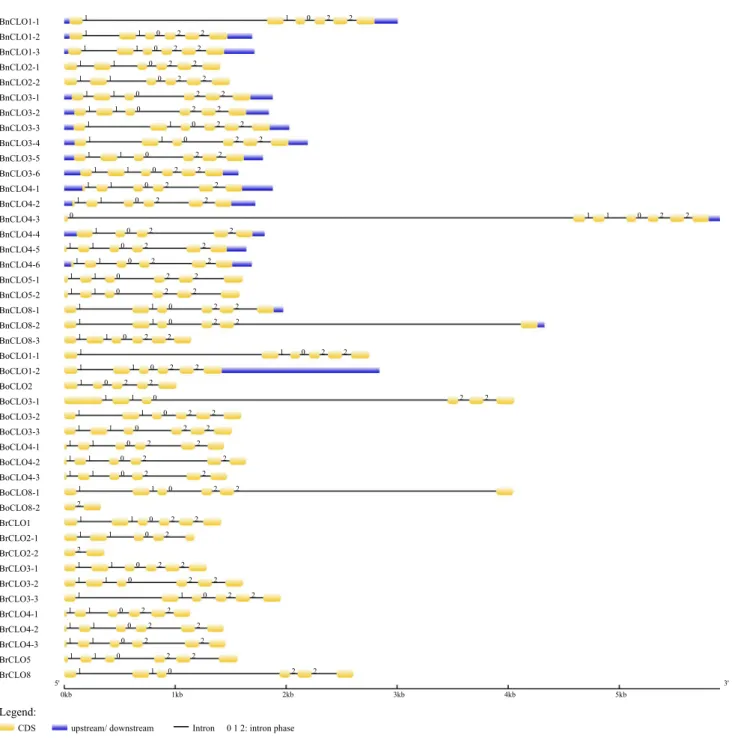
The intron/exon structures of each caleosin gene from Bras-sica species were analyzed (Fig. 6). The results showed a highly conserved intron/exon structure among these caleosins. Eighty-four percent (38/44) of caleosins contained 6 exons and 5 introns, except for BnCLO4-3 (seven exons and six introns), BnCLO4-4, BoCLO2 and BrCLO2-1 (five exons and four introns), BoCLO8-2 and BrCLO2-2 (two exons and one intron).
Fig. 3 Chromosomal architecture of caleosin genes in B. rapa (a), B. oleracea (b), and B. napus (c). The number/word at the top des-ignates the chromosome number. S means scaffold. Scale bar on the
left designates 30 Mb (a), 40 Mb (b) and 60 Mb (c) chromosomal distance. Chromosome sizes (Mb) are marked at the bottom end of each chromosome
Table 3 Segmentally duplicated caleosin genes in A. lyrata, B. rapa and B. oleracea
Species Duplicated caleosin 1 Caleosin 1 locus Duplicated caleosin 2 Caleosin 2 locus Flanking genes Ks Age (MYA)
A. lyrata AlCLO5 472583 AlCLO4 926397 5 1.4700 49.00
AlCLO1 329010 AlCLO2 495609 10 0.8696 28.99
B. rapa BrCLO2-1 Bra002921 BrCLO1 Bra026407 4 1.2297 40.99
BrCLO3-1 Bra005501 BrCLO3-3 Bra021847 12 0.3203 10.68
BrCLO3-3 Bra021847 BrCLO3-2 Bra022936 11 0.2066 6.89
BrCLO4-1 Bra003948 BrCLO4-3 Bra007934 8 0.4034 13.45
BrCLO4-3 Bra007934 BrCLO4-2 Bra016195 9 0.3584 11.95
BrCLO4-1 Bra003948 BrCLO5 Bra012369 6 1.7034 56.78
B. oleracea BoCLO1-1 Bol006498 BoCLO1-2 Bol039674 7 0.2592 8.64
BoCLO3-3 Bol027265 BoCLO3-2 Bol037934 12 0.3096 10.32
BoCLO3-1 Bol037013 BoCLO3-3 Bol027265 7 0.3144 10.48
BoCLO4-2 Bol017417 BoCLO4-3 Bol041428 2 0.4303 14.34
BoCLO4-1 Bol000440 BoCLO4-3 Bol041428 2 0.3506 11.69
The intron phases were also analyzed (Fig. 6). Phase 0 means the intron locates between two codons, while phase 1 means the intron locates after the first nucleotide of the codon and phase 2 means the intron locates after the sec-ond nucleotide of the codon. Intron phases of the brassica-ceous caleosins were highly conserved. Those genes which showed the same structure also shared the same phase of 1, 1, 0, 2 and 2. The intron phase of BrCLO4-3 was 0, 1, 1, 0, 2 and 2; BnCLO4-4 and BoCLO2 were 1, 0, 2 and 2; BrCLO2-1 was 1, 1, 0 and 2, while BoCLO8-2 and BrCLO2-2 were 2. For those genes which had no less than 4 exons, their last four exons were very similar in size.
Discussion
Phylogenetic analysis of caleosin genes in Brassicaceae plants
There are eight caleosin proteins in A. thaliana, named as AtCLO1–AtCLO8. Four of these (AtCLO4–AtCLO7) were determined to be L-caleosins. Among them, AtCLO4
and AtCLO5 are segmentally duplicated, while AtCLO4 and AtCLO6, AtCLO5 and AtCLO7 are tandem duplica-tions. Among other 4 H-caleosins, AtCLO1 and AtCLO2 are segmental duplications (Shen et al. 2014). Neither
A. lyrata nor the three Brassica species had homolo-gous genes of AtCLO7 (Table 1). Arabidopsis and Bras-sica plants experienced an archaic speciation (Blanc et al. 2003; Town et al. 2006; Yang et al. 1999), which may indicate the tandem duplication of AtCLO5 and AtCLO7 occurred after the speciation between A. thaliana and it relative A. lyrata approximately 10 MYA (Hu et al. 2011). While a homologous gene of AtCLO6 was found in A.
lyrata, no homologs were found in the three Brassica spe-cies (Table 1). This may suggest that the tandem duplica-tion of AtCLO4 and AtCLO6 happened after the speciaduplica-tion of Arabidopsis and Brassica plants, but before the spe-ciation of A. thaliana and A. lyrata approximately10–20 MYA (Blanc et al. 2003; Hu et al. 2011; Town et al. 2006; Yang et al. 1999). It is probable that a series of tandem duplications occurred in the A. thaliana genome, which is consistent with previous conclusions drawn by others (Cannon et al. 2004).
Table 4 Caleosins in B. napus and their diploid parents
a NA means no available value
B. napus locus in GGD B. napus locus in ENA Gene name of B. napus gene Parent locus Gene name of parent
CLO1 BnaC08g12280D CDX97363 BnCLO1-1 Bol006498 BoCLO1-1
*BnaA01g15860D *CDX89307 BnCLO1-2 *Bra026407 BrCLO1
*BnaC01g18950D *CDX94289 BnCLO1-3 *Bol039674 BoCLO1-2
CLO2 BnaA10g09480D CDY17314 BnCLO2-1 *Bra002920 BrCLO2-2
BnaC09g31660D CDY19900 BnCLO2-2 *Bol038946 BoCLO2
CLO3 *BnaA03g15390D *CDX84691 BnCLO3-1 *Bra022936 BrCLO3-2
*BnaC03g18600D *CDX79524 BnCLO3-2 *Bol037013 BoCLO3-1
*BnaA04g19410D *CDY37727 BnCLO3-3 *Bra021847 BrCLO3-3
*BnaC04g43780D *CDY23744 BnCLO3-4 *Bol037934 BoCLO3-2
*BnaC04g11110D *CDY19488 BnCLO3-5 *Bra005501 BrCLO3-1
*BnaA05g10200D *CDY17168 BnCLO3-6 *Bol027265 BoCLO3-3
CLO4 BnaC06g31770D CDY11562 BnCLO4-1 Bra016195 BrCLO4-2
BnaA07g28790D CDX96268 BnCLO4-2 Bol000440 BoCLO4-1
*BnaA07g23760D *CDX68336 BnCLO4-3 *Bra003948 BrCLO4-1
*BnaC06g24570D *CDY23488 BnCLO4-4 *Bol017417 BoCLO4-2
*BnaC02g20100D *CDY09468 BnCLO4-5 *Bol041428 BoCLO4-3
*BnaA02g15090D *CDY03728 BnCLO4-6 *Bra007934 BrCLO4-3
CLO5 BnaA07g10050D CDY25777 BnCLO5-1 Bra012369 BrCLO5
BnaC07g13170D CDY12477 BnCLO5-2 NAa NA
CLO6 NA NA NA NA NA
CLO7 NA NA NA NA NA
CLO8 BnaA02g30970D CDY33890 BnCLO8-1 Bra020623 BrCLO8
BnaC02g39270D CDY05610 BnCLO8-2 Bol001379 BoCLO8-1
Homologous genes of AtCLO1 and AtCLO2 are found in all of four species (Table 1), indicating that segmental duplication of CLO1 and CLO2 happened before speciation of these species. It probably happened in common ances-tors of A. thaliana and Brassica plants; this is consistent with a previous study (Shen et al. 2014). The time of seg-mental duplications of AlCLO1 and AlCLO2, BrCLO1 and BrCLO2-1 also provides plausible evidence of this. How-ever, no segmental duplication is found between BoCLO1 and BoCLO2 (Table 1), which indicates a rearrangement in the B. oleracea genome after the formation of this species, approximately 4.6 MYA. This conclusion is consistent with other studies (Liu et al. 2014).
Homologous genes of AtCLO4 and AtCLO5 are iden-tified in three species except B. oleracea. BnCLO5-2 evolved from the C-genome of B. oleracea (Table 1), indi-cating the loss of BoCLO5 after the formation of B. napus. The segmental duplication of CLO4 and CLO5 in A.
thali-ana, A. lyrata and B. rapa happened between 56.78–40.33 MYA (Shen et al. 2014; this paper), earlier than forma-tions of brassicaceous plants approximately 24–40 MYA (Blanc et al. 2003). This confirms the segmental duplica-tion of CLO4 and CLO5 in common ancestors of A.
thali-ana and Brassica plants (Shen et al. 2014). BoCLO5 was
lost in the last 7500 years, after the formation of B. napus. These results may indicate that while the majority of gene elimination in B. oleracea occurred before 4.6 MYA (Liu et al. 2014), some elimination happened within the last 7500 years.
Nine B. rapa genes were segmentally duplicated between 7 and 13.67 MYA, except for BrCLO4 and BrCLO5, BrCLO1 and BrCLO2. All ten segmental dupli-cations of B. oleracea genes occurred between 14.34–7.35 MYA (Table 1). A specific process of whole-genome tripli-cation occurred in Brassica plants between 5 and 16 MYA (Liu et al. 2014; Song et al. 1995; Wang et al. 2011), which may indicate that these segmental duplications are the results of whole-genome triplication.
There are two tandem duplications in CLO2 genes in B.
rapa (BrCLO2-1 and BrCLO2-2), while there is only one CLO2 found in B. oleracea. In the genome of B. napus no gene has been found to have evolved from BrCLO2-1. This indicates that B. rapa may have experienced tandem dupli-cation after its speciation with B. oleracea approximately 4.6 MYA. This result is consistent with a previous study which reported that tandem duplications occurred through-out the evolution of B. rapa (Wang et al. 2011). Among these caleosins, BnCLO8-3 was evolved from BoCLO8-2.
a
b
AtCLO5 AlCLO5 AtCLO7 BnCLO5-2 BrCLO5 BnCLO5-1 AtCLO6 AlCLO6 AtCLO4 AlCLO4 BrCLO4-3 BnCLO4-6 BoCLO4-3 BnCLO4-5 BrCLO4-1 BnCLO4-3 BoCLO4-2 BnCLO4-4 BoCLO4-1 BnCLO4-1 BrCLO4-2 BnCLO4-2 BoCLO1-2 BnCLO1-3 BnCLO1-2 BrCLO1 BoCLO1-1 BnCLO1-1 AtCLO1 AlCLO1 AtCLO2 AlCLO2 BrCLO2-1 BnCLO2-1 BoCLO2 BrCLO2-2 BnCLO2-2 AtCLO8 AlCLO8 BoCLO8-2 BnCLO8-3 BrCLO8 BnCLO8-1 BoCLO8-1 BnCLO8-2 AtCLO3 AlCLO3 BrCLO3-2 BnCLO3-1 BoCLO3-1 BnCLO3-2 BrCLO3-1 BnCLO3-6 BoCLO3-3 BnCLO3-5 BrCLO3-3 BoCLO3-2 BnCLO3-3 BnCLO3-4 cycad 99 100 90 80 100 54 100 99 71 100 99 75 73 100 81 100 63 100 75 94 63 68 63 67 84 86 81 100 66 100 99 100 93 100 87 96 99 73 100 100 98 99 100 52 100 100 57 68 98 69 99 0.1 AlCLO5 AtCLO5 AtCLO7 BnCLO5-2 BrCLO5 BnCLO5-1 AtCLO6 AlCLO6 AtCLO4 AlCLO4 BrCLO4-3 BnCLO4-6 BoCLO4-3 BnCLO4-5 BnCLO4-1 BoCLO4-1 BrCLO4-2 BnCLO4-2 BrCLO4-1 BnCLO4-3 BoCLO4-2 BnCLO4-4 BnCLO1-2 BoCLO1-2 BnCLO1-3 BrCLO1 BoCLO1-1 BnCLO1-1 AtCLO1 AlCLO1 AtCLO2 AlCLO2 BrCLO2-1 BnCLO2-1 BoCLO2 BrCLO2-2 BnCLO2-2 AtCLO8 AlCLO8 BoCLO8-2 BnCLO8-3 BrCLO8 BnCLO8-1 BoCLO8-1 BnCLO8-2 AtCLO3 AlCLO3 BrCLO3-2 BnCLO3-1 BoCLO3-1 BnCLO3-2 BnCLO3-6 BrCLO3-1 BoCLO3-3 BnCLO3-5 BnCLO3-3 BoCLO3-2 BrCLO3-3 BnCLO3-4 cycad 98 82 100 95 70 65 95 72 99 73 92 68 97 94 72 99 93 80 100 59 66 70 99 50 98 100 99 58 72 79 68 100 77 98 100 86 100 100 91 95 63 100 100 100 81 100 0.1Fig. 4 Phylogenetic trees of caleosins in A. thaliana, A. lyrata, B. rapa, B. oleracea and B. napus by the NJ method in MEGA 6.06 (a) and the ML method in PhyML 3.0 (b). Black, green, purple, blue and
red represents caleosin genes from A. thaliana, A. lyrata, B. rapa, B.
oleracea and B. napus, respectively. Numbers next to a node indicate percent bootstrap values (>50 %). The bars at the bottom indicate the average number of amino acid substitutions per site (color figure online)
The structure of BnCLO8-3 was conserved but BoCLO8-2 was severely truncated (see Supplemental Figure 1) and contained only two exons and one intron (phase 2). This indicates that the truncation happened after the speciation of B. napus. BnCLO4-3 evolved from BrCLO4-1, while BnCLO4-4 evolved from BoCLO4-2. BrCLO4-1 and BoCLO4-2 shared a conserved gene structure and intron phase. In contrast, the gene structures and intron phases of BnCLO4-3 and BnCLO4-4 were different, which appears to be unique within the B. napus genome. Gene struc-tures of BoCLO2 and BrCLO2-2 were different, while no change was found in caleosins from their diploid parents. This indicated these changes/differences arose after the emergence of B. napus.
According to results of this study, there were six caleo-sins (CLO1, CLO2, CLO3, CLO4, CLO5, CLO8) in the genome of the common ancestor of Arabidopsis and Bras-sica plants. A whole genome triplication happened among Brassica plants after their speciation from Arabidopsis (Wang et al. 2011). However, three homologs of CLO3 and CLO4 were found in the B. napus genome, while there were only 0–2 homologs of others (Table 1 and S1). This indicated only CLO3/4 homologies were retained, while others lost some (or even all) members of their homologous genes after the triplication. According to the ‘gene dosage
hypothesis’ (Birchler and Veitia 2007), CLO3/4 might play more important roles.
Sub-functionalization, neo-functionalization and non-functionalization may also occur in a multigene fam-ily. These processes may be caused by gene mutation or structural transformation (Lynch and Conery 2000; Lynch 2002). For instance, using AlCLO4 as a standard, in the L-caleosin CLO5, a conserved phosphorylation site S191 is substituted by H in BrCLO5, 1 and BnCLO5-2, and T169 is replaced by A in these three caleosins (see Supplemental Figure 1). Motif analyses showed that part of the N-terminus of CLO5 had been lost (Fig. 2). Expres-sion analyses indicated its extremely low expresExpres-sion level (Fig. 5). Phylogenetic analysis shows its loss from the B. oleracea genome after the formation of this spe-cies (Fig. 4). Collectively, these data indicate the caleosin CLO5 engendered its non-functionalization through gene mutation and structural transformation, and would be lost upon subsequent evolution.
Caleosin gene families and their expansion patterns in Brassicaceae
In this study, 7, 11, 11 and 22 caleosin genes were identi-fied from the genomes of A. lyrata, B. rapa, B. oleracea
-5.7 6 -4.2 3 -2.7 0 -1.18 0.35 1.88 3.41 4.93 6.46 7.99 2.90 3.62 4.34 5.06 5.78 6.50 7.22 7.94 8.66 9.38 -6.0 9 -4.4 6 -2.8 2 -1.1 9 0.45 2.08 3.72 5.35 6.99 8.62 BrCLO1 BrCLO2-1 BrCLO3-2 BrCLO3-3 BrCLO4-1 BrCLO4-2 BrCLO4-3 BrCLO5 BrCLO8 BrCLO2-2 BrCLO3-1 F S SL R L C EST + -+ + + + + + -+
a
c
BoCLO1-1 BoCLO1-2 BoCLO3-2 BoCLO3-3 BoCLO4-1 BoCLO4-2 BoCLO4-3 BoCLO8-1 BoCLO8-2 BoCLO2 BoCLO3-1 B S SL R L F C GDS CL EST -+ + + + + + -+b
F SD GS VM ME A FL O N BnCLO1-3 BnCLO1-2 BnCLO3-3 BnCLO3-5 BnCLO4-1 BnCLO4-3 BnCLO4-5 BnCLO5-1 BnCLO8-1 BnCLO2-1 BnCLO3-1 BnCLO1-1 BnCLO3-2 BnCLO2-2 BnCLO3-4 BnCLO4-6 BnCLO4-4 BnCLO4-2 BnCLO3-6 BnCLO8-2 BnCLO5-2 BnCLO8-3 -+ -+ -+ -+ + + -+ -+ -+ + + + + + + -+ -+ -+-Fig. 5 Expression pattern of caleosin genes in B. rapa (a), B. olera-cea (b), and B. napus (c). The heat map were generated by log2 nor-malized values of caleosin genes. The color scale representing log2 values is shown at the bottom. The plus sign means expression data exist in the corresponding library. The minus sign means no
expres-sion data exist in the corresponding library. S stem, SL silique, R root,
L leaf, F flower, C callus, B bud, GDS germinated seeds, CL coty-ledons, SD seed, GS germinating seed, VM vegetative meristem, ME microspore-derived embryo, A abnormal, FL full-length, O other, N none, NA not available
and B. napus, respectively. Caleosins from A. lyrata and
B. oleracea are newly-discovered in this study. Informa-tion regarding B. rapa caleosins is consistent with previ-ous research (Hu et al. 2013). A 27-kDa-caleosin and a 25-kDa-caleosin have been identified in B. napus embryos (Hernandez-Pinzon et al. 2001); a seed-specific caleo-sin has also been identified in seed of oilseed rape by Katavic et al. (2006). Nine caleosins (including seven BnCLO1/2 and two BnCLO3) had been assembled from
the EST-library of B. napus using A. thaliana sequences as probes, seven of which (including five BnCLO1/2 and two BnCLO3) have been confirmed by means of proteom-ics (Jolivet et al. 2009). The newly-identified BnCLO1/2 sequences do not fit the number of caleosin genes assem-bled from the B. napus EST database. While this may be due to a splicing error, results in this study fit the proteom-ics well. Six BnCLO3s are identified (Table 1). This num-ber is larger than results from EST databases, which may
1 -1 O L C n B . 1 1 0 2 2 BnCLO1-2 1 1 0 2 2 BnCLO1-3 1 1 0 2 2 BnCLO2-1 1 1 0 2 2 BnCLO2-2 1 1 0 2 2 BnCLO3-1 1 1 0 2 2 BnCLO3-2 1 1 0 2 2 BnCLO3-3 1 1 0 2 2 BnCLO3-4 1 1 0 2 2 BnCLO3-5 1 1 0 2 2 BnCLO3-6 1 1 0 2 2 BnCLO4-1 1 1 0 2 2 BnCLO4-2 1 1 0 2 2 BnCLO4-3 0 1 1 0 2 2 BnCLO4-4 1 0 2 2 BnCLO4-5 1 1 0 2 2 BnCLO4-6 1 1 0 2 2 BnCLO5-1 1 1 0 2 2 BnCLO5-2 1 1 0 2 2 BnCLO8-1 1 1 0 2 2 BnCLO8-2 1 1 0 2 2 BnCLO8-3 1 1 0 2 2 BoCLO1-1 1 1 0 2 2 BoCLO1-2 1 1 0 2 2 BoCLO2 1 0 2 2 BoCLO3-1 1 1 0 2 2 BoCLO3-2 1 1 0 2 2 BoCLO3-3 1 1 0 2 2 BoCLO4-1 1 1 0 2 2 BoCLO4-2 1 1 0 2 2 BoCLO4-3 1 1 0 2 2 BoCLO8-1 1 1 0 2 2 BoCLO8-2 2 BrCLO1 1 1 0 2 2 BrCLO2-1 1 1 0 2 BrCLO2-2 2 BrCLO3-1 1 1 0 2 2 BrCLO3-2 1 1 0 2 2 BrCLO3-3 1 1 0 2 2 BrCLO4-1 1 1 0 2 2 BrCLO4-2 1 1 0 2 2 BrCLO4-3 1 1 0 2 2 BrCLO5 1 1 0 2 2 BrCLO8 1 1 0 2 2 5' 3' 0kb 1kb 2kb 3kb 4kb 5kb Legend:
CDS upstream/ downstream Intron 0 1 2: intron phase
Fig. 6 Gene structure and intron phase of Cruciferous caleosins
pre-dicted by GSDS 2.0. Yellow rectangles represent CDS; blue
rectan-gles represent upstream/downstream regions; the thin lines represent
the intron and the figures represent the phase of corresponding introns (color figure online)
be due to incomplete EST data. This study also shows a larger number of caleosins than predicted by proteomics which might be due to the similarities among BnCLO3-X genes.
The caleosin gene family is a multigene-family. The numbers of B. rapa and B. oleracea caleosins are nearly 1.4 times that in A. thaliana, which is lower than the ratio of gene numbers between B. rapa or B. oleracea with A.
thaliana (41,174/25,498 = 1.6, 45,758/25,498 = 1.8) (Arabidopsis genome initiative 2000; Liu et al. 2014; Wang et al. 2011). The probable reason is that both two-tandem duplications in A. thaliana occurred after the segregation of Arabidopsis and Brassica plants.
Among seven A. lyrata caleosin genes, four of them experienced segmental duplication, two experienced tan-dem duplication, and only one experienced both processes. Nine of the eleven B. rapa caleosins experienced segmental duplication, two experienced tandem duplication and one of them experienced both processes. Ten of eleven B. oleracea caleosins experienced segmental duplication (Table 3). We can therefore infer that segmental duplication is the main expansion form for those genes. The combined actions of tandem duplication and segmental duplication are the main expansion form of A. thaliana caleosins.
The number of B. napus caleosins is the sum of B.
rapa and B. oleracea caleosins. This may indicate that the expansion of B. napus caleosins was due to natural hybridi-zation and the subsequent process of genome doubling.
According to the results, segmental duplication is the main gene expansion form for caleosins in those brassica-ceous plants.
Crucial motifs of caleosins in the tested brassicaceous plants
According to this study, caleosins can be characterized by a single calcium binding domain called an EF-hand (motif 1), proline knot (motif 2), and several potential phospho-rylation and haem-binding sites. Our motif analysis indi-cate that these putative caleosins are able to bind calcium, phosphate and haem, which enable them to play roles dur-ing lipid droplet formation or in response to stress. Loss of these motifs in BrCLO2 and BoCLO8-2 (Fig. 2), when combined with expression analyses (Fig. 5), suggests that they may have lost their function. The changes of H70 to C and H138 to V for AtCLO7 may indicate the loss of its per-oxygenase activity.
The N-terminal upstream sequence (motifs 7-4) of the calcium-binding domain of BoCLO2 has been lost. All CLO5 genes lost their upstream N-terminal sequences (motif 6) of the calcium-binding domain (Fig. 2).
Combined with expression data, these N-terminal upstream sequences (motif 7-4 for H-caleosins and motif 6 for L-caleosins), are probably critical for caleosin function.
Expression analysis of caleosins in the tested Brassicaceae plants
Functional differentiation of caleosin genes can be explained using differentially expressed gene (DEG) analysis of their orthologs and paralogs. For instance, for the CLO3 genes, BrCLO3-1, BrCLO3-2, BrCLO3-3 and BoCLO3-1, BoCLO3-2, BoCLO3-3, are paralogs, while BrCLO3-1 and BoCLO3-1, BrCLO3-2 and BoCLO3-2, and BoCLO3-3 and BrCLO3-3 are three pairs of orthologs. Among them, differences in ortholog expression were smaller than in paralog expression (Fig. 5). This may be due to the sub-genome dominance effect, which can con-serve functions of a single gene while promoting the sub-functionalization or neo-sub-functionalization of its paralogs (Wang et al. 2011). According to the current study, para-logs are the main cause for functional diversities among caleosins.
Expression patterns of B. rapa and B. oleracea orthologs are similar (Fig. 5). Obvious differences are detected among B. napus caleosin genes and their progenitor par-ents, except for BnCLO2. These distinctions may due to the necessity of gene expression changes during the process of environmental adaptations of the allopolyploid formed by natural polyploidization. These changes are results of many short-lived occurrences of genetic diversity happening in allopolyploid genomes (Song et al. 1995). According to the “additivity hypothesis”, expression patterns of allopol-yploids are the average of the expression in their parents (Higgins et al. 2012). However, the expression in B. napus caleosin genes and that in their parents did not fit the “addi-tivity hypothesis”, which is consistent with the fact that commonly expressed genes in diploid parents do not fit the “additivity hypothesis” in the allotetraploid (Higgins et al. 2012; Jiang et al. 2015). Thus the expression patterns of B.
napus caleosin genes cannot be directly inferred from that of their parents.
Among several caleosin paralogs in Brassica plants, genes with higher expression levels are likely to play more important roles (Cheng et al. 2014). Thus, BrCLO3-3, BrCLO4-2, BoCLO3-2, BoCLO4-1, BnCLO1-2, BnCLO1-3, BnCLO3-3 and BnCLO3-4 are worthy of fur-ther research, while the extremely low expression levels of BrCLO2-1, BrCLO2-2, BrCLO5, BnCLO2-1, BnCLO3-1, BnCLO4-5, BnCLO5-1, BnCLO5-2, and BnCLO8-3 might indicate that under normal growth conditions, they may play roles of less importance.
Functional analysis of important B. napus caleosins
The ABRERATCAL element (S000507) is detected in BnCLO1-2, BnCLO1-3, BnCLO3-3 and BnCLO3-4 by PLACE analysis (see Supplemental Table 6). This element can respond to calcium signaling (Kaplan et al. 2006). PlantCARE analysis indicates there are several phytohor-mone repsonse-related elements in BnCLO1-2, BnCLO1-3, BnCLO3-3 and BnCLO3-4. These genes contain integrated EF-hand domains, which show a consistent capacity for calcium-binding. Taken together, this suggests that cal-cium is involved in signal transduction processes enabled by these caleosins and subject to regulation by phytohor-mones. In addition, BnCLO1-2 and BnCLO1-3 contain an “RY-repeat” element, which can bind transcription factors within the B3-domain (Ezcurra et al. 2000). Transcription factors ABI3, FUS3 and LEC2, containing B3 domains, are associated with lipid metabolism (McGlew et al. 2015). The PlantCARE analysis shows that the RY-element is only found in BnCLO3-4, while the Skn-1 motif, which is related to lipid metabolism (Pang et al. 2014), is found in BnCLO1-2 and BnCLO1-3. This may be evidence that these caleosins have a relationship with triacylglycerol accumulation and decomposition/turnover.
BnCLO1-2 shows specific expression in seed or germi-nating seed and BnCLO1-3 exhibits seed-specific expres-sion (Fig. 5). The seed is the most important tissue for tria-cylglycerol accumulation in B. napus; the decomposition of lipid droplets by proteases and lipases and the subsequent β oxidation of the fatty acids released, can provide energy for the germinating seed. Therefore, these two caleosins may play roles in triacylglycerol accumulation or turnover, or calcium-meidated signal transduction in seeds, while BnCLO1-2 may also play a role in calcium-mediated signal transduction during seed germination. BnCLO3-3 shows meristem-specific expression while BnCLO3-4 shows a uniform expression in different organs and their expres-sion is also augmented under stress, suggesting a role for calcium-based signal transduction in stress responses in relevant tissues.
In summary, analyses of phylogeny, structural motifs, genome expansion, gene expression and functional analy-sis were studied. All 51 Brassica and A. lyrata caleosins, showing different motif structures and physicochemi-cal properties, can be divided into two distinct families: H-family or L-family. Structural analysis indicated the intron phases are conserved among the majority of the Brassica caleosins and segmental duplication was identi-fied as the main gene expansion form for them. Among them, BrCLO2 and BoCLO8-2 have lost their calcium binding domain, proline knot, potential phosphorylation sites and haem-binding site motifs, which, when com-bined with their low expression levels, suggests that these
caleosins have likely lost their related functions. Others like BnCLO1-2, BnCLO1-3, BnCLO3-3 and BnCLO3-4 may involve phytohormone-related responses because associated signature elements are found in their sequences. In addition, the ‘RY-repeat’ elements, which can be bound by transcription factors possessing the B3-domain, such as ABI3, FUS3 or LEC2, were discovered in BnCLO1-2 and BnCLO1-3. The expression data indicated that caleosins of high expression level, such as BrCLO3-3, BrCLO4-2, BoCLO3-BrCLO4-2, BoCLO4-1, BnCLO1-BrCLO4-2, BnCLO1-3, BnCLO3-3 and BnCLO3-4, are likely to play an important role as structural stabilizers of lipid droplets or are invoked in response to stress, both of which will require further study.
Acknowledgments This work was supported by the National
Natu-ral Science Foundation of China (31270295) and funding provided by Northwest A&F University, China.
References
Allen J, Leach N, Ferguson S (2005) The histidine of the c-type cytochrome CXXCH haem-binding motif is essential for haem attachment by the Escherichia coli cytochrome c maturation (Ccm) apparatus. Biochem J 389:587–592
Arabidopsis genome initiative (2000) Analysis of the genome sequence of the flowering plant Arabidopsis thaliana. Nature 408(6814):796
Aubert Y, Vile D, Pervent M, Aldon D, Ranty B, Simonneau T, Vava-sseur A, Galaud J-P (2010) RD20, a stress-inducible caleosin, participates in stomatal control, transpiration and drought toler-ance in Arabidopsis thaliana. Plant Cell Physiol 51:1975–1987 Bailey TL, Williams N, Misleh C, Li WW (2006) MEME:
discover-ing and analyzdiscover-ing DNA and protein sequence motifs. Nucleic Acids Res 34:W369–W373
Beilstein MA, Nagalingum NS, Clements MD, Manchester SR, Mathews S (2010) Dated molecular phylogenies indicate a Miocene origin for Arabidopsis thaliana. Proc Natl Acad Sci 107:18724–18728
Birchler JA, Veitia RA (2007) The gene balance hypothesis: from classical genetics to modern genomics. Plant Cell 19:395–402 Blanc G, Wolfe KH (2004) Widespread paleopolyploidy in model
plant species inferred from age distributions of duplicate genes. Plant Cell 16:1667–1678
Blanc G, Hokamp K, Wolfe KH (2003) A recent polyploidy super-imposed on older large-scale duplications in the Arabidopsis genome. Genome Res 13:137–144
Blée E, Flenet M, Boachon B, Fauconnier ML (2012) A non-canoni-cal non-canoni-caleosin from Arabidopsis efficiently epoxidizes physiologi-cal unsaturated fatty acids with complete stereoselectivity. FEBS J 279:3981–3995
Blée E, Boachon B, Burcklen M, Le Guédard M, Hanano A, Heintz D, Ehlting J, Herrfurth C, Feussner I, Bessoule J-J (2014) The reductase activity of the Arabidopsis caleosin RESPONSIVE TO DESSICATION20 mediates gibberellin-dependent flowering time, abscisic acid sensitivity, and tolerance to oxidative stress. Plant Physiol 166:109–124
Blom N, Gammeltoft S, Brunak S (1999) Sequence and structure-based prediction of eukaryotic protein phosphorylation sites. J Mol Biol 294:1351–1362