Publisher’s version / Version de l'éditeur:
Vous avez des questions? Nous pouvons vous aider. Pour communiquer directement avec un auteur, consultez la première page de la revue dans laquelle son article a été publié afin de trouver ses coordonnées. Si vous n’arrivez pas à les repérer, communiquez avec nous à [email protected].
Questions? Contact the NRC Publications Archive team at
[email protected]. If you wish to email the authors directly, please see the first page of the publication for their contact information.
https://publications-cnrc.canada.ca/fra/droits
L’accès à ce site Web et l’utilisation de son contenu sont assujettis aux conditions présentées dans le site LISEZ CES CONDITIONS ATTENTIVEMENT AVANT D’UTILISER CE SITE WEB.
The 11th European Conference on Principles and Practice of Knowledge
Discovery in Databases (PKDD) [Proceedings], 2007
READ THESE TERMS AND CONDITIONS CAREFULLY BEFORE USING THIS WEBSITE. https://nrc-publications.canada.ca/eng/copyright
NRC Publications Archive Record / Notice des Archives des publications du CNRC :
https://nrc-publications.canada.ca/eng/view/object/?id=d741ee77-f3c0-4d76-a7d6-2d9757d8602a
https://publications-cnrc.canada.ca/fra/voir/objet/?id=d741ee77-f3c0-4d76-a7d6-2d9757d8602a
NRC Publications Archive
Archives des publications du CNRC
This publication could be one of several versions: author’s original, accepted manuscript or the publisher’s version. / La version de cette publication peut être l’une des suivantes : la version prépublication de l’auteur, la version acceptée du manuscrit ou la version de l’éditeur.
Access and use of this website and the material on it are subject to the Terms and Conditions set forth at
Pruning relations for substructure discovery of multi-relational
databases
National Research Council Canada Institute for Information Technology Conseil national de recherches Canada Institut de technologie de l'information
Pruning Relations for Substructure
Discovery of Multi-Relational Databases *
Guo, H., Viktor, H.L., Paquet, E.
September 2007
* published at The 11th European Conference on Principles and Practice of Knowledge Discovery in Databases (PKDD). September 17-21, 2007. Warsaw, Poland. NRC 49827.
Copyright 2007 by
National Research Council of Canada
Permission is granted to quote short excerpts and to reproduce figures and tables from this report, provided that the source of such material is fully acknowledged.
Pruning Relations for Substructure Discovery of
Multi-relational Databases
Hongyu Guo1, Herna L. Viktor1, and Eric Paquet2
1
School of Information Technology& Engineering, University of Ottawa, Canada {hguo028, hlviktor}@site.uottawa.ca,
2
National Research Council of Canada, Ottawa, Canada [email protected]
Abstract. Multirelational data mining methods discover patterns across multiple interlinked tables (relations) in a relational database. In many large organizations, such a multi-relational database spans numerous de-partments and/or subdivisions, which are involved in different aspects of the enterprise such as customer profiling, fraud detection, inventory management, financial management, and so on. When considering mul-tirelational classification, it follows that these subdivisions will express different interests in the data, leading to the need to explore various sub-sets of relevant relations with high utility with respect to the target class. The paper presents a novel approach for pruning the uninteresting rela-tions of a relational database where relarela-tions come from such different parties and spans many classification tasks. We aim to create a pruned structure and thus minimize predictive performance loss on the final classification model. Our method identifies a set of strongly uncorrelated subgraphs to use for training and discards all others. The experiments performed demonstrate that our strategy is able to significantly reduce the size of the relational schema without sacrificing predictive accuracy.
1
Introduction
Knowledge discovery from relational databases poses a unique opportunity for the data mining community. In many large organizations, such a relational data-base spans numerous departments and/or subdivisions and these subdivisions will express different interests in the data, leading to the need to explore various subsets of relevant relations with high utility with respect to the target class. Furthermore, acquiring such data is often expensive. Also, it becomes harder to preserve data privacy when data in a database is from multiple sources. These problems can be mitigated by pruning uninteresting relations before constructing a model. Few attempts to address this issue have been made so far [5, 12].
This paper presents the Subgraph Ensemble Structure Pruning(SESP) method for pre-pruning relational databases. The SESP approach aims to create a pruned relational schema that models only the most informative substructures, while maintaining satisfactory predictive performance. This is achieved by removing
2 Hongyu Guo, Herna L. Viktor, Eric Paquet
either irrelevant or redundant substructures from the database. The SESP al-gorithm assumes that strongly correlated substructures contain redundant in-formation. Those which are weakly correlated to the class are said to be of low relevance. The SESP approach initially decomposes the relational domain into subgraphs. From this set, it subsequently identifies a subset of subgraphs which are strongly uncorrelated with each other, but correlated with the target class (uncorrelated subgraphs). All other subgraphs are discarded. We compare the classifiers constructed from the original schema with those constructed from the pruned database. Our experiments on both real-world and synthetic databases demonstrate that the SESP approach is able to significantly reduce the com-plexity of the relational schema without sacrificing the predictive accuracy.
The paper is organized as follows. Section 2 describes the problem setting. Next, a detailed discussion of the SESP algorithm is provided in Section 3. Section 4 presents a comparative evaluation. Section 5 concludes the paper.
2
Problem Setting
The problem setting for our SESP strategy is defined by a relational database schema ℜ, which is described by a set of tables {R1,· · ·,Rn}. Each table Ri
consists of a set of tuples TR, a primary key, and a set of foreign keys (in this
paper, we refer to primary key and foreign keys as key attributes). Foreign key attributes3 link to primary keys of other tables. This type of linkage defines a
join (relationship) between the two tables involved. A set of joins with n tables R1 ✶ · · · ✶ Rn describes a join path, where the length of it is defined as the
number of joins it contains.
In a relational classification setting a database ℜ contains a target relation Rt, a set of background relations Rb, and a set of joins (J). Each tuple x ∈ TRt
includes a unique primary key attribute x.k (tuple identifier) and a categorical variable y. The task in this setting is to find a function F (x) which maps each tuple x of the target table Rtto a category label y. That is, y = F (x, Rt, Rb, J).
The SESP method aims to pre-prune the relational structure for the task of multirelational classification without loss of predictive accuracy. The SESP pruning strategy is closely related to our Multiple View Relational Classification (MRC) method presented by Guo and Viktor in [4]. The MRC method aims at constructing an accurate relational classifier directly from a relational database by using multiple views on the data.
3
The SESP Pruning Approach
The core idea of the SESP method is to identify a small set of strongly un-correlated subgraphs given a database schema. As presented in Algorithm 1, the process consists of two key steps: 1) to initially decompose the relational database schema into subgraphs (subgraph construction); and 2) to identify the subset of strongly uncorrelated subgraphs (subgraph evaluation).
3
Pruning Relations for Substructure Discovery of Multi-relational Databases 3
Algorithm 1The SESP Pruning Approach
Input:A relational database ℜ= {Rt, Rb, J}
Output:A pruned database ℜ′= {R
t, R′b, J′}
1: Divide ℜ into training data set Ttand evaluation set Tm;
2: Convert ℜ into undirected graph G; 3: Decompose G into a set of subgraphs {S};
4: Build a classifier for each subgraph in {S}, using Tt;forming {Cd1,· · · , C m d};
5: Let subgraph set C = ∅;
6: Generate an evaluation examples set Tm′, using Tmand {Cdi} m 1;
7: Select a subgraph feature set A′ from Tm′;
8: For each Ci
dwith at least one attribute in A
′ : C.add(Ci d); forming {C i }k 1 (k ≤ m);
9: Remove duplicate relations/relationships from {Ci
}k
1; forming ℜ′= {Rt, R′b, J′};
10: return ℜ′.
3.1 Subgraph Construction
The subgraph construction process aims to build a set of subgraphs given a relational database schema where each subgraph corresponds to a unique join path. The construction process initially converts the relational database schema into an undirected graph, using the tables as the nodes and joins as edges.
Two heuristic constraints are imposed on each constructed subgraph. The first is that each subgraph must start at the target relation. This constraint ensures that each subgraph will contain the target relation and, therefore, be able to construct a classification model (details to be discussed in Section 3.2). The second constraint is for relations to be unique for each candidate subgraph. Typically in a relational domain, the number of possible join paths given a large number of relations is usually very large, making it too costly to exhaustively search all join paths [7]. Also, join paths with many relations may decrease the number of entities related to the target tuples. Therefore, we propose to this restriction for the SESP algorithm as a tradeoff between accuracy and efficiency. Using these constraints, the subgraph construction process proceeds initially by finding unique join paths with two relations, i.e. join paths with a length of one. These join paths are progressively lengthened, one relation at a time. We use the length of the join path as the stopping criterion, preferring subgraphs with shorter length. The reason for preferring shorter subgraphs is that semantic links with too many joins are usually very weak in a relational database [13]. Thus we specify a maximum length for join paths. When this number is reached, the entire join path extraction process stops. Note that a special subgraph, one that is comprised solely of the target relation, is created as well.
3.2 Subgraph Evaluation
In order to select which subgraphs will be best for classification, subgraphs are evaluated according to the following methodology(Algorithm 1). Firstly, each of the created subgraphs is used to construct a separate classifier (subgraph-based
4 Hongyu Guo, Herna L. Viktor, Eric Paquet
relational classification). Secondly, the constructed classification models are used to generate an evaluation data set in which each instance is described by sets of feature sets (subgraph features). Each feature set describes the knowledge contained in one of the classification models. Thirdly, the set of subgraph features which are strongly uncorrelated with each other, but correlated with the target class, are identified. These subgraph feature sets correspond, therefore, to a set of subgraphs. Lastly, subgraphs which are not selected are discarded.
Subgraph-based Relational Classification Each subgraph created in Sec-tion 3.1 can be used to build a relaSec-tional classifier using tradiSec-tional single-table learning algorithms. These methods require “flat” data presentations. In order to employ these “flat” data methods, aggregation operators are usually used to squeeze a bag of tuples into one attribute-based entity. Often, different aggrega-tion funcaggrega-tions are employed on different types of attributes. Here, for a Nominal Attribute, the aggregation COUNT function is applied to calculate the number of times the attribute occurs within the data set. For a Binary Attribute for which there are only two possible values, the COUNT function is applied separately on each of the two values. For a Numeric Attribute, the aggregation functions SUM, AVG, MIN, MAX, STDDEV and COUNT are applied. In this way, each subgraph separately creates a set of attribute-based training instances.
Subgraph FeaturesSubgraph features are used to describe the knowledge held by subgraph-based classifiers and represent the corresponding subgraphs. The subgraph features are generated as follows. Let {C1, · · · , Cn} be n classifiers
(each is built using a different subgraph). Let Tmbe an evaluation data set with
m labels {y1, · · · , ym}. For each instance t (with label L) in Tm, each classifier is
called upon to produce predictions {fyk
Ci(t)} (i ∈ {1, · · · , n} and k ∈ {1, · · · , m})
for it. Here, fyk
Ci(t) denotes the probability that instance t belongs to class yk, as
predicted by classifier Ci. In this way a set of evaluation examples is constructed
where each consists of sets of prediction set {Pyk
Ci(t)} and the original class label
L. For instance, C1is described and represented by features {fyk
C1(t)}. We define
{fyi
C1(t)} to be the subgraph features of classifier C
1. As an example, consider a
two class (y1 and y2) problem with two classifiers C1 and C2. For each tuple t
in the evaluation data set, each classifier Ciwill assign each class y
ia prediction
pi
i. Thus, the evaluation example t
′
has two attributes p1
1 and p12 for subgraph
C1, and two other attributes p2
1and p22 for C2, along with the class of t.
Correlation Measurement of SubgraphsThe SESP strategy uses a heuris-tic measure to calculate the correlation score of a set of subgraphs (represented by subgraph features). This measure considers the correlation information both between subgraphs and between those subgraphs and the class to be learned. A similar heuristic principle has previously been applied in test theory by Ghis-elli [3] and in feature selection by Hall [6]. This heuristic assigns each subset of features a level of “goodness.” The score is formalized by Equation 1 [6]:
Q = KRcf
K+ K(K − 1)Rf f
(1)
Here, K is the number of features in the subset, Rcf is the average
Pruning Relations for Substructure Discovery of Multi-relational Databases 5
To measure the degree of correlation between features and the target class and between the features themselves, we use the notion of Symmetrical Un-certainty (U) [10] to calculate Rcf and Rf f. This score is a variation of the
Information Gain (InfoGain) measure [11]. It compensates for InfoGain’s bias toward attributes with more values, and has been successfully applied by Ghis-elli [10] and Hall [6]. Symmetrical Uncertainty is defined as follows:
Given features X and Y ,
U = 2.0 × Inf oGain H(Y ) + H(X)✁
where H(X) and H(Y ) are the entropies of the random variables X and Y , perspectively. Note that, these measures need all of the features to be nominal, so numeric features are first discretized properly.
Subgraph Pruning In order to identify a set of uncorrelated subgraphs, the evaluation procedure searches all of the possible subgraph feature subsets, and constructs a ranking on them. The best ranking subset will be selected, i.e. the subset with the highest Q value.
To search the subgraph feature space, the SESP method uses a best first search strategy [8]. The method starts with an empty set of features, and keeps expanding, one feature at a time. In each round of the expansion, the best fea-ture subset, namely the subset with the highest “goodness” value Q is chosen. In addition, the SESP algorithm terminates the search if a preset number of consecutive non-improvement expansions occurs. Based on our experimental ob-servations we empirically set the number to five (5).
Subgraphs are selected based on the final best subset of subgraph features. If a subgraph has no features that are strongly correlated to the class, the knowledge possessed by this subgraph can be said to be unimportant for the task at hand. Thus, it makes sense to prune this subgraph. The SESP algorithm, therefore, keeps a subgraph if and only if any of its subgraph features appears in the final best ranking subset.
4
Experimental Results
In our evaluation, we compare the accuracy of a relational classifier constructed from the original schema with the accuracy of one built from a pruned schema. We perform our experiments using the MRC, RelAggs [9], TILDE [2], and Cross-Mine algorithms. The MRC and RelAggs approaches are aggregation-based al-gorithms where C4.5 decision trees [11] were applied as the single-table learner. The C4.5 decision tree learner was used due to its de facto standard for em-pirical comparisons. In contrast, the CrossMine and TILDE methods are two benchmark logic-based strategies. In addition, we only consider join paths which contain less than four tables. This number was empirically determined and pro-vides a good trade off between accuracy and execution time. Also, C4.5 decision tree was applied as the subgraph-based classifiers of the SESP strategy. All ex-periments were conducted using ten-fold cross validation. We report the average running time of each fold (run on a 3 GHz Pentium4 PC with 1 GByte of RAM).
6 Hongyu Guo, Herna L. Viktor, Eric Paquet
4.1 Real Databases
Financial Database: Our first experiment uses the financial database from the PKDD 1999 discovery challenge [1]. This database consists of eight tables. This database provides us with two different learning problems. Our first learning task (F234) is to learn if a loan is good or bad from the 234 finished tuples. The second experimental task (F400) uses the Financial database as prepared in [13], which has 400 examples in the target table.
ECML98 Database: Our second experiment uses the database from the ECML 1998 Sisyphus Workshop. The learning task (ECML) is to categorize the 7,329 households into classes 1 and 2 [9]. Eight background relations are provided for this learning task. We here used the new star schema prepared in [9].
Table 1.Accuracies obtained using methods MRC, RelAggs, TILDE, and CrossMine against the original and pruned schemas, along with the compression rate
Schema MRC RelAggs TILDE CrossMine Compress.
Original Pruned Original Pruned Original Pruned Original Pruned Rate F400 88.0 % 88.0 % 89.0 % 86.8 % 81.3 % 81.0% 85.8 % 87.3 % 50.0 % F234 92.3 % 92.3 % 90.2 % 90.2 % 86.8 % 86.8% 88.0 % 89.4 % 25.0 % ECML 88.2 % 87.5 % 88.0 % 86.2 % 53.7 % 52.0% 85.3 % 83.7 % 55.5 %
Table 2.Execution time (seconds) required using the four tested methods against the original and pruned schemas, along with the computational time of the SESP method
Schema MRC RelAggs TILDE CrossMine Pruning
Original Pruned Original Pruned Original Pruned Original Pruned Time F400 2.83 2.25 60.00 51.83 650.00 132.32 8.10 6.76 1.97 F234 1.60 1.17 40.80 34.13 568.30 80.36 5.00 3.41 1.07 ECML 424.43 220.99 1703.58 1206.39 1108.60 167.76 570.90 366.78 356.24
Experimental Results and Discussion: The predictive accuracy we obtained, us-ing MRC, RelAggs, TILDE, and CrossMine is presented in Table 1. The results obtained with the respective original and pruned schemas are shown side by side. We also present the compression rates achieved by the SESP approach in the last column of Table 1. The compression rate considers the number of relations of the original schema (Noriginal) and the number of relations pruned (Npruned)
and is calculated as (Noriginal− Npruned)/Noriginal. In table 2, we also provide
the execution time of the pruning process, as well as the running time required for the four tested algorithms against the original and pruned schemas.
From Table 1, one can see that the SESP algorithm not only significantly reduces the size of the relational schema, but also produces compact pruned schemas that provide comparable multi-relational classification models in terms of the accuracy obtained. The results shown in Table 1 provide us with two mean-ingful observations. The first is that the SESP strategy is capable of pruning the database schemas meaningfully. The compression rates for these three learning
Pruning Relations for Substructure Discovery of Multi-relational Databases 7
schemas are 50%, 25%, and 55.5%, respectively. The second finding is that the pruned schemas produce comparable accuracies, when compared to the results obtained with the original schemas. Results as obtained by the aggregation-based methods show that, for two of the three databases (F400 and F234), the MRC algorithm obtained the same predictive results when pruned. Only against the ECML database, did the pruned MRC algorithm obtain a slightly lower accuracy than the original (lower by only 0.7%). When considering the RelAggs algorithm, the accuracy produced by the RelAggs method against both the pruned and full schemas were comparable. Against the F234 data set, the RelAggs algorithm achieved the same predictive results. Only against the F400 and ECML data sets, did the RelAggs method yield slightly lower accuracy than the original.
When testing with the logic-based strategies, Table 1 shows that, the TILDE algorithm obtained almost the same accuracy against two of the three tested data sets (F400 and F234). Only against the ECML database, did the TILDE algorithm obtain a slightly lower accuracy than the original (lower by only 1.7%). When considering the CrossMine method, the accuracy produced by this method against both the pruned and full schemas was also very close.
In terms of computational cost of the SESP algorithm, results presented in Table 2 show that the pruning processes were fast. In addition, the results also indicate that meaningful execution time reduction was achieved when building the relational models against the pruned schema, when compared to that of constructing models against the original relational structures.
4.2 Synthetic Databases
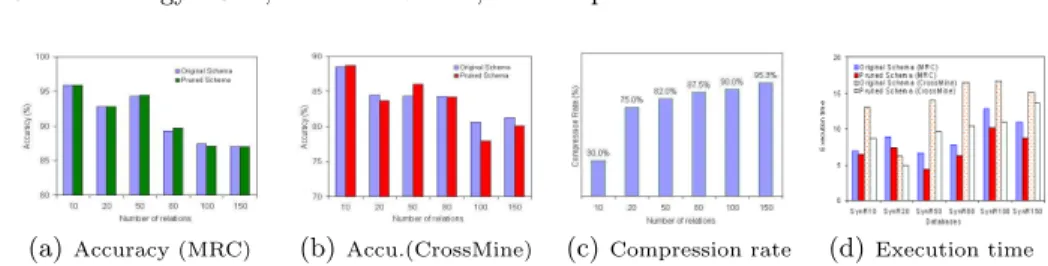
To further test the SESP algorithm, we generated six synthetic databases with different characteristics. The database generator was obtained from Yin et al. in [13]. For each database in this paper, we set the expected number of tuples and attributes to 1000 and 15, respectively. The six databases were generated with 10, 20, 50, 80, 100, and 150 relations (denoted as SynR10, SynR20, SynR50, SynR80, SynR100, and SynR150), respectively. The accuracies obtained (on both original and pruned schemas) by the MRC and CrossMine methods are shown in Figures 1(a) and 1(b), respectively. The compression rates obtained are provided in Figure 1(c). We also provide the execution time needed using the MRC and CrossMine algorithms against the original and pruned schemas in Figure 1(d).
From these Figures one can again see that the SESP algorithm not only signif-icantly reduces the complexity of the structural schemas, but also produces very comparable classification models in terms of the accuracy obtained. The MRC algorithm, for example, produced equal or higher accuracies for all databases, except for a slight decrease of 0.3% with the SynR80 database. When using the CrossMine method, the results also convince us that the pruned schemas produce comparable classifiers in terms of accuracies obtained. In terms of compression rate, the results in Figure 1(c) show that the compression rates were more than 80% for databases with more than 50 relations. In addition, results as presented in Figure 1(d) show that the execution time needed for constructing relational models using the two tested algorithms was meaningful reduced when pruned.
8 Hongyu Guo, Herna L. Viktor, Eric Paquet
(a)Accuracy (MRC) (b) Accu.(CrossMine) (c)Compression rate (d)Execution time
Fig. 1.Accuracies obtained and execution time (seconds) required by the MRC and CrossMine methods, as well as compression rates achieved by the SESP
5
Conclusion and Future Work
Multirelational data mining application usually involves a large number of rela-tions. This paper presents a novel algorithm to pre-prune uninteresting relations of relational learning tasks. Our experiments demonstrate that the strategy is able to significantly reduce the size of the relational schema while still maintain-ing the accuracy of the final model. This research suggests that one can build an accurate relational classification model using only a small subset of the orig-inal schema. Our future work will include research on extending the subgraph definition to include graphs with more than one slot chain.
References
1. P. Berka. Guide to the financial data set. In A. Siebes and P. Berka, editors,
PKDD2000 Discovery Challenge, 2000.
2. H. Blockeel and L. D. Raedt. Top-down induction of first-order logical decision trees. Artificial Intelligence, 101(1-2):285–297, 1998.
3. E. E. Ghiselli. Theory of Psychological Measurement. McGrawHill Company, 1964. 4. H. Guo and H. L. Viktor. Mining relational data through correlation-based multiple
view validation. In KDD ’06, pages 567–573, New York, NY, USA, 2006.
5. A. Habrard, M. Bernard, and M. Sebban. Detecting irrelevant subtrees to improve probabilistic learning from tree-structured data. Fundamenta Informaticae: Special
Issue on Mining Graphs, Trees and Sequences, 2005.
6. M. Hall. Correlation-based feature selection for machine learning, Ph.D thesis, department of computer science, university of waikato, new zealand, 1998. 7. R. Hamill and N. Martin. Database support for path query functions. In Proc. of
21st British National Conference on Databases (BNCOD 21), pages 84–99, 2004.
8. R. Kohavi and G. H. John. Wrappers for feature subset selection. Artificial
Intel-ligence, 97(1-2):273–324, 1997.
9. M.-A. Krogel. On Propositionalization for Knowledge Discovery in Relational Databases. PhD thesis, Otto-von-Guericke-Universitt Magdeburg, 2005.
10. W. H. Press, B. P. Flannery, S. A. Teukolsky, and W. T. Vetterling. Numerical
recipes in C: the art of scientific computing. Cambridge University Press, 1988.
11. J. R. Quinlan. C4.5: programs for machine learning. Morgan Kaufmann Publishers Inc., San Francisco, CA, USA, 1993.
12. L. Singh, L. Getoor, and L. Licamele. Pruning social networks using structural properties and descriptive attributes. In ICDM ’05, pages 773–776, 2005.
13. X. Yin, J. Han, J. Yang, and P. S. Yu. Crossmine: Efficient classification across multiple database relations. In ICDE ’04, Boston, 2004.