HAL Id: hal-01187714
https://hal.sorbonne-universite.fr/hal-01187714
Submitted on 27 Aug 2015
HAL is a multi-disciplinary open access archive for the deposit and dissemination of sci-entific research documents, whether they are pub-lished or not. The documents may come from teaching and research institutions in France or
L’archive ouverte pluridisciplinaire HAL, est destinée au dépôt et à la diffusion de documents scientifiques de niveau recherche, publiés ou non, émanant des établissements d’enseignement et de recherche français ou étrangers, des laboratoires
2D characterization of near-surface V P/V S:
surface-wave dispersion inversion versus refraction
tomography
Sylvain Pasquet, Ludovic Bodet, Laurent Longuevergne, Amine Dhemaied,
Christian Camerlynck, Fayçal Rejiba, Roger Guérin
To cite this version:
Sylvain Pasquet, Ludovic Bodet, Laurent Longuevergne, Amine Dhemaied, Christian Camerlynck, et al.. 2D characterization of near-surface V P/V S: surface-wave dispersion inversion versus refraction tomography. Near Surface Geophysics, European Association of Geoscientists and Engineers (EAGE), 2015, 13 (4), pp.315-331. �10.3997/1873-0604.2015028�. �hal-01187714�
2D characterization of near-surface V
P/V
S: surface-wave profiling versus
refraction tomography
Sylvain Pasqueta,∗, Ludovic Bodeta, Laurent Longuevergneb, Amine Dhemaiedc, Christian Camerlyncka, Fay¸cal Rejibaa, Roger Gu´erina
a
Sorbonne Universit´es, UPMC Univ Paris 06, CNRS, EPHE, UMR 7619 METIS, 4 place Jussieu, 75005 Paris, France
bUniversit´e Rennes I, CNRS, UMR 6118, G´eosciences Rennes, 35042 Rennes, France c´
Ecole des Ponts ParisTech, UMR 8205, CERMES, 77420 Champs-sur-Marne, France
Abstract
The joint study of pressure (P-) and shear (S-) wave velocities (VP and VS), as well as their
ratio (VP/VS), has been used for many years at large scales but remains marginal in near-surface
applications. For these applications, VP and VS are generally retrieved with seismic refraction
tomography combining P and SH (shear-horizontal) waves, thus requiring two separate acquisitions. Surface-wave prospecting methods are proposed here as an alternative to SH-wave tomography in order to retrieve pseudo-2D VS sections from typical P-wave shot gathers and assess the applicability
of combined P-wave refraction tomography and surface-wave dispersion analysis to estimate VP/VS
ratio. We carried out a simultaneous P- and surface-wave survey on a well-characterized granite– micaschists contact at Plœmeur hydrological observatory (France), supplemented with an SH-wave acquisition along the same line in order to compare VS results obtained from SH-wave refraction
tomography and surface-wave profiling. Travel-time tomography was performed with P- and SH-wave first arrivals observed along the line to retrieve VPtomo and VStomo models. Windowing and stacking techniques were then used to extract evenly spaced dispersion data from P-wave shot gathers along the line. Successive one-dimensional Monte Carlo inversions of these dispersion data were performed using fixed VP values extracted from the VPtomo model and no lateral constraints
between two adjacent one-dimensional inversions. The resulting one-dimensional VSsw models were then assembled to create a pseudo-2D Vsw
S section, which appears to be correctly matching the
general features observed on the VStomo section. If the VSsw pseudo-section is characterized by strong velocity uncertainties in the deepest layers, it provides a more detailed description of the lateral variations in the shallow layers. Theoretical dispersion curves were also computed along the line with both VStomo and VSsw models. While the dispersion curves computed from VSsw models provide
results consistent with the coherent maxima observed on dispersion images, dispersion curves computed from VStomo models are generally not fitting the observed propagation modes at low frequency. Surface-wave analysis could therefore improve VS models both in terms of reliability
and ability to describe lateral variations. Finally, we were able to compute VP/VS sections from
both VSsw and VStomo models. The two sections present similar features, but the section obtained from VSsw shows a higher lateral resolution and is consistent with the features observed on electrical resistivity tomography, thus validating our approach for retrieving VP/VS ratio from combined
P-wave tomography and surface-wave profiling.
Keywords: Seismic methods, Surface-wave profiling, P-wave tomography, SH-wave tomography, VP/VS ratio.
∗
Corresponding author: Sorbonne Universit´es, UPMC Univ Paris 06, UMR 7619, METIS, case 105, 4 Place Jussieu, 75252 Paris Cedex 05, France. Phone: +33 (0)1 44 27 45 91 - Fax: +33 (0)1 44 27 45 88.
1. INTRODUCTION
1
The joint study of pressure (P-) and shear (S-) wave velocities (VP and VS, respectively), as well
2
as their ratio (VP/VS), has been used for many years at large scales. VP/VS is commonly employed
3
in seismology and geodynamics to study oceanic and continental crusts’ structures (Nicholson and
4
Simpson 1985;Juli`a and Mej´ıa 2004;Tryggvason and Linde 2006;Powell et al. 2014), subduction
5
and extension zones (Nakajima et al. 2001;Bauer et al. 2003;Latorre et al. 2004; Gautier et al.
6
2006;Reyners et al. 2006), active volcanic areas (Walck 1988;Sanders et al. 1995;Lees and Wu
7
2000;Schutt and Humphreys 2004), or earthquake-source regions (Catchings 1999;Ryberg et al.
8
2012). VP/VS has proved to be an efficient parameter to highlight the existence of melt or aqueous
9
fluid phase (Takei 2002) since the liquid phase affects VP and VS differently (Biot 1956a,b).
10
Many theoretical studies (Berryman 1999; Lee 2002; Dvorkin 2008) and experimental
devel-11
opments (Wyllie, Gregory, and Gardner 1956; Murphy 1982; Prasad 2002; Uyanık 2011) have
12
been aimed at understanding the effect of saturation and pore fluids on body wave velocities in
13
consolidated media, especially in the field of hydrocarbon exploration where the VP/VS ratio is
14
frequently used to discriminate different pore fluids in reservoirs (Tatham and Stoffa 1976; Fu,
15
Sullivan, and Marfurt 2006;Rojas 2008). The value of the VP/VS ratio is also related to in situ
16
stress orientation (Thompson and Evans 2000), fractures and cracks presence, and pore geometry
17
for individual lithologies with small variations in composition (Tatham 1982;Wilkens, Simmons,
18
and Caruso 1984).
19
In near-surface applications (at depth lower than 100 m), the combined study of VP and VS is
20
often proposed without the calculation of VP/VS ratios. It is classically carried out for engineering
21
purposes to determine the main mechanical properties of reworked materials in active landslides
22
(Godio, Strobbia, and De Bacco 2006; Jongmans et al. 2009;Socco et al. 2010b; Hibert et al. 2012),
23
control fill compaction in civil engineering (Heitor et al. 2012;Cardarelli, Cercato, and De Donno
24
2014), study weathering and alteration of bedrock (Olona et al. 2010), or assess earthquake site
25
response (Jongmans 1992;Lai and Rix 1998;Raptakis et al. 2000;Othman 2005). More recently,
26
this approach has also been proposed for hydrological applications to characterize shallow aquifers
27
(Grelle and Guadagno 2009; Mota and Monteiro Santos 2010; Konstantaki et al. 2013; Pasquet
28
et al. 2015).
29
For these shallow-target studies, VP and VS are generally retrieved with seismic refraction
tomography using both P and SH (shear-horizontal) waves (Turesson 2007;Grelle and Guadagno
31
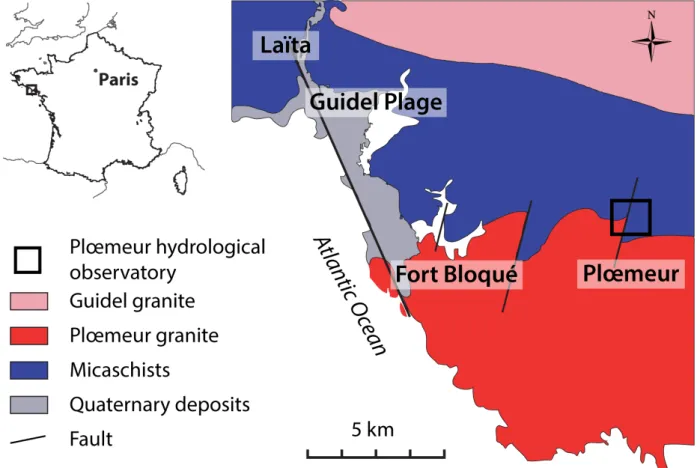
2009;Fabien-Ouellet and Fortier 2014;Pasquet et al. 2015). The use of this method is widespread
32
since it is easily carried out with a one-dimensional (1D) to three-dimensional (3D) coverage, quick
33
to implement and relatively inexpensive (Galibert et al. 2014). However, if measurements of VP
34
are performed quite efficiently for many years, retrieving VS remains complex since it requires the
35
use of horizontal component geophones difficult to set up horizontally (Sambuelli et al. 2001) and
36
specific sources strenuous to use (Sheriff and Geldart 1995; Jongmans and Demanet 1993; Xia et al.
37
2002;Haines 2007).
38
As an alternative to SH-wave refraction tomography, surface-wave prospecting methods are
39
commonly proposed to achieve indirect estimation of VS in a relatively straightforward manner
40
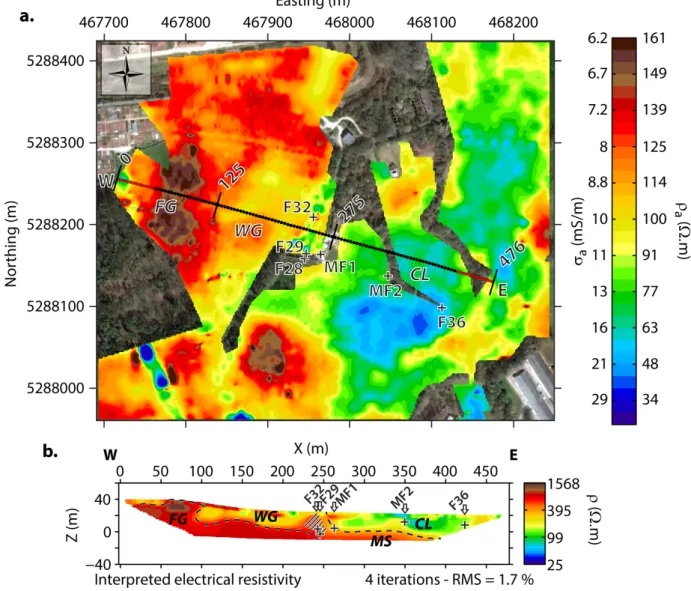
(e.g.,Gabriels, Snieder, and Nolet(1987); Jongmans and Demanet (1993); Park, Miller, and Xia
41
(1999); Socco and Strobbia(2004); andSocco, Foti, and Boiero (2010a)). Due to their dispersive
42
nature, surface waves are characterized by an investigation depth that mainly depends on the
43
considered data frequency. Surface waves are thus widely used at large scales in global seismology for
44
mantle investigations using low frequencies. When targeting shallow structures with strong lateral
45
variability, surface-wave methods are, however, limited by the well-known trade-off between lateral
46
resolution and investigation depth (Gabriels et al. 1987). On the one hand, the inverse problem
47
formulation requires the investigated medium to be assumed 1D below the spread, which has to be
48
short enough to achieve lateral resolution and perform two-dimensional (2D) profiling. On the other
49
hand, long spreads and low-frequency geophones are required to record long wavelengths in order
50
to increase the investigation depth and mitigate near-field effects (Russel 1987;Forbriger 2003a,b;
51
O’Neill 2003;O’Neill and Matsuoka 2005;Bodet et al. 2005;Zywicki and Rix 2005;Bodet, Abraham,
52
and Clorennec 2009). When the seismic set-up provides redundant data, several countermeasures
53
exist to overcome these drawbacks and narrow down the lateral extent of dispersion measurements,
54
such as common mid-point cross-correlation (Hayashi and Suzuki 2004;Grandjean and Bitri 2006;
55
Ikeda, Tsuji, and Matsuoka 2013), multi-offset phase analysis (Strobbia and Foti 2006; Vignoli and
56
Cassiani 2010), or offset moving windows and dispersion stacking techniques (O’Neill, Dentith, and
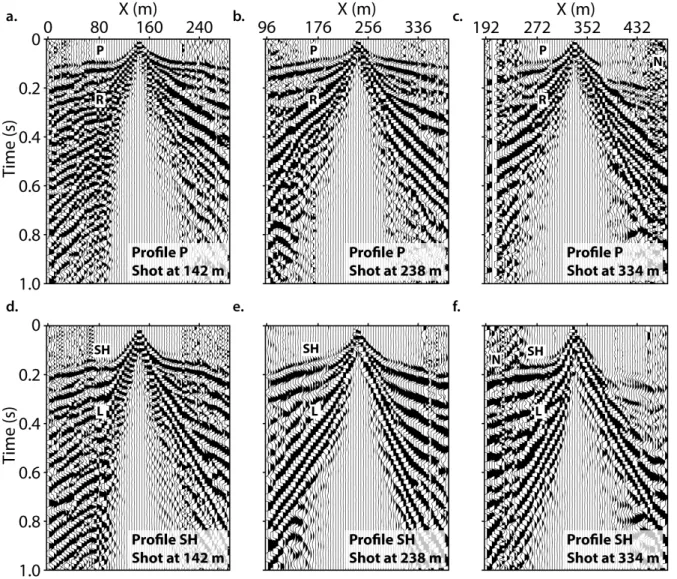
57
List 2003;Bohlen et al. 2004;Neducza 2007;Boiero and Socco 2010,2011;Bergamo, Boiero, and
58
Socco 2012).
59
The joint analysis of travel-time tomography VP and surface-wave profiling VS has recently
been proposed to retrieve 1D time-lapse VP/VS soundings (Pasquet et al. 2015) or 2D VP/VS
61
sections (Ivanov et al. 2006;Konstantaki et al. 2013).Pasquet et al.(2015) highlighted an overall
62
consistency between the temporal variations of the water table and VP/VS contrasts. For their
63
part, Konstantaki et al. (2013) assessed the lateral fluctuations of a shallow aquifer water table
64
level with 2D VP/VS variations. Using a single standard acquisition set-up to retrieve 2D VP and
65
VS sections thus appears interesting and convenient to reduce equipment costs and acquisition
66
time. Yet, refraction tomography and surface-wave profiling involve distinct characteristics of the
67
wavefield and different assumptions about the medium, thus providing results of different resolutions
68
and investigation depths difficult to compare to each other.
69
This study tackles such issues through a systematic comparison of VS models obtained from
70
SH-wave refraction and surface-wave dispersion inversion, along with VP retrieved from P-wave
71
refraction, as recently proposed by Pasquet et al. (2014, 2015). For this purpose, we targeted
72
the Plœmeur hydrological observatory (France). This experimental site has been subject to many
73
geophysical and hydrogeological studies aimed at characterizing the flow processes involved in the
74
recharge of the outstandingly productive fractured aquifer present in the region (Touchard 1999;
75
Le Borgne et al. 2006a,b, 2007; Ruelleu et al. 2010; Jim´enez-Mart´ınez et al. 2013). The study
76
area is located at a contact between granites and micaschists, clearly highlighted in the surface by
77
electrical resistivity tomography (ERT) and electrical conductivity (EC) mapping. However, previous
78
refraction seismic studies showed that VP alone was neither able to detect the contact zone nor able
79
to discriminate granites from micaschists, probably because P-wave velocity is mainly controlled by
80
the water content in the weathered areas. The site consequently provided a challenging framework
81
to test the applicability of the joint interpretation of VP and VS for near-surface applications.
82
In the present study, VP and VS sections were classically obtained with P- and SH-wave
travel-83
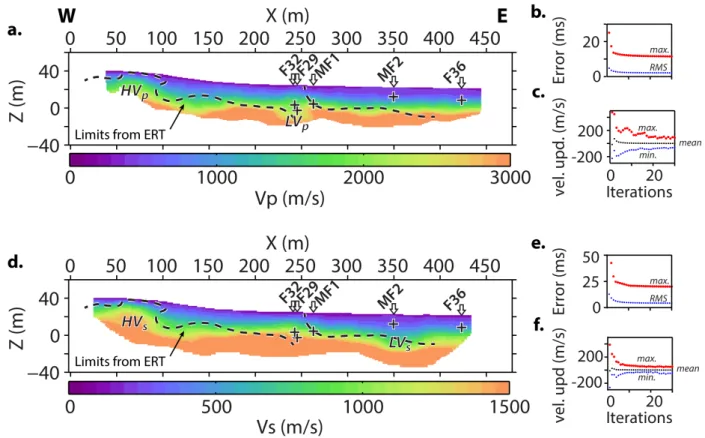
time tomography carried out on a line intersecting the contact zone. Surface-wave profiling was
84
performed by means of offset moving window and dispersion stacking techniques. Local dispersion
85
measurements were first extracted from different shots illuminating the same portion of the seismic
86
line and then stacked to increase signal-to-noise ratio. The extraction window was eventually moved
87
along the line to retrieve a collection of local multimodal dispersion measurements. Several window
88
lengths were tested to find the best compromise between lateral resolution and investigation depth
89
(Pasquet et al. 2012). The lateral consistency of dispersion data was thoroughly controlled during
picking through visual browsing and a posteriori verified on phase velocity pseudo-sections. Separate
91
Monte Carlo inversions of dispersion curves were then performed along the line with no lateral
92
constraints in order to reconstruct a pseudo-2D VS section. The parameterization of those inversions
93
was based on: (i) VP obtained from travel-time tomography; (ii) a priori geological knowledge;
94
and (iii) maximum wavelengths observed along the line. Theoretical dispersion curves were then
95
recomputed from both VS models along the line to control the inversion quality and the consistency
96
of these models. Finally, VP/VS obtained from both methods were compared to evaluate their ability
97
to image VP/VS variations and assess their practical limitations.
98
2. SITE DESCRIPTION AND DATA ACQUISITION
99
2.1. Geological setting
100
The Plœmeur site is located on the south coast of Brittany (west of France), 3 km far from the
101
Atlantic Ocean, near the city of Lorient (Fig. 1). The crystalline bedrock aquifer present in the area
102
is composed of tectonic units developed during the Hercynian orogeny and marked by numerous
103
synkinematic intrusions of upper Carboniferous leucogranites (Ruelleu et al. 2010). The pumping
104
site is located at the intersection of: (i) a contact between the Plœmeur granite and overlying
105
“Pouldu” micaschists dipping 30◦ to the North and (ii) a subvertical fault zone striking N 20◦ (Fig.1).
106
Weathering in the area is limited to the first few metres, except in the micaschists near the pumping
107
site where it reaches about 30 m. Before the start of the pumping activities in 1991, the site was a
108
natural aquifer discharge area with preferential upward fluxes. The average water levels began to
109
decline during the first years of operation but have stabilized since 1997 (Jim´enez-Mart´ınez et al.
110
2013). Despite the low permeability and porosity of these lithologies, pumping wells implanted in
111
the site have been continuously producing water at a rate of about 106 m3 per year since 1991
112
(Touchard 1999), with limited head decrease and no seawater intrusion. One of the challenges on
113
this site is to understand recharge processes in these highly heterogeneous systems. For this purpose,
114
the site is monitored by several wells implanted mostly around the contact zone and in the clayey
115
area overlaying micaschists (F* and MF* in Fig. 2).
116
2.2. Previous geophysical results
117
Slingram EC mapping and ERT were carried out on the site prior to the seismic campaign in
118
order to accurately describe near-surface lithologies. Apparent EC (σa) variations over the first
5.5 m in depth were mapped using an electromagnetic device with low induction number (intercoil
120
spacing of 3.66 m and frequency of 9.8 kHz) in vertical dipole (VD) configuration, integrating
121
conductivity values down to about 6 m in depth (McNeill 1980). We used a continuous acquisition
122
mode following profiles separated with 5 m to 7 m, covering an area of about 15 ha (Fig.2a). As for
123
ERT, we used a multi-channel resistivimeter with a 96-electrode Wenner–Schlumberger array and 1
124
roll-along (Fig. 2b). The electrodes were spaced with 4 m in order to obtain a 476-m-long profile
125
roughly oriented west–east (WE on Fig.2a). The inversion was performed using the RES2DINV
126
software (Loke and Barker 1996).
127
Results of EC mapping show smooth lateral variations of σa (from less than 5 mS/m to over
128
30 mS/m, i.e., from 200 Ωm to less than 30 Ωm in terms of apparent electrical resistivity ρa) in
129
the subsurface. Western low σa values are clearly associated with the presence of very shallow
130
granite (between 0 m and 125 m along the WE profile in Fig.2a). On the contrary, higher σa values
131
observed in the eastern part can be related to clays overlaying weathered micaschists (between 275 m
132
and 476 m in Fig.2a). Such distribution seems in agreement with the assumption of the contact
133
zone striking N 20◦ in the area. ERT results are also consistent with the anticipated geological
134
structures in depth and clearly match the apparent EC variations in surface (Fig.2b). Four main
135
structures can be delineated in Fig.2b: fresh granite (FG), almost outcropping in the western part,
136
characterized by high-electrical-resistivity (ρ) values (around 1000 Ωm); weathered granite (WG),
137
at the surface in the western part, characterized by significantly lower ρ values (around 200 Ωm);
138
clays (CL), at the surface in the eastern part, characterized by slightly lower ρ values (between
139
50 Ωm and 200 Ωm); and micaschists (MS), deeper in the eastern part, characterized by higher ρ
140
values (around 750 Ωm). Possible evidence of the contact zone is visible between 225 m and 250 m
141
along the ERT profile, marking a strong contrast between WG and clays (hashed area in Fig.2b).
142
The positions of the nearest piezometric wells are projected on the WE line with their measured
143
piezometric head level. A significant decrease in this level is observed in the wells located in the
144
hashed area due to pumping occurring in the F28 well. WhilePasquet et al. (2015) studied VP/VS
145
in simplified 1D conditions, this site offers the perfect framework to address 2D issues (i.e., presence
146
of strong lateral variations of lithology and topography), especially when knowing that previous
147
P-wave tomography studies failed to depict these lateral variations.
2.3. Seismic acquisition
149
The seismic acquisition set-up was deployed along the ERT profile (WE in Fig.2a). It consisted
150
of a simultaneous P- and surface-wave acquisition followed by an SH-wave acquisition along the same
151
line. We used 72 geophones, a 4-m receiver spacing and 2 roll-alongs to finally obtain a 476-m-long
152
profile (Fig.3). A 72-channel seismic recorder was used with 14-Hz vertical component geophones
153
for the P-wave and surface-wave profiles and with 14-Hz horizontal component geophones for the
154
SH-wave profile. The use of 14-Hz geophones offers a good compromise to obtain seismic records
155
with a frequency content suitable for surface-wave, refraction, and reflection processing. First shot
156
location was one-half receiver spacing away from the first trace, and move-up between shots was one
157
receiver interval in order to achieve the high coverage required to perform refraction tomography
158
and to stack dispersion data. In addition, 219 shots were recorded along each profile for a total
159
number of 15768 active traces. The P-wave source consisted of an aluminium plate hit vertically by
160
a 5-kg sledgehammer. The plate was hit six times at each position to increase signal-to-noise ratio.
161
SH waves were generated with a handheld source consisting of a heavy metal frame hit laterally
162
by a 5-kg sledgehammer. The SH-wave source was hit 12 times at each position. For both P- and
163
SH-wave acquisitions, the sampling rate was 0.25 ms and the recording time was 2 seconds to
164
include full surface-wave wavefield. A delay of −0.02 seconds was kept before the beginning of each
165
record to prevent early triggering issues. The collected data presented on Fig.4 are affected with a
166
significant noise level, especially at far offset (80 m and more), due to active pumping wells and
167
military airplanes regularly landing and taking off from a nearby air force base. Seismograms clearly
168
show lateral variations due to both topographic effects and subsurface velocity changes, with strong
169
attenuation over clays and micaschists in the eastern part of the line.
170
3. TRAVEL-TIME TOMOGRAPHY
171
3.1. Travel-time data
172
We applied DC removal and a zero-phase low-pass filter on both P- and SH-wave data to remove
173
high-frequency noise (>100 Hz) and help for first arrival identification at far offsets. For the P-wave
174
profile, a total of 7076 first arrivals (45% of all traces) were determined (Fig.5a) and 10352 traces
175
(65% of all traces) were picked on SH-wave shots (Fig. 5c). Travel-time data could not be obtained
176
where noise level was too high (grey dots in Fig.5), with average maximum offsets around 100 m
for P waves and around 150 m for SH waves. Travel times are represented in a source–receiver
178
diagram (Fig. 5), which shows the distribution of first arrival times for each source–receiver pair
179
(Bauer et al. 2010;Baumann-Wilke et al. 2012). The diagonal traces indicate the zero-offset travel
180
times, where source and receiver locations are identical. This representation gives a first impression
181
of the subsurface velocity structure and allows for checking the lateral consistency of picked travel
182
times. Three main areas are clearly visible on both P- and SH-wave first arrivals: the first area
183
(from 0 m to 125 m) is characterized by the shortest first arrival times (i.e., shallow high velocity
184
zone); the area between 125 m and 275 m depicts slightly increasing times; and the third area
185
(from 275 m up to the end of the line) shows greater arrival times (compared with the first area),
186
probably associated with shallow low velocities.
187
The distribution depicted in Fig.5a and5c appears interestingly related to the lateral variability
188
observed on the EC map (Fig.2a). Along the seismic profile, very low σa values occur between
189
0 m and 125 m on the granite side and are coherent with short first arrival times. High-σa values
190
observed between 275 m and the end of the line are also consistent with the shallow low velocity
191
zone suggested by long first arrival times. In the centre part (from 125 m to 275 m), intermediate
192
apparent EC values are in agreement with slightly decreasing shallow velocities observed in Fig.5a
193
and 5c, suggesting a thickening of the weathered layer.
194
3.2. Tomography inversion
195
Travel-time data were inverted with the refraction tomography software RAYFRACT (Schuster
196
and Quintus-Bosz 1993;Sheehan, Doll, and Mandell 2005;Rohdewald 2011) using a smooth gradient
197
initial model. This model is the 2D extension of the mean 1D model obtained directly from picked
198
travel times, assuming velocity gradients in a 1D tabular medium (Gibson, Odegard, and Sutton
199
1979). It varied from 10 m/s at the surface to 3500 m/s at 40 m in depth for the P-wave model and
200
from 10 m/s at the surface to 2000 m/s at 40 m in depth for the SH-wave model. The inversion
201
process was stopped when velocity update, global root-mean-square (RMS) error, and maximum
202
normalized residual reached minimum values. In addition, 30 iterations were needed for both
P-203
and SH-wave travel times. For the P-wave profile, the global RMS error (in blue in Fig.6b) and the
204
maximum normalized residual (in red in Fig.6b) both steeply decrease during the first six iterations,
205
i.e., from 5 ms to 2.5 ms and from 25 ms to 13 ms, respectively, and more gradually during the last
206
iteration steps until they both reach minimum values of 2.1 ms and 11.5 ms, respectively. Mean
velocity update also rapidly decreases to reach a minimum value after six iterations (in black in
208
Fig. 6c). Maximum and minimum velocity updates (in red and blue, respectively, in Fig.6c) are
209
more perturbated and tend to stabilize only after 20 iterations. As for SH-wave data, the global
210
RMS error (in blue in Fig. 6e) and the maximum normalized residual (in red in Fig. 6e) both
211
quickly decrease during the first 10 iterations, i.e., from 12.5 ms to 6 ms and from 50 ms to 22 ms,
212
respectively, and more smoothly during the last iteration steps until they both reach minimum
213
values of 4.3 ms and 20.1 ms, respectively. Mean, maximum, and minimum velocity updates (in
214
black, red, and blue, respectively, in Fig. 6f) reach minimum values after 10 iterations.
215
Normalized residuals were computed between observed and calculated travel times for every
216
picked trace (Bauer et al. 2010). Their distributions are represented in source–receiver diagrams for
217
both P- (Fig.5b) and SH-wave (Fig.5d) travel times. P-wave inversion results have lower global
218
RMS values (2.1 ms for P waves; 4.3 ms for SH waves) and maximum residual values (11.5 ms for
219
P waves; 20.1 ms for SH waves), and the mean residual value is higher for P waves (6.7%) than for
220
SH waves (3.9%). The ratio of residuals below 10% is also higher for SH-wave models (around 93%)
221
than for P-wave models (around 91%). The distribution of residuals shows the highest values at near
222
offsets, probably due to shallow lateral heterogeneities and triggering issues during the acquisition.
223
The final velocity models were clipped for both VP (Fig. 6a) and VS (Fig.6d) sections below a
224
ray coverage of 100 rays per grid cell to keep only well-resolved areas. Both models are characterized
225
by velocities mainly following a linearly increasing trend in depth and show no strong lateral
226
variations. Only slight perturbations of the initial gradient model along the line can be observed
227
with: (i) higher VP and VS in the western part (HVP and HVS, respectively), corresponding to the
228
high-electrical-resistivity values associated with FG; (ii) lower VP in the centre (LVP), consistent
229
with a decrease in the piezometric head level and evidences of the contact zone inferred from ERT;
230
and (iii) lower VS in the eastern part of the profile (LVS).
231
4. SURFACE-WAVE PROFILING
232
4.1. Extraction of dispersion curves
233
Our multifold acquisition set-up allowed us to obtain surface-wave dispersion images from
234
P-wave shot gathers using windowing and dispersion stacking to narrow down the lateral extent of
235
dispersion measurements and increase the signal-to-noise ratio. Dispersion stacking was performed
following the basic workflow derived from O’Neill et al.(2003).
237
1. Select nW traces centred on a specific position along the line (Xmid).
238
2. Load a shot illuminating the selected spread.
239
3. Window the nW traces in the selected shot record.
240
4. Transform the wavefield to the frequency-phase velocity domain (dispersion image).
241
5. Normalize amplitude spectrum at each frequency.
242
6. Repeat steps 2–5 for the nS selected shots.
243
7. Stack all normalized dispersion images and pick the dispersion curves for each identified
propa-244
gation mode from the final image.
245
8. Shift the window of dW traces to the next Xmid and repeat steps 1–7.
246
As aforementioned, the difficulty is to find the best compromise between investigation depth,
247
spectral resolution, and lateral resolution while keeping the 1D assumption valid. Thus, we first
248
performed trial-and-error tests (Pasquet et al. 2012) to select the optimum window size (nW )
249
and the number of sources (nS), keeping in mind that there is not, for the moment, any perfect
250
criterion (P´erez Solano 2013;P´erez Solano, Donno, and Chauris 2014). A 20-m-wide window with
251
six traces (nW = 6) was eventually used with six direct and six reverse shots on each side of the
252
window (nS = 6). Using more sources is likely to increase signal-to-noise ratio and enhance the
253
maxima but would narrow down the effective study area along the line (black dots in Fig. 2a).
254
Single dispersion images were obtained from each shot using a slant stack in the frequency domain
255
(Russel 1987; Mokhtar, Herrmann, and Russell 1988). These images (in which maxima should
256
correspond to Rayleigh-wave propagation modes) were first compared to confirm the validity of
257
the 1D approximation below the spread (Jongmans et al. 2009). These 12 single dispersion images
258
were then stacked as a final dispersion image. The moving window was finally shifted along the line
259
with a step of one receiver spacing (dW = 1, i.e., 4 m). We thus obtained evenly spaced dispersion
260
images at each spread mid-point (Xmid) with a large overlap in order to retrieve smoothly varying
261
dispersion images between two adjacent stacking windows and help for visual browsing when picking
262
dispersion curves.
263
We eventually obtained a collection of 105 stacked dispersion images along the line, on which
264
coherent maxima associated with the different propagation modes were identified. Visualization
265
of adjacent stacked dispersion images allowed for following the progressive lateral evolution of
the different modes and for avoiding mode misinterpretation (Zhang and Chan 2003;O’Neill and
267
Matsuoka 2005;Boaga et al. 2013;Ezersky et al. 2013). These maxima were finally extracted on
268
each stacked dispersion image with an estimated standard error in phase velocity defined according
269
to the workflow described inO’Neill (2003). The dispersion lateral variability is illustrated here
270
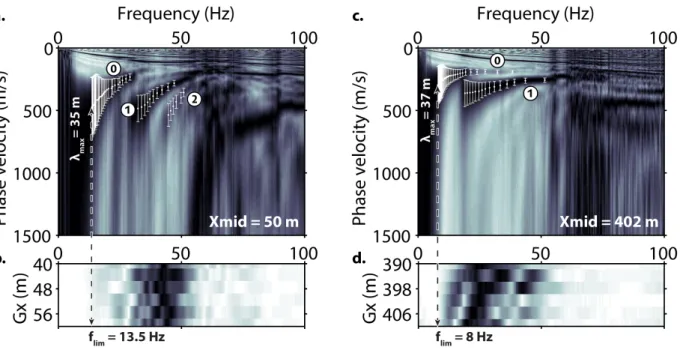
by two examples at both sides of the line (Fig. 7a (Xmid = 50 m) and 7c (Xmid = 402 m)).
271
As, for instance, recommended by Bodet (2005) and Bodet et al. (2009), dispersion curves were
272
limited down to frequencies (flim) where the spectral amplitude of the seismogram became too low
273
(13.5 Hz in Fig.7b and 8 Hz in Fig.7d). Several authors (e.g., O’Neill(2003) and Zywicki and Rix
274
(2005)) also mentioned that wavelengths higher than 50% of the spread length should not be used
275
in order to mitigate near-field effects and prevent from velocity underestimation at low frequency.
276
These recommendations are only basic rules of thumb mostly valid when using the fundamental
277
mode only. Here, we used wavelengths higher than 50% of our spread length since we were able to
278
perform dispersion stacking and use higher modes, which are of great constraint on the inversion
279
with a strong impact on the investigation depth (Gabriels et al. 1987;Xia et al. 2003). Furthermore,
280
possible low-frequency discrepancies were limited by attributing important errors to dispersion data
281
with respect to frequency and spread length (O’Neill 2003). Finally, the corresponding maximum
282
wavelength (λmax) was extracted (35 m in Fig.7a and 37 m in Fig.7c) to retrieve λmax/2, a typical
283
investigation depth criterion (O’Neill 2003).
284
Up to four propagation modes were observed along the line and identified as fundamental (0),
285
first (1), second (2), and third (3) higher modes (only modes up to 2 were identified in the examples
286
shown in Fig. 7). The resulting dispersion curves are presented in Rayleigh-wave phase velocity
287
pseudo-sections as a function of the wavelength λ and the spread mid-point Xmid (Fig.8) in order
288
to control the lateral coherence of mode identification (Strobbia et al. 2011; Haney and Douma 2012;
289
Boiero et al. 2013a; Ezersky et al. 2013). The fundamental mode pseudo-section (Fig. 8a) does not
290
present unrealistic abrupt changes (considering the overlap between two adjacent stacking windows)
291
but shows significant lateral variations of Rayleigh-wave phase velocities. High phase velocities
292
(from 200 m/s to 550 m/s) exist in the western part of the line (from the beginning to around
293
100 m), whereas the eastern part of the line (from 275 m to the end) is characterized by lower
294
phase velocities (around 150 m/s–200 m/s). The first (Fig.8b), second (Fig.8c), and third (Fig.8d)
295
higher modes show less lateral variations in terms of velocity, but the available frequency range for
mode 1 presents significant lateral fluctuations. The maximum wavelength (λmax) observed at each
297
Xmid ranges from 20 m to 50 m with an average value around 30 m (Fig.8e).
298
4.2. Inversion
299
Assuming a 1D tabular medium below each extraction window, we performed a 1D inversion of
300
dispersion data obtained at each Xmid. We used the neighbourhood algorithm (NA) developed
301
by Sambridge(1999) and implemented for near-surface applications by Wathelet, Jongmans, and
302
Ohrnberger(2004) and Wathelet(2008) within the GEOPSY tool (available atwww.geopsy.org).
303
Theoretical dispersion curves were computed from the elastic parameters using the Thomson–Haskell
304
matrix propagator technique (Thomson 1950;Haskell 1953). NA performs a stochastic search of
305
a pre-defined parameter space (namely, VP, VS, density, and thickness of each layer) using the
306
following misfit function (MF ):
307 M F = v u u t Nf X i=1 (Vcali− Vobsi) 2 Nfσi2 , (1)
with Vcali and Vobsi being the the calculated and observed phase velocities at each frequency fi, Nf 308
being the number of frequency samples, and σi being the phase velocity measurement error at each
309
frequency fi.
310
An appropriate choice of these parameters is considered as a fundamental issue for the successful
311
application of inversion (Socco and Strobbia 2004; Renalier et al. 2010). Based on site a priori
312
geological knowledge (presence of weathering gradients), we used parameterization with a stack
313
of ten layers overlaying the half-space to look for a velocity gradient. The thickness of each layer
314
was allowed for ranging from 0.5 m to 2.5 m. The maximum half-space depth (HSD) is of great
315
importance since it depends on the poorly known investigation depth of the method. It was fixed to
316
the half of the maximum wavelength observed along the entire line (25 m), as recommended by
317
O’Neill (2003) andBodet et al. (2005). The valid parameter range for sampling velocity models
318
was 10 m/s–1500 m/s for VS (based on dispersion observations and refraction tomography), with
319
velocities constrained to only increase with depth, based on geological a priori information. P-wave
320
velocity being of weak constraint on surface-wave dispersion, only the S-wave velocity profile can be
321
interpreted (Der and Landisman 1972;Russel 1987). However, an identical layering is required for
322
VP and VS in order to interpret VP/VS ratios. For this purpose, we extracted an average VP value
for each 2.5-m-thick slice of the VP model obtained from refraction tomography (Fig. 6a). This
324
average value was then used to fix VP in each layer of the inversion parameterization. Furthermore,
325
VS values were allowed to vary in such a way that Poisson’s ratio values always remained between
326
0.1 and 0.5 in order to prevent from unrealistic VS values. Density was set as uniform (1800 kg/m3)
327
since its influence on dispersion curves is very limited (Der and Landisman 1972; Russel 1987). It is
328
worth mentioning that, except for the VP values, we used the same parameterization for all the 1D
329
inversions performed along the line. We assumed that stacking and windowing already naturally
330
smoothed the dispersion data, thus not requiring the use of lateral constraints between successive
331
inversions.
332
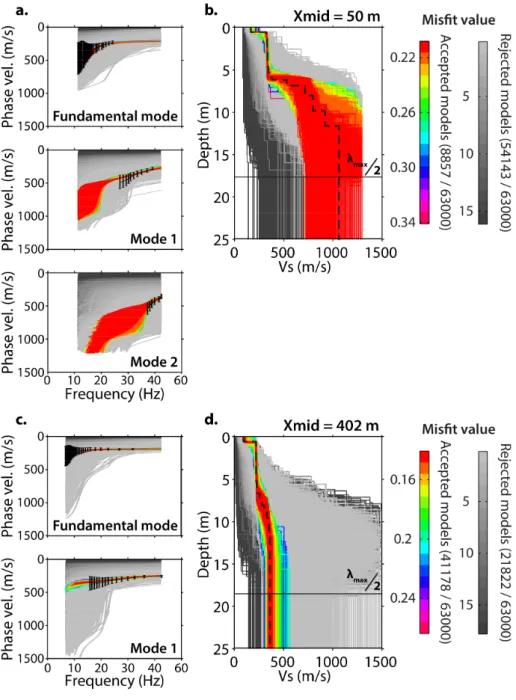
A total of 63000 models were generated with NA (Fig. 9a (Xmid = 50 m) and 9c (Xmid =
333
402 m)). Models matching the observed data within the error bars were selected, as suggested
334
byEndrun et al.(2008). The accepted models were used to build a final average velocity model
335
associated with the centre of the extraction window (dashed line in Fig.9b (Xmid = 50 m) and9d
336
(Xmid = 402 m)). As the maximum HSD remains constant along the line (same parameterization
337
for each inversion), λmax/2 is given (solid black line in Fig. 9b and 9d) to show where inverted
338
models expand below typical investigation depth criterion. Normalized residuals between observed
339
and calculated phase velocities were computed along the line for each individual sample of the picked
340
dispersion curves. Their distributions are represented in pseudo-sections to control the quality of
341
the final pseudo-2D VS section. The fundamental mode residuals’ pseudo-section (Fig.10a) shows
342
quite uniform values, with a maximum of 19%, a mean residual of 5%, and 86% of the residuals
343
with values below 10%. Residual values obtained for the first higher mode (Fig.10b) present higher
344
values, especially at great wavelength. The maximum residual value is 29%, the mean is 9%, and
345
only 62% of the residuals are below 10%. As for the second and the third higher modes (Fig.10c
346
and10d, respectively), residuals remain very low with a maximum of 12% and 3%, respectively, and
347
a mean residual of 1.8% and 1.3%, respectively. In addition, 99% of the second higher mode samples
348
have residual values below 10%, whereas all samples of the third higher mode have residuals below
349
10%. We additionally computed the misfit for each 1D VS model along the line with equation (1)
350
(Fig.10e). Misfit values remain stable along the line and range from 0.05 to around 0.25, with a
351
mean value of about 0.125. Several gaps are present along the line and correspond to inversions
352
where none of the calculated models were fitting the error bars.
Each 1D VS model was then represented at its corresponding Xmid position to obtain a
pseudo-354
2D VS section (Fig. 11). All the models were represented down to the maximum HSD (25 m),
355
with the investigation depth criterion λmax/2 superimposed in hashed black line. With such a
356
representation, the actual HSD of each model can be easily followed along the line and compared
357
with the investigation depth criterion. If the lateral variations of VS values remain remarkably
358
smooth in the shallow layers, the deepest layers and the half-space present an important variability
359
of VS caused by the higher uncertainties in dispersion measurements at great wavelength (i.e.,
360
higher residual values in Fig.10). Global results show a shallow low velocity layer (∼ 250 m/s),
361
which is thinner in the western part of the line (from 3 m to 6 m) and becomes thicker (∼ 10 m) in
362
the eastern part. High velocities (between 500 m/s and 1000 m/s) can be observed in the western
363
part, directly below the shallow low velocity layer, whereas the velocity of the half-space remains
364
below 500 m/s in the eastern part.
365
5. QUALITATIVE COMPARISON OF VELOCITY MODELS AND RESULTING
366
VP/VS
367
The comparison of velocity models obtained from P-wave tomography (VPtomo, Fig.6a), SH-wave
368
tomography (VStomo, Fig.6b), and surface-wave dispersion profiling (VSsw, Fig.11) provided results
369
that are consistent with the main structures interpreted from ERT data (Fig.2b). However, velocity
370
models do not provide such a clear delineation of these structures, especially for VPtomo and VStomo
371
sections. Indeed, the travel-time tomography method smoothes the lateral variations of velocity and
372
often suffers from the strong influence of triggering issues on short travel times, which mainly affect
373
the reconstruction of shallow structure velocities. As for surface-wave profiling, the overlaying of
374
structures delimited by ERT on the VSsw pseudo-2D section (Fig.11) confirms the lateral consistency
375
of both VS models in the first 20 m in depth. If the surface-wave method is clearly limited by its
376
low investigation depth in this case, it provides more information regarding the lateral variations of
377
shallow layers’ velocities and seems to detect the modifications of mechanical properties occurring
378
in the contact zone.
379
At both Xmid = 50 m (Fig. 12a) and Xmid = 402 m (Fig. 12d), 1D models of VS and VP
380
extracted from tomography sections (VStomo in green solid line and VPtomo in green dashed line,
381
respectively) are characterized by similar trends of continuously increasing velocities in depth.
Furthermore, 1D VSsw models (red solid line) show the presence of two constant velocity layers
383
followed by a linearly increasing velocity layer overlaying the half-space. Despite a low investigation
384
depth, the VSsw pseudo-section manages to depict the shallow lateral variations and remains in good
385
agreement with VStomo.
386
As a control of both VS models, forward modelling was performed along the line (examples
387
for Xmid = 50 m and Xmid = 402 m are shown in Fig. 12c and 12f, respectively). On the one
388
hand, theoretical dispersion curves were computed using 1D VPtomo and VStomo models (green solid
389
line). On the other hand, theoretical dispersion curves were calculated using 1D VSsw models and
390
1D VPtomo models resampled in depth according to the VSsw layering (VPrs) (red solid line). VSsw
391
models provide the best fit with the picked dispersion curves and the coherent maxima observed on
392
dispersion images, supporting the validity of the final VSsw model averaged from all models fitting
393
the error bars. For their part, dispersion curves computed from VStomo models are generally not well
394
fitting the observed propagation modes at low frequency, leading us to question the validity of the
395
tomographic model in the deepest layers.
396
After cross-validating both VS models, we computed VP/VS ratios along the line with: (i) VSsw
397
and VPrs (Fig. 13a) and (ii) VStomo and VPtomo (Fig.13b). The VStomo/VPtomo section shows smooth
398
lateral variations, with low VP/VS (∼ 1.5) in the western (from 0 m to 150 m) and central
399
(from 200 m to 250 m) parts, separated by intermediate values (∼ 2–2.5). The eastern part is
400
characterized by higher values (around 2.5 and up to 3.5). At first sight, the Vsw
S /VPrs section might
401
look different, especially in the beginning of the line (from 0 m to 275 m), where anomalous high
402
VP/VS values are observed around 5-m to 10-m depth. At these depths, the VSsw model presents
403
mostly constant velocities, whereas the VPrs model is characterized by linearly increasing velocities.
404
This incompatibility can thus explain the VP/VS discrepancies observed in this layer. With this in
405
mind, we were yet able to delineate different VP/VS areas, which correspond well to those observed
406
on the Vtomo
S /VPtomosection. These different areas and the observed VP/VS values are also consistent
407
with the main structures delineated in the ERT results (Fig. 2b), whereas it was not clear on VP or
408
VS only.
409
Moreover, 1D VP/VS ratios extracted at Xmid = 50 m (Fig.12b) and Xmid = 402 m (Fig.12e)
410
from VPrs/VSsw (red solid line) and VPtomo/VStomo (green solid line) show similar trends. Stronger
411
contrasts and higher ratio values are yet observed on surface-wave analysis results. VP/VS values
observed at Xmid = 50 m are overall low (below 2.75) with both methods. The water table level
413
extrapolated from the nearest representative piezometric well implanted in the granite (around
414
100 m west from Xmid = 50 m) is not consistent with any of the contrasts observed on the VP/VS
415
models. Indeed, the estimated water table level (∼ 20 m) is close to the maximum HSD where
416
VSsw becomes poorly resolved. Furthermore, no strong VP/VS variations can be anticipated in
417
such low-permeability and low-porosity materials (Takei 2002). At Xmid = 402 m, shallow high
418
VP/VS ratio values (around 4) are consistent with a wet soil, whereas a strong contrast at 11.5-m
419
depth remarkably matches the water table level interpolated from levels measured in MF2 and F36
420
(black dashed line). This feature is confirmed on the pseudo-2D VP/VS section in the eastern part
421
(Fig. 13a).
422
6. DISCUSSION AND CONCLUSIONS
423
In order to assess the applicability of combined P-wave refraction tomography and surface-wave
424
dispersion analysis to estimate VP/VS ratio in near-surface applications, we performed seismic
425
measurements on a well-known granite–micaschists contact at Plœmeur hydrological observatory
426
(France). A simultaneous P- and surface-wave survey was achieved using a single acquisition set-up
427
and was supplemented with an SH-wave acquisition along the same line in order to compare VS
428
results obtained from SH-wave refraction tomography and surface-wave profiling.
429
P- and SH-wave first arrivals observed along the line were used to perform travel-time tomography
430
and retrieve VPtomo and VStomo models. Evenly spaced dispersion data were extracted along the line
431
from P-wave shot gathers using windowing and stacking techniques. Successive 1D Monte Carlo
432
inversions of these dispersion data were achieved using fixed VP values extracted from the VPtomo
433
model and no lateral constraints between two adjacent 1D inversions. The resulting 1D VSsw models
434
were then assembled to create a pseudo-2D VSsw section. We computed normalized residuals between
435
observed and calculated phase velocities along the line to control the quality of the VSsw model.
436
This model appears to be correctly matching the VStomo model obtained with SH-wave refraction
437
tomography. The VSsw model is however characterized by strong velocity uncertainties in the deepest
438
layers. The recomputation of theoretical dispersion curves along the line also provided results that
439
are consistent with the measured dispersion images and proved to be a reliable tool for validating
440
VS models obtained from SH-wave refraction tomography and surface-wave profiling. Finally, we
were able to compute VP/VS sections from both VSsw and VStomo. The two sections present similar
442
features, but the section obtained from VSsw shows a higher lateral resolution, which is consistent
443
with the features observed on ERT, thus validating our approach for retrieving VP/VS ratio from
444
combined P-wave tomography and surface-wave profiling. Furthermore, the VP/VS ratios obtained
445
in the clay and micaschists area show a strong contrast consistent with the observed water table
446
level.
447
An incompatibility, however, remains between VPrsand VSsw, which can lead to anomalous VP/VS
448
values. Indeed, travel-time tomography provides a smooth 2D reconstruction of the medium along
449
ray paths propagating from sources to sensors in a narrow frequency band. The investigation depth
450
is strongly related to the length of the acquisition profile and the maximum offset between sources
451
and receivers. Furthermore, the medium is described as a function of the ray coverage, which is
452
strongly related to the spacing between sensors and usually increases in high-velocity zones. For
453
their part, surface-wave methods allow reconstructing pseudo-2D VS sections by juxtaposing single
454
1D models obtained along the line. In this case, the spectral resolution and the investigation depth
455
are a function of the frequency and increase with the length of the recording array, whereas the
456
lateral resolution is inversely correlated with the individual array length. In order to retrieve VP and
457
VS models more suited for VP/VS computation, a joint inversion approach combining Rayleigh and
458
P-guided waves dispersion data along with P-wave refraction travel times could be developed, in
459
the continuation ofMaraschini et al. (2010),Piatti et al. (2013) andBoiero, Wiarda, and Vermeer
460
(2013b) works.
461
7. ACKNOWLEDGEMENTS
462
The authors would like to thank Claudio Strobbia, Daniela Donno, and two anonymous reviewers
463
for their constructive comments. This work was supported by the French National Programme
464
EC2CO – Biohefect (Project “ ´Etudes exp´erimentales multi-´echelles de l’apport des vitesses sismiques
465
`
a la description du continuum sol-aquif`ere”) and the ANR Project CRITEX ANR-11-EQPX-0011. It
466
was also supported by the SOERE-H+ “R´eseau National de sites hydrog´eologiques” network and by
467
the CLIMAWAT European Project “Adapting to the Impacts of Climate Change on Groundwater
468
Quantity and Quality”. They kindly thank A. Kehil, J. Jimenez-Martinez, E. Coulon, and N.
469
Lavenant (G´eosciences Rennes) for technical assistance during field work. They would also like to
thank J. Thiesson (UMR METIS) for valuable discussions during data processing and interpretation.
8. REFERENCES
472
Bauer K., Moeck I., Norden B., Schulze A., Weber M. and Wirth H. 2010. Tomographic P wave velocity and
473
vertical velocity gradient structure across the geothermal site Groß Sch¨onebeck (NE German Basin): relationship
474
to lithology, salt tectonics, and thermal regime. Journal of Geophysical Research: Solid Earth 115(B8), B08312.
475
Bauer K., Schulze A., Ryberg T., Sobolev S.V. and Weber M.H. 2003. Classification of lithology from seismic
476
tomography: a case study from the Messum igneous complex, Namibia. Journal of Geophysical Research: Solid
477
Earth 108(B3), 2152.
478
Baumann-Wilke M., Bauer K., Schovsbo N.H. and Stiller M. 2012. P-wave traveltime tomography for a seismic
479
characterization of black shales at shallow depth on Bornholm, Denmark. Geophysics 77(5), EN53–EN60.
480
Bergamo P., Boiero D. and Socco L.V. 2012.Retrieving 2D structures from surface-wave data by means of space-varying
481
spatial windowing. Geophysics 77(4), EN39–EN51.
482
Berryman J.G. 1999. Origin of Gassmann’s equations. Geophysics 64(5), 1627–1629.
483
Biot M.A. 1956a. Theory of propagation of elastic waves in a fluid-saturated porous solid. I. Low-frequency range.
484
The Journal of the Acoustical Society of America 28(2), 168–178.
485
Biot M.A. 1956b. Theory of propagation of elastic waves in a fluid-saturated porous solid. II. Higher frequency range.
486
The Journal of the Acoustical Society of America 28(2), 179–191.
487
Boaga J., Cassiani G., Strobbia C. and Vignoli G. 2013. Mode misidentification in Rayleigh waves: ellipticity as a
488
cause and a cure. Geophysics 78(4), EN17–EN28.
489
Bodet L. 2005. Limites th´eoriques et exp´erimentales de l’interpr´etation de la dispersion des ondes de Rayleigh: apport
490
de la mod´elisation num´erique et physique. PhD thesis, ´Ecole Centrale de Nantes et Universit´e de Nantes, France.
491
Bodet L., Abraham O. and Clorennec D. 2009.Near-offset effects on Rayleigh-wave dispersion measurements: physical
492
modeling. Journal of Applied Geophysics 68(1), 95–103.
493
Bodet L., van Wijk K., Bitri A., Abraham O., Cˆote P., Grandjean G. et al. 2005. Surface-wave inversion limitations
494
from laser-Doppler physical modeling. Journal of Environmental and Engineering Geophysics 10(2), 151–162.
495
Bohlen T., Kugler S., Klein G. and Theilen F. 2004. 1.5D inversion of lateral variation of Scholte-wave dispersion.
496
Geophysics 69(2), 330–344.
497
Boiero D. and Socco L.V. 2010. Retrieving lateral variations from surface wave dispersion curves. Geophysical
498
Prospecting 58(6), 977–996.
499
Boiero D. and Socco L.V. 2011. The meaning of surface wave dispersion curves in weakly laterally varying structures.
500
Near Surface Geophysics 9(6), 561–570.
501
Boiero D., Socco L.V., Stocco S. and Wis´en R. 2013a. Bedrock mapping in shallow environments using surface-wave
502
analysis. The Leading Edge 32(6), 664–672.
503
Boiero D., Wiarda E. and Vermeer P. 2013b. Surface- and guided-wave inversion for near-surface modeling in land
504
and shallow marine seismic data. The Leading Edge 32(6), 638–646.
505
Cardarelli E., Cercato M. and De Donno G. 2014. Characterization of an earth-filled dam through the combined use
506
of electrical resistivity tomography, P- and SH-wave seismic tomography and surface wave data. Journal of Applied
507
Geophysics 106, 87–95.
Catchings R.D. 1999. Regional Vp, Vs, Vp/Vs, and Poisson’s ratios across earthquake source zones from Memphis,
509
Tennessee, to St. Louis, Missouri. Bulletin of the Seismological Society of America 89(6), 1591–1605.
510
Der Z.A. and Landisman M. 1972. Theory for errors, resolution, and separation of unknown variables in inverse
511
problems, with application to the mantle and the crust in southern Africa and Scandinavia. Geophysical Journal of
512
the Royal Astronomical Society 27(2), 137–178.
513
Dvorkin J. 2008. Yet another Vs equation. Geophysics 73(2), E35–E39.
514
Endrun B., Meier T., Lebedev S., Bohnhoff M., Stavrakakis G. and Harjes H.P. 2008. S velocity structure and radial
515
anisotropy in the Aegean region from surface wave dispersion. Geophysical Journal International 174(2), 593–616.
516
Ezersky M.G., Bodet L., Akawwi E., Al-Zoubi A.S., Camerlynck C., Dhemaied A. et al. 2013. Seismic surface-wave
517
prospecting methods for sinkhole hazard assessment along the Dead Sea shoreline. Journal of Environmental and
518
Engineering Geophysics 18(4), 233–253.
519
Fabien-Ouellet G. and Fortier R. 2014. Using all seismic arrivals in shallow seismic investigations. Journal of Applied
520
Geophysics 103, 31–42.
521
Forbriger T. 2003a. Inversion of shallow-seismic wavefields: I. Wavefield transformation. Geophysical Journal
522
International 153(3), 719–734.
523
Forbriger T. 2003b.Inversion of shallow-seismic wavefields: II. Inferring subsurface properties from wavefield transforms.
524
Geophysical Journal International 153(3), 735–752.
525
Fu D.T., Sullivan E.C. and Marfurt K.J. 2006. Rock-property and seismic-attribute analysis of a chert reservoir in
526
the Devonian Thirty-one Formation, west Texas, U.S.A. Geophysics 71(5), B151–B158.
527
Gabriels P., Snieder R. and Nolet G. 1987.In situ measurements of shear-wave velocity in sediments with higher-mode
528
Rayleigh waves. Geophysical Prospecting 35(2), 187–196.
529
Galibert P.Y., Valois R., Mendes M. and Gu´erin R. 2014.Seismic study of the low-permeability volume in southern
530
France karst systems. Geophysics 79(1), EN1–EN13.
531
Gautier S., Latorre D., Virieux J., Deschamps A., Skarpelos C., Sotiriou A. et al. 2006. A new passive tomography of
532
the Aigion area (Gulf of Corinth, Greece) from the 2002 data set. Pure and Applied Geophysics 163(2–3), 431–453.
533
Gibson B.S., Odegard M.E. and Sutton G.H. 1979. Nonlinear least-squares inversion of traveltime data for a linear
534
velocity-depth relationship. Geophysics 44(2), 185–194.
535
Godio A., Strobbia C. and De Bacco G. 2006. Geophysical characterisation of a rockslide in an alpine region.
536
Engineering Geology 83(1–3), 273–286.
537
Grandjean G. and Bitri A. 2006. 2M-SASW : Multifold multichannel seismic inversion of local dispersion of Rayleigh
538
waves in laterally heterogeneous subsurfaces: application to the Super-Sauze earthflow, France. Near Surface
539
Geophysics 4(6), 367–375.
540
Grelle G. and Guadagno F.M. 2009. Seismic refraction methodology for groundwater level determination: “Water
541
seismic index”. Journal of Applied Geophysics 68(3), 301–320.
542
Haines S. 2007. A hammer-impact, aluminium, shear-wave seismic source. Technical Report OF 07-1406. United
543
States Geological Survey.
544
Haney M.M. and Douma H. 2012. Rayleigh-wave tomography at Coronation Field, Canada: The topography effect.
545
The Leading Edge 31(1), 54–61.
Haskell N.A. 1953.The dispersion of surface waves on multilayered media. Bulletin of the Seismological Society of
547
America 43(1), 17–34.
548
Hayashi K. and Suzuki H. 2004. CMP cross-correlation analysis of multi-channel surface-wave data. Exploration
549
Geophysics 35(1), 7–13.
550
Heitor A., Indraratna B., Rujikiatkamjorn C. and Golaszewski R. 2012. Characterising compacted fills at Penrith
551
Lakes development site using shear wave velocity and matric suction. In: 11th Australia - New Zealand Conference
552
on Geomechanics: Ground Engineering in a Changing World, Melbourne, Australia. pp. 1262–1267.
553
Hibert C., Grandjean G., Bitri A., Travelletti J. and Malet J.P. 2012. Characterizing landslides through geophysical
554
data fusion: Example of the La Valette landslide (France). Engineering Geology 128, 23–29.
555
Ikeda T., Tsuji T. and Matsuoka T. 2013. Window-controlled CMP crosscorrelation analysis for surface waves in
556
laterally heterogeneous media. Geophysics 78(6), EN95–EN105.
557
Ivanov J., Miller R.D., Xia J., Steeples D. and Park C.B. 2006. Joint analysis of refractions with surface waves: an
558
inverse solution to the refraction-traveltime problem. Geophysics 71(6), R131–R138.
559
Jim´enez-Mart´ınez J., Longuevergne L., Le Borgne T., Davy P., Russian A. and Bour O. 2013. Temporal and spatial
560
scaling of hydraulic response to recharge in fractured aquifers: Insights from a frequency domain analysis. Water
561
Resources Research 49(5), 3007–3023.
562
Jongmans D. 1992.The application of seismic methods for dynamic characterization of soils in earthquake engineering.
563
Bulletin of the International Association of Engineering Geology - Bulletin de l’Association Internationale de
564
G´eologie de l’Ing´enieur 46(1), 63–69.
565
Jongmans D., Bi`evre G., Renalier F., Schwartz S., Beaurez N. and Orengo Y. 2009. Geophysical investigation of a
566
large landslide in glaciolacustrine clays in the Tri`eves area (French Alps). Engineering Geology 109(1–2), 45–56.
567
Jongmans D. and Demanet D. 1993. The importance of surface waves in vibration study and the use of Rayleigh
568
waves for estimating the dynamic characteristics of soils. Engineering Geology 34(1–2), 105–113.
569
Juli`a J. and Mej´ıa J. 2004.Thickness and Vp/Vs ratio variation in the Iberian crust. Geophysical Journal International
570
156(1), 59–72.
571
Konstantaki L., Carpentier S., Garofalo F., Bergamo P. and Socco L.V. 2013. Determining hydrological and soil
572
mechanical parameters from multichannel surface-wave analysis across the Alpine Fault at Inchbonnie, New Zealand.
573
Near Surface Geophysics 11(4), 435–448.
574
Lai C.G. and Rix G.J. 1998. Simultaneous inversion of Rayleigh phase velocity and attenuation for near-surface site
575
characterization. Report No. GIT-CEE/GEO-98-2. Georgia Institute of Technology.
576
Latorre D., Virieux J., Monfret T., Monteiller V., Vanorio T., Got J.L. et al. 2004. A new seismic tomography of
577
Aigion area (Gulf of Corinth, Greece) from the 1991 data set. Geophysical Journal International 159(3), 1013–1031.
578
Le Borgne T., Bour O., Paillet F.L. and Caudal J.P. 2006a. Assessment of preferential flow path connectivity and
579
hydraulic properties at single-borehole and cross-borehole scales in a fractured aquifer. Journal of Hydrology
580
328(1–2), 347–359.
581
Le Borgne T., Bour O., Riley M.S., Gouze P., Pezard P.A., Belghoul A. et al. 2007. Comparison of alternative
582
methodologies for identifying and characterizing preferential flow paths in heterogeneous aquifers. Journal of
583
Hydrology 345(3–4), 134–148.
Le Borgne T., Paillet F., Bour O. and Caudal J.P. 2006b. Cross-borehole flowmeter tests for transient heads in
585
heterogeneous aquifers. Ground Water 44(3), 444–452.
586
Lee M.W. 2002. Modified Biot-Gassmann theory for calculating elastic velocities for unconsolidated and consolidated
587
sediments. Marine Geophysical Researches 23(5–6), 403–412.
588
Lees J.M. and Wu H. 2000. Poisson’s ratio and porosity at Coso geothermal area, California. Journal of Volcanology
589
and Geothermal Research 95(1–4), 157–173.
590
Loke M.H. and Barker R.D. 1996. Rapid least-squares inversion of apparent resistivity pseudosections by a
quasi-591
Newton method. Geophysical Prospecting 44(1), 131–152.
592
Maraschini M., Ernst F., Foti S. and Socco L.V. 2010. A new misfit function for multimodal inversion of surface
593
waves. Geophysics 75(4), G31–G43.
594
McNeill J. 1980. Electromagnetic terrain conductivity measurement at low induction numbers. Technical Report
595
TN-6. Geonics Limited. Ontario, Canada.
596
Mokhtar T.A., Herrmann R.B. and Russell D.R. 1988. Seismic velocity and Q model for the shallow structure of the
597
Arabian Shield from short-period Rayleigh waves. Geophysics 53(11), 1379–1387.
598
Mota R. and Monteiro Santos F. 2010.2D sections of porosity and water saturation from integrated resistivity and
599
seismic surveys. Near Surface Geophysics 8(6), 575–584.
600
Murphy W.F.I. 1982. Effects of partial water saturation on attenuation in Massillon sandstone and Vycor porous
601
glass. The Journal of the Acoustical Society of America 71(6), 1458–1468.
602
Nakajima J., Matsuzawa T., Hasegawa A. and Zhao D. 2001. Three-dimensional structure of Vp, Vs, and Vp/Vs
603
beneath northeastern Japan: Implications for arc magmatism and fluids. Journal of Geophysical Research: Solid
604
Earth 106(B10), 21843–21857.
605
Neducza B. 2007. Stacking of surface waves. Geophysics 72(2), 51–58.
606
Nicholson C. and Simpson D.W. 1985. Changes in Vp/Vs with depth: implications for appropriate velocity models,
607
improved earthquake locations, and material properties of the upper crust. Bulletin of the Seismological Society of
608
America 75(4), 1105–1123.
609
Olona J., Pulgar J., Fern´andez-Viejo G., L´opez-Fern´andez C. and Gonz´alez-Cortina J. 2010. Weathering variations
610
in a granitic massif and related geotechnical properties through seismic and electrical resistivity methods. Near
611
Surface Geophysics 8(6), 585–599.
612
O’Neill A. 2003. Full-waveform reflectivity for modelling, inversion and appraisal of seismic surface wave dispersion
613
in shallow site investigations. PhD thesis, The University of Western Australia, Australia.
614
O’Neill A., Dentith M. and List R. 2003. Full-waveform P-SV reflectivity inversion of surface waves for shallow
615
engineering applications. Exploration Geophysics 34(3), 158–173.
616
O’Neill A. and Matsuoka T. 2005. Dominant higher surface-wave modes and possible inversion pitfalls. Journal of
617
Environmental and Engineering Geophysics 10(2), 185–201.
618
Othman A.A.A. 2005. Construed geotechnical characteristics of foundation beds by seismic measurements. Journal
619
of Geophysics and Engineering 2(2), 126–138.
620
Park C.B., Miller R.D. and Xia J. 1999. Multichannel analysis of surface waves. Geophysics 64(3), 800–808.
621
Pasquet S., Bodet L., Dhemaied A., Mouhri A., Vitale Q., Rejiba F. et al. 2015. Detecting different water table