NAVIGATING THE
SEAS:
WOMEN IN HIGHER EDUCATION IN NIGERIA
ABIOLA ODEJIDE University of Ibadan. Ibadan. Nigeria.
ABSTRACT. The article describes the expansion in the numbers of women students at universities in Nigeria since the 1940s, pointing out regional differences and the ways in which development strategies to promote science and technology in education have put a brake on the enrollment of women. It also explores the limited openings for women academics in higher educa-tion in Nigeria, and the initiatives women have undertaken to promote professional development.
PARCOURIR LES MERS: LES FEMMES EN ENSEIGNEMENT SUPÉRIEUR AU NIGÉRIA RÉSUMÉ. L'article décrit l'augmentation du nombre d'étudiantes dans les universités du Nigéria depuis les années 1940 et fait ressortir les disparités régionales ainsi que
la
manière dont les stratégies de développement qui visaient à promouvoir la science et la technologie en éducation ont freiné l'inscription des femmes. Il explore aussi le nombre limité de débouchés pour les femmes universitaires en enseignement supérieur au N igéria, et fait état des initiatives prises par les femmes pour promouvoir le perfectionnement professionnel.Universities are viewed in many African countries as critical institutions for national development, providing a corps of educated elite to serve the community and nation. In Nigeria, university education was provided from 1948 with the establishment of the University College ofIbadan as a college of the University of London, around the same time that Legon University in the then Gold Coast, (now Ghana), and Makerere in Uganda were founded. The University College of Ibadan started off with 104 students, 3 of who were female. One, Olufunmilayo Nzegwu later described them as "three hopeful young girls' who had 'high expectations of making a new Nigeria ofhighly qualified people and ofhigh ideals' (Nzekwu, 1980, p. 31). The graduates of the universities in the British colonies were typically male, western in orientation and nurtured to "make possible a politics of inde-pendence that could relate weIl with the concerns of the Europeans" (Manya, 2000).
Between 1948 and 1974, six universities were set up in Nigeria. However, in the 1970s there was a dramatic expansion in higher education and by 1979, there were 39. Expansion has continued, but at a slower rate. In 2002 there were 59, universities:52 govemment owned and 7 private. Between 1975 and 1996, student enrolment grew from 26,000 to 236,261 (Federal Republic of Nigeria, 1997). But, as will be shown, this significant growth in enrolments has shown larger increases in male student numbers than fe-male.
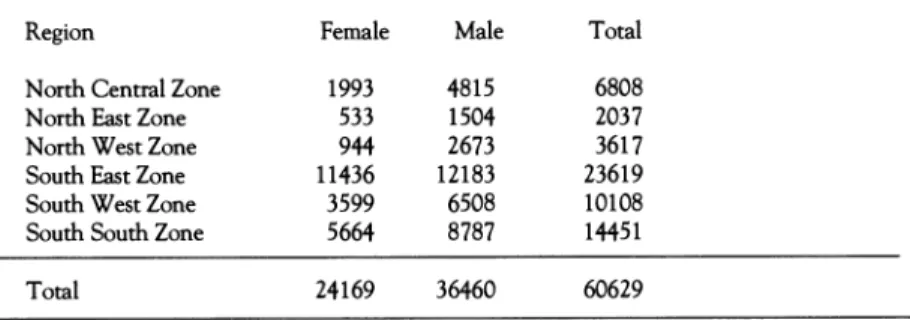
This paper focuses on the experiences and engagements of women as stu-dent, staff and managers in higher education in Nigeria. lt is based partly on an analysis of the documents of selected universities and on a small-scale study involving interviews with women in university management positions at three universities in the south and discussions and correspondence with women who are members of a number of networks of women academics. Since 1948, when the three young girls entered the University College of Ibadan, there has been a significant increase in the number of women having access to higher education .. The ove raIl picture for the country indicates large number of women admitted to higher education in 2000. They comprise 40% of aIl admissions, but there is considerable variation across the zones of the country. Thus there are many fewer admissions of women and men from the northem zones, compared to the southem zones, but in the northem zones women comprise just over a quarter of admissions, compared to just under half in the south east zone and around a third in the other southem zones. (See Tables at end)
In much writing on the expansion of higher education in Nigeria the emphasis tends to be on numbers. Rarely is the focus on introspection into the roles and perceptions of women who have entered higher education regarding the impact and the significance of the positions they are occupy-ing. Structural and cultural barriers have been discussed (Alele-Williams, 1992), but the nature of the experience remains to be documented. There is also a need to examine the factors which may account for women's entry into higher education and the policies which are in place within institutions which can be appropriated to serve the ends of women's advancement and ensure the sustainability of the trend for increasing numbers of admissions. The university is still unfamiliar terrain to many female students and staff, especially in certain disciplines like Science and T echnology and in man-agement. Examining both figures and policies in Nigeria, Pereira (2002, p. 1) notes the "although university systems tend to be spoken of in gender neutral terms, the effects of their workings are far from gender neutral." The first female staff was employed in the year of Nigeria's independence, 1960, in the Department of History (Interview, Awe, 2002). The percentages of female academic staff recruited in Nigerian universities in 1996/97 were:
Navigating the Seas: Women in higher education in Nigeria
Social Sciences, 9.2% (150 out of1631); Sciences, 12.8%, Arts, 14.7% and Education, 22.2%. (Data generated by NUC, 2001 cited in Pereira, 2002) Student enrolment by faculty showed the same preponderance of males in science and technology. According ta 1996 data generated by the National Universities Commission (NUC), the regulatory body for universities in Nigeria, 31.7% of Science students were women, compared ta 37.6% in the Social Sciences and 44.6% in Arts, (Pereira, 2002). The gender differentials reflect the situation at secondary school level, in which more males are enroUed. The pyramidal nature of the Nigerian educational system with a broad base at primary level, narrowing at secondary and tertiary levels underscores the limitation in access ta higher education. Okebukola (1998) notes that while women are encouraged ta take advantage of higher educa-tional opportunities, no deliberate attempt is made ta lower admission standards in their favour.
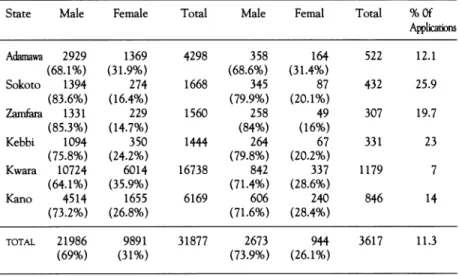
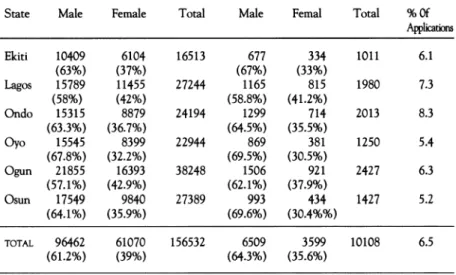
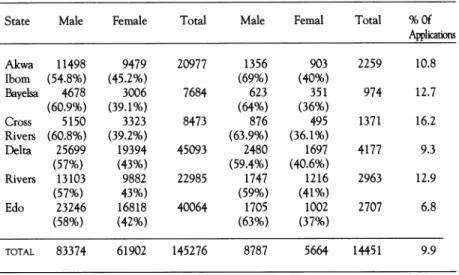
The statistics of applications and admissions into Nigerian universities by state of origin and by sex in 2000/2001 (See Table 2a-f) reveals interesting variations across geographical zones. In aU the six zones, there is a wide difference between the number of applications and àctual number of admis-sions, ranging from the 6.5% of South West zone ta the 15.2% ofboth the North East and SouthEast zones. However, actual figures present a more revealing picture, since for example, the 6.5% of admission in the South West (Table 2e) is 10,108 candidates, while the 13.8% for the North East is only 2243 (Table 2b). The highest figures of female enrolment are from the South East, Il,436 (48.4%) where in 2 states, Anambra and Imo, female enroUment exceeds that of males (Table 1). The situation in that zone of high male drop out rate in secondary schools has led ta interventions by the govemments and UNICEF in a campaign ta reverse the trend. The lowest female admission figures are from the North East (533), where Jigawa State has as low as 29 female candidates for the session. Tables 1a-f show that the highest admissions figures for females are from the southem part of the country, II,436 from the South East, 5644 from the South South and 3599 from the South West. The low figures of 668 from the North East, 787 from the North West and 2015 from the North Central underscore Okebukola's advocacy of the use of incentives such as bursaries and scholarships for women, public enlightenment programs ta remove cultural impediments ta women's education, employment of more women into administrative and academic positions and enhancement programs by organisations such as the Forum of African Women Educationists (FA WE).(1998)
The poor condition of universities in Nigeria have made gender issues appear less urgent than funding or govemance. There was a military coup in 1965 and military rule for almost thirty years thereafter. This had a profound effect on university education. The culture of the universities took
on the rigid structure of military commando There was an erosion of univer-sity autonomy, and a diminution of the humanistic sociocultural values on which universities thrive. (Obanya, 2002). The period of military rule was also marked by unplanned proliferation of university education in Nigeria. Changing government policies and a deliberate policy of widening access to higher education led to a dramatic increase in the number of students, but drastically reduced funding universities, resulting in poor governance. The period of economic recession in the 1980s and 1990s accompanied by hyperinflation affected universities severely, since the federal government had been their main funder. In spite of the change over to a civilian government in May 1999, underfunding still continues. For example, the total budgetary allocation for Social Services, under which education is subsumed in the national budget, decreased from 12.6% in 1999 to 12.2% in 2000 and 7.5% in 2001. Only 9.9%, totaling 82.6 billion Naira, was allocated to education out of a total national budget of 834.5 billion Naira. (Obanya, 2002) This contrasts with the figures for other African countries like Zimbabwe which spent 17.6% of its national budget on education, and South Africa, which spent 24% over the same period. In these straitened circumstances attention tends to focus on competing claims for funding for attracting and retaining high quality staff, acquisition of books for the library, equipping the laboratory and increasing staff remuneration rather that issues of gender equality.
Since 1999 there have been laudable initiatives to improve the quality of teaching, learning and research in institutions ofhigher learning. For exam-pIe, the recently inaugurated National Universities Systems Improvement Project (NUSIP) and the National Virtual (Digital) Library Project funded by the Federal Ministry of Education and international agencies are de-signed to bring about radical changes to the system and facilitate enhanced access to national and international information resources. The National Universities Commission has also begun to play a role in evaluating univer-sity programs through its program accreditation project But in these reforms gender is not foregrounded.
Nigeria is a signatory to the Convention of Elimination of All Forms of Discrimination against women and has established sorne projects for the implementation of the articles of the Convention, but has not enacted the domestic laws for the enforcement of the articles. Even though the 1999 Nigerian Constitution makes provision for equality of women, "the problem is with how far in practice, the constitution guarantees rights, protects the interest of women having regard to the religious, traditional and cultural norms that govern (the) society" (Nasir, 2001, p. 160). The CEDA W Committee for Reporting Obligations noted at their 1998 session that, in Nigeria, there is still a paucity of gender disaggregated statistics which would
Navigating the Seas: Women in higher education in Nigeria
make comparison of women's progress in several sectors of national life easier. (Sani, 2001). An examination of the various Nigerian University Acts, which govern the establishment of each university shows that, in general, they contain a clause prohibiting exclusion on account of "ethnic grouping, sex, place of birth or of family origin or religious or political persuasion from studentship, employment or membership of any body estab-lished by the Act" (University ofUyo Draft Act, 2000, p.18; University of Benin Amendment Act, 2000, p.18, University of Jos Draft Act, 2000 Section 1:3 a).
As
part of this very partial implementation of CEDA W there are no re-served places for women with regard to admission to higher education or employment. Higher education admission requirements, focus not only academic achievement, but also take account of catchment areas. Priorities are given to applicants from educationally disadvantanged areas and select by discipline. There is a discipline quota of 60:40 of Science to Arts.As
more women take arts subjects at high school, this policy acts as a brake on their access to higher education. The dilemma for policy makers in Nigeria is how to integrate a national policy of promoting science and technology in national development with what is perceived as a less compelling impera-tive of advancing women's interests.
University staff are more likely to be male, a phenomenon which can be explained by the pattern of access to higher education within the country. Table 5 shows the gender distribution of staff at the University of Ibadan, the oldest of the universities, in 2001. Nearly 80% of academic staff and 70% of senior administrators are male, 88.1% of prof essors, 78% of senior lecturers and 75% of junior lecturers are male.
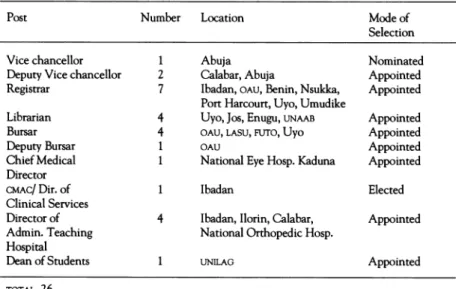
From the 1990s, women have become slightly more visible in middle and top management in higher education in Nigeria as some have attained positions as Rectors, Directors of Institutes, Deans, Registrars and Univer-sity Bursars (Odejide, 2001) Tables 3 and 4list the numbers in senior posts and the means of gaining those posts. It is evident that women very rarely gain access to senior posts through election. Some are appointed to leader-ship roles on the basis of a transparent appointments process. In interviews with some in these posts it emerged that where the criteria were academic and professional qualifications, proven skil1s and competence on the job, they felt they had a fair chance of succeeding. But, as Tables 3 and 4 show, the majority of women who have senior posts have gained these through nomination. This indicates women in senior leadership may be linked to powerful groups working through the senior woman they nominate. During the period of military mIe Vice Chancellors were nominated by the military heads of state. T wo women Vice Chancellors nominated in this way subse-quently encountered problems with their university communities.
Adadevoh (2001) argues that it is necessary for women to gain better qualification and experience suitable for leadership. The problem is "By whose definition?" There continues the problem of deciding what consti-tutes acceptable criteria for advancement. What weighting for example is attached to: competence in teaching, service to the department and univer-siry committees, type of research and outlets for research? The politics of research and publication differs from institution to institution, and in N i-geria, it is also tied to the age of the university (whether first, second and third generation university), ownership (whether federal, state or private) and the type of universiry, whether conventional or specialized. An exam-pIe of the new thinking about the weighting of research in relation to teaching for promotion purposes is the proposaI in one Nigerian university's vision document to allocate up to 30% weighting to teaching competence (University ofIbadan, 2001). Such decisions are being made in the context of changing ideas about the relevance of tertiary education to national and community goals, globalization and the flow of knowledge between the North and the South. But they also have implications for considering affirmative action polices for women with regard to gaining access to posi-tions of power and decision making in higher education.
In interviews, participants currently holding senior jobs attributed this promotion to their academic and professional education, and "staying power" on the job. They also commented on their willingness to rise through the ranks, when men tended to move to greener pastures. Sorne saw society's perception of women as being more circumspect and honest as a factor in their career advancement, while others noted how with the expansion of Nigeria's economy in the 1970s men had moved from posts in higher education to the private sector leaving spaces that women were able to fill. In the view of respondents the major constraints to women's advancement to leadership positions in higher education were 'cultural' and linked to women's interpersonal relationships. Many mentioned 'men's superiority complex', and social pressures on women not to move into the public sphere. Other common perceptions were of a widespread preference for male leadership, and general apathy among women with regard to taking on leadership. Nigeria's long history of militarisation inextricably linked lead-ership with authoritarianism, a quality that is not defined as feminine. In addition the volatile nature of staff and student activism in Nigerian higher education institutions often involves physical and psychological violence. This makes it easy for a community to designate university management as a terrain best suited to males. Other "disabilities" that emerged related to a woman's ethnicity, unmarried status or radical politics. Ethnicity, religious affiliation, and ideological orientation might be important determinants of opportunities to engage in decision making and succeed in leadership posts. These are not unambiguously beneficial for the women who occupy them
Navigating the Seas: Women in higher education in Nigeria
Mbanefoh' s study (1995) mentions the loneliness of women who find them-selves in management positions in Nigeria. This study corroborates this. Participants in leadership position mentioned how often they had to have recourse to coping strategies, such as accessing family support, ignoring male prejudices, utilizing good time management, and "proving oneself' often by working long hours or acquiring additional training. None thought of chal-lenging the status quo or initiating systemic change. This was in spite of the fact that they could read the power relations within the system fairly accurately. Moreover, since these women acquired their posts through what they regarded as merit, they were wary of supporting affirmative action for women. While a few respondents commented on the old boy networks in facilitating men's success, they did not take due cognizance of how the organizational structure has been largely defined by men and often alienated women or that there were processes that could challenge the influence of these informaI networks
Women's groups have played an ambiguous role in projects to support women students and staff in higher education in Nigeria. In the 1970s conservative women's groups like the National Council of Women's Soci-eties and the socialist feminist group, Women in Nigeria (WIN) helped galvanize feminist scholarship and facilitated the establishment ofWomen's networks such as the Association of Aftican Women for Research and Development (AAWORD). Since the 1980s and the 1990s, there has been a noticeable increase in the number of women's groups which focus on women in higher education. Sorne of these groups are discipline based like Girls and science and Technology (GASAT), while others are multidisciplinary like the Network for Gender Sensitive Education, the National Association ofWomen Academics (NA W ACS), the Network for Women's Studies in Nigeria (NWSN), the Women's Research and Docu-mentation Centre (WORDOC) and the Ahmadu Bello Women's Study Group (ABWSG). Generally the women's groups that focus on higher education, aim to prioritize confronting the gender inequlities in their workplace and discipline. They act as support groups for women associated with higher education.
However an examination of the work of four of such groups shows that they tend to adopt prograrns which focus on inclusion, into the institution rather than transformation. Their membership includes teachers, researchers and to a lesser extent, activists in universities and research institutes. They typically work to facilitate women's careers and encourage younger women to join them. A number assist women through mentorships in coping with professional and personal roles. The activities coyer members' welfare, social policy, education, communication! information, publication and ad-vocacy. Sorne collaborate with other women's groups outside the university. But in spite of the increased number of academic and professional women's
groups, there seems to be little enthusiasm among the majority of women working and studying within universities to join them. Often women staff and students comment on their lack of power to change the situation, and the implication of women's associations in internaI university politics. A view is commonly expressed that these groups diminish the potential for making changes From within.
One avenue that has been explored relates to the establishment of courses in women's studies. No Nigerian university currently runs a full degree in Women's Studies; rather, courses on women's issues are taught as part of the undergraduate programs in certain disciplines like Sociology, Literature, Education, and Psychology. (Marna, 1996) One university, Obafemi Awolowo University, Ile Ife runs a graduate program on Gender and Policy Studies. The Network for Women's Studies in Nigeria, founded in 1996, recognized its pivotaI role in shaping the Women's Studies' curriculum by embarking on a preparation of a national curriculum for Gender Studies in Nigeria at its inaugural meeting. It recommended that the core curriculum for W om-en's Studies needs to address the attitudes, knowledge and skills to be acquired by students as well as provide guidelines on methods of leaming and teachingand methods of assessment. (Odejide & Isiugo-Abanihe, 1999). Since the NUC previously prescribed a Minimum Academic Standards Guide for all universities in the nation, the NWSN considered it strategie to have a professional group drawn From scholars From all over the country contribute to the content and structure of the currieulum and thus hasten the process of its legitimization by the accreditation body. This strategy would also facilitate the running of nation wide workshops on feminist approaches to teaching and learning, since it had been observed that the earlier Afriean initiatives in incorporating gender issues into different dis-ciplines had encountered the ambivalence of initiators of the programs towards the issue ofpatriarchy and women's subordination. (Odejide, 1999a; Odejide, 1999b)
Currently, in Nigeria, most universities are engaged in curriculum review as part of the National Universities Commission's requirement for accredita-tion of programs and ranking of universities according to performance. This opportunity offered by periods of university curriculum reviews for introduc-ing new courses is very useful as is corroborated by Denzer's experience with Women's Studies. in Ibadan, Nigeria, where she was able to inject elements ofWomen's Studies into her undergraduate History courses (Denzer, 1999) with signifieant results in students' choiee of topies for their final year essays.
Conclusion
The opportunities for improving women's presence in higher education institutions in Nigeria will emerge From a combination of factors internaI
Nalligating the Seas: Women in higher education in Nigeria
and external to the universities themselves and to the country. The major factor is the impact of glohalization on higher education, as new sites of leaming emerge through open and distance learning and new opportunities for participation develop for women who have dropped out of school. The preponderance of females in existing part time and sandwich programs for continuing teacher-training education is a positive sign in this direction. Such programs need to hegin to engage with gender differences in their course offerings, content and pedagogies and not only concentrate on enhanced access for women. Gender needs to he an explicit concern in policies of expansion and inclusion.
REFERENCES
Adadevoh, I. O. (2001, September). Feminism, professionalism and educationalleadership: An approach to capacity building in Nigerian universities. The Nigerian Social Scientist 4(2). Alele-Williams, G. (1990). Major constraints to women's access to higher education. In UNESCO, Higher education in Africa: Tfends and challenges far the 21 st century. Dakar: UNESCO Regional Office, BREDA.
De la Rey, C. (2001). Women and management in South Africa. Paper presented at the ACU/ IOE Seminar, Johannesburg, South Africa, 7-11. 2001.
Federal Ministry of Education. (2000). GUidelines on university autonomy. (Nigeria). Federal Republic of Nigeria. (1992). Highereducation in the nineties and beyond: Report of the Commission on the Review of Higher Education in Nigeria (Longe Report). Unpublished. Federal Republic of Nigeria. (1997). Report of the Committee on the Future of Higher Education in Nigeria. (Ndayako Report). Unpublished.
Gold, A., Morley, L.. & Unterhalter, E. (2001). Managing gendered change in Commonwealth higher education. Paper presented at the ACU/IOE Seminar, Johannesburg, 9th_1l th, 2001. Lamptey, A.S. (1992). Promoring women's participation in research and management in African universities. in UNESCO, Higher education in Africa: Trends and challenges for the 21"t Century. Dakar: UNESCO Regional Office, BREDA.
MacFadden, P. (n.d.) African women and the challenges of leadership development. In A. Aderinwale (Ed.), CommunicatiOn and leadership for empowerment: Summary report and papers presented at the Women's Forum, Arthur's Seat Hotel, Cape Town, 28th_ 30th May, 1998. Abeokuta: Africa Leadership Forum.
Makhubu, L.P. (1998). The right to higher education and equal opportunity particularly for women: The major challenge of our time. In UNESCO, Higher education in Africa: Achieve-ments, challenges and prospects. Dakar: UNESCO Regional Office, BREDA.
Marna, A. (Ed.). (1996). Serting an agenda for women's studies in Nigeria: Report of the Workshop of the Network for Women's Studies in Nigeria. Zaria: Tamaza Publishing. Manya, M. O. (2000). Equal opportunities policy (gender). A means to ensuring the number of female senior managers and decision makers at the University of Nairobi. Policy Studies, 130. London: University of London.
Mbanefoh, N. (1995). Women participation in higher education in Nigeria. In UNESCO, Women in higher education in Africa, 148. Dakar: UNESCO Regional Office, Dakar
Mlama, P. (1998). Increasing access and equity in higher education: gender issues. In UNESCO, Higher education in Africa: Achievements, challenges and prospects. Dakar: UNESCO Regional Office, BREDA.
Morley, L., with Unterhalter, E, & Gold, A. (2002). Sounds and silences: Gendered change in ht;er education institutions in the Commonwealth. Paper presented at the Women's World 2002 8 International Interdisciplinary Congress on Women. Makerere University, Kampala, Uganda. Nasir,J. (2001). HumanRightsofWomen. in H. Sani, Women in national development: Theway forward. Ibadan: Spectrum Books
Nzegwu, G. O. (1981). Reminiscences of an Ibadan alumna. In T. N. Tamuno, Ibadan lIOices: Ibadan University in tTansition, pp. 30-32. Ibadan: Ibadan University Press.
Obanya, P. (2002). Rwitalising education in Africa. Ibadan: Stirling Horden.
Odejide, A. (2001, Feb. 9-11). Women in management in highereducation in Nigeria: Therole of academic women's groups. Paper presented at the Association of Commonwealth Universi-ties and Institute of Education London Seminar on Managing Gendered Change in Higher Education in Selected Commonwealth Countries. Johannesburg.
Odejide, A. (2002). Profile of Women's Research and Documentation Centre, Institute of African Studies, University of Ibadan, Nigeria. Feminist Africa www:feministafrica.org Odejide, B., & Isiugo-Abanihe, I. (Eds.). (1999). Curriculum for gender and women's studies in Nigeria. Report of the Workshop of the Network for Women's Studies in Nigeria No.3 Ibadan: Mosuro.
Odejide, B. (1999). Teaching methods and strategies in gender Studies. In B. Odejide & Isiugo-Abanihe, Curriculum for gender and women' s studies in Nigeria. Report of the Workshop of the Network for Women's Studies in Nigeria No.3 Ibadan: Mosuro.
Odejide, B. (1999). Developing the curriculum in gender and women's studies: Whose knowledge? Whose power? Paper presented at the Workshop on Strengthening Institutional Capacity for Engaging in Gender and Women's Studies in Northern Nigerian Universities. Ahmadu Bello University, September 27 - 30, 1999.
Okebukola, P. (1998). Management ofhigher education with a special reference to Nigeria. In UNESCO, Higher education in Africa: Achiel!ements, challenges and prospects. Dakar: UNESCO Regional Office, BREDA.
Pereira, C. (Ed.). (1997). Concepts and methods for gender and women's studies in Nigeria. Report of the Network for Women's Studies in Nigeria No. 2. Zaria: Tamaza Publishing. Pereira, C. (2002). What methodologies for analysing gender in the universi~ system? Paper presented for Gender and Higher Education project ofWomen's World 2002: 8 International Interdisciplinaty Congress on Women, 21-26, 2002. Makerere University, Kampala, Uganda. UNESCO. (1992). Higher education in Africa: Trends and challenges in the 21 st Century. Dakar: UNESCO Dakar regional Office, BREDA
UNESCO. (1998). Higher education in Africa: Achiel!ements, challenges and prospects. Dakar: UNESCO Regional Office, BREDA.
UNESCO Secretariat. (1998). Higher education and women: Issues and perspectives. Thematic debate. ED-98 CONF .202/15. Paris, August 1998.
University of Benin Amendment Act, 2000. Unpublished.
University of Ibadan Vision for the 21 st Centuty Committee Interim Report, 200I. University oOos Draft Act, 2000. Unpublished.
University of Uyo Drafr Act, 2000. Unpublished.
Navigating the Seas: Women in higher education in Nigeria
TABLE 1. Admissions to higher education by zone and gender. 2000
Region Female Male Total
North Central Zone 1993 4815 6808
North East Zone 533 1504 2037
North West Zone 944 2673 3617
South East Zone 11436 12183 23619
South West Zone 3599 6508 10108
South South Zone 5664 8787 14451
Total 24169 36460 60629
Swrœ: Derive<! from joint Admissions and Matriculation Board 2002
TABLE Za. Applications and admissions statistics (UME/DE) by State of origin and sex 2000/200 1 Session North Central Zone
APPLICATIONS ADMISSIONS
State Male Female Total Male Femal Total %Of
AwIïcatDls Benue 6490 3509 9999 1318 545 1863 18.6 (64.9%) (35.1%) (70.7%) (29.3%) katsina 1584 498 2082 248 81 329 15.8 (76.1%) (23.9%) 75.4%0 (24.6%) Kogi 11214 5965 17179 1498 695 2193 12.3 (63.3%) (26.7%) (68.3%) (31.7%) Plateau 2787 1441 4228 376 162 538 12.7 (65.9%) (34.1%) (69.9%) (30.1%) Kaduna 4416 2185 6601 633 234 867 13.1 (66.9%) (33.1%) (73.5%) (27%) Niger 2328 999 3327 447 173 620 18.6 (70%) (30%) (72.1%) (27.9%) Nasarnwa 1995 785 2780 295 103 398 14.3 (71.8%) (28.2%) (74.1%) (25.9%) TOTAL 30814 15382 46196 4815 1993 6808 14.7 (66.7%) (32.3%) (78.7%) (29.3%)
Swtce: Derive<! from joint Admissions and Matriculation Board 2002
UME: University Matriculation Examinations
IlE: Direct Entry i.e. Advanced Leve~ National Certificaœ Œ Education, National Diploma
TABLE 2b. Applications and admissions statistics (UME/DE) by State of origin and sex 2000/2001 Session North East Zone
APPLICATIONS ADMISSIONS
State Male Female Total Male Femal Total %Of Applications Borno 2841 1295 4136 368 204 572 13.8 (68.7%) (31.3%) (64.3%) (35.7%) Gombe 1310 509 1819 279 88 367 20.1 (72%) (28%) (76%) (24%) Jigawa 1283 215 1498 187 29 216 14.4 (63.3%) (26.7%) (68.3%) (31.7%) Taraba 1725 542 2267 205 57 262 11.5 (76.1%) (23.4%) (78.2%) (21.8%) Yobe 1416 331 1747 114 59 173 9.9 (81.1%) (18.9%) (65.9%) (34.1%) Bauchi 1511 420 1931 351 96 447 23.1 (78.2%) (21.8%) (76.6%) (23.4%) TOTAL 10086 3312 1398 1504 533 2037 15.2 (75.3%) (24.7%) (73.8%) (26.2%)
TABLE 2e. Applications and admissions statistics (UME/DE) by State of origin and sex 2000/2001 Session North West Zone
APPLICATIONS ADMISSIONS
State Male Female Total Male Femal Total %Of Applications Adamawa 2929 1369 4298 358 164 522 12.1 (68.1%) (31.9%) (68.6%) (31.4%) Sokoto 1394 274 1668 345 87 432 25.9 (83.6%) (16.4%) (79.9%) (20.1%) Zamfura 1331 229 1560 258 49 307 19.7 (85.3%) (14.7%) (84%) (16%) Kebbi 1094 350 1444 264 67 331 23 (75.8%) (24.2%) (79.8%) (20.2%) Kwara 10724 6014 16738 842 337 1179 7 (64.1%) (35.9%) (71.4%) (28.6%) Kano 4514 1655 6169 606 240 846 14 (73.2%) (26.8%) (71.6%) (28.4%) TOTAL 21986 9891 31877 2673 944 3617 11.3 (69%) (31%) (73.9%) (26.1%)
Navigating the Seas: Women in higher education in Nigeria
TABLE 2d. Applications and admissions statistics (UME/DE) by State of origin and sex 2000/2001 Session South East Zone
APPLICATIONS ADMISSIONS
State Male Female Total Male Femal Total %Of
Applications Abia 13663 12869 26325 2293 1944 4237 16.1 (52%) (48%) (54.1%) (45.9%) Anambm 19452 25401 44853 3224 3612 6836 15.2 (43.4%) (56.6%) (47.2%) (52.8%) Ebonyi 3975 2031 6006 706 310 1016 17.0 (66.2%) (33.8%) (69.5%) (30.5%) Enugu 11167 10667 21834 1878 1441 3319 15.2 (51.1%) (48.9%) (56.6%) (43.4%) lmo 28043 28548 56591 4082 4129 8211 14.5 (50%) (50%) (50%) (50%) TOTAL 76300 79516 155609 12183 11436 23619 15.2 (49%) (51%) (51.6%) (48.4%)
TABLE 2e. Applications and admissions statistics (UME/DE) by State of origin and sex 2000/2001 Session South West Zone
APPLICATIONS ADMISSIONS
State Male Female Total Male Femal Total %Of
Applications Ekiti 10409 6104 16513 677 334 1011 6.1 (63%) (37%) (67%) (33%) Lagos 15789 11455 27244 1165 815 1980 7.3 (58%) (42%) (58.8%) (41.2%) Ondo 15315 8879 24194 1299 714 2013 8.3 (63.3%) (36.7%) (64.5%) (35.5%) Oyo 15545 8399 22944 869 381 1250 5.4 (67.8%) (32.2%) (69.5%) (30.5%) Ogun 21855 16393 38248 1506 921 2427 6.3 (57.1 %) (42.9%) (62.1%) (37.9%) Osun 17549 9840 27389 993 434 1427 5.2 (64.1%) (35.9%) (69.6%) (30.4%%) TOTAL 96462 61070 156532 6509 3599 10108 6.5 (61.2%) (39%) (64.3%) (35.6%)
TABLE 2f. Applications and admissions statistics (UME/DE) by State of origin and sex 2000/2001 Session South South Zone
APPLICATIONS ADMISSIONS
State Male Female Total Male Femal Total %Of
AppIK:atioos Akwa 11498 9479 20977 1356 903 2259 10.8 Ibom (54.8%) (45.2%) (69%) (40%) Bayelsa 4678 3006 7684 623 351 974 12.7 (60.9%) (39.1%) (64%) (36%) Cross 5150 3323 8473 876 495 1371 16.2 Rivers (60.8%) (39.2%) (63.9%) (36.1%) Delta 25699 19394 45093 2480 1697 4177 9.3 (57%) (43%) (59.4%) (40.6%) Rivers 13103 9882 22985 1747 1216 2963 12.9 (57%) 43%) (59%) (41%) Edo 23246 16818 40064 1705 1002 2707 6.8 (58%) (42%) (63%) (37%) TOTAL 83374 61902 145276 8787 5664 14451 9.9
TABLE 3. Women in management in higher education in Nigeria 1989-1999
Post Number Location
Vice chancellor Deputy Vice chancellor Registrar Bursar Rector (poly) Librarian cmac/ Dir. of Clinical Services TOTAL 15 3 1 2 2 3 3 1
OAU: Obafemi Awolowo University, Ile Ife FUTA: Fedeml UniveRSIty of Agriculture, Alwre
UNH.AG: University of Lagos
LUn!: Lagos University Teaching HosPITAL
Benin, Lagos STATE, Abuja IFE (OAU)
OAU,FUTO OAU,UNll.AG Ibadan, Ilorin, Yaba Ibadan, OSU, OAU
LUTH Mode OF seLECtion Nominated Nominated Appointed Appointed Appointed Appointed Appointed
Navigating the Seas: Women in higher education in Nigeria
TABLE 4. Women in management in higher education current figures
P06t Number Location Mode of
Selection
Vice chancellor 1 Abuja Nominated
Deputy Vice chancellor 2 Calabar, Abuja Appointed Registrar 7 Ibadan, OAU, Benin, Nsu\cka, Appointed
Pon Harcoun, Uyo, Umudike
Librarian 4 Uyo, J06, Enugu, UNAAB Appointed
Bursar 4 OAU, LASU, FUTO, Uyo Appointed
Deputy Bursar 1 OAU Appointed
Chief Medical 1 National Eye H06p. Kaduna Appointed Director
CMAc/ Dir. of Ibadan Elected
Clinical Services
Directorof 4 Ibadan, Ilorin, Calabar, Appointed Admin. Teaching National Orthopedie Hosp.
Hospital
Dean of Students UNll.AG Appointed
TOTAL 26
TABLE 5. Staff strength University of Ibadan
Category Number Male Female
Academie Staff 1332 78.7% 21.3%
Other Senior Staff 1713 7M% 29.6%
Junior 2970 78.5% 21.5% Total 5835 75.4% 21.5% Academic Staff by Category Professors/Readers 23.7% 88.1% 11.9% Senior Lecturers 25.2% 78.2% 21.8%
Lecturer 1 & below 51.1% 74.5% 25.5%
TOTAL 100% 78.7% 21.3%
ABIOLA ODEJIDE teaches in the Department of Communication and Language Arts, University of Ibadan, Nigeria. She is the Coordinator of the Women's Research and Documentation Centre, University of Ibadan and Chair of the Curriculum Sub-Committee, Network of Women's Studies in Nigeria. She has served as editor of Women and the Media in Nigeria (1996), and Curriculum for Gender and Women '5 Studies in Nigeria (1999).
ABIOLA ODEJIDE enseigne au département des arts de la communication et du langage à
l'University of Ibadan au Nigéria. Elle est aussi la coordonnatrice du Women's Research and Documentation Centre de l'University of Ibadan, et elle est directrice du Curriculum Sub-Committee du Network of Women's Studies au Nigéria. De plus, elle a occupé le poste de rédactrice pour les publications Women and the Media in Nigeria (1996), et Curriculum for Gender and Women's Studies in Nigeria (1999).