Accelerating Cleantech Hardware Product
Development
by
Erin Elizabeth Looney
Submitted to the Department of Mechanical Engineering
in partial fulfillment of the requirements for the degree of
Doctor of Philosophy in Mechanical Engineering
at the
MASSACHUSETTS INSTITUTE OF TECHNOLOGY
May 2020
c
○ Massachusetts Institute of Technology 2020. All rights reserved.
Author . . . .
Department of Mechanical Engineering
May 15, 2020
Certified by . . . .
Ian Marius Peters
Research Scientist
Thesis Supervisor
Certified by . . . .
Tonio Buonassisi
Professor of Mechanical Engineering
Thesis Supervisor
Certified by . . . .
Maria Yang
Professor of Mechanical Engineering
Thesis Supervisor
Accepted by. . . .
Accelerating Cleantech Hardware Product Development
by
Erin Elizabeth Looney
Submitted to the Department of Mechanical Engineering on May 15, 2020, in partial fulfillment of the
requirements for the degree of
Doctor of Philosophy in Mechanical Engineering
Abstract
Startups in the Cleantech sector have historically had poor return on investment and high failure rates when compared with the medical or software sectors. One reason given for the disappointing outcomes of many Cleantech companies is slow product development (PD) and cycles of learning. In this thesis, I explore the major bot-tlenecks in hardware product development (PD) including slow cycles of learning, especially in Cleantech. I then develop technical and operational interventions to help overcome these obstacles. I accomplish this through 55 interviews with hard-ware startup chief executive and chief technology officers worldwide and subsequent analysis of the data from these conversations. By analyzing this data, I find ways to accelerate the innovation process and work toward applying these to Cleantech hardware product development.
First, I find that prototyping is the largest time sink for hardware startups with a median of 2.5 years. I further find that prototyping times are not correlated with certain product complexity metrics. This suggests that something other than technological constraints determines prototyping times. To examine this further, I investigate the impact of innovation models on prototyping times. I find that a flexible, natural innovation model can accelerate early-stage innovation while a structured PD approach is preferred for later-stage innovation.
Then through qualitative coding of the interview transcripts, I find another PD bottleneck in relationships with the key stakeholders of investors, customers, and manufacturers. I find several best practices regarding these relationships, and I propose that codifying some of these as requirements in the traditional sense might be a promising strategy to accelerate PD timelines. Next, I present an outlook for technological acceleration strategies that are cutting edge and have only just begun
to be used by startups. These include computational tools like automation, machine learning (ML), and high performance computing (HPC), as well as physical tools like 3D printing.
Lastly, I present a computational tool for testing solar photovoltaics as an exam-ple of a PD acceleration method. This tool, called Representative Identification of Spectra and the Environment (RISE) uses K-means, a machine learning clustering algorithm. The RISE method overcomes the shortcomings of past spectral classifiers used in industry and academia. This method is technology agnostic and the two parameters of RISE, 𝑘1 and 𝑘2 can uniquely classify all spectra worldwide unlike the commonly used APE classifier. I further demonstrate the RISE method in practice using LED-based solar simulators to test solar devices, capturing more performance data relevant to real world conditions per unit time than current standard testing allows. Using only 18 representative spectra, I correctly reproduce energy yield dif-ferences between silicon solar cells and CdTe solar cells with an accuracy of less then 1.5 ± 0.5% as compared to over 5% when using STC. With the findings enumer-ated above, this thesis adds data-driven technical and operational strategies to the Cleantech community’s playbook to accelerate cycles of learning.
Thesis Supervisor: Ian Marius Peters Title: Research Scientist
Thesis Supervisor: Tonio Buonassisi Title: Professor of Mechanical Engineering Thesis Supervisor: Maria Yang
Acknowledgments
I want to first thank Patrick T. Komiske III, my partner, fiancé, best friend, biggest fan, and the love of my life. This would not have been possible without your calm and steady presence, your encouragement, and the joy you bring to my life. Your support through the past 3 years has meant more to me than I can say. Thank you so much.
Next, I want to thank my family. Mom, Dad, and Emery thank you for being you. You are my shelter in the storm, and I am the luckiest person in the world to call you my (Looney) family! Also, thank you to Grandma Pat, Grandma Sally, and Pop, you have all been important to me in a unique way. Thank you for always being there for me. Thank you to Hannah, Sarah, Aunt Julie, and Uncle Matt who have been my second family for my whole life. Thank you for the years of support and patience with me!
It is a pleasure to extend a heart-felt thank you to Ian Marius Peters, my co-advisor. Marius, you have been a wonderful mentor for many reasons. To name a few: your drive for research excellence in pursuit of solutions to important problems like climate change mitigation, your detailed and thorough feedback on every talk, presentation, and idea presented to you, and your leadership through difficult times lending confidence and clarity to myself and the entire lab. Thank you for being a mentor, role-model, and friend.
Next, I would like to thank Tonio Buonassisi, my co-advisor, for inviting me into the PVLab, introducing me to an excellent group of people, and setting a research vision that is exciting and important for the world. Your dedication and tireless efforts to better our research efforts and opportunities is impressive and inspiring. Thank you.
I would further like to thank Maria Yang for becoming my co-advisor, offering salient and important feedback, having confidence in my work, and generally being a joy to work with. Thank you to my committee member Warren Seering for excel-lent feedback and a voice of reassurance and wisdom throughout the thesis writing process. Thank you also to my committee member Betar Gallant for taking inter-est in my work and providing useful feedback from another important Cleantech perspective.
Next, I would like to thank my friends, who make my life better and more mean-ingful in so many ways. You guys are the best! A special thanks to my PVLab friends who have made the past 5 years a joy. Thank you to Rachel Kurchin, Amanda Youssef, Mallory Jensen, Hannu Laine, Liu Zhe, Ashley Morishige, David Berney Needleman, Michael Kelly, Sarah Sofia, and others for being excellent friends and role-models throughout my years in the lab. You are all amazing people, and I am lucky to have worked with you.
A further special thanks to my MIT cohort (and company) who have become integral to my life in Cambridge. Thank you to Rashed Al-Rashed, Liz Strong, Katherine Liu, Samantha McBride, Sebastian Gehrmann, Rebecca Zubaljo, Bethany Lettiere, and many more.
Lastly, I would like to dedicate this thesis to my late grandfather, Paul T. Golley (Gramps), a lifelong mechanical engineer. I thought of Gramps often while working through engineering quandaries. I heard many stories of him taking apart anything mechanical to understand it, working on car engines, and even racing cars. I really wish I could have shared my acceptance to MIT, subsequent research, and PhD defense with Gramps. I know he would be proud, and that is a wonderful feeling.
Contents
1 Introduction 16
1.1 Defining Cleantech . . . 17
1.2 Cleantech 1.0: Silicon Valley takes on Climate Change . . . 19
1.2.1 Outcome of Cleantech 1.0 . . . 19
1.3 Thesis Motivation . . . 22
1.4 Cleantech in the literature . . . 23
1.4.1 My approach . . . 23
1.5 Research Questions . . . 24
1.6 Thesis Outline . . . 25
2 Accelerating Cleantech Interview 27 2.1 Introduction . . . 27
2.2 Interview Methods . . . 28
2.2.1 Sample selection . . . 29
2.2.2 Workflow Mapping . . . 31
2.3 Interview Sections . . . 32
2.3.1 Personal and Company Info . . . 32
2.3.3 Requirements . . . 37
2.3.4 Modeling . . . 38
2.3.5 Concept Generation and Selection . . . 40
2.3.6 Product Complexity . . . 40 2.3.7 Prototyping . . . 45 2.3.8 Manufacturing . . . 48 2.3.9 Overview . . . 49 2.3.10 Other Considerations . . . 50 2.4 Interview Analysis . . . 52 2.4.1 Transcription . . . 53 2.4.2 Quantitative Methods . . . 53 2.4.3 Qualitative Methods . . . 53 2.5 Hypotheses . . . 55
3 Interview Analysis I: prototyping, product complexity and innova-tion models 57 3.1 Product Development Status Quo . . . 58
3.2 Product Complexity and Prototyping Times . . . 61
3.3 Structured vs. Organic PD process . . . 64
3.3.1 Definitions of Natural and Structured PD . . . 66
3.3.2 Arguments in Favor of Structured PD . . . 67
3.3.3 Arguments in favor of Natural PD . . . 68
3.3.4 Finding Balance Between Natural and Structured PD . . . 70
3.4 Case Study of Introducing Structure Late . . . 72
3.5 Transition from Natural to Structured PD . . . 75
3.5.2 Working with Outside Partners . . . 76
3.5.3 Iterative Innovation Model . . . 77
3.6 Conclusions and Future Research . . . 79
4 Interview Analysis II: Relational Requirements with Customers, Investors, and Manufacturers 81 4.1 Introduction and Motivation . . . 82
4.2 Identifying Relational Requirements . . . 85
4.3 Customer Relationships . . . 85
4.3.1 Customers vs. Users . . . 86
4.3.2 Customer Relationships: Quantitative Analysis . . . 87
4.3.3 Customer Relationships: Qualitative Analysis . . . 89
4.3.4 Customer Relational Requirements . . . 92
4.4 Investors . . . 92
4.4.1 Pressure by Investors . . . 94
4.4.2 Investors as Sources of Intelligence . . . 97
4.4.3 Investor as Customer . . . 98
4.4.4 Investor Relational Requirements . . . 99
4.5 Manufacturers . . . 99
4.5.1 Manufacturing Relationships: Quantitative Analysis . . . 100
4.5.2 Manufacturing Relationships: Qualitative Analysis . . . 102
4.6 Conclusions . . . 107
5 Interview Analysis III: Tools for Accelerated Design, Build, and Test 110 5.1 Design . . . 112
5.1.1 Status Quo . . . 112
5.1.2 Strategies and Tools for Future Design . . . 114
5.2 Build . . . 117
5.2.1 3D printing . . . 118
5.2.2 Automation . . . 120
5.3 Testing and Validation . . . 121
5.3.1 Status Quo . . . 121
5.3.2 Strategies and Tools for Future Testing . . . 122
5.3.3 A New Testing Method for Solar Photovoltaics . . . 123
5.4 Conclusions . . . 124
6 Representative Identification of Spectra and Environments (RISE) for accelerated testing of novel PV materials 126 6.1 Motivation . . . 127
6.2 Existing Classification Methods . . . 129
6.2.1 Average Photon Energy (APE) . . . 129
6.2.2 Simple Model of the Atmospheric Radiative Transfer of Sun-shine (SMARTS) . . . 130
6.3 RISE Method . . . 131
6.3.1 Spectrum Data . . . 133
6.4 Spectral Classification and Features . . . 136
6.4.1 Evaluation of RISE Classification with Distortion . . . 140
6.5 Conclusions . . . 142
7 Accelerated Solar Testing and Energy Yield Prediction 143 7.1 Motivation . . . 143
7.2 PV Modeling . . . 145
7.2.1 Input Parameters . . . 145
7.2.2 One-Diode Model . . . 147
7.2.3 Energy Yield Prediction . . . 149
7.2.4 Model Evaluation . . . 151
7.2.5 Experimental verification . . . 155
7.3 Conclusions and Future Possibilities . . . 160
8 Summary of Contributions 162 8.1 Ch.2 Summary . . . 162 8.2 Ch.3 Summary . . . 163 8.3 Ch.4 Summary . . . 164 8.4 Ch.5 Summary . . . 165 8.5 Ch.6 & Ch.7 Summary . . . 166 8.6 Final Conclusions . . . 167 8.7 Research Outlook . . . 169 A 171 A.1 Cleantech in Literature, A Detailed Review . . . 171
A.1.1 Cleantech Clustering . . . 171
A.1.2 Financial Strategies for Cleantech . . . 172
A.1.3 Policy Strategies for Cleantech . . . 174
B 176 B.1 Cleantech Sector of Photovoltaics . . . 176
B.1.1 The Origins of Solar and Cleantech 1.0 . . . 176
B.1.3 Discussion/Analysis . . . 189
C 190 C.1 Accelerated Materials Development . . . 190
C.1.1 AMD Introduction . . . 190
D 193 D.1 Examples of Relational Requirements for Adaptation . . . 193
D.1.1 Customer Relational Requirements . . . 193
D.1.2 Investor Relational Requirements . . . 194
D.1.3 Manufacturer Relational Requirements . . . 194
E 195 E.1 Qualtrics Survey . . . 195
List of Figures
1-1 Cleantech vs. Other Sectors . . . 20
1-3 Industrial Sectors Years to Exit . . . 22
2-1 Global Map of Interviewed Companies . . . 31
2-3 Example Workflow Timeline . . . 32
2-5 Aggregated Interviewee Information . . . 33
2-7 Aggregated Company Information I . . . 34
2-9 Aggregated Company Information II . . . 35
2-11 Aggregated Company Information III . . . 35
2-13 Aggregated Product Planning Interview Responses . . . 36
2-15 Complexity Parameters . . . 44
2-17 Jobs To Be Done Opportunity Landscape . . . 52
3-1 Time Taken for Product Development Steps . . . 58
3-3 Perceptions of Interviewees about Product Development Times . . . . 60
3-5 Complexity Metrics vs. Average Time to Prototype . . . 63
3-7 Natural to Structured Innovation Spectrum . . . 71
3-9 Company Timeline Example of Overengineering Slowdown . . . 74
4-1 Customer Relationships of Interviewed companies . . . 88
4-3 Company Timeline Example of Talking to Customers Late . . . 89
4-5 Types of Investment . . . 93
4-7 Pressure by Investors . . . 94
4-9 Pressure by Investors vs. Number of Weeks per Prototype . . . 95
4-11 Design For Manufacturing . . . 100
4-13 First Discussed DFM vs. Average Time per Prototype . . . 102
4-15 Company Timeline Example of Discussing Manufacturing . . . 103
4-17 Company Timeline Example of Discussing Manufacturing . . . 104
4-19 Locations of Incorporation and Manufacturing . . . 106
5-1 Accelerated Systems Development . . . 111
5-3 Concept Selection Methods . . . 112
5-5 Generative Modeling Examples from Autodesk . . . 116
6-1 External Quantum Efficiency and Spectra Examples . . . 128
6-3 Flow chart of RISE Method . . . 133
6-5 Data Used for RISE Method . . . 135
6-7 Spectra Cluster Centers found with K-means . . . 136
6-9 Heat Map of Colorado Spectra Frequencies . . . 137
6-11 Heat Map of Four Climate Zones Spectral Frequencies . . . 138
6-13 Heat Map of Distortion Values . . . 141
7-1 Temperature and Humidity Clusters . . . 146
7-3 IV curves and Heat Map for Colorado Energy Yield Predictions . . . 150
7-5 IV curves and Heat Map for Several Climate Zones Energy Yield Pre-dictions . . . 151
7-7 Comparisons of Simulated Energy Yield Predictions . . . 153
7-9 LEDs of Solar Simulator and Fits to Spectra . . . 156
7-11 RISE Spectra and IV curves Simulations vs. Experiments . . . 158
7-13 Normalized Short Circuit Current Differences in LED-RISE Method . 159 B-1 Solar Installations (2010-2019e) . . . 177
B-3 Photovoltaics Learning Curve . . . 178
B-5 Polysilicon Price Over Time . . . 180
B-7 First Solar Financials . . . 185
List of Tables
2.1 Interview Contents from PD Process . . . 29 2.2 Complexity Parameter Scales . . . 45 7.1 Modelling Parameters and STC Results . . . 149
Chapter 1
Introduction
The topic of this thesis is accelerating the development and commercialization of new "clean" technologies, many of which are not succeeding as products. As climate change is a time-sensitive issue, the inability to commercialize new technologies is an issue the world cannot ignore. Furthermore, business-as-usual solutions are not good enough. Societies will need to discover, design, and develop new technologies, processes, and policies faster and more effectively than ever before to meet this challenge. In this thesis, I work to understand what is preventing startup companies trying to commercialize Cleantech from succeeding at rates similar to other market sectors such as medical and software. I devise new solutions and strategies designed to help Cleantech startups overcome these obstacles, and I give a specific example of one such strategy for the sector of photovoltaics. In this introductory chapter, I chronicle the rise of the Cleantech sector, what my approach to this research is in contrast to literature, and define the specific research questions I will address in this work.
1.1
Defining Cleantech
The term "Cleantech" first emerged in the late 1990s in venture capital (VC) circles and was popularized when the Cleantech Venture Network was created in 2002. This same organization, now called the Cleantech Group has a working definition of Cleantech1:
"Cleantech is new technology and related business models offering com-petitive returns for investors and customers while providing solutions to global challenges. Cleantech spans many industry verticals and is defined by the following eleven segments: Energy Generation, Energy Storage, Energy Infrastructure, Energy Efficiency, Transportation, Wa-ter/Wastewater, Air/Environment, Materials, Manufacturing/Industrial, Agriculture, and Recycling/Waste." [1]
This definition does not precisely define the criteria that a new technology or business model must meet to be counted as Cleantech. In response, several financial market analysts and others have created more exact definitions. Dow Jones VentureOne says that Cleantech companies are:
"... defined as companies that directly enable the efficient use of natural resources and reduce the ecological impact of production. The impact of Cleantech can be either to provide superior performance at lower costs or to limit the amount of resources needed while maintaining comparable productivity levels." [30]
Another definition from Thompson Reuters and National Venture Capital Associa-tion says:
1This definition was presented in a 2018 presentation by Richard Youngman the director of the
"Clean technology investment focuses on innovations which conserve en-ergy and resources, protect the environment, or eliminate harmful waste." [30]
The National Resource Defense Council defines Cleantech companies differently: "They use new, innovative technology to create products and services that compete favorably on price and performance, while reducing mankind’s impact on the environment." [20]
All four of these definitions give criteria for classification of cleantech companies vs non-cleantech companies with varying degrees of specificity. For example new technologies that "provide solutions to global challenges" could describe many non-cleantech companies, as could "providing superior performance at lower cost." It is these criteria in conjunction with the mandate to "conserve energy and resources, protect the environment, or eliminate harmful waste" that make it cleantech.
The difficulty in classifying Cleantech companies is further muddied by the de-sire of companies to be designated as "Cleantech" for marketing reasons. Being a Cleantech company is a profitable public image, and therefore many companies en-deavor to be classified as such whether or not they meet the criteria laid out above. Furthermore, the exact ways in which a company must operate to qualify as "pro-tecting the environment," for example, are not defined. While rigorous definitions and classifications are desired for clear company designation, for this thesis whether a company can be designated as Cleantech is not decided by the author but by the community. Self-regulation within the Cleantech community is taken as a proxy for rigorous classification. Companies that proclaim to be Cleantech and are accepted as such by the community are therefore designated as Cleantech in this thesis.
1.2
Cleantech 1.0: Silicon Valley takes on Climate
Change
In the early 2000s, two world trends coincided to create a new economic sector. One was the increasing consensus on the existence of anthropogenic climate change and its devastating effects on the climate of our world [61]. The other was the rise of the Silicon Valley tech sector and venture capital (VC) successes that dominated the corporate world as part of the fifth technological revolution of Information Tech-nology [137][44][115]. As the Dotcom Tech bubble began to collapse in 2001, VC’s looked elsewhere to invest and the Cleantech sector emerged in the early 2000s as an investment opportunity[106]. Technologies that are now a part of Cleantech existed before 2000, but the VC hype brought attention to these technologies in a new way, spurring investment and further innovation. In the five years from 2006 to 2011, venture capitalists invested over 25 billion dollars in Cleantech 1.0 [18][48].
1.2.1
Outcome of Cleantech 1.0
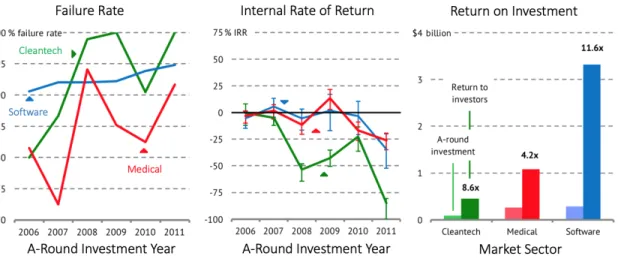
The outcome of the Cleantech 1.0 was bleak for investors. More than half of the investment was lost, and Cleantech companies failed more and had lower rates of return than competing VC sectors such as medical and software which can be seen in Figure 1-1[48]. These poor outcomes have led to a major drop in investment in Cleantech startups.
Figure 1-1: Cleantech vs. Other Sectors
Cleantech had high failure rates and negative rates of return as well as low return to investors of cleantech when compared to other sectors.[48]
There have been several responses by investors to try to overcome the demise of Cleantech 1.0. Each response comes with an assumption of why Cleantech 1.0 failed. Here are three of the main reasons given for the difficulties of Cleantech 1.0 which I document here along with the strategies some investors have taken to overcome them.
1. One assumption is that the technology risk was poorly understood by investors. According to a policy analyst a Bloomberg New Energy finance, "What a lot of them (in the VC community) didn’t bargain for, and, frankly didn’t really understand, is that it’s almost never going to be five guys in a garage. You need a heck of a lot of money to prove that you can do your technology at scale." [36] This reasoning caused several investment groups to drop out of any investment in Cleantech all together. While others have hired technical experts to overcome the perceived knowledge gap.
2. Another reason given by the investment community for the disappointment of Cleantech 1.0 is the complex market space of energy. Many of the Cleantech companies invested in were renewable energy technologies with small margins to make profit trying to compete in the incumbent commodity market of en-ergy with a tough regulatory environment. This reality meant that any new companies hoping to innovate in this space had to compete on a cents per kWh level with existing technologies. Also, the energy market notoriously fluctuates so if the prices of competing energy sources suddenly drop as happened in 2009 with natural gas in the United States, new companies and the technologies they deliver had little to no ability to withstand that market shift.[94]
3. Another assumption of why Cleantech 1.0 did poorly is that the cycles of learning or timeline to market for these technologies was too long for investors wanting returns. One Cleantech VC describes this problem saying that the average time from founding to IPO was 8.3 years, so "If you’re signing up to build a clean-tech winner, reserve a decade of your life." [113] Some venture funds have developed a strategy in response with longer funds and blended capital to overcome this.
Startup companies have also developed strategies for overcoming some of these barriers. For example, many Cleantech companies now target niche beachhead mar-kets first rather than the bigger more lucrative ones. Another popular strategy involves working closely with incubators and accelerators that hold institutional knowledge of markets and regulatory environments and have demonstrated successful product launches.
1.3
Thesis Motivation
To date, strategies by investors and companies to overcome the three problems out-lined above have not been proven to be broadly effective, but there have been anec-dotal successes. There is evidence that slow cycles of learning are worse for Cleantech startups than others. In Figure 1-3 it is shown that Cleantech has the longest exit time on average compared to medical and software companies.
0 5 10 15 20 0 2 4 6 8 10 12 14 N umb er o f S ta rt up s
Cleantech Years to Exit
0 20 40 60 80 100 0 2 4 6 8 10 12 14 16 N umb er o f S ta rt up s
Medical Years to Exit
0 100 200 300 400 500 600 0 2 4 6 8 10 12 14 16 N umb er o f S ta rt up s
Software Years to Exit
0 2 4 6 8 10 12 14 16 18 0 2 4 6 8 10 12 14 16 18
0 2 4 6 8 10 12 14 16 18
Figure 1-3: Industrial Sectors Years to Exit
The differences in time to exit between three industrial sectors are shown. The cleantech distribution shows a longer time to exit than medical and software [19].
Software companies are the favorites of the VC community with 3-year average exit times when investors can start receiving return on investment (ROI). Medical, often slowed by medical regulations has longer exit times than software, but these are well understood and can be alleviated through investment by wealthy pharmaceutical or medical device companies. Cleantech has a bi-modal distribution with 4-year and 8-year peaks, and unlike the pharmaceuticals or devices in the medical sector, there is not a specific government mandated path to market. There are also few if any large Cleantech companies with high margins to keep startups afloat until they are ready to exit. These realities demonstrate the need to accelerate cycles of learning and time to market for Cleantech startups to attract investment capital and work toward the larger goal of a sustainable future.
disappointing outcome: slow cycles of learning and long times to market. I hope to add data-driven technical and operational strategies to the Cleantech community’s playbook targeted to accelerate product development(PD).
1.4
Cleantech in the literature
Several research communities have worked toward understanding and helping the Cleantech sector succeed including business schools, sociologists, economists, geog-raphers, Cleantech policy groups, etc. There is a focus within some of these research communities on writing case studies to understand specific successes or failures within cleantech companies. Many lessons can be learned from case studies including how individual companies overcame or failed to overcome the major setbacks common to Cleantech. There have also been articles published on the Cleantech industry as a whole, including Cleantech clustering, financial, and policy strategies to boost the sector. In Appendix A, I give an overview of this literature. The majority of Cleantech literature discusses how to overcome barriers to commercialization with industrial clustering, financial, and policy strategies. This research has focused on addressing obstacles cleantech companies face from a "top-down" perspective. By "top-down" I mean through research implemented outside of the engineering disci-pline focusing on strategies for implementation by governments and large institutions.
1.4.1
My approach
In contrast to the majority of literature, I approach this research from a "bottom-up" perspective. A bottom-up approach in this case indicates two things:
currently working to commercialize Cleantech from within startups rather than from secondary sources.
2. I formulate technical and operational strategies and solutions that can be im-plemented by the startups on the ground rather than strategies for funding and policy groups.
This point of view can shed new light on the obstacles faced by Cleantech 1.0 and how to overcome them.
1.5
Research Questions
Through an examination of 55 hardware startup companies, of which around half are designated as Cleantech, I seek to understand the pain points and bottlenecks within the product development process. Focusing on slow cycles of learning and long exit times for these companies, I formulate several research questions to explore. The specific research questions I hope to answer are enumerated below.
Main research questions:
1. What are the main bottlenecks in hardware product development, especially in Cleantech?
2. Are there technical or operational interventions that can speed up cycles of learning for hardware startups?
3. How might new state of the art computational and hardware tools be used to accelerate hardware product development?
Through quantitative and qualitative analysis of the interview transcripts, along with cleantech product design experience, placed within the available literature, I formulate strategies and tools for accelerating product development in Cleantech.
1.6
Thesis Outline
A short outline of the thesis is as follows.
In Chapter 1, I present the background of Cleantech 1.0 and describe the gaps missing in literature that this thesis helps to fill.
In Chapter 2, I cover the interview study, including sample selection, transcrip-tion, analysis methods, and how hypotheses were formed and tested.
In Chapter 3, I explore research outcomes from the interview study finding and an-alyzing pain points including prototyping, product complexity and innovation mod-els.
In Chapter 4, I explore how relational requirements affected the product devel-opment process for the interviewees, including those with customers, investors, and manufacturers
In Chapter 5, I examine technical strategies used by the interviewees, and I explore cutting edge tools for future use in prototyping, specifically the design, build and test steps of product development.
In Chapter 6, I present a spectral classification method called Representative Identification of Spectra and the Environment (RISE) as an example of an accelera-tion tool for solar photovoltaics testing.
In Chapter 7, I use the RISE method experimentally to demonstrate its potential use in accelerated testing for energy yield predictions for different climate zones in laboratory or industrial setting.
In Chapter 8, I summarize and conclude the thesis, reiterating my main contri-butions to the literature.
Chapter 2
Accelerating Cleantech Interview
2.1
Introduction
The struggle of early stage Cleantech companies to succeed was outlined in Chapter 1 with examples of the research done to understand these barriers. One of the reasons for the failures of these companies is the slow cycles of learning inherent in their hardware development.[?] Much of the literature about Cleantech to date offers analysis and strategies from a top-down approach including financial and policy strategies and theory that could help the Cleantech sector succeed. See Appendix A for more detail. In contrast, this study takes a bottom-up approach developed by talking directly with the technologists that make up the Cleantech companies and determining technical and operational strategies to be implemented directly by them. Specifically a set of questions was developed in order to:
1. Map and analyze company product development (PD) timelines. 2. Determine pain points and slowdowns in PD.
3. Discover and outline solutions to accelerate PD.
These interview goals are almost exactly the same as the research questions from Chapter 1, with the addition of mapping PD timelines as a strategy to inform items 2 and 3. In this chapter, I introduce the interview methods and sample selection, as well as explain each section of the interview.
2.2
Interview Methods
I chose a facilitated survey format for this interview combining my engineering do-main expertise with sociology research methods both quantitative and qualitative. The purpose of the study is to map workflows and understand pain points along the PD process which requires the interview to be of a certain length and depth, con-taining approximately 170 questions and lasting between 45 minutes and 2 hours. The interview questions are enumerated in Appendix ??. Also, enough companies must be interviewed to get a broad picture of the PD path for hardware startup to find generalizable conclusions. To accomplish this breadth, I completed 55 inter-views with N between 30 and 55 for individual questions depending on the company. Therefore, my choice of approximately 50 interviews lasting about one hour was targeted for a mix of breadth and depth allowing for a broader understanding than what typical case studies allow as well as a deeper analysis than the scope of typi-cal surveys. This unique study provides a new "bottom-up", interdisciplinary, and mixed-methods perspective into the hardware PD process specific to Cleantech.
The content of the interview is outlined by the Product Design and Development textbook by Ulrich, Eppinger, and Yang[153], used in the MIT product engineering class 2.009 to guide student through the PD process as it might happen within
Table 2.1: Interview Contents from PD Process Section 1 Personal and Company Info Section 2 Product Planning Section 3 Requirements Section 4 Modeling
Section 5 Concept Generation and Selection Section 6 Complexity
Section 7 Prototyping Section 8 Manufacturing Section 9 Overview
a company setting. The generic PD process was adapted from this text for the interview as can be seen below in Table 2.1.
2.2.1
Sample selection
The makeup of the sample for the interview study determines what conclusions I can draw from the work. My goal in picking the subjects is therefore to find a sample that best represents the larger population of companies generally. For this work, a purposeful sampling technique was used meaning that the sample was selected based on characteristics of the population and study objectives stated above [117]. The study encompasses early stage hardware startups in general with a focus on the subset of participating Cleantech companies. With several market segments involved, the data can be compared between sectors including Cleantech, Medical, Consumer electronics, IoT, and others.
Participants were contacted through online forms, LinkedIn connections, and publicly available email addresses. Of the over 500 cold contacts made, around 40 agreed to the interview, an acceptance rate of less than 10%. The companies chosen
for an interview were therefore based on willingness to participate, making it a non-probability sampling technique. This brings some amount of bias to the companies interviewed as they self-selected to be interviewed. However, there were some factors combating this, as there was a countervailing snowball sampling effect. For example, one company CEO would introduce me in person or by email to other company leaders that would fit into the study. The likelihood of these subjects participating was much higher than if I had contacted them cold.
At first, to start finding subjects, I targeted hardware accelerators as potential interview sites where many interviews could be accomplished. I contacted over 20 hardware accelerators to set up pathways for interviewing participating companies. Unfortunately, the accelerator leadership would not allow mass contact of their port-folio companies. Therefore, I determined all contacting would have to be done by cold-contacting individual companies.
In the end, 55 companies from around the world agreed to participate. The companies can be seen in Figure 2-1.
Figure 2-1: Global Map of Interviewed Companies
Locations of the companies that participated in the study. A majority are in Boston and Singapore with others scattered around North America and Europe.
2.2.2
Workflow Mapping
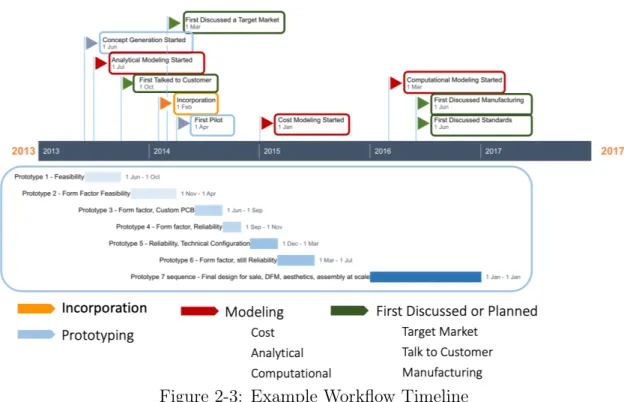
One major component of the interview is workflow mapping where I established a timeline for each company’s PD process to understand how long the individual PD steps take. I first ask interviewees for an incorporation date; all following timeline questions are asked with respect to the given incorporation date (i.e., How many months before or after incorporation was X step started or finished?) An example of a timeline from the study with the major PD milestones and tasks can be seen in 2-3.
Figure 2-3: Example Workflow Timeline
An example of a workflow timeline developed through interviews. Incorporation (orange), prototyping (blue), modeling (red), and operational milestones (green) are key components.
2.3
Interview Sections
In this section I explain the details of both the content and design of each interview section.
2.3.1
Personal and Company Info
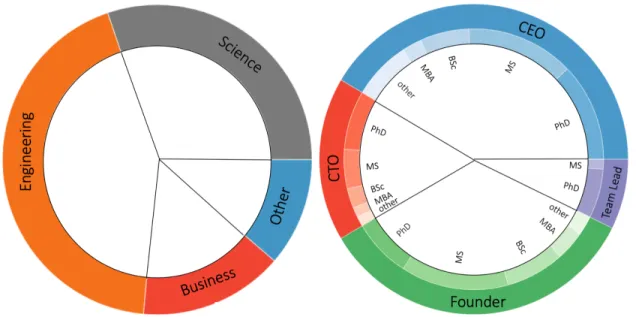
The goal of the first section of the interview is to understand who the interviewee is and the basic history of the company they are a part of. First, I focus on the interviewee’s characteristics including academic degrees and position in the company as seen from the results in Figure 2-5. The majority of participants have a background
in engineering or science and are either the CEO, CTO and/or founder of their company. In addition, the majority of the participants have advanced educational degrees beyond a bachelor’s degree.
Figure 2-5: Aggregated Interviewee Information
Breakdown of the survey participants in terms of position in the company and highest academic degree.
After understanding who the participants are, I ask about company information: ∙ How many employees do you have?
∙ Are you a business-to-business (B2B) or business-to-customer (B2C) company? ∙ What type of funding sources do you have or have you had?
∙ How do you procure funding?
∙ Was significant technology or business development done within a research institution or another company?
∙ Are you or have you been a member of incubator and accelerator?
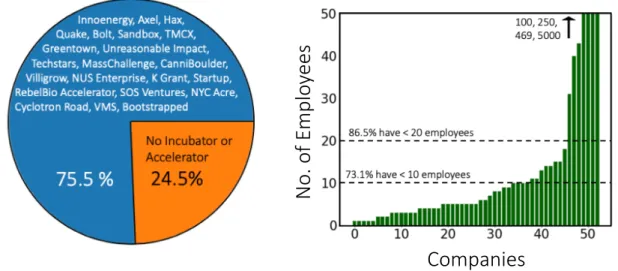
All of these questions are designed to develop an understanding of the sample set and what conclusions can be taken from the interviews. Some of these results are shown below in Figure 2-7, Figure 2-9, and Figure 2-11, and some will be analyzed in future chapters.
No
. o
f E
m
pl
oy
ee
s
Companies
Figure 2-7: Aggregated Company Information I
Left: How many companies were or had been a part of an incubator or accelerator program during their PD. Right: Number of workers the sample companies employed.
Number of Companies
No
. h
ou
rs
w
or
ke
d
pe
r d
ay
Figure 2-9: Aggregated Company Information II
Left: Number of business-to-business (B2B) vs. business-to-customer (B2C) company types in sample. Right: number of hours worked by average employee in company per day.
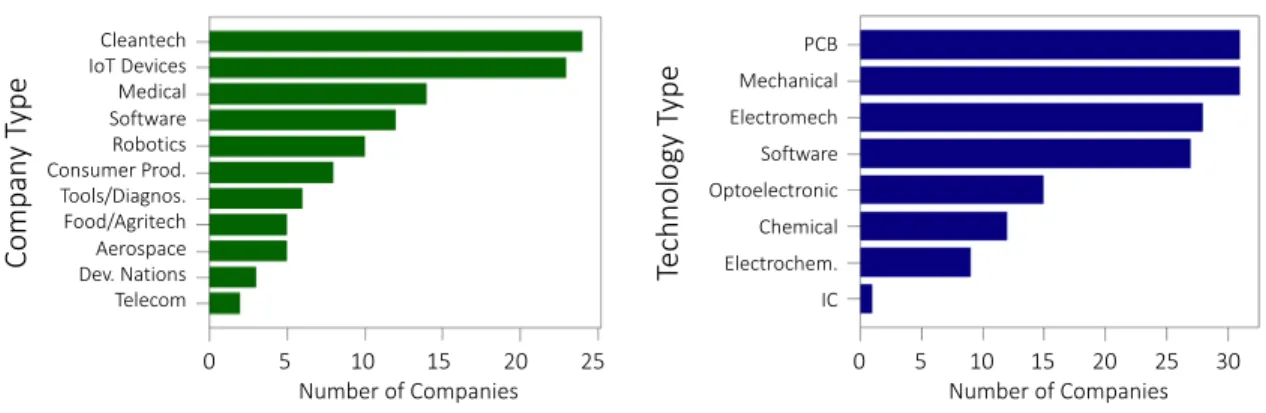
Te ch nol ogy T yp e Number of Companies 5 10 15 20 25 0 Number of Companies 5 10 15 20 25 0 30 Cleantech IoT Devices Medical Software Robotics Consumer Prod. Tools/Diagnos. Food/Agritech Aerospace Dev. Nations Telecom Co m pa ny Typ e PCB Mechanical Electromech Software Optoelectronic Chemical Electrochem. IC
Figure 2-11: Aggregated Company Information III
Left: Company type of which many companies picked more than one category. Right: Technology of which many companies picked more than one category.
2.3.2
Product Planning
The product planning section is the first PD step adapted from the generic PD process flows from the textbook [153]. Product planning is the part of PD where a basic schedule of the process is laid out and strategic milestones are envisioned by the team. I ask questions in this section to tease out how the company planned for PD, probing the startup’s strategic vision for their specific PD. I begin with questions taken from the textbook to see if the companies participated in these basic strategy development steps:
∙ What kind of product development is undertaken? ∙ What is the competitive strategy?
Answers to these questions can be seen below in Figure 2-13.
Number of Companies Cor e IP Ty pe o f P ro du ct New Platform Other New Technology Derivative Incremental Application Business model Other Assembly Process Material Co re IP Tech Customer Other Cost Co m pe tit iv e St ra te gy 5 0 10 15 Number of Companies 5 10 15 20 25 0
Figure 2-13: Aggregated Product Planning Interview Responses
Left: The core IP type and competitive strategy of the companies. Right: The type of product development being undertaken by the company.
I find the majority of companies have core IP in novel applications, and the type of product development being undertaken is most often a new product platform or new technology.
The purpose of the next part of this section is how and when the company tar-gets a market. This is a key step in product planning and also the initial interview inquiry relating to the "first milestones" as identified in the workflow mapping. First milestones are defined as the first time the employees of the startup seriously planned for important PD steps, in this case targeting a market. These milestones are an indication of how aware the startups were of the obstacles ahead for them as a hard-ware startup. Other "Firsts" include milestones such as first talking to a customer, designing for manufacturing, and designing for standards and certification.
∙ When did you first target a market with respect to incorporation? ∙ What was the hardest part of targeting market?
∙ Were any specific tools or methodologies used?
I will go through analysis of these answers and the rest of the interview in future chapters.
2.3.3
Requirements
The next section is designed to learn how the company deals with finding and doc-umenting product requirements. Engineering requirements, as defined by the Fun-damentals of Systems Engineering class at MIT, "describe the necessary functions and features of the system one is to conceive, design, implement and operate."[29] This is a narrow definition of requirements focusing on technical elements which is broadened and discussed further in Chapter 4.
In the requirements section I first ask if the company perceives their design as user-centered:
∙ Would you characterize your product as “user-centered” design? Please answer: Yes, Somewhat, Neutral, Not Really, No
This question is asked to understand if the company identifies as using the design principles now taught in some engineering schools and design workshops called user-centered design (UCD). The background of UCD and its importance to PD for hard-ware companies is expanded on in Chapter 4.
Next, I seek to understand why and how companies gathered customer prefer-ences and determined requirements from these preferprefer-ences and other engineering constraints. I asked the following questions:
∙ Did you talk with customers before starting design?
∙ How many business days before or after the incorporation date did you first speak with them?
∙ How did you gather customer preferences?
∙ Were traditional engineering requirements identified and targeted for design? [Yes, Less officially worded, No requirements discussed]
∙ What types of requirements were included? [Functional, Performance, Inter-face, Maintainability, Reliability, Others]
∙ If you didn’t use traditional requirements, how were the user’s needs quantifi-ably turned into design concepts?
2.3.4
Modeling
The next section in the interview is about modeling. I cover the technical modeling of the product, including analytical and computational modeling, as well as business
modeling, including cost modeling. Analytical modeling is defined as a "mathemati-cal model with closed form solution." To prompt thinking about analyti"mathemati-cal modeling, I refer to this as the "back of the envelope," "proof of concept" equations that give approximate ideas of the constraints and requirements of the system being designed. Computational modeling is defined as a computer-based simulation used to analyze the complex physics of the system. Lastly, cost modeling encompasses a broad range of activities revolving around the prediction of capital costs and cost of manufactur-ing of a product versus projected retail value.
An entire section is devoted to this due to the variety of approaches a company can take toward modeling, from not bothering to do it at all to modeling extensively. Either of these extremes could change the pace of PD for better or worse. One difficulty with actually mapping modeling timelines is the non-contiguous nature of many of these models. Often they are started and put down many times as the company develops, evolving as needed. As a result, most of the modeling milestones placed on the timelines are when the modeling was first started or finished.
For each type of modeling I asked:
∙ Did you do (analytical/computational/cost) modeling? ∙ How many days after incorporation was it started?
∙ How many business days until first usable results were produced? ∙ How many people worked on it?
∙ How much do you think technical modeling negatively affected the timeline? [None at all, A little, A moderate amount, A lot, A great deal]
2.3.5
Concept Generation and Selection
Concept generation (or ideation) and selection are important creative steps in the PD process that are often done uniquely based on the makeup of the company. I asked the interviewee to think of when they were first brainstorming and developing the idea for the product, and explain how this process looked for then. During their narrative I would ask the following questions to learn specifics.
∙ When was the first ideation round started with respect to incorporation? ∙ How many people were generally a part of ideation?
∙ How long did a round of ideation generally last?
∙ How many concepts were created in an ideation round? ∙ How long was more than one concept pursued?
∙ Do you think designs were killed off too quickly? ∙ Do you think designs were pursued too long?
∙ How was a concept selected? [External decision, Product champion, Intuition, Voting, Web-based survey, Pros and cons, Prototype and test, Decision matri-ces, Other]
∙ How many people were generally a part of concept selection?
2.3.6
Product Complexity
The next section of the interview was about the product itself, not just the process. This was added so that different types of products could be compared via several
complexity parameters. These complexity parameters are adapted from a literature review of complexity metrics for products. Within engineering, there is no stan-dardized definition of complexity[92], and product complexity has been quantified in dozens of ways depending on the study purpose and available data set. Most academic fields and sub-fields have a different definition and metric for complexity. A desired metric for this work is one that is quantitative and can be plotted against time to prototype. Here I review the relevant literature used to create the complex-ity interview questions and metrics I adapted to create a complexcomplex-ity metric for this study.
Product Complexity in Literature
In this section, I will discuss how I adapted questions for the interview from the existing literature. First, Novak and Eppinger defined product complexity as having three major components: (1) number of components to specify and produce, (2) extent of interactions to manage between these components, (3) degree of product novelty [114]. Because the specific questions they asked in their study pertain only to vehicle systems, this cannot be used directly for this work, but the major three components are applicable. The base of the complexity questions for this interview come from these three major components.
That same year, Tang and Salminen compiled a list of works on complexity from literature including different strategies for addressing complexity, new complexity metrics, and a wide range of research fields and applications. Out of all of the litera-ture reviewed, only two contain quantitative complexity metrics for hardware [145]. First, axiomatic design is defined by Suh et al. as time-dependent (combinatorial and periodic) vs. time independent (real and imaginary) complexity. Each of these
is a measure of uncertainty in achieving specified functional requirements [144]. To formulate this metric, probabilities of achieving functional requirements must be known, which is out of scope for this interview as assessment of this for early stage hardware startups would be unreliable. The second quantitative metric was from Eppinger who developed the Design Structure Matrix (DSM) for management teams as a representation of complex processes during PD [37]. This metric is interesting for understanding PD complexity through tasks. However, the complexity metric I am looking for is for the physical product itself, and therefore the DSM method is not pertinent.
Over ten years later, another set of complexity metrics was reviewed in a 2012 paper by Crespo-Varela et al. searching for a quantitative complexity metric that could be used for hardware products [27]. From an initial review of fourteen different complexity metrics, they found three potential metrics that both have a mathemat-ical formulation and applicability to hardware [9][135][78]. They compared these metrics for 21 hip replacement devices, finding that none of the metrics encompass all major complexity parameters for example product uniqueness. They then pro-pose a new metric that adopts major aspects from the others for a more complete metric. I adopt from their new metric some parameters to use as questions to the interviewees including number of components (custom and off-the-shelf), number of functions, and innovation (through design and build outsourcing).
Another review done by Rodriquez-Toro et. al. introduces complexity in terms of assembly-oriented design. In this work, complexity is divided into two categories: (1) conceptual metrics usually for design including topology, geometry, and assem-bly, and (2) mathematical models [133]. They propose a new total complexity metric using a mathematical model which is a combination of many types of complexity: manufacturing, process, structural complexity, and sequence complexity. Total
com-plexity is found by adding all of these complexities together with weights associated with each. I adopt some of these complexity parameters for the interview including tooling, max number of components, number of assembly operations, and material parameters.
A useful differentiation between types of complexity is also found in Schuh & Schwenk who split the origins of complexity into internal and external reasons [138]. Four types of complexity are classified: Market, product, organization, and process. For these interview, I mostly focus on product complexity, but I also include some questions on process and market complexity. For example, I add questions about how many disciplines are involved in PD and how many functions the product performs [92]. I also added market complexity parameters such as number of competitors and number and types of standard. There are many other formulations of complexity that were not used in this work due to lack of available parameter data or unsuitability [62].
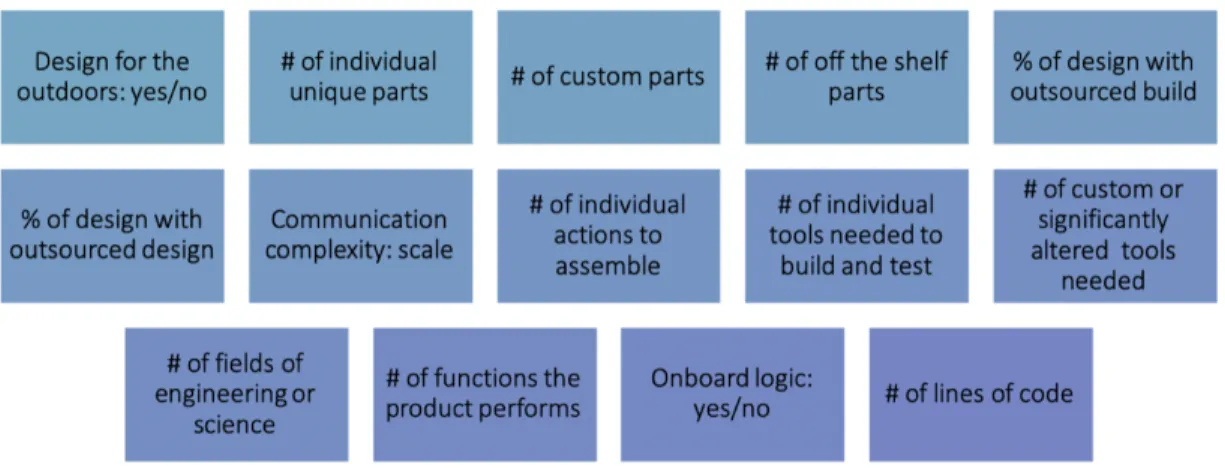
Using the literature outlined above, I created a set of questions to gauge product complexity for these early stage hardware startups. Out of all the parameters adapted from the above literature, I added a few additional parameters to track including how many custom and off the shelf parts there are, whether the product has onboard logic and the number of lines of code it has, as well as if it is designed for the outdoors. The full list of 14 quantifiable parameters tracked in the interviews can be seen below in Figure 2-15.
Figure 2-15: Complexity Parameters
The fourteen complexity parameters asked about in each interview as adapted from litera-ture and modified to focus on product and process specifically.
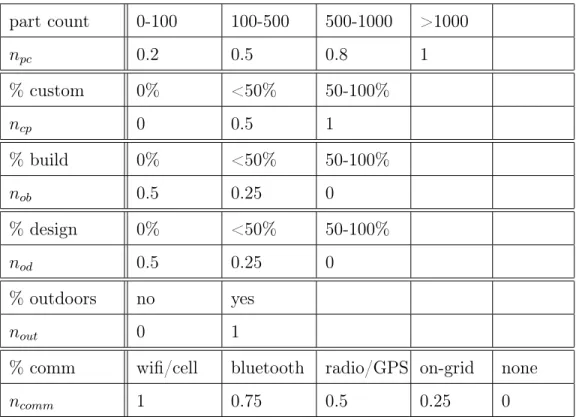
I also developed a complexity metric as an aggregate of several parameters: num-ber of parts, numnum-ber of custom parts, percentage of design outsourced, percentage of build outsourced, whether they were designing for the outdoors, and communication complexity as shown in Chapter 3. Other parameters could not be added to the metric successfully due to lack of knowledge by some of the interviewees to answer the full set of complexity questions. Each parameter used to make the metric is then normalized on a scale from 0 to 1 and then an average is taken of all these parameters for each company. The result is a number between 0 and 1 with those closest to 1 being the most complex. The mathematical formulation is given below in Equation 2.1. In this equation, 𝑛𝑝𝑐 stands for part count, 𝑛𝑐𝑝 stands for custom part count, outsourcing the build is denoted by 𝑛𝑜𝑏, outsourcing the design by 𝑛𝑜𝑑, 𝑛𝑜𝑢𝑡 stands for designing for the outdoors, 𝑛𝑐𝑜𝑚𝑚 stands for communication complexity, and 𝑛𝑡𝑜𝑡 is the total number of variables which in this case is 6. Each of these parameters is between 0 and 1, and they are calculated as seen in the Table 7.1 below.
𝐶𝑜𝑚𝑝𝑙𝑒𝑥𝑖𝑡𝑦, 𝐶 = (𝑛𝑝𝑐+ 𝑛𝑐𝑝+ 𝑛𝑜𝑏+ 𝑛𝑜𝑑+ 𝑛𝑜𝑢𝑡+ 𝑛𝑐𝑜𝑚𝑚)/𝑛𝑡𝑜𝑡 (2.1)
Table 2.2: Complexity Parameter Scales part count 0-100 100-500 500-1000 >1000 𝑛𝑝𝑐 0.2 0.5 0.8 1 % custom 0% <50% 50-100% 𝑛𝑐𝑝 0 0.5 1 % build 0% <50% 50-100% 𝑛𝑜𝑏 0.5 0.25 0 % design 0% <50% 50-100% 𝑛𝑜𝑑 0.5 0.25 0 % outdoors no yes 𝑛𝑜𝑢𝑡 0 1
% comm wifi/cell bluetooth radio/GPS on-grid none
𝑛𝑐𝑜𝑚𝑚 1 0.75 0.5 0.25 0
2.3.7
Prototyping
The next part of the interview is about prototyping. One of the most difficult things when discussing the PD process with a range of people from different backgrounds and educations is defining each PD step. This is especially true when discussing prototyping as there are myriad interpretations of what a prototype is exactly. Is each individual iteration a prototype, or rather is that just a version of a "prototype sequence"? To avoid this confusion, I explicitly defined each step to consistently
explain to each interviewee.
For the definition of prototype, the interviewee is told that we are looking for prototype sequences. The software world has a well-known naming system with pro-totype sequences being known as Version 1.0, 2.0, etc., and individual iterations within those prototype sequences known as Version 1.1, 1.2, 1.3, etc. For hardware it can be messier as there can be virtual prototypes as well as physical prototypes, parallel subsystem prototypes, and full integration prototypes. To combat these complexities, the interviewees are prompted to think along the lines of the software scheme explained above. I also encouraged interviewees to think in the framework of established hardware prototype sequence names such as looks-like vs. works-like prototypes. With these prompts, most interviewees could divide the PD timeline into a set of prototype sequences which we call prototypes for the rest of this thesis for simplicity. These prototypes can also be designed and built in parallel and be for different sub-components of the overall system.
Another definition to consider regarding prototypes is the distinction (or lack thereof) between technology vs. product development and prototyping. Technology development (TD) is when a concept is still being proven out as a viable working technology, while product development (PD) focuses on making a commercial prod-uct out of an already proven technology. This distinction is blurry for many of the companies interviewed that are working in the technology push regime. Often some version of the technology has been proven, but perhaps not completely enough to meet the requirements of a commercial product, so some hybrid of TD and PD is being undertaken by the company. For some of the technologies, iterations have already occurred within an academic laboratory years before incorporation. In the interview, when discussing prototyping, the interviewee defines whether the proto-types specific to their company are more on the TD or PD side. The important time
that I want to record is the prototyping time for a company once they incorporate and take investment funding, inducing time pressure to get a viable product. There-fore, whether they are doing TD or PD is less important than, although correlated with, how quickly they can make a viable system that either inspires more funding or leads to an exit.
Also, a distinction must be made between designing, prototyping iterations, and testing. In this work, designing encompasses ideation (concept generation) and con-cept selection. Whereas prototyping iterations (the build) are the physical builds of the product and testing is the evaluation of the prototype. Two types of testing are defined in the interview. One is technical testing which encompasses any testing of the performance of the system with measured metrics. For example, with batteries this could be lifetime testing, capacity testing, efficiency testing, etc. Another type of testing is customer testing where the system is tried out by potential customers for functional and/or aesthetic appeal. One difficulty with this concept is that often within one prototyping sequence, there are several "design, build, test" cycles so that the prototyping encompasses all of these steps. To keep this consistent across interviews, the prototyping sequences are mapped out on a timeline including indi-vidual questions about the times to design, build, and test. I also include open-ended questions about their design, build, and test process to capture nuances.
To accomplish the questions about prototyping and establish the timeline, I first I ask how many prototyping sequences their company has been through. Then I ask an identical set of questions for each prototyping sequence:
∙ Main objective for this component prototype?
∙ How many business days after incorporation was it started? ∙ How many days did it take to complete?
∙ How many people worked on it?
∙ How important is the speed of this iteration?
∙ How satisfied are you with your speed of this iteration? ∙ Was this tested on sample customers?
∙ How was it communicated to the audience? [verbal, sketch, photos, story-board, video, simulation, interactive media, physical models, working proto-types, other]
∙ Was technical testing done on the product? ∙ What kind of testing was done?
∙ How long did testing take?
This set of questions is asked iteratively until all prototypes have been covered. The majority of companies I interview have done between 3-5 prototypes.
2.3.8
Manufacturing
The next section focuses on manufacturing. These questions stem from a set of methodologies called "design for X" where X can be reliability, environmental im-pacts, manufacturability, etc. The most common of these is design for manufactura-bility (DFM) which is extremely important for hardware startups as manufacturing costs are a key indicator of the economic success of a product. DFM includes several steps including estimating manufacturing costs and reducing component, assembly, and supporting production costs as well as considering impact of DFM on other parts of PD. [153] What plans companies have in place for manufacturing as well as their
adherence to DFM principles could be indicators for how efficiently they navigate PD. Therefore I ask the questions are below:
∙ When did you first start to discuss manufacturing with respect to incorpora-tion?
∙ Did you explicitly use design for manufacturing principles? ∙ What is the plan for manufacturing?
∙ When did you first consider standards and certification for your product? ∙ What processes are necessary for manufacturing and assembling your product? ∙ How much compromise on materials, methods, and manufacturing location has
been necessary?
2.3.9
Overview
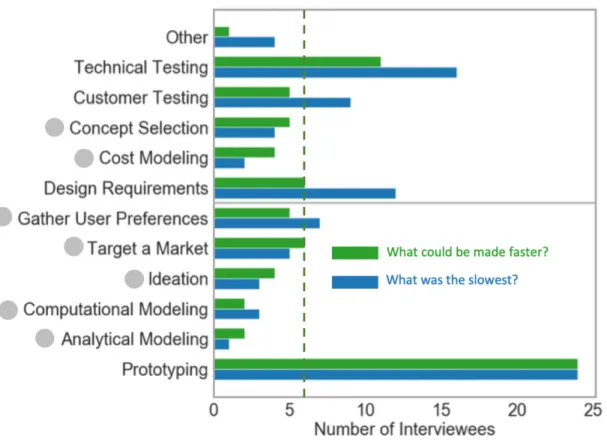
The questions posed in the overview section ask the interviewee to reflect on the PD timeline we just went through together. In this section, I ask directly the interviewee’s thoughts on the major questions we are trying to answer in this study. I ask what were bottlenecks in their process and their opinions on how they might overcome these bottlenecks in future ventures. I also ask about investor pressure given slow PD.
∙ Has your company been pressured by funding sources to speed up design due to slow development timelines vs. short investor timelines?
∙ Which do you think could be made faster? Pick all that apply. [targeting a market segment, gathering user preferences, defining requirements, analytical modeling, computational modeling, cost modeling, concept generation, concept selection, prototyping, customer testing, technical testing, other]
∙ What would you have changed first in how you approached the design process to shorten the development timeline?
∙ What kind of strategies would you try to implement?
2.3.10
Other Considerations
One complication that arose while making the timelines for each company are market pivots. Some companies first developed a product that was unfortunately not viable in the market, so they pivot into a sector in which they can actually make money. These pivots require redesigns of varying degrees, and considerably slow down prod-uct development, but not necessarily individual prototypes. For these companies, I pick one of the products either before or after the pivot and chronicle its path.
Memory and perception also play a role with workflow mapping. As these time-lines are coming from the experience of the interviewee, their individual perception of the process and an imperfect memory can distort the objective timelines. This must be accounted for in the uncertainty of the results.
Opportunity Landscape
Another quantitative set of questions asked of interview participants in addition to those enumerated above comes from the theory called Outcome-Driven Innovation, also referred to as the "Jobs to Be Done" theory. The theory states that consumers
buy products specifically to get jobs done as measured through obtaining outcomes they wish to achieve with the bought object [154]. Within this framework is an "op-portunity algorithm" which is a way to measure and rank innovation opportunities [155]. We adopt this method for use in identifying opportunities to innovate on and accelerate the PD process.
To find these opportunities, the interviewees are asked a series of questions about each segment in the PD process. For example, for the targeting a market step of the PD process, interviewees were asked:
EL: "How important was targeting a market segment to your desired outcome? Pick among these choices."
Slide text:
∙ 1 - Not important at all ∙ 2 - Somewhat important ∙ 3 - Important
∙ 4 - Very Important ∙ 5 - Extremely Important
EL: "And, how satisfied are you with the tools and processes available to you to target a market? Pick among these choices."
Slide text:
∙ 1 - Not satisfied at all ∙ 2 - Somewhat satisfied ∙ 3 - Satisfied
∙ 4 - Very Satisfied ∙ 5 - Extremely Satisfied
With the answers, each PD can be placed on a figure that visualized the overall innovation opportunity score for that PD step. The PD steps that score with the highest importance, and lowest overall satisfaction are the ones where intervention in the form of new PD tools and strategies should make the most difference. Below in Figure 2-17 is the opportunity landscape compiled from this interview. We can see targeting a market, gathering user preferences, defining requirements, outsourcing, scaling up are all growth areas.
Importance
Sa
tis
fa
ct
ion
Overserved Underserved Target a MarketGather User Preferences Defining Requirements Analytical Modeling Computational Modeling Cost Modeling Concept Generation Concept Selection Outsourcing Speed of Iteration Scaling Up
Figure 2-17: Jobs To Be Done Opportunity Landscape
Opportunity landscape mapped from the interviews showing what are underserved areas where there are opportunities to create acceleration strategies.
2.4
Interview Analysis
In this work a hybrid of quantitative and qualitative methods, often referred to as mixed methods is used to explore what the bottlenecks in the PD process are and
how they can be overcome.
2.4.1
Transcription
Out of the 55 interviews, 50 agreed to be recorded, and were subsequently analyzed via audio file and through transcription which was done by the transcription service Rev. This resulted in 1175 pages of transcription to process. In addition, each answer was documented by the interviewer in Qualtrics survey software which was then exported into spreadsheets for analysis.
2.4.2
Quantitative Methods
The quantitative parts of the survey include the workflow mapping, complexity met-rics, and jobs to be done opportunity landscape discussed above in the interview sections. These quantitative metrics are gathered as a means to generate statistics and work toward to generalizing any findings.
2.4.3
Qualitative Methods
To complement the quantitative data gathered, open ended questions about each PD step are asked. To analyze the results and find conclusive insights, qualitative research methods from the field of sociology are employed. The main method used in this work is qualitative coding which is "a way of indexing or categorizing the text in order to establish a framework of thematic ideas about it."[52] There are two main types of coding. One is data-driven (grounded) which is when the researcher allows themes to emerge from the documents with no pre-existing framework. The other is concept-driven (a priori ) which is when the researcher applies a pre-existing
framework when analyzing the documents. With either of these approaches, coding is an iterative process of code refinement and comparison to the source text [142].
In this work, we used a mixed approach of both concept- and data- driven cod-ing. As a trained engineer and the interviewer for the study, I employ concept-driven coding with pre-existing hypotheses and framework. My collaborator Andre Buscar-iolli, a trained sociologist, does data-driven coding with no pre-existing framework. Through a series of meetings, the codes found in common by both coders (Andre and myself) or mutually agreed upon through compelling evidence are pursued. Through this work, over a dozen codes were found for the 55 interviews, and were iterated upon until several specific coded themes developed. There are two kinds of codes used in this work. There is data-driven or grounded coding that allow themes to emerge from the documents. There is also concept-driven a priori that applies pre-existing theoretical frameworks to analyze the documents [52]. Codes found for this work include:
Data-driven Codes
∙ Fast vs. Slow Iteration Tension
∙ Merge and clash of technology and business aspects of PD ∙ Manufacturer Relationships
∙ Investor Relationships ∙ Customer Relationships
∙ Natural vs. Structured process ∙ Practiced vs. Taught
∙ Abstract vs. Concrete Concept-driven Codes
∙ What they would or would not have done differently ∙ Slowest steps, or any major pain points
∙ Lack of manufacturing knowledge ∙ Lack of targeting a market
∙ Emotional attachment to design or application
2.5
Hypotheses
The stated goal of the interview done for this thesis is to map PD timelines, determine pain points in PD, and discover what could accelerate this process. With over a dozen qualitative codes and quantitative data collected, a set of hypotheses develop toward this goal. I separate these hypotheses into two categories: operational and technological. The operational category pertains to parts of the PD process "relating to the routine functioning and activities of a business or organization."[140] Whereas the technological category relates specifically to the product and its design, functions, prototyping, testing, etc. These hypotheses are enumerated below.
Technical Hypotheses to Test:
1. Prototyping is the longest development activity.
3. Startups to date rarely employ state of the art computational tools for design, build and testing processes.
Operational Hypotheses to Test:
1. Bringing structure into the process at the wrong time in product development causes delays.
2. Successful relationships with customers, investors, and manufacturers acceler-ate product development.
Using these two designations and the extensive data collected from the interview, analyses are presented in the next three chapters to test these hypotheses, determine pain points in PD, and develop paths to acceleration.
Chapter 3
Interview Analysis I: prototyping,
product complexity and innovation
models
In this chapter, I examine what hinders successful cleantech commercialization and how the community can overcome these obstacles through mixed-methods analysis of interview data. I test two technical hypotheses in this chapter developing two findings: First, I show that prototyping is the longest product development process. Second, I show that product complexity does not correlate to prototyping times which suggests the existence of a systematic rate-limiter in PD independent of the product itself. Then, to understand what this rate-limiter might be, I explore a third operational hypothesis, using qualitative labels to investigate the impact of innova-tion models on cycles of learning. I find that a flexible, organic innovainnova-tion model can accelerate early-stage innovation, while a structured PD approach is preferred for later-stage innovation.