
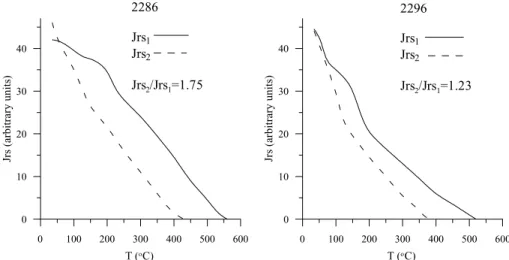
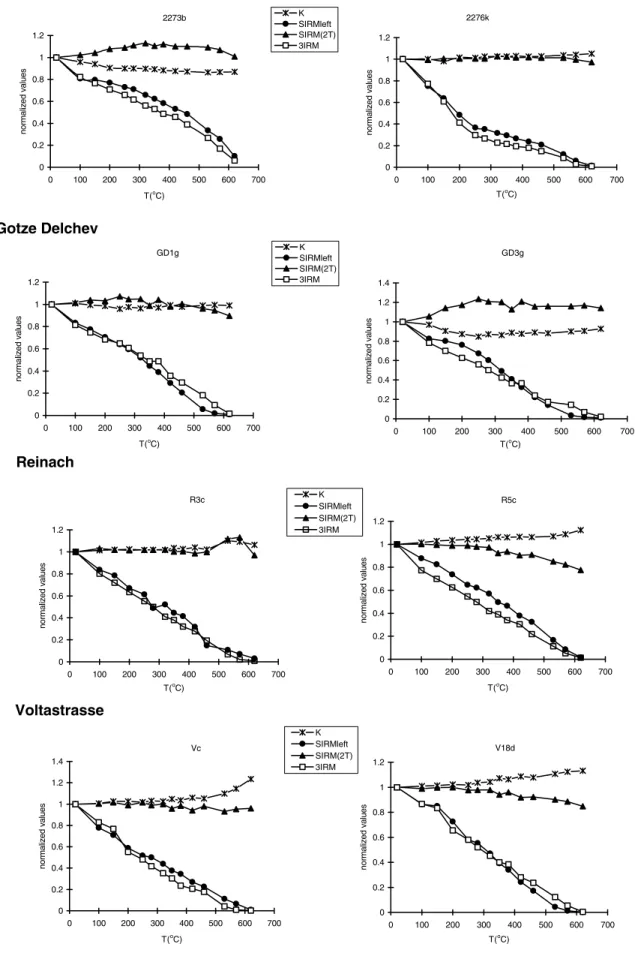
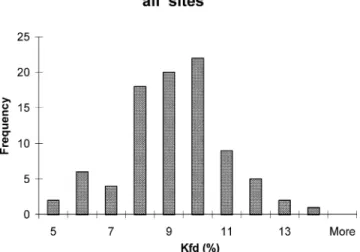
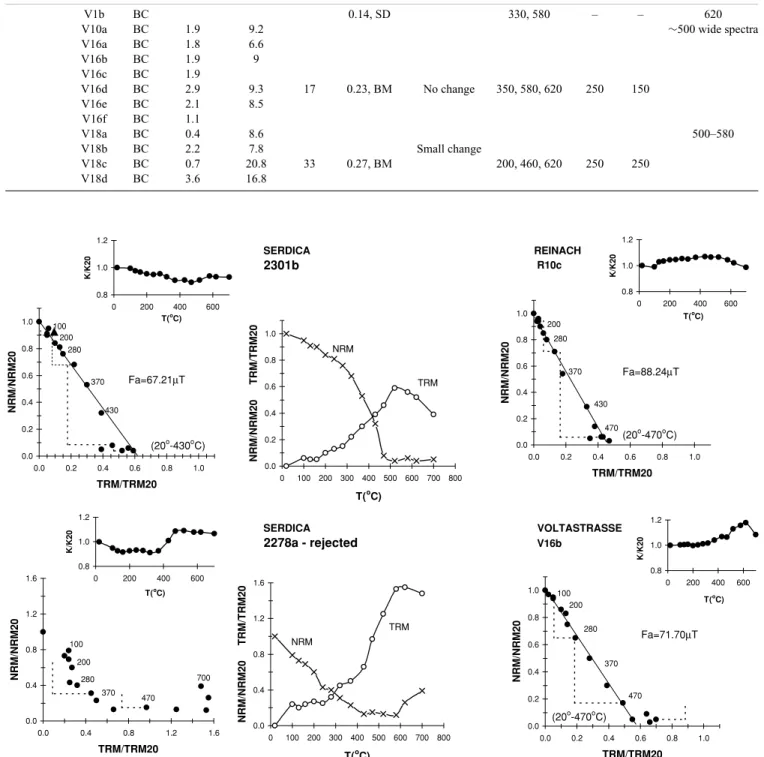
On the suitability of baked clay for archaeomagnetic studies as deduced from detailed rock-magnetic studies
Texte intégral
Figure

Documents relatifs
These low-frequency properties are modeled by combining (1) a complexation model of the surface properties of clay minerals (kaolinite, illite, and smectite), (2) a polarization
Nature Communications, Nature Publishing Group, 2012, 3, pp.999.. Femtosecond magnetization phenomena have been challenging our understanding for over a decade. Most experiments
The ease with which a fraction of the sa- turation magnetization is obtained (all the moments of the particles along the projections of the field upon the plane of their
signal is due to linear dichroism. Similar behaviour is exhibited by MnCl2 in the same geometry. As discussed in the previous paper, the linear dichroism could come
- Previous magnetization investi- gations of Tb have shown the presence of time depen- dent and thermal hysteresis effects in the ferromagnetic region.. However these studies
The computer studies of the required magnetic field were performed by choosing the curvature of the separate coil frag- ments and the configuration of the exter nal contour and
Estimate of the magnetic anisotropy effect on the archaeomagnetic inclination of ancient bricks..
2° Le composé MnSn2 possède une transition brusque d’une structure antiferromagnétique vers.. une configuration où les amplitudes des moments,
