HAL Id: hal-02744212
https://hal.inrae.fr/hal-02744212
Submitted on 3 Jun 2020
HAL is a multi-disciplinary open access
archive for the deposit and dissemination of sci-entific research documents, whether they are pub-lished or not. The documents may come from teaching and research institutions in France or abroad, or from public or private research centers.
L’archive ouverte pluridisciplinaire HAL, est destinée au dépôt et à la diffusion de documents scientifiques de niveau recherche, publiés ou non, émanant des établissements d’enseignement et de recherche français ou étrangers, des laboratoires publics ou privés.
temperature cycle
Marie Gosme, Lydie Dufour, Hector Daniel Inurreta Aguirre, Christian
Dupraz
To cite this version:
Marie Gosme, Lydie Dufour, Hector Daniel Inurreta Aguirre, Christian Dupraz. Microclimatic effect of agroforestry on diurnal temperature cycle. 3. European Agroforestry Conference (EURAF 2016), Institut National de Recherche Agronomique (INRA). UMR Fonctionnement et conduite des systèmes de culture tropicaux et méditerranéens (1230)., May 2016, Montpellier, France. 466 p. �hal-02744212�
Agroforestry and climate change (oral)
MICROCLIMATIC EFFECT OF AGROFORESTRY ON
DIURNAL TEMPERATURE CYCLE
Gosme M*, Dufour L, Inurreta Aguirre HD and Dupraz C * Correpondence author: [email protected]
INRA, UMR 1230 SYSTEM, F-34000 Introduction
Climate change results in a global increase of average temperature, but its effect on diurnal temperature cycle (DTC) is less clear. It was initially thought that the amplitude of DTC was decreasing with climate change, as daily minimum ( night-time) temperature were increasing at a faster rate than daily maximum temperature (Karl et al. 1991; Easterling et al. 1997). However, more recent studies based not on daily minimum and maximum but on hourly data showed an increase of the amplitude of daily temperature cycles (Wang and Dillon 2014).
This asymmetry between day/night temperature change has important effects on plant physiology, as processes such as heat stress, winter hardiness, vernalisation, cold-hardening and winterkill are dependent on extreme daily temperature, and respiration and photosynthesis have different responses to temperature, resulting in a shift in the balance between photosynthesis and respiration, and thus a change in carbon uptake (Mooney et al. 1993). As a result, crop yield generally decreases with increasing night temperatures, e.g. for rice (Peng et al. 2004), wheat or barley (Garcia et al. 2015).
Trees further modify the microclimate experienced by crops in agroforestry, compared to crops grown in pure agricultural fields. The daytime shade of the trees reduces the temperature, potentially protecting crops against extreme heat, while the mask of the tree canopy against the sky increases night temperatures by reducing radiative cooling, which might be beneficial to crops in case of frost but might also reduce yield in other cases. Therefore, our objective is to better characterise the effect of trees on the diurnal temperature cycle in order to determine if agroforestry has the potential to alleviate or inversely to aggravate the impact of climate change.
Material and Methods:
Experimental site. Microclimate was monitored under mature agroforestry systems
(AF) vs in full sun (FS) in the Mediterranean climate (43°42'N, 3°51'E) over several months (April-June 2015 and November 2015 onward). In each season, measurements were made in a field that was divided in two parts: AF conditions (15 year-old poplars, approx. 30 m high in 2015, 20-year old ash trees, approx. 15 m high in 2016) and FS conditions (some Sorb trees, less than 2 m high).
Microclimate sensors. Air temperature was monitored using Vaisala HUMICAP®
Humidity and Temperature Probe HMP155 linked to Campbell Scientific datalogger CR1000. The probes were placed inside DTR Radiation & Precipitation Shields, 1m above soil surface. In 2015, 6 probes were installed in AF conditions and 1 in FS conditions; in 2016, 4 probes were installed in AF conditions and 2 in FS conditions, but results from all probes in a given condition were averaged. Average hourly temperature was recorded continuously from 2015 -04-22 to 2015-06-24 and from 2015-11-21 to 2016-03-15 (last day available for this analysis, monitoring will continue until harvest). Additional meteorological data (e.g. global radiation, rain, wind, air temperature and humidity) was measured in a meteorological station located on the same site in a pure agricultural field.
Statistical analysis. Days were classified as cloudy if global radiation received during
the day in the meteorological station was less than 50% of the extra -terrestrial radiation computed with sun geometry with R package sirad. Time of sunrise and time of sunset were computed for each day using the function suncalc from package RAtmosphere. The daily temperature cycle (DTC) model of Göttsche and Olesen (2001) was fitted to the air temperature data for each day (from sunrise to sunrise of the next day) and in each condition separately. This model consists of a cosine term, describing the effect of the sun, and an exponential term, describing the decrease of the surface temperature at night:
T(t) = T0+ Ta× cos ( π ω× (t − tm)), if t < ts T(t) = (T0+ δT) + [Ta× cos ( π ω× (ts− tm)) − δT] × e −(t−ts) k , if t ≥ ts , with k =ω π[tan−1( π ω× (ts− tm)) − δT Ta× sin −1(π ω× (ts− tm))]
Agroforestry and climate change (oral)
with T0 the residual temperature just before sunrise, Ta the temperature amplitude, ω
the width over the half-period of the cosine term, tm the time of the maximum, ts the start of the
attenuation function, and
δT=
T0−T
(t
→∞), wheret
is the time.Fitting was done using function nls of R. As the initial model often resulted in the fitting algorithm reaching regions where the model is not defined, the model was reparameterised replacing ω with 2x(tm-(tr+lag)) with tr the time of sunrise (computed from sun geometry) and lag the lag between sunrise and the onset of temperature rise, boundaries were defined for
each parameter ((0,45), (-20,20), (12,16), (12,20) and (-4,4) for Ta, δT, tm, ts, and lag,
respectively), and T0 was computed directly from the data, taking the mean temperature around sunrise. The fitted parameters were then used to compare the DTC in AF vs FS conditions, by fitting regression lines for the parameter in AF as a function of the parameter in FS, for each season and sky cloudiness separately. The slope of the regression was tested against the hypothesis slope=1, and the intercept was tested against 0. Linear regression was performed with the function lm of base R statistical language, and hypothesis testing was performed using function LinearHypothesis of R package car.
Results
Observed differences in air temperature. To compare air temperature in AF
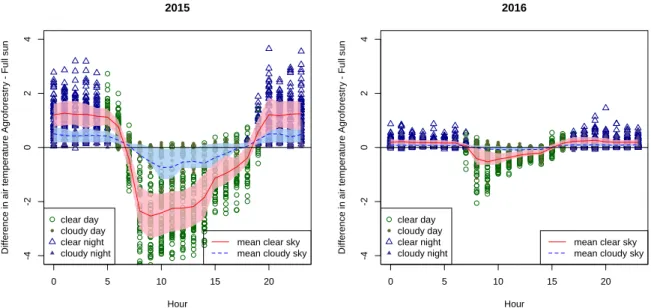
conditions with the FS conditions, the difference TAF-TFS was computed for each hour. The difference in air temperature was always negative during the day (at least from 2 hours after sunrise until sunset) and positive during the night (Figure 4Erreur ! Source du renvoi
introuvable.). The difference between AF and FS was more marked on clear days than on
covered days: in the spring of 2015, the mean difference was -1.2 °C on clear days vs -0.27 °C on cloudy days (respectively 1.17 vs 0.43 at night). In the winter of 2016, it was -0.23 vs -0.04 in the day and 0.15 vs 0.08 at night.
Figure 4: Difference in air temperature between the agroforestry condition and the full sun condition, as a function of hour of the day in 2015 growing season (left) and 2016 growing season (right). Circles: observations during the day; triangles: observations during the night. Days were classified as clear (open symbols) or cloudy (solid symbols) to compute the mean (line) and 25% and 75% percentiles (shaded areas) separately for the clear days (solid line) and the cloudy days (dashed line).
Fitting of a diurnal temperature cycle model. On clear days, the fitting algorithm
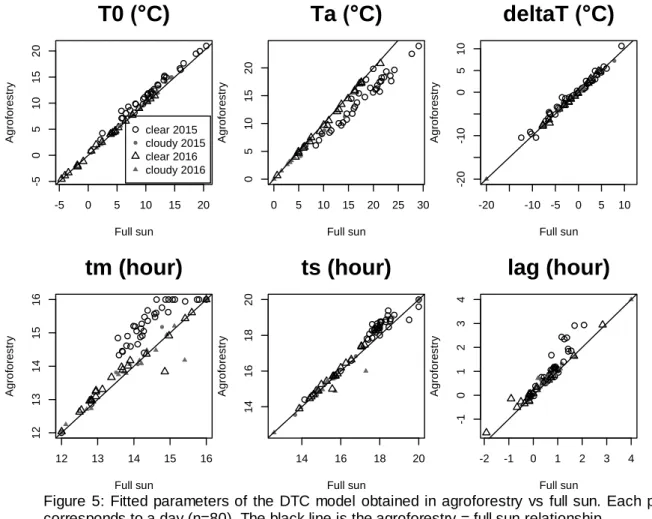
converged in 55% of the cases, but on cloudy days, the model was fitted successfully in only 42% of the cases. On days when the model could be fitted, the root mean square error of prediction was 1°C. The parameters of the DTC in agroforestry as a function of the parameter in full sun are represented in Figure 5, and the values and tests of the estimated parameters are summarized in Table 2. On clear days in 2015 (measurements made in spring and summer), T0 was significantly higher in agroforestry than in the full sun, the intercept being 1.41 °C ; Ta was
lower in agroforestry and this difference increased with increasing temperature amplitude ; δT
was slightly higher in agroforestry for negative values of δT but the difference disappeared
when δT becomes positive ; the lag between sunrise and the onset of temperature rise was
higher in agroforestry, but only on days when this lag was important also in full sun. On clear
0 5 10 15 20 -4 -2 0 2 4 2015 Hour D if fe re n c e i n a ir t e m p e ra tu re A g ro fo re s tr y F u ll s u n clear day cloudy day clear night cloudy night
mean clear sky mean cloudy sky
0 5 10 15 20 -4 -2 0 2 4 2016 Hour D if fe re n c e i n a ir t e m p e ra tu re A g ro fo re s tr y F u ll s u n clear day cloudy day clear night cloudy night
mean clear sky mean cloudy sky
Agroforestry and climate change (oral)
days in growing season 2016 (measurements made in autumn and winter), tm and lag were slightly higher in agroforestry. On cloudy days, the parameters of the DTC model were not different between agroforestry and full sun, except Ta in 2016, which was slightly lower in agroforestry.
Figure 5: Fitted parameters of the DTC model obtained in agroforestry vs full sun. Each point corresponds to a day (n=80). The black line is the agroforestry = full sun relationship.
Table 2: result of the linear regression parameter in agroforestry = f(parameter in the sun).
season sky n R2 parameter intercept slope p-value intercept=0 p-value slope = 1
2015 clear 36 0.98 T0 1.41 0.98 0.000 0.302 36 0.94 Ta -0.40 0.84 0.548 0.000 36 0.98 δT 0.39 0.94 0.006 0.016 36 0.81 tm 0.85 1.00 0.477 0.965 36 0.88 ts 1.75 0.93 0.099 0.203 36 0.84 lag -0.02 1.42 0.853 0.000 cloudy 5 0.99 T0 -0.25 1.07 0.737 0.299 5 0.96 Ta 0.91 0.74 0.359 0.058 5 1.00 δT -0.17 0.96 0.237 0.184 5 0.98 tm -0.03 1.01 0.978 0.892 5 1.00 ts -1.58 1.11 0.073 0.053 5 0.95 lag 0.22 0.97 0.092 0.836 2016 clear 22 1.00 T0 0.04 1.01 0.521 0.520 22 1.00 Ta -0.27 0.99 0.054 0.470 22 1.00 δT 0.11 1.03 0.076 0.086 22 0.94 tm 1.47 0.90 0.042 0.054 22 0.98 ts -0.95 1.07 0.103 0.072 22 0.97 lag 0.15 0.92 0.000 0.063 cloudy 17 1.00 T0 -0.02 1.01 0.663 0.121 17 1.00 Ta -0.05 0.98 0.229 0.022 17 1.00 δT 0.05 1.00 0.051 0.881 17 0.93 tm 1.08 0.92 0.254 0.236 17 0.94 ts 0.76 0.94 0.427 0.368 17 0.98 lag 0.08 0.96 0.076 0.315 -5 0 5 10 15 20 -5 0 5 1 0 1 5 2 0
T0 (°C)
Full sun A g ro fo re s tr y clear 2015 cloudy 2015 clear 2016 cloudy 2016 0 5 10 15 20 25 30 0 5 1 0 1 5 2 0Ta (°C)
Full sun A g ro fo re s tr y -20 -10 -5 0 5 10 -2 0 -1 0 0 5 1 0deltaT (°C)
Full sun A g ro fo re s tr y 12 13 14 15 16 1 2 1 3 1 4 1 5 1 6tm (hour)
Full sun A g ro fo re s tr y 14 16 18 20 1 4 1 6 1 8 2 0ts (hour)
Full sun A g ro fo re s tr y -2 -1 0 1 2 3 4 -1 0 1 2 3 4lag (hour)
Full sun A g ro fo re s tr yAgroforestry and climate change (oral)
Discussion
In our mature agroforestry plots, the effect of the trees on microclimate was consistent between years, with lower temperatures during the day but higher temperatures during the night in agroforestry compared to the full sun. This effect was more pronounced in the spring, when temperatures are high and trees have leaves, than in the fall-winter, (although the difference could also be due to the difference in tree size between the poplars and the ash trees). Karki and Goodman (2015) also found colder temperature in agroforestry during the day in mature agroforestry in summer (18–20-year-old loblolly pine (Karki and Goodman 2015)), but contrary to our results, they observed no difference in air temperature at night, and a warmer temperature in agroforestry during winter (the pattern of differences was not consistent between periods in the day during fall and spring, maybe because they did not take into account the actual time of sunrise and sunset). On the contrary, the same authors using the same methodology found opposite results in young agroforestry plantation (4-7-year-old longleaf-pine (Karki and Goodman 2013)), where air temperature was warmer in agroforestry compared to the full sun in spring and summer, colder in agroforestry in winter except early in the morning, and warmer in agroforestry in the fall except early morning and at night. The authors interpret this difference in the temperature effect of agroforestry as the fact that young trees produce only limited shade while they still reduce wind speed. Our comparison between cloudy and clear sky days indicates that in our case, the main effect of our trees was through the modification of the radiative transfers of energy, as the difference between agroforestry and full sun were limited on the days when the sky was covered by clouds, while wind had no effect on the difference between agroforestry and full sun during the day and a very limited effect during the night (results not showed). The fact that there were no consistent relationships between parameters of the DTC in full sun and the same parameter in agroforestry indicates that simple linear relationships are not sufficient to predict the daily temperature cycle in agroforestry from the temperature in full sun.
These results indicate that agroforestry has the potential to limit the risk of heat stress by reducing the amplitude of the daily increase of temperature, leading to a temperature up to 4°C lower in the hottest part of the hottest days. Unfortunately, agroforestry also increases the risk of yield loss due to insufficiently cold nights, which might not be a problem for vernalisation, because the effect of agroforestry is limited in winter, but might increase night respiration and thus reduce biomass increment and yield. Further studies are needed in order to determine the balance between positive and negative effects of microclimate modifications on plants, which will also vary according to the phenology of the trees and the crop.
Acknowledgements:
The AGFORWARD project (Grant Agreement N° 613520) is co-funded by the European Commission, Directorate General for Research & Innovation, within the 7th Framework Program of RTD, Theme 2 - Biotechnologies, Agriculture & Food. The views and opinions expressed in this report are purely those of the writers and may not in any circumstances be regarded as stating an official position of the European Commission.
References:
Easterling DR, Horton B, Jones PD, et al (1997) Maximum and minimum temperature trends for the globe. Science 277:364–367. doi: 10.1126/science.277.5324.364
Garcia GA, Dreccer MF, Miralles DJ, Serrago RA (2015) High night temperatures during grain number determination reduce wheat and barley grain yield: a field study. Glob Change Biol 21:4153–4164. doi: 10.1111/gcb.13009 Göttsche F-M, Olesen FS (2001) Modelling of diurnal cycles of brightness temperature extracted from METEOSAT
data. Remote Sens Environ 76:337–348. doi: 10.1016/S0034-4257(00)00214-5
Karki U, Goodman MS (2015) Microclimatic differences between mature loblolly-pine silvopasture and open-pasture. Agrofor Syst 89:319–325. doi: 10.1007/s10457-014-9768-4
Karki U, Goodman MS (2013) Microclimatic differences between young longleaf-pine silvopasture and open-pasture. Agrofor Syst 87:303–310. doi: 10.1007/s10457-012-9551-3
Karl TR, Kukla G, Razuvayev VN, et al (1991) Global warming: Evidence for asymmetric diurnal temperature change. Geophys Res Lett 18:2253–2256. doi: 10.1029/91GL02900
Mooney HA, Koch GW, Field CB (1993) Potential Impacts of Asymmetrical Day -Night Temperature Increase on Biotic Systems. In: Proceedings of the International MINIMAX WORKSHOI. pp 467–484
Peng S, Huang J, Sheehy JE, et al (2004) Rice yields decline with higher night temperature from global warming. Proc Natl Acad Sci 101:9971–9975. doi: 10.1073/pnas.0403720101
Wang G, Dillon ME (2014) Recent geographic convergence in diurnal and annual temperature cycling flattens global thermal profiles. Nat Clim Change 4:988–992. doi: 10.1038/nclimate2378