Publisher’s version / Version de l'éditeur:
Building and Environment, 12, 3, pp. 175-179, 1977
READ THESE TERMS AND CONDITIONS CAREFULLY BEFORE USING THIS WEBSITE. https://nrc-publications.canada.ca/eng/copyright
Vous avez des questions? Nous pouvons vous aider. Pour communiquer directement avec un auteur, consultez la première page de la revue dans laquelle son article a été publié afin de trouver ses coordonnées. Si vous n’arrivez pas à les repérer, communiquez avec nous à [email protected].
Questions? Contact the NRC Publications Archive team at
[email protected]. If you wish to email the authors directly, please see the first page of the publication for their contact information.
NRC Publications Archive
Archives des publications du CNRC
This publication could be one of several versions: author’s original, accepted manuscript or the publisher’s version. / La version de cette publication peut être l’une des suivantes : la version prépublication de l’auteur, la version acceptée du manuscrit ou la version de l’éditeur.
Access and use of this website and the material on it are subject to the Terms and Conditions set forth at
Public washrooms
Henning, D. N.
https://publications-cnrc.canada.ca/fra/droits
L’accès à ce site Web et l’utilisation de son contenu sont assujettis aux conditions présentées dans le site LISEZ CES CONDITIONS ATTENTIVEMENT AVANT D’UTILISER CE SITE WEB.
NRC Publications Record / Notice d'Archives des publications de CNRC:
https://nrc-publications.canada.ca/eng/view/object/?id=7839c45b-3c6d-462a-acee-16c5a7705f33
https://publications-cnrc.canada.ca/fra/voir/objet/?id=7839c45b-3c6d-462a-acee-16c5a7705f33
National Research
Conseil national
I
*
Council Canada
de recherche Canada
PUBLIC WASHROOMS
by
D.N.
p n n i n g
Reprinted from
Building and Environment
Vol.
12, No. 3,
1977,
p. 175 179
DBR Paper No.742
Division of
Building Research
T
SO
MMAIRE
L e s
r
Csultats de p l u s i e u r s Ctudes s u r l'utilisation d e s t o i l e t t e s
sont d k c r i t s d e mGme qu'une v a r i 6 t 6 d'exigences d a n s d i v e r s
codes e t n o r m e s . Des r e n s e i g n e m e n t s s u r l e pourcentage d e
p e r s o n n e s utilisant l e s t o i l e t t e s , l a d u r Ce d'utilisation e t l e s
r k s u l t a t s d e s i m u l a t i o n s p a r o r d i n a t e u r s sont dCcrits pour d e s
c e n t r e s d'achat, d e s t h k s t r e s , d e s s t a d e s e t d e s s t a d e s couverts.
Building and Environment, Vol. 12, pp. 175-179, Pergamon Press 1977. Printed in Great Britain
-
Public Washrooms
D. N. HENNING*The provision oJ public washroom Jucilicies is usually based on requirements in various building codes, and health and labour standards. These requirements are traditional and often d o not correspond t o the actual usage of washrooms. Without information on the extent t o which washrooms are used it is difficult, i f n o t impossible, t o make a rational decision about the number of plumbingfixtures t o install in a building. As plumbingfixtures are expensive (about $2000 each
includingfixture, plumbing, space occupied, andfinishes), the over-provision offixtures can result in a needless waste of money. On the other hand, the underprovision of fixtures results in user dissatisfaciion. and perl~aps increased m i n t e r ~ n n c e costs and l~ealtk hazards.
To enahle designers to make reusonable decisions ahout rhe prorision t ~ f w ~ s h r o o m ~ a c i i i e s and so enahle the various agencies that are responaihlejor plumhingfixture requirements 10 stipulute an
uppropriute number ofpxrures. ii!lhrmation must he der!elnped ro describe the liltelihood ofvario~rs
jivrures heinn useti und rhr rnnneqrrences qfproviding a cerrilin ntrrnber and rrrrange?nfnt o[fixture,s. The National Research Cnimcil's Division qf' B~rllding Research htrs hren condrrcting sruilies o f
washroom use over the lastfew years in order t o provide this kind ofinformation.
T H E ESTIMATES of use described in this article are based on computer simulations using data obtained from a study of a few buildings. More studies are needed but these initial results can be used to indicate the approx- imate number and kind of fixtures required and the possible direction of change from existing requirements which may be necessary. Although discussing washroom use in terms of waiting probabilities and average waiting ,
times does not eliminate differing opinions, it at least brings the discussion to a level that can lead to the resolution of differing views held by users, owners, designers and authorities having jurisdiction.
Building Code of Canada (1975)[2] requires twice as many fixtures for women as for men; the Building Code Act of OntarioCl] requires twice as many fixtures for men as for women in large assembly occupancies. Studies in Ottawa have shown that, in a theatre, twice as many fixtures for women are required. With theatres, as with industrial occupancies, there are large variations (a difference of up to 22 to 1) in the standards and design guides that an architect would use as a basis for design.
STUDIES AT DBR/NRC
Studies at the Division of Building Research[3,4] have
EXISTING REQUIREMENTS
An attempt to rationalize the number of plumbing fixtures required could start by considering the existing requirements in various codes and standards. Unfor- tunately, these requirements are often perpetuated in the absence of any sound basis for establishing the real needs. Enormous variations in requirements can be found within some occupancy types. For example, the Ontario Building Code requires one elimination fixture for every 300 males in an industrial occupancy. For this same occupancy, the Department of Labour in British Col- umbia requires one fixture for every 12.5 men. If a building contained 600 men the Building Code Act of Ontario[l] would require 2 elimination fixtures; the B.C. Department of Labour would require 48. Although most people would probably agree that 2 fixtures for 600 men is inadequate, it is very difficult to arrive a t a meaningful consensus based on the abstraction of persons per fixtures. If one knew the waiting times and probabilities of having t o wait involved with these requirements, the differences could be resolved fairly readily.
Theatres provide another example where a consider- able difference exists between standards. The National
*Building Design and Use Section, Division of Building Research, National Research Council of Canada, Ottawa.
shown that some factors thought to be important in
. washroom design are irrelevant and other factors not now
considered are quire important. The ratio of water closets (WCs) to urinals, variations in building populations and efficiency related t o washroom size are examples of the latter. O n the other hand, the serving of alcoholic beverages, which has often been used as a basis for occupancy classification, appears t o have little effect on washroom use in some assembly-type occupancies. Some occupancies need a few more fixtures than are now installed. In other situations the number of fixtures installed is adequate but the ratio of fixture types is inappropriate. In some occupancies there are too many fixtures.
Further work is needed t o confirm the estimates described in this article and t o establish the effect of signage and washroom accessibility on the patterns of use. These two aspects were not considered in the DBR studies but probably have a bearing on the use of washrooms. The present program is designed to provide factual information for the design and operations of washroom facilities and to guide the preparation of codes and standards.
THEATRES
A study on the use of washrooms in a performing arts centre in Ottawa suggests that more WCs in women's washrooms are needed. It also suggests that, although the 175 ?
176 D. N. Henning total number of elimination fixtures in the men's
washroom is adequate, the ratio of urinals to WCs should be increased from the present 1 or 2 urinals per WC to about 6.
Based on the average duration and frequency of use observed in the theatre and assuming that there should be a sufficient number of fixtures to accommodate those who want to use a washroom during a n intermission, in a 1000- seat theatre, for example, one would install I 1 WCs for women and 1 WC and 5 urinals for men. The provision of fixtures at this level would allow those people who want to use a washroom to d o so but it would also result in considerable line ups at the beginning of the intermission period. This suggests that the 11 fixtures for women and 6
fixtures for men is a bare minimum.
Table 1 lists the number of fixtures that would be installed in a 1000-seat theatre as required by a number of codes and design guides.
Table 1. Washroom provisions for a 1000-seat theatre
Source
National Building Code (1975)[2] Building Code Act of Ontario
(1974)ClI
Quebec Building Code (1973)[5] Arch. Graphic Standards[6] R. Ham, Theatre Planning[7] From Observations by DBR I 1 I MALES
I " " 1
FEMALES-
S A T U R D A Y 1 2 2 USERS 2 1 % O F M A L E - P O P U L A T I O N-I
... S U N D A Y 1 3 5 USERS 2 4 % O F M A L E P O P U L A T I O Ni
T I M E , M I N U T E S TIME, M I N U T E S Washroom populations during intermission at theatre . Women Men (men's washroom contains 4 WCs and 5 urinals, women's -washroom contains 6 WCsl. w c s - 7 4 4 4 7 11 w c s ?
-
2 3 4 5 1 Urinals - - 2 4 3 3 20 5According to some authorities, assembly occupancies in which alcoholic beverages are served require more elimination fixtures than other types of assembly occu- pancies. The theatres studied in Ottawa serves alcoholic beverages and could be classified as an assembly occupancy with fixed seats or as a n assembly occupancy serving alcoholic beverages. The classification is impor- tant since, if the building was classified as an assembly occupancy serving alcoholic beverages, 5 times as many fixtures for men and 2 i times as many fixtures for the women would have to be installed. In fact, there is almost no difference in washroom usage when alcoholic bev- erages are served and when they are not (Fig. 1). This is not t o say that the serving of alcoholic beverages has n o influence on washroom use in other occupancies but in the theatre studied the availability of alcoholic beverages did not affect the use of washroom facilities.
SHOPPING CENTRES
Studies of washroom use in a shopping centre have shown that the ratio of urinals to WCs has a significant effect on waiting times and probabilities of having t o wait. Figure 2 shows the manhours of waiting based on a 6- hour computer simulation of washroom use with varying WC to urinal ratios. (The washroom has 14 fixtures: initially 13 WCs and one urinal, then 12 WCs and two urinals, 11 WCs and three urinals and so on.) The minimum waiting time was obtained with 3 or 4 WCs per urinal. As the percentage of urinals increased from this
0
-0 1 4 6 8 10 12 14 1 6 RATIO, W C l U R l N A L
Fig. 2. Effect of WC/urinal ratio on waiting times (shopping plaza).
NUMB E L I M I N A T I O N FIXTURES THE WASHROOM
Fig. 3. Effect of washroom size o n efficiency (per cent of users who must wait, men's washroom).
the number of hours of waiting was 21. Most building codes allow 2 urinals per WC for a ratio of 0.5 which would result in waiting times even longer than those shown on the diagram.
Figure 3 portrays the relationship between the number of WCs and urinals in a men's washroom and the number of men the washroom can accommodate for a given percentage of users waiting to use a fixture. One can see, for example, that, with an arrival rate of 20 people per washroom per hour per fixture, a 6-fixture washroom will result in a 5 % probability of having to wait. This represents 120 people per hour (20 x 6). One can also see that with 120 people per hour using a 4-fixture washroom, (30 people per hour per fixture) many more people will have to wait. A washroom with 8 elimination fixtures, with 5
%
of the users having to wait, would have t o be replaced by 3 washrooms containing 4 elimination fixtures to maintain the same probability of having to wait to use a fixture. This increased efficiency when more fixtures are installed was also shown for the men's wash basins and for both the WCs and wash basins in the women's washrooms. For example, with 2 % of the women waiting to use the wash basins a room with 2 fixtures can serve about 40 people per hour; a room with 4 fixtures can serve about 200 people per hour.The major problem with existing washroom require- ments is that the population design load is based on maximum loading for fire safety features in a building. This is about twice the population observed at a shopping plaza on a typically busy Friday night. In the shopping centres studied, a typical Friday night or Saturday afternoon would result in a population of about one person per 85 sq ft of gross leasable area (G.L.A.). If this population, which is likely to be 60 "/, female, is used with a typical washroom arrival rate of 8
%
of the population per hour and a 5%
probability of having t o wait for a fixture, the provisions are as shown in Table 2. ( A 5%
probability of having to wait means that, if an individual is in the plaza once a week at the busiest time and uses the washroom once every three weeks, he o r she will have to wait for a fixture approximately once a year.)Table 2. Washroom provisions for shopping plaza assuming 1 washroom for each sex
Men Women
G.L.A., WCs& Wash Wash
sq ft urinals basins WCs basins
The provisions shown in Table 2 are approximately one third of number of fixtures now required by the NBC 1975.
Increased efficiency resulting from an increase in size of washrooms was also found in studies done in England on washroom use in officesC81. This study suggested the provisions listed in Table 3 which will result in a 1 in-100 probability of having to wait to use one of the fixtures. With this very low probability the average waiting time would probably be only a few seconds; the provision of fixtures at this level may be somewhat generous for mandatory legislation.
Table 3. Proposed scale of washroom provisions for offices in England. Minimum number of fixtures requlred in a single washroom serving a given population to give a ( l in 100
probability of having to wait[8]
Female Number of WCs Male Number of WCs population required population required
1- 10 1 1- 10 1
11- 25 2 11- 30 2
26- 50 3 31- 60 3
51-100 4 61-100 4
> 100 Add 1 per 50 > 100 Add 1 per 50
Number of Number of
Female wash basins Male wash basins population required population required
--- - 1- 15 1 1- 20 1 16- 80 2 21- 90 2 > 80 Add l p e r 150 > 90 Add l p e r 150 -- Number of Male urinals population required
STADIUMS AND ARENAS
Washroom facilities in several stadiums and arenas have been studied by the Division of Building Research. As with other occupancies the population and ratio of men to women is an important factor. For sporting events such as hockey, football, and baseball, one can typically expect 75
%
of the population to be male. But arenas and stadiums are not necessarily only used for sporting events. A popular male vocalist entertaining at a grandstand show during a summer exhibition drew spectators in the ratio of 2 women for each man. A similar percentage of women was noted in the audience attending a figure skating exhibit in an arena. This variation in percentages of men and women in the audience should be considered when designing washroom facilities for these types of occupancies.At a baseball or football game almost all the men entering the washroom used a WC or urinal and almost all of those used the fixtures for urination only. Even the use of a wash basin as a urinal is not uncommon in some football stadiums.
178 D. N. Henning At a baseball stadium where beer is sold, during a
double header 123
%
of the men and 94%
of the women used a washroom. During the break between games, 22%
of the men and 13
%
of the women used the washroom. Normally, there is no scheduled break during a baseball pnme and the heaviest usage is immediately after the game. During the game, because there are short breaks between innings, the washrooms are used much more than during a football game when it is not unreasonable to expect 20-25%
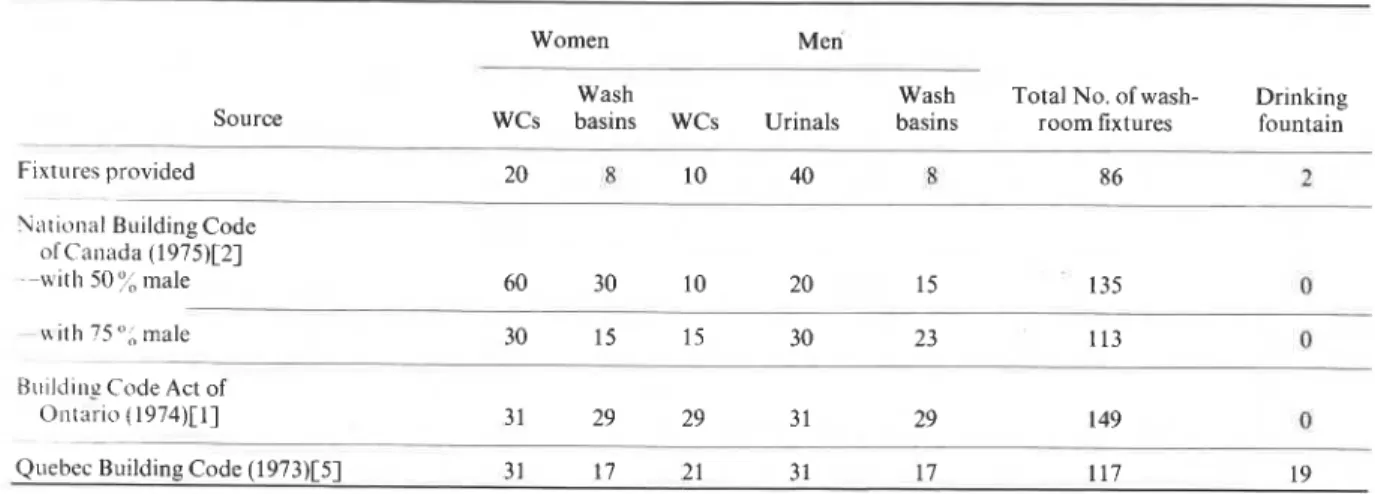
of the male population to use a washroom durrng the half-time break.The section of the baseball stadium studied had a seating capacity of 9000 people. With the actual pop- ulation at 7000 or 8000, the women's washroom ade- quately served the population. The urinals and WCs in the men's washroom were very busy; about 20 additional urinals would be desirable. The wash basins in the men's washroom were more than adequate. Table 4
their way out of a washroom there is a much higher probability that they will use these facilities than if they did not pass by them. In an assembly occupancy, at a function with a scheduled intermission when a great many people arrive at the same time t o use the washroom, separate doors for entry and exit can improve the circulation patterns. In addition, it is most desirable to have adequate space inside the washroom so that lineups for the various fixtures d o not cut off access to other fixtures such as wash basins.
There are quite a few people who are unable to use a typical public washroom because of some physical disability. People in wheelchairs and those with heart conditions or other ambulatory problems may not be able to go up or down stairs to use a washroom located on another level. People in wheelchairs require somewhat larger entrance doors and toilet stalls. Children also have difficulty with some facilities because of the height or
Table 4. Number of washroom fixtures based on 9000-seat section of stadium
Women Men
Wash Wash Total No. of wash- Drinking
Source WCs basins WCs Urinals basins room fixtures fountain
Fixtures provided 20 R 10 40 8 86 2 \nt~ondl B u ~ l d ~ n g Code or Canada (1975)[2] m ~ t h 50", male 60 30 10 20 15 135 0 a ~ t h l S O , male 30 15 15 30 23 113 0 - - H u ~ l d ~ n g Code Act of Ontario (1974)[1] 31 29 29 31 29 149 0 - - -- -
Quebec Building Code (1973)[5] 31 17 21 3 1 17 117 19
describes the actual number of fixtures provided and the because they are accompanied by a parent of the opposite number of fixtures that would be required by the Ontario,
Quebec and National Building Codes.
It appears that in a stadium for baseball events, slightly k u e r fixtures than now required by codes could be installed. The ratio of fixture types and the number of fixtures for each sex needs to be modified, however; more urinals and fewer wash basins are required.
If the section studied was located in a football stadium one could expect that there would be 1500 men who ivould want to use a washroom during the mid-game break. With the Building Code Act of Ontario require- ments of 60 WC's and urinals it would take about 22 nijn~ites for these men to use the washroom. This is longer than the amount of time usually available. In addition the provision of fixtures a t this level would result in long lineups and waiting times beyond the capabilities of some spectators.
sex. Some men are unable to use urinals because of the lack of privacy provided. In the shopping plaza studied over 20 0/, of the WC use was for urination only and most of the time the WCs were used as urinals even when the urinals were not fully occupied. Studies at the Division have not included people's attitudes towards public washrooms but this is an area which would probably yield a great deal of useful design information.
The distribution of facilities is another problem area. In the theatre studied there were two identical sets of washrooms; one set served the balcony located im- mediately above the set that served the orchestra level. There were fewer people on the balcony level and many of them came t o the orchestra level to buy a drink at the bar during intermission. This resulted in an insufficient number of fixtures on the lower level and many unused fixtures on the upper level.
In general, it appears that although a few more fixtures
OTHER CONSIDERATIONS are required in some occupancies, the number of fixtures
provided in many occupancies could be reduced through Apart from the number and ratio of fixtures there are careful considerations of building populations, fixture other aspects that affect the use of washrooms. The ratios and distribution of washroom facilities. Millions of arrangement of fixtures, for example, appears t o have an dollars could thus be saved each year in reduced effect on their use. When people pass by wash basins on construction and maintenance costs.
findings and to describe the use of washrooms in other Building Research, National Research Council of Canada occupancies it will be possible to produce a design guide and is published with the approval of the Director of the for use by architects and regulatory bodies in providing Division.
suitable public washroom facilities.
REFERENCES T h e Building Code Act o f o n t a r i o , 0 . Reg. 925175 (1974).
National Building Code of Canada, National Research Council of Canada, Assoc. Corn. on Nat. Bldg. Code, Ottawa, NRCC 13982 (1975).
D. N. Henning, The Use of Washroom Facilities in a Theatre Complex, National Research Council of Canada, Division of Building Research, Ottawa, 1975. NRCC 14669.
D. N. Henning, The Use of Washroom Facilities in an Enclosed Suburban Shopping Plaza, National Research Council of Canada, Division of Building Research, March 1977, NRCC 15871.
Quebec Building Code, Quebec OfSicial Gazette, March 21, Vol. 105, No. 6 (1973). J. N. Boar, Architectural Graphic Standards. Wiley, 6th Edition (1970).
R. Ham, Theatre Planning, Architectural Press, London (1972).
P. J. Davidson & R. G. Courtney. Revised Scales for Sanitary Accommodation in Offices. Build.
Environ. 11,51-56 (1976).
O t h e r s o u r c e s o f i n f o r m a t i o n o n w a s h r o o m u s e
1. Building Research Establishment, Department of the Environment, Garston, Watford, WD2 7JR, England.
2. Building Regulations Division, Planning Department, City of dalgGy, P.O. Box 2100, Calgary, Alberta. T2P 2M5.