HAL Id: inserm-01330903
https://www.hal.inserm.fr/inserm-01330903
Submitted on 13 Jun 2016HAL is a multi-disciplinary open access archive for the deposit and dissemination of sci-entific research documents, whether they are pub-lished or not. The documents may come from teaching and research institutions in France or abroad, or from public or private research centers.
L’archive ouverte pluridisciplinaire HAL, est destinée au dépôt et à la diffusion de documents scientifiques de niveau recherche, publiés ou non, émanant des établissements d’enseignement et de recherche français ou étrangers, des laboratoires publics ou privés.
Title: Personality Profiles in Young Adults with
Disordered Eating Behavior
Patrick Raynal, Tiffany Melioli, Henri Chabrol
To cite this version:
Patrick Raynal, Tiffany Melioli, Henri Chabrol. Title: Personality Profiles in Young Adults with Disordered Eating Behavior. Eating Behaviors, Elsevier, 2016, 22, pp.119-123. �inserm-01330903�
Elsevier Editorial System(tm) for Eating Behaviors
Manuscript Draft
Manuscript Number:
Title: Personality Profiles in Young Adults with Disordered Eating Behavior
Article Type: Full Length Article
Keywords: Subclinical eating disorders; Personality; Eating behaviors; Cluster classification
Corresponding Author: Dr. Patrick Raynal, Corresponding Author's Institution:
First Author: Patrick Raynal
December 3rd, 2015
To the Editor of Eating Behaviors
Dear Pr. Miller,
Please find enclosed a manuscript entitled "Personality Profiles in Subclinical Eating Disorders".
We would like to submit this work for publication as a full-length paper in Eating
Behaviors (word counts: abstract: 179; text + references: 3497).
As possible referees, I suggest: Jennifer D. Slane
VISN 4 Mental Illness Research, Education and Clinical Center, Pittsburgh VA, USA E-mail: [email protected]
Kelly L. Klump
Michigan State University, Dept of Psychology, East Lansing, MI, USA E-mail: [email protected]
Michael W. MacGregor
University of Saskatchewan, Saskatoon, Canada E-mail: [email protected]
I thank you very much in advance for the reviewing process. Sincerely,
Patrick Raynal, Ph.D. Senior research scientist
Highlights
• 101 college students with disturbed eating behavior were classified on personality disorder traits
• Schizotypal, autistic, obsessional, borderline and cyclothymic traits were used • 3 distinct clusters were obtained: high-traits, low-traits and schizotypal-borderline-cyclothymic
• Symptoms of depression, suicidal ideas, obsessive-compulsion and trait anger varied between groups
Running head: PERSONALITY IN DISORDERED EATING BEHAVIOR
Personality Profiles in Young Adults with Disordered Eating Behavior
Patrick Raynala, Tiffany Meliolia, Henri Chabrola
a Centre d’Etudes et de Recherches en Psychopathologie et Psychologie de la
Santé
Université de Toulouse, France
Corresponding author:
P. Raynal, Laboratoire CERPPS, Université de Toulouse-Jean Jaurès, 5 allées Antonio Machado, 31058 Toulouse, France
Phone number : 33 561 22 52 90 Fax number : 33 561 25 70 93
E-mail address: [email protected]
*Manuscript
Abstract
Personality traits are closely related to eating disorders (ED) and might be involved in their maintenance and development. Nevertheless little is known regarding the association between personality traits and disordered eating in subclinical
populations. College students answered questionnaires assessing disordered eating behaviors (DEB) and the following personality disorder (PD) traits: schizotypal, autistic, obsessional, borderline and cyclothymic. Participants with DEB (n=101, 87% women) displayed significantly higher scores for several variables including schizotypy,
cyclothymic, borderline and obsessionnal traits compared to other participants (n=378). Cluster analysis in the DEB subsample led to the identification of three groups: 1) a cluster with a high level of traits (HT); 2) a cluster scoring high on schizotypal, borderline and cyclothymic traits (SBC); 3) a cluster with a low level of traits (LT). Symptoms of depression, suicidal ideations, trait anger and obsessive-compulsive symptoms were higher in the HT and the SBC clusters compared to the LT cluster. Given that two thirds of participants suffering from DEB appeared to display a morbid
personality profile, taking into account PD traits of individuals with DEB appears of prime importance.
1. Introduction
Personality features might play an important role in both etiology and outcome of eating disorders (ED) (MacGregor & Lamborn, 2014). Personality disorders (PD) are common among individuals suffering from ED with a comorbidity reaching 60 %
according to several studies (Cassin & von Ranson, 2005; Wonderlich & Mitchell, 2001). Furthermore, individuals suffering from anorexia nervosa (AN) are frequently affected by obsessive-compulsive PD (Young, Rhodes, Touyz, & Hay, 2013). Regarding
individuals with bulimic symptoms, literature data have found a high prevalence of the traits associated with borderline PD (including impulsivity and sensation seeking) (Atiye, Miettunen, & Raevuori-Helkamaa, 2014; MacGregor & Lamborn, 2014; von Lojewski & Abraham, 2014).
While previous ED classifications were mainly based on the presence or absence of obsessive-compulsive or borderline PD traits, more recent studies have introduced larger comorbid personality psychopathology, leading to the description of three personality profiles, observed either in adolescents or in adults: undercontrolled, overcontrolled and low psychopathology profiles which could be associated to distinct illness course and treatment response (Lavender et al., 2013; Turner et al., 2014; Wildes & Marcus, 2013).
Other comorbidities of ED have been explored including autism-spectrum disorders. Recent studies have reported 20% of autism-spectrum traits among
individuals with ED (Huke, Turk, Saeidi, Kent, & Morgan, 2013; Westwood et al., 2015). In addition, the presence of bipolar and schizophrenia-spectrum disorders were also described (Kouidrat, Amad, Lalau, & Loas, 2014; Remberk, Bazynska,
A major issue to better understand ED etiology lies in the relationship between clinical and subthreshold ED. Subthreshold ED have a high prevalence among
adolescents and young women, representing an important source of physical and psychological impairments including symptoms of anxiety and depression (Chamay-Weber, Narring, & Michaud, 2005; Touchette et al., 2011). Nevertheless the relationship between threshold and subthreshold ED remains unclear, with a lack of consensus regarding whether subthreshold ED represent a less severe form of ED or a transitional phase to fullblown ED. Due to this lack of consensus, the characteristics of patients who will develop clinical ED are still unclear and surprisingly, to date, only a few studies focused on personality features associated to subthreshold ED. To our knowledge, only one study has explored the personality profiles of women with subthreshold ED, using an instrument assessing 18 dimensions of personality disorders. They have found the three personality clusters already emphasized in ED, suggesting that the same
personality traits may contribute to both ED and subthreshold ED (Perkins, Slane, & Klump, 2013).
Following a similar approach, the aim of this study was to identify a typology of young adults with DEB based on personality disorder traits. Contrary to prior study, we focused on traits associated to ED and not limited to personality disorders (including traits reflecting the association to autistic, bipolar and schizophrenia spectra, that are obsessive-compulsive traits, borderline traits, autistic traits, cyclothymic traits and schizotypal traits).
2. Methods
2.1. Participants
Participants were recruited through social networks and official website of several French universities. Only those who answered >95% of the items were included in this study. The sample is thus composed of 479 individuals (96 males; 383 females) aged between 18 and 25 (mean age of males = 21 ±2.3; mean age of females = 20.7 ±1.9;
p=.32). The study followed the ethical guidelines of the Helsinki Declaration and its
procedures were approved by the ethics committee of the research ward. Participants provided their willingness to participate through a consent form and no compensation was offered. The questionnaires were anonymous.
2.2. Measures
2.2.1. Eating behavior
Disordered eating was assessed using the French translation of Eating Attitudes Test-26 (EAT-26) (Garner, Olmsted, Bohr, & Garfinkel, 1982; Leichner, Steiger, Puentes-Neuman, Perreault, & Gottheil, 1994) which assesses symptoms of ED through 26 items scored on a 6-point scale, ranging from 1 (never) to 6 (always). An example item is “I avoid eating when I am hungry.” A cutoff score of 20 has been identified as indicating DEB (Garner et al., 1982).
2.2.2. Personality traits
2.2.2.1 Schizotypal traits
Schizotypal traits were assessed using the Schizotypal Personality Questionnaire- Brief (SPQ-B) (Raine & Benishay, 1995), a self-administered scale including 22
dichotomous items. Each item (e.g., "People sometimes find me aloof and distant") is scored 0/1 (no/yes).
2.2.2.2. Cyclothymic traits
The Temperament Evaluation of Memphis, Pisa, Paris and San Diego
autoquestionnaire (TEMPS-A) (Akiskal et al., 2005) was used to measure cyclothymic
traits, using the relevant subscale (12 items; e.g., "My ability to think varies greatly from sharp to dull for no apparent reason"). Items were scored 0 (no) or 1 (yes).
2.2.2.3. Obsessional personality traits
Obsessional traits were measured using the French version of the Obsessional personality disorder scale of the Personality Diagnostic Questionnaire-4 (Bouvard, 2002; Hyler, Rieder, Williams, Spitzer, & Lyons, 1988). This scale contained 8 items (e.g., "I feel that my standards and ethics are higher than those of my peers") scored 0 (false) or 1 (true).
2.2.2.4. Borderline personality traits
Borderline PD traits were assessed using the nine relevant items of the
Personality Diagnostic Questionnaire-4 (Bouvard, 2002; Hyler et al., 1988). Items were
scored from 1 (totally false) to 7 (totally true).
2.2.2.5. Autistic traits
Autistic traits were measured using the Autism spectrum Quotient (AQ) (Baron-Cohen, Wheelwright, Skinner, Martin, & Clubley, 2001) under its 10-item version (e.g., "When I am reading a story, I find it difficult to work out the characters intentions"). Items were scored 0 [no] or 1 [yes], except for items 2-6 and 9 that were scored
2.2.3. Psychopathogical symptoms
2.2.3.1. Depression symptoms and suicidal ideation
Depression was evaluated using The Centre for Epidemiological
Studies-Depression scale (CES-D) (Radloff, 1977) under its 10-item version (e.g., "My sleep has
not been good"). Responses were made on a 4-point Likert scale, ranging from 0 to 3. A short suicidal ideation scale was added (Chabrol, Rodgers, & Rousseau, 2007),
containing 3 items (e.g., "I felt life was not worth living") that were scored similarly as CES-D.
2.2.3.2. State-trait anger
State-trait anger was assessed using the second part of the State-trait anger
expression inventory-2 (STAXI-2) (Spielberger, 1988) under its French version
(Borteyrou, Bruchon-Schweitzer, & Spielberger, 2008). This scale contained 8 items (e.g., "I get easily angry") scored 1 (almost never) to 4 (almost always).
2.2.3.3. Obsessive-compulsive symptoms
Obsessive-compulsive symptoms were assessed using the French version of the
Obsessive Compulsive Inventory-Revised (OCI-R) (Foa et al., 2002; Zermatten, Van der
Linden, Jermann, & Ceschl, 2006). It contains 18 items (e.g., "I check things more often than necessary") scored from 0 ("Not at all") to 4 ("Extremely").
2.2.4. Substance use
Cannabis use was measured with the Cannabis Use Disorder Identification
Test-Revised (CUDIT-R) (Adamson et al., 2010). Alcohol consumption was assessed using the
first item of the Alcohol Use Disorders Identification Test (AUDIT) (Saunders, Aasland, Babor, Delafuente, & Grant, 1993).
All these questionnaires have demonstrated adequate reliability and validity (Adamson et al., 2010; Akiskal et al., 2005; Baron-Cohen et al., 2001; Bouvard, 2002; Foa et al., 2002; Garner et al., 1982; Hyler et al., 1988; Radloff, 1977; Raine & Benishay, 1995; Saunders et al., 1993; Spielberger, 1988; Zermatten et al., 2006).
2.2.5. Personal information
This study collected general information regarding the participants (age, sex, academic degree and academic results during the past semester). The variable “academic results” was obtained by asking students their overall grade for the last semester (Failed; Passed with grade ≥10/20 and <12/20; Passed with grade ≥12/20 and <14/20; Passed with grade ≥14/20 and <16/20; Passed with grade ≥16/20).
Cronbach alphas and score ranges are presented in Table 1. The obsessive-compulsive personality trait and the autistic trait scales showed suboptimal Cronbach's alphas ranging between 0.50 and 0.70, an acceptable level of consistency for short scales (Schmitt, 1996).
3. Results
Comparison of participants with and without DEB
Participants scoring above 20 on the EAT-26 (n=101, 87.3% female, 12.7% male) were compared to the rest of participants (considered as the control group; n=378, 77.2% female, 21.8% male). The proportion of female was higher in the group scoring
Cluster analysis
Cluster analysis was conducted among the DEB group in two steps to generate personality profiles, based on personality traits (schizotypal, cyclothymic, borderline, obsessional and autistic) converted to z-scores. Absence of multicolinearity was
evaluated through an analysis of the correlations between the variables selected for the cluster analysis (all variables had tolerance values > .40). In the first step, a hierarchical cluster analysis was conducted (Ward’s method with squared Euclidean distance). Based on the dendrogram and the aggregation curve, a three-cluster solution was identified. In the second step, K-means clustering was used to assign individuals to one of the identified clusters. A discriminant analysis showed clear differences between clusters (Wilks’ = 0.145, p<0.001) with 97.3% of cases correctly classified. Data
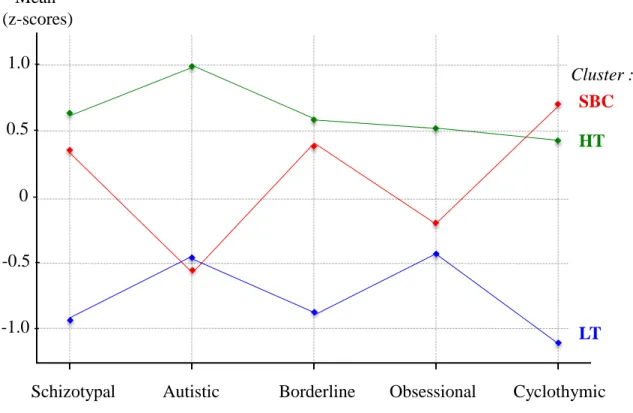
revealed a first group that was well below the mean of DEB group on all traits (Figure 1; Table 2). This cluster was thus termed the “Low Traits” cluster (LT, n=35 [34.7%], women 94.3%, men 5.7%). A second group was characterized with high scores on
schizotypal, borderline and cyclothymic traits and low scores on autistic and obsessional dimensions; it was thus called the “Schizotypal, Borderline and Cyclothymic” cluster (SBC, n=33 [32.7%], women 84.8%, men 15.2%). The last cluster was characterized by scores that were at least a half standard deviation above the mean on all dimensions – schizotypal, autistic, cyclothymic, borderline, obsessional– and was thus named "High Traits" cluster (HT, n=33[32.7%], women 81.8%, men 18.2%). Interestingly autistic traits were the most elevated traits in this cluster, with AQ-10 scores twice higher than in other clusters. No difference in sex ratio could be observed between the different clusters (p range=0.11-0.5, Fisher's exact test).
Cluster group differences in level of disturbed eating behaviors,
results were tested using an analysis of variance. Compared to the LT cluster, the HT and SBC clusters participants displayed higher scores on depressive symptoms, suicidal ideas, obsessive-compulsive symptoms and state-trait anger (Table 2). In addition, individuals from the HT group showed a lower level of academic degree in comparison with the LT cluster.
4. Discussion
The aim of this study was to identify a typology of young adults with DEB based on personality disorder traits. To our knowledge, this study is the second to explore personality profiles among young adults with DEB, based on PD traits. Our classification showed convergences and some differences with the previous study aiming at exploring the PD trait profiles of women with DEB (Perkins et al., 2013). Perkins et al.'s study (2013) described three clusters (Adaptive, Dysregulated, Rigid) with two clusters closely matching those identified in our study. The Adaptive cluster corresponds to LT as the group with lowest traits. The Dysregulated group, displaying the highest levels of all traits with the exception of intimacy problems, appeared concordant with HT.
Interestingly, autistic traits were the highest component of HT, and differences in autistic traits between HT and other clusters were large (1.5 SD). This finding thus provides further support to the notion of an association between a sub-group of ED and autistic traits (Courty et al., 2013; Oldershaw, Treasure, Hambrook, Tchanturia, &
indicated by low autistic and obsessionnal traits). Nevertheless, the Rigid cluster showed some dysregulation traits as it displayed a level of affective instability higher than the Adaptive cluster. Furthermore, the compulsivity level in Rigid was lower than in Dysregulated, suggesting that obsessionality was somewhat limited in Rigid cluster, as it appeared in SBC (Perkins et al., 2013).
At the symptom level, the comparison between our results and Perkins et al.'s study is limited by the difference in study variables. Our clusters did not differed from each other on DEB scores, whereas differences appeared in some disordered eating dimensions in Perkins et al.’s report. In our study, the most striking difference between clusters was the prominence of obsessional-compulsive symptoms, with a score twice higher in HT and SBC than in LT, while all other variables showed more modest inter-cluster variations (Table 2). Considering that HT and SBC altogether represent two thirds of individuals in our sample, these data indicate that obsessive-compulsive symptoms are a very frequent comorbidity of DEB.
This study is not exempt from limitations. Firstly, the small sample size and the low proportion of men may restrict the generalizability of the present finding. Secondly, self-report measures were used, which can induce some bias in data collection.
Nevertheless, this study suggests that the classification of DEB in function of PD traits could be extended to men, considering that no difference in sex ratio could be observed between clusters. Moreover, personality traits of the autistic, schizotypal and bipolar spectra may be relevant to the classification of DEB or subclinical ED. As a conclusion, this study emphasizes the importance of taking into account PD traits in DEB. Two thirds of DEB group appeared to display a morbid personality profile which might represent a transitional phase to clinical ED. Further studies are needed to better understand the role and implication of personality profile in the etiology of ED.
References
Adamson, S. J., Kay-Lambkin, F. J., Baker, A. L., Lewin, T. J., Thornton, L. et al. (2010). An improved brief measure of cannabis misuse: The Cannabis Use Disorders Identification Test-Revised (CUDIT-R). Drug and Alcohol Dependence, 110, 137-143.
Akiskal, H. S., Mendlowicz, M. V., Jean-Louis, G., Rapaport, M. H., Kelsoe, J. R. et al. (2005). TEMPS-A: validation of a short version of a self-rated instrument designed to measure variations in temperament. Journal of Affective Disorders, 85, 45-52. Atiye, M., Miettunen, J., & Raevuori-Helkamaa, A. (2014). A Meta-Analysis of
Temperament in Eating Disorders. European Eating Disorders Review, 23, 89-99. Baron-Cohen, S., Wheelwright, S., Skinner, R., Martin, J., & Clubley, E. (2001). The
autism-spectrum quotient (AQ): Evidence from Asperger Syndrome/high-functioning autism, males and females, scientists and mathematicians. Journal of Autism and
Developmental Disorders, 31, 603-603.
Booth, T., Murray, A. L., McKenzie, K., Kuenssberg, R., O'Donnell, M. et al. (2013). Brief Report: An Evaluation of the AQ-10 as a Brief Screening Instrument for ASD in Adults. Journal of Autism and Developmental Disorders, 43, 2997-3000.
Borteyrou, X., Bruchon-Schweitzer, M., & Spielberger, C. D. (2008). The French adaptation of the STAXI-2, C.D. Spielberger's State-trait anger expression
inventory. Encephale-Revue De Psychiatrie Clinique Biologique Et Therapeutique,
34, 249-255.
Bouvard, M. (2002). Questionnaires et échelles d’évaluation de la personnalité. Masson.
Paris.
Cassin, S. E., & von Ranson, K. M. (2005). Personality and eating disorders: A decade in review. Clinical Psychology Review, 25, 895-916.
Chabrol, H., Rodgers, R., & Rousseau, A. (2007). Relations between suicidal ideation and dimensions of depressive symptoms in high-school students. Journal of
Foa, E. B., Huppert, J. D., Leiberg, S., Langner, R., Kichic, R. et al. (2002). The obsessive-compulsive inventory: Development and validation of a short version.
Psychological Assessment, 14, 485-496.
Garner, D. M., Olmsted, M. P., Bohr, Y., & Garfinkel, P. E. (1982). The Eating Attitudes Test - Psychometric Features and Clinical Correlates. Psychological Medicine, 12, 871-878.
Huke, V., Turk, J., Saeidi, S., Kent, A., & Morgan, J. F. (2013). Autism Spectrum Disorders in Eating Disorder Populations: A Systematic Review. European Eating Disorders
Review, 21, 345-351.
Hyler, S. E., Rieder, R. O., Williams, J. B., Spitzer, J. H., & Lyons, M. (1988). The Personality Diagnostic Questionnaire: Development and preliminary results. Journal of
Personality Disorders, 2, 229-237.
Kouidrat, Y., Amad, A., Lalau, J. D., & Loas, G. (2014). Eating disorders in schizophrenia: implications for research and management. Schizophrenia Research and
Treatment, 2014, 791573.
Lavender, J. M., Wonderlich, S. A., Crosby, R. D., Engel, S. G., Mitchell, J. E. et al. (2013). Personality-based subtypes of anorexia nervosa: Examining validity and utility using baseline clinical variables and ecological momentary assessment. Behaviour
Research and Therapy, 51, 512-517.
Leichner, P., Steiger, H., Puentes-Neuman, G., Perreault, M., & Gottheil, N. (1994). Validation of the French Version of the Eating Attitudes Test (Eat-26) for Francophone Quebecers. Canadian Journal of Psychiatry-Revue Canadienne De
Psychiatrie, 39, 49-54.
MacGregor, M. W., & Lamborn, P. (2014). Personality Assessment Inventory profiles of university students with eating disorders. Journal of Eating Disorders, 2, 20. Oldershaw, A., Treasure, J., Hambrook, D., Tchanturia, K., & Schmidt, U. (2011). Is
Anorexia Nervosa a Version of Autism Spectrum Disorders? European Eating
Disorders Review, 19, 462-474.
Perkins, P. S., Slane, J. D., & Klump, K. L. (2013). Personality clusters and family
relationships in women with disordered eating symptoms. Eating Behaviors, 14, 299-308.
Radloff, L. S. (1977). The CES-D Scale: A self-report depression scale for research in the general population. Applied Psychological Measurements, 1, 385-401.
Raine, A., & Benishay, D. (1995). The SBQ-B: A brief screening instrument for schizotypal personality disorder. Journal of Personality Disorders, 9, 346-355.
Remberk, B., Bazynska, A. K., Krempa-Kowalewska, A., & Rybakowski, F. (2014).
Adolescent insanity revisited: Course and outcome in early-onset schizophrenia spectrum psychoses in an 8-year follow-up study. Comprehensive Psychiatry, 55, 1174-1181.
Saunders, J. B., Aasland, O. G., Babor, T. F., Delafuente, J. R., & Grant, M. (1993). Development of the Alcohol-Use Disorders Identification Test (Audit) - Who Collaborative Project on Early Detection of Persons with Harmful Alcohol-Consumption. Addiction, 88, 791-804.
Schmitt, N. (1996). Uses and abuses of coefficient alpha. Psychological Assessment, 8, 350-353.
Spielberger, C. D. (1988). Manuel for the state-trait anger expression inventory (STAXI): PAR 2000.
Touchette, E., Henegar, A., Godart, N. T., Pryor, L., Falissard, B. et al. (2011). Subclinical eating disorders and their comorbidity with mood and anxiety disorders in adolescent girls. Psychiatry Research, 185, 185-192.
Turner, B. J., Claes, L., Wilderjans, T. F., Pauwels, E., Dierckx, E. et al. (2014). Personality profiles in Eating Disorders: Further evidence of the clinical utility of examining subtypes based on temperament. Psychiatry Research, 219, 157-165.
von Lojewski, A., & Abraham, S. (2014). Personality factors and eating disorders: Self-uncertainty. Eating Behaviors, 15, 106-109.
Westwood, H., Eisler, I., Mandy, W., Leppanen, J., Treasure, J. et al. (2015). Using the Autism-Spectrum Quotient to Measure Autistic Traits in Anorexia Nervosa: A Systematic Review and Meta-Analysis. Journal of Autism and Developmental
Disorders, Nov 5 [Epub ahead of print], 1-15.
Wildes, J. E., & Marcus, M. D. (2013). Alternative methods of classifying eating disorders: Models incorporating comorbid psychopathology and associated features.
Young, S., Rhodes, P., Touyz, S., & Hay, P. (2013). The relationship between obsessive-compulsive personality disorder traits, obsessive-obsessive-compulsive disorder and
excessive exercise in patients with anorexia nervosa: a systematic review. Journal
of Eating Disorders, 1, 16.
Zermatten, A., Van der Linden, M., Jermann, F., & Ceschl, G. (2006). Validation of a French version of the Obsessive-Compulsive Inventory-Revised in a non-clinical sample.
European Review of Applied Psychology-Revue Europeenne De Psychologie Appliquee, 56, 151-155.
Table 1
N=479
Variables α Range M. S.D. M. S.D. t Cohen's d
Schizotypy 0.78 0-21 8.01 4.25 10.12 4.58 -4.39* 0.48 Autistic traits 0.53 0-8 3.06 1.59 3.33 1.74 -1.46 0.16 Cyclothymic traits 0.77 0-12 4.31 3.15 6.64 3.12 -6.64* 0.74 Borderline traits 0.82 9-60 29.28 10.08 39.50 12.45 -8.62* 0.90 Obsessional traits 0.58 0-8 3.58 1.54 4.02 1.52 -2.59* 0.29 Depression 0.69 1-25 12.16 3.90 15.02 3.83 -6.59* 0.74 Suicidal ideas 0.87 0-9 0.65 1.37 1.71 2.38 -5.79* 0.55 Obsess.-compulsive symptoms 0.83 0-64 17.00 10.49 22.66 11.92 -4.70* 0.50 State-trait anger 0.86 8-32 18.05 5.07 20.63 5.66 -4.44* 0.48
Academic degree n.a. 1-6 2.60 1.30 2.57 1.35 0.21 0.02
Academic results n.a. 1-5 3.03 1.03 3.05 1.16 -1.14 0.02
Control DEB
n=378 n=101
Comparison of the disordered eating behavior group (DEB) with the control group (t-test).
Table 2
Typology of 101 subjects with DEB based on the following traits: schizotypal, autistic, cyclothymic, borderline and obsessional;
Cluster comparison using ANOVA and post-hoc test
N=101 Variables M SD M SD M SD F Schizotypal traits 6.03ab 3.34 11.33a 3.40 13.06b 3.72 37.85* Autistic traits 2.54a 1.44 2.33b 0.96 5.09ab 1.18 53.06* Cyclothymic traits 3.34ab 1.91 8.85a 1.86 7.94b 2.18 75.80* Borderline traits 28.49ab 8.20 43.30a 9.372 47.09b 11.06 36.03* Obsessional traits 3.43a 1.61 3.88b 1.53 4.79ab 1.14 7.71* Eating behavior 36.71 14.29 31.48 10.43 34.12 12.22 1.50 Depression 12.06ab 3.11 15.91a 3.51 17.00b 2.87 22.89* Suicidal ideas 0.51ab 1.46 1.91a 2.58 2.82b 2.45 9.41* Obsess.-compulsive symptoms 13.57ab 8.48 25.85a 11.451 29.24b 9.59 23.81* State-trait anger 17.69ab 5.30 21.58a 5.51 22.67b 5.08 8.36* Alcohol 1.23 1.21 1.61 1.25 1.21 1.19 1.11 Cannabis 1.40 2.88 3.00 5.30 2.79 6.78 0.96 Academic degree 3.06a 1.23 2.36 1.38 2.24a 1.32 3.82* Academic results 3.40 1.03 2.79 1.11 2.94 1.27 2.67
Note: Means with the same superscript letter are significantly different from each other (Tukey post-hoc test)
* p<0.05 n =33 32.67% 32.67% 34.65% Cluster: LT SBC HT n =35 n =33 Table(s)
Figure 1. Classification of individuals from the DEB group: Three-cluster solution based on scores for the dimensions indicated on the x-axis.
SBC : cluster with high level of Schizotypal, Borderline and Cyclothymic traits HT : High Traits cluster
LT : Low Traits cluster
1.0 -
0.5 -
0 -
-0.5 -
-1.0 -
Autistic Obsessional Cyclothymic Schizotypal Cluster : LT SBC HT Mean (z-scores) Borderline Figure(s)
Author disclosures
• Role of funding sources: This study received no funding.
• Contributors: PR and HC designed the study and conducted the statistical analyses. PR wrote the first draft of the manuscript. HC and TM contributed to and have approved the final manuscript.
• Conflict of Interest: The authors report no conflict of interest. • Acknowledgments: PR is supported by Inserm.