Publisher’s version / Version de l'éditeur:
Vous avez des questions? Nous pouvons vous aider. Pour communiquer directement avec un auteur, consultez la première page de la revue dans laquelle son article a été publié afin de trouver ses coordonnées. Si vous n’arrivez pas à les repérer, communiquez avec nous à [email protected].
Questions? Contact the NRC Publications Archive team at
[email protected]. If you wish to email the authors directly, please see the first page of the publication for their contact information.
https://publications-cnrc.canada.ca/fra/droits
L’accès à ce site Web et l’utilisation de son contenu sont assujettis aux conditions présentées dans le site LISEZ CES CONDITIONS ATTENTIVEMENT AVANT D’UTILISER CE SITE WEB.
Technical Translation (National Research Council of Canada), 1977
READ THESE TERMS AND CONDITIONS CAREFULLY BEFORE USING THIS WEBSITE.
https://nrc-publications.canada.ca/eng/copyright
NRC Publications Archive Record / Notice des Archives des publications du CNRC :
https://nrc-publications.canada.ca/eng/view/object/?id=cc624f3f-68f3-48c8-84be-68afcf2854c8 https://publications-cnrc.canada.ca/fra/voir/objet/?id=cc624f3f-68f3-48c8-84be-68afcf2854c8
NRC Publications Archive
Archives des publications du CNRC
For the publisher’s version, please access the DOI link below./ Pour consulter la version de l’éditeur, utilisez le lien DOI ci-dessous.
https://doi.org/10.4224/20358618
Access and use of this website and the material on it are subject to the Terms and Conditions set forth at
Mechanical behaviour of frozen soils under triaxial compression
Neuber, H.; Wolters, R.; National Research Council of Canada. Division of Building Research
CANADA I IVSTITUTE
FOR SCIENTIFIC AND TECHNICAL
I NFORMATIOIV
I NSTITUT CANADl EN
DE L'IN FORMATION SCl ENTl FlQLlE ET TECHlVlQUE
N R C I CNR T T
-
1902'TECHNICAL TRANSLATION TRADUCTION TECHNIQUE
H. NEUBER A N D R. WOLTERS
MECHANICAL BEHAVIOUR OF FROZEN SOILS
UNDER
TRlAXlAL
COMPRESSION
FORTSCHRITTE I N DER GEOLOGIE VON RHEINLAND U N D WESTFALEN. 17:500
-
536. 1 9 7 0TRANSLATED BY/TRADUCTION DE
ROBERT S E R R ~
THIS IS THE TWO HUNDRED AND THIRTIETH I N THE SERIES OF TRANSLATIONS PREPARED FOR THE DIVISION OF BUILDING RESEARCH
TRADUCTION N U M ~ R O 230 DE L A S ~ R I E P R ~ P A R ~ E POUR
LA D I V I S I O N DES RECHERCHES EN BATIMENT
OTTAWA 1977
National Research Conseil national
Title:
NATIONAL RESEARCH COUNCIL OF CANADA TECHNICAL TRANSLATION
Mechanical behaviour of frozen soils under triaxial compression
Author (s) : H. Neuber and R. Wolters
Reference: Fortschritte in der Geologie von Rheinland
und Westfalen, 17:500-536, 1970.
PREFACE
Stability of artificially frozen coal mining shafts in Germany has initiated interest in the mechanical properties of frozen ground. This article reports on laboratory uniaxial and triaxial loading tests on frozen soil samples taken from several geological zor.es through which a shaft has been driven. The effects of such factors as grain size, anbient pressure, temperature and rate of loading on the strength and deformation properties of frozen soils were investigated.
The major success of freezing operations in mine shaft engineering and construction is attributed to the frozen thick walls and arches which are capable of transmitting short-term loads, protecting against collapse from vibration and providing a watertight barrier.
The Division is grateful to Mr. R. ~ e r r 6 , Translation Services, National Research Council, for translating this paper and to Mr. T.H.W. Baker, of this Division, for checking
the translation for technical accuracy.
Ottawa,
November 1977
C.B. Crawford, Director,
MECHANICAL BEHAVIOUR OF FROZEN SOILS UNDER TRIAXIAL COMPRESSION
1. Introduction
After the war, increased numbers of coal-mining shafts were sunk, using new methods of permanent support, but when
it came to accurately evaluate stability during drilling and after, there were not sufficient precise data about the exact load-bearing capacity and deformation of individual geological strata and rock types in the frozen and unfrozen state. In order to solve various drilling problems and develop better supporting methods for the shafts, the builder had to be given quantitative data about the strength and deformation behaviour of the rock. It seemed that this could be done by precisely recording the layers and observing their behaviour during shaft-sinking operations (Kalterherberg & Wolters 1958, Kalterherberg 1968), by making "in situ" stress and strain measurements before and after the preparation and thawing of the frozen material, by making theoretical observations of the processes involved in frost propagation in the soil, and
comparing the resulting data on stress and deformation at different temperatures. In addition to in situ measurements, we also expected good results from laboratory investigations of soil samples, using the methods of soil mecha3ics. To say nothing of the financial cost of large-scale tests, we felt this procedure was useful and necessary to explain basic
questions about the behaviour of various types of soil in the frozen state.
The first results of these investigations and the methods and equipment used were reported at the Spring Conference of the German Geological Society held in Mul.heim/Ruhr in May, 1961
Since recent data may provide more fundamental infor- mation, and may be important in a number of applications,
this paper is a report on the present situation, all the more so as information about mining shafts is relatively rare and representative sample sources may no longer be available at a later date.
People who need such information may not be able to carry out such tests themselves because of the equipment needed. The results of these special investigations of various geologica zones will therefore be described with as many details as possible, so that further implications may be drawn individually as the need arises.
2. Sampling and experimental procedure
To investigate the behaviour of various soils in the frozen state, we gathered samples, as undisturbed as
possible, in frozen shaft sections of a number of coal- mining operations in as wide a variety of geological zones as possible. As a rule, we cut out of the unfrozen centre of the shaft cylindrical test specimens 20 cm high and 7 cm in diameter, using steel cylinders. As much as possible, we did this in three directions perpendicular to each other, taking about six samples in each case (perpendicular and parallel to the strata in a north-south and east-west
direction). Tests could not be carried out with all specimens, since there occurred some disturbances, such as frost cracks. At a certain depth, the entire section of a shaft was already frozen, some larger fragments were taker, and these were cut up in the frozen state and machined into cylinders also 7 cm in diameter, using a lathe. The specimens taken in the
unfrozen state were frozen in a cold room, usually inside the sampling cylinders. Most samples were frozen at a
temperature of - 5 ' ~ ~ since that is generally the dynamic
temperature in the freezing shaft. In natural conditions, the layers are frozen in the loaded state, and therefore we used solid covers as seals while freezing the specimens inside the cylinders. One series of specimens was frozen after being placed in triaxial cells and subjected to a confining pressure, so as to determine any differences with the above- mentioned mode of reparation. We were not able to detect
any influence of this on the subsequent test results. Before they were placed in triaxial cells, all specimens were reduced through plan-parallel sections* to a length of 17.5 cm, provided with steel loading plates at the faces, and covered with a fine rubber membrane as a seal against the pressurized liquid
(hydraulic oil). The specimens already frozen outside the cells were mounted and subjected to a confining pressure, and then consolidated for at least 24 hours under constant isotropic loading (confining pressure), before being exposed to an
additional axial load. The confining pressures (a ) were
3
generally 10, 30 and 50 kg/cm2, in line with the depth of the frozen shafts in the Ruhr area. Finally, uniaxial compression tests were carried out using the same equipment (a = 0).
3
Following consolidation, the axial load was increased under a constant confining pressure until the breaking point was reached. During most of this loading, i.e. until shortly before the breaking point, the rate of loading was kept
constant. The strain rate increased to a predetermined value, which was then kept constant. In most tests, the rate of
loading at - 5 ' ~ was such that the breaking point was reached after about one hour. This type of uniform procedure was deemed necessary if we were to obtain comparable data about the influence of materials, orientation and confining pressure on the axial load-bearing capacity and the accompanying
d e f o r m a t i o n s . O f t e n a s u f f i c i e n t number o f specimens a l s o made i t p o s s i b l e t o c a r r y o u t l o n g - t e r m t e s t s a t s u b s t a n t i a l l y lower r a t e s o f l o a d i n g ( t e s t t i m e s o f up t o s e v e r a l d a y s ) .
Loads, i n c l u d i n g a x i a l o n e s , w e r e e x e r t e d on t h e s p e c i m e n s h y d r a u l i c a l l y by means o f a u t o m a t i c a l l y c o n t r o l l e d o i l pumps, s e t up o u t s i d e t h e c o l d room. The a d d i t i o n a l a x i a l l o a d and t h e accompanying c h a n g e i n l e n g t h were r e c o r d e d c o n s t a n t l y on t h e specimen i t s e l f b y means o f r e s i s t a n c e s t r a i n gauge
r e c o r d e r s , i n o r d e r t o a v o i d e r r o r s t h r o u g h p i s t o n f r i c t i o n and h o u s i n g d e f o r m a t i o n of t h e t r i a x i a l c e l l s .
The measured v a l u e s were r e c o r d e d c o n t i n u o u s l y , l i k e w i s e o u t s i d e t h e c o l d room, s o t h a t t h e r e was no i n t e r f e r e n c e w i t h t h e t e m p e r a t u r e from p e o p l e e n t e r i n g t h e room d u r i n g t h e t e s t s . The t e m p e r a t u r e o f t h e specimen was measured d u r i n g t h e e n t i r e
t e s t , f o r c o n t r o l p u r p o s e s , by means o f t h e r m o e l e m e n t s l o c a t e d on i t s e x t e r n a l s u r f a c e , and l i k e w i s e r e c o r d e d . F l u c t u a t i o n s remained below O . l O ~ , s i n c e t h e s l i g h t t e m p e r a t u r e v a r i a t i o n s produced by t h e i n t e r m i t t e n t o p e r a t i o n o f t h e c o o l i n g equipment i n t h e c o l d room w e r e a t t e n u a t e d by t h e h y d r a u l i c o i l s u r r o u n d - i n g t h e specimen. I n e v a l u a t i n g t h e t e s t s , we c a l c u l a t e d t h e r e l a t i v e change i n l e n g t h a s t h e q u o t i e n t o f t h e a b s o l u t e change i n l e n g t h and t h e o r i g i n a l h e i g h t o f t h e specimen. We d e t e r m i n e d t h e a d d i t i o n a l a x i a l s t r e s s a s t h e q u o t i e n t o f t h e a d d i t i o n a l a x i a l l o a d and a mean c r o s s - s e c t i o n a l a r e a which i n c r e a s e d w i t h t h e l i n e a r c o m p r e s s i o n o f t h e sample. T h i s c r o s s - s e c t i o n a l a r e a w a s o b t a i n e d u n d e r t h e two a s s u m p t i o n s t h a t t h e form o f t h e
specimen w a s c y l i n d r i c a l and i t s volume reniained c o n s t a n t .
During t h e t e s t s , t h e a x i a l l o a d t h u s d e t e r m i n e d i n c r e a s e d r e l a t i v e l y s l o w l y a s a r u l e , up t o a maximum, and t h e n d r o p p e d a g a i n more o r l e s s r a p i d l y , u n d e r a c o n s t a n t s t r a i n r a t e . T h i s
highest stress reached is called the breaking stress, and the accompanying relative change in length is called the breaking strain. Taken together, the two provide the so-called break- ing point in the corresponding diagrams.
In this way, 46 zones in nine shafts were investigated. The location of these shafts is indicated in figure 1, while figure 2 shows a simplified geological profile of each shaft and the depth of the zones investigated at different levels. The grain size by weight distribution at each sampling point
is indicated in the form of a bar diagram at the corresponding depth. Each of these zones was given a lab number, also used in the following figures to identify the test results.
In the results of investigations of different zones displaying similar grain size, there was a noticeable additional influence of cementation due to lime, etc. It seemed appropriate, therefore, to investigate materials of different grain size, but without these particularities. During broader exploration outside the shafts, and depending on the extension of the layer, the possibility of practically unlimited sampling also offered an opportunity to carry out series of experiments on other factors such as temperature and varying rate of loading. We chose a clean sand, a fine silty sand and clay for this purpose. These sampling points are also shown in figure 1. Triaxial compression tests were also carried out on these materials in the unfrozen state to establish comparisons with the frozen state in Eerms of strength and deformation. For these tests, in which pore- water pressures in the closed system were measured during the additional axial loading, the dimensions of the specimens were only 3.6 cm in diameter by about 9 cm in length, because of restrictions imposed by the equipment used.
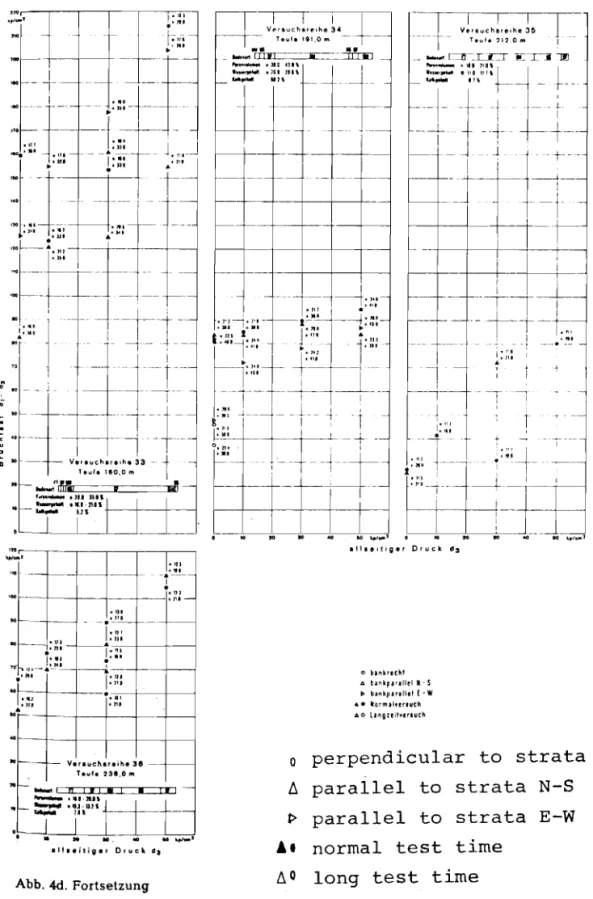
3 . E x p e r i m e n t a l r e s u l t s 3 . 1 I n v e s t i g a t i n g v a r i o u s l a y e r s o f t h e o v e r b u r d e n i n f r o z e n s h a f t s 3 . 1 . 1 O u t l i n e o f t h e b r e a k i n g s t r e n g t h a n d s t r a i n c u r v e s F i g u r e 3 shows t h e b r e a k i n g p o i n t s o f a l l n o r m a l t e s t s ( - 5 ' ~ a n d a b o u t o n e h c u r o f l o a d i n c r e a s e t o f a i l u r e ) f o r t h e 4 6 z o n e s . T h e r e i s a w i d e r a n g e o f p r o p e r t i e s i n t h e v a r i o u s z o n e s . Even b e f o r e a n y c l a s s i f i c a t i o n a c c o r d i n g t o p a r t i c u l a r c h a r a c t e r i s t i c s o r s o i l t y p e s and p r o p e r t i e s , i t i s a p p a r e n t t h a t t h e h i g h e s t b r e a k i n g s t r e n g t h s c o r r e s p o n d t o o n l y s l i g h t d e f o r m a t i o n v a l u e s , i . e . w e h a v e a r a t h e r " b r i t t l e " p a t t e r n . I n v e r s e l y , i n o t h e r m a t e r i a l s r e l a t i v e l y s m a l l b r e a k i n g s t r e n g t h s c o r r e s p o n d t o l a r g e d e f o r m a t i o n s , i n d i c a t i n g a more " p l a s t i c " b e h a v i o u r . N o t e t h e a l m o s t r e c t i l i n e a r c u r v e f o r t h e u p p e r b o u n d a r y o f t h e s c a t t e r i n g r a n g e . The l o w e s t b r e a k i n g s t r e n g t h s w e r e r e c o r d e d a t p r e c i s e l y 1 2 kg/cm2, a n d t h e h i g h e s t a t 214 kg/cm2, y i e l d i n g r e l a t i v e f a i l u r e s t r a i n s b e t w e e n 0 . 5 a n d 3 7 % o f t h e o r i g i n a l l e n g t h o f t h e s p e c i m e n . F i g u r e 4 i n c l u d e s a s e p a r a t e d i a g r a m f o r e a c h z o n e , showing t h e b r e a k i n g s t r e n g t h ( u l t i m a t e c o m p r e s s i v e s t r e n g t h ) as a f u n c t i o n o f t h e c o n f i n i n g p r e s s u r e . S u b f i g u r e s 4a t o 4 i show t h e z o n e s o f i n d i v i d u a l s h a f t s . F o r e a c h t e s t t h e r e i s a p o i n t , a n d t h e symbol i n d i c a t e s t h e s a m p l i n g d i r e c t i o n and t h e d u r a t i o n o f t h e t e s t ( n o r m a l o r l o n g - t e r m t e s t ) . A b a r d i a g r a m shows t h e t y p e o f s o i l i n t h e zone ( g r a i n s i z e d i s t r i b u t i o n a c c o r d i n g t o w e i g h t ) . The w a t e r c o n t e n t and p o r o s i t y o f e a c h s a m p l e a r e i n d i c a t e d b e s i d e t h e p o i n t showing t h e i r b r e a k i n g s t r e n g t h . Below t h e b a r d i a g r a m s i s t h e s c a t t e r i n g r a n g e o f t h e s e c h a r a c t e r i s t i c s f o r t h e s p e c i m e n s o f a z o n e , a s w e l l a s t h e l i m e c o n t e n t .
3.1.2 The dependence of the breaking strength and strain on various factors
Depending on the type of soil, the breaking strength more or less increases with the confining pressure, as occurs in unfrozen material. In these frozen specimens, non-cohesive soils exhibit a relatively sharp increase or high angle of internal friction, some reaching almost 40°, with yet some cohesion as a result of freezing. Examples are provided by
experiment series No. 8/9 from the Wulfen 1 shaft and No. 33
from the Sophia-Jacoba 6 shaft. In both these examples, the different breaking strength values can be clearly recognized on the basis of the sampling direction, despite some variation
of individual points (e.g, experiment series No. 33 or 12). In
the case of cohesive soils such as those in test series No. 22
and 61 from shaft IV
o on is berg)
and shaft V (Neukirchen-Vluyn)of MEAG, there is often no longer an increase in the frozen state, and this corresponds to an angle of friction of 0'. For the zones where it was possible to carry out longer load tests on the specimens (long-term tests with loads applied up to 100 hours), the recorded breaking strengths are also
indicated, using an open symbol. These values are basically lower than those of normal tests. To sum up the influence of
the rate of testing, we used figure 5 to plot the differences
between the breaking strengths of specimens under "normal" and substantially slower loading, expressed as the difference in the logarithms of the test times, over the breaking strength for a "normal" test period (cf. figures 16 and 19). Adjusting the scattering range shows that materials for which the normal test produced relatively high breaking strengths generally
exhibit a greater drop in strength with increased testing time. The influence of mineral cementation is observed here in
particular cases. Thus, for equal total strength, there is a
substantially sharper drop for lime-free zone No. 29 as opposed
lime content 25%). This may be an indication that the bond produced by ice in frozen soils is a significant factor in their strength characteristics.
There were considerable differences in breaking strengths among the results of normal tests for various zones. To probe deeper into this, we took the breaking strengths shown in
figure 4 from such normal tests in individual zones, and
arranged them in groups of similar soil type, not according to shafts (figure 6)
.
For this breakdown, the weight percentage of fine components was considered the essential element. The weight percentages of
grain sizes ~ 0 . 0 6
mm
were used as boundaries between individualgroups. For each group, the breaking strengths are shown in a separate diagram, again as a function of the confining pressure, according to the following breakdown:
C
Soil group with grains ~ 0 . 0 6
mm
in weight % Figure
<
5% 615% &25% 440%>40%, with a content of fine components (2 pm
<20% >20%
A comparison of these diagrams for six soil groups shows a marked influence of grain size. An analysis of the breaking
strengths for individual soil groups in figure 6 shows clearly
that strength, viewed as a whole, decreases with increasing fine content. In particular, there is a drop in the angle of internal friction. There is of course some amount of
fluctuation. Those fluctuations which occur within a
particular zone can be explained through local inhomogeneities for narrow ranges or for only one specimen (e.g. frost cracks filled with ice).
Differences in strength between zones for a soil type are partly the result of differences in the mean grain size and the grain size distribution, in porosity, in water
saturation, etc., as comparisons of these individual values with the breaking strength have shown. This does not explain the larger deviations upwards from the mass of tests results of a soil group. Another factor is responsible for this, namely cementation in the natural (unfrozen) state. A look at the lime contents entered in figure 6 at individual points shows clearly that there are significant lime contents
accompanying the higher breaking strengths. Figure 6 also shows that, especially for the coarser soil types, only relatively small strength values were reached, in spite of some higher lime conten,ts. In the case of very cohesive layers, on the other hand, the highest lime contents belong almost exclusively to the firmest specimens. The main
explanation,£or the variations in lime content is that, especially in the coarser materials, lime also occurs in the form of single grains, e.g. shelly sand, and in cohesive materials occasionally in concretions too. In either case, this in no way results in an increase in strength. The breaking strength is increased only if the lime is finely distributed and acts as a cement to form adhesive bonds between the grains or minerals. This type of cementation
is accompanied, in particular, by a marked increase in friction. For this cementation, the binder required for a corresponding increase in the breaking strength apparently increases as the grain size decreases. The only basic exceptions are zones 32, 35 and 36, with lime contents of
lime content 25%). This may be an indication that the bond produced by ice in frozen soils is a significant factor in their strength characteristics.
There were considerable differences in breaking strengths among the results of normal tests for various zones. To probe deeper into this, we took the breaking strengths shown in
figure 4 from such normal tests in individual zones, and arranged them in groups of similar soil type, not according to shafts (figure 6)
.
For this breakdown, the weight percentage of fine components was considered the essential element. The weight percentages of
grain sizes ~ 0 . 0 6 mm were used as boundaries between individual
groups. For each group, the breaking strengths are shown in a separate diagram, again as a function of the confining pressure, according to the following breakdown:
Soil group with grains <0.06 mm
in weight % Figure
6 5%
<15% 425%
4 4 0 %
>40%, with a content of fine components <2 pm
420% >20%
A comparison of these diagrams for six soil groups shows a marked influence of grain size. An analysis of the breaking strengths for individual soil groups in figure 6 shows clearly that strength, viewed as a whole, decreases with increasing fine content. In particular, there is a drop in the angle of internal friction. There is of course some amount of
fluctuation. Those fluctuations which occur within a
particular zone can be explained through local inhomogeneities for narrow ranges or for only one specimen (e.g. frost cracks filled with ice).
Differences in strength between zones for a soil type are partly the result of differences in the mean grain size and the grain size distribution, in porosity, in water
saturation, etc., as comparisons of these individual values with the breaking strength have shown. This does not explain
the larger deviations upwards from the mass of tests results of a soil group. Another factor is responsible for this, namely cementation in the natural (unfrozen) state. A look at the lime contents entered in figure 6 at individual points shows clearly that there are significant lime contents
accompanying the higher breaking strengths. Figure 6 also shows that, especially for the coarser soil types, only relatively small strength values were reached, in spite of some higher lime conten,ts. In the case of very cohesive, layers, on the other hand, the highest lime contents belong almost exclusively to the firmest specimens. The main
explanation.for the variations in lime content is that, especially in the coarser materials, lime also occurs in the form of single grains, e.g. shelly sand, and in cohesive materials occasionally in concretions too. In either case,
this in no way results in an increase in strength. The breaking strength is increased only if the lime is finely distributed and acts as a cement to form adhesive bonds between the grains or minerals. This type of cementation
is accompanied, in particular, by a marked increase in friction. For this cementation, the binder required for a corresponding increase in the breaking strength apparently increases as the grain size decreases. The only basic exceptions are zones 32, 35 and 36, with lime contents of
1.4%, 0.7% and 2.6% in the most cohesive soil group (figure 6f). They exhibit far greater strength values than other specimens with a comparable lime content. Another type of cementation is responsible for this. These three zones of
the Sophia-Jacoba shaft in ~Cckelhoven have their origin in
layers that form part of the "Aachen Cretaceous" system. According to information kindly provided by Dr. Stadler, the specimens of these layers contain a high proportion of well graded quartz grains in silt size. The quartz grains
are cemented together by a very fine-grained, weblike cement
comprising illite ~ l kaolin, which has a fairly dark d
pigmentation (from organic substances?). The texture is unusual: not clearly set as usual, but felty.
Dr. Stadler considers the cause of the abnormal breaking strength to be the compact clay cement, which may have an even greater strength because of the organic substances. In his opinion, the clayish cement may be saturated slightly with silicic acid (optically invisible). This would be in agreement with observations made in the Aachen area, where silicifications occur time and again in similar layers.
The intense weathering of the material
-
feldspar is nolonger present
-
could also point to this. It can neitherbe proven, nor excluded, that as a secondary result of the plutonism expected in this region, there may be a generally more pronounced diagenesis, perhaps as a result of the
higher thermal conductivity of the stones.
There was a third type of cementation in zone 8/9 from
the Wulfen I shaft, where finely distributed iron hydroxide,
in addition to lime, has also produced a marked stabilization effect. This zone exhibits the highest breaking strengths for the coarsest soil group.
The i n f l u e n c e o f l i m e c o n t e n t on t h e b r e a k i n g s t r e n g t h i s a l s o shown i n f i g u r e 7 , where t h e b r e a k i n g s t r e n g t h s a r e shown a s a f u n c t i o n o f l i m e c o n t e n t f o r a l l s o i l g r o u p s f o r a 3 = 30 kg/cm2. Keeping i n mind t h a t t h e h i g h e s t s t r e n g t h v a l u e s b e l o n g t o t h e p r e v i o u s l y d i s c u s s e d c a s e s o f a n o t h e r t y p e o f c e m e n t a t i o n , we have f o r t h e r e s t a g e n e r a l i n c r e a s e i n b r e a k i n g s t r e n g t h a s l i m e c o n t e n t i n c r e a s e s . A s a f u r t h e r i l l u s t r a t i o n , t a k i n g i n t o c o n s i d e r a t i o n t h e b r e a k i n g s t r a i n , w e t o o k t h e s o i l g r o u p s w i t h a s i l t - c l a y c o n t e n t o f o v e r 4 0 % , i n which t h e i n f l u e n c e of l i m e c o n t e n t i s e s p e c i a l l y e v i d e n t , and p l o t t e d i n f i g u r e 8 t h e b r e a k i n g p o i n t s f o r 0 3 = 30 kg/cm2, i . e . t h e b r e a k i n g s t r e n g t h a s a f u n c t i o n of b r e a k i n g s t r a i n . The v a l u e s b r e a k down i n t o two g r o u p s h a v i n g r e l a t i v e l y low
s t r e n g t h v a l u e s f o r l a r g e d e f o r m a t i o n s , and v i c e - v e r s a . The
l a t t e r g r o u p i s formed of z o n e s which e x h i b i t a marked n a t u r a l
c e m e n t a t i o n ( l i m e , i r o n o r o t h e r ) . T h i s p r i m a r y c e m e n t a t i o n i s a l s o c h a r a c t e r i z e d by sudden f a i l u r e u n d e r s l i g h t deforma- t i o n . T h i s d i f f e r e n c e i s shown c l e a r l y i n t h e p i c t u r e s o f t a b l e 1 ( s p e c i m e n s a f t e r l o a d i n g ) . The s p e c i m e n s a r e from z o n e s which a r e d e p i c t e d i n f i g u r e 8 e i t h e r a t t h e f a r u p p e r l e f t o r l o w e r r i g h t , and t h e y a l l had i d e n t i c a l d i m e n s i o n s a t t h e b e g i n n i n g . The breakdown o f t h e c o h e s i v e s o i l s u n d e r h i g h e r l a t e r a l p r e s s u r e ( 0 3 = 30 kg/cm2) i n t o two s u c h r a n g e s may a l s o b e an i n d i c a t i o n t h a t i n a d d i t i o n t o a n ' l i c e c e m e n t a t i o n " , t h e r e i s p o s s i b l y a n o t h e r t y p e o f bond between t h e g r a i n s . 3.2. S e r i e s o f e x p e r i m e n t s w i t h s o i l t y p e s o f w i d e l y v a r y i n g g r a i n s i z e and m i n e r a l c o m p o s i t i o n To i n v e s t i g a t e more f u n d a m e n t a l d i f f e r e n c e s i n t h e b e h a v i o u r o f v a r i o u s s o i l t y p e s i n t h e p r e s e n c e o f f r o s t , we needed a g r e a t e r number o f s a m p l e s . W e t h e r e f o r e c h o s e t h r e e s e d i m e n t s o f w i d e l y d i f f e r e n t g r a i n s i z e , which were w e l l a c c e s s i b l e ,
namely: lower terrace sand, Tertiary moulding sand and
Tertiary clay. It was also important, in making this choice, to ensure that there was no mineral cementation. This was
done, in the case of the Upper Oligocene moulding sand, by
taking samples only from the thick weathering zone. As for the Tertiary clay (Pilocene), it is a recent, lime-free deposit little exposed to precompression.
Figure 9 shows the grain size distribution of these
three types of soil. 't:e carried out systematic investigations
of the influence of loading time and temperature on these materials.
3.2.1 Lower-terrace sand (medium and coarse sand)
Non-cohesive sand from the Rhine's lower terrace was vibrated in steel cylinders under water (porosity about 31%), and frozen very slowly in the water-saturated state. We
also had available any number of smaller cylindrical
specimens 3.6 cm in diameter and 9 cm high, as well as
larger ones 7 cm in diameter and 17.5 cm high.
3.2.1.1 Uniaxial creep tests
Cylindrical specimens of the smaller dimensions were placed in the cold room and subjected to a predetermined axial pressure in each case by means of levers. To prevent evaporation, their surface was protected with a thin rubber membrane, and their end faces with steel plates. Using dial indicators, we recorded the gradual compression under each constant load. Figure 10 shows the compression of a specimen as a function of time, under a load that increased progressively by 3.75 kg/cm2. As can be seen, the compression increased relatively fast when the load was first applied, and then slowed down increasingly until it was almost at
r e s t . T h i s p r o c e s s was r e p e a t e d when t h e l o a d was i n c r e a s e d t o t h e n e x t l e v e l , whereby t h e f i n a l s e t t l e m e n t i n e a c h c a s e w a s n o t o n l y p r o p o r t i o n a l t o t h e l o a d a p p l i e d , b u t i n c r e a s e d p r o g r e s s i v e l y a s t h e l o a d a p p r o a c h e d t h e b r e a k i n g s t r e n g t h . I n t h e o t h e r u n i a x i a l c r e e p t e s t s , t h e l o a d a p p l i e d t o e a c h specimen was k e p t c o n s t a n t a l m o s t w i t h o u t e x c e p t i o n d u r i n g t h e e n t i r e t e s t . F i g u r e 11 shows t h e r e c o r d e d c o m p r e s s i o n v a l u e s , a g a i n a s a f u i l c t i o n o f t i m e . T h i s d i a g r a m l e a v e s a n
o b s c u r e i m p r e s s i o n a t f i r s t . The main r e a s o n f o r t h i s may b e
t h a t t h e i n i t i a l s e t t l e m e n t v a l u e s f l u c t u a t e s h a r p l y , s o t h a t
dependence on t h e l o a d l e v e l i s made more o b v i o u s o n l y l a t e r .
These i r r e g u l a r i t i e s a t t h e b e g i n n i n g of t h e t e s t c a n b e
e x p l a i n e d by t h e r o u g h n e s s of t h e specimen f a c e s , i n a d d i t i o n t o which t h e r e may a l s o have been n o t i c e a b l e i n h o m o g e n e i t i e s i n t h e specimen i t s e l f a t h i g h e r l o a d s .
I n c o n t r a s t t o t h e l a r g e d i f f e r e n c e s which o c c u r r e d d u r i n g t h e f i r s t two t o f o u r h o u r s a f t e r t h e l o a d was a p p l i e d , t h e r e was much b e t t e r a g r e e m e n t , f o r e q u a l l o a d s , i n t h e s u b s e q u e n t
c o m p r e s s i o n v a l u e s . The e s s e n t i a l p o i n t t o b e made i s t h a t ,
d e p e n d i n g on t h e s i z e o f t h e l o a d , t h e r e s u l t was one o f two b a s i c a l l y d i f f e r e n t b e h a v i o u r p a t t e r n s :
( a ) With l o a d s up t o 2 5 kg/cm2, t h e c o m p r e s s i o n s l o w s down
more and more d u r i n g t h e f i r s t one o r two d a y s u n t i l i t i s p r a c t i c a l l y damped o u t .
( b ) With l o a d s o f more t h a n 2 5 kg/cm2, tl!e c o m p r e s s i o n
i n c r e a s e s s t e a d i l y , whereby a t f i r s t t h e r e can s t i l l o c c u r a t e m p o r a r y s l o w i n g down, i n p a r t i c u l a r u n d e r o n l y s l i g h t l y g r e a t e r l o a d s .
With this material and at this temperature, the boundary between the two patterns appears to be precisely 25 kg/cm2, since below that load almost all the specimens followed the behaviour pattern in a), whereas one specimen can be con-
sidered as a transition towards b). It may be, then, that
the limiting creep stress, in terms of the strength of materials, lies precisely at this point.
A few specimens were unloaded, once deformation had
reached a standstill. As can also be seen from figure 11, only a small part of the compression was thereby restored.
If the load was then applied once again, the compression was only slightly greater than the level reached before unloading occurred.
For the sake of comparison, creep tests were also carried out with ice cylinders of the same dimensions. These specimens were prepared with distilled, deaerated water placed in thin-walled metal pipes; they were glass- clear and frozen only gradually inside a larger volume of water, under vacuum, so as to prevent any inhomogeneities and cracks. There was a greater fluctuation in the
behaviour of these specimens than in the frozen sand samples. Thus there was only an approximate indication for the limiting creep stress. This may be between 5 and 10 kg/cm2 for - ~ O C , and perhaps a little higher according
to results of individual tests. In a comparative test with rapid load increase to failure, the latter occurred after two minutes under a load of 40 kg/cm2.
3.2.1.2 Triaxial compression tests
To further investigate the strength and deformation behaviour of these non-cohesive sands, we also carried out
t r i a x i a l c o m p r e s s i o n t e s t s w i t h c y l i n d r i c a l s p e c i m e n s o f t h e l a r g e r d i m e n s i ~ n s . The e x p e r i m e n t a l p r o c e d u r e c o r r e s p o n d e d t o t h a t u s e d f o r t h e n o r m a l t e s t w i t h s p e c i m e n s t a k e n f r o m s h a f t s , i . e . , a f t e r c o n s o l i d a t i o n u n d e r c o n f i n i n g p r e s s u r e , t h e l o a d was i n c r e a s e d t o f a i l u r e a t a c o n s t a n t r a t e w i t h i n a p e r i o d o f a b o u t o n e h o u r . T h i s a l l o w e d u s t o o b s e r v e t h e b e h a v i o u r p a t t e r n s u n d e r v a r i o u s c o n f i n i n g p r e s s v . r e s a n d a t v a r y i n g temperatures. The t e s t s w e r e c a r r i e d o u t a t a m b i e n t t e m p e r a t u r e , - 5 ' ~ a n d - 1 5 ' ~ ~ i n e a c h c a s e u n d e r c o n s t a n t c o n f i n i n g p r e s s u r e s o f 0 t o 50 kg/cm2. F i g u r e 1 2 shows some t y p i c a l l o a d s e t t l e m e n t c u r v e s f o r t e s t s w i t h n o n - f r o z e n m a t e r i a l a s w e l l a s f o r t h r e e t e s t s a t - 5 ' ~ ~ 50 kg/cm2 l a t e r a l p r e s s u r e a n d a v a r y i n g r a t e o f l o a d i n g . The f i n a l s e t t l e m e n t v a l u e s f o r t h e u n i a x i a l c r e e p t e s t s c a r r i e d o u t a t - 5 ' ~ ~ r e c o r d e d u n d e r l o a d s up t o t h e l i m i t i n g c r e e p s t r e s s ( i d e n t i f i e d by a b r o k e n l i n e ) , a r e p l o t t e d i n e a c h c a s e o v e r t h e i r l o a d v a l u e . The f i n a l s e t t l e m e n t v a l u e s f o r t h e u n i a x i a l c r e e p t e s t s w e r e r o u g h l y e q u a l t o t h e s e t t l e - m e n t v a l u e s f o r t h e u n f r o z e n s p e c i m e n s u b j e c t e d t o a c o n t i n u o u s l o a d u n d e r a l a t e r a l p r e s s u r e o f 1 0 kg/cm2, f o r e q u a l a x i a l e x c e s s l o a d s . The p o i n t s c o r r e s p o n d i n g t o t h e f i n a l s t a g e o f t h e c r e e p t e s t s l i e r o u g h l y a l o n g t h e l o a d s e t t l e m e n t c u r v e o f t h e t r i a x i a l t e s t u n d e r a l a t e r a l p r e s s u r e o f 1 0 kg/cm2, o r e l s e t h e y s p r e a d t o w a r d s somewhat l a r g e r s e t t l e m e n t v a l u e s . Thus t h e c o n s o l i d a t i o n o f s a n d f r o z e n a t - 5 ' ~ may c o r r e s p o n d r o u g h l y t o a c o n f i n i n g p r e s s u r e o f 9 kg ~ m on t h e same / ~ m a t e r i a l i n t h e u n f r o z e n s t a t e . The l o a d s e t t l e m e n t c u r v e s f o r t r i a x i a l t e s t s a t - ~ O C , a c o n f i n i n g p r e s s u r e o f 50 kg/cm2 a n d v a r y i n g l o a d i n g t i m e s o f 0 . 3 8 t o s i x h o u r s e x h i b i t a "more b r i t t l e " b e h a v i o u r a s o p p o s e d t o t h e u n f r o z e n s a n d . I n s p i t e o f some f l u c t u a t i o n i n t h e b r e a k i n g s t r e n g t h , i t i s a p p a r e n t t h a t t h e f i n a l s e t t l e m e n t v a l u e s i n c r e a s e a s l o a d i n g t i m e i n c r e a s e s .
F i g u r e 1 3 shows t h e b r e a k i n g s t r e n g t h v a l u e s f o r t h r e e d i f f e r e n t t e m p e r a t u r e s a s a f u n c t i o n o f t h e c o n f i n i n g p r e s s u r e . The v a l u e s b e l o n g i n g t o o n e t e m p e r a t u r e a r e l i n k e d t o g e t h e r by s t r a i g h t l i n e s . I n e a c h c a s e t h e y l i e a l o n g r o u g h l y s t r a i g h t l i n e s , which i n c r e a s e w i t h t h e c o n f i n i n g p r e s s u r e . The medians o f t h e t h r e e e x p e r i m e n t s e r i e s a r e n o t q u i t e p a r a l l e l , however, b u t a r e somewhat f l a t t e r a t f r e e z i n g t e m p e r a t u r e s . T h i s means t h a t t h e a n g l e of f r i c t i o n i s r e d u c e d s l i g h t l y b y f r e e z i n g . On t h e o t h e r hand, f r e e z i n g produced c o h e s i o n , which i n c r e a s e s a s t h e t e m p e r a t u r e d r o p s . F o r t h e t e s t s a t - 1 5 ' ~ ~ f o r example, t h e r e w a s on t h e a v e r a g e an a n g l e o f f r i c t i o n o f 26Oand a
c o h e s i o n o f a b o u t 40 kg/cm2.
3.2.2 Upper O l i g o c e n e moulding s a n d ( f i n e s i l t y s a n d )
The f i n e s i l t y s a n d , which i s r e l a t i v e l y more p l a s t i c a s a r e s u l t o f heavy g l a u c o n i t e a d m i x t u r e (moulding s a n d ) , i s found i n l a r g e r m i n e s o f t h e V i e r s e n h o r s t , from which w e
w e r e a b l e t o t a k e a s u f f i c i e n t number o f c o n ~ p a r a b l e s p e c i m e n s . These l a y e r s b e l o n g i n g t o t h e " O l i g o c e n e s e a s a n d " h a v e a wide d i s t r i b u t i o n , and m u s t a l s o b e d r i l l e d t h r o u g h i n t h e f r o z e n s h a f t s o f t h e Lower Rhine. The p o r o s i t y i s a b o u t 4 0 % , and i n t h e s p e c i m e n s i n v e s t i g a t e d i s w a t e r - f i l l e d t o 30-70%. P l o t t i n g t h e b r e a k i n g s t r e n g t h i n terms of w a t e r s a t u r a t i o n showed t h a t f o r t h i s r a n g e t h e r e was s t i l l no dependence between t h e two. I n v i e w o f p r e v i o u s o b s e r v a t i o n s of t h e i n f l u e n c e o f t h e s a m p l i n g d i r e c t i o n on t h e specimens ( a n i s t r o p y ) (Neuber & W o l t e r s 1 9 6 3 ) , o n l y s p e c i m e n s p e r p e n d i c u l a r t o s t r a t a a r e d e a l t w i t h below. . F i g u r e 1 4 shows t y p i c a l l o a d s e t t l e m e n t c u r v e s f o r d i f f e r e n t t e m p e r a t u r e s and d i f f e r e n t r a t e s of l o a d i n g . The s t r a i n c u r v e s a r e g i v e n f o r e a c h g r o u p a t a g i v e n t e m p e r a t u r e
and t e s t t i m e , and f o r s e v e r a l c o n f i n i n g p r e s s u r e s o r u n i a x i a l t e s t s . The g r o u p s a r e a r r a n g e d i n s u c h a way t h a t t h e d u r a t i o n of t h e t e s t i n c r e a s e s from l e f t t o r i g h t , and t h e e x p e r i m e n t a l t e m p e r a t u r e i n c r e a s e s from t o p t o bottom. F o r t h e r a t e o f l o a d i n g u s e d i n t h e "normal t e s t " , t h e s p e c i m e n s w e r e i n v e s t i - g a t e d a t f o u r d i f f e r e n t t e m p e r a t u r e s . The i n f l u e n c e o f t h e r a t e o f l o a d i n g o r t e s t i n g t i m e was d e t e r m i n e d a t - 5 ' ~ f o r p e r i o d s o f a b o u t 0 . 1 t o 4 0 h o u r s . The b r e a k i n g s t r a i n i n c r e a s e d as t h e c o n f i n i n g p r e s s u r e i n c r e a s e d . On t h e o t h e r hand, we d i d n o t n o t i c e any e s s e n t i a l dependence e i t h e r on t h e t e m p e r a t u r e o r on t h e r a t e o f l o a d i n g . I t w a s n o t e d t h a t t o some e x t e n t t h e i n i t i a l i n c r e a s e i n t h e b r e a k i n g s t r a i n c u r v e f o r f r o z e n
s p e c i m e n s w a s more pronounced t h a n f o r u n f r o z e n o n e s , and t h a t t h e u n i a x i a l t e s t s a t lower f r e e z i n g t e m p e r a t u r e s , f a r from r e a c h i n g a h o r i z o n t a l end t a n g e n t , s u d d e n l y s h e a r e d o f f
-
a s i n a b r i t t l e f r a c t u r e . To b e t t e r show t h e r e l a t i o n between t h e b r e a k i n g s t r e n g t h , t h e c o n f i n i n g p r e s s u r e and t h e t e m p e r a t u r e , w e t o o k t h e s e v a l u e s f o r "normal" t e s t i n g t i m e s from t h e b r e a k i n g s t r a i n c u r v e s o f f i g u r e 1 4 and combined them i n f i g u r e 1 5 . T h e r e was a c l e a r i n c r e a s e i n s t r e n g t h a s a r e s u l t o f f r e e z i n g . The l i n e s c o n n e c t i n g t h e b r e a k i n g p o i n t s f o r u n f r o z e n and deep- f r o z e n s o i l s a r e p r a c t i c a l l y p a r a l l e l , i . e . t h e a n g l e of f r i c t i o n f o r t h i s m a t e r i a l r e m a i n s a b o u t t h e same, and t h e " c o h e s i o n " i n c r e a s e s a s t h e t e m p e r a t u r e d r o p s . A t r e d u c e d f r e e z i n g t e m p e r a t u r e s ( - 5 ' ~ ) and h i g h e r c o n f i n i n g p r e s s u r e s , t h e r e s u l t s were somewhat d i f f e r e n t . T h i s c o u l d mean t h a t t h e "bond between t h e g r a i n s " produced by f r e e z i n g a t - 5 ' ~ i s l o s t a g a i n a t h i g h e r p r e s s u r e s f o r t h e t e s t t i m e o f a b o u t o n e h o u r u s e d h e r e , i . e . , u n d e r s u c h c o n d i t i o n s , and w i t h t h i s m a t e r i a l , s l i g h t f r e e z i n g d o e s n o t i n c r e a s e s t r e n g t h .This is supported by the fact that there was a relatively low breaking strength in the - 5 ' ~ curve for a lateral pressure of 30 kg/cm2, whereas at - 1 5 ' ~ there was a corresponding drop only for a confining pressure of 50 kg/cm2. On the other hand, the lines connecting the breaking points for unfrozen and deep- frozen (-25'~) material run practically straight and parallel. With the unfrozen material, it is only in the lower loading range that the slight drop in the angle of friction occurs as the pressures increase. To determine more precisely the
influence of the rate of loading in frozen material, we also carried out tests of varying duration at -5'~. The breaking strength values recorded for various load times are plotted over a logarithmic time scale in figure 16, on the basis of the tests for the load deformation curves in figure 14. As opposed to the rapid tests lasting a few minutes, the break- ing points for "normal" and long-term tests lasting one to several hours are clearly lower. The drop is relatively large in the uniaxial tests. This pattern also supports the
explanation given with reference to figure 15, regarding the relatively low strength values for higher confining pressures at lower freezing temperatures.
3.2.3 Tertiary red clay (clayish silt)
For a very cohesive soil we chose a clay zone of the brown coal overburden, since there were good sampling possibilities in one of the open pits of the Lower Rhine area. The material investigated was so-called red clay and belonged to the Pliocene era. In terms of grain size, we were dealing with a clayish silt ( ~ 3 4 % of grains < 2pm)
(figure 9). According to radiographic analyses, the
mineral content was roughly as follows: about 25% quartz, about 25% mica (illite), about 40% kaoline (fireclay), 5%
The d r y d e n s i t y o f t h e c l a y s i n v e s t i g a t e d was a b o u t 1 . 9 2
g / c m 3 , whereby t h e p o r o s i t y was 27.3-28.7%. The m o i s t u r e
s a t u r a t i o n was p r a c t i c a l l y 1 0 0 % i n t h e f r o z e n s a m p l e s . F i g u r e shows t y p i c a l l o a d s e t t l e m e n t c u r v e s f o r t h e s p e c i m e n s i n v e s t i g a t e d , a r r a n g e d a c c o r d i n g t o t e m p e r a t u r e a n d r a t e o f l o a d i n g . A s i n t h e c o r r e s p o n d i n g i l l u s t r a t i o n o f t h e f i n e s i l t y s a n d ( f i g u r e 1 4 ) , h e r e t o o t h e i n d i v i d u a l g r o u p s a r e a r r a n g e d f r o m t o p t o b o t t o m f o r r i s i n g t e m p e r a t u r e s a n d f r o m l e f t t o r i g h t f o r i n c r e a s e d l o a d times. A s f o r t h e b r e a k i n g s t r a i n , t h e s c a t t e r i n g r a n g e d i d n o t show a n y c l e a r d e p e n d e n c e e i t h e r o n t h e s e p a r a m e t e r s o r on t h e c o n f i n i n g p r e s s u r e . A t t h e lowest t e m p e r a t u r e and f a s t e s t r a t e o f l o a d i n g , t h e r e was a d r o p i n t h e b r e a k i n g s t r a i n . I f w e compare t h e l o a d s e t t l e m e n t c u r v e s o f u n f r o z e n m a t e r i a l w i t h t e s t g r o u p s o f f r o z e n s o i l o f e q u a l b r e a k i n g s t r e n g t h , t h e u n f r o z e n s p e c i m e n s , a s o p p o s e d t o t h e f i n e s i l t y s a n d ( f i g u r e 1 4 ) , e x h i b i t s h a r p e r i n i t i a l t a n g e n t s . A s t h e t e m p e r a t u r e d r o p s a n d t h e r a t e o f l o a d i n g i n c r e a s e s , t h e r e i s a c l e a r i n c r e a s e i n t h e b r e a k i n g s t r e n g t h o f t h e f r o z e n s a m p l e s , i . e . t h e r e i s a n i n c r e a s e from t h e l o w e r r i g h t g r o u p t o t h e u p p e r l e f t . A t a r e d u c e d f r e e z i n g t e m p e r a t u r e ( - 5 ' ~ ) ~ t h e r e i s n o b a s i c d i f f e r e n c e a s compared t o t h e u n f r o z e n s a m p l e s . To s t u d y t h e s e r e l a t i o n s h i p s i n g r e a t e r d e t a i l , w e c o m p i l e d t h e b r e a k i n g s t r e n g t h s f o r v a r i o u s e x p e r i m e n t a l c o n d i t i o n s i n f i g u r e s 1 8 a n d 1 9 . F i g u r e 1 8 shows t h e b r e a k i n g s t r e n g t h a s a f u n c t i o n o f t h e c o n f i n i n g p r e s s u r e a t d i f f e r e n t t e m p e r a t u r e s f o r " n o r m a l " l o a d t i m e s . T h e r e i s a b a s i c d i f f e r e n c e w i t h r e s p e c t t o t h e r e s u l t s o f t h e s a n d y s o i l t y p e s c o n s i d e r e d s o f a r , i n t h a t h e r e t h e f r o z e n c l a y s show p r a c t i c a l l y n o more i n c r e a s e i n t h e c o n n e c t i n g l i n e s , i . e . t h e r e i s no l o n g e r any i n t e r n a l f r i c t i o n , Only a t t h e l o w e s t t e m p e r a t u r e s i s t h e r e a s l i g h t i n c r e a s e , w h i c h i s more c l e a r l y e l i m i n a t e d w i t h s h o r t e r l o a d t i m e s ( c f . f i g u r e 1 7 ) . The c o h e s i o n i n c r e a s e s f a l r l y e v e n l y a s t h e t e m p e r a t u r e d r o p s . A t r e d u c e d f r e e z i n g t e m p e r a t u r e s
( - 5 ' ~ ) ~ t h e d i f f e r e n c e w i t h r e s p e c t t o t h e u n f r o z e n s t a t e o n l y o c c u r s i n t h e r a n g e o f l o w e r c o n f i n i n g p r e s s u r e s . I t i s t r u e t h a t t h e u n f r o z e n s a m p l e s show some i n t e r n a l f r i c t i o n a t l o w e r p r e s s u r e s ( b e l o w 0 3 = 2 0 k g / c m 2 ) . T h i s s i m p l y c o n f i r m s , f o r t h e c l a y a s f o r t h e f i n e s i l t y s a n d , t h a t f r e e z i n g a t j u s t a few d e g r e e s below z e r o d o e s n o t p r o d u c e a n y i n c r e a s e i n b r e a k i n g s t r e n g t h u n d e r h i g h e r p r e s s u r e s , i . e . a t g r e a t e r d e p t h s . I n t h i s s o i l m a t e r i a l , t h i s may b e d u e t o t h e f a c t t h a t h i g h e r stresses a r e r e a c h e d w i t h t h e c a p i l l a r y w a t e r a s a r e s u l t o f t h e m o l e c u l a r f o r c e s o f a t t r a c t i o n , a n d t h e s e s t r e s s e s l o w e r t h e f r e e z i n g p o i n t . A c c o r d i n g t o B e r n a t z i k ! 1 9 4 7 ) , it may b e t h a t o n l y p a r t o f t h e p o r e - w a t e r i s f r o z e n i n t h i s c l a y a t - 5 ' ~ . T h i s i s enough t o i n c r e a s e t h e " c o h e s i o n " c o n s i d e r a b l y a t low p r e s s u r e s . I n l i n e w i t h t h e r e s u l t s f o r f i n e s i l t y s a n d , f i g u r e 1 9 shows, f o r t h e r e d c l a y , t h e i n f l u e n c e of t h e r a t e o f l o a d i n g o n t h e b r e a k i n g s t r e n g t h ; t h e r e w e r e g r e a t e r e x p e r i m e n t a l v a r i a t i o n s h e r e , and s o t h e r e s u l t s f o r d i f f e r e n t t e m p e r a t u r e s a r e a l s o shown. Here t o o t h e r e i s a g e n e r a l l y c l e a r d r o p i n s t r e n g t h a s t h e l o a d t i m e i n c r e a s e s ( d e c r e a s i n g r a t e o f l o a d i n g ) , w i t h a p a r t i c u l a r l y l a r g e d r o p i n t h e r a n g e of t h e l o w e s t f r e e z i n g t e m p e r a t u r e ( - 2 5 ' ~ ) a n d t h e h i g h e s t c o n f i n i n g p r e s s u r e ( 5 0 k g / c m 2 ) . T h i s i s i n l i n e w i t h t h e o b s e r v a t i o n m e n t i o n e d a b o v e , t h a t t h e r e was a l s o some i n t e r n a l f r i c t i o n i n t e s t s a t t h e l o w e s t t e m p e r a t u r e u n d e r t h e f a s t e s t l o a d i n g . T h a t t h i s i s n o l o n g e r t h e c a s e f o r a l l o t h e r e x p e r i m e n t a l c o n d i t i o n s , h o w e v e r , i s a l s o i n d i c a t e d b y t h e c o i n c i d e n c e o f t h e c u r v e s f o r v a r i o u s c o n f i n i n g p r e s s u r e s a t t h e i n d i v i d u a l t e m p e r a t u r e s .
3.3 Comparative b e h a v i o u r o f t h e i n d i v i d u a l s o i l t y p e s and e v a l u a t i o n o f t h e e x p e r i m e n t a l r e s u l t s I n o r d e r t o compare t h e r e s u l t s o f e x p e r i m e n t s e r i e s on s o i l s t h a t c l e a r l y e x h i b i t e d no m i n e r a l c e m e n t a t i o n w i t h t h e b r e a k i n g s t r e n g t h s o f s a m p l e s from m i n i n g s h a f t s , w e p l o t t e d t h e a p p r o p r i a t e v a l u e s from f i g u r e s 1 3 , 1 5 and 18 i n f i g u r e 6 f o r t h o s e s o i l g r o u p s t o which t h e y c o u l d b e a s s i g n e d . The b r e a k i n g s t r e n g t h s f o r t h e e x p e r i m e n t s e r i e s i n f i g u r e s 6 a , Ed and 6f w e r e c o n n e c t e d by s t r a i g h t l i n e s . I f we c o n s i d e r t h e g r o u p o f s a n d m a t e r i a l w i t h n o t more t h a n 5% s i l t - c l a y f o r t h e l o w e r t e r r a c e , t h e c u r v e r u n s r o u g h l y i n t h e m i d d l e o f t h e s c a t t e r i n g r a n g e f o r i n v e s t i g a t i o n s o f t h e z o n e s . T h i s s a n d from t h e l o w e r t e r r a c e i s c o a r s e r t h a n t h e s a m p l e s t a k e n from t h e s h a f t s . I t h a s no f i n e s c o n t e n t . A s a r e s u l t , i t r i g h t l y l i e s w i t h i t s b r e a k i n g s t r e n g t h s a t t h e u p p e r l i m i t o f t h e n o n - c o n s o l i d a t e d s a n d s o f t h i s g r o u p . Here t o o t h e i n c r e a s e w i t h c o n f i n i n g p r e s s u r e ( i n t e r n a l f r i c t i o n ) i s more pronounced t h a n t h e lower s c a t t e r i n g r a n g e l i m i t . Above i t
t h e r e a r e p r a c t i c a l l y o n l y s a n d z o n e s showing d e f i n i t e m i n e r a l c e m e n t a t i o n . The l e v e l of t h e b r e a k i n g s t r e n g t h s o f t h e lower- t e r r a c e sand i n t h e s c a t t e r i n g r a n g e o f i t s c o r r e s p o n d i n g s o i l g r o u p f o r t h e zone i n v e s t i g a t i o n s c a n t h e r e f o r e b e e x p l a i n e d u n e q u i v o c a l l y , and i s i n f u l l a g r e e m e n t w i t h t h e e x p l a n a t i o n s g i v e n on page 1 6 . T h e r e i s a s i m i l a r c o r r e s p o n d e n c e when w e compare t h e f i n e s i l t y sand u s e d i n t h e e x p e r i m e n t s e r i e s w i t h t h e c o r r e s p o n d i n g s o i l g r o u p ( f i g u r e 6d) from t h e s h a f t z o n e s . The v a l u e s o f t h e s h a f t s a m p l e s which d e v i a t e s h a r p l y upwards r e f e r o f c o u r s e t o cemented l a y e r s . The o t h e r m a t e r i a l s f a l l w i t h i n t h e s c a t t e r i n g r a n g e , e x c e p t f o r zone No. 4 7 , whose b e h a v i o u r p a t t e r n i s t y p i c a l o f a s t r o n g l y c o h e s i v e s o i l . T h i s i s i n agreement w i t h t h e d a t a on i t s g r a i n s i z e d i s t r i - b u t i o n i n f i g u r e 4 f . I t h a s a r e l a t i v e l y h i g h v e r y - f i n e c o n t e n t f o r good g r a i n s i z e d i s t r i b u t i o n . The v a l u e s of
zone 28 which deviate downwards for a confining pressure of a 3 = 50 kg/cm2 confirm the observations made on pages 16-18 for this fine silty sand material, whereby reduced freezing temperatures ( - 5 ' ~ ) for higher confining presscres do not further provide a significant increase in strength.
The strength curve of the red clay borders downwards on the range of variation of the corresponding soil group
(cf. figure 6f). This is in agreement with its higher clay content in the absence of cementation. The more sharply deviating value of zone 24 under uniaxial loading can be explained by the fact that this marl (lime content about 62%) had more cracks; in fact, only two specimens could be placed in the experimental equipment. The influence of cementation on the higher failure values of this group was discussed on pages 9-11.
One result of this comparison of breakin9 strengths for experiment series with those for zone experiments may be the definite influence of material composition for
frozen soil. The experiment series had also shown the significance of temperature and rate of loading. As a general outline of the temperature factor, figure 20
contains the mean values for the shear parameters normally used, i..e. cohesion and angle of internal friction, for the three different soil materials under normal load times as a function of the test temperature. These friction and cohesion values follow straight lines which determine the variations of the corresponding experimental values for the total pressure range in each case ( 0 3 = 0 . . . 5 0 kg/cm2).
The angle of friction is lower at a reduced freezing temperature, as opposed to the unfrozen state; in fact, the more fine-grained the material, the more it drops. This drop is relatively unimportant for the non-cohesive
material, whereas for the strongly cohesive soil the internal friction is practically entirely suppressed. With increasing freezing temperatures, it increases again quite fast for the slightly cohesive soil layers, and for very cohesive soils
only at still lower temperatures. With the drop in temperature, freezing produces a fairly equal increase in cohesion per degree for sand and clay. There is a practically linear increase for the clay in the temperature range studied (down to - 2 5 ' ~ ) ~ whereas the sand exhibits a particularly sharp increase at reduced temperatures. As for the fine silty sand, there is also a relatively large increase in the first portion of the freezing range, but as the temperature drops further, only slightly higher values are reached. Whereas the angle of internal friction drops in the same way as the grain size from sand to silty sand to clay, the cohesion is smallest
for the medium grain size. This sequence is in agreement with the degree of frost sensitivity of the various soil types. We know from experience that the material with the lowest cohesion values is also the most frost-sensitive, whereas pure sand is
insensitive to frost, and shows here the highest cohesion values. The clay occupies an intermediate position for both
these aspects.
The influence of the rate of loading was observed in the
shaft zones and discussed on pages 7-8. In the corresponding
figure 5, following the experiment series, the results for the varying degrees of frozen clay were compared to the values for the normal experiments. The points were connected for each of -So, 15' and -25'~. These fit well in the overall picture and the explanation given above, that to the higher strength
produced by increased freezing under a normal load time there
corresponds a sharper drop in the breaking strength when the load time is increased. The results of the other experiment series are also in good agreement with the data in figure 5,
whereby for the lower-terrace sand even the difference between the uniaxial normal tests and the creep tests is quantitatively adjusted. This is an indication that for very long load
applications, freezing does not produce any significant
increase in strength. Figure 19 also shows, according to the results of just 100 hours, that strength values converge
sharply towards each other with increasing load times, at all temperatures and confining pressures. The experimental results may well indicate that the major technical success of freezing operations in shaft construction and construction engineering is as follows: freezing helps produce thick walls or arches in which the grain skeleton can transfer stresses, because its cohesion is assured by the ice bond. This applies generally to short-term loads, and in particular protects against collapse from vibrations. Another basic advantage of the freezing process is the watertightness of the frozen soil material.
In view of the firm relation between the results of the series and zone investigations, where the freezing strength depends on the composition of the material, the temperature and the load time, it should be possible to derive and justify predictions about the expected behaviour of any frozen soil. It must be pointed out, that the investigations were carried out in the ground area, and the cracks were avoided where possible. That these occasionally had some influence is evident from the variations. In applying the results to the mountain area, it must be kept in mind thzt cracks are
generally present there, and that additional cracks may result from the freezing process, especially in the case of cohesive soils. On the other hand, however, where there are cracks, the strength of ice can at least be taken into
consideration, as long as the freezing temperatures are maintained, since they are practically compensated thereby.
Inversely, when thawing occurs, conditions may become unfavourable as the cracks fill with water.
References
Bernatzik, W.: Baugrund und Physik.
-
310 S., ~ u r i c h (Schweiz. Druck- und Verlagshaus) 1947.Kalterherberg, J.: Ingenieurgeologische Untersuchungen in Gefrierschachten.
-
Fortschr. Geol. Rheinld. u. Westf., 15, S. 291-
324, 2 Taf., 18 Abb., Krefeld 1968.Kalterherberg, J. & Wolters, R.: Bodenphysikalische Untersuch- ungen im Niederrheinischen ~ e r t i a r und ihre Anwendung beim Schachtbau.
-
Fortschr. Geol. Rheinld. u. Westf., 1, S.73-83, 6 Abb., Krefeld 1958.Neuber, H. & Wolters, R.: Scherfestigkeit von Proben aus
verschiedenen geologischen Formationen in gefrorenem und ungefrorenem Zustand.
-
Z. deutsch. geol. Ges., 114, S.303-
317, 16 Abb., Hannover 1363.Figure 1. Map of North Rhine-Westphalia showing the sampling points.
1
-1
Westphalian Cretaceous Trough:
: . -.I
Lower Rhine Embayrnent-1
Shale Mountains of the RhineFormsand = moulding sand
Niederterrassensand = lower-terrace sand Rotton = red clay
NBAG> ( qluyn ) y ~ R h ~ l n ~ r c u s s r n 9 .--<,--,,-- NBAG IV (Ton~sbcrg ) X : Tr.c,hv,,5-
5
'-"
R h e ~ n ~ s c h e s r h e ~ n ~ s c h e I 1 I 0 5 0 100 km L-- I IF i g u r e 3 . S c a t t e r i n g r a n g e o f t h e b r e a k i n g p o i n t s of a l l s h a f t s a m p l e s i n v e s t i g a t e d ( t e m p e r a t u r e - ~ O C , c o n f i n i n g p r e s s u r e v a r y i n g between 0 and 5 0 k g / c m 2 ) O r d i n a t e : B r e a k i n g s t r e n g t h ( 0 1
-
0 3 ) kg/cm2 ~ ~ ~ ~ A b s c i s s a : B r e a k i n g s t r a i n E , 'g Numbers r e f e r t o t h e e x p e r i m e n t a l zone o r e x p e r i m e n t s e r i e s .Abh. 3 . S t ~ e u b e r e ~ c h d e r B r u c t ~ p u n k l t ~ d l l e r u n t r r s u c h t e ~ l S c l i d t h t p r o b c n ('rt'lnpe'.dtlIr - 5 ( ' ,
F i g u r e 4a. E x p e r i m e n t a l r e s u l t s o f f o u r z o n e s f r o m t h e Wulfen I s h a f t a t t h e M a t h i a s S t i n n e s AG c o a l m i n e s ( b r e a k i n g s t r e n g t h s a t - 5 ' ~ )
.
The s y m b o l s f o r f i g u r e s 4a t o 4 i a r e e x p l a i n e d w i t h f i g u r e 4d. O r d i n a t e : B r e a k i n g S t r e n g t h , ( 0 1-
0 3 I m a x A b s c i s s a : C o n f i n i n g p r e s s u r e , 0 3 E x p e r i m e n t s e r i e s 1 0 Depth 43.0 S o i l t y p e P o r o s i t y M o i s t u r e c o n t e n t L i m e c o n t e n t E x p e r i m e n t s e r i e s 12 D e p t h 1 6 0 . 5 m S o i l t y p e P o r o s i t y M o i s t u r e c o n t e n t Lime c o n t e n t E x p e r i m e n t s e r i e s 8 & 9 D e p t h 71.0 m S o i l t y p e P o r o s i t y M o i s t u r e c o n t e n t L i m e c o n t e n t E x p e r i m e n t s e r i e s 11 Depth 231.8 m S o i l t y p e P o r o s i t y M o i s t u r e c o n t e n t Lime c o n t e n t' ( 3 o~-- Faq u3lselpnla) 3~ sauugg se!qlew aqla~6laq~alq0y
Figure 4b. Experimental results of two zones from shaft 9
of the Rheinpreussen AG for mining and chemistry
(breaking strengths at -5'~)
.
Ordinate: Breaking strength,
( 0 1
-
0 3 ) ~ ~ ~Abscissa: Confining pressure, a 3 Experiment series 13 Depth 136.2
m
Soil type Porosity Moisture content Lime content Experiment series 14 Depth 141.1 m Soil type Porosity Moisture content Lime contentAbb. 4b. Untersuchungsergebnisse von zwei Horizonten aus Scfiacht 9 der RheinpreuDen AG fiir Rergbau und
Abb. 4c. U n t e ~ s u c l l u n g s e r g e b n i s s e v o n n e u n Horlzonten d u s Schaclit IV (Tiinisberg] der N i e d c r r h e i n i s d i e n R ~ r c j w e r k s - A ( ; (Bruchlaslen bei S oC)
F i g u r e 4c. Experimental results of nine zones from s h a f t
IV
( ~ 6 n i s b e r ~ ) of the Niederrheinische Berywerks-AG (breaking s t r e n g t h s at - 5 ' ~ ) .
Abb. 4 d . IJntersuchungsergebnisse v o n zehn Horizonten a u s S c h a c h t 6 tier Gebcrkschaft S o p h i a - J a c o b a ( R r t 1 t f i l a 5 t e n bei - 5 " C )
F i g u r e 4 6 . E x p e r i m e n t a l r e s u l t s o f t e n z o n e s from s h a f t 6 of
t h e G e w e r k s c h a f t S o p h i a - J a c o b a ( b r e a k i n g s t r e n g t h s
a 1 l a . i l i g . r D r u c k # I
Abb. 4d. Fortsetzung
Q perpendicular to strata
A
parallel to strata N-S P parallel to strata E-WA # normal test time


![Abb. 4c. U n t e ~ s u c l l u n g s e r g e b n i s s e v o n n e u n Horlzonten d u s Schaclit IV (Tiinisberg] d e r N i e d c r r h e i n i s d i e n R ~ r c j w e r k s - A ( ; (Bruchlaslen bei S o C)](https://thumb-eu.123doks.com/thumbv2/123doknet/14365474.503442/41.920.149.747.190.892/abb-u-horlzonten-schaclit-iv-tiinisberg-n-bruchlaslen.webp)