HAL Id: hal-01332678
https://hal.archives-ouvertes.fr/hal-01332678
Submitted on 17 Jun 2016HAL is a multi-disciplinary open access archive for the deposit and dissemination of sci-entific research documents, whether they are pub-lished or not. The documents may come from teaching and research institutions in France or
L’archive ouverte pluridisciplinaire HAL, est destinée au dépôt et à la diffusion de documents scientifiques de niveau recherche, publiés ou non, émanant des établissements d’enseignement et de recherche français ou étrangers, des laboratoires
and capitalize on talents
Melanie Souhait, Sébastien Chevalier, Lucie Hernandez
To cite this version:
Melanie Souhait, Sébastien Chevalier, Lucie Hernandez. TalentCampus, a training program to reveal, develop and capitalize on talents. VIII International Congress of Psychology and Education (CIPE 2016), Universidad de Alicante, Jun 2016, Alicante, Spain. �hal-01332678�
TALENTCAMPUS, A TRAINING PROGRAM TO REVEAL, DEVELOP AND CAPITALIZE ON TALENTS
M. Souhait,1 S. Chevalier,2 L. Hernandez,3
1 TalentCampus, Fondation of scientific cooperation, Dijon, France 2 Professor in IRM department, Burgundy University, Dijon, France
3 IREDU (Institute of Research in Education), Burgundy University, Dijon, France,
TalentCampus - Dijon, France,
CIRAP (Interdisciplinary Center of Applied research in the field of Prison), Enap - Agen, France
Abstract
Since 2012, the French project TalentCampus has set up training sessions to help people to develop their soft skills. TalentCampus was created in 2012 by a cluster of universities and higher education institutions, with a national agency for PhD support (ABG Intelli’agence). It was awarded funding through a national research call (IDEFI – french government investment for the future scheme).
The aim of TalentCampus is to increase excellence in higher education by exploring the development of soft skills. However, the training sessions are not only for higher education students. Indeed, the idea is for participants to discover themselves through exchanges with people from many different backgrounds.
Social background, age and disciplinary diversity are key factors in the success of TalentCampus sessions, which bring together high school pupils, students (from undergraduates to doctoral students), juniors and seniors professionals and job seekers. TalentCampus training sessions are based on active pedagogy, innovative content learning and collective immersion. It also creates training programs for companies or universities who have identified specific needs.
Set up as 3 to 5-day workshops during the school holidays, TalentCampus develops skills to complement academic ability, including self-confidence, communication, leadership, emotional intelligence, and stress management. The courses are supervised by specialists from many different fields: for example, sport teachers or actors.
Each training session is evaluated in order to know if the trainees have achieved the intended educational objectives. We will see in this communication what learners think about active pedagogy and mixed group during the training sessions.
The sessions started in 2012 in Bourgogne Franche-Comté region. National and international developments are in progress as the target of TalentCampus is to disseminate and to let diffuse its best practices at a national and international levels. Session development in education system, lifelong training, as well as scientific research development aims to reach this target.
Key words: soft skill; diversity; active pedagogy
TALENTCAMPUS, UN PROGRAMA DE CAPACITACIÓN PARA REVELAR, DESARROLLAR Y RESALTAR TALENTOS.
M.Souhait, 1, S.Chevalier, 2 L. Hernandez, 3
1 TalentCampus, Fundación de Cooperación científica, Dijon, Francia 2 Profesor en IRM Departamento de la Universidad de Borgoña, Dijon, Francia
3 IREDU (Insitut de Investigación sobre la educación), Universidad de Borgoña, Dijon,
France, TalentCampus - Dijon, France,
CIRAP (Centro Interdisciplinario de Investigación Aplicada sobre el Campo Penitenciario), Enap - Agen, France
Resumen
Desde el 2012, el proyecto francés TalentCampus ha creado cursos permitiendole a personas, desarrollar sus propias habilidades. TalentCampus fue creado por un grupo de universidades y escuelas de educación superior y una agencia nacional para apoyo de tesis doctoral (ABG Intelli'agence). Ha ganado una subvención nacional para la investigación (IDEFI - inversión para el futuro).
El objetivo es aumentar la excelencia en la educación superior mediante la exploración de desarrollo de habilidades interpersonales. Sin embargo, las capacitaciones no sólo se les proponen a los estudiantes de educación superior.
De hecho, la idea es que personas se descubran a través de intercambios con diferentes personas de otros niveles.
Procedencia social, edad y diversidad disciplinaria son factores claves para el éxito de las capacitaciones TalentCampus. Las sesiones reúnen adolescentes de escuela secundaria, los estudiantes (licenciatura, postgrado, doctorado), empleados y solicitantes de empleo. TalentCampus se basa en la pedagogía activa, el aprendizaje de contenido innovador e inmersión colectiva. TalentCampus también crea programas de capacitación para empresas o universidades que tienen necesidades específicas.
Propuesto en forma de talleres de 3 a 5 días durante las vacaciones escolares, TalentCampus desarrolla habilidades complementarias, habilidades académicas tales como la autoestima, comunicación, liderazgo, inteligencia emocional o manejo del estrés. Diferentes tipos de instructores imparten el curso de formación, como profesores del deporte o actores comediantes.
Cada sesión es evaluada para conocer si los alumnos logran objetivos educativos. Varias semanas o meses después de la formación, tienen que responder a preguntas sobre la utilidad de la capacitación. Es así cómo sabemos que las sesiones permiten descubrir o desarrollar sus propias habilidades. También sabemos que las personas se sienten más motivadas y quieren poner en marcha proyectos personales y profesionales. Su autoestima y confianza en sí mismos es mejor.
Las sesiones se llevan a cabo en áreas regionales, nacionales e internacionales. Los próximos retos del proyecto consiste en continuar con la difusión de mejores prácticas, publicaciones científicas y sesiones internacionales.
Palabras clave: habilidad o competencia social, habilidades interpersonales; diversidad; pedagogía activa.
1. Introduction
1.1. TalentCampus presentation
Since 2012, the IDEFI TalentCampus project (Excellence Initiative in Innovative Training - ANR-11-IDEFI-0035) has been setting up training sessions to give groups of people aged 16 to 61 (including high schoolers, undergraduates, postgraduates and doctoral students, professionals, job seekers, people of all ages) the opportunity to work on their social skills.
Considered as an "educational laboratory", the TalentCampus scheme, was born of a partnership between the Universities of Burgundy and Franche-Comté, the BFC Scientific Cooperation Foundation, the BFC Polytechnicum, the Dijon ESC Business School group and the ABG-Intelli'agence (a national research support non-profit).
1.2. Context of the research
The aim of TalentCampus is to enable everyone to discover and develop their social skills: to optimize the impact of their communication, to improve leadership, to increase self-confidence and self-esteem, to manage stress and feelings, to learn how to work in teams, etc.
This work on soft skills arose from the observation of a fact of French corporate life: young French graduates have excellent academic skills, but encounter difficulties with teamwork, or public speaking. Yet the professional knowledge required for a job does not only involve so-called "technical" or “academic” knowledge or skills, but also organizational and relational know-how. (Chatigny, 2001)
Moreover, the latest OECD report published in 2015 "Skills for Social Progress: The Power of Social and Emotional Skills" indicates that the notion of social skills has emerged as a central issue in the fields of education and training.
Therefore during the TalentCampus training sessions, through the group tasks presented to them, the participants learn to better identify their strengths, talents, and social skills. Depending on each individual’s project, the TalentCampus scheme allows them to better understand their inner motivations and desires and thus to define a more suitable subsequent curriculum, to pursue professional retraining, or even to integrate the labour market.
All the training sessions rely on active pedagogy: the learners often work in teams on a project, which affords them a core position in the learning process. In addition, TalentCampus sessions are set up for large groups (between 30 and 50 people).
Another asset of the TalentCampus scheme is diversity (cultural, generational, and social diversity), which allows participants to meet many different people and to learn from all of them. Younger people discover the experience of older participants and give their dynamism to them.
The purpose of this communication is to present TalentCampus, an innovative program for the development of social skills. We will first present the TalentCampus training sessions: who are the participants? How do they evaluate the training they receive?
We will then discuss the proposed pedagogy, a combination of diversity and large group work: why "mix" learners and why make them work in a large group? What are the benefits of these strategies? What are the limitations of the scheme?
Finally, we will extend the discussion to the limitations of such programs.
2. Method
The training sessions take place during the school holidays (i.e. 4 times per year) and accommodate all types of people eager to discover their own talents. Indeed, we can consider that each individual has one or more talents, which they may be aware of or which they may need to discover. This hypothesis echoes the cognitivist approach, which considers that social difficulties such as social anxiety or shyness come from the
inhibition of social skills (Nader-Grosbois, 2007; George, 2001; Wolpe, 1990 quoted by Emilien, 2003). Social skills would effectively have been acquired by the subject and are therefore present but, as they are inhibited by certain social situations, they cannot be used (George, 2001). The objective of TalentCampus training sessions is to work on such skills, so as to disinhibit them and allow the participant’s talent(s) to be revealed.
2.1. Participants
This work covers the period from February 2015 to February 2016, during which five training sessions, each lasting 3 to 5 days, were organized. About 200 people attended these sessions and, of those, 152 responded to the questionnaires handed out at the end of each session (more than 75% of responses). This is the data we present here.
During the TalentCampus training sessions, learners operate in a socio-constructivist context. Indeed, individuals are first and foremost social beings, who co-build their skills and knowledge through personal experience, interaction and confrontation with their social environment (Joannaert, 2009; Vygotsky, 1978). In this context, skills cannot simply be transmitted through decontextualized teaching (Joannaert, 2009).
That is why, during the TalentCampus training sessions, learners: - collaborate with a heterogeneous group of people, - participate actively in the learning process.
2.2. Measures
All the training sessions organized by TalentCampus are evaluated on 3 levels:
- An evaluation to determine the impact of the session on the learner's trajectory in the short, medium, and long term (mobility, ambition for further training and education, professional integration, etc.). Evaluation questionnaires are routinely sent to people who have received TalentCampus training, which provides information about the changes operated by the learner as a consequence of the training session.
- An evaluation of the impact of training on the learners' skills, conducted before and after the training session (use of psychological tests validated and published and put in place with the Paris Institute of Environmental Medicine).
- An assessment of the quality of the modules and of the entire training process (satisfaction survey).
This last declarative-type tool is the focus this communication. During, and just after the training session, the learners express their opinion about the proposed modules. The attainment of learning goals is also measured.
In addition to these three levels of evaluation, researchers from several fields of study (psychology, sociology, and education sciences) regularly observe the training sessions.
2.3. Procedure
The results presented below will focus on two questions that the students are asked at the very end of the training session:
- Was there real cohesion in the group? (in other words, is diversity beneficial?)
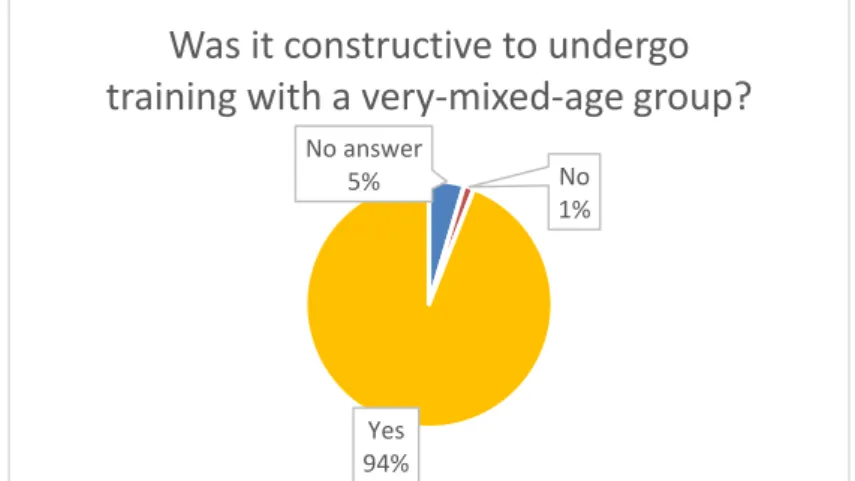
- In your opinion, was it constructive to undergo training with a very-mixed-age group?
3. Results
The socio-constructivist approach to training means that learners build their skills in a socio-cultural context. This means that each individual is active in the learning process and that all participants, their roles and representations, and their singular, subjective experiences are taken into consideration in this learning process.
Furthermore, in a socio-constructivist learning process, the construction of knowledge (know-how or life skills) occurs in groups and teams (of at least two people), in problem situations that require collaboration and confrontation of viewpoints: using one's own experiences and using the other to co-construct one's knowledge. We speak of "collaborative learning": the learner uses the group's resources to learn.
No answer
5% No
2%
Yes 93%
Was there real cohesion in the group?
No answer
5% No
1%
Yes 94%
Was it constructive to undergo
training with a very-mixed-age group?
In TalentCampus training sessions, the learner is confronted every day with problems to be tackled as a team of 5 or 6 people with very different profiles. Thus, a young 16-year-old high-schooler may be required to complete a team-project with people of over 50 or 60 years old and, as such, with long life experiences (unlike the teenager who can "only" attest to his or her short experience, but who is regarded by the older team-members as a source of energy and motivation, as a booster). Exchanging between team-mates is one of the assets of these sessions.
Indeed, in answer to the question “was there real cohesion in the group?”, 93% of respondents replied “yes, the group was united during the session”.
Figure 1: percentage of learners answering the question: was there real cohesion in the group?
In addition, 94% of learners say that undergoing training with people of very different ages is constructive.
Figure 2: percentage of learners answering the question: Was it constructive to undergo training with a very-mixed-age group?
The heterogeneity of the participants was, from the outset of TalentCampus in 2012, an essential criterion for the project leaders. The intention was indeed for everyone to benefit from the diverse experiences in the group during the training sessions. This collaborative learning process in a very heterogeneous group is a strong asset of the scheme, according to the learners, but also according to the trainers.
However, this socio-constructivist approach may be criticized as being difficult to apply in situations involving large groups. This is nonetheless a training format TalentCampus has been developing since 2014. Indeed, the assumption made by the project team is that exchanges will be maximized if learners work in sub-groups of 5-6 people, within a larger group of 30 to 50 people. Thus, the trainer becomes a facilitator who assists the sub-groups to achieve their common project goal. The members in the subgroups change every day to allow as many encounters as possible.
It turns out that 100% of respondents are positive about this method (50 students surveyed in October 2015 and February 2016). According to them, it helped them "to discover others", and "to feel comfortable by facilitating expression and risk-taking”. It also seems to "foster a sense of belonging to a group”. The participants also speak of “enrichment”, “attention”, “diversity” and “common problem-solving”. Finally, self-discovery (for oneself and through the eyes of the others) is a benefit of working in subgroups.
For many authors, it is methods such as those offered in TalentCampus training sessions, i.e. interactive and experiential methods where the learner is active, such as role-playing or scenarios, practical work on feelings and emotions, that are the most effective (Lamboy Shankland, 2011; Kirschner et al, 2006 cited by January et al, 2011;.. Rondeau et al., 2003). These methods appear to be more effective than those based on passive learning, with a combination of discussion and instruction (theoretical method) (January et al., 2011). For Rondeau et al. (2003), cooperative methods emphasizing social interaction and teamwork are also among the most effective.
4. Discussion
We have studied above the benefits of the innovative teaching method proposed in TalentCampus sessions. We have actually observed that diversity in training and the constant exchanges during group work phases are acknowledged by learners (figure 1&2) and by many authors as criteria of training efficiency.
We may however point out some limitations in the scheme, including the difficulty sometimes encountered by learners in working within a very heterogeneous group. Learners may find it hard to work within their teammates’ reference frameworks and the trainer must provide communication and group-work tools to make it possible to overcome these hurdles.
Moreover, it is recognized that a limit to the size of the group must be respected. According to Oosterbeek et al. (2010), this dimension may have an adverse effect on the program's outcome. Indeed, for project-based learning, it is important for the groups to be small enough for everyone to be able to find a role, a place and thus be able to express themselves.
Other limitations may be pointed out:
- Active learning is not universally known: do learners always adopt it naturally? How do the trainers transform their more traditional methods into active learning or even into project-based learning?
- In a system of recurring group-work, are intra-personal skills as developed as inter-personal skills? Would they be developed further if the students worked individually? What about self-esteem?
- From an evaluative point of view, how does one go about organizing the monitoring of the long-term impact of such schemes on learners? What about the program’s impact on professional integration and academic reorientation?
These questions are asked since the first training sessions created by TalentCampus. Different works on these subjects are in progress in order to study them and to answer these questions. Scientific works made on TalentCampus trainings showed tendencies
about intra-personal and inter-personal skills. Publications are in progress. The question about the long-term impact of the training sessions is determining: how this training can affect learners life (studies, work and personal life?). Effective monitoring of learners in the TalentCampus leraners network will allow analysis this parameter, while considering multiple factors contributing to the trajectory of an individual.
5. Conclusions
TalentCampus training sessions act on several aspects to enable people to develop their social skills:
- During a session, the learners work on different disciplines, such as communication, self-confidence, team working, etc.
- Heterogeneity of public is also a key point.
- Sessions rely on active pedagogy: the learners work in teams on a project and sessions are set up for large groups.
The first two aspects are main points of the training sessions since 2012. They remain key points in every training that TalentCampus creates. Learners, educational institutions and companies recognize that heterogeneity of public is a great benefice for the training.
The last point that TalentCampus team develops since 2014 is becoming a key point to. Indeed, the training sessions have to welcome big groups of students when they occur in high school or in university classes. According to learners, team works are a good way to discover their own competencies and to work on soft skills. The learners’ feedbacks encourage the development of this active pedagogy in large groups.
Innovation requires constant monitoring to know the benefits and limitations of these new methods. That is why, form the beginning of TalentCampus training sessions, ongoing assessments are essential.
The current challenge is to disseminate these innovative practices while continuing to innovate.
6. References
Chatigny, C. (2001). La construction de ressources opératoires. Contribution à la
conception des conditions de formation en situation de travail. Thèse de doctorat d’ergonomie. Conservatoire National des Arts et Métiers. Paris.
Chevalier, S, Arnold, D., Henry, M., Catinot, A. (2013). TalentCampus: novel approaches and environments to help learners reveal, develop and capitalize their talent, The Joy of Learning Enhancing Learning Experience - Improving Learning Quality, Proceedings of the European Distance and E-Learning (Network 2013 Annual Conference, Oslo, 12-15 June, 2013.)
George, G. (2001). Les thérapies d’affirmation de soi : applications et techniques chez les adolescents. Annales Médico-psychologiques, revue psychiatrique, 159(10), 717‑721.
January, A. M., Casey, R. J., & Paulson, D. (2011). A Meta-Analysis of Classroom-Wide Interventions to Build Social Skills: Do They Work? School Psychology Review, 40(2), 242-256.
Joannaert, P. (2009). Compétences et socioconstructivisme : un cadre théorique. Bruxelles : De Boeck.
Nader-Grosbois, N. (2007). Régulation, autorégulation, dysrégulation: pistes pour l’intervention et la recherche. Editions Mardaga.
OCDE. (2015). Skills for Social Progress: The Power of Social and Emotional Skills. Paris: Organisation for Economic Co-operation and Development.
Oosterbeek, H., M. van Praag, Ijsselstein, A. (2010). The impact of entrepreneurship education on entrepreneurship skills and motivation. European Economic Review, 54, 442-454.
Rondeau, N., & Centre international de résolution de conflits et de médiation (Éd.). (2003). Guide d’implantation des programmes d’habiletés sociales et de résolution de conflits en milieu scolaire. Montréal: C.I.R.M.
Shankland, R., Lamboy, B. (2011). Utilité des modèles théoriques pour la conception et l’évaluation de programmes en prévention et promotion de la santé. Pratiques Psychologiques, 17, 153-172.