Publisher’s version / Version de l'éditeur:
Journal of the Electrochemical Society, 144, 11, pp. 3715-3721, 1997
READ THESE TERMS AND CONDITIONS CAREFULLY BEFORE USING THIS WEBSITE. https://nrc-publications.canada.ca/eng/copyright
Vous avez des questions? Nous pouvons vous aider. Pour communiquer directement avec un auteur, consultez la première page de la revue dans laquelle son article a été publié afin de trouver ses coordonnées. Si vous n’arrivez pas à les repérer, communiquez avec nous à [email protected].
Questions? Contact the NRC Publications Archive team at
[email protected]. If you wish to email the authors directly, please see the first page of the publication for their contact information.
NRC Publications Archive
Archives des publications du CNRC
This publication could be one of several versions: author’s original, accepted manuscript or the publisher’s version. / La version de cette publication peut être l’une des suivantes : la version prépublication de l’auteur, la version acceptée du manuscrit ou la version de l’éditeur.
Access and use of this website and the material on it are subject to the Terms and Conditions set forth at
Dechlorination of monochlorobenzene using organic mediators
Kargina, O.; MacDougall, B.; Kargin, Yu. M.; Wang, L.
https://publications-cnrc.canada.ca/fra/droits
L’accès à ce site Web et l’utilisation de son contenu sont assujettis aux conditions présentées dans le site
LISEZ CES CONDITIONS ATTENTIVEMENT AVANT D’UTILISER CE SITE WEB.
NRC Publications Record / Notice d'Archives des publications de CNRC:
https://nrc-publications.canada.ca/eng/view/object/?id=73a61e92-644b-4c3d-b864-ac9faa708ca9
https://publications-cnrc.canada.ca/fra/voir/objet/?id=73a61e92-644b-4c3d-b864-ac9faa708ca9
J. Electrochem. Soc., Vol. 144, No. 11, November 1997 © The Electrochemical Society, Inc. 27. P. W. Crawford, E. Carlos, J. C. Ellegood, C. C. Cheng,
Q. Dong, D. F. Liu, and Y L. Luo, Electrochim. Acta, 41, 2399 (1996).
28. B. G. Szczepankiewicz and C. H. Heathcock, J. Org.
Chem., 59, 3512 (1994).
29. G. A. Charyulu, T. C. McKee, and C. M. Ireland,
Tetra-hedron Lett., 30, 4201 (1989).
30. P. H. Rieger, Electrochemistry, 2nd ed., Chapman and Hall, New York (1994).
31. G. Gritzner and J. Kuta, Pure Appl. Chem., 56, 461 (1984).
32. A. J. Bard and L. R. Faulkner, Electrochemical
Meth-ods, Wiley, New York (1980).
33. A. Ashnagar, J. M. Bruce, P. L. Dutton, and R. C. Prince, Biochim. Biophys. Acta, 801, 351 (1984). 34. P. Zuman, Substituent Effects in Organic
Polar-ography, Plenum Press, New York (1967).
35. R. J. Driebergen, E. E. Moret, L. H. M. Janssen, J. S. Blauw, J. J. M. Holthuis, S. J. Postma Kelder, W. Ver-boom, D. N. Reinhoudt, and W. E. Van Der Linden,
Anal. Chim. Acta, 257, 257 (1992).
36. H. Lund, in Organic Electrochemistry, 3rd ed., H. Lund and M. M. Baizer, Editors, p. 401, Marcel Dekker, New York (1991).
37. B. S. Jensen and V. D. Parker, J. Chem. Soc., Chem.
Commun., 367 (1974).
38. R. F Nelson, J. Electroanal. Chem., 18, 329 (1968). 39. J. Heinze, Angew. Chem. Int. Ed. Engl., 23, 831 (1984). 40. K. R. Kunz, B. S. Iyengar, R. T Dorr, D. S. Alberts, and
W. A. Remers, J. Med. Chem., 34, 2281 (1991). 41. S. S. Pan and H. Gonzalez, Molec. Pharmacol., 37, 966
(1990).
42. E. M. Hodnett, C. Wongwiechintana, W. J. Dunn III, and P. Marrs, J. Med. Chem., 26, 570 (1983).
43. C. Hansch and A. Leo, Exploring QSAR;
Fundamen-tals and Applications in Chemistry and Biology, p.
377, American Chemical Society, Washington, DC (1995).
44. W G. Schulz, I. Islam, and E. B. Skibo, J. Med. Chem.,
38, 109 (1995).
Dechlorination of Monochlorobenzene
Using Organic Mediators
0. Kargina,*a B. MacDougall,*a Yu. M. Kargin,*
'b and L. Wang
0'National Research Council of Canada, Institute for Chemical Process and Environmental Technology, Ottawa, Ontario, Canada KIA OR6
bDepartment of Chemistry, Kazan State University, Kazan, Russia 420008
ABSTRACT
In the presence of an organic mediator such as dibenzofuran, the reduction of chlorobenzene occurs indirectly and at substantially less negative potentials compared to its direct reduction at a glassy carbon cathode in acetonitrile. By using the indirect, mediator approach to reduction of chlorobenzene, constant current electrolysis at carbon plate cathodes can give complete dechlorination with high current efficiency Both divided and undivided cells were used, each having their own advantages. Besides dibenzofuran, naphthalene and biphenyl were successfully tested as organic mediators for chlorobenzene reduction. During the entire electrolysis, the mediator concentration remained practically constant so that substantially less mediator was required in comparison to the substrate, i.e., chlorobenzene. Higher concentrations of mediator can be beneficial, e.g., a dibenzofuran:chlorobenzene ratio of 2.5:5 as compared to 1:5, if the electrolysis is to be conducted at higher current density. For electrolysis of large amounts of chlorobenzene, an approach where the substrate is added periodically to a solution of the (reduced) mediator is recommended. A comparison of the results from direct vs. indirect dechlorination of chlorobenzene clearly demonstrates the substantial superiority of the latter approach.
Introduction
A large number of chlorinated aromatic compounds are environmental pollutants. The key step in their detoxifica-tion and destrucdetoxifica-tion is dechlorinadetoxifica-tion. One approach to dechlorination is the use of chemical reducing agents, however this requires elevated temperatures and long reaction times.l3 Electrochemistry offers an alternative route through cathodic reduction of the C-C1 bond. This occurs irreversibly (with an overvoltage due to a slow elec-tron transfer) with the consumption of two elecelec-trons and a proton and results in hydrogenation products.4 In non-aqueous solutions the source of proton. could be traces of water, the solvent, or the quaternary ammonium cation of the supporting electrolyte.
Polychlorinated aromatic compounds are usually reduced in a stepwise manner with the elimination of each subse-quent chlorine requiring a more negative potential.5 The removal of the last chlorines occurs at extreme negative potentials which are not achievable in aqueous solutions.6 In nonaqueous solvents the reduction of chlorobenzene can be observed under conditions where a wide range of nega-tive potentials can be achieved, e.g., aprotic solvents like dimethylformamide (DMF) and dimethyl sulfoxide (DMSO) with quaternary ammonium salts as background electrolyte and cathodes with high hydrogen overvoltage, such as mer-cury and lead.5 '8 However, decomposition of the lead
cath-* Electrochemical Society Active Member.
ode and formation of some metallorganic products present restrictions to the wider application of those materials. Carbon cloth and carbon felt were reported to be the best overall cathode materials for direct dechlorination of chlo-rinated benzenes and polychlochlo-rinated biphenyls (PCBs) even though the efficiency was significantly below 100%.7
Efforts have been made to decrease the overvoltage for the carbon-chlorine bond reduction. One approach is to catalyze the electron transfer reaction either by modifying the electrode surface (attempts to find the most efficient cathode, such as carbon cloth, for example, Ref. 7) or by electrogenerating catalysts for homogeneous reaction.10"' In the latter case, the idea is to add an oxidized form of a reversible redox couple to a solution containing the chlo-rinated substrate. At the potential characteristic for that redox couple, but lower than the potential necessary for direct reduction of the substrate, the electrogenerated reduced form of the mediator transfers electrons from the electrode to the chlorinated substrate in the vicinity of the electrode surface. In the simplest case, this redox couple just shuttles electrons between electrode and substrate.
The application of organic electron carriers to the re-duction of halogen organic compounds is interesting from a number of points of view. It has been established in the literature that the limiting step in irreversible reduction of halogen organic compounds is, as a rule, electron transfer. A quantitative theory of homogeneous catalysis has been developed for evaluating the kinetics of: outer sphere elec-3715
J. Electrochem. Soc., Vol. 144, No. 11, November 1997 © The Electrochemical Society, Inc.
tron transfer on the basis of electrochemical param-eters..2'4 Indirect reduction of chlorinated and brominat-ed compounds in the presence of organic mbrominat-ediators has been thoroughly studied by a number of research groups, usually as a technique for obtaining electrochemical parameters which are otherwise difficult to determine.4 From a synthetic point of view, homogeneous catalysis offers certain advantages because it allows the target reac-tion of a substrate to be performed at a lower potential without the necessity for contact between the substrate and the electrode surface. Such contact is sometimes undesirable since it can lead to film formation (and thus passivation) at the electrode surface.
As mentioned above, the most common product of dechlorination of chlorobenzenes is a hydrogenation prod-uct. However, other reaction routes are possible depending on the experimental conditions. As an example, formation of coupling products is sometimes observed, especially when the indirect reduction is carried out in the presence of metal complex compounds as mediators.' This possi-bility must always be considered when analyzing for reac-tion products and doing mass balance calculareac-tions.
In this paper, attention is focused on the indirect reduc-tion of chlorobenzene. For polychlorinated benzenes, the reduction potential for dechlorination becomes more nega-tive as the number of chlorines decreases, i.e., chloroben-zene is the hardest to dechlorinate. Since total dechlorina-tion of polychlorinated compounds will eventually involve removal of the last chlorine in the molecule, dechlorination of monochlorocompound is usually the critical step in the overall dechlorination process. The occurrence of a homo-geneous reaction between some aromatic anion radicals and chlorobenzene was previously observed in DMF using Hg electrode.2 4- 6
,17 Presented in this paper are new results
obtained in acetonitrile at a carbon electrode. The number of possible mediators is extended as well to include diben-zofuran, which was not previously suggested as a mediator for indirect reduction of chlorobenzene. This research also demonstrates the application of the homogeneous electro-catalysis techniques to the dehalogenation of a compound which is hard to dehalogenate directly, and indicates the advantages of the technique for synthesis applications.
Experimental
Chemicals and solutions.-Distilled in glass acetonitrile
(Anachemia), chlorobenzene, dibenzofuran (Aldrich), naphthalene (Anachemia), biphenyl (Eastman), benzene, and toluene (Anachemia) were used as received. Tetrabutylammonium tetrafluoroborate (Aldrich) was recrystallized from water-ethanol solution and dried at
60°C for 3 days.
Electrodes.-Glassy carbon (from the Electrosynthesis
Co., Lancaster, NY) was used as the material for the cath-ode. For cyclic voltammetry experiments, a disk electrode was fabricated from a glassy carbon rod (diam 3 mm) incorporated into Teflon. For the electrolysis experiments, the cathode was a glassy carbon plate (thickness - 2 mm) with the working dimensions 15 x 30 mm. Magnesium rod (Aldrich) was used as the counterelectrode in the electrol-ysis experiments and Pt foil in cyclic voltammetry experi-ments. The reference electrode in all experiments was Ag/0.1 M AgNO, in CH3CN.
Cyclic voltammetry.-Cyclic voltammetry curves were
registered with a glassy carbon disk electrode (diam 3 mm) using EG&G PARC potentiostat, Model 363, connected to a universal programmer, EG&G PARC Model 175. Pt foil was the counterelectrode and Ag/0.1 M AgNO, in CH3CN
the reference electrode.
In the experiments, 20 ml of 0.1 M BuNBF4 in CH3CN were placed in a conical cell, purged with argon (presatu-rated with the solvent) after which an aliquot of a stock solution of reactant was added to the cell in order to reach the desired concentration (normally 0.5 to 1.0 mM). After additional purging with argon, a voltammogram was regis-tered. During this time argon was purged over the solution.
Before each run the glassy carbon disk electrode was polished with A120, powder (0.05 Lm) with an ECOMET 3 variable speed grinder-polisher (Buehler) and rinsed in an ultrasonic bath (Fisher Scientific).
Kinetic studies.-Rate constants for homogeneous
elec-tron transfer reactions were measured by the linear sweep voltammetry technique according to the method suggested by Saveant and Vianello8
for catalytic currents. The experiments were conducted by adding 0.1 to 1.0 ml of 0.2 M stock solution of chlorobenzene to 20 ml of 0.1 M Bu4NBF4 in CHCN containing 0.5 to 1.0 mM of a media-tor. In this way, the mediator to substrate ratio was in the range of 1:10 to 1:30. Voltammograms were recorded at sweep rates of 10, 20, 50, and 100 mV s' for every media-tor:substrate ratio. The parameter measured was the peak current for mediator in the absence (id) and the presence (ik) of substrate. Second-order rate constants for the homogeneous reaction were calculated using the following formula
ik _ 1 XRT kC_
Td 0.447 nF
I
v
where C is the substrate concentration, M; k is the rate constant, M
-' s--'; v is the potential sweep rate, V s-1; and
a is the stoichiometric coefficient.
General procedure for electrolysis.-Electrolysis was
performed in divided and undivided cells under controlled current and controlled potential conditions. The cathode was a glassy carbon plate, the anode was a magnesium rod, and the reference electrode was Ag/0.1 M AgNO, in CHCN.
Divided cell.--An H-type cell with a glass frit divider
was used for the electrolysis. Normally, 60 ml of solution was used for the experiments, with 53 ml being in a work-ing compartment and 7 ml in a counter compartment. 50 ml of 0.1 M solution of Bu4 NBF4 in acetonitrile was placed in the cathodic compartment of the cell, and the solution was allowed to distribute between the two compartments through the glass frit separator. A specific amount of mediator, usually 0.06 to 0.10 mmol (depending on the par-ticular ratio of mediator:substrate employed in the exper-iment) was dissolved in 5 ml of acetonitrile and trans-ferred to the cathode compartment. After purging with argon for 15 to 20 min, a voltammogram was registered in the same cell. The limiting current for the mediator was measured. Then 0.30 to 0.34 mmol of chlorobenzene was dissolved in 5 ml of acetonitrile and transferred to the cathodic compartment. In all experiments the concentra-tion of chlorobenzene in relaconcentra-tion to the total volume of the-cell was 5 mM, unless otherwise stated. After the addition of chlorobenzene to the cell and purging with argon for 5 to 10 min, a voltammogram was registered again, and the increase in mediator current was observed. In controlled current experiments, a selected current of approximately two-thirds of the peak current value (in the presence of substrate) was used. The potential of the working elec-trode was monitored during electrolysis. In controlled potential electrolysis, the selected potential was the poten-tial corresponding to the limiting current of the mediator.
Undivided cell.--The procedure is similar to the above,
except that the volume of the solution was 80 ml, with the amounts of reagents adjusted to maintain the same range of concentrations as for the divided cell. Electrolyses were performed at room temperature, and the solution was stirred with a magnetic stirrer and purged with argon dur-ing electrolysis. Progress of the electrolysis was monitored by gas chromatography with a mass-selective detector. Samples of 0.5 ml were withdrawn from the electrolysis solution after every 6 to 12 C passed.
Analytical procedures (GC/MS).-Gas
chromatography-mass spectrometry (GC/MS) spectra were run on Hewlett Packard GCD Series gas chromatograph (Model G1800A) with electron ionization detector. The column used was an 3716
J. Electrochem. Soc., Vol. 144, No. 11, November 1997 © The Electrochemical Society, Inc. HP-5 capillary column (30 m, 0.25 mm diam, 0.25 pm of
5% phenyl methyl siloxane coating) from Hewlett Packard. Samples being injected were prepared by dilut-ing 0.5 ml of the electrolysis solution with 1.5 ml of ace-tonitrile, containing an internal standard. Temperature-programmed methods were developed to achieve good resolution of the chromatographic peaks for chloroben-zene, benzene as product, acetonitrile as solvent and the mediator. The following method was used: 40°C (5 min) to 150°C at 10°C/min to 170°C at 5°C/min. Retention times (in minutes) of the compounds were the following: benzene (2.55), toluene (4.44), chlorobenzene (6.95), naphthalene (13.98), biphenyl (16.85), and dibenzofuran (18.9). Identification of the products was done by mass spectrom-etry. For quantitative analysis, toluene in a fixed concen-tration was used as an internal standard.
Results and Discussion
Voltammetry.-Direct reduction.-A voltammogram of
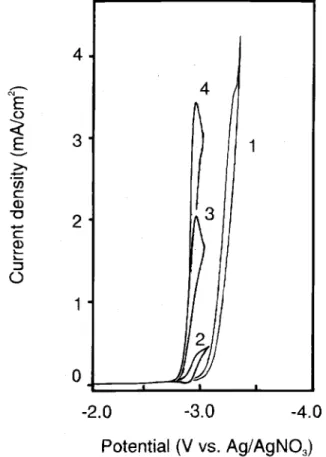
chlorobenzene at a glassy carbon disk electrode in ace-tonitrile, containing 0.1 M Bu4NBF4, shows one reduction peak at highly negative potentials, poorly resolved from the background electrolyte discharge current (Fig. 1, curve 1). However, it is possible with a reasonable degree of accuracy to estimate the peak potential, which is about -3.25 V. The peak is irreversible, the height corresponding to a two-electron reaction, indicating the reduction prob-ably follows the path documented in the literature for reduction of chlorobenzene at a Hg electrode in DMF or DMSO.5
Reduction of chlorobenzene in the presence of a media-tor.-As mentioned in the introduction, the occurrence of
the homogeneous reaction between aromatic anion-radi-cals, such as phenanthrene, naphthalene, etc., and chlorobenzene was observed by polargraphy in DMF in some early work leading to th development of a theory of homogeneous catalysis. As potential catalysts for chlorobenzene reduction, the following organic com-pounds were selected: biphenyl, naphthalene, and diben-zofuran. The electrochemical characteristics for these compounds meet the criteria for mediators, i.e., they are reduced in a one-electron reversible manner with the for-mation of a relatively stable anion-radical, and the poten-tial for reduction is close to the peak potenpoten-tial for reduc-tion of the substrate. A typical voltammogram of dibenzofuran in the absence and presence of chloroben-zene is shown in Fig. 1 (curves 2-4). On addition of chlorobenzene to a solution of dibenzofuran, the reduction peak of the latter increased and the oxidation peak of the anion radical decreased and eventually disappeared. This indicates that the overall process becomes irreversible suggesting a subsequent chemical reaction involving the anion radical results in the regeneration of the parent (mediator) molecule. The reaction scheme for chloroben-zene reduction in the presence of dibenzofuran in acetoni-trile at the glassy carbon electrode follows the path sug-gested for reduction of halogenated benzenes under conditions of homogeneous electrocatalysis
A + e
A-PhCl + A - aA + products
Similar effects were observed in the case of biphenyl and naphthalene as mediators. Assuming that the homoge-neous chemical reaction between the anion radical and chlorobenzene is the slowest step and the decomposition of the aryl halide anion-radicals into products occurs rapid-ly, the rate constant for the homogeneous electron transfer reaction can be evaluated on the basis of the theory for homogeneous electrocatalysis. Kinetic parameters can be calculated from voltammetric data if certain requirements are met for the mediator and substrate: (i) the reduction of the selected mediator should be reversible and occur at potentials lower in absolute value than those for the sub-strate; (ii) the difference in reduction potentials for
media-4
3
E
oE
c) Ca)
0)a
2
2
1
0
-2.0
-3.0
-4.0
Potential (V vs. Ag/AgNO
3)
Fig. 1. Voltammograms taken at 10 mV s-1 at a glassy carbon disk electrode in CH3CN/O. 1 M Bu4NBF4for 10 mM chlorobenzene (1), 1 mM dibenzofuran (2), 1
mM
dibenzofuran in the presence of 5 mM (3), and 10 mM (4) of chlorobenzene.tor and substrate normally should not exceed 400 to 500 mV; (iii) the reduced form of the mediator has a lifetime sufficient for the reaction with the substrate in the bulk of the solution. As for the substrate, its reduction should be irreversible due to slow electron transfer; also the product of the electron transfer to the substrate has to be trans-formed into a final product in a fast and irreversible man-ner (so that the reaction between mediator and substrate is shifted to the product of substrate reduction).
The reaction was carried out under pseudo first-order conditions, i.e., with an excess of substrate. An experi-mentally obtained parameter ik/id (ratio of the mediator
peak current in the presence and absence of substrate) at different sweep rates and concentrations of reagent were fitted to the equation. S As an illustration, calculated sec-ond-order reaction rate constants for the different media-tors for varied experimental parameters are given in Table I. The corresponding potential differences between standard potentials of the mediators and the halfwave potential of the substrate are also listed in Table I. According to the theory of homogeneous catalysis for purely outer sphere electron transfer, there should be a lin-ear correlation between the difference in potentials of the mediator-substrate pair and the rate constant of homoge-neous electron transfer from the mediator to the substrate. In other words, the mediator with the most positive poten-tial in the series should display the lowest electron trans-fer rate to chlorobenzene, as shown in Table I.
Electrolysis.-As shown above, homogeneous electron
transfer from the electrogenerated anion radical to a mol-ecule of chlorobenzene was established by voltammetry. This means that chlorobenzene can be reduced at poten-tials typical for the mediator redox couple, i.e., at signifi-cantly less negative potentials than would be required for its direct reduction. Thus the overvoltage typical for direct reduction of aryl halides will be significantly reduced. This is especially important in the case of chlorobenzene 3717
Table I. Rate constants for the homogeneous reaction of chlorobenzene with the anion radicals of different mediators generated at a glassy carbon disk electrode in acetonitrile/0. 1 M Bu4NBF4. Scan rate was set at 0.1 V/s.
Ratio
Mediator of C6H5C1 ik/id log k Average E°(mdiator)
-to media-tor (M- s'- ) log k (M' s ') El1/2(substrte) (V) Napntnalene Dibenzofuran Biphenyl 1:10 1:20 1:30 1:10 1:20 1:30 1:10 1:20 1:30 1 .0 8.3 12.7 8.8 13.8 16.7 10.2 17.5 21.7 O.oU 3.43 3.64 3.79 3.88 3.88 3.92 4.07 4.11 3.9 4.0 0.26 0.17
where direct reduction occurs very close to the reduction of the background electrolyte. Another advantage with this approach is that a reversible redox couple of the medi-ator is now responsible for the electrochemical reaction on the. electrode surface, the following chemical reaction between the anion radical and chlorobenzene occurring in the bulk of the solution. This means that factors associat-ed with the adsorption of either aryl halide or a product of its reduction on the electrode surface are eliminated, and there is little chance that an inhibiting film will form at the electrode surface, poison the reaction, and interfere with the continuous electrolysis process.
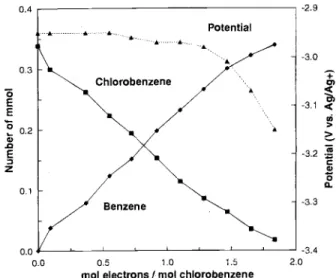
To determine products of the reaction, electrolysis of chlorobenzene was run in the presence of a mediator. The results of electrolysis are also important in establishing the stoichiometry of the homogeneous reaction and thus give rise to more accurate kinetic data. Considering that the reaction between the mediator and chlorobenzene results in regeneration of the mediator, the amount of mediator required for the conversion of chlorobenzene should be less than equimolar. The molar ratio of media-tor:substrate was selected to be 1:5, with a concentration of chlorobenzene of 5 mM and dibenzofuran as mediator at 1 mM. Electrolysis was performed in a divided cell with a glass frit separator both potentiostatically and galvano-statically. In the former case, the potential of the working electrode was selected to correspond to that which is char-acteristic of the mediator redox couple, i.e., -3.0 V (see Fig. 1). The galvanostatic electrolysis was conducted at a current of 10 mA. This current was selected by taking as a guide the limiting current of the mediator in the absence of substrate at the glassy carbon plate cathode. In the course of either electrolysis route, the concentration of chlorobenzene decreases and a product appears which was identified by GC/MS as benzene. Indeed, benzene was found to be the only product of chlorobenzene dechlorina-tion, other possible products (e.g., the coupling reaction product biphenyl) being absent.
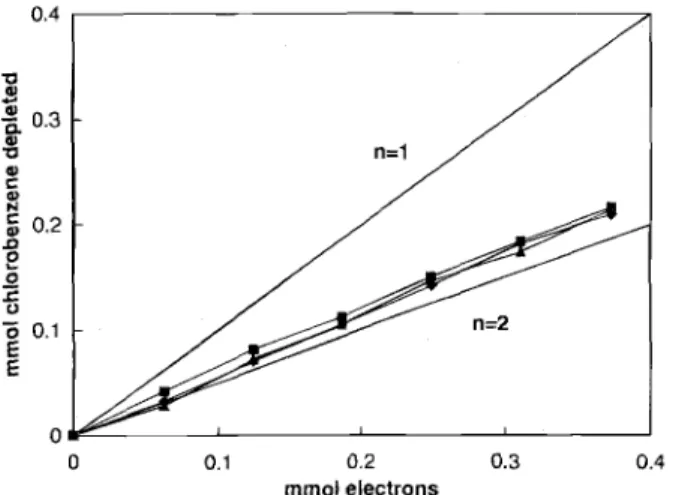
Typical electrolysis results are shown in Fig. 2 for the galvanostatic approach. Similar trends are observed for the potentiostatic mode of operation. Besides the concen-tration of substrate and product, the potential of the cath-ode during galvanostatic electrolysis is also shown in Fig. 2. This potential remained in the range of dibenzofu-ran reduction (i.e., ca. -2.95 V) until most of the substrate was consumed. During the electrolysis, there was an excel-lent correlation between the decrease in chlorobenzene concentration and the increase in amount of benzene. It should be noted that the total number of moles of sub-strate and product remained relatively constant during the entire electrolysis; this is consistent with the fact that ben-zene was the only reduction product found. The stoi-chiometry of the reaction was determined from the slope of the graph (Fig. 3), plotting the amount of chlorobenzene depleted vs. the quantity of electrons consumed. The cal-culated stoichiometric coefficient is 1.91 t 0.06 (r2= 0.99), very close to the theoretical value of two. These observa-tions confirm the overall scheme of the reaction as
H+
PhC1 + 2A - PhH + C1 + 2A
Apparently, there are two anion radicals of mediator required to reduce one molecule of chlorobenzene. However, the stoichiometric coefficients calculated in a similar manner for biphenyl and naphthalene [both 1.74 + 0.03 (r2 = 0.99)] as mediators are somewhat lower than two. The reasons for this deviation in behavior are still under investigation and will be discussed in a future
paper.
Concentration of mediator during electrolysis.-To
deter-mine whether the mediator is consumed in the dechlorina-tion reacdechlorina-tion, the concentradechlorina-tion of mediator was measured during electrolysis by GC/MS. The concentration of all employed mediators remains constant (within experimen-tal error) during electrolysis. This is consistent with the assumption that the reaction results in the regeneration of the mediator and the anion radical does not participate in other reactions which could lead to irreversible consump-tion of the mediator.
Mediator-substrate ratios.-Selected ratios of
concentra-tion of mediator to substrate, which in the above case was 1:5, demonstrate that the conversion of chlorobenzene to benzene can be achieved in the presence of much smaller amounts of mediator in relation to substrate. Employing
.O E E 'o E z -2.9 -3.0 0) -3.1 , 3 -3.2 'U -0 3.3 -3.4 0.0 0.5 1.0 1.5 2.0
mol electrons I mol chlorobenzene
Fig. 2. Change in concentration of chlorobenzene () and ben-zene () as a function of the quantity of electrons consumed per initial amount of chlorobenzene. Initial concentrations of chlorobenzene and dibenzofuran were 5 and 1 mM, respectively; electrolysis in a divided cell at 10 mA with CH3CN/0.1 M Bu4NBF4
as electrolyte and 4.5 mm2glassy carbon plate as cathode. Also shown is the working electrode potential (A) with respect to Ag/O. 1 M AgNO3in CH3CN.
O. v.I
A
J. Electrochem. Soc., Vol. 144, No. 11, November 1997 © The Electrochemical Society, Inc.
0.3 0.4
zene depleted with a are presented for .), naphthalene (), ose given in Fig. 2.
higher concentrations of mediator may be advantageous if one wants to operate at higher current densities. In the experiment described below, the concentration of media-tor was 2.5 mM as opposed to 1 mM; the substrate concen-tration was the same, i.e., 5 mM. The higher concenconcen-tration of mediator allowed the electrolysis to be run at 17 mA compared to 10 mA in the previous case. The chloroben-zene concentration profile is similar to the electrolysis at 10 mA and the lower concentration of mediator; however, the material balance is somewhat better. Complete dechlo-rination of chlorobenzene in this case was achieved with-in about 60% of the time required at the lower current, with-in line with the ratio of 10:17.
Composition of catholyte and anolyte.-The dechlorination
reaction required the consumption of protons, which could be abstracted either from the solvent or tetrabutylammoni-um cation. Thus the gradual alkalization of the catholyte occurred. Released alkaline species caused decomposition of tetrabutylammonium cation and formation of lamine as registered by GC/MS. The amount of tributy-lamine increased in the course of the electrolysis. As an added complication, it was found that solutions with high-er alkalinity caused the appearance of a shigh-eries of addition-al chromatographic peaks from cyclosiloxane compounds, such as hexamethyl-cyclotrisiloxane, octamethyl-cyclote-trasiloxane, and decamethyl-cyclopentasiloxane, presum-ably due to breakdown of the silicon-based column coating or the septum material. On the other hand, dissolution of magnesium in the anodic compartment brought about an increase in acidity of the anolyte which was confirmed by testing the solution.
A problem occurs when the solutions of opposite pH meet and cause the formation of an insoluble precipitate in the glass frit, leading to a sharp increase of cell resist-ance. To overcome this problem, efforts were made to neu-tralize the forming alkali by adding some acids to the catholyte. Among the acids, NaHCO3 and boric acids were tested. It was assumed that their solubility in CH3CN is extremely low. NaHCO3 stayed in suspension during elec-trolysis, but did not influence the formation of undesirable decomposition products. On the other hand, boric acid appeared to dissolve in CH3CN and interfered with the lifetime of the electrogenerated anion radicals. Efficiency of dehalogenation in the presence of boric acid was there-fore very low. Work is continuing in an attempt to find a solution to this problem.
The system used in the present investigation can best be described as nominally dry since no special precaution was taken to eliminate all traces of water (indeed some water may be beneficial as a source of proton for dechlorination). While traces of water can be tolerated by the system, water
in significant amounts brings about a decrease in current efficiency. For example, addition of 1 ml of water to the catholyte (1.7 volume percent H2O) resulted in a current efficiency of ca. 80%.
Undivided cell.-Performing electrolysis in a divided cell
is beneficial for studying the mechanism of electrochemical processes. It permits the separation of cathodic and anodic reactions and reduces the possibility of cross interference. As indicated earlier, during dechlorination in a divided cell strong bases were formed in the catholyte which, unless neutralized in a suitable manner, would cause problems for scaling up the process. In this respect, utilizing products of the anodic reaction for neutralization will be useful. For practical reasons, undivided cells with no separators are very attractive. The use of an undivided cell, when feasible, will lead to lower cost due to elimination of the separator as well as the resulting lower cell voltage.
Electrolysis of 5 mM chlorobenzene in the presence of 2.5 mM dibenzofuran was carried out at a constant current of 17 mA. A decrease in concentration of chlorobenzene and formation of benzene as product were observed (Fig. 4). The calculated number of electrons required for reduction of one molecule of chlorobenzene is 2.16 + 0.03 (r2 = 0.998). The number is higher than the one observed under similar conditions in a divided cell, consistent with the increased possibility of unwanted side reaction in the undivided cell. Assuming the consumption of two electrons per molecule of chlorobenzene, the calculated current effi-ciency is about 90%. The concentration of dibenzofuran as mediator remained constant during electrolysis (Fig. 4) indicating that the reaction of magnesium cations with the mediator anion radicals was negligible. The possibility of performing dechlorination of chlorobenzene in an undivid-ed cell, albeit with a slightly lower efficiency, demonstrates that the products of the reaction at the anode do not severely interfere with the stability of the anion radicals, and the mediator is not oxidized at the anode under the experimental conditions employed.
Continuous electrolysis.-It is obvious from the above
results that dechlorination of chlorobenzene can be per-formed indirectly in the presence of a small amount of mediator, the electrolysis being performed at the potential associated with the mediator reduction. The mediator in this case acts as a catalyst which is being regenerated dur-ing dechlorination. The fact that the concentration of mediator does not change during dechlorination of chloro-benzene indicates that a small fixed amount of the
media-E c a Cu 4, a C 0 Q 2.0 0.0 0.5 1.0 1.5
mol electron /mol chlorobenzene
Fig. 4. Variation of the concentration of chlorobenzene (), ben-zene (), and dibenzofuran (A) during indirect electrolysis in an
undivided cell at 17 mA. Initial concentration of chlorobenzene was 5 mM and dibenzofuran was 2.5 mM. Solvent was CH3CN
and cathode was 4.5 mm2glassy carbon plate.
U.4 a 0.3 , ' 0.2 2 ' 0.1 E E 0 0 0.1 0.2 mmol electrons Fig. 3. Variation of the amount of chloroben the quantity of electrons consumed (mmol). Dat three different mediators, i.e., dibenzofuran (A and biphenyl (). Conditions are identical to the
tor-catalyst can be used for dechlorination of much larger quantities of chlorobenzene on a continuous basis. An experiment was conducted where anion-radicals of deben-zofuran were generated in an undivided cell and portions of chlorobenzene were added to that cell for dechlorina-tion. After the first portion of chlorobenzene was partially dechlorinated, another portion of chlorobenzene was added to the same cell. Figure 5 shows the change of cur-rent during potentiostatic continuous electrolysis of 2.5 mM dibenzofuran (0.2 mmol) in the presence of chlorobenzene which was added to the cell in portions. Point No. 1 on the graph indicates the current for dibenzo-furan before adding chlorobenzene. After adding 0.4 mmol of chlorobenzene, the current for dibenzofuran increased (point No. 2). During electrolysis, the current dropped due to the consumption of chlorobenzene. A new portion of 0.4 mmol of chlorobenzene was added and the current increased again (point No. 3). This operation was repeated several times. Analysis of samples taken during electrolysis indicated that the current efficiency for dechlorination of chlorobenzene was about 90%. Thus 0.2 mmol of dibenzo-furan was used to dechlorinate 1.7 mmol of chlorobenzene. It is interesting that the concentration of dibenzofuran as mediator remained constant up tol2 F/mol of dibenzofu-ran, after which some losses in dibenzofuran were noticed. After 18 F/mol of dibenzofuran were passed (which was near the end of the electrolysis in Fig. 5), the estimated losses were around 7% of the original amount of dibenzo-furan. The result indicates that in very long-term electrol-yses in an undivided cell, it may be necessary to add small
amounts of mediators to the system from time to time.
Direct vs. indirect electrolysis.-For comparison,
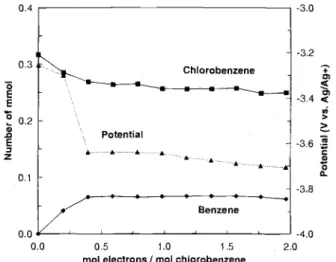
electrol-ysis of chlorobenzene without a mediator was performed at 10 mA constant current. Benzene was detected as the only product. The dependence of the concentrations of chlorobenzene and benzene during electrolysis is shown in Fig. 6. At the beginning of the electrolysis, dechlorination proceeded with reasonable efficiency, but after 0.3 F/mol were passed, the potential of the working electrode shift-ed to more negative values, and the efficiency became neg-ligibly small. The advantage of performing dechlorination in the presence of a mediator is demonstrated by compar-ing the results of the two electrolyses. The only difference between the two experiments is that one was performed in the presence of dibenzofuran as mediator, the other one in its absence. It is immediately obvious that while dechlori-nation proceeded essentially to completion in the presence of the mediator, it slowed down and eventually stopped in
40 30 E E 20 U 10 0 0 so50 100 150 Time of electrolysis (min.) Fig. 5. Plot of current vs. time for potentiosta -3.0 V in an undivided cell with a solution of 2. ran (0.2 mmol), i.e., point 1 on graph, to which benzene were added at points 2, 3, 4, 5, and 4.5 mm2glassy carbon plate.
0.4 0.3 E E 0 E z 0.2 0.1 fon 0.0 0.5 1.0 1.5
mol electrons / mol chlorobenzene
-3.0 -3.2 -3.4 c -3.6 --3.8 -4.0 2.0
Fig. 6. Change of chlorobenzene () and benzene () concen-trations, as well as electrode potential (A), during direct electroly-sis of 5 mM chlorobenzene at 4.5 mm2glassy carbon plate elec-trode. Electrolyte was CH3CN/O. 1 M Bu4NBF4; divided cell; current was 10 mA.
the direct mode of operation. This latter result is probably due to the formation of an inhibiting reaction film on the electrode surface (because in that case the reaction is forced to occur at the electrode surface). While doing the dechlorination indirectly via the mediator route obviously involves some additional expense, the fact is that it may be the only way to achieve the desired result in a continuous electrochemical fashion.
Conclusions
Electrolysis of chlorobenzene in acetonitrile in the pres-ence of organic mediators (dibenzofuran, biphenyl, naphthlene) allows a complete dechlorination of the sub-strate and the formation of benzene as the only product. Current efficiency is close to 100%. The dechlorination can be successfully performed in either a divided or undi-vided cell with a magnesium sacrificial anode. The media-tor concentration remains practically unchanged during electrolysis. The benefits of the indirect over the direct dechlorination route are well illustrated by the chloroben-zene/benzene system.
Acknowledgments
The authors are grateful to Jeff Wright for assistance in GC/MS analysis and to Dr. Michael Gattrell and Dr. Thierry Guena for useful discussions.
Manuscript submitted Dec. 17, 1996; revised manuscript received July 21, 1997.
The National Research Council of Canada assisted in meeting the publication costs of this article.
REFERENCES
1. D. K. Parker and R. J. Steichen, U.S. Pat. 4,284,516 (1981).
2. F W. Chuang, R. A. Larson, and M. S. Wessman,
Envi-.i TQ .hnn, 1 90 9Afnl1(100R\
3. W. A. Davies and R. G. H. Prince, Process Saf. Environ.
Prot., 72, 113 (1994).
4. D. G. Peters, in Organic Electrochemistry, an
Introduc-tion and a Guide, 3rd ed., H. Lund and M. M. Baiser,
Editors, p. 361, Marcel Dekker, Inc., New York (1991). 2. S. . arwell, : . eland, and . . eer, J.
lec-200 250 troanal. Chem., 61, 303 (1975).
6. F. L. Lambert and K. Kobayashi, J. Org. Chem., 23, 773 (1953).
atic
electrolysis at 7. S. M. Kulikov, V. P. Plekhanov, A. I. Tsyganok, C..5 mM dibenzofu- Schlimm, and E. Heitz, Electrochim. Acta, 41, 527
0.4 mmol chloro- (1996).
6. Cathode was 8. D. Petersen and J. Voss, Z. Naturforsch., 45b, 1105 (1990). 9. D. J. Mazur and N. L. Weinberg, U.S. Pat. 4,702,804
Chlorobenzene Potential ... Benzene X I I t I ~ l I I I I 1
J. Electrochem. Soc., Vol: 144, No. 11, November 1997 © The Electrochemical Society, Inc.
(1987).
10. T. E Connors and J. F. Rusling, This Journal, 130, 1120 (1983).
11. T. F. Connors, J. F Rusling, and A. Owlia, Anal. Chem., 57, 170 (1985).
12. C. P. Andrieux, J. M. Dumas-Bouchiat, and J. M. Saveant, J. Electroanal. Chem., 87, 55 (1978).
13. H. Lund, M.-A. Michel, and J. Simonet, Acta Chem.
Scand., B28, 900 (1974).
14. C. P. Andrieux, C. Blocman, J. M. Dumas-Bouchiat, and J. M. Saveant, J. Am. Chem. Soc., 101, 3431 (1979). 15. Y. Rollin, M. Troupel, D. G. Tuck, and J. Perichon, J.
Organometal. Chem., 303, 131 (1986).
16. J. Simonet, M.-A. Michel, and H. Lund, Acta Chem.
Scand., B29, 489 (1975).
17. J. W. Sease and R. C. Reed, Tetrahedron Lett., 393 (1975). 18. J. M. Saveant and E. Vianello, Electrochim. Acta, 10,
905 (1965).
Role of Corrosion Inhibiting Pigments on the Electrochemical
Kinetics of a Copper-Containing Aluminum Alloy
M. Kendig,* M. Cunningham, S. Jeanjaquet, and D. Hardwick
Rockwell Science Center, Thousand Oaks, California 91360, USA
ABSTRACT
The electrochemical polarization behavior of the copper-containing Al 2024-T3 alloy in deaerated 0.01 M NaCl sat-urated with a number of solid inhibitors demonstrates that one of the compounds examined, barium metaborate, exhibits an inhibiting power in excess of that of zinc chromate. Electrochemical polarization of a synthetic 0-phase CuAl2 inter-metallic in aerated 0.01 M NaCl with and without the presence of the barium metaborate and zinc chromate inhibitors has also been examined.
Introduction
Cu-containing structural alloys of aluminum such as Al 2024 and Al 2219 are typically passivated with a chromate conversion coating prior to painting and adhesive bond-ing. The passivation treatment by chromate forms an ad-herent surface film of aluminum oxide and chromium oxide that contains unreacted chromate,6 particularly in the outer layers.l"4
Corrosion protective primers for Al also contain chro-mate inhibiting pigments. The inhibiting pigments in con-tact with water release active hexavalent species which in turn passivate the metallic substrate. Films formed by the reaction of chromate containing inhibitors with Al and particularly the otherwise difficult to protect Al 2024-T3 alloy are uniquely corrosion resistant. However, demand for elimination of hexavalent chromium and improved corrosion life of paint requires alternatives for passivating the highly active surfaces of the 2000 series alloys.
This paper examines the electrochemical behavior of Al 2024-T3 in deaerated 0.01 M NaCl and in the presence and absence of selected corrosion inhibiting compounds with the objective of identification of corrosion inhibiting primer pigments as alternatives to the environmentally hazardous chromates, in particular Zn chromate. The par-ticular deaerated and dilute chloride environment was chosen since our focus is on understanding the action of corrosion inhibiting pigment species in paints and sealants, particularly those used for inhibiting corrosion in occluded regions and crevices within aircraft. Since it has been more or less established that the intermetallic phases such as the 0 CuAl2 and (Cu, Mg)A12determine the corrosion rate of Cu-containing Al alloys,6` the electro-chemical behavior of a model intermetallic, CuAl,, in sev-eral environments was also examined.
Experimental
Al 2024-T3.-7.6 x 7.6 cm coupons of the as-received
alloy 2024 in the T3 condition were degreased in hot xylene and then deoxidized in an acidic (pH 1) bromate reagent (Sanchem 1000, Sanchem, Chicago, IL) for 15 min at typically 38°C. The samples were coupled to a platinized titanium basket so as to galvanically inhibit the redeposi-tion of copper generated by dissoluredeposi-tion of the
intermetal-* Electrochemical Society Active Member.
lic phase. The test Al 2024 material was produced by The Aluminum Company of America (Pittsburgh, PA) and ob-tained from Joseph T. Ryerson and Son, Inc. (Chicago, IL). The material had the folowing analysis: Si (0.50%), Fe (0.50%), Cu (4.35%), Mg (1.50%), Cr (0.10%), Zn (0.25%), Ti (0.15%), other (0.20%), Al (balance).
In order to characterize the morphology, distribution, and size of the intermetallic phase, a sample of the Al 2024-T3 in the same orientation for which all subsequent electrochemical experiments were performed was polished to 1 m in kerosene and then electropolished in a methanol/5% sulfuric acid/l% HF solution. Electron micrographs (at 500 times magnification) taken from sev-eral locations on the resulting surface were analyzed using a 100 point grid in order to determine the area fraction of the intermetallic phase.
Preparation of CuAI2 samples.-The phase diagram
shows that the intermetallic compound CuAl2 forms from the melt at 590°C via the peritectic reaction
Liquid [32.2 atomic percent (a/o) Cu]
+ CuAl (49.8 a/o Cu) e? CuAl2(32.8 a/o Cu) The CuAl, phase is not a line compound. However, at its greatest width, near the Al-Cu eutectic temperature, the composition range of the single phase field is only 1 [atom-ic percent (a/o)]. The peritect[atom-ic reaction coupled with the narrow width of the phase field makes the preparation of single-phase CuAl, quite difficult. Like the other inter-metallic compounds in the Al-Cu system, CuAl2is quite hard and brittle. Preparation of uncracked single-phase
CuAl2is therefore extremely difficult.
The two-phase region on the Al-rich side of CuAl2 con-sists of CuAl, + solid solution Al(Cu), while the Cu-rich side contains two intermetallic phases: CuAl2 + CuAl. We chose to prepare our alloys slightly Al-rich; the incorpora-tion of a small amount of the solid soluincorpora-tion Al into the structure should act as a ductile phase toughener and reduce thermally induced cracking in the CuAl2phase as it is cooled from the preparation temperature.
To prepare the samples, high purity Al and Cu (99.999% and 99.9999%, respectively) were weighed and placed into an alumina crucible. The crucible was placed i a tube furnace that was evacuated, then backfilled with a partial pressure of argon. Following melting, the material was 3721