Publisher’s version / Version de l'éditeur:
Vous avez des questions? Nous pouvons vous aider. Pour communiquer directement avec un auteur, consultez la
première page de la revue dans laquelle son article a été publié afin de trouver ses coordonnées. Si vous n’arrivez pas à les repérer, communiquez avec nous à [email protected].
Questions? Contact the NRC Publications Archive team at
[email protected]. If you wish to email the authors directly, please see the first page of the publication for their contact information.
https://publications-cnrc.canada.ca/fra/droits
L’accès à ce site Web et l’utilisation de son contenu sont assujettis aux conditions présentées dans le site
LISEZ CES CONDITIONS ATTENTIVEMENT AVANT D’UTILISER CE SITE WEB.
Internal Report (National Research Council of Canada. Institute for Research in Construction), 1996-03-01
READ THESE TERMS AND CONDITIONS CAREFULLY BEFORE USING THIS WEBSITE.
https://nrc-publications.canada.ca/eng/copyright
NRC Publications Archive Record / Notice des Archives des publications du CNRC :
https://nrc-publications.canada.ca/eng/view/object/?id=41e86ca5-224f-4044-8301-b90bb3642632 https://publications-cnrc.canada.ca/fra/voir/objet/?id=41e86ca5-224f-4044-8301-b90bb3642632
NRC Publications Archive
Archives des publications du CNRC
For the publisher’s version, please access the DOI link below./ Pour consulter la version de l’éditeur, utilisez le lien DOI ci-dessous.
https://doi.org/10.4224/20358733
Access and use of this website and the material on it are subject to the Terms and Conditions set forth at Evacuation Time and Movement in Office Buildings
jzfi
ITH1
1 R 4 2 7 National Research Conseil national
BLDG Council Canada de recherches Canada
COP. 2 Institute for lnstitut de
no. 7 1 1 Research in recherche en
March Construction construction
1996
IWCmCHC
Evacuation Time and Movement in
Office Buildings
. ~ J I s ~ ' I / L C I S ' ~ N K C : / ~ ~ ~ ~ inrernal repo t tlnsrltute 1
I R C Ser ANALYSE I s ~,
P
Recelved on: 05-13-96
I
Internal report
by Guylene Proulx, Adina Kaufman and Joelle Pineau
Internal Report No. 71 1
Date of issue: March 1996
This is an Internal report of the Institute for Research in Construction. Although not intended for general distribution, it may be cited as a reference in other publ~cations.
Evacuation Time and Movement in Office Buildings Adina Kaufman. GuylGne Proulx. Ph.D., Joelle Pineau
TABLE O F CONTENTS
...
LIST OF FIGURES...
m LIST OF TABLES...
iv ACKNOWLEDGEMENTS...
v...
EXECUTIVE SUMMARY vi 1.0 INTRODUCTION...
1 2.0 OBJECTIVES...
2 3.0 GENERAL METHODOLOGY...
34.0 METHOD AND RESULTS FOR EACH BUILDING
...
64.1 Building A . London
...
6 Occupants...
8 Procedure...
8...
Results 9...
Occupant Behaviour 9 Occupants' Use of Staircases...
10Evacuation Timing
...
10Time Comparisons According to Age
...
12Speed of the Occupants on the Stairs
...
13Speed Comparisons According to Gender
...
15Speed Comparisons According to Age
...
16Alarm Audibility Measurement
...
16Questionnaires
...
20 Conclusions...
22 4.2 Building B . Ottawa...
24 Occupants...
25 Procedure...
25 Results...
26 Occupant Behaviour...
26...
Occupants' Use of Staircases 27. .
Evacuation Tmmg...
27Time Comparisons According to Gender
...
30Time Comparisons According to Age
...
.
31Speed of the Occupants on the Stairs
...
31Speed Comparisons According to Gender
...
34...
. .
Alarm
Audibility Measurement...
35Questionnaires
...
38...
Conclusions 41
...
5.0 JOINT RESULTS
.
BOTH BUILDINGS COMBINED 43 5.1 Comparisons of Time and Speed...
43 Time to Start...
43...
Time to Exit 43 Time to Move...
44...
Speed in Stairs 445.2 Time and Speed Comparisons Regrouping the Two Buildings
...
44...
Time and Swed Comoarisons According, to Gender . 44
...
Time and Speed Comparisons According to Age 45 5.3
Alarm
Audibility Comparison...
45...
6.0 COMPARISON OF OFFICE AND APARTMENT BUILDINGS 46 6.1 Study Background
...
46 6.2 Time and Speed Comparisons...
46...
6.3 Occupant Behaviour and Characteristics 48
7.0 GENERAL CONCLUSIONS
...
49 8.0 REFERENCES...
51LIST OF FIGURES Figure 1: Figure 2: Figure 3: Figure 4: Figure 5: Figure 6: Figure 7: Figure 8: Figure 9: Figure 10: Figure 11:
London Building
-
F i s t Floor Plan...
7 London Building - Fifth Floor Plan...
7 Audibility Design Window-
55 year old man with normal hearing:First Floor Lobby
...
18 Audibility Design Window - 55 year old man with hearing impairment:First Floor Lobby
...
18 Audibility Design Window-
55 year old man with normal hearing:Fith Floor Washroom
...
19 Audibility Design Window - 55 year old man with hearing impairment:Fifth Floor Washroom
...
19 Ottawa Building-
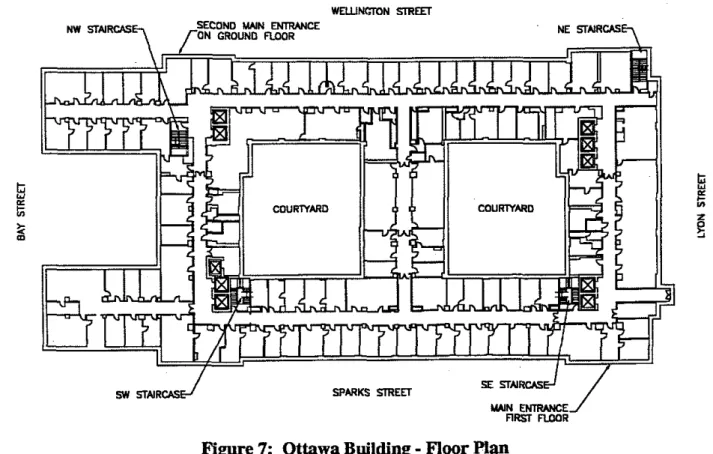
Floor Plan...
25 Audibility Design Window-
55 year old man with normal hearing:Open Office 4003
...
36 Audibility Design Window - 55 year old man with hearing impairment:Open Office 4003
...
36 Audibility Design Window-
55 year old man with normal hearing:Corridor near 4152
...
37 Audibility Design Window-
55 year old man with hearing impairment:LIST OF TABLES Table 1: Table 2: Table 3: Table 4: Table 5: Table 6: Table 7: Table 8: Table 9: Table 10: Table 11: Table 12: Table 13: Table 14: Table 15: Table 16: Table 17: Table 18: Table 19: Table 20: Table 21: Table 22: Table 23: Table 24: Table 25:
...
.London Building Evacuation Timing in 1 min Intervals 10
...
London Building
.
Evacuation Timing in 15s
Intervals 11...
London Building . Time Comparisons According to Gender 12 London Building
.
Time Comparisons According to Age...
13 London Building.
Speed and Time in Staircase...
14...
London Building
.
People Entering Stairs From Each Floor 15...
.London Building Speed of Occupants in Stairs 15 London Building
.
Gender Comparisons of Speed and Time in Stairs...
16...
London Building
.
Age Comparisons of Speed and Time in Stairs 16 London Building.
Background Noise and Alarm Audibility Analysis...
17...
Ottawa Building . Evacuation Timing in 1 min Intervals 28
...
Ottawa Building
.
Evacuation Timing in 15 s Intervals 29...
Ottawa Building . Observed and Calculated Times to Start 29
...
Ottawa Building
.
Time Comparisons According to Gender 30...
Ottawa Building - T i e Comparisons According to Age 31 Ottawa Building " . Soeed and Time in Staircases &
...
32...
.
Ottawa Building People Entering Stairs From Each Floor 32 Ottawa Building . Speed of Occupants in Stairs
...
33...
Ottawa ~ u i l d i n g . dender ~ o m ~ & s o n s of Speed and Time in Stairs 34
...
.
Ottawa Building Age Comparisons of Speed and Time in Stairs 34
...
Ottawa Building
.
Background Noise and Alarm Audibility Analysis 35...
Office Buildings . Comparisons of Times and Speeds 43
...
.
Office Buildings Comparisons of Times and Speeds by Gender 45
...
.Office Buildings Comparisons of Times and Speeds by Age 45
...
ACKNOWLEDGEMENTS
Many people participated in this research project. We would first l i e to thank the occupants of the buildings studied. They participated willimgly in the evacuation drill, not only providing us with interesting data but also useful insights, either directly or in
answering the post-evacuation questionnaire. We are also grateful to the building fire safety and security personnel of the two buildings; they were patient and helpful in
providing information on their buildings and their occupants, as well as allowing
us
accessto the premises to install the observation equipment
The participation of the firefighters was essential in ensuring the success of this
study. We are grateful to all of the firefighters who willingly took part in the drills: City of London F i e Department
Fire Prevention Inspector, John D. Conley Fire Prevention Inspector, Craig D. Stevens City of Ottawa Fire Department
Division Chief
-
Planning, Peny McConnell Fire Hall #2 Chief Casagrande and his teamWe would like to recognize the contribution of Chantal Laroche of the University of Ottawa to the measurement and analysis of alarm audibility during the fxe drills.
Many people at the National Research Council of Canada helped in installing the equipment, distributing questionnaires, acting as observers or editing the manuscript. We would especially like to thank John C. Latour, John W. MacLaurin, Jocelyn Henrie and Roch Monette.
This work was jointly funded by the National Research Council of Canada (NRCC) and Public Works and Government Services Canada (PWGSC) and we would like to thank Brian Kyle of PWGSC for his invaluable assistance in the organization of this project.
Evacuation Time and Movement in Office Buildings Adina Kaufman, Guylsne Proulx, Ph.D., Joelle Pineau
EXECUTIVE SUMMARY
The National Fire Lab of the Institute for Research in Construction (IRC) of the National Research Council of Canada (NRCC) is currently continuing development of a computerized risk-cost assessment model, F~RECAM", to be used in evaluating building design. The FiREcAM" model was developed by IRC with support from Public Works and Government Services Canada and National Defence Canada as well as through a partnership with fire research experts at the University of Technology in Australia.
While many aspects of FiREcAh4" now completed, the Occupant Response and Occupant Evacuation models within ~ i ~ E ~ A h 4 " r e q u i r e testing and validation. In order to evaluate these models, the model predictions must be compared to data that is gathered from actual evacuations. Then, based uuon a comuarison of the F~RECAM" predictions and the actual observed data, adjustments to the Occupant Response and ~ c & ~ a n t Evacuation models can be made if necessary.
A joint research project was undertaken by the National Research Council of Canada (NRCC) and Public Works and Government Services Canada (PWGSC) to carry- out two office building case studies. The purpose of this part of the study was to gather data from evacuation drills in the two studied buildings and then to compare the observed results with results predicted by the computer tool F~RECAM".
The research looked at two case studies of office buildings. Evacuation drills were done in the Dominion Building in London, Ontario and in the West Memorial Building in Ottawa, Ontario. Both fue drills were organized, supervised, and carried out with the full participation of local fue departments or local fue protection services. This report
concerns the data gathered during these two evacuation drills.
Before evacuation drills in the two buildings, NRCC staff met with building security and fire safety officers and identified occupants having some limitations. NRCC staff met with these occupants, informed them of the upcoming drill, and discussed their knowledge of the building evacuation procedures, and their ability, or inability, to
participate in the drill. All those who were contacted chose to comply with the evacuation drill with the other occupants.
The two drills took lace on weekdays between 14:00 and 1415 in order to have the largest possible number of occupants in the building. These two evacuation drills were carried out in September and October of 1995. For both evacuations, the weather was warm and while somewhat overcast, there was no rain during the drills. During each drill, data was gathered concerning the following: the time to respond to the alarm, the
selection and use of staircases, the time to travel in the stairs, and the time to evacuate the building. Video cameras were positioned in corridors, staircases, and at the different exits
to record the location, time and frequency of occupant movements. The data provided from the obse~ation of these tapes was used in various statistical calculations. During the evacuation drill, the research team remained outside the building in such a way as to not interfere with either the building occupants or the firefighters. The occupants were not made aware of the fact that it was an evacuation drill rather than a real emergency.
Prior to the evacuation, measurements were made of the ambient noise in a number of predetermined locations within the building. During the drill, measurements were made of the fire alarm at the same prescribed locations. This data concerning noise levels with and without the alarm sounding was used to evaluate the audibility of the alarm bells.
Firefighters arriving at the scene followed their usual procedures and checked the building for any remaining occupants. When the fuefighters judged that the situation was satisfactory, the captain gave the "all clear", the alarms were reset and occupants went back to their offices.
After the evacuation drills, a questionnaire was distributed to all occupants of the building who had been present during the evacuation drill. Occupants were asked
questions pertaining to their initial reaction to the alarm, their evacuation route, and their general level of knowledge about fue safety procedures within the building. A series of statistical analyses was done on the data from these completed questionnaires including an analysis of variance to assess the impact of gender, age and limitations on people's
behaviour.
A series of statistical analyses was also conducted on the data gathered using the video cameras. The times to start the evacuation, to move to safety and to totally evacuate the building were studied. An analysis of variance was used to compare buildings and to assess the impact of gender and age. The speed of movement on stairs was also analyzed.
The results show that the time to start the evacuation is faster for females than males, but that occupants of both genders take the same time to move from start to exit Thus, because of their faster times to start, the females evacuate the building faster than males. The age of the occupants was not found to be a significant factor in evacuation times and speeds.
The two buildings showed significant differences in the times to start, exit, and move and the speed of occupants in the stairs. These differences can be explained by many factors including the architectural design of the floors and staircases and the level of fire safety education and training possessed by building occupants.
A comparison of the results from this study of evacuation drills in office buildings with previous studies involving evacuations in midrise and higbrise apartment buildings reveals many interesting differences. Occupants in the office buildings evacuated much faster than the apartment residents, primarily because they reacted much faster to the
...
W1
alarm bells and began to evacuate with much less delay. This faster response in office
-
buildings is attributed to the population in the office Gildings that consisted of adults who were not res~onsible for the evacuation of young children or elderly relatives, the use of floor ftre w i d e n s to direct people to exits A d encourage them to evacuate quickly, and the level of education and training possessed by the building occupants who hadexperienced at least one fire M 1 annually while working in the building. The office building occupants, however, did exhibit many behaviours that delayed their evacuation, such
as
returning to their offices and waiting for co-workers, and further steps could beEvacuation Time and Movement in Office Buildings Adina Kaufman, Guylkne Proulx, Ph.D., Joelle Pineau
1.0 INTRODUCTION
In 1992,401 Canadians perished because of fire. Yet, the number of people who perish in office building fues in Canada annually is almost insignificant, with only two office building fire fatalities in 1992, and none in 1991. While 44% of the total number of fues occurred in residential buildings, 86% of fue deaths occurred in people's homes [I]. One is compelled to ask why such a disproportionate number of deaths occur in housing and why so few people perish in office building f i s . The answer lies in an understanding of both the characteristics of occupants and the level of education and fire safety training to which occupants are exposed.
In apartment buildings, occupants may be asleep at the time the alarm sounds, while office occupants are almost guaranteed to be awake at the time of the alarm. While buildings in which people sleep inherently more dangerous than those used only during the day [2,3], other factors must be examined. Occupants in office buildings are trained through annual fire drills and literature distributed at the workplace. People are not required to have fire drills in their residences, nor is fire safety information usually readily available in a private residence. In addition, office buildings tend to have a fairly
homogeneous population of adults, while housing includes people of all ages, from young children to elderly seniors. It has been found that people learn about fire safety at work or
at school. and not in the home.
The study of evacuation drills in office and apartment buildings appears essential to better understand the factors that contribute to people's evacuation and to devise plans of action to educate and train people about fire safety both at home and at work.
Not only must an understanding of the importance of training and education be developed in order to maximize the savings of human life, but also a method of
determining the relative merits of different fire safety designs must be determined. The computerized risk-cost model,
R R E C A M ~
developed by the National Research Council of Canada (NRCC) is capable of such a feat. F ~ R E c A M " ~ ~ an excellent tool to compare different fue safety designs and determine the relationship between the relative costs of a given design and the corresponding risk to human life. In order for the computerized model to be accepted as a valid tool, however, actual case studies with observed data must be used to verify the model's predictions.Two office building evacuations were conducted in collaboration with Public Works and Government Services Canada (PWGSC) to gather this data and serve
as
case studies for verification of FXECAM". A comparison of the data observed and the predictions from the model will allow for any necessary adjustments to be made to F~REcAM~.In this report, the data gathered from these case studies is presented, with a focus on understanding the characteristics of the office building occupants, the behaviour of occupants during the evacuation, and the times and speeds involved in the evacuation. In addition, the office building evacuations are compared to previous evacuations in
apartment buildings in an attempt to determine what factors contribute to the fastest possible evacuation times for people in both business and residential structures.
2.0 OBJECTIVES
The general objective of this project was to collect real data on evacuation times and the movement of occupants in office buildings. Furthermore, it was important to compare the observed results with results predicted by the computerized tool F~REcAM@. In this manner, the Occupant Response Model and the Occupant Evacuation Model of
F ~ A M " could be evaluated and adjusted if necessary. An understanding of the way in which people actually evacuate a building under fire emergency conditions is an essential
component of the design and verification of F~RECAM".
The data collected will be used to determine the characteristics of different groups of occupants. Differences in evacuation times and speeds between genders will be
explored,
as
will be differences between two age groups of occupants, those under 40 years and those over 40 years of age. If sufficient numbers of people with limitations are found to be working in the buildings, then the effects of these limitations on evacuation times and speeds will also be explored.This is the third research project by NRCC to study evacuations of occupants from buildings. The first two studies were done in collaboration with Canada Mortgage and Housing Corporation (CMHC). The first such study examined the evacuation of midrise apartment buildings and the second study examined the evacuation of highrise apartment buildings [4,5]. The results of this study of office building evacuations will be compared to those of the previous studies of apartment buildings to identify similarities and
differences in the occupants' timing and behaviour.
In the previous studies of apartment buildings, it was found that many residents did not evacuate the building quickly because they could not hear the alarm from within their apartment units and were unaware that an evacuation was taking place until other
residents or firefighters informed them of the drill. For this reason, sound measurements will be taken in specified locations both before and during the ala& to determine whether the alarm is audible in all areas of the office buildings. In addition, occupants will be asked about alarm audibility in the questionnaire distributed after the evacuation drill.
The primary benefit of this study for the occupants, and for society in general, is
the identification of ~roblems associated with evacuations to h e l ~ develo~ fire safetv systems and architectural solutions that increase safety for all occupants.' Other beiefits regarding, for example, the time required for the evacuation of such buildings, may enable fire departments to be better prepared and potentially to save lives.
Findings from this study will assist the buildings' owner, PWGSC, to decide upon necessary changes for assuring that these heritage buildings provide an acceptable level of safety and to improve the education, training, and fire preparedness of occupants in the buildings.
Furthermore, the results of the research will no doubt be included along with results of other projects, in updates of fire safety regulations and in the National Building Code of Canada.
3.0 GENERAL METHODOLOGY
The research involved collecting real data on the evacuation times and movement of occupants in two office buildings managed by PWGSC. The buildings chosen were identified by PWGSC. Both buildings are heritage buildings that must soon undergo major refurbishing including a complete update of fire safety features. Researchers at NRCC discussed the study with the building management in each case and obtained their permission to observe the required annual evacuation drill for each building.
Information, such as the building evacuation procedures, type of alarm system, the location of the alarm bells, staircase and conidor measurements, the number of exits and demographic information about the occupants, was obtained on-site.
Whenever possible, the researchers met with those occupants who had limitations in order to discuss the study and determine their ability to participate. In the few cases identified, the three occupants who met with researchers chose to participate fully in the evacuation drill.
On the day of the evacuation drill, video cameras were positioned in the corridors and staircases to caoture the movement of the evacuees inside the buildings. Video
-
cameras were also set up outside to record the occupants exiting from the building. The NRCC researchers remained outside d u r i n ~ the evacuation to avoid disrupting the . .movement or influencing the behaviour of evacuees.
The evacuation drills were performed in early fall of 1995. The evacuations took place between 14:OO and 14:15 on weekdays. In London, the evacuation began when the principal researcher told the designated occupant to pull the fire alarm. In Ottawa, the evacuation began when the principal researcher telephoned the designated occupant and asked that occupant to pull the fire alarm.
Members of the local fire department were contacted prior to the drill to discuss the evacuation procedure and the location of the hypothetical fire to determine a strategy for evacuating &cupants. Participation of the firefighters was important for many
reasons. Their oresence added realism to the evacuation, and the sound of their truck sirens both added realism and had the potential to alert occupants of the situation if they
were not able to hear the alarm bells within the building. In addition, the fiefighters were able to verify the functioning of all fxe safety systems within the building, and ensured that
all
occupants had vacated the building. The drill ended when the fmfighters judged thatall
the occupants had reached a safe location. The fue captain then gave the "all clear", the alann was turned off and occupants were allowed to return to their offices.Immediately after the drill took place, the occupants received a questionnaire. This post-evacuation questionnaire gathered information regarding an occupant's initial reaction to the alarm, hidher evacuation route, and hidher general level of knowledge about fire safety procedures within the building.
The videotapes were carefully viewed and put into a transcript The use of video allowed for precise recording of the timing of each occupant's actions. The transcript identifies each individual using an index number, and classifies subjects according to gender and age. Information is recorded about each subject including the time that a person begins to respond to the alarm, the direction of movement, the speed of movement in the staircase, and general behaviour during the evacuation.
The data from both the questionnaires and the video camera observation were then analyzed using SPSS Version 6.01, a comprehensive software package for statistical data analysis. This program was used to determine if significant differences existed between occupants of different genders and ages when examining their times to start the
evacuation, exit the building, and move from start to finish. It was also used to determine trends in questionnaire responses among people based upon gender, age, the floors on which they usually work, and the departments for which they work.
Two basic types of statistical analysis were performed to analyze the data. In the first type, a cross-tabulation comparison using a Chi-Square statistical analysis was performed and in the second type, an Analysis of Variance (ANOVA) was used. These tests compare the scores of groups and determines their similarity by producing a probability level (p-level). For the purposes of this research, a p-level less than p = 0.05
indicates that there is less than an
5%
probability the raults occurred by chance. The choice of p = 0.05 as a test of significance is a standard convention in the social sciences, and indicates that there is a 95% confidence level that the differences between the two groups are real differences that would occur again if the experiment was repeated. Thus,a
p-level Iess thanp
= 0.05 indicates statistically significant results161.
The evacuees were placed in one of two age categories as judged by the researcher viewing the videotapes. Categoly 1 defined those perceived to be less than 40 years of age, and category 2 defined those perceived to be greater than 40 years of age. In general, those in Category 1 are between 20 and 40 years of age, and those in category 2 are between 40 and 65 years of age.
Limitations are those factors which may hinder an occupant's ability to travel with ease, particularly in the staircase. h i o r to the evacuation, three people were identified as
having limitations, one was overweight and two were pregnant. All three individuals stated that they would have no difficulty participating in the evacuation drill. While some overweight people and pregnant women were seen in the video recordings, no people with visible limitations that impeded their evacuation could be identified from the recordings. The presence of hearing problems, heart problems, respiratory problems and the like could not be inferred from the videotapes, although they may have had an effect on occupants' movement times and behaviour.
The two buildings were also compared to one another to see if signifcant diferences could be found between the two sets of occupants.
The use of videotapes made it possible to calculate the speed of the occupants travelling down the stairs. For each person, it was possible to determine the time at which they first appeared in the staircase and the time at which they reached the first or ground floor landing. These times were used to calculate the total time each person travelled in the staircase. In addition, the cameras were located in such a way
as
to view each floor landing and allowed for a computation of the time spent travelling between each pair of floors. Then, using measurements of the staircase taken prior to the drill, a speed was calculated for each individual as the occuoant travelled between two floors. An average-
speed in the stairs was then calculated for-each occupant by finding the mean of the diferent speeds in travelling between each pair of floors. These two speed calculations, mean timein stairs and speed in d s were &d to determine if any speed differences existed between occupants of different genders and ages.In collaboration with Dr. Chantal Laroche, Department of Audiology and Speech Language Pathology of the University of Ottawa, the sound of the fire alarm was
measured during the drill. The first series of measurements was carried out one hour before the drill to measure the ambient sound. The measurements were taken using a type 1 microphone (Cirrus MK 224) plugged into a digital audio tape recorder W A C DAP-20). Prior to the evacuation, diferent samples of approximately 15 to 20 s duration were recorded in locations such
as
corridors, closed offices, washrooms and staircases. Sound measurements were taken from the designated location, ensuring that themicrophone was approximately 1 metre from surrounding walls. During the drill, a second series of measurements was taken in the same locations. The locations were selected in order to give a good representation of the different places in which a building occupant could be located upon hearing the alarm bells.
Data gathered were analysed using a Toshiba T-5200 computer equipped with a digital-to-analogue board and two specialised software packages. The first software package, dBFETE, gives the 113 octave band levels (80-8000 Hz) and the overall level in dBA of each sample. The second software package, DetectsoundTM, was used to analyse the audibility and recognition of the alarm for different background noises recorded in the different locations. The audibility was assessed taking into account the hearing status of a group of 55 year old men with normal hearing and a group of 55 year old men with a mild
to severe hearing loss. This age group gives an interesting picture of the alarm audibility and is representative of the occupants in the buildings.
DetectsoundTM is a software package developed by the University of Montreal Groupe d'Acoustique to evaluate and help in the selection of warning sounds [7, 81. The software analyses the audibility and recognition of the alarm considering the background noise, the hearing status of the receivers and, if appropriate, the
use
of hearing protectors. Different algorithms, based on scientific literature and experimental studies, are included in the software. They allow comparisons to be made between the spectral content of an alarm measured at a specific location, and the audibility "design window" calculated according to the background characteristics and the hearing status of the receivers. The hearing status of the receiver refers to the hearing thresholds and the frequency selectivity of the ear. Hearing thresholds in noise are computed for each 113 octave band and 10 to 25 dB are added to these values in order to make sure that the alarm will not only be detected but also attract attention and be recognised. The design window goes from 125 to 3000 Hz in such a way as to take into account that spectral elements over 3000 Hz canbe missed by people suffering from different kinds of hearing losses, for example, older people or workers exposed to noise.
4.0 METHOD AND RESULTS FOR EACH BUILDING
Two office buildings were studied in this research. Although these buildings contain similar features, it is important to look at each building individually.
4.1 Building A
-
LondonThe fust building studied is the Dominion Building located in London, Ontario. The building is 7 stories high with a basement; the seventh floor has limited floor space, no occupants and is of little interest for this evacuation study. The floor space is different from one storey to the other, and the building is narrower on upper floors than it is on the fust floor. The difference is illustrated in Figures 1 and 2. All entrances are on the fxst floor. Two main entrances on the east side of the building lead into a large open lobby area, although during the evacuation drill one of these exits was closed due to
construction on the exterior of the building. Another main entrance is located in the middle of the building on the south side. On the north side of the building there are two exits from first floor office areas but these doors are not used as entrances. In addition. entry and exit are possible through the loading dock area on the fust floor. The loading dock is not, however, intended
as
an entrance or exit, and is elevated 1.22m
off the ground, accessible by climbing a small ladder attached to the outside wall of the building.N M O N ST. PECEPnON AREA
RE&? STAIRME FRONT STAIRME
UlUN D m U N C E
HRD INCOME SECURKY EAD END CORRIDOR
G U N M A POST VI P 8 z
6
E CUSTOMS dr EXCISE MAIN ENTRANCE/
SIDE W C E SIDE STAIRCASE OUEEN ST. Public Area semi-publicFigure 1: London Building
-
First Floor PlanFU LLARTON STREET
P E A R STAIRCASE P O N T STAIRCASE
QUEEN STREEl
Figure 2: London Building
-
Fifth Floor PlanThe basement of the building is primarily the large printing services area and has few occupants. The first floor of the building includes offices that
are
frequented byHuman Resources Department Income Security. Thus, a number of people
are
constantly entering and exiting this floor. The second through sixth floorsare
a mix of open space area and divided offices located on either side of long hallways. There are three staircases, located at the front, side, and rear of the building. Two elevatorsare
located at the front of the building, and two freight elevators are located at the rear of the building.Occupants had many exits to choose from during the evacuation. Those who used the Front Staircase had to enter the first floor lobby and exit through the West entrance because the East entrance was locked for construction work. Those who used the Rear Staircase exited using the Fullarton St. exit Those who used the Side Staircase exited using the Queen S t exit at the centre of the building. Occupants from the basement entered the Rear Staircase and then exited by the Fullarton St. exit on the first floor.
At least one commissionnaire is permanently on location in the building. He is
stationed at
a
desk in the main lobby on the first floor. During an evacuation of the building, the commissionnaire is expected to be present at the main building entrance in order to inform the firefighters of the situation and direct themas
required.Occupants
At the time of the evacuation, approximately 180 people worked in the building. This is a very low occupant density since the building's size indicates a capacity of over 800 individuals based on the National Building Code 1995 minimum requirement of 9.3
mZ
of floor space per occupant [91; or at least a capacity of 600 occupants based on PWGSC's practice of 12 m2 per occupant. Among those in the building during the evacuation, there were none with visible impairments that impeded evacuation.Procedure
During the week preceding the drill, the researchers met with the building security officers. A copy of the fire emergency procedures for the building was consulted. This manual outlined such things
as
the presence of floor fire emergency officers (fue wardens) whose job was to ensure a quick and safe evacuation of their floors. These fire wardensare
easily identified by the yellow helmets which they wear during an evacuation.There were 30 video cameras positioned in the four stairwells and in corridors on
all the floors, including the basement. The cameras were activated shortly before the alarm began and were not turned off until after the alarm ended.
Prior to the evacuation, the drill was discussed with Inspectors of the Fire
Prevention Division of the City of London F i e Department. It was decided that the local fire department would anive on location with a fire truck and would activate the truck siren for a few minutes. After a delay of four minutes, two f i i prevention officers would
enter the building and make sure all occupants had evacuated before giving the 'a11 clear' signal to reset the a l m and allow occupants to re-enter the building.
Questionnaires were distributed after the drill to all occupants of the building who were present at the time of the drill. The researchers then collected the questionnaires at the respondents' desks within the next hour.
During the drill, two researchers recorded sound samples in various locations throughout the building. One researcher carried the measurement instruments and made the recordings, while the other researcher directed the pair to the 13 prescribed locations in which ambient noise samples had been taken prior to the drill. Sound measurements were taken in locations including a washroom, hallways, staircases, the loading dock, the front lobby, a closed office, and an open office area.
Results
' The evacuation drill took place on September 7,1995, on an overcast but dry and
warm afternoon, with a temperature of 19 OC. An occupant on the fifth floor was
instructed by the principal researcher to pull the alarm. The occupant proceeded to pull the alarm, and the alarm sounded. This started the evacuation at 14:09:21.
The alarm systems activated as anticipated. The drill ended at 14:23:35, 14:14 min after the start. The occuoants were then allowed to return to their offices. A f i e
protection officer from the London fire department entered the building prior to
commencement of the drill at 14:08:55 and proceeded to the fifth floor by elevator. The alarm started while he was in the elevator, i d upon arrival at the fifth floor he proceeded to check floors for occupants, and close doors that had been left open. Another fire protection officer entered the building a few minutes after the alarm activation, but the firefighters in full uniform remained outside the building.
Occupant Behaviour
One hundred and sixty-five occupants were seen throughout the evacuation drill. This represents the total number of occupants in the building at the time of the drill. Several of these occupants displayed a variety of behaviours prior to evacuating, such
as
leaving their offices and then returning to retrieve forgotten items, and standing still and talking to friends.The only person who was observed inside the building during the evacuation and who did not ultimately exit the building prior to termination of the alarm was the
commissionnaire stationed in the frontidbby. All other people exited the building.
During the evacuation drill, a number of people were observed engaging in activities which delayed their immediate evacuation of the building. The most common activity was to wait for a friend prior to starting one's evacuation. Other common activities that increased the time required to evacuate were choosing to take an exit other than the one that is closest, and returning to one's office to retrieve such items
as
coats and valuables. It is impossible to specify exactly what percentage of the occupantsengaged in many of these activities because while the video cameras were used to observe each occupant in the stairs, they were not able to observe all occupants while they were inside their own offices and travelling along the floors of the building.
Occupants' Use of Staircases
Of the occupants who were on the second and higher floors when the MI began, all knew to exit by staircases and none attempted to take the elevators. Of those
occupants who were seen in the stairs, 66.2% (n=88) took the Side Staircase, 22.6% (n=30) took the Rear Staircase, and 11.3% (n=15) took the Front Staircase. People tended to move towards the staircases with which they were most familiar. Most people used the Side Staircase which is the central and the most visible staircase. The Side Staircase is a clearly marked exit that is accessed from the main hallway on each floor. On most floors, there are many more offices and occupants located at the rear of the building than the front because of the architectural layout and subdivision of department space on the floors. As a result, the second most common choice of stairs was the Rear Staircase.
In addition, the Front Staircase is often not even noticed by the occupants, whose attention tends to focus on the elevators rather than the stairs behind them.
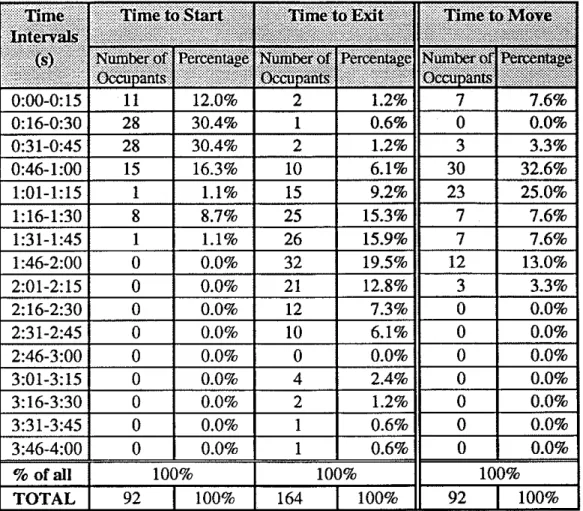
The tables below present the occupants' evacuation times. Table l displays the times at 1 min intervals and Table
2
displays the times at 15 s intervals for the fust 4 0 0 min only. Three different evacuation times are calculated for this analysis: a) Time to Start, b) Time to Exit, and C) Time to Move. The Time to Start represents the amount of time elapsed between the start of the alarm and the moment when the person starts to evacuate the building (for example, by exiting one's office). The Time to Exit represents the amount of time elapsed between the start of the alarm and the moment when the person exits the building. The Time to Move is the difference between the Time to Start and the Time to Exit; it providesan
indication of the time taken by occupants to travel from start to finish, regardless of when and where they started their evacuation.11
Table 2: London Building
-
Evacuation Timing in 15 s IntervalsIn calculating the Times to Start, Exit and Move in Table 1, different numbers of occupants are used. This represents the fact that some occupants were not seen starting their evacuation, for example those who were fust seen in the stairs. Only one occupant who had been seen starting did not exit the building. Table 2 presents data in
a
more detail through the use of 15 second intervals for the fust four minutes of the evacuation. Even though the alarm sounded continuously for over 14 minutes, everyone had left the building within the fust four minutes of the alarm activation.The number of occupants for which time to start data was available is somewhat limited
as
information is available for only 92 occupants of the 165 observed in thebuilding. Nevertheless, this does represent a majority of the building occupants and can be considered representative of the entire population.
As seen in Table 1, all of the people with an observed time to start began their evacuation within two minutes of the start of the alarm. Some individuals were observed to start immediately upon hearing the alarm; usually it was the fire wardens who were at their desks and immediately grabbed their helmets and began their duties. The average
Time to Start for all evacuees was 0:36 min (SD = 0:21). Table 2 shows that the majority of the evacuees, 89.1%, started to evacuate within the first minute of the alarm.
The occupants' Times to Exit were more varied than the Times to Start but were nevertheless quite consistent and remained under 4 0 0 min in all cases. The times range from 0: 10 min after the alarm began to sound until 3:46 min after the alarm sounded. Thus, within 4 0 0 min of the alarm sounding, 100% of occupants who eventually exited the building had already done so. One occupant did not exit the building, the
commissionnaire in the front lobby. Such factors as the Time to Start, distance travelled, age of the evacuee, and other such factors are likely to have affected the Time to Exit.
All of the evacuees had Times to Move under 4:00 min. In fact, over 96% of
occupants had Times to Move of less than 2:00 min. The T i e to Move was greatly affected by the floor on which the occupant started hidher evacuation. For example, while the average Time to Move for an occupant on the second floor was 0:57 min (SD =
0:10), the average for an occupant on the sixth floor was 1:54 min (SD = 0:06).
Time Comparisons According to Gender
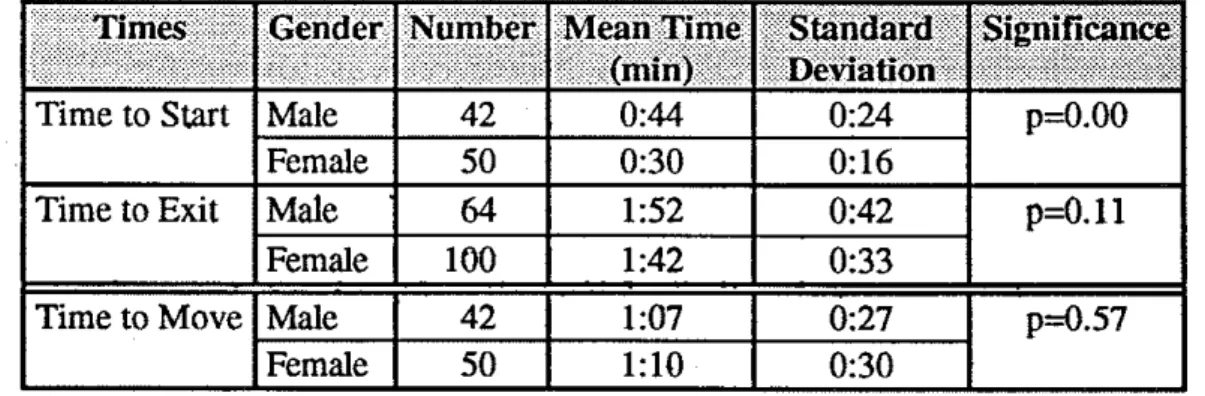
The ANOVA test was used to determine whether any differences exist between males and females for evacuation times. The results of this test, as well as the mean times for each gender, are presented in Table 3.
Table 3: London Building
-
Time Comparisons According to GenderThe female occupants of the building start faster than the males, and exit slightly faster than the males. The Time to Move is the same for both males and females. The difference in Time to Start is statistically significant, while the other two results
are
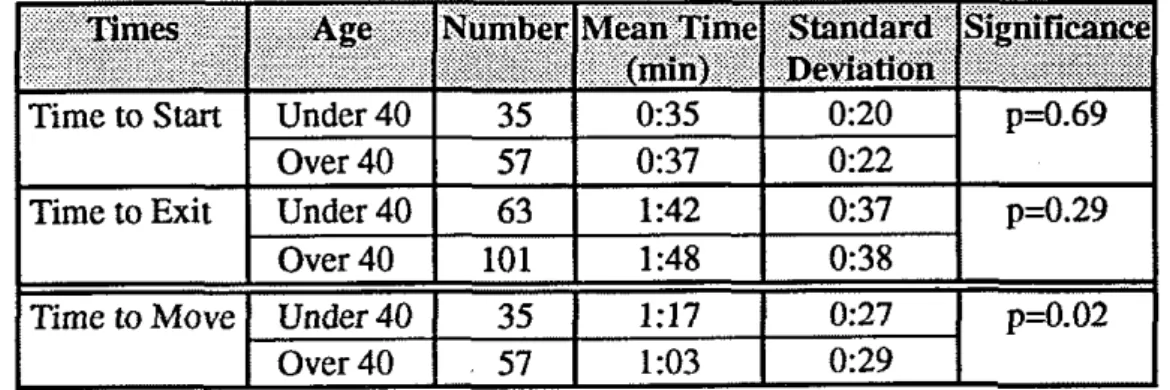
not statistically significant. Thus, females start faster than males, while men and women appear to take approximately the same time to travel an evacuation path from start to exit. Time Comparisons According to AgeAges of the evacuees were estimated by the researchers when watching the videotapes. The evacuees were then placed in one of two age categories based on this
estimate. The first category was adults under 40 years of age and the second category was adults over 40 years of age. The youngest occupants observed were approximately
20 years old, and the oldest occupants observed were approximately 65 years old.
Table 4: London Building
-
~ i m e Comparisons According to AgeOccupants aged greater than 40 years appear to start at approximately the same time as those aged less than 40 years. Those less than forty years tend to exit slightly faster although this result is not statistically significant. The Time to Move is greater for the younger adults. Thus, while occupants of all ages appear to react to the alarrn with approximately the same delay, the older adults tend to move faster from the time they start to the time they exit than do the younger adults.
Speed of the Occupants on the Stairs
Speed calculations were made for the individuals who used the stairs
as
part of their evacuation route. The mean speed of alI occupants was 0.78 m/s (SD = 0.17) andthe mean time spent in the stairs was 0:48 min (SD = 057).
In order to calculate the speed values for the stairs, the distance travelled between each set of floors was divided by the time taken by the individual to descend from one floor to the next. All three staircases showed variations in distances between floors, so calculations were made for each flight of stairs based on its measured distance to be travelled. Then, the mean of the speeds between the different floors was determined to give an average speed in the staircase for each individual. In addition, the total time spent in the stairs was calculated for each individual. The mean speed and time in the stairs varied among the three staircases.
While it is quite expected that the Side Staircase would have the slowest mean speed because of the crowding in that staircase, it is somewhat surprising that the Rear Staircase which was less used should have an equally slow mean speed. This can be explained because of the structure of the staircases. The Rear Staircase has steps that are
only 0.86 m wide while the Side Staircase has stairs 1.06 m wide. This difference of0.20 m allows for two people to share a step
in
the Side Staircase while people must proceed single file in the Rear Staircase. It has been found in previous research that the width ofthe stairs has a dramatic effect on the mean speed of travel [lo]. Thus, whiie markedly less people use the Rear Staircase, in certain locations its reduced width has a strong effect on speed of travel. For example, at floor landings where those entering the
stairs
must enter the flow of people descending, those in the Side Staircase can continue to descend alongside the people who have just entered, while those descending in the Rear Staircase must stop and wait for the people who have just entered to pass and can only continue their descent after that has occurred.Table 5: London Building
-
Speed and Time in StaircaseIt is not at all surprising that the Front Staircase has the fastest mean speed since there are only 15 occupants who use these stairs and thus crowding is not a problem, and the stairs
are
1.2 m wide so people have much space to use for their descent andare
not inhibited by other people descending the stairs.It is also quite understandable that the Side Staircase has the longest mean time in the stairs, for it has not only the slowest mean speed, but its occupants also travel an average of 39.4 m (SD = 21.9), compared to 28.8 m (SD = 13.8) for the Front Staircase, and 26.9 m (SD = 11.6) for the Rear Staircase.
It may be expected that as people entered the stairs on the various floors, the stairs would become more crowded and thus the lower floors would show people with slower average speeds. It was found, however, that this was not necessarily the case; while the lower floors were definitely more crowded because of the added number of people descending, this observation did not necessarily explain all of the fluctuations in mean speed values. Table 6 below shows how many people entered the stairs at each floor and Tlable 7 illustrates the average speed of the occupants as they travelled between each set of floors for all staircases combined. and the most crowded staircase. the Side Staircase. individually. From Table 7, it is clear that the speeds fluctuate between floors. An analysis of Table 6 helps to understand the reasons for these variations.
First, upon examination of all staircases combined, it is seen that those entering the stairs at the sixth floor are not numerous and do not encounter any people already
descending the stairs, nor do they have to merge with many people entering the stairs at the fifth floor, and thus they move quickly, with a mean speed of 1.25 mls (SD = 0.30).
From that point downward, the mean speeds are relatively similar but show a tendency to decrease with minor fluctuations. This is explained because whiie some crowding does occur at floor landings, in general people in this building are able to descend at
a
relativelysteady rate, with a slight reduction in speed at floor landings to allow others to enter. It is
somewhat diffcult to determine how much of the reduction in mean speed as people descended can be attributed to a general increase in crowding and how much can be attributed to specific crowds at floor landings where people are entering the stairs. The reason for this is that, coincidentally, the number of people entering the stairs increases steadily from the f i t h to the fourth, from the fourth to the third, and from the thud to the second floors.
Table 6: London Building
-
People Entering Stairs From Each FloorTable 7: London Building
-
Speed of Occupants in StairsUpon examination of the Side Staircase isolated from the other two staircases, similar conclusions can be drawn as were from the analysis of all staircases combined. For example, the speed from the sixth to fifth floors is quite fast, and is then dramatically reduced from the fifth to the fourth floor when crowding becomes a concern. The effects of crowding
-
are more noticeable in examining the Side Staircase in isolation. The speed-
starts out quite fast, drops suddenly upon encountering a large crowd at the fourth floor landing, and then as the stairs become increasingly crowded, the mean speed steadily decreases.Soeed Com~arisons According to Gender
The mean time in the stairs and the mean speed for each gender are compared in Table 8. A statistically significant result is that females travelled faster than males in the stairs, p
<
0.05. Females also spent less time in the stairs while still travelling an average of 3.3 m further than males, but these results are not statistically significant. Statistical analyses were done to determine what factors may have contributed to the faster mean speeds for females since this result is contrary to all literature in the field. It was foundthat males and females were evenly distributed in their choice of staircases and among the different floors. Thus, the only statistically significant result indicating a difference between genders is that females travelled fast& in the stairs than did males.
Table 8: London Building
-
Gender Comparisons of Speed and Time in StairsSpeed Comparisons According to Ape
The mean time in the stairs and the mean speed for each adult age group are compared in Table 9. Those under 40 years of age descend at the same mean speed as those over 40 years of age. Despite this fact, those over 40 show a longer mean time in stairs but this result is not statistically significant, and can also easily be explained by the fact that those over 40 tended to travel an average of 4.7 m further in the stairs than those under 40 years of age. There are no statistically significant differences in the travel
patterns of these two groups of adults within the stairs.
Table 9: London Building
-
Age Comparisons of Speed and Time i n StairsFurthermore, when the age groups were subdivided according to gender, it was found that females were faster than males in bath the under 40 and over 40 age groups. Alarm Audibility Measurement
Table 10 presents measurements in dBA of the ambient background noise and of the background noise with the alarm operating for 13 different locations throughout the building.
The alarm should have a minimum of three spectral elements within the audibility design window in order to meet audibility requirements. The last two columns in Table 10 represent the number of spectral components reaching the audibility design window. The numbers in parentheses represent the number of spectral components that exceeded the audibility design window, which confirms the intense sound pressure in some locations.
Table 10: London Building
-
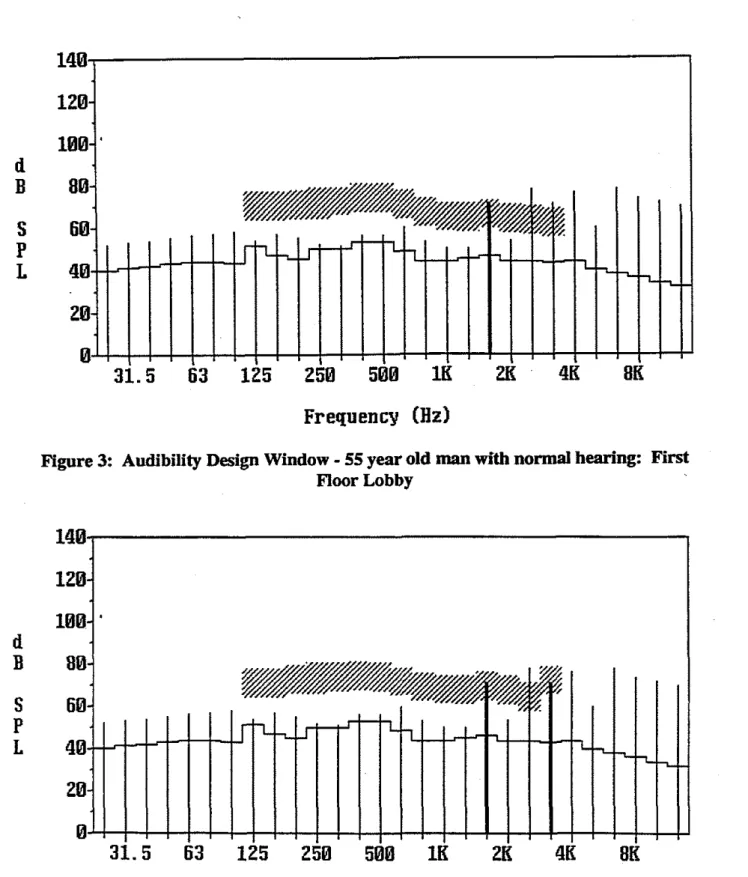
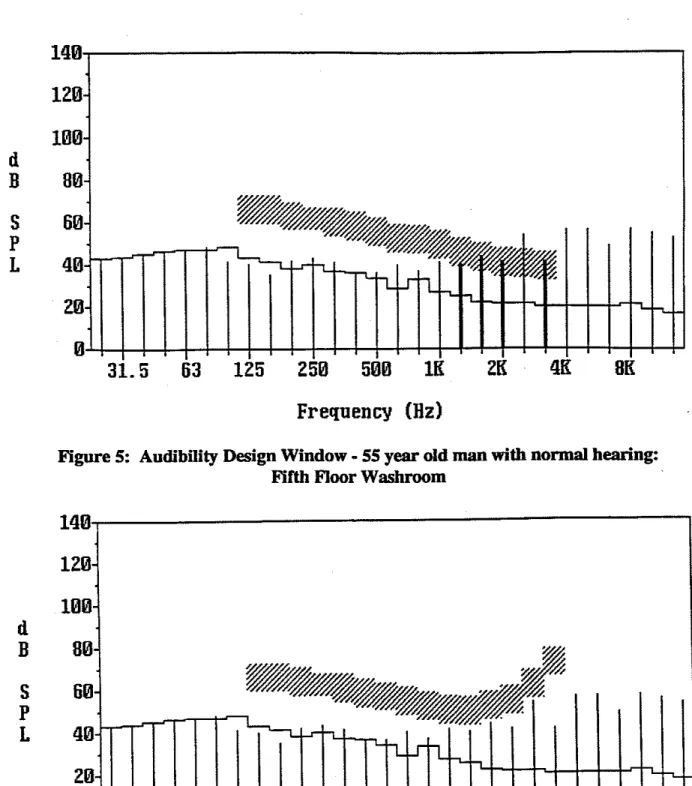
Background Noise and Alarm Audibility AnalysisFigures 3 through 6 illustrate some of the results obtained with ~ e t e c t s o u n d ~ for the fire alarm analysis of the building. In these figures, the x-axis represents the frequency content in hertz (Hz). The y-axis gives the sound pressure level (dBSPL). Measurements of the spectral content of the background noise is represented by the continuous horizontal line and the alarm level by the vertical lines for each 113 octave band. The diagonal
hatched area represents the audibility design window into which the alarm should have a minimum of three spectral elements in order to meet the requirements of audibility. The spectral elements that reach the audibility design window are represented with a thicker vertical line.
In the main lobby on the f i s t floor, only one spectral component reached the audibility design window for a 55 year old man with normal hearing, as shown in Figure 3. It is interesting to note that the alarm audibility is such in this location that two spectral components would be heard by
a
55 year old man with mild to severe hearing loss (from 1 to 8 kHz) as shown in Figure 4. It should be noted that in Figures 3 and 4, thebackground noise level and the alarm status are the same, the only difference is the hearing status of the receivers. The hearing status of the receivers changes the shape of the design window which becomes an important factor in an alarm audibility analysis.
Frequency
(Hz)
Figure 3: Audibility
Design
Window-
55 year old man with normal hearing: FirstEloor Lobby
Frequency
(Hz1
Figure
4: AudibilityDesign
Window-
55 year old manwith
hearing impairment: First Floor LobbyFrequency
(Hz)
Figure 5: Audibility Design Window
-
55 year old man with normal hearing:Fifth Floor Washroom
Frequency
(Hz)
Figure 6: Audibility
Design
Window-
55 year oldman with
hearing impairment:In the fifth floor washroom, four spectral components reached the audibility design window for a
55
year old man with normal hearing,as
shown in Figure 5, while none of the spectral components reached the audibility design window for a55
year old male with mild to severe hearing loss as shown in Figure 6. Thus, while the front lobby example illustrates a case in which the alarm is not well designed for either an individual with normal hearing or a hearing impairment, the alarm audibility in the washroom is good for a person with normal hearing, but the alarm is not audible to the hearing impaired individual.Questionnaires
The questionnaire was distributed to all occupants of the building who could be located immediately following the evacuation drill and who were in the building at the time the alarm bell began to sound. One hundred and thirty-five questionnaires were
distributed, and one hundred and six completed questionnaires were returned to the research group.
Of the 106 people who responded, 105 stated that at the time of the fire alarm they were on the floor on which their office is located. Only one person received a
questionnaire on a floor that was different from the floor he was on during the alarm. This
person received a questionnaire at his desk on the thud floor but was in the basement at the time of the drill. Of the 27 people who were not in their own offices when the alarm sounded, only one person chose to return to her office prior to evacuating the building. This person is a floor fire warden and it is speculated that she returned to retrieve her yellow hard hat that serves to identify her as a warden to other building occupants throughout the evacuation.
The audibility of the alarm was rated as loud enough by 89.3% of respondents. Only 5.8% felt that the alarm was too loud and these people were distributed relatively evenly throughout the building, with up to two respondents on each floor reporting this problem. While only 4.9% of respondents stated that the alarm was too quiet, this
represents five people, four of whom were on the fourth floor. In addition, while only one person indicated that she could not hear the fire alarm, she was also on the fourth floor and did not suffer from a hearing impairment. No general relationship could be found between a subject's interpretation of alarm audibility and whether helshe was in an open or closed office area at the time of the alarm.
It was found that 21.2% of building occuvants thought that the fire alarm indicated
that a real fire emergency was in progress.-~evek statistic2 analyses were completed to determine if those who believed that a real
fm
was in progress behaved any differently - -than those who thought that it was a fire drill, equipment test, or other such controlled situation. It was found that there was no statistically significant interaction between the subject's interpretation of the alarm and whether they performed such pre-evacuation actions as gathering valuables. In addition, statistical analysis was used to determine if certain personal characteristics would make a person more likely to interpret the alarm
as
a real fire emergency. The relationship between whether males or females were more likely to interpret the fire as a real emergency was not statistically significant. Similar
results were found in attempting to show interaction between the person's interpretation of the situation and their age or whether they had limitations; both these analyses had results that were not statis&ally significan;
Upon hearing the alarm, only three people indicated that they sought more information. One of these three people was attending
a
two day training course and was not familiar with the building. All three indicated that they had never received instruction in emergency procedures for the building, and two of them stated that they did not know where to look for such information. One of these people had a mobility impairmentIn order to exit the building, all occupants, except for those on the fust floor, used one of the three staircases available in the building. Of those who used the stairs, 63 people (64.9% of respondents) stated that they used the Side Staircase, 25 people (25.8% of respondents) used the back staircase, and 9 people (9.3% of respondents) used the Front Staircase. These responses are consistent with the evacuation patterns observed in the video recordings in which 66.2% used the Side Staircase, 22.6% used the Rear
Staircase, and 11.3% used the Front Staircase. It is important to recognize that many respondents noted that they altered their usual patterns of evacuation because of the construction currently underway on the exterior of the building. Thus, the distribution of people among the three staircases may not be representative of a typical evacuation in this building.
People showed a marked tendency to evacuate using the Side Staircase. In fact, many people whose offices were closer to the front or Rear Staircase chose to exit by the Side Staircase. For example, 54% of those who exited by the Side Staircase should have exited by the front, and 17.5% who exited by the side should have exited by the Rear Staircase.
While evacuating down the staircase, some people encountered situations which impeded their evacuation. Four people complained of others crowding at the entry to the stairs. One of these people was involved in a training session with approximately ten
participants and it is speculated that the group travelled together to the stairs, thus creating a bottleneck.
Eight people stated that the large number of people descending hindered their movement in the staircase. Understandably, most of these people (six of the total eight) were from the second and third floors and thus had to deal with the many people
descending from both their own floors and the floors above. In addition, seven of the eight people were travelling in the Side Staircase which was the most used staircase and thus these observations seem accurate.
Twelve people complained that those in front were moving too slowly. These people started their descent anywhere between floor six and floor two. However, of these twelve people, eleven were in the most popular staircase, the Side Staircase.
There were 15 people who reported that they had some kind of limitation which could impede their evacuation. Five people suffered from asthma, three were pregnant, four had arthritis, one had a mobility impairment, one had a vision impairment, and one had arthritis and was overweight. Only three people in the building reported having a device to assist in their evacuation and five indicated that another employee acted
as
a designated aide for evacuation. Of those who indicated that they had used theirdesignated aide, all were pleased with the system and found that it worked. None of the people with limitations was prevented from evacuating the building.
Fourteen people indicated that they did not know where to evacuate the building. These people had offices on floors two, three, four and six. Nevertheless, all people evacuated the building. Ten of these fourteen people indicated that they had exited the
.,
.
-
building by following others. No relationship could be found between whether a person knew where to evacuate and the department by whom helshe is employed. It is interesting to note that of these fourteen who did not know where to e;a;uate, three of them had some type of limitation (asthma, pregnancy, and a mobility impairment).Some interesting observations were made based on the questionnaire
as
to the general level of fue safety awareness among building occupants. A total of 71 people (67% of respondents) stated that they had never received instruction in evacuation procedures for the building and 81 people (76.4% of respondents) indicated that they would not know where to find such information. In addition, although the guideline to Fire Safety Procedures for PWGSC states that each floor will have a "Floor Fire Emergency Officer", 59 people (55.7% of respondents) could not name this person on their floor. The knowledge of the floor f ~ e emergency officer varied remarkably between floors. For example, while none of 19 respondents on the sixth floor could identify the floor fire emeroencv officer. all 12 of the fourth floor resoondents identified a floor - , fireemergency officer, Knowledge of the fire warden also varied by department, indicating different policies of fire education between departments. For example, while in some departmeits all employees could identify the warden, in at least one other, none of the
employees could identify a floor fire widen. It is also important to recognize that some
floors had more than one officer as the size and organization of the floors easily lends itself to this situation.
Conclusions
The evacuation drill in the London office building lasted 14: 14 min. All of the occupants who were seen evacuating the building chose to exit either directly outside from the fust floor or by using the staircases from the upper floors; none of the occupants tried to use the elevators to evacuate.
The occupants tended to travel in familiar directions. Of those occupants who used the stairs to evacuate, 66.2% chose to exit by the Side Staircase which