Mammalian Genome 8, 328-332 (1997).
e / / o / / / e
9 Spnnger-Verlag New York Inc 1997
Characterization, chromosomal localization, and genetic variation of
the porcine heart fatty acid-binding protein gene
Frans Gerbens, 1 Giinther Rettenberger, 2 Johannes A. Lenstra, 3 Jacques H. V e e r k a m p , 4 Marinus F.W. te Pas 1 lDLO-Institute for Animal Science and Health (ID-DLO), P.O. Box 65, 8200 AB Lelystad, The Netherlands
2Swiss Federal Institute of Technology, Department of Animal Science, ETH-Zentrum TAN, 8092 Zurich, Switzerland
3Institute of Infectious Diseases and Immunology, Faculty of Veterinary Medicine, Utrecht University, P.O. Box 80.165, 3508 TD Utrecht, The Netherlands
4Department of Biochemistry, University of Nijmegeu, P.O. Box 9101, 6500 HB Nijmegen, The Netherlands Received: 22 August 1996 / Accepted: 3
January
1997Abstract. The purpose of this study was to detect genetic varia- tion in the porcine H-FABP gene, a candidate gene for meat quality traits in pigs. Lambda phages containing the porcine H-FABP gene were isolated by plaque hybridization with human H - F A B P cDNA. The coding and flanking intronic sequences of the porcine H-FABP gene were determined as well as 1.6 kb of the 5' upstream region. The various potential regulatory sequences in this region are in accordance with the function and expression of the protein in muscle and mammary tissue. Furthermore, comparison with the homolog region of the mouse identified a highly conserved 13-bp element (CTTCCT [A/C] TTTCGG) that may be involved in regu- lation of expression. The porcine H-FABP gene was localized on Chromosome (Chr) 6 by porcine sequence-specific PCR on D N A from a pig/rodent cell hybrid panel. In addition, part of the H- FABP gene was screened for genetic variation by PCR-RFLP analysis. Three PCR-RFLPs were detected, one in the upstream region (HinfI) and two in the second intron (HaelII and MspI). In most pig breeds the corresponding alleles have a variable distri- bution, possibly a consequence of selective breeding. This genetic variation will enable us to investigate the role of the H-FABP locus in porcine production and meat quality traits.
Introduction
One objective in pig breeding programs is the reduction of fat in the carcass to meet the consumers' demands for lean meat. Gen- erally, fat reduction is surveyed as a decrease in backfat thickness. However, other fat depots such as the intramuscular fat (IMF) are reduced as well. Further reduction of this IMF would be undesir- able because it is the main fat depot in meat and is positively correlated with meat quality traits (Wood et al. 1988). Hovenier et al. (1992) showed that IMF reduction is not completely correlated with backfat reduction, so both traits can be treated separately. Since IMF is hardly measurable in living animals, a (genetic) marker for this trait is necessary to exclude this depot from further reduction. Recently, it has been statistically shown that a major gene for IMF deposition is present in pigs (Janss et al. 1994), but the location and mode of action of this gene is still unknown. A candidate for this major gene may be the gene that encodes for heart fatty acid-binding protein (H-FABP).
Fatty acid-binding proteins (FABPs) are small intracellular proteins involved in fatty acid transport from the plasma mem-
Correspondence to: F. Gerbens
The nucleotide sequence data reported in this paper have been submitted to the EMBL database and have been assigned the accession numbers X98555, X98556, X98557, and X98558.
brane to the sites of [3 oxidation and/or triacylglycerol or phos- pholipid synthesis (Veerkamp and Maatrnan 1995). Furthermore, FABPs may modulate the intracellular fatty acid concentration (Veerkamp et al. 1993) and in this manner regulate various cellular processes and lipid metabolism in particular. FABPs are members of a family of intracellular lipid-binding proteins of at least eight structurally distinct types: adipocyte, brain, epidermal, heart, in- testinal, ileal, liver, and myelin.
The heart type FABP (H-FABP) is a 15-kDa protein present in several tissues with a high demand for fatty acids such as cardiac and skeletal muscle and lactating mammary gland. Recently it became clear that mammary-derived growth inhibitor (MDGI), a protein that inhibits tumor cell growth (Bohmer et ai. 1987), is in fact a mixture of H-FABP and adipocyte-type FABP (Specht et al. 1996). The murine H-FABP gene has been isolated and contains four exons encoding 24, 58, 34, and 17 amino acids, respectively (Treuner et al. 1994).
The aim of our studies is to look for a possible relationship between genetic heterogeneity in the H-FABP gene and variation in IMF deposition in pigs. To initiate this, we isolated and char- acterized the porcine H-FABP gene and determined its chromo- somal localization. In particular, genetic variation of this gene was identified, which can be used for future association studies or linkage analysis with production and meat quality traits. Materials and methods
Isolation of H-FABP containing phage clones. A porcine genomic DNA EMBL3/SP6/T7 lambda library (Clontech Laboratories Inc., Palo Alto, Calif.) was screened by plaque hybridization (Sambrook et al. 1989) to human H-FABP cDNA in the pSP65 vector (Peeters et al. 1991) labeled with [c~-32p]dCTP by nick translation (Sambrook et al. 1989). Briefly, 500,000 plaques were transferred to replica nitrocellulose filters and mcu- bated in denaturation buffer (1.5 M NaCI/0.5 M NaOH) for 2 min, neutral- ization buffer (1.5 M NaC1/0.5 M Tris-HCl, pH 8.0) for 5 min, and fixauon buffer [0.2 M Tris-HC1, pH 7.5/2 • SSC(0.3 M NaC1, 0.03 M sodium citrate)] for 30 s. The filters were air-dried and baked at 80~ for 2 h. The filters were prehybridized [6 x SSC/0.5% (wt/vol) SDS/5 x Denhardt's and 100 ixg/ml NaOH-treated salmon sperm DNA] for 2 h at 67~ and hy- bridized at 67~ overnight m the same buffer containing the radioactive probe. The filters were washed four times with 2 x SSC, 0.1% (wt/vol) SDS for 30 rain at room temperature.
Twenty plaques that showed positive signals on both replica filters were purified by two additional rounds of low-density plaque hybridiza- tion. Phage DNA was isolated by the plate lysate method (Sambrook et al.
1989).
Polymerase chain reactions. PCR amphfications were performed on 1 txl of a 1:1000 dilution of phage DNA preparations or 50 ng of genomic DNA in 50 Ixl containxng 0.2 units Super Tth polymerase (SphaeroQ,
F. Gerbens et al.: Characterization of the porcine H-FABP gene 329
Leiden, The Netherlands) in 10 mM Tris-HC1 (pH 9.0)/50 mM KC1/1.5 mM MgCI2/0.1% (wt/vol) gelatin/l% Triton X-100/0.5 fiN of each primer (Pharmacia Bmtechnologies, Uppsala, Sweden) and 0.2 mM of each dNTP (Boehringer Mannhelm, Mannheim, Germany). After 3 min of denatur- ation at 94~ 33 cycles of amplification were carried out: 94~ for 1 min, the indicated annealing temperature (Tables 3 and 4) for 1 min, and 72~ for the time considering the length of the expected fragment (ca 1 min for every kb).
DNA sequence analysis. P C R # 1 (Table 3) was performed on DNA of the purified phage clones to identify the clones containing the H-FABP
gene. Two positive phage clones were used to subclone the H-FABP gene. Therefore, the SacI and KpnI (Boehringer Mannheim) restriction digestion fragments of the phage DNA, contamlng the 5' upstream region and exon 1 through exon 3, were subcloned in pBS. Intron 3 and exon 4 were amplified with porcine genomic DNA as template and primers from P C R # 2 (Table 3). The 3' untranslated region was amplified with porcine muscle eDNA as template and specific primers for porcine H-FABP exon 1 or 3 (Table 3) in combination with the anchor primer from the 5'/3' RACE-PCR kit (Boehringer Mannhelm). PCR products were cloned in the pT7Blue vector (Novagen Inc., Madison, Wis., USA). Products of two independent PCR reactions were cloned to identify errors by the Super Tth polymerase upon sequence analysis.
Recombinant plasmid DNA from H-FABP clones was purified with the Wizard Maxtprep kit (Promega). The nucleotide sequence was determined by dideoxy sequencing, either by cycle sequencing (Perkin Elmer, Foster City, Calif., USA) or autoread sequencing (Pharmacla Biotechnologies, Uppsala, Sweden) and the analysis was performed on a ABI 373 (Perkin Elmer, Foster City, CA, USA) or ALF DNA sequenator (Pharmacia Bio- technologies, Uppsala, Sweden), respectively. The DNA sequence was analyzed by the Genetics Computer Group (University of Wisconsin, Madison, Wis, USA) software packages.
Chromosomal localization. Two independently established pig/rodent somatic cell hybrid panels (Panel A, Rettenberger et al. 1996; Panel B, Zijlstra et al. 1994) were used to map the H-FABP gene to a specific chromosome by PCR. DNA (100 ng) from each cell hybrid containing porcine chromosomes in various combinations was used in the P C R # 3 (Table 3) reaction, which unambiguously amplified porcine H-FABP in- tron 3 sequences.
Concordancy and correlation were statistically evaluated as described by Chevalet and Corpet (1986). The distribution patterns of the PCR sig- nals for porcine H-FABP were compared with the distnbutmn patterns of the pig chromosomes and of reference loci of mdividual pig chromosomes. A marker is syntenic with a chromosome or reference locus with a prob- ability of 97.5% ff the ~b is >0.74 for 20 hybrid lines. Synteny can be excluded ff ~b is <0.59.
R F L P screening. Porcine genomic DNA was isolated as described (Sambrook et al. 1989) from EDTA-treated blood stored at -80~ Geno- mlc DNA (100 ng) was used for PCR amplification in 50 p+l reaction mixture as described before. The primer sequences and its corresponding product size and annealing temperature for each combination are given in Table 4. Fifteen txl of the PCR reaction was used for restriction digestion with two units of HaelII, HinfI, or MspI (Boehringer Mannheim) m a total volume of 20 IM. MspI thgestion was carried out directly in the PCR buffer;
HaelII and HinfI digestions were carried out upon addition of the recom- mended concentrated reaction buffer. Restriction digestion fragments were loaded on a 2% (MspI) or 3% (HaelII and HinfI) agarose (Sigma, St Louis, Mo., USA) gel. After electrophoresis the RFLP patterns were scored by two persons, independently. Allele frequencies between breeds were com- pared with a binomial model with a significance treshold of 95%. Genotype distributions within breeds were tested for Hardy-Weinberg equilibrium as described by Falconer and Mackay (1996).
R e s u l t s
Porcine H - F A B P gene sequence analysis. The H-FABP gene se- quence was determined including 1.6 kb of the upstream regulatory region and 0.2 kb of the 3' untranslated region (Fig. 1). To do this, three phage clones that contained the H-FABP gene were isolated from the porcine genomic DNA library by plaque hybridization. Subsequently, DNA from
g g c t t c c t t ct c a Q a t t c c g a a g a g c g c c t t g a g g c c a g g a a a g g g g a c t g g t c ct g c c a g c c e c g g g g a g g g a t t e g g a t c c c g g g t a c e c g t g c t g c c g g g c g c c t a c g g g c t g c c c c t t c c t c t t t c q q e a g g c t g g g g g a t g g g c g a t c a a c c c g g c g a g g c a g c g c ct g o a t g g g g e t t c c t a t t t c a ( ~ g a g c g g g g g c g t a c g c c a c g c c t c g t c a c g t g a c g c t a g g g c c a t t t a a a g c g g t a g c g c g g g c t g g g a g c c g c c g g t c c t g g a a t t t t t g c g c g c c t g t t c t g t c g t c t c t t t c t c a g c c t a g c c c a g c ctcaccATGGTGOACGCCTTCOCGG~ZACCTGGAAOCTAGTOGACAGCAAG~T M V D A F A G T W K L V D S K N T T C O A T G & C T A C A T G A A G T C A A T T G g t g a g < 4.2 k b >c t c a gGTGTOO~-~-~-x F D D Y M K S I G V G F G C C A C C A G G C A G G T ( ~ g C C A A C A T G A C C A / % O C C T A C C A C A A T C A T C G A A G T G A A T A T R ~ V A N M T K P T T I I E V N 6 ~ M ~ G A C A C A A T C A T C A T A A A A A C A C A A A G C A C C T T C A A G A G C A C A G A G A T C A G C G D T I I I K T ~ $ T F K S T E I S T T ~ G C T 6 ~ G A G T G G A G T T T G A ~ A G A C A A C A G C A G A T O A C A ~ R A 6 ~ T C A A G F K L G V E F D E T T & D D R K V K g t g a g < 2 . 5 k b > c a c a g T C C A T T G T G A C A C T ~ g & T G G A ~ g C A / % A C T T G T C C A C S I V T L D G O K L V H C~q~...AGA, AGTGGAATGGACAAGAGACA~CGCTZ~T~C(~gO+%ACTAGTTGA~G L ~ K W N G ~ H T T L V R E L V D G A A A C T C A T C C T G g t a a g < I . 5 k b > t c c a g A C A C T C A C C C A T G G C A G T G 4 ~ A G T T K L I L T L T H G S A V T G C A C T C G C A C T T A C G A O A A A G A G G C A T G A c c t g c c c a t c c c t t c g a c t g t t c c C T R T Y W K E A s t o p t g c c a a t t g g c t a c t c c t g g a c t c a g c a c c a g a t t g c c t c a t t t t t t c c t c t g g c a t t t t g t a a a a a t c t a c t t t g g g g a t a t t c t c c t g g g g t c a g g t t g c a e c a g c ct r c g t t c a g t t c c g g t t c t t g t t g t g t a t g t t w g t t t t t t t t t a a t t g c a t cc a a a g g g t g c t ct g a g g t c a a t a a a a t a g c c a a g g c * c a c c *
Fig. 1. The porcine H-FABP gene sequence includmg 330 bp of the 5' upstream region and 200 bp of the 3' untranslated region. Exons are rep- resented by bold capital letters, and the deduced amino acid sequence is shown underneath and numbered. The putative TATA-box, the polyade- nylation signal in the 3' UTR, and the polymorphic Hinfl site (GATTC) are depicted bold and underlined. The 13-nucleotide element is depicted double underlined. The size of the nondepicted intron sequences is shown between arrowheads. The two poly-A tail starting positions are indicated by asterisks.
these phage clones was cloned and subjected to sequence analysis. The region downstream of exon 3 was isolated as PCR fragments amphfied on porcine genomic DNA and muscle eDNA.
The exons were identified in the porcine H-FABP gene sequence (Fig. 1) accordmg to homology with known H-FABP sequences of cattle and mouse. The percentage of identity of the coding part of the porcine H-
FABP gene with the homologous genes of other species is very high (Table 1) both for the DNA sequence as well as for the predicted amino acid sequence. The resulting four exons encoded in respective order 24, 58, 34, and 17 amino acids, and the sizes of the introns were about 4.2, 2.5, and 1.5 kb, respectively.
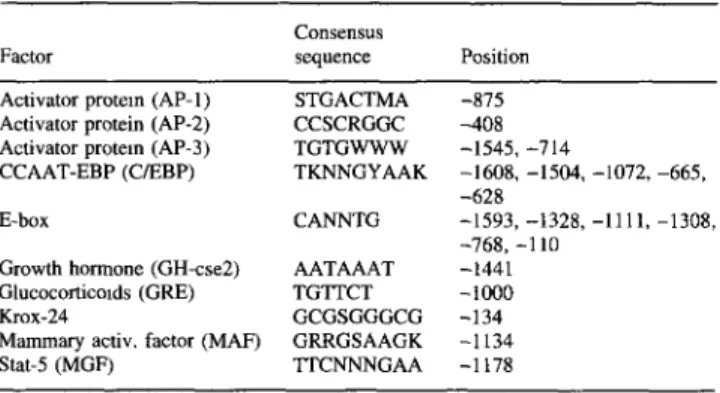
Sequence analysis of the 5' regulatory region revealed a potential TATA box 92 bp upstream the ATG start codon (Fig. 1) and potential consensus binding sites for various transcription factors such as MYOD and hormone receptors (Table 2). In the 3' untranslated region the con- sensus poly-A signal sequence was identified (Fig. 1).
Screening of the porcine genomic DNA library also yielded H-FABP
Table 1. Interspecies identity of the H-FABP encoding DNA sequence and the predicted amino acid sequence.
Pe~ent~eidennty with porcine H-FABP
Speoes DNA Protein
Cattle a 92 92 Human b 91 90 Mouse c 84 87 Rat d 85 86 a Billich et al. 1988. b Peeters et al. 1991. Bmas et al. 1992. ~ Claffey et al. 1987.
330
Table 2. Position of transcnptton upstream region.
factor binding sues in the porcine H-FABP gene
Consensus
Factor sequence Position
Activator protem (AP- 1) STGACTMA -875
Activator protein (AP-2) CCSCRGGC -408
Activator protein (AP-3) TGTGWWW -1545, -714
CCAAT-EBP (C/EBP) TKNNGYAAK -1608, -1504, -1072, -665,
-628
E-box CANNTG -1593, -1328, -111 l, -1308,
-768, -1 l0
Growth hormone (GH-cse2) AATAAAT -1441
Glucocorticmds (GRE) TGTTCT -1000
Krox-24 GCGSGGGCG -134
Mammary activ, factor (MAF) GRRGSAAGK -1134
Stat-5 (MGF) TTCNNNGAA -1178
pseudogene-like sequences as identified by the absence of intronic se- quences. T w o of these pseudogenes were analyzed by sequencing the P C R # 2 (Table 3) amplification products. Furthermore, a pseudogene product amplified on porcine genomic D N A was also analyzed. Various nucleotide substitutions as well as frameshifts were detected between the
H-FABP gene coding region and pseudogene sequences. All three pseu- dogene sequences were distinct from one another, and one contained a 27-bp internal duplication (data not shown; sequences submitted to E M B L database with accession No.'s X98555, X98556, and X98557).
Genomic location o f the porcine H - F A B P gene. The presence of the porcine H-FABP gene in two independently established pig/rodent cell hybrid panels, A and B, was tested by the porcine-specific P C R # 3 (Table 3). The obtamed data were compared with the k n o w n cytogenetic data of both panels and data from already mapped loci for each chromosome, the so-called reference loci, for panel A. The H-FABP gene could be assigned to pig Chr 6 because a single significant correlation (qb) was detected for both panels of 0.89 and 0.83, respectively. All other chromosomes were asyntenic for both panels because the correlation did not exceed 0.54.
Sites o f genetic variation in the porcine H - F A B P gene. Digestion of PCR (Table 4) products with the restriction digestion enzymes HaeIII, HinfI and MspI revealed three fragment length p o l y m o r p h i s m s (RFLP).
The H i n t site is located in the 5' upstream region, whereas the HaeIII and MspI sites are about 300 bp apart in intron 2 of the H - F A B P gene.
The frequencies of the different RFLP genotypes for various pig breeds were determined in unrelated animals (Table 5). The three polymorphisms are present in all breeds tested, except for the HaeIII and MspI RFLPs in the Hampshire and M e i s h a n breed. The allele frequencies estimated for pig breeds represented by more than nine animals revealed significant differ- ences between t h e m (Table 5). Furthermore, in the Duroc breed the Hinfl
allele frequency distribution is at dlsequilihrium.
Discussion
Although the fatty acid binding and antigenic crossreactivity of porcine H-FABP have been studied extensively (Paulussen et al. 1988), its amino acid sequence has not been known until now. We show that 86% to 92% of the predicted amino acid sequence of porcine H-FABP is identical to the H-FABP sequences of other
Table 3. The conditions for porcine H-FABP gene specific PCR reactmns
PCR Site b Primer sequence T ~ , a Size (kb)
# 1 exon 1 exon 2 # 2 exon 3 exon 4 # 3 exon 3 intron 3 5'GCCAGCATCACTATGGTGGACGCTTTC 5'CTrAAAGCTGATCTCTGTGTTC 57 4.4 5'GGAGGCAAACTTGTTCACCTGC 5'TCTTTCTCGTAAGTGCGAGTGC 57 1.6 5'GGAGGCAAACTTGTTCACCTGC 5'GTACTGGGAGCACTCTTCACTC 62 1.5 a Annealing temperature (~
b Exon pnmers are based on human and mouse H-FABP cDNA sequences and the mtron 3 primer on porcine H-FABP DNA sequence
F. Gerbens et al.: Characterization of the porcine H-FABP gene
Table 4. The PCR conditions for the PCR-RFLP detecUon assays.
RFLP Primer Tan. ~ Size (bp)
HaelIl/MspI 5 ' ATTGCTTCGGTGTGTTTGAG
5 'TCAGGAATGGGAGTTATrGG 57 850
HinfI 5'GGACCCAAGATGCCTACGCCG
5'CTGCATCTTTGACCAAGAGG 57 700
Annealing temperature (~
mammalian species (Table 1). The higher similarity of porcine and human H-FABP, compared with rat H-FABP, is reflected also in the antigenic crossreactivity patterns (Paulussen et al. 1990).
The porcine H-FABP gene resembles the murine H-FABP gene (Treuner et al. 1994) in overall structure, although the porcine introns are larger. Furthermore, a potential TATA box (TTTAAA) and poly-A signal (AATAAA) are present. Analysis of the porcine H-FABP cDNA sequences revealed two poly-A tail start sites four nucleotides apart (Fig. 1). In fact, an alternative poly-A start site with a spacing of four nucleotides was previously reported as one of the differences between bovine H-FABP and MDGI cDNA sequences (Spener et al. 1990), but also corresponds to the differ- ences between the murine H-FABP gene and a pseudogene-like sequence (Treuner et al. 1994).
H-FABP pseudogene-like sequences have been localized to murine Chrs 8, 10, and 17 (Heuckeroth et al. 1987; Treuner et al. 1994) and human Chr 13 (Veerkamp and Maatman 1995), respec- tively. Several clones that contained pseudogenes were isolated from the porcine genomic DNA library. On the basis of restriction digestion patterns of the clones, we estimated that the porcine genome contains at least three different H-FABP pseudogenes (data not shown). Three porcine pseudogenes from two different pigs were analyzed by sequencing a PCR product containing a part of the H-FABP pseudogene. Alignment of these sequences with the H-FABP gene sequence showed that all three had frameshift mutations, and one had ~in internal 27-bp duplication (data not shown). Moreover, we detected various nucleotide substitutions in all three porcine pseudogene fragments, whereas the murine H- FABP pseudogene differed by only three nucleotides from the complete murine H-FABP coding sequence. In mice no expression of the H-FABP pseudogene was detected in an array of tissues (Treuner et al. 1994). In conclusion, it is unlikely that the porcine pseudogenes are expressed because of the additional high degen- eracy of these sequences.
Potential transcription factor binding sites have been found in the 5' upstream region of the murine H-FABP gene (Treuner et al. 1994). These binding sites can also be found in the porcine H- FABP gene upstream region (Table 2) and are consistent with the reported tissue-specific expression or function of H-FABP. For
Table 5. Allele frequency and number of heterozygotes for the porcine H-FABP RFLPs in various pig breeds.
Allele frequency and number of heterozygotes per pig breed a RFLP Allele b DL DU GY HS ME PI WP MspI A .98 c .40 a 81 ~ 1.0 1.0 ~ .90 .70 Aa 1 4 11 0 0 1 3 HaelII D .32 c .40 c .31 ~ 1.0 1.0 d 50 .10 Dd I t 4 17 0 0 1 1 Hinfl H .70 c .70 c'd .97 d .33 .45 c 70 .90 Hh 10 2 2 2 6 1 1 n f 20 10 34 6 11 5 5
a DL, Dutch Landrace; DU, Duroc, GY, Great Yorkshire; HS, Hampshire; ME, Mel- shan; PI, Pletrain; WP, Wild Pig
b Alleles represented by letters: A, 750 + t00 bp; a, 850 bp; D, 850 bp; d, 450 + 400 bp, H, 197 + 59 bp; h, 256 bp (besides other fragments).
c.d,e Data withm a row lacking the same superscript letter differ (P < 0.05). f The number of unrelated animals tested per breed.
F. Gerbens etal.: Characterization of the porcine H-FABP gene 331
instance, the presence of potential E-boxes, which direct expres- sion to skeletal muscle cells upon binding of the myogenic MyoD protein family, could direct the H-FABP expression. On the other hand, H-FABP is highly expressed in cardiac tissue, but this ex- pression is not regulated by these myogenic factors that are not present in cardiac myocytes (Olson et al. 1995).
General metabolic regulation of the H-FABP gene could be explained by the presence of potential binding sites for activator proteins (AP) 1, 2, and 3, Krox 24, and the glucocorticoid- responsive element, which also renders responsiveness for the es- trogen and progesterone receptors. The significance of the poten- tial C/EBP (CAAT enhancer binding protein) binding sites is un- clear, since this protein is thought to be primarily expressed in adipocytes (MacDougald and Lane 1995).
Interestingly, a 13-nucleotide (CTTCCT[A/C]TTTCGG)-long element found twice in 250 base pairs preceding the A T G start codon of the porcine H-FABP gene (Fig. 1) was also found once in the murine H-FABP gene upstream region. This element has no homology to any potential binding site in a transcription factor database as well as in the GENBANK/EMBL nucleotide databases and probably represents a new element involved in transcriptional regulation.
The presence of potential Stat 5 binding sites would explain the pregnancy- and lactation-dependent expression of the H-FABP gene in the mammary gland (Binas et al. 1992). Namely, Stat 5 is a member of the Jak/Stat signal transduction pathway and is acti- vated by the pregnancb,-dependent hormone prolactin in the mouse mammary gland (Liu et al. 1995). This Stat 5 binding site is also detected in the promoters of various milk protein genes (Watson et al. 1991) that are expressed in late pregnancy and during lactation. J" Two independent cell hybrid panels (Rettenberger et al. 1996 and Zijlstra et al. 1994) have been used for mapping. The porcine H-FABP gene was localized on Chr 6. The corresponding human and mouse H-FABP genes are localized on Chr lp32-p33 (Peeters et al. 1991; Troxler et al. 1993) and Chr 4 (distal to Lck; Bahary e t a l . 1991), respectively, in a region that is highly conserved in evolution (Paszek et al. 1995). Several other genes that are mapped in this conserved region in mice and human, like ENO-1 and PGD (Yerle et al. 1995), are also found on porcine Chr 6. Indeed, heterologous chromosome painting of human chromosomes to the pig genome indicated that porcine Chr 6q21-26 is homologous to parts of human Chr 1 (Rettenberger et al. 1995).
In our search for genetic variation in the H-FABP gene, RFLPs were detected in the upstream region and intron 2. The subsequent genotypes show a diverse distribution in the pig breeds tested except in the Hampshire and Meishan breeds for the intron 2 specific RFLPs (Table 5). Interestingly, also wild pigs show het- erogeneity for each RFLP.
Although for some breeds the sample size is very small, the observed difference in the genotype frequency distribution be- tween breeds may be the result of selective breeding. However, a small number of founder animals for a population either by changed selection criteria or import, as for the western Meishan population, also changes the allele frequency.
The Hinfl allele frequency distribution is at disequilibrium in the Duroc breed, which may suggest selection pressure in favor of the H allele. Interestingly, the Duroc breed has a different MspI allele frequency distribution than the Great Yorkshire and the Dutch Landrace breeds. The Duroc breed has a higher percentage of IMF and a lower growth rate compared with the Great York- shire breed (Hovenier et al. 1992), which, upon selection for growth rate, may have changed the allelic distribution of the H- FABP RFLPs. Currently we are investigating possible relations of the H-FABP genotypes with meat quality traits like IMF and the more general traits as fat deposition and lean growth.
Acknowledgments. We thank Prof. Dr. H. Geldermann (Universit~it Ho- henheim, Germany) and Dr. Ir. A.G. de Vries for providing the blood of
Wild and Hampshire pigs, respectively. The Meishan pigs used were from a population provided to the Wageningen Agricultural University by Eu- ribrid BV, Boxmeer (NL). Furthermore, we wish to thank Dr. C. Zijlstra (Faculty of Veterinary Medicine, University of Utrecht), who kindly pro- vided DNA of the pig/rodent cell hybrid panel B. This project was finan- cially supported by the pig breeding companies Nederlands Varkensstam- boek B.V. (NVS), VOC Nieuw Dalland B.V., Prova B.V., and the Product Boards for Livestock, Meat and Eggs (PVE).
Patent. A patent (No. 96200855.3) was filed for the porcine H-FABP gene sequence, the described PCR-RFLP tests to detect genetic variation within it, and the use of these tests in breeding programs.
References
Bahary N, Zorich G, Pachter JE, Leibel RL, Friedman JM (1991) Molecu- lar genetic linkage maps of mouse chromosomes 4 and 6. Genomics 11, 33-47
Billich S, Wissel T, Kratzin H, Hahn U, Hagenhoff B, Lezius AG, Spener F (1988) Cloning of a full length complementary DNA for fatty acid- binding protein from bovine heart. Eur J Biochem 175, 549-556 Binas B, Spitzer E, Zschiesche W, Erdmann B, Kurtz A, Mueller T, Ni-
emann C, Blenau W, Grosse R (1992) Hormonal induction of functional differentiation and mammary derived growth inhibitor expression in cultured mouse mammary gland explants. In Vitro Cell Dev Biol 28A, 625~634
Bohmer F, Kraft R, Otto A, Wernstadt C, Hellmann U, Kurtz A, Muller T, Rohde K, Etzold G, Lehmann W, Langen P, Heldin C-H, Grosse R (1987) Identification of a polypeptide growth inhibitor from bovine mammary gland. J Biol Chem 262, 15137-15143
Chevalet C, Corpet F (1986) Statistical decision rules concerning synteny or independence between markers. Cytogenet Cell Genet 43, 132-139 Claffey KP, Herrera VL, Brecher P, Ruiz-Opazo N (1987) Cloning and
tissue distribution of rat heart fatty acid-binding protein mRNA: identi- cal forms in heart and skeletal muscle. Biochemistrj 26, 7900-7904 Falconer DS, Mackay TFC (1996) Introduction to quantitative genetics, 4th
ed( (Essex, England: Longman Group), pp 1-19
Heuckeroth RO, Birkenmeier EH, Levin MS, Gordon JI (1987) Analysis of the tissue-specific expression, developmental regulation, and linkage relationships of a rodent gene encoding heart fatty acid,binding protein. J Biol Chem 262, 9709-9717
Hovenier R, Kanis E, Van Asseldonk Th, Westerink NG (1992) Genetic parameters of pig meat quality traits in a halothane negative population. Livest Prod Sci 32, 309-321
Janss LLG, Van Arendonk JAM, Brascamp EW (1994) Identification of a single gene affecting intramuscular fat in Meishan crossbreds using Gibbs sampling. World Conference on Genetics Applied to Livestock Production, Guelph
Liu K, Robinson GW, Gouilleux F, Groner B, Henninghausen L (1995) Cloning and expression of Stat5 and an additional homologue (Stat5b) involved in prolactin signal transduction in mouse mammary tissue. Proc Natl Acad Sci USA 92, 8831-8835
MacDougald OA, Lane MD (1995) Transcriptional regulation of gene expression during adipocyte differentiation. Annu Rev Biochem 64, 345-373
Olson NE, Perry M, Schulz RA (1995) Regulation of muscle differentia- tion by the MEF-2 family of MADS box transcription factors (mini review). Dev Biol 172, 2-14
Paszek AA, Schook LB, Louis CF, Mickelson JR, Flickinger GH, Mur- taugh J, Mendiola JR, Janzen MA, Beattie CW, Rohrer GA, Alexander LJ, Andersson L, Ellegren H, Johansson M, Mariani P, Marklund L, Hoyheim B, Davies W, Fredholm M, Archibald AL, Haley CS (1995) First international workshop on porcine chromosome 6. Anim Gen 26, 377-401 (Abstract of J. Gellin)
Paulussen RJA, Van der Logt CPE, Veerkamp JH (1988) Characterization and binding properties of fatty acid binding proteins from human, pig and rat heart. Arch Biochem Biophys 264, 533-545
Paulussen RJA, Van Moerkerk HTB, Veerkamp JH (1990) Immunological quantification of fatty acid binding proteins. Tissue distribution of liver and heart FABP types in human and porcine tissues. Int J Biochem 22, 393-398
Peeters RA, Veerkamp JH, Geurts van Kessel A, Kanda T, Ono T (1991) Clonmg of the cDNA encoding human skeletal muscle fatty acid binding protein, its peptide sequence and chromosomal localization. Biochem J 276, 203-207
332 F. Gerbens et al.: Characterization of the porcine H-FABP gene Visualization of the conservation between pigs and humans by heter-
ologous chromosomal painting. Genomics 26, 372-378
Rettenberger G, Bruch J, Fries R, Archibald AL, Hameister H (1996) Assignment of 19 porcine type I loci by somatic cell hybrid analysis detects new regions of conserved synteny between human and pig. Mamm Genome 7, 275-279
Sambrook J, Fritsch EF, Maniatls T (1989) Molecular Cloning: A Labo- ratory Manual. (Cold Spring Harbor, N.Y.: Cold Spring Harbor Labo- ratory)
Specht B, Bartetzko N, Hohoff C, Kuhl H, Franke R, Brrchers T, Spener F. (1996) Mammary derived growth inhibitor is not a distinct protein but a mix of heart-type and adipocyte-type fatty acid-binding protein. J Biol Chem 271, 19943-19949
Spener F, Unterberg C, B~rchers T, Grosse R (1990) Characteristics of fatty acid-binding proteins and their relation to mammary-derived growth inhibitor. Mol Cell Biochem 98, 57~68
Treuner M, Kozak CA, Gallahan D, Grosse R, Muller T (1994) Cloning and characterization of the mouse gene encoding mammary-derived growth inhibitor/heart fatty acid-binding protein. Gene 147, 237-242 Troxler RF, Offner GD, Jian JW, Wu BL, Skare JC, Milunsky A, Wyandt
HE (1993) Localization of the gene for human heart fatty acid binding protein to chromosome lp32-1p33. Hum Genet 92, 536-566
Veerkamp JH, Maatman RGHJ (1995) Cytoplasmic fatty acid binding proteins: their structure and genes. Progr Lipid Res 34, 17-52 Veerkamp JH, Van Kuppevelt THMSM, Maatman RGHJ, Prinsen CFM
(1993) Structural and functional aspects of cytosolic fatty acid binding proteins. Prostaglandins Leukot Essent Fatty Acids 49, 887-906 Watson CJ, Gordon KE, Robertson M, Clark AJ (1991) Interaction of
DNA-bindmg proteins with a milk protein gene promoter in vitro: iden- tification of a mammary gland-specific factor. Nucleic Acids Res 19, 6603~5610
Wood JD, Enser M, Moncrieff CB, Kempster AJ (1988) Effects of carcass fatness and sex on the composition and quality of pigmeat. 34th Inter- national Congress of Meat Science and Technology. August 29- September 2, 1988, Brisbane, Australia, pp 562-564
Yerle M, Lahib-Mansais Y, Mellink C, Goureau A, Proton P, Echard G, Gellin J, Zijlstra C, De Haan N, Bosma AA, Chowdhary B, ~3u F, Gustavsson I, Thomsen PD, Christensen K, Rettenberger G, Hameister H, Schmitz A, Chaput B, Frelat G (1995) The PIGMaP consortium cytogenetic map of the domestic pig (Sus scrofa domestica). Mamm Genome 9, 176-186
Zijlstra C, Bosma AA, de Haan NA (1994) Comparative study of pig- rodent somatic cell hybrids. Anlm Genet 25, 319-327