Publisher’s version / Version de l'éditeur:
Journal of Experimental & Theoretical Artificial Intelligence, 23, 3, pp. 343-362, 2011-07-01
READ THESE TERMS AND CONDITIONS CAREFULLY BEFORE USING THIS WEBSITE. https://nrc-publications.canada.ca/eng/copyright
Vous avez des questions? Nous pouvons vous aider. Pour communiquer directement avec un auteur, consultez la première page de la revue dans laquelle son article a été publié afin de trouver ses coordonnées. Si vous n’arrivez pas à les repérer, communiquez avec nous à [email protected].
Questions? Contact the NRC Publications Archive team at
[email protected]. If you wish to email the authors directly, please see the first page of the publication for their contact information.
NRC Publications Archive
Archives des publications du CNRC
This publication could be one of several versions: author’s original, accepted manuscript or the publisher’s version. / La version de cette publication peut être l’une des suivantes : la version prépublication de l’auteur, la version acceptée du manuscrit ou la version de l’éditeur.
For the publisher’s version, please access the DOI link below./ Pour consulter la version de l’éditeur, utilisez le lien DOI ci-dessous.
https://doi.org/10.1080/0952813X.2010.502311
Access and use of this website and the material on it are subject to the Terms and Conditions set forth at
Analogy perception applied to seven tests of word comprehension
Turney, Peter D
https://publications-cnrc.canada.ca/fra/droits
L’accès à ce site Web et l’utilisation de son contenu sont assujettis aux conditions présentées dans le site LISEZ CES CONDITIONS ATTENTIVEMENT AVANT D’UTILISER CE SITE WEB.
NRC Publications Record / Notice d'Archives des publications de CNRC: https://nrc-publications.canada.ca/eng/view/object/?id=90710a15-d0a7-4497-8f9f-6d57b9a25cb3 https://publications-cnrc.canada.ca/fra/voir/objet/?id=90710a15-d0a7-4497-8f9f-6d57b9a25cb3
Analogy Perception Applied to Seven Tests of
Word Comprehension
Peter D. Turney
Institute for Information Technology
National Research Council of Canada
M-50 Montreal Road
Ottawa, Ontario, Canada
K1A 0R6
Phone: (613) 993-8564
Fax: (613) 952-7151
[email protected]
Analogy Perception Applied to Seven Tests of
Word Comprehension
Abstract
It has been argued that analogy is the core of cognition. In AI research, algorithms for analogy are often limited by the need for hand-coded high-level representations as input. An alternative approach is to use high-high-level perception, in which high-level representations are automatically generated from raw data. Analogy perception is the process of recognizing analogies using high-level perception. We present PairClass, an algorithm for anal-ogy perception that recognizes lexical proportional analogies using represen-tations that are automatically generated from a large corpus of raw textual data. A proportional analogy is an analogy of the form A:B::C:D, meaning “A is to B as C is to D”. A lexical proportional analogy is a proportional analogy with words, such as carpenter:wood::mason:stone. PairClass rep-resents the semantic relations between two words using a high-dimensional feature vector, in which the elements are based on frequencies of patterns in the corpus. PairClass recognizes analogies by applying standard supervised machine learning techniques to the feature vectors. We show how seven dif-ferent tests of word comprehension can be framed as problems of analogy perception and we then apply PairClass to the seven resulting sets of analogy perception problems. We achieve competitive results on all seven tests. This is the first time a uniform approach has handled such a range of tests of word comprehension.
Keywords: analogies, word comprehension, test-based AI, semantic relations, synonyms, antonyms.
1
Introduction
Many AI researchers and cognitive scientists believe that analogy is “the core of cognition” (Hofstadter, 2001):
• “How do we ever understand anything? Almost always, I think, by using one or another kind of analogy.” – Marvin Minsky (1986)
• “My thesis is this: what makes humans smart is (1) our exceptional abil-ity to learn by analogy, (2) the possession of symbol systems such as lan-guage and mathematics, and (3) a relation of mutual causation between them
whereby our analogical prowess is multiplied by the possession of relational language.” – Dedre Gentner (2003)
• “We have repeatedly seen how analogies and mappings give rise to sec-ondary meanings that ride on the backs of primary meanings. We have seen that even primary meanings depend on unspoken mappings, and so in the end, we have seen that all meaning is mapping-mediated, which is to say, all meaning comes from analogies.” – Douglas Hofstadter (2007)
These quotes connect analogy with understanding, learning, language, and mean-ing. Our research in natural language processing for word comprehension (lexical semantics) has been guided by this view of the importance of analogy.
The best-known approach to analogy-making is the Structure-Mapping Engine (SME) (Falkenhainer et al., 1989), which is able to process scientific analogies. SME constructs a mapping between two high-level conceptual representations. These kinds of high-level analogies are sometimes called conceptual analogies. For example, SME is able to build a mapping between a high-level representa-tion of Rutherford’s model of the atom and a high-level representarepresenta-tion of the so-lar system (Falkenhainer et al., 1989). The input to SME consists of hand-coded high-level representations, written in LISP. (See Appendix B of Falkenhainer et al. (1989) for examples of the input LISP code.)
The SME approach to analogy-making has been criticized because it assumes that hand-coded representations are available as the basic building blocks for ana-logy-making (Chalmers et al., 1992). The process of forming high-level conceptual representations from raw data (without hand-coding) is called high-level perception (Chalmers et al., 1992). Turney (2008a) introduced the Latent Relation Mapping Engine (LRME), which combines ideas from SME and Latent Relational Analysis (LRA) (Turney, 2006). LRME is able to construct mappings without hand-coded high-level representations. Using a kind of high-level perception, LRME builds conceptual representations from raw data, consisting of a large corpus of plain text, gathered by a web crawler.
In this paper, we use ideas from LRA and LRME to solve word comprehen-sion tests. We focus on a kind of lower-level analogy, called proportional analogy, which has the form A:B::C:D, meaning “A is to B as C is to D”. Each component mapping in a high-level conceptual analogy is essentially a lower-level propor-tional analogy. For example, in the analogy between the solar system and Ruther-ford’s model of the atom, the component mappings include the proportional analo-gies sun:planet::nucleus:electron and mass:sun::charge:nucleus (Turney, 2008a).
Proportional analogies are common in psychometric tests, such as the Miller Analogies Test (MAT) and the Graduate Record Examination (GRE). In these tests, the items in the analogies are usually either geometric figures or words. An early AI
system for proportional analogies with geometric figures was ANALOGY (Evans, 1964) and an early system for words was Argus (Reitman, 1965). Both of these sys-tems used hand-coded representations to solve simple proportional analogy ques-tions.
In Section 2, we present an algorithm we call PairClass, designed for recogniz-ing proportional analogies with words. PairClass performs high-level perception (Chalmers et al., 1992), forming conceptual representations of semantic relations between words, by analysis of raw textual data, without hand-coding. The repre-sentations are high-dimensional vectors, in which the values of the elements are derived from the frequencies of patterns in textual data. This form of represen-tation is similar to latent semantic analysis (LSA) (Landauer and Dumais, 1997), but vectors in LSA represent the meaning of individual words, whereas vectors in PairClass represent the relations between two words. The use of frequency vectors to represent semantic relations was introduced in Turney et al. (2003).
PairClass uses a standard supervised machine learning algorithm (Platt, 1998; Witten and Frank, 1999) to classify word pairs according to their semantic rela-tions. A proportional analogy such as sun:planet::nucleus:electron asserts that the semantic relations between sun and planet are similar to the semantic relations between nucleus and electron. The planet orbits the sun; the electron orbits the nucleus. The sun’s gravity attracts the planet; the nucleus’s charge attracts the electron. The task of perceiving this proportional analogy can be framed as the task of learning to classify sun:planet and nucleus:electron into the same class, which we might call orbited:orbiter. Thus our approach to analogy perception is to frame it as a problem of classification of word pairs (hence the name PairClass).
To evaluate PairClass, we use seven word comprehension tests. This could be seen as a return to the 1960’s psychometric test-based approach of ANAL
-OGY (Evans, 1964) and Argus (Reitman, 1965), but the difference is that
Pair-Class achieves human-level scores on the tests without using hand-coded represen-tations. We believe that word comprehension tests serve as an excellent benchmark for evaluating progress in computational linguistics. More generally, we support test-based AI research (Bringsjord and Schimanski, 2003).
In Section 3, we present our experiments with seven tests:
• 374 multiple-choice analogy questions from the SAT college entrance test (Turney et al., 2003),
• 80 multiple-choice synonym questions from the TOEFL (test of English as a foreign language) (Landauer and Dumais, 1997),
• 50 multiple-choice synonym questions from an ESL (English as a second language) practice test (Turney, 2001),
• 136 synonym-antonym questions collected from several ESL practice tests (introduced here),
• 160 synonym-antonym questions from research in computational linguistics (Lin et al., 2003),
• 144 similar-associated-both questions that were used for research in cogni-tive psychology (Chiarello et al., 1990), and
• 600 noun-modifier relation classification problems from research in compu-tational linguistics (Nastase and Szpakowicz, 2003).
We discuss the results of the experiments in Section 4. For five of the seven tests, there are past results that we can compare with the performance of PairClass. In general, PairClass is competitive, but not the best system. However, the strength of PairClass is that it is able to handle seven different tests. As far as we know, no other system can handle this range of tests. PairClass performs well, although it is competing against specialized algorithms, developed for single tasks. We believe that this illustrates the power of analogy perception as a unified approach to lexical semantics.
Related work is examined in Section 5. PairClass is similar to past work on se-mantic relation classification (Rosario and Hearst, 2001; Nastase and Szpakowicz, 2003; Turney and Littman, 2005; Girju et al., 2007). For example, with noun-modifier classification, the task is to classify a noun-noun-modifier pair, such as laser
printer, according to the semantic relation between the head noun, printer, and
the modifier, laser. In this case, the relation is instrument:agency: the laser is an instrument that is used by the printer. The standard approach to semantic relation classification is to use supervised machine learning techniques to classify feature vectors that represent relations. We demonstrate in this paper that the paradigm of semantic relation classification can be extended beyond the usual relations, such as
instrument:agency, to include analogy, synonymy, antonymy, similarity, and
asso-ciation.
Limitations and future work are considered in Section 6. Limitations of Pair-Class are the need for a large corpus and the time required to run the algorithm. We conclude in Section 7.
PairClass was briefly introduced in Turney (2008b). The current paper de-scribes PairClass in more detail, provides more background information and dis-cussion, and brings the number of tests up from four to seven.
2
Analogy Perception
A lexical analogy, A:B::C:D, asserts that A is to B as C is to D; for example, carpenter:wood::mason:stone asserts that carpenter is to wood as mason is to stone;
that is, the semantic relations between carpenter and wood are highly similar to the semantic relations between mason and stone. In this paper, we frame the task of recognizing lexical analogies as a problem of classifying word pairs (see Table 1).
Word pair Class label carpenter:wood artisan:material mason:stone artisan:material potter:clay artisan:material glassblower:glass artisan:material sun:planet orbited:orbiter nucleus:electron orbited:orbiter earth:moon orbited:orbiter starlet:paparazzo orbited:orbiter
Table 1: Examples of how the task of recognizing lexical analogies may be viewed as a problem of classifying word pairs.
We approach this task as a standard classification problem for supervised ma-chine learning (Witten and Frank, 1999). PairClass takes as input a training set of word pairs with class labels and a testing set of word pairs without labels. Each word pair is represented as a vector in a feature space and a supervised learning al-gorithm is used to classify the feature vectors. The elements in the feature vectors are based on the frequencies of automatically defined patterns in a large corpus. The output of the algorithm is an assignment of labels to the word pairs in the test-ing set. For some of the followtest-ing experiments, we select a unique label for each word pair; for other experiments, we assign probabilities to each possible label for each word pair.
For a given word pair, such as mason:stone, the first step is to generate mor-phological variations, such as masons:stones. In the following experiments, we use morpha (morphological analyzer) and morphg (morphological generator) for morphological processing (Minnen et al., 2001).1
The second step is to search in a large corpus for phrases of the following forms:
• “[0 to 1 words] X [0 to 3 words] Y [0 to 1 words]” • “[0 to 1 words] Y [0 to 3 words] X [0 to 1 words]”
In these templates, X:Y consists of morphological variations of the given word pair; for example, mason:stone, mason:stones, masons:stones, and so on. Typical phrases for mason:stone would be “the mason cut the stone with” and “the stones
that the mason used”. We then normalize all of the phrases that are found, by using
morpha to remove suffixes.
The templates we use here are similar to those in Turney (2006), but we have added extra context words before the first variable (X in the first template and Y in the second) and after the second variable. Our morphological processing also differs from Turney (2006). In the following experiments, we search in a corpus of 5 × 10¹⁰words (about 280 GB of plain text), consisting of web pages gathered by a web crawler.2 To retrieve phrases from the corpus, we use Wumpus (B ¨uttcher and Clarke, 2005), an efficient search engine for passage retrieval from large corpora.3
The next step is to generate patterns from all of the phrases that were found for all of the input word pairs (from both the training and testing sets). To generate patterns from a phrase, we replace the given word pairs with variables, X and Y , and we replace the remaining words with a wild card symbol (an asterisk) or leave them as they are. For example, the phrase “the mason cut the stone with” yields the patterns “the X cut * Y with”, “* X * the Y *”, and so on. If a phrase contains n words, then it yields2(n−2)patterns.
Each pattern corresponds to a feature in the feature vectors that we will gen-erate. Since a typical input set of word pairs yields millions of patterns, we need to use feature selection, to reduce the number of patterns to a manageable quan-tity. For each pattern, we count the number of input word pairs that generated the pattern. For example, “* X cut * Y *” is generated by both mason:stone and car-penter:wood. We then sort the patterns in descending order of the number of word pairs that generated them. If there are N input word pairs (and thus N feature vectors, including both the training and testing sets), then we select the top kN patterns and drop the remainder. In the following experiments, k is set to 20. The algorithm is not sensitive to the precise value of k.
The reasoning behind the feature selection algorithm is that shared patterns make more useful features than rare patterns. The number of features (kN ) de-pends on the number of word pairs (N ), because, if we have more feature vectors, then we need more features to distinguish them. Turney (2006) also selects pat-terns based on the number of pairs that generate them, but the number of selected patterns is a constant (8000), independent of the number of input word pairs.
The next step is to generate feature vectors, one vector for each input word pair. Each of the N feature vectors has kN elements, one element for each se-lected pattern. The value of an element in a vector is given by the logarithm of the frequency in the corpus of the corresponding pattern for the given word pair. For
2The corpus was collected by Charles Clarke at the University of Waterloo. We can provide
copies of the corpus on request.
3
example, suppose the given pair is mason:stone and the pattern is “* X cut * Y *”. We look at the normalized phrases that we collected for mason:stone and we count how many match this pattern. If f phrases match the pattern, then the value of this element in the feature vector islog(f + 1) (we add 1 because log(0) is undefined). Each feature vector is then normalized to unit length. The normalization ensures that features in vectors for high-frequency word pairs are comparable to features in vectors for low-frequency word pairs.
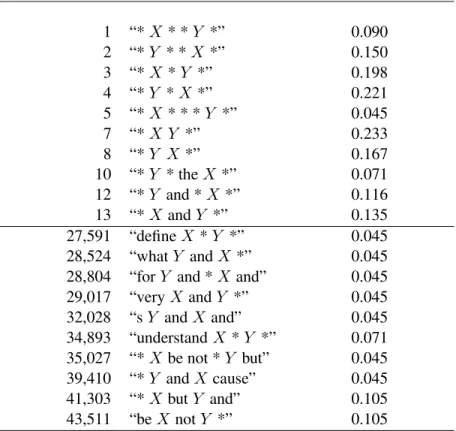
Table 2 shows the first and last ten features (excluding zero-valued features) and the corresponding feature values for the word pair audacious:boldness, taken from the SAT analogy questions. The features are in descending order of the num-ber of word pairs that generate them; that is, they are ordered from common to rare. Thus the first features typically involve patterns with many wild cards and high-frequency words, and the first feature values are usually nonzero. The last features often have few wild cards and contain low-frequency words, with feature values that are usually zero. The feature vectors are generally highly sparse (i.e., they are mainly zeros; if f = 0, then log(f + 1) = 0).
Now that we have a feature vector for each input word pair, we can apply a standard supervised learning algorithm. In the following experiments, we use a sequential minimal optimization (SMO) support vector machine (SVM) with a radial basis function (RBF) kernel (Platt, 1998), as implemented in Weka (Waikato Environment for Knowledge Analysis) (Witten and Frank, 1999).4 The algorithm generates probability estimates for each class by fitting logistic regression models to the outputs of the SVM. We disable the normalization option in Weka, since the vectors are already normalized to unit length. We chose the SMO RBF algorithm because it is fast, robust, and it easily handles large numbers of features.
In the following experiments, PairClass is applied to each of the seven tests with no adjustments or tuning of the learning parameters to the specific problems. Some work is required to fit each problem into the general framework of PairClass (analogy perception: supervised classification of word pairs), but the core algo-rithm is the same in each case.
It might be objected that what PairClass does should not be considered as level perception, in the sense given by Chalmers et al.. (1992). They define high-level perception as follows:
Perceptual processes form a spectrum, which for convenience we can divide into two components. ... [We] have low-level perception, which involves the early processing of information from the various sensory modalities. High-level perception, on the other hand, involves taking
4
Feature number Feature (pattern) Value (normalized log) 1 “* X * * Y *” 0.090 2 “* Y * * X *” 0.150 3 “* X * Y *” 0.198 4 “* Y * X *” 0.221 5 “* X * * * Y *” 0.045 7 “* X Y *” 0.233 8 “* Y X *” 0.167 10 “* Y * the X *” 0.071 12 “* Y and * X *” 0.116 13 “* X and Y *” 0.135 27,591 “define X * Y *” 0.045 28,524 “what Y and X *” 0.045 28,804 “for Y and * X and” 0.045 29,017 “very X and Y *” 0.045 32,028 “s Y and X and” 0.045 34,893 “understand X * Y *” 0.071 35,027 “* X be not * Y but” 0.045 39,410 “* Y and X cause” 0.045 41,303 “* X but Y and” 0.105 43,511 “be X not Y *” 0.105
Table 2: The first and last ten features, excluding zero-valued features, for the pair X:Y = audacious:boldness. (The “s” in the pattern for feature 32,028 is part of a possessive noun. The “be” in the patterns for features 35,027 and 43,511 is the result of normalizing “is” and “was” with morpha.)
a more global view of this information, extracting meaning from the raw material by accessing concepts, and making sense of situations at a conceptual level. This ranges from the recognition of objects to the grasping of abstract relations, and on to understanding entire situations as coherent wholes. ... The study of high-level perception leads us directly to the problem of mental representation. Representations are the fruits of perception.
Spoken or written language can be converted to electronic text by speech recog-nition software or optical character recogrecog-nition software. It seems reasonable to call this low-level perception. PairClass takes electronic text as input and gener-ates high-dimensional feature vectors from the text. These feature vectors represent abstract semantic relations and they can be used to classify semantic relations into
various semantic classes. It seems reasonable to call this high-level perception. We do not claim that PairClass has the richness and complexity of human high-level perception, but it is nonetheless a (simple, restricted) form of high-level perception.
3
Experiments
This section presents seven sets of experiments. We explain how each of the seven tests is treated as a problem of analogy perception, we give the experimental results, and we discuss past work with each test.
3.1 SAT Analogies
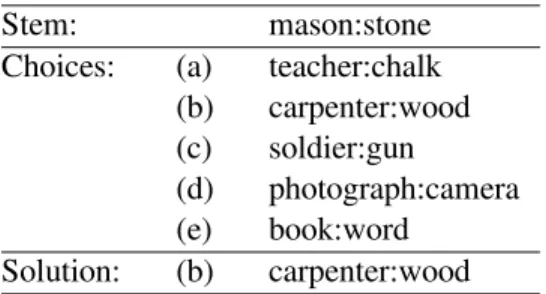
In this section, we apply PairClass to the task of recognizing lexical analogies. To evaluate the performance, we use a set of 374 multiple-choice questions from the SAT college entrance exam. Table 3 shows a typical question. The target pair is called the stem. The task is to select the choice pair that is most analogous to the stem pair.
Stem: mason:stone Choices: (a) teacher:chalk
(b) carpenter:wood (c) soldier:gun
(d) photograph:camera (e) book:word
Solution: (b) carpenter:wood
Table 3: An example of a question from the 374 SAT analogy questions.
The problem of recognizing lexical analogies was first attempted with a system called Argus (Reitman, 1965), using a small hand-built semantic network with a spreading activation algorithm. Turney et al. (2003) used a combination of 13 independent modules. Veale (2004) used a spreading activation algorithm with WordNet (in effect, treating WordNet as a semantic network). Turney (2005) used a corpus-based algorithm.
We may view Table 3 as a binary classification problem, in which mason:stone and carpenter:wood are positive examples and the remaining word pairs are nega-tive examples. The difficulty is that the labels of the choice pairs must be hidden from the learning algorithm. That is, the training set consists of one positive exam-ple (the stem pair) and the testing set consists of five unlabeled examexam-ples (the five choice pairs). To make this task more tractable, we randomly choose a stem pair
from one of the 373 other SAT analogy questions, and we assume that this new stem pair is a negative example, as shown in Table 4.
Word pair Train or test Class label mason:stone train positive tutor:pupil train negative teacher:chalk test hidden carpenter:wood test hidden soldier:gun test hidden photograph:camera test hidden book:word test hidden
Table 4: How to fit a SAT analogy question into the framework of supervised classification of word pairs. The randomly chosen stem pair is tutor:pupil.
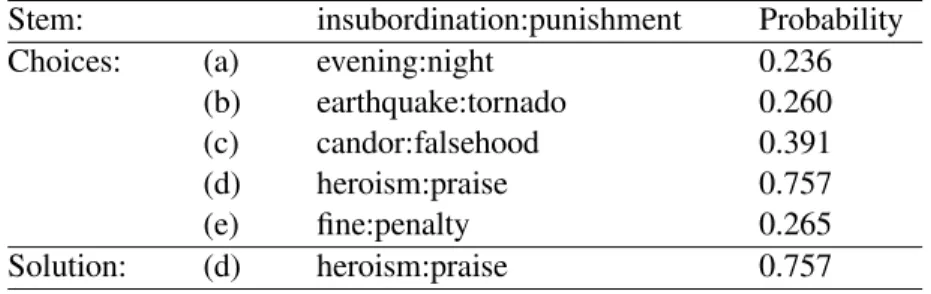
To answer a SAT question, we use PairClass to estimate the probability that each testing example is positive, and we guess the testing example with the highest probability. Learning from a training set with only one positive example and one negative example is difficult, since the learned model can be highly unstable. To increase the stability, we repeat the learning process 10 times, using a different ran-domly chosen negative training example each time. For each testing word pair, the 10 probability estimates are averaged together. This is a form of bagging (Breiman, 1996). Table 5 shows an example of an analogy that has been correctly solved by PairClass.
Stem: insubordination:punishment Probability Choices: (a) evening:night 0.236
(b) earthquake:tornado 0.260 (c) candor:falsehood 0.391 (d) heroism:praise 0.757 (e) fine:penalty 0.265 Solution: (d) heroism:praise 0.757
Table 5: An example of a correctly solved SAT analogy question.
PairClass attains an accuracy of 52.1% on the 374 SAT analogy questions. The best previous result is an accuracy of 56.1% (Turney, 2005). Random guessing would yield an accuracy of 20% (five choices per question). The average senior high school student achieves 57% correct (Turney, 2006). The ACL Wiki lists 12
previously published results with the 374 SAT analogy questions.5 Adding Pair-Class to the list, we have 13 results. PairPair-Class has the third highest accuracy of the 13 systems.
3.2 TOEFL Synonyms
Now we apply PairClass to the task of recognizing synonyms, using a set of 80 multiple-choice synonym questions from the TOEFL (test of English as a foreign language). A sample question is shown in Table 6. The task is to select the choice word that is most similar in meaning to the stem word.
Stem: levied Choices: (a) imposed
(b) believed (c) requested (d) correlated Solution: (a) imposed
Table 6: An example of a question from the 80 TOEFL synonym questions.
Synonymy can be viewed as a high degree of semantic similarity. The most common way to measure semantic similarity is to measure the distance between words in WordNet (Resnik, 1995; Jiang and Conrath, 1997; Hirst and St-Onge, 1998; Budanitsky and Hirst, 2001). Corpus-based measures of word similarity are also common (Lesk, 1969; Landauer and Dumais, 1997; Turney, 2001).
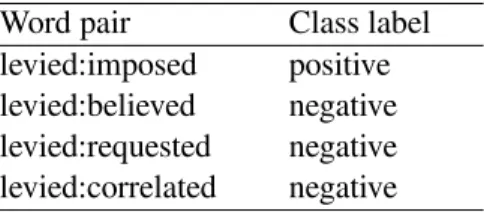
We may view Table 6 as a binary classification problem, in which the pair levied:imposed is a positive example of the class synonymous and the other possible pairings are negative examples, as shown in Table 7.
Word pair Class label levied:imposed positive levied:believed negative levied:requested negative levied:correlated negative
Table 7: How to fit a TOEFL synonym question into the framework of supervised classification of word pairs.
5
For more information, see SAT Analogy Questions (State of the art) at http://aclweb.org/aclwiki/. There were 12 previous results at the time of writing, but the list is likely to grow.
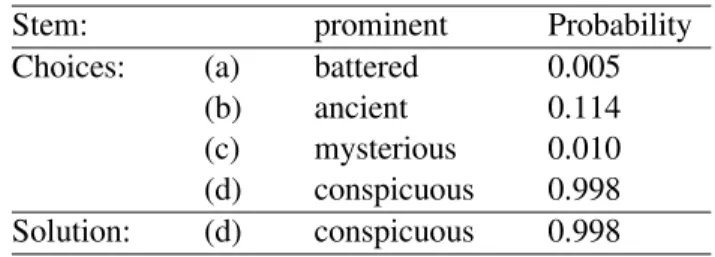
The 80 TOEFL questions yield 320 (80×4) word pairs, 80 labeled positive and 240 labeled negative. We apply PairClass to the word pairs using ten-fold cross-validation. In each random fold, 90% of the pairs are used for training and 10% are used for testing. For each fold, we use the learned model to assign probabilities to the testing pairs. Our guess for each TOEFL question is the choice that has the highest probability of being positive, when paired with the corresponding stem. Table 8 gives an example of a correctly solved question.
Stem: prominent Probability Choices: (a) battered 0.005
(b) ancient 0.114 (c) mysterious 0.010 (d) conspicuous 0.998 Solution: (d) conspicuous 0.998
Table 8: An example of a correctly solved TOEFL synonym question.
PairClass attains an accuracy of 76.2%. For comparison, the ACL Wiki lists 15 previously published results with the 80 TOEFL synonym questions.6 Adding PairClass to the list, we have 16 algorithms. PairClass has the ninth highest accu-racy of the 16 systems. The best previous result is an accuaccu-racy of 97.5% (Turney et
al., 2003), obtained using a hybrid of four different algorithms. Random guessing
would yield an accuracy of 25% (four choices per question). The average foreign applicant to a US university achieves 64.5% correct (Landauer and Dumais, 1997).
3.3 ESL Synonyms
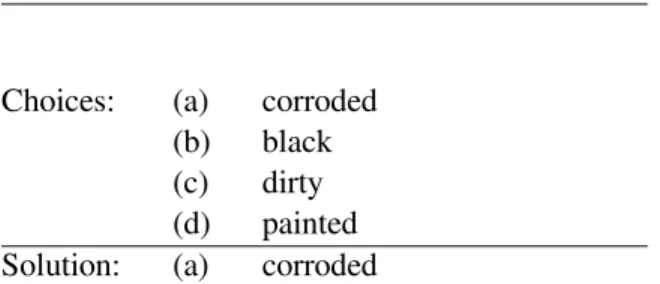
The 50 ESL synonym questions are similar to the TOEFL synonym questions, except that each question includes a sentence that shows the stem word in context. Table 9 gives an example. In our experiments, we ignore the sentence context and treat the ESL synonym questions the same way as we treated the TOEFL synonym questions (see Table 10).
The 50 ESL questions yield 200 (50 × 4) word pairs, 50 labeled positive and 150 labeled negative. We apply PairClass to the word pairs using ten-fold cross-validation. Our guess for each question is the choice word that has the highest probability of being positive, when paired with the corresponding stem word.
PairClass attains an accuracy of 78.0%. The best previous result is 82.0% (Jar-masz and Szpakowicz, 2003). The ACL Wiki lists 8 previously published results
6See TOEFL Synonym Questions (State of the art) at http://aclweb.org/aclwiki/. There were 15
Stem: “A rusty nail is not as strong as a clean, new one.” Choices: (a) corroded
(b) black (c) dirty (d) painted Solution: (a) corroded
Table 9: An example of a question from the 50 ESL synonym questions.
Word pair Class label rusty:corroded positive rusty:black negative rusty:dirty negative rusty:painted negative
Table 10: How to fit an ESL synonym question into the framework of supervised classification of word pairs.
for the 50 ESL synonym questions.7 Adding PairClass to the list, we have 9 al-gorithms. PairClass has the third highest accuracy of the 9 systems. The average human score is unknown. Random guessing would yield an accuracy of 25% (four choices per question).
3.4 ESL Synonyms and Antonyms
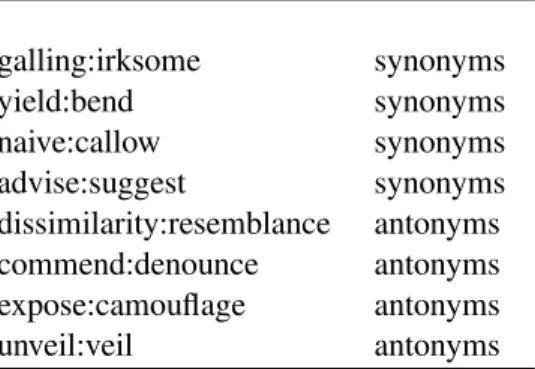
The task of classifying word pairs as either synonyms or antonyms readily fits into the framework of supervised classification of word pairs. Table 11 shows some examples from a set of 136 ESL (English as a second language) practice questions that we collected from various ESL websites.
Hatzivassiloglou and McKeown (1997) propose that antonyms and synonyms can be distinguished by their semantic orientation. A word that suggests praise has a positive semantic orientation, whereas criticism is negative semantic orien-tation. Antonyms tend to have opposite semantic orientation (fast:slow is posi-tive:negative) and synonyms tend to have the same semantic orientation (fast:quick is positive:positive). However, this proposal has not been evaluated, and it is not difficult to find counter-examples (simple:simplistic is positive:negative, yet the words are synonyms, rather than antonyms).
7
See ESL Synonym Questions (State of the art) at http://aclweb.org/aclwiki/. There were 8 sys-tems at the time of writing, but the list is likely to grow.
Word pair Class label galling:irksome synonyms yield:bend synonyms naive:callow synonyms advise:suggest synonyms dissimilarity:resemblance antonyms commend:denounce antonyms expose:camouflage antonyms unveil:veil antonyms
Table 11: Examples of synonyms and antonyms from 136 ESL practice questions.
Lin et al. (2003) distinguish synonyms from antonyms using two patterns, “from X to Y ” and “either X or Y ”. When X and Y are antonyms, they occa-sionally appear in a large corpus in one of these two patterns, but it is very rare for synonyms to appear in these patterns. Our approach is similar to Lin et al. (2003), but we do not rely on hand-coded patterns; instead, PairClass patterns are generated automatically.
Using ten-fold cross-validation, PairClass attains an accuracy of 75.0%. Al-ways guessing the majority class would result in an accuracy of 65.4%. The aver-age human score is unknown and there are no previous results for comparison.
3.5 CL Synonyms and Antonyms
To compare PairClass with the algorithm of Lin et al. (2003), this experiment uses their set of 160 word pairs, 80 labeled synonym and 80 labeled antonym. These 160 pairs were chosen by Lin et al. (2003) for their high frequency; thus they are somewhat easier to classify than the 136 ESL practice questions. Some examples are given in Table 12.
Lin et al. (2003) report their performance using precision (86.4%) and recall (95.0%), instead of accuracy, but an accuracy of 90.0% can be derived from their figures, with some minor algebraic manipulation. Using ten-fold cross-validation, PairClass has an accuracy of 81.9%. Random guessing would yield an accuracy of 50%. The average human score is unknown.
3.6 Similar, Associated, and Both
A common criticism of corpus-based measures of word similarity (as opposed to lexicon-based measures) is that they are merely detecting associations (co-occur-rences), rather than actual semantic similarity (Lund et al., 1995). To address this
Word pair Class label audit:review synonyms education:tuition synonyms location:position synonyms material:stuff synonyms ability:inability antonyms balance:imbalance antonyms exaggeration:understatement antonyms inferiority:superiority antonyms
Table 12: Examples of synonyms and antonyms from 160 labeled pairs for experi-ments in computational linguistics (CL).
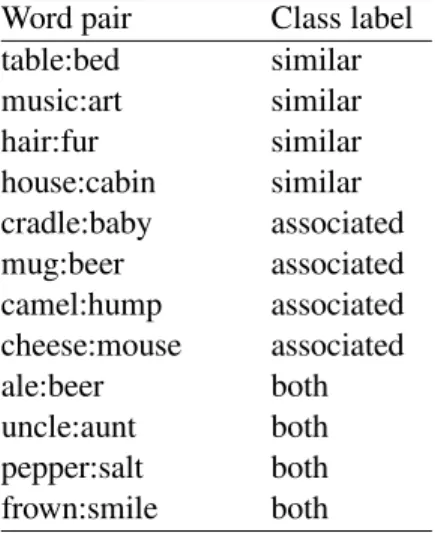
criticism, Lund et al. (1995) evaluated their algorithm for measuring word simi-larity with word pairs that were labeled similar, associated, or both. These labeled pairs were originally created for cognitive psychology experiments with human subjects (Chiarello et al., 1990). Table 13 shows some examples from this collec-tion of 144 word pairs (48 pairs in each of the three classes).
Word pair Class label table:bed similar music:art similar hair:fur similar house:cabin similar cradle:baby associated mug:beer associated camel:hump associated cheese:mouse associated ale:beer both uncle:aunt both pepper:salt both frown:smile both
Table 13: Examples of word pairs labeled similar, associated, or both.
Lund et al. (1995) did not measure the accuracy of their algorithm on this three-class classification problem. Instead, following standard practice in cognitive psychology, they showed that their algorithm’s similarity scores for the 144 word pairs were correlated with the response times of human subjects in priming tests. In a typical priming test, a human subject reads a priming word (cradle) and is then
asked to complete a partial word (complete bab as baby) or to distinguish a word (baby) from a non-word (baol). The time required to perform the task is taken to indicate the strength of the cognitive link between the two words (cradle and baby). Using ten-fold cross-validation, PairClass attains an accuracy of 77.1% on the 144 word pairs. Since the three classes are of equal size, guessing the majority class and random guessing both yield an accuracy of 33.3%. The average human score is unknown and there are no previous results for comparison.
3.7 Noun-Modifier Relations
A noun-modifier expression is a compound of two (or more) words, a head noun and a modifier of the head. The modifier is usually a noun or adjective. For ex-ample, in the noun-modifier expression student discount, the head noun discount is modified by the noun student.
Noun-modifier expressions are very common in English. There is wide varia-tion in the types of semantic relavaria-tions between heads and modifiers. A challenging task for natural language processing is to classify noun-modifier pairs according to their semantic relations. For example, in the noun-modifier expression electron
microscope, the relation might be theme:tool (a microscope for electrons; perhaps
for viewing electrons), instrument:agency (a microscope that uses electrons), or
material:artifact (a microscope made out of electrons).8 There are many poten-tial applications for algorithms that can automatically classify noun-modifier pairs according to their semantic relations.
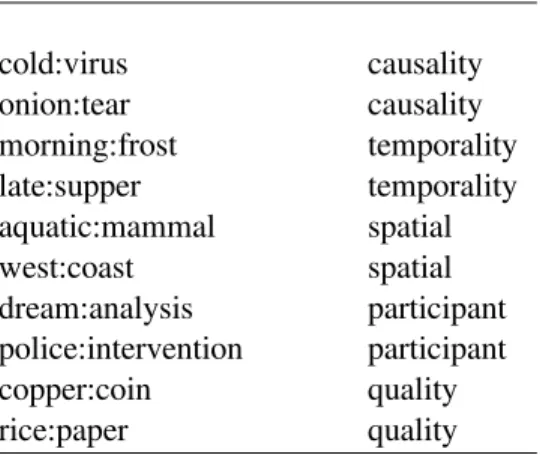
Nastase and Szpakowicz (2003) collected 600 noun-modifier pairs and hand-labeled them with 30 different classes of semantic relations. The 30 classes were organized into five groups: causality, temporality, spatial, participant, and quality. Due to the difficulty of distinguishing 30 classes, most researchers prefer to treat this as a five-class classification problem. Table 14 shows some examples of noun-modifier pairs with the five-class labels.
The design of the PairClass algorithm is closely related to past work on the problem of classifying noun-modifier semantic relations, so we will examine this past work in more detail than in our discussions of related work for the other six tests. Section 5 will focus on the relation between PairClass and past work on semantic relation classification.
Using ten-fold cross-validation, PairClass achieves an accuracy of 58.0% on the task of classifying the 600 noun-modifier pairs into five classes. The best pre-vious result was also 58.0% (Turney, 2006). The ACL Wiki lists 5 prepre-viously
pub-8
Word pair Class label cold:virus causality onion:tear causality morning:frost temporality late:supper temporality aquatic:mammal spatial west:coast spatial dream:analysis participant police:intervention participant copper:coin quality rice:paper quality
Table 14: Examples of noun-modifier word pairs labeled with five semantic rela-tions.
lished results with the 600 noun-modifier pairs.9 Adding PairClass to the list, we have 6 algorithms. PairClass ties for first place in the set of 6 systems. Guessing the majority class would result in an accuracy of 43.3%. The average human score is unknown.
4
Discussion
The seven experiments are summarized in Tables 15 and 16. For the five experi-ments for which there are previous results, PairClass is not the best, but it performs competitively. For the other two experiments, PairClass performs significantly above the baselines. However, the strength of this approach is not its performance on any one task, but the range of tasks it can handle. No other algorithm has been applied to this range of lexical semantic problems.
Of the seven tests we use here, as far as we know, only the noun-modifier re-lations have been approached using a standard supervised learning algorithm. For the other six tests, PairClass is the first attempt to apply supervised learning.10 The advantage of being able to cast these six problems in the framework of standard supervised learning problems is that we can now exploit the huge literature on su-pervised learning. Past work on these problems has required implicitly coding our
9
See Noun-Modifier Semantic Relations (State of the art) at http://aclweb.org/aclwiki/. There were 5 systems at the time of writing, but the list is likely to grow.
10Turney et al. (2003) apply something like supervised learning to the SAT analogies and TOEFL
synonyms, but it would be more accurate to call it reinforcement learning, rather than standard su-pervised learning.
Experiment Vectors Features Classes SAT Analogies 2,244 44,880 374
TOEFL Synonyms 320 6,400 2
ESL Synonyms 200 4,000 2
ESL Synonyms and Antonyms 136 2,720 2 CL Synonyms and Antonyms 160 3,200 2 Similar, Associated, and Both 144 2,880 3 Noun-Modifier Relations 600 12,000 5 Table 15: Summary of the seven tasks. See Section 3 for explanations. The number of features is 20 times the number of vectors, as mentioned in Section 2. For SAT Analogies, the number of vectors is374 × 6. For TOEFL Synonyms, the number of vectors is80 × 4. For ESL Synonyms, the number of vectors is 50 × 4.
Experiment Accuracy Best previous Baseline Rank SAT Analogies 52.1% 56.1% 20.0% 3 of 13 TOEFL Synonyms 76.2% 97.5% 25.0% 9 of 16 ESL Synonyms 78.0% 82.0% 25.0% 3 of 9 ESL Synonyms and Antonyms 75.0% - 65.4% -CL Synonyms and Antonyms 81.9% 90.0% 50.0% 2 of 2 Similar, Associated, and Both 77.1% - 33.3% -Noun-Modifier Relations 58.0% 58.0% 43.3% 1 of 6 Table 16: Summary of experimental results. See Section 3 for explanations. For the Noun-Modifier Relations, PairClass is tied for first place.
knowledge of the nature of the task into the structure of the algorithm. For ex-ample, the structure of the algorithm for latent semantic analysis (LSA) implicitly contains a theory of synonymy (Landauer and Dumais, 1997). The problem with this approach is that it can be very difficult to work out how to modify the algo-rithm if it does not behave the way we want. On the other hand, with a supervised learning algorithm, we can put our knowledge into the labeling of the feature vec-tors, instead of putting it directly into the algorithm. This makes it easier to guide the system to the desired behaviour.
Humans are able to make analogies without supervised learning. It might be ar-gued that the requirement for supervision is a major limitation of PairClass. How-ever, with our approach to the SAT analogy questions (see Section 3.1), we are blurring the line between supervised and unsupervised learning, since the train-ing set for a given SAT question consists of a strain-ingle real positive example (and a single “virtual” or “simulated” negative example). In effect, a single example
(such as mason:stone in Table 4) becomes a sui generis; it constitutes a class of its own. It may be possible to apply the machinery of supervised learning to other problems that apparently call for unsupervised learning (for example, clustering or measuring similarity), by using this sui generis device.
5
Related Work
One of the first papers using supervised machine learning to classify word pairs was Rosario and Hearst’s (2001) paper on classifying noun-modifier pairs in the medical domain. For example, the noun-modifier expression brain biopsy was classified as Procedure. Rosario and Hearst (2001) constructed feature vectors for each noun-modifier pair using MeSH (Medical Subject Headings) and UMLS (Unified Medical Language System) as lexical resources. They then trained a neu-ral network to distinguish 13 classes of semantic relations, such as Cause,
Loca-tion, Measure, and Instrument. Nastase and Szpakowicz (2003) explored a similar
approach to classifying general-domain noun-modifier pairs, using WordNet and Roget’s Thesaurus as lexical resources.
Turney and Littman (2005) used corpus-based features for classifying noun-modifier pairs. Their features were based on 128 hand-coded patterns. They used a nearest-neighbour learning algorithm to classify general-domain noun-modifier pairs into 30 different classes of semantic relations. Turney (2005; 2006) later addressed the same problem using 8000 automatically generated patterns.
One of the tasks in SemEval 2007 was the classification of semantic relations between nominals (Girju et al., 2007).11 The problem is to classify semantic rela-tions between nominals (nouns and noun compounds) in the context of a sentence. The task attracted 14 teams who created 15 systems, all of which used supervised machine learning with features that were lexicon-based, corpus-based, or both.
PairClass is most similar to the algorithm of Turney (2006), but it differs in the following ways:
• PairClass does not use a lexicon to find synonyms for the input word pairs. One of our goals in this paper is to show that a pure corpus-based algorithm can handle synonyms without a lexicon. This considerably simplifies the algorithm.
• PairClass uses a support vector machine (SVM) instead of a nearest neigh-bour (NN) learning algorithm.
11SemEval 2007 was the Fourth International Workshop on Semantic Evaluations. More
in-formation on Task 4, the classification of semantic relations between nominals, is available at http://purl.org/net/semeval/task4.
• PairClass does not use the singular value decomposition (SVD) to smooth the feature vectors. It has been our experience that SVD is not necessary with SVMs.
• PairClass generates probability estimates, whereas Turney (2006) uses a co-sine measure of similarity. Probability estimates can be readily used in fur-ther downstream processing, but cosines are less useful.
• The automatically generated patterns in PairClass are slightly more general than the patterns of Turney (2006), as mentioned in Section 2.
• The morphological processing in PairClass (Minnen et al., 2001) is more sophisticated than in Turney (2006).
However, we believe that the main contribution of this paper is not PairClass itself, but the extension of supervised word pair classification beyond the classification of noun-modifier pairs and semantic relations between nominals, to analogies, syn-onyms, antsyn-onyms, and associations. As far as we know, this has not been done before.
6
Limitations and Future Work
The main limitation of PairClass is the need for a large corpus. Phrases that contain a pair of words tend to be more rare than phrases that contain either of the members of the pair, thus a large corpus is needed to ensure that sufficient numbers of phrases are found for each input word pair. The size of the corpus has a cost in terms of disk space and processing time. In the future, as hardware improves, this will become less of an issue, but there may be ways to improve the algorithm, so that a smaller corpus is sufficient.
Human language can be creatively extended as needed. Given a newly-defined word, a human would be able to use it immediately in an analogy. Since PairClass requires a large number of phrases for each pair of words, it would be unable to handle a newly-defined word. A problem for future work is the extension of PairClass, so that it is able to work with definitions of words. One approach is a hybrid algorithm that combines a corpus-based algorithm with a lexicon-based algorithm. For example, Turney et al. (2003) describe an algorithm that combines 13 different modules for solving proportional analogies with words.
7
Conclusion
The PairClass algorithm classifies word pairs according to their semantic relations, using features generated from a large corpus of text. We describe PairClass as
performing analogy perception, because it recognizes lexical proportional analo-gies using a form of high-level perception (Chalmers et al., 1992). For given in-put training and testing sets of word pairs, it automatically generates patterns and constructs its own representations of the word pairs as high-dimensional feature vectors. No hand-coding of representations is involved.
We believe that analogy perception provides a unified approach to natural lan-guage processing for a wide variety of lexical semantic tasks. We support this by applying PairClass to seven different tests of word comprehension. It achieves competitive performance on the tests, although it is competing with algorithms that were developed for single tasks. More significant is the range of tasks that can be framed as problems of analogy perception.
The idea of subsuming a broad range of semantic phenomena under analogies has been suggested by many researchers (Minsky, 1986; Gentner, 2003; Hofstadter, 2007). In computational lingistics, analogical algorithms have been applied to ma-chine translation (Lepage and Denoual, 2005), morphology (Lepage, 1998), and semantic relations (Turney and Littman, 2005). Analogy provides a framework that has the potential to unify the field of semantics. This paper is a small step towards that goal.
In this paper, we have used tests from educational testing (SAT analogies and TOEFL synonyms), second language practice (ESL synonyms and ESL synonym and antonyms), computational linguistics (CL synonyms and antonyms and noun-modifiers), and cognitive psychology (similar, associated, and both). Six of the tests have been used in previous research and four of the tests have associated per-formance results and bibliographies in the ACL Wiki. Shared tests make it possible for researchers to compare their algorithms and assess the progress of the field.
Applying human tests to machines is a natural way to evaluate progress in AI. Five of the seven tests were originally developed for humans. For the SAT and TOEFL tests, the average human scores are available. On the SAT test, PairClass has an accuracy of 52.1%, with a 95% confidence interval ranging from 46.9% to 57.3% (using the Binomial Exact test). The average senior high school student applying to a US university achieves 57% (Turney, 2006), which is within the 95% confidence interval for PairClass. On the TOEFL synonym test, PairClass has an accuracy of 76.2%, with a 95% confidence interval ranging from 65.4% to 85.1% (using the Binomial Exact test). The average foreign applicant to a US university achieves 64.5% (Landauer and Dumais, 1997), which is below the 95% confidence interval for PairClass. Thus PairClass performance on SAT is not significantly different from average human performance, and PairClass performance on TOEFL is significantly better than average human performance.
One criticism of AI as a field is that its success stories are limited to narrow domains, such as chess. Human intelligence has a generality and flexibility that
AI currently lacks. This paper is a tiny step towards the goal of performing com-petively on a wide range of tests, rather than performing very well on a single test.
Acknowledgements
Thanks to Michael Littman for the 374 SAT analogy questions, Thomas Lan-dauer for the 80 TOEFL synonym questions, Donna Tatsuki for the 50 ESL syn-onym questions, Dekang Lin for the 160 synsyn-onym-antsyn-onym questions, Christine Chiarello for the 144 similar-associated-both questions, and Vivi Nastase and Stan Szpakowicz for the 600 labeled noun-modifiers. Thanks to Charles Clarke for the corpus, Stefan B ¨uttcher for Wumpus, Guido Minnen, John Carroll, and Darren Pearce for morpha and morphb, and Ian Witten and Eibe Frank for Weka. Thanks to Selmer Bringsjord for inviting me to contribute to the special issue of JETAI on
Test-Based AI. Thanks to Joel Martin for comments on an earlier version of this
paper. I am especially thankful to Michael Littman for initiating my interest in analogies in 2001, by suggesting that a statistical approach might be able to solve multiple-choice analogy questions.
References
(Breiman, 1996) Leo Breiman. Bagging predictors. Machine Learning,
24(2):123–140, 1996.
(Bringsjord and Schimanski, 2003) Selmer Bringsjord and Bettina Schimanski. What is artificial intelligence? Psychometric AI as an answer. In Proceedings
of the 18th International Joint Conference on Artificial Intelligence (IJCAI-03),
pages 887–893, Acapulco, Mexico, 2003.
(Budanitsky and Hirst, 2001) Alexander Budanitsky and Graeme Hirst. Semantic distance in WordNet: An experimental, application-oriented evaluation of five measures. In Proceedings of the Workshop on WordNet and Other Lexical
Re-sources, Second Meeting of the North American Chapter of the Association for Computational Linguistics (NAACL-2001), pages 29–24, Pittsburgh, PA, 2001.
(B ¨uttcher and Clarke, 2005) Stefan B ¨uttcher and Charles Clarke. Efficiency vs. effectiveness in terabyte-scale information retrieval. In Proceedings of the 14th
Text REtrieval Conference (TREC 2005), Gaithersburg, MD, 2005.
(Chalmers et al., 1992) David J. Chalmers, Robert M. French, and Douglas R. Hofstadter. High-level perception, representation, and analogy: A critique of
artificial intelligence methodology. Journal of Experimental & Theoretical
Ar-tificial Intelligence, 4(3):185–211, 1992.
(Chiarello et al., 1990) Christine Chiarello, Curt Burgess, Lorie Richards, and Alma Pollock. Semantic and associative priming in the cerebral hemispheres: Some words do, some words don’t . . . sometimes, some places. Brain and
Lan-guage, 38:75–104, 1990.
(Evans, 1964) Thomas Evans. A heuristic program to solve geometric-analogy problems. In Proceedings of the Spring Joint Computer Conference, pages 327– 338, 1964.
(Falkenhainer et al., 1989) Brian Falkenhainer, Kenneth D. Forbus, and Dedre Gentner. The structure-mapping engine: Algorithm and examples. Artificial
Intelligence, 41(1):1–63, 1989.
(Gentner, 2003) Dedre Gentner. Why we’re so smart. In Dedre Gentner and Su-san Goldin-Meadow, editors, Language in Mind: Advances in the Study of
Lan-guage and Thought, pages 195–235. MIT Press, 2003.
(Girju et al., 2007) Roxana Girju, Preslav Nakov, Vivi Nastase, Stan Szpakowicz, Peter Turney, and Deniz Yuret. Semeval-2007 task 04: Classification of se-mantic relations between nominals. In Proceedings of the Fourth International
Workshop on Semantic Evaluations (SemEval 2007), pages 13–18, Prague,
Czech Republic, 2007.
(Hatzivassiloglou and McKeown, 1997) Vasileios Hatzivassiloglou and Kath-leen R. McKeown. Predicting the semantic orientation of adjectives. In
Pro-ceedings of the 35th Annual Meeting of the ACL and the 8th Conference of the European Chapter of the ACL (ACL/EACL-1997), pages 174–181, 1997.
(Hirst and St-Onge, 1998) Graeme Hirst and David St-Onge. Lexical chains as representations of context for the detection and correction of malapropisms. In Christiane Fellbaum, editor, WordNet: An Electronic Lexical Database, pages 305–332. MIT Press, 1998.
(Hofstadter, 2001) Douglas Hofstadter. Epilogue: Analogy as the core of cogni-tion. In Dedre Gentner, Keith J. Holyoak, and Boicho N. Kokinov, editors, The
Analogical Mind: Perspectives from Cognitive Science, pages 499–538. MIT
Press, 2001.
(Jarmasz and Szpakowicz, 2003) Mario Jarmasz and Stan Szpakowicz. Roget’s thesaurus and semantic similarity. In Proceedings of the International
Confer-ence on Recent Advances in Natural Language Processing (RANLP-03), pages
212–219, Borovets, Bulgaria, 2003.
(Jiang and Conrath, 1997) Jay J. Jiang and David W. Conrath. Semantic similarity based on corpus statistics and lexical taxonomy. In Proceedings of the
Inter-national Conference on Research in Computational Linguistics (ROCLING X),
pages 19–33, Tapei, Taiwan, 1997.
(Landauer and Dumais, 1997) Thomas K. Landauer and Susan T. Dumais. A so-lution to Plato’s problem: The latent semantic analysis theory of the acquisition, induction, and representation of knowledge. Psychological Review, 104(2):211– 240, 1997.
(Lepage and Denoual, 2005) Yves Lepage and Etienne Denoual. Purest ever example-based machine translation: Detailed presentation and assessment.
Ma-chine Translation, 19(3):251–282, 2005.
(Lepage, 1998) Yves Lepage. Solving analogies on words: An algorithm. In
Pro-ceedings of the 36th Annual Conference of the Association for Computational Linguistics, pages 728–735, 1998.
(Lesk, 1969) Michael E. Lesk. Word-word associations in document retrieval sys-tems. American Documentation, 20(1):27–38, 1969.
(Lin et al., 2003) Dekang Lin, Shaojun Zhao, Lijuan Qin, and Ming Zhou. Iden-tifying synonyms among distributionally similar words. In Proceedings of
the 18th International Joint Conference on Artificial Intelligence (IJCAI-2003),
pages 1492–1493, 2003.
(Lund et al., 1995) Kevin Lund, Curt Burgess, and Ruth Ann Atchley. Semantic and associative priming in high-dimensional semantic space. In Proceedings of
the 17th Annual Conference of the Cognitive Science Society, pages 660–665,
1995.
(Minnen et al., 2001) Guido Minnen, John Carroll, and Darren Pearce. Ap-plied morphological processing of English. Natural Language Engineering, 7(3):207–223, 2001.
(Minsky, 1986) Marvin Minsky. The Society of Mind. Simon & Schuster, New York, NY, 1986.
(Nastase and Szpakowicz, 2003) Vivi Nastase and Stan Szpakowicz. Exploring noun-modifier semantic relations. In Fifth International Workshop on
Compu-tational Semantics (IWCS-5), pages 285–301, Tilburg, The Netherlands, 2003.
(Platt, 1998) John C. Platt. Fast training of support vector machines using se-quential minimal optimization. In Advances in Kernel Methods: Support Vector
Learning, pages 185–208. MIT Press Cambridge, MA, USA, 1998.
(Reitman, 1965) Walter R. Reitman. Cognition and Thought: An Information
Pro-cessing Approach. John Wiley and Sons, New York, NY, 1965.
(Resnik, 1995) Philip Resnik. Using information content to evaluate semantic sim-ilarity in a taxonomy. In Proceedings of the 14th International Joint Conference
on Artificial Intelligence (IJCAI-95), pages 448–453, San Mateo, CA, 1995.
Morgan Kaufmann.
(Rosario and Hearst, 2001) Barbara Rosario and Marti Hearst. Classifying the se-mantic relations in noun-compounds via a domain-specific lexical hierarchy. In Proceedings of the 2001 Conference on Empirical Methods in Natural
Lan-guage Processing (EMNLP-01), pages 82–90, 2001.
(Turney and Littman, 2005) Peter D. Turney and Michael L. Littman. Corpus-based learning of analogies and semantic relations. Machine Learning, 60(1– 3):251–278, 2005.
(Turney et al., 2003) Peter D. Turney, Michael L. Littman, Jeffrey Bigham, and Victor Shnayder. Combining independent modules to solve multiple-choice synonym and analogy problems. In Proceedings of the International
Confer-ence on Recent Advances in Natural Language Processing (RANLP-03), pages
482–489, Borovets, Bulgaria, 2003.
(Turney, 2001) Peter D. Turney. Mining the Web for synonyms: PMI-IR versus LSA on TOEFL. In Proceedings of the Twelfth European Conference on
Ma-chine Learning (ECML-01), pages 491–502, Freiburg, Germany, 2001.
(Turney, 2005) Peter D. Turney. Measuring semantic similarity by latent relational analysis. In Proceedings of the Nineteenth International Joint Conference on
Ar-tificial Intelligence (IJCAI-05), pages 1136–1141, Edinburgh, Scotland, 2005.
(Turney, 2006) Peter D. Turney. Similarity of semantic relations. Computational
Linguistics, 32(3):379–416, 2006.
(Turney, 2008a) Peter D. Turney. The latent relation mapping engine: Algorithm and experiments. Journal of Artificial Intelligence Research, 33:615–655, 2008.
(Turney, 2008b) Peter D. Turney. A uniform approach to analogies, synonyms, antonyms, and associations. In Proceedings of the 22nd International
Confer-ence on Computational Linguistics (Coling 2008), pages 905–912, Manchester,
UK, 2008.
(Veale, 2004) Tony Veale. WordNet sits the SAT: A knowledge-based approach to lexical analogy. In Proceedings of the 16th European Conference on Artificial
Intelligence (ECAI 2004), pages 606–612, Valencia, Spain, 2004.
(Witten and Frank, 1999) Ian H. Witten and Eibe Frank. Data Mining: Practical
Machine Learning Tools and Techniques with Java Implementations. Morgan