HAL Id: hal-01887648
https://hal.archives-ouvertes.fr/hal-01887648
Submitted on 4 Oct 2018
HAL is a multi-disciplinary open access
archive for the deposit and dissemination of
sci-entific research documents, whether they are
pub-L’archive ouverte pluridisciplinaire HAL, est
destinée au dépôt et à la diffusion de documents
scientifiques de niveau recherche, publiés ou non,
Energy consumption in smarthome: Persuasive
interaction respecting user’s values
Hélène Haller, Van-Bao Nguyen, Gilles Debizet, Yann Laurillau, Joëlle
Coutaz, Gaëlle Calvary
To cite this version:
Hélène Haller, Van-Bao Nguyen, Gilles Debizet, Yann Laurillau, Joëlle Coutaz, et al.. Energy
con-sumption in smarthome: Persuasive interaction respecting user’s values. IDAACS 2017 - 9th IEEE
International Conference on Intelligent Data Acquisition and Advanced Computing Systems:
Technol-ogy and Applications, Sep 2017, Bucharest, Romania. pp.804-809, �10.1109/IDAACS.2017.8095199�.
�hal-01887648�
The 9th IEEE International Conference on Intelligent Data Acquisition and Advanced Computing Systems: Technology and Applications
21-23 September, 2017, Bucharest, Romania
Energy Consumption in Smarthome: Persuasive
Interaction Respecting User’s Values
Abstract—
Housing consumption keeps growing in spite of energy efficient devices. The problem seems to come from not only the lack of information about how to use these devices but also from the lack of willingness from inhabitants. This double assessment invites to think about support toward inhabitants’ behaviors concerning to energy consumption, which is affected by both devices and values.
The paper follows an interdisciplinary research between persuasive human computer interaction and sociological studies of domestic energy consumption. The scientific contribution is the integration of the sociological dimensions of energy consumption and behavior change into interactive system design principles. We present a proof of concept for the sustainable change of users’ behavior in energy consumption that demonstrates the applicability of these principles.
Keywords—indicators, persuasive system, energy consumption
I. INTRODUCTION
Residential use is currently considered as the main factor that results in the massive increase of energy demands. Electrical devices take part in most of our daily activities and social services. Housing consumption contributes to approximately 28% of the worldwide total energy and keeps growing with an estimation of 40% by 2040 [1]. This has tremendous impacts on climate change through gas emissions. Consequently, reducing energy consumption will have positive impact on fighting against climate change and global warming issues. Still, it remains a social challenge and needs to be addressed. The approach to reduce housing consumption through more energy efficient equipment does not tackle the issue as the number of devices in a household continues to augment rapidly.
The problem seems to come from the end-users themselves. Focusing on how people use their so-called energy-efficient appliances, researchers have identified the principal causes that lead to these issues: firstly, the lack of information about household consumption (e.g. the excessive consumption might be due to a lack of insulation not from the devices), then the absence of
understanding about the appliances (e.g. reasons behind the over-consumed of a refrigerator) and last but not least the willingness to change the current behavior.
Our work focuses on using persuasive human-computer interaction technology to solve these issues by raising awareness and motivation. From the perspective of research in Human-Computer Interaction (HCI), we seek to build an interactive system, which aims to support a sustainable change in human behavior specifically in the domain of energy consumption.
Our suggestion is to explore more current knowledge about value-centered approaches [5] in producing this interactive system. All of this brings us to answer to the following question: “How to design interactive persuasive systems to induce sustainable and durable behavior in household consumption with respect to user values?”
In addition, changing people’s behaviors implies long-term and complex processes in both psychology and sociology perspectives. It encourages us to present a multidisciplinary research between persuasive technology and sociological studies of energy consumption in smart home.
This paper is organized as follow. The first part focuses on persuasive human computer interaction applied to energy consumption in smart home. We provide the background knowledge about persuasive technology, the overview of existing studies that aims to promote the behavior changes, its applications and its limitations. The second section underlines the social dimensions of energy consumption and behavior change. It describes how individual behavior can be explained by social sciences. It also highlights how user values and others factors can be used as motivation material. Finally, the early prototype presents a solution for the sustainable change in users’ behavior in energy consumption based on these sociological dimensions. The scientific contribution is the identification of these dimensions and their integration as interactive system design principles.
Hélène Haller
2, Van-Bao Nguyen
1, Gilles Debizet
3, Yann Laurillau
1, Joëlle Coutaz
1, Gaëlle Calvary
1 1 Univ. Grenoble-Alpes, CNRS, Grenoble INP, LIG, F-38000 Grenoble, France, [email protected] 2 Univ. Grenoble-Alpes, Pacte – Social science research center, F-38000 Grenoble, [email protected]II. BACKGROUND &STATE OF THE ART
A. Background Knowledge of Persuasive Technology
Persuasive technology refers to “an interactive technology that changes a person’s attitudes or behaviors” [4].
Behavior change has frequently been motivated by psychological theories and models, which aims to understand human behavior. The goal-setting theory underlines the importance of goal setting in the motivation of people to adopt behavior [6]. Ryan shows the concepts of intrinsic and extrinsic motivation in
Self-determination theory [18]. Bandura introduces the self-efficacy construct as the representation of the belief in
one's own ability to adopt the behavior [2].
Fogg presents his own behavior model Fogg Behavior Model (FBM) in which he states three factors that required for a change of behavior to happen: motivation, ability and triggers [8]. The change is likely to happen if the target behavior is triggered when it is sufficiently motivated and has the ability to achieve the behavior.
The Transtheoretical Model of Change (TTM) [11,12] proposed by Prochaska and DiClemente, attempts to decompose the change of behavior into different processes. This model presents a cycle of 6 stages (Fig. 1) which individuals need to experience before achieving the intentional behavior change, these stages are: Pre-Contemplation (Not Ready), Pre-Contemplation (Getting Ready), Preparation (Ready), Action, Maintenance and Termination.
Figure 1. Transtheorical model of change
B. State of the Art in energy consumption
This section highlights some existing studies of persuasive technology in energy consumption and the limitations of these works.
1) Applications in energy consumption
Power-aware-cord [10] (Fig. 2-a) uses a lighting electrical cord to illustrate the flow of electricity. Water-Bot [3] (Fig. 2-b) encourages users to reduce their water usage by providing instantly feedback information about the water usage. It includes a device attached to the
faucet that keeps track of water usage and reminds users to save water.
Figure 2. a) Power-aware-cord (left) b) Waterbot (right)
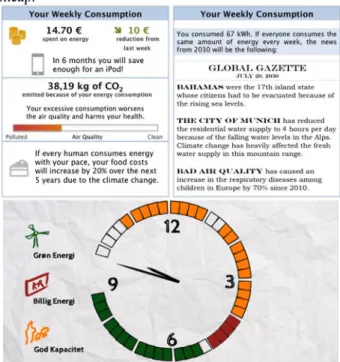
Petkov [17] (Fig. 3-a) proposes an approach to reduce energy consumption based on the possible savings. It presents the financial gain that users can obtain by using less energy. It highlights also the impact of energy consumption on health, resource and environment. eForecast [14] provides a clock-view representation (Fig. 3-b), which indicates the peaks hours for domestic household and also the green zone when electricity cost is cheap.
Figure 3. a) Possible savings (top) b) Clock view representation of electricity cost (bottom).
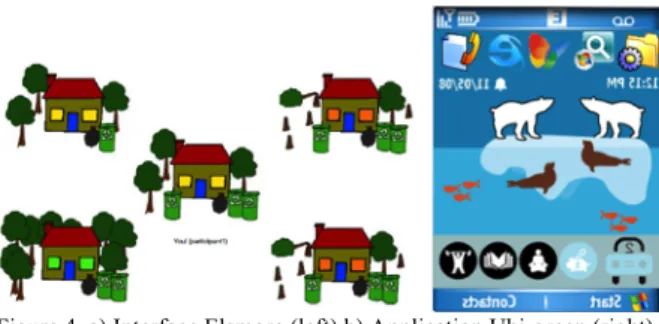
Elsmore [7] explores human behavior by combining two domains: energy and sobriety. The interface consists of 5 households, the window color presents the overall result, and number of trees and trashcans reflect electricity consumption and waste. Ubi-green [9] uses the metaphor of a Polar bear standing on an iceberg to illustrate household consumption (Fig. 4-b). The objective is to keep the polar alive and improve the ecosystem. It consists a series of actions that need to be accomplished in order to reach the final stage.
Figure 4. a) Interface Elsmore (left) b) Application Ubi-green (right)
2) Limitations
Firstly, behavior change is a long-term process rather than a single event [11,12]. Power-aware-cord and WaterBot can only be effective at the Pre-Contemplation stage when it seeks to plant a seed into user’s mind by visualizing energy consumption. It seems insufficient to lead users to make a commitment or action.
The second problem relates to motivation incentive in behavior change. Petkov uses the possible savings as motivation, however the financial effect does not lead to a durable behavior change. Moreover, when the cost of energy is low in comparison to individual income, the motivation is not likely to be effective. As a consequence, e-Forecast seems to be incapable of providing a sustainable solution.
Thirdly, the use of social influence and values centered in energy persuasive system are mentioned but still remains scarcely exploited. Elsmore explores how community influence affects human behavior as the incentive to motivate individual changes while Ubi-green considers the intrinsic values [18] of human as the key factor to raise the awareness about energy consumption. However, as Elsmore principally focus on comparison between households. Some participants will consider it as a competition hence the objective may be varied, some will try to win and others may do whatever it take to not finish last. In Ubi-green, the possibility of raising extrinsic values is presented. The fact that some participants may hold it as a game will negatively impact the original aims of the application.
Taking into account the potential effect of community influence and individual values on behavior changes. Our solution is to apply the value-centered approach [5], which is insufficiently exploited. Next section reveals more about how to make a durable and sustainable behavior change and the key factors can be suitable for the purpose of changing one’s behavior in consuming energy.
III. SOLUTION
C. Social science contributions to persuasive technology in the energy consumption field
This previous body of literature contains two reflections. First, the duration of the change of behaviour seems to be linked with the duration of the experiment. Several explanations can be outlined, and the best known one is of course the Hawthorne effect: subjects change
their behaviour because they know they are observed. Second, asking for a change that tends to decrease energy consumption while the energy cost is low remains incompatible. This assessment questions the economic rationality that is supposed to shape a reference frame for decisions.
Two questions arise: how to make last a behaviour change? What factors, other than economic savings, can be mobilized in order to change behaviours related to energy consumption?
1) Behaviour change in the long-term
To obtain a change in the long-term process, we based our reflexion on the work of Kurt Lewin [16] about the three steps required for a change of behaviour: unfreeze, change, and freeze. Lewin highlighted the central function of a group around the person who tried to change his habits.
Based on this discovery, Joule and Beauvois [13] developed a theory aiming to insure a change in the long term. According to them, the key for a durable change relies on commitment. They define commitment as the conditions in which the realization of an act can only be attributed to the one who realized it. Working on an engagement from a person means fostering the freezing effect and so the durability. They draw a typology of these conditions up, in which the group, the community, has once again a main role to play in a lasting behaviour change.
If the change has to come from the individual himself, being helped or, at least be aware that a group knows about our decision of change, can help the change to last. Besides, technologies, and particularly computers, hold a great power regarding persuasion and change behaviour (Fogg, Cuellar, & Danielson, 2007 [19]): this channel can be mobilized to increase the fields of values to which people are sensitive.
2) Other factors included in behaviour
Sociology supposes that human choices are guided by some values and social norms – they constitute the base for an action.
According to organisational sociology, values and norms are included in logics of action e.g. all the actions carried out to achieve an ideal. The individual defines this ideal and then acts according to it.
When it comes to energy consumption and its control, several values have been identified [15]:
• Comfort
• Seek for fun in the use of technologies • Will to control the housing and himself • Energy-fan behaviour
• Economical behaviour • Ecological behaviour
Nevertheless, if this typology tends to simplify human behaviour, it cannot be reduced to it. The referent logic of action can vary over time. Besides, a change of behaviour contains an individual dimension but you can’t restraint
the reflexion to a micro-individual scale: energy infrastructures are also concerned when it comes to change in the long run (Shove, 2003; Shove, Walker, & Brown, 2014 [20]). But we are aware this is not the question here.
D. Prototype
Based on this sociological perspective, we designed the user interface of persuasive interactive system. Through its awareness properties, such a user interface aims at persuading and helping inhabitants to change their behavior in order to reduce their energy consumption.
Technically, this system is based on an explanation engine that relies on several sensors disseminated in an inhabitation: smart energy plugs, temperature sensors, CO2 measurement sensors, etc. This engine allows us to represent past consumption, current state of the inhabitation as well as to recommend actions to reduce consumption or to increase thermal comfort (e.g. to open the corridor door at the right moment to balance temperature in a room). In the following we focus on the user interface and illustrate the design principles we considered.
Designed for daily life. One compelling approach to potentially impact the motivation of individual is to offer an interactive system for daily life. Our suggestion is to bring daily activities and objects such as consulting time, checking weather or decorative elements into interactive system. Fig. 5 illustrates the design concept in “Mondrian” style.
Figure 5. Design concept with Mondrian style
Each square represents a block of information that corresponds to a specific activity. At the center of the interface, a 24-hour clock provides an overview about the energy consumption of the last 24 hours.
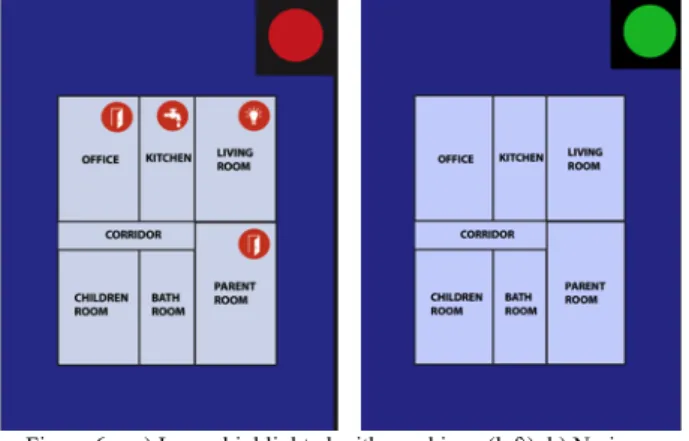
On the left, the blocks filled in blue provide information about the outside conditions (top-left blue rectangle: air quality, humidity percentage, weather conditions) and about inside the inhabitation. The latter is represented through a map of the inhabitation (a rectangle represents a room or a corridor (e.g. bedroom, kitchen)). As detailed in the following subsection, red and green circles indicate the global status of the inhabitation as well as the status for each room.
We envision such a user interface available as an interactive wall surface (e.g. a tablet). Moreover, such a user interface would be location in an every day place (e.g. in the corridor, near to the entrance). Indeed, as it embeds utility functions (e.g. information about the weather, a clock), it would easily catch the eye for key moments of the day (e.g. looking at the clock before leaving home). Thus, it would maximize (i.e. awareness) the persuasive aspects of the user interface (e.g. notification to remind efforts to be done to reduce energy consumption; to provide greetings and reward in order to maintain appropriate behaviors).
Use of living metaphors. The use of metaphors in the interface design process is examined and evaluated. When people face something new and want to understand, they usually try to compare it to other things that they have already known in order to fit it into their knowledge structure. The use of living metaphors thus may be triggered to facilitate learning. The metaphors can be based on an activity or an object with users familiar knowledge. This prototype relies on the traffic light metaphor to demonstrate the different tasks in our interactive system. The goal is to promote a glanceable (i.e. concise) user interface: in a glance, I can check if everything is ok in the inhabitation.
Figure 6. a) Issues highlighted with a red icon (left), b) No issues: green light (right)
As shown in Fig. 6, let us focus on the left side of Fig. 5. As explained above, this part of the user interface represents a logical representation of an inhabitation (less accurate than a real 2-dimensional map). The traffic light metaphor is used as follows: if the system detects an undesired event (i.e. lights on in a room with no presence), a red circle is drawn in the related room associated to an icon (e.g. a light bulb means that lights are on; an open door means that, according to smart e-coach, a door should stay closed in order to optimize temperature in the room and/or to maintain air quality). The circle located at the top-right part of the area provides a global view. Therefore, a green circle means that everything is ok.
Designed for everyday tasks. Another method to keep users motivate is to give them the full and easy controls of their habitation. We seek to simplify the complex notion such as optimizing energy while keeping
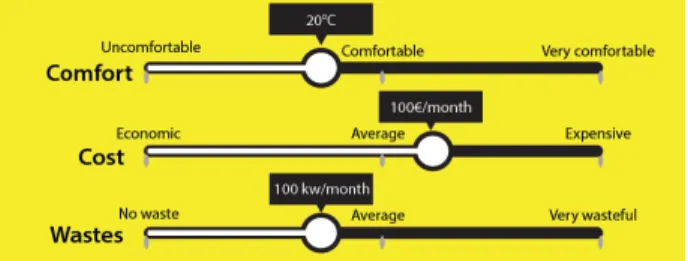
acceptable thermal comfort. Our solution is to transform these tasks in a form of everyday activity such as navigating on a map or manipulating the usual widgets. We present a prototype of sliders, which based on Pareto principles and aims to help users define their own trade-off between their values. Based on the 6 identified values above. First, we decide to eliminate two of them (“seek for fun in the use of technologies” and “will to control the housing and himself”) as their short-term impacts are not suitable with our purpose. As the remaining terms were not easily understandable for a majority of the inhabitants, we seek to change their headings. More precisely, we keep the title “comfort” and gather the two categories “energy-fan behavior” and “economical behavior” under the notion of “cost”. Finally, we renamed the “ecological behavior” by the term “wastes”. Fig. 7 demonstrates three sliders associated to three different user values: comfort, cost and wastes.
Figure 7. Defining the compromise between user values
Once defined, appropriate calculations and measures are considered, the engine provides a list of recommend actions. Fig. 8 shows the action line recommended.
Figure 8. Recommended actions
IV. CONCLUSION AND PERSPECTIVES
In this paper, we made three contributions. First, we identified the social dimensions of energy consumption in making the long-term behavior change. We presented also the factors, which promotes the changes of behavior related to energy consumption. Second, we underline the existing studies of persuasive technology, its applications and limitations. Finally, we presented a prototype in order to illustrate our design principles and user-centered value approaches.
The future work includes the on-going development of our prototype, the design principles and its evaluations
and finally a longitudinal study of whether persuasive interaction respecting on user values actually motivated behavior change. For the latter, we first need to conduct a usability study to avoid bias in the longitudinal study. Secondly, the goal of the longitudinal study is to evaluate over a long period of time if our system effectively induces and help to maintain a behavior change. For this purpose, the system is planned to be installed in a housing tower with high level of energy efficiency in France.
V. ACKNOWLEDGEMENTS
This work has been supported by the project INVOLVED ANR-14-CE22-0020, the Cross Disciplinary Project Eco-SESA financed by the IdEx Univ. Grenoble Alpes, and EquipEx AmiQual4Home ANR-11-EQPX-00.
VI. REFERENCES
[1] “International Energy Outlook 2013,” United States Energy Information Administration, 2013.
[2] Albert Bandura. 1977. Self-efficacy: Toward a unifying theory of behavioral change. Psychological Review 84, 2: 191–215. http://doi.org/10.1037/0033-295X.84.2.191
[3] Arroyo, E., Bonanni, L., Selker, T. Waterbot: exploring feedback and persuasive techniques at the sink. Proc of CHI ’05, ACM Press (2005), 631-639..
[4] B. J. Fogg. 1998. Persuasive computers: perspectives and research directions. In Proceedings of the SIGCHI Conference on Human
Factors in Computing Systems (CHI '98), 225–232.
http://doi.org/10.1145/274644.274677.
[5] Cockton, G 2005.A Development framework for value-centered design. Proc CHI 2005 Extended Abstracts. ACM. 1292-95 [6] Edwin A. Locke and Gary P. Latham. 2002. Building a practically
useful theory of goal setting and task motivation: A 35-year odyssey. American Psychologist 57, 9: 705–717. http://doi.org/10.1037/0003-066X.57.9.705
[7] Elsmore, C., Wilson, M.L., Jones, M. & Eslambolchilar, P. (2010). Neighbourhood wattch-community based energy visualisation for the home. In Nundge & Influence Through Mobile Devices workshop (NIMD).
[8] Fogg, B. J. (2009). A behavior model for persuasive design. Proc. of the 4th International Conference on Persuasive Technology, ACM.
[9] Froehlich, J., Dillahunt, T., Klasnja, P., Mankoff, J., Consolvo, S., Harrison, B., Landay, J.A. (2009). Ubigreen: investigating a mobile tool for tracking and supporting green transportation habits. Proc. ACM CHI’09, 1043-1052.
[10] Gustafsson, A., Gyllensward, M. (2005). The power-aware cord: energy awareness through ambient information display. Proc.
ACM CHI’05, 1423-1426.
[11] James O Prochaska, Carlo C DiClemente. 1984. The
transtheoretical approach: crossing traditional boundaries of therapy. Homewood. ISBN 087094438X.
[12] James O. Prochaska, Carlo C. DiClemente, and John C. Norcross. 1992. In search of how people change: Applications to addictive behaviors. American Psychologist 47, 9: 1102–1114. http://doi.org/10.1037/0003-066X.47.9.1102
[13] Joule, R.-V., & Beauvois, J.-L. (2010). La soumission librement consentie (6e édition revue et corrigée). Paris: Presses Universitaires de France - PUF.
[14] Kjeldskov, J., Skov, M.B., Paay, J., Lund, D., Madsen, T. and Nielsen, M. Eco-Forecasting for Domestic Electricity Use. Proc. CHI’15 ACM (2015), 1985- 1988.
[15] La Branche, S. (2015). Réflexions sur l’engagement énergétique : vers des profils énergétiques ? In Les sociétés contemporaines à l’épreuve des transitions énergétiques (pp. 320–323). Tours.
[16] Lewin, K. (1947). Frontiers in Group Dynamics. Concept, Method and Reality in Social Science; Social Equilibria and Social Change. Human Relations, 1(1), 5–41.
[17] Petkov, P., Goswami, S., Kobler, F. & et Krcmar, H. (2012). Personalised Eco-feedback As a Design Technique for Motivating Energy Saving Behaviour at Home. In Proceedings of the 7th Nordic Conference on Human-Computer Interaction: Making Sense Through Design, NordiCHI ’12, pages 587–596, New York, NY, USA, ACM.
[18] Ryan, R. M., Deci, E. L. (2000) Self-determination theory and the facilitation of intrinsic motivation, social development, and well-being. Amer Psy, 55(1), 68-78.
[19] Fogg, B. J., Cuellar, G., & Danielson, D. (2007). Motivating, Influencing, and Persuading Users. In The Human-Computer
Interaction Handbook: Fundamentals, Evolving Technologies and Emerging Applications, Second Edition (CRC Press, p. 1384).
[20] Shove, E., Walker, G., & Brown, S. (2014). Material culture, room temperature and the social organisation of thermal energy. Journal