Convective Heat Transfer Enhancement in
Nanofluids: Real Anomaly or Analysis Artifact?
The MIT Faculty has made this article openly available.
Please share
how this access benefits you. Your story matters.
Citation
Prabhat, Naveen, Jacopo Buongiorno, and Lin-Wen Hu. “Convective
Heat Transfer Enhancement in Nanofluids: Real Anomaly or
Analysis Artifact?” Journal of Nanofluids 1, no. 1 (June 1, 2012):
55-62.
As Published
http://dx.doi.org/10.1166/jon.2012.1003
Publisher
American Scientific Publishers
Version
Author's final manuscript
Citable link
http://hdl.handle.net/1721.1/83928
Terms of Use
Creative Commons Attribution-Noncommercial-Share Alike 3.0
CONVECTIVE HEAT TRANSFER ENHANCEMENT IN NANOFLUIDS: REAL ANOMALY OR ANALYSIS ARTIFACT?
Naveen Prabhat
Massachusetts Institute of Technology Cambridge, MA, USA
Jacopo Buongiorno
Massachusetts Institute of Technology Cambridge, MA, USA
[email protected], 617-253-7316
Lin-wen Hu
Massachusetts Institute of Technology Cambridge, MA, USA
ABSTRACT
The nanofluid literature contains many claims of anomalous convective heat transfer enhancement in both turbulent and laminar flow. To put such claims to the test, we have performed a critical detailed analysis of the database reported in 12 nanofluid papers (8 on laminar flow and 4 on turbulent flow). The methodology accounted for both modeling and experimental uncertainties in the following way. The heat transfer coefficient for any given data set was calculated according to the established correlations (Dittus-Boelter’s for turbulent flow and Shah’s for laminar flow). The uncertainty in the correlation input parameters (i.e. nanofluid thermo-physical properties and flow rate) was propagated to get the uncertainty on the predicted heat transfer coefficient. The predicted and measured heat transfer coefficient values were then compared to each other. If they differed by more than their respective uncertainties, we judged the deviation anomalous. According to this methodology, it was found that in nanofluid laminar flow in fact there seems to be anomalous heat transfer enhancement in the entrance region, while the data are in agreement (within uncertainties) with the Shah’s correlation in the fully developed region. On the other hand, the turbulent flow data could be reconciled (within uncertainties) with the Dittus-Boelter’s correlation, once the temperature dependence of viscosity was included in the prediction of the Reynolds number. While this finding is plausible, it could not be conclusively confirmed, because most papers do not report information about the temperature dependence of the viscosity for their nanofluids.
Keywords:
NOMENCLATURE
c Specific heat, J/kgK D Diameter, m
hm Average heat transfer coefficient, J/kg
k Thermal conductivity, W/mK L Length, m Num Nusselt number Pe Peclet number Pr Prandtl number q" Heat flux, W/m2 Re Reynolds number s2 Variance T Temperature, oC V Velocity, m/s
x Distance from channel inlet, m
Greek Symbols
Nanoparticle volumetric fraction µ Viscosity, Pas
ρ Density, kg/m3
Subscripts
f Fluid
1. INTRODUCTION
A literature search was conducted for publications on nanofluids convective heat transfer; the search yielded 46 journal papers [1-46]. Most of these papers report that addition of nanoparticles to base fluids “enhances the convective heat transfer capabilities”. However, what constitutes enhancement is subject to interpretation. According to the established correlations for turbulent and laminar convective heat transfer, the heat transfer coefficient (htc) depends on the thermophysical properties and flow parameters as follows:
Dittus-Boelter’s correlation [47], fully developed turbulent flow
4 . 0 8 . 0 Pr Re 023 . 0 m Nu 2 . 0 4 . 0 8 . 0 8 . 0 6 . 0 4 . 0 4 . 0 6 . 0 4 . 0 8 . 0 023 . 0 Re 023 . 0 D V k c D k c hm (1)
Eq.1 is valid for 0.7<Pr<120, Re>10000, L/D>10.
Shah’s correlation [48], developing laminar flow (fixed wall heat flux)
03 . 0 * 03 . 0 * * 0722 . 0 364 . 4 1 * 953 . 1 1 3 / 1 x x x x Num (2) where k cVD D x x / / *
. Eq. 2 is valid for Re < 2300 and any value of Pr.
By examining Eq. 1, we can readily see that, for a given Reynolds number, nanofluids tend to have a higher turbulent htc than their base fluids, because of their higher viscosity and thermal conductivity, in spite of a somewhat lower specific heat. On the other hand, for fixed velocity, the turbulent htc can be enhanced or decreased, depending on the relative magnitude of the viscosity, thermal conductivity and density increase. From Eq. 2, we see that for fully-developed laminar flow (x*>>1), the htc is directly proportional to the thermal conductivity while no other thermophysical property matters. Thus, in fully-developed laminar flow, nanofluids are expected to have higher htc than their base fluids. In the entrance region (x*<<1), the htc depends on thermal conductivity and also specific heat and density (but not on viscosity), so nanofluids can either have higher or lower htc depending on the relative magnitude of the changes in these properties. All these trends are expected and can be captured if accurate values of the thermo-physical properties are available for the nanofluids of interest. Of the 46 papers examined, only
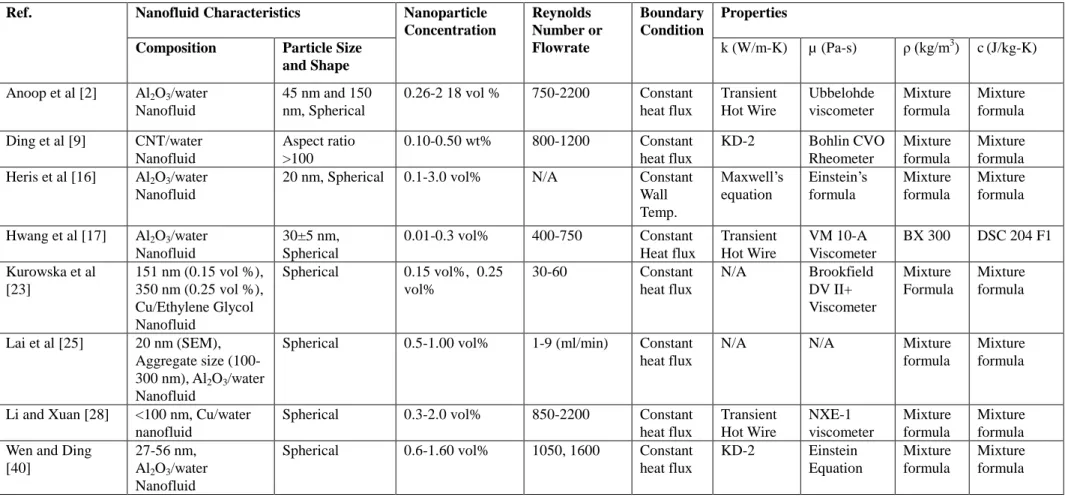
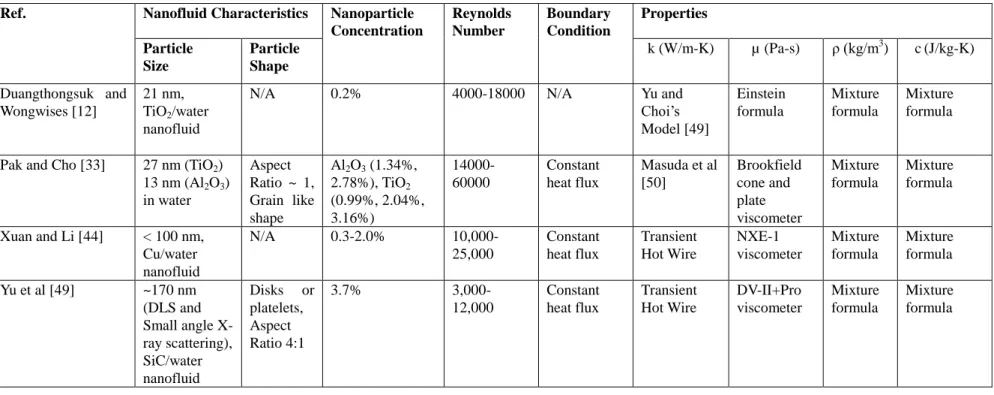
12 papers (summarized in Tables I and II) claimed significant deviations from the above correlations1. However, often in these studies the nanofluid properties were not measured, but rather calculated from models (sometimes questionable models); moreover, the uncertainties in the calculated htc values were not quantified. These shortcomings make it difficult to assess if in fact a significant deviation from Eqs. 1-2 is present or not. Therefore, we decided to conduct a critical analysis of the claims of anomalous heat transfer enhancement in these papers. The question of anomalous enhancement is important, because a significant deviation of the data from Eqs. 1-2 would signal the presence of some nanoparticle-specific heat transfer mechanisms that make nanofluids behave in a fundamentally different way from homogenous fluids.
The methodology adopted in our analysis is described in Section 2, while the results are discussed in Section 3. Conclusions are offered in Section 4.
2. METHODOLOGY
The evaluation methodology comprised the following steps:
- Collection of htc experimental data. Measured htc data were extracted from the figures in the
original papers. The data were sometimes plotted as htc vs Reynolds number, sometimes as htc vs x/D (especially in laminar flow). Uncertainties in the measured htc values were typically reported in the papers and ranged from 3 to 5%. If not reported, a 5% experimental uncertainty was assumed in our analysis.
- Prediction of htc. The htc was predicted according to Eqs. 1-2 using the measured values of velocity
(or volumetric flow rate), channel diameter, and thermo-physical properties reported in the papers. If the thermo-physical properties had not been measured, we used the following models:
f p (1 ) (3) pcp fcf c (1 ) (4) ) ( 2 ) ( 2 2 f p f p f p f p f k k k k k k k k k k (5) 1
All these papers present some form of ‘validation’ of the experimental apparatus by comparing pure
5 . 2 1 f (6)
Eqs 3 and 4 are the definitions of mixture density and specific heat for a two-component medium. Eq. 5 is Maxwell’s model for thermal conductivity of a dispersion of particles in a homogenous medium; Maxwell’s model (in its updated version due to Nan et al. [51]) was shown to correctly reproduce the thermal conductivity of nanofluids [52]. Eq 6 is Einstein’s model for the viscosity of a dilute dispersion of non-interacting spherical particles in a homogenous medium. Unfortunately, Einstein’s model does not reproduce the nanofluid viscosity data accurately [53]. Specifically, it has been found to greatly underestimate the nanofluid viscosity data [53]. Therefore, we have used Einstein’s model as a lower bound for viscosity and Williams et al.’s data [42] as an upper bound. While this approach is hardly satisfactory, the reader should note that viscosity does not affect the htc in laminar flow, so this issue is of concern only for turbulent flow. Moreover, all turbulent flow studies have reported their viscosity except Duangthongsuk and Wongwises [12]. In summary, the Einstein’s model was used solely in the analysis of Duangthongsuk and Wongwises’s data.
- Uncertainty on the predicted htc. The uncertainty on the value of the predicted htc was calculated by
propagating the uncertainties on the individual input parameters in Eqs. 1-2, i.e. velocity, diameter, and the thermo-physical properties. The thermo-physical property uncertainties were either picked directly from the original paper (when reported) or were in turn estimated by propagating the uncertainty of the input parameters in the models of Eqs. 3-6. For propagation of uncertainties, we used the standard methodology applicable to normal distributions; that is, for any generic function y=f(x1,x2…xn), the variance of y, s2y, was calculated as follows:
i xi i y s x f s 2 2 2 (7)- Definition of anomalous enhancement. The measured and predicted htc were plotted in the same
figure. If they differed by more than their respective uncertainties (error bars), we judged the deviation to be anomalous.
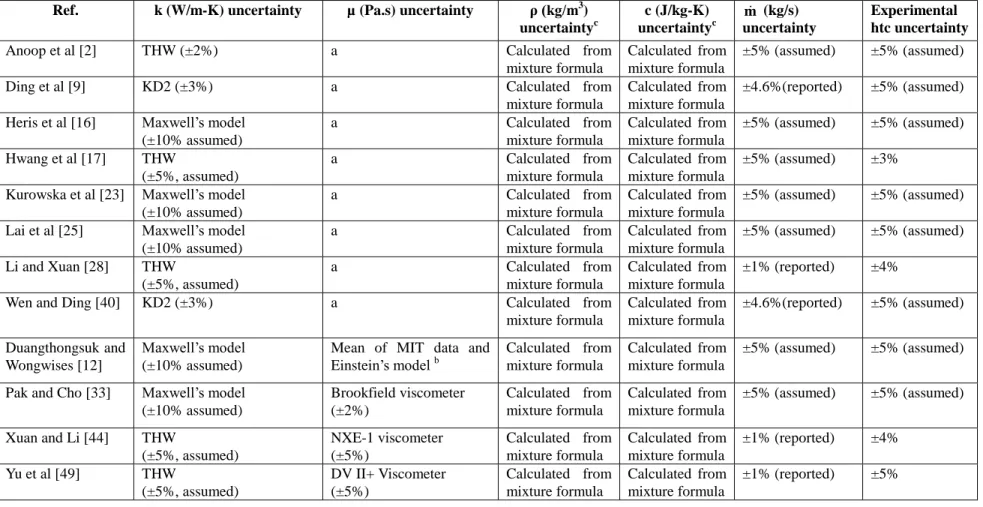
Table III reports many of the assumptions made in the analysis of the various datasets. However, because of space limitations, it is impossible to report all details here. The interested reader is strongly encouraged to consult N. Prabhat’s M.S. Thesis [54].
3. RESULTS
3.1 Laminar Flow
The analysis of the laminar flow data produced the following results:
- Anomalous htc enhancement (as defined in Section 2) was observed in the data by Anoop et al. [2], Wen and Ding [40] and Ding et al. [9], Heris et al. [16], Kurowska et al. [23] and Li and Xuan [28], but not in the data by Hwang et al. [17] and Lai et al. [25]. Representative htc plots from these two groups are shown in Figs 1 through 5.
- The deviations from the Shah’s correlation were generally more pronounced at higher Reynolds number (still within the laminar flow range) and higher nanoparticle concentrations. Investigation of the physical mechanisms responsible for these trends is an interesting area for future contributions.
3.2 Turbulent Flow
Anomalous enhancement was observed for all 4 turbulent flow datasets. Representative htc plots are shown in Fig 6 (solid lines). However, we noted that in all 4 turbulent studies the Reynolds number was defined in terms of the nanofluid viscosity at room temperature. Interestingly, if the nanofluid viscosity dependence on temperature is assumed to be as strong as that of water (an assumption justified by Williams et al.’s viscosity data [42]) and taken into account in the definition of the Re number, the experimental htc-vs-Re curves shift to the right and overlap with the predicted curves, as shown in Fig 6 (broken lines). In other words, the anomalous enhancement in turbulent flow might simply be a case of ‘mistaken viscosity’, although this suspicion cannot be confirmed conclusively, since none of the 4 turbulent flow studies reported the nanofluid viscosity as a function of temperature. This is also an area for future contributions.
4. CONCLUSIONS AND FUTURE WORK
A detailed analysis of 12 nanofluid convective heat transfer datasets (both in the laminar and turbulent flow regimes) was conducted. The data were compared to the predictions of the Dittus-Boelter (turbulent) and Shah’s (laminar) correlations, using the properties of the nanofluids, measured (when available) or calculated. Experimental as well as model uncertainties were accounted for in the analysis. It was shown that significant deviations (i.e. beyond uncertainties) between the data and the predictions of the heat transfer correlations can occur in the laminar flow regime, particularly in the entrance region; the enhancement becomes more pronounced at higher (but still laminar) Reynolds number and higher particle concentration. This finding was surprising to us, since our own nanofluids experimental data for
laminar flow [36] had showed no deviation from the Shah’s correlation; in fact we were initially rather skeptical of the claims of anomalous enhancement found in the literature.
On the other hand, we suspect that the anomalous enhancement observed in the turbulent flow regime could be an analysis artifact, due to the use of the room-temperature viscosity in the definition of the Reynolds number.
The following items are recommended for future work:
- Mixed forced/free convection effects in the laminar flow data sets (especially those in the low Reynolds number range) should be assessed and possibly ruled out, to strengthen the conclusion of anomalous enhancement.
- Investigation of the physical mechanisms responsible for anomalous enhancement in the laminar flow regime is needed.
- Viscosity-vs-temperature data for nanofluids are needed to clarify the apparent discrepancy in turbulent flow.
REFERENCES
[1]
H. Abbassi, and Cyrus Aghanajafi, 2006, “Evaluation of Heat Transfer Augmentation in a Nanofluid-Cooled Microchannel Heat Sink”, Journal of Fusion Energy, Vol. 25, No. 3/4, 187-196, December 2006[2]
Anoop K.B., Sundararajan T., Das S.K., 2009. Effect of particle size on the convective heat transfer in nanofluid in the developing region. International Journal of Heat and Mass Transfer 52 (2009) 2189–2195.[3]
J. Buongiorno, “Convective Transport in Nanofluids”, J. of Heat Transfer Vol. 128, 240-250,2006.
[4]
K. Chmiel-Kurowska, Grzegorz Dzido, Andrzej Gierczycki, Andrzej B. Jarzębski, 2008, “Experimental Investigation of heat transfer to nanofluids”, Proceedings of the Sixth International ASME Conference on Nanochannels, Microchannels and Minichannels, ICNMM2008-62215, 23-25 June 2008, Darmstadt, Germany.[5]
M. Chopkar, A. K. Das, I. Manna, P. K. Das, 2008, “Pool boiling heat transfer characteristics of ZrO2–water nanofluids from a flat surface in a pool”, Heat Mass Transfer (2008) 44:999-1004[6]
B.-H. Chun, Hyun Uk Kang, and Sung Hyun Kim, 2008, “Effect of alumina nanoparticles in the fluid on heat transfer in double-pipe heat exchanger system”, Korean J. Chem. Eng., 25(5), 966-971 (2008)[7]
P. M. Congedo, Stefano Collura and Paolo Maria Congedo, 2008, “Modeling and analysis of natural convection heat transfer in nanofluids”, Proceedings of 2008 ASME Summer Heat Transfer Conference, Jacksonville, FL.[8]
Dale A., Jamil A. Khan, Andrew M. Hayes and Aly Shaaban, 2008, “Evaluating The Thermal Characteristics Of Copper-II and Zinc-Oxide Nanofluids Flowing over a Heated Flat Plate Proceedings of 2008 ASME Summer Heat Transfer Conference, Jacksonville, FL.[9]
Y. Ding, Hajar Alias, Dongsheng Wen, Richard A. Williams, 2006, “Heat transfer of aqueous suspensions of carbon nanotubes (CNT nanofluids)”, International Journal of Heat and Mass Transfer 49 (2006) 240–250[10]
Y. Ding, Haisheng Chen, Yurong He, Alexei Lapkin, Mahboubeh Yeganeh, Lidija Siller and Yuriy V. 2007, “Forced convective heat transfer of nanofluids”, Advanced Powder Technology, Vol. 18, No. 6, pp. 813–824 (2007)[11]
W. Duangthongsuk, S. Wongwises, 2008, “Effect of thermophysical properties models on the predicting of the convective heat transfer coefficient for low concentration nanofluid”, International Communications in Heat and Mass Transfer 35 (2008) 1320–1326[12]
W. Duangthongsuk, S. Wongwises , 2009, “Heat transfer enhancement and pressure drop characteristics of TiO2–water nanofluid in a double-tube counter flow heat exchanger”, International Journal of Heat and Mass Transfer, 52 (2009) 2059–2067[13]
A. Falahatpisheh and Omid Abouali, 2008, “Free Convection of nanofluid in vertical annuli”, Proceedings of the Sixth International ASME Conference on Nanochannels, Microchannels and Minichannels, ICNMM2008-62090, 23-25 June 2008, Darmstadt, Germany[14]
X. Fan, Haisheng Chen, Yulong Ding, Pawel K. Plucinski and Alexei A. Lapkin, “Potential of ‘nanofluids’ to further intensify microreactors”, J. of Royal Society of Chemistry, Green Chem., 2008, 10, 670–677[15]
Y. He, Yi Jin, Haisheng Chen, Yulong Ding, Daqiang Cang, Huilin Lu, 2007, “Heat transfer and flow behaviour of aqueous suspensions of TiO2 nanoparticles (nanofluids) flowing upward through a vertical pipe”,International Journal of Heat and Mass Transfer 50 (2007) 2272–2281[16]
Heris S.Z., Esfahany M.N., Etemad S.Gh, 2007. Experimental investigation of convective heat transfer of Al2O3/water nanofluid in circular tube, International Journal of Heat and Fluid Flow28 (2007) 203–210
[17]
Hwang K.S., Jang S.P., Choi S.U.S., 2009. Flow and convective heat transfer characteristics of water-based Al2O3 nanofluids in fully developed laminar flow regime, International Journal of Heat and Mass Transfer 52 (2009) 193–199[18]
S Kabelac and K.B. Anoop, 2008, “Experimental convective heat transfer with nanofluids”, Proceedings of the Sixth International ASME Conference on Nanochannels, Microchannels and Minichannels, , ICNMM2008-62099, 23-25 June 2008, Darmstadt, Germany[19]
S.-W. Kang, Wei-Chiang Wei, 2005, “Experimental investigation of silver nanofluid on heat pipe thermal performance”, Proceedings of Tamkang University 2005 International Nano and MEMS Workshop, Taipei, Taiwan.[20]
Khalil Khanafer, Kambiz Vafai, Marilyn Lightstone, “Buoyancy-driven heat transfer enhancement in a two-dimensional enclosure utilizing nanofluids”, International Journal of Heat and Mass Transfer 46 (2003) 3639–3653[21]
J. Kim, Yong Tae Kang, Chang Kyun Choi, 2004, “Analysis of convective instability and heat transfer characteristics of nanofluids” Physics of fluids, Volume 16, Number 7, 2395–2401.[22]
Kulkarni, Devdatta P., Namburu, Praveen K., Ed Bargar, H. and Das, Debendra K., 2008 “Convective Heat Transfer and Fluid Dynamic Characteristics of SiO2 Ethylene Glycol/Water Nanofluid”,Heat Transfer Engineering,29:12,1027 — 1035[23]
Kurowska K.C., Dzido G., Gierczycki A., Jarzębski A.B., 2008. Experimental Investigation of Heat Transfer to Nanofluids, Proceedings of the Sixth International ASME Conference on Nanochannels, Microchannels and Minichannels ICNMM2008, Darmstadt, Germany.[24]
W.Y. Lai, B. Duculescu, P.E. Phelan & Ravi Prasher, 2006, “A Review of Convective Heat Transfer with Nanofluids for Electronics Packaging,0-7803-9524-7/06 IEEE[25]
Lai W.Y., Phelan P.E., Vinod S., Prasher R., 2008, Convective Heat Transfer for water-based alumina nanofluids in a single 1.02-mm, 11th Intersociety Conference on Thermal and Thermomechanical Phenomena in Electronic Systems (ITHERM), May 28-31, 2008, Orlando, Florida, pp. 970-978.[26]
J.Lee , Roger D Flynn, Kenneth E Goodson, John K Eaton, 2007, “Convective heat transfer of a nanofluid (DI + Al2O3) in microchannel”, 2007 ASME-JSME Thermal Engineering Summer HeatTransfer Conference, Vancouver, BC, Canada.
[27]
Jie Li, Clement Kleinstreuer, 2008, “Thermal performance of nanofluid flow in microchannels” , International Journal of Heat and Fluid Flow 29 (2008) 1221–1232[28]
Q. Li and Y. Xuan, 2002, “Convective heat transfer and flow characteristics of Cu-water nanofluid,” Science in China (Series E), Vol 45 No.4, 408-416[29]
S. E. B. Maïga, C. T. Nguyen, N. Galanis, G. Roy, 2004, “Heat transfer behaviours of nanofluids in a uniformly heated tube”, Superlattices and Microstructures 35 (2004) 543–557[30]
S. E. B. Maïga, S. J. Palm, C. T. Nguyen, G. Roy, N. Galanis, (2005), “Heat transferenhancement by using nanofluids in forced convection flows”, International Journal of Heat and Fluid Flow 26 , 530–546
[31]
N Masoumi, N Sohrabi and A Behzadmehr, 2009, “A new model for calculating the effectiveviscosity of nanofluids” J. Phys. D: Appl. Phys. 42 (2009) 055501 (6pp)
[32]
A.K. Nayak, M.R. Gartia, P.K. Vijayan, 2008, “An experimental investigation of single-phase natural circulation behavior in a rectangular loop with Al2O3 nanofluids”, Experimental Thermaland Fluid Science 33 (2008) 184–189
[33]
B. C. Pak and Young I. Cho, “Hydrodynamic and heat transfer study of dispersed fluids with submicron metallic oxide”, Experimental Heat Transfer, 11:151-170, 1998[34]
M.N. Pantzali, A.A. Mouza, S.V. Paras, 2009, “Investigating the efficacy of nanofluids ascoolants in plate heat exchangers (PHE)”, Chemical Engineering Science (2009), Volume 64, Issue 14, 15 July 2009, Pages 3290–3300.
[35]
Rashmi W, Ismail A F, Asrar W, Khalid M, and Faridah Y, 2008, Natural Convection Heat Transfer in nanofluids-a numerical study, Proceedings of the 2008 ASME Fluids Engineering Conference, Jacksonville, FL.[36]
Rea U., McKrell T., Hu LW, and Buongiorno J. 2009, “Laminar Convective Heat Transfer and Viscous Pressure Loss of Alumina-Water and Zirconia-Water Nanofluids,” Int. J. Heat Mass Transfer, 52, 7-8, 2042-2048.[37]
G. Roy, S. J. Palm and C. T. Nguyen, 2005, “Heat Transfer and Fluid Flow of Nanofluids in Laminar Radial Flow Cooling Systems”, J. of Thermal Science Vol.14, No.4, (2005),1003-2169[38]
T.-H. Tsai, Reiyu Chein, 2007, “Performance analysis of nanofluid-cooled microchannel heat sinks”, International Journal of Heat and Fluid Flow 28 (2007) 1013–1026[39]
Weerapun Daungthongsuk, Somchai Wongwises, 2007, “A critical review of convective heat transfer of nanofluids”, Renewable and Sustainable Energy Reviews 11 (2007) 797–817[40]
Wen D., Ding Y., 2004. Experimental investigation into convective heat transfer of nanofluid at the entrance region under laminar flow conditions. International Journal of Heat and Mass Transfer 47 (24), 5181–5188[41]
D. Wen , Yulong Ding, 2005, “ Formulation of nanofluids for natural convective heat ttransferapplications”, International Journal of Heat and Fluid Flow 26 (2005) 855–864
[42]
Williams, W. C., Buongiorno, J., and Hu, L. W., 2008, “Experimental Investigation of Turbulent Convective Heat Transfer and Pressure Loss of Alumina/Water and Zirconia/Water Nanoparticle Colloids (Nanofluids) in Horizontal Tubes,” ASME J. Heat Transfer, Vol 130, 042412-1/7[43]
Y. Xuan , Wilfried Roetzel, 2000, “Conceptions for heat transfer correlation of nanofluids”, International Journal of Heat and Mass Transfer 43 (2000) 3701-3707[44]
Xuan Y., Li Q., 2003. Investigation on convective heat transfer and flow features of nanofluids. Journal of Heat Transfer 125, 151–155.[45]
Y. Yang, Z. George Zhang, Eric A. Grulke, William B. Anderson, Gefei Wu, 2005, “Heat transferproperties of nanoparticle-in-fluid dispersions (nanofluids) in laminar flow”, International Journal of Heat and Mass Transfer 48, 1107–1116
[46]
Yu W., France D.M., Smith D.S., Singh D., Timofeeva E.V., Routbort J. L., 2009, Heat transfer to a silicon carbide/water nanofluid, International Journal of Heat and Mass Transfer 52 (2009)[47]
J. H Lienhard IV and J. H. Lienhard V, A heat transfer textbook, 3rd edition, Phlogiston Press (2002), Cambridge, MA.[48]
Shah R.K. (1975) Thermal entry length solutions for the circular tube and parallel plates, Proceedings of the 3rd National Heat and Mass Transfer Conference, Indian Institute of Technology, Bombay, I (Paper HMT-11-75).[49]
W. Yu and S. U. S. Choi, “The Role of Interfacial Layers in the Enhanced Thermal Conductivity of Nanofluids: A Renovated Maxwell Model”, J. Nanoparticle Res., 5, 167 (2003).[50]
Masuda, H., A. Ebata, K. Teramae, N. Hishinuma, 1993, “Alteration of Thermal Conductivity and Viscosity of Liquid by Dispersing Ultra-Fine Particles”, Netsu Bussei, Vol. 7, No. 4, 227-233.[51] C. W. Nan, R. Birringer, David R. Clarke, H. Gleiter, “Effective thermal conductivity of
particulate composites with interfacial thermal resistance”, J. Appl. Phys. 81 (10), 6692, 15 May
(1997).
[52]
Jacopo Buongiorno, David C. Venerus, Naveen Prabhat, Thomas McKrell, Jessica Townsend,
Rebecca Christianson, Yuriy V. Tolmachev, Pawel Keblinski, Lin-wen Hu, Jorge L. Alvarado, In
Cheol Bang, Sandra W. Bishnoi, Marco Bonetti, Frank Botz, Anselmo Cecere, Yun Chang, Gang
Chen, Haisheng Chen, Sung Jae Chung, Minking K. Chyu, Sarit K. Das, Roberto Di Paola,
Yulong Ding, Frank Dubois, Grzegorz Dzido, Jacob Eapen, Werner Escher, Denis Funfschilling, Quentin Galand, Jinwei Gao, Patricia E. Gharagozloo, Kenneth E. Goodson, Jorge Gustavo
Gutierrez, Haiping Hong, Mark Horton, Kyo Sik Hwang, Carlo S. Iorio, Seok Pil Jang, Andrzej
B. Jarzebski, Yiran Jiang, Liwen Jin, Stephan Kabelac, Aravind Kamath, Mark A Kedzierski, Lim
Geok Kieng, Chongyoup Kim, Ji-Hyun Kim, Sukwon Kim, Seung Hyun Lee, Kai Choong Leong,
Indranil Manna, Bruno Michel, Rui Ni, Hrishikesh E. Patel, John Philip, Dimos Poulikakos,
Cecile Reynaud, Raffaele Savino, Pawan K. Singh, Pengxiang Song, Thirumalachari
Sundararajan, Elena Timofeeva, Todd Tritcak, Aleksandr N. Turanov, Stefan Van Vaerenbergh,
Dongsheng Wen, Sanjeeva Witharana, Chun Yang, Wei-Hsun Yeh, Xiao-Zheng Zhao, Sheng-Qi Zhou, 2009, A benchmark study on thermal conductivity of nanofluids, Journal of Applied
[53]
Venerus, D, Buongiorno, J, Christianson, R, Townsend, J, Bang, IC, Chen, G, Chung, SJ, Chyu, M, Chen, H, Ding, Y, Dubois, F, Dzido, G, Funfschilling, D, Galand, Q, Gao, J, Hong, H, Horton, M, Hu, LW, Iorio, CS, Jarzebski, AB, Jiang, Y, Kabelac, S, Kedzierski, MA, Kim, C, Kim, JH, Kim, S, McKrell, T, Ni, R, Philip, J, Prabhat, N, Song, P, Vaerenbergh, SV, Wen, D, Witharana, S, Zhao, X and Zhou, S, “Viscosity Measurements On Colloidal Dispersions (Nanofluids) For Heat Transfer Applications”, J. Appl. Rheology, 20, 44582, 2010.[54]
N. Prabhat, Critical Evaluation of Anomalous Thermal Conductivity and Convective Heat Transfer Enhancement in Nanofluids, M.S. Thesis, Nuclear Science and Engineering Dept., Massachusetts Institute of Technology, May 2010. (available at http://libguides.mit.edu/diss)Fig 1. Local htc [W/m2K] for Lai et al.’s data (1.0 vol% alumina, 5 ml/min), showing no significant deviation between the measured and predicted htc.
Fig 2. Local htc [W/m2K] for Wen and Ding’s data (1 vol% alumina, Re=1600), showing a very large anomalous enhancement in the entrance region, a lot smaller at high x/D. The uncertainty bars for the predicted curve are present, but small in this case.
Fig 3. Local htc [W/m2K] for Ding et al.’s data (0.1 wt% Carbon Nano-Tubes, Re=800), showing a very large anomalous enhancement in the entrance region, but no deviation at high x/D. The uncertainty bars for the predicted curve are shown, but small in this case.
Fig 4. Average htc [W/m2K] for Li and Xuan’s data (2.0 vol% Cu), showing large anomalous enhancement, whose magnitude increases with increasing Re number.
Fig 5. Average htc [W/m2K] for Heris et al.’s data (3.0 vol% alumina), showing anomalous enhancement, whose magnitude increases with increasing Pe number.
(a) (b)
(c) (d)
Fig 6. Average htc [W/m2K] for (a) Xuan and Li’s data (1.5 vol% Cu), (b) Pak and Cho’s data (3.16 vol% titania), (c) Duangthongsuk and Wongwises’s data (0.2 vol% Ti), and (d) Yu et al.’s data (3.2 vol% silicon carbide). The solid lines are for a Reynolds number based on room-temperature viscosity, while the broken lines are for a Reynolds number based on viscosity at 45C. Note that the when the effect of temperature on viscosity is taken into account, the measured htc no longer displays anomalous deviations from the predicted htc.
Table I. Nanofluids convective heat transfer studies analyzed in this paper (laminar flow).
N/A = not available
Ref. Nanofluid Characteristics Nanoparticle Concentration Reynolds Number or Flowrate Boundary Condition Properties Composition Particle Size
and Shape k (W/m-K) µ (Pa-s) ρ (kg/m3) c(J/kg-K) Anoop et al [2] Al2O3/water Nanofluid 45 nm and 150 nm, Spherical 0.26-2 18 vol % 750-2200 Constant heat flux Transient Hot Wire Ubbelohde viscometer Mixture formula Mixture formula Ding et al [9] CNT/water Nanofluid Aspect ratio >100 0.10-0.50 wt% 800-1200 Constant heat flux KD-2 Bohlin CVO Rheometer Mixture formula Mixture formula Heris et al [16] Al2O3/water Nanofluid
20 nm, Spherical 0.1-3.0 vol% N/A Constant Wall Temp. Maxwell’s equation Einstein’s formula Mixture formula Mixture formula Hwang et al [17] Al2O3/water Nanofluid 30±5 nm, Spherical 0.01-0.3 vol% 400-750 Constant Heat flux Transient Hot Wire VM 10-A Viscometer BX 300 DSC 204 F1 Kurowska et al [23] 151 nm (0.15 vol %), 350 nm (0.25 vol %), Cu/Ethylene Glycol Nanofluid Spherical 0.15 vol%, 0.25 vol% 30-60 Constant heat flux N/A Brookfield DV II+ Viscometer Mixture Formula Mixture formula Lai et al [25] 20 nm (SEM), Aggregate size (100-300 nm), Al2O3/water Nanofluid
Spherical 0.5-1.00 vol% 1-9 (ml/min) Constant heat flux
N/A N/A Mixture
formula
Mixture formula
Li and Xuan [28] <100 nm, Cu/water nanofluid
Spherical 0.3-2.0 vol% 850-2200 Constant heat flux Transient Hot Wire NXE-1 viscometer Mixture formula Mixture formula Wen and Ding
[40]
27-56 nm, Al2O3/water
Nanofluid
Spherical 0.6-1.60 vol% 1050, 1600 Constant heat flux KD-2 Einstein Equation Mixture formula Mixture formula
Table II. Nanofluids convective heat transfer studies analyzed in this paper (turbulent flow).
N/A = not available
Ref. Nanofluid Characteristics Nanoparticle Concentration Reynolds Number Boundary Condition Properties Particle Size Particle Shape k (W/m-K) µ (Pa-s) ρ (kg/m3) c(J/kg-K) Duangthongsuk and Wongwises [12] 21 nm, TiO2/water nanofluid
N/A 0.2% 4000-18000 N/A Yu and
Choi’s Model [49] Einstein formula Mixture formula Mixture formula
Pak and Cho [33] 27 nm (TiO2)
13 nm (Al2O3) in water Aspect Ratio ~ 1, Grain like shape Al2O3 (1.34%, 2.78%), TiO2 (0.99%, 2.04%, 3.16%) 14000-60000 Constant heat flux Masuda et al [50] Brookfield cone and plate viscometer Mixture formula Mixture formula Xuan and Li [44] < 100 nm, Cu/water nanofluid N/A 0.3-2.0% 10,000-25,000 Constant heat flux Transient Hot Wire NXE-1 viscometer Mixture formula Mixture formula Yu et al [49] ~170 nm (DLS and Small angle X-ray scattering), SiC/water nanofluid Disks or platelets, Aspect Ratio 4:1 3.7% 3,000-12,000 Constant heat flux Transient Hot Wire DV-II+Pro viscometer Mixture formula Mixture formula
Table III. Uncertainties in input parameters for prediction of htc.
a
The laminar flow htc is independent of viscosity.
b Since this paper did not report nanofluid viscosity data, its value was bounded using Einstein’s formula (lower bound) and the MIT data [42] (upper bound) c Uncertainties in density and specific heat of nanofluid were calculated using uncertainty propagation through the mixture formula assuming 10% uncertainty in
nanoparticle properties.
Ref. k (W/m-K) uncertainty µ (Pa.s) uncertainty ρ (kg/m3) uncertaintyc c (J/kg-K) uncertaintyc m (kg/s) uncertainty Experimental htc uncertainty
Anoop et al [2] THW (±2%) a Calculated from
mixture formula
Calculated from mixture formula
±5% (assumed) ±5% (assumed)
Ding et al [9] KD2 (±3%) a Calculated from
mixture formula
Calculated from mixture formula
±4.6%(reported) ±5% (assumed) Heris et al [16] Maxwell’s model
(±10% assumed) a Calculated from mixture formula Calculated from mixture formula ±5% (assumed) ±5% (assumed) Hwang et al [17] THW (±5%, assumed) a Calculated from mixture formula Calculated from mixture formula ±5% (assumed) ±3% Kurowska et al [23] Maxwell’s model
(±10% assumed) a Calculated from mixture formula Calculated from mixture formula ±5% (assumed) ±5% (assumed) Lai et al [25] Maxwell’s model
(±10% assumed) a Calculated from mixture formula Calculated from mixture formula ±5% (assumed) ±5% (assumed) Li and Xuan [28] THW (±5%, assumed) a Calculated from mixture formula Calculated from mixture formula ±1% (reported) ±4%
Wen and Ding [40] KD2 (±3%) a Calculated from
mixture formula Calculated from mixture formula ±4.6%(reported) ±5% (assumed) Duangthongsuk and Wongwises [12] Maxwell’s model (±10% assumed)
Mean of MIT data and Einstein’s model b Calculated from mixture formula Calculated from mixture formula ±5% (assumed) ±5% (assumed)
Pak and Cho [33] Maxwell’s model (±10% assumed) Brookfield viscometer (±2%) Calculated from mixture formula Calculated from mixture formula ±5% (assumed) ±5% (assumed) Xuan and Li [44] THW (±5%, assumed) NXE-1 viscometer (±5%) Calculated from mixture formula Calculated from mixture formula ±1% (reported) ±4% Yu et al [49] THW (±5%, assumed) DV II+ Viscometer (±5%) Calculated from mixture formula Calculated from mixture formula ±1% (reported) ±5%
![Fig 1. Local htc [W/m 2 K] for Lai et al.’s data (1.0 vol% alumina, 5 ml/min), showing no significant deviation between the measured and predicted htc](https://thumb-eu.123doks.com/thumbv2/123doknet/14485036.524882/15.918.271.652.111.376/fig-local-alumina-showing-significant-deviation-measured-predicted.webp)
![Fig 2. Local htc [W/m 2 K] for Wen and Ding’s data (1 vol% alumina, Re=1600), showing a very large anomalous enhancement in the entrance region, a lot smaller at high x/D](https://thumb-eu.123doks.com/thumbv2/123doknet/14485036.524882/16.918.268.651.141.416/local-alumina-showing-anomalous-enhancement-entrance-region-smaller.webp)
![Fig 3. Local htc [W/m 2 K] for Ding et al.’s data (0.1 wt% Carbon Nano-Tubes, Re=800), showing a very large anomalous enhancement in the entrance region, but no deviation at high x/D](https://thumb-eu.123doks.com/thumbv2/123doknet/14485036.524882/17.918.254.667.140.435/local-carbon-tubes-showing-anomalous-enhancement-entrance-deviation.webp)
![Fig 4. Average htc [W/m 2 K] for Li and Xuan’s data (2.0 vol% Cu), showing large anomalous enhancement, whose magnitude increases with increasing Re number](https://thumb-eu.123doks.com/thumbv2/123doknet/14485036.524882/18.918.267.658.141.433/average-showing-anomalous-enhancement-magnitude-increases-increasing-number.webp)
![Fig 5. Average htc [W/m 2 K] for Heris et al.’s data (3.0 vol% alumina), showing anomalous enhancement, whose magnitude increases with increasing Pe number](https://thumb-eu.123doks.com/thumbv2/123doknet/14485036.524882/19.918.286.652.143.420/average-alumina-showing-anomalous-enhancement-magnitude-increases-increasing.webp)
![Fig 6. Average htc [W/m 2 K] for (a) Xuan and Li’s data (1.5 vol% Cu), (b) Pak and Cho’s data (3.16 vol% titania), (c) Duangthongsuk and Wongwises’s data (0.2 vol% Ti), and (d) Yu et al.’s data (3.2 vol% silicon carbide)](https://thumb-eu.123doks.com/thumbv2/123doknet/14485036.524882/20.918.117.789.132.694/fig-average-xuan-titania-duangthongsuk-wongwises-silicon-carbide.webp)