HAL Id: hal-02565036
https://hal.archives-ouvertes.fr/hal-02565036
Submitted on 1 Mar 2021
HAL is a multi-disciplinary open access
archive for the deposit and dissemination of
sci-entific research documents, whether they are
pub-lished or not. The documents may come from
teaching and research institutions in France or
abroad, or from public or private research centers.
L’archive ouverte pluridisciplinaire HAL, est
destinée au dépôt et à la diffusion de documents
scientifiques de niveau recherche, publiés ou non,
émanant des établissements d’enseignement et de
recherche français ou étrangers, des laboratoires
publics ou privés.
Quantitative Insertion of Carbon Monoxide into
Cobalt–Oxygen Bonds
Yong Wang, Yajun Zhao, Shuaishuai Zhu, Xingping Zhou, Jing Xu, Xiaolin
Xie, Rinaldo Poli
To cite this version:
Yong Wang, Yajun Zhao, Shuaishuai Zhu, Xingping Zhou, Jing Xu, et al..
Switchable
Poly-merization Triggered by Fast and Quantitative Insertion of Carbon Monoxide into Cobalt–Oxygen
Bonds. Angewandte Chemie International Edition, Wiley-VCH Verlag, 2020, 59 (15), pp.5988-5994.
�10.1002/anie.201914216�. �hal-02565036�
Switchable Polymerization Triggered by Fast and Quantitative
Insertion of Carbon Monoxide into Cobalt-Oxygen Bonds
Yong Wang,*
[a]Yajun Zhao,
[a]Shuaishuai Zhu,
[a]Xingping Zhou,*
[a]Jing Xu,
[b]Xiaolin Xie
[a]and Rinaldo
Poli*
[c]Abstract: A strategy that uses carbon monoxide (CO) as a molecular
trigger to switch the polymerization mechanism of a cobalt Salen complex [Salen = (R,R)-N,N′-bis(3,5-di-tertbutylsalicylidene)-1,2-cyclohexanediamine] from ring-opening copolymerization (ROCOP) of epoxides/anhydrides to organometallic mediated controlled radical polymerization (OMRP) of acrylates is described. The key phenomenon is a rapid and quantitative insertion of CO into the Co-O bond, allowing for in situ transformation of the ROCOP active species (Salen)CoIII-OR into the OMRP photoinitiator (Salen)CoIII-CO
2R. The
proposed mechanism, which involves CO coordination to (Salen)CoIII
-OR and subsequent intramolecular rearrangement via migratory insertion has been rationalized by DFT calculations. Regulated by both CO and visible light, on-demand sequence control can be achieved for the one-pot synthesis of polyester-b-polyacrylate diblock copolymers (Đ < 1.15).
Introduction
The fundamental properties and functionalities of polymers are directly correlated to their primary microstructures. Whereas enzymes display exceptional efficiency for the synthesis of precisely programmed biopolymers within a living cell, it is a major challenge to regulate polymer sequence and architecture from
mixture of monomers for modern polymer chemistry.1 An
attractive solution may lay in the rapidly evolving field of switchable catalysis, whereby the reactivity of a metal-based polymerization catalyst is altered in response to an external stimulus.2 Typically, the switch involves a change of the active
species, which is achieved either via in situ modification of the metal coordination sphere through a stimulus-responsive
functional group,3 or by a metal oxidation state change via a redox
process4. In this regard, current achievements in switchable
polymerization have mostly been limited to catalysts that iterate between mechanistically similar polymerization reactions.
The ring-opening copolymerization (ROCOP) of
epoxides/anhydrides has emerged as a burgeoning method to
produce polyesters.5 The wide availability of renewable
monomers and the opportunity for post-polymerization
modification open access to a myriad of new materials with unique
properties that are not accessible through traditional
condensation reactions.6 Cobalt Salcy [bis(salicylaldimine)]
complexes featuring nucleophilic axial groups [(Salcy)CoIIIX; X =
halides, carboxyl, etc.] are among the most investigated catalysts for the copolymerization, wherein the alternative insertion of anhydrides and epoxides is directly correlated to the reversible
formation and dissociation of the Co-O bonds (Scheme 1A).7
Relative to the polar Co-O bonds, Co-C bonds tend to break homolytically to generate carbon-based radicals as is known to
occur, for instance, in the biological action of vitamin B12.8 This
process may be promoted by thermal treatment or by light
irradiation.9 Recently, cobalt complexes have been used to
ensure the well-controlled polymerization of a wide variety of the challenging nonconjugated monomers through the strategy
known as organometallic mediated controlled radical
polymerization (OMRP) (Scheme 1B).10 Especially, Fu and Peng
et al. demonstrated that an alkoxycarbonyl cobalt Salen complex (Salen is a specific Salcyl ligand with a trans-cyclohex-diyl tether, Scheme 2) could serve as the photoinitiator as well as the
mediator for visible light controlled OMRP.11
In order to expand the application scopes of biodegradable polymers resulted from ROCOP, intensive research efforts have been directed to the rational design and synthesis of block copolymers by combining ROCOP and other living/controlled
polymerization techniques.12 We have reported the one-step
synthesis of well-defined CO2-based block copolymers via
concurrent ROCOP and RAFT polymerization using a bifunctional chain transfer agent in 2018, however, only conjugated monomers such as methyl methacrylate (MMA) and styrene (St) were involved.12b In a recent contribution, we have illustrated a
mechanistic switch involving ROCOP and OMRP with a (Salen)Co system as catalyst/mediator for both mechanisms. The
switch operated in the OMRP-to-ROCOP direction via a O2
-triggered modification of the polymer chain end from R to Co-OR and was implemented for the development of diblock copolymers with a poly(vinyl acetate) block and a polycarbonate
block (by ROCOP of CO2/epoxides).2d Herein, we report a switch
of polymerization mechanism in the opposite direction, from ROCOP of epoxides/anhydrides to OMRP, using carbon
monoxide (CO) as a molecular trigger and the (Salen)CoIIICl
complex as the mediator (Scheme 2). Central to this protocol is the direct and quantitative insertion of CO into Co-O bonds, which enables an in situ transformation of the ROCOP active species
(Salen)CoIII-OR into the OMRP photoinitiator (Salen)CoIII-CO
2R.
Although CO insertions into metal-carbon single and multiple bonds are implicated in many stoichiometric and catalytic transformations of great significance in both industrial and
acade-[a] Dr. Y. Wang,Y. J. Zhao, S. S. Zhu, Prof. Dr. X. P. Zhou, Prof. Dr. X. L. Xie.
School of Chemistry and Chemical Engineering Huazhong University of Science and Technology Wuhan 430074, P. R. China
E-mail: [email protected]; [email protected] [b] Prof. Dr. J. Xu.
College of Chemistry and Material Science Shandong Agricultural University Taian 271018, P. R. China [c] Prof. Dr. R. Poli.
Laboratoire de Chimie de Coordination (LCC-CNRS) Université de Toulouse, UPS, INPT
205, route de Narbonne, 31077 Toulouse (France) E-mail: [email protected]
Supporting information for this article is given via a link at the end of the document.
Scheme 1.Scheme 1 Chain propagation processes: cobalt(III) complex mediated ROCOP of anhydrides/epoxides (A); cobalt complex mediated controlled/ living radical polymerization of vinyl monomers (B).
Scheme 2. CO-triggered switch from cobalt mediated ROCOP to OMRP for the
one-pot synthesis of polyester-b-polyacrylate.
mic fields,13 those into a metal-oxygen bond are less common.14
Most are related to the Group 10 metals and all concern metals in oxidation states up to II. In those systems, the metal-alkoxide bonds are weakened by filled-filled orbital interactions between the O lone pairs and the metal d orbitals. This process is unprecedented, to the best of our knowledge, for cobalt and for a metal complex in an oxidation state as high as III.
Results and Discussion
CO-insertion study. In our primary effort to accomplish a switch
from ROCOP to OMRP, we turned for inspiration to the work of Oertling and Kadish, which described the formation of [(Porphyrin)CoIII(CO)]+ via binding of CO with [(Porphyrin)Co]+ at
room temperature.15 The weak metal dπ→ligand π* backbonding
revealed by Raman studies of the resultant [(Porphyrin)CoIII(CO)]+
suggests that CO is largely σ-bonded to the metal and that the
carbonyl carbon atom is quite positive charged.16 Under the
assumption of a facile dissociation of (Salen)CoIII-OR into
[(Salen)CoIII]+ and the highly nucleophilic –OR (Scheme 3A1),17 it
is possible to envision that (Salen)CoIII-OR may transform into
(Salen)CoIII-CO
2R in the presence of CO. Alternatively, CO may
directly coordinate to (Salen)CoIII-OR and the resulting
[(Salen)CoIII(CO)]OR adduct may intramolecularly rearrange via
insertion (Scheme 3A2). Yet another possibility is ionic dissociation after CO coordination (Scheme 3A3). All these mechanisms were previously shown to occur for other systems,
depending on the nature of the complex and on the conditions.18
It is worth mentioning that the methoxycarbonyl cobalt complex (Salen)CoIII-CO
2Me used by Fu and Peng was synthesized by
sequential oxidation of (Salen)CoII with oxone in methanol and
carbonylation process with CO, which is indicative of the
formation of a (Salen)CoIII-OMe intermediate.11
Scheme 3. Mechanistic aspects concerning the CO insertion into Co-O bonds
to form alkyloxy cobalt Salen complexes.
To verify this assumption, the stoichiometric ring-opening of
propylene oxide (PO) operated by (Salen)CoIIICl (complex 1) was
carried out in ampule at room temperature, aiming to obtain the moisture sensitive (Salen)Co-alkoxo intermediates (2a and 2b)
(Scheme 3B).19 The reaction mixture was then allowed to stir in
the dark under 1 atm CO for 12 h before removing the excess PO by evaporation under vacuum. The electrospray ionization mass spectrum (ESI-MS) of the resultant dark green powder displayed
[(Salen)CoIIICl+PO+CO]+ (see Figure S1 in the Supporting
Information), suggesting that the (Salen)cobalt-alkoxo complexes were completely converted to the targeted alkoxycarbonyl cobalt Salen complexes (3a and 3b). This green powder was also
analyzed by 1H and 13C NMR (see Figures S2 and S3). By
comparison of these spectra with those of pure 3a that was obtained following the protocol described in literature (see Figures
S4 and S5),11 the 3a/3b ratio could be determined as 77:23,
indicative of the preferential attack on the sterically unhindered epoxide ring carbon atom during the ring opening reaction. The direct treatment of 1 with PO and 1 atm of CO also generated the alkoxycarbonyl cobalt Salen complexes, suggesting that CO does not hinder the PO ring opening on the cobalt Salen complex. The
3a/3b mixture initiated a well-controlled OMRP of methyl acrylate
(MA) after an induction period of about 1 h under a light intensity
of 10 mW·cm-2. MALDI-TOF-MS spectra of the resultant
poly(methyl acrylate) (PMA) exhibited two series of peaks in
accordance with (Cl + PO + CO + MAn + OH)Na+ and (Cl + PO +
CO + MAn + OH)K+, respetively (Figure S7). This suggests that
the alkoxycarbonyl cobalt Salen complexes undergo Co–acyl bond homolysis and generate alkoxycarbonyl radicals able to initiate the polymerization, which is in full agreement with the work
by Fu and Peng.11 Further experiments involving the
epoxides/anhydrides ROCOP followed by the CO addition were performed to test whether each of the ROCOP active species could be effectively carbonylated (Scheme 3C). In a first experiment, the ROCOP of PO and phthalic anhydride (PA) catalyzed by 1 was conducted in the presence of a large PO excess ([PO]/[PA]/[1]=1000/100/1), ensuring the generation of the
[(Salen)CoIII-O-PPE] chain end (Scheme 3C1). CO was then
added after a specific polymerization time. As revealed by NMR spectroscopy, the PA consumption stopped after the CO addition (see Figures S8 and S9). This suggests that CO quickly terminates the copolymerization reaction. The final product had a dark green color, consistent with the formation of a carbonyl
cobalt Salen complex. The 1H NMR and GPC analyses confirmed
that the product is poly(propylene phthalate) (PPE) with complete alternation of PO and PA monomers and with a number average molecular weight (Mn) of 4.3 kg/mol and dispersity of 1.10 (see
Figures S10 and S11). The ESI-MS analysis showed two series
of signals in accordance with [(Salen)CoIIICl + PO + CO + (PO +
PA)n]Na+ and [(Salen)CoIIICl + PO + CO + (PO + PA)n]K+,
respectively (see Figure S12), indicative of the full conversion of
the alkyoxy active species [(Salen)CoIII-O-PPE] into (Salen)CoIII
-CO2-PPE. Furthermore, an isotope labeling experiment using
13CO was conducted and the resultant polymeric product was
confirmed as (Salen)CoIII-C13O
2-PPE according to the ESI-MS
analysis (Figure S14), which further elucidates the mechanistic aspects related to the CO insertion process. This material was able to photoinitiate the OMRP of MA (vide infra). The comparative ROCOP experiments with excess PA (Scheme 3C2), aiming at the selective formation of a carboxyl chain end [(Salen)CoIII-O
2C-PPE] after full PO conversion, was executed in
toluene ([PO]/[PA]/[1]/[toluene]=20/100/1/200). As for the previous experiment, CO was added at the end of the
polymerization, but a white product was obtained in this case (see Figures S15 and S16). The ESI-MS analysis of the product exhibited two series of signals, which could be assigned to [Cl + PO + (PO + PA)n + H]Na+ and [Cl + PO + (PO + PA)n + H]K+,
respectively (see Figure S17). Moreover, this material was not a suitable photoinitiator for the OMRP of MA. Therefore, we envision that CO can only insert into the Co-O bond of
(Salen)CoIII-O-PPE and not into that of (Salen)CoIII-O
2C-PPE. In
this regard, we propose that (Salen)CoIII-O
2C-PPE can
stoichiometrically ring-open PO in the presence of CO to generate (Salen)CoIII-CO
2-PPE, thus enabling the full conversion of the
ROCOP active species into the carboalkoxo cobalt Salen complexes (Scheme 3C).
DFT Calculations.The remarkable and unprecedented experi
-mental finding of a CO insertion into a CoIII-alkoxide species to
yield a CoIII-carboalkoxy species was further investigated by DFT
calculations in order to confirm its feasibility and to assess which of the three envisaged mechanisms in Scheme 3A would be preferred. Since two of the three mechanisms involve a charge separation (Scheme 3, A1 and A3), the calculations included a polarizable continuum model in propylene oxide, which was used in large excess, as solvent (ε = 16.0) and a correction for
dispersion forces was also included.20 The calculations were
carried out with the DFT approach at the full QM level, using slightly simplified ligands for the sake of computational efficiency. The tBu substituents on the Salen ligand were replaced with Me groups to yield the Salen* model and the polymer chain beyond
the cobalt-bonded PO unit in the polymeric –O-PPE alkoxide
ligand was replaced by an H atom to yield the O-CH(Me)CH2OH
alkoxide model. For other computational details, see the SI. The salient results are summarized in Figure 1. The ionic dissociation
of the alkoxide to yield the [Co(Salen*)]+/-OCHMeCH
2OH ion pair
is energetically very costly, even in the dielectric solvent (56.8 kcal/mol). Before solvation correction, the corresponding ΔG298K,1M is 142.4 kcal/mol. Therefore, this pathway appears
unfeasible. On the other hand, CO addition to the
[Co(Salen*)(CO)(OCHMeCH2OH)] intermediate is relative facile.
Two isomers may be obtained, the most stable of which has a trans configuration (ΔG298K,PO,1M = -7.6 kcal/mol). This isomer
does not have an appropriate ligand arrangement for the migratory insertion step of pathway A2, but could lead to the ionic dissociation of pathway A3. This, however, is once again
energetically too costly (ΔG298K,PO,1M = 47.4 kcal/mol). The
alternative [Co(Salen*)(CO)(OCHMeCH2OH)] isomer with a cis
relative arrangement of the CO and alkoxide ligands is slightly endoergic but kinetically accessible (1.4 kcal/mol), with a slightly exoenergetic bond formation (-4.2 kcal/mol) and a mild stabilization by solvation (-4.1 kcal/mol). The subsequent CO insertion is very facile, with a barrier of only 4.8 kcal/mol from the carbonyl adduct or 3.4 kcal/mol from the separated reagents, and is very exothermic. Thus, the transformation of the alkoxide into the carboalkoxyl group by CO addition is predicted to be irreversible. Calculations were also carried out to assess the
Figure 1. Free energy profile (ΔG298K,1M) in PO (ε = 16.0) for the reaction between [Co(Salen*)(OCHMeCH2OH)] and CO to yield [Co(Salen*)(COOCHMeCH2OH)].
homolytic bond strength of the CoIII-E (E = O or C) bond in the
various complexes involved in this work. As a reference, the bond
dissociation free energy (BDFE) of [(Salen*)CoIII
-CH(CH3)CO2CH3] in the PO medium at 298 K was calculated as
19. 7 kcal/mol. The CoIII-O bond in [(Salen*)CoIII
-OCH(CH3)CH2OH] is homolytically stronger (28.1 kcal/mol),
consistent with the observation that the [(Salen)CoIII-O-PPE] does
not initiate the OMRP of MA. Finally, the CoIII-C bond in
[(Salen*)CoIII-CO
2CH (CH3)CH2OH] is even stronger (36.7
kcal/mol). This suggests that [(Salen)CoIII-CO
2-PEE] produced by
CO insertion will not spontaneously initiate the radical polymerization of MA under thermal activation.
Light initiated OMRP of MA mediated by (Salen)CoIII-CO2-PPE.
The (Salen)CoIII-CO
2-PPE product obtained from the procedure
of Scheme 3C2 (Mn = 5.3 kDa, Ð = 1.15) was explored as the
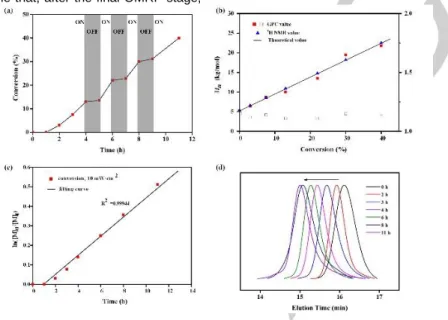
photoinitiator for the OMRP of MA under periodic light on–off process (Figure 2). Figure 2a reveals that visible light could give ON/OFF control over the living chain growth of PPE-b-PMA. During the whole procedure, the polymerization was well-controlled, as indicated by the kinetic study (Figures 2b and 2c) and by the excellent match between experimental and observed molar masses. The OMRP of MA was observed to proceed with linear first-order kinetics with an induction period and an apparent
polymerization rate of 5.4×10⁻²·h-1, from which the radical
concentration was estimated as ~1.11×10⁻⁹ M. The low
concentration of propagating radicals largely minimized undesirable side reactions leading to dead polymers and ensured the living character. This was expected on the basis of the
previous MA polymerization study with control by (Salen)CoIII
-CO2-Me.11 Moreover, the GPC curves of the polymeric products
displayed monomodal and narrow distributions as well as a continuous molecular weight increase (Figure 2d), in agreement with the formation of PPE-b-PMA. In order to investigate the effect of light on the OMRP of MA after the induction period, comparative experiments have been conducted (i) for 4 h under a light intensity of 10 mW·cm-2, (ii) for 1 h under a light intensity of
10 mW·cm-2 + 3 h under a light intensity of 5 mW·cm-2, (iii) for 1 h
under a light intensity of 10 mW·cm-2 + 3 h in the dark and (iv)
only for 1 h under a light intensity of 10 mW·cm-2. The conversions
of MA were 28.8%, 17.6%, 14.3% and 5.4%, respectively, suggesting that the polymerization does not require constant irradiation with light, but at the same time the polymerization rate scales with the light intensity (Figures S18-S21). It is notable that the induction periods under light density of 5 mW·cm-2 and 10
mW·cm-2 are around 2 h and 1 h, respectively, indicating that
stronger light density is favorable for shortening the induction periods of the OMRP mediated by the in-situ generated alkoxycarbonyl cobalt Salen complexes via CO insertion into Co-O bonds.
CO-triggered switchable polymerization from ROCOP to OMRP. Encouraged by these results, several one-pot
terpolymerizations of epoxides, anhydrides and acrylates were conducted in ampules at room temperature (Table 1). The reactions comprised three stages: 1) ROCOP of the epoxides/anhydrides mixture; 2) chain-end modification by addition of CO; 3) visible light initiated OMRP of acrylates. The ampules were kept in the dark (wrapped by aluminum foil) during
steps 1 and 2. The reactions were monitored by 1H NMR analysis
of aliquots taken at regular intervals. At first, PO, PA and MA were used as the model substrates (Table 1, entries 1-5). Given that CO and visible light could provide temporal control over the ROCOP/OMRP switch and the OMRP process, respectively, it is possible to precisely manipulate the incorporation of monomers into the resulting polymer chains. Taking entry 1 as an example, ROCOP and OMRP occurred during the first stage and the third
stage, respectively, as revealed by the 1H NMR spectra (Figures
S22-23). According to the NMR characterization of the isolated products, both PPE with a completely alternating PO/PA structure and PMA formed in the one-pot procedure. However, no signals corresponding to the junction units could be detected (see Figures S24-S26). Both the GPC curves of products of the first stage and the third stage exhibited monomodal and narrow distribution (Figure S27). Moreover, the theoretical molecular weights calculated from the monomer conversions were all in good agreement with the values obtained from the GPC curves. It is notable that polyester/polyacrylate ratio measured by NMR (1:2.26) agree well with that calculated from GPC analysis (1:2.29). To unambiguously verify the block structure, the
0.0 1.4 -29.0 -+ 56.8 +CO Ionic dissociation 4.8 [Co(Salen*)]+ -O-CHMeCH 2OH [Co(Salen*)(O-CHMeCH2OH)] [Co(Salen*)(CO)(O-CHMeCH2OH)] -7.6 (cis) (trans) [Co(Salen*)(COO-CHMeCH2OH)] 39.8 A1 A3 -[Co(CO)(Salen*)]+ -O-CHMeCH 2OH + A2 Ionic dissociation Insertion
polymers were analyzed by DOSY NMR spectroscopy (Table 1, entry 1). The characteristic signals of both PPE and PMA blocks shared the same diffusion coefficient, whereas a blend of the PPE/PMA constituents, which were expressly synthesized by PO/PA ROCOP and by MA OMRP with approximately the same chain length ratio as the diblock copolymer, displayed two diffusion coefficients (see Figures S28 and S29). Furthermore, the quantitative insertion of CO into Co-O bonds also occurred when the CO insertion process was reduced from 12 h to 30 min (Table 1, entry 5). It is notable that, after the final OMRP stage,
the PPE-b-PMA product has a (Salen)Co chain-end function linked via a Co-C bond, allowing postpolymerization modification via treatment with radical scavengers such as thiols or nitroxides.
By direct addition of 2,2,6,6-tetramethylpiperidine-1-oxyl
(TEMPO) into the reaction mixture after the third stage of the reaction (Table 1, entry 2), we successfully synthesized PPE-b-PMA macromolecules end-capped with TEMPO (Scheme 4), as
confirmed by 1H NMR spectroscopy (see Figure S30), yielding an
isolated polymer in the form of a white powder.
Figure 2. Visible light initiated OMRP of MA mediated by (Salen)CoIII-CO
2-PPE (Mn = 5.3 kDa, Ð = 1.15) at room temperature; a household white LED lamp was used as the light source (the light intensity was 10 mW·cm-2 at the sample position). (a) Investigation of the “ON/OFF” switching regulated by light. (b) Evolution of number-average molecular weight and polydispersity (Mw/Mn) with the MA conversion; the straight line represents the theoretical mass weight evolution. (c) Kinetic plot for the OMRP of MA. (d) Evolution of the GPC traces.
Table 1. One-pot synthesis of block copolymers via CO triggered switchable polymerization from the ROCOP of epoxides/anhydrides to the OMRP of acrylates.a
Entry Monomer ROCOP OMRP Polyester /Polyacrylateb Mn,theoc (kg/mol) Mn,GPCd (kg/mol) Ð d Time (h) Conv. (%) b
(anhydride) Time (min)
Conv. (%)b (acrylate) 1 [PO]/[PA]/[MA] 48 31 60 17 1/2.26 21.0 20.2 1.09 2e [PO]/[PA]/[MA] 60 40 10 1 1/0.10 9.1 8.2 1.13 3 [PO]/[PA]/[MA] 72 46 50 35 1/8.73 39.5 36.7 1.25 4 [PO]/[PA]/[MA] 72 46 90 63 1/15.7 63.5 59.6 1.23 5f [PO]/[PA]/[MA] 96 58 50 16 1/1 25.8 24.6 1.13 6 [PO]/[PA]/[nBA] 48 31 20 4 1/2.20 11.5 9.2 1.11 7 [EO]/[PA]/[MA] 24 73 60 9 1/1.26 21.7 19.8 1.11 8 [EO]/[CHA]/[MA] 12 23 60 33 1/4.28 33.0 30.4 1.16 9 [EO]/[THPA]/[MA] 25 70 50 18 1/0.75 29.2 27.3 1.16 10 [PO]/[NBA]/[MA] 65 35 40 8 1/0.60 14.6 12.7 1.15 11 [PO]/[NBA]/[nBA] 60 29 25 2 1/0.30 9.0 7.7 1.14 a
Conditions: room temperature; [epoxide]/[anhydride]/[acrylate]/[Complex 1] = 1000/100/1000/1; CO insertion processes run for 12 h; light source for OMRP: household white LED lamp (10 mWcm-2 at the sample position). bDetermined by 1H NMR spectroscopy. cM
n,theo = [Mw(epoxide) + Mw(anhydride)] × 100 × Conv.(anhydride) + Mw(acrylate) × 1000 × Conv.(acrylate). dDetermined by GPC analysis in THF, calibrated against polystyrene standards. eTerminated with TEMPO. fThe CO insertion process runs for 30 min.
The monomer scope was subsequently expanded using ethylene oxide (EO), cyclohexene anhydride (CHA),
cis-5-norbornene-endo-2,3-dicarboxylic anhydride (NBA),
cis-1,2,3,6-tetrahydrophthalic anhydride (THPA) and n-butyl acrylate (nBA) (Table 1, entries 6-10). In all cases, the targeted polyester-b-polyacrylates were successfully obtained with narrow distributions (Ð < 1.17) (see Figures S32-S62).
Scheme 4. Postpolymerization modification of (Salen)Co terminated diblock
PPE-b-PMA via treatment with TEMPO.
Conclusion
In summary, the first example of a switch from the ring-opening copolymerization (ROCOP) of epoxides/anhydrides to a
light-initiated organometallic mediated controlled radical
polymerization (OMRP) of vinyl monomers has been described, using a (Salen)Co system as a common catalyst/moderating agent and CO as a molecular trigger. Central to this protocol is the direct insertion of CO into the Co-O bond of the ROCOP active species (Salen)CoIII-OR to afford (Salen)CoIII-CO
2R, which acts
as successful OMRP photoinitiator for the OMRP of MA. Mechanistic aspects concerning the quantitative transformation of
the Co-O bond into a Co-CO2 bond have been reasonably
proposed, as confirmed by experimental results and supported by DFT calculations. This constitutes the first example of CO insertion into a metal-alkoxide bond for cobalt and for any metal in the oxidation state III. Regulated by both CO and light, on-demand monomer incorporation has been demonstrated for the one-pot terpolymerization of epoxides, anhydrides and acrylates, allowing the elaboration of polyester-b-polyacrylate diblock copolymers with precisely programmed sequence, relative block lengths and chain-end functionality.
Experimental Section
Typical procedure for synthesis of (Salen)CoIII-CO
2-PPE
[PPE=poly-(propylene phthalate)]. In an argon filled glove box, (Salen)CoIIICl
complex (63.9 mg, 0.1 mmol), PA (1.48 g, 10 mmol) and PO (7.0 mL, 100 mmol) were charged into a 25 mL ampoule, which was wrapped in aluminum foil and equipped with a magnetic stir bar. The ampoule was taken out of the glove box and allowed to stirred at 25 oC for 24 h before it
was degassed and pressurized with 1 atm CO. Then, the ampoule was allowed to stir at 25 oC for 12 h. A small aliquot of the polymerization
mixture was taken out for 1H NMR spectroscopy and the remained crude
mixture was precipitated in cold n-hexane.
Typical procedure for visible light initiated OMRP of MA mediated by (Salen)CoIII-CO
2-PPE. In an argon filled glove box, (Salen)CoIII-CO2-PPE
(Mn = 5.3 kDa, Ð = 1.15), MA were charged into a 25 mL ampoule equipped
with a magnetic stir bar, [(Salen)CoIII-CO
2-PPE]/[MA]=1/1000, [M]0=1.0 M
solvent: CH2Cl2. The ampoule was then taken out of the glove box and
allowed to stirred at 25 oC under irradiation of a household white LED lamp
with light intensity of 10 mW·cm-2. A small aliquot of the polymerization
mixture was taken out for 1H NMR spectroscopy and the remained crude
mixture was precipitated in cold n-hexane.
Typical procedure for CO triggered switchable polymerization from ROCOP to OMRP. In an argon filled glove box, (Salen)CoIIICl complex
(63.9 mg, 0.1 mmol), PA (1.48 g, 10 mmol), MA (9.0 mL, 100 mmol) and PO (7.0 mL, 100 mmol) were charged into a 25 mL ampoule, which was wrapped in aluminum foil and equipped with a magnetic stir bar. The ampoule was then taken out of the glove box and allowed to stirred at 25
oC. After the allotted reaction time, it was degassed and pressurized with
1 atm CO and allowed to stir at 25 oC for 12 h. Next, the aluminum foil was
uncovered and the ampule was degassed and pressurized with 1 atm argon and allowed to stir at ambient temperature under irradiation of a household white LED lamp with light intensity of 10 mW·cm-2. A small
aliquot of the polymerization mixture was taken out for 1H NMR
spectroscopy and the remained crude mixture was precipitated in cold n-hexane.
Acknowledgements
YW, YJZ and XPZ thank the Financial support from National Key R&D Plan (No.2016YFB0302400), NSFC (No.21604027) of china, the Fundamental Research Funds for the Central Universities (HUST:2019JYCXJJ015) as well as the analytical and testing assistance from the Analysis and Testing Center of HUST. RP thanks the CNRS (Centre National de la Recherche Scientifique) for support and the CALMIP mesocenter of the University of Toulouse for the allocation of computational resources.
Conflict of interest
The authors declare no conflict of interest
Keywords: Ring-opening copolymerization • organometallic mediated radical polymerization • switch catalysis • block copolymer • polypropylene carbonate
References
(1) Bates, F. S.; Hillmyer, M. A.; Lodge, T. P.; Bates, C. M.; Delaney, K. T.; Fredrickson, G. H. Science 2012, 336, 434-440.
(2) a) Eisenreich, F.; Kathan, M.; Dallmann, A.; Ihrig, S. P.; Schwaar, T.; Schmidt, B. M.; Hecht, S. Nat. Catal. 2018, 1, 516-522. b) Chen, C. Nat. Rev.
Chem. 2018, 2, 6-14. c) Teator, A. J.; Lastovickova, D. N.; Bielawski, C. W. Chem. Rev. 2016, 116, 1969-1992. d) Zhao, Y. J.; Wang, Y.; Zhou, X. P.; Xue,
Z. G.; Wang, X. H.; Xie, X. L.; Poli, R. Angew. Chem. Int. Ed. 2019, 58, 14311-14318; Angew. Chem. 2019, 131, 14449-14456. e) Zhu, S. S., Zhao, Y. J., Ni, M. L., Xu, J., Zhou, X. P., Liao, Y. G., Wang, Y., Xie, X. L. Macro. Lett. 2020, 9, 204−209. f) Zhu, S. S., Wang, Y., Ding, W. Z., Zhou, X. P., Liao, Y. G., Xie, X. L.
Polym. Chem. 2020, 10.1039/c9py01508f.
(3) a) Wang, X.; Thevenon, A.; Brosmer, J. L.; Yu, I.; Khan, S. I.; Mehrkhodavandi, P.; Diaconescu, P. L. J. Am. Chem. Soc. 2014, 136, 11264-11267. b) Broderick, E. M.; Guo, N.; Vogel, C. S.; Xu, C.; Sutter, J. R.; Miller, J.
T.; Meyer, K.; Mehrkhodavandi, P.; Diaconescu, P. L. J. Am. Chem. Soc. 2011,
133, 9278-9281. c) Wei, J.; Diaconescu, P. L. Accounts Chem. Res. 2019, 52,
415-424. d) Chen, C. ACS Catal. 2018, 8, 5506-5514.
(4) a) Qi, M.; Dong, Q.; Wang, D.; Byers, J. A. J. Am. Chem. Soc. 2018, 140, 5686-5690. b) Biernesser, A. B.; Delle Chiaie, K. R.; Curley, J. B.; Byers, J. A.
Angew. Chem. Int. Ed. 2016, 55, 5251-5254; Angew. Chem. 2016, 128,
5337-5340. c) Anderson, W. C.; Rhinehart, J. L.; Tennyson, A. G.; Long, B. K. J. Am.
Chem. Soc. 2016, 138, 774-777.
(5) a) Longo, J. M.; Sanford, M. J.; Coates, G. W. Chem. Rev. 2016, 116, 15167-15197. b) Fieser, M. E.; Sanford, M. J.; Mitchell, L. A.; Dunbar, C. R.; Mandal, M.; Van Zee, N. J.; Urness, D. M.; Cramer, C. J.; Coates, G. W.; Tolman, W. B. J. Am. Chem. Soc. 2017, 139, 15222-15231.
(6) a) Van Zee, N. J.; Coates, G. W. Angew. Chem. Int. Ed. 2015, 54, 2665-2668; Angew. Chem. 2015, 127, 2703-2706. b) Chen, Y.; Wilson, J. A.; Petersen, S. R.; Luong, D.; Sallam, S.; Mao, J.; Wesdemiotis, C.; Becker, M. L. Angew.
Chem. Int. Ed. 2018, 57, 12759-12764; Angew. Chem. 2018, 130, 12941-12946.
(7) DiCiccio, A. M.; Longo, J. M.; Rodríguez-Calero, G. G.; Coates, G. W. J.
Am. Chem. Soc. 2016, 138, 7107-7113.
(8) a) Abeles, R. H.; Dolphin, D. Accounts Chem. Res. 1976, 9, 114-120. b) Halpern, J. Science 1985, 227, 869.
(9) Demarteau, J.; Debuigne, A.; Detrembleur, C. Chem. Rev. 2019, 119, 6906-6955.
(10) a) Debuigne, A.; Poli, R.; Jérôme, C.; Jérôme, R.; Detrembleur, C. Prog.
Polym. Sci. 2009, 34, 211-239. b) Banerjee, S.; Ladmiral, V.; Debuigne, A.;
Detrembleur, C.; Poli, R.; Améduri, B. Angew. Chem. Int. Ed. 2018, 57, 2934-2937; Angew. Chem. 2018, 130, 2984-2987. c) Debuigne, A.; Caille, J.-R.; Jérôme, R. Angew. Chem. Int. Ed. 2005, 44, 1101-1104; Angew. Chem. 2005,
117, 1125-1128. d) Poli, R. Angew. Chem. Int. Ed. 2006, 45, 5058-5070; Angew. Chem. 2006, 118, 5180–5192. e) Poli, R. Polymer Science: A Comprehensive Reference, Vol. 3, Elsevier BV, Amsterdam 2012, 351-357.
(11) Zhao, Y.; Yu, M.; Zhang, S.; Wu, Z.; Liu, Y.; Peng, C. H.; Fu, X. Chem.
Sci. 2015, 6, 2979-2988.
(12) a) Li, Y.; Zhang, Y. Y.; Hu, L. F.; Zhang, X. H.; Du, B. Y.; Xu, J. T. Prog.
Polym. Sci. 2018, 82, 120-157. b) Wang, Y.; Zhao, Y. J.; Ye, Y. S.; Peng, H. Y.;
Zhou, X. P.; Xie, X. L.; Wang, X. H.; Wang, F. S.; Angew. Chem. Int. Ed. 2018,
57, 3593– 3597; Angew. Chem. 2018, 130, 3655– 3659. c) Darensbourg, D.J., Green Chem. 2019, 21, 2214-2223. d) Zhou, H. J.; Yang, G. W.; Zhang, Y. Y.;
Xu, Z. K.; Wu, G. P. ACS Nano 2018, 12, 11471-11480.
(13) a) Peng, J. B.; Wu, F. P.; Wu, X. F. Chem. Rev. 2019, 119, 2090-2127. b) Drance, M. J.; Sears, J. D.; Mrse, A. M.; Moore, C. E.; Rheingold, A. L.; Neidig, M. L.; Figueroa, J. S. Science 2019, 363, 1203-1205. c) Wu, X. F.; Fang, X.; Wu, L.; Jackstell, R.; Neumann, H.; Beller, M. Accounts Chem.Res. 2014, 47, 1041-1053.
(14) a) Bennett, M. A.; Yoshida, T. J. Am. Chem. Soc. 1978, 100, 1750-1759. b) Rees, W. M.; Churchill, M. R.; Fettinger, J. C.; Atwood, J. D. Organometallics
1985, 4, 2179-2185. c) Kim, Y. J.; Osakada, K.; Takenaka, A.; Yamamoto, A. J. Am. Chem. Soc. 1990, 112, 1096-1104. d) Dockter, D. W.; Fanwick, P. E.;
Kubiak, C. P. J. Am. Chem. Soc. 1996, 118, 4846-4852. e) Kapteijn, G. M.; Dervisi, A.; Verhoef, M. J.; Frederik, M. A.; van den Broek, H.; Grove, D. M.; van Koten, G. J. Organomet. Chem. 1996, 517, 123-131.
(15) a) Schmidt, E.; Zhang, H.; Chang, C. K.; Babcock, G. T.; Oertling, W. A.
J. Am. Chem. Soc. 1996, 118, 2954-2961. b) Kadish, X. H. M. a. K. M. Inorg. Chem. 1989, 28, 3743-3747.
(16) Willner, H.; Aubke, F. Angew. Chem. Int. Ed. 1997, 36, 2402-2425;
Angew. Chem. 1997, 109, 2506.
(17) a) Cohen, C. T.; Chu, T.; Coates, G. W. J. Am. Chem. Soc. 2005, 127, 10869-10878. b) Ren, W. M.; Liu, Z. W.; Wen, Y. Q.; Zhang, R.; Lu, X. B. J. Am.
Chem. Soc. 2009, 131, 11509-11518.
(18) a) Macgregor, S. A.; Neave, G. W. Organometallics 2003, 22, 4547-4556. b) Macgregor, S. A.; Neave, G. W. Organometallics 2004, 23, 891-899. c) Bi, S.; Zhao, J.; Fan, W. E. I.; Li, P. J. Theor. Comput. Chem. 2012, 11, 1-17. (19) Robert, C.; Schmid, T. E.; Richard, V.; Haquette, P.; Raman, S. K.; Rager, M.-N.; Gauvin, R. M.; Morin, Y.; Trivelli, X.; Guérineau, V.; del Rosal, I.; Maron, L.; Thomas, C. M. J. Am. Chem. Soc. 2017, 139, 6217-6225.
Entry for the Table of Contents (Please choose one layout)
RESEARCH ARTICLE
Yong Wang,*,† Yajun Zhao,† Shuaishuai Zhu,† Xingping Zhou,*,† Jing Xu,‡ Xiaolin
Xie† and Rinaldo Poli*,§
Page No. – Page No.
Switchable Polymerization Triggered by Fast and Quantitative Insertion of Carbon Monoxide into Cobalt-Oxygen Bonds
![Figure 1. Free energy profile (ΔG 298K,1M ) in PO (ε = 16.0) for the reaction between [Co(Salen*)(OCHMeCH 2 OH)] and CO to yield [Co(Salen*)(COOCHMeCH 2 OH)].](https://thumb-eu.123doks.com/thumbv2/123doknet/13667432.430211/5.892.273.764.135.338/figure-energy-profile-reaction-salen-ochmech-salen-coochmech.webp)