Prof. W. A. Rosenblith Dr. N. Y. S. Kiang L. S. Frishkopf Dr. J. S. Barlow ' Dr. T. T. Sandel M. H. Goldstein, Jr. Dr. M. A. B. Brazier R. M. Brown R. Koehler
RESEARCH OBJECTIVES
The Communications Biophysics group continues its quantitative study of electrical activity of the nervous system through an analysis of both evoked responses to sensory stimuli (1, 2) and of so-called spontaneous patterns of the brain-wave type (3). During the past year we have examined in detail the way in which ongoing activity in anesthe-tized animals affects the specific responses to acoustic clicks (4, 5).
In our conceptual and mathematical models, in our methods of recording, and in the instrumentation that we have developed for computing purposes, we continue to empha-size statistical characteristics of the behavior of the nervous system.
W. A. Rosenblith
References
1. L. S. Frishkopf, Quarterly Progress Report, Research Laboratory of Electronics, M.I. T., April 15, 1955, p. 75.
2. G. S. Fahringer, Quarterly Progress Report, Research Laboratory of Electronics, M.I.T., Oct. 15, 1955, pp. 79-81.
3. J. S. Barlow and M. A. B. Brazier, Quarterly Progress Report, Research Labora-tory of Electronics, M. I. T., April 15, 1955, pp. 79-82.
4. D. H. Raab, N. Y. S. Kiang, and R. M. Brown, Quarterly Progress Report, Research Laboratory of Electronics, M. I. T., April 15, 1955, pp. 76-77.
5. D. H. Raab and N. Y. S. Kiang, Quarterly Progress Report, Research Laboratory of Electronics, M. I. T., Oct. 15, 1955, pp. 76-79.
A. RESPONSES FROM THE AUDITORY NERVOUS SYSTEM TO BURSTS OF NOISE
Electrical responses to clicks, pure tones, and bursts of tone from various locations in the auditory pathway of cats have been studied by many previous investigators. The present study compares responses to clicks with responses to bursts of noise of various onset characteristics.
Responses from anesthetized cats (Dial) were recorded by gross electrodes placed near the round window of the cochlea and on various points of the auditory cortex. Intensity levels for clicks were measured in decibels relative to a pulse amplitude of 1 volt at the earphone; levels for the noise in the bursts were given in decibels relative to 1 volt rms at the earphones. Since the bandwidth of the electrical noise was considerably wider than the passband of the earphones, the noise was filtered
,From the Neurophysiological Laboratory of the Neurology Service of the Mass-achusetts General Hospital.
(XIX. COMMUNICATIONS BIOPHYSICS)
KI
200v
2msec
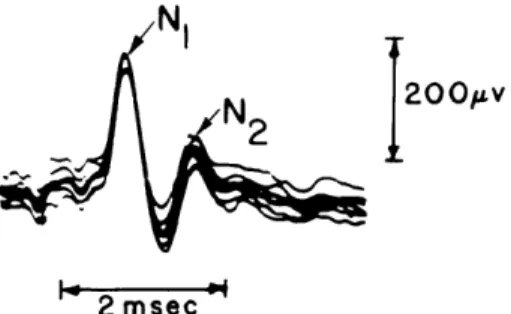
Fig. XIX-1. Peripheral click responses. Oscilloscopic traces of click responses recorded by a gross electrode near the round window of the cochlea. Superposition of ten responses to clicks of -63 db presented at the rate of 1 click per second.
low-pass with a nominal 7 kc/sec cutoff for purposes of calibration. The reported responses were taken approximately 30 db above the level at which electrical responses were first detected ("threshold").
The waveform of peripheral responses to clicks is characterized by the two well-known sharp peaks, N1 and NZ (Fig. XIX-1). N1 represents the summated action potential of the auditory nerve; N2 represents, at least in part, repetitive discharges of some auditory nerve fibers. For bursts of noise with fast onset (Fig. XIX-2a) a "slow" potential is found to follow the N1 and N2 peaks. When, however, the onset of the noise is gradual (Fig. XIX-2b), this "slow" potential remains, while the N1 and N2 components are not detectable. At the auditory cortex, responses to clicks and noise bursts with either fast or slow onset are characterized by similar waveforms. Thus, there are acoustic stimuli that evoke clear-cut responses at the auditory cortex without giving rise to detectable N1 and N2 components at the peripheral location.
There is another set of conditions under which cortical responses may be obtained without N1 and NZ being simultaneously detectable. Figure XIX-2c demonstrates that
in the presence of a steady masking noise (at 10 db below burst level) N1 or N2 are not detected but the response at the cortex remains present.
These phenomena can be interpreted in terms of the activity of single units. For bursts of noise with abrupt onset, the firings of auditory nerve fibers are well-synchronized, creating the N1 and N2 peaks. As the onset of the bursts becomes more gradual, the firings of auditory nerve fibers become less synchronized and the individual spikes, now dispersed in time, do not summate. The constant masking noise presumably causes continual firing of auditory nerve fibers without the synchrony neces-sary to produce a detectable N1 or N2. This background activity results in a threshold distribution for individual fibers that prevents even an abrupt stimulus from producing visible N1 and N2 peaks. Since the cortical surface-positive response represents the
(b) 400v
(c) I400v
(d)
-- 200 /v
40 msec
Fig. XIX-2. Cochlear and cortical responses to bursts of noise.
(a) Five superimposed oscilloscopic traces of responses to bursts of noise with fast rise time. The upper traces are recordings from the middle ectosylvian gyrus of the auditory cortex. The lower traces represent recordings from a point near the round window. With this time base, the N1 and N2 peaks are greatly compressed, compared
to Fig. XIX-1. N1 can be seen as the first spikelike deflection. N2 is represented by the smaller later hump. A "slow" potential is seen following N1 and N2 (arrow). Burst level is -76 db.
(b) Five superimposed oscilloscopic traces of responses to bursts of noise with slow rise time. The recording sites are as in Fig. XIX-2a. As can be seen in Fig. XIX-2d, both the instant of triggering and the gradual onset of the noise bursts contribute to the greater latencies. Note that the N1 and N2 deflections are not seen, but the "slow" potentials (arrow) and the cortical responses subsist. Burst level is -76 db.
(c) Five superimposed oscilloscopic traces of responses to burst of noise with fast rise time presented against a background of wideband masking noise. The recording sites are as in Fig. XIX-2a. There is some indication that the "slow" potential (arrow) is present, while N1 and N2 cannot be seen. The cortical responses are still present.
Burst level is -76 db. Masking noise is at -86 db.
(d) Oscilloscopic traces of cochlear responses of the envelopes of the onset of noise bursts. The uppermost trace represents the cochlear response to one of a series of bursts of noise (slow rise time). The second trace represents the electric signal into the earphone for a burst with slow rise time. The third trace represents the elec-trical signal into the earphone for a burst with fast rise time. The bottom trace repre-sents the cochlear response to one of a series of bursts (fast rise time). The top and
the bottom traces show the "slow" potential (arrow) and the time relations more dis-tinctly than do the superimposed tracings above.
(XIX. COMMUNICATIONS BIOPHYSICS)
desynchronization sufficient to eliminate the N1 and N2 peaks is not sufficient to elimi-nate the cortical criterion response.
We have thus been able, by means of two methods, to manipulate stimulus conditions in such a way that cortical responses can be obtained without the presence of N1 and N2
in the corresponding peripheral responses.
N. Y. S. Kiang, M. H. Goldstein, Jr.
B. CORRELATION STUDIES OF ELECTROENCEPHALOGRAMS
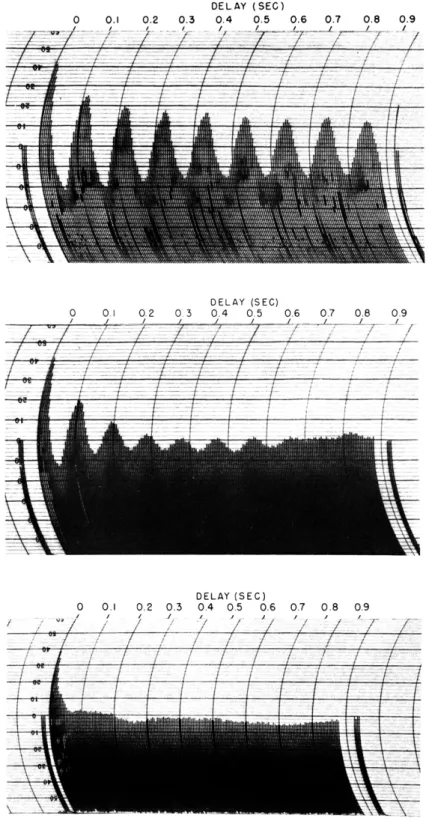
Magnetic tape recordings with the accompanying inked tracings were made of the electroencephalograms (EEG's) of a number of human subjects, and autocorrelations of many of these recordings were obtained by means of the analog electronic correlator in this Laboratory (1). A considerable degree of variation was found between individuals in respect to the autocorrelations of their EEG's as recorded from similar (measured) electrode placements. Variations were also noted, of course, in the inked tracings. Some indication of the variation in content and in persistence of rhythms, as shown by autocorrelation, can be seen from the examples in Fig. XIX-3. All of these results were obtained from one-minute samples of bipolar scalp recordings (right parietal to right occipital). The correlation functions were normalized for equal deflection at zero
delay (T), and the maximum delay is 925 msec.
Figure XIX-4 indicates the autocorrelations for the first of the subjects of Fig. XIX-3 and for two additional subjects, with the maximum delay increased by a factor of five to
4. 6 seconds, and with five-minute recordings from electrode placements, instead of one-minute recordings, as described above. These examples were especially selected to illustrate persistence of components in the autocorrelation for relatively large values of delay.
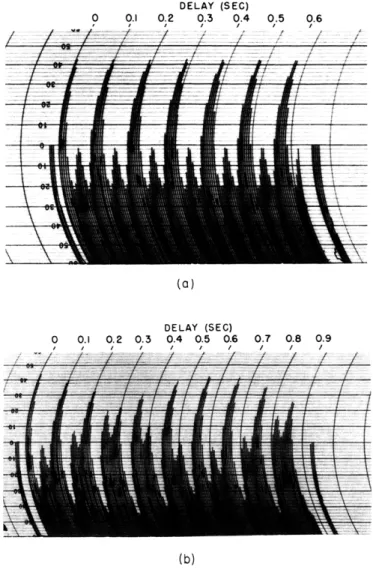
The autocorrelation of a one-minute sample of an EEG recorded from a pair of midline electrodes 6 cm apart on the occiput of another subject is shown in Fig. XIX-5. Unlike the examples shown in Figs. XIX-3 and XIX-4, it shows more than one principal component. For comparison, Fig. XIX-6a is the autocorrelation of a mixture of two
sine waves, 10 and 20 per second, of equal amplitude; Fig. XIX-6b is the autocorrelation of a mixture of 10 and 19 cycle sine waves of equal amplitude. Thus one would conclude from inspection of Fig. XIX-6 that the presence of the higher of the two frequencies is
evidenced by the small peaks, fixed in the case of 10 and 20 cps, and shifting in the case of 10 and 19 cps, as the delay T is increased. The shifting of the minor peaks with increasing delay in the autocorrelation of the EEG in Fig. XIX-5 indicates
0 0.1 0.2 / I / 0. DELAY (SEC) 3 0.4 0.5 0.6 0.7 0.8 0.9 - . ... . / DELAY (SEC) 0 0.1 0.2 0.3 0.4 0.5 0.6 0.7 0.8 0.9
Fig. XIX-3. Autocorrelations of one-minute samples of the EEG's of three human subjects recorded from bipolar electrodes (right parietal to right occipital) on the scalp. Steps of delay AT, 5 msec; maximum delay,
DELAY (SEC) DELAY (SEC) 3 i j---L ,;:-: LI-.
i
" i~
KI
DELAY (SEG) 4 5Fig. XIX-4. Autocorrelations of five-minute samples of the EEG's of the first of the subjects of Fig. XIX-3 and of two other subjects, with electrode place-ments similar to those of Fig. XIX-3. Steps of delay AT, 10 msec; maximum delay, 4. 6 sec.
-- =
Fig. XIX-5. Autocorrelation of bipolar recording delay AT, 5 msec;
a one-minute sample of the EEG from another subject; from scalp electrodes on the mid-occiput. Steps of maximum delay, 925 msec.
DELAY (SEC)
DELAY (SEC)
0 0.1 0.2 0.3 0.4 0.5 0.6 0.7 0.8 0.9
Fig. XIX-6. Autocorrelation of equal amplitude mixtures of two sine waves: (a) 10 and 20 cps; (b) 10 and 19 cps. Steps of delay AT, 5 msec.
(XIX. COMMUNICATIONS BIOPHYSICS)
of 9 4 per second. Such a marked indication of rhythms of approximately twice the alpha frequency is unusual in our results thus far, although the phenomenon is familiar to electroencephalographers.
J. S. Barlow, M. A. B. Brazier
References
1. J. S. Barlow and R. M. Brown, An analog correlator system for brain potentials, Technical Report 300, Research Laboratory of Electronics, M.I.T., July 14, 1955.