Computational Visual Reality
MASSACHUSETTS
INS 'fJEby
OF
TECHNOLOGYMatthew Waggener Hirsch
OCT
0
2014
B.S., Tufts University (2004)
LIBRARIES
M.S., MIT Media Lab (2009)
Submitted to the Program in Media Arts and Sciences, School of Architecture and Planning,
in partial fulfillment of the requirements for the degree of Doctor of Philosophy in Media Arts and Sciences
at the
MASSACHUSETTS INSTITUTE OF TECHNOLOGY
September 2014
Massachusetts Institute of Technology 2014. All rights reserved.
Signature redacted
Author
Program in Media Arts and. Sciences
July 11, 2014
Signature redacted
Certified by
Henry Holtzman Research Scientist Program in Media Arts and Sciences Thesis Supervisor
Signature redacted
Certified by
Ramesh Raskar Associate Professor of Media Arts and Sciences Program in Media Arts and Sciences Thesis Supervisor
Signature redacted
Accepted byP roT. a ie Maes Interim Academic Head Program in Media Arts and Sciences
Computational Visual Reality
by
Matthew Waggener Hirsch
Submitted to the Program in Media Arts and Sciences, School of Architecture and Planning,
on July 11, 2014, in partial fulfillment of the requirements for the degree of
Doctor of Philosophy in Media Arts and Sciences
Abstract
It is not so far-fetched to envision a future student working through a difficult physics problem by
using their hands to manipulate a 3D visualization that floats above the desk. A doctor preparing
for heart surgery will rehearse on a photo-real replica of his patient's organ. A visitor to the British Museum in London will sketch a golden Pharaoh's headdress, illuminated by a ray of sunlight
pour-ing in the window, never aware that the physical artifact is still in Egypt. Though such scenarios
may seem cut from the pages of science fiction, this thesis illuminates a path to making them possible. To create more realistic and interactive visual information, displays must show high quality 3D im-ages that respond to environmental lighting conditions and user input. The availability of displays capable of addressing the full range of visual experience will improve our ability to interact with computation, the world, and one another.
Two of the many problems that have impeded previous efforts to design high-dimensional displays are the need to:
1. process large amounts of information in realtime; and 2. fabricate hardware capable of conveying that information.
Light field capture and display is enormously data-intensive, but by applying compressive techniques that take advantage of multiple data redundancies in light transport, it is possible to overcome these challenges and make use of hardware available in the near-term.
This thesis proposes display and capture frameworks that use non-negative tensor factorization and dictionary-based sparse reconstruction, respectively, in conjunction with the co-design of algorithms, optics, and electronics to allow compressive, simultaneous, light field display and capture.
Thesis Supervisor: Henry Holtzman
Title: Research Scientist, Program in Media Arts and Sciences
Thesis Supervisor: Ramesh Raskar
Computational Visual Reality
by
Matthew Waggener Hirsch
The following people served as readers for this thesis:
Signature redacted
Thesis Reader _Michael Hawley Director and Curator, EG
Signature redacted
Thesis Reader
V. Michael Bove Principal Research Scientist Program in Media Arts and Sciences
Contents
Abstract 1 Introduction 1.1 What is an8 1.1.1 Math 1.1.2 Scale 1.2 What is Com 1.3 Motivation D Display? . . . . ematical Model . . . . of the Problem . . . . pressive Capture and Display? . . . . . 1.4 Applications . . . .1.4.1 Passive Entertainment . . . . 1.4.2 Gaming . . . . 1.4.3 Medical . . . . 1.4.4 Interaction and Interfaces . . . . . 1.4.5 Data Visualization . . . . 1.4.6 Optical Computing . . . . 1.4.7 Abstract Representation or Stimuli 1.5 Dissertation Overview . . . .
2 Background
2.1 The Human Visual System . . . . 2.1.1 Physiology . . . . 2.1.2 Depth Perception . . . . 2.1.3 Temporal Perception . . . . 2.2 Light Transport . . . . 2.3 Taxonomy of Display Systems . . . . 2.3.1 Glasses-based Displays . . . . 2.3.2 Glasses-free Displays . . . . 2.4 Taxonomy of Camera Systems . . . . 2.4.1 Light Field Cameras . . . . 2.4.2 Depth Cameras . . . . 2.5 Combined Systems . . . . 2.6 Beyond Dirac Representations . . . . 2.7 Interactive Techniques . . . .
3 Compressive Methods for Visual Display
3 11 13 13 15 17 18 19 20 22 23 25 26 27 28 28 31 31 32 37 39 40 40 40 42 47 47 47 49 49 51 53
3.1 Requirements for a Compressive Display System 3.2 Optically Efficient Methods . . . .
3.2.1 Tomographic Synthesis . . . . 3.2.2 Liquid Crystal Displays . . . . 3.2.3 Modeling Multi-Layer LCDs . . . . 3.2.4 Synthesizing Polarization Fields . . . . 3.2.5 Implementation . . . . 3.2.6 Assessment . . . . 3.3 High-Rank 3D . . . .. . . . .
3.3.1 Content-Adaptive Parallax Barriers . . . . . 3.3.2 Implementation . . . . 3.3.3 Assessment . . . . 3.4 Tensor Displays: A Compressive Display Framework 3.4.1 Tensor Display Framework . . . . 3.4.2 Analysis . . . . 3.4.3 Implementation . . . . 3.4.4 Assessment . . . . 3.4.5 Understanding Tensor Displays . . . . 3.4.6 Light Field Tensors . . . . 3.4.7 Light Field Tensor Factorization . . . . 3.4.8 Limitations . . . .
4 Compressive Methods for Visual Capture
4.1 Requirements for a Compressive Capture System . 4.2 Optically Efficient Methods . . . .
4.2.1 Angle Sensitive Pixels . . . 4.3 Sparse Reconstruction . . . . 4.3.1 Dictionary Learning . . . . 4.3.2 Reconstruction . . . . 4.4 A Switchable Light Field Camera . 4.4.1 Light Field Acquisition with 4.4.2 Synthesis . . . . 4.4.3 Analysis . . . . 4.4.4 Implementation . . . . 4.4.5 Results . . . .
5 Compressive 8D Display
5.1 About This Chapter . . . . 5.2 A Classical Method . . . . 5.2.1 Implementation . . . . 5.2.2 Assessment . . . . 5.2.3 Prototyped Applications . . 55 55 59 61 64 66 71 76 83 92 94 101 101 111 118 126 127 129 129 137 141 . . . 142 . . ... 142 ... 142 ...-.-.-.-. 143 ...-... 144 . ... 145 ... ... 145 ASPs ... 145 ... . ... 149 ... ... 150 155 ... 158 161 . . . . 16 1 . . . . 162 . . . . 162 . . . 164 . . . . 166 5.3 Architecture . . . .
6 Applications and Extensions
169
173 54
6.1 Focus 3D: Accomodation . . . . 173
6.1.1 Focus 3D Architecture . . . . 177
6.1.2 Implementation . . . . 192
6.1.3 Assessment . . . . 194
6.2 Compressive Light Field Projector . . . 200
6.2.1 Compressive Light Field Synthesis . . . 202
6.2.2 Implementation . . . . 209
6.2.3 Assessment . . . . 214
6.3 Soundaround: An 8D Display for Audio . . . . 218
6.3.1 Related Work . . . 220
6.3.2 Multi-View Audio . . . 221
6.3.3 Implementation . . . . 225
6.3.4 Assessment . . . 226
Thanks
I owe a tremendous debt of gratitude to my Ph.D. advisers and those with whom I have collabroated on the constituent work comprising this thesis. Ramesh Raskar has been a force of creativity and inspiration in this work, always pushing me to see beyond what is in front of me to what might be. Henry Holtzman, lover of great technology in many forms, has helped me center my work on human experience.
Douglas Lanman and Gordon Wetzstein have been collaborators, mentors, friends, and leaders. The compressive display and compressive capture frameworks presented in this thesis are built around their mathematical insights.
None of this could have happened without my closest friends: my fiance Louise Flannery and my technical conscience, Tom Baran. They have kept me sane, and provided invaluable advice of every kind.
I thank my parents, Ellen Waggener and Paul Hirsch, and my grandfather, James Pendleton Waggener, Jr., for instilling in me a lasting sense of wonder and optimism for the world, without sufficient reserves of which no Ph.D. would be possible.
Members of the Camera Culture, Information Ecology, and Design Ecology groups at the Media Lab, as well as students and staff at the Center for Bits and Atoms have provided me with invaluable discussions, questions, advice, assistance, and more.
Chapter 1
Introduction
It is not so far-fetched to envision a future student working through a difficult physics problem by manipulating a 3D visualization that floats above his desk-perhaps using a finger to trace lines of integration through a field. A doctor preparing for heart surgery will rehearse on a photo-real replica of his patient's organ. He may use a scalpel-like light-pen over a mock surgical table, while the scene before him is annotated by simulated vital readings and guides derived from medical imaging data. The owner of an upscale club, while preparing for an evening event previews materials and textures from a "Versailles" catalog on a tablet, tilting the screen to get the full effect of the ambient lighting on the bas relief tiles shown there. Finally settling on blue velvet wall coverings and a coffered ceiling, 8D displays covering the walls and ceiling of the club render photo-real, three-dimensional details that respond to the light sources in the room. A visitor to the British Museum in London will sketch a golden Pharaoh's headdress, illuminated by a ray of sunlight pouring in the window, never aware that the artifact is still in Egypt.
These, and countless science fiction accounts of future displays like them, are compelling be-cause they blur the line between visual reality and rendering in a way that current, planar, purely emissive displays cannot. The displays in the hypothetical scenarios above require general modulation of light transport to achieve a high level of realism. However, going from a 2D display to a glasses-free 3D display or a light transport display, is not as simple
as adding one or two additional dimensions. Moving along this trajectory, the underlying problem goes from two, to four, to eight dimensions. While the current brute-force Dirac sampled methods of display and capture work well for 2D problems, they fail to achieve the same apparent quality for high dimensional problems, where designs must resort to multiplexing. Compressive light transport displays will take advantage of natural redun-dancy in 4D and 8D light transport problems to greatly simplify their data and fabrication requirements, at the cost of increased computation.
In the next sections of this chapter, it may seem odd to work as hard as this thesis does to justify the development of 3D, 4D, or 8D displays. Science fiction and fantasy are famously rife with display technologies that explore the heights of human imagination and plumb the depths of technological impossibility (See Figure 1-1). Furthermore, popular interest in new display technologies is consistent and strong. However, the litany of disappointments in the fields of virtual reality, augmented reality, and glasses-based and glasses-free 3D over periods of decades have soured the commercial and academic appetite for advanced displays. The long history of display technologies that have failed to surpass the convenience and comfort of standard 2D screens is now inescapable when proposing a display with new capabilities. In some cases, it seems the prevailing public opinion has shifted to believe that binocular depth cues and other features absent in today's display technology are not useful, or worse, detrimental to experiencing immersive content or transmitting information.
This thesis is about display technologies that can reshape what we mean when we think of a display: its fundamental capabilities and applications. However, in recognition of the long history of the field, we will attempt to frame an argument justifying renewed attention in this area. The argument, though nuanced, comprises two key points:
" 3D, 4D and 8D display technology is indeed useful for a multitude of tasks including entertainment, human-computer interfaces, data visualization, and scientific research. " The reason that previous attempts to expand the capabilities of display technology have been disappointing is that they have attempted to directly, ray-by-ray, scan out or capture light, following the formula for success to-date in 2D display. This
motivates the core contributions of the thesis to compressive light field capture and display.
1.1
What is an 8D Display?
An 8D display is a generalized light transducer. In abstract such a display is capable of reproducing any visual phenomena observed in the physical world-and many phenomena that go beyond what is possible with linear optics. In practice, as discretized physical devices, 8D displays will be subject to constraints on spatio-angular resolution (depth-of-field), intensity, contrast, color gamut (wavelength), temporal update rate, and field-of-view, and also be subject to various optical aberrations and imperfections. However, with these constraints, 8D displays offer the tantalizing possibility of moving beyond the flat and unresponsive screens of today, and creating a truer window into the digital world.
1.1.1 Mathematical Model
In this thesis, we adopt the methods of computer graphics to analyze the design space of
8D displays. The most fundamental description of the problem of computer graphics is embodied in the rendering equation [106].
Lo
(x, wo, A, t) = Le(x, wo, A, t) +j
fr(x, -wi,wo,
A, t) Li(x, -wi, A, t) (wi - n) dwi (1.1) where A is the wavelength of light, t is time, x is a spatial coordinate, wo is an outgoing light direction, and wi is an incoming light direction, and Q is the hemisphere of possible light direction vectors. Equation 1.1 represents a high-dimensional, complex model that is sufficient to capture all visual information generated by a point in physical space. While modern computer graphics has standardized around a geometric model that simplifies theFigure 1-1: Novel display technologies proposed in science fiction films. a) Star Wars IV: A
New Hope. A 3D Death Star map floats in the center of a command station and b) Princess
Leia delivers a message. Perhaps the most well known depictions of advanced displays in fiction, these have inspired considerable follow-on work in film, literature, and research. c) The Forbidden
Planet. An alien display renders live images that interact optically with the environment, driven
by a brain interface. d) Superman. A ghostly, dimensional, disembodied head conveys messages from a stored consciousness. e) A Scanner Darkly. A hologram-like table-top display can project captured 3D images of people and objects. The agents wear a suit with an ever-shifting appearance to mask their identities. f) The Veldt. A Bradbury short story, adapted for television. Perhaps the first description of a physically and optically real virtual world created by advanced display technology. In a special room, characters experience computer renderings in perfect, life-like detail. The renderings can inflict physical harm. g) Star Trek: The Next Generation. The Holodeck is perhaps the best known example of a completely immersive display technology. Much like in The
Veldt, characters in the Holodeck experience anything they can imagine to program, in complete
optical and physical realism. The interactive displays of h) Avatar, i) Prometheus, and k) Iron Man represent a modern trend: depicting advanced gestural interfaces as mediated through 4D display. They share the characteristics of being semi-translucent (appear volumetric, additive). They depict 3D objects without a mediating display surface between the object and the observer's eye. In
j)
Total Recall a dimensional rendering of a person is projected non-line-of-sight, and reacts believably toscene lighting conditions. Observers accept that the person is physically present. 1) Minority Report
shows a 2D video re-rendered for a glasses-free 3D display. m) The Wizard of Oz. An oft-used trope in fantasy stories is the crystal ball. The observer looks in upon a life-like view of a spatially or temporally remote scene, presumably with all the clarity and depth of reality.
Comp tation (u,v,s,t)
(t)D Rendering
4Jr
--Light Field Capture Light Field Display
Figure 1-2: A mathematically convenient way to parameterize a light field is the two plane
pa-rameterization, shown here. A ray is identified in 3D space by two points of intersection with each of two planes, in this case (u, v) and (s, t). This yields a 4D representation of light transport. When considering both capture and display problems simultaneously, the problem becomes 8D, but enables new forms of rendering and interaction.
rendering equation, a branch of computer graphics-image based rendering (IBR)-has instead developed a discretized, linear algebraic approach that requires sampling a simplified four-dimensional quantity derived from the rendering equation known as a light field [126, 63] (See Figure 1-2).
Though IBR has fallen out of favor for pure computer graphics applications, light fields have proven to be an invaluable tool in modeling advanced camera [147, 194, 135] and display [156, 99, 119, 206] systems. In these cases, the 4-dimensional quantity corresponds only to wi or wo over Q and x, as the light field is taken to represent only received or emitted light in a camera or display system, respectively, and not both.
The notion of an 8D display comes from simultaneously considering both input and output ray fields from the surface of the 8D display. This corresponds to modeling two unique sets of rays, wo and wi over (Q, x).
1.1.2 Scale of the Problem
When considering Equation 1.1, it is clear that an 8D display will demand a great deal more data throughput than a 2D display; there are many more rays in a 3D volume than there are pixels on a 2D screen.
We also describe approaches to build cameras that capture light transport. These light field displays and cameras predominantly use Dirac sampled schemes to directly convert 2D pixels at one moment in time into 4D rays in a light field, using spatio-temporal multiplexing. Though similar analyses can be conducted for light field imaging systems, in this section we will confine the discussion to light field displays. In order to achieve a high degree of realism, a light field display must support all visual stimuli recognized by the human visual system. Perhaps the most difficult effects to achieve are the related effects of accommodation and retinal blur; the refocusing of the lens of the eye creates spatial blur effects across the depth of a displayed scene. In order to achieve this effect with a ray-based light field display it has been shown that at least two angular samples are required across the pupil of the eye [180]. One type of display to achieve this effect is the Supermultiview lenticular display [181].
In order to build intuition about the scale of this problem, let us consider the bandwidth requirements of an iPhone "retina" display, and compare it to a hypothetical Supermultiview display with sufficient angular sampling rate and field of view to create accommodation when held in the hand at a comfortable distance.
The iPhone 5, released September 2012, has a screen resolution of 640 x 1136 and a refresh rate of 60 Hz. Assuming a 24-bit color space, the space-time bandwidth product for this display is over 1 GB/s.
For the purpose of this comparison, we will make some assumptions in order to determine the angular sampling requirements of the proposed Supermultiview display. First, we assume the pupil of the human eye is 5 mm, even though it varies with lighting conditions. Also, we assume a 45 cm viewing distance, as this is the approximate target viewing distance calculated for "retina" displays. Finally, we assume that the viewer will want to turn the device up to 450 in any direction, and that the 3D effect should work in any orientation
(requiring a full 4D light field).
Under these assumptions, the angular extent subtended by the human pupil will be approx-imately 0.60. Since the system requires a 900 field-of-view on each axis, and two samples
5 refresh rate, color depth, and image resolution, this will require a space-time-angle band-width product of almost 100 TB/s.
The iPhone 5 display has 326 ppi, meaning each pixel is approximately 78pm. To use a naive lenticular approach to achieve the hypothetical device of the last paragraph and maintain the iPhone 5 form factor, each pixel would need to be about 260 nm, while the wavelength of visible light is centered around 500 nm. Scaling pixel sizes below the wavelength of light will create severe diffraction blur effects.
It is clear from this back-of-the-envelope analysis that new approaches will be required from both optics and algorithms perspectives to meet the challenges of convincing, true-to-life display systems. Though the challenge laid out above may still be beyond near-term technical limits, in this thesis we lay the groundwork for methods that will mitigate the optical and computational challenges of advanced display systems.
1.2
What is Compressive Capture and Display?
Compressive light field acquisition refers to a set of techniques inspired by recent develop-ments in compressive sensing [50, 14] and sparse data modeling. The intuition that moti-vates this problem is that, though light fields are dense and high-dimensional constructs, the information they contain is well structured. By creating a robust model for the data typically contained in light fields, it is possible to exploit the structure of natural scenes in order to capture a dense light field with fewer samples than predicted by the Nyquist sampling theorem. These techniques are described in detail in Chapter 4.
Compressive light field display is conceptually very close to compressive light field acqui-sition. The problem is the reverse: to emit light rays from a display in order to represent a desired light field by setting fewer pixel values than predicted by the Nyquist sampling theorem. Again, this can be accomplished by exploiting the structure of the light field to be displayed. These techniques are described in detail in Chapter 3.
1.3
Motivation
By many accounts we are living in a technological gilded age, in which the computational devices that surround and pervade our lives are ever more numerous and interconnected. The connections between our minds and our devices, by way of our sensory inputs, has not kept pace. The gap between the capabilities of the human visual system (HVS), and those of current display technologies is particularly wide. Though our visual systems are capable of disambiguating complex three dimensional scenes, disentangling the complex interplay of illumination and pigmentation patterns, perception across many stops of dynamic range and many wavelengths, the fundamental capabilities of our displays have not changed for a century-since it was possible to represent the illusion of motion. If we consider the problem of displaying text and images, an LCD screen is little better than a 4000 year old parchment.
There is significant evidence that, at least for spatial tasks, additional visual cues from advanced displays can increase understanding and competence. This has been shown defini-tively in the case of surgical robots [144], visualization [208], and CAD applications [140]. It is hard to enumerate now, as we embark on the journey to build the tools that will enable truly engaging advanced display systems, the ways in which human cognition and human computer interaction may benefit. With the correct toolbox, we argue that the addressable application space is large. Indeed, in Section 1.4 we sample some of the promising elements from the field of possible applications for this suite of technologies, though the bulk of this thesis is dedicated to the methods-electro-optical and algorithmic-for creating the next generation of light transport technologies.
It is well established that the human visual system is both the most informative and most costly of our senses. In addition to the dense packing of optically sensitive neurons in the eye, there are many stages of processing on the retina, in the optic nerve, and in the visual cortex of the brain. This is explained further in Section 2.1. This complexity has been finely tuned over millions of years to enable, from a signal processing perspective, a high-bandwidth sensory channel into the conscious mind. The unique capacity of this channel to
inform and measure the world justifies the great metabolic cost and evolutionary complexity of the visual system.
However, the HVS is not as simple or general as a man-made camera. Because vision is me-diated by many levels of special-purpose neural processing, each level being adapted through evolution to historical features of our environment and survival needs, the information that reaches the brain cannot be considered as merely a bit stream. This will ring true to anyone who has attempted to read a bar code, or memorize the random distribution of grass in a field or sand on a beach. Rather, visual information that we hope to absorb easily and recall readily must be coded to avail itself of the existent and pre-determined special-purpose processing of the HVS. And as we shall see in later chapters, these processing layers are keenly tuned to shape, motion, depth, and the interplay of light and matter.
Today we find ourselves in the position of demanding an ever richer stream of information from our computational systems, primarily through visual channels. However, we continue to deliver this information using displays that present the HVS with an impoverished slice of visual reality. In this thesis we hope to provide the tools necessary for building the next generation of computer driven displays that can provide interactive imagery in the native format of the HVS.
1.4
Applications
Broadly, applications for glasses-free 3D display fall on a spectrum from direct spatial representation, to spatial metaphor, to abstract representation, to direct stimulation of the visual system to create non-physical visual effects. While 3D display systems coupled with optical input capabilities have not been widely examined to date, much of the application space overlaps with traditional glasses-free 3D display systems. The following exploration of applications has been ordered along the direct-indirect spectrum, starting with direct representations of real or imagined physical worlds for passive entertainment, and ending with the representation of abstract information, through direct stimulation of distinct layers of the HVS. The evolution of applications for advanced displays will be as much about
Passive Entertainment
k
Gaming
Medical Applications
Interaction and Interfaces
Q Data Visualization
-
Optical Computing
Abstract Stimuli
Application
Direct
Abstract
Figure 1-3: Application spectrum, from direct to indirect representation. 3D displays have been
applied primarily to direct representation applications in the past. One of the promising directions for the future of advanced display systems is to more quickly and accurately convey abstract information.
our evolving understanding of human perception and cognition as it will be about the technologies that support arbitrary visual stimuli. The primary contributions of this thesis are technological, but we hope to motivate these technological pursuits by observing that there are multitudes of applications beyond the direct spatial representations of medical imaging, CAD, and 3D maps, especially once displays take on collocated light field input and output capabilities with sufficient spatio-temporal resolution.
1.4.1 Passive Entertainment
Since the inception of television the primary use case of display technologies has been in support of passive entertainment-watching film and animation to convey a story or events to a non-participating audience. Certainly the advent of ubiquitous general purpose computation has drastically changed the landscape of display applications. However when considering use cases for all types of 3D displays, the most often proposed are passive entertainment applications.
Since the 1950s stereo movies have flirted with audiences every two decades, never quite moving beyond gimmick status. More recently LCD panel manufacturers have sought to
differentiate their offerings in a fiercely competitive market by adding various forms of glasses-based and glasses-free 3D features. The lukewarm reception of 3D displays in the service of passive entertainment applications is rooted not only in the visual quality problems suffered by popular technologies, but more deeply in perceptual effects of adding additional depth cues.
If the goal of a display intended for passive entertainment is to allow an audience to lose themselves in an immersive story experience, in many cases binocular depth cues can stand in opposition to this goal. Instead 3D displays can push viewers into an "uncanny valley" of visual perception wherein the un-reality of the scene presented to the viewer becomes difficult to ignore. The most serious contributing issues are the loss of scale invariance, and limited depth-of-field, which necessitates depth compression. In the case of a typical flat display, the 2D images presented on the screen are invariant to screen size and distance, leaving the HVS to fill in expected sizes from features of the images. In contrast, binocular depth cues provide sufficient information to ground the size of the displayed virtual objects relative to the physical size of the bounding box of the screen. This makes it more chal-lenging to ignore the physical size of the screen presenting the images, which may not be appropriate or reasonable for every scene of a movie.
By way of example, we present four common scenes in film that cause problems for various displays that present binocular depth cues.
" In order to increase the intimacy of a scene in a movie viewed by audiences in a theater using stereo glasses, a director chooses a tightly cropped close up on the lead actors' faces. This appears to the uncomfortable audience as two giants pushing their faces through the front of the theater.
" A stereo movie is adapted for display on a stereo television. It contains a sweeping landscape fly-over filmed from a widely spaced stereo rig on a helicopter. Because binocular disparity does not occur over great distances, the appearance of disparity in the scene causes it to look like a diorama landscape the size of the television.
9 A cartoon about dinosaurs is rendered for a stereo television. However, to a viewer the scene appears more like a puppet show created by marionettes.
* A movie contains a scene looking down a long hallway. The limited depth-of-field of a glasses-free 3D display requires the scene to be depth compressed in preparation for the screen. To the viewer this presents as an unnaturally flat looking world.
This analysis should not suggest that it is impossible to present properly formatted passive entertainment on an appropriate 3D display. However, it should suggest that such an undertaking will require a great deal of care, and may not be achievable by adapting content created for 2D displays. The analysis should also not suggest that content suffering from these problems is un-watchable. In fact personal preference around these issues varies widely, and many people find the experience of viewing 3D content enjoyable in spite of the many challenges in delivering such content appropriately. Finally, this analysis should suggest that as the size of the screen shrinks- for example, in going from a theater setting to a television in a living room-the problems of scale invariance and depth-of-field will only be exacerbated.
1.4.2 Gaming
Gaming is a promising application for 3D and other advanced display systems in that
1. content is rendered, rather than captured, meaning enormous flexibility in creating the right content for the right display, and
2. experiences can more easily be tailored to the capabilities of the display. This means that, unlike captured images, or images that seek to realistically represent physical environments, it is more easily possible to constrain the placement of virtual objects to the depth-of-field of the display, and work within the temporal, spatial, and angular resolution limits of the display.
The gaming industry has invested quite a bit in 3D gaming, with each of the major players releasing consoles and games that support the latest generation of commercial 3D televisions. Adoption faces the classic chicken-and-egg problem of requiring users to first own a 3D capable display, for which there is little available content, before they can play a 3D console game. 3D gaming on computer platforms has followed a similar trend, where many titles support 3D, but are crippled in that they must always cater to the overwhelmingly larger audience consuming 2D content.
A lesson to take away from this situation is that there is another related chicken-and-egg problem at play in the case of the adoption of advanced displays. 3D capable displays will not become widely distributed until there are compelling applications available that motivate consumers to overcome their cost of adoption. However, application developers tend to seek backwards compatibility with 2D displays in their application in order to ensure a minimum of available audience. This, by definition, means that the 3D effect in these backwards-compatible applications will always be unnecessary to its core functions. It is little wonder that few truly compelling applications exist for 3D in the consumer space when they are also required to be functional without 3D capabilities.
As display abilities increase beyond 2D, 3D, and 4D to true 8D displays the space of possible gaming applications will increase dramatically. Game designers working with such displays will have the ability to blend the real and the virtual seamlessly.
1.4.3 Medical
Medical diagnostics has been one of the early adopters of advanced displays [171), though progress has not been steady. Being a life-critical field, there is the potential that insti-tutions responsible for treatment will pay a higher price than consumer markets for even small performance gains over commodity display equipment. This has lead to research and development efforts to target advanced displays to medicine.
Another reason for early 3D display applications to have targeted medical imaging is that in many cases the data collected by medical imaging devices are naively 3D, or volumetric. A
*d) ) f
a) b) c)
Figure 1-4: A small cross-section of 3D gaming devices from the past decades. a) Early VR gaming
platform Nintendo VirtualBoy. Released in 1995 it was a commercial failure. b) Autostereoscopic gaming console Nintendo 3DS. Released in 2011 is has achieved only moderate commercial success. c) Nvidia 3D Vision shutter glasses kit, version 1 and 2. Stereo glasses that work with desktop computers have been available since the 1990s. Nvidia's offering was released in 2008. Such glasses have maintained a strong following in a niche market but have not become mainstream. d) LG Optimus 3D P920 and e) HTC EVO 3D are smartphones with parallax barrier autostereoscopic displays, both released in 2011. 3D capable smartphones have not been widely adopted and new
models have not been produced. f) Oculus Rift VR display. Having improved upon long-standing pain problem areas in VR, such as latency, image resolution, and cost, the platform currently holds promise, but no products have been released or announced.
significant component of the analysis of this data is dedicated to interpreting 3D structures in a patient's body and classifying those structures to determine treatments. This means that the sub-problem of serving doctors seeking to render diagnosis or treatment via medical imaging is a straightforward direct representation problem. The display system seeks to create as true-to-life a representation as possible.
However, as motivated at the opening of this section, applications for displays that spatially and temporally collocate optical transducers will be able to move beyond direct spatial representations of stored medical imaging data. Ultimately, advanced displays will lead to new and improved forms of interaction-covered in more detail in Section 1.4.4. This can lead to new forms of medical instruments which give doctors realistic live views of patient physiological information in real time across large size scales.
One example of such a device would be an advanced form of an otoscope for measuring a pa-tient's inner ear. Traditional otoscopes face a number of challenges, including illumination, and magnification. An electronic version composed of two linked 8D displays at different
size scales could present a novel solution to these problems. The practitioner would be able to view larger-than-life images of important structures in a patient's ear. The probe end of the device, a second 8D display, would be inserted into the ear in place of the tip of a traditional Otoscope. While capturing 4D information for viewing, the tip can also emit light, controlled by the light recorded by the viewing end. This will allow arbitrary, well controlled illumination.
1.4.4 Interaction and Interfaces
Many applications exist, such as the Otoscope above, which map the intuitions and skills developed by everyday existence into domains that are typically, by way of size, temporal scale, or complexity, remote. Coupled with insights about the nature of the Human Visual System summarized in Section 1.3, mediating remote domains through computation and advanced display systems will provide powerful new tools for Human Computer Interaction (HCI).
In Section 5.2.3 we explore an application developed on a prototype 8D display that allows a user to explore a medical imaging data set using a standard lamp as a virtual x-ray. In the demo, the intensity of incident light is mapped to the opacity of structures from a volumetric scan of a patient. Thus, as the user moves the lamp above a 3D rendering of the patient data, she can select different segments and layers of the data for viewing by positioning the lamp.
Optical information collected by an 8D display can also be used more indirectly to extract structure information about objects in front of the screen-for example the position and pose of a human hand. This means that displays with light field input- capabilities can double as gestural computing peripherals [81].
Interaction scenarios employing advanced displays are not limited to interaction with com-puters and data. Interaction between people, mediated by advanced displays will play an enormous role in the future of this technology. Though it initially sounds like a small de-tail, creating a display that can link two speakers and conveys all the nuance entailed in
c)
b) d) f) O
LL'-k"ENei c ttv Ia . -
-Figure 1-5: Examples of 3D human-computer interfaces. File browsers such as a) FSV in Unix and
b) 3D fileSpace on Mac OS provided spatially distributed metaphors for file hierarchies. 3D desktop environments seek to use spatial metaphors for distributing operating system elements. Pictured are
c) Sun Microsystems' Project Looking Glass, and the Linux compiz compositing window manager
3D desktop cube plugin. Similar ideas have been prototyped for web browsing applications as shown in e) SphereXPlorer and for organizing web content as shown in f) E15:FB, which allows the user to browse facebook data in a 3D environment.
human social interaction, not the lest of which includes the ability to make eye contact while speaking, will greatly increase the efficiency of remote interaction. An 8D display, which collocates 4D light field input and 4D light field output can solve this problem. However, often when interaction is considered it is in the context of HCI. With the advent of computer graphics hardware capable of cheaply rendering down-projected 3D onto 2D screens, there have been many attempts to create 3D environments for desktop computing and web browsing. Some of these are depicted in Figure 1-5. It is not clear that the advantages afforded by such interfaces outweigh the encumberment of navigating a 3D environment with the tools of a 2D interface. These environments have not been successful in finding adoption in the mainstream: a cautionary tale for those seeking to implement 3D interfaces.
1.4.5 Data Visualization
The problem of data visualization is one of transmitting information from a display into the head of a human being. Of all the applications listed in this chapter, the application of data visualization most clearly avails itself of the bandwidth, or channel capacity of the human
.,it
visual system. The area of information visualization has been well studied in the space of 2D displays [202], using both down-projected 3D and 2D representations. Less attention has been paid to data visualization on 3D displays [208].
To be sure, there is little that can be presented on a higher dimensional display that cannot be conveyed eventually on a lower dimensional display. As the display dimensionality is increased we expect cognition tasks related to digesting presented information to become more rapid, and more intuitive. For example, to extract 3D information from a 2D display, motion parallax over time, lighting cues, and more may be required-especially when a user is asked to identify the structure of unfamiliar or non-physical objects such as the data of a graph or chart. A 4D display adds parallax based on the users own head motion, and perhaps accommodation effects-all of which make the experience of viewing the display more like that of viewing an object in the real world. Finally an 8D display can add optical interactivity to the process of consuming data from a screen. A viewer can observe the imagery on the display under natural lighting conditions created by a hand-held lamp. All of this provides an additional level of realism. But when observing data that have no obvious physical analogy, it is possible to break physically analogous models, such as was described in the virtual x-ray demo in Section 5.2.3.
1.4.6 Optical Computing
An 8D display is a general purpose optical transducer. Within the spatial, angular, and temporal sampling limits of the hardware such an apparatus can be used to directly link physical optics with general purpose computation. This presents the opportunity to create hybrid optical systems, where portions of the system are implemented virtually behind an 8D display and other portions are implemented physically in front of the display. Further, multiple 8D displays can be linked to achieve bi-directional pass-through systems.
8D display is closely linked to computational light transport. Recent work has shown that it is possible to create hybrid computational and optical systems in order to iteratively examine and operate upon a light transport matrix [152, 153]. A possible application for
future 8D displays will be as a valuable tool in creating and measuring arbitrary light transport in order to characterize the light transport matrix of a scene. Thus, 8D displays with sufficient dynamic range could be used to change the appearance of objects in a room, or quickly make precise measurements of material properties.
1.4.7 Abstract Representation or Stimuli
Many visual phenomena are addressable by advanced displays beyond the perception of depth through binocular or other cues. Exploring these corners of the HVS will doubtless be a valuable application for future 8D displays.
One example lies in the area of color perception. It is known that color information is encoded differentially in human vision, where yellow and blue are opposed, as are red and green. Thus, with one eye one cannot observe the color "yellowish-blue" or "reddish-green". However, it has been shown that causing opposed colored patches to merge in the same region of the visual field of both eyes of an observer, such exotic colors can be observed [45]. Thus it may be that 4D or 8D displays can allow observers to see colors beyond the standard RGB combinations typically observed in nature.
It has also been shown that presenting different intensity stimuli to the same region of an observers eyes can result in the perception of specularity (glossiness) [203]. This seems a natural result, as specular objects have a narrow reflective lobe, often leading to dramatic intensity differences with small changes in perspective. This fact suggests that 4D and 8D displays may be able to induce the perception of albedo beyond what is naturally observable.
1.5
Dissertation Overview
The aim of this thesis is to develop a framework for driving displays that support capabilities beyond 2D output into the mainstream. The framework is primarily technical in nature, describing the optics, electronics, and algorithms that support the goal of overcoming the longstanding limitations of high dimensional display.
In this section we describe the arc of this thesis document.
As display systems become more advanced, the technology and methods for creating displays becomes increasingly entangled with human perception, the structure of the information being displayed, and the application served by the display. In this chapter, we have laid out a line of reasoning to motivate the technical work to come. We have presented a non-exhaustive list of applications (Section 1.4) that may benefit from advanced displays-from 3D, to 4D, to 8D. And we have explored some of the reasons that displays have been unsuccessful in the past. We have also motivated the need for displays that simultaneously emit and capture 4D light fields (Section 1.1), as a special class of advanced display which we term an 8D display. Capturing rich optical information about the environment in which the display exists is a key feature required to create seamless experiences in which the display functions more like a window than a screen. We have also shown that the information requirements for advanced displays under naive sampling schemes are prohibitive.
The line of reasoning in this chapter suggests that compressive displays will be the way forward as we seek to overcome the challenges presented by supporting novel display appli-cations and capabilities.
In subsequent chapters of the thesis, we situate and then detail the technical contributions towards solving the problems motivated by this chapter. Chapter 2 provides a family tree of prior work in the related problems of light field capture and light field display.
Chapters 3 and 4 introduce the methods used for compressive light field display and compres-sive light field capture, respectively. Both chapters follow a similar structure, introducing the requirements for light field display and capture systems and then presenting algorithms and electro-optical systems, designed holistically, to meet the proscribed requirements. It is an interesting result that the methods for compressive capture and for compressive display, though similar in concept, share very little in practical implementation. This is due to the fundamental asymmetry of the ordering of linear optics and non-linear computation in the problems of light capture (measurement) and display (representation).
prototype which uses a simple Dirac (classical) sampling scheme. The goal of this chapter is to describe the methods by which compressive 8D displays can be created, from both an algorithmic and hardware perspective. Chapter 6 details a number of applications that extend the framework presented in Chapter 3. Specifically, Section 6.1 details a method for creating accommodation cues in an advanced display system, Section 6.2 details a method for creating glasses-free 3D projection, and Section 6.3 explores the extension of the ideas developed in this thesis to the domain of audio, which serves as an example of a medium that is not well suited to the geometric ray approximation.
In this thesis we present results from working prototypes that demonstrate the compressive display and compressive capture principles outlined herein. We also present results from a working prototype 8D display that uses a classical sampling method, but implements some representation and interaction methods described in Section 1.4. Finally, we propose future hardware and algorithmic schemes to combine all of these presented concepts together into a computational 8D display. With some limitations, such displays will blur the lines between simulated or captured and replayed information, and the physical world. We adopt the term Computational Visual Reality to describe the space occupied by computational 8D displays.
Chapter 2
Background
Here, we will describe the foundational work upon which the thesis will be built. In the Sections 2.3 and 2.4 we describe the long history in optics and more recently, computer graphics, of creating and capturing light transport. This is achieved by introducing a taxonomy of display and camera systems. We will focus on glasses-free 3D display and light field capture, as these areas are deeply related to the techniques developed in this thesis. In order to understand the prior work in the 3D display space, and motivate this thesis, Section 2.1 describes the physiology of human vision-what cues we use to understand the world and disambiguate objects. Section 2.2 describes the background of light fields, a ray-based method of modeling light transport that has its origins in computer graphics, and a tool that is used throughout this thesis to develop methods for advanced display systems. In section 2.6 we provide the background to support compressed light field representations for display and capture, and contrast the two applications. We also provide examples of previous work in support of human-computer interaction using advanced display systems.
2.1
The Human Visual System
The human visual system is complex and involves many layers of processing. Cells within the eye respond to incident light in different wavelength bands and intensities [117]. The visual
cortex is divided into regions V1 through V5, which are connected through feed-forward and feedback relationships, and process increasingly more complex and abstract visual data. Processing occurs in V1 to accomplish many low level tasks, for example, detecting oriented edges. At higher levels, a single neuron may fire when a particular familiar face enters the visual field [161].
2.1.1 Physiology
The neuronal processing systems involved in vision range from simple, specialized, parallel operations, such as oriented wavelet filters, to broadly general, serial operations, such as object recognition. Different visual problems are processed at different levels of the visual system. For example, one can readily detect a red fruit among green leaves, or a patch with a pattern that does not match the background, but finding a specific type of object, say pliers, among a jumble of other objects, or finding a specific face in a crowd, requires slow methodical search. In the latter case, the attention of the viewer must dwell on each item and consider whether it matches some criteria. In this section we include a brief overview of the visual system for reference purposes.
One of the most attractive reasons to use advanced display systems capable of providing physiological depth cues is that more of the burden of visual processing can be shifted to the fast, parallel, neural paths, rather than slower, serial paths.
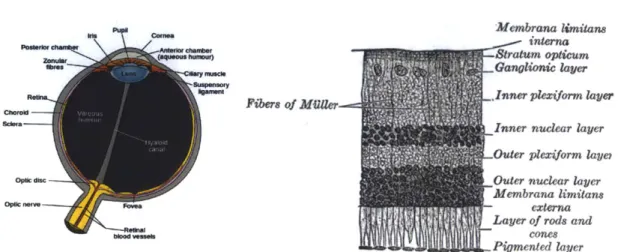
The Eye The eye contains the optics and sensors of the visual system. The cornea, crystalline lens, and vitreous humor of the eye all provide refractive power to focus images onto the retina. The lens shape can be altered with musculature around the front of the eye in order to provide adjustable focusing power. The eye also has an adjustable aperture, the iris. The structure, which is camera-like in nature, can be seen on the left of Figure 2-1. Notably, the eye has a curved focal surface, unlike most man-made camera systems, greatly reducing the required complexity of the optical system.
Iris Pp /Corne.
Paslarlar chand r AnterWo chanmber
Zonular fibres -im_ -/i ^^:" (agqusaihilmloun YinmN~sensory R hgamsst Sdera Optk disc i Optic nerveblo esh ***"oodFwasel Membrana limitans interna - Stratum optieum -.Ganglionic layer
__Inner plexzform layer
Fibers of A Ur-cll
Inner nuclear layer
Outer plexiform laye?
44Oue
nuclear layerMembrana limitans
externa , li Layer of rods and
cones
.__Pigmented layer
Figure 2-1: The eye and retina. The eye (left) contains the optics and sensors of the visual system.
The cornea, crystalline lens, and vitreous humor of the eye provide adjustable focusing power, while the retina (detail, right) acts as an optical sensor. (Images public domain)
Figure 2-2: The point spread function of the optics of the eye (left). A letter 'E' shown at 20/20
acuity (center), is substantially blurred by the PSF of the eye (right). It is an area of active research to understand how the visual system recovers high fidelity imagery from this information. Images courtesy of Roorda Lab [164]
Figure 2-3: Pseudocolor images from various retinal regions of different subjects, courtesy of Roorda Lab [163]. Between different subjects and across regions of the retina the distribution of short (blue), medium (green), and long (red) receptive cells to varies randomly, with some general
trends.
Retina The retina is the optical sensor of the visual system. Rod and cone cells are tuned
to respond to low and high intensity light, respectively. Cone cells are further differentiated with long, medium, and short wavelength pigments, making them responsive to red, green, and blue wavelengths. Unlike a camera sensor, the receptive cells of the retina are not placed in a uniform or repeating pattern or with uniform density [162] (See Figure 2-3). Though the distribution of cells appears to be random, some generalizations can be made. The cells are most densely packed in the fovea the center of the retina - which covers approximately two degrees of the visual field. This places the highest spatial resolution in the center of the visual field. Conversely, the highest temporal response appears at the periphery of the visual field.
Considerable early processing occurs on the retina. Bipolar cells create connections between neighboring photoreceptors in order to respond to bright and dark spots in the visual field. Horizontal cells create connections to larger areas of photoreceptors, and modulate the responses of the connected cells to enhance contrast. Varieties of retinal ganglion cells are instrumental in object detection, both spatially and temporally. These systems are still actively studied and not perfectly understood.
Visual Cortex The visual cortex contains multiple levels and pathways of processing,
and a full description of the layout and function of this brain region is an active area of investigation in neuroscience. For the purpose of this section, it is sufficient to note the structure of the cortex, the macro-scale function of the pathways, and the abstraction levels at various processing stages, from simple image features calculated in parallel to high-level attentional processing that is abstract and conceptual.
The optic nerve, delivering impulses from the retinas of both eyes, enters the brain at the mid-brain in the Thalamus in a structure known as the lateral geniculate nucleus (LGN). The LGN combines the left and right visual fields of the eyes, and delivers them to the right and left brains, respectively. The majority of inputs into the LGN are modulatory, originating elsewhere in the brain. The LGN feeds into the Occipital lobe at the back of the brain, where the primary visual cortex is located.
The visual cortex is subdivided into distinct regions called cortical areas, named sequentially V1, V2, V3, etc. The first area of the visual cortex to receive visual stimuli, V1 primarily deals in low level stimuli such as intensity, color, and edge orientation. In fact, the V1 region contains a warped spatial map of the retina, known as a retinoptic map, as shown in Figure 2-4.
Later stages of processing in the visual cortex take place in V2, V3, and so on. The signals diverge into dorsal and ventral streams [62], with the dorsal stream hypothesized to be involved in object localization and motion planning, and the ventral stream involved object identification. Recent work has cast some doubt on the strict separation between the functions of these two areas [138].
Perhaps because the metabolic energy available to the brain is limited, or because the body is limited in the number of concurrent actions it can perform (for example, movement of eyes or arms), the brain has developed a neural activity suppression mechanism known as attention [75]. According to feature integration theory [190], attention allows low level visual features, such as color, motion, and edge orientation, to be fused into more complex, higher-level descriptions. Thus, simple distinctions, such as those between the texture of the region
S. 4 *4 0 1* 2 3 H 1 cm
2;S
/1/
eral RostralI
Figure 2-4: Images of the V1 cortex of a macaque monkey. (Left) the monkey was injected with
a radioactive substance, taken up in brain tissue with neural activity. The sedated monkey's eyes were exposed to the blinking target shown on the left. The monkey was sacrificed and the brain photographed with a device sensitive to radioactivity. The warped spatial map of the retina can be observed. [185] (Right) In a similar experiment, a map of V1 response to oriented edges was produced [23].
20o .
l mm
I s c psdf+s b n F e 2 d th r c s f i 9. . . Ire r 1 1 !J , "; s Jr l ""i ; ofFigure 2-5: An example comparing
parallel and serial visual search
[75].
The-+
stands in contrast to the disjoint L, as it can be identified pre-attentionally, early in the visual cortex. The distinction between the L and T symbols requires attentional processing.
composed of + symbols in Figure 2-5, and the region composed of disjoint L symbols, can be quickly recognized with low-level parallel processing. More complex distinctions, such as those between the disjoint L and disjoint T symbols in Figure 2-5, require feature fusion, and therefore serial, element-by-element attentional processing.
Binocular depth cues are processed at a pre-attention stage, and therefore represent a powerful set of visual cues for rapid visual processing.
2.1.2 Depth Perception
When the visual system is functioning correctly, the overlapping visual fields of the two eyes are stitched together into a seamless single view of the world, with depth information extracted from an expansive set of cues. This section will focus on the cues used by the visual system to extract depth information from an arbitrary scene [80].
Psychological Cues These cues rely on high-level scene interpretation and prior experi-ence. Thus they can be conveyed in a flat picture, do not require binocular vision, and therefore are supported by existing 2D displays.
Perspective The lens of the eye creates a perspective projection of the world onto
the retina. Parallel lines vanish at a point at infinity.
Relative Size Objects of apparently similar size appear smaller as they recede into
the distance.
Known Size Objects of known size appear smaller as they recede into the distance.
The size of familiar objects such as other people can be used as a depth indicator without a reference.
Atmospheric Effects Distant objects are obscured by additional atmospheric haze.
Occlusion Distant objects are obscured as they pass behind nearer objects. This cue
yields scene ordering.
Texture Gradients Repeating patterns diminish in size as they recede from the
viewer.
Lighting and Shading The pattern of shaded and illuminated features on an object
provides a strong depth cue.
Motion Parallax As the head is moved from side to side, regions of the background
are revealed or obscured.
Physiological Cues [80] These cues are nearer to direct physical measurements taken by
various components of the visual system. They gauge the true depth of a scene, and therefore give misleading or inconsistent cues when viewing a 2D image of a scene. There is a complex interplay between the physiological and psychological cues that is not yet fully characterized, although it is known that providing conflicting cues in some circumstances can lead to viewer discomfort [85].
Binocular Disparity The relative offsets of objects viewed from the different
per-spectives of the right and left eyes yields depth information for objects within a few meters of the viewer.
Convergence The eyes are aimed at an object of interest. The degree to which the
eyes are "toed in" - towards being cross-eyed - gives the visual system depth information about the object.
Accommodation The muscle tension required to focus the eye on a nearby object
is proportional to its distance.
Retinal Blur Related to accommodation, the degree to which the image of an object
is blurred on the retina is proportional to distance.
2.1.3 Temporal Perception
The human eye has a finite temporal response rate, which manifests as temporal averaging. Thus, high frequency temporal stimuli will appear increasingly uniform as the frequency is increased. The rate above which the average person will perceive a flickering light source to be uniform is known as the flicker fusion rate [74]. As the eye is not a simple camera, the flicker fusion rate is a function of six inputs:
* The modulation frequency of the lighting source.
* The peak-to-peak value of the modulation.
* The mean intensity of the modulation.
" The wavelength of the light source.
" The position of the source in the field-of-view of the of the observer.
" The degree of dark adaptation of the viewer (i.e. previous recent exposure to bright or dark).
This variation is primarily explained by the distribution of rods and cones across the eye, and the relative wavelength, intensity, and temporal sensitivity of these types of cells. By understanding the temporal parameters of human vision, we are able to make displays that are tuned to best deliver only the important components of a scene.


![Figure 2-3: Pseudocolor images from various retinal regions of different subjects, courtesy of Roorda Lab [163]](https://thumb-eu.123doks.com/thumbv2/123doknet/14440756.516885/34.918.119.772.141.375/figure-pseudocolor-various-retinal-regions-different-subjects-courtesy.webp)