Final formatted article © Institute of Entomology, Biology Centre, Czech Academy of Sciences, České Budějovice.
An Open Access article distributed under the Creative Commons (CC-BY) license (http://creativecommons.org/licenses/by/4.0/).
EUROPEAN JOURNAL OF ENTOMOLOGY
EUROPEAN JOURNAL OF ENTOMOLOGY
ISSN (online): 1802-8829 http://www.eje.cz
policy in the European Union (EU) and some other
coun-tries in Europe. Indeed, within the EU, part of the direct
payments is conditional on farmers implementing various
ecological measures, including the maintenance of
“eco-logical focus areas”, such as fi eld margins (i.e. “greening
of direct payment” in Pillar 1, Hodge et al., 2015).
Moreo-ver, agri-environmental schemes (Pillar 2), which may be
adopted by farmers on a voluntary basis, were developed
to “reduc[e] environmental risks associated with modern
farming on the one hand, and preserve nature and
cultivat-ed landscapes on the other hand” (European Commission,
2005). More recently, there have been calls to diversify
ag-ri-environmental schemes to include measures enhancing
Do fl ower mixtures with high functional diversity enhance aphid
predators in wildfl ower strips?
SÉVERIN HATT 1, 2, 3, ROEL UYTTENBROECK 1, 4, THOMAS LOPES 2, PIERRE MOUCHON 2, 5, JULIAN CHEN 3,
JULIEN PIQUERAY 6, ARNAUD MONTY 4 and FRÉDÉRIC FRANCIS 2
1 TERRA – AgricultureIsLife, Gembloux Agro-Bio Tech, University of Liège, Passage des Déportés 2, 5030 Gembloux, Belgium;
e-mail: [email protected]
2 Functional and Evolutionary Entomology, Department of Agronomy, Biology and Chemistry, Gembloux Agro-Bio Tech,
University of Liège, Passage des Déportés 2, 5030 Gembloux, Belgium; e-mails: [email protected], [email protected]
3 State Key Laboratory for Biology of Plant Diseases and Insect Pests, Institute of Plant Protection, Chinese Academy
of Agricultural Sciences, 2 West Yuanmingyuan Rd., Haidian District, 100193 Beijing, China; e-mail: [email protected]
4 Biodiversity and Landscapes, Department of Biosystems Engineering, Gembloux Agro-Bio Tech, University of Liège,
Passage des Déportés 2, 5030 Gembloux, Belgium; e-mails: [email protected], [email protected]
5 Institut Supérieur d’Agriculture de Lille, 48 boulevard Vauban, 59046 Lille, France; e-mail: [email protected] 6 Natagriwal asbl, Passage des Déportés 2, 5030 Gembloux, Belgium; e-mail: [email protected]
Key words. Syrphidae, Coccinellidae, Chrysopidae, agri-environmental measure, conservation biological control, wildfl ower
strips, functional diversity, Rao’s index
Abstract. Among the semi-natural elements in agricultural landscapes, wildfl ower strips sown at fi eld margins or within fi elds are
potential habitats for the natural enemies of insect pests. As insects are sensitive to a variety of fl ower traits, we hypothesized that mixtures with high functional diversity attract and support a higher abundance and species richness of aphid fl ower visiting preda-tors than mixtures with low functional diversity. During a fi eld experiment, repeated over two years (2014 and 2015) in Gembloux (Belgium), aphid predators (i.e., lacewings, ladybeetles and hoverfl ies) were pan-trapped in fi ve sown fl ower mixtures (including a control mixture, with three replicates of each mixture) of low to high functional diversity based on seven traits (i.e., fl ower colour, ultra-violet refl ectance and pattern, start and duration of fl owering, height and fl ower class, primarily based on corolla morphol-ogy). In both years, the species of fl owering plants in the sown mixtures (i.e., sown and spontaneous fl owers) were listed, and the realized functional diversity in each plot calculated. Over the two years, a high functional diversity was not associated with high abundance and richness of aphid predators. Moreover, ladybeetles, which made up the majority of the predators trapped, were more abundant in mixtures with very low or intermediate functional diversity at sowing, especially in 2014. We hypothesize that certain fl owers, which were abundant in certain mixtures (and not in those exhibiting the highest functional diversity), attracted predators and were suffi ciently abundant to support them. Our results present novel information that could be used for developing fl ower mixtures that provide effective ecosystem services, such as pest control.
INTRODUCTION
Wildfl ower strips (WFS) are one of several types of
habi-tats used by insects in agricultural landscapes (Holland et
al., 2016). There is extensive evidence that, when sown at
fi eld margins, WFS support a higher abundance and
diver-sity of insects compared to adjacent crops (reviewed by
Haaland et al., 2011). Indeed, WFS provide insects with
fl oral food (such as nectar and pollen), as well as alternative
prey and hosts for insect predators and parasitoids,
respec-tively. WFS also provide insects with overwintering sites
and shelters against adverse conditions, such as pesticide
spraying (Landis et al., 2000). For these reasons,
subsidiz-ing the sowsubsidiz-ing of WFS is part of the agri-environmental
Eur. J. Entomol. 114: 66–76, 2017 doi: 10.14411/eje.2017.010
vided by fl owers must be available when the insects need it
(Colley & Luna, 2000).
The extensive literature available on how fl ower traits
affect natural enemy behaviour highlights that different
insect species respond differently to the same trait.
There-fore, it is hypothesized that mixing fl ower species with
dif-ferent values for these traits, generating a high functional
diversity (FD) at the mixture level, will attract and support
a high diversity and abundance of insects. Previous studies
showed that plant mixtures with high FD benefi t both
natu-ral enemies and pollinators (Fontaine et al., 2006;
Camp-bell et al., 2012; Balzan et al., 2014). However, the high
FD in these studies was based on an increased diversity in
types of corolla, which determines the availability of food
resources. Because insects are sensitive to several other
fl ower traits, the present study aimed to explore whether
a high FD in fl ower mixtures based on a multiplicity of
traits enhances their use by fl ower visiting aphid predators.
Our results are expected to provide baseline information
for developing effective WFS mixtures for use in
agricul-tural landscapes.
MATERIAL AND METHODS
Study design
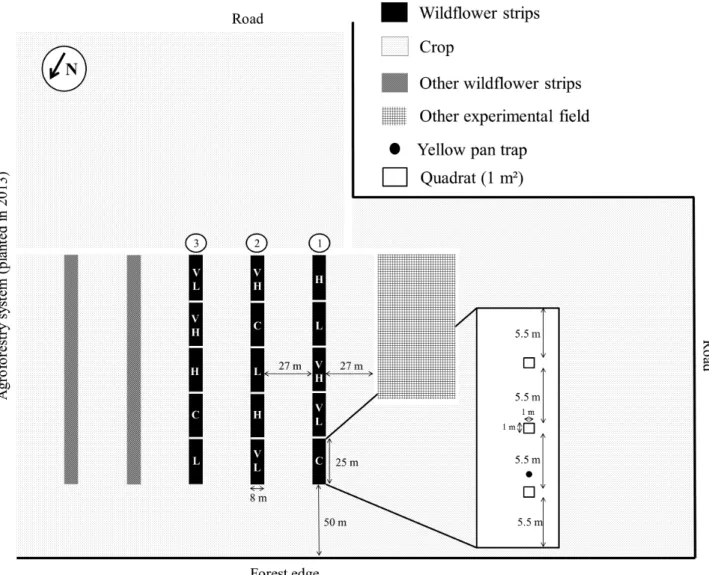
Field experiments were conducted during the 2014 and 2015 growing seasons in a 9 ha fi eld of the experimental farm belong-ing to Gembloux Agro-Bio Tech (University of Liège), Namur Province, Belgium (50°34´03̋N; 4°42´27̋E). The fi eld was char-acterized by a loamy soil that drains naturally (Service Public de Wallonie, 2014). Before starting this experiment, the fi eld was managed conventionally (i.e. synthesised fertilisers and pesti-cides were applied), and winter wheat was grown the previous year. No particular soil treatments were implemented before the experiment. A forest (i.e. l’Escaille natural reserve) is present on the north-west side of the fi eld, while a young agroforestry system (planted in 2013) is present on the north-east side. Five WFS (125 m × 8 m) were sown in 2013. Each strip was divid-ed into fi ve equally sizdivid-ed plots (25 m × 8 m), i.e., a total of 25 plots. These plots were sown with fi ve different fl ower mixtures in a Latin square design. Three out of the fi ve strips were as-sessed due to logistic constraints and work force limitation (Fig. 1). Four of the fi ve mixtures contained seven fl ower species and three grass species (Festuca rubra, Agrostis spp. and Poa praten-sis). The fi fth mixture (control, C) only contained the three grass species (Table 1). All fl owering plants are native perennial spe-cies that are commonly found in Belgian grasslands (benefi ts of such species, compared to exotic and/or annual species are re-viewed by Fiedler & Landis, 2007a), are typically used in agri-environmental schemes in Wallonia, Belgium, and are available commercially (seeds were obtained from ECOSEM, Belgium). Flower species (0.5 kg.ha–1 of each, see Table 1) and grass species
(Festuca rubra: 11.5 kg.ha–1; Agrostis spp.: 5 kg.ha–1; Poa
prat-ensis: 5 kg.ha–1) were sown on 6th June 2013. Equal seed masses
of the fl ower species were sown so that the species were similarly abundant. Species with lower seed mass are expected to suffer a greater mortality and, thus, might need more seeds compared to species with higher seed mass in order to obtain the same abun-dance (Turnbull et al., 1999). Each year, WFS were mown at the end of June and September. Adjacent to WFS, oilseed rape (Bras-sica napus L.) was grown from September 2013 to June 2014, while winter wheat (Triticum aestivum L.) was grown from Octo-ber 2014 to July 2015.
ecosystem services, in addition to approaches that purely
aim to support biodiversity (McKenzie et al., 2013; Ekroos
et al., 2014). Among other ecosystem services (Zhang et
al., 2007), the natural regulation of insect pests is of
par-ticular interest when considering the damaging effects of
insecticides on human health and the environment (Devine
& Furlong, 2007; Baldi et al., 2013) and the resistance of
pests to insecticides (Foster et al., 2007).
Conservation biological control is defi ned as “the use
of tactics and approaches that involve the manipulation of
the environment (i.e., the habitat) of natural enemies so as
to enhance their survival, and/or physiological and
behav-ioural performance, and resulting in enhanced
effective-ness” (Barbosa, 1998). When applied to WFS, such
ma-nipulations consist of sowing mixtures that support natural
enemies. Yet, enhancing natural enemies through habitat
management might not necessarily lead to pest control.
In addition to the fi ve hypotheses proposed by Tscharntke
et al. (2016), the resources and shelter provided by WFS
might retain natural enemies, limiting their ability to
con-trol pests in adjacent crops (Rand et al., 2006). Moreover,
simply sowing fl owers might not generate a higher
abun-dance of key benefi cial species in strips, and reduce the
abundance of pests in adjacent crops (Uyttenbroeck et al.,
2016). One explanation is that some natural enemies might
not be attracted to the species of fl owers that are sown,
or, if they are, might not fi nd the resources that they need
(Wäckers, 2004). Therefore, several studies have explored
the effects of specifi c fl ower species on insect behaviour
in order to select the species that effectively attract and
support the benefi cial ones (Tooker et al., 2006; Fiedler &
Landis, 2007a; Van Rijn & Wäckers, 2010; Carrié et al.,
2012). However, the functional traits of fl owers must be
assessed in order to understand why some fl ower species
are suitable for insects, and why some are not.
Traits are defi ned as “any morphological, physiological
or phenological feature measurable at the individual level”
(Violle et al., 2007). When traits are considered in the
envi-ronment in which a plant grows, they may affect ecological
processes, and are qualifi ed as functional (Dı́az & Cabido,
2001). Several studies have explored the effect of fl ower
traits on the behaviour of natural enemies using
labora-tory experiments, monospecifi c plots in fi elds or plants in
pots (Mondor & Warren, 2000; Schaller & Nentwig, 2000;
Fiedler & Landis, 2007b; Miller et al., 2013; Van Rijn &
Wäckers, 2016). The shape of the corolla is another fl ower
trait, which determines how insects access the food
pro-vided by fl owers. This trait has been extensively studied
because many natural enemies need pollen and nectar at
certain stages in their development (Lu et al., 2014; Van
Rijn et al., 2016). Other morphological traits, such as
col-our and ultra-violet (UV) refl ectance, are involved in host
plant recognition and, thus, fl ower attractiveness (Chittka
et al., 1994; Campbell et al., 2010), while plant height
might affect their fl ight (Wratten et al., 2003). Finally,
phe-nological traits, such as the month of the onset and duration
of fl owering, might be important, because the food
pro-Fig. 1. Experimental fi eld design. C – control, VL – very low, L – low, H – high, and VH – very high are the fi ve fl ower mixtures sown
de-scribed in terms of their functional diversity at sowing.
Table 1. Flower mixtures sown in June 2013, constituting a gradient of functional diversity based on Rao’s index. C – control, VL very low,
L – low, H – high, VH – very high. All fl owering species were perennial species that are commonly found in Belgian grasslands and used in agri-environmental schemes in Wallonia, Belgium.
Family Species Mixtures / Functional diversity (Rao’s index)
C / 0 VL / 0.08 L / 0.11 H / 0.15 VH / 0.19 Flowering species
Apiaceae Anthriscus sylvestris x x x
Apiaceae Heracleum sphondylium x
Asteraceae Achillea millefolium x x x x
Asteraceae Crepis biennis x
Asteraceae Hypochaeris radicata x
Asteraceae Leontodon hispidus x x
Asteraceae Leucanthemum vulgare x x
Dipsacaceae Knautia arvensis x x
Fabaceae Lotus corniculatus x
Fabaceae Medicago lupulina x
Fabaceae Trifolium pratense x
Geraniaceae Geranium pyrenaicum x
Lamiaceae Origanum vulgare x
Lamiaceae Prunella vulgaris x x
Lythraceae Lythrum salicaria x x
Malvaceae Malva moschata x
Rubiaceae Galium verum x x
Grass species
Poaceae Agrostis spp. x x x x x
Poaceae Festuca rubra x x x x x
Sown functional diversity
The four fl ower mixtures (the fi fth one being the control) were chosen based on their FD values using Rao’s quadratic index (Botta-Dukát, 2005). To create the mixtures, 20 fl ower species were chosen and described based on seven of their functional traits that were retrieved from Lambinon et al. (2008) and the TRY database (Kattge et al., 2011) (Table S1). The seven traits were chosen based on their potential effect on fl ower visitors. First, visual cues are known to be decisive for insects when se-lecting a plant (Campbell et al., 2010). Hence, the following traits were considered: (i) fl ower colour, (ii) UV refl ectance of the pe-ripheral part of the fl ower, and (iii) whether the UV refl ectance of the internal fl ower part differed from that of the external part (also called “UV pattern”). Second, fl owering phenology determines whether fl oral resources are available when target insects need them (Colley et al., 2000). Therefore, (iv) the month of the onset of fl owering and (v) the duration of fl owering were chosen. Third, (vi) vegetation height was included, because it might affect insect fl ight (Wratten et al., 2003). Fourth, (vii) fl ower class after Müller (1881) was used, because it provides a measure of the the avail-ability of nectar for insects that visit fl owers, which determines whether WFS are able to support natural enemies (Van Rijn et al., 2016). All of the possible combinations of mixtures of seven species were listed, and their FD value was calculated (R function “divc”, package “ade4”; Dray & Dufour, 2007). Combinations with the lowest and the highest FD were selected, as well as those with a value closest to the 33rd and the 67th percentile of the range.
As a result, four mixtures were generated with contrasting FD, termed very low (VL), low (L), high (H) and very high (VH) (Table 1).
Realized functional diversity
To evaluate the effect of the realized FD of the mixtures on fl ower visiting aphid predators, the effective composition of the fl ower mixtures was assessed each year. In three 1 m*1 m perma-nent quadrats in each plot (Fig. 1), fl ower species were recorded and their relative cover estimated on 18–19 June 2014 and 19–23 June 2015 (before mowing). The nomenclature of Lambinon et al. (2004) was followed. Based on the species of fl owers listed (both sown and spontaneous), their traits and their relative cover in the quadrats, the realized FD of the mixture in each plot was calculated.
Monitoring of insect species
Flower visiting predators were trapped from 7 May to 25 June 2014 and from 12 May to 30 June 2015 (i.e. for seven weeks in both years). In each plot, a yellow pan trap (Flora®, 27 cm diameter and 10 cm depth) was installed on a fi berglass stick and positioned at vegetation height. Its position was adjusted during the growing season to follow plant growth. Traps were fi lled with water containing a few drops of detergent (dish-washing liquid) to reduce the surface tension of the water. The traps were emptied and refi lled every seven days, and the trapped insects were con-served in 70% ethanol. Aphidophagous ladybeetles (Coleoptera: Coccinellidae), as well as lacewings (Neuroptera: Chrysopidae) and hoverfl ies (Diptera: Syrphidae), the larvae of which prey on aphids, were identifi ed to species using identifi cation keys in San Martin (2004), van Veen (2010) and Roy et al. (2013), respective-ly. Because the adults of these predatory families are all highly mobile and able to traverse agricultural landscapes (Evans, 2003; Villenave et al., 2006; Almohamad et al., 2009), their dispersion through the different plots was comparable.
Statistical analyses
First, the linear relation between the sown and realized FD in each plot was tested for both years by using Pearson’s correlation (P < 0.05).
Second, the effects of the sown mixtures on insect abundance (response variables: all predators pooled, and lacewings, lady-beetles, hoverfl ies individually) and total predator species rich-ness (species of the three predator families pooled) were assessed by fi tting generalised linear mixed effect models (R function “glmer”, package “lme4”; Bates et al., 2014) with Poisson error distribution (log-link function). Mixtures (C, VL, L, H, VH), years (2014, 2015) and their interaction were included as fi xed factors, and the plots included as random effects, as measures were repeated on seven consecutive occasions in the same plots each year. For every model, data over-dispersion was tested and found to occur for the summed predator, ladybeetle and hoverfl y abundance. For these variables, generalised linear models with negative binomial error distribution were fi tted (R function “glm. nb”, package “MASS”, Venables & Ripley, 2002), as suggested by Ver Hoef & Boveng (2007). The effects of fi xed factors in every model were tested using likelihood-ratio tests (P < 0.05). When their interaction was signifi cant, analyses were performed for each year separately.
Third, the effect of the realized FD on insect abundance (re-sponse variables: all predators pooled, and lacewings, ladybee-tles, hoverfl ies individually) and total predator species richness (numbers of species of the three predator families pooled) were assessed for each year separately, as each year each plot poten-tially had a different value of FD, by fi tting generalised linear mixed effect models. FD values were included as fi xed factors and plots were included as random factors. Data over-dispersion was tested and found to occur for the summed predator, lady-beetle and hoverfl y abundance in 2014. Thus, generalised linear models with negative binomial error distribution were fi tted in-stead. The effects of realized FD in every model were tested using likelihood-ratio tests (P < 0.05). All analyses were done using R program (R Core Team, 2013).
RESULTS
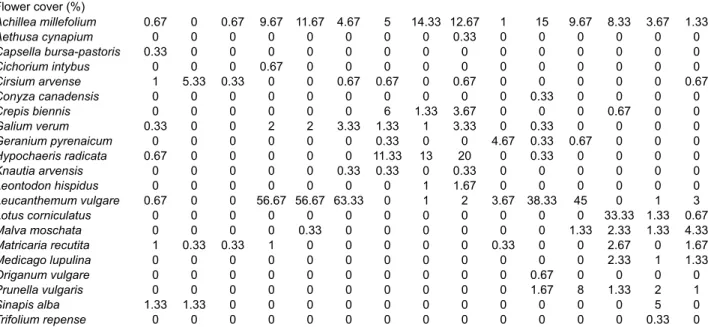
Flower cover, species and functional diversity
Twenty-one and 20 fl ower species were recorded in the
quadrats in 2014 and 2015, respectively (Table 2), out of
which eight species in both years were not sown. Among
these spontaneous species, Cirsium arvense and Sinapis
alba had the highest cover in plots in 2014, whereas in
2015 it was C. arvense and Rumex obtusifolius (Table 2).
The cover of all other spontaneous species never on
aver-age exceeded 3% of the quadrat surface in each plot.
Con-versely, three of the sown species, Anthriscus sylvestris,
Heracleum sphondylium and Lythrum salicaria, were not
recorded in either year, with Origanum vulgare also not
recorded in 2015.
The values of the realized FD in 2014 and 2015 are given
in Table 2. Except for the C plots, the values of the realized
FD were lower than those of the sown mixtures. No signifi
-cant correlations were found between the sown and
real-ized FD in both 2014 (df = 13; r = 0.48; p-value = 0.071)
and 2015 (df = 13; r = 0.22; p-value = 0.423).
Aphid predator abundance and diversity
Predators were signifi cantly more abundant in 2014 than
2015 (i.e. 161 and 51 individuals trapped respectively,
Ta-bles 3–4). Ladybeetles were the most abundant predators
in both years, especially in 2014, followed by hoverfl ies
and lacewings (total abundance is presented in Table 3).
Equal species richness was recorded for ladybeetles and
hoverfl ies in 2014 (i.e., four species); however, hoverfl y
species richness was higher in 2015 (i.e. fi ve and three
species respectively, Table 3). During this two year
experi-ment, only one species of lacewing was recorded.
Effect of sown mixtures and realized functional diversity on aphid predators
Only ladybeetle abundance was signifi cantly associated
with the mixtures sown (Table 4). As the interaction
be-tween mixture and year effects was also signifi cant, annual
analyses showed that mixtures had a nearly signifi cant
effect in 2014 (df = 4; χ² = 9.4; pvalue = 0.052) and a signifi
-cant effect in 2015 (df = 4; χ² = 12.4; p-value = 0.014). The
mixtures had no signifi cant effect on the sums of predators,
lacewings and hoverfl ies and their species richness (Table
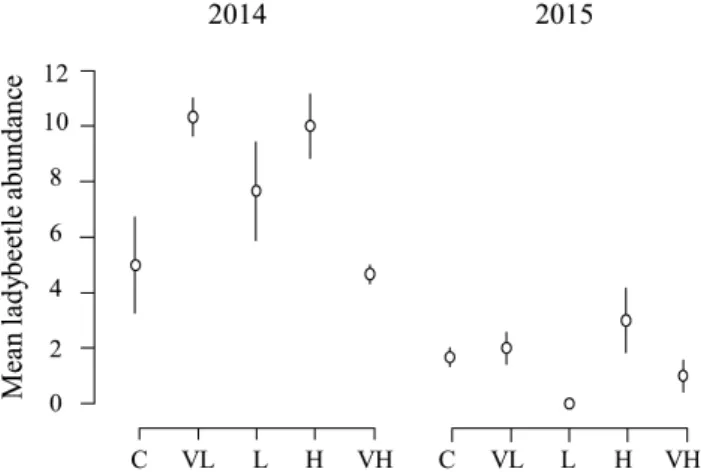
4). In 2014, ladybeetles were the most numerous in VL, L
and H mixtures, whereas they were the least abundant in
L and VH mixtures in 2015 (Fig. 2). Neither insect
abun-dance (i.e., sum of predators, as well as every family
sepa-rately) nor their species richness was signifi cantly affected
by the realized FD in either 2014 or 2015 (Table 5).
Table 2. Realized functional diversity (FD, Rao’s index) and mean cover (%) of each fl ower species in each plot (C – control, VL – very
low, L – low, H – high, VH – very high; the numbers are the number of replicates of each mixture sown; see Fig. 1), based on the three 1 m² quadrats in each plot in 2014 and 2015. Flower cover was assessed at the end of June each year.
C1 C2 C3 VL1 VL2 VL3 L1 L2 L3 H1 H2 H3 VH1 VH2 VH3 2014
Realized FD (Rao’s index) 0.075 0.053 0.012 0.006 0.006 0.006 0.044 0.046 0.048 0.093 0.020 0.058 0.055 0.115 0.112 Flower cover (%) Achillea millefolium 0.67 0 0.67 9.67 11.67 4.67 5 14.33 12.67 1 15 9.67 8.33 3.67 1.33 Aethusa cynapium 0 0 0 0 0 0 0 0 0.33 0 0 0 0 0 0 Capsella bursa-pastoris 0.33 0 0 0 0 0 0 0 0 0 0 0 0 0 0 Cichorium intybus 0 0 0 0.67 0 0 0 0 0 0 0 0 0 0 0 Cirsium arvense 1 5.33 0.33 0 0 0.67 0.67 0 0.67 0 0 0 0 0 0.67 Conyza canadensis 0 0 0 0 0 0 0 0 0 0 0.33 0 0 0 0 Crepis biennis 0 0 0 0 0 0 6 1.33 3.67 0 0 0 0.67 0 0 Galium verum 0.33 0 0 2 2 3.33 1.33 1 3.33 0 0.33 0 0 0 0 Geranium pyrenaicum 0 0 0 0 0 0 0.33 0 0 4.67 0.33 0.67 0 0 0 Hypochaeris radicata 0.67 0 0 0 0 0 11.33 13 20 0 0.33 0 0 0 0 Knautia arvensis 0 0 0 0 0 0.33 0.33 0 0.33 0 0 0 0 0 0 Leontodon hispidus 0 0 0 0 0 0 0 1 1.67 0 0 0 0 0 0 Leucanthemum vulgare 0.67 0 0 56.67 56.67 63.33 0 1 2 3.67 38.33 45 0 1 3 Lotus corniculatus 0 0 0 0 0 0 0 0 0 0 0 0 33.33 1.33 0.67 Malva moschata 0 0 0 0 0.33 0 0 0 0 0 0 1.33 2.33 1.33 4.33 Matricaria recutita 1 0.33 0.33 1 0 0 0 0 0 0.33 0 0 2.67 0 1.67 Medicago lupulina 0 0 0 0 0 0 0 0 0 0 0 0 2.33 1 1.33 Origanum vulgare 0 0 0 0 0 0 0 0 0 0 0.67 0 0 0 0 Prunella vulgaris 0 0 0 0 0 0 0 0 0 0 1.67 8 1.33 2 1 Sinapis alba 1.33 1.33 0 0 0 0 0 0 0 0 0 0 0 5 0 Trifolium repense 0 0 0 0 0 0 0 0 0 0 0 0 0 0.33 0 2015
Realized FD (Rao’s index) 0.096 0.000 0.036 0.008 0.011 0.005 0.057 0.051 0.059 0.059 0.018 0.026 0.075 0.041 0.069 Flower cover (%) Achillea millefolium 1 0 1.33 9.67 20 8.67 13.67 24 20.33 5.33 33.33 22.67 20 38.33 27.67 Silene latifolia 0 0 0 0 0 0 0 0 0 0 0 0.33 0 0 0 Cirsium arvense 1.67 10.67 0.67 0 0 2 1.33 0 0.67 1 0.33 0.33 1 2 0.67 Crepis biennis 0 0 0 0 0 0 0.67 0.67 0 0 0 0 0 0 0 Galium verum 0.33 0 0.33 2.33 3.33 1.67 1.33 1 4 0 0 0 0.33 0 0 Geranium pyrenaicum 0 0 0 0 0 0 0.67 0 0 5.33 0.33 0 0 0 0 Hypochaeris radicata 0.33 0 0 0 0.33 0 3.33 22.33 8 0 0.33 0 0 0 0 Knautia arvensis 0 0 0 0 0 0.33 0.33 0 0 0 0 0 0 0 0 Leontodon hispidus 0 0 0 0 0 0 1 2.67 8.33 0 1.33 1 0 0 0 Leucanthemum vulgare 1.67 0 0 71.67 80 96 0 1.33 8 19.33 68.33 51.67 0 0.33 6.67 Lotus corniculatus 0 0 0 0 0 0 0 0 0 0 0 0 0.67 0 0 Malva moschata 0 0 0 0 0 0 0 0 0.67 0 0.33 0.33 1.67 1.33 4.33 Malva sylvestris 0 0 0 0 0 0 0 0 0.33 0 0 0 0 0 0 Medicago lupulina 0 0 0 0 0 0 0 0 0 0 0 0 0.33 0 0 Plantago major 0.33 0 0 0 0 0 0 0 0 0 0 0 0 0 0 Prunella vulgaris 1.33 0 0 0.33 0.67 0 0 0 0 0 1.67 2.67 2 2 1.67 Rumex obtusifolius 0 0 0 3.33 0 0 0 1.33 0 0 0 0 10.33 0.67 0 Rumex crispus 2 0 0 0 0 0 0 0 0 0 0 0 0.67 0 0 Sonchus sp. 0 0 0 0.33 0 0 0.67 0 0 0 0 0 0 0 0 Trifolium sp. 0 0 0 0.33 0 0 0 0 0 0 0 0 0 0.67 0
DISCUSSION
Our study indicates that a high abundance and richness
of fl ower visiting aphid predators is not necessarily
asso-ciated with a high FD of fl ower mixtures. Only
ladybee-tles, which made up the majority of the predators trapped
in both years, were affected by the sown mixtures.
Lady-beetles were mostly trapped in plots where the FD of the
mixture was very low or intermediate at sowing, especially
in 2014.
A surprisingly low number of predators was trapped.
In the case of hoverfl ies, we trapped on average 30 times
more per week per trap in the crops growing adjacent to
the WFS in 2015 (Hatt et al., 2017) while Tschumi et al.
(2016) trapped on average 20 times more per week per
trap in WFS adjacent to potato crops in June and July in
Switzerland. A reason for this might be that hoverfl y
abun-dance often peaks in July in such regions, as was the case
in 2015 in adjacent crops (Hatt et al., 2017). In the present
experiment, insects were trapped in the WFS only up to
the end of June. As for ladybeetles, a slightly higher
num-ber than recorded in these previous studies was trapped in
2014, but three times less was recorded in 2015. Indeed,
insect abundance differed in the two years of the study. The
higher abundance of predators, especially ladybeetles, in
2014 might be due to the early summer in that year,
favour-ing greater insect occurrence in early sprfavour-ing compared to
2015. In addition, other studies conducted in the same
re-gion report a very low density of ladybeetles in 2015,
indi-cating that their abundance was low that year in the region
of Gembloux (Fassotte, 2016; Hatt et al., 2017). Similar
annual variability in ladybeetle abundance is reported in
Belgium (Vandereycken et al., 2013).
The results recorded for the effect of FD contradicted
our hypothesis. We expected the abundance and richness
of natural enemies to be positively associated with FD,
Table 3. Summed abundance of every aphid predator species trapped in each mixture (over a seven-week period from May to June in
both years, three repetitions per mixture, one yellow pan-trap per repetition, which was emptied and refi lled every week).
2014 2015 2014–2015
C VL L H VH Total C VL L H VH Total Total
Lacewings 4 5 3 2 1 15 1 2 3 2 1 9 24
Chrysoperla carnae (Stephens, 1836) 4 5 3 2 1 15 1 2 3 2 1 9 24
Ladybeetles 15 31 23 30 14 113 5 6 – 9 3 23 136
Coccinella 7 punctata (Linnaeus, 1758) – 8 3 4 – 15 1 4 – 3 1 9 24 Harmonia 4 punctata (Pontoppidan, 1763) – – – – – – – – – 1 – 1 1 Harmonia axyridis (Pallas, 1773) 7 11 9 12 8 47 – – – – – – 47 Propylea 14 punctata (Linnaeus, 1758) 9 12 10 14 5 50 4 2 – 5 2 13 63 Tytthaspis 16 punctata (Linnaeus, 1761) – – 1 – 1 2 – – – – – – 2
Hoverfl ies 6 6 9 6 6 33 6 1 2 6 4 19 52
Episyrphus balteatus (De Geer, 1776) 5 5 8 4 4 26 1 1 – – 3 5 31 Eupeodes corollae (Fabricius, 1794) – 1 1 – 1 3 1 – 2 1 – 4 7 Melanostoma mellinum (Linnaeus, 1758) – – – 2 – 2 – – – 2 – 2 4 Platycheirus manicatus (Meigen, 1822) – – – – – – – – – 1 – 1 1 Sphaerophoria scripta (Linnaeus, 1758) – – – – – – 4 – – 2 1 7 7 Syrphus ribesii (Linnaeus, 1758) – – – – 1 1 – – – – – – 1
Total 25 42 35 38 21 161 12 9 5 17 8 51 212
“–” indicates that no individuals of these species were trapped.
Table 4. Effect of mixtures sown (C, VL, L, H, VH) and years (2014,
2015), and their interaction, on the abundance and species rich-ness of predators. Signs of estimates were retrieved from the se-lected models when signifi cant, “–” means that the values for 2015 were lower than those for 2014. Degree of freedom (df), χ²- and p-values were obtained from the likelihood ratio tests performed on the selected model. * P < 0.05; *** P < 0.001.
Estimate df χ² p-value Abundance Predators Mixture 4 7.75 0.101 Year – 1 45.6 < 0.001 *** FD:Year 4 6.18 0.186 Lacewings Mixture 4 3.41 0.476 Year 1 1.52 0.212 FD:Year 4 1.74 0.784 Ladybeetles Mixture 4 12.2 0.016 * Year – 1 55.3 < 0.001 *** FD:Year 4 9.82 0.044 * Hoverfl ies Mixture 4 1.12 0.891 Year 1 1.99 0.158 FD:Year 4 2.74 0.602 Species richness Predators Mixture 4 7.12 0.130 Year – 1 33.7 < 0.001 *** FD:Year 4 5.67 0.225
Table 5. Effect of realized functional diversity (Rao’s index) on
predator abundance and species richness of predators in 2014 and 2015. Signs of estimates were retrieved from the selected models. Degree of freedom (df), χ²- and p-values were obtained from the likelihood ratio tests performed on the selected models.
2014 2015
Estimate df χ² p-value Estimate df χ² p-value Abundance Predators – 1 2.78 0.096 – 1 0.04 0.846 Lacewings – 1 2.18 0.140 – 1 0.12 0.73 Ladybeetles – 1 2.93 0.089 – 1 1.70 0.192 Hoverfl ies – 1 <0.01 1 + 1 2.09 0.148 Diversity Species richness – 1 2.75 0.097 – 1 0.63 0.428
because these predators have different nutritional
require-ments and might react differently to different fl ower traits
at different times. However, our fi ndings are consistent
with Balzan et al. (2014, 2016), who report that FD had
no effect on the abundance of fl ower visiting natural
en-emies. Furthermore, these authors report that mixtures
with intermediary FD support a higher natural enemy
rich-ness. Balzan et al. (2014, 2016) increased FD by
increas-ing the diversity of fl ower corolla types, which determines
the ability of natural enemies to benefi t from fl ower nectar
(Vattala et al., 2006; Van Rijn & Wäckers, 2016). Insect
abundance and diversity recorded in this study, however is
not associated with FD based on seven traits. Balzan et al.
(2014, 2016) suggest that the presence of certain species of
plants, particularly those attractive to natural enemies (i.e.,
Apiaceae spp. in their case), might mask the effect of FD
on fl ower visitors. This might also have affected our
re-sults, especially as some fl owering species covered a large
surface area in some plots, whereas others that were sown
were not even recorded (Table 2).
There are several explanations for the unequal
establish-ment of different species of plants, despite similar seed
weights being sown. For instance, competition for space
and resources might result in the establishment of the most
competitive species. Alternatively, the conventional
farm-ing practices used in the fi eld before the experiment
(es-pecially the application of nitrogen fertilisers) might have
favoured the most productive species, which limited the
establishment of diversifi ed mixtures (Pywell et al., 2002).
In our experiment, the Asteraceae Leucanthemum vulgare
was the most abundant species in VL and H mixtures (Table
2). The high abundance of this species, compared to others,
may account for the lower than expected values of realized
FD in H and the low values in VL plots. However, most of
the predators trapped, especially ladybeetles, were trapped
in the H and VL plots. Leucanthemum vulgare is typically
visited by hoverfl ies, ladybeetles and lacewings (Ricci et
al., 2005; Carrié et al., 2012; Wäckers & Van Rijn, 2012),
because it is a rich source of nectar and pollen (Brodie et
al., 2015). This resource might be of particular benefi t to
ladybeetles, for which pollen is one its most nutritious
non-prey food sources, enabling them to complete their
devel-opment and survive when prey are scarce (Berkvens et al.,
2008; Lundgren, 2009).
Adult hoverfl ies exclusively feed on fl owers, with
pol-len providing a source of proteins that directly infl uence
their fecundity, while nectar is a source of sugars,
provid-ing energy and increasprovid-ing their longevity and foragprovid-ing
capacity (Laubertie et al., 2012; Van Rijn et al., 2013).
Thus, any fl ower that was abundant in the mixtures and
produced nectar (i.e. fl owers with shallow fl orets, because
hoverfl ies have a short proboscis; Van Rijn & Wäckers,
2016) and pollen are likely to be attractive. For instance,
the Asteraceae, Achillea millefolium, is typically visited
by hoverfl ies (Salveter, 1998; Tooker et al., 2006;
Car-rié et al., 2012) and enhances their longevity (Van Rijn &
Wäckers, 2016). In our study, A. millefolium was present
in every fl ower mixture, and was quite abundant in most
plots (Table 2). The presence of this species might have
resulted in hoverfl ies being equally distributed across the
different treatments. Moreover, ladybeetles and hoverfl ies
are sensitive to colour, especially yellow (Sutherland et al.,
1999; Mondor et al., 2000). Hoverfl ies are also sensitive to
fl owers with a contrasting UV-pattern (Koski & Ashman,
2014). Some species with these traits might have been
at-tractive. For instance, Hypochaeris radicata was quite
abundant in L mixtures, especially in 2014, and might have
attracted hoverfl ies, resulting in their being slightly (but
not signifi cantly) more numerous in plots with these than
other mixtures.
Lacewings were less abundant than other predators in
both years. They might also have benefi ted from a large
variety of fl owers in the strips, as they are considered to
be opportunistic (Villenave et al., 2006). In addition, some
spontaneous weeds, such as C. arvense and R. obtusifolius
(the most abundant spontaneous plants listed in several
plots), might have attracted predators, as they often host
aphids that are prey for ladybeetle adults and the larvae
of all three predators studied (Salveter, 1998). This
phe-nomenon might also explain why some individuals were
trapped in the control plots, even when few fl oral resources
were available but with the values of the functional traits
differed enough to result in higher than expected values of
realized FD.
The presence of prey in adjacent crops might also have
attracted natural enemies out of the fl ower strips,
poten-tially explaining their generally low abundance in the
mix-tures. Indeed, hoverfl y adults for instance search for aphid
colonies in which to lay their eggs after having fed on
fl owers (Almohamad et al., 2009). While further analyses
are needed to confi rm such a hypothesis, a higher
abun-dance of natural enemies in adjacent crops than in WFS,
would enhance biological pest control. Despite the
high-er FD of VH mixtures at sowing, and to some extent in
2014 and 2015 (Table 2), the low attraction of the WFS
to natural enemies might also be explained by the limited
establishment of some of the species sown. The cover of
Fig. 2. Mean (summed abundance recorded during seven weeks
of trapping each year divided by the three repetitions ± SEM) lady-beetle abundance in each mixture sown, based on their functional diversity at sowing: C – control, VL – very low, L – low, H – high, VH – very high.
sown fl ower species in the quadrats was low (except for A.
millefolium, which was also abundant in other mixtures)
and, some sown species, like Lythrum salicaria, were not
even recorded in the quadrats (Table 2). Moreover, some
of the plant species that established successfully could a
priori not provide food for hoverfl ies, ladybeetles or
lace-wings, because of their fl ower morphology. This is the case
for plants of both Fabaceae and Malvaceae, which have a
corolla that is too deep for e.g. hoverfl ies to access their
nectar (Wäckers & Van Rijn, 2012).
The non-signifi cant correlations between the sown and
realized FD indicate that it is diffi cult to obtain a certain
realized FD by sowing fl ower mixtures. This may be due
to various factors such as the presence of spontaneous
spe-cies, the better development of the most productive and
competitive, and the non-development of some sown
spe-cies. Considering the optimal growing conditions (e.g.
ex-posure to sun, humidity, soil disturbance) for the different
species on the one hand, and better balancing of the
num-ber of seeds between the different species by also
consider-ing their productivity and competitiveness (and not only
considering their weight as in this study) on the other hand,
may result in more diversifi ed mixtures. Moreover, rather
than relying on mixture FD, sowing fl ower species that
are known to support natural enemies might enhance their
presence in WFS, and even favour pest control in adjacent
crops. This is the “pick and mix” approach developed by
Wäckers & Van Rijn (2012) and successfully tested in
the fi eld by Tschumi et al. (2014, 2015, 2016).
Neverthe-less, WFS have to provide multiple ecosystem services,
including pollination, and participate in the conservation
of insect species that are endangered in agricultural
land-scapes (Ekroos et al., 2014; Batáry et al., 2015). Within this
context, a higher diversity of arthropods could potentially
occur in fl ower mixtures with a high FD. Indeed, Balzan et
al. (2014) report that the abundance of wild bees
(Hyme-noptera) increases with FD. Depending on the objectives
assigned to WFS (i.e. enhancing pest control, pollination,
conservation, or all of these combined), different strategies
could be used when formulating fl ower mixtures.
Within an agricultural context, sowing WFS is proposed
to enhance biodiversity conservation and ecosystem
ser-vices, with doubts being raised about whether they will be a
source of pests infesting adjacent crops (Frank, 1998; Hatt
et al., 2015; Tscharntke et al., 2016). Moreover, it is worth
establishing the threshold at which increasing the mixture
of FD also improves its attraction for predators and shelters
pests. For instance, aphids use visual and olfactory cues to
locate host plants (Döring, 2014). Thus, increasing plant
functional diversity might increase the chance of including
more colours, UV patterns and odours that are attractive to
aphids. It is also possible, a higher diversity of trait values
might confuse aphids. For instance, when a high diversity
of colours is present, the attractive ones might be masked.
In parallel, if a large variety of odours is present, it might
not be possible to distinguish attractive cues. This effect of
diversifi ed plant systems was fi rst theorised by Root (1973)
in the Resource concentration hypothesis. This suggests
that diversifi ed cropping systems (e.g. intercropping), or,
in the present case, diversifi ed fl ower strips, might be less
attractive to pests than monospecifi c systems (Letourneau
et al., 2011; Lopes et al., 2016).
The present study investigated an array of traits;
howev-er, the selection was not exhaustive. Other traits could have
been chosen; for instance, traits related to the abundance
and quality of nectar and pollen (rather than just
availabili-ty, as used here in the context of “fl ower type” based on the
classifi cation of Müller, 1881) or the profi le of
semiochem-ical volatiles emitted by fl owers. Indeed, fl ower visiting
in-sects, particularly aphid predators, respond to nectar and
pollen abundance and quality, as well as odour (Laubertie
et al., 2006; Adedipe & Park, 2010; Laubertie et al., 2012).
Thus, it is necessary to screen a variety of fl ower species
for these traits and establish their ability to attract and
sup-port aphid predators, in order to advance our knowledge in
this fi eld of research. As the value of the FD being tested
depends on the chosen traits, further fi eld-based research
assessing different mixtures based on several other traits
should be implemented, with the objective of enhancing
the ability of WFS to deliver multiple ecosystem services
in agriculture.
ACKNOWLEDGMENTS. The authors thank the Experimental
Farm of Gembloux Agro-Bio Tech (University of Liège) for pro-viding technical support, F. Van De Meutter (The Research Insti-tute for Nature and Forest – INBO, Belgium) for verifying hover-fl y identifi cations, the TRY initiative on plant traits (http://www. try-db.org) for providing the data on fl ower traits, and the two anonymous reviewers whose accurate comments and suggestions improved the manuscript. The Belgian National Fund for Scien-tifi c Research (FNRS) awarded FRIAs (Fonds pour la Recherche en Industrie et Agronomie) PhD scholarship to T. Lopes. S. Hatt, R. Uyttenbroeck, and this study in general was funded by CARE AgricultureIsLife (University of Liège) and the Chinese Opening Fund of State Key Laboratory for Biology of Plant Diseases and Insect Pests (SKLOF201601).
REFERENCES
ADEDIPE F. & PARK Y.-L. 2010: Visual and olfactory preference of
Harmonia axyridis (Coleoptera: Coccinellidae) adults to vari-ous companion plants. — J. Asia-Pac. Entomol. 13: 316–323. ALMOHAMAD R., VERHEGGEN F. & HAUBRUGE É. 2009: Searching
and oviposition behavior of aphidophagous hoverfl ies (Di-ptera: Syrphidae): a review. — Biotechnol. Agron. Soc. Envi-ron. 13: 467–481.
BALDI I., CORDIER S., COUMOUL X., ELBAZ A., GAMET-PAYRASTRE
L., LE BAILLY P., MULTIGNER L., RAHMANI R., SPINOSI J. & VAN
MAELE-FABRY G. 2013: Pesticides: Effets sur la Santé. Institut
national de la santé et de la recherche médicale, Paris, 1002 pp. BALZAN M.V., BOCCI G. & MOONEN A.-C. 2014: Augmenting
fl ower trait diversity in wildfl ower strips to optimise the con-servation of arthropod functional groups for multiple agroeco-system services. — J. Insect Conserv. 18: 713–728.
BALZAN M.V., BOCCI G. & MOONEN A.-C. 2016: Utilisation of
plant functional diversity in wildfl ower strips for the delivery of multiple agroecosystem services. — Entomol. Exp. Appl.
158: 304–319.
BARBOSA P.A. 1998: Conservation Biological Control. Academic
BATÁRY P., DICKS L.V., KLEIJN D. & SUNDERLAND W.J. 2015: The
role of agri-environment schemes in conservation and environ-mental management. — Conserv. Biol. 29: 1006–1016. BATES D., MAECHLER M., BOLKER B. & WALKER S. 2014: lme4:
Linear mixed-effects models using Eigen and S4. R package. URL: http://CRAN.R-project.org/package=lme4
BERKVENS N., BONTE J., BERKVENS D., DEFORCE K., TIRRY L. & DE
CLERCQ P. 2008: Pollen as an alternative food for Harmonia
axyridis. — BioControl 53: 201–210.
BOTTA-DUKÁT Z. 2005: Rao’s quadratic entropy as a measure of
functional diversity based on multiple traits. — J. Veg. Sci. 16: 533–540.
BRODIE B.S., SMITH M.A., LAWRENCE J. & GRIES G. 2015: Effects
of fl oral scent, color and pollen on foraging decisions and oo-cyte development of common green bottle fl ies. — PLoS ONE
10(12): e0145055, 15 pp.
CAMPBELL A.J., BIESMEIJER J.C., VARMA V. & WÄCKERS F.L. 2012:
Realising multiple ecosystem services based on the response of three benefi cial insect groups to fl oral traits and trait diversity. — Basic Appl. Ecol. 13: 363–370.
CAMPBELL D.R., BISCHOFF M., LORD J.M. & ROBERTSON A.W.
2010: Flower color infl uences insect visitation in alpine New Zealand. — Ecology 91: 2638–2649.
CARRIÉ R.J.G., GEORGE D.R. & WÄCKERS F.L. 2012: Selection
of fl oral resources to optimise conservation of agriculturally-functional insect groups. — J. Insect Conserv. 16: 635–640. CHITTKA L., SHMIDA A., TROJE N. & MENZEL R. 1994: Ultraviolet
as a component of fl ower refl ections, and the colour perception of Hymenoptera. — Vision Res. 34: 1489–1508.
COLLEY M.R. & LUNA J.M. 2000: Relative attractiveness of
po-tential benefi cial insectary plants to aphidophagous hoverfl ies (Diptera: Syrphidae). — Environ. Entomol. 29: 1054–1059. DEVINE G.J. & FURLONG M.J. 2007: Insecticide use: Contexts and
ecological consequences. — Agric. Hum. Values 24: 281–306. DÍAZ S. & CABIDO M. 2001: Vive la différence: plant functional
diversity matters to ecosystem processes. — Trends Ecol. Evol.
16: 646–655.
DÖRING T.F. 2014: How aphids fi nd their host plants, and how
they don’t. — Ann. Appl. Biol. 165: 3–26.
DRAY S. & DUFOUR A.B. 2007: The ade4 package:
implement-ing the duality diagram for ecologists. — J. Stat. Softw. 22(4): 1–20.
EKROOS J., OLSSON O., RUNDLÖF M., WÄTZOLD F. & SMITH H.G.
2014: Optimizing agri-environment schemes for biodiversity, ecosystem services or both? — Biol. Conserv. 172: 65–71. EUROPEAN COMMISSION 2005: Agri-environment Measures.
Over-view on General Principles, Types of Measures and Applica-tion. European Commission, Directorate General for Agricul-ture and Rural Development, Brussels, 24 pp.
EVANS E.W. 2003: Searching and reproductive behaviour of
fe-male aphidophagous ladybirds (Coleoptera: Coccinellidae): a review. — Eur. J. Entomol. 100: 1–10.
FASSOTTE B. 2016: Sexual Attraction in Lady Beetles:
Fundamen-tals and Applications. PhD Thesis, University of Liège – Gem-bloux Agro-Bio Tech, GemGem-bloux, 160 pp.
FIEDLER A.K. & LANDIS D.A. 2007a: Attractiveness of Michigan
native plants to arthropod natural enemies and herbivores. — Environ. Entomol. 36: 751–765.
FIEDLER A.K. & LANDIS D.A. 2007b: Plant characteristics
associ-ated with natural enemy abundance at Michigan native plants. — Environ. Entomol. 36: 878–886.
FONTAINE C., DAJOZ I., MERIGUET J. & LOREAU M. 2006:
Function-al diversity of plant-pollinator interaction webs enhances the persistence of plant communities. — PLoS Biol. 4: 129–135.
FOSTER S.P., DEVINE G.J. & DEVONSHIRE A.L. 2007: Insecticide
resistance. In Van Emden H.F. & Harrington R. (eds): Aphids Crop Pests. CABI, Cambridge, MA, pp. 261–286.
FRANK T. 1998: The role of different slug species in damage to
oil-seed rape bordering on sown wildfl ower strips. — Ann. Appl. Biol. 133: 483–493.
HAALAND C., NAISBIT R.E. & BERSIER L.-F. 2011: Sown wildfl
ow-er strips for insect consow-ervation: a review. — Insect Consow-erv. Divers. 4: 60–80.
HATT S., UYTTENBROECK R., LOPES T., PAUL A., DANTHINE S., BOD -SON B., PIQUERAY J., MONTY A. & FRANCIS F. 2015: Do
wild-fl ower strips favor insect pest populations at fi eld margins? — Agric. Agric. Sci. Procedia 6: 30–37.
HATT S., LOPES T., BOERAEVE F., CHEN J. & FRANCIS F. 2017: Pest
regulation and support of natural enemies in agriculture: ex-perimental evidence of within fi eld wildfl ower strips. — Ecol. Eng. 98: 240–245.
HODGE I., HAUCK J. & BONN A. 2015: The alignment of
agricul-tural and nature conservation policies in the European Union. — Conserv. Biol. 29: 996–1005.
HOLLAND J.M., BIANCHI F.J.J.A., ENTLING M.H., MOONEN A.C.,
SMITH B.M. & JEANNERET P. 2016: Structure, function and
man-agement of semi-natural habitats for conservation biological control: a review of European studies. — Pest Manag. Sci. 72: 1638–1651.
KATTGE J., DÍAZ S., LAVOREL S., PRENTICE I.C., LEADLEY P., BÖNISCH
G., GARNIER E., WESTOBY M., REICH P.B., WRIGHT I.J. ETAL.
2011: TRY – a global database of plant traits. — Glob. Change Biol. 17: 2905–2935.
KOSKI M.H. & ASHMAN T.-L. 2014: Dissecting pollinator
re-sponses to a ubiquitous ultraviolet floral pattern in the wild. — Funct. Ecol. 28: 868–877.
LAMBINON J., DELVOSALLE L. & DUVIGNEAUD J. 2004: Nouvelle
Flore de Belgique, du Grand-Duché de Luxembourg, du Nord de la France et des Régions Voisines. 5th ed. Jardin Botanique National de Belgique, Meise, 1167 pp.
LAMBINON J., DE LANGHE J.-E., DELVOSALLE L. & DUVIGNEAUD
J. 2008: Flora van België, het Groothertogdom Luxemburg, Noord-Frankrijk en de Aangrenzende Gebieden. Nationale Plantentuin van België, Meise, 1091 pp.
LANDIS D.A., WRATTEN S.D. & GURR G.M. 2000: Habitat
manage-ment to conserve natural enemies of arthropod pests in agricul-ture. — Annu. Rev. Entomol. 45: 175–201.
LAUBERTIE E.A., WRATTEN S.D. & SEDCOLE J.R. 2006: The role
of odour and visual cues in the pan-trap catching of hoverfl ies (Diptera: Syrphidae). — Ann. Appl. Biol. 148: 173–178. LAUBERTIE E.A., WRATTEN S.D. & HEMPTINNE J.-L. 2012: The
con-tribution of potential benefi cial insectary plant species to adult hoverfl y (Diptera: Syrphidae) fi tness. — Biol. Contr. 61: 1–6. LETOURNEAU D.K., ARMBRECHT I., RIVERA B.S., LERMA J.M., CAR
-MONA E.J., DAZA M.C., ESCOBAR S., GALINDO V., GUTIÉRREZ C.,
LÓPEZ S.D. ETAL. 2011: Does plant diversity benefi t
agroeco-systems? A synthetic review. — Ecol. Appl. 21: 9–21.
LOPES T., HATT S., XU Q., CHEN J., LIU Y. & FRANCIS F. 2016:
Wheat (Triticum aestivum L.)-based intercropping systems for biological pest control: a review. — Pest Manag. Sci. 72: 2193–2202.
LU Z.-X., ZHU P.-Y., GURR G.M., ZHENG X.-S., READ D.M.Y.,
HEONG K.-L., YANG Y.-J. & XU H.-X. 2014: Mechanisms for
fl owering plants to benefi t arthropod natural enemies of insect pests: Prospects for enhanced use in agriculture. — Insect Sci.
21: 1–12.
LUNDGREN J.G. 2009: Nutritional aspects of non-prey foods in the
life histories of predaceous Coccinellidae. — Biol. Contr. 51: 294–305.
MCKENZIE A.J., EMERY S.B., FRANKS J.R. & WHITTINGHAM M.J.
2013: Landscape-scale conservation: collaborative agri-envi-ronment schemes could benefi t both biodiversity and ecosys-tem services, but will farmers be willing to participate? — J. Appl. Ecol. 50: 1274–1280.
MILLER N., AL DOBAI S., LEGASPI J. & SIVINSKI J. 2013:
Estimat-ing attraction of Syrphidae (Diptera) to fl owerEstimat-ing plants with interception traps. — Biocontr. Sci. Technol. 23: 1040–1052. MONDOR E.B. & WARREN J.L. 2000: Unconditioned and
condi-tioned responses to colour in the predatory coccinellid, Harmo-nia axyridis (Coleoptera: Coccinellidae). — Eur. J. Entomol.
97: 463–467.
MÜLLER H. 1881: Alpenblumen, ihre Befruchtung durch
Insek-ten und ihre Anpassungen an dieselben. Wilhelm Engelmann, Leipzig, 612 pp.
PYWELL R.F., BULLOCK J.M., HOPKINS A., WALKER K.J., SPARKS
T.H., BURKE M.J.W. & PEEL S. 2002: Restoration of
species-rich grassland on arable land: assessing the limiting processes using a multi-site experiment. — J. Appl. Ecol. 39: 294–309. R CORE TEAM 2013: R: A Language and Environment for
Sta-tistical Computing. R Foundation for StaSta-tistical Computing, Vienna.
RAND T.A., TYLIANAKIS J.M. & TSCHARNTKE T. 2006: Spillover
edge effects: the dispersal of agriculturally subsidized insect natural enemies into adjacent natural habitats. — Ecol. Lett.
9: 603–614.
RICCI C., PONTI L. & PIRES A. 2005: Migratory fl ight and
pre-diapause feeding of Coccinella septempunctata (Coleoptera) adults in agricultural and mountain ecosystems of Central Italy. — Eur. J. Entomol. 102: 531–538.
ROOT R.B. 1973: Organization of a plant-arthropod association
in simple and diverse habitats: the fauna of collards (Brassica oleracea). — Ecol. Monogr. 43: 95–124.
ROY H.E., BROWN P.M.J., COMONT R.F., POLAND R.L. & SLOGGETT
J.J. 2013: Ladybirds. Pelagic Publishing, Exeter, 142 pp. SALVETER R. 1998: The infl uence of sown herb strips and
sponta-neous weeds on the larval stages of aphidophagous hoverfl ies (Dipt., Syrphidae). — J. Appl. Entomol. 122: 103–114. SAN MARTIN G. 2004: Clé de Détermination des Chrysopidae de
Belgique. Jeune et Nature asbl, Wavre, 43 pp.
SCHALLER M. & NENTWIG W. 2000: Olfactory orientation of the
seven-spot ladybird beetle, Coccinella septempuctata (Coleo-ptera: Coccinellidae): Attraction of adults to plants and conspe-cifi c females. — Eur. J. Entomol. 97: 155–159.
SERVICE PUBLICDE WALLONIE 2014: Cartes des Sols de Wallonie.
URL: http://geoapps.wallonie.be/CigaleInter/#CTX=CNSW# BBOX=172556.38064514095,175228.67765640165,139464 .25249213536,140017.23276476256 (last accessed 28 Nov. 2016).
SUTHERLAND J.P., SULLIVAN M.S. & POPPY G.M. 1999: The infl
u-ence of fl oral character on the foraging behaviour of the hover-fl y, Episyrphus balteatus. — Entomol. Exp. Appl. 93: 157–164. TOOKER J.F., HAUSER M. & HANKS L.M. 2006: Floral host plants of
Syrphidae and Tachinidae (Diptera) of central Illinois. — Ann. Entomol. Soc. Am. 99: 96–112.
TSCHARNTKE T., KARP D.S., CHAPLIN-KRAMER R., BATÁRY P., DE
-CLERCK F., GRATTON C., HUNT L., IVES A.R., JONSSON M., LARS -EN A. ETAL. 2016: When natural habitat fails to enhance
bio-logical pest control – Five hypotheses. — Biol. Conserv. 204: 449–458.
TSCHUMI M., ALBRECHT M., ENTLING M.H. & JACOT K. 2014:
Targeted fl ower strips effectively promote natural enemies of aphids. — IOBCwprs Bull. 100: 131–135.
TSCHUMI M., ALBRECHT M., ENTLING M.H. & JACOT K. 2015: High
effectiveness of tailored fl ower strips in reducing pests and crop plant damage. — Proc. R. Soc. (B) 282: 20151369, 8 pp. TSCHUMI M., ALBRECHT M., COLLATZ J., DUBSKY V., ENTLING M.H.,
NAJAR-RODRIGUEZ A.J. & JACOT K. 2016: Tailored fl ower strips
promote natural enemy biodiversity and pest control in potato crops. — J. Appl. Ecol. 53: 1169–1176.
TURNBULL L.A., REES M. & CRAWLEY M.J. 1999: Seed mass and
the competition/colonization trade-off: a sowing experiment. — J. Ecol. 87: 899–912.
UYTTENBROECK R., HATT S., PAUL A., BOERAEVE F., PIQUERAY J.,
FRANCIS F., DANTHINE S., FRÉDERICH M., DUFRÊNE M., BODSON
B. ETAL. 2016: Pros and cons of fl owers strips for farmers: a
review. — Biotechnol. Agron. Soc. Environ. 20: 225–235. VAN RIJN P.C.J. & WÄCKERS F.L. 2010: The suitability of fi eld
margin fl owers as food source for zoophagous hoverfl ies. — IOBCwprs Bull. 56: 125–128.
VAN RIJN P.C.J. & WÄCKERS F.L. 2016: Nectar accessibility
deter-mines fi tness, fl ower choice and abundance of hoverfl ies that provide natural pest control. — J. Appl. Ecol. 53: 925–933. VAN RIJN P.C.J., KOOIJMAN J. & WÄCKERS F.L. 2013: The
contri-bution of fl oral resources and honeydew to the performance of predatory hoverfl ies (Diptera: Syrphidae). — Biol. Contr. 67: 32–38.
VAN VEEN M.P. 2010: Hoverfl ies of Northwest Europe: Identifi
ca-tion Keys to the Syrphidae. KNNV, Zeist, 248 pp.
VANDEREYCKEN A., DURIEUX D., JOIE E., SLOGGETT J.J., HAUBRUGE
É. & VERHEGGEN F.J. 2013: Is the multicolored Asian
ladybee-tle, Harmonia axyridis, the most abundant natural enemy to aphids in agroecosystems? — J. Insect Sci. 13(158): 14 pp. VATTALA H.D., WRATTEN S.D., VATTALA C.B., PHILLIPS F.L. &
WÄCKERS F.L. 2006: The infl uence of fl ower morphology and
nectar quality on the longevity of a parasitoid biological con-trol agent. — Biol. Contr. 39: 179–185.
VENABLES W.N. & RIPLEY B.D. 2002: Modern Applied Statistics
with S. 4th ed. Springer, New York, xi + 495 pp.
VER HOEF J.M. & BOVENG P.L. 2007: Quasi-poisson vs.
nega-tive binomial regression: how should we model overdispersed count data? — Ecology 88: 2766–2772.
VILLENAVE J., DEUTSCH B., LODÉ T. & RAT-MORRIS E. 2006: Pollen
preference of the Chrysoperla species (Neuroptera: Chrysopi-dae) occurring in the crop environment in western France. — Eur. J. Entomol. 103: 771–777.
VIOLLE C., NAVAS M.-L., VILE D., KAZAKOU E., FORTUNEL C., HUM -MEL I. & GARNIER E. 2007: Let the concept of trait be
func-tional! — Oikos 116: 882–892.
WÄCKERS F. 2004: Assessing the suitability of fl owering herbs as
parasitoid food sources: fl ower attractiveness and nectar acces-sibility. — Biol. Control 29: 307–314.
WÄCKERS F.L. & VAN RIJN P.C.J. 2012: Pick and mix: selecting
fl owering plants to meet the requirements of target biological control insects. In Gurr G.M., Wratten S.D., Snyder W.E., & Read D.M.Y. (eds): Biodiversity and Insect Pests: Key Issues for Sustainable Management. John Wiley & Sons, Chichester, pp. 139–165.
WRATTEN S.D., BOWIE M.H., HICKMAN J.M., EVANS A.M., SEDCOLE
J.R. & TYLIANAKIS J.M. 2003: Field boundaries as barriers to
movement of hover fl ies (Diptera: Syrphidae) in cultivated land. — Oecologia 134: 605–611.
ZHANG W., RICKETTS T.H., KREMEN C., CARNEY K. & SWINTON
S.M. 2007: Ecosystem services and dis-services to agriculture. — Ecol. Econ. 64: 253–260.
Received October 12, 2016; revised and accepted January 13, 2017 Published online January 27, 2017
Table S1. Traits of each fl ower species considered to constitute the mixtures. Traits were retrieved from Lambinon et al. (2008) and the
TRY database (Kattge et al., 2011).
Flower species ColourUV periphery (%) UV pattern Blooming start Blooming duration (months) Max. height
(cm) Flower type (Müller, 1881) Achillea millefolium White 3.5 No June 6 45 Associations with totally hidden nectar Anthriscus sylvestris White 3.5 No May 2 120 Open nectaries
Crepis biennis Yellow 33.5 Yes June 3 120 Associations with totally hidden nectar
Galium verum Yellow 3.5 No May 5 80 Open nectaries
Geranium pyrenaicum Violet 76 Yes May 5 60 Totally hidden nectar Heracleum sphondylium White 3.5 No June 3 150 Open nectaries Hypericum perforatum Yellow 53 Yes July 3 60 Pollen fl owers
Hypochaeris radicata Yellow 33.5 Yes June 4 60 Associations with totally hidden nectar Knautia arvensis Violet 3.5 No June 4 60 Associations with totally hidden nectar Leontodon hispidus Yellow 53 Yes June 5 40 Associations with totally hidden nectar Leucanthemum vulgare White 3.5 No May 4 60 Associations with totally hidden nectar Lotus corniculatus Yellow 3.5 No May 5 30 Bee fl owers
Lythrum salicaria Violet 76 Yes June 4 150 Totally hidden nectar Malva moschata Violet 53 Yes July 3 80 Totally hidden nectar Medicago lupulina Yellow 3.5 No April 7 50 Hymenoptera fl owers Origanum vulgare Violet 11.5 No July 3 80 Totally hidden nectar Prunella vulgaris Violet 76 Yes July 3 50 Hymenoptera fl owers Ranunculus acris Yellow 21.5 Yes May 5 90 Partly hidden nectar
Silene latifolia White 21.5 Yes May 6 90 Moth fl owers