HAL Id: hal-02398797
https://hal.archives-ouvertes.fr/hal-02398797
Submitted on 8 Dec 2019
HAL is a multi-disciplinary open access
archive for the deposit and dissemination of
sci-entific research documents, whether they are
pub-lished or not. The documents may come from
teaching and research institutions in France or
abroad, or from public or private research centers.
L’archive ouverte pluridisciplinaire HAL, est
destinée au dépôt et à la diffusion de documents
scientifiques de niveau recherche, publiés ou non,
émanant des établissements d’enseignement et de
recherche français ou étrangers, des laboratoires
publics ou privés.
Au(I)/Au(III)-Catalyzed C-N Coupling
Jessica Rodriguez, Nicolas Adet, Nathalie Saffon-Merceron, Didier Bourissou
To cite this version:
Jessica Rodriguez, Nicolas Adet, Nathalie Saffon-Merceron, Didier Bourissou.
Au(I)/Au(III)-Catalyzed C-N Coupling.
Chemical Communications, Royal Society of Chemistry, 2019.
�hal-02398797�
Au(I)/Au(III)-Catalyzed C–N Coupling
Jessica Rodriguez,
aNicolas Adet,
aNathalie Saffon-Merceron
band Didier Bourissou*
aa. CNRS/Université Paul Sabatier, Laboratoire Hétérochimie Fondamentale et Appliquée (LHFA, UMR 5069). 118 Route de Narbonne, 31062 Toulouse Cedex 09 (France). Email: [email protected]
b. Institut de Chimie de Toulouse (FR 2599). 118 Route de Narbonne, 31062 Toulouse Cedex 09 (France).
Abstract: Cycling between Au(I) and Au(III) is challenging so that gold-catalyzed cross-couplings are
rare. The (MeDalphos)AuCl complex, which we showed prone to undergo oxidative addition, is
reported here to efficiently catalyze the C‒N coupling of aryl iodides and amines. The transformation
does not require external oxidant nor directing group. It is robust and works with a wide scope of aryl
iodides and N-nucleophiles under mild conditions. Mechanistic studies, including the NMR and MS
characterization of a key aryl amido Au(III) complex, strongly support a 2e redox cycle in which
oxidative addition precedes transmetalation and reductive elimination is the rate-determining step.
Gold(III) chemistry has grown spectacularly during the last decade,1 but applications in catalysis are still rare, mainly due to
the difficulty to access the +III oxidation state. Nevertheless, some C–C and C–X (X = N, O…) cross-coupling reactions proceeding via Au(I)/Au(III) catalytic cycles have been reported recently, in particular arylation reactions.2,3 Most of these
transformations make use of a strong external oxidant or a diazonium salt as electrophile, which limits the scope of compatible coupling partners and functional groups.4 Our group is exploring a complementary strategy based on “ancillary”
ligands that emulate otherwise disfavoured reactivity at gold, such as oxidative addition.5,6 In this respect, the (P,N) ligand
MeDalphos [Ad2P(o-C6H4)NMe2] was recently shown to readily promote oxidative addition of aryl iodides to gold and to
enable catalytic C–C cross-coupling reactions under mild conditions without the need for an external oxidant.7,8 The
(MeDalphos)AuCl complex was later reported by Spokoyny and coworkers to be very efficient for the stoichiometric arylation (C–S coupling) of unprotected peptides and proteins, as well as for the construction of hybrid nanoclusters.9
C–N cross-coupling is undoubtedly the most straightforward and general route to prepare aryl-amines. Palladium (Buchwald-Hartwig amination)10 and copper (Ullmann and Chan-Lam couplings)11 occupy forefront positions in transition
metal-catalyzed C–N cross-coupling. Gold-catalyzed methodologies are very interesting to develop as the specific properties of gold may enable to achieve transformations which are challenging or limited in scope with the other transition metals, but gold has been very rarely reported to promote C–N bond formation and C–N reductive elimination from Au(III) complexes actually remains very scarce.
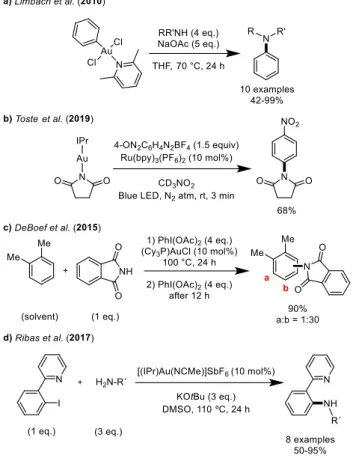
Figure 1. Stoichiometric and catalytic C‒N coupling reactions mediated by gold complexes.
As summarized in Figure 1, a few arylation reactions of
N-nucleophiles mediated by gold(III) have been reported over the last decade.12-16 Limbach and coworkers provided in 2010
the first examples of stoichiometric C–N reductive elimination of aryl gold(III) complexes by reacting well-defined 2,6-lutidine aryl gold(III) complexes with N-nucleophiles (Figure 1a).12 Very recently, Toste et al described C‒N coupling between an
aryldiazonium salt and succinimide mediated by gold under photoredox conditions and detailed mechanistic studies were performed (Figure 1b).13 To the best of our knowledge, gold-catalyzed C–N couplings have only been reported twice so far.
Direct and regioselective arylation of phtalimide (oxidative C‒N coupling with arenes) has been achieved in 2015 by DeBoef and coworkers using phosphine gold(I) complexes and PhI(OAc)2 as external oxidant.14 More recently, in 2017, Ribas et al.
described the first oxidant-free Au-catalyzed C–N coupling involving aryl iodides (Figure 1d).15 Despite these significant
advances, the reaction conditions (temperature ≥ 100°C, catalytic loading = 10 mol%) and the requirement of an external oxidant or a preinstalled directing group limit the scope and practical interest of the transformation.
With the aim to advance further this chemistry, we have investigated the possibility to catalyze C‒N coupling with the (MeDalphos)AuCl complex, taking advantage of the faculty of this gold(I) complex to readily activate aryl iodides. Our results are reported hereafter. The scope and mechanism of the transformation are discussed.17
To start with, the coupling of p-toluenesulfonamide and iodobenzene was used as benchmark reaction. The influence of different reaction parameters (ratio of the coupling partners, T, halide scavenger, base, solvent) was studied (Table 1).19 The
coupling product 1 was obtained in 99% yield using the conditions as given in entry 1. All other conditions resulted in lower yields, such as the use of K3PO4 or NaOAcF as base, or other halide scavengers such as AgSbF6 or AgBF4 (entries 2-5). The
highest yield was obtained using o-DCB/MeOH 50:1 as solvent (entries 6 and 7). Increasing further the temperature was not beneficial (entry 8).
Entry T Halide
Scavenger Base Solventa Yield 1 75 °C AgOTf DTBP DCB/MeOH 99%
3 75 °C AgOTf NaOAcF DCB/MeOH 10% 4 75 °C AgSbF6 DTBP DCB/MeOH 72% 5 75 °C AgBF4 DTBP DCB/MeOH 77% 6 75 °C AgOTf DTBP DCB 86% 7 75 °C AgOTf DTBP DMF/MeOH 92% 8 100 °C AgOTf DTBP DCB/MeOH 80%
Table 1. Optimization. Yields determined using GC-MS with n-dodecane as internal standard, DTBP = 2,6-di-tert-butylpyridine. aSolvent/MeOH = 50/1.
With optimized conditions in hands, the coupling of
4-iodotoluene with different N-nucleophiles was investigated (Figure 2a), starting with anilines. Aniline itself gave a very low yield (7%) and no coupling was observed with p-anisidine. Gratifyingly, anilines bearing electron-withdrawing substituents in the para position (NO2,CF3 or COMe) gave the corresponding C‒N coupling products 4-6 in good to excellent yields.18 The
ortho-substituted
2-methyl-4-nitroaniline also reacted smoothly and cleanly to afford 7. Note that the anilines react selectively at the nitrogen atom (no trace of C-arylated products were detected), whereas indole was found to exclusively undergo C3-arylation under similar conditions.8
Figure 2. a) Scope of amines. Cross-coupling of p-iodotoluene and N-nucleophiles catalyzed by (MeDalphos)AuCl at 0.2 M of aryl iodide. aBenzamide (1 eq.), 2 mol% (MeDalphos)AuCl, 4 h, 0.6 M. bAll reagents weighted in air. cBenzamide (2 mmol, 1 eq.), 1 mol% (MeDalphos)AuCl, overnight, 0.6 M. d16 h. b) Scope of aryl
N B O O O N O O O S O F F F H H
iodides. Cross-coupling of aryl iodides and p-toluenesulfonamide or p-toluamide catalyzed by (MeDalphos)AuCl at 0.1 M of aryl iodide. Yields determined using
1H NMR with n-dodecane as internal standard. Isolated yields in parentheses.
Besides p-toluenesulfonamide, the reaction works very well with aliphatic and aromatic amides as shown by the quantitative formation of products 9-13. Importantly, the presence of functional groups is compatible with the gold-catalyzed arylation, as shown by the high-yield preparation of Br- and Bpin-substituted N-aryl amides 12 and 13. The structure of 13 was unambiguously confirmed by X-ray diffraction analysis.19 Selective activation of aryl iodides in the presence of Ar‒Br and
Ar‒BPin bonds is particularly noteworthy as it raises selectivity issues with Pd catalysts.
In all cases, the C‒N coupling of the primary aromatic amines and amides is highly selective in monoarylation and diarylation products were not detected. Nevertheless, the gold catalyst also promotes the arylation of secondary amides as exemplified by the formation of 14-15. The synthesis of 15 is particularly noteworthy. Starting from p-toluenesulfonamide, compound 1 can be obtained by C‒N coupling with iodobenzene and further arylated with 4-iodotoluene using extended reaction times. Thereby, it is possible to sequentially introduce two different aryl groups at nitrogen.
The preparation of primary anilines in protected forms is also possible and straightforward using tert-butyl carbamate (Boc) and benzyl carbamate (Cbz) as ammonia surrogates. The corresponding products 16 and 17 were readily obtained in quantitative yields.
The robustness and scalability of the gold-catalyzed reaction was assessed using 4-iodotoluene and benzamide as substrates. The corresponding product 10 was also obtained in excellent yield in air and with technical grade solvents, showing that no stringent precautions are needed. Very good results were obtained at larger scale. Starting from 2 mmol of substrates with only 1 eq. of benzamide and 1 mol% of (MeDalphos)AuCl, the arylated product 10 was obtained in 99% yield after overnight reaction.
The scope of aryl iodides was then assessed (Figure 2b). The reaction works well with electron-rich, electron-poor and
ortho-substituted substrates, as shown by the quantitative formation of 18-21. Complete selectivity for C–I bond activation
in the presence of C–Br, C–OTf and C–Bpin functional groups is observed upon synthesis of 22-24 (the structure of 23 was confirmed by X-ray diffraction analysis),19 highlighting the complementarity and orthogonality of gold and palladium catalysis.
Having established the efficiency and generality of the
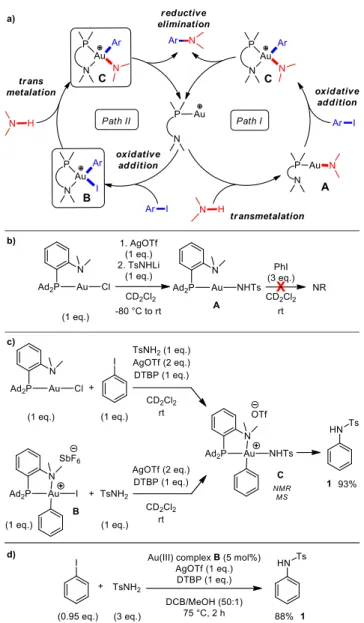
gold-catalyzed C‒N coupling, we sought to gain insight into the reaction mechanism. As schematically depicted in Figure 3a, two main pathways can be envisioned. They differ essentially in the order of the transmetalation/oxidative addition steps.
Toste et al have shown that in the gold-promoted C–N coupling of succinimide and aryl diazoniums under photoredox conditions, transmetalation precedes aryl transfer to gold (path I).13 To assess the feasibility of this route with our system,
the amido Au(I) complex A was prepared (Figure 3b). Its structure was analyzed by multi-nuclear NMR. Of note, the 1H‒15N HSQC NMR spectrum shows 15N NMR signals at 38.1 ppm for the NMe2 group (close
to that of the (MeDalphos)AuCl complex, 37.0 ppm) and 110.2 ppm for the NHTs group with a JNP coupling constant of 37
Hz. X-ray diffraction data for the 2LiOTf adduct was also obtained.19 Despite the presence of the (P,N) ligand to favor oxidative
addition and stabilize the ensuing Au(III) species,7,8,20 complex A was found to be completely inert towards iodobenzene (no
sign of a reaction after 3 days at room temperature in the presence of 3 eq. of PhI).19
From this observation, we surmised that oxidative addition precedes transmetalation in our case (Path II). To support this hypothesis, we studied the influence of N-nucleophiles as additives on the oxidative addition of iodobenzene to the (MeDalphos)AuCl complex.21 No significant impact was noticed with p-nitroaniline and p-toluenesulfonamide, complex B
forms very rapidly and quantitatively. Conversely, the presence of either aniline or p-anisidine slows down the reaction and the oxidative addition is not complete even after 5 h, in line with the absence or very low catalytic activity observed with those substrates.19
Figure 3. Catalytic cycles envisioned to account for the C–N coupling mediated by bond formation operating via aryl-Au(III) intermediates (a), stoichiometric and
catalytic reactions carried out to gain mechanistic insight (b-d). Yields of 1 were determined by 1H NMR with n-dodecane as internal standard.
Next, we sought to characterize reactive intermediates by running a coupling reaction at rt using 1 eq. of (MeDalphos)AuCl (Figure 3c). 31P NMR monitoring showed fast and clean formation of a new product at 62 ppm. 1H‒15N HSQC experiments
allowed to identify this species as the aryl amido Au(III) complex C. The 15N NMR signal for the NMe2 now appears at 72.8
ppm, in the typical range of (P,N)-chelated Au(III) complexes ( 71.5 ppm for complex B) while the NHTs group resonates at 117.8 ppm as a doublet. The value of the JNP coupling constant (36 Hz, very similar to that observed for complex A) supports trans arrangement of the amido group and phosphorus atom at gold. The structure of C was further confirmed by high
resolution electrospray ionization mass spectrometry (m/z = 865.3232).19 Complex C slowly evolves at rt to regenerate the
(MeDalphos)Au(I)+ complex and release the cross-coupling product 1 (93% yield after 36 h).22 The aryl Au(III) complex B is not
observed during the course of the reaction, but its involvement is supported by the following reactions performed starting from isolated samples of B: (i) under stoichiometric conditions at rt, it also gives complex C that slowly undergoes reductive elimination and releases the C‒N coupling product (Figure 3c), (ii) under the optimized catalytic reactions, its activity is very similar to that of the (MeDalphos)Au(I)+ complex (Figure 3d).
Thus, all observations are consistent and support the 2e redox cycle II for this gold-catalyzed C‒N coupling. Oxidative addition of the aryl iodide precedes transmetalation and reductive elimination is the rate-determining step.
In summary, we have developed a new C‒N coupling methodology that proceeds via a Au(I)/Au(III) catalytic cycle and draws on the faculty of the (P,N) ligand MeDalphos to promote oxidative addition. The reaction does not require the presence of an external oxidant or a directing group. It is robust, operates under mild conditions and works well with a variety of aryl iodides and amines. Most noticeable is the tolerance of functional groups that tend to raise selectivity issues with the other transition metals. Mechanistic studies, including the characterization of a key Au(III) intermediate, strongly support a catalytic sequence made of oxidative addition, transmetalation and rate-determining reductive elimination.
Financial support from the Centre National de la Recherche Scientifique and the Université de Toulouse is
gratefully acknowledged. J. R. thanks the European Commission for a MCIF (Gold3Cat-799606). The NMR service of ICT is acknowledged for assistance with the 1H–15N HSQC NMR experiments.
Notes and references
1 R. Kumar and C. Nevado, Angew. Chem. Int. Ed., 2017, 56, 1994−2015.
2 (a) G. Zhang, Y. Peng, L. Cui and L. Zhang, Angew. Chem. Int. Ed., 2009, 48, 3112−3115; (b) M. N. Hopkinson, A. Tessier, A.
Salisbury, G. T. Giuffredi, L. E. Combettes, A. D. Gee and V. Gouverneur, Chem. Eur. J., 2010, 16, 4739–4743; (c) L. T. Ball, G. C. Lloyd-Jones and C. A. Russell, Science, 2012, 337, 1644−1648; (d) L. T. Ball, G. C. Lloyd-Jones and C. A. Russell, C. A.
J. Am. Chem. Soc., 2014, 136, 254−264; (e) X. C. Cambeiro, N. Ahlsten and I. Larrosa, J. Am. Chem. Soc., 2015, 137,
15636−15639; (f) L. Huang, M. Rudolph, F. Rominger and A. S. K. Hashmi, Angew. Chem. Int. Ed., 2016, 55, 4808−4813; (g) T. J. A. Corrie, L. T. Ball, C. A.Russell and G. C. Lloyd-Jones, J. Am. Chem. Soc., 2017, 139, 245−254; (h) M. Hofer, A. Genoux, R. Kumar and C. Nevado, Angew. Chem. Int. Ed., 2017, 56, 1021−1025.
3 For reviews, see: (a) P. Garcia, M. Malacria, C. Aubert, V. Gandon and L. Fensterbank, ChemCatChem, 2010, 2, 493−497;
(b) M. N. Hopkinson, A. D. Gee and V. Gouverneur, Chem. Eur. J., 2011, 17, 8248−8262; (c) H. A. Wegner and M. Auzias,
Angew. Chem. Int. Ed., 2011, 50, 8236−8247; (d) T. C. Boorman and I. Larrosa, Chem. Soc. Rev., 2011, 40, 1910−1925; (e)
M. N.Hopkinson, A. Tlahuext-Aca and F. Glorius, Acc. Chem. Res., 2016, 49, 2261−2272; (f) M. O. Akram, S. Banerjee, S. S. Saswade, V. Bedi and N. T. Patil, Chem. Commun., 2018, 54, 11069−11083; (g) M. Zidan, S. Rohe, T. McCalluma and L. Barriault, Catal. Sci. Technol., 2018, 8, 6019−6028; (h) C.-S. Wang, P. H. Dixneuf and J.-F. Soulé, Chem. Rev., 2018, 118, 7532−7585.
4 (a) M. Schuler, F. Silva, C. Bobbio, A. Tessier and V. Gouverneur, Angew. Chem. Int. Ed., 2008, 47, 7927−7930; (b) M. Hofer
and C. Nevado, Tetrahedron, 2013, 69, 5751−5757.
5 M. Joost, A. Amgoune and D. Bourissou, Angew. Chem. Int. Ed., 2015, 54, 15022−15045.
6 2,2’-Bipyridine ligands were also shown to promote oxidative addition to gold and subsequent reaction with an aryl zinc
reagent induced C–C cross-coupling (stoichiometric Negishi-type reaction): M. J. Harper, C. J. Arthur, J. Crosby, E. J. Emmett, R. L. Falconer, A. J. Fensham-Smith, P. J. Gates, T. Leman, J. E. McGrady, J. F. Bower and C. A. Russell, J. Am.
Chem. Soc., 2018, 140, 4440−4445. For recent insights on ligand influence, see: Y. Yang, L. Eberle, F. F. Mulks, J. F. Wunsch,
M. Zimmer, F. Rominger, M. Rudolph and A. S. K. Hashmi, J. Am. Chem. Soc., 2019, 141, 17414−17420.
7 A. Zeineddine, L. Estévez, S. Mallet-Ladeira, K. Miqueu, A. Amgoune and D. Bourissou, Nat. Commun., 2017, 8, 565−572. 8 J. Rodríguez, A. Zeineddine, E. D. Sosa-Carrizo, K. Miqueu, N. Saffon-Merceron, A. Amgoune and D. Bourissou, Chem. Sci.,
2019, 10, 7183−7192.
9 (a) M. S. Messina, J. M. Stauber, M. A. Waddington, A. L. Rheingold, H. D. Maynard and A. M. Spokoyny, J. Am. Chem. Soc., 2018, 140, 7065−7069; (b) J. M. Stauber, E. A. Qian, Y. Han, A. L. Rheingold, P. Král, D. Fujita and A. M. Spokoyny,
2019, DOI: 10.26434/chemrxiv.9783800.
10 (a) A. S. Guram and S. L. Buchwald, J. Am. Chem. Soc., 1994, 116, 7901–7902; (b) F. Paul, J. Patt and J. F. Hartwig, J. Am. Chem. Soc., 1994, 116, 5969–5970.
11 (a) D. M. T. Chan, K. L. Monaco, R.-P. Wang and M. P. Winters, Tetrahedron Lett., 1998, 39, 2933–2936; (b) P. Y. S. Lam,
C. G. Clark, S. Saubern, J. Adams, M. P. Winters, D. M. T. Chan and A. Combs, Tetrahedron Lett., 1998, 39, 2941–2944; (c) G. Evano, N. Blanchard and M. Toumi, Chem. Rev., 2008, 108, 3054–3131; (d) F. W. Patureau and L. J. Gooßen, Angew.
Chem. Int. Ed., 2014, 53, 5738–5739.
12 S. Lavy, J. J. Miller, M. Pažický, A.-S. Rodrigues, F. Rominger, C. Jäkel, D. Serra, N. Vinokurov and M. Limbach Adv. Synth. Catal., 2010, 352, 2993–3000.
13 S. Kim and F. D. Toste, J. Am. Chem. Soc., 2019, 141, 4308–4315. 14 L. Marchetti, A. Kantak, R. Davis and B. DeBoef, Org. Lett., 2015, 17, 358–361. 15 J. Serra, T. Parella and X. Ribas, Chem. Sci., 2017, 8, 946–952.
16 For a stoichiometric intramolecular C–N coupling from a
C^N-cyclometalated Au(III) complex, see: J. H. Kim, R. T. Mertens, A. Agarwal, S. Parkin, G. Berger and S. G. Awuah, Dalton
Trans., 2019, 48, 6273–6282.
17 During the final stage of this manuscript preparation, a related work by Patil and co-workers was published on line: M. O.
Akram, A. Das, I. Chakrabarty and N. T. Patil, Org. Lett.,
2019, 21, 8101–8105.
18 A similar trend was observed by Ribas et al.15 19 See Supporting Information for details.
20 L. Huang, F. Rominger, M. Rudolph and A. S. K. Hashmi, Chem. Commun., 2016, 52, 6435–6438.
21 For recent discussions on the assessment of the functional group tolerance of chemical reactions, see: (a) K. D. Collins and F. Glorius, Acc. Chem. Res., 2015, 48, 619–627; (b) L. Pitzer, F. Schäfers and F. Glorius, Angew. Chem. Int. Ed., 2019,
58, 8572–8576.