A 120nW 18.5kHz RC oscillator with comparator
offset cancellation for ±0.25% temperature stability
The MIT Faculty has made this article openly available.
Please share
how this access benefits you. Your story matters.
Citation
Paidimarri, A., D. Griffith, A. Wang, A. P. Chandrakasan, and
G. Burra. “A 120nW 18.5kHz RC Oscillator with Comparator
Offset Cancellation for ±0.25% Temperature Stability.” 2013 IEEE
International Solid-State Circuits Conference Digest of Technical
Papers (February 2013).
As Published
http://dx.doi.org/10.1109/ISSCC.2013.6487692
Publisher
Institute of Electrical and Electronics Engineers (IEEE)
Version
Author's final manuscript
Citable link
http://hdl.handle.net/1721.1/92830
Terms of Use
Creative Commons Attribution-Noncommercial-Share Alike
10.7
A 120nW 18.5kHz RC Oscillator with Comparator Offset
Cancellation for ±0.25% Temperature Stability
Arun Paidimarri1, Danielle Griffith2, Alice Wang3, Anantha Chandrakasan1
and Gangadhar Burra2
1 Massachusetts Institute of Technology, Cambridge, MA 2 Texas Instruments, Dallas, TX
3 MediaTek, Austin, TX
Integrated low-frequency oscillators can replace crystal oscillators as sleep-mode timers to reduce the size and cost of wireless sensors [1]. Since the timer is one of the few continuously functioning circuits, minimizing its power consumption can greatly reduce sleep-mode power of highly duty-cycled systems. Temperature stability of the oscillator is important in order to minimize timing uncertainly and guard time for the radios, and thus maximizing sleep time. The voltage-averaging feedback method described in [2] achieves high stability in the MHz frequencies, but when scaled to the kHz range, requires very large filters. On the other extreme, gate leakage-based timers have been designed for sub-nW power consumption, but operate in the sub-Hz frequencies [3]. In the past, high accuracy RC oscillators in the kHz range have been designed with feedforward correction [1] and self-chopped operation [4]. In this work, an offset cancellation architecture achieves long-term frequency stability and temperature stability while operating at lower power.
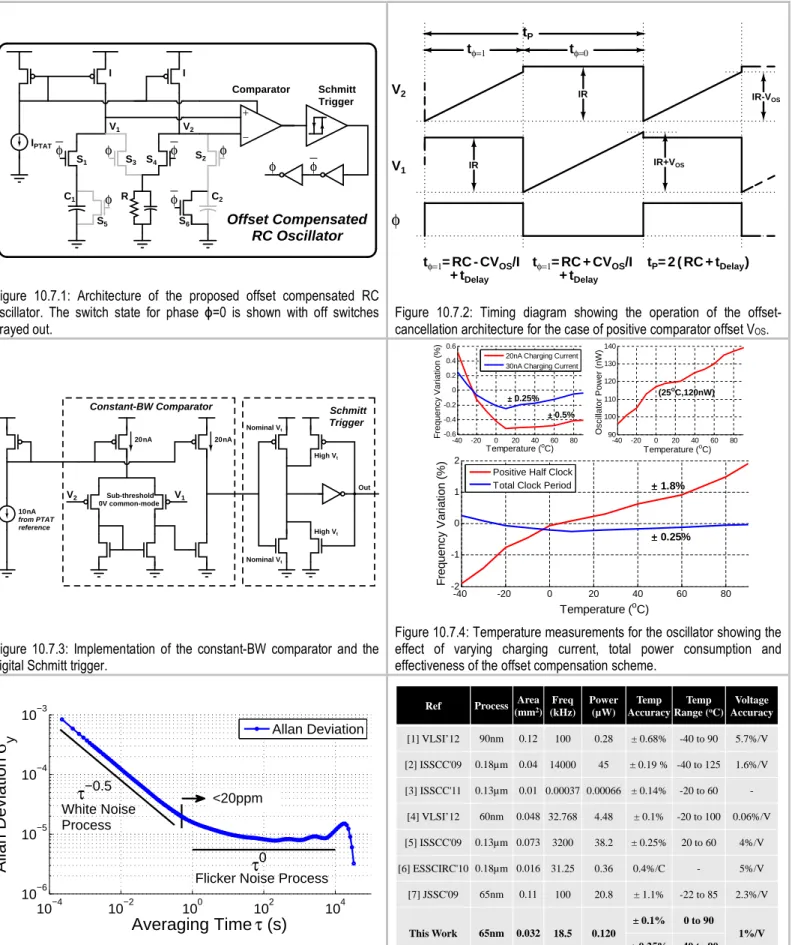
The architecture of the proposed offset-cancelling oscillator is shown in Fig. 10.7.1. When phase ɸ=0, a current I passes through resistor R to generate a voltage I·R on node V2. At the same time, a matched current source charges
capacitor C1, such that node V1 crosses V2 at time RC. After tdelay corresponding
to the delay of the comparator and subsequent buffers, ɸ changes to 1, which then resets the capacitor voltage. In addition, the role of the two comparator inputs is reversed, with V1 being the resistor voltage and V2 the voltage across
capacitor C2. The period of the oscillator is thus nominally 2RC+2tdelay. Two
separate capacitors are used in the two phases so that the delay of capacitor discharge is not included in the period. This switching scheme also cancels comparator offset. For example, if the comparator has an offset Vos, as shown in
Fig. 10.7.2, the duration of phase ɸ=0 increases by CVos/I, however the opposite
phase ɸ=1 decreases by the same amount, thus the total period of oscillation is constant. This cancellation scheme allows significant power reduction in the oscillator by: (a) permitting low-swing oscillations since offset and temperature variations of the offsets do not proportionally affect frequency stability, (b) requiring only one comparator as opposed to two in traditional architectures, and (c) relaxing the specifications on the comparator offset, and allowing optimization of gain and bandwidth. The offset cancellation also attenuates the effect of flicker noise, improving long-term stability of the oscillator.
In this design R is chosen to be 5MΩ and C1 and C2 are 5pF for an RC time
constant of 25µs. The charging current I is 30nA on each branch, for a swing of only 150mV. Simulations show that a 10mV offset change (~6% of the swing) affects the frequency by only 0.06% thanks the offset cancellation scheme, a 100x improvement.
Temperature stability of the oscillator is affected by the on-resistance and off-leakage of switches S1-S6 in addition to comparator delay variations. For
example, resistance changes of 5kΩ or leakage current variations of 30pA change the oscillation frequency by 0.1%. The switch size is optimized by considering that large devices give low on-resistance while smaller devices give lower leakage. For example, discharging switches S5, S6 are sized weak since
the discharge delay does not affect frequency. Switches S3, S4, when off, see a
VGS of −150mV, decreasing leakage by >30x, and are hence sized for resistance.
The comparator and Schmitt trigger design is shown in Fig. 10.7.3. In order to handle low common-mode inputs, a PMOS-input design is used and saturation of the input pair is ensured by sub-threshold operation. Transconductance efficiency (gm/Id) is also maximized, hence reducing power. The bandwidth of the
comparator is set such that its delay is about 100ns, <0.4% of the period. In addition, to keep the comparator delay independent of temperature, a PTAT current reference is used, ensuring constant gm in sub-threshold, which in turn
gives constant bandwidth. During the change of phase, when nodes V1 and V2
switch roles, the comparator has small voltage glitches, which may result in
rail-to-rail glitches at the output of the inverters. In order to prevent these glitches, and limit cycling, the first buffer stage connected to the comparator is a Schmitt trigger, implemented in a digital fashion. A small hysteresis minimizes asymmetry in the switching point of the comparator in the two phases. Weak high-VT transistors provide a hysteresis of a few 10s of mV, which is still sufficient to eliminate glitches. The Schmitt trigger and subsequent inverters add <10ns to the overall delay, and hence do not affect temperature stability of the oscillator. The oscillator was fabricated in a 65nm CMOS process. The die photo is shown in Fig. 10.7.7. The RC oscillator consumes an area of 0.032mm2. The oscillator
operates from a 1V supply and consumes 120nW. The current sources charging R and C consume 30nA each, the comparator 40nA, current mirrors 10nA and the Schmitt triggers and buffers consume 10nA. The current reference, shared with the rest of the system, works from a system supply voltage of 1.5V-3.3V and consumes 25nA. It generates the 10nA PTAT current reference required for the oscillator. The center frequency is tunable from 9 to 30kHz through on-chip R and C tuning. All measurements described further are at the center of this range (~18.5kHz). The oscillator has a supply voltage dependence of less than 1%/V, allowing relaxed supply regulation requirements.
Temperature stability measurements are shown in Fig. 10.7.4. Over −40 to 90°C, the oscillator has a frequency variation of ±0.25%. In a reduced temperature range from 0 to 90°C, the frequency variation reduces to ±0.1% for an average of about 22ppm/°C. The effect of offset compensation is also demonstrated by comparing temperature stability of the total period with the period of one of the phases. Offset cancellation achieves a 7x reduction from ±1.8% down to ±0.25%. The effect of charging current values is characterized by comparing two charging currents, 20nA and 30nA. At 20nA, switch leakage and reduced slope on the capacitor charging degrades performance giving ±0.5% temperature variation. The total oscillator current consumption as a function of temperature is also plotted in Fig. 10.7.4.
Long term stability of the oscillator is also critical to sleep-mode timer performance, and is captured by the Allan deviation, plotted in Fig. 10.7.5 for a 24hr measurement in a typical office environment. At averaging times below 0.5s, it is white noise limited; and beyond this, it is flicker noise limited. The offset-cancellation scheme helps reduce the flicker noise and its contribution to the Allan deviation, leaving a floor below 20ppm for intervals over 0.5s. This indicates the ability of the oscillator to measure long sleep times accurately. Fig. 10.7.6 summarizes this work and compares it with previously published RC oscillators operating in various frequencies.
In conclusion, an offset cancellation scheme has been presented that helps achieve temperature stability of ±0.25%, ultra-low power operation at 120nW and long-term stability of better than 20ppm, advancing the state of fully-integrated timers for wireless sensors.
Acknowledgements: The authors would like to acknowledge P. Roine and P.
Nadeau for useful discussion and J. Reid for skilled layout.
References:
[1] T. Tokairin, et al., "A 280nW, 100kHz, 1-cycle start-up time, on-chip CMOS relaxation oscillator employing a feedforward period control scheme," Dig. Symp.
VLSI Circuits, pp. 16-17, June 2012
[2] Y. Tokunaga, et al., "An on-chip CMOS relaxation oscillator with power averaging feedback using a reference proportional to supply voltage," ISSCC
Dig. Tech. Papers, pp. 404-405, Feb. 2009
[3] Y. Lee, et al., "A 660pW multi-stage temperature-compensated timer for ultra-low-power wireless sensor node synchronization," ISSCC Dig. Tech. Papers, pp. 46-48, Feb. 2011
[4] K.-J. Hsiao, "A 32.4 ppm/°C 3.2-1.6V self-chopped relaxation oscillator with adaptive supply generation," Dig. Symp VLSI Circuits, pp. 14-15, June 2012 [5] K. Choe, et al., "A precision relaxation oscillator with a self-clocked offset-cancellation scheme for implantable biomedical SoCs," ISSCC Dig. Tech. Papers pp.402-403, Feb. 2009
[6] J. Lim, K. Lee, K. Cho, "Ultra low power RC oscillator for system wake-up using highly precise auto-calibration technique," ESSCIRC, 2010 Proceedings of
the , pp.274-277, Sept. 2010
[7] F. Sebastiano, et al., "A Low-Voltage Mobility-Based Frequency Reference for Crystal-Less ULP Radios," J. Solid State Circuits, vol.44, pp.2002-2009, July 2009
Figure 10.7.1: Architecture of the proposed offset compensated RC
oscillator. The switch state for phase ɸ=0 is shown with off switches
grayed out.
Figure 10.7.2: Timing diagram showing the operation of the
offset-cancellation architecture for the case of positive comparator offset V
OS.
Figure 10.7.3: Implementation of the constant-BW comparator and the
digital Schmitt trigger.
Figure 10.7.4: Temperature measurements for the oscillator showing the
effect of varying charging current, total power consumption and
effectiveness of the offset compensation scheme.
Figure 10.7.5: Allan Deviation measurement over 24 hours shows
long-term stability of the oscillator.
Figure 10.7.6: Summary of measured results and comparison to
previous work.
− + φ φ φ φ φ φ V1 V2 I R I C2 C1 φ φ IPTAT Comparator Schmitt TriggerOffset Compensated
RC Oscillator
S1 S2 S5 S6 S3 S4 V1 V2φ
tφ=1 tφ=0 tP IR IR IR-VOS IR+VOS tφ=1= RC - CVOS/I tφ=1= RC + CVOS/I tP= 2 ( RC + tDelay) + tDelay + tDelay Schmitt Trigger V1 V2 20nA 20nA Out Nominal Vt High Vt Constant-BW Comparator Nominal Vt High Vt Sub-threshold 0V common-mode from PTAT 10nA reference -40 -20 0 20 40 60 80 -2 -1 0 1 2 Temperature (oC) F re q u e n c y V a ri a ti o n ( % )Positive Half Clock Total Clock Period
±±±± 0.25% ±±±± 1.8% -40 -20 0 20 40 60 80 90 100 110 120 130 140 Temperature (oC) O sc ill a to r P o w e r (n W ) (25oC,120nW) -40 -20 0 20 40 60 80 -0.6 -0.4 -0.2 0 0.2 0.4 0.6 Temperature (oC) F re q u e n cy V a ri a ti o n ( % )
20nA Charging Current 30nA Charging Current
±±±± 0.25% ±±±± 0.5% 10−4 10−2 100 102 104 10−6 10−5 10−4 10−3
Averaging Time
τ
(s)
Allan Deviation
σ
y Allan Deviationτ
−0.5 White Noise Processτ
0Flicker Noise Process <20ppm
Ref Process Area (mm2) Freq (kHz) Power (µW) Temp Accuracy Temp Range (oC) Voltage Accuracy [1] VLSI’12 90nm 0.12 100 0.28 ± 0.68% -40 to 90 5.7%/V [2] ISSCC'09 0.18µm 0.04 14000 45 ± 0.19 % -40 to 125 1.6%/V [3] ISSCC'11 0.13µm 0.01 0.00037 0.00066 ± 0.14% -20 to 60 -[4] VLSI’12 60nm 0.048 32.768 4.48 ± 0.1% -20 to 100 0.06%/V [5] ISSCC'09 0.13µm 0.073 3200 38.2 ± 0.25% 20 to 60 4%/V [6] ESSCIRC'10 0.18µm 0.016 31.25 0.36 0.4%/C - 5%/V [7] JSSC'09 65nm 0.11 100 20.8 ± 1.1% -22 to 85 2.3%/V This Work 65nm 0.032 18.5 0.120 ± 0.1% 0 to 90 1%/V ± 0.25% -40 to 90