Publisher’s version / Version de l'éditeur:
Psychological Medicine, 31, August 6, pp. 949-964, 2001-08-01
READ THESE TERMS AND CONDITIONS CAREFULLY BEFORE USING THIS WEBSITE. https://nrc-publications.canada.ca/eng/copyright
Vous avez des questions? Nous pouvons vous aider. Pour communiquer directement avec un auteur, consultez la
première page de la revue dans laquelle son article a été publié afin de trouver ses coordonnées. Si vous n’arrivez pas à les repérer, communiquez avec nous à [email protected].
Questions? Contact the NRC Publications Archive team at
[email protected]. If you wish to email the authors directly, please see the first page of the publication for their contact information.
Archives des publications du CNRC
This publication could be one of several versions: author’s original, accepted manuscript or the publisher’s version. / La version de cette publication peut être l’une des suivantes : la version prépublication de l’auteur, la version acceptée du manuscrit ou la version de l’éditeur.
For the publisher’s version, please access the DOI link below./ Pour consulter la version de l’éditeur, utilisez le lien DOI ci-dessous.
https://doi.org/10.1017/S003329170105425
Access and use of this website and the material on it are subject to the Terms and Conditions set forth at
Full-spectrum fluorescent lighting: a review of its effects on physiology and health
McColl, S. L.; Veitch, J. A.
https://publications-cnrc.canada.ca/fra/droits
L’accès à ce site Web et l’utilisation de son contenu sont assujettis aux conditions présentées dans le site LISEZ CES CONDITIONS ATTENTIVEMENT AVANT D’UTILISER CE SITE WEB.
NRC Publications Record / Notice d'Archives des publications de CNRC:
https://nrc-publications.canada.ca/eng/view/object/?id=02227cdb-de14-4f12-a4ce-6831fa2b5dbc https://publications-cnrc.canada.ca/fra/voir/objet/?id=02227cdb-de14-4f12-a4ce-6831fa2b5dbc
McColl, S.L.; Veitch, J.A.
A version of this document is published in / Une version de ce document se trouve dans : Psychological Medicine, v. 31, no. 6, August 2001, pp. 949-964
www.nrc.ca/irc/ircpubs
© 2001, Her Majesty in right of Canada. All rights reserved. National Research Council of Canada, Ottawa, ON K1A 0R6
PHYSIOLOGY & HEALTH
Shelley L. McColl and Jennifer A. Veitchii
McGill University, Department of Psychology and National Research Council of Canada, Institute for Research in Construction
ABSTRACT
Background. Full-spectrum fluorescent lighting (FSFL) has been credited with causing dramatic
beneficial effects on a wide variety of behaviours, mental health outcomes, and physical health effects, as compared to other fluorescent lamp types. These effects are hypothesized to occur because of similarity between FSFL emissions and daylight, which is said to have evolutionary superiority over other light sources.
Method. This review, covering the period 1941-1999, critically considers the evidence for direct
effects of FSFL through skin absorption as well as indirect effects on hormonal and neural processes.
Conclusions. Overall, the evidence does not show dramatic effects of fluorescent lamp type on
behaviour or health, nor does it support the evolutionary hypothesis.
INTRODUCTION
Fluorescent lighting is a source of interest and concern to people ("Office lighting", 1980; Veitch et al., 1993). Concerns include effects on health, mood and behaviour, ranging from visual discomfort to serious problems, such as skin cancer (Lindner & Kropf, 1993; Stone, 1992; Veitch et al., 1993; Veitch & Gifford, 1996). One characteristic of fluorescent lighting that has been consistently blamed as a cause of these complaints is, spectral power distribution (SPD), the relative contribution of energy at various wavelengths to the overall colour appearance of the light (Rea, 1993). Natural daylight has a broad, relatively flat SPD and is believed by many to be best for health and well-being (Veitch et al., 1993; Veitch & Gifford, 1996).
Full-spectrum fluorescent lamps (FSFL) are said to mimic the spectral qualities of daylight. Many believe that FSFLs provide similar health-promoting effects to natural daylight. Initial interest in FSFL began with simple observations of plants (Ott, 1973), and zoo animals (Blatchford, 1978; Laszlo, 1969) which appeared to thrive under FSFL. Studies of perceptual and behavioural effects include investigations of visibility, hyperactivity, and academic performance in schoolchildren, and fatigue in office workers. The purported benefits of FSFL on health and well-being are controversial. It has been argued that there is an absence of sound scientific evidence in support of the health claims made in the lamp's labeling (Food and Drug
Administration, 1986). Nonetheless, a substantial proportion of the public accepts these claims, believing that light that mimics daylight is better for health (Veitch et al., 1993). Media attention
i McColl, S. L., & Veitch, J. A. (2001). Full-spectrum fluorescent lighting: A review of its effects on physiology
and health. Psychological Medicine, 31, 949-964.
ii Correspondence concerning this article should be sent to Jennifer A. Veitch, National Research Council of Canada,
Institute for Research in Construction, Bldg M-24, 1200 Montreal Road, Ottawa, ON K1A 0R6 Canada. Electronic mail may be sent to [email protected].
has contributed to this notion (Blumenthal, 1992; Cook, 1994; Henderson, 1986; "Light treatment", 1994; "Report Card", 1993). Veitch and McColl (2001) reviewed the literature concerning visual, perceptual, and cognitive effects of FSFL and concluded that the evidence for such effects is very weak. Boyce (1994) and Gifford (1994) reached similar conclusions in their critiques on the claims for FSFL.
One difficulty is that the theoretical rationale for FSFLs effects is rarely described in the literature, and when mentioned is often vague and problematic. The principal hypothesis
regarding FSFL holds that because daylight was the principal light source for most of the period during which life evolved, physiological processes should function optimally under daylight; any deviation from daylight might lead to suboptimal functioning (Hughes, 1980; Ott, 1982;
Wurtman & Neer, 1970; Wurtman, 1975a). FSFL being more suited to our biological makeup should improve health and well-being as compared to lamps with SPDs less similar to daylight. Some proponents of the evolutionary hypothesis further contend that the UV component of FSFL is critical to its biological and behavioural effects (cf. Cameron, 1986).
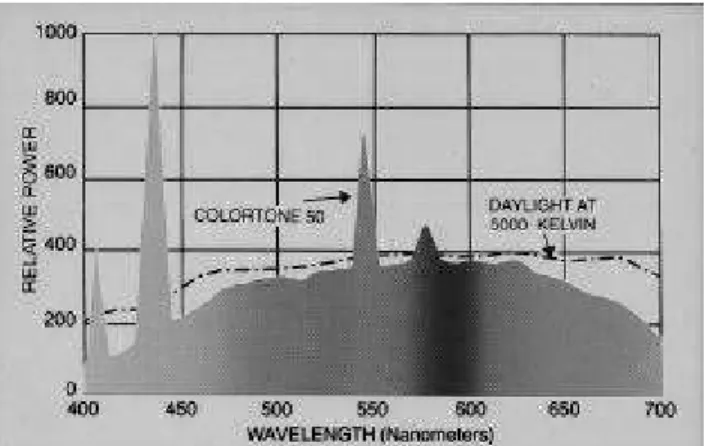
It is debatable whether FSFLs produce light similar to daylight. A FSFLiii is one that
emits light in all parts of the visible spectrum and some in the ultraviolet-A region of short-wavelength, high-energy radiation (UV-A, 320-400 nm), has a CCTiv of 5000 K or greater and a
iiiAlthough there is no firm definition of FSFL lamps, we adopt the definition of FSFL described by Boyce (1994). iv Colour correlated temperature (CCT) describes the colour of a light source in terms of a blackbody radiator, which
Figure 1. Spectral power
distribution curves for generic FSFL (top) and CWFL (bottom) lamps. (© IESNA, 1993. Used by permission.)
colour rendering index (CRI)v of at least 90 (see Figure 1). In contrast, daylight varies in
correlated colour temperature (CCT) from 5000 to 10,000 K depending on sky conditions, season, and time of day (Thorington, 1985). Moreover, daylight is more intense than any interior lighting. Offices and schools are designed to provide 200-500 lumens/m2 [lux, lx] incident on a desk surface, whereas outside, daylight is on the order of 50,000-100,000 lx. Daylight also is polarized. Polarization for interior lighting requires a special filter (see Clear & Mistrick, 1996). However, it is true that the general shape of the SPD of a FSFL is more similar to daylight than other lamps, such as the common cool-white fluorescent lamp (CWFL) (Rea, 1993; see Figure 1).
The present review addresses the questions “Is there sufficient evidence of health benefits attributable to FSFL to support a recommendation for its use in general interior lighting?” and "What contribution might FSFL make to known light therapies?" The scope of this question is multidisciplinary, crossing the boundaries of psychology, physiology, and medicine. The answer is relevant to health-care professionals because FSFL could provide a simple, easily applied treatment that would supplement other health promotion efforts and treatments and expand on existing clinical treatments using light therapy. The review covers literature from 1941-1999vi on
the effects of FSFL on physiological mechanisms that are thought to affect human physical and mental health and physical activity levels, including direct absorption effects from eyes and other body tissues as well as indirect non-visual physiological and psychological effects.
DIRECT ABSORPTION EFFECTS Vitamin D and Calcium Metabolism
Light absorption through the skin stimulates chemical reactions in the blood and in other tissues (Wurtman, 1975a, 1975b; Holick, 1995; 1996). The metabolism of vitamin D3 is the best known of the beneficial photochemical processes. Vitamin D is essential to the regulation of calcium metabolism and to the maintenance of bones and teeth (Holick, 1996). Evidence suggests that most of the Vitamin D activity in the blood is in a form that can only be derived from exposure to light. For most people, sufficient daylight exposure for health is available. However, for special populations such as the institutionalized chronically ill, the elderly, shift workers, and those living in extreme polar latitudes, electric light may be the only available source for light-stimulated vitamin D metabolism. The relevant question is whether FSFL are more efficacious than other lamp types for supplying this need, as has been advocated (Hughes
is a theoretical object that radiates energy perfectly. CCT is the colour temperature (in Kelvin) at which a blackbody has the same colour appearance as the fluorescent lamp.
vCRI refers to the colour appearance of illuminated objects under a given light source, rather than the colour
appearance of the light itself. It is a comparison of the colour illuminated by a reference (standard) light source of the same colour temperature. If the match between colour appearances under the two lamps is perfect, the CRI=100. Among the most common fluorescent lamps is the cool-white fluorescent lamp (CWFL), which is characterized by a SPD designed to maximize achromatic visibility and has CCT=4100K. Warm-white fluorescent lamps (WWFL), also common, are warmer in colour appearance (CCT=3000K). Various lamps exist within these CCT classes, with varying degrees of colour rendering capability.
vi The basis for the review was a search of Psychological Abstracts, Index Medicus, Ergonomics Abstracts and the
electronic databases PsycInfo, Medline, and Inspec. Journals not covered by these services, but known to be relevant, were also searched, for example Journal of the Illuminating Engineering Society and Lighting Research and Technology. Proceedings of lighting conferences, which publish brief versions of papers presented, were also reviewed. Because of the widespread public interest in this topic, it was decided to be as inclusive as possible in this review, to provide a comprehensive overview of publications on this topic.
& Neer, 1981).
One widely cited trial has been interpreted as favoring FSFL. Neer et al. (1971) and Neer
et al. (1970) reported a two-year study of calcium absorption involving subjects in a population of elderly patients. Participants exposed to treatment of 5000 lx of FSFL for 8 hours a day (with UVR) showed significantly greater calcium absorption and improved intestinal calcium uptake than control-group participants who were exposed to 300-500 lx of CWFL. Given that the FSFL illumination levels were 10 times greater than the CWFL, the effect might be a result of intensity and not spectral composition.
Because of the importance of calcium metabolism to normal formation and healthy maintenance of bones and teeth, one might expect FSFL to prove beneficial to dental health. Studies on rodents do not generally support this hypothesis (Sharon et al., 1971; Feller et al., 1974), and research on humans provides mixed results. Mayron et al. (1975a, 1975b) found fewer dental caries over one school year in first-and second-graders whose windowless classrooms had radiation-shielded FSFL, compared to unshielded CWFLs. Hargreaves and Thompson (1989) tracked dental caries in elementary schoolchildren over a two year period.vii
FSFL replaced CWFLs in two schools, and CWFLs remained in the other two. Children from the FSFL classrooms had fewer dental caries at the end of the 22-month period, but had also had better oral hygiene and gingivitis scores at both baseline and follow-up, which is suggestive of differences in predisposition or dental hygiene habits. Photometric details are lacking in these reports, and there was no control over selection, maturation, or history effects (as defined by Cook & Campbell, 1979).
Hathaway et al. (1992) (journal publication by Hathaway, 1995; cited in "Report card", 1994) included dental caries as a measure in their study of lighting effects on schoolchildren. Each of five schools installed one lamp type, either CWFL, FSFL/UVR (two schools), FSFL/NoUVR, or high-pressure sodium (HPS). Students in the schools having ultraviolet-enhanced FSFL had fewer caries, on average, than students in the FSFL/NoUVR school, but no statistical tests were reported. Indeed, they were unable to interpret the overall results because a large proportion of students in the CWFL school had fissure sealants applied, which prevent caries. Moreover, there was no indication of the prior incidence of dental caries in any of the schools, making it possible that there might have been initial differences between groups in the likelihood of developing dental caries. Other uncontrolled external variables, such as nutrition, fluoridated water consumption, tooth-brushing, flossing, and fluoride treatments might also have influenced the outcome.
Skin Reactions
UVR risk. Light absorption by the skin itself produces the familiar responses of suntan and sunburn -- protective and pathological responses, respectively (Wurtman, 1975a). However, skin cancers can also be the result of excessive exposure to UVR, particularly the higher energy rays at shorter wavelengths (UVR-B, 290-320 nm). The possible phototoxic effects of
fluorescent light exposure on the skin is a matter of some public concern (Stone, 1992; Willey, 1992), including worries that the UVR wavelengths in fluorescent lamps might constitute a hazard for skin cancer.
viiInternal evidence suggests that this study was conducted in conjunction with Wohlfarth's colour psychodynamics
experiments (see below: Wohlfarth, 1984; Wohlfarth & Gates, 1985), which were conducted in the same academic year in the 4 elementary schools in the same town in Alberta, Canada. Details about the lighting and classrooms are lacking in all three reports.
Calculations of the UVR dose from interior fluorescent lighting as generally implemented have concluded that, the average annual dosage of UVR received from interior fluorescent
lighting is approximately 5 % of the dose received from daylight exposure over the year at 50o -60o latitude (Whillock et al.,1988). The exposure from FSFL is designed to be higher than other fluorescent sources, particularly in the low-energy UVR-A range (320-400 nm). The literature review revealed no studies that have used a common methodology to measure UVR from FSFL; however, Bergman et al. (1995) reported that for CWFLs, at 1000 lx illumination, the
permissible exposure time is 8 hours, whereas for sunlight at 30 degrees from zenith, the permissible exposure time is 12 minutes.
Epidemiological studies of fluorescent lighting and cancer, in which respondents retrospectively report their exposure to fluorescent lighting, have not been specific as to lamp type, nor has it proven possible to specify if acrylic diffusers shielded the fluorescent lamps and blocked UVR exposure (Elwood, 1986). Reviews of the epidemiological data have concluded that currently available evidence does not support a relationship between fluorescent lighting and malignant melanoma (Muel et al., 1988; Elwood, 1986). Moreover, risk assessment studies suggest that the probability of developing skin cancers from occupational exposure to fluorescent lighting is so minimal that it does not warrant changes in lighting practice or regulatory control (Muel et al., 1988).
Photosensitivity. A small number of people experience skin reactions to light. Most frequently, the active wavelengths in these diseases are in the ultraviolet range (e.g., Harber et
al., 1985) and in rare cases, can be induced in particularly sensitive individuals by fluorescent light sources at intensities used in interior lighting (Brown et al., 1969; Kobza et al., 1973; Harber et al., 1985). However, the same light sources that can elicit photosensitive reactions have also been prescribed preventatively to induce tolerance in solar urticaria patients (Ramsay, 1977).
The most common abnormal skin response to sunlight is polymorphous light eruption, which may affect 10% of the population after a sudden, intense sun exposure (Prawer, 1991). For those who suffer from more serious forms, the consequences may include the possibility of hypotension and unconsciousness (cf. Ramsey, 1977).
Neonatal Hyperbilirubinemia
Light exposure is also a biologically effective means to treat neonatal hyperbilirubinemia (neonatal jaundice), a disorder common in premature babies who lack the means to metabolize bilirubin, a product of the decomposition of hemoglobin in dead red blood cells. Exposure to light bleaches the bilirubin irreversibly into a form that can be excreted. In vitro studies show that the action spectrum of bilirubin peaks in the blue range between 400-500 nm (cf. Furst et al., 1978; Thorington et al., 1971). However, there is a continuing debate concerning the most
effective lighting type for phototherapy so that the implications of this treatment for general lighting practice are not clear. Some lighting specialists believe that the ideal phototherapy lamp would be a FSFL because of its high values both for the theoretical degradation of bilirubin and for the colour discrimination it allows medical staff in observing patient progress (Thorington et
al., 1971).
Investigations of the treatment efficacy of various lamp types used for phototherapy of neonatal hyperbilirubinemia have achieved little consensus, partly because of poorly-controlled experiments, in which irradiance (dose) varied (this will occur when lamps with different
mean therapy duration vs. rate of decrease of serum bilirubin). Overall, the evidence does not support any particular lamp type (Ennever, 1990), although this has not prevented authors from recommending one lamp type or another (e.g., Vecchi et al., 1983; Warshaw et al., 1980; Yasunaga et al., 1975).
INDIRECT PHYSIOLOGICAL EFFECTS Growth and Development
If daylight is essential to health, then FSFL exposure in childhood may similarly result in improvements in health and development. The UVR component is purported to be important to these processes in children, although research in this area is at an early stage (Brainard, Gaddy,
et al., 1994). UVR influences neuroendocrine physiology in the development of rats and hamsters (Brainard et al. 1992; Brainard, Barker et al., 1994) and evokes visual responses in children (Brainard et al. 1992, Sanford et al., 1996), but the role of UVR in circadian or neuroendocrine regulation in children is unknown.
Hathaway et al. (1992) compared height, weight, and body fat changes in all students and the age of onset of menarche in the girls between schools using different fluorescent lighting types. The percentage reaching the expected age of menarche in the school with high-pressure sodium (HPS) lighting was lower-than-predicted, and the percentages in the FSFL/NoUVR and FSFL/UVR schools were higher-than-predicted. The highest percentage was in the
FSFL/NoUVR school. They provided no clear evidence that lamp type had any effect on the other health outcomes, although they interpreted a smaller increase in height in the HPS school as a detrimental effect of lamp type. However, the research design could not eliminate selection, maturation rate, or selection X maturation rate confounds (cf. Cook & Campbell, 1979).
Kuller and Lindsten (1992) studied Swedish children in the same age range as those in the Hathaway et al. (1992) study and found no statistically significant effects of lamp type or classroom windows on annual body growth. Whatever the role of UVR in growth and
development, the dose received from FSFLs does not appear to contribute significantly to it, as compared to other lamp types.
Physical Health Effects
There is evidence that ultraviolet radiation can affect immune system functioning in both animals and humans (Noonan & DeFabo, 1994; Morison, 1983;Allen & Cureton, 1945). A twenty-year history of field investigations into the effects of FSFL on illness rates in children has used school attendance as an index of overall physical health. One reported fewer sick days in classrooms with FSFL (London, 1987). Others found no effects of lamp type on absence rates (Kuller & Lindsten, 1992; Mayron et al., 1974; Wohlfarth, 1984). In Alberta schools, Hathaway
et al. (1992) assessed mean monthly attendance rate, among other variables over a two-year period. Rates for all students in the school with FSFL/UVR and the school with CWFL were identical (95.9%). The school with FSFL/NoUVR had a fractionally higher monthly mean
attendance, 96.2%. Methodological problems weaken the inferences here: these studies measured global measures of classroom absences, without controlling for contagion, presence of windows, socioeconomic status, number of students in the classes, or socioeconomic differences between schools. Overall, fluorescent lamp type appears to have no effect on school attendance.
Neurological Functioning
assembly plant workers (Berry, 1983) and reduce the incidence of epileptic seizures (Dutczak, 1985), although no mechanism has been suggested for this effect. Both of these investigations failed to control illuminance levels; therefore, the causal factor remains unknown.
One systematic study, in which adults were exposed to either bright or dim FSFL or WWFL, tested the hypothesis that bright light (1700 lx) would tend to elevate EEG-measured cortical activity in comparison to dim light (450 lx) (Kuller & Wetterberg, 1993). No specific hypotheses about EEG activity were made, and the results were complex and not internally consistent. FSFL were associated in one case with sleepiness (more theta activity), and in another with increased activity (greatest afternoon increase in beta activity). Moreover, results that were predicted, such as increased beta activity under high illuminance, did not occur. Given that luminous modulation is known to influence neural function, it is possible that the known between-lamps differences in degree of luminous modulation (flicker) could have confounded the results of this study. FSFLs have greater luminous modulation than WWFLs (Rea, 1993).
Arousal and Stress
Although arousal is popularly used as an explanatory, intervening variable, it is not a unidimensional construct (Lacey, 1967/1984). Psychophysiologists (e.g., Blascovich & Kelsey, 1990; Venables, 1984) emphasize that in discussing physiological activity, one must speak of systems, not of a symbolic construct specified in terms of a few arbitrarily chosen physiological indices. None of the studies reported here tied their physiological measures to any
psychophysiological theory, making it difficult to advance theories concerning the effects of light on arousal and stress.
There are two competing, contradictory notions about the effects of FSFL on arousal and stress. One view holds that, being similar to daylight, FSFL increases arousal and decreases fatigue compared to other light sources. Although a physiological explanation for this effect has not been advanced, the effect of light on the suppression of melatonin secretion may be
involved.viii At the retinal level, it is not known which photoreceptors, nor what specific area of
the retina, are responsible for this stimulation (Brainard, Gaddy et al., 1994), although the blue-green wavelengths appear to most strongly suppress the release of pineal melatonin (cf. Brainard
et al., 1997). There is also weak evidence that lighting of high CCT, such as FSFL, more strongly suppresses both (i) the nocturnal fall in body core temperature and (ii) the nocturnal increase in melatonin secretion (Morita & Tokura, 1996).
A second view speculates that light sources that differ from daylight are stressors that heighten arousal, indicators of which could be increased sympathetic nervous system activity and increased secretion of stress-related hormones. In this respect, FSFL would be less stressful than other sources since it is more similar to daylight (e.g., Tibbs, 1981; Chance, 1983; Wohlfarth, 1984). However, this position is inconsistent with the finding of greater increases in diastolic blood pressure and heart rate in response to exposure to lighting of high CCT (>6700K) compared to other sources (Mukae & Sato, 1992).
Hormone secretion. Two studies found no effect of lamp type on cortisol secretion in adults (Erikson and Kuller, 1983; Kuller & Wetterberg, 1993). Erikson and Kuller (1983)
viiiAlthough the normal physiological roles of the hormone melatonin are still poorly understood, it is well
established that bright light suppresses melatonin secretion (Arendt, 1995). Levels of illumination generated by typical artificial room lighting can cause partial suppression of pineal melatonin secretion (Brainard et al., 1997). Since melatonin indirectly promotes sleep (Lewy et al. 1992; Dollins et al., 1993; Zhdanova & Wurtman, 1997) and has been shown to decrease body temperature (Cagnacci et al., 1992; Cagnacci et al., 1994), light activated
conducted a field study in which they compared urinary melatonin and cortisol levels in office workers under FSFL and another unspecified fluorescent lamp. No significant differences in any hormonal measures were found between the subjects in the two conditions. However, the offices both had windows, which might have obscured the results by reducing the difference in ambient illumination between the floors. Kuller and Wetterberg (1993) conducted a tightly controlled laboratory experiment over a full workday exposure, but found no effect of illumination intensity or spectral composition (WWFL versus FSFL) on melatonin or cortisol secretion.
Two field experiments have found weak evidence of a relationship between illumination and hormone secretion. Kuller and Lindsten (1992) examined morning levels of urinary cortisol four times in the school year. The results included a significant three-way interaction between season, lamp type, and windows, in that the children in the windowless classroom with WWFL showed a delay in the annual pattern. Classes with windows, and a windowless class with FSFL, displayed the minimum cortisol level in December, but the windowless WWFL classroom reached minimum in February. They hypothesized that the effect of an absence of natural or artificial daylight in that classroom was a delay in the annual variation in cortisol production. However, classrooms, not individuals, should have served as the level of analysis. Between-class differences in all manner of stressors could have confounded these results.
Hollwich and Dieckhues (1980) exposed adults to 14 days of CWFL at 3500 lux followed by 14 days of daylight. A second group experienced 14 days of FSFL followed by 14 days of daylight. They concluded that exposure to CWFL produced a stress response reflected in higher cortisol and ACTH levels, but that FSFL produced no effect relative to daylight. However, the experimental design cannot eliminate order effects nor the confounding effects of illuminance, which was not reported for the daylight conditions but is generally higher for daylight than electric lighting.
Sympathetic nervous system activity. A series of oft-cited field experiments were reported as demonstrations of the superiority of FSFL and specially-selected classroom colours for blood-pressure reduction (Wohlfarth, 1984; Wohlfarth & Gates, 1985; Wohlfarth & Sam, 1982). However, the team lacked control over selection, maturation, history, and expectancy biases, and did not appropriately analyze their data.
Adult females were exposed to FSFL or WWFL fo r a four-hour session in a windowless room displayed a variety of effects on cardiovascular functions (Chance, 1983). The results included interactions between lamp type and duration of exposure, in which under FSFL resting systolic and diastolic blood pressure dropped from hour 1 to hour 3, then rose again slightly at hour 4. Under WWFL, there was a slight but consistent rise in systolic and diastolic blood pressure from hour 1 to hour 4. Both measures were always lower in the FSFL condition, which was also less bright than the WWFL condition. Four of fifteen physiological measures during and after exercise on a stationary bicycle showed significant differences: longer exercise time; lower heart rate after six minutes of exercise; higher predicted maximal oxygen uptake; and higher final pulse pressure, under FSFL. The pattern was interpreted as an indication that the FSFL caused less stress than the WWFLs, but the possibility of an illuminance effect cannot be ruled out because the lamps were replaced one-for-one without controling for their differing luminous efficacy.
Several studies in this area confounded lamp type and illuminance effects (because FSFL emit fewer lumens per watt than other lamp types, illuminance is lower for FSFL if one
exchanges lamp types one-for-one). The one experiment to control for this effects found no differences in average heart rate or cardiac arrhythmia, each measured at two times of day, as a
function of illuminance or lamp type (Kuller & Wetterberg, 1993).
Physical Activity Levels
Some authors consider physical activity to be overt signs of activation and arousal (e.g., Ferguson & Munson, 1987). However, the systematic links between motor behaviours and other arousal measures are not always clear; consequently, we have treated this topic as a separate issue.
Motor task performance. Jewett et al. (1986) tested a curious claim that FSFL with special radiation shielding maintains muscle strength compared to other sources. On measures of shoulder muscle strength, there was no effect of lighting in subjects exposed to incandescent or fluorescent sources. In a second experiment, there was evidence that the judgment of muscle weakness is an expectancy effect on the part of the observer or the subject.
Two doctoral dissertations have tested this hypothesis with FSFL compared to either CWFL or WWFL. Both confounded illuminance and lamp type and found no clear evidence of a lamp type effect on motor performance (Berry, 1983; Chance, 1983). Boyce and Rea (1994) found no effect of office lighting (bright or dim polarized FSFL, or bright unpolarized CWFL, and all luminaires absorbed UVR) on reaction time, but reaction times did increase with dimmer stimuli and with reflected luminaire images in the VDT screen. These effects are consistent with predictions based on the visibility of the stimuli (cf. Rea & Ouellette, 1991).
Ferguson and Munson (1987) carefully designed a field study in elementary school classrooms, using measures of hand steadiness, grip strength, and reaction time. They found inconsistent results in comparisons of FSFL and CWFLs that, they suggested, might reflect a tendency for FSFL to reduce activation. However, there were no differences between the CW, deluxe-CW (better colour rendering properties), and incandescent lamps in three separate groups whose lighting remained the same over the two data-collection periods. The spectral differences between the fluorescent sources and the incandescent source are far greater than the subtle difference between FSFL and CWFL. Furthermore, the fluorescent sources had conventional magnetic ballasts and therefore were subject to luminous flicker, whereas incandescent lamps do not flicker. These profound differences between conditions should also have caused differences in performance on the motor tasks, if lighting is the explanation.
Activity levels in schoolchildren. Several studies using videotape or time-lapse
photography have concluded that FSFL reduces hyperactivity or aggressiveness, but have lacked clear coding protocols for these behaviours and have other internal validity deficiencies,
including confounding illuminance and lamp type (Mayron et al., 1974; Ott, 1976; Wohlfarth & Sam, 1982).ix Moreover, most of the classroom studies did not randomly assign students to
classes. Therefore, it is probable that there were existing differences between classes in ability, experience, personality variables and rates of maturation. Furthermore, most classroom studies violated the fundamental statistical assumption that each subject be independent of the others (Keppel, 1982). The appropriate analysis would be a nested design to separate the classroom effects from the student effects. Expectancies on the part of both teachers and raters are also strong competing explanations for the observations.
One well-designed and well-controlled study found no effect of lamp type on
ixAt least one special education teacher was motivated on the basis of Ott's (1976) article to attempt a field trial of
incandescent lighting in place of the usual fluorescent lighting in her classroom (Painter, 1977). She reported a drop in hyperkinetic activity, but also stated that teachers described the room as "warm, pleasant, homelike, restful, and noninstitutional" (p. 183). The possibility that the children responded to the changed atmosphere or to a change in teacher behaviour was neither tested nor discussed.
hyperactivity. O'Leary et al. (1978a) performed a systematic replication of the Mayron et al. (1974) study, studying children previously diagnosed as hyperactive, eliminating daylight, and controlling for illuminance level differences and expectancy effects on the part of teachers, observers, and children. They used a previously validated measure of classroom behaviour as the dependent measure of hyperactivity. FSFL and CWFLs were alternated, week by week, for eight weeks. There was no effect of lamp type on any hyperactivity measure.
Mayron (1978) held that O'Leary et al., in using a classroom of diagnosed hyperactive children, had not addressed the effects of FSFL of activity levels in non-clinical child
populations. O'Leary et al (1978b) refuted this argument, and other reviewers have judged the O'Leary et al. study to be the methodologically stronger of the two (Henker & Whalen, 1980). Moreover, three well-designed experiments, using standardized behavioural coding, also failed to find clear, replicable effects of lamp type on classroom behaviour (Ferguson & Munson, 1987; Norris, 1979; Schulman, 1989).x
Even in the studies with the best experimental designs, daylight from windows might have confounded the independent variable. Schulman (1989) gave no information about window conditions in the classroom he studied; neither did Ferguson and Munson (1987) (although Boray et al. (1989) noted that the Ferguson and Munson classrooms had large windows). Norris (1979) closed window blinds in those classrooms having windows, but could not entirely exclude daylight. Mayron et al. (1974) did not report whether the classrooms had windows, but Mayron
et al. (1975a, 1975b), described the rooms as windowless.
Kuller and Lindsten (1992) followed classroom behaviour in four classrooms over one school year, crossing the presence of windows with the type of fluorescent lamp (FSFL or WWFL). On four occasions during the school year, lectures were observed and behaviour coded using a validated method. Factor analysis was used to establish two components to the coded behaviours: Ability to concentrate and sociability. Windows, rather than lamp type, appeared to influence the seasonal pattern of these scores. Kuller and Lindsten did not use a nested
experimental design and had a small sample:item ratio for their factor analysis. It is not clear whether biological responses to the changing seasons, social responses to the progressing school calendar, maturation factors, or behavioural responses to changing (or unchanging, in the
windowless rooms) lighting conditions underlie this variation.
Self-reported activity. A number of studies conducted in laboratory settings failed to demonstrate that FSFL influence self-reported activity (Kolanowski, 1990; Boray et al., 1989; Veitch et al., 1991). Similarly, there is no clear evidence that FSFL influence fatigue ratings. In one widely cited study, students completed 34 ratings of fatigue dimensions after a four-hour study session under either FSFL or CWFL. Only one of the 34 subjective reports is reported to have varied systematically with lamp type (Maas et al., 1974 [also described in Kleiber et al., 1974]). Because the subjective report that yielded a positive finding was similar to other scales that had not shown any difference, the outcome was dismissed as being attributed to chance (no statistics published).
Light Therapy
Seasonal depression. One widely known indirect effect of lighting is in the treatment of depressive disorder with seasonal pattern, commonly known as Seasonal Affective Disorder (SAD), first described by Rosenthal et al. (1984) (see DSM-IV, American Psychiatric
xThe studies by Ferguson & Munson (1987) and by Norris (1979) were the only ones to correctly use a nested
Association [1994] for diagnostic criteria and Garvey et al. [1988] for detailed clinical
description). Estimates of the incidence of SAD vary, but are generally in the range of 7-9% (cf. Hill, 1992). On the basis of community-based surveys, the prevalence of SAD in North America has ranged from 0.8% to 9.7% (cf. Lam & Levitt, 1998). Some argue that there exists also a milder disorder, termed subsyndromal-SAD, which affects 13-18% of the North American population (cf. Hill, 1992; Kasper et al., 1989).
Light therapy is now well established as an effective, nonpharmacological treatment for seasonal mood disorders (Rosenthal, 1993; Tam et al., 1995) and guidelines for its use have been established (see Lam & Levitt, 1998; also see Remé et al., 1996 for safety issues). Evidence also exists to support its use for people with the subsyndromal form (Kasper et al., 1990). While the pathophysiology of SAD and the mechanism underlying the treatment effect are not yet known, an abnormality in the regulation of serotonin has received much support (see Tam et al, 1998; Rosenthal, 1993; Neumeister et al., 1997a; 1997b; 1998; but also see Lam et al., 2000; Sher et
al., 1999). Melatonin suppression by bright light has also been postulated as well as other neural-hormonal hypotheses (e.g. Partonen, 1995), but the evidence is mixed (Lee, Blaschko, et al., 1997; Hill, 1992; Rosenthal, 1993; Tam et al., 1995).
Although there are empirically derived guidelines for most efficacious intensity, timing (albeit controversial), and duration of light therapy (Lam & Levitt, 1998), FSFL is not
recommended as necessary to the treatment effect (Rosenthal, 1993; Tam et al., 1995). Early trials used bright FSFL as treatment, often in comparison to dim light controls, either
incandescent or FSFL (e.g., Hellekson et al., 1986; Isaacs et al., 1988; Rosenthal et al., 1985; Winton et al., 1989; Wirz-Justice et al., 1986). This was partly because of the belief that onset of the condition related to reduced day length, and the treatment was intended to lengthen the
apparent day length. However, effective treatment of SAD has been achieved with a wide variety of bright white lights (Bielski et al., 1992; Eastman et al., 1998; Kripke et al., 1983; Lewy et al., 1987; Terman et al., 1998; Yerevanian et al., 1986), and some bright coloured lights (Brainard et
al., 1990; Oren et al., 1991). Wirz-Justice et al. (1996) obtained clinical improvement in SAD with 1-hour outdoor light exposure, as compared to a half-hour exposure to 2800 lx “white light” (exact type unknown). Lee, Chan, et al. (1997) conducted a meta-analysis of the literature on the spectral qualities of lamps used in light therapy trials and found that there was no difference in treatment efficacy between FSFL and CWFL, but that lamps with shorter-wavelength output (blue-green-yellow) produced better outcomes than red lamps. However, red lamps are most often used at low intensities as control conditions; this confound means that it is not possible to rule out a role for longer wavelengths in the action spectrum for SAD light therapy.
Two studies have compared light therapy conditions with and without a UVR component. Although bright light therapy reduced depressive symptoms, the presence of UVR was not necessary for the antidepressive effect (Lam et al., 1991; Lam, Buchanan, et al., 1992). Lee, Chan et al. (1997), confirmed this observation in their meta-analysis. Even though the properties of FSFL do not appear necessary for treatment efficacy; some authors persist in the belief that light that simulates daylight is more efficacious (e.g., Dalgliesh et al., 1996). Physiological research continues to search for the retinal photopigments responsible for the treatment effect and to define a spectral response curve, but has not yet achieved this goal.
Nonseasonal depression. There is less research on the use of light therapy for
nonseasonal depression, but Kripke (1998) suggested that overall, light therapy is effective at reducing depressive mood symptoms for nonseasonal depression. There are no studies that compare the efficacy of FSFL versus other sources in this regard. One study reported that
severely depressed inpatients in sunny hospital rooms had shorter stays than those in dull rooms (Beauchemin & Hayes, 1996). This observation might reflect an effect of the exposure to a broad spectrum source, or could have other associations with light intensity, window view, or other variables.
Eating disorders. Eating disorders with seasonal patterns also respond to light therapy (see Lam & Goldner, 1998). Lam (1989) reported that a patient given bright FSFL therapy improved in mood and had fewer binge-eating episodes than during a crossover trial with dim FSFL. Lam and his colleagues followed this case study with a controlled trial (Lam, Goldner, et
al., 1994) in which patients with bulimia nervosa with or without a seasonal pattern who underwent light therapy with dim red light versus those using bright CWFL showed improved mood and reduced binge/purge episodes and relapse. As in the literature on SAD, it does not appear that FSFL is necessary for effective treatment.
Light therapy for healthy populations. Light therapy has been used with some success to treat other conditions such as premenstrual dysphoria (Parry et al., 1993; Lam et al., 1999). Because of its effects on the circadian system, light therapy has also been used to treat sleep disorders (Boulos et al., 1995), jet lag and shift work disorders (see Boulos et al., 1998 for review).
The finding that light therapy is effective in improving symptoms in those otherwise regarded as healthy leads to the question as to whether or not light therapy could be used to enhance mood in the general population. There is some evidence that daily light doses experienced in Western cultures are low, and that these levels might be associated with
depressive symptoms (Espiritu et al., 1994). Several studies conclude that light therapy does not typically have beneficial effect on mood in normal populations (e.g. Genhardt et al., 1993; Kasper et al., 1989; 1990, but see Partonen et al., 1998, Partonen & Lönqvist, 2000). However, the results of most of these studies are preliminary and the effects of different lamp spectral compositions have not yet been evaluated.
COMMON CONFOUNDS Light Intensity
For visually-mediated processes, luminance, or the quantity of luminous flux propagated in a given direction from a point on a surface (colloquially called brightness) is the appropriate descriptor of the light stimulus. However, many studies reviewed here reported illuminance, which is the area density of luminous flux incident on a surface (i.e. light level). Luminance is related to illuminance by reflectance of the surface, but most studies did not indicate the reflectance of surfaces, making the luminance unknown. This problem was compounded by photometric errors because measurements of illuminance and luminance are made using meters calibrated against an incandescent standard( see Ouellette, 1993). For direct absorptive effects, the unweighted value, irradiance, the density of radiant energy falling on a surface (unweighted by visual sensitivity) is the appropriate intensity measure.
Luminaire Type
Research reports were not consistent in the manner of describing the luminaires housing the lamps. Some lighting systems including commonly-used plastic and glass lenses and
diffusers absorb almost all the UVR below 400 nm (Whillock et al., 1988), although special UVR-transmitting plastics and glass are commercially available. Unless otherwise noted, all experimental conditions within a single study used the same type of luminaire, but in general it is
not known whether this would have transmitted the UVR component.
Daylighting
The presence of daylight in some or all of the rooms used for investigations of lamp type is another potential confounding variable and was inconsistently reported. The variability in illuminance and spectral qualities of daylight over the course of the day and with weather conditions is considerably greater than any difference between fluorescent lamp types. Therefore, it is impossible to characterize precisely to which stimulus conditions subjects responded if they were in rooms with windows.
Ballast Type
One difference between natural light sources and some electric lighting technologies is in the occurrence of flicker, which is an artifact of the technology used to control voltage in
discharge lamps. A device called a ballast performs this function. Fluorescent lamps on conventional magnetic ballasts have the appearance of a constant output, but in fact their luminous output varies at twice the AC rate (thus, at 120 Hz in North America; and 100 Hz in Europe). Electronic ballasts, a relatively new technology available for fluorescent lamps, use integrated electronic circuitry to increase the rate of oscillation to the range 20-60 kHz. The luminous flicker of fluorescent lights using magnetic ballasts, as compared to electronic ballasts, can reduce reading efficiency and performance on visual tasks, interfere with saccadic eye movements, and may cause headaches (Kuller & Laike, 1998; Veitch & McColl, 1995; Veitch & Newsham, 1998; Wilkins, 1986; Wilkins et al., 1989).
Expectancy Biases
The Hawthorne studies (Snow, 1927; Roethlisberger & Dickson, 1939) demonstrated that lighting research is not immune to the confounding effects of participant expectancies, which can bias empirical outcomes (although see Jones, 1992 and Adair, 1984). Expectancy biases are a potential problem in lighting research because the nature of the stimulus is difficult to hide to sighted subjects. In field and laboratory experiments, such expectancies can be avoided by using between-subjects experiments and by not informing participants (where possible) that lighting is an independent variable, to avoid activating any existing biases or beliefs about lamp type effects. For clinical research on light therapy the lack of a placebo control is controversial. There is some evidence of moderate improvements by placebo treatments, suggesting expectancy biases and beliefs can mediate the effect (Eastman, 1990; Eastman et al., 1992; but see Eastman
et al., 1998; Terman et al., 1998; Wirz-Justice & Anderson, 1990).
CONCLUSION
There is no dispute that light affects animal and human physiology and health. Both direct and indirect pathways for this influence are known, although not always well understood. In certain cases, such as neonatal hyperbilirubinemia, known effects of light on physiology have led to simple, non-invasive treatment for disease. This review, however, sought to determine whether or not FSFL should replace other lamp types for widespread general interior lighting. or in light treatment for psychological disorders. Although media interest and broad publicity have been accorded this idea, the review revealed little support for it. This review does reveal,
however, that much of the research in this area, upon which many of these claims are based, is of poor quality. Effects that are observed tend to be small, and often cannot be firmly attributed to light sources. Veitch and McColl (2001) reached similar conclusions with respect to the literature
on visual, perceptual, and cognitive effects of FSFL.
Proponents of FSFL advocate this light source because of its purported similarity to daylight, which they claim has evolutionary significance for human well-being. Overall, however, the evidence reviewed here does not support the evolutionary hypothesis. With a few exceptions, the best studies show that whether through direct light absorption by skin, or by indirect hormonal or neural mechanisms there is generally no intrinsic benefit to FSFL in comparison to other common electric light sources.
One reason for the lack of support for this hypothesis, even among well-designed and thoroughly-reported investigations, could be the inadequate equality between FSFL emissions and daylight. Our light exposure is typically reflected and filtered light and is not principally direct rays from a source (Corth, 1983). The spectral composition of the daily light dose depends on the colours and reflectances of walls, ceilings, floors, furniture, plants and ground, and on the transmittance or reflectance of windows, water, eyeglasses or contact lenses, and the eye itself. Thus, a specification of the spectral qualities of light solely in terms of the lamp SPD is
inaccurate as a description of the visual and physiological stimulus.
Although the necessary light dose for health and well-being is unknown, the direct effects of UVR on vitamin D metabolism and calcium absorption are widely accepted. The review noted a few studies favoring FSFL for the metabolism of Vitamin D and, indirectly, on calcium
absorption and dental caries. Even in this instance the best outcomes may relate as much to intensity of the light or to some other unknown aspect of illumination. The UVR from an FSFL is far less than that from daylight, making the effect negligible for people with access to outdoor exposure. The experimental evidence for the efficacy of FSFL to replace naturally occurring UVR exposure in populations unable to obtain daylight is scant.
It remains possible that improvements in research design, statistical analysis, and reporting will reveal meaningful effects of FSFL on important physiological and behavioural outcomes. Work in this area should proceed cautiously, rigorously, and with a more clear connection to theories of systematic effects. In particular, well-controlled studies are needed to determine the necessary daily light dose, both in intensity and in spectral distribution.
Researchers also should pay further attention to the possible role of luminous modulation to determine the optimal lighting system characteristics for the daily light exposure.
Researchers in the biobehavioural sciences, in collaboration with experts on the technical performance of lighting systems, have an important role to play in improving the quality of lighting-behaviour research and affecting lighting codes and standards, which are presently based largely on consensus about how lighting affects people (Boyce, 1987, 1996). For the present, however, it can be concluded that the scientific literature does not support the claims that FSFLs can dramatically improve physical or mental health, as compared to other electric light sources. Widespread adoption of these more expensive, less energy-efficient light sources is unwarranted (cf. Veitch & Finn, 1994).
Acknowledgments
This work was funded by the National Research Council of Canada and by grants from Canada Mortgage and Housing Corporation, Duro-Test Canada Inc., General Electric Lighting, Manitoba Hydro, and Osram-Sylvania Inc. A version of this paper appeared in an unpublished report (Veitch & McColl, 1994), and an abbreviated version of this paper was presented at the 23rd Session of the Commission Internationale de l'Éclairage, November 1-8, 1995, New Delhi, India.
The authors gratefully acknowledge the assistance of Sylvie Chauvin, Martha Jennings, Michael Ouellette, and Dale Tiller with the preparation of this review, and are thankful to Peter Boyce, George Brainard, Robert Gifford, Stuart Kaye, Robert Levin, Terry McGowan, Guy Newsham, David Post, David Sliney, Frances Wilkinson and several
anonymous reviewers, who have helped to shape successive versions of the manuscript.
REFERENCES
Adair, J.G. (1984). The Hawthorne effect: A reconsideration of the methodological artifact, Journal of Applied
Psychology, 69, 334-345.
Allen, R. M., & Cureton, T. K. (1945). Effect of ultraviolet radiation on physical fitness. Archives of Physical
Medicine and Rehabilitation, 26, 641-644.
American Psychiatric Association. (1994). Diagnostic and statistical manual of mental disorders (4th ed.). Washington, DC: Author.
Arendt, J. (1995). Melatonin and the mammalian pineal gland. London: Chapman & Hill.
Beauchemin, K.M. & Hays, P. (1996). Sunny hospital rooms expedite recovery from severe and refractory depressions, Journal of Affective Disorders, 40, 49-51.
Bergman, R. S., Parham, T. G., & McGowan, T. K. (1995). UV emission from general lighting lamps. Journal of the
Illuminating Engineering Society, 24(1), 13-24.
Berry, J. L. (1983). Work efficiency and mood states of electronic assembly workers exposed to full-spectrum and conventional fluorescent illumination. Dissertation Abstracts International, 44, 635B. (University Microfilms No. DA8315116).
Bielski, R. J., Mayor, J., & Rice, J. (1992). Phototherapy with broad spectrum white fluorescent light: A comparative study. Psychiatry Research ,43, 167-175.
Blascovich, J., & Kelsey, R. M. (1990). Using electrodermal and cardiovascular measures of arousal in social psychological research. In C. Hendrick & M. S. Clark (Eds.), Research methods in personality and social
psychology (pp. 45 - 73). Newbury Park, CA: Sage.
Blatchford, D. (1978). The effects of natural light on animals and an appraisal of the value of True-Lite. Herptile, 3, 8-18.
Blumenthal, R. G. (1992, December 31). New York schools consider installing full-spectrum lights to help students.
The Wall Street Journal, p. B2.
Boulos, Z. (1998). Bright light treatment for jet lag and shift work. In R.W. Lam (Ed.), Seasonal affective disorder
and beyond: light treatment for SAD and non-SAD conditions (pp. 253-287). Washington, DC: American
Psychiatric Press.
Boulos, Z., Campbell, S.S., Lewy, A.J., Terman, M., Dijk, D.J., Eastman, C.I. (1995). Light treatment for sleep disorders: consensus report. VIII. Jet lag. Journal of Biological Rhythms, 10, 167-176.
Boray, P. F., Gifford, R., & Rosenblood, L. (1989). Effects of warm white, cool white, and full-spectrum fluorescent lighting on simple cognitive performance, mood, and ratings of others. Journal of Environmental
Psychology, 9, 297-308.
Boyce, P. R. (1987, May and June). Lighting research and lighting design: Bridging the gap. Lighting Design and
Application, 17(5), pp. 10-12, 50-51; and, 17(6), pp. 38-44.
Boyce, P. R. (1994). Is full-spectrum lighting special? In J. A. Veitch (Ed.)., Full-spectrum lighting effects on
performance, mood, and health (IRC Internal Report No. 659, pp. 30-36). Ottawa, ON: National Research
Council of Canada, Institute for Research in Construction. [URL: http://www.nrc.ca/irc/fulltext/ir659/contents.html]
Boyce, P. R. (1996). Illuminance selection based on visual performance - and other fairy stories. Journal of the
Illuminating Engineering Society,25(2),41-49.
Boyce, P. R., & Rea, M. S. (1994). A field evaluation of full-spectrum, polarised lighting. Journal of the
Illuminating Engineering Society, 23(2), 86-107.
Brainard, G. C., Barker, F. M., Hoffman, R. J., Stetson, M. H., Hanifin, J. P., Podolin, P. L., & Rollag, M. D. (1994). Ultraviolet regulation of neuroendocrine and circadian physiology in rodents. Vision Research, 34, 1521-1533.
Brainard, G. C., Beacham, S., Hanifin, J. P., Sliney, D., & Streletz, L. (1992). Ultraviolet regulation of neuroendocrine and circadian physiology in rodents and the visual evoked response in children. In F. Urbach (Ed.), Biological responses to UVA radiation (pp. 261-271). Overland Park, KS: Valdenmar Publishing.
Brainard, G.C., Rollag, M.D. & Hanifin, J.P. (1997). Photic regulation of melatonin in humans: Ocular and neural signal transduction, Journal of Biological Rhythms, 12, 537-546.
Brainard, G. C., Gaddy, J. R., Ruberg, F. L., Barker, F. M., Hanifin, J. P., & Rollag, M. D. (1994). Ocular
(pp. 415-432). London: John Libbey & Co.
Brainard, G. C., Sherry, D., Skwerer, R. G., Waxler, M., Kelly, K., & Rosenthal, N. E. (1990). Effects of different wavelengths in seasonal affective disorder. Journal of Affective Disorders, 20, 209-216.
Brown, S., Lane, P. R., & Magnus, I. A. (1969). Skin photosensitivity from fluorescent lighting. British Journal of
Dermatology, 81, 420-428.
Cagnacci, A.R., Elliot, J.A. & Yen, S.S.C. (1992). Melatonin: a major regualtor of the circadian rhythm of core temperature in humans, Journal of Clinical Endocrinology and Metabolism, 75, 447-452.
Cagnacci, A.R., Soldari, C, Romagnolo, C. & Yen, S.S.C. (1994). Melatonin-induced decrease in body temperature in women: A threshold event, Neuroendocrinology, 60, 549-552.
Cameron, J. T. (1986, January/February). John Ott: The "light" side of health. The Mother Earth News, No. 97, pp. 17-22.
Cathcart, D. (1998, September). Lighting: Illuminating seasonal affective disorder. Canadian Architect, p. 63. Chance, R. E. (1983). The effects of two ranges of fluorescent lighting spectra on human physical performance.
Dissertation Abstracts International, 43, 2862B. (University Microfilms No. DA8302215).
Clear, R., & Mistrick, R. G. (1996). Multilayer polarizers: A review of the claims. Journal of the Illuminating
Engineering Society, 25(2), 70-88.
Cook, D. (1994, March/April). A case of daylight robbery. Psychology Today, 27(2), p. 8.
Cook, T. D., & Campbell, D. T. (1979). Quasi-experimentation: Design and analysis issues for field settings. Boston: Houghton-Mifflin.
Corth, R. (1983, March). The impact of lighting on health. In Proceedings of the National Symposium on Lighting
Design for Hospitals (pp. 59-66). Ottawa, ON: Health & Welfare Canada.
Dalgliesh, T., Rosen, K., & Marks, M. (1996). Rhythm and blues: The theory and treatment of seasonal affective disorder. British Journal of Clinical Psychology, 35, 163-182.
Dollins, A. B., Lynch, H. J., Wurtman, R. J., Deng, M. H., & Lieberman, H. R. (1993). Effects of illumination on human nocturnal serum melatonin levels and performance. Physiology and Behaviour, 53, 153-160. Dutczak, S. E. (1985). The effects of cool-white, full spectrum fluorescent, and colour adjusted diffused lights on
severely physically and mentally handicapped children: A preliminary study. International Journal of
Biosocial Research, 7, 17-20.
Eastman, C.I. (1990). What the placebo literature can tell us about bright light therapy for SAD,
Psychopharmacology Bulletin, 26, 495-504.
Eastman, C.I., Lahmeyer, H.W., Watell, L.G., Good, G.D. & Young, M.A. (1992). A placebo-controlled trial of light treatment for winter depression, Biological Psychiatry, 34, 210-220.
Eastman, C.I., Young, M.A., Fogg, L.F., Liu, L, & Meaden, P.M. (1998). Bright light treatment of winter depression, Archives in General Psychiatry, 55, 883-889.
Elwood, J. M. (1986). Could melanoma be caused by fluorescent light? A review of relevant epidemiology. Recent
Results in Cancer Research, 102, 127-136.
Ennever, J. F. (1990). Blue light, green light, white light, more light: Treatment of neonatal jaundice. Clinics in
Perinatology, 17, 467-481.
Erikson, C., & Kuller, R. (1983). Non-visual effects of office lighting. Proceedings of the 20th Session of the
Commission Internationale de l'Éclairage, pp. D602/1-4.
Espiritu, R. C., Kripke, D. F., Ancoli-Israel, S., Mowen, M. A., Mason, W. J., Fell, R. L., Klanber, M. R., & Kaplan, D. J. (1994). Low illumination experienced by San Diego adults: Association with atypical depressive symptoms. Biological Psychiatry, 35, 403-407.
Feller, R. P., Edmonds, E. J., Shannon, I. L., & Madsen, K. O. (1974). Significant effect of environmental lighting on caries incidence in the cotton rat. Proceedings of the Society for Experimental Biology and Medicine,
145, 1065-1068.
Ferguson, R. V., & Munson, P. A. (1987). The effects of artificial illumination on the behavior of elementary school
children (Final report to Extramural Research Programs Directorate Health Services and Promotions
Branch Health and Welfare Canada). Victoria, B.C.: University of Victoria, School of Child Care. Food and Drug Administration. (1986, September 10). Lamp's labeling found to be fraudulent (FDA Talk paper
T86-69). Rockville, MD: US Department of Health and Human Services.
Furst, E., Stinton, V. D., Moore, F. A., & Harris, T. R. (1978). An alternative phototherapy light combination. The
Journal of Pediatrics, 93, 102-105.
Garvey, M. J., Wesner, R., & Godes, R. N. (1988). Comparison of seasonal and nonseasonal affective disorders.
American Journal of Psychiatry, 145, 100-102.
in normal elderly women, Psychiatry Research, 47, 87-97.
Gifford, R. (1994). Scientific evidence for claims about full-spectrum lamps: Past and future. In J. A. Veitch (Ed.).,
Full-spectrum lighting effects on performance, mood, and health (IRC Internal Report No. 659, pp. 37-46).
Ottawa, ON: National Research Council of Canada, Institute for Research in Construction. [URL: http://www.nrc.ca/irc/fulltext/ir659/contents.html]
Harber, L. C., Whitman, G. B., Armstrong, R. B., & Deleo, V. A. (1985). Photosensitivity diseases related to interior lighting. Annals of the New York Academy of Sciences, 453, 317-327.
Hargreaves, J. A., & Thompson, G. W. (1989). Ultraviolet light and dental caries in children. Caries Research, 23, 389-392.
Hathaway, W. E. (1995). Effects of school lighting on physical development and school performance. Journal of
Educational Research, 88, 228-242.
Hathaway, W. E., Hargreaves, J. A., Thompson, G. W., & Novitsky, D. (1992). A study into the effects of light on
children of elementary school age -- A case of daylight robbery. Edmonton, AB: Alberta Education, Policy
and Planning Branch, Planning and Information Services Division.
Hellekson, C. J., Kline, J. A., & Rosenthal, N. E. (1986). Phototherapy for seasonal affective disorder in Alaska.
American Journal of Psychiatry, 143, 1035-1037.
Henderson, J. (1986). Light as nutrient: A design update. Interiors, 146, 50.
Henker, B., & Whalen, C. K. (1980). The changing faces of hyperactivity: Retrospect and prospect. In C. K. Whalen & B. Henker (Eds.), Hyperactive children: The social ecology (pp. 321-363). New York: Academic Press. Hill, M. A. (1992). Light, circadian rhythms, and mood disorders: A review. Annals of Clinical Psychiatry, 4,
131-146.
Holick, M.F. (1995). Environmental factors that influence the cutaneous production of vitamin D, American Journal
of Clinical Nutrition, 61, 638S-45S
Holick, M.F. (1996). Vitamin D and bone health, Journal of Nutrition, 126, 1159S-64S .
Hollwich, F., & Dieckhues, B. (1980). The effect of natural and artificial light via the eye on the hormonal and metabolic balance of animal and man. Ophthalmologica, 180, 188-197.
Hughes, P. C. (1980). The use of light and color in health. In A. C. Hastings, J. Fadiman, & J. S. Gordon (Eds.), The
complete guide to holistic medicine: Health for the whole person (pp. 294-308). Boulder, CO: Westview
Press.
Hughes, P. C., & Neer, R. M. (1981). Lighting for the elderly: A psychobiological approach to lighting. Human
Factors, 23, 65-85.
Isaacs, G., Stainer, D. S., Sensky, T. E., Moor, S., & Thompson, C. (1988). Phototherapy and its mechanisms of action in seasonal affective disorder. Journal of Affective Disorders, 14, 13-19.
Jewett, D. L., Berman, S. M., Greenberg, M. R., Fein, G., & Nahass, R. (1986). The lack of effects on human muscle strength of light spectrum and low-frequency electromagnetic radiation in electric lighting. Journal of the
Illuminating Engineering Society, 15(2), 19-29.
Jones, S.R. (1992). Was there a Hawthorne effect?, American Journal of Sociology, 98, 451-468.
Kasper, S., Rogers, S. L. B., Madden, P. A., Joseph-Vanderpool, J. R., & Rosenthal, N. E. (1990). The effects of phototherapy on the general population. Journal of Affective Disorders, 18, 211-219.
Kasper, S., Rogers, S. L. B., Yancey, A., Skwerer, R. G., Schulz, P. M., & Rosenthal, N. E. (1989). Psychological effects of light therapy in normals. In N. E. Rosenthal & M. C. Blehar (Eds.), Seasonal affective disorders
and phototherapy (pp. 260-270). New York: Guilford Press.
Keppel, G. (1982) Design and analysis: A researcher's handbook (2nd ed.). Englewood Cliffs, NJ: Prentice-Hall. Kleiber, D. A., Musick, P. L., Jayson, J. K., Maas, J. B., & Bartholomew, R. P. (1974, January). Lamps - their effect
on social interaction and fatigue. Lighting Design + Application, 4(1), pp. 51-53.
Kobza, A., Ramsay, C. A., & Magnus, I. A. (1973). Photosensitivity due to the 'sunburn' ultraviolet content of white fluorescent lamps. British Journal of Dermatology, 89, 351-359.
Kolanowski, A. M. (1990). Restlessness in the elderly: The effect of artificial lighting. Nursing Research, 39, 181-183.
Kripke, D. F., Rische, S. C., & Janowsky, D. (1983). Bright white light alleviates depression. Psychiatry Research,
10, 105-112.
Kripke, D.F. (1998). Light treatment for nonseasonal depression: speed, efficacy, and combined treatment, Journal
of Affective Disorders, 49, 109-117.
Kuller, R. & Laike, T. (1998). The impact of flicker from fluorescent lighting on well-being, performance, and physiological arousal. Ergonomics, 41, 433-447.
of Environmental Psychology, 12, 305-317.
Kuller, R., & Wetterberg, L. (1993). Melatonin, cortisol, EEG, ECG and subjective comfort in healthy humans: Impact of two fluorescent lamp types at two light intensities. Lighting Research and Technology, 25, 71-81. Lacey, J. I. (1984). Somatic response patterning and stress some revisions of activation theory. In M. G. H. Coles, J.
R. Jennings, & J. A. Stern (Eds.), Psychophysiological perspectives: Festschrift for Beatrice and John
Lacey (pp. 42 - 70). New York: Van Nostrand Reinhold. (Reprinted from Appley, M. H. & Trumbull, R.
(Eds.) (1967). Psychological stress: Issues in Research (pp. 14-44). New York: Appleton-Century-Crofts). Lam, R. W. (1989). Light therapy for seasonal bulimia. American Journal of Psychiatry, 146, 1640-1641.
Lam, R. W., Bowering T. A., Tam E. M., Grewal A., Yatham L. N., Shiah S., Zis A. P., (2000). Effects of rapid tryptophan depletion in patients with seasonal affective disorder in natural summer remission.
Psychological Medicine, 30,79-87.
Lam, R. W., Buchanan, A., Clark, C. M., & Remick, R. A. (1991). Ultraviolet versus non-ultraviolet radiation therapy for seasonal affective disorder. Journal of Clinical Psychiatry, 52, 213-216.
Lam, R. W., Buchanan, A., Mador, J. A., Corral, M. R., & Remick, R. A. (1992). The effects of ultraviolet-A wavelengths in light therapy for seasonal depression. Journal of Affective Disorders, 24, 237-244.
Lam, R. W., Carter, D., Misri, S., Kuan, A. J., Yatham, L. N., Zis, A. P. (1999). A controlled study of light therapy in women with late luteal phase dysphoric disorder. Psychiatry Research, 86, 185-192.
Lam, R.W. & Goldner, E.M. (1998). Seasonality of bulimia nervosa and treatment with light therapy. In R.W. Lam (Ed.), Seasonal affective disorder and beyond: light treatment for SAD and non-SAD conditions (pp. 193-220). Washington, DC: American Psychiatric Press.
Lam, R. W., Goldner, E. M., Solyom, L., & Remick, R. A. (1994). A controlled study of light therapy for bulimia nervosa, American Journal of Psychiatry, 151, 744-750.
Lam, R.W. & Levitt, A.J. (1998). Canadian Consensus guidelines for the treatment of seasonal affective disorder: a summary of the report of the Canadian consensus group on SAD, The Canadian Journal of Diagnosis,
15(10) [October Supplement], 1-17.
Laszlo, J. (1969). Observations on two new artificial lights for reptile displays. International Zoo Yearbook, 9, 12-13.
Lee, T. M. C., Chan, C. C. H., Paterson, J. G., Janzen, H. L., & Blashko, C. A. (1997). Spectral properties of phototherapy for seasonal affective disorder: A meta-analysis. Acta Psychiatrica Scandinavica, 96, 117-121.
Lee, T. M. C., Blashko, C. A., Janzen, H. L., Paterson, J. G., & Chan, C. C. H. (1997). Pathophysiological mechanism of seasonal affective disorder. Journal of Affective Disorders, 46, 25-38.
Lewy, A.J., Ahmed, S., Jackson, J.M. & Sack, R.L. (1992). Melatonin shifts human circadian rhythms according to a phase curve response, Chronobiology International, 9, 380-392.
Lewy, A. J., Sack, R. L., Miller, S., & Hoban, T. M. (1987). Antidepressant and circadian phase-shifting effects of light. Science, 235, 352-354.
Light treatment for depression. (1994, November). Prevention, 46(11), pp. 65-66.
Lindner, H., & Kropf, S. (1993). Asthenopic complaints associated with fluorescent lamp illumination (FLI): The role of individual disposition. Lighting Research and Technology, 25, 59-69.
London, W. P. (1987, November 21). Full-spectrum classroom light and sickness in pupils. The Lancet 2(8569), pp. 1205-1206.
Maas, J. B., Jayson, J. K., & Kleiber, D. A. (1974). Effects of spectral differences in illumination on fatigue. Journal
of Applied Psychology, 59, 524-526.
Mayron, L. W. (1978). Hyperactivity from fluorescent lighting - fact or fancy: A commentary on the report by O'Leary, Rosenbaum, & Hughes. Journal of Abnormal Child Psychology, 6, 291-294.
Mayron, L. W., Ott, J. N., Amontree, E. J., & Nations, R. (1975a). Light, radiation, and dental caries. Academic
Therapy, 10, 441-448.
Mayron, L. W., Ott, J. N., Amontree, E. J., & Nations, R. (1975b, July/August). Caries reduction in school children.
Applied Radiology, pp. 56-58.
Mayron, L. W., Ott, J., Nations, R., & Mayron, E. L. (1974). Light, radiation, and academic behavior. Academic
Therapy, 10, 33-47.
Morison, W.L. (1983). The effect of UV radiation on immune reactions in humans. In: Photoimmunology, J.A. Parish, W.L. Morison, M.L. Kripke (eds.), New York: Plenum, pp. 205-212.
Morita, T. & Tokura, H. (1996). Effects of lights of different color temperature on the nocturnal changes in core temperature and melatonin in humans, Applied Human Science, 15, 243-246.