Publisher’s version / Version de l'éditeur:
Journal of the Canadian Ceramic Society, 44, pp. 23-29, 1975
READ THESE TERMS AND CONDITIONS CAREFULLY BEFORE USING THIS WEBSITE. https://nrc-publications.canada.ca/eng/copyright
Vous avez des questions? Nous pouvons vous aider. Pour communiquer directement avec un auteur, consultez la première page de la revue dans laquelle son article a été publié afin de trouver ses coordonnées. Si vous n’arrivez pas à les repérer, communiquez avec nous à [email protected].
Questions? Contact the NRC Publications Archive team at
[email protected]. If you wish to email the authors directly, please see the first page of the publication for their contact information.
NRC Publications Archive
Archives des publications du CNRC
This publication could be one of several versions: author’s original, accepted manuscript or the publisher’s version. / La version de cette publication peut être l’une des suivantes : la version prépublication de l’auteur, la version acceptée du manuscrit ou la version de l’éditeur.
Access and use of this website and the material on it are subject to the Terms and Conditions set forth at
Durability studies on bricks used in the Atlantic provinces
Davison, J. I.
https://publications-cnrc.canada.ca/fra/droits
L’accès à ce site Web et l’utilisation de son contenu sont assujettis aux conditions présentées dans le site LISEZ CES CONDITIONS ATTENTIVEMENT AVANT D’UTILISER CE SITE WEB.
NRC Publications Record / Notice d'Archives des publications de CNRC:
https://nrc-publications.canada.ca/eng/view/object/?id=f72eb5ed-05e2-43b3-aa36-962833f78e21 https://publications-cnrc.canada.ca/fra/voir/objet/?id=f72eb5ed-05e2-43b3-aa36-962833f78e21
N a t i o n a l Research Council o f Canada
Ser
TH1
N21d
Conseil n a t i o n a l de recherches du CanadaDURABILITY STUDIES ON BRICKS USED IN THE ATLANTl C PROVINCES
by J . I . Davison
4
Rep r
i
n t e d fromJourna
1
o f t h e Canadian Cerami c Soci e t y V o l .44,
1975P .
23-29
D B R
Paper No. 684D i v i s i o n o f Bui l d i n g Research
Durability studies on bricks used
in the Atlantic Provinces
J.I. Davison
ANALYZED
ABSTRACT. Field observations indicate that the performance of several bricks used in the area is inconsistent with durability predicted by ASTM and CSA Specification requirements. The results of long-range laboratory and outdoor freeze-thaw cycling tests are compared with absorption values, saturation coefficients, and compressive strength values. Six clay bricks and one concrete brick are included in the study. The study indicates that there are some exceptions to durability predicted by requirements in the specifica- tions.
T h e durability of clay bricks has traditionally been assessed o n the basis of their ability to survive laboratory freeze-thaw cycling tests. T h e method currently used to determine this, described in ASTM(1) and CSA(2) Stan- dards, is as follows. After total immersion in water for four hours, brick samples are placed on edge in trays, submerged to a depth of 112 in. in water, and frozen at a temperature not exceeding 16°F (-9°C) for 20 hours. Then they are thawed by total immersion in water for four hours, and the freezing procedure is repeated until 50 cycles have been completed. After every fifth cycle the samples are air dried for 40 hours. visually inspected and the cycling resumed. Samples are considered to have failed when visual inspection reveals "evident disintegration" or when weight losses at the end of 50 cycles exceed a minimum figure (the "minimum" in the CSA Standard is 3 per cent of the original weight of the sample).
T h e conditions of the test are very severe. In effect there is simultaneous freezing from all sides of the saturated sample, although field experience indicates a unidirectional freezing of partially saturated units in a masonry wall.
T h e test is also time consuming, a fact that makes it impractical for use as an acceptance test. As an alternative, acceptance can be based on criteria established in studies by McBurney (3,4) relating freeze-thaw cycles with other properties of bricks.
Field observations have indicated some performances contradicting those predicted by the various criteria and this J.I. Davison is a Research Officer with the Atlantic Regional Station in Halifax of the Division of Building Research, National Research Council of Canada.
RESUME.
Des observations sur place indiquent que les rksultatsobtenus avec'plusieqrs briques dans la region ne s'acordent pas avec la durabilite prevue par les exigences des norrnes de I'ASTM et de I'ACNOR. L'auteur compare les resultats d'essais cycliques de gel- degel a long terme en laboratoire et i I'exterieur avec les valeurs d'absorption. les coefficients de saturation et les valeurs de resistance a la compression. L'etude englobe six briques d'argile et une brique de beton, et indique qu'il existe des exceptions aux exigences de durabilite des normes.
resulted in a study of bricks used in the Atlantic area. This paper reports the results of this study.
CSA Standard A82.1-1967 permits acceptance of bricks meeting requirements for compressive strength. absorption and saturation coefficient. Bricks that have average (five samples) values as follows: compressive strength, 2500 psi (minimum); five-hour boiling water absorption 22 per cent (maximum), and saturation coeffi- cient 0.88 (maximum), are considered sufficiently durable for use in masonry walls exposed to Canadian weather conditions.
The saturation coefficient, defined as the ratio of the absorption by 24-hour immersion in cold water, to the absorption after five hours immersion in boiling water, is considered the most significant of these properties. Express- ed another way, the saturation coefficient can be considered to be the ratio of easily filled pore space to the total pore space. T h e theory is that if only part of the pore space is filled, then the remaining space can accommodate the expansion that water undergoes on freezing without distress- ing the unit. The freezing of water is accompanied by an expansion of 9 per cent, well within the 12 per cent relief val;e capability of a brick that has a saturation coefficient of 0.88.
The prediction of durability on the basis of the saturation coefficient, however, is not infallible for certain de-aired clay bricks(5) and the CSA Standard permits waiver of this requirement if (1) the average comp~.essive strength exceeds 8000 psi, or (2) the average 24-hour immersion absorption is less than 8 per cent.
Field performance of two local bricks has not been
consistent with results of the laboratory freeze-thaw test. One brick, which met all the requirements of CSA A82.1 and performed satisfactorily in the field, always failed by breaking up during early stages of freeze-thaw cycling tests. Another brick had an excellent performance record both in the freeze-thaw cycling tests and in field service, despite a borderline saturation coefficient. This study was therefore designed to correlate deterioration resulting from long-term, freeze-thaw cycling tests and the properties of a variety of bricks.
Experimental
Seven bricks manufactured and used in the Atlantic area were selected for the study. Six were of clay: five being manufactured by the extruded stiff-mud method and the other by a modified dry-press method. T h e seventh, a concrete brick manufactured by the Dunbrik process, was included to illustrate the differences in performance between clay and concrete units. It should be emphasized that clay and concrete units are not really comparable; differences
in
raw materials and the manufacturing processes result in entirely different properties, a fact often overlooked because of similar end use. T h e CSA Standard for Concrete Brick (A165.2) does not mention durability, although there is n o doubt that bricks that meet the requirements of the Standard are considered to have adequate durability.
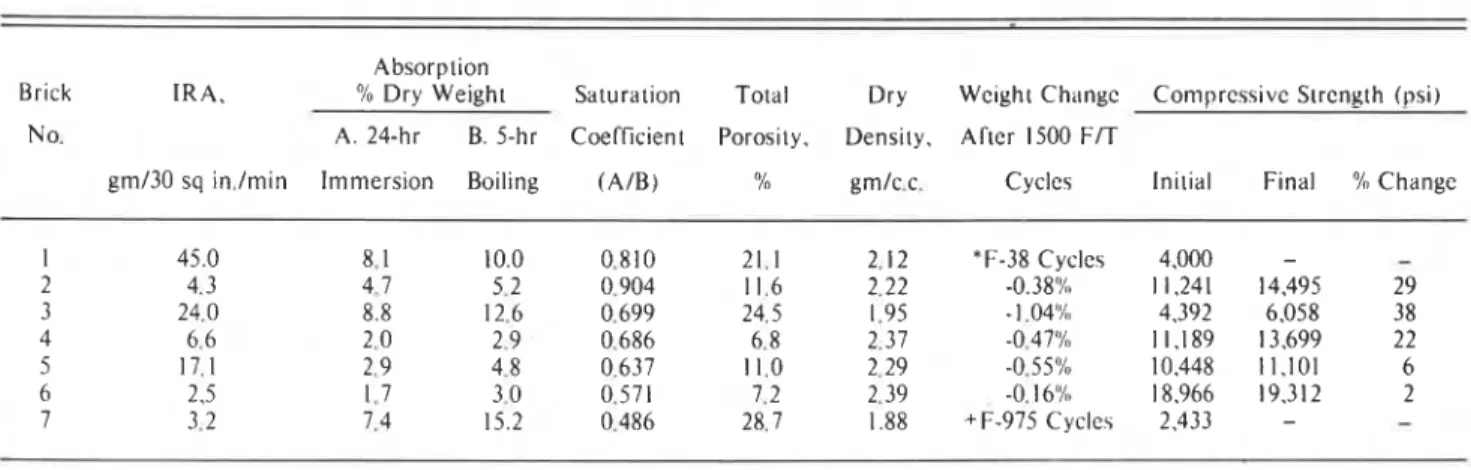
provide comparable data to relate to the clay bricks. Freeze-thaw cycling tests were started January 30. 1962 and terminated, upon completion of 1500 cycles, on January 13, 1970. It was only possible to complete four cycles in a five-day work week. so the procedure was modified to permit air drying after every 4th cycle. The drying period was thereby increased by 24 hours. At 114 cycles, samples were dried for 72 hours at 230°F (I 10°C) and their dry weights checked against the original. Weight checks were made periodically during the remainder of the cycling period. Failure was defined as ( I ) development of structural cracks or other visual deterioration, or (2) weight loss exceeding 5 per cent of the original weight. After the final weight check at the end of the test, surviving samples were tested for compressive strength. These results are shown in Table I. Discussion
All five extruded clay bricks survived the freeze-thaw cycling tests with minimal weight changes. The dry-press clay brick failed at 38 cycles and the concrete brick at 975 cycles.
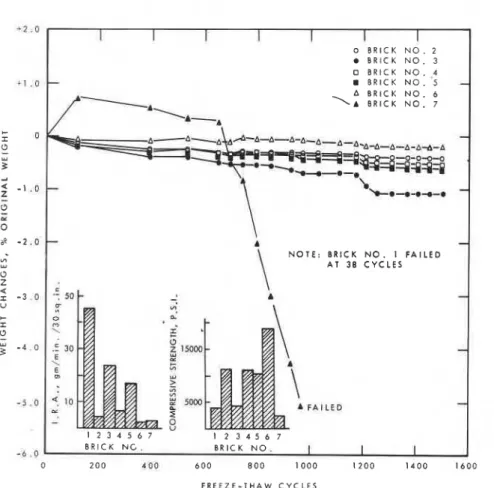
The fa'ilures .were for entirely different reasons. Cracks appeared in the clay brick at 7 cycles, a t ' l 5 cycles there was some flaking and spalling, and at 38 cycles the brick had literally fallen apart. The concrete brick failed by weight loss. As anticipated, it gained weight as hydration of the cement continued during early cycling. Weight reached a maximum at 114 cycles and then started to decline. At 690
Table I. proper tie.^ of bric.k.r.
Absorption
Brick IRA. % Dry Weight Saturation Total Dry Wcight Change Coniprcssive S~rcngth (psi) No. A. 24-hr B. 5-hr Coerficient Porosity. Density, Arter 1500 F I T
gml30 sq in,/min Immersion Boiling (AIB) "/" gm1c.c. Cycles Initial Final %I Change I 45.0 8.1 10.0 0.8 10 21.1 2.12 *F-38 Cycles 4,000 -
-
2 4.3 4.7 5.2 0.904 11.6 2.22 -0.38'%1 1 1,241 14,495 29 3 24.0 8.8 12.6 0.699 24.5 1.95-
1.04'%, 4.392 6.058 38 4 6.6 2.0 2.9 0.686 6.8 2.37 -0.47'%, 11.189 13.699 22 5 17.1 2.9 4.8 0.637 11.0 2.29 -0.55'%, 10.448 11,101 6 6 2,5 1.7 3.0 0.571 7.2 2.39 -0.16'%1 18.966 19.3 12 2 7 3.2 7.4 15.2 0.486 28.7 1.88 +F-975 Cycles 2.433 --
* - Fa~lure by crack~ng+ - Failure by surl"ice erosion
B r ~ c k N o I -Clay - d r y press
Bricks Nos. 2 ro 6 ~ n c l u s ~ v e - Clay - extruded
Bricks Nos. 4 and 5 are from same plan[ - d~frerent I R A ranges B r ~ c k No. 7 -Concrete Dunbrik
Only one sample of each brick was included in the study because of space limitations in the freezer. ~ a c h was tested for Initial Rate of Absorption (IRA), and absorption by the 24-hour immersion and five-hour boiling tests. From these data, saturation coefficients, total porosity and dry density values were calculated. The bricks were then cut in half; one portion was used for a compressive strength test and the other for freeze-thaw cycling. All tests followed procedures in CSA Standard A82.2-1954, although these procedures are not recommended to determine absorption values for concrete brick. They were used in this instance to
cycles the weight was back to theoriginal value and at 975 i t exceeded the 5 per cent failure figure. Weight losses resulted frojh a gradual erosion of surface material (as evidenced by a collection of sand in the freezing tray each day) and a rounding-off of the originally sharp, well-defined corners and edges. I t was not a structural failure and there was no similar performance in any of the clay bricks.
Weight losses in the surviving clay bricks ranged from 0.16 to 1.04 per cent. They increased gradually from the start of cycling, with the biggest jump occurring between 1177 and 1216 cycles (Figure 1). Surprisingly, compressive strength J O U R N A L OF T H E C A N A D I A N C E R A M I C SOCIETY
0 B R l C K N O . 2 B R l C K N O . 3 BRlCK N O . ,4 + 1 . a
-
BRlCK N O . 5-
A B R l C K N O . 6---
\A B R l C K N O . 7 -' 4 -0 2 w 3 d 4 - 1 0 -I
f
be--.-.**-
2 0 8 - 2 . 0-
-
Y) 0 w C N O T E : B R l C K N O . I F A I L E D AT 3 8 C Y C L E S2
- 3 0 ' 7 5 0-
-
U P 9 + 0 Q I'.
0 2 E ' -4.0 .E 30 C1 ; l50W-
E-.
m + "7 S Y t "7 w, - 5 . 0f
10 Z 5W-
e5
F A I L E D-
1 2 3 4 5 6 7S
1 2 3 4 5 6 7 B R l C K N C . -6 .O B R I C K N O I I I o Z O O a o o b o o 8 0 0 1 0 0 0 1 2 0 0 1 4 0 0 1 6 0 0FIGURE 1. Weight c h a n g e vs. labo-
F R E E Z E - T H A W C Y C L E S
ratory freeze-thaw cycling,
values for surviving bricks were superior to original values; it
/
had been anticioated that freezing would result in some reduction in strength. T h e biggest percentage change oc- curred in brick No. 3; it had the lowest original value at 4392 psi, the highest weight loss 1.04 per cent, and also the highest IRA among the extruded bricks at 24 gm/3d sq in./min. Conversely, brick No. 6 had the lowest increase in compres- sive strength compared with the highest initial value, the lowest weight loss, and the lowest IRA. Possibly there was some sort of hydration, during the test period, that was proportional to the ability of the bricks to absorb water. In any event, it is evident that 1500 cycles of freezing and thawing did not cause any reduction in the compressive strength of the surviving bricks.Comparison of weight loss and other properties
T h e properties of the bricks are rated according to their magnitude in Table 11. Absorption properties, including IRA, 24-hour immersion, 5-hour boiling, saturation coeffi- cient, and total porosity, are listed in the order of increasing magnitude, while dry density and compressive strength are by decreasing magnitude. Weight loss is listed by increasing magnitude. It will be seen that weight loss ratings closely parallel IRA and compressive strength ratings, i.e., weight loss increases as IRA increases and compressive strength decreases. as noted above.
It can also be seen that the increased final compres- sive strength values did not change from the original rating order. T h e lack of a consistent pattern in increased
compressive strength, expressed as a percentage of the original value, is also evident.
It also appears, from Figure 1, that wight loss is more closely related to compressive strength than to IRA. The biggest gap in the weight loss pattern is between 0.55 percent for brick No. 5 and 1.04 percent for brick No. 3; there is also a big spread in compressive strength (10,445 versus 4392 psi) for these two bricks, while the big gap in the IRA pattern is between 6.6 and 17.1 gm/30 sq in./min for bricks Nos. 4 and 5.
T h e performance of two of the bricks should be noted. T h e dry-press brick (brick No. I ) , which showed distress at 7 cycles and failed at 38, meets all the property requirements of CSA A82.1 as shown in the following comparison:
Compressive 5-Hour Boiling Saturation Strength, psi Absorption, % Coefficient CSA A82.1 requirement* 2 5 3 (Min.) 22.0 (Max.) 0.88 (Max.)
Dry-press brick 4000 10.0 0.8 1
It exceeds all requirements with comfortable margins, and its saturation coefficient of 0.81, i.e., 81 percent "easily" filled pores, indicates a more than adequate 19 percent "relief valve" to accommodate the 9 percent expansion if all the water in the "easily filled" pores freezes. Paradoxically, this brick, durable according to specification requirements yet far
VOLUME 44, 1975
Conclusion
T h e study supports evidence f r o m f i e l d observations t h a t the prediction o f durability o n t h e basis o f criteria i n c u r r e n t C S A a n d A S T M Specifications is n o t always infallible.
References
(1) ASTM C67 Standard Methods o f Sampling and Testing Brick and Structural Clay Tile.
VOLUME 44, 1975
(2) CSA Standard A82.2 Me~hods of Si~nlpling and Test~ng Rr~ck. (3) J.W. McBurney. The Relation o f Freezing ant1 Thi~wlng
Resistance to Physical Properties o f Clay and Shale I3~11lil1ng Brick. Pr0ceeditrg.r. T/lir[v-ei~h/h Atrtrricrl X1ee111l.q. AS7.M. 3 5
247-251 (1935).
(4) J.W. McBurney and A.R. Eberlc. Freezing and T h n u ~ n g Tests for Building Brick. Paper presenred at the Forty-lirsr Annual Meeting. ASTM. 1938.
(5) J.W. McBurney and P.V. Johnson. Durabil~iy of Dealred Brick. J. Am. Ceram. Soc. 39 (5): 159-168 (1956).
(6) ASTM Specification C62 Building Brick (Solid Masonry'Uni~s made from Clay or Shale).