HAL Id: inserm-01828914
https://www.hal.inserm.fr/inserm-01828914
Submitted on 3 Jul 2018HAL is a multi-disciplinary open access
archive for the deposit and dissemination of sci-entific research documents, whether they are pub-lished or not. The documents may come from teaching and research institutions in France or abroad, or from public or private research centers.
L’archive ouverte pluridisciplinaire HAL, est destinée au dépôt et à la diffusion de documents scientifiques de niveau recherche, publiés ou non, émanant des établissements d’enseignement et de recherche français ou étrangers, des laboratoires publics ou privés.
A standardised representation for non-parametric fMRI
results
Camille Maumet, Guillaume Flandin, Martin Perez-Guevara, Jean-Baptiste
Poline, Justin Rajendra, Richard Reynolds, Bertrand Thirion, Thomas E.
Nichols
To cite this version:
Camille Maumet, Guillaume Flandin, Martin Perez-Guevara, Jean-Baptiste Poline, Justin Rajendra, et al.. A standardised representation for non-parametric fMRI results. OHBM 2018 - Annual meeting of the Organization of Human Brain Mapping, Jun 2018, Singapore, Singapore. pp.1-4. �inserm-01828914�
A standardised representation for non-parametric fMRI results
1. Camille Maumet. University of Rennes, Inria, CNRS, Inserm, IRISA, Rennes, France.
2. Guillaume Flandin, Wellcome Trust Centre for Neuroimaging, UCL Institute of Neurology, London, UK.
3. Martin Perez-Guevara, Criteo, Paris, France
4. Jean-Baptiste Poline, McGill University, Ludmer Centre, Montreal Neurological Institute, Montreal, Quebec, Canada
5. Justin Rajendra, Scientific and Statistical Computing Core, National Institute of Mental Health, National Institutes of Health, USA
6. Richard Reynolds, Scientific and Statistical Computing Core, National Institute of Mental Health, National Institutes of Health, USA
7. Bertrand Thirion, Inria, Saclay, France
8. Thomas E. Nichols Oxford Big Data Institute, Li Ka Shing Centre for Health Information and Discovery, Nuffield Department of Population Health, University of Oxford, Oxford, UK.
Introduction
Reuse of data collected and analysed at another site is becoming more prevalent in the neuroimaging community (cf. for example (Milham et al. 2017)) but this process usually relies on intensive data and metadata curation. Given the ever-increasing number of research datasets produced and shared, it is desirable to rely on standards that will enable automatic data and metadata retrieval for large-scale analyses (Wilkinson et al. 2016).
We recently introduced NIDM-Results (Maumet et al. 2016), a data model to represent and publish data and metadata created as part of a mass univariate neuroimaging study (typically functional magnetic resonance imaging). Here we extend this model to allow for the representation of non-parametric analyses and we introduce a JSON API that will facilitate export into NIDM-Results.
Methods
This work was developed within NIDASH, an international collaboration dedicated to projects advancing neuroimaging data sharing. The group works openly and meets weekly through videoconferences; minutes of online discussions are publicly available (cf.
https://github.com/incf-nidash/nidm). We also received feedback from other members of the neuroimaging community.
NIDM-Results relies on semantic web technologies. Although those techniques are very powerful, they are not yet widespread in our scientific community and the learning curve with these tools can be steep. In order to facilitate the development of export tools into NIDM-Results, we created a simple JSON API that can be used by neuroimaging software developers as an intermediate step to generate a NIDM-Results document.
Results
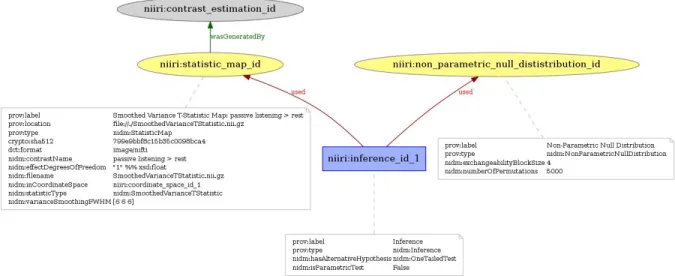
Fig. 1. provides an overview of the extension for non-parametric tests. Briefly, a new object was created to store information about the non-parametric null distribution, including the number of permutations used and the size of the exchangeability blocks. In addition, a new statistic type was created to represent smoothed-T statistic, a variant of the T-Statistic in which the variance is smoothed also sometimes referred to as "pseudo-T Statistic". To test the usability of the specification, we added capabilities to the SnPM software package (Nichols and Holmes 2002) to export its results into NIDM-Results.
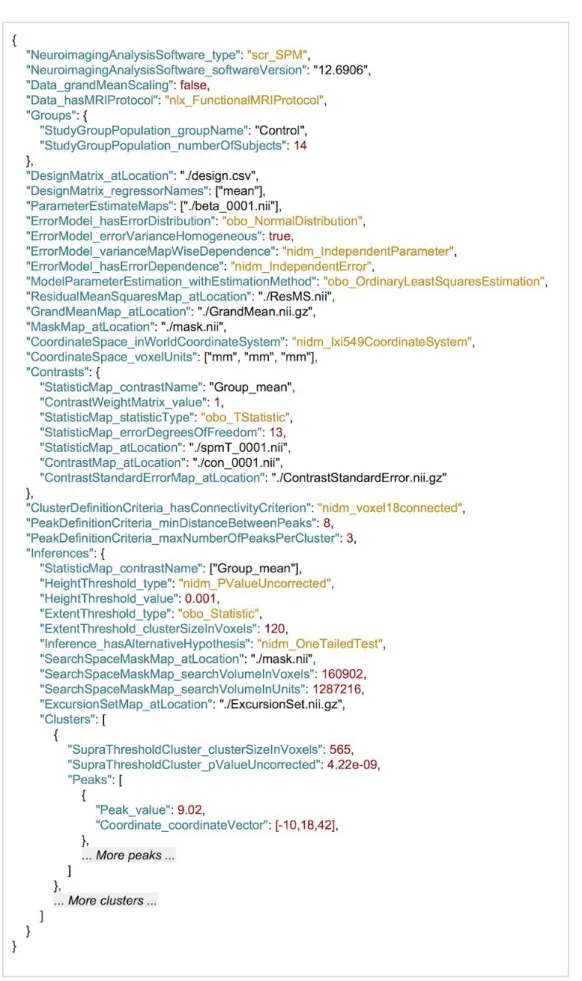
The JSON API is publicly available and open for comments at https://tinyurl.com/y84uxobq. The document is divided into two main subsections describing mandatory and optional fields respectively. Fig. 2 provides an example of a compliant JSON file including information about the neuroimaging
software, data scaling, design matrix, error model, contrasts and statistics as well as a list of the peaks and clusters found in the thresholded map. We have built libraries in Python (https://github.com/incf-nidash/nidmresults) and MATLAB (as part of SPM (Penny et al. 2011)) that can be used to create an NIDM-Results document from a document created in agreement with the JSON API. The MATLAB library is used by SnPM to generate its NIDM-Results export.
Conclusions
We have provided a data model to represent data and metadata created by mass-univariate nonparametric studies. We hope that this model will ease realization of large-scale image-based meta-analyses. We also welcome feedback and new contributions from the community on the specifications and the various implementations. In the future, we would like to extend the list of nonparametric neuroimaging tools (e.g. AFNI's (Cox 1996) 3dttest++ or FSL's (Jenkinson et al. 2012) randomise) that provide export to NIDM-Results. By providing an easy mechanism to export to NIDM-Results, our goal is to increase interoperability between existing neuroimaging software packages and to facilitate the development of generic tools. As an example of such tool, we have started developing viewers in MATLAB and Python that can be used to display a NIDM-Results pack, regardless of the neuroimaging software package that was used for the analysis.
Figures
Fig. 2 . Example of JSON file for a group fMRI inference with an uncorrected voxelwise threshold p<0.001.
Acknowledgments
NIDASH meetings are supported by the International Coordinating Neuroinformatics Facility (INCF). This work was supported by a 2016 INCF seed travel grant for NIDM-Results (CM). We would like to acknowledge the work of all the INCF task force members as well as of many other colleagues who have helped the task force. We are particularly indebted to M. Abrams and the INCF secretariat staff. We also acknowledge the long-standing support of DDWG activities by the BIRN (NIH 1 U24 RR025736-01), and the Wellcome Trust for support of (CM, TEN).
References
Cox, R. W. 1996. “AFNI: Software for Analysis and Visualization of Functional Magnetic Resonance Neuroimages.” Computers and Biomedical Research, an International Journal
, 162–73.Jenkinson, Mark, Christian F. Beckmann, Timothy E. J. Behrens, Mark W. Woolrich, and Stephen M. Smith. 2012. “FSL.” NeuroImage
62 (2):782–90.Maumet, Camille, Tibor Auer, Alexander Bowring, Gang Chen, Samir Das, Guillaume Flandin, Satrajit Ghosh, et al. 2016. “Sharing Brain Mapping Statistical Results with the Neuroimaging Data Model.” Scientific Data
3 (160102). Nature Publishing Group. https://doi.org/10.1038/sdata.2016.102.Milham, Michael, Cameron Craddock, Michael Fleischmann, Jake Son, Jon Clucas, Helen Xu, Bonhwang Koo, et al. 2017. “Assessment of the Impact of Shared Data on the Scientific Literature.” bioRxiv
. https://doi.org/10.1101/183814.Nichols, Thomas E., and Andrew P. Holmes. 2002. “Nonparametric Permutation Tests for Functional Neuroimaging: A Primer with Examples.” Human Brain Mapping
15 (1):1–25. Penny, William D., Karl J. Friston, John T. Ashburner, Stefan J. Kiebel, and Thomas E.Nichols. 2011. Statistical Parametric Mapping: The Analysis of Functional Brain Images
. Elsevier.Wilkinson, Mark D., Michel Dumontier, I. Jsbrand Jan Aalbersberg, Gabrielle Appleton, Myles Axton, Arie Baak, Niklas Blomberg, et al. 2016. “The FAIR Guiding Principles for Scientific Data Management and Stewardship.” Scientific Data