READ THESE TERMS AND CONDITIONS CAREFULLY BEFORE USING THIS WEBSITE. https://nrc-publications.canada.ca/eng/copyright
Vous avez des questions? Nous pouvons vous aider. Pour communiquer directement avec un auteur, consultez la première page de la revue dans laquelle son article a été publié afin de trouver ses coordonnées. Si vous n’arrivez pas à les repérer, communiquez avec nous à [email protected].
Questions? Contact the NRC Publications Archive team at
[email protected]. If you wish to email the authors directly, please see the first page of the publication for their contact information.
NRC Publications Archive
Archives des publications du CNRC
This publication could be one of several versions: author’s original, accepted manuscript or the publisher’s version. / La version de cette publication peut être l’une des suivantes : la version prépublication de l’auteur, la version acceptée du manuscrit ou la version de l’éditeur.
Access and use of this website and the material on it are subject to the Terms and Conditions set forth at
Hydration of C4AF + gypsum : study of various factors
Ramachandran, V. S.; Beaudoin, J. J.
https://publications-cnrc.canada.ca/fra/droits
L’accès à ce site Web et l’utilisation de son contenu sont assujettis aux conditions présentées dans le site
LISEZ CES CONDITIONS ATTENTIVEMENT AVANT D’UTILISER CE SITE WEB.
NRC Publications Record / Notice d'Archives des publications de CNRC:
https://nrc-publications.canada.ca/eng/view/object/?id=1bdcea94-f308-4a7a-8f57-307ef50a275a
https://publications-cnrc.canada.ca/fra/voir/objet/?id=1bdcea94-f308-4a7a-8f57-307ef50a275a
National Research
Conseil national
.d
I
$
Council Canada
de recherches Canada
BLDG
HYDRATION OF C4AF
+
GYPSUM
:
STUDY
OF VARIOUS FACTORS
by
V.S.
Ramachandran and
J. J.
Beaudoin
ANALYZED
Reprinted from
09I
7th International Congress on the
Chemistry of Cement
II
Vol. 11,
Paria
1980
p. 11-25
11130
DBR Paper No. 980
Division of Building Research
This publication i s being distributed by the Division of Building R e s e a r c h of the National R e s e a r c h Council of
Canada. I t should not b e reproduced in whole o r in p a r t
without p e r m i s s i o n of the original publisher.
T h e
Di-
vision would b e glad to b e of a s s i s t a n c e in obtaining s u c h p e r m i s s i o n .
Publications of the Division m a y b e obtained by m a i l - ing the a p p r o p r i a t e r e m i t t a n c e (a Bank, E x p r e s s , o r P o s t Office Money O r d e r , o r a cheque, m a d e payable to the R e c e i v e r G e n e r a l of Canada, c r e d i t NRC) t o
the
National R e s e a r c h Council of Canada, Ottawa. K l A OR 6
.
Stamps a r e not acceptable.
A l i s t of a l l publications of the Division i s available and m a y b e obtained f r o m the Publications Section, Divieion of Building R e s e a r c h , National R e s e a r c h Council of Canada, Ottawa. KIA OR6.
Hydration of C,AF+gypsum
:
study of various factors
L'hydratation du
C4AF
+
gypse
:
Btude de divers facteurs
V.S. RAMACHANDRAN (Senior Research Officer) and J.J. BEAUDOIN (Associate Research Officer)
Division of Building Research, National Research Council of Canada, Ottawa, Ontario
K
1
A OR 6 Canada.
RESUME: Les auteurs hydratent de l'aluminoferrite tetracalcique (C4AF) contenant du gypse dans des proportions de 0, 5, 10, 20 et 30% 2 25 ou 80°C soit sous forme de disques (prlcomprimls 2 des pressions de 140 et de 690 MPa), soit sous forme de poudre pour des rapports eaulciment de 0.5 et de 1.0.. 11s identifient et
quantifient les produits d'hydratation pour des periodes variant de quelques minutes 2 sept jours au moyen de la mSthode thermique difflrentielle. La sequence de formation des hydrates, c'est-2-dire l'hydrate hexagonal, l'hydrate cubique, l'ettringite, l'hydrate 2 basse teneur en sulfoaluminates et la solution solide, de msme que leurs interconversions dSpendent principalement de la temperature, de la teneur en gypse et du rapport initial eaulsolide. Les auteurs montrent que l'ettringite n'est pas necessairement un precurseur de la formation d'un hydrate 5 basse teneur en sulfoaluminates lorsque l'hydratation se fait 2 un trZs faible rapport eau/solide et
2 80°C.
SUMMARY: Tetracalcium aluminoferrite (C4AF) mixed with gypsum in amounts of 0, 5, 10, 20 and 30% was hydrated at 25 or 80°C either as discs (pre-compacted at pressures of 140 and 690 MPa) or in powder form at water/cement ratios of 0.5 and 1.0. Hydration products formed at periods ranging from a few minutes to seven days were identified and estimated by the Differential Thermal Technique. The sequence of formation of hydrates - viz, hexagonal hydrate, cubic hydrate, ettringite, low sulphoaluminate and solid solution - and their interconversions were primarily dependent on gypsum content,temperature and initial water/solid ratio. The study indicated that ettringite need not necessarily be a precursor of the formation of low sulphoaluminate hydrate when hydration is carried out at a very low w/s ratio and 80°C.
INTRODUCTION
The ferrite phase comprising 8 to 12% of an average portland cement has received very little attention with respect to its hydration and physico-mechanical characteristics. This may be ascribed partly to the assumption that the ferrite and C3A phases in cement behave in a similar manner. There is evidence, however, that in the presence of gypsum significant differences exist in the hydration behaviour of C3A and C4AF, and there is no unanimous opinion on the sequence of hydration and types of hydration products formed under different conditions.
In an earlier investigation (1) of the effect of temperature on the physico-mechanical characteristics of hydrating C4AF at very low w/c ratios, several new observations were made. This work has been extended to a sequential examination of the hydration products formed in the system CqAF-CaSO4.2H20-H20
(using varying w/s ratios) hydrated for different periods at 25 or 80°C.
EXPERIMENTAL
Tetracalcium aluminoferrite (C4AF) used in this investigation had the following chemical analysis:
A1203 = 20.43%, Fe2O3 = 32.65%, CaO = 45.82% and free
CaO <0.5% and loss on ignition 0.37%; the surface area was 3300-3400 cm2g-1 (Blaine).
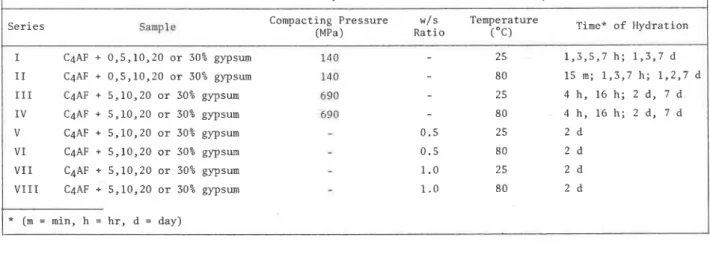
Eight groups of starting materials, the temperature of hydration, and the periods at which the thermo- grams were obtained are described in Table I. The samples were analysed semi-quantitatively by the DSC (Differential Scanning Calorimktric) technique using the DuPont 900 thermal analysis system. Details of these measurements have been described (1) X-ray powder photographs were obtained with a Philips Camera using a CuKa source; length changes were measured by a modified,Tuckerman gauge extenso- meter (2); and rate of heat development during hydration was determined by a conduction calorimeter (1).
RESULTS AND DISCUSSION
Different types of hydration products are formed in the CqAF-CaSO4.2H20-H20 system, depending on initial proportions of materials, temperature and time of hydration. The compounds that may be present at a
I I
particular time of hydration may consist of unreacted C4AF, CaS04.2H20 and Hz0 and the hydrated products
Cq (A, F)H13 (hexagonal phase), C3 (A, F)H6 (cubic phase),
c~(A,F)~cS.H~~ (ettringite)
,
C ~ ( A , F ) C ~ . H ~ ~ (lowsulphoaluminate) and a solid solution of the low
sulphoaluminate with C4(A,F)H13. In this paper, the
solid solution is also referred to as low sulpho- aluminate. In each mole of the hydrated product
containing x mole of Fe and y mole of A,
x
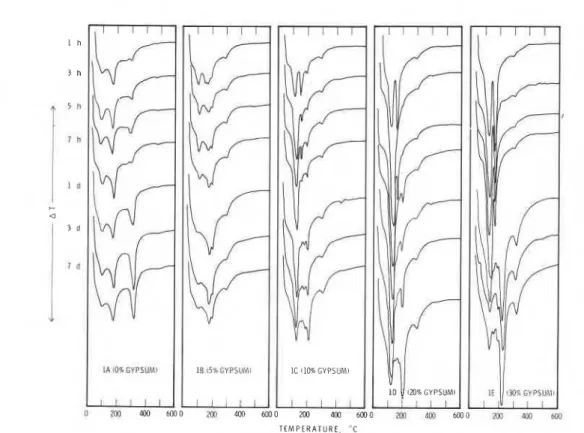
+ y = 1.Tetracalcium aluminoferrite (C4AF) does not show any thermal effect in the temperature range studied. Gypsum indicates two endothermal effects with peaks in the range 150 to 200°C, representing the stepwise removal of water. At low concentrations of gypsum the two peaks may merge in a single endothermal peak at about 150 to 160°C. Free water is indicated by an endothermal effect at about 100°C. The hexagonal phase exhibits an endothermal peak at about 160 to 17S°C, the cubic form at about 300 to 32S°C. Ettringite is identified by an endothermic peak at about 110 to 125°C and the low sulphoaluminate phase by an endothermal effect at about 200 to 210°C. Another of lower intensity is exhibited at about 300°C. The solid solution of low sulphoaluminate with C4(A,F)H13 has thermal effects similar to those of low sulphoaluminate. Small variations in the characteristic peak temperatures may occur, but because products of hydration are examined
sequentially at different intervals these variations do not pose any problems for identification. Thermal curves of CqAF-gypsum mixtures formed at 140 MPa and hydrated for different lengths of time at 2S°C are shown in Figure 1. Figure 1A represents thethermogramsof C4AF hydrated for different periods. The first endothermal effect occurring at about 100°C is due to desorbed water, the second at 170 to 180°C represents the dehydration of the hexagonal phase, and that at about 300 to 320°C is caused by the partial dehydration of the cubic phase. At 1 h both hexagonal and cubic phases are present. As hydration progresses, increased amounts of the cubic phase are formed by the conversion of the hexagonal phase, which is also formed continuously. Even at 7 days there is no complete conversion of the hexagonal to the cubic phase.
---
TABLE I
-
Materials Examined by the Differential Thermal TechniqueSeries Sample Compacting Pressure w/s Temperature
("C) Time* of Hydration
(MPa) Ratio
I C4AF + 0,5,10,20 or 30% gypsum 140 25 1,3,5,7 h; 1,3,7 d
I I C4AF + 0,5,10,20 or 30% gypsum 140 80 15 m; 1,3,7 h; 1,2,7 d
I11 C4AF + 5,10,20 or 30% gypsum 690 25 4 h, 16 h; 2 d, 7 d
IV C4AF + 5,10,20 or 30% gypsum 690 80 4 h, 16 h; 2 d, 7 d
V C4AF + 5,10,20 or 30% gypsum 0.5 25 2 d
V I C4AF + 5,10,20 or 30% gypsum 0.5 80 2 d
VII C4AF + 5,10,20 or 30% gypsum 1.0 2 5 2 d
VIII C4AF + 5,10,20 or 30% gypsum 1 .O 80 2 d
I A 10% GYPSUM)
0 2 0 0 4 0 0 6 W
T E M P E R A T U R E . 'C
Fig. 1 - D i f f e r e n t i a l thermal behaviour of C4AF + gypsum (140 MPa) hydrated t o d i f f e r e n t p e r i o d s a t 2S°C
Formation o f t h e hexagonal phase and i t s c o n v e r s i o n t o t h e c u b i c phase proceeds much f a s t e r i n t h e C3A-HzO system than i n t h e C4AF-Hz0 system ( 3 ) . Whereas C3A forms hexagonal p l a t e s w i t h i n a few minutes o f c o n t a c t with H20, t h e C4AF phase hydrated t o t h e same e x t e n t may n o t develop a well-defined morphology ( 4 ) . I t appears t h a t a h i g h e r s u r f a c e a r e a product enveloping t h e unhydrated C4AF g r a i n s impedes t h e d i f f u s i o n of water molecules more e f f i c i e n t l y than t h e c r y s t a l l i n e product formed on t h e C3A g r a i n s .
Addition of 5% gypsum a l t e r s t h e ' h y d r a t i o n behaviour of C4AF (Figure 1B). In 3 e f i r s t hour of h y d r a t i o n gypsum (peaks i n t h e range 150 t o 170°C), t h e
hexagonal phase (peak a t about 180°C), and e t t r i n g i t e (peak a t about 105 t o llO°C) a r e p r e s e n t . As hydration p r o g r e s s e s t h e i n t e n s i t y of t h e peak due t o e t t r i n g i t e d e c r e a s e s . Low sulphoaluminate formed from t h e conversion o f e t t r i n g i t e can be i d e n t i f i e d by a peak a t about 200°C. A t 7 days t h e major phases p r e s e n t i n t h e system a r e t h e low sulphoaluminate and t h e hexagonal form. The absence of an i n t e n s e endethzrmal peak a t 300°C suggests t h a t a t 5% gypsumtheconversion of t h e hexagonal t o t h e c u b i c phase i s r e t a r d e d . S i m i l a r o b s e r v a t i o n s were r e p o r t e d on t h e i n t e r - conversion r e a c t i o n s i n t h e C3A-HzO-gypsum system (5). I t was suggested t h a t s o r p t i o n of even small amounts of SO4-- a r e capable of r e t a r d i n g t h e conversion o f hexagonal t o c u b i c phase. As t h e amount o f gypsum i n t h e mixture i s i n c r e a s e d from 5 t o 30%, l a r g e r amounts of e t t r i n g i t e a r e formed w i t h i n minutes of c o n t a c t with water (Figure 1 (C t o E ) ) . The commencement of conversion o f e t t r i n g i t e t o low sulphoaluminate i s delayed a s t h e c o n c e n t r a t i o n o f gypsum i s i n c r e a s e d i n
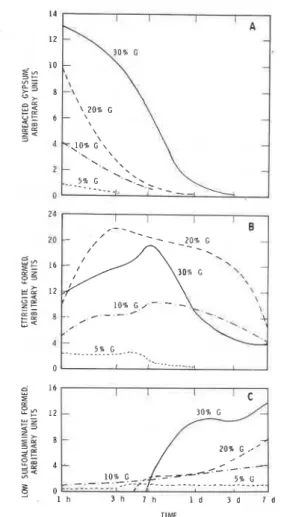
t h e mixture. Almost complete i n h i b i t i o n of t h e formation of t h e hexagonal phase a l s o occurs. In most samples both e t t r i n g i t e and monosulphate c o - e x i s t a t p e r i o d s of h y d r a t i o n from a few hours t o s e v e r a l days. The r e l a t i v e amounts of unreacted gypsum and high and low sulphoaluminate contained i n samples a t d i f f e r e n t times a t 2S°C a r e shown i n Figure 2 . C a l c u l a t i o n s suggest t h a t w i t h i n 1 h r e l a t i v e l y more gypsum h a s r e a c t e d t o form e t t r i n g i t e i n mixtures c o n t a i n i n g l a r g e r amounts of gypsum (Figure 28). Conduction c a l o r i m e t r i c d a t a a l s o i n d i c a t e t h a t i n t h e f i r s t 30 min l a r g e r amounts of h e a t a r e developed i n mixtures c o n t a i n i n g g r e a t e r amounts of gypsum. Although almost a l l gypsum'has r e a c t e d a t 7 h i n samples c o n t a i n i n g 5 t o 20% gypsum, s u b s t a n t i a l amounts a r e s t i l l p r e s e n t i n t h e mixture prepared with 30% gypsum (Figure 2A). A l l samples show a general d e c r e a s e i n t h e amount of e t t r i n g i t e a f t e r 3 t o 7 h o f h y d r a t i o n and an i n c r e a s e i n t h e amount of t h e low sulphoaluminate phase. I t i s g e n e r a l l y b e l i e v e d t h a t e t t r i n g i t e begins t o convert t o low sulphoaluminate a f t e r a l l gypsum has been consumed. In mixtures c o n t a i n i n g low amounts of gypsum t h i s may be v a l i d ; b u t a t 30% gypsum, although t h e r e i s a decrzase i n t h e amount o f e t t r i n g i t e and an i n c r e a s e i n t h e amount of low sulphoaluminate, t h e r e i s s t i l l a s u b s t a n t i a l amount of unreacted gypsum a t 7 h. I t appears t h a t a f t e r t h i s l e n g t h o f time t h e r e a c t i o n between e t t r i n g i t e and C4AF t o form low sulphoaluminate p r o g r e s s e s a t a f a s t e r r a t e than t h e r e a c t i o n between C4AF and gypsum t o form e t t r i n g i t e . A h i g h e r r a t e of d e c r e a s e i n t h e amount of e t t r i n g i t e i n t h e sample c o n t a i n i n g 30% gypsum a f t e r 7 h i n d i c a t e s t h a t t h e
TIME
Fig. 2
-
Relative amounts of variousphases present in the CqAF-CaS04.2H20 (140 MPa) system hydrated at 2S°C for
different periods. ( G : per cent gypsum
-
with respect to C4AF)C4AF surface becomes more easily accessible for the formation of ettringite and its conversion to mono-
sulphates after this period (Figure 28). Length
change measurements reveal that the mixture contain- ing 30% gypsum shows as high an expansion as 10.8% at 7 h, compared to only 2.9% for that containing 20% gypsum. A higher expansion may result in a higher porosity and better availability of the C4AF surface for reactions.
Differential thermal characteristics of C4AF-gypsum mixtures containing 0, 5, 10, 20 and 30% gypsum
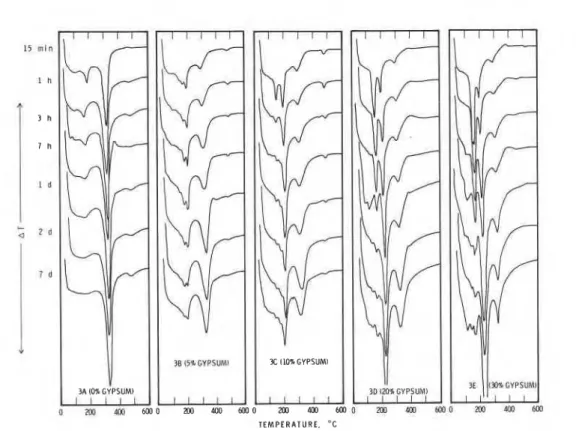
(pressed at 140 MPa) and hydrated at 80°C to different periods are shown in Figure 3. The C4AF sample forms a large amount of the cubic phase within
15 min (Figure 3A). Hydration occurs at a faster
rate at 80°C than at 2S°C, as evidenced by an almost complete absence of the hexagonal phase after about one day. At 80°C there is a possibility of direct conversion of the C4AF to the cubic form without the
formation of a metastable phase (6). At an addition
of 5% gypsum, low sulphoaluminate is formed even at
15 min (Figure 3B). A concurrent formation of the cubic phase is also evident, increasing as hydration progresses. At a dosage of 5% gypsum, the formation of the cubic form is retarded more efficiently at 25 than at 80°C (Figure 1B). As the percentage ofgypsum is increased from 5 to 30%, lower amounts of cubic phase are formed owing to the preferential reaction of C4AF with gypsum to form sulphoaluminate. The rate of consumption of gypsum and formation of low sulpho- aluminate are shown in Figure 4. The low sulpho- aluminate form evident at 15 min increases as
hydration progresses [Figure 4B) ; the ettringite
phase, if present at all, is formed in small amounts. It is generally suggested that the initial product of hydration of C3A or C4AF in the presence of gypsum is ettringite. The non-existence of ettringite in C4AF- gypsum mixtures formed at 140 MPa and hydrated at 80°C suggests that in a low porosity system, in which the particles of gypsum and C4AF are in intimate contact with each other, the mobility of ions is restricted, and at this temperature a direct formation of low sulphoaluminate may be favoured. The other possibility is that ettringite formed initially converts to low sulphoalurninate at an extremely fast rate. Further work is in progress to resolve the question of the mechanism involved in the direct formation of low sulphoaluminate in low porosity systems.
Figure 5 compares the thermal characteristics of hydrated products prepared from CqAF-gypsum mixtures
(pressed at 690 MPa) containing 5, 10, 20 and 30% gypsum and hydrated to different periods at 2S°C. Generally, gypsum is consumed at a slower rate inthis mixture and the rate of ettringite formation and its conversion to low sulphoalurninate is retarded to a greater extent than in one formed at 140 MPa
(Figure 1B to E). At a pressure of 690 MPa the
particles in the sample are in much more intimate contact with each other and the effective porosity is much lower than in that prepared at 140 MPa.
The mobility of ions is restricted in samples made at a higher pressure, facilitating the formation of products at the original sites of the starting materials. Hydration and interconversions may be impeded, therefore, in samples formed at 690 MPa. The thermograms of C4AF-gypsum mixtures formed at 690 MPa and hydrated at 80°C for different periods are shown in Figure 6. There is evidence of simultaneous formation of both ettringite and low sulphoaluminate as a consequence of high temperature and low porosity.
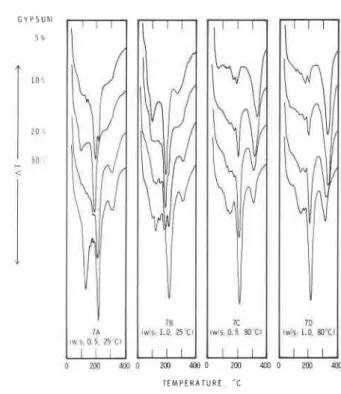
Figure 7 represents the thermal curves of C4AF-
CaS04-2H20 mixtures hydrated at w/s = 0.5 or 1.0 for
two days at 25 or 80°C. Most samples hydrated for two days at 25°C contain mainly low sulphoalurninate. The interconversions seem to occur at a faster rateat higher w/s ratios. At 80°C and low gypsum content, C4AF hydrates to form the cubic form. The conversion of ettringite to monosulphate also occurs at a faster rate. A combination of higher w/s ratio and higher temperature is conducive to faster hydration and interconversions.
Most samples were also subjected to XRD studies. In many, especially at earlier times of hydration, though thermal peaks indicated the formation of various products of hydration, XRD did not. Either the amounts of hydration products were low or they were not well crystallized for identification purposes by XRD technique.
T E M P E R A T U R E . "C
Fig. 3 - Differential thermal behaviour of CqAF+gypsum (140 MPa) hydrated to different periods at 80°C 16 - 12 - -
-
-..
T ...-- _ . _ _ - - - - _ _ - - 5%. - -
G 0 I I I I I I I 15 rnin 1 h 3 h 5 h 7 h I d 2 d 3 6 7 4 TIMEFig. 4 - Relative amounts of gypsum and low sulphoaluminate present in the CqAF-CaS04.2H20 (140 MPa) system hydrated at 80°C for different periods.
(G:
per cent gypsum with respect to C4AF)4 h A 16 h 2 d 7 d
-
4 5 A 15% GYPSUM1 I l l 0 200 4a 5C I I * GYPSUM! I l l o m 4 0 T E M P E R A T U R E , "CFig. 5 - Differential thermal behaviour of CqAF+gypsum (690 MPa) hydrated to different periods at 25OC
D ZCO Q O O MO 4 W O MO M O O .W dM
-- T E M P E R A T U R E . " C
Fig. 6 - Differential thermal behaviour of CqAF+gypsum (690 MPa) hydrated to different periods at 80°C
CONCLUSIONS
1. The sequence of reactions and interconversions in the CqAF-CaSO4.2H20-H20 system at low w/s ratios and high temperatures is different from those occurring at normal w/s ratios.
2. In this low porosity system there is evidence at the original sites of the reactants of formation of cubic hydrate, low sulphoaluminate and ettringite. 3. At very low w/s ratios and higher temperatures low sulphoaluminate need not result from the conversion reaction involving ettringite. 4. Contrary to general belief, conversion of ettringite to low sulphoaluminate can occur even in the presence of gypsum.
5 . The Differential Thermal Technique is more sensitive than XRD for identifying and estimating various hydration products in the C4AF-CaS04-2H20-H20 system.
1.- V.S. RAMACHANDRAN and J.J. BEAUDOIN (1976), "Significance of water:solid ratio and temperature on the physico-mechanical characteristics of
T E M P E R A T U R E " C
Fig. 7 - Differential thermal behaviour of CqAF-gypsum (w/s 0.5 or 1.0) hydrated for 2 days at 25°C or 80°C
hydrating 4CaO.Al203.Fe203," Journal of Material Science, Vol. 11, 1893-1910.
2.- R.F. FELDMAN. P.J. SEREDA and V.S. RAMACHANDRAN (1964), "A study of length changes of compacts of portland cement on exposure to H20," Highway Research Record, No. 62, 106-118.
3.- R.F. FELDMAN and V.S. RAMACHANDRAN (1966), "Character of hydration of 3Ca0-A1203," Journal of the American Ceramic Society, Vo1..49, 268-272.' 4.- I. JAWED, S. GOT0 and R. KONDO (1976), "Hydration a
of tetracalcium aluminoferrite in presence of lime and sulfates," Cement and Concrete Research, Vol. 6, 441-454.
5.- R.F. FELDMAN and V.S. RAMACHANDRAN (1967). "The influence of CaS04.2H20 upon the hydration character of 3CaO.Al203," Magazine of Concrete Research, Vol. 18, 185-196.
6.- V.S. RAMACHANDRAN and R.F. FELDMAN (1973), "Significance of low water/solid ratio and temperature on the physico-mechanical characteristics of hydrates of tricalcium aluminate," Journal of Applied Chemistry and Biotechnology, Vol. 23, 625-633.