Publisher’s version / Version de l'éditeur:
Laser Physics, 4, pp. 525-528, 2005
READ THESE TERMS AND CONDITIONS CAREFULLY BEFORE USING THIS WEBSITE.
https://nrc-publications.canada.ca/eng/copyright
Vous avez des questions? Nous pouvons vous aider. Pour communiquer directement avec un auteur, consultez la première page de la revue dans laquelle son article a été publié afin de trouver ses coordonnées. Si vous n’arrivez pas à les repérer, communiquez avec nous à [email protected].
Questions? Contact the NRC Publications Archive team at
[email protected]. If you wish to email the authors directly, please see the first page of the publication for their contact information.
NRC Publications Archive
Archives des publications du CNRC
This publication could be one of several versions: author’s original, accepted manuscript or the publisher’s version. / La version de cette publication peut être l’une des suivantes : la version prépublication de l’auteur, la version acceptée du manuscrit ou la version de l’éditeur.
Access and use of this website and the material on it are subject to the Terms and Conditions set forth at
Tomographic imaging of molecular orbital with high harmonic
generation
Itatani, J.; Levesque, J.; Zeidler, D.; Spanner, M.; Corkum, P. B.; Villeneuve,
D. M.
https://publications-cnrc.canada.ca/fra/droits
L’accès à ce site Web et l’utilisation de son contenu sont assujettis aux conditions présentées dans le site LISEZ CES CONDITIONS ATTENTIVEMENT AVANT D’UTILISER CE SITE WEB.
NRC Publications Record / Notice d'Archives des publications de CNRC: https://nrc-publications.canada.ca/eng/view/object/?id=d13422db-161c-4dac-88c5-b909b13f7c5d https://publications-cnrc.canada.ca/fra/voir/objet/?id=d13422db-161c-4dac-88c5-b909b13f7c5d
525
Laser Physics, Vol. 15, No. 4, 2005, pp. 525–528.
Original Text Copyright © 2005 by Astro, Ltd.
Copyright © 2005 by MAIK “Nauka /Interperiodica” (Russia).
Although the total electron density in molecules is routinely measured by X-ray diffraction or electron scattering, only two methods are able to “see” the high-est occupied molecular orbitals (HOMO)—electron-momentum spectroscopy and scanning tunneling microscopy. Electron-momentum spectroscopy [1] is an e, 2e scattering technique that can determine the radially averaged density of the outermost valence elec-trons. Scanning tunneling microscopy [2] gives the electron density, distorted by surface states. We show that high-harmonic emission from molecules [3–9] allows the three-dimensional shape of the highest elec-tronic orbital to be measured, including the relative phase of the components of the wavefunction.
Molecular alignment is achieved via the rotational wavepacket technique: first, an intense but nonionizing laser pulse (60 fs, 1013 W/cm2, “pump”) is focused into
a supersonic N2 gas jet. This laser field gives a kick to
the molecules towards the laser polarization direction to create rotational wavepackets. Another time-delayed intense laser pulse (30 fs, 3 × 10¹⁴ W/cm2, “probe”) is
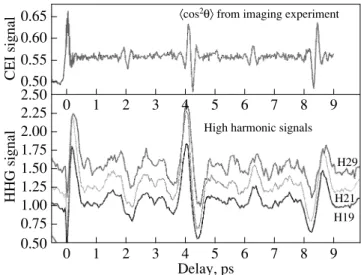
then focused into the gas jet to produce harmonics. Both pulses are linearly polarized in the same direction. Figure 1 shows the intensities of 19th, 21st, and 29th harmonics as a function of the pump–probe delay. The variation of harmonic intensities agrees well with the degree of molecular alignment 〈cos2θ〉 (top panel) that
was measured in a separate experiment [10]. All orders of harmonics show similar revivals. This result indi-cates that harmonics are enhanced when molecules are aligned parallel to the field and suppressed when they are perpendicular. The best alignment along the polar-ization of the pump pulse is achieved at the half revival at a delay of 4.1 ps. We use this revival to create an ensemble of aligned molecules. By rotating the polar-ization vector of the pump pulse, we are able to rotate
this ensemble relative to the probe pulse’s polarization vector.
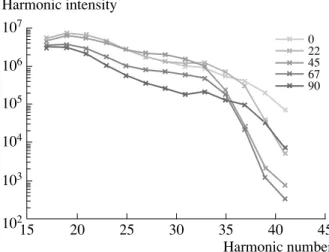
Figure 2 shows the intensity of harmonics generated from nitrogen molecules aligned at five different angles relative to the polarization axis of the pulse that gener-ates the harmonics.
Tomographic Imaging of Molecular Orbitals
with High-Harmonic Generation
J. Itatani
1, 2, J. Levesque
1, 3, D. Zeidler
1, H. Niikura
1,
P. B. Corkum
1, and D. M. Villeneuve
1,*
1 National Research Council of Canada, 100 Sussex Drive, Ottawa, Ontario K1A 0R6, Canada
2 University of Ottawa, 150 Louis Pasteur, Ottawa, Ontario K1N 6N5, Canada
3 INRS-Energie et Materiaux, Varennes, Québec J3X 1S2, Canada
*e-mail: [email protected] Received September 29, 2004
Abstract—High harmonics produced in aligned molecules contain structural information on bound electronic states. We have produced high harmonics from N2 molecules aligned in five directions relative to the laser polar-ization axis. The projected images of the highest molecular orbital (HOMO) are successfully reconstructed based on computed tomography using the observed harmonic spectra. The reconstructed wavefunction includes both amplitude and phase. We also show that attosecond bound-state electron wavepacket dynamics will man-ifest itself in the high-harmonic spectra.
0.75 0 CEI signal Delay, ps 1.00 1.25 1.50 1.75 2.00 2.25 0.50 2.50 0.50 0.55 0.60 0.65 1 2 3 4 5 6 7 8 9 0 1 2 3 4 5 6 7 8 9
High harmonic signals H29 H21 H19 〈cos2θ〉 from imaging experiment
HHG signal
Fig. 1. The lower panel shows the intensity of harmonics 19, 21, and 29 recorded at different pump–probe time delays. The pump pulse at time zero initiates a rotational wave-packet in gas-phase nitrogen. At different times, notably at 4.1 ps, a rotational revival occurs, resulting in a macro-scopic alignment of the molecular axis in space. The top panel shows the degree of alignment as quantified by the
〈cos2θ〉 measurement as recorded in a different experiment.
The agreement between the two shows that the harmonic emission is strongest when the molecular axis is parallel to the laser polarization.
STRONG FIELD
PHENOMENA
526
LASER PHYSICS Vol. 15 No. 4 2005
ITATANI et al.
Under our experimental conditions, the alignment dependence of tunnel ionization is small (angular vari-ation ~25%) and is approximately canceled by the spa-tial spread of the electron wavepacket in the continuum. We therefore conclude that the alignment dependence of harmonic intensities is dominated by the recombina-tion process.
When the wavepacket ψc recollides with N2, its
lat-eral spread reaches ~9 Å by quantum diffusion. This size is considerably larger than the size of molecules. The electron wavepacket seen by the molecule can thus be approximated by a chirped plane wave; i.e., ψc =
(p)exp[ipx – iKt], where p is the momentum of the electron and K(= p2/2) is the kinetic energy. The
induced dipole is then given by d(ω = K) ~
A(p)〈ψg|r|exp(ipx)〉. This expression is the spatial Fou-rier transform of rΨg projected onto the direction
per-pendicular to the laser polarization. Once we know the harmonic spectrum S(ω) ~ ω4|d(ω)|2, including the
spectral phase and polarization, we can deduce the pro-jected wavefunction by inverse Fourier transforming the harmonic spectrum. This is equivalent to measuring the projected images of the wavefunction Ψg in
differ-ent directions. We can therefore reconstruct the image of the bound-state wavefunction by applying the algo-rithm of computed tomography [11].
We lack knowledge of the complex amplitude A(p) in the plane wave expansion of the continuum wave-packet. To determine A(p), we record the harmonic spectrum of an atom, namely, argon, whose orbital is known. At present we do not measure the phase of each harmonic, although this is possible and has been dem-onstrated [12]. Figure 3 shows the reconstructed molec-ular orbital of N2 compared with the ab initio
calcula-tion for the HOMO of N2 (σg).
Reconstruction of a single molecular orbital by high-harmonic generation is surprisingly selective to a single orbital. This is due to several properties of the process that work together. (1) Tunnel ionization is selective to the highest occupied orbital due to the non-linear dependence on ionization potential. (2) The con-tinuum wavepacket is coherent with the orbital wave-function from which it came (it is the same wavefunc-tion). (3) All electrons in the molecule will radiate in the influence of the returning wavefunction, but only the HOMO will do so coherently. (4) The phase-match-ing characteristics of HHG that lead to a well-colli-mated xuv beam require that all the molecular emitters
be in phase. The emission from all electrons except the HOMO will be randomly phased and will not add coherently.
We propose that we can also observe electron wave-packet motion within an atom or molecule using harmonic spectra. We argued above that only the high-est energy state is seen because only the state that is ionized is coherent with the continuum wavefunction. If we create a coherent superposition of two or more
A p
∑
105 20 Harmonic intensity Harmonic number 106 107 104 103 10215 25 30 35 40 45 0 22 45 67 90Fig. 2. The high-harmonic spectra were recorded from nitrogen aligned at five different angles relative to the polar-ization vector of the probe laser. The angles are shown in degrees. There is an order-of-magnitude dependence on the intensity versus angle. These intensities were recorded at a pump–probe time delay of 4.1 ps, corresponding to a revival of the rotational wavepacket.
Fig. 3. (a) Shows the reconstruction of the molecular orbital wavefunction of nitrogen. This reconstruction uses a com-puted tomography algorithm using the data from Fig. 2, as well as a calibration spectrum from argon, whose orbital shape is known. Note that both positive and negative values are present, so this is an actual wavefunction, not the square
of the wavefunction. (b) Shows the N2σg orbital shape from
an ab initio calculation. –3 3 –2 –1 0 1 2 –3 –2 –1 0 1 2 3 (a) Y , Å 2 1 0 –1 (b) X, Å 2 1 0 –1 –3 3 –2 –1 0 1 2 –3 –2 –1 0 1 2 3 Y , Å
LASER PHYSICS Vol. 15 No. 4 2005
TOMOGRAPHIC IMAGING OF MOLECULAR ORBITALS 527
electronic states—an electronic wavepacket—then the HHG spectrum will contain information about all the states that compose the wavepacket. Figure 4 shows that interference can occur between two different kinetic-energy portions of the recolliding wavepacket that give the same xuv emission frequency. If the period
of the wavepacket is shorter than the duration of the chirped returning electron wavepacket, and a few-cycle probe pulse is used, then the motion will be seen as a series of minima in the HHG spectrum. By changing the pump–probe delay, these minima will move in fre-quency.
To demonstrate how the bound-state wavepacket motion appears in harmonic spectra, we use the one-dimension tune-dependent Schrödinger equation to simulate an electron in a diatomic potential in the pres-ence of an intense laser field. The field is chosen at a wavelength of 1.6 µm and a duration of 8 fs to induce a single recollision. To form a fast-moving bound-state wavepacket, two electronic states with energy differ-ence ΔE = 9.5 eV are equally populated before the arrival of the laser pulse. This energy difference corre-sponds to wavepacket motion with a period of 435 as. By varying the initial phase of the two states, we
per-form a numerical pump–probe measurement of the wavepacket motion.
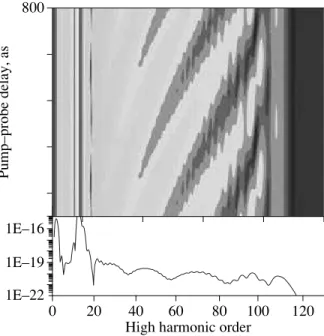
Figure 5 shows the calculated harmonic spectrum versus the initial phase of the two states. The structure in the harmonic spectrum synchronizes with the bound-state wavepacket motion. Both the modulation in the single time delay spectrum and the movement of the modulation in the pump–probe spectrum measure wavepacket dynamics.
ACKNOWLEDGMENTS
The authors acknowledge financial support from Photonic Research Ontario, the Canadian Institute for Photonic Innovation, and the Alexander von Humboldt-Stiftung.
REFERENCES
1. C. E. Brion, G. Cooper, Y. Zheng, et al., “Imaging of Orbital Electron Densities by Electron Momentum Spectroscopy—a Chemical Interpretation of the Binary (e, 2e) Reaction,” Chem. Phys. 270, 13 (2001).
Fig. 4. A schematic diagram shows the bound-state poten-tial at the bottom, with two populated energy levels. The upper curve represents the kinetic-energy distribution of the recolliding continuum electron wavepacket. Even though the continuum wavepacket originates only from the upper bound state, it is coherent with both bound states. The recombination radiation will then show interferences that come from different continuum electron energies that occur at different times in the chirped wavepacket. This will man-ifest itself as interferences in the high-harmonic spectra.
1E–16
20
High harmonic order 1E–19 1E–22 40 60 80 100 120 0 Pump–probe delay, as 800
Fig. 5. A time-dependent Schrödinger equation simulation of an atom with two equally populated bound states shows the interference pattern that reflects the beat frequency between the bound states. The optical field had a
wave-length of 1.6 µm and a duration of 8 fs, with mainly a single
high-harmonic pulse generated. The energy spacing of the two levels is 9.5 eV, leading to an bound-state electron wavepacket with a period of 435 as. The square of the accel-eration of the dipole is plotted as the intensity versus har-monic order. Different pump–probe time delays are shown. The minima in each spectrum come from different electron
kinetic energies that lead to the same xuv frequency. This
simulation shows that it is possible to observe attosecond bound-state electron motion.
528
LASER PHYSICS Vol. 15 No. 4 2005
ITATANI et al. 2. G. Binning, H. Rohrer, Ch. Gerber, and E. Weibel,
“Sur-face Studies by Scanning Tunneling Microscopy,” Phys. Rev. Lett. 49, 57 (1982).
3. H. Sakai and K. Miyazaki, “High-Order Harmonic Gen-eration in Nitrogen Molecules with Subpicosecond Vis-ible Dye-laser Pulses,” Appl. Phys. B 61, 493 (1995). 4. Y. Liang, A. Augst, S. L. Chin, et al., “High Harmonic
Generation in Atomic and Diatomic Molecular Gases Using Intense Picosecond Laser Pulses—A Compari-son,” J. Phys. B 27, 5119 (1994).
5. R. Velotta, N. Hay, M. B. Manson, et al., “High-Order Harmonic Generation in Aligned Molecules,” Phys. Rev. Lett. 87, 183901 (2001).
6. R. de Nalda, E. Heesel, M. Lein, et al., “Role of Orbital Symmetry in High-Order Harmonic Generation from Aligned Molecules,” Phys. Rev. A 69, 031804(R) (2004).
7. N. Hay, M. Lein, R. Velotta, et al., “Investigations of Electron Wave-Packet Dynamics and High-Order
Har-monic Generation in Laser-aligned Molecules,” J. Mod. Opt. 50, 561 (2003).
8. N. Hay, R. Velotta, M. Lein, et al., “High-Order Har-monic Generation in Laser-aligned Molecules,” Phys. Rev. A 65, 053805 (2002).
9. M. Lein, P. P. Corso, J. P. Marangos, and P. L. Knight, “Orientation Dependence of High-Order Harmonic Gen-eration in Molecules,” Phys. Rev. A 67, 023819 (2003). 10. P. W. Dooley, I. V. Litvinyuk, K. F. Lee, et al., “Direct Imaging of Rotational Wave-Packet Dynamics of Diatomic Molecules,” Phys. Rev. A 68, 023406 (2003). 11. C. Kak and M. Slaney, Principles of Computerized
Tomographic Imaging (Society for Industrial and
Applied Mathematics, New York, 2001).
12. Y. Mairesse, A. de Bohan, L. J. Frasinski, et al., “Attosecond Synchronization of High-Harmonic Soft X-rays,” Science 302, 1540 (2003).
View publication stats View publication stats