Publisher’s version / Version de l'éditeur:
Vous avez des questions? Nous pouvons vous aider. Pour communiquer directement avec un auteur, consultez la première page de la revue dans laquelle son article a été publié afin de trouver ses coordonnées. Si vous n’arrivez pas à les repérer, communiquez avec nous à [email protected].
Questions? Contact the NRC Publications Archive team at
[email protected]. If you wish to email the authors directly, please see the first page of the publication for their contact information.
https://publications-cnrc.canada.ca/fra/droits
L’accès à ce site Web et l’utilisation de son contenu sont assujettis aux conditions présentées dans le site LISEZ CES CONDITIONS ATTENTIVEMENT AVANT D’UTILISER CE SITE WEB.
Cyberpsychology and Behavior, 6, 5, 2004-07-05
READ THESE TERMS AND CONDITIONS CAREFULLY BEFORE USING THIS WEBSITE.
https://nrc-publications.canada.ca/eng/copyright
NRC Publications Archive Record / Notice des Archives des publications du CNRC :
https://nrc-publications.canada.ca/eng/view/object/?id=54a341ea-4a68-4036-9189-febaa8204836
https://publications-cnrc.canada.ca/fra/voir/objet/?id=54a341ea-4a68-4036-9189-febaa8204836
NRC Publications Archive
Archives des publications du CNRC
This publication could be one of several versions: author’s original, accepted manuscript or the publisher’s version. / La version de cette publication peut être l’une des suivantes : la version prépublication de l’auteur, la version acceptée du manuscrit ou la version de l’éditeur.
For the publisher’s version, please access the DOI link below./ Pour consulter la version de l’éditeur, utilisez le lien DOI ci-dessous.
https://doi.org/10.1089/109493103769710578
Access and use of this website and the material on it are subject to the Terms and Conditions set forth at
Using VR to Improve the Performance of Low-Earth Orbit Space Robot
Operations
National Research Council Canada Institute for Information Technology Conseil national de recherches Canada Institut de technologie de l'information
Using VR to Improve the Performance of Low-Earth
Orbit Space Robot Operations *
Lapointe, J.-F., and Massicotte, P.
October 2003
* published in Cyberpsychology and Behavior. Vol. 6, No. 5, October 2003. pp. 545-548. NRC 46525.
Copyright 2003 by
National Research Council of Canada
Permission is granted to quote short excerpts and to reproduce figures and tables from this report, provided that the source of such material is fully acknowledged.
Using VR to Improve the Performance of
Low-Earth Orbit Space Robot Operations
JEAN-FRANÇOIS LAPOINTE, Ph.D., and PHILIPPE MASSICOTTE
ABSTRACT
The operations of current robotics systems in low-earth orbit could benefit from the use of
virtual reality (VR) systems to improve their performance. This paper presents an example of
the type of contribution such a system could provide to assist the space robot operators in
their operations, by using the increased situational awareness and the ease of use associated
with VR systems.
545 CYBERPSYCHOLOGY& BEHAVIOR
Volume 6, Number 5, 2003 © Mary Ann Liebert, Inc.
INTRODUCTION
A
PART FROM THE PASTROTEX and ETS-7experi-ments,1,2 the operations of low-earth orbit
(LEO) space robots are currently limited to the use of the Shuttle Remote Manipulator System (SRMS), and the Space Station Remote Manipulator System (SSRMS).
The SRMS, as its name implies, is installed in the cargo bay of the space shuttle, while the SSRMS is installed on the International Space Station (ISS). Those systems are illustrated in Figure 1.
These two robotics systems are non-autonomous and thus are controlled and supervised by human operators in a human-in-the-loop way, the simplest form of remote control.3 In both cases the direct
views on the worksite of the robots are seldom and therefore, the operators rely almost uniquely on camera views during the operations.
It is important to understand that the visual cues represent the only source of information available to the operators to achieve safe and efficient work. Given this constraint and since it is sometimes im-possible to get a good view of specific parts of the worksite, the assistance of other astronauts is often required to assist the operators in their tasks, espe-cially when large objects are manipulated in con-strained spaces. In those cases, the assisting astronauts becomes the “eyes” of the operator by
taking a “space walk” and going directly on the worksite.4,5
These workarounds allow the operator to get a good direct or indirect view of the robot worksite, in order to safely complete the tasks.
Once the assembly of the ISS completed, there will be fourteen cameras installed on it at fixed lo-cations. Each of those cameras is mounted on a pan/tilt unit (PTU) to control their orientation. In addition to that, four cameras are mounted on the SSRMS, one fixed at each end and two others mounted on the arm near the elbow, on PTUs.
The operation of the SRMS and SSRMS con-stantly alternates between camera selection/con-trol, and robot conselection/con-trol, until the task is completed. The cameras are currently selected and con-trolled from a display and control panel made of different physical controls such as buttons and switches. The camera control is done by adjusting their different parameters such as pan/tilt/speed/ zoom/focus/iris.
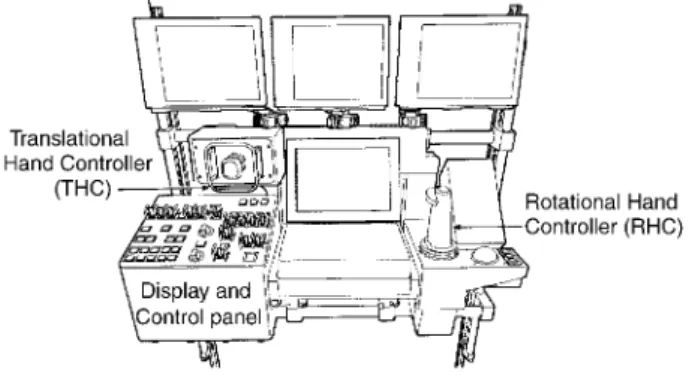
On the other hand, the control of the robots is done with the use of two 3-degree-of-freedom hand controllers, as well as a standard graphical user in-terface. On the ISS, all those interfaces are combined in a control station called the robotic workstation (RWS), shown in Figure 2.
The current workstation is fully functional but requires the operator to remember the location of
Visual Information Technology Group, Institute for Information Technology, National Research Council of Canada, Ottawa, On-tario, Canada.
each camera in order to choose the good ones when comes the time to operate the robot. The building of such a cognitive model (mental map) of the system requires a lot of training for the operators and is prone to errors.
The training of both the SRMS and the SSRMS is done on simulators. The training for the SRMS is done by the NASA at the Johnson Space Center. For the SSRMS, the training is done by the Canadian Space Agency at the John H. Chapman Space Cen-ter on a simulator called MOTS (MSS Operations and Training System).6
The camera selection and control is a crucial part of the robotics system operation and typically, most of the time required to accomplish a task is spent for the selection and control of the cameras in order to get a good view of the worksite. The remaining time is used for the control of the robot.
The performance and safety of space robot opera-tions are of prime importance,7 and this paper
de-scribes a VR-based proof-of-concept human-machine interface that makes use of direct manipulation, and the combination of both the global and local views of the worksite, in order to simplify the operations.
The use of those techniques could eventually re-duce the training time required by the operators. We also think that it has the potential to signifi-cantly reduce the task completion time.
THEORETICAL FOUNDATIONS
The proof-of-concept VR system described here, called COSMOS (Control of Operations in Space and Monitoring of Orbital Systems) is based on VR technologies and its design is based on the recom-mendations of a task analysis of the operation of low-earth-orbit robots.4
This task analysis showed that safety is the most important factor in space and that since direct viewing of the worksite is limited, most of the time, the only way to provide the operator with a view of the worksite is through the use of video cameras.
Since the cameras are located on the ISS itself, all the views provided by them are local in essence and there is no way to obtain a global view of the structure.
This is where VR can help, by providing, through a model of it, a global view of the ISS. This model can then be augmented with additional informa-tion and can be observed from any point of view.
This latest feature alone, which is specific to VR systems, makes it useful to increase the situational awareness (SA) of the operators by providing them both a global view of the ISS and a local view of the worksite.
This scenario compares well to the current situa-tion where only local views are available to the op-erators.
The possibility to add information to the VR scene also can improve the overall productivity by allowing a fast an easy selection and control of the cameras located on the ISS in a way that requires al-most no training.
SYSTEM DESCRIPTION
COSMOS is mainly composed of a 3D graphical model of the ISS (based on the planned complete structure) that orbits around a 3D model of the earth. A global view of the system is shown in Figure 3.
COSMOS is currently controlled by a standard computer keyboard and mouse, with two joysticks used for both navigating around the ISS and to con-trol the SSRMS when in robot concon-trol mode.
When the operator needs to select a camera view of the worksite, it can easily display the location, orientation and field-of-view of all the cameras, simply by pushing a button.
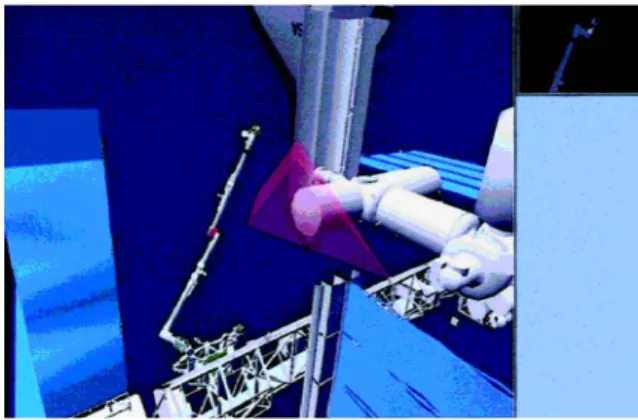
The display of this information is accomplished by augmenting the VR scene with a pictorial de-scription of the cameras field-of-views in the form of semi-transparent viewing volumes or frustums
546 LAPOINTE AND MASSICOTTE
FIG. 1. SRMS (left) and SSRMS (right).
(truncated square pyramids) originating from each camera location on the ISS (Fig. 4).
As a result, the operator can easily spot the cam-era that will give the best view of the desired work-site and select it directly, simply by pointing and clicking on it.
The system confirms the selection of a particular camera view through visual feedback, by changing the color of the selected frustum (Fig. 5).
Also, COSMOS can provide simultaneously the global ISS view and the local worksite view by dis-playing the particular camera view in a separate window (Fig. 6).
The direct manipulation of the system eliminates the need to remember the location of each camera as well as their associated number. This technique alone has the potential to significantly reduce the operator’s training time and the errors associated with the selection of the inappropriate camera views. As a result this could positively impact the overall performance of the low-earth orbit space robot operations.
DISCUSSION
The use of direct manipulation and the fact of being able to see simultaneously a camera location, orientation and field-of-view is a great advantage for the operation of the robots as compared to the current situation. This eliminates the need to member their location or their number, therefore re-ducing the training time.
In addition to that, the instantaneous visual feed-back associated with the direct manipulation inter-face eases significantly the selection and control of the cameras.
Moreover, the interactive 3D nature of VR is criti-cal here to illustrate the camera poses, since it is not
LOW-EARTH ORBIT SPACE ROBOT OPERATIONS 547
FIG. 3. COSMOS overview.
FIG. 4. Camera’s view.
FIG. 5. Visual feedback indicating the selected camera (in red).
always possible to show all of them from a single point of view. In fact, when the operator wants to view a particular part of the ISS, the VR system al-lows to navigate around it and thus change the viewpoint until the area of interest (and the nearby cameras) are visible.
Finally, by having simultaneously access to both the global view of the ISS and the local view of a se-lected camera, the situational awareness8of the
op-erator is significantly increased.
Of course, before the implementation of such a VR interface on the ISS becomes a reality, some is-sues need to be addressed, one of them being the availability of radiation-hardened computers that are powerful enough to run VR simulations.9
Future research could attempt to measure the real performance gains associated with such an in-terface by running it through real scenarios and comparing the results with those obtained by using the conventional interface. Also, new advanced control modes of the space robots could be ex-plored with the help of a VR system, although more precise models of the ISS could be necessary in this case, something that could be possible with the help of advanced sensing system.10
ACKNOWLEDGMENTS
This research project was done with the financial support of PRECARN Associates for the ROSA pro-ject.11 Thanks to our partners from the Canadian
Space Agency and from the company MD robotics, for providing us several parts of the ISS graphical model.
REFERENCES
1. Hirzinger, G., Brunner, B., Dietrich, J., et al. (1994). ROTEX: the first remotely controlled robot in space. Presented at ICRA 94, the IEEE International Confer-ence on Robotics and Automation.
2. Oda, M. (2000). Experience and Lessons Learned from the ETS-VII Robot Satellite. Presented at ICRA
2000, the IEEE Int. Conference on Robotics and Au-tomation.
3. Sheridan, T.B. (1992). Telerobotics, automation, and human
supervisory control. Cambridge, MA: MIT Press. 4. Lapointe, J.F., Dupuis, E., Hartman, L., et al. (2002).
An analysis of low-earth orbit space operations. Pre-sented at the Joint Association of Canadian Ergono-mists/Applied Ergonomics (ACE-AE) Conference, Banff, Alberta, Canada.
5. National Aeronautics and Space Administration. (2001). Mission Control Center Status report 7 STS-98. NASA Shuttle Status, Johnson Space Center. 6. Harvie, D., & Abbasi, V. (2001). Preparation for
Ad-vanced Space Robotics Simulations in MOTS (the MSS Operations and Training Simulator). Presented at i-SAIRAS 2001, the 6th Int. Symp. on Artificial In-telligence and Robotics & Automation in Space. 7. Skaar, S. B., & Ruoff, C. F. (1994). Teleoperation and
Robotics in Space. Progress in Astronautics and Aeronautics, Volume 161, the American Institute of Aeronautics and Astronautics.
8. Wickens, C. D., & Hollands, J. G. (2000). Engineering psychology and human performance, third edition. Prentice Hall.
9. Katz, D. S., & Some, R. R. (2003). NASA advances ro-botic space exploration. IEEE Computer 52–61. 10. English, C.E., Samson, C., Christie, I., et al. (2002).
“Production of models of the International Space Sta-tion elements from 3D laser images.”, SPIE Proceed-ings, Optoelectronics, Photonics, and Imaging (Opto Canada 2002), Ottawa, Ontario, Canada.
11. Gillett, R., Greenspan, M., Hartman, L., et al. “Remote Operations with Supervised Autonomy (ROSA)”, Proceedings of i-SAIRAS 2001, the 6th Int. Symp. on Artificial Intelligence and Robotics & Automation in Space, June 2001, 8 pages (CD-ROM only).
Address reprint requests to:
Jean-François Lapointe, Ph.D. Visual Information Technology Group Institute for Information Technology National Research Council of Canada 1200 Montreal Road, Building M-50 Ottawa, Ontario, Canada K1A 0R6 E-mail: [email protected]