HAL Id: hal-01472462
https://hal.archives-ouvertes.fr/hal-01472462
Submitted on 20 Feb 2017HAL is a multi-disciplinary open access archive for the deposit and dissemination of sci-entific research documents, whether they are pub-lished or not. The documents may come from teaching and research institutions in France or abroad, or from public or private research centers.
L’archive ouverte pluridisciplinaire HAL, est destinée au dépôt et à la diffusion de documents scientifiques de niveau recherche, publiés ou non, émanant des établissements d’enseignement et de recherche français ou étrangers, des laboratoires publics ou privés.
Observation using synchrotron X-ray diffraction of the
crystallographic evolution of α-titanium after oxygen
diffusion
Jean Baillieux, Dominique Poquillon, Benoit Malard
To cite this version:
Jean Baillieux, Dominique Poquillon, Benoit Malard. Observation using synchrotron X-ray diffraction of the crystallographic evolution of α-titanium after oxygen diffusion. Philosophical Magazine Letters, Taylor & Francis, 2015, vol. 95 (n° 5), pp. 245-252. �10.1080/09500839.2015.1014876�. �hal-01472462�
To link to this article : DOI: 10.1080/09500839.2015.1014876
URL :http://dx.doi.org/10.1080/09500839.2015.1014876
This is an author-deposited version published in: http://oatao.univ-toulouse.fr/ Eprints ID: 16702
O
pen
A
rchive
T
oulouse
A
rchive
O
uverte (
OATAO
)
OATAO is an open access repository that collects the work of Toulouse researchers and makes it freely available over the web where possible.To cite this version: Baillieux, Jean and Poquillon, Dominique and Malard, Benoit Observation using synchrotron X-ray diffraction of the
crystallographic evolution of α-titanium after oxygen diffusion. (2015)
Philosophical Magazine Letters, vol. 95 (n° 5). pp. 245-252. ISSN 0950-0839
Any correspondence concerning this service should be sent to the repository administrator:
Observation using synchrotron X-ray diffraction of the
crystallographic evolution of α-titanium after oxygen diffusion
J. Baillieux, D. Poquillon* and B. Malard
CIRIMAT-Université de Toulouse, INP-ENSIACET, 4 allée Emile Monso, BP 44362, 31030 Toulouse Cedex 4, France
In this study, the effect of oxygen diffusion on the crystallographic evolution of α-titanium has been studied using synchrotron X-ray diffraction. Measure-ments were carried out directly on sample cross-sections that were directly pre-oxidized at high temperature. Changes in hardness, oxygen content and lattice parameters after oxidation were determined by coupling microhardness measurements and electron probe microanalyzer results.
Keywords: X-ray diffraction; oxidation; titanium; EPMA; oxygen diffusion
1. Introduction
Titanium and its alloys are widely used in a variety of applications, including the aerospace and chemical industries. This widespread use is because of titanium’s mechanical properties, low density and good corrosion resistance. Presently, aerospace manufacturers try to reduce weight, while increasing engine efficiency, often by exposing different components made of Ti-base alloys to higher temperatures. The effect of oxidation on the mechanical properties must therefore be taken into account.
The O–Ti (oxygen–titanium) system and the oxidation of titanium have been exten-sively studied, but few correlations between oxygen concentration and α-titanium crystal-lographic modifications exist [1,2]. At temperatures above 600–700 °C, the oxidation rate is parabolic; it then becomes linear with increasing temperature. This oxidation leads to the formation of an oxide layer (OL) on the surface with an oxygen diffusion zone (ODZ) in the metal. In this temperature range, TiO2rutile, an n-type semiconductor, has
been observed to form an OL on pure titanium during oxidation [1,3]. The oxide that is initially formed is compact, but after extended exposure, multiple OLs are observed and can be associated with oxide spallation [6]. Even during the parabolic stage, the oxida-tion mechanism of titanium is complex owing to the high solubility of oxygen in the hexagonal-close-packed (hcp) structure of α-titanium (up to 30 at.%). During oxidation, oxygen diffusion and dissolution under the OL lead to development of the ODZ. This solid solution is harder and more brittle than the initial metal [4,5]. The depth of the ODZ increases with increasing temperature and duration of exposure. Understanding the oxidation mechanism of titanium requires a study of both OL growth and dissolution, as well as diffusion of oxygen in titanium (ODZ growth).
Oxygen is the most important interstitial solute in titanium alloys because the alloy’s microstructural and mechanical properties are directly influenced by oxygen concentra-tion [7,8]. It is well known that oxygen preferentially occupies the octahedral sites of the hcp structure by increasing the lattice parameters significantly, and particularly c over a. This understanding has led to the development of a diffusion model with a direct octahedral-to-octahedral transition. However, recent studies have shown that the diffusion mechanism is more complicated [9,10]. Oxygen insertion modifies the lattice parameters of hcp titanium, and a significant increase of the c parameter compared to the parameter has been observed [11]. This lattice parameter evolution leads to hardness gradient along the ODZ, and higher the oxygen concentration, the harder the material. Dubertret [12] noted that because hardness is dependent on oxygen content, it was possible to characterize the ODZ depth using microhardness measurements.
The objective of this work was to study the effects of pure titanium oxidation to determine if a link exists between oxygen content, microhardness measurements and lat-tice parameter modification. Instead of preparing and analyzing alloys with different oxygen contents, as was done previously [13], the ODZ was characterized directly after oxidation of a pure titanium sample using synchrotron X-ray diffraction, which allows the precise study of a zone, thin enough to quantify the effects of oxygen diffusion. 2. Materials and methods
Ti50A, a commercially available pure titanium alloy (ASTM grade 2), was used. The chemical composition of Ti50A is presented in Table 1. Ti50A was provided by TIMET and received as a sheet (2 mm × 500 mm × 1000 mm) after being mill-annealed and cold-rolled. Four parallelepiped samples (7 mmrolling direction× 5 mm × 2 mm) were cut
from the sheet, polished using 600 grit SiC paper and then cleaned in ethanol and acetone. Oxidations were performed at 600 and 700 °C in a Carbolite® furnace under laboratory air as described in Table 2.
Oxidation condition chosen in order to obtain a significant ODZ (more than 10 μm in depth) are based on a previous oxidation study [8]. To obtain a cross-section of each sample, the two largest opposite faces (7 mm × 5 mm) were polished after heat treat-ment to remove the OL and the ODZ of these faces. At least 500 μm was removed to ensure proper measurements. Transversal observation enabled the observation of the different layers in each sample as shown in Figure 1a. The ODZ is defined by the hard-ness measurements as the affected depth in which the hardhard-ness is at least one standard deviation higher than the average hardness measured in the sample centre.
Synchrotron X-ray measurements were performed on the ID11 beamline at the European Synchrotron Radiation Facility (ESRF) in Grenoble; the experimental method is described in Figure 1b. A single-scan approach was performed to evaluate structural
Table 1. Chemical composition of Ti50A alloy, commercially pure titanium – ASTM grade 2 – (wt %).
C H Fe N O Ti
gradients in the polycrystalline ODZ with a resolution of 4 μm. Similar measurements have already been obtained for ferritic thin films, where the phase ratio and stress gradi-ent have been successfully quantified with a 150 nm depth resolution [14]. In our exper-iment, the beam dimensions used were 300 μm length and 7 μm height. The step between each measurement was 4 μm. Each sample was analysed along a line large enough to interact with the different layers. The sample positioning was carefully done to obtain a beam parallel to the top surface. Using a rotating sample holder, measure-ments were obtained at 0° and 180° to optimize sample positioning. Calibrations of the wavelength and sample distance to the detector were performed using a CeO2 powder
attached above the samples. After integrating the data on the entire 2D diffractogram, the 1D data were analysed using the XRD software Diffracplus Topas®. Lattice parame-ters of hcp titanium were calculated and refined using a full pattern matching approach. Microhardness measurements, which enabled the identification of the ODZ, were per-formed with a microhardness Buelher® instrument using a 10 g mass. Three lines of 15 indentations were carried out within the affected area. The oxygen concentration along the ODZ was measured and characterized using an electron probe microanalyzer
Table 2. Heat-treatment conditions (temperature, duration and environment).
Sample S1 S2 S3 S4 Heat treatment 700 °C 52 h AIR 700 °C 75 h AIR 600 °C 100 h AIR 700 °C 52 h VACUUM
Figure 1. Synchrotron X-ray diffraction measurement and experimental method (a) sample collection, (b) scheme of the analysed volume.
(EPMA) and secondary ion mass spectrometry (SIMS) [15]. However, owing to the thinness of the ODZ on samples S1, S2 and S3, these two techniques did not produce useful results. A longer additional oxidation was carried out at 700 °C for 288 h to generate data on oxygen content.
3. Results
The a and c lattice parameters of hcp titanium (P63/mmc) were calculated for each
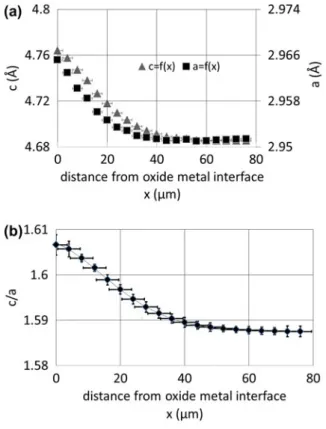
sam-ple. As expected, a gradual increase of these parameters is observed as the distance from the oxide metal interface decreases for samples heat-treated in air (S1, S2 and S3). The lattice parameters for the bulk of samples S1, S2 and S3 can be compared with the parameters of the sample heat-treated in a vacuum (10−5 mBar) (S4); no changes in
lattice parameters were observed for sample S4. Therefore, the changes in lattice parameters can be attributed to inward oxygen diffusion.
Lattice parameters as a function of oxidation distance for sample S1 are plotted in Figure 2. Similar evolution profiles were observed for S2 and S3; however, the differ-ences in ODZ distance between the samples suggest that oxygen diffusion depends on both temperature and time. For example, even if oxidation time is more important for
Figure 2. Evolution of lattice parameters below the oxide/metal interface in the ODZ of sample S1. (a) a and c parameters. (b) c/a ratio.
S3, the oxygen diffusion distance is larger for S1 (50 μm) than for S3 (40 μm) because of the higher exposure temperature. For a given temperature (700 °C), an increase of the ODZ with oxidation time is observed (60 μm for S2).
The hardness evolution was measured for each sample along the ODZ, and hardness data for sample S1 are given in Figure 3. For each oxidized sample, the hardness, c/a ratio and volume of the hcp unit cell increases when measured closer to the oxidized surface.
4. Discussion
The gradient of lattice parameters and the significant increase of c over a from the sur-face to the bulk leads to an evolution of the c/a ratio. This ratio evolution shows the crystal expansion along the c axes and confirms the diffusion and insertion of oxygen through the octahedral sites of the hcp structure [16]. At room temperature, typical unit cell parameters for an α crystal structure are: a = 2.950 Å and c = 4.683 Å. These val-ues can reach up to 2.970 Å for a and 4.790 Å for c at 900 °C [15]. It is interesting to note that crystal deformation caused by oxygen diffusion is always lower than deforma-tion caused by temperature. However, for high oxygen contents near the oxide/metal interface, lattice parameters can approach values that are caused by pre-oxidation temperature.
No evidence of an ordered phase was found by X-ray diffraction and SIMS mea-surements, revealing no nitrogen diffusion in the temperature range tested. Therefore, this deformation of the hcp cell is directly linked to inward diffusion of oxygen. Furthermore, hardness results are influenced by interactions between interstitial oxygen and dislocations. Figure 4a compares c/a and microhardness evolution for sample S1 in the ODZ; a linear dependence is observed. Figure 4b compares oxygen content and mi-crohardness in the ODZ. Again, a linear dependence is observed. Dubertret [12] showed a linear correlation between hardness, lattice parameters and oxygen content but only for low oxygen contents (behind 8 at.%). Above this oxygen concentration, the linear correlation was no longer visible, and variations were observed at specific compositions (as Ti12O and Ti6O). However, these results were obtained by measuring the parameters Figure 3. Evolution of the hardness profile below the oxide/metal interface in the ODZ of sample S1. The solid curve represents the erfc fit (see Equation (1)).
of Ti alloys prepared with different amounts of oxygen. Nevertheless, results obtained by measuring the ODZ of other Ti alloys confirm the linear relationship between oxygen content and hardness [17,18].
To correlate oxygen diffusion, microhardness and lattice parameters, data are available in the literature for other titanium alloys [18]. However, the originality of the present work lies in the data obtained for lattice parameters; oxygen concentration is proportional to the c/a lattice parameter, which is proportional to microhardness.
The profiles obtained were analysed using the solution of Fick’s second law to cal-culate the oxygen diffusion coefficient (D) for each sample. Non-linear regression was used to fit the hardness profile to the following equation:
H mx ¼ Hm0þ ðHmmax$ Hm0Þ erfc x 2 ffiffiffiffiffi Dt p " # (1) where Hvx is the hardness in Hv, Hv0 is the initial hardness, Hvmax is the hardness limit
at the interface metal/oxide, x is the depth in cm, D is the oxygen diffusion coefficient in m2/s and t is the time in seconds.
The fitted equation is plotted with the hardness profiles in Figure 3. A very good correlation with hardness profile is obtained for each sample. The average diffusion
Figure 4. (a) Linear relationship between hardness and c/a ratio for sample S1. (b) Comparison between hardness and oxygen content on an ODZ profile measured by EPMA on a sample oxidized under air at 700 °C during 288.
coefficient obtained at 700 °C is D = 2 × 10⁻¹⁵m2/s, which is in agreement with
literature data [19–21].
At the oxide/metal interface, the c/a ratio seems to stabilize at a value that depends on temperature oxidation, but further investigation is needed to confirm this result. It is relatively complicated to determine precise oxygen content in the metal/oxide interface. Some studies have shown this oxygen content to be dependent on temperature and exposure time [3,18,22]. For a given temperature, stabilization of oxygen content is expected at the metal oxide interface.
5. Conclusions
Synchrotron X-ray diffraction measurements were carried out on α-titanium to better understand the correlation between lattice parameters, oxygen content and microhard-ness in a titanium alloy subjected to oxidation. A linear correlation was established at 700 and 600 °C between the c/a ratio, oxygen content and hardness for low oxygen contents ([o] < 25 at.%). The oxygen diffusion coefficient that was obtained is in good agreement with data available in the literature for Ta6 V alloys. Oxygen enrichment in α-titanium increases the volume of the hcp unit cell but also increases the c/a ratio. The linear correlation found between crystal lattice distortion and hardness may be used, thereafter, in mechanical models incorporating microstructure changes with time to model materials with gradient properties [23].
Acknowledgments
The authors gratefully acknowledge Jonathan Wright from (ESRF) for his help with synchrotron measurements, Sophie Gouy (UMS Castaing) for EPMA analysis and Teresa Hungria (UMS Castaing) SIMS measurements.
References
[1] J.L. Murray and H.A. Wriedt, Bull. Alloy Phase Diag. 8 (1987) p.148. [2] P. Kofstad, High Temperature Corrosion, Springer, London, 1988.
[3] A.M. Huntz-Aubriot and B. Pieraggi, Oxydation des matériaux métalliques, Hermes Science Publication/Lavoisier, Paris, 2003.
[4] I. Gurappa, Mater. Sci. Eng. A356 (2003) p.372.
[5] W.J. Boettinger, M.E. Williams, S.R. Coriell, U.R. Kattner and B.A. Mueller, Metall. Mater. Trans., B 31 (2000) p.1419.
[6] J.E. Lopes Gomes and A.M. Huntz, Oxid. Met. 14 (1980) p.249. [7] Z. Liu and G. Welsch, Metall. Trans., A 19 (1988) p.1121.
[8] J. Baillieux, D. Poquillon and J. Huez, Mechanic & Industry (2014). doi: 10.1080/ 09500839.2015.1014876
[9] H. Conrad, Prog. Mater. Sci. 26 (1981) p.123.
[10] H. Wu and D.R. Trinkle, Phys. Rev. Lett. 107 (2011) p.045504.
[11] D. David, E.A. Garcia, X. Lucas, G. Beranger and J. Less, Common. Met. 65 (1979) p.51. [12] A. Dubertret, PhD thesis, Faculté des sciences, Paris, 1970.
[13] I.I. Kornilov, V.V. Vavilova, L.E. Fykin, R.P. Ozerov, S.P. Solowiev and V.P. Smirnov, Metall. Trans. 1 (1970) p.2569.
[15] W. Szkliniarz and F. Grosman, Presented 6th World Conference on Titanium, France, 1988. [16] H. Ma, M. Wang and W. Wu, J. Mater. Sci. Technol. 20 (2004) p.719.
[17] D. Poquillon, C. Armand and J. Huez, Oxid. Met. 79 (2013) p.249.
[18] M. Göbel, V.A.C. Haanappel and M.F. Stroosnijder, Oxid. Met. 55 (2001) p.137. [19] J.N. Pratt, W.J. Bratina and B. Chalmers, Acta Metall. Mater. 2 (1954) p.203. [20] D. Gupta and S. Weinig, Acta Metall. 10 (1962) p.292.
[21] C.J. Rosa, Metall. Trans. 1 (1970) p.2517.
[22] M.H. Song, S.M. Han, D.J. Min, G.S. Choi and J.H. Park, Scripta Mater. 59 (2008) p.623. [23] T.A. Parthasarathy, W.J. Porter, S. Boone, R. John and P. Martin, Scripta Mater. 65 (2011)