HAL Id: tel-01748212
https://hal.univ-lorraine.fr/tel-01748212
Submitted on 29 Mar 2018HAL is a multi-disciplinary open access archive for the deposit and dissemination of sci-entific research documents, whether they are pub-lished or not. The documents may come from teaching and research institutions in France or
L’archive ouverte pluridisciplinaire HAL, est destinée au dépôt et à la diffusion de documents scientifiques de niveau recherche, publiés ou non, émanant des établissements d’enseignement et de recherche français ou étrangers, des laboratoires
Synthesis and characterization of bimetallic Pt/Ni
particles for the application of catalysis
Noor Hana Hanif Abu Bakar
To cite this version:
Noor Hana Hanif Abu Bakar. Synthesis and characterization of bimetallic Pt/Ni particles for the application of catalysis. Other. Université Henri Poincaré - Nancy 1, 2010. English. �NNT : 2010NAN10013�. �tel-01748212�
AVERTISSEMENT
Ce document est le fruit d'un long travail approuvé par le jury de
soutenance et mis à disposition de l'ensemble de la
communauté universitaire élargie.
Il est soumis à la propriété intellectuelle de l'auteur. Ceci
implique une obligation de citation et de référencement lors de
l’utilisation de ce document.
D'autre part, toute contrefaçon, plagiat, reproduction illicite
encourt une poursuite pénale.
Contact : [email protected]
LIENS
Code de la Propriété Intellectuelle. articles L 122. 4
Code de la Propriété Intellectuelle. articles L 335.2- L 335.10
http://www.cfcopies.com/V2/leg/leg_droi.php
U.F.R. STMP
Ecole Doctorale : SESAMES
Chimie et Physico-Chimie Moléculaires et Théorique
Thèse en Co-tutelle UHP-USM
présentée pour l’obtention du titre de
Docteur de l’Université Henri Poincaré, Nancy-I
en Chimie et Physico-Chimie Moléculaires
par NOOR HANA HANIF ABU BAKAR
PARTICULES BIMETALLIQUES. SYNTHESE, CARACTERISATION ET PROPRIETES CATALYTIQUES.
SYNTHESIS AND CHARACTERIZATION OF BIMETALLIC PtNi PARTICLES FOR THE APPLICATION OF CATALYSTS
Soutenue le 2 Mars 2010 à Penang
Membres du jury
Rapporteurs : Abdul Rahman bin Mohamed, Universiti Sains Malaysia, Penang
P r of. Antoin e Ab ouk ais, Un iv ersité d u L ittoral, Dunk erq u e Examinateurs : Wan Ahmad Kamil, Professeur, Universiti Sains Malaysia, Penang
Mohamad Abu Bakar, Maître de Conférences, Universiti Sains Malaysia, Penang (Directeur de Thèse)
Orfan Zahraa, Maître de Conférences, ENSIC, Nancy
Mohammed M. Bettahar, Professeur, Université Henri Poincaré.H.P., Nancy (Directeur de Thèse)
SYNTHESIS AND CHARACTERIZATION OF BIMETALLIC
PtNi PARTICLES FOR THE APPLICATION
OF CATALYSTS
by
NOOR HANA HANIF ABU BAKAR
Thesis submitted in fulfillment of the requirements for the degree of
Doctor of Philosophy
ACKNOWLEDGEMENT
I am grateful to many people who have made it possible for me to
complete this thesis. It is with this thought in mind that I would like to take this
opportunity to thank them.
First and foremost, I would like to like to express my appreciation to my
supervisors, Professor Mohammed M. Bettahar and Associate Professor Dr.
Mohamad Abu Bakar as well as my co-superviosors, Dr. Serge Monteverdi and
Prof Jamil Ismail for their consistent support, guidance and advice throughout the
completion of this work.
My sincere gratitude also goes to Dr. Michel Mercy from the
Heterogeneous Catalysis Laboratory in Université Henri Poincaré for his
consistent help in accomplishing this work. Thank you also to En. Muthu, Miss
Jamilah, Mr. Johari and Mrs. Faezah from the Electron Microscope Department,
USM, Dr. Jaafar Ghanbaja from the Electron Microscope and Microanalysis
Department, UHP, Mr. Ali as well as the staff from the School of Chemical
Sciences, USM. A special thanks to all of them for their much appreciated help.
I would also like to acknowledge the financial support from Universiti
Sains Malaysia, Communauté Urbaine du Grand Nancy, Université Henri
Poincarée as well as the French and Malaysian governments for the Co-tutelle
Finally, my heartfelt appreciation goes to my friends and family, who
have assisted me in various aspects and have continuously given me much
TABLE OF CONTENTS
Acknowledgement ii
Table of Contents iv
List of Tables xi
List of Figures xii
List of Abbreviations xvii
Abstrak xx Abstrait xxi Abstract xxiii CHAPTER 1 – INTRODUCTION 1.1 A Brief Overview 1 1.2 Problem Statements 2 1.3 Research Objectives 2 1.4 Scope of Study 3 1.5 Thesis Layout 4 1.6 References 5 CHAPTER 2 – LITERATURE REVIEW 2.1 Nanoparticles 6 2.2 Bimetallic Nanoparticles 7
2.2.3 Ensemble and Ligand Effects of Bimetallic Particles 13 2.3 Preparation of Catalysts 14 2.3.1 Classical Methods 14 2.3.1.1 Precipitation Technique 15 2.3.1.2 Impregnation Technique 15 2.3.2 Non-classical Methods 17 2.3.2.1 Chemical Reduction 17 2.3.2.2 Microwave Reduction 17 2.3.2.3 Mechanical Attrition 18 2.4 Supports 18
2.4.1 Silicon (IV) Dioxide (SiO2) 19
2.4.2 MCM-41 20
2.5 Characterization Techniques 21
2.5.1 Temperature Programmed Reduction 21
2.5.2 Temperature Programmed Desorption 22
2.5.3 X-ray Diffraction 25
2.5.4 X-ray Photoelectron Spectroscopy 27
2.5.5 Transmission Electron Microscopy 29
2.6 Application 30
2.6.1 Energy 30
2.6.2 Environment 33
2.6.3 Industries 34
2.7 Bimetallic PtNi Nanoparticles 35
2.9 References 39
CHAPTER 3 – EXPERIMENTAL
3.1 Materials 45
3.2 Methods 46
3.2.1 Preparation of Stock Solutions 46
3.2.1.1 Pt/Ni Supported Crystalline Silica Catalysts 46
3.2.1.2 Pt/Ni Stabilized Oleic Acid (Pt/Ni-OA) 46
3.2.1.3 Pt/Ni –OA Supported Crystalline Silica 47 Catalysts (Pt/Ni-OA/Silica)
3.2.1.4 Pt/Ni Supported MCM-41 Catalysts (Pt/Ni-MCM) 47
3.2.2 Synthesis of Pt/Ni Supported Crystalline Silica via 47 Co-precipitation.
3.2.3 Synthesis of Pt/Ni Supported Crystalline Silica via 48 Co-impregnation
3.2.4 Synthesis of Pt/Ni Supported Crystalline Silica via 49 Step-impregnation
3.2.5 Synthesis of Pt/Ni Stabilized Oleic Acid Particles 49
3.2.5.1 Effect of Various Concentrations of Oleic Acid 50
3.2.5.2 Effect of Various Reaction Temperatures 50
3.2.6 Preparation of Pt/Ni-OA/Silica Catalysts 50
3.2.7 Preparation of Pt/Ni-MCM Catalysts via Non-classical 51
Method
3.2.8 Preparation of Pt/Ni-MCM via Classical Methods 52
3.3 Characterization Techniques 52
3.3.1 H2-Temperature Reduction (H2-TPR) 52
3.3.2.1 Non-classical Catalysts 53
3.3.2.2 Classical Catalysts 54
3.3.3 Temperature Programmed Surface Reaction (TPSR) 54
3.3.4 O2-Chemisorption 54
3.3.5 Transmission Electron Microscopy 55
3.3.6 Powder X-ray Diffraction 55
3.3.7 Fourier Transform Infrared (FTIR) 55
3.3.8 X-ray Photoelectron Spectroscopy (XPS) 56
3.4 Calculation Methods 56
3.4.1 Determination of Fractal Dimension 56
3.4.2 Determination of Metal Dispersion 56
3.4.2.1 Borodzinski and Banarowska Method 56
3.4.2.2 H2-Chemisorption Method 57
3.4.3 Total Surface Area of Metal Phase 58
3.4.4 Particle Size 59 3.4.4.1 H2-Chemisorption Method 59 3.4.4.2 XRD Technique 59 3.4.5 Degree of Reduction 60 3.5 Catalytic Reaction 60 3.6 Kinetic Studies 62
3.6.1 Determination of Reaction Orders 62
3.6.2 Determination of Energy of Activation 63
CHAPTER 4 - THE SYNTHESIS AND CATALYTIC PROPERTIES OF Pt/Ni SUPPORTED SILICA CATALYSTS PREPARED VIA NON-CLASSICAL METHODS
4.1 Introduction 65 4.2 Structural studies 67 4.3 Surface Characteristics 76 4.3.1 H2-TPR Profiles 76 4.3.2 H2-Chemisorption 78 4.3.3 H2-TPD Analysis 79 4.3.4 XPS 84
4.4 Effect of Borohydride Reduction 87
4.5 Hydrogenation of Benzene 88
4.6 Summary 90
4.7 References 92
CHAPTER 5 – EFFECT OF IMPREGNATION TECHNIQUE FOR CATALYSTS PREPARED VIA NON- CLASSICAL METHODS 5.1 Introduction 95 5.2 Surface Characteristics 97 5.2.1 H2-TPR Analysis 97 5.2.2 H2-Chemisorption 101 5.2.3 H2-TPD Analysis 102 5.3 TEM Analysis 105 5.4 Catalytic Activity 109
5.7 References 120
CHAPTER 6 - CATALYTIC STUDIES OF Pt/Ni STABILIZED OLEIC ACID BIMETALLIC PARTICLES
INCORPORATED ONTO SILICA
6.1 Introduction 122
6.2 Formation of Pt/Ni Bimetallic Nanoparticles 123
6.3 Alloying of Pt/Ni Bimetallic Nanoparticles 123
6.4 Morphology 127
6.4.1 Effect of Oleic Acid Concentration 127
6.4.2 Effect of Reaction Temperature 130
6.5 Pt/Ni Interaction with Oleic Acid 131
6.6 Oleic Acid Stabilized Pt/Ni Deposited on Silica 132
6.6.1 Morphology of Active Phase in the Pt/Ni-OA/Silica 132 Catalysts 6.6.2 Surface Characteristics 134 6.6.2.1 H2-TPR Analysis 134 6.6.2.2 H2-Chemisorption 136 6.6.2.3 H2-TPD Analysis 136 6.6.3 Benzene Hydrogenation 139 6.7 Summary 141 6.8 References 143
CHAPTER 7 – EFFECT OF REDUCTION CONDITIONS
7.1 Introduction 145
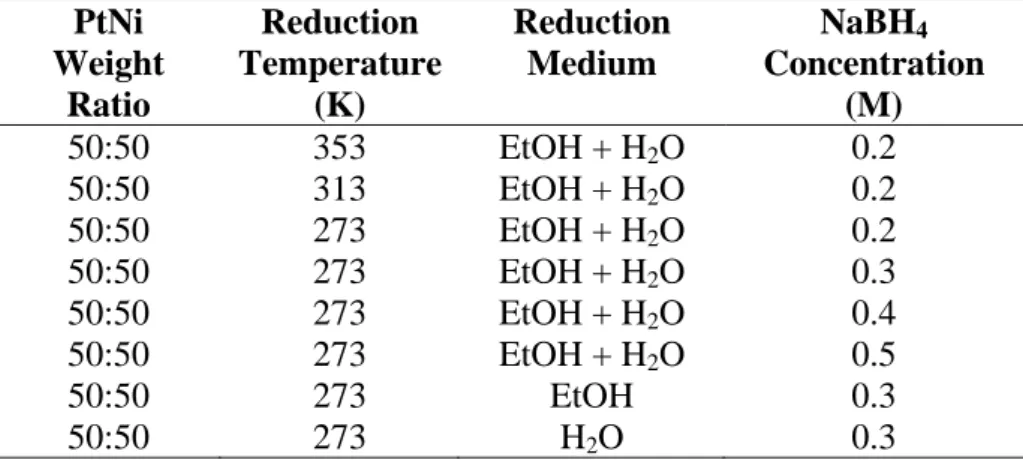
7.4 Effect of NaBH4 Concentration 151
7.5 Effect of Reduction Medium 155
7.6 Comparison with Monometallic Catalysts at Optimum Conditions 158
7.7 Summary 161
7.8 References 162
CHAPTER 8 - Pt/Ni SUPPORTED MCM-41 CATALYSTS PREPARED VIA CLASSICAL METHODS
8.1 Introduction 163
8.2 Effect of Activation Conditions 165
8.3 O2-Chemisorption 166 8.4 Surface Characteristics 168 8.4.1 H2-TPR Analysis 168 8.4.2 H2-Chemisorption Studies 171 8.4.3 H2-TPD Profiles 172 8.5 Structural Properties 174 8.6 Morphological Studies 176 8.7 Catalytic Activity 181 8.8 Kinetic Investigations 184
8.9 Classical vs Non-classical Catalysts 187
8.10 Summary 191
8.11 References 192
CHAPTER 9 – CONCLUSIONS
9.1 Conclusion 194
LIST OF PUBLICATIONS AND PRESENTATIONS 200
LIST OF TABLES
Table 3.1: Preparation parameters of PtNi supported MCM-41
catalysts prepared via non-classical methods using co-impregnation technique.
51
Table 4.1: Average particle size, H2-chemisorption and H2-TPD
studies.
79
Table 5.1: Amounts of H2 chemisorbed, production and desorbed
from H2-chemisorption, H2-TPR and H2-TPD analysis.
103
Table 5.2: Physico-chemical characteristics of supported silica
catalysts.
108
Table 6.1: Lattice parameters of PtNi alloys prepared at different
ratios
126
Table 8.1: Maximum conversions and temperatures at maximum
conversion of the Pt50Ni50-MCMC catalyst activated at
various conditions.
166
Table 8.2: The degree of reduction of the PtNi catalysts supported
MCM-41.
168
Table 8.3: H2-Chemisorption, dispersion and average particle size of
the PtNi catalysts supported MCM-41.
171
Table 8.4: Average particle sizes and distribution of particle shapes
of the metallic phase in the PtNi catalysts (a) before and (b) after hydrogenation reactions.
177
Table 8.5: Percentage of conversion, specific rates and TOF values
of the PtNi supported MCM-41 catalysts prepared with various PtNi ratios.
184
Table 8.6: Specific rates of the Pt50Ni50 and Pt100 catalysts supported
on MCM-41 prepared via classical and non-classical methods. Catalysts activated at 473 K for duration of 15 minutes in 100 ml/min pure hydrogen.
LIST OF FIGURES
Figure 2.1: The influence of particle size on the number of surface,
defect and face atoms.
7
Figure 2.2: The effect of the various types of atoms on the conversion
of allyl alcohol to propanol.
7
Figure 2.3: Graphical plot of the overall excess of free energy as a
function of cluster size, r for heterogeneous and homogeneous nucleation
8
Figure 2.4: Illustrations of typical bimetallic models (a) core-shell
morphology; (b) random model and (c) separated model.
9
Figure 2.5: Schematic diagram of the growth mechanism of core shell
bimetallic particles.
10
Figure 2.6: Graphical plot of the overall excess of Gibbs free energy,
ΔGr as a function of cluster size, r for alloys and the
corresponding monometals.
11
Figure 2.7: Schematic representation of three types of alloys, (a)
random, (b) clustered and (c) ordered.
12
Figure 2.8: CO-TPD of PdCo supported Al2O3 catalysts prepared with
various PdCo ratios.
24
Figure 2.9: XRD diffractograms of (a) PtcoreCushell (b) PtcoreCushell after
annealing (c) CucorePtshell and (d) CucorePtshell after
annealing.
27
Figure 2.10: The energetics of an x-ray photoemission experiment. 28
Figure 2.11: TEM image of bimetallic particles with core-shell
morphology.
30
Figure 2.12: Schematic diagram of a typical fuel cell process for a
DMFC.
32
Figure 2.13: Illustration of the hydrogenation of benzene via
hydrogen spillover on a support
38
Figure 3.2: Setup for hydrogenation of benzene. 61
Figure 4.1: XRD diffractograms of (a) the crystalline silica and fresh
catalysts and (b) the respective Pt peaks deconvolution.
68
Figure 4.2: XRD diffractograms of crystalline silica, activated
catalysts and the respective Pt peaks deconvolution.
69
Figure 4.3: TEM images and particle size histograms of (a) Ni100-P
(b) Pt100-P and (c) Pt90Ni10-CP catalysts supported on
crystalline silica.
71
Figure 4.4: Electron diffraction of (a) Ni100-P (b) Pt100-P (c) Pt90Ni10
-CP catalysts.
74
Figure 4.5: Line profiles of Pt90Ni10-CP supported on crystalline silica. 75
Figure 4.6: H2-TPR profiles of the various fresh PtNi catalysts
supported on crystalline silica.
77
Figure 4.7: H2-TPD profiles of the various PtNi catalysts supported
on crystalline silica.
80
Figure 4.8: H2-TPD profiles of Pt47Ni53-CP without and after activation 83
Figure 4.9: XPS spectra of (a) Pt 4f of Pt100-P(b) Ni 2p of Ni100-Pand
(c) Pt 4f of Pt90Ni10-CP.
85
Figure 4.10: Profiles of the reaction rate of hydrogenation of benzene
to cyclohexane for various PtNi catalysts supported on crystalline silica relative to the reaction temperature.
89
Figure 5.1: TPR profiles of (a) Pt100-I and Ni100-I catalysts as well as
catalysts prepared via (b) CI and (c) SI technique.
98
Figure 5.2: TPD profiles of (a) Pt100-I and Ni100-I catalysts as well as
PtNi catalysts supported on silica prepared via (a) CI and (b) SI technique.
103
Figure 5.3: TEM micrographs of (a) Pt100-I (b) Ni100-I (c) Pt48Ni52-SI
and (d) Pt55Ni45-CI and their corresponding histograms on
size distribution.
106
Figure 5.4: Reaction rates of hydrogenation of benzene for (a) Pt100-I
and Ni100-I as well as PtNi catalysts prepared via (b) CI
and (c) SI techniques.
110
Figure 5.6: XRD diffractograms of Pt100-I and Pt55Ni45-CI catalysts
prepared via co-impregnation. Diffractograms are obtained after subtraction of the silica peaks.
115
Figure 5.7: XPS profiles of (a) Pt100-I (b) Ni100-I (c) Pt55Ni45-CI 116
Figure 6.1: XRD diffractograms of PtNi alloys with different ratios
prepared at 80 ºC with 0.02 M oleic acid (a) Pt100; (b)
Pt93Ni7; (c) Pt78Ni22; (d) Pt61Ni39 and (e) Pt31Ni69.
124
Figure 6.2: XRD diffractograms of PtNi alloys with different ratios
prepared using 0.02 oleic acid at 80 ºC (a) Ni100 and (b)
Pt15Ni85.
126
Figure 6.3: Relationship between lattice parameter of PtNi nanoalloys
with EDX composition.
127
Figure 6.4: Typical TEM micrographs of (a) aggregated and (b)
network formed Pt78Ni22 nanoparticles prepared at 353 K
stabilized oleic acid.
129
Figure 6.5: FTIR spectra of (a) pure oleic acid and (b) PtNi stabilized
oleic acid.
132
Figure 6.6: H2-TPR profiles of the PtNi-OA/Silica catalysts prepared
using various PtNi ratios.
135
Figure 6.7: H2-TPD profiles of the PtNi-OA/Silica catalysts prepared
using various PtNi ratios.
137
Figure 6.8: Reaction rates of the hydrogenation of benzene for the
PtNi-OA/Silica catalysts as a function of temperature.
141
Figure 7.1: Typical H2-TPR profiles of fresh Pt50Ni50-MCM-41
catalysts prepared in various conditions.
147
Figure 7.2: TEM images of Pt50Ni50-MCM-41 catalysts prepared with
0.2 M NaBH4 in distilled water at reduction temperatures
of (a) 273 K and (b) 313 K.
147
Figure 7.3: Reaction rates for the hydrogenation of benzene by
Pt50Ni50 supported MCM-41 catalysts prepared using 0.2
M NaBH4 in distilled water at various reduction
temperatures.
149
Figure 7.4: (a) SEM images of Pt50Ni50–MCM-41 prepared at 273 K
using 0.2 M NaBH4 in distilled water and line profiles of
(b) Si and O and (c) Pt and Ni.
Figure 7.5: TEM images of the Pt50Ni50 catalysts supported on
MCM-41 prepared at 273 K using 0.3 M NaBH4 prepared in (a)
mixtures of distil water and ethanol and (b) distil water.
150
Figure 7.6: H2-TPD profiles of Pt50Ni50-MCM-41 prepared at 273 K
using various NaBH4 concentrations.
153
Figure 7.7: Effect of NaBH4 concentration on the reaction rate of
benzene hydrogenation. Pt50Ni50 – MCM-41 prepared at
273 K in mixtures of distil water and ethanol.
155
Figure 7.8: Effect of ethanol on the reaction rate of hydrogenation of
benzene by Pt50Ni50 catalysts supported on MCM prepared
using 0.3 M NaBH4 at 273 K.
158
Figure 7.9: H2-TPD profiles of Pt100, Ni100 and Pt50Ni50 and MCM-41
prepared at 273 K using 0.3 M NaBH4 in ethanol.
159
Figure 7.10: Reaction rates of hydrogenation of benzene by Pt100,
Ni100 and Pt50Ni50 catalysts supported on MCM prepared
using 0.3 M NaBH4 at 273 K in ethanol.
160
Figure 8.1: H2-TPR profiles of PtNi supported MCM-41 catalysts
prepared at various PtNi ratios.
169
Figure 8.2: H2-TPD profiles of PtNi supported MCM-41 catalysts
prepared at various PtNi ratios.
173
Figure 8.3: XRD diffractograms of (a) Pt100-MCM-C and (b) Pt90Ni10
-MCM-C before as well as (c) Pt100-MCM-C and (d)
Pt90Ni10-MCM-C after benzene hydrogenation reactions.
175
Figure 8.4: Typical images of the various morphologies (a) spherical
(b) mixtures of spherical and rectangular and (c) rectangular nanoparticles in the catalysts.
178
Figure 8.5: TEM images of typical areas in the (a) Ni100-MCM-C and
(b) Pt100-MCM-C catalysts as well as their corresponding
EDX analysis.
180
Figure 8.6: Profiles of the reaction rate of hydrogenation of benzene
to cyclohexane for various PtNi catalysts supported on MCM-41 relative to the reaction temperature.
182
Figure 8.7: The dependence of the reaction rate on the partial pressure
of (a) hydrogen (b) benzene.
Figure 8.8: Hydrogenation of benzene profiles of the Pt100 and
Pt50Ni50 catalysts prepared via (a) non-classical
synthesized at optimum conditions and (b) classical methods.
LIST OF ABBREVIATIONS
A Pre-exponential factor
AAS Atomic Adsorption Spectroscopy
Ar Argon ASA Silica-Alumina Bz Benzene C Classical Co Initial conversion CI Co-impregnation CP Co-precipitation D Dispersion DF Fractal dimension d diameter dat Atomic diameter
drel(VS) Relative volume surface mean diameter
Ea Energy of activation
EDAX/EDS Energy dispersive x-ray spectroscopy
FTIR Fourier Transform Infrared Spectroscopy
H2 Hydrogen
He Helium
I Impregnation
k Rate constant
KB Chemisorption constant for benzene
KH Chemisorption constant for hydrogen
NaBH4 Sodium borohydride
m Partial order of hydrogen
MCM-41 Mesotructured aluminosilicate
n Partial order of benzene
NA Avogadro number
Ni Nickel
O2 Oxygen
OA Oleic acid
P Precipitation
PBz Partial pressure of benzene
PH Partial pressure of hydrogen
Pt Platinum
R Gas constant
r Rate
S Total surface area
SiO2 Silica
SEM Scanning Electron Microscopy
SI Step-impregnation
TEM Transmission Electron Microscopy
TPD Temperature Programmed Desorption
TPR Temperature Programmed Reduction
XPS X-ray Photoelectron Spectroscopy
Sintesis dan Pencirian Zarah Dwi-Logam PtNi untuk Aplikasi Sebagai Mangkin
Abstrak
Sintesis mangkin zarah dwi-logam PtNi yang disokong oleh silika, disediakan melalui kaedah bukan klasik, dengan menggunakan natrium borohidrat (NaBH4) sebagai
agen penurun, telah dikaji secara terperinci. Penyokong silika yang digunakan bagi penyelidikan ini dihadkan kepada silika berhablur dan aluminosilikat mesoporos (MCM-41). Pelbagai teknik penyediaan dan parameter penurunan dikaji bagi memahami bagaimana faktor-faktor ini mempengaruhi struktur akhir zarah PtNi yang disokong oleh silika serta reaktiviti pemangkinan terhadap penghidrogenan benzena kepada sikloheksana. Didapati bahawa kaedah penurunan ini dapat menurunkan sepenuhnya garam-garam logam semasa peringkat penyediaan mangkin. Penggunaan hidrogen ditentukan menggunakan analisis H2-TPR, yang mana sebahagian besarnya disebabkan
oleh permukaan fasa logam yang teroksida semasa penyimpanan.
Kajian terhadap kesan daripada teknik penyediaan menunjukkan bahawa permukaan dan sifat pemangkinan adalah sangat dipengaruhi oleh nisbah PtNi serta kaedah bagaimana garam logam diperkenalkan ke atas penyokong. Mangkin yang disediakan melalui teknik ko-impregnasi umumnya mempamerkan reaktiviti pemangkinan yang lebih baik berbanding yang disediakan melalui teknik ko-pemendakan dan impregnasi berperingkat. Seterusnya, mangkin yang mengandungi kandungan Ni yang tinggi menunjukkan kecenderungan terhadap reaktiviti yang rendah berbanding dengan mangkin yang mengandungi kandungan Pt yang tinggi. Beberapa mangkin mempamerkan reaktiviti yang lebih baik berbanding dengan mangkin monologam Pt. Kajian menunjukkan bahawa reaktiviti yang lebih baik ini disebabkan oleh pengaloian Pt dan Ni serta diikuti pemisahan permukaan oleh Pt.
Bagi memperbaiki reaktiviti pemangkinan, zarah PtNi yang distabilkan oleh asid oleik telah disintesis sebelum diterap ke atas penyokong silika. Kajian ini bertujuan untuk mendapatkan kawalan yang lebih baik ke atas penyelerakan dan pengaloian antara zarah PtNi. Keputusan menunjukkan bahawa walaupun penyelerakan aloi yang lebih baik diperolehi, aktiviti yang sangat rendah diperhatikan. Pemisahan permukaan oleh Ni besar kemungkinan disebabkan oleh kehadiran oksigen daripada asid oleik.
Kesan daripada pelbagai parameter juga dikaji untuk meningkatkan reaktiviti pemangkinan. Suhu penurunan, kepekatan NaBH4 dan medium di mana penurunan
dilakukan dipelbagaikan. Kepelbagaian parameter ini mempengaruhi morfologi zarah dan penyelerakan zarah PtNi. Reaktiviti pemangkinan yang optimum diperolehi apabila zarah PtNi yang kecil berselerak terbentuk pada suhu 273 K menggunakan 0.3 M NaBH4
di dalam medium etanol.
Kaedah klasik juga digunakan untuk mensintesis mangkin PtNi yang disokong. Dalam kajian ini, zarah PtNi terbentuk menggunakan H2 sebagai agen penurun. Beberapa
mangkin menunjukkan reaktiviti yang meningkat. Kajian menunjukkan ia disebabkan oleh kesan penambatan ion Ni2+ yang menambat Pt kepada penyokong lalu membentuk zarah Pt yang halus dan berselerak yang dapat digunakan bagi tindak balas pemangkinan.
Secara umumnya, adalah jelas bahawa zarah aloi dan bukan aloi dwi-logam yang disokong oleh silika boleh meningkatkan tindak balas penghidrogenan jika dibandingkan dengan masing-masing mangkin mono-logam. Namun demikian, nisbah PtNi, teknik penyediaan, persekitaran di mana zarah diturunkan dan penyokong mempengaruhi struktur fasa logam mangkin ini. Oleh itu pemahaman yang menyeluruh ke atas parameter ini adalah penting untuk mensintesis mangkin dengan ciri-ciri tertentu yang
Synthèse et Caractérisation de Particule Bi-métallique PtNi pour l’Application de la Catalyse
Abstrait
La synthèse des catalyseurs bi-métalliques de PtNi supportées sur silice préparés par une méthode non-classique a été étudiée de manière approfondie en utilisant le borohydrure de sodium (NaBH4) comme réducteur du précurseur métallique. Les
supports silice utilisés ont été limités à la silice cristallisée et à l’aluminosilicate mesoporeux MCM-41. Diverses techniques de préparation et divers paramètres de réduction ont été étudiés pour déterminer l’effet de structure des particules bi-métalliques PtNi supportées, ainsi que leurs propriétés catalytiques pour l’hydrogénation du benzène en cyclohexane en phase gazeuse. On a montré que cette méthode permettait la réduction totale des sels métalliques pendant l'étape de préparation des catalyseurs. La consommation de l'hydrogène par ces catalyseurs, mesurée par réduction en température programmée, a été attribuée à l’oxydation de la surface de métal pendant leur stockage.
Les études de l'effet des différentes techniques de préparation, ont montré que les propriétés de la surface et les propriétés catalytiques sont influencées par le rapport de PtNi et par la méthode de dépôt des précurseurs métalliques sur la surface du support. En général, les catalyseurs qui ont été préparés par la technique de co-imprégnation donnent une meilleure réactivité catalytique comparée à celles donnée par la co-précipitation et par l’imprégnation par étapes. Par ailleurs, les catalyseurs qui contiennent plus de Ni ont montré une plus faible réactivité, contrairement aux catalyseurs plus riches en Pt, plus réactifs. Plusieurs catalyseurs bimetalliques ont démontré une meilleure réactivité que le catalyseur mono-métallique Pt. Les recherches ont prouvé que l’amélioration de la réactivité peut être attribuée à la formation d’alliage de Pt et Ni accompagnée de la ségrégation du Pt sur l’alliage.
Pour l’amélioration de la réactivité, des particules bi-métallique PtNi stabilisées d'acide oléique ont été synthétisées avant l'incorporation sur le support de silice. Cette méthode a pour but une meilleure dispersion pour la fabrication de l’alliage PtNi. Les résultats montrent, en effet, une meilleure dispersion des particules dans les alliages formés mais la réactivité est très faible. La ségrégation du Ni sur la surface de la particule d’alliage, qui se produit en raison de la présence des oxygènes de l'acide oléique, est la cause de la faible réactivité de l’hydrogénation du benzène.
L'effet de plusieurs paramètres de réduction a été également étudié pour augmenter la réactivité catalytique. Trois paramètres ont été étudiés, la température de la réduction, la concentration de NaBH4 et l’environnement dans lequel la réduction a été
effectuée. Les variations de ces paramètres affectent la morphologie et la dispersion des particules PtNi. La réactivité catalytique optimum a été obtenue lors de la formation de petites particules PtNi dispersées à la température de 273 K avec 0.3 M de NaBH4 en
solution dans l'éthanol.
Les méthodes classiques aussi ont été utilisées pour la synthèse des catalyseurs PtNi supportés. Dans cette étude les particules de PtNi ont été formées la en phase gazeuse en utilisant un traitement thermique sous hydrogène du précurseur métallique calciné. Plusieurs des catalyseurs ont montré une meilleure réactivité que le platine. On a trouvé qu’elle est attribuable à l’effet d’ancrage des ions de Ni2+ sur le support et la fixation du Pt sur ces ions. Dans ce cas, les particules de Pt sont très petites, bien dispersées et disponibles pour la réaction catalytique.
En conclusion, il apparaît dans ce travail que les particules bimétalliques supportées, combinées en alliage ou non, peuvent donner lieu à une meilleure réactivité que les catalyseurs monométalliques. Cependant, le rapport de PtNi, la technique de
affectent la surface de la phase métallique des catalyseurs. Par conséquent, nos résultats montrent qu’il est impératif de comprendre et de contrôler ces paramètres pour synthétiser les catalyseurs possédant les meilleures propriétés.
Synthesis and Characterization of Bimetallic PtNi Particles for the Application of Catalysts
Abstract
The synthesis of PtNi bimetallic particles supported silica catalysts, prepared via non-classical methods using sodium borohydride (NaBH4) as a reducing agent, was
studied in detail. The silica supports employed in this work is limited to crystalline silica and mesoporous aluminosilicate (MCM-41). Various preparation techniques as well as reduction parameters were investigated to gain an insight on how these factors influenced the final structure of the PtNi particles on the silica support and their catalytic reactivity towards the hydrogenation of benzene to cyclohexane. It was found that this reduction method enabled total reduction of the metal salts during the preparation stage of the catalysts. Hydrogen consumptions which were detected using H2-TPR analysis
were mainly attributed to surface oxidation of the metal phase during storage.
Studies on the effect of preparation techniques showed that the surface and catalytic properties of the catalysts are largely affected by the PtNi ratio as well as the method in which the metal salts are introduced onto the support. Catalysts prepared via co-impregnation technique generally exhibited better catalytic reactivity when compared to those prepared via co-precipitation and step-impregnation techniques. Further, catalysts with higher Ni content showed a tendency towards lower reactivity in contrast to those with high Pt content. Several catalysts demonstrated enhanced reactivity when compared to the monometallic Pt catalysts. Investigations showed that the improved reactivity can be attributed to alloying of the Pt and Ni accompanied by surface segregation of Pt.
As a means to improve catalytic reactivity, PtNi stabilized oleic acid particles were synthesized prior to incorporation onto a silica support. The intention of this study is to allow better control of the dispersion and alloying between the PtNi particles. Results show that though better dispersed alloys were obtained, very low activity was observed. Nickel surface segregation is likely to be the cause of this due to the presence of oxygen from oleic acid.
The effect of several reduction parameters was also investigated to enhance catalytic reactivity. The reduction temperature, NaBH4 concentration and medium in
which reduction was carried out were varied. Variations in these parameters affected the particle morphology and dispersion of the PtNi particles. Optimum catalytic reactivity was obtained when small dispersed PtNi particles were formed at 273 K using 0.3 M NaBH4 in a medium of ethanol.
Classical methods were also used for the synthesis of PtNi supported catalysts. In this study the PtNi particles were formed using H2 gas as the reducing agent. Several
catalysts showed improved reactivity. Investigations show that this is attributed to the anchoring effect of Ni2+ ions which anchors Pt to the support, forming fine dispersed Pt particles available for catalytic reaction.
In general, it is obvious that alloyed and non – alloyed bimetallic particles supported on silica can lead to the enhancement of hydrogenation reactions when compared to the respective monometallic catalysts. However, the PtNi ratios, preparation techniques, environment in which the particles are reduced and support influences the structure of the metallic phase of these catalysts. Therefore it is imperative to gain a thorough understanding on these parameters, in order to synthesize catalysts with desired properties.
CHAPTER 1
INTRODUCTION
1.1 A Brief Overview
The term ‘catalyst’ is not novel in today’s society. In fact, the term was
first used by Berzelius as early as in the 1800’s [1]. Since then, numerous
catalytic processes have been developed to meet the requirements of a particular
era. From the production of bulk explosives during World War I to the generation
of hydrogen to produce energy as well as environmental catalysts to reduce
pollution in our modern civilization, the applications of catalysts has changed
with time. Though without a doubt, catalysts are important necessities as they
exist in every aspect of our lives, it is undeniable that the main reason research in
this area has been kept alive until now, is its tremendous economic benefits.
In recent times, much attention has been devoted to understanding
catalysts and their synthesis, to enable the development of catalysts with better
efficiency. Increasing interest has been placed on heterogeneous catalysis as they
can be regenerated and used frequently, indirectly making them cost effective.
With this in mind, various metals, supports and synthesis conditions have been
investigated. This has inadvertently brought about the increasing attention in
supported bimetallic catalysts especially when in the nanoscale. Nevertheless,
this reason, much work has been focused on studying not only the properties of
these materials but also on their synthesis conditions.
1.2 Problem Statements
• The synthesis of supported bimetallic nanoparticles has gained tremendous attention as catalysts as they are known to promote enhanced reaction rates
when compared to their monometallic catalysts. Although extensive work has
been carried out on PtNi supported catalysts for oxidation reduction reactions,
very few have focused on PtNi supported catalysts for hydrogenation
reactions.
• A very limited work on PtNi supported silica based catalysts prepared via non-classical techniques exists. The lack of understanding of this particular
system disables the design of potential catalysts for hydrogenation reactions.
1.3 Research Objectives
To overcome the above problems, the aims of this study have been to
focus on the following:
• To investigate the influence of preparation techniques on the properties and reactivity of the PtNi supported crystalline silica catalysts prepared via
non-classical methods.
• To study the effect of pre-stabilized PtNi nanoparticles on the synthesis of supported PtNi catalysts.
• To gain a comprehensive understanding on how to manipulate the reduction parameters of the non-classical method, in order to control the morphology of
• To comprehend the nature in which the PtNi exists when prepared via classical catalysts and to compare its characteristics and reactivity with those
prepared via non-classical methods.
1.4 Scope of Study
This study has been limited to the synthesis of PtNi bimetallic
nanoparticles on silica supports. Both low and high surface area supports namely
crystalline silica and aluminosilicate, mesostructured hexagonal framework,
MCM-41 were used. Although the main intention of these supports is to control
the morphology and nature in which the PtNi bimetallic particles existed, the
effect of oleic acid as a stabilizer for the synthesis of PtNi bimetallic particles
which were then incorporated onto crystalline silica was also investigated.
Non-classical reduction methods were mainly employed in this study.
Sodium borohydride (NaBH4) was used as the reducing agent for the formation
of the bimetallic PtNi nanoparticles. Several techniques in relation to how the
metal salts were introduced onto the support as well as the influence of various
reduction parameters were investigated. For comparison purposes, classical
methods whereby hydrogen (H2) acted as a reducing agent, was also studied.
The surface of the resulting catalysts were mainly characterized using
flow methods such as H2 temperature programmed reduction (H2-TPR), H2
-chemisorption and H2 temperature programmed desorption (H2-TPD). X-ray
photoelectron spectroscopy (XPS) was also employed. Other characterization
techniques include the transmission electron microscopy (TEM) and scanning
spectroscopy (EDAX/EDS) and electron diffraction as well as powder x-ray
diffraction (XRD).
1.5 Thesis Layout
This thesis consists of nine chapters. The first chapter is an overview of
this thesis. It highlights the research justification, problem statements, research
objectives and the scope of this thesis. Chapter two provides a literature survey,
which will cover the development in the field related to the subject of this thesis.
In chapter three, the detail experimental procedures and techniques are described.
The findings of this research are divided into several chapters. Chapter 4 to 7
focuses on the catalysts prepared via non-classical methods while the sole chapter
on catalysts prepared via classical methods is presented in Chapter 8. In Chapter
4 and 5, the synthesis, characterization and reactivity of the PtNi supported
crystalline silica catalysts prepared via precipitation and impregnation techniques
respectively are discussed in detail. The results and discussion in both these
chapters have been published in Journal of Molecular Catalysis A and Journal of
Catalysis respectively. The following chapter then focuses on the effect of oleic
acid stabilized PtNi nanoparticles incorporated onto crystalline silica as potential
catalysts. This is followed by a detailed study on the influence of several
reduction parameters on the properties and reactivity of the PtNi bimetallic
particles supported on MCM-41 in Chapter 7, which has been published in
Catalysis Letters. For comparison purposes, the PtNi supported MCM-41
catalysts prepared via classical methods is then presented in Chapter 8. Finally,
1.6 References
1. R. A. van Santen, P. W. N. M. van Leeuwen, J. A. Moulijn, B. A. Averill, Studies Surf. Sci. Catal. Vol. 123. 1999, Netherlands: Elsevier Science B. V, pg 3-28.
CHAPTER 2
LITERATURE REVIEW
2.1 Nanoparticles
Nanoparticles are particles that fall in the ‘nano’ regime which ranges
between 1 - 100 nm. In terms of size, these particles bridge between atoms or
molecules and bulk materials. Hence, their electronic and geometric properties
differ from the two. Nanoparticles exhibit ‘quantum effects’ whereby the energy
levels are an intermediate between both the atoms or molecules and bulk
materials [1]. Therefore this creates a bandgap energy unlike the bulk material
and atoms/molecules which are continuous and large correspondingly. Metal
nanoparticles also posses’ unique properties such as an increase in the number of
kinks, corners and edges with dangling bonds (unattached atoms that extend out
of a surface) [2, 3]. An example of this occurrence is seen in Figure 2.1, where
the number of surface and defect atoms increase with the decrease in particle size
while face atoms decrease with decreasing particle size [4]. Generally, both the
changes in electronic and geometric properties when nanoparticles are formed
can be beneficial in catalytic reactions. A demonstration on the influence of the
geometric effect of nanoparticles is shown in Figure 2.2. Here it is observed that
the hydrogenation of allyl alcohol to propanol on Pd nanoparticles, prefers face
Figure 2.1: The influence of particle size on the number of surface, defect and
face atoms [4].
Figure 2.2: The effect of the various types of atoms on the conversion of allyl
alcohol to propanol [4].
2.2 Bimetallic Nanoparticles
Bimetallic nanoparticles are formed via the incorporation of two or more
metals in a system. Generally they can be categorized as alloyed or non-alloyed
bimetallic nanoparticles. The alloyed particles may adopt a random alloy or
(atoms of a metal, grouping together) or core-shell structures [5]. A fine line
exists between differentiating the existence of alloyed or non-alloyed bimetallic
particles. Though several authors have attempted to clarify the differences
between the two [6], the question whether a difference between the two exists, is
still frequently debated upon.
2.2.1 Non-alloyed Bimetallic Nanoparticles
Generally, the formation of non-alloyed bimetallic particles is governed
by the nucleation and growth rates of the metals involved. When two metals exist
in a system, the energy required for nucleation of the metals to occur is
minimized when compared to a system that contains only one metal. This is
illustrated in Figure 2.3 which relates the free energy of a system containing
either a type of metal (a homogeneous system) or more than one metal (a
heterogeneous system) with the average particle size of the metal particles
formed.
Figure 2.3: Graphical plot of the overall excess of free energy as a function of
Various structures of non-alloyed bimetallic particles have been reported.
Among them are those that exhibit core-shell, random, separated as well as
cluster in cluster morphologies. Some of these structures are illustrated in Figure
2.4.
Figure 2.4: Illustrations of typical bimetallic models (a) core-shell morphology;
(b) random model and (c) separated model [5].
The formation of either of these structures depends on several factors such
as the preparation method and metals involved. Typically, bimetallic particles
which exhibit core-shell morphologies consist of a metal forming a core with
another metal element surrounding the core to form a shell. A variety of factors
influence its mechanism of formation. Among them are the reduction potential of
the metals involved [7] as well as the method in which the metals are introduced
structure takes place in two steps. In the first stage, metal ions are reduced to
form atoms, which subsequently aggregate into small clusters and grow at the
expense of other metal ions. When metal ions of another metal are available,
these ions will adsorb onto the surface of the first metal. Successive reduction in
a suitable environment will result in a shell surrounding the first metal [8]. A
schematic diagram of the growth mechanism is shown in Figure 2.5. Various
techniques have been used to prepare bimetallic particles with these structures.
Among them are the deposition technique used to prepare RePd and NiPt
particles [9] and the chemical reduction technique to synthesize PtFe2O3 particles
[10].
Figure 2.5: Schematic diagram of the growth mechanism of core shell
bimetallic particles [8].
2.2.2 Alloyed Bimetallic Nanoparticles
Alloys have been identified as a metallic system consisting of two or more
components irrespective of the nature in which the metals are mixed [11, 12]. The
formation of these bimetallic particles can best be described in terms of
alloys occur when the excess of free energy, of the metals involved (ΔG), is
negative. Therefore, the enthalpy and entropy of mixing for an alloy can take
various values. Typically, most alloys occur spontaneously upon mixing of the
metals. In this case, the system has a negative enthalpy of mixing (ΔH < 0) and a
positive entropy of mixing (ΔS > 0) [6, 13]. In contrast when the mixing of
metals is endothermic, in other words the enthalpy of mixing is positive (ΔH >
0), alloys are formed only at high temperatures as this will lead to a higher
contribution from the entropy when compared to the enthalpy of mixing [6, 13].
At low temperatures, the contribution of the entropy of mixing is lower than that
of the enthalpy of mixing. Hence, the excess of free energy of mixing is positive.
Under these conditions, alloys are not formed as the metals are immiscible [6,13].
The difference in the volume free energy of monometals and alloys
formed from these monometals as a function of particle radius gives a good
description of the effect of alloying. As shown in Figure 2.6, the volume free
energy of alloys is lower than that of monometals.
Figure 2.6: Graphical plot of the overall excess of Gibbs free energy, ΔGr as a
Typically alloys can either take the form of monophasic or biphasic
alloys. By definition, monophasic alloys are solid solutions whereby the metals
involved exist as a homogeneous phase. In contrast, biphasic alloys occurs when
the metals exist in two phases [11]. In this sense, only partial solid solutions are
formed. An example of this type of alloy is the segregation of one of the metals to
the surface of the alloy. This phenomenon has frequently been reported and its
occurrence is dependent on factors such as the enthalpy of mixing, the atomic
size of the metals as well as the surface free energies [14].
In addition, alloys can also be classified based on their crystalline order.
Three different alloy structures which are known as random, clustered and
ordered alloys exist [6]. Typical illustrations of the different types of alloys are
presented in Figure 2.7.
(a) (b) (c)
Figure 2.7: Schematic representation of three types of alloys, (a) random, (b)
2.2.3 Ensemble and Ligand Effects of Bimetallic Particles
As catalysts, the formation of bimetallic particles has generated a lot of
attention due to the benefits they present. Apart from the enhanced reactivity it
can exhibit when compared to their respective monometallic catalysts [15], these
particles may also demonstrate better selectivity [16] as well as resistance
towards deactivation. Much interest has been given to understand how bimetallic
nanoparticles influence these properties. Hence, the ensemble and ligand effects
have been put forward to better explain these phenomenons.
The ligand effect which is also termed as the electronic effect refers to the
modification in electronic interactions that occur between metals in bimetallic
systems [17]. This involves electrons in the d band of transition metals. The
ensemble effect (also known as the geometric effects) on the other hand explains
the enhanced catalytic properties of alloys, in terms of the number of active sites
on a surface that is necessary for a reaction to occur [17]. In other words, the
selectivity of a reaction can be altered by blocking certain active sites that favor
another reaction [14]. Some researches have expressed this as the dilution of
actives sites in a metal with a second inert metal [18].
Several authors have attempted to ascribe the enhanced activity and
selectivity of catalysts using the ligand and ensemble effects [19]. However, it
has been established that the two effects correlate with each other [11, 20]. As an
example, when an atom or several atoms of a metal A is placed in an
environment of another metal B, such an occurrence cannot be considered solely
as an ensemble effect as either metal may have an electronic effect on the other
2.3 Preparation of Catalysts
The preparation of supported metal catalysts can generally be prepared
using one of two methods. These methods are widely known as the classical and
non-classical methods. In both methods, the techniques in which the metal salts
are introduced onto the supports are similar. The variation between the methods
lies more in the reduction stage of the metal salts.
2.3.1 Classical Methods
The classical method is frequently used for its simplicity. It also has the
advantage in eliminating chemical compounds such as sulfur and chlorine
available in the metal salts, which can be poisonous in the final catalytic reaction.
Generally, this method is a three step procedure that involves the incorporation of
metal salts onto a support, calcinations and finally the reduction of the metal
oxides to metal particles in a flow of hydrogen at elevated temperatures. Each
step plays a significant role in determining the final properties of the catalyst. As
an example, though the aim of the calcinations step is to oxidize the metal ions
and to remove poisonous compounds, the temperature at which calcination is
conducted can induce changes in the metal particle size as well as the support. In
terms of the support, it has been reported that γ-Al2O3 changes to α-Al2O3 at
calcination temperatures of 1300 K [21]. The reduction step can also influence
the support. This particularly occurs when reducible oxides such as TiO2 and
CeO2 are used as supports. For instance, CeO2 can be reduced to Ce2O3 [22].
Even though the calcination and reduction steps are important when preparing
catalysts via classical methods, it is no doubt that the technique in which the
three types of techniques, the deposition, impregnation and precipitation are often
employed.
2.3.1.1 Precipitation Technique
This technique entails the formation of an insoluble metal hydroxide or
carbonate precipitate upon the addition of a solvent or an acid or base to a metal
salt solution. The precipitate can then later be converted to metal oxides via
calcinations [23]. One or more metals can be precipitated in a system. When two
or more metals are involved, sequential or co- precipitation can occur. Sequential
precipitation often arises as a result of a large difference in the solubility of the
products formed from the original components concerned. Hence,
co-precipitation requires a good solubility between the components. Though various
metal salt solutions are mixed with the intention of carrying out co-precipitation,
sequential precipitation may also occur [24]. This often leads to an
inhomogeneity of the metal phase at a macroscopic level [24], which is the main
disadvantage of the precipitation technique. Contrary to this, if
co-precipitation is achieved, very small particles which are beneficial in catalytic
reactions can be formed [23].
2.3.1.2 Impregnation Technique
The impregnation of metal salts into a support is typically carried out by
mixing an excess of a metal salt solution with a support. The main objective is to
occlude the solution into the pores or to allow it to adsorb onto the pore surface
of the support [23]. After mixing for a certain duration of time, the catalysts are
The incorporation of large amounts of metal salts is preferable. However,
several factors such as the mixing time, temperature, concentration of the metal
salt solution and type of metal salt employed during impregnation can influence
the final amount of metal salt incorporated into or onto the support. These
preparation parameters have been studied extensively by various research groups.
Frequently, longer durations of impregnation time can increase the
amount of impregnated metal salt. Though increasing the mixing time is
effective, a major drawback of this technique is its extremely long preparation
procedure. To overcome this, other researchers have carried out impregnation in
several stages. In this technique, a metal salt solution is mixed with the support
for a certain time before drying. This procedure is then repeated several times to
increase the amount of impregnated metal salts [25]. Subsequently, to further
optimize the amount of impregnated metal salt, higher temperatures have also
been used during the mixing stage. Gayen et al. [26] used this technique in order
to increase the solubility of the metal salt. As a result, they found that higher
amounts of Ni nitrate can be impregnated indirectly reducing the number of
impregnation stages required.
The impregnation of two or more metal salts onto a support can also be
carried out simultaneously (co-impregnation) or subsequently
(step-impregnation). In the prior technique, it is important to consider that the affinity
of different metal salt solutions to adsorb onto a support varies. Therefore a
consequence of utilizing this technique of impregnation is that the final ratio of
the different components impregnated may not be the same as that in the metal
2.3.2 Non - classical Methods
Non-classical preparation methods generally include those that do not
involve calcinations followed by activations at high temperatures for long
durations of time. This type of method includes those prepared via physical as
well as chemical methods also known as the top-down and bottom-up methods
correspondingly. Basically, the main purpose of these methods is to obtain an
alternative route to synthesizing catalysts with small metal particles. A variety of
non-classical methods have been put forward. However, methods which can be
categorized as chemical methods remains the most popular.
2.3.2.1 Chemical Reduction
The chemical method usually involves the use of chemical reagents to
reduce the metal salts. This may eliminate the need for a calcinations step and
creates an opportunity to reduce the length of activation time. Several chemical
reagents such as hydrazine [27], borohydride [28, 29] and alcohols [30] have
been used for the preparation of bimetallic catalysts. The variation in reducing
strength for the different chemical reagents results in different nucleation and
growth rates of the metal particles [31]. This can indirectly influence the final
properties of the catalysts formed.
2.3.2.2 Microwave Irradiation
The microwave irradiation technique is a potential reduction method for
the formation of metallic particles. This is mainly due to its rapid and uniform
heating nature which can lead to particle sizes with a narrow distribution [32].
catalysts, as well as Pt supported carbon [36, 37]. Generally most of the studies
show that metal supported catalysts prepared via microwave irradiation gave rise
to small sized particles when compared to other reduction methods [35, 37]. Even
so, there exist systems where the metal particles formed by microwave irradiation
are larger than that formed via conventional heating [33]. Though the microwave
reduction technique demonstrated contrary effects on the particle size, a general
enhanced activity was observed for these catalysts when compared to those
prepared via other techniques in these studies [33, 35].
2.3.2.3 Mechanical Attrition
This physical preparation method has commonly been employed to
prepare alloys, hence is well known as the mechanical alloying technique. In this
technique, the particles are formed via structural decomposition of coarser
grained structures [38]. Examples of the application of this technique are the
preparation of NiB-MgNi composites [39] and CoNi alloys for oxygen reduction
reactions [40]. Though this method has been reported to be popular for the
formation of nanocrystalline materials [38], one of its drawbacks is its difficulty
in obtaining a narrow size distribution of the particles as well as controlling the
particle size so that small sized particles are formed.
2.4 Supports
An early concept of typical supports is that this carrier for metal species is
a non-reactive compound that is thermally stable even at high temperatures.
Today, this perception of supports has altered. It is now well known that supports
controlling particle morphology in terms of both shape as well as size, but also
changes the reducibility of a metal. The use of mesoporous supports can lead to
the synthesis of small sized particles provided that growth of the particles occurs
in the pores of these supports [41]. In contrast, the reducibility of metal ions or
oxides on the other hand is dependent on the strength of metal support
interaction. It has been shown that reducible supports can lead to strong metal
support interaction [42]. Furthermore, supports can also contribute to the
selectivity and catalytic activity directly via spillover species on the support or by
the availability of certain sites necessary for a reaction [43]. All these factors can
indirectly influence catalytic activity.
2.4.1 Silicon (IV) Dioxide (SiO2)
Silicon dioxide or better known as silica is composed of a silicon (Si), the
second most available element on earth and two atoms of oxygen (O) [44]. It
exists naturally in the form of quartz or sand. Silica can form both crystalline as
well as amorphous structures. Among the various crystalline forms known are
quartz, tridymite and cristobalite. The majority of the crystalline silica is
composed of repeating tetrahedron SiO4 units, which are bound together by their
tops hence sharing an oxygen atom [45]. In contrast to crystalline silica, the
amorphous state exists as anhydrous glass and hydrated colloidal silica [45].
Silica has long since been used as supports for metal particles as they are
chemically inert and have high thermal stability. Among the numerous metals
supported on this carrier are NiCu [46], Ni [47, 48] and NiB [49]. Though this
to the use of mesoporous silica as this category of silica provides a larger surface
area when compared to the traditional silica.
2.4.2 MCM-41
This mesoporous ordered silica material was discovered in 1992 by
researches from the Mobile Central Research Laboratory [50, 51]. Its structure is
composed of hexagonal shaped pore walls that are amorphous. Even so, the
ordered nature of these pores results in the material adopting a long-range
crystallinity characteristic [52]. Typically the pore sizes range in the nano regime
of 1.5-10 nm, hence this provides the material with a high specific surface area of
approximately 1000 m2 g-1 [53]. Though this feature as well as its enhanced
thermal stability is advantageous as a catalyst support, its poor acidity and redox
properties limit its potential in several catalytic reactions [54]. Other established
characteristics of siliceous MCM-41 is it’s hydrophobic nature as well as its
small amounts of OH sites on its surface including three types of silanol groups.
These silanol groups are significant in surface modification reactions such as
silylation [51]. These materials only show weak acidity hence are only promising
for reactions that do not require strong acidity. This inconvenience has been
overcome by incorporating metal species into the silica framework. Though this
can cause deterioration in the long range ordered structure, it creates active
centers which can improve catalytic behavior. For instance, incorporation of
aluminium in the MCM-41 framework is known to form acid sites that can be
2.5 Characterization Techniques
In the early 1900s, a lack of fundamental understanding of the surface
properties of supported metal catalysts especially bimetallic catalysts existed
mainly due to the limitation in characterization tools. During this era, techniques
such as magnetic moments and electrical conductivity measurements were mainly
employed [12]. Better understanding of catalysts was only obtained from the
1950’s when spectroscopic techniques were introduced as a means to investigate
properties such as the surface of catalysts [56]. Since then, numerous
characterization tools have been established, enabling researches to gain better
insight on the properties of catalysts.
2.5.1 Temperature Programmed Reduction (TPR)
Temperature programmed reduction is a dynamic flow technique that
provides information on the reducibility of metal oxides or metal ions in catalysts
which are prepared via classical methods. It also gives an insight on the extent of
reduction of the metal phase for catalysts synthesized using non-classical
methods. The basic principle of this technique involves flowing diluted H2
through a sample, while increasing its temperature at a predetermined rate. Metal
oxides or metal ions available in the catalysts will consume hydrogen forming
metal nanoparticles in a reduced state. Generally, the position of the peak at
which H2 consumption occurs, gives information on the temperature at which the
metals can be reduced, the state in which the metals exist whether as ions or
oxides, the strength of metal-support interaction as well as the size of the metal
particles. For bimetallic supported catalysts, this surface characterization
supported catalyst, influences these characteristics. For instance, a study on
silica-alumina (ASA) supported nickel catalysts demonstrates that the
metal-support interaction decreases with increasing Ni content in the sample or as a
result of the addition of Pd in the catalyst. This is elucidated by the decrease in
temperature at which H2 consumption for the NiO occurs [57]. Further, upon the
addition of Li to the Ni/ASA catalyst, different metal species are observed. Peaks
arising at 670, 720 and 820 K are indicative of various nickel oxides while the
peak at 944 K corresponds to nickel in a cationic form [57]. Other research
groups have also described the use of this characterization technique to
comprehend similar characteristics of various catalysts [58, 59].
2.5.2 Temperature Programmed Desorption (TPD)
This dynamic flow method was originally applied to evaluate the strength
of interactions between a surface and an adsorbed species as well as the reaction
sites available on a catalyst [60, 61]. Its concept is based on the availability of
sufficient thermal energy to break bonds between an adsorbent and its adsorbate.
This is accomplished by applying a temperature ramp to the sample. Samples
which are initially treated in a reactive gas such as H2, desorbs the reactive gas
into a passing non-reactive gas. The amount of adsorbate desorbed as a function
of temperature is followed giving rise to desorption peaks. The peak positions
and intensity are dependent on several factors such as the support and metal
involved, the adsorbate as well as the pretreatment conditions [43]. The
application of this technique to characterize the surface of catalysts has been
demonstrated by Li and coworkers [62]. They described the desorption of H2
temperature at which desorption occurs shifted to lower temperatures with the
addition of Ni to Pt. This is due to hydrogen spillover and suggests a strong
interaction between Pt and Ni.
Further, the surface composition of bimetallic catalysts can also be
evaluated using carbon monoxide (CO) TPD. This reactive gas is frequently
employed to investigate the different surface adsorption sites available especially
when Pd is involved. This is due to the fact that CO favors different adsorption
sites on Pd when compared to other metals. As an example, this reactive gas has
been employed for the investigations of PdCo bimetallic catalysts [63]. On Pd,
CO adsorption mainly occurs on threefold hollow sites followed by bridge and
atop sites. In contrast, adsorption of CO on Co occurs favorably on atop sites.
Hence, the CO TPD for pure Pd/Al2O3 exhibits a desorption peak at 450 K (three
fold hollow sites) while pure Co/Al2O3 gives rise to a peak mainly at 390 K (atop
sites) with a shoulder at 280 K (bridge sites). When bimetallic PdCo/Al2O3
catalysts were formed by depositing Pd onto the support followed by Co, changes
in the surface properties can clearly be seen with increasing deposition of Co.
This is illustrated in Figure 2.8. Based on this knowledge, specific adsorption
Figure 2.8: CO-TPD of PdCo supported Al2O3 catalysts prepared with various
PdCo ratios [63].
This technique has also been expanded to characterize other
characteristics. Among them is the acidity of the catalysts or their supports.
Molecules such as pyridine are used as probes for the detection of acid sites due
to their small size, good thermal stability and high basicity [64]. Other molecules
such as ammonia [65, 66] and benzene have also been employed for similar
purposes. This characterization technique gives an insight on the strength and
number of acid sites available on a support or catalyst. However, its main
disadvantage is its inability to differentiate Bronsted acid sites from Lewis acid
sites. For this reason, this method has at times been supported by characterization
methods such as pyridine FTIR.
The acidity of bimetallic catalysts has been studied by several research
to Pt supported zeolite and modernite decreases the acidity of the catalysts
irrespective of the preparation technique employed has been obtained [65].
Further, when the acidity of a range of alumina supports were investigated using
ammonia TPD, studies showed that γ-alumina, extrudates and tablets show higher
ammonia desorption when compared to α-alumina as well as trans-alumina. This
is indicative of larger amounts of acid sites available on the earlier supports
compared to the latter [67].
Furthermore this characterization tool can also be used to determine the
distribution of activation energy for the desorption of hydrogen. This has been
described for Ni supported silica catalysts using hydrogen as the probe molecule
[68].
2.5.3 X-ray Diffraction
This x-ray technique is employed to comprehend the structure of
nanoparticles and gain qualitative elemental information [5]. The basic principle
of this characterization method is based on the generation of monochromatic
x-rays from a cathode ray tube. These x-x-rays are directed to a sample resulting in
the emission of scattered waves from the atoms. A diffracted radiation is formed
when these waves interfere with each other. Its intensity is largely influenced by
the structure of the elements analyzed [69]. Hence this enables the determination
of the geometric structure of the particles as well as their average particle size.
In the case of bimetallic particles, this technique is advantageous as it
enables discrimination between physical mixtures of different metal particles as
well as alloys. In catalysts where mixtures of two or more types of metal particles
![Figure 2.1: The influence of particle size on the number of surface, defect and face atoms [4]](https://thumb-eu.123doks.com/thumbv2/123doknet/14495108.718179/33.892.262.665.130.454/figure-influence-particle-size-number-surface-defect-atoms.webp)
![Figure 2.8: CO-TPD of PdCo supported Al 2 O 3 catalysts prepared with various PdCo ratios [63]](https://thumb-eu.123doks.com/thumbv2/123doknet/14495108.718179/50.892.269.665.125.512/figure-pdco-supported-catalysts-prepared-various-pdco-ratios.webp)
![Figure 2.11: TEM image of bimetallic particles with core-shell morphology [8].](https://thumb-eu.123doks.com/thumbv2/123doknet/14495108.718179/56.892.286.643.114.436/figure-tem-image-bimetallic-particles-core-shell-morphology.webp)
![Figure 2.12: Schematic diagram of a typical fuel cell process for a DMFC [78].](https://thumb-eu.123doks.com/thumbv2/123doknet/14495108.718179/58.892.225.702.359.873/figure-schematic-diagram-typical-fuel-cell-process-dmfc.webp)