
HAL Id: hal-00298467
https://hal.archives-ouvertes.fr/hal-00298467
Submitted on 20 Mar 2007HAL is a multi-disciplinary open access
archive for the deposit and dissemination of sci-entific research documents, whether they are pub-lished or not. The documents may come from teaching and research institutions in France or abroad, or from public or private research centers.
L’archive ouverte pluridisciplinaire HAL, est destinée au dépôt et à la diffusion de documents scientifiques de niveau recherche, publiés ou non, émanant des établissements d’enseignement et de recherche français ou étrangers, des laboratoires publics ou privés.
Unpredictability of internal M2
H. van Haren
To cite this version:
H. van Haren. Unpredictability of internal M2. Ocean Science Discussions, European Geosciences Union, 2007, 4 (2), pp.303-323. �hal-00298467�
OSD
4, 303–323, 2007 Unpredictability of internal M2 H. van Haren Title Page Abstract Introduction Conclusions References Tables Figures ◭ ◮ ◭ ◮ Back CloseFull Screen / Esc
Printer-friendly Version Interactive Discussion
EGU Ocean Sci. Discuss., 4, 303–323, 2007
www.ocean-sci-discuss.net/4/303/2007/ © Author(s) 2007. This work is licensed under a Creative Commons License.
Ocean Science Discussions
Papers published in Ocean Science Discussions are under open-access review for the journal Ocean Science
Unpredictability of internal M
2
H. van Haren
Netherlands Institute for Sea Research (NIOZ), P.O. Box 59, 1790 AB Den Burg, The Netherlands
Received: 22 February 2007 – Accepted: 8 March 2007 – Published: 20 March 2007 Correspondence to: H. van Haren ([email protected])
OSD
4, 303–323, 2007 Unpredictability of internal M2 H. van Haren Title Page Abstract Introduction Conclusions References Tables Figures ◭ ◮ ◭ ◮ Back CloseFull Screen / Esc
Printer-friendly Version Interactive Discussion
EGU Abstract
Current observations from a shelf sea, continental slopes and the abyssal North-East Atlantic Ocean are all dominated by the semidiurnal lunar (M2) tide. It is shown that
motions at M2vary at usually large barotropic and coherent baroclinic scales, >50 km horizontally and >0.5 H vertically. H represents the waterdepth. Such M2-scales are
5
observed even close to topography, the potential source of baroclinic, “internal” tidal waves. In contrast, incoherent small-scale, ∼10 km horizontally and ∼0.1 H vertically, baroclinic motions are dominated around f, the local inertial frequency, and/or near 2Ω≈S2, the semidiurnal solar tidal frequency. Ω represents the Earth’s rotational
vec-tor. This confirms earlier suggestions that small-scale baroclinic M2-motions generally
10
do not exist in the ocean in any predictable manner, except in beams very near (<10 km horizontally) to their source. As a result, M2-motions are not directly important for
gen-erating shear and internal wave induced mixing in the ocean. Indirectly however, they may contribute to ocean mixing if transfer to small-scale motions at f and/or S2can be proven. Also far from topography, small-scale motions are found at either or both of
15
the latter frequencies. Different suggestions for the scales at these particular frequen-cies are discussed, ranging from the variability of “background” density gradients and associated divergence and focusing of internal wave rays to the removal of the internal tidal energy by non-linear interactions. It is noted that near f and S2 the short-wave
inertio-gravity wave bounds are found in the limit of very weak stratification, which are
20
often observed in small-scale near-homogeneous layers.
1 Introduction
The semidiurnal tidal frequency band contains most energetic motions in many parts of the ocean (e.g. Fig. 1). These energetic motions reside at a few deterministic, highly predictable frequencies. Exceptions are for example some parts of the
west-25
OSD
4, 303–323, 2007 Unpredictability of internal M2 H. van Haren Title Page Abstract Introduction Conclusions References Tables Figures ◭ ◮ ◭ ◮ Back CloseFull Screen / Esc
Printer-friendly Version Interactive Discussion
EGU Sea (Perkins, 1972).
Recent studies on tidal motions focus on the dissipation of lunar (M) gravitational energy by the world’s tides and on their importance for large-scale meridional over-turning in the ocean (Munk and Wunsch, 1998). Observational evidence (Polzin et al., 1997; Ledwell et al., 2000; Egbert and Ray, 2000) suggests dissipation of tidal energy
5
not just in shelf seas, but especially also (1/3 of the total tidal energy dissipation) in the ocean basins through “internal” waves breaking, e.g. above sloping topography. Surface (“barotropic”) tidal energy is transferred to internal (“baroclinic”) wave motions supported by vertical density stratification, after interaction with (large-scale) topogra-phy (e.g. Baines, 1982). This implies a scale transfer from the large barotropic scales,
10
>O(100 km) horizontally and O(H) the water depth vertically, to the small baroclinic scales, O(1–100 km) horizontally and <O(0.1H) vertically (Wunsch, 1975; Garrett and St. Laurent, 2002).
However, it is suggested that not very far from their topographic source, after O(100 km) into the ocean interior, nearly all small-scale baroclinic motions are
dissi-15
pated and only the largest, O(100 km) horizontally and O(0.5H) vertically, baroclinic scales remain (e.g., Gerkema, 2001; St. Laurent and Garrett, 2002; Rainville and Pinkel, 2006). The latter seems not in agreement with the notion that internal tides are highly intermittent in time implying a rather broadband spectral appearance, in stark contrast with the highly deterministic surface tides (Wunsch, 1975; van Haren,
20
2004). Furthermore, it seems at odds with the idea that internal tides are relevant for deep-ocean mixing: at such large vertical scales O(0.5H) shear and associated diapy-cnal mixing cannot be important. However, deep open-ocean mixing is evidenced in microstructure observations (e.g., Polzin et al., 1997; Walter et al., 2005).
In this paper, I elaborate on the discrepancy between surface and internal, or more
25
precisely large and small-scale, coherent and incoherent, tidal motions from obser-vations. As will be demonstrated, these observations especially show a lack of dis-tinct small-scale semidiurnal lunar (M2) energy. Observations are from different sites
mod-OSD
4, 303–323, 2007 Unpredictability of internal M2 H. van Haren Title Page Abstract Introduction Conclusions References Tables Figures ◭ ◮ ◭ ◮ Back CloseFull Screen / Esc
Printer-friendly Version Interactive Discussion
EGU erately deep, very energetic Faeroe-Shetland Channel to the rough slopes and the
abyssal plain in the Bay of Biscay. At all sites, M2 dominates the total kinetic energy.
First, historic observations are discussed in Sect. 2, which show earlier evidence or lack of internal small-scale M2. In Sects. 3 and 4, sites, data and their handling, in-cluding the split between surface and internal tidal motions, are discussed. In Sect. 5
5
observations are presented. Interpretation and implications are discussed in Sect. 6.
2 Historic observations revisited
In the summer-stratified central North Sea (H = 45 m), the spatial structure of M2(and
other) tidal currents is largely due to barotropic flows, modified by varying viscosity, but not due to internal waves despite the strong stratification (van Haren and Maas,
10
1987; Howarth, 1998). This lack of internal tides is reflected in the relatively weak tidal vertical shear S = (∂u/∂z, ∂v/∂z), for horizontal current components (u, v), which is negligible in the strong stratification near the surface. Instead, apparent dominant baroclinic (mode-1) motions are found at the local inertial frequency f, exhibiting large S across large near-surface stratification (Fig. 3). Note that these inertial motions too are
15
basically barotropic motions governed by viscosity and a lateral boundary (Millot and Cr ´epon, 1981). The observed spectral enhancement at the frequency M2+f suggests
a coupling between the viscosity modified barotropic tidal and the geostrophically ad-justed, presumably atmospherically induced, inertial motions (van Haren et al., 1999).
A lack of small-scale baroclinic tidal motions is not restricted to shelf seas like the
20
North Sea. Sherwin (1991) suggests that internal waves in the Faeroe-Shetland Chan-nel (H≈1000 m) are largely neglected, ever since 1932 when “Helland-Hansen sug-gested that, although the Wyville-Thomson ridge could generate an internal tide, most of the observed [tidal] variation further down the channel was due to tidal advection”. Helland-Hansen (1932) concluded this following careful tidal analysis of temperature
25
data observed during one of the first deep-sea process studies, early in the twentieth century. Helland-Hansen’s three observational sites were at the 500 m isobath on both
OSD
4, 303–323, 2007 Unpredictability of internal M2 H. van Haren Title Page Abstract Introduction Conclusions References Tables Figures ◭ ◮ ◭ ◮ Back CloseFull Screen / Esc
Printer-friendly Version Interactive Discussion
EGU sides of the Faeroe-Shetland Channel. Recent observations, only∼20 km away from
one of these sites on the Shetland side of the Channel, showed that semidiurnal tidal motions are strongly affected by 3–4 days periodic sub-inertial variations in the density and current (vorticity) field (Hosegood and van Haren, 2006).
On larger ocean scales, Gould and McKee (1973) presented remarkable
observa-5
tions on a disparity between M2 and semidiurnal solar tidal (S2) motions above the
continental slope in the Bay of Biscay (H≤4000 m), the top of which is considered one the world’s major sources for internal tides. Using vertical modal decomposition of three-weeks current observations, they showed that kinetic energy at M2was
fraction-ally distributed as (0.55, 0.15, 0.15, 0.15) over modes (0, 1, 2, 3), respectively. Thus,
10
most energy at M2 was found in barotropic mode 0, rather than in baroclinic modes 1–3 (Gould and McKee did not resolve higher modes). In contrast, equally energetic S2was distributed as (0.1, 0.7, 0.1, 0.1), with most energy in the first baroclinic mode.
Gould and McKee (1973) suggested that the observed difference between M2 and S2
resulted from local topography and its effects on wave propagation of the two tidal
15
components. Although such difference in baroclinic tidal constituents observations is understandable even near their source, because of the dispersion of internal waves at different frequencies (van Haren, 2004), the favouring of relatively smaller, albeit still fairly large, scales at S2is not well understood.
Apparent disparity between scales of motions at M2 and [f,] S2 is also the subject
20
here. A selection of data from the above regions will be discussed, focusing on ‘inter-nal’ motions. This requires separation of internal signals from ubiquitous ‘barotropic’ semidiurnal motions. The latter are defined as motions driven by surface pressure gradients due to the tidal potential. Such pressure gradients are theoretically char-acterized by little variation over large spatial scales, O(1000 km) horizontally and >H
25
vertically, little Doppler shifted and all energy is found at a single, sharp harmonic fre-quency. However, barotropic tidal currents do vary over relatively small spatial scales O(10–100 km horizontally), when modified, e.g., by density variations, small-scale to-pography or bottom friction. Frictional influence may be found over only a relatively
OSD
4, 303–323, 2007 Unpredictability of internal M2 H. van Haren Title Page Abstract Introduction Conclusions References Tables Figures ◭ ◮ ◭ ◮ Back CloseFull Screen / Esc
Printer-friendly Version Interactive Discussion
EGU small vertical range in the abyssal ocean, but it can cover a substantial part of the
water column in shallow seas like the North Sea.
3 Defining baroclinic motions
Formally, barotropic oscillatory current U is defined for each total current component u as, 5 U(z, t) = z2 X z1 ud z, (1)
similar for v, for “suitable” vertical distance ∆z = z1 – z2 >0.5 H. As is verified, the
amplitude and phase of a particular constituent of U may be equally well (to within 10% relative accuracy) be achieved from harmonic analysis over a suitable length of time t >>T, the tidal period. We define baroclinic motions as,
10
u′= u − U. (2)
Thus, barotropic and baroclinic motions are split according to their specific spatial and temporal dimensions, which may be different for different environments. For exam-ple, in the central North Sea the vertical extent (∼0.3–0.4 H) of the frictional bottom boundary layer is considered. Above sloping bottoms, topographic length scales and
15
variations in stratification are considered.
A simpler, somewhat more arbitrary, split is also used here by computing finite spatial current differences. By definition, finite shear S = (∆u/∆z, ∆v/∆z) depends on the vertical length scale ∆z. Hence, as long as ∆z<H shear can be used to discriminate barotropic from baroclinic motions. However, considering either vertical internal wave
20
modes, above a flat bottom, or internal wave rays, as is more appropriate above sloping bottoms, varying vertical length scales will yield different baroclinic motions included in the shear. Likewise, finite horizontal gradients ∆u/∆x, y and ∆v/∆x, y will separate baroclinic from barotropic motions when ∆x, y <10 km, say (Briscoe, 1975).
OSD
4, 303–323, 2007 Unpredictability of internal M2 H. van Haren Title Page Abstract Introduction Conclusions References Tables Figures ◭ ◮ ◭ ◮ Back CloseFull Screen / Esc
Printer-friendly Version Interactive Discussion
EGU
4 Data
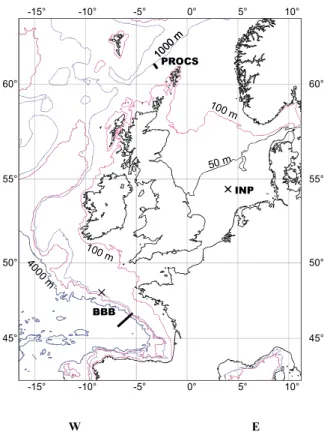
Data are used from current meters and acoustic Doppler current profilers (ADCP) that were moored in the flat bottom central North Sea, above the continental slope and into the abyssal plain of the Bay of Biscay, and at a sloping side in the Faeroe-Shetland Channel (Fig. 2). To avoid instrumental bias of data, analysis is restricted to
obser-5
vations using only Aanderaa RCM-8 mechanical current meters and RDI-ADCP at fre-quencies 75 and 600 kHz. Prior to analysis, the stability of the clocks of the instruments is verified by comparison with a single standard, before mooring deployment and after recovery, and also by frequency determination of the dominant harmonic M2. Records
are accepted when time is stable to within half the sampling period, over the entire
10
record.
In the Faeroe-Shetland Channel, observed total currents are up to 0.6–0.9 m s−1. The bottom slope is generally weak (∼2–4◦), very gentle and showing zones of varying rough and smooth structure. This ocean channel north of the British Isles is relatively narrow (200 km wide) and moderately deep (H<1300 m). Moorings were deployed
15
along a transect perpendicular to the Shetland continental slope between H = 500 and 1000 m (60.8◦N, 03.0◦W and 61.0◦N, 03.3◦W). Here, two weeks data will be discussed from the periods May 1997 and April 1999. To avoid some of the fisheries hazards, all moorings were shorter than 100 m above of the bottom, with current meters less than 50 m above the bottom. The cross-slope distance between the moorings was typically
20
∆x=10 km, whilst the vertical instrument separation and the ADCP’s vertical bin size resolution varied between ∆z=10 and 35 m.
In the Bay of Biscay, moorings were located along a transect for which H =1500– 4800 m, down the continental slope into the abyssal plain (46.7◦N, 05.4◦W–45.8◦N, 06.8◦W) with current meter devices between the bottom and up to 500 or 1000 m
25
above it. This continental slope is extremely rugged and canyon-like, compared to the Faeroe-Shetland Channel. Currents are somewhat weaker, varying between 0.15 and 0.6 m s−1.
OSD
4, 303–323, 2007 Unpredictability of internal M2 H. van Haren Title Page Abstract Introduction Conclusions References Tables Figures ◭ ◮ ◭ ◮ Back CloseFull Screen / Esc
Printer-friendly Version Interactive Discussion
EGU
5 Observations
In the strongly stratified near-surface (z∼–10 m) layers (of thickness ∆z=1–5 m) in the North Sea, shear varies rapidly with depth. The sample in Fig. 3 not only shows dom-inant baroclinic f and M2+f, but also rare “(sub)peaks” at 2f, 3f, 4f, in sharp contrast
with (sub)peaks at M2, M4, M6, M8in the barotropic signal. However, the amplitude of
5
the baroclinic peaks varies considerably within a few m in the vertical, commensurate the variations in S supported by the equally varying stratification. The absence of M2
-signal at the smaller baroclinic vertical scales is also observed in the deep-ocean, with the exception of the stratified bottom boundary layer above a slope (Gemmrich and van Haren, 2002) and in internal tidal beams very close to their source.
10
As the internal tide source is found between H=300 and 800 m at the continental slope in the Bay of Biscay (Pingree and New, 1991), the present ∆z=48 m ADCP-vertical current difference data reveal strong deterministic M2 and S2 around 740 m,
but not around 1040 m (Fig. 4a). Given a 2% tidal beam slope, and assuming that the deeper observations are made just outside the internal tide beam, the horizontal
15
distance between the ADCP and the source at the slope is <12 km. In these data with relatively large kinetic energy Ek(M2)>> Ek(f), f the local inertial frequency, tidal –
foremost M2rather than S2– shear is observed to vary by a decade in magnitude over
a few 100 m vertically. Outside the beam, S is no longer significantly peaking at M2and |S(f)| = |S(M2)|.
20
A similar vertical current difference spectrum as the latter is observed in the ocean interior above the abyssal plain >110 km from the continental slope, even over O(10) times larger vertical scales (Fig. 4b). Using ∆z=400 m, the vertical distance between consecutive current meters on a mooring at 600 and 1000 m above the bottom, the disparity between M2and S2in kinetic energy disappears in vertical current difference
25
data peaking near, but not exactly at M2and S2: 1.01M2and 0.99S2. This suggests an
interaction with a motion at 0.02 cpd, typical for the long-term variations in the area, but differently for M2 and S2, which are now more or less equal in magnitude in contrast
OSD
4, 303–323, 2007 Unpredictability of internal M2 H. van Haren Title Page Abstract Introduction Conclusions References Tables Figures ◭ ◮ ◭ ◮ Back CloseFull Screen / Esc
Printer-friendly Version Interactive Discussion
EGU with the kinetic energy peaks. Even larger peak shifting is observed in other areas, like
the Faeroe-Shetland Channel.
In the topographically less complex Faeroe-Shetland Channel kinetic energy is domi-nant at synoptic scales (∼2–5 cycles per day; 1 cpd = 2π/86400 s−1, having amplitudes of 0.1–0.2 m s−1) and at M2(Hosegood and van Haren, 2006; Figs. 1, 5, 6 here). In
con-5
trast, vertical (Fig. 5) and “horizontal”, cross-slope (Fig. 6) current differences across typical scales of 200 m and 10 km, respectively, are mostly dominated at 2.0–2.2 cpd = (1.0–1.1)S2. Using small vertical scales ∆z≤50 m, occasionally equal or larger
vari-ance is observed around local f (Fig. 5) with a gradual change in peak frequency from ∼f to ∼S2when ∆z increases from 20 to 200 m. These observations suggest that most
10
“incoherent” or relatively small-scale internal tidal energy is near S2, relatively far from M2, whilst the mixing inducing shear resides around f. The question remains whether
f-shear is induced by tidal motions. Note that Ek(f) is small in this area, it is not extending
as a significant peak above the spectral continuum.
Across typically 10 km in the cross-slope direction (Fig. 6), the dominant current
15
difference variance near S2is accompanied by relatively large variance at different
fre-quencies, varying from a relatively broad semidiurnal band to 0.9f = 1.57 cpd, depend-ing on time and location. In some of the 1999-data (Fig. 6b) S2 varies 180◦ in phase
across 10 km in cross-slope direction at 35 m (and other heights, not shown) above the bottom between H = 500 and 700 m. During other observational periods and in other
20
areas, such S2phase change is observed over distances of 20–30 km. In the
Faeroe-Shetland Channel, all observations across the range of scales investigated, about half the local continental slope equivalent to ∆x∼50 km horizontally and ∆z∼400 m verti-cally, imply that motions at M2 are homogeneous across these scales despite strong
internal forcing and stratification. The large spatial variations in spring-neap cycle (as
25
suggested by Gerkema, 2002) are all attributable to relatively small spatial scales at S2, not M2. The outstanding question is whether the small-scale baroclinic semidiurnal
tidal motions (mainly near S2) represent free waves, phase-locked forced motions or
OSD
4, 303–323, 2007 Unpredictability of internal M2 H. van Haren Title Page Abstract Introduction Conclusions References Tables Figures ◭ ◮ ◭ ◮ Back CloseFull Screen / Esc
Printer-friendly Version Interactive Discussion
EGU
6 Discussion
The strong discrepancy in observed scales between tidal constituents M2and S2is not
a priori obvious as both are thought large-scale barotropic sources converting their en-ergy to small baroclinic scales in a near-similar fashion. Their frequency separation is so small that they are equally considered “near-inertial”. Specifically, we are concerned
5
with the observed sequence of increasing scales for the order f, S2, M2. This contrasts
with an expected order of f, M2, S2considering the internal wave band bounds. Below, several possible reasons are discussed for the observed scale differences.
Vertical small-scales at f are known to exist in the ocean ever since the observations by Leaman and Sanford (1975). Small near-inertial scales are expected, because f
10
constitutes the short vertical wave limit of the internal gravity wave band f<σ<N in the traditional approximation. N represents the buoyancy frequency. However, their generation is still not fully understood. Locally, near-inertial waves may be generated, for example following the geostrophic adjustment of fronts. These fronts can be set-up by any external, spatially varying forcing. Apart from atmospheric disturbances, local
15
interior forcing may be due to semidiurnal tidal waves. But, the relative importance of tidal input in generating f is not yet known and requires further investigation.
Tidal energy can be redistributed through the spectrum following non-linear, reso-nant or non-resoreso-nant, interaction processes. Wave-wave interaction creates higher harmonics, whilst parametric subharmonic instability (or subharmonic resonance, SR)
20
enhances energy at smaller scales at half the frequency, so that free internal waves, generated in large N from M2, can propagate freely equatorward from|ϕ| = 28.8◦ (Hi-biya et al., 2002), whilst those by S2for|ϕ| < 30
◦
. Although these interactions create small-scale motions, they do not specifically create them around f (until f coincides with M1 or S1 at a “critical latitude”) or S2. Furthermore, due to SR it is especially the
25
large-scale, most energetic M2that is drained following the interaction, with the smaller
scales possibly retained at half the generic frequency.
OSD
4, 303–323, 2007 Unpredictability of internal M2 H. van Haren Title Page Abstract Introduction Conclusions References Tables Figures ◭ ◮ ◭ ◮ Back CloseFull Screen / Esc
Printer-friendly Version Interactive Discussion
EGU observed small-scale S2actually represent Doppler-shifted small-scale M2-motions. In
an environment where strong sub-tidal currents prevail one expects Doppler shifting of internal wave frequencies in Eulerian current measurements with respect to a fixed frame of reference, provided the Doppler shifting sub-tidal current acts as the source of the internal wave (beams). However, the latter constraint is generally not satisfied,
5
when the internal tide is generated at a fixed location at a fixed distance from the current meter. This suggested lack of importance of Doppler shifting is reflected in the observations, as broadening or smearing of harmonic peaks is not observed, whilst shifts to particular, harmonic frequencies f and S2cannot be substantiated.
As another alternative, M2-motions may interact with sub-tidal N-variations, creating
10
motions at non-constituent frequencies (van Haren, 2004), including some local f. We recall the observations in the Faeroe-Shetland Channel where small-scales are found at∼0.9f and ∼1.05S2, whilst M2-f≈0.1f ≈0.18 cpd ≈1.05S2-M2. In the Bay of Biscay
peak shifts of 0.02 cpd coincide in value with typical long-term variations in currents (van Haren, 2004). Assuming that internal wave (beam) propagation depends on
sub-15
inertial variations in background conditions (f, low-frequency vorticity ζ and N)(x, y, z, t), such frequency shifts can be explained considering typical ocean variations in these parameters.
Local effective inertial frequency may vary by such amounts due to low-frequency vorticity variations ζ =∂vl f/∂x – ∂ul f/∂y, e.g. due to meso-scale eddies passing, that 20
the short-wave limit may shift to feff= f + ζ/2 (Mooers, 1975). Typical ocean values are|ζ | = 0.1f for meso-scale eddies, and 0.01–0.02f was inferred for the deep Bay of Biscay (van Haren, 2004), but near continental slopes in the Faeroe-Shetland Channel they may increase to|ζ | = 0.5f (Hosegood and van Haren, 2006). There, (near)S2
oc-casionally becomes the low-frequency short-internal wave limit, at∼5 days periodicity
25
in April 1999. On the contrary, the rather peaking appearance of observed 0.9f and S2 -shear and current difference is not expected from such rather broad feff – distribution
that periodically varies its sign with time thereby rather smearing peaks.
OSD
4, 303–323, 2007 Unpredictability of internal M2 H. van Haren Title Page Abstract Introduction Conclusions References Tables Figures ◭ ◮ ◭ ◮ Back CloseFull Screen / Esc
Printer-friendly Version Interactive Discussion
EGU at f, is found at S2 or more exactly at 2Ω = 1.0027S2 for gyroscopic waves: internal
inertio-gravity waves under homogeneous conditions N = 0 (when they propagate in meridional direction). Whilst such conditions are only found on large scales in convec-tive regimes that are not quite common in the usually stably stratified ocean, small-scale layering of N = 0 can be quite ubiquitous, e.g. induced by internal wave straining
5
or breaking. Recall that such small-scale layering in stratification is highly associated with layering in shear, so that the two, vertical and horizontal (Gerkema and Shrira, 2005), short inertio-gravity wave limits f (large N) and 2Ω (N = 0) may delimit the shear-bounds.
For proof, we need more information on open ocean shear at the 1–10 m scales that
10
result from fine-scale straining. In addition to the present analysis, data may be inves-tigated in isotherm-following coordinates, but it is noted that 1-m shear-layering in the central North Sea did not reveal greatly different spectral results when considered in a Eulerian or isotherm-following coordinates (van Haren, 2000). Also, the above re-sults should be verified in other ocean areas, e.g. the Mediterranean Sea and Western
15
Atlantic Ocean, where Ek(M2) is relatively weak.
7 Conclusions
In a variety of North-Eastern Atlantic Ocean environments currents are investigated that are dominated by highly predictable semidiurnal lunar tidal M2. The spatial vari-ability of these M2-currents is low compared to that of other constituent motions. M2
-20
currents have scales >O(100 km) horizontally and≥0.5H vertically, which are dominant barotropic or lowest mode coherent baroclinic. These scales are not only observed in the open ocean, but also very close to continental slopes. Smaller M2-scales are only observed in a tidal beam, near one of the prominent sources of internal tides.
As a result, small-scale M2-motions are generally unpredictable as they are lost in
25
noise. They are not (directly) of importance for shear-induced ocean mixing, except in a internal beam in the vicinity (<10 km horizontally) of its source.
OSD
4, 303–323, 2007 Unpredictability of internal M2 H. van Haren Title Page Abstract Introduction Conclusions References Tables Figures ◭ ◮ ◭ ◮ Back CloseFull Screen / Esc
Printer-friendly Version Interactive Discussion
EGU Instead, small spatial scales or potentially large shear are observed away from M2,
near f and S2, and also, to second order, at inertial-tidal higher harmonics. The specific frequencies at which large shear is found, and the lack of dominant advective currents acting as internal tidal wave sources, rule out the importance of Doppler shifting.
The near-inertial (1±0.2)f and near-semidiurnal solar (1±0.1)2Ω≈ (1±0.1)S2 bands
5
are special, because they constitute the short-wave limits of the inertio-gravity wave band under weak stratification. The former frequencies may be fed from M2at critical
latitudes equatorward of|ϕ|≈30◦, whilst both may be fed via interaction with variations in background stratification and vorticity at all latitudes. Then, the observed peaks may represent wave and shear trapping.
10
Acknowledgements. I enjoyed the assistance of the crew of the R. V. Pelagia, who participated
in the deployment and recovery of all NIOZ-moorings. Members of NIOZ-MTM designed and constructed the deep-ocean moorings. J. Thieme and T. Hillebrand helped preparing and de-ploying the instruments. M. Hiehle made Fig. 2. I thank H. van Aken for the use of current meter data from his project BBB. The Western Atlantic Ocean data in Fig. 1 are from the OSU
15
deep-water archive. This work is supported by different grants (INP, BBB, PROCS, LOCO) from the Netherlands organization for the advancement of scientific research, NWO.
References
Baines, P. G.: On internal tide generation models, Deep-Sea Res., 29, 307–338, 1982.
Briscoe, M. G.: Preliminary results from the trimoored internal wave experiment (IWEX), J.
20
Geophys. Res., 80, 3872–3884, 1975.
Egbert, G. D. and Ray, R. D.: Significant dissipation of tidal energy in the deep ocean inferred from satellite altimeter data, Nature, 405, 775–778, 2000.
Garrett, C. and St. Laurent, L.: Aspects of deep ocean mixing, J. Oceanogr., 58, 11–24, 2002. Gemmrich, J. R. and van Haren, H.: Internal wave band eddy fluxes in the bottom boundary
25
layer above a continental slope, J. Mar. Res., 60, 227–253, 2002.
Gerkema, T.: Internal and interfacial tides: beam scattering and local generation of solitary waves, J. Mar. Res., 59, 227–255, 2001.
OSD
4, 303–323, 2007 Unpredictability of internal M2 H. van Haren Title Page Abstract Introduction Conclusions References Tables Figures ◭ ◮ ◭ ◮ Back CloseFull Screen / Esc
Printer-friendly Version Interactive Discussion
EGU
Gerkema, T.: Application of an internal tide generation model to baroclinic spring-neap cycles, J. Geophys. Res., 107, 3124, doi:10.1029/2001JC001177, 2002.
Gerkema, T. and Shrira, V. I.: Near-inertial waves in the ocean: beyond the “traditional approx-imation”, J. Fluid Mech., 529, 195–219, 2005.
Gould, W. J. and McKee W. D.: Vertical structure of semi-diurnal tidal currents in the Bay of
5
Biscay, Nature, 244, 88–91, 1973.
Helland-Hansen, B.: Physical oceanography and meteorology, In: Report on the scientific re-sults of the “Michael Sars” North Atlantic deep-sea expedition 1910, Vol. 1, Bergen Museum, Bergen, Norway, 1932.
Hibiya, T., Nagasawa, M., and Niwa, Y.: Nonlinear energy transfer within the oceanic
in-10
ternal wave spectrum at mid and high latitudes, J. Geophys. Res., 107(C11), 3207, doi:10.1029/2001JC001210, 2002.
Hosegood, P. and van Haren, H.: Sub-inertial modulation of semi-diurnal currents over the continental slope in the Faeroe-Shetland Channel, Deep-Sea Res. I, 53, 627–655, 2006. Howarth, M. J.: The effect of stratification on tidal current profiles, Cont. Shelf Res., 18, 1235–
15
1254, 1998.
Leaman, K. D. and Sanford, T. B.: Vertical propagation of inertial waves: a vector spectral analysis of velocity profiles, J. Geophys. Res., 80, 1975–1978, 1975.
Ledwell, J. R., Montgomery, E. T., Polzin, K. L., St. Laurent, L. C., Schmitt, R. W., and Toole, J. M.: Evidence for enhanced mixing over rough topography in the abyssal ocean, Nature,
20
403, 179–182, 2000.
Millot, C. and Cr ´epon, M.: Inertial oscillations on the continental shelf of the Gulf of Lions-Observations and theory, J. Phys. Oceanogr., 11, 639–657, 1981.
Mooers, C. N. K.: Several effects of a baroclinic current on the cross-stream propagation of inertial-internal waves, Geophys. Fluid Dyn., 6, 245–275, 1975.
25
Munk, W., and Wunsch, C.: Abyssal recipes II: energetics of tidal and wind mixing, Deep-Sea Res., 45, 1977–2010, 1998.
Nagasawa, M., Niwa, Y., and Hibiya, T.: Spatial and temporal distribution of the wind-induced internal wave energy available for deep water mixing in the North Pacific, J. Geophys. Res., 105, 13 933–13 943, 2000.
30
Perkins, H.: Inertial oscillations in the Mediterranean, Deep Sea Res., 19, 289–296, 1972. Pingree, R. D. and New, A. L.: Abyssal penetration and bottom reflection of internal tidal energy
OSD
4, 303–323, 2007 Unpredictability of internal M2 H. van Haren Title Page Abstract Introduction Conclusions References Tables Figures ◭ ◮ ◭ ◮ Back CloseFull Screen / Esc
Printer-friendly Version Interactive Discussion
EGU
Polzin, K. L., Toole, J. M., Ledwell, J. R., and Schmitt, R. W.: Spatial variability of turbulent mixing in the abyssal ocean, Science, 276, 93–96, 1997.
Sherwin, T. J.: Evidence of a deep internal tide in the Faeroe-Shetland Channel, in: Tidal Hydrodynamics, edited by: Parker, B. B., John Wiley, 469–488, 1991.
Rainville, L. and Pinkel, R.: Propagation of low-mode internal waves through the ocean, J.
5
Phys. Oceanogr., 38, 1220–1236, 2006.
St. Laurent, L. and Garrett, C.: The role of internal tides in mixing the deep ocean, J. Phys. Oceanogr., 32, 2882–2899, 2002.
van Haren, H.: Properties of vertical current shear across stratification in the North Sea, J. Mar. Res., 58, 465–491, 2000.
10
van Haren, H.: Incoherent internal tidal currents in the deep-ocean, Ocean Dyn., 54, 66–76, 2004.
van Haren, H., Maas, L., Zimmerman, J. T. F., Ridderinkhof, H., and Malschaert, H.: Strong inertial currents and marginal internal wave stability in the central North Sea, Geophys. Res. Lett., 26, 2993–2996, 1999.
15
van Haren, J. J. M. and Maas, L. R. M.: Temperature and current fluctuations due to tidal advection of a front, Neth. J. Sea Res., 21, 79–94, 1987.
Walter, M., Mertens, C., and Rhein, M.: Mixing estimates from a large-scale hydrographic survey in the North Atlantic, Geophys. Res. Lett., 32, L13605, doi:10.1029/2005GL022471, 2005.
20
OSD
4, 303–323, 2007 Unpredictability of internal M2 H. van Haren Title Page Abstract Introduction Conclusions References Tables Figures ◭ ◮ ◭ ◮ Back CloseFull Screen / Esc
Printer-friendly Version Interactive Discussion EGU 1 2 3 4 10−3 10−2 10−1 100 101 102 P (10 −4 s −2 /cpd) σ (cpd) M 2S2 M+2 M 4 f f FSC f CBfWA
an Haren Fig. 1
Fig. 1. Moderately smoothed kinetic energy spectra from 140 days of near-bottom (8 m) Aan-deraa RCM-8 current meter data in the Faeroe-Shetland Channel (FSC; thick line) at 61◦N, –3.3◦W, H = 1040 m. For reference, spectra are given from yearlong current meter data in the Canary Basin (CB; thin solid line; moderately energetic but peaked at semidiurnal constituents) and Western Atlantic Ocean (WA; thin dashed line; smooth spectrum, weak tides), respectively. Both data sets are from open ocean basins, at z = –3000 m (H ≈ 5200 m) and near latitude ϕ = 30◦N. Aanderaa RCM-5 data are measured at 32.7◦N, –70.8◦W in 1982, whilst Aanderaa RCM-11 data are obtained at 30.00◦N, –23.1◦W in 2005.
OSD
4, 303–323, 2007 Unpredictability of internal M2 H. van Haren Title Page Abstract Introduction Conclusions References Tables Figures ◭ ◮ ◭ ◮ Back CloseFull Screen / Esc
Printer-friendly Version Interactive Discussion EGU N W E 45° 45° 50° 50° 55° 55° 60° 60° -15° -15° -10° -10° -5° -5° 0° 0° 5° 5° 10° 10° INP PROCS BBB 100 m 100 0 m 100 m 50 m 100 0 m 40 0 0 m
Fig. 2. North-east Atlantic Ocean and north-west European shelf with sites of current meter mooring arrays from projects: PROcesses at a Continental Slope (PROCS), Integrated North Sea Program (INP) and Bay of Biscay Boundary layers (BBB).
OSD
4, 303–323, 2007 Unpredictability of internal M2 H. van Haren Title Page Abstract Introduction Conclusions References Tables Figures ◭ ◮ ◭ ◮ Back CloseFull Screen / Esc
Printer-friendly Version Interactive Discussion EGU 1 2 3 4 5 6 7 8 910 10−3 10−2 10−1 100 101 102 103 P (10 −4 s −2 /cpd) σ (cpd) M 2S2 2f M 3f 4f 4 M 6 M 8 M 2 + f
f
Fig. 3. Nearly raw kinetic energy spectra from 8 days of barotropic currents (shaded), defined according to (1) between 10 and 30 m, and baroclinic currents (2) at z = –16 m in strong strat-ification (heavy solid line). Data are from upward looking 600 kHz ADCP sampling ∆z = 0.5 m intervals whilst moored in a frame fixed to the bottom in the central North Sea (INP) at 54.4◦N, 4.0◦E during summer.
OSD
4, 303–323, 2007 Unpredictability of internal M2 H. van Haren Title Page Abstract Introduction Conclusions References Tables Figures ◭ ◮ ◭ ◮ Back CloseFull Screen / Esc
Printer-friendly Version Interactive Discussion EGU 10−4 10−3 10−2 P (10 −4 s −2 /cpd) M 2S2 f
a
1.4 1.6 1.8 2 10−2 100 P (10 −4 m 2 s −2 /cpd) σ (cpd)b
Fig. 4. Nearly raw spectra from 11 months of current measurements in the Bay of Biscay (BBB). (a) Vertical current shear across ∆z = 48 m from 75 kHz ADCP, between [–764 and –716] m (shaded) and [–1068 and –1020] m (heavy solid line). The upward looking ADCP was moored above the continental slope (at 500 m above H = 1600 m; 46.7◦N, –5.4◦W). (b) Kinetic energy from current meter at –3800 m (shaded) and current difference over 400 m vertically (heavy solid line) above the abyssal plain (H = 4800 m; 45.8◦N, –6.8◦W). Note the difference in f between (a) and (b), due to a small change in latitude.
OSD
4, 303–323, 2007 Unpredictability of internal M2 H. van Haren Title Page Abstract Introduction Conclusions References Tables Figures ◭ ◮ ◭ ◮ Back CloseFull Screen / Esc
Printer-friendly Version Interactive Discussion EGU 1 2 3 4 10−1 100 101 102 103 104 105 106 107 P (10 −4 s −2 /cpd) σ (cpd) M 2S2 M2M4 + f f ∆z=20 m ∆z=50 m ∆z=100 m ∆z=200 m
van Haren Fig. 5
Fig. 5. Nearly raw vertical current difference spectra from 13 days of upward looking 75 kHz ADCP observations between [–550 and –350] m in the Faeroe-Shetland Channel (60.9◦N, –3.1◦W, H = 600 m). Vertical current differences are computed between observations at z = – 550 m and data from higher-up, at increasing distance: ∆z = 20 m (heavy solid line), 50 m (solid line; offset vertically by one decade), 100 m (two decades off-set), 200 m (three decades). For reference, kinetic energy at z = –350 m is shown above (shaded; arbitrary vertical scale). The heavy solid vertical lines are at 1.57 cpd (0.9f ) and 2.08 cpd.
OSD
4, 303–323, 2007 Unpredictability of internal M2 H. van Haren Title Page Abstract Introduction Conclusions References Tables Figures ◭ ◮ ◭ ◮ Back CloseFull Screen / Esc
Printer-friendly Version Interactive Discussion EGU 100 102 P (10 −4 m 2 s −2 /cpd) M 2S2 f 2f M2M4 + f a 100 102 P (10 −4 m 2 s −2 /cpd) b 1 2 3 4 100 102 P (10 −4 m 2 s −2 /cpd) σ (cpd) c
Fig. 6. Nearly raw kinetic energy (shaded) and “horizontal” slope following current difference (heavy solid lines) spectra from 13 days of current meter observations at 34 m above the bottom in the Faeroe-Shetland Channel. (a) Data from April 1997, with kinetic energy at location H = 500 m and current difference between observations at locations H = 500 and 700 m. (b) as (a), but for data from April 1999. The vertical heavy solid lines are as in Fig. 5. (c) as (b) but for data at location H = 800 m and the difference between observations at locations H = 800 and 1000 m.



![Fig. 5. Nearly raw vertical current di ff erence spectra from 13 days of upward looking 75 kHz ADCP observations between [–550 and –350] m in the Faeroe-Shetland Channel (60.9 ◦ N, –3.1 ◦ W, H = 600 m)](https://thumb-eu.123doks.com/thumbv2/123doknet/14782687.597263/21.918.173.544.43.454/nearly-vertical-current-spectra-looking-observations-shetland-channel.webp)

