From Facet-based to Visualised
Digital Library Interfaces
An Empirical Study of User Experiences
with Digital Libraries
Doctoral Dissertation submitted to the
Faculty of Informatics of the Università della Svizzera Italiana in partial fulfillment of the requirements for the degree of
Doctor of Philosophy
presented by
Maram Hassan Barifah
under the supervision of
Dissertation Committee
Prof. Matthias Hauswirth Università della Svizzera italiana, Switzerland Prof. Vittorio Limongelli Università della Svizzera italiana, Switzerland
Prof. Pia Borlund Oslo Metropolitan University, Norway
Prof. Ian Ruthven University of Strathclyde, United Kingdom
Dissertation accepted on
Research Advisor Co-Advisor
Fabio Crestani Monica Landoni
PhD Program Director
Prof. Walter Binder and Prof. Silvia Santini
I certify that except where due acknowledgement has been given, the work presented in this thesis is that of the author alone; the work has not been submit-ted previously, in whole or in part, to qualify for any other academic award; and the content of the thesis is the result of work which has been carried out since the official commencement date of the approved research program.
Maram Hassan Barifah Lugano,
In memory of my beloved nephew,
Abdualaziz Alrumaim
"I don’t think that architecture is only about shelter, is only about a very simple enclosure. It should be able to excite you, to calm you, to make you think."
Zaha Hadid
Abstract
Digital library (DL) systems in the last decade have provided an unprecedented access to library content that were confined to their physical spaces. The last twenty years of the DL system renovation have witnessed several generations of online catalogs from the Online Public Access Catalogue (OPAC) late 1980s, to the next generation catalog systems (NGC).
DL systems are extensively used to facilitate access to collections of digital resources. Thus, NGC offers more user-friendly interfaces by providing function-alities like faceted navigation and filters. The facets are based on the unified index of metadata of the library’s content, and it is believed that facets assist users to achieve higher task accuracy and satisfaction.
However, many researchers criticize the architectural elements of the tradi-tional representation of contents in DL systems for two main reasons: firstly, the knowledge organisation schemes adopted to build DL systems were created by experts to classify resources, this results in inadequate use of the search tools i.e. facets and other DL functions by the end-users who are not familiar with the pur-pose of such techniques. Secondly, users are not allowed to deploy techniques of berrypicking in the search process, as no other information seeking behaviour (ISB) than the goal-directed ISB are supported.
The basic assumption of this study is that there is a need to provide alternative modes of access to information than the traditional facet-based DL interfaces.
The context of this study includes three different libraries serving three dif-ferent communities of users. These libraries have in common similar facet-based interfaces that built on the traditional DL information architecture.
Our investigation follows a user-centered approach where the users are a cen-tral part in the design process of the system. Therefore, this research employs ethnographic techniques, that aim to explore the interactions of the real users along with other user attributes e.g. experience level, attitude, and affective variables including emotion and mood. In particular, this research investigates how users interact with the DL interfaces, and how they perceive the quality of the DL interface through: log file analysis, screen video recording, user
viii
ence (UX) study, and a large attitudinal survey.
Results from such investigation lead to the second phase of the thesis which is the redesign of the facet-based interface by adopting the visualization approach. The visualization technique has been selected as it is supposed to provide an intuitive means for users to interact with the information. An intuitive interface is characterized by being easy to use and learn, requiring little to no previous knowledge, and just feeling "natural" to use.
Thus, the main concern of this thesis is to examine the effectiveness of the visualized interface as an alternative to the traditional DL interfaces, by consid-ering the users’ perspective. The evaluation of the visualized interface indicates that visualization is a promising solution that can enhance positive gauging of the participants’ satisfaction, together with experiential values that invoke low level of frustrations and high enjoyment.
Acknowledgements
First and foremost, I would like to express my sincere gratitude to my father Hassan Barifah and mother Maryam Al-Salmi for their unlimited supports.
I wish to express my gratitude and appreciation to my supervisors Prof. Fabio Crestani and Dr. Monica Landoni whose guidance, support and encouragement has been invaluable throughout this study. I am also grateful to my doctoral thesis committee, Prof. Pia Borlund, Prof. Ian Ruthven, Prof. Matthias Hauswirth, and Prof. Vittorio Limongelli for the thoughtful comments and recommendations on this dissertation.
Further, my special thanks to the Saudi Ministry of Education for funded this project.
I acknowledge the support of RERO Doc administrators for their collabo-ration, and sharing the log files data. We also thanks Mr.Alessio Tutino, from University Library Lugano for the enlightening conversations on DLs, users and librarians.
I would like to express our deep gratitude to Effat University, Jeddah, Saudi Arabia for their support to conduct the laboratory user study. Special thanks to Dr. Ayman Eddakrouri, the administrator of Effat Library and Cultural Museum, and to the Graduate Studies and Research Department.
I also thank Dr. Saad Azzahri, from King Saud University, Information Science department for helping us to distribute the survey used in this thesis.
In addition, special thanks to my neighbor in Lugano, Mrs. Helen AlHariri and her family for their great support and help. Surely, not forget to thank IR lab group at USI.
Finally, a very big thanks to my family members for always encouraging me to pursue this thesis.
Contents
Contents xi
List of Figures xv
List of Tables xvii
I Introduction and Background
1
1 Introduction 3 1.1 Motivation . . . 3 1.2 Research Problem . . . 6 1.3 Thesis Goals . . . 7 1.4 Research Questions . . . 8 1.5 Methodology . . . 9 1.6 Thesis Outline . . . 10 1.7 Contributions . . . 12 1.8 Publication Overview . . . 14 2 Background 17 2.1 Evaluation . . . 17
2.1.1 Overview of IR’s Evaluation . . . 17
2.1.2 Interactive IR’s Evaluation . . . 18
2.1.3 Digital Libraries . . . 19
2.1.4 Types of Digital Libraries . . . 20
2.1.5 Digital libraries’ Information Architecture . . . 20
2.1.6 Evaluation of Digital libraries . . . 21
2.2 Log File Analysis . . . 24
2.3 Why Search Fail? . . . 27
2.3.1 Reasons Behind the Failed Searches . . . 27 xi
xii Contents
2.3.2 The Affective Variable in Relation to the Failed Searches . . 30
2.4 User Experience in DL . . . 32
2.4.1 System Properties: . . . 34
2.4.2 User Characteristics: . . . 34
2.4.3 Context Parameters: . . . 35
2.4.4 The Instrumental and Non-instrumental Perceptions: . . . 35
2.4.5 Emotional Reactions: . . . 36
2.5 Interface Visualisation . . . 37
2.5.1 Challenges of the Traditional DL Interfaces: . . . 38
2.5.2 Information Visualisation . . . 39
2.5.3 Visualization of Information in DLs . . . 41
II Exploring
43
3 Exploring Usage Patterns of a Large-scale Digital Library by Analyzing the Log Files 45 3.1 Introduction . . . 453.2 Materials . . . 46
3.2.1 Challenges to Conduct Log File Analysis . . . 46
3.2.2 RERO Doc . . . 46
3.2.3 Data Description . . . 47
3.3 The Experimental Setup . . . 48
3.3.1 Data Preparing and Processing . . . 48
3.3.2 Interface Analysis . . . 50
3.3.3 Building the Topology of Session Action . . . 52
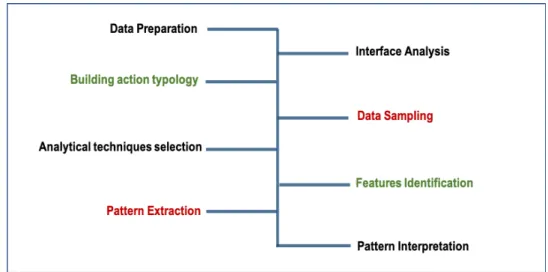
3.3.4 Analytical Techniques . . . 52 3.3.5 Features Identification: . . . 54 3.4 Experiments . . . 54 3.5 Results . . . 58 3.5.1 Item Seekers . . . 58 3.5.2 Navigators . . . 60 3.5.3 Searchers . . . 62 3.6 Discussion . . . 65
3.6.1 Inform the design and development of interactive systems 66 3.6.2 Inform the design of user studies . . . 67
3.7 Study Limitations . . . 68
xiii Contents
III Investigating
71
4 Why Searches Fail? 73
4.1 Introduction . . . 73
4.2 Methodology . . . 73
4.3 Results . . . 77
4.3.1 Demographic Data: . . . 77
4.3.2 System Expertise Level: . . . 78
4.3.3 Domain Expertise Level . . . 79
4.3.4 Search Performance: . . . 80
4.3.5 Behavioural Analysis: . . . 81
4.3.6 Causes for Failure . . . 82
4.3.7 Emotions Analysis: . . . 82
4.4 Discussion . . . 86
4.5 Study Limitations . . . 89
4.6 Conclusion . . . 89
5 Evaluating User Experiences in a Digital Library 91 5.1 Introduction . . . 91 5.2 Methodology . . . 93 5.2.1 The Library . . . 93 5.2.2 Experiment Phases . . . 94 5.2.3 Pilot Study . . . 96 5.3 Results . . . 97
5.3.1 Participants Expertise Levels: . . . 97
5.3.2 Behavioral Analysis: . . . 98
5.3.3 The Instrumental and Non-instrumental Quality Perceptions: . . . 99
5.3.4 The Associated Moods: . . . 103
5.3.5 Challenges and Suggestions for Improvement . . . 106
5.4 Discussion . . . 107
5.5 Conclusion . . . 111
6 Large-scale Attitudinal Survey 113 6.1 Introduction . . . 113
6.2 The Platform . . . 113
6.3 The Study . . . 114
6.3.1 Participants . . . 116
xiv Contents
6.4 Results and Discussion . . . 117
6.4.1 Participants’ Perspectives of the SDL . . . 117
6.4.2 User Requirements and Challenges . . . 119
6.5 Commonality Between the Studies . . . 120
6.6 Conclusion . . . 124
IV Prototyping
127
7 Can Visualisation be a Solution? 129 7.1 Introduction . . . 1297.2 Methods . . . 130
7.2.1 System Implementation . . . 130
7.2.2 Interface Design . . . 131
7.2.3 Design of the Evaluation Study . . . 136
7.2.4 The Task . . . 136
7.2.5 Instruments . . . 138
7.3 Results . . . 140
7.3.1 Task-level Evaluation . . . 140
7.3.2 Test-level Evaluation . . . 140
7.3.3 Log File Analysis . . . 142
7.3.4 Challenges and Solutions . . . 146
7.4 Discussion . . . 146
7.5 Conclusion and Limitation . . . 149
V Conclusion
151
8 Conclusion and Future Work 153 8.1 Summary of the Thesis . . . 1538.2 Future Works . . . 159
8.2.1 Technical Development: . . . 159
8.2.2 Methodological Development: . . . 161
Bibliography 163 Appendices 185 .1 The online study . . . 187
.2 The laboratory study . . . 187
Figures
1.1 Bates [1989] Berrypicking ISB Model . . . 7
1.2 The Research Design . . . 10
2.1 The Digital Library Interaction Components Tsakonas et al. [2004] 23 2.2 DLs in the Information Space Casarosa [2010] . . . 29
2.3 Interaction User Experience Framework Mahlke [2008] . . . 33
2.4 The ’Honeycomb’ Model of User Experience of Morville [2004]. . 36
2.5 Pick-A-Mood Scale Desmet et al. [2016] . . . 38
3.1 Snippet of the Log Files . . . 47
3.2 The Framework of Exploring UPs in LFs . . . 48
3.3 RERO Doc Interface . . . 49
3.4 Result Page . . . 50
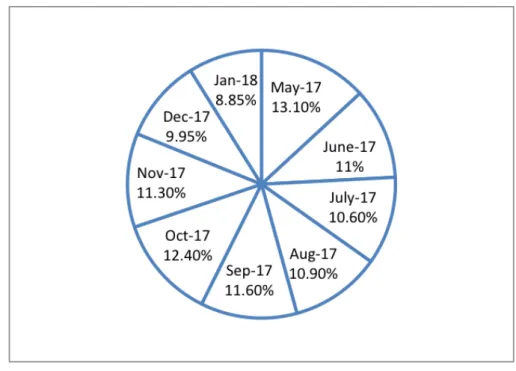
3.5 The Distribution of the Sessions over the Period . . . 56
3.6 The Highest Silhouette Score for K . . . 57
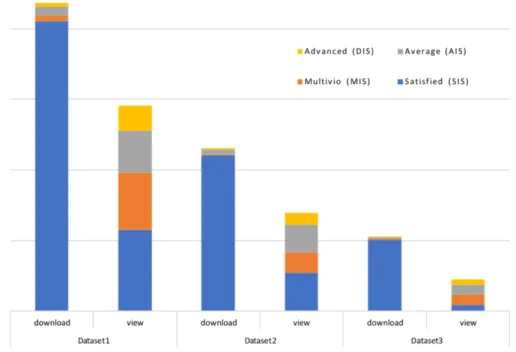
3.7 Patterns of the Item Seeker Across the Datasets . . . 60
3.8 Facets Used by the Advanced Navigators . . . 61
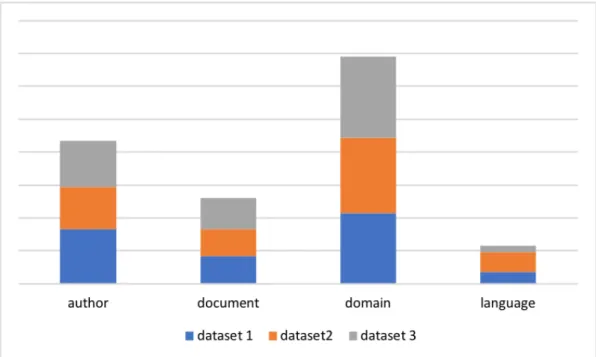
3.9 The Variations Among the Navigators . . . 61
3.10 Facets Used by the Searchers . . . 63
3.11 The Variations among the Searchers . . . 64
4.1 The Experimental Website . . . 74
4.2 The Experimental Phases . . . 76
4.3 The Frequency of the Problems for both Tasks . . . 85
4.4 The Distribution of the Emotions . . . 86
5.1 Interaction User Experience Framework Mahlke [2008] . . . 92
5.2 The Digital Library Homepage Interface . . . 93
5.3 The Digital Library Search Result Interface . . . 94
5.4 Experiment’s Lab . . . 96 xv
xvi Figures 5.5 The Perceptions Towards the Instrumental and Non-instrumental
Quality of the DL . . . 102
5.6 Examples of the Participants’ Answers . . . 103
5.7 Participants’ Moods Before and After the Experiment . . . 104
5.8 The Most Difficult Situations when Dealing with DL . . . 107
5.9 User Requirements to Improve the Interface . . . 108
6.1 SDL Homepage . . . 114
6.2 The Results Page of SDL . . . 115
6.3 Challenges Faced by SDL Users . . . 120
6.4 User Requirements and Challenges . . . 121
7.1 The System Architectural . . . 131
7.2 The Interfaces Before and After Visualisation . . . 133
7.3 General Visualisation Reference Model Card [1999] . . . 134
7.4 The Radial Layout . . . 135
7.5 SUS Scale Sauro [2020] . . . 143
7.6 Participants’ Perceptions of SUS Dimensions . . . 143
7.7 The Interface After the Modification . . . 144
1 The Informed Consent . . . 188
2 The Pre-Questionnaire . . . 189
3 The Post Questionnaire . . . 190
4 The Ethical Approval of the User Study . . . 191
5 Task Questionnaire . . . 192
6 Test Questionnaire Part 1 . . . 193
7 Test Questionnaire Part 2 . . . 194
Tables
1.1 Thesis’s Research Questions . . . 8
2.1 Summary of the Existing Studies . . . 26
3.1 Actions Typology of RERO Doc . . . 53
3.2 Session Features . . . 55
3.3 The Number of Records and Session of Each Dataset . . . 56
3.4 Characteristics of UPs . . . 59
3.5 The Dominant Facets of the Average Navigator . . . 60
4.1 Examples of the Participants’ Information Needs . . . 75
4.2 Number of Submitted Searches . . . 77
4.3 Participants Characteristics (N=32) . . . 78
4.4 System’s Expertise Level . . . 79
4.5 Topic’s Expertise for the Exploratory Task . . . 80
4.6 Metrics to Quantify the Behaviour . . . 82
4.7 Behavioral Analysis of both Groups for the Two Tasks . . . 83
4.8 Problems Reported by the Participants . . . 84
4.9 The Distribution of the Emotions for the Search and Overall Expe-riences . . . 85
5.1 Examples of the Participants’ Information Needs . . . 95
5.2 System’s Expertise Level . . . 97
5.3 Metrics to Quantify the Behaviour . . . 99
5.4 Behavioral Analysis of the Advanced and Non-advanced Participants100 5.5 Honeycomb Dimensions . . . 100
5.6 Participants’ Perceptions Towards the DL . . . 101
5.7 The Mood Before and After the Experiment . . . 105
6.1 Demographics Data of the Participants . . . 116
6.2 System’s Expertise Level . . . 117 xvii
xviii Tables
6.3 Perspectives of Both Groups to SDL . . . 119
6.4 Participants’ Perceptions Towards Both DLs . . . 122
6.5 Summary of the Studies Conducted in this Thesis . . . 125
7.1 Examples of the Participants’ Information Needs . . . 137
7.2 UX Evaluation Metrics and Questions . . . 139
7.3 Task-level Evaluation . . . 141
7.4 Test-level Evaluation . . . 141
7.5 SUS Scores and the Interpretation Sauro [2020] . . . 143
7.6 Metrics Used to Quantify the Interactions . . . 145
Part I
Introduction and Background
Chapter 1
Introduction
1.1 Motivation
Information retrieval (IR) is defined as "finding material (usually documents) of an unstructured nature (usually text) that satisfies an information need from within large collections (usually stored on computers)" Manning et al. [2008] (p. 1). Mainly, IR research has focused on how precisely and completely text representations match queries against a store of indexed texts Sanderson [2010]. In reality, when users interact with IR systems, they do not only create queries and judge the relevance of the results. Instead, various forms of user engagement in the search process are involved. Understanding the user aspects when inter-acting with the information system is under the umbrella of an emerged distinct research area called interactive IR (IIR). Comparing to the traditional IR studies which eliminate the users from the IR evaluation, IIR studies have widened the research objects to focus on users’ behaviors and experiences, as well as interac-tions between users-systems and users-information Kelly [2009]. Consequently, IIR research is called to consider various contextual factors, e.g. task types, user characteristics, user knowledge, search stages, and system features, that affect the dynamic user-system interactions when designing effective IR systems Xie and Cool [2009].
IIR is still a growing research area in the field of information science Joo [2013]. The context of this research considers digital libraries platform as an IR system.
The last 20 years of DL systems architectural renovations witnessed several generations of online catalogs from the Online Public Access Catalogue (OPAC) late 1980s to the next generation catalog systems (NGC) Yang and Wagner [2010].
OPAC provided the same access points as the card catalog. On the other hand, 3
4 1.1 Motivation NGC which is variously referred to as catalog overlays and discovery layers offers access to a greater diversity of sources than the traditionally available through a library’s catalog. NGC is web-based applications that search in a unified index of metadata. Thus, it is characterized by having a central index from which to return results through a single interface of extensive content including library catalog records, resources from institutional repositories, indexing and abstract-ing services, vendor databases, and other scholarly information resources. NGC uses open platforms, open source license software, and open content where pos-sible. For better supporting users’ expectations, NGC offers more user-friendly interfaces by providing functionalities like faceted navigation and filters Nagy [2011].
The facets are based on the unified index of metadata of the library’s content, and it is believed that facets assist users to achieve higher task accuracy and satisfaction Yeh and Liu [2011].
As many libraries adopted the NGC techniques, there is a growing interest of research in assessing the effectiveness of the current DL, on user search activities and task performance. Researchers are divided into two groups: the supporters who found that the DL search tools e.g. facets are useful and valuable features, and the opponents who confirmed that the current DL interfaces are confusing and overwhelming, and they call for innovative approaches, capable of handling the inherent complexity of DL systems with more uncomplicated and intuitive interfaces without a high learning curve Harkema [2015].
Consequently, a growing number of information science and technology re-searchers argue that the mismatch between users’ real interactions and the func-tionality of the DL is due to the posited disconnect between information be-haviour and practises (IBP) research and the development of information tech-nologies and information services Huvila et al. [2019]. The main critique is that the design of new technology and systems is not guided by the insights of IBP re-search, regardless of the enormous number of studies produced by IBP research. Users interact with the DL through the information space which is presented by its interface. In a search episode, the information behavior may change many times as the user information needs and interests are developed or their behavior is triggered by the affordances encountered on their way through the space of information Marchionini [2006].
Harkema [2015] considered the tradition design of the DL interfaces as an ob-stacle that kept the DLs as monument comparing to other growing and dynamic web sources, and he called for creating more opened and multifaceted informa-tion spaces. The current DL informainforma-tion architecture, the facet-based interfaces, supports only one type of information behavior, the goal-directed one. Thus,
dif-5 1.1 Motivation ferent researchers called to develop interfaces that go beyond the standard search functions, and promote different information behavior Pérez-Montoro and Nu-alart [2015]. Lueg and Twidale [2018] confirmed the need for alternative inter-faces and functionality that intentionally designed for humans by saying:
"We seem to have become stuck designing interfaces that are more suit-able for patient, logical, rational robots (or Vulcans) than for mam-mals who get tired, bored, exited, irritated, intrigued, or distracted, and who even change their minds about what they want to do." Lueg
and Twidale [2018] p.409
To address age-old problems reported in the DL evaluation studies, this re-search adopts user-centered approach where the users should be a central part in the design process of the system Alben [1996]. This dissertation starts the investigation implicitly by exploring the usage patterns (UP) recorded in the log files (LF) of the DL system. The analysis of the LF will reveal hidden information about the user interactions. This leads us to investigate deeply the real usage of the DL functions; i.e. to what extent the DL’s search tools are used?
This will be done by conducting three different user studies; one will inves-tigate why searches failed and it will be remotely run study, another one will investigate deeply the user experiences with the DL and it will be conducted in a laboratory setting, and the last-one will enable us to collect a large-scale atti-tudinal survey.
Users’ search behavior and cognitive processes can be significantly influenced by the type of search tools and interfaces they interact with. The basic assumption of this study, is that there is a need to provide alternative modes of access to information than the traditional facet-based DL interfaces.
To address this gap, we are going to redesigned the current DL interface tak-ing in our consideration that:
"The ultimate goal of any discovery service, bar none, is to place content in the hands of the user or, more specifically, to discover, present, and deliver relevant content in a convenient, intuitive manner to today’s researcher." Vaughan [2011] p.48-49
Thus, this dissertation will adopt the visualization approach as an alternative to the traditional DL interface. Visualization is not a new phenomenon in the IR filed but it has rarely been used in the DL context. Through visualization, complex information converted to a more user-accessible form. The features of the visualizations help to rapidly process information and provide knowledge that can not be recognized without visual data processing.
6 1.2 Research Problem The ultimate aim of this study is to examine to what extent the visualized DL interface can be adopted and used intuitively by users. Different instruments will be utilised for the evaluation, and the results will be discussed to see whether the interactive visualized interface has a positive impact on the overall user ex-perience or not.
The following sections summarize the research problem, research questions, thesis goals, methodology of this research, thesis outline, and publication overview.
1.2 Research Problem
Motivated by Nielsen [2020] who claimed that the structure of the website should be driven by the tasks the users came to the site to perform. Back to the eighties, the current DL interface heirs of the classical interfaces that built on a particu-lar architectural anatomy including the controlled vocabuparticu-laries and the filtering function through certain criteria e.g. author, year of publication, subject..etc Nu-alart et al. [2014].
Since then and in contrast to the other information systems, the DL inter-faces have barely evolved on the basis of the findings provided by user studies, nor have the advances developed in specific disciplines, such as information ar-chitecture, or those derived more generally from user experience (UX) Pérez-Montoro and Nualart [2015]. Most of the IIR studies still remain in measuring how search results are relevant, useful or satisfactory as an indicator for system performance Borlund [2003].
This shortage result in significant limitations includes preventing deploying techniques of berrypicking in the search process Bates [1989], and supporting other ISB divergent, explorative behaviour. In her model as in figure 1.1, and in contrast to the assumption of ‘standard’ information retrieval that the user’s information need remains the same throughout the search process, Bates [1989] emphasized the iterative nature of the search process. As new information en-countered, new queries may be formulated, thus a search may lead to a new and unanticipated directions. Accordingly, the information needs are not satisfied by a single document but rather by a series of bits and selections of information found along the way.
Pérez-Montoro and Nualart [2015] confirmed that the available tools of the DL include classification support users with only goal-directed information needs, while there is a need to design the DL interfaces to support the divergent infor-mation needs. Björneborn [2010] claimed that the traditional design of the DL supports only the convergent information behaviour, the goal-directed behaviour,
7 1.3 Thesis Goals
Figure 1.1. Bates [1989] Berrypicking ISB Model and ignores the divergent or the explorative behaviour.
Therefore, this research attempts to fill this gap by firstly investigate the real usage of the DL tools by: (i) analysing the log files of a large-scale DL, (ii) con-ducting a series of user studies both online and offline. Secondly, the research examined the efficiency of the visualised interface as an alternative to the tradi-tional DL interfaces.
1.3 Thesis Goals
Based on the shortcomings in the present literature, the aim of this study is three-fold:
1. To provide empirical studies with the purpose of gain a comprehensive and in-depth analysis of users’ interactions and perceptions in naturalistic settings,
2. To aid the researchers’ understanding of user behaviour in DL domain by deploying user experience techniques which should be the ultimate crite-rion of the user-centered design, and leads to recommendations for im-proving DL functionalities, and
8 1.4 Research Questions
Questions Method Chapter
1- What are the potential UPs of a large-scale DL? 2- What are the main features that characterise the above UPs?
Log files
analysis 3
3- What are the reasons behind search failures from the searchers’ perspective?
4- What are the primary emotions individual experienced in the failed searches?
Online user study
4
5- To what extent the DL functions are usable by users with different expertise?
6- Will the advanced participants share similar perceptions of the DL compared to the non-advanced participants?
7- What are the associated moods before and after the search experience in the DL?
8 -What are the influential factors that might affect the moods before and after the search experience?
Laboratory
user study 5
9- How would user perceive Saudi Digital Library (SDL)?
10- What are the commonality between the studies? Survey 6 11- How do users perceive a visualised
interface for a DL?
12- To what extent the new visualised interface can be adopted and understood by users?
Online
study 7
Table 1.1. Thesis’s Research Questions
3. To examine the efficiency of the visualised interface as an alternative to the traditional DL interfaces
1.4 Research Questions
The research aims to answer one main question: to what extent the DL’s search
tools i.e. facets and filtering functions are usable? This question was divided into
sub-questions. Different approaches were applied to answer those questions. We list the corresponding research questions in table 1.1 that have guided the research presented in this thesis.
9 1.5 Methodology
1.5 Methodology
This research employs ethnographic techniques. Ethnography refers to “the use of in-depth observation, and often participation, of a human group, culture, or context, with the goal of developing a rich description of activities, interactions, beliefs, roles, and goals” Lazar et al. [2017]. Basically, ethnography is based on the understanding of complex human practices by an in-depth study.
In human-computer interaction (HCI), ethnographic research is particularly useful for understanding how stakeholders interact with a system to complete complex tasks. It can help in providing an understanding of the context in which specific interfaces or systems are developed and implemented. Therefore, ethno-graphic studies are usually conducted “in the wild” where the “action” of inter-est takes place e.g. in homes, workplaces, or educational settings” Lazar et al. [2017].
Ethnography methods including participant observation focuses on develop-ing an understanddevelop-ing of the design problems by evaluatdevelop-ing an existdevelop-ing design in order to support future design decisions. Therefore, in the early stages of a user-centered design project, ethnography methods are particularly useful Lazar et al. [2017].
This work aims to explore the interactions of the real users along with other user attributes e.g. experience level, attitude, and and affective variables in-cluding emotion and mood. Particularly, to explore how users interact with the interfaces, and how they perceive the interfaces quality through: log file analysis, screen video recording, UX study, and large attitudinal survey.
The context of this study includes three different libraries, namely: (1) RERO Doc1; acronym of REseau ROmand, designates the network of libraries in West-ern Switzerland. (2) Effat DL 2, academic DL of Effat University, and (3) SDL, Saudi Digital Library3. All the mentioned libraries have in common similar facet-based interfaces that built on the traditional DL information architecture.
This work consists of two main fundamental phases, each phase has sub-phases as it depicted in figure 1.2.
In phase (I): the evaluation, series of studies were completed, and thus their results lead to phase (II): the prototyping. Phase (I) started by exploring the usage patterns recorded in the log files of RERO Doc DL.
Then, as the problem identified, the author investigated deeply the problem by involving real users of three different DL systems. In order to guarantee more
1http://doc.rero.ch/
2https://library.effatuniversity.edu.sa/ 3https://sdl.edu.sa
10 1.6 Thesis Outline
Figure 1.2. The Research Design
realistic results and eliminate the impact of the contextual factor, the experiments were carried out in different environments. The online study was designed to be run remotely in the users naturalistic settings, the UX study was conducted in the laboratory setting, and the attitudinal survey was distributed online. The results of the investigating sub-phase confirmed the findings of the LF analysis.
The outcomes of phase (I) inspired us to redesign the current DL of RERO Doc phase (II). The new design was evaluated by users, and accordingly some modifications were made to improve the new interface and enhance the user experiences.
1.6 Thesis Outline
The dissertation consists of eight chapters under five parts as follows.
Part 1 - Introduction and Background
• Chapter 1 – Introduction
fol-11 1.6 Thesis Outline lowed by introducing the research problem, and then presented the re-search questions. Finally, the rere-search methodology, and contributions of this dissertation were explained.
• Chapter 2 – Background
The research problem was identified by reviewing the related works of dif-ferent disciplines. The scope of the dissertation is wide, thus the back-ground chapter covered three main areas: digital library literature, evalu-ation including the literature of the user aspects, and finally reviewed the information visualisation related works.
Part 2 - Exploring
• Chapter 3 – Exploring Usage Patterns of a Large-scale Digital Library LF analysis is known as an inexpensive method that enables researchers to reveal hidden information about the systems, and help to gain an overview of the user experiences with the system. Thus, this study started by analysing the LF of RERO Doc DL, the study and the results are presented in chap-ter chapchap-ter 3.
Part 3 - Investigation
The LF analysis assists us to identify aspects for further investigation, thus the this part consists of the following chapters:
• Chapter 4 – Why Searches Fail?
Researchers believed that facets-based DL interfaces assist users to achieve higher task accuracy and satisfaction. To investigate this assumption, an online user study was conducted with the collaboration of RERO Doc aim-ing to understand why searches failed, and to what extent the facet-based DL interface functions are used. Chapter 4 described the study design and the results.
• Chapter 5 – Evaluating User Experiences in a Digital Library
The result of the study in chapter 4 motivated us to redesign the current DL interface followed the user-centered design approach. The user-centered design approach requires a deep understanding of the user experience (UX) before the processing of the redesign.
12 1.7 Contributions Thus, the purpose of this chapter is to investigate the UX in the DL by considering threefold aspects: The first is to understand to what extent the DL functions are usable, the second is to investigate the user perceptions of the instrumental and non-instrumental quality of the DL, and the third is to examine the associated mood before and after the search experience. The design and results of this study is presented in chapter 5.
• Chapter 6 – Large-scale Attitudinal Survey
So far, in this research the interactions with the DLs were examined im-plicitly by analysing the LFs, and exim-plicitly by conducting online and labo-ratory user studies. In order to confirm or deny the commonality between the findings of the studies, a large-scale attitudinal survey was distributed to collect more data of the users’ perspectives by considering a new DL with different population. Chapter 6 summarised the findings of those studies where the results inspired us to redesign the current DL interface by adopt-ing the visualisation approach.
Part 4 - Prototyping
• Chapter 7 – Can Visualisation be a Solution?
As a response to the problems reported in the user studies, we redesigned the facet-based interface, and the interactive visualised interface is pre-sented. The goal of this chapter is to examine the effectiveness of the visu-alised interface as an alternative to the traditional DL interfaces.
Part 5 - Conclusion and Future Work
• Chapter 8 – Conclusion and Future Work
Finally, the summary of this study is presented in this chapter, along with the future directions.
1.7 Contributions
This dissertation contributes to the filed of the DL in four main aspects as follows: • Framework for analysing DL log files
13 1.7 Contributions Regardless of the importance of the LF analysis as a valuable source of the hidden information of the user interactions, the number of the LF analysis studies is low compere to other web platforms.
Discovering information from LFs is not a trivial process; it requires a strategic plan to gain a better understanding of the hidden information. In this dissertation, we defined a framework for analysing DL log files to help and encourage DL administrators, information science researchers and students to conduct LF analysis.
The framework is explained in chapter 3, and the work is published as Bar-ifah and Landoni [2019a].
• Design an IIR naturalistic experimental platform
One of this research goals is to conduct evaluation experiments in a nat-uralistic setting as far as possible in terms of the task design and/or the experimental setting i.e. in the user everyday settings. Thus, a method-ological contribution of this thesis is designing an experimental platform that enabled the participants to take part in a semi-naturalistic study as in chapter 4. We define it as semi-naturalistic given that users were work-ing in their own environment while bework-ing guided by the simulated task scenarios. A simulated work task situation is "a short textual description that presents a realistic information requiring situation that motivates the test participant to search the IR system" Borlund [2016] (p.395). The re-sults of this study was presented in ISIC 2020 conference.
It is also worth noticing when considering our contribution to the design of naturalistic studies, the introducing of the user-tailored task that was generated from the study in chapter 4, and reused in chapter 7. The user-tailored task refers to self-generated tasks by the real users of a system, and it can be used later to design the simulated task scenarios to evaluate the system.
• User experience (UX) study in DL
Researchers called to deploy UX techniques, which should be the ultimate criterion of the user-centered design, to address age-old problems reported in the DL evaluation studies. Evaluating a system should be moved beyond the usability and quantitative metrics for fully understanding the UX. To our best knowledge, DL research lacks to the UX studies, and lacks of empirical studies that combined different data collection tools for fully un-derstanding of user interaction, and user experiences.
14 1.8 Publication Overview Thus we contribute to the filed by deploying a user-centered method for fully understanding the UX in the DL domain. The design and results of the study is explained in chapter 5, and this work published as Barifah et al. [2020].
• Implementing visualised interface as an alternative to the traditional
DL interface
DL interface design has barely evolved on the basis of the findings pro-vided by user studies, nor have the advances developed in specific disci-plines, such as ISB, or those derived more generally from user experience (UX) studies. To response to this research need, this study adopted the visualisation interface as an alternative to the facet-based DL interface. Although there were different attempts of implementing visualisation in-terfaces and tools in the DL systems, Pérez-Montoro and Nualart [2015] stated that visualisation has not yet been widely implemented in the DL for practical and methodological reasons.
Examples of the practical reasons are: visualisation tools are not integrated in the standard search field-result list paradigm of DL which means users perceive them as being secondary tools Hienert et al. [2012]. Moreover, visualising results are not very intuitive to users due to the high level of abstraction and conceptualization of the visualisation architecture.
Regarding the methodological reasons, along with other reasons, Pérez-Montoro and Nualart [2015] confirmed that most of visualisations pro-totypes used small collections of documents and their efficient use with large collections has not been demonstrated. Moreover, most of the pro-posed techniques were not tested with the involvement of end users, and this makes it difficult to draw any clear conclusions about their efficiency. Therefore, in response to such gaps, this research adopted the interactive visualise interface to a large-scale DL system. Followed by conducting a user-centred evaluation study to investigate the efficiency of the visualisa-tion in DL platform. The interface design and the study result described in chapter 7.
1.8 Publication Overview
Most of the works presented in this thesis was published in different events as listed below:
15 1.8 Publication Overview • Barifah, M. and Landoni, M. [2019]. Exploring usage patterns of a large-scale digital library, 2019 ACM/IEEE Joint Conference on Digital Libraries (JCDL) Barifah and Landoni [2019a].
• Barifah, M. and Landoni, M.[2019c]. Obstacles to conducting log file stud-ies in Saudi Arabia,With an Eye to the Future: HCI Research and Practice in the Arab World Barifah and Landoni [2019c].
• Barifah, M. and Landoni, M.[2019b]. Interactive search profiles as a design tool,International Conference on Human-Computer Interaction, Springer, pp. 18-30 Barifah and Landoni [2019b].
• Barifah, and M. Landoni, M., [2020]. Emotions associated with the failed searches in a digital library .In press (accepted at ISIC 2020).
• Barifah, M. Landoni, M., & Eddakrouri, A. [2020]. Evaluating the user ex-perience in a digital library. Proceedings of the Association for Information Science and Technology, 57(1), e280 Barifah et al. [2020].
• Measuring the User Experience with a Visualised Digital Library, under re-view of CHIIR 2021.
Chapter 2
Background
Because the scope of this research is wide and covers different disciplines, var-ious research domains have been investigated starting with an overview of the evaluation of the information retrieval (IR) and interactive IR (IIR) evaluation, moving to digital library systems as an IR system, then to the user aspects in re-lation to DL, and finally the literature of the information visualisation in DL was reviewed.
2.1 Evaluation
This section reviews the evaluation of IR, IIR, and DL systems.
2.1.1 Overview of IR’s Evaluation
Information retrieval is defined as "finding material (usually documents) of an unstructured nature (usually text) that satisfies an information need from within large collections (usually stored on computers), Manning et al. [2008].
Evaluation is a fundamental aspect of both IR and Interactive Information Retrieval (IIR) research Kelly and Sugimoto [2013]; Zuva and Zuva [2012].
System-oriented evaluation approaches fail to capture the dynamic environment
of IIR Tamine-Lechani et al. [2010]. For instance, Cranfield Paradigm, the stan-dardised evaluation approach in IR research, evaluate retrieval systems based on a test collection and associated relevance judgements for extensive testing and comparison of retrieval algorithms Maxwell and Azzopardi [2016].
The system-centred method aims to measure the effectiveness and efficiency of the IR systems. The effectiveness is defined as "a measure of the ability of the system to retrieve relevant documents while at the same time holding back
18 2.1 Evaluation non-relevant one" Rijsbergen [1979]. Therefore, IR models and algorithms are evaluated in terms of their ability to identify topical relevant documents Tamine-Lechani et al. [2010]. The efficiency of the system can be assessed including the coverage of the collection, the time lag, presentation of the output, and the effort involved by user in obtaining answers to a request Rijsbergen [1979].
Various metrics can be used to evaluate the IR systems. Precision and recall belong to the Set-based measures. Precision is the measurement of the fraction of retrieved documents that are relevant whereas recall is the fraction of rele-vant documents retrieved Sanderson [2010]. Rank-based measures are used to measure the position of the items in the ranked list e.g. mean average preci-sion (MAP) and discounted cumulative gain (DCG). Other measures are used to evaluate different IRS problems e.g. measure the success of search tasks by using mean reciprocal rank (MRR). Or using S-recall to assess the variability or diversity of results Clough and Sanderson [2013]. The system-oriented ap-proach is widely used due to the established parameters (metrics), thus the re-sults are easy to compute and interpret and the process is fast compared to the user-oriented approach Akhigbe et al. [2011]. Also, the system-oriented tests are distinguished by being repeatable, inexpensive, and ideal for testing specific components e.g. learning a ranker Clough and Sanderson [2013]. Because the focus of the system-oriented approach is assessing the performance of the under-lying search algorithms with little involvement of end users, the system-oriented approach has been criticised for lacking of insight into the user-system interac-tion and disregarding iterative and exploratory retrieval Petrelli [2008].
2.1.2 Interactive IR’s Evaluation
IIR studies how users interact with IR systems and evaluates the users’ satis-factions with the retrieved information Kelly [2009]. IIR systems are defined by Borlund [2000] as "those where the user dynamically conducts searching tasks and correspondingly reacts to systems responses over session time". Thus, users’ behaviours, experiences and interactions with systems are the main focus of IIR’s studies Kelly [2009]. Three ingredients are essential in IIR studies Bor-lund [2003]: the involvement of potential users as test participants, the use of dynamic and individual information needs, and the employment of relevance judgements. Different actions are embodied in the process of IIR including: "query formulation and reformulation, search result list interaction (scanning, assessing and clicking), document interaction (reading and judging relevance), and result list and session abandonment" Pääkkönen et al. [2017].
en-19 2.1 Evaluation gage with a system in order to retrieve relevant documents, user-oriented evalu-ation approach was emerged. These are characterised by involving real users in the evaluation process and considering the context, human aspects, and interac-tions in relation to the retrieval processes Kelly [2009]; Borlund [2000]. When involving the users, a variety of evaluation metrics are used which can be di-vided into four standard classes Belkin [2010]; Catarci and Kimani [2012]; Kelly [2009]:
1. The performance measures include: interactive recall and precision, multi-level relevance and rank measures, time-based measures (efficiency), in-formativeness for evaluating search results, and cost and utility measures. 2. The contextual measures consider: user characteristics or individual
differ-ences, measures of information needs.
3. The interaction measures cover: number of queries, number of search re-sults viewed, number of documents viewed, number of documents saved, and queries length.
4. The usability measures include effectiveness, efficiency, and satisfaction. However the user-centred evaluation approach has been criticised for being costly and time consuming Azzopardi [2011], and producing data that are not reusable, and delivering results that are not reproducible Joho et al. [2007].
The context of this research considers digital libraries platform as an IR sys-tem. The following section covers the literature of the digital library.
2.1.3 Digital Libraries
DLs can be defined as a type of "distributed systems with the capability to store various electronic resources and provide convenient access for end users via net-works" Zha et al. [2015]. Similarly Frias-Martinez et al. [2007a] defines DL as "collections of information that have associated services delivered to user com-munities using a variety of technologies".
Thus, the DLs are characterised by being information systems; (a) that pro-vide information services, (b) where information should be organized and pre-sented in usable ways, (c) that enable users to communicate with information, and (d) help users to satisfy their information needs Fox [2002]. DLs provide
20 2.1 Evaluation authentic content where the collections or items are organised by knowledge-able professionals Agosti et al. [2012]. In most cases, their interfaces are struc-tured hierarchically, providing different types of interactions: traditional key-word searching and browsing-related activities, including using multifaceted menu and inter-document linkages Han and Wolfram [2016].
2.1.4 Types of Digital Libraries
There are different types of digital libraries based on the data distribution and material localisation. Those are: the Stand-alone Digital Library (SDL), Fed-erated Digital Library (FDL), and Harvested Digital Library (HDL). The SDL is self-contained where the holdings are digital scanned or digitized, and the mate-rial is localized and centralized in a fully computerized fashion with networked access. The ACM Digital Library IEEE Computer Society DL are examples of SDL. The second type is FDL that composes several autonomous SDLs to form a net-worked library based on common focus and topic with a single user interface. An example of the FDL is Networked Digital Library of Theses and Dissertation. FDL systems usually implemented discovery tools such as SCOPUS, Database Ad-visor, ELIN, Knowledge Cite Library, and OCLS’ FirstSearch. Finally, the HDL a virtual library providing mainly metadata with pointers to the holdings that are "one click away" in Cyberspace. the Internet Public Library is an example of the HDL Kadury and Frank [2007].
2.1.5 Digital libraries’ Information Architecture
Back to the eighties, the current DL interface heirs of the classical interfaces of the document databases on CD-ROM that built on a particular architectural anatomy including the controlled vocabularies and the filtering function through certain criteria e.g. author, year of publication, subject..etc Nualart et al. [2014]. Most of the DL utilized the discovery search interface (DSI). One of the design principles behind the DSI is the information architecture which is defined as the "combi-nation of organization, labeling, and navigation schemes within an information system" Rosenfeld and Morville [2002]. Consequently, the DSI is a gate that en-ables access to the DL catalogue and to multiple databases through a single search box Gross and Sheridan [2011]. The DSI is recognized to possess an abundance of search tools: facets, advanced search, and sorting. Those search tools are de-signed to be dynamic filters, limits or refinements that assist users to modify a set of search results. Facets, in particular, are powered by the controlled vocabu-laries and detailed metadata that librarians have built and maintained, and they
21 2.1 Evaluation are usually positioned vertically on the left side of the interface Hall [2016]. Ac-cordingly, there are three main components in the DL interfaces namely: the data model describing the information available to the users (e.g. labeling and termi-nology), the navigational model including the procedures for gaining access to data model (i.e. search tools e.g. facets and advanced search), and the interface style referring to the surface presentation (e.g. style and color) Cushman and Rosenberg [1991].
2.1.6 Evaluation of Digital libraries
Digital libraries tend to satisfy user needs by providing authentic and useful con-tent which will determine the excon-tent of the usage of the DL Petrelli [2008].
Evaluation is defined as "the systematic process of determining the merit, value, and worth of something. Evaluation is broader than assessment and in-volves making a judgement as to the effectiveness of an assessment. Evaluation has a certain goal, methodology and devices or techniques. The goal suggests some evaluation criteria e.g. performance, which sometimes break down to eval-uation parameters e.g. response time, availability" Fuhr et al. [2007].
Evaluations are classified into: formative evaluation which is conducted dur-ing the development phases of a DL system to minimise imperfections before release. In contrast, summative evaluation is conducted in the final stages of the development or after an initial release. Comparative evaluation where dif-ferent systems or components are compared. And the iterative evaluation that are conducted regularly as new materials are added, metadata are updated and user characteristics changed or new users joined Xie and Cool [2009]; Petrelli [2008]. Due to the interdisciplinary research domain of the DL covering infor-mation retrieval, human-computer interaction, and inforinfor-mation science, the lit-erature is rich with various evaluation models, frameworks and criteria Tsakonas et al. [2004].
DL is not only a content-bearing tool, thus considering system retrieval per-formance solely is not sufficient to evaluate the overall system acceptability. In-stead, the interactions between the three core components: user, content, and
system should be considered. Such interactions are embodied in the usage of a
system thus monitoring the usage provide useful information for evaluation and improvement processes Fuhr et al. [2007].
The three DL components: the user, content, and system are described by Tsakonas et al. [2004] and summarised as the following:
numer-22 2.1 Evaluation ous and complicated attributes Belkin [2010]. Users tend to use digital libraries to fulfil their information needs. Their interactions are embod-ied in the ISB which are affected by different attributes including expertise in using the system, familiarity, frequency of using the system and tasks’ knowledge. Lacking of expertise and knowledge result in poor usage of the system’s functionalities and content identification. Therefore, it is im-portant to enlarge the scope of IIR systems’ evaluation by considering more metrics i.e user attributes to evaluate usage along with the system perfor-mance evaluation Behnert and Lewandowski [2017].
2. Content: it is the main motivation behind using a DL, and finding the rele-vance and useful content is always related to the users’ information needs i.e. search tasks of the users. The availability and the usefulness of the con-tent affect the users’ seeking behaviour, query (re)formulation, and types of digital collections.
3. System: it is the mean of the interaction between the users and the con-tent and it consists of IR mechanisms, interface structure, and information architecture.
The interaction among the three DL components is depicted in 2.1: the user,
content, and system are classified by Fuhr et al. [2007] and Tsakonas et al. [2004]
into: content-system, user-system, and user-content interactions, they summarised as follows:
Content-system interaction which can be evaluated by considering the
perfor-mance of the system that depends on the structures and representations of the content. Such evaluation is done computationally where the user cannot eval-uate it directly. Precision and recall are examples of the measures. To evaleval-uate the interaction of the user-system, usability aspects are examined including (i)
ef-fectiveness: the accuracy and completeness with which users achieve specified
goals i.e. user performance and error generation, (ii) efficiency: the resources expended in relation to the accuracy and completeness with which users achieve goals e.g. completion time. And (iii) satisfaction: the comfort and acceptability of use e.g. aesthetic comfort and readability Cabrerizo et al. [2010].
The motivation behind using a DL is embodied in the interaction between the
user-content where the usefulness of the content in relation to the search tasks
and needs is the criterion. Hügi and Schneider [2013] explained the usefulness features to include relevance, available format of the material i.e. text or multi-media, level of the available material e.g. meta data, abstract, full text, reliability, and coverage.
23 2.1 Evaluation
Figure 2.1. The Digital Library Interaction Components Tsakonas et al. [2004] A holistic framework of the evaluation was introduced by Xie and Cool [2009] where they focused on the following features: interface usability, system perfor-mance, user satisfaction, collection quality and service quality.
It is important to mention that not all the evaluation criteria should be applied in one study, it depends on the aim of the study Tsakonas et al. [2004].
Depending on the aim and the focus of the evaluation, different approaches can be followed to conduct evaluation studies of IIR systems Kelly [2009]. The main approaches are: the naturalistic studies which can be conducted in the naturalistic setting and involving real users with real search tasks, or laboratory controlled experiments e.g. TREC-style Maxwell and Azzopardi [2016]. Un-dertaking IIR experiments with test subjects is laborious in terms of organising and running, time consuming, costly, and the experiments are difficult to repro-duce Azzopardi [2011]; Kelly [2009]. However involving the end-users in the evaluation help system designers to design better systems and improve user ex-periences Kelly [2009].
In this thesis, different methods were followed. Firstly, we started by analysing the log files of the DL system to explore areas that might need further investiga-tion. Secondly, a remotely user study was conducted to understand why searches failed and to what extent the DL functions are used. Thirdly, a laboratory user study run to gain a deeper insights into the user experiences in the DL context.
ex-24 2.2 Log File Analysis periences were reviewed as follows
2.2 Log File Analysis
Providing IIR system users with better experiences requires a deep understanding of their information searching behaviour. Information searching can be defined as "users’ purposive behaviours in finding relevant or useful information in their interactions with information retrieval (IR) systems" Xie [2012]. Users follow different search strategies or moves when interacting with systems. One method for understanding search strategies is investigation of users’ digital footprints, or usage patterns (UP), found in log files (LFs) Ndumbaro [2018].
LF analysis refers to "the study of electronically recorded interactions between online information retrieval systems and the persons who search for the informa-tion found in those systems" Peters [1993]. LF analysis is an attractive approach due to the availability of the data considering a larger scale of interactions Hajek and Stejskal [2017]; Han and Wolfram [2016], and being less subject to bias and non-invasive, as it records interactions between systems and users that might not be clearly observed in laboratory experiments Bollen and Luce [2002].
The dynamic nature of the DL requires profound understanding of the user in-teractions. Thus, scholars utilised LF analysis to investigate two user-interaction levels: clickstream analysis and fine-grained actions analysis. The former concept refers to the higher-level analysis of interaction during a search session, and the latter refers to the investigation of sub-actions inside the UPs, with query-related analysis being an example Han and Wolfram [2016].
Previous scholars investigated UPs with the aim of assessing users’ interaction and improving their search experiences. Chen and Cooper [2001] undertook a pioneering study of library UP recognition. They aimed to automatically detect UPs based on users’ interactions extracted from the LFs of an online academic library catalog system. They employed clickstream analysis, and the session was the unit of analysis. Based on 257,000 sessions, UPs were characterised accord-ing to 47 operational implicit features of a session. The main features were ses-sion, search, display, relevance, error and help. Chen and Cooper used hybrid clustering and principal component analysis to identify, six distinct UPs: knowl-edgeable and sophisticated use, unsophisticated use, highly interactive use with good search performance, known-item searching, help intensive searching, and relatively unsuccessful use.
Similarly, Eason et al. [2000] investigated the UPs of an electronic journal collection by implementing K-means clustering analysis. Twenty-two months of
25 2.2 Log File Analysis LF records were analysed along with surveys. The main variables analysed were frequency of use, breadth of use, depth of use, functions use, use of back and current issues, and read and print (e.g. PDF or HTML). Eight UPs were found: enthusiastic users, focused regular users, specialised occasional users, restricted users, lost users, exploratory users, tourists, and the searchers.
Nicholas et al. [2006] considered records from academic DL from June 2004 to December 2004 and investigated the potential UPs of accessed journals in a DL. They found four different UPs: accessing from search engines, subject lists, alphabetical or journal list, and a combination of the methods. The variables considered in this analysis were items viewed, session duration, time online, and site penetration. They concluded that the users who used more than three access methods were demanding users. Also, they established that the types of information needed, such as fact checking affected the patterns and access methods.
Frias-Martinez et al. [2007b] investigated the role of human factors, particu-larly cognitive styles, levels of expertise and gender differences, in stereotyping behaviour and perception of an academic library catalogue. They employed LF analysis in combination with questionnaires. Three clustering techniques were implemented: K-means, hierarchical and fuzzy clustering. Five different clusters emerged in relation to the system experts and functions used. They concluded that K-means clustering yielded positive results in terms of meaningful interpre-tation of results and ease of implemeninterpre-tation.
Kovacevic et al. [2010] also implemented data mining techniques to analyse LF records of an academic DL, in particular K-means and Naive Bayes classifica-tion, with the aim of improving DL recommendation services. UPs were clustered based on the users’ profiles and search history. They considered more explicit features including the users’ institute, town, gender, age and services used. Con-sequently, services were recommended to new users based on previous similar user profiles and preferred services. Similarly, Renaud et al. [2015] analysed li-brary UPs in relation to students’ academic performance. They categorised the UPs according to explicit features such as academic positions, student class, and departments. Ndumbaro [2018] analysed the UPs of an academic OPAC system. The analysis of the LFs involved tracking preferred access points (e.g. search by title, author, subject or phrase, or multiple searches), and query-based be-haviour to identify reasons for search failures. The dataset consisted of records for January to December 2015, with 532,113 search hits. Traditional descrip-tive statistics were used. Similarly, Papatheodorou et al. [2003] investigated the UPs of an academic DL to assess the preferred access points and construct user communities. Their unit of analysis was the query, and the Clique mining
algo-26 2.2 Log File Analysis
Study Techniques applied Dataset description
Chen and Cooper [2001] hybrid clustering 257,000 sessions Eason et al. [2000] k-means cluster 22 months logs Nicholas et al. [2006] descriptive analysis seven-month period Frias-Martinez et al. [2007b] k-means, hierarchical, fuzzy 48 records
Kovacevic et al. [2010] k-means & Naive Bayes 230,000 records Renaud et al. [2015] statistical analysis & software Weekly snapshot Ndumbaro [2018] statistical & content analysis one year logs Papatheodorou et al. [2003] clique mining 32 months log files Joo [2013] statistics, kernel regression sixty students entries
Table 2.1. Summary of the Existing Studies
rithm was implemented to cluster patterns. Two different UPs were identified: specialised users who frequently utilised "Author" as the access point, and a ho-mogeneous user group whose behaviour was characterised by using all the main access points. They concluded that the variations in behaviour was due to the users’ specialisation and the nature of the collections.
Joo [2013] analysed the LFs of a national DL to investigate search tactic patterns in relation to task types: known-item, specific information, and ex-ploratory search. Transition analysis was implemented to trace common patterns of sequential tactics for each task. Hierarchical clustering and multi-dimensional scaling were employed for clustering search sessions by search tactic selection. Joo determined that the main features that differentiated the patterns were fre-quency of actions, spent time, change over time, and transition.
This brief review of related work indicates that LF analysis assists scholars and practitioners to gain deeper insights into users interactions and their search-ing experiences. The studies involvsearch-ing minsearch-ing UP in the context of DLs can be classified according to: type of the platform (i.e OPAC system or academic DL),
level of analysis (i.e. clickstream or fine-grained actions), available features (i.e.
explicit or implicit), and purpose of analysis (e.g. identify user communities and interests, or enhance the system, services or interface). Classification enables selection of suitable analysis methods (e.g. descriptive statistics, clustering ,or classification) Hajek and Stejskal [2017]; Siguenza-Guzman et al. [2015].
We also noticed the lack of a standard dataset description among previous studies. Table (2.1) presents a summary of the studies, and shows considerable variation in dataset descriptions. Units used in the literature to describe datasets included data size, duration of data collection (e.g. week, month) and session or record numbers. A standard unit set is important to allow the findings to be comparable to others. Using a combination of data size by number of records
27 2.3 Why Search Fail? or measurement unit (e.g. GB) and session numbers is more informative than using one unit alone.
The first phase of this research is to explore the UP of a Large-scale DL. The contributions of the chapter is to define a framework for analysing a large scale DL log files. In chapter 3 the study, the framework, and the results presented.
2.3 Why Search Fail?
The second phase of this research is to investigate the real use of the DL’s func-tionalities. And this was achieved by conducting different user studies. Starting by understanding why search failed, and then a laboratory user study was con-ducted to measure the user experience when interacting with the DL. According to the literature, the researchers confirm that the DL functions were design with the aim of helping users to find resources, thus we focused on the failed searches with aim to identify to what extent the DL functions were utilised. This section reviewed the literature of the unsuccessful searches.
2.3.1 Reasons Behind the Failed Searches
The concept of success or failure of outcomes for information seeking was intro-duced by Wilson [1999] in his model of ISB. Mansourian [2008] defined search failure as "the situation in which users attempt to satisfy their information needs, but they fail to do so" (p. 29). Unsuccessful search experiences force users to refine their searches, ultimately resulting in low expectations, frustration, and less perseverance.
Generally, online search failures occur when systems fail to retrieve the de-sired information Drabenstott and Weller [1996]. Searchers might encounter failures when the system provides too many results, too few results, no results (zero hits), irrelevant or confusing results Lau and Goh [2006]; Xie and Cool [2009].
In the digital library domain, the failed searches have been investigated im-plicitly by analysing the query behaviour extracted from the log files, and explic-itly by conducting user studies. The former category identified ill queries as the primer failure cause to include: typing and spelling errors Peters [1989], query formulation Antell and Huang [2008], irrelevant keywords, spelling mistakes, and incorrect use of Boolean logic Debowski [2001].
User studies helped to identify three main factors that could be behind failed searches, namely: task characteristics, system performance and design, and user
28 2.3 Why Search Fail? attributes. Examples of relevant task characteristics are: search types (e.g., un-known and un-known item searches) Slone [2000], characteristics of the informa-tion needed (e.g., vague and unfamiliar) Tang [2007]; Wildemuth et al. [2013]. The system effect includes the limited coverage of the digital library Behn-ert et al. [2017], and user interface Fast and Campbell [2004]; Blandford et al. [2001]; Capra et al. [2007].
The users are the centroid of the interaction process, they tend to search to fulfil information needs which defines as "the start state for information search, seeking and human information behavior to fill a gap in knowledge of the in-formation user" Cole [2015] (p.4117). The inin-formation needs are addressed by contents that available on the IR systems. Thus, the effectiveness of such sys-tems can be evaluated in terms of their support to achieve users’ information needs or tasks. Ingwersen [2000] divides the information needs into:
verifica-tive, conscious topical, and muddled topical information needs where the first one
is a fact-oriented task and the others are topical-oriented tasks. For each of these tasks it is possible to predict the associated search behaviour Borlund and Dreier [2014]. The association between INs and search behaviour is as the following:
1. Verificative information need (VIN): it is characterised by a being well-defined and stable information need as the user wants to "verify information objects with known non-topical (structured) data, such as author names, journal name, and facts". The associated search behaviour is querying and filtering where searchers are more confident in formulating the queries and filter irrelevant information within a relatively short time.
2. Conscious topical information need (CIN): it is a topical, well-defined, and variable information need, and the searcher aims to "clarify, review, or pursue information in a known subject matter and domain, where known subject matter signifies topical (unstructured) data about contents, such as terms, concepts, and image representation". The associated search be-haviour is an exploratory search bebe-haviour characterised by dynamic inter-action including querying and navigating.
3. Muddled topical information needs (MIN): the information need is topical and poorly defined where the searcher explores "new concepts and rela-tions outside known subject matter or domain". Consequently, the search behaviour associated with MIN is browsing, search loops, and trial and error behaviour.
Task reveals the real information needs of searchers and their search intentions. Researchers distinguish between three levels of tasks: work tasks which is "an
![Figure 1.1. Bates [1989] Berrypicking ISB Model and ignores the divergent or the explorative behaviour.](https://thumb-eu.123doks.com/thumbv2/123doknet/14275404.490902/27.892.146.739.130.525/figure-bates-berrypicking-model-ignores-divergent-explorative-behaviour.webp)

![Figure 2.1. The Digital Library Interaction Components Tsakonas et al. [2004]](https://thumb-eu.123doks.com/thumbv2/123doknet/14275404.490902/43.892.255.637.155.477/figure-digital-library-interaction-components-tsakonas-et-al.webp)
![Figure 2.3. Interaction User Experience Framework Mahlke [2008]](https://thumb-eu.123doks.com/thumbv2/123doknet/14275404.490902/53.892.204.728.301.903/figure-interaction-user-experience-framework-mahlke.webp)
![Figure 2.5. Pick-A-Mood Scale Desmet et al. [2016]](https://thumb-eu.123doks.com/thumbv2/123doknet/14275404.490902/58.892.255.677.186.537/figure-pick-a-mood-scale-desmet-et-al.webp)