Part]
I
I
Section
Section 2
ystems and S:
nals
Computer-Aided
Design
Chapter 1 Custom
Integrated Circuits
Chapter 2 Computer-Integrated Design and Manufacture
Chapter 1. Custom Integrated Circuits
Academic and Research StaffProfessor Jonathan Allen, Professor John L. Wyatt, Jr., Professor Srinivas Devadas, Professor Anantha P. Chandrakasan, Professor Jacob K. White, Professor Berthold K.P. Horn, Professor Hae-Seung Lee, Pro-fessor J. Nicholas Newman, ProPro-fessor Terry P. Orlando, ProPro-fessor Martin A. Schmidt, ProPro-fessor Stephen D. Senturia, Professor Chales G. Sodini, Dr. Narayana R. Aluru, Dr. Ali Beskok, Dr. F. Thomas Korsmeyer, Dr. Scott B. Dynes, Dr. Ichiro Masaki, Dr. Christopher J. Terman
Visiting Scientists and Research Affiliates
Daniel W. Engels, Dr. Herre S.J. van der Zant
Graduate Students
Jason R. Bergendahl, Michael T. Chou, Steven J. Decker, Michael S. Ehrlich, Ibrahim M. Elfadel, Farzan Fallah, Stanislav E. Frumkin, Jeffrey C. Gealow, George I. Hadjiyiannis, Silvina Z. Hanono, Mattan Kamon, Chang Ho Lee, Jing-Rebecca Li, David A. Martin, Yehia M. Massoud, Ogden J. Nastov, Joel R. Phillips, Johannes Tausch, Chig-Chun Wang, Junfeng Wang
Technical and Support Staff
Susan E. Chafe, Dorothy A. Fleischer
1.1 Custom Integrated Circuit Design
Sponsors
IBM Corporation
MIT School of Engineering
Project Staff
Professor Jonathan Allen, Dr. Scott B. Dynes, Michael S. Ehrlich, Dr. Christopher J. Terman Since last year, considerable progress has been made toward the implementation of an interactive learning environment for VLSI design. The major goal of this research is to design a computer-based learning environment that includes a text with active links to other programs; and to couple this text to a computer-aided design environment that will allow interactive exploration of circuit behavior and the design of substantial MOS integrated circuits. The text is now in hypertext form, and links to the computer-aided design environment are being developed.
The core of the computer-aided design capability is a SPICE-like simulator in which the essential circuit simulation capability has been preserved without retaining other SPICE features not needed in this environment. MOS device models have been added to this simulator, enabling it to broadly simu-late all styles of MOS digital circuits. In particular, the use of a SPICE-like simulator avoids conver-gence difficulties found with some simulators, in
connection with pass-gate circuits and other struc-tures that can provide difficulties in look-up table simulators. For each figure in the text, a corre-sponding SPICE input deck has been developed. The intent is for students to write and read these listings. In this way, it is easy for a student to modify any aspect of a circuit, such as width-to-length ratios of transistors. In the future, the plan is to provide a schematic editor to graphically edit such circuits. However, for the present, a schematic viewer based on the SPICE deck is provided. For integrated-circuit layout, a reduced version of the MAGIC layout program is utilized. In addition, an extraction program is provided so users can convert the layout to a net list appropriate for SPICE simulation. Basic plotting capability is pro-vided, as well as waveform arithmetic, which is exceedingly useful in understanding the behavior of circuits.
The computer-aided design tools described above enable design entry, as well as simulation, at both the circuit and layout levels, based on these repre-sentations. This will be the core of the initial set of computer-aided design resources provided in the interactive learning environment. Earlier, substan-tial effort was made to utilize commercial computer-aided design tools, but the project is now focused on the utilization of modified public domain software and the creation of new software. The entire inter-active learning environment will be capable of being used not only in a stand-alone manner on either a workstation, PC, or laptop computer, but it will also
Chapter 1. Custom Integrated Circuits
be capable of being used as a network resource utilizing JAVA.
It is anticipated that the first version of the interac-tive learning environment will be used in MIT subject 6.371 (Introduction to VLSI Systems) in the fall of 1997. Now that the project is self-contained and no longer dependent on arrangements with outside vendors, it has progressed rapidly with the project team in control of all aspects of the soft-ware.
1.2 Cost-Effective Hybrid Vision
Systems for Intelligent Highway
Applications
Sponsor
National Science Foundation Grant MIP 94-23221
Project Staff
Professor Berthold K.P. Horn, Professor Hae-Seung Lee, Dr. Ichiro Masaki, Professor Martin A. Schmidt, Professor Charles G. Sodini, Professor John L. Wyatt, Jr., Jason R. Bergendahl, Steven J. Decker, Stanislav E. Frumkin, Jeffrey C. Gealow, David A.
Martin, Chig-Chun Wang
The cost of machine vision systems is limiting their applications. The goal of this project is to develop new cost-effective architectures for vision systems and to evaluate them for intelligent highway applica-tions. We propose an advanced modular architec-ture as a way of improving the cost and performance of vision systems. We call the archi-tecture the heterogeneous nanocomputer network. It is heterogeneous because the network consists of a variety of functional modules. Some modules are application-specific integrated circuits (ASIC) chips for straight-forward early-vision processing while the others are highly programmable. The modules can be either analog, digital or mixed signal. The heterogeneity provides a significant opportunity to lower the cost of each module by tailoring its archi-tecture to a particular function with minimum con-straints. Each functional module is called a nanocomputer because its computational silicon area is significantly smaller than a conventional microcomputer. Reducing module size is important to reducing total system cost. A small-grain archi-tecture also provides greater flexibility for inte-grating modules. A network architecture is essential for integrating multiple modules without communica-tion bottlenecks.
1.2.1 Brightness Adaptive CMOS Imager
with Digital Output
Graduate student Steven J. Decker, working with Professor Charles Sodini, has been designing and testing an imager to act as the front end of a modular vision system. The imager consists of a 256 X 256 wide-dynamic-range pixel array, 256 cor-related double-sampling circuits, 128 cyclic analog-to-digital converters, and test structures. The chip was fabricated in a 0.8 pm CMOS process. Die area is approximately 10.4 mm X 8.3 mm. Digital output is column-parallel, with a maximum design speed of 1000 frames/second at 370 mW of static power dissipation.
Each pixel consists of a photodiode, a sense capacitor, a lateral overflow gate, a charge spill gate, a row select device, and a source follower. Over the integration period, photodiode current passes through the charge spill gate into the sense capacitor. At the end of the integration period, the row select device is turned on, connecting the source follower to a bias current source. The output (source) voltage follows the voltage on the sense capacitor, less a threshold voltage. The pixel is then reset through the lateral overflow gate.
The pixel is designed for high sensitivity and opera-tion over a wide dynamic range. Sensitivity is enhanced by having a large fill factor (47 percent). Sensitivity is also improved by using a charge spill gate, which allows the photocharge collected over a large area to be sensed using a small capacitance. The conversion gain is approximately 12 uV/e, and the dark current is less than 10 fA.
Wide dynamic range operation is achieved by applying a time-varying voltage to the lateral over-flow gate. For very low illumination, all of the photocurrent is collected in the photodiode, and the effective integration time is identical to the inte-gration period. As illumination increases, the effec-tive integration time decreases, decreasing the sensitivity of the pixel. The compression character-istic is user-adjustable. No additional pixel area is required.
The lateral overflow gate waveform is generated by a 256-stage, 8b wide digital shift register, eight dc analog voltage lines, and 256 DACs. Each row in the imaging array has a common lateral overflow gate voltage, generated by one stage of the shift register and one DAC. The user inputs digital words at the start of the shift register, each of which contains exactly one high bit. At each row, the DAC connects the lateral overflow gates to the analog voltage selected by the high bit. As the shift register is clocked forward, a stepped voltage waveform is generated at each row, and the waveforms are
staggered between rows so that the pixels can be read out using a progressive scan technique. Correlated double-sampling (CDS) is used to
reduce the fixed-pattern noise. Two measurements of the pixel output voltage are taken, one at the end of the integration period, and one after the pixel is
reset. By subtracting the second sample from the first sample, offset errors are removed to first order. In particular, the effect of threshold voltage offsets in the source follower and lateral overflow devices are removed. Fixed-pattern noise caused by geom-etry mismatch in the source follower device and current source bias mismatch is also removed. The CDS circuit also converts the signal from single-ended to fully differential for the ADC.
Analog-to-digital conversion is performed by a switched-capacitor cyclic converter. The algorithm can be operated at varying levels of accuracy, depending on the number of conversion cycles per-formed, up to the inherent accuracy of the con-verter. Ultimate accuracy is limited by capacitor matching, which is expected to be in the 8b to 10b
range. The converter uses a four-phase clock, and produces bits on the odd phases. For 8b output, the conversion time is 1.6 ps.
A surface-mount printed circuit board has been designed and fabricated to test the chip. The opera-tion of all individual test cells (pixel, CDS circuit, and ADC) has been verified. Work is proceeding on downloading complete image frames.
1.2.2 Silicon IC Process Compatible Uncooled Infrared Imager Design
Infrared imagers are widely adopted in satellite remote sensing, night vision systems and military target acquisition because infrared has a high trans-mission coefficient in air and objects emit strong infrared radiation around room temperature. Com-pared to a typical imager design, an uncooled one is favored since an expensive cooling system for reducing thermal noise is avoided. Moreover, the imager has the potential to be low cost if the fabri-cation process is fully silicon IC process compatible. The uncooled imager in our study utilizes a thermal detector structure. Through sealed-cavity wafer bonding technology, this structure incorporates a thermally isolated silicon nitride plate and a single crystal Si-bolometer transducer above it. The mem-brane, suspended in air and connected to the sub-strate by several thin tethers, provides mechanical support for the Si-bolometer and acts as an absorp-tion layer since nitride has an specific infrared
absorption band. The Si-bolometer is constructed by patterning bonded silicon wafers and is
con-nected electrically to outside circuits by titanium wires. Titanium serves as the contacting metal in this structure due to its lower thermal conductivity compared to aluminum. In our design, all the nec-essary materials are currently IC foundry compat-ible. From a process point of view, the extra work other than typical IC fabrication procedures are the wafer bonding pre-processing and bolometer forming post-processing.
The uncooled imager works as follows: first, infrared photons are absorbed by absorption layers on the pixels, which correspond to the nitride mem-branes. The photon energy is converted into heat. Consequently, the temperature of the pixels rise above that of the substrate due to the thermally-isolated structure. The silicon bolometer, a temper-ature sensitive resistor, will convert this tempertemper-ature rise into voltage signal output under constant current bias. As the infrared image is projected and focused on the imager chip, the signal on each pixel can be picked up sequentially by utilizing a x-y multiplexer on chip. In order to achieve high signal output and reasonable frequency response, the heat capacity and thermal conductance for each pixel should be made as small as possible. This means the size of the pixel should be minimized and the tethers should be long, thin, and narrow. Minimization of the pixel size increases imager resolution. However, photolithography technology poses a limit on the pixel size. Besides that, the membranes are suspended above the substrate by 10 microns to relieve the impact of thermal conduc-tance caused by air.
This research will be separated into two main phases. In the first phase, the preliminary theore-tical calculation will be performed by assuming a first order lumped thermal model and the optimal
pixel structure will be determined. Furthermore, optical and electrical parameters will be extracted to predict the imager performance. The integrity of the nitride membrane through high temperature process and metalization with the required step coverage will also be investigated. In the second phase, the focus will be on the design and fabrication of the imager chip which incorporates signal processing circuits. System testing will be completed and the prototype infrared imager will be demonstrated.
1.2.3 Real-time Three-dimensional Vision System
Graduate student Jason R. Bergendahl, under the supervision of Professor Berthold Horn and Dr. Ichiro Masaki, is developing a real-time machine vision system for stereo distance measurements in automotive applications. The basic approach differs
Chapter 1. Custom Integrated Circuits
substantially from those used by other stereo vision systems under development. First, the stereo dis-tance measurements rely on edge correlation between stereo pairs, rather than area correlation. The algorithm is greatly simplified to allow real-time performance at frame rate (30 frames/second) to be realized. Another important difference is that the distance measurements are based on sub-pixel dis-parity measurements between the stereo pairs, allowing for a compact camera arrangement that does not preclude accurate distance measurement. In the first phase of the project, completed in December 1995, the proposed stereo vision algo-rithm was implemented on a workstation. This effort confirmed the functionality of the basic algo-rithm, and contributed to a better understanding of the capabilities of a PC for performing image pro-cessing without the aid of additional hardware. A standard Pentium-based desktop PC with PCI bus was used. To meet our real-time goal, a hardware system capable of processing images in real-time was added to the PC. We use a PCI plug-in board from Imaging Technology, Inc. (ITI) as our hard-ware image processing platform.
The completed system has three major compo-nents: the camera assembly, the PC-based image processing hardware, and the PC itself. The PC is present to both serve as host to the image pro-cessing hardware and to perform the high level functions of the algorithm. The camera assembly consists of three miniature CCD cameras, which are equally-spaced with optically axes aligned, and secured to a metal baseplate. In our current exper-imental setup, the left and right cameras are 25 cm apart, with the center camera located midway between them. A small LCD display for viewing the results of the algorithm on-road was also added. The complete system has been installed in a test vehicle for on-road trials. Power for the system is obtained exclusively from the electrical supply of the test vehicle (through the cigarette lighter). The software has undergone a number of revisions
since the first implementation on the workstation. The software now controls the simultaneous image acquisition from the three cameras, and the image processing steps performed both in the image pro-cessing hardware the PC. Our basic approach is to recover the depth to features in the 3-D environ-ment using a stereo triple acquired from the three cameras. We find point correspondences among features in the images, and compute depth from disparity. The specific steps in our algorithm are: edge detection, localizing edges, finding edge cor-respondences, localizing edges to subpixel accu-racy, and generating the depth map. The depth map is then used to locate vehicles and lane markings on the roadway.
On-road trials have been conducted on a local highway to evaluate our approach and algorithm under a number of different driving conditions. Although the system has not yet been tested against ground truth data, the results are qualita-tively reasonable. The current effort underway aims to reliably separate the vehicles on the roadway from the lane markings. Once successfully accom-plished, this will greatly simplify the task of vehicle identification and lane tracking.
1.2.4 Time-to-Collision Chip
The purpose of this project is to compute the time it takes an object to hit a camera in real time. To date, the least squares based time to collision algo-rithm has been verified and the IC implementing a simplified version has been designed. The remaining work includes testing of the chip logic design and its layout. The chip will then be manu-factured though MOSIS IC fabrication service. The major application of the algorithm as seen at this time is a warning system that makes one object aware of a potential collision with another object in its vicinity. One example of this would be a system consisting of an imager and a chip implementing the algorithm placed on a car. The system (imager) would be directed in one of the driver's blind spots and provide an early warning about approaching vehicles in terms of time to impact.
The algorithm is based on the following equations, assumptions and mathematical techniques. The brightness constraint equation is used in conjunc-tion with the rigid body constant velocity moconjunc-tion. The brightness constraint equation provides an equation constraining the values of spacial and temporal derivatives, object normal and velocity vectors for each pixel in the image. Since pixel brightness is the input from the imager, precision is not well controlled. To make an accurate estimate of object normal and velocity (therefore time to colli-sion), a least squares mathematical technique is employed. The brightness constraint equation is for-mulated in terms of spatial and temporal derivatives which are approximated using an appropriate deriv-ative kernel. The error introduced in this process is another reason for the use of the least squares approach.
As the first phase of the project, the algorithm has been coded in C and evaluated based on synthetic (generated in the computer) and real data taken in the lab under controlled conditions. The algorithm simulations in both settings have shown that the algorithm estimates the time to impact very
The main version of the algorithm (based on a 2-D array of pixels) has the advantage that the camera does not require calibration. That is X and Y cordinates of a pixel can be specified to within a constant without affecting the output. However, the algorithm is still rather complex and requires signif-icant hardware resources for real time implementa-tion.
The simplified version of the algorithm takes advan-tage of the observation that the motion of a car can be described by a 2-D motion vector (in the plane of the road) rather than 3-D vector. This allows us to use only one line of data with Y=0 to compute the time to collision. Therefore, the simplified algo-rithm is based on a 1-D array of pixels. The compu-tational structure of the algorithm becomes very symmetrical and is simplified considerably. These improvements make the algorithm ready for the real time hardware implementation.
The simplified algorithm has been programmed and verified with good results. The arithmetic operations (add, multiply, divide) have been coded using finite arithmetic. The precision limitations have been investigated. The only drawback of this simplified algorithm is that it requires camera calibration. (The line of data with Y=0 is required.)
The IC implementation of the algorithm is based on the fact, that the core of the algorithm computation adds and multiplies with real numbers. Due to the
large dynamic range exhibited by the spacial and temporal derivatives, the floating point implementa-tion is used for the arithmetic. The simulaimplementa-tions with the data available have shown that 12 bits for the mantissa and 6 bits for exponent produce ade-quated results. However, to be conservative the mantissa is chosen to be 16 bits.
The IC design represents programmable floating point units (floating point multiplier and adder oper-ating on 16b/6b flooper-ating point data). The relatively small amount of computation allows us to multiplex all the arithmetic operations onto a single floating point unit. The sequence of the arithmetic oper-ations is determined by a program that is down-loaded on the chip at the initialization time. At present, the major part of the logic design is com-plete.
Some minor modifications to the computational core as well as the initialization logic are yet to be designed. After a comprehensive simulation of the chip logic, the chip will be layed out and manufac-tured through the MOSIS fabrication service.
1.2.5 Integrated Computing Structure for Pixel-Parallel Image Processing
Graduate student Jeffrey C. Gealow, working with Professor Charles G. Sodini, has developed a pixel-parallel image processor chip. Typical low-level image processing tasks are performed by applying a uniform set of operations for each pixel in each input image. Thus, they may be efficiently handled by an array of processing elements, one per pixel, sharing instructions issued by a single controller. Using logic pitch-matched to DRAM cells, a single chip provides a 64 X 64 processing element array suitable for real-time applications.
A processing element combines a 128-bit DRAM column with one-bit-wide logic. Processing ele-ments are interconnected to create a two-dimensional rectangular array matching the structure of image data. With the interconnection network extended across chip boundaries, multiple chips may be used to form processing element arrays matching the size of large images.
The chip was fabricated in a 3.3 V ASIC process available through the MOSIS Service. The 80 square mm-chip has eight blocks of 512 processing elements. At the center of each block is a twin cell DRAM array with 128 rows and 512 columns. The layout pitch of processing element logic is double the memory column pitch. Arrays of 256 logic units are placed above and below the DRAM array. There are no column decoders-logic circuits are connected directly to the bitlines. The pitch-matched processor implementation maximizes the bandwidth between memory and logic and mini-mizes processing element area.
Fabricated chips are fully functional. Operating with a 60 ns clock cycle, the chips dissipate 300 mW. A demonstration system employs four chips to form a 128 X 128 processing element array. Several low-level image processing tasks have been imple-mented: smoothing and segmentation, median filtering, edge detection, and optical flow computa-tion. All have been successfully performed in real time with input images provided at standard video frame rate.
1.2.6 Mixed-Signal Array Processor for Multi-Instruction Multi-Data Operations
Graduate student David A. Martin, working with Professor Hae-Seung Lee and Dr. Ichiro Masaki, has develped a mixed-signal array processor chip. Many low level vision algorithms require only low to moderate precision (6 to 8 bits). For these applica-tions, a special purpose analog circuit is often smaller, faster, and lower power solution than a
Chapter 1. Custom Integrated Circuits
general purpose digital processors. However, because these analog chips are only suitable for one very specific function, they are often expensive, low volume products. This sub-project presents a more general purpose programmable mixed-signal array processor that combines the flexibility of digital processor with the small area and low power of an analog circuit. It achieves a processing effi-ciency in terms of power and area superior to that of comparable digital processor. Each processor in the array has a digital control unit, an analog switch fabric, an analog storage unit, and an analog arith-metic unit with an accuracy of 7 bits. The analog arithmetic unit utilizes a unique circuit that com-bines a cyclic switched capacitor A/D and D/A to perform addition, subtraction, multiplication, and division. Each processor cell performs, in parallel with all of the other processor cells, 0.8 million operations per second, consumes 1.825 mW of power, and uses 700 pm by 270 pm of silicon area. The chip was fabricated in Hewlett Packard's 0.8 pm triple metal CMOS process. The
multi-instruction, multidata operation scheme of the chip made it possible to implement image convolution operations with a relatively small number of pro-cessing cells. An array of these processors was used to successfully perform an edge detection algorithm, and a sub-pixel resolution algorithm exe-cuted on the array increased the resolution of the edge locations by a factor of four.
1.3 Computer-Aided Design Techniques
for Embedded System Design
Sponsor
Defense Advanced Research Projects Agency/ U.S. Army Intelligence Center
Contract DABT63-94-C-0053
Project Staff
Professor Srinivas Devadas, Daniel W. Engels, George I. Hadjiyiannis, Silvina Z. Hanono
1.3.1 Embedded Systems
The high level of integration afforded by advances in processing technology has brought new chal-lenges to the design of digital systems. Designing an entire system with a custom integrated circuit is now neither economical nor practical. As time-to-market requirements a place greater burden on designers for fast design cycles, programmable components are being introduced into the system and an increasing amount of system functionality is implemented in software relative to hardware.
These programmable components, called
embedded processors or embedded controllers, can
be general-purpose microprocessors, off-the-shelf digital signal processors (DSPs), in-house application-specific instruction-set processors (ASIPs), or microcontrollers. Systems containing programmable processors that are employed for applications other than general-purpose computing are called embedded systems.
The advantages of incorporating software compo-nents are twofold: (1) faster turnaround time due to the use of predefined processors, and (2) increased flexibility due to field programmability. Moreover, various applications of the same genre may share the same hardware structure, with differences reflected in the software component, and it is pos-sible to use the same mask for all applications. Since the aggregate volume of a number of applica-tions is higher than the individual volumes, using software components substantially reduces the cost
of manufacturing.
1.3.2 Hardware-Software Co-Design
As a result of the advantages of software, modern integrated systems are often composed of a heter-ogeneous mixture of hardware and software com-ponents. A system may consist of a digital signal processor (DSP) core, a program ROM, RAM, application-specific circuitry (ASIC), and other inter-face and peripheral circuitries. Because of the trend towards this design style, developers of computer-aided design (CAD) tools are faced with the challenge of providing circuit designers with tools that can support the design of such systems. In the design flow, the designer first determines which parts of the functionality of the system will be implemented in hardware and which parts in soft-ware. The designer then proceeds to design each of the hardware and software components. The system is simulated and evaluated with a hardware-software co-simulator. If the results of the simu-lation meet design specifications (e.g., correctness and timing constraints), then the design is accepted. Otherwise, the designer may re-partition the original algorithmic specification and reiterate the same process. Under this methodology, tools for code generation and hardware-software
co-simulation have become essential parts of the designer's tool-box.
The methodology required for code generation will be most useful if it can be easily adapted to gener-ating code for different processors. This property is commonly called retargetability. The methodology will require, in addition to traditional code optimiza-tions, new techniques specifically for the classes of
processors that are commonly found in embedded systems: off-the-shelf fixed-point DSP architectures and application-specific instruction processors used in DSP applications.
1.3.3 Retargetable Compilation
The term retargetable compilation has been widely used and describes a broad range of capabilities. We divide the spectrum into three categories and briefly describe the extent to which each of these categories applies.
Automatically retargetable. The ideal auto-matically retargetable compiler takes in a descrip-tion of the target architecture in its structural form and generates code for the target. By structural
form we mean a form that is suitable also for the
synthesis of hardware. Thus, the code generation process requires no user intervention. In practice, however, this level of retargetability seems to be applicable to a limited family of architectures within which variations are well characterized, e.g., number of registers in a register file, bit-widths, and available functions of an execution unit.
User retargetable. Here, the user specifies the target architecture to a compiler generator by des-cribing the instruction set and the actions of each instruction. Such a description is usually called
behavioral. The compiler generator takes the description as input, and outputs a compiler for the target architecture. This method has been used with some success for the code selection phase of existing compilers.
Developer retargetable. This level of retarget-ability is sometimes simply termed portretarget-ability. One way to handle machine specific optimizations that go beyond instruction selection is to permit the developer to modify the compiler to target the given architecture. Clearly the dividing line between retargeting and essentially writing a new compiler for each architecture is rather thin.
1.3.4 Retargetability and a
Machine-Description Language
Given an application or a set of applications, a system designer is required to develop a high-performance system that runs the applications. Once the partitioning between hardware and soft-ware has been determined, the tasks of hardsoft-ware synthesis and software synthesis remain.
The target architecture model has to be determined in the software synthesis trajectory. The designer may opt to design or redesign an application-specific instruction processor (ASIP) to run the soft-ware. The design then needs to specify the functionality of the ASIP which involves deciding the hardware structure of the ASIP. In order to deter-mine how fast the application runs on the given hardware specification of the ASIP, one has to compile the application program to ASIP code. Hand-coding is not an option since it eliminates the capability of iterating over the hardware specifica-tion of the ASIP optimizing for code speed and/or size. We argue that in order to be able to explore the design space, an efficient and versatile retargetable compilation strategy is required.
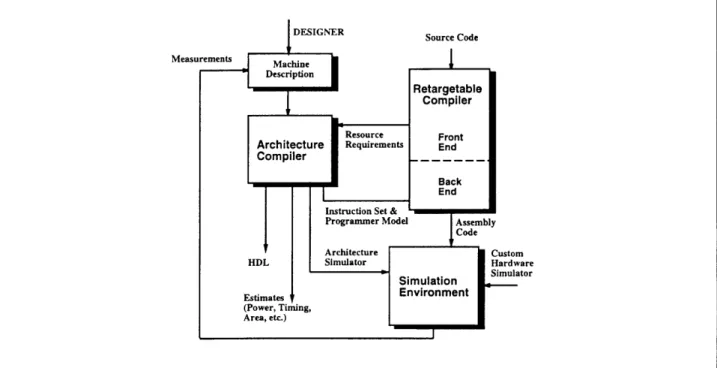
A retargetable compiler receives as input the program corresponding to the application as well as the machine description of the ASIP. The machine description includes a microarchitecture specifica-tion and an instrucspecifica-tion set specificaspecifica-tion. The code generator produces code that can run on the ASIP optimized for speed and size. By varying the machine description and evaluating the resulting object code, one can effectively explore the design space of both hardware and software components. The ASIP design flow scenario we have developed is illustrated in figure 1.
The machine description language ISDL is a driver for various templates which correspond to param-eterizable and scalable datapaths. Our machine description has five different components:
1. Instruction set: number of fields and field formats,
2. Operations available in each unit, 3. Registers and topology,
4. Conflicts (in the form of rules) between oper-ations that cannot be executed simultaneously or have to be a certain number of clock cycles apart, and
5. Hints for optimization (optional).
To make retargetable compilation easier, we focus on restricted addressing modes, uniform interfaces to each functional unit, and assume source operand
Chapter 1. Custom Integrated Circuits
Figure 1. The design flow for an ASIP.
commutativity in instructions' and that complications such as interlock handling are done in hardware. Traditional compiler optimizations such as sched-uling, register allocation, loop unrolling and address assignment can be used in the retargetable com-piler and are driven by the parameters provided by the machine description. The key step in the pre-liminary which produces the SUIF intermediate form, is the intermediate form of the Stanford SUIF compiler. The preliminary code generated is pro-duced from a rule-based machine description written in OLIVE, a tree-based pattern matcher.
SUIF then serves as an input to the instruction selector/scheduler. Depending on the number and type of available functional units, matches are gen-erated on SUIF operations, where each match cor-responds to a legal combination of SUIF operations that can be executed in parallel on the given machine. Optimal instruction selection/scheduling involves choosing the appropriate subset of matches, minimizing the cost of instructions; we have investigated the use of binate covering to solve this problem.
Handling data transfers is the next major step. The various operations in the instructions require data to be in prescribed locations. Register allocation is first performed where it is decided which values will
reside in memory and which will reside in each reg-ister file. We then generate the data transfers required to implement the chosen instructions. Data transfers include register-to-register, memory-to-register, and register-to-memory transfers. Next, the data transfers are optimally scheduled in par-allel with the instructions without violating depend-ence constraints; we will investigate the use of compaction algorithms to solve this problem. This step is parameterized by the number of available address generators, the ports available at each reg-ister file, and the topology of connections between
register files, memory and the functional units. The optimizations of storage assignment and code compression are performed on the generated code, if the optimizations are enabled in the target archi-tecture. Peephole optimization to exploit irregular features of the target architecture is the final step.
1 We do not assume that each operation is commutative, merely that each operand can come from the same set of sources, e.g., register file A, memory, etc.
DESIGNER Source Code
Measurements Machine Description
Retargetable Compiler
Resource Front
Architecture Requirements End
Compiler m
e Back
End Instruction Set &
Programmer Model Assembly Code Architecture Custom HDL Simulator Hardware Simulation Simulator Estimates Environment (Power, Timing, Area, etc.)
1.4 Functional Verification of VLSI
Systems
Sponsors
Mitsubishi Corporation National Science Foundation
Young Investigator Award Fellowship MIP 92-58376
Project Staff
Professor Srinivas Devadas, Farzan Fallah
Functional simulation is the most widely used method for design verification. At various levels of abstraction, e.g., behavioral, register-transfer level and gate level, the designer simulates the design using a large number of vectors attempting to debug and verify the design. A major problem with functional simulation is the lack of good metrics or tools to evaluate the quality of a set of functional vectors. Metrics used currently are based on instruction counts and are quite simplistic. Designers are forced to use ad-hoc methods to ter-minate functional simulation, e.g., CPU time limita-tions.
We have proposed a new metric for measuring the extent of design verification provided by a set of functional simulation vectors. This metric is uni-versal and can be used uniformly for all designs. Our metric computes controllability information cor-responding to instructions being executed, as well as observability information corresponding to whether effects of errors at inputs to modules can be observed at module outputs.
The proposed metric is inspired by notions of fault coverage used in manufacturing test and notions of coverage certification used in software testing. In order to compute observability information, we tag variable values in behavioral or register-transfer level simulation and use a simulation calculus to efficiently calculate the coverage provided by an arbitrary set of functional vectors. Tags on variable values are not tied to particular design errors; they serve as a mechanism for extending standard cov-erage metrics to include observability requirements. Our initial experiments support the validity of the proposed metric. Using this metric in design verifi-cation can result in higher-quality functional tests and improved correctness checking.
1.4.1 Publications Journal Articles
Hadjiyiannis, G., A.P. Chandrakasan, and S. Devadas. "A Low-Power, Low-Bandwidth Pro-tocol for Remote Wireless Terminals." ACM
Trans. Wireless Comput. Forthcoming.
Liao, S., S. Devadas, K. Keutzer, S. Tjiang and A. Wang. "Code Optimization Techniques in Embedded DSP Processors." Des. Automation
Embedded Syst.: An International Journal.
Forthcoming.
Liao, S., S. Devadas, K. Keutzer, S. Tjiang, and A. Wang. "Storage Assignment to Decrease Code Size." ACM Trans. Prog. Lang. Syst. 18(3):
235-253 (1996).
Monteiro, J., S. Devadas, A. Ghosh, K. Keutzer, and J. White. "Estimation of Average Switching Activity in Combinational Logic Circuits Using Symbolic Simulation." IEEE Trans. Comput.-Aided Des. Forthcoming.
Monteiro, J., S. Devadas, and A. Ghosh. "Retiming Sequential Circuits for Low Power." Int. J.
High-Speed Electron. Syst. 7(2): 323-340 (1996).
Monteiro J., and S. Devadas. "Techniques for Power Estimation and Optimization at the Logic Level: A Survey." J. VLSI Signal Process. 13(2-3): 259-276 (1996).
Conference Proceedings
Devadas, S., A. Ghosh, and K. Keutzer. "An Observability-Based Code Coverage Metric for Functional Simulation." Proceedings of the International Conference on Computer-Aided Design, San Jose, California, November 1996.
Hadjiyiannis, G., A.P. Chandrakasan and S. Devadas "A Low-Power, Low-Bandwidth Pro-tocol for Remote Wireless Terminals." Pro-ceedings of the IEEE Global Telecommunications Conference, London, England, November 1996.
Hadjiyiannis, G., S. Hanono, and S. Devadas. "ISDL: An Instruction Set Description Language for Retargetability." Proceedings of the 1997 Design Automation Conference. Forthcoming.
Monteiro, J., S. Devadas, P. Ashar, and A. Mauskar. "Scheduling Techniques to Enable Power Management." Proceedings of the 33rd
Design Automation Conference, Las Vegas,
Chapter 1. Custom Integrated Circuits
Sudarsanam, S., S. Liao, and S. Devadas. "Anal-ysis and Evaluation of Address Arithmetic Capa-bilities in Custom DSP Processors and ASIPs."
Proceedings of the 1997 Design Automation Conference. Forthcoming.
1.5 Offshore Structure Analysis
-WAMIT Development
Sponsor
Joint Industry Program on Offshore Structure Analysis
Project Staff
Dr. Ali Beskok, Dr. F. Thomas Korsmeyer, Chang Ho Lee, Professor J. Nicholas Newman, Professor Jacob K. White
Continuing our efforts in the time-domain analysis of ship and body motions, we released TIMIT 2.1 to approximately 14 organizations including the David Taylor Research Center, major international oil companies and contractors, and classification socie-ties. While current research (including our own) is advancing into quasi-linear and completely non-linear analyses of ship motion in waves, efficient, primarily linearized, computational tools are needed. We have also completed or nearly completed three extensions of the theory and implementation: finite depth analysis, generalized modal analysis, and complete second-order mean force analysis.2
In the area of accelerated algorithms for potential flow problems, the release of FastLap 2.0 probably marks the furthest advancement to which we will take the fast-multipole approach. Version 2.0 extends multipole acceleration to new integral for-mulations such as the so-called source formulation and the desingularized approach. The latter requires a generalization of the algorithm to include
separate upward and downward pass trees. This feature also allows the computation of quantities in the field, such as the gradient of the potential.3 Also, we have extended the precorrected-FFT algo-rithm to problems in ocean engineering, particularly those with oscillatory kernels.4
1.6 Coupled Simulation Algorithms for
Microelectromechanical CAD (MEMCAD)
Sponsors
Analog Devices
Defense Advanced Research Projects Agency
Project Staff
Dr. Narayana R. Aluru, Dr. Ali Beskok, Professor Martin A. Schmidt, Professor Stephen D. Senturia, Junfeng Wang, Professor Jacob K. White
Micromachining technology has enabled the fabri-cation of several novel microsensors and microactu-ators. Because of the specialized processing involved, the cost of prototyping simple microsen-sors, microvalves, and microactuators is enormous. In order to reduce the number of prototype failures, designers of these devices need to make frequent use of simulation tools. To efficiently predict the performance of microelectromechanical systems, these simultion tools need to account for the inter-action between electrical, mechanical, and fluidic
forces. Simulating this coupled problem is made more difficult by the fact that most MEMS devices are innately three-dimensional and geometrically complicated. It is possible to simulate efficiently these devices using domain-specific solvers, pro-vided the coupling between domains can be handled effectively. In this work we have devel-oped several new approaches and tools for efficient computer aided design and analysis of MEMS.5
2 F.T. Korsmeyer and H.B. Bingham, "The Transient Diffraction Problem," submitted to Fluid Mech.
3 S.M. Scorpio, R.F. Beck, and F.T. Korsmeyer, "Nonlinear Water Wave Computations Using a Multipole Accelerated Desingularized Method," Twenty-first Symposium on Naval Hydrodynamics, Trondheim, Norway, 1996.
4 F.T. Korsmeyer, J. Phillips, and J. White, "A Precorrected FFT Algorithm for Accelerating Surface Wave Problems," Eleventh Interna-tional Workshop on Water Waves and Floating Bodies, Hamburg, Germany, 1996.
5 N. Aluru and J. White, "Direct-Newton Finite-Element/Boundary-Element Technique for Micro-Electro-Mechanical-Analysis," IEEE Solid-State Sensor and Actuator Workshop, Hilton-Head Island, South Carolina, June 1996, pp. 54-57. N. Aluru and J. White, "A Coupled Numerical Technique for Self-Consistent Analysis of Micro-Electro-Mechanical-Systems," Proceedings of the ASME Winter Annual Meeting, forthcoming.
1.7 Simulation Algorithms for RF
Circuits
Sponsors
Cadence Design Systems MAFET Consortium
Project Staff
Ogden J. Nastov, Professor Jacob K. White
Designers of RF integrated circuits make extensive use of simulation tools which perform nonlinear periodic steady-state analysis and its extensions. However, the computational cost of these simu-lation tools have restricted users from examining the detailed behavior of complete RF subsystems. Recent algorithmic developments, based on matrix-implicit iterative methods, are rapidly changing this situation and providing new faster tools which can easily analyze circuits with hundreds of devices. We have investigated these new methods by des-cribing how they can be used to accelerate finite-difference, shooting-Newton, and harmonic-balance based algorithms for periodic steady-state analysis.6
We developed a preconditioned recycled Krylov-subspace method to accelerate a recently devel-oped approach for ac and noise analysis of linear periodically-varying communication circuits. Exam-ples show that the combined method can be used to analyze switching filter frequency response, mixer noise frequency translation, and amplifier intermodulation distortion. In addition, it can be shown that for large circuits the preconditioned recycled Krylov-subspace method is up to 40 times faster than the standard optimized direct methods.7
1.8 Numerical Techniques for
Simulating Josephson Junction Arrays
Sponsors
Consortium for Superconducting Electronics National Defense Science and Engineering
Graduate Fellowship
Project Staff
Joel R. Phillips, Dr. Herre S.J. van der Zant, Pro-fessor Terry P. Orlando, ProPro-fessor Jacob K. White Vortices play a central role in determining the static and dynamic properties of two-dimensional (2-D) superconductors. Artificially fabricated networks of superconducting islands weakly coupled by Josephson junctions are model systems to study the behavior of vortices. Through simulation, we have discovered that the static properties of vortices in an array of Josephson junctions can be significantly influenced by magnetic fields induced by the vortex currents. The energy barrier for vortex motion is enhanced, nearly doubling for penetration depths on the order of a cell size. Moreover, we have found that correct calculation of the vortex current distribution, the magnetic moment, and the lower critical field require modeling mutual induc-tance interactions between all cell pairs in the array. To make numerical simulation of the system with all inductive effects computationally feasible, a novel FFT-accelerated integral equation solver was derived. This algorithm is sufficiently efficient to allow Shapiro steps and the dynamics of row-switched states in large (500X500 cells) arrays.8
1.9 Efficient 3-D Interconnect Analysis
Sponsors
Consortium for Superconducting Electronics Defense Advanced Research Projects Agency Digital Equipment Corporation
IBM Corporation MIT Lincoln Laboratory
National Defense Science and Engineering
6 R. Telichevesky, K. Kundert, and J. White, "Fast Simulation Algorithms for RF Circuits," Invited paper Proceedings of the Custom Integrated Circuits Conference, San Diego, California, May 1996; R. Telichevesky, K. Kundert, and J. White, "Receiver Characteriza-tion Using Periodic Small-Signal Analysis," Proceedings of the Custom Integrated Circuits Conference, San Diego, California, May 1996.
7 R. Telichevesky, K. Kundert, and J. White, "Efficient AC and Noise Analysis of Two-Tone RF Circuits," Proceedings of the 33nd Design Automation Conference, Las Vegas, Nevada, June 1996.
8 J.R. Phillips, H.S.J. van der Zant, J. White, and P.T. Orlando, "Influence of Induced Magnetic Fields on Shapiro Steps In Josephson-Junction Arrays, " Phys. Rev. B (1994); J.R. Phillips, H.S.J. van der Zant, and T.P. Orlando, "Dynamics of Row-Switched States In Josephson-Junction Arrays,Phys. Rev. B Vol. 50: 9380 (1994).
Chapter 1. Custom Integrated Circuits
Graduate Fellowship
Semiconductor Research Corporation
Project Staff
Michael T. Chou, Mattan Kamon, Yehia M. Massoud, Joel R. Phillips, Johannes Tausch, Pro-fessor Jacob K. White
We have developed multipole-accelerated algo-rithms for computing capacitances and inductances of complicated 3-D geometries, and have imple-mented these algorithms in the programs FASTCAP and FASTHENRY. The methods are accelerations of the boundary-element or method-of-moments techniques for solving the integral equations associ-ated with the multiconductor capacitance or induc-tance extraction problem. Boundary-element methods become slow when a large number of ele-ments are used because they lead to dense matrix problems which are typically solved with some form of Gaussian elimination. This implies that the com-putation grows as n3, where n is the number of panels or tiles needed to accurately discretize the conductor surface charges. Our new algorithms, which use Krylov subspace iterative algorithms with a multipole approximation to compute the iterates, reduces the complexity. Accurate multiconductor capacitance and inductance calculations grow nearly as nm where m is the number of conductors. For practical problems which require as many as 10,000 panels or filaments, FASTCAP and FASTHENRY are more than two orders of magni-tude faster than standard boundary-element based programs.9 Manuals and source code for FASTCAP and FASTHENRY are available directly from MIT. In more recent work, we have been developing an alternative to the fast-multipole approach to poten-tial calculation. The new approach uses an
approx-imate representation of charge density by point charges lying on a uniform grid instead of by multi-pole expansions. For engineering accuracies, the grid-charge representation has been shown to be a more efficient charge representation than the multi-pole expansions. Numerical experiments on a variety of engineering examples arising indicate that algorithms based on the resulting
"precorrected-FFT" method are comparable in
com-putational efficiency to multipole-accelerated itera-tive schemes, and superior in terms of memory
utilization.
The precorrected-FFT method has another signif-icant advantage over the multipole-based schemes: because it can be easily generalized to some other common kernels. Preliminary results indicate that the precorrected-FFT method can easily incorporate kernels arising from the problem of capacitance extraction in layered media. More importantly, problems with a Helmholtz equation kernel have be solved at moderate frequencies with only a modest increase in computational resources over the zero-frequency case. An algorithm based on the
precorrected-FFT method which efficiently solves the Helmholtz equation could form the basis for a rapid yet accurate full-wave electromagnetic anal-ysis tool.10
Our latest work has been on extending the applica-bility of precorrected-FFT and fast multipole schemes. We have combined these fast tech-niques with new numerically stable integral formu-lations for problems in electroquasistatics (distributed RC) and for problems with high dielec-tric permitivity ratios." In addition, we have extended the algorithms in FASTHENRY to include finite substrate conductivity and used it to analyze on-chip inductance.12 We have also developed par-allel versions of the precorrected-FFT algorithm, as
9 K. Nabors, F.T. Korsmeyer, F.T. Leighton, and J.K. White, "Multipole Accelerated Preconditioned Iterative Methods for Three-Dimensional Potential Integral Equations of the First Kind," SIAM J. Sci. Stat Comp. 15(3): 713-735 (1994); M. Kamon, M.J. Tsuk,
and J. White, "FASTHENRY: A Multipole-Accelerated 3-D Inductance Extraction Program," IEEE Trans. Microwave Theory Tech. 42(9): 1750-1758 (1994). p1750-1758
10 J. Phillips, "Error and Complexity Analysis for a Collocation-Grid-Projection plus Precorrected-FFT Algorithm for Solving Potential Integral Equations with Laplace or Helmholtz Kernels," Second Place Student Paper Competition, Colorado Conference on Multigrid Methods, April 1995; J.R. Phillips and J.K. White, "Precorrected-FFT Methods for Electromagnetic Analysis of Complex 3-D Intercon-nect and Packages," Invited paper, Progress in Electromagnetic Research Symposium, Seattle, Washington, July 1995.
11 M.T. Chou, T. Korsmeyer, and J.K. White, "Transient Simulations of Three-dimensional Integrated Circuit Interconnect Using a Mixed Surface-Volume Approach," Proceedings of the 32nd Design Automation Conference, San Francisco, California, June 1995; J. Tausch and J. White, "Multipole Accelerated Capacitance Calculation for Structures with Multiple Dielectrics With High Permitivity Ratios," Proceedings of the 33nd Design Automation Conference, Las Vegas, Nevada, June 1996.
12 Y.M. Massoud and J.K. White, "Simulation of the Coupling Inductance Effect on Circuit Crosstalk, "Proceedings of TECHCON, Tempe, Arizona, July 1996.
well as preconditioners which improve the conver-gence of the iterative solver used in FASTHENRY.13
1.10 Model Order Reduction for
Interconnect Analysis
Sponsors
Defense Advanced Research Projects Agency Semiconductor Research Corporation
Project Staff
lbrahim M. Elfadel, Mattan Kamon, Joel R. Phillips, Michael T. Chou, Professor Jacob K. White
Reduced-order modeling techniques are now com-monly used to efficiently simulate circuits combined with interconnect. Generating reduced-order models from realistic 3-D structures, however has received less attention. Recently we have been studying an accurate approach to using the iterative method in the 3-D magnetoquasistatic analysis program
FASTHENRY to compute reduced-order models of frequency-dependent inductance matrices associ-ated with complicassoci-ated 3-D structures. This method, based on a Krylov-subspace technique, namely the Arnoldi iteration, reformulates the system of linear ODEs resulting from the FASTHENRY equation into a state-space form and directly produces a reduced-order model in state-space form. The key advantage of this method is that it is no more expensive than computing the inductance matrix at a single frequency. The method compares well with the standard Pade approaches and may present some advantages because in the Arnoldi-based algorithm, each set of iterations produces an entire column of the inductance matrix rather than a single entry, and if matrix-vector product costs dom-inate then the Arnoldi-based algorithm produces a better approximation for a given amount of work. Finally, we have shown that the Arnoldi method
generates guaranteed stable reduced order models,
even for RLC problems.14
1.11 Adaptive Techniques for Fast
Integral Equation Solvers
Sponsors
Defense Advanced Research Projects Agency Multiuniversity Research Intiative
National Science Foundation
Semiconductor Research Corporation
Project Staff
Jing-Rebecca Li, Johannes Tausch, Dr. F. Thomas Korsmeyer, Professor Jacob K. White
Finding computationally efficient numerical tech-niques for simulation of three-dimensional struc-tures has been an important research topic in almost every engineering domain. Surprisingly, the most numerically intractable problem across these various discplines can be reduced to the problem of solving a three-dimensional Laplace problem. Such problems are often referred to as potential prob-lems, and application examples include electrostatic analysis of sensors and actuators, electro- and magneto-quasistatic analysis of integrated circuit interconnect and packaging, and potential flow based analysis of wave-ocean structure interaction. The development of extremely fast-multipole- and
precorrected-FFT-accelerated iterative algorithms solving potential problems has made it possible to analyze far more complicated structures than ever before. This has led to a new problem. Since the structures being analyzed are so complicated, they can not be discretized by hand nor can the algo-rithms be tuned by hand. Instead, algoalgo-rithms must be developed which are completely automatic, and insure accurate results. In order to develop such codes, we are investigating alternative formulations
13 M. Kamon, B. Krauter, J. Phillips, L. Pileggi, and J.K. White, "Two Optimizations to Accelerated Method-of-Moments Algorithms for Signal Integrity Analysis of Complicated 3-D Packages," Proceedings of the Fourth Topical Meeting on Electrical Performance of Electronic Packaging, Portland, Oregon, October 1995, pp. 213-216; N.R. Aluru, V. Nadkarni, and J. White, "A Parallel Precorrect-ed-FFT Based Capacitance Extraction Program for Signal Integrity Analysis," Proceedings of the 33nd Design Automation
Confer-ence, Las Vegas, Nevada, June 1996.
14 IM. Elfadel, L.M. Silveira, and J.K. White, "Stability Criteria for Arnoldi-Based Model Order Reduction," Proceedings of the IEEE
Conference on Acoustics, Speech, and Signal Processing (ICASSP '96), Atlanta, Georgia, May 1996; L.M. Silveira, M. Kamon, and
J.K. White, "Efficient Reduced-Order Modeling of Frequency-Dependent Coupling Inductances Associated with 3-D Interconnect Structures," IEEE Trans. Components, Packaging, Manufacturing Technology, Part B: Advanced Packaging; L.M. Silveira, M. Kamon,
I. Elfadel, and J. White, "A Coordinate-Transformed Arnoldi Algorithm for Generating Guaranteed Stable Reduced-Order Models of RLC Circuits," Proceedings of the International Conference on Computer Aided Design, San Jose, California, November 1996.
Chapter 1. Custom Integrated Circuits
and mesh refinement strategies for integral equa-tions.15
1.11.1 Publications
Aluru, N.R., V. Nadkarni, and J. White. "A Parallel Precorrected-FFT Based Capacitance Extraction Program for Signal Integrity Analysis." Pro-ceedings of the 33nd Design Automation Con-ference, Las Vegas, Nevada, June 1996.
Aluru, N.R., and J. White. "Direct-Newton Finite-Element/Boundary-Element Technique for Micro-Electro-Mechanical-Analysis." IEEE Solid-State Sensor and Actuator Workshop, Hilton-Head Island, South Carolina, June 1996.
Aluru, N.R., and J. White. "A Coupled Numerical Technique for Self-Consistent Analysis of Micro-Electro-Mechanical-Systems." Proceedings of the ASME Winter Annual Meeting. Forthcoming.
Elfadel, I.M., L.M. Silveira, and J. White. "Stability Criteria for Arnoldi-Based Model Order Reduction." Proceedings of the IEEE Confer-ence on Acoustics, Speech, and Signal Pro-cessing (ICASSP '96), Atlanta, Georgia, May
1996.
Korsmeyer, F.T., J. Phillips, and J. White, "A Pre-corrected FFT Algorithm for Accelerating Surface Wave Problems." The Eleventh Inter-national Workshop on Water Waves and Floating Bodies, Hamburg, Germany, 1996. Korsmeyer, F.T., and H.B. Bingham. "The
Tran-sient Diffraction Problem." Submitted to Fluid
Mech.
Massoud, Y., and J. White. "Simulation of the Cou-pling Inductance Effect on Circuit Crosstalk."
Proceedings of TECHCON, Tempe, Arizona,
July 1996.
Scorpio, M.S., F.R. Beck, and F.T. Korsmeyer. "
Nonlinear Water Wave Computations Using a Multipole Accelerated Desingularized Method." Twenty-first Symposium on Naval
Hydro-dynamics, Trondheim, Norway, 1996
Silveira, L.M., M. Kamon, and J.K. White. "Efficient Reduced-Order Modeling of Frequency-Dependent Coupling Inductances Associated
with 3-D Interconnect Structures." IEEE Trans.
Components, Packaging, Manufacturing Tech-nology Part B: Advanced Packaging.
Silveira, L.M., M. Kamon, I. Elfadel, and J. White. "A Coordinate-Transformed Arnoldi Algorithm for Generating Guaranteed Stable Reduced-Order Models of RLC Circuits." Proceedings of the International Conference on Computer Aided Design, San Jose, California, November 1996.
Tausch, J., and J. White. "Preconditioning First and Second Kind Integral Formulations of the Capacitance Problem." Proceedings of the Copper Mountain Conference on Iterative Methods, April 1996.
Tausch, J., and J. White. "Mesh Refinement Strate-gies for Capacitance Extraction Based on Resi-dual Errors." Proceedings of the IEEE Workshop on Electrical Performance of Elec-tronic Packaging, Santa Cruz, California, October 1996.
Tausch, J., and J. White. "Boundary Integral Sol-ution of Laplace's Equation in Multi-Layered Media with High Permittivity Ratios." Pro-ceedings of the 13th GAMM-Seminar Kiel on Numerical Treatment of Multi-Scale Problems,
Kiel, Germany, January 1997. Forthcoming. Tausch, J., and J. White. "Multipole Accelerated
Capacitance Calculation for Structures with Mul-tiple Dielectrics With High Permitivity Ratios."
Proceedings of the 33nd Design Automation Conference, Las Vegas, Nevada, June 1996.
Telichevesky, R., K. Kundert, and J. White. "Fast Simulation Algorithms for RF Circuits. "Invited paper Proceedings of the Custom Integrated
Cir-cuits Conference, San Diego, California, May,
1996.
Telichevesky, R., K. Kundert, and J. White. "Receiver Characterization Using Periodic Small-Signal Analysis." Proceedings of the Custom Integrated Circuits Conference, San
Diego, California, May, 1996.
Telichevesky, R., K. Kundert, and J. White.
"Effi-cient AC and Noise Analysis of Two-Tone RF
Circuits." Proceedings of the 33nd Design Auto-mation Conference, Las Vegas, Nevada, June 1996.
15 J. Tausch and J.K. White, "Preconditioning First and Second Kind Integral Formulations of the Capacitance problem," Proceedings of the 1996 Copper Mountain Conference on Iterative Methods, April 1996; J. Tausch and J. White, "Mesh Refinement Strategies for "Capacitance Extraction Based on Residual Errors," Proceedings of the IEEE Workshop on Electrical Performance of Electronic
Packaging, Santa Cruz, California, October 1996, forthcoming. J. Taush and J.K. White, "Boundary Integral Solution of Laplace's
Equation in Multi-Layered Media with High Permittivity Ratios," Proceedings of the 13th GAMM-Seminar Kiel on Numerical Treatment