HAL Id: hal-00533085
https://hal-iogs.archives-ouvertes.fr/hal-00533085
Submitted on 8 Nov 2010HAL is a multi-disciplinary open access archive for the deposit and dissemination of sci-entific research documents, whether they are pub-lished or not. The documents may come from teaching and research institutions in France or abroad, or from public or private research centers.
L’archive ouverte pluridisciplinaire HAL, est destinée au dépôt et à la diffusion de documents scientifiques de niveau recherche, publiés ou non, émanant des établissements d’enseignement et de recherche français ou étrangers, des laboratoires publics ou privés.
Highly efficient, high-power, broadly tunable,
cryogenically cooled and diode-pumped Yb:CaF2
Sandrine Ricaud, Dimitris N. Papadopoulos, Patrice Camy, Jean-Louis
Doualan, Richard Moncorgé, Antoine Courjaud, Eric Mottay, Patrick Georges,
Frédéric Druon
To cite this version:
Sandrine Ricaud, Dimitris N. Papadopoulos, Patrice Camy, Jean-Louis Doualan, Richard Mon-corgé, et al.. Highly efficient, high-power, broadly tunable, cryogenically cooled and diode-pumped Yb:CaF2. Optics Letters, Optical Society of America - OSA Publishing, 2010, 35 (22), pp.3757-3759. �10.1364/OL.35.003757�. �hal-00533085�
Highly efficient, high power, broadly tunable,
cryogenically cooled and diode-pumped Yb:CaF
2laser
S. Ricaud1,4,*, D. N. Papadopoulos2, P. Camy3,
J. L. Doualan3, R. Moncorgé3, A. Courjaud4, E. Mottay4, P. Georges1 and F. Druon1
1
Laboratoire Charles Fabry de l'Institut d'Optique (LCFIO), UMR 8501CNRS, Université Paris-Sud, RD 128 Campus Polytechnique, 91127 Palaiseau, France
2
Institut de la Lumière Extrême (ILE), UMS 3501 CNRS, Ecole Polytechnique, ENSTA ParisTech, Institut d’Optique, Université Paris-Sud, Palaiseau, France
3
Centre de recherche sur les Ions, les Matériaux et la Photonique (CIMAP), UMR 6252 CEA-CNRS-ENSICAEN, Université de Caen, 14050 Caen, France
4
Amplitude Systèmes, 6 allée du doyen Georges Brus, 33600 Pessac, France *Corresponding author: [email protected]
Abstract: We present a high-power diode-pumped Yb:CaF2 laser operating at cryogenic
temperature (77 K). A laser output power of 97 W at 1034 nm was extracted for a pump power of 245 W. The corresponding global extraction efficiency (versus absorbed pump power) is 65%. The laser small signal gain was found equal to 3.1. The laser wavelength could be tuned between 990 and 1052 nm with peaks which well correspond to the structure of the gain cross section spectra registered at low temperature. © 2010 Optical Society of America
Since its first laser operation in 2004 [1], Yb:CaF2 has been one of the most studied and
promising crystals in the realm of Yb-doped materials for laser applications [2-4]. In fact, this crystal gathers several interesting advantages for the development of high-power diode-pumped lasers, among which an excellent thermal conductivity [5], comparable to YAG, a broad emission band, extending from about 1010 and 1070 nm and a long emission lifetime of 2.3 ms. At the end, however, the most important advantage over its competitors could be in the fact that the crystal growth of pure CaF2 is already well mastered and that
ultra-high-quality and very large crystals of Yb:CaF2 could be produced in the near future.
On the other hand, it is now well known that operating this type of laser materials at cryogenic temperatures such as 77K (Liquid Nitrogen LN2 temperature) usually positively
affects their performance, especially at high power levels, because of increased thermal conductivities and absorption and emission cross sections [6-7].
Thus, the purpose of the present paper has four main objectives: a deeper investigation of the luminescent and gain properties of the laser material at LN2 temperature and direct
information of its laser efficiency and the potential extractable laser power at such temperature.
According to the Slack’s measurements [8] performed with undoped CaF2 crystals, the
thermal conductivity (κ) increases by about a factor 6 by lowering the temperature down to LN2 temperature. According to these measurements the thermal conductivity at 77 K reaches
a value of about 68 W/m/K. The thermal conductivity vs temperature follows the well-known hyperbolic law, with for CaF2 the following empirical coefficients: κ=2652/(T-37), for T>50
K. For a 2.2% Yb-doped CaF2 crystal, using the Gaumé’s model [9] and assuming a sound
velocity of 6000 m/s at 77 K, we estimated a decrease of the thermal conductivity around 23 W/m/K.
From the spectroscopic point of view (see in Fig. 1), the absorption peak around 980 nm increases by about a factor 2.7. It becomes sharper and slightly shifts to longer wavelengths with a FWHM of 19 nm and a wavelength of 979 nm at 300K down to a FWHM of 3 nm and a wavelength of 980.4 nm at 77 K. The emission spectrum also changes significantly. The emission cross section increases by about a factor 2 around 1030 nm and the spectrum lets appear more structured and well-distinct peaks. At low temperature the saturation fluence at 1034 nm is 17 kW/cm2 compared to 33 kW/cm2 at room temperature. Such improved thermal and spectroscopic properties thus should lead to improved laser performance.
The laser experiments were performed with a 5-mm-long, 2.2-%Yb-doped CaF2 crystal.
The crystal was positioned in a cryostat on a copper mount directly cooled at 77 K by LN2. A
200 µm thick indium fold was inserted between the crystal and the copper mount to ensure the thermal contact and to avoid any stress resulting from the different expansion coefficients of the crystal and the copper mount. LN2 was poured in the cryostat without special care and
no problem was observed on the crystal due to thermal shock during this process.
The crystal was uncoated and slightly wedged (~2.5°). It was deliberately tilted with respect to the propagation axis in order to access to the Fresnel reflections and avoid coupling cavity effects. The crystal was pumped with a 245 W fiber coupled diode laser (Ф=400 µm NA=0.22). The overall transmission of the imaging system (see in Fig. 2), including the dichroïc input mirror and the first window of the cryostat, was 87 % leading then to a maximum incident pump power onto the crystal of 212 W (maximal pump fluence of 153 kW/cm2). The laser cavity was a simple V-shape laser cavity optimized to have a nearly constant waist radius in the crystal of 200±15 µm for a thermal lens ranging between -0.1 m to -3 m. Laser emission was then transverse-single-mode. As shown in the figure 2, different measurements were taken simultaneously for a given operating point. These measurements included: average powers throughout the output coupler and from one of the Fresnel
reflections, spectrum and beam profile recording, and part of the transmitted pump power (Pref) to evaluate the absorption variation during laser operation due to the different saturation
absorption conditions. The laser wavelength tunability was obtained by inserting a prism in the collimated arm of the cavity (Fig. 2).
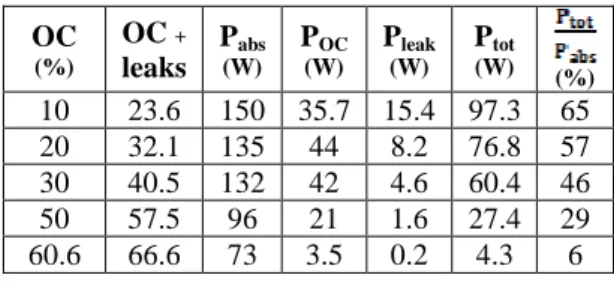
The first set of experiments has consisted in optimizing the average power extractable from the laser cavity. The results for different output couplers (OC) are summarized in the table 1. With an incident pump power on the crystal of 212 W, the absorbed pump power in absence of laser emission was 74 W; but due to strong saturation effect this value drastically increased under laser operation (see column Pabs in Table 1). The maximum laser output power (Ptot)
including the output power throughout the output coupler (POC) and the leaks due to the reflection losses on the crystal (4xPleak) was 97.3 W for an equivalent output coupler of 23.6
%. In this case the intracavity laser fluence on the crystal was 280 kW/cm2. The laser wavelength was 1034 nm and the efficiency of the laser (laser over absorbed pump powers) reached 65 %. This value was derived by considering a corrected absorbed pump power under laser operation. Indeed, absorption under laser operation nearly doubles compared to absorption without laser operation. This is due to a drastic reduction of pump-absorption saturation [10]. It is to be noticed that such correction is rarely performed and even mentioned in the literature concerning lasers based on Yb-doped materials and which often report efficiencies reaching 80 to 90 %. For comparison, without this correction, our laser efficiency (laser output power versus absorbed pump power without laser operation) would reach 131 %! The overall laser output power versus the real absorbed pump power is plotted in the figure 3. It is worth noting the linearity of the curve which indicates both the efficiency of the cooling process and the potential of Yb:CaF2 to be pumped even harder. According to this
data, the laser efficiency (Fig. 3) quickly reaches a maximum value around 60 % to 70 % and stays relatively constant afterwards. The beam profile evolution is also reported. Despite an
increasing size of the spot, the laser beam quality stays globally the same. The negative thermal lens [5] of the Yb:CaF2 crystal was also estimated, by using an ABCD propagation
code, to be between -2.2 m at low pump power (20 W absorbed) up to -0.22 m at full pump power (150 W absorbed),which is coherent with a thermo-optic coefficient around -11 x10-6 K-1. Finally, we also adjusted the inclination of the crystal in order to maximize the output power by re-coupling in the cavity two of the four Fresnel reflections. The optimal transmission of the output coupler was then 20 % and the average output power was 62 W.
The second type of experiments has concerned the small signal gain of Yb:CaF2, with the
perspective of the development of a short pulse amplifier. Gain was measured by analyzing the total average output power versus the output coupler transmission. The maximum gain corresponded to about 68 % optical losses, which leads to a round-trip laser gain value of about 3.1. Considering then a round-trip in a 2.2-% Yb-doped (N=5.4 1020 ions/cm3) crystal with a thickness L=5 mm and using the formula of the small signal gain, i.e. g0=exp(σg(β,λ0).N.2.L), it gives a gain cross-section σg(β,λ0)=0.21 10-20 cm2 at λ0=1034 nm.
Furthermore, using a finite element algorithm we estimate the average temperature of the crystal around 100 K and σg=β.σe(λ0)-(1-β).σa(λ0), which gives an inversion ratio β=0.45 (σe(λ0)=0.47 10-20 cm2 and σa(λ0)=3.5 10-24 cm2). This high β value corroborates first the very efficient pump absorption and second, the strong absorption saturation without laser operation
Our last investigation has concerned laser wavelength tunability. Figure 4 compares the laser tuning curve obtained experimentally with the gain cross section derived at 100K for
β=0.4. The peaks of the two curves well coincide and show four distinct spectral regions centered around 992 nm, 1020 nm, 1034 nm and 1050 nm. Despite the cryogenic sharpening of the spectra, the bandwidths remain relatively broad especially in the 1010-1040 nm region, which makes this laser system interesting for short pulse amplification. The hole around 1026 nm is due to a not enough selective set up, indeed by adding a pinhole into the cavity we
succeeded in lasing at this wavelength range. It is worth noting that, at low temperature, maximum gain occurs at 992 nm. This means an ultra low quantum defect of about 1.1 % is naturally possible (without dichroic mirror). In the present experiment, however, due to the characteristics of the dichroïc input mirror, the natural laser wavelength was 1034 nm. Nevertheless 992 nm laser operation has been demonstrated for the first time despite the high losses of the dichroïc mirror.
In conclusion, we have presented the first laser operation of a singly doped Yb:CaF2 at
cryogenic temperature and high power level. The laser shows very interesting properties: a laser efficiency up to 70 %, an output power approaching 100 W, a small signal gain exceeding 3, a laser wavelength tunability compatible with femtosecond pulse amplification and a maximum gain at 992 nm. Concerning the potential of Yb:CaF2 for efficient high-power
and short-pulse cryogenic amplifiers, one of the issues may concern the strong absorption saturation obtained with a 2.2-%Yb-doped and 5 mm long single crystal. To overcome this problem, different options can be explored, but each of them requires trade-offs. A first trade off can be found between gain and energy storage: a wider pump spot will lead to better absorption but lower gain. Second, longer or but more heavily doped crystals can be used, but a longer crystal requires a better quality (lower beam divergence) pump diode, and a more heavily doped one will lead to a decreased thermal conductivity (down to 17 W/m/K for a 5 % doped crystal for example),then to increased thermal limitations. Nevertheless, short pulse amplification could be foreseen with high efficiency in regard of these possible trade offs. Moreover, as the width of the emission spectrum of Yb:CaF2 at 77 K is not so significantly
affected compared to room temperature, high–gain and short-pulse amplification should be readily achieved.
[1] V. Petit, J. L. Doualan, P. Camy, V. Menard, and R. Moncorgé, "CW and tunable laser operation of Yb3+ doped CaF2," Appl. Phys. B 78, 681-684 (2004).
[2] M. Siebold, S. Bock, U. Schramm, B. Xu, J. L. Doualan, P. Camy, and R. Moncorgé, "Yb:CaF2 — a new old laser crystal," Appl. Phys. B 97(2), 327-338 (2009).
[3] M. Siebold, M. Hornung, R. Boedefeld, S. Podleska, S. Klingebiel, C. Wandt, F. Krausz, S. Karsch, R. Uecker, A. Jochmann, J. Hein, and M. C. Kaluza, "Terawatt diode-pumped Yb:CaF2 laser," Opt. Lett. 33(23), 2770-2772 (2008).
[4] F. Friebel, F. Druon, J. Boudeile, D. N. Papadopoulos, M. Hanna, P. Georges, P. Camy, J. L. Doualan, A. Benayad, R. Moncorgé, C. Cassagne, and G. Boudebs, "Diode-pumped 99 fs Yb:CaF2 oscillator," Opt. Lett. 34(9), 1474-1476 (2009).
[5] J. Boudeile, J. Didierjean, P. Camy, J. L. Doualan, A. Benayad, V. Ménard, R. Moncorgé, F. Druon, F. Balembois, and P. Georges, "Thermal behaviour of ytterbium-doped fluorite crystals under high power pumping," Opt. Express 16, 10098-10109 (2008).
[6] T.Y. Fan, D.J. Ripin, R.L. Aggarwal, J.R. Ochoa, B. Chann, M. Tilleman, J. Spitzberg, "Cryogenic Yb3+-Doped Solid-State Lasers," IEEE Sel. Top. in Quant. Electron. 3, 448-459 (2007).
[7] A. Pugžlys, G. Andriukaitis, D. Sidorov, A. Irshad, A. Baltuška, W. J. Lai, P.B. Phua, L. Su, J. Xu, H. Li, R. Li, S. Ališauskas, A. Marcinkevicius, M. E. Fermann, L. Giniunas, R. Danielius "Spectroscopy and lasing of cryogenically cooled Yb,Na:CaF2," Appl. Phys. B. 97(2), 339-350 (2009).
[8] G. A. Slack, "Thermal Conductivity of CaF2, MnF2, CoF2, and ZnF2 Crystals" Phys. Rev. 122, 1451-1461 (1961).
[9] R. Gaumé, B. Vienna, D. Vivien, J. P. Roger, and D. Fournier, "A simple model for the prediction of thermal conductivity in pure and doped in saluting crystals," Appl. Phys. Let. 83, 1355-1357 (2003).
[10] A. Pirri, D. Alderighi, G. Toci, M. Vannini, M. Nikl, H. Sato, "Direct comparison of Yb3+:CaF2 and heavily doped Yb3+:YLF as laser media at room temperature," Opt. Express 17, 18312-18319 (2009).
Fig. 1. Absorption and emission cross-section spectra of Yb:CaF2 at different temperatures.
Fig. 2. Laser experimental setup (OC: Output Coupler).
Fig. 3. Laser output power and laser efficiency versus absorbed pump power and corresponding beam profiles (at 1034 nm).
Fig. 4. Comparison between experimental laser tunability (red curve) and gain cross section at 100 K (blue curve).
Table 1. Laser performance for different output couplers. OC (%) OC + leaks Pabs (W) POC (W) Pleak (W) Ptot (W) (%) 10 23.6 150 35.7 15.4 97.3 65 20 32.1 135 44 8.2 76.8 57 30 40.5 132 42 4.6 60.4 46 50 57.5 96 21 1.6 27.4 29 60.6 66.6 73 3.5 0.2 4.3 6