
Ministry of Higher Education and Scientific Research
UNIVERSITY OF 8 MAI 1945 /GUELMA ةملاق/1945يام8 ةعماج FACULTY OF LETTERS AND LANGUAGES تاغللا وبادلآا ةيلك DEPARTMENT OF LETTERS AND ENGLISH LANGUAGE ةيزيلجنلاا ةغللا مسق
A Dissertation Submitted to the Department of English in Partial Fulfilments of the Requirements for the Master Degree in
Language and Culture
Submitted by Supervised by BOULEMIA Aymen Mrs. ZEMITI Asma RAFRAF Sohieb
Board of Examiners
Chair: Mr. ZEMMOURI Layachi (MAA) (Université 8 Mai 1945/Guelma) Supervisor: Mrs. ZEMITI Asma (MAA) (Université 8 Mai 1945/Guelma) Examiner: Mrs. AMIAR Mounira (MAA) (Université 8 Mai 1945/Guelma)
2019-2020
Economic Sanctions as an American Foreign Policy Instrument
The Case of Iraq
First of all, we dedicate this humble work to our parents, our families and people close to us. We dedicate this work to our caring and loving mothers and big-hearted fathers. We Also dedicate it to our brothers and sisters for their kind word and endless support. Special appreciation goes to the ones who helped us to reach this and to the most faithful friends here in the university and in our private life.
We would like to express our sincere gratitude and appreciation to our supervisor Ms. Asma Zemiti for her hard work, insightful remarks and suggestions. Thanks to all our friends, professors and those dear to us who held our hand or helped us on this path.
The main concern of this dissertation is to examine the US sanctions in Iraq and mainly economic sanctions as a part of its foreign policy which were imposed either by the US directly or by the UN. The main conclusion of this dissertation is that the US economic sanctions on Iraq and their consequences offers an insight to the implementation of sanctions as a key tool in the US foreign policy as a whole. On one hand, to reach this conclusion the dissertation starts with the US foreign policy history and the history of economic sanctions and their utilities then an examination of the US economic sanctions on Iraq and the conflict between the US and Iraq from 1991 to 2003. While on the other hand the work examines the outcome of sanctions on both parties, the ‘sender’ presented in the Unites States and the ‘receiver’ presented in Iraq.
صخلم تابوقعلا صحف وه ةحورطلأا هذهل يسيئرلا فدهلا ةيكيرملأا دض اصتقلاا تابوقعلا ةصاخو قارعلا ءزجك ةيد ةيجراخلا اهتسايس نم وس ا اء أ ناك ةيكيرملأا ةدحتملا تايلاولا اهردصم وأ تنتسا مهأ .ةدحتملا مملأا ةحورطلأا يف جا وه نأ اهجئاتنو قارعلا ىلع ةيكيرملأا ةدحتملا تايلاولل ةيداصتقلاا تابوقعلا ةيؤرب انل حمست تابوقعلا أك نم أزجتي لا ءزجو ةاد لوصولل .ةيكيرملأا ةيجراخلا ةسايسلا ىلإ اذه عبتت جاتنتسلاا ه هذ روطت ةحورطلأا لا ةسايسلا خيرات تايلاولل ةيجراخ نم قارعلا ىلع ةيداصتقلاا تابوقعلا صحف مث ةيداصتقلاا تابوقعلل اهمادختساو ةيكيرملأا ةدحتملا 1991 ىلإ 2003 امأ . كيرملأا ةدحتملا تايلاولا نم لك ىلع بقاوعلاو جئاتنلا صحفب ةحورطلأا هذه موقت ىرخلأا ةيحانلا نم لاو ةي .قارع
Table of contents
Introduction……….…01
Chapter One: The History US Foreign Policy and Economic Sanction I. Development of the US Foreign Policy after WWI………..………...06
II. History of Sanctions Adopted by the USA and the United Nations……….08
III. How Sanctions Shaped the US Foreign Policy?...12
III.1. Sanctions as a Tool of Imposing US Dominance……….13
III.2. How Sanctions Come to be US Major Foreign Policy Wildcard?...14
Chapter Two: US Economic Sanctions in Iraq I. US Intervention in Iraq 1991 and the Invasion 2003………18
I.1. Origins of USA and Iraq Relations………..…………..18
I.2. The 1991 Intervention and its Reasons………...22
II. The US War of Sanctions in Iraq………...………….……….24
III. The 2003 Invasion and the Reasons Behind it………26
Chapter III: Sanctions Against Iraq: Costs and Failures I. The Outcome of the Sanctions on the Iraqi Side……….32
I.1. The Long Going Process of Sanctions…….………...…………32
III. The Extent of Success of Sanctions Goals………40
Conclusion………45
Fig. 1. Sanctions Imposed by the US………...15
Fig. 2. Sectoral Compounds of Iraqi the Gross Domestic Product. ………..…..21
Fig. 3. U.S. Defense Spending Compared to Worldwide Spending……….30
Figure.4. Foreign Debt Compared to the Gross Domestic Product………..35
Figure. 5. Infant (under 1 year) and Child Mortality (under 5 years) Rates (per 1,000/year) for Iraq………36
Fig. 6. Iraq Oil Exports to the US………..….39
Table. 1. Iraq Exports and Imports from 1987 to 1994 ……….….…..…..41
CENTCOM United States Central Command
IEEPA International Emergency Economic Powers Act
UK United Kingdom
UN the United Nations
UNICEF United Nations Children's Fund UNSR United Nations Special Rapporteur US United States of America
USSR Union of Soviet Socialist Republics RDJTF Rapid Deployment Joint Task Force RDF Rapid Deployment Forces
TWEA Trading with the Enemy Act
Introduction
United States of America was established after a long going period of internal conflicts starting from the war of independence to the Civil War. In its first years, the country did not have a role to play in major world decisions, however after maintaining a national balance and becoming a strong country independent by its resources and having a total Closed Economy, the United States in the 20th C started to open to the world and impose its impact and power all over the globe.
United States ‘hegemony started by the beginning of the 19thC when it begun to
interfere in the political as well as the economical issues of Latin America as it called “United States Sphere of interests or America’s Backyard” (Jones). One of the examples was “The Monroe Doctrine” a doctrine issued by President Monroe in 1823 stating that the necessity of ending colonialism in Latin America or what was stated as the New World and to keep away the Old World conflicts away and avoid America to be a new battleground (Monroe Doctrine).
By the end of the First World War United States emerged to the world as a part of influence and after the end of the Second World War it appeared to be, alongside the United Soviet Socialist Republic (USSR) ,as one of the two dominant powers under what was known as the Two Blocs, the Western Bloc led by U.S. and the Eastern Bloc led USSR. During this period of Cold War United States worked for a new political strategy to impose its foreign policy power and to maintain it all over the world with less military intervention and economic costs. Then came the idea of sanctions as a powerful tool, these sanctions were used for the first time in 1935 by the League of Nations against Mussolini, the United States started
it first on what was known as ABCD Line against Japan in 1940 , a series of embargos imposed by America, Britain, China and Dutch.
The United States sanction policy was always effective in Foreign affairs and it was the dominant of the U.S. Foreign policy sphere during the Cold war and ever since, trying to maintain its dominance as a major power. The U.S.imposed many series of sanctions for different policy goals, these goals were either to settle countries internal conflicts such as expropriation, destabilization like the situation of Mexico 1938 to 1947 and Brazil 1962 to 1964, or for regime change as the example of Japan 1941 to 1945 and North Korea from 1950 and ongoing. They were also used to destabilize an opposed US bloc policy as the example of Castro in Cuba 1960 to 1989; the same was for Trujillo of the Dominican Republic 1962 to 1964, moving to the sanctions against Iraq that began on 1980 and was added by United Nation on 1991 and ended in the intervention of 2003 . United States Sanctions were not always guaranteed to work perfectly as many countries opposed these sanctions and refused to work under the U.S. policies. Though those countries achieved this goal, the main aim of sanctions was mostly to paralyze the country pillars of economy and growth.
This study while using the historical method aims to answer questions such as: What shapes the US foreign policy throughout history? What led the U.S. foreign policy makers to come up with this strategy (the roots of sanction strategy)? How did sanctions-built USA as a major controller and decision maker in the world order? What are the consequences that led to US intervention in Iraq? How did the U.S. use sanctions to control the Iraq regime? How did UN help in the process of imposing sanctions? What are the outcomes of this policy in the views of the global opinion?
Throughout its history of wars and interventions, the United States developed various foreign policies such as imposing sanctions, uprising civil war or a direct intervention.
Through investigating the case of Iraq, this study advances the hypothesis that the economic sanctions imposed by U.S. before and after the intervention, were the major effective instruments used by US foreign policy that proved its applicability and made it clear that the Iraqi regime would crack and fall economically and politically.
The subject of American foreign policy is one of the topics that shed a lot of ink throughout time. Voluminous books and a number of articles have been written to discuss and explore the theme of American foreign policy and its different tools including economic sanctions
Anthony Cordesman holds the Arleigh A. Burke Chair in Strategy at the Center for Strategic and International Studies (CSIS) and is a national security analyst on a number of global conflicts, suggests that this war of sanctions may be a struggle that Iraq has begun to win in his book Iraq and the War of Sanctions: Conventional Threats and Weapons of Mass Destruction. Saddam Hussein's regime, according to the author, remains aggressive and ambitious, and its military capabilities cannot be judged solely by the current state of Iraq's armed forces. Most dangerous of all is Iraq's continuing effort to build an arsenal of weapons of mass destruction. Cordesman analyzes Iraqi strategic intentions and diplomatic
opportunities, and assesses the options available to the international community to counter the Iraqi threat.
In his book A Different Kind of War: the UN Sanctions Regime in Iraq, H.-C. von Sponeck, the former “UN Humanitarian Coordinator for Iraq,” explores the UN's sanction policies against Iraq, their consequences, and the domestic conditions during the 1990’s .His extensive research is based on previously unpublished internal UN documents and discussions with UN decision makers (such as General Secretary Kofi Annan), Iraqi officials and
politicians (including Saddam Hussein), and ordinary Iraqis. The author’s findings question who really benefited from the program, what role the UN Security Council and its various
member states played, and whether there were then and are today alternatives to the UN's Iraq policies.
Joy Gordon is a Professor of Social Ethics and a PhD in philosophy from Yale University, and her JD from Boston University School details In her book Invisible war: the United States and the Iraq Sanctions, how the United States not only prevented critical humanitarian goods from entering Iraq but also undermined attempts at reform; unilaterally overrode the UN weapons inspectors; and manipulated votes in the Security Council. In every political, legal, and bureaucratic domain, the deliberate policies of the United States ensured the continuation of Iraq’s catastrophic condition.
In her Making it Work: U.S. Economic Sanctions in Iraq, Lieutenant Colonel Cathrine G. Haight offers a brief general examination of the use of economic sanctions as an
instrument of policy to an examination of the specific case of economic sanctions currently used against Iraq and the smart sanctions regime suggested recently by Secretary of State Colin Powell.
In their Sanction Against Iraq: Costs of Failure, Peter Boone, HarisGazdar and Athar Hussain provide a detailed report prepared for the Center for Economic and Social Rights on the impact of United Nations-imposed economic sanctions on the economic well-being of the civilian population of Iraq.
Sanctions were the ultimate tool in the US foreign policy arsenal to impose and to greatly benefit from it as a way to spread regime and to control , eliminate threatening regimes or to protect its economical gains .Economic sanctions served the US in many scenarios and cases but it was not always effective or successful due to the difficulty in perfecting its imposition as seen in previous cases. The success of sanctions is dependent on many factors such as timing, precision and context.
Examining the earlier US Iraqi relationship that was described as a mutual and pacific relationship was an important part in fulfilling this research. Then studying how this mutuality changed into decisive conflicts that redraw both countries policies and the Gulf region
countries was more than important to deeply understand the reasons behind imposing economic sanctions. Furthermore, the work shows the mechanism of the sanctions and how they were applied alongside the intervention of 1990 and the invasion of 2003.
The third chapter was the most important since it examines the aftermath of this sanctions and how they effectively succeeded to achieve the purpose of withdrawing Iraq and put an end to Saddam hegemony and changed Iraq as a whole. This chapter also deals with the political social and economical problems that sanctions and war have brought to the Iraqi government and people at one scale.
Chapter One
The History of the US Foreign Policy and Economic Sanctions
This introductory chapter examines the development of U.S. foreign policy after WWI and its implementation of sanctions as an essential tool. Also, it sheds the light on the progressive path that the U.S. took in midst of all the changes that the world witnessed politically and economically and how sanctions played a massive role in its foreign policy.
U.S. foreign policy goals changed with time due to the transformation of its international status and power. The end of World War I had a tremendous impact on Americantendencies of imposing and implementing sanctions for multiple reasons and gains. As the U.S. gained more recognition and power its approach to foreign affairs and relations changed and took a more interesting path.This new foreign policy path was categorized by a sudden rise in the use of sanction and the involvement in international affairs which was unusual considering the U.S. previous isolationist tendencies throughout its history.
I. Development of the US Foreign Policy after WWI
The values and beliefs of a country or a nation constitutes its foreign policy in terms of identifying what is the norm of behaving among individuals and by extension to other
countries around it. This concept of identifying foreign policy provides a tool for navigating foreign policy decisions, source and desired function (McCormick 6,7). The foreign policy of a country is partially decided by its population because foreign policy decision makers are official bodies of the country which are formed by the people themselves.
The U.S. foreign policy is standing on three major pillars which are national security, economic interests and domestic politics. Sanctions, however, are used as a defense
mechanism by the United States to protect its interests but when it fails it resorts to military power as a last option (Osieja 5). Every shift and change to the U.S. foreign policy, therefore, is highly influenced by these elements that it strives to protect. This reinforces the idea that
the United States is using sanctions to purely defend its interests regardless of any human costs.
Till the beginning of the WWI the U.S. kept its isolationist policy. A policy which is primarily centered around maintaining minimum contact with foreign countries especially European countries so not to be considered as an ally or a possible enemy to avoid being used a pawn in Europe countries quest for dominance (Paterson 4). Isolationism was a necessary strategy that kept the U.S. from taking risks of being in the midst of a war that would jeopardize both its safety and its economy.
The U.S. president at the time Woodrow Wilson, the 28th president of the United States from the democratic party, stated that the U.S. must remain neutral and uninvolved in the war. A sequence of events such as the submarine warfare in 1917, the sinking of U.S. ships and the Zimmerman telegram incident pushed the U.S. to get out of its isolation. The reelected president Woodrow stated in April 2,1917 that the U.S. would no longer stand still and its involvement was followed by the grievous loss of American lives which caused the US to go back to its isolationist state accompanied with the Neutrality Act of 1936 which denied any form of assistance to any side of the conflict (Paterson 18).The change back toward isolationism was prompted by the results of previous acts that were to grievous to be neglected .
The U.S. found its way back to breaking its isolation as a result of the 1941 Pearl Harbor incident and by the end of the WWII it resurfaced as one of the two super powers forcing it again to reconsider its foreign policy as a reaction to the communist expansion by helping the vulnerable European countries in 1945 through tremendous financial assistance or what is known as The Marshall Plan (Paterson 19). This means that American foreign policy was not static but it was changing according to the international atmosphere as counter meager for any anticipated possible threat in the future.
The U.S. foreign policy changes as a reaction to its priorities being endangered or jeopardized and with the change of the state of the world and power; the once isolated U.S. that considered its isolation a priority has now changed its foreign policy principles especially after the emergence of what is known as globalization (Paterson 20).The United States
considered any drastic change to the world because of globalization as having an effect on the U.S. and its foreign policy as an extension.
In 2001 George W Bush a Republican President caused the U.S. foreign policy to be altered once more by opting to prioritize military force, abandoning peacekeeping missions, controlling weapons of mass destruction and stating that the U.S. willingness to act
unilaterally if it had to. After the 9/11 attacks and the Bush Doctrine in 2002 the U.S. shifted toward an even more unilateralist state, prioritized power over diplomacy and increased assistance efforts to countries that might fall to terrorist regimes (Paterson 31).U.S. president ,as the executive branch representative ,holds the power to effect the change the U.S. foreign policy provided the right motives and elaborate causes to back his decisions.
II. History of Sanctions Adapted by the USA and the United Nations
Sanctions are a set of procedures that aim at establishing economic and political restrictions and forming economic, financial and diplomatic shackles that hinder the target from using force .It can change in terms of duration and gravity which is dependent on what message does the sender wishes to covey and the scale of the targets actions (Farrall6,7). It is a very effective tool if used properly to target the country’s economic gaps and weaknesses when paired with other policies it ultimately results in relinquishing any resistance from the target country.
Diplomatic andpolitical sanctions are political and diplomatic methods of pressuring which present a subtle type of leverage without the use of brute force and financial means on the target and pressuring its status internationally .Military sanctions on the other hand mostly
take the form of denying military assistance , access to international weapons ‘markets and forcing embargoes to weaken the targets military power (Nephew 44).Diplomatic and political sanctions are perhaps less harmful than other types of sanctions.
Technological sanctions are flexible in terms of duration and gravity and aim at impeding the targets technological capacities. To achieve this, various methods are used such as preventing the targets from attaining crucial imports as well as denying them the right of forming possible technological alliances and impeding technological development efforts. Economic sanctions are frequently used because they weaken the target’s capacities through controlling its imports, exports and boycotts at specific times and durations that further damage the target and maximizes the benefits of the senders(Nephew 45,46). Sanctions as tools are versatile in both implementation and goal because each one serves a different aspect. They must be implicated perfectly accompanied with other tools to maximize their effect on the target country.
Targeted financial sanctions function as a tool of pressure and dominance assertion through applying financially crippling and constraining persuaders to result a favorable reaction or action which would serve the imposer of such sanctions (Cortright 25). Financial sanctions cause the compliance of the target country with the sender demands without the use of military power through caging its financial sources and restricting its economic activities by accurate targeting of financially vulnerable commodities until it settles and cooperates with the sender’s regime.
The United States of America is interestingly considered as one of the leading nations in supporting the idea of imposing sanctions against countries which do not share its ideology or oppose its interests. This policy is not a new strategy followed by the United States; rather this policy is rooted in early American foreign policy. The Trading With the Enemy Act or TWEA was a response to a much needed piece of legislation that the U.S. Congress lacked to
legislate trade restrictions against the ever growing Germany in the 1916’s.It allowed the U.S. to restrict its international trading with enemies through prioritizing national security at the expense of limiting the control of government over it (Carischet al.7).
The U.S. firstly relied on the Trading With The Enemy Act of 1917 as a source of legitimacy and legislation for its sanctions mainly economic sanctions against North Korea and Cuba and later was replaced by the International Emergency Economic Powers Act in 1977 which was first used on Iranian economic sanctions in 1979 and continued through the 1990s to be the U.S. main source of legislation for 10 unique separate regimes such as Libya, Iraq , the former Republic of Yugoslavia , Sudan and Taliban . The United Nations
Participation Act was originally used for the sanctions against Rhodesia and later it was used for all sanction regarding Iraq and the National Union for The Total Independence of Angola primarily and Libya partially (Cortright 69). This act gives authority for U.S. to participate as a member of the United Nations Organization.
The IEPA or the International Economic Power Act authorized the president of the U.S. to take control of international trade and commerce in case of emergency whether partially or completely external (Christopher et al). In 1956 the U.S. caused the French and Britain to retreat from the Suez using economic sanction that continued to be successful in the 1960s when the U.S. managed to force Egypt to stop assisting both Yemen and Congo’s rebels. Despite its efficiency against major power like France and Britain before, it remains difficult to weaken a major power by simply hindering the function of its economy.
U.S. economic sanctions failed to stop the Turkish-Cyprus case that started in 1974 and lasted for 30 years and it was followed by another failure of sanctions like Jimmy Carters , a democratic U.S. president who took office from 1977 to 1981 ,grain embargo and boycott of the 1980s Moscow Olympics that attempted to stop the Soviet occupation of Afghanistan
(Hufbauer et al.10).Economic sanctions are particularly useful in the right context and when they are aimed towards exploiting a specific vulnerability.
The U.S. more recent sanctions were mainly aimed towards preventing targeted countries from attaining and developing nuclear technology and as a result it joined Canada which already started its efforts in 1974 in both Pakistan and India in pressuring South Korea , South Africa , Taiwan , Brazil , Argentina , India and Pakistan to limit any nuclear
advancement that can ultimately result in the development of weapons of mass destruction (Hufbauer et al 12). The nuclear power and the extension of weapons of mass destruction are capable of changing the new world order causing the U.S. to impede those who seek to attain it and especially rogue nations and terrorists.
The UN on the other hand suffered from limitations which justified its participation in only two sanctions against Rhodesia and South Africa since its foundation and up to the 1990s .Later on, and after the 1990s the UN increased its sanctions only to be discouraged by its effects due to humanitarian reasons such as a high count of civilian casualties which led the UN to tone down its sanctions especially after Iraq and Haiti cases(Hufbauer et
al.131,132). The UN unlike the U.S. is a multilateral entity which creates inconvenience meeting everyone’s standards and therefore restrains its actions and increases the likelihood of its tendency to avoid inhuman actions.
In 1977 the UN saw South Africa as an international threat and sought to contaminate it by issuing arms embargoes which failed to be effective because several members of the UN failed to commit to it over the estimated duration until the establishment of a new government in South Africa in 1994 which put an end to the dilemma. After the Somalian conflict in 1992 arms embargoes by the UN wereestablished which later proved ineffective in 2003 over the duration of its implementation due to several violations conducted by Somalia’s neighboring countries (Staibano andWallensteen 36).
UN sanctions in the case of Libya, however, proved effective due to an air and arm embargoes against the country which was followed by other exports sanctions and asset freezing to pressure the country to hand over two suspects involved in the Pan Am 103 flight that was previously bombed. Libya then agreed to the UN demands in 1999 which marked an end to the sanctions imposed (Staibano and Wallensteen41).The successful imposing of sanctions stems from the context and method of implementation and in the case of Libya sanctions served as an intimidation tool that lead the target to cooperate for the fear of a much more strict sanctions with more stakes and loses .
In 1993 the UN’s embargo and asset freezing towards Haiti after its military coup against its president were faced by false negotiation promise in 1993 which led to its temporary suspension but were later tightened and accompanied with severe embargoes and flight bans in 1994 which would later succeed in returning the Haiti’s president to power .The conflict of Ethiopia and Eritrea prompted the UN to impose arms embargoes which were terminated after a year of implementation due to the end of the quarrel (Wallensteen and Staibano 36-47).
The UN sanctions against Belgrade ultimately resulted in weakening the Bosnia Serbs thanks to a multilateral partial military siege from 1992 to 1995 in Yugoslavia(O’Sullivan 290).This case is a display of the undisputed fact that the UN multilateral sanctions backed with other policy tools was a key element in insuring the efficiency of its sanctions which made the UN a valuable pawn in which the U.S. could motivate to enforce sanctions due to its international status .
III. How Sanctions Shaped the U.S. Foreign Policy?
The term sanctions senders refer to the country or even countries responsible for it and the target refers to the country or countries which the sanctions are aimed at (Elliott 44). Since sanctions are ultimately related to the sender’s foreign policy and serve a need, do U.S.
foreign policy decision makers rely greatly on sanctions to the extent of reshaping and remodeling its foreign policy around it?
III.1 Sanctions as a Tool of Imposing U.S. Domain
The economic sanctions are by far the most frequently used sanction as opposed to other types of sanctions like technological, diplomatic and military since they deprive the target access to world markets and essential imports (Nephew 44). Although they are most effective when used in the perfect context and target vulnerabilities wherever they exist, they are only as useful and efficient as the sender controls them which gave the U.S. an advantage since it holds big if not the biggest state in the new world order.
Sanctions serves two main functions: to force a certain action, regime or to pave the way to a military action or involvement like in the case of Iraq which offers a great sample – insight- to display how the U.S. dominance is conveyed by sanctions and specifically
economic sanctions (Nephew 44). The economic sanctions disable and impede the target financially which results in restricting its options and rises the possibility of compliance with the senders wishes. It may also resemble a message to any other country or a group of
countries that follows similar policies as the target (Elliott 44). Due to the gravity that the sanction holds which is linked to the sender its results successfully coveys a message and a display of power for those who fail to comply with the sender’s commands.
The economic sanctions are strong and effective as long as the sender country is strong and powerful or in other words to enforce an economic sanctions any type of sanction such as embargoes and import bans the sender country needs to have the necessary power to
implement the needed merger (Askari et al. 18).Taking Cuban sanctions case as an example that started with denying Cubans access to refining their sugar followed by 1960’s cut of Cuban sugar quota which pushed Cuba towards trading with the Soviets .
These sanctions which were aimed at weakening the Cuban economy and by extension complying to the U.S. dominance only continued to further corner and strengthen the U.S. grip over the Cuban economy by even more aggressive sanctions such as the 19 October 1960 partial embargo of essential goods and the 23 march 1962 on locally manufactured imports. These sanctions proved to be a great alternative of political and military actions especially after the Bay of Pigs incident that further legitimated the use of economic sanctions (Osieja 72). The U.S. was capable of asserting and enforcing such sanctions not only because it had the power to back it with the necessary military force and finance but because it targeted exploitable gaps in the sender’s structure.
III.2. How Sanctions Come to be U.S.Major Foreign Policy Wildcard
The U.S. frequent use of sanctions in dealing with foreign affairs became regular over time which mandates that sanctions formation and implication along with its consequences served the U.S. needs greatly that it had to duplicate, reshape and improve these sanctions over time on multiple targets with differentiated implementations and durations. The U.S. foreign policy collided with these sanctions and mobilized it toward serving its goals.
The U.S. upon emerging as a super power and with the conjoined economic status mobilized economic sanctions through its own hands or one of its pawns like the UN and its sanctions against Rhodesia for the sole purpose of implementing dominance(Hufbauer et al. 5).The U.S. made use of its position as a super power and started its global influence and practiced its foreign policy freely thanks to the multitude of sanction that served as an instrument of intimidation enforcement and a display of strength leading it to be favorable tool to its foreign policy.
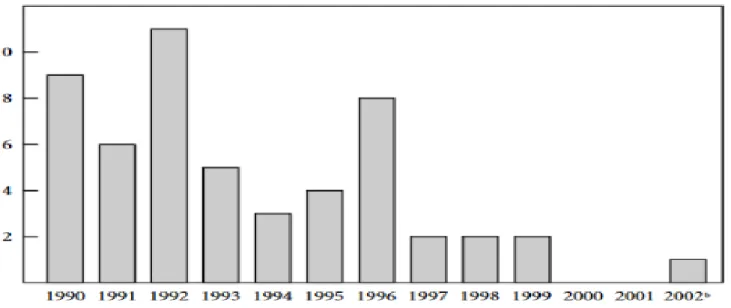
Fig. 1. Sanctions imposed by the U.S .
Source: O’Sullivan, Meghan. Shrewd Sanctions: Statecraft and State Sponsors of Terrorism. Brookings Institution Press, 2003.
The U.S. use of sanctions grew after its emergence of the cold war as a super power which funded it ever growing need to protect itself and its global interests
Sanctions and economic sanctions in particular offer an alternative solution for international issues and violations of what is considered an international norm through refraining the sender from engaging in an all-out war and conflict. It is usually used as a display of force and sender’s willingness to escalate the situation if it was provoked (Selden 6,7). TheU.S. usage of sanctions stems from its functionality and efficiency along with other policies in solving international problems and has since been integrated in the U.S.foreign policy.
In order to fully benefit from a sanction, it must not be independently carried out and should be pared with other policy tools. Sanctions need to be accurately targeting one or more aspects of the target’s country at a vulnerable opportunity and for a calculated period of time
to serve a given goal effectively (O’Sullivan 287,288). Sanctions’ way of implementation offers an insight to their results if they were poorly executed and contextually flawed as well as if done properly and effectively.
The 1979 events in Iran resulted in the capture of U.S. diplomats which prompted an intense military, economic and political spree of sanction ranging from freezing assets, embargoes and bans to motivating other countries to follow the U.S. sanctions. Iran faced immense sanctions pressure from multiple sides until it collapsed and gave up to the U.S. demand in 1981with the Algiers accord (O’Sullivan 48). Sanctions are a direct measurement and a direct blow to the targets finance and strength in general that stops the situation from escalating further which led the U.S.to count on its use in such cases and became a favorable asset in the U.S. arsenal and a better alternative to military intervention.
The 1990 Iraq invasion of Kuwait is considered a case where sanctions were used intensively as it forced arms embargoes, imports and exports sanctions with the exception of humanitarian aids and trades. These sanctions were forced by the UN and the U.S. after the invasion and continued after the U.S. intervention in 1991 in Kuwait and formed an intense siege against Saddam Hussein and through time resulted in complete destruction of the Iraq economy and financial capacities.
It is true that the Iraq was completely in the grasp of the U.S. and UN yet Saddam Hussein showed no intent of surrendering which prompted the 2003 invasion of Iraq
(Nephew17-22 ) .This case depicted how the U.S. prioritized sanctions over military solution using a multiple combination of sanctions for different durations which shows the U.S .familiarity with such sanctions and opting to utilize it as a smoking gun .
At first isolationism offered a temporary and a much-needed policy but as the world changed the U.S.had to alter its policy in the face of globalization one way or another while maintaining its key aspects (McCormick 28). In face of wars and global development and
various changes in the world the U.S. had to adapt its foreign policy and develop it to suite these changes and at the same time preserve its principles. After emerging as a super power the U.S. started to utilize its new status to its favor as a tool of intimidation and spreading its regime by implementing and enforcing sanctions and other policy tools. The U.S. foreign policy adopted sanctions and perfected using them in different means to serve its goals to the extent that it became a constant inseparable tool in its kit which made the U.S. foreign dependent and reliant on its use.
Chapter Two
U.S. Economic Sanctions in Iraq
I. The U.S.Intervention in Iraq1991 and the Invasion 2003
Chapter two is devoted to explore the U.S. sanctions and military intervention in Iraq both in 1991 and 2003 by shedding the light on the origins of USA and Iraq relationship since the begging of Saddam ruling and moving to the long going period until the Gulf War took place and what follows it from different circumstances that shaped this unstable relationship.
Iraq was a powerful dominating country in the Middle East at that time and regarding the U.S. interests in the Gulf and Middle East, it was inevitable for these two countries to neglect each other’s impact in the region and this led to a relationship described sometimes as mutual and sometimes regarded as enemies.
I.1. The Origins of U.S. and Iraq Relations
During the 1950s Iraq did not play an effective role regarding the U.S.foreign relations, even after the 1958 revolution, it was not the country that would threaten the U.S.presence in the area. It was until 1979 that Iraq would mean an important ally to the United States in the region. This was due to the Iranian Revolution and its impact on the U.S foreign policy known as “the twin pillars strategy”,a strategy adapted by U.S. during the rivalry with the Soviet Union, which sought to make up its two regional allies Saudi Arabia and Iran as controlling powers in the region to block the communism spread(Hurst 19). This means that Iraq was clearly out of the game for the United States since it was not a part of the pillars.
Threatened by the new Iranian regime views, the United States looked for a new strategy to maintain its hegemony in the area as well as containing the new possible threat. Accordingly, it set a new page on its relationship with Iraq and made it an essential strategy to
sustain its domination on the region (Teicher and Teicher 79). The signing of the treaty between Egypt and Israel was also considered a strategic victory to the U.S.by shifting the Arab forces from a potential clash with Israel (Halper and Clarke).Egypt paid the price of its betrayal and was excluded from the Arab League and now the U.S.important ally in the region is now out of power (Hinnebusch 194). This opened the door for other possible leaders to fill that gap and it was an opportunity to place Saddam Hussein as the new leader following the U.S. instructions.
Saddam Hussein became the Iraqi 5th president on July, 16th 1979 after forcing Ahmed Hassan Al-Bakr to resign (Marr 226), this move only strengthened his domination more since he was the main figure during his position of general in the Iraqi armed forces in 1976.Saddam’s power increased more after what became to be known as “1979 Ba'ath Party Purge” when he eliminated 68 alleged co-conspirators within the party. As taking the internal threat away, Saddam now turned to the international phase as he believed that Iraq should take a major role in the region. As a result in February 8th 1980 he issued “Pan-Arabism” in which he condemned and rejected the superpower presence in the Middle East (Hurst 25). This early moves from Saddam were clearly showing his views and his regime path against superpower countries.
Both the Iranian revolution of 1979 led by Ruhollah Khomeini who was known with his direct opposition to U.S. and the USSR invasion of Afghanistan, put theU.S.interests in Middle East in danger. Different policies were taken by the U.S. presidency such as the Carter Doctrine and the Rapid Deployment Forces known as RDF issued in 1979(Acharya 80). RDF consists of a mobile unity force that rapidly moved to different locations in Europe and Korea. It was replaced in 1983 by Rapid Deployment Joint Force “RDJTF” to take missions in the gulf region(Karsh and Rautsi 37). The mission included access to different naval and air basses in the area to assure military presence, this however was faced by speculation of the
allied Arab countries since they saw the U.S.lack of keeping the Shah in Iran, and this put U.S.at the danger of losing the area for the Soviet dominance (Hurst), so other solutions to contain the Soviets and Iranians were to be taken.
At this moment the idea of re-establishing new relation with Iraq came to existence as National Security Advisor Zbigniew Brzezinski stressed that the idea of “non-relationship” with Iraq should be revised (Hurst 29).This strategy was a result of the unstable Soviet Union and Iraqi relation as Iraq threatened to cut diplomatic relation with them if they continued to support Ethiopia against the Eritreans as well as condemning the Soviet invasion to Afghanistan. In the other side, Iraq started to have a mutual relationship with United States and it began to exchange commerce and naval ships (Acharya 88). These were signs of the growing up relation to the U.Sside and a new page for the U.S foreign policy to take place.
Iraq began to emerge as hegemonic country in the region after the Iraq-Iranian War of September 1980, when Saddam invaded Iran borders.The clash continued and was only settled by Algiers Agreement 1975. For the U.S.it was a double threat that means that in the condition of Iran winning, it would be a major problem to U.S interests but if Iraq would won it would be less risky despite the Iraq foreign policy since it remained the Soviet Union ally and had potential desires to control the Gulf, so both were not welcomed by U.S. As Iran continued cutting relation with U.S, Saddam in the other hand - following the USSR devastating war in Afghanistan where they began to lose supplies - he started to tighten relations with Reagan’s administrations and tried to restore the relation with Egypt after its expulsion from the Arab League in 1979 mostly for military business (Halliday 61).
Despite this closeness with U.S.none of the U.S.regional allies in the Gulf accepted American bases in the region thus they were not totally capable of providing their own security (Hurst 41). The best example of these countries was Saudi Arabia which despite its richness and the capability of having advanced weapons, it lacked the human resource to use
it. In the other hand U.S. saw Iraq as a good key for a U.S. presence in the gulf and it gave support during its war with Iran, despite having doubts about its unsustainable regime (Hinnebush154). This was clear in 1982 when U.S. removed Iraq from the state’s department list of state sponsors of terrorism. Moreover, it provided Iraq with satellites intelligence that marked the Iranian troop’s positions (Karsh and Rautsi 68). The United States also passed a passage to UN calling for ceasefire (Sluglett et al. 195). Though Saddam was able to finance his war at the time, but in 1982 the oil collapsed and he failed to finance his war.
The U.S. therefore provided financial aids in form of agriculture trade to help finance the rolling war (Marr 225). The administration has encouraged other countries to supply Saddam, such as France – Iraq most non-Soviet military provider – and Italy. Moreover U.S. allowed third parties or non-official companies to sell Iraq U.S. made equipment (Hersh 12). At 1987 U.S. was directly involved in the war in favor of Iraq by what was known as Re-flagging Kuwaiti oil tankers in order to protect the oil supplies and brought a legitimate presence in the Gulf Sea and forced the Iranian bombing the tankers and therefore accepting UNSR 598 agreement (Acharya 112). In 1989 Reagan was succeeded by President Bush who was himself a leader of pro-Arab/pro-Iraq lobby and relations continued working well until Iraqi invasion of Kuwait in 1990 (Hurst 70). This invasion would constitute a turning point in the Iraqi –American relations.
Fig. 2. Sectoral Compounds of Iraqi the Gross Domestic Product.
Source: “Regime Finance and Procurement — Central Intelligence Agency.” CIA,
www.cia.gov/library/reports/general-reports-1/iraq_wmd_2004/chap2.html. Accessed 20 Oct. 2020.
The figure 1 shows that Iraq is a primary Oil dependent country which is about 61% of its Gross domestic product and this can somehow show why the invasion of Kuwait took place and necessity of Oil reserves for Iraq.
I.2. The 1991 intervention and its reasons.
Following the circumstances witnessed in the period of 1990, different events resulted in the direct clash between U.S. and Iraq, starting in 1990 and became a real invasion in 2003. On August 2,1990 the Iraqi forces invaded the neighbor country Kuwait with no anticipation from the international sphere to this occupation. The Iraqi tanks were rolling the Kuwait City streets and this marked what lately known as The Gulf War.
The war was a result of different contradictions and circumstances one of them was Iraq, Iranian war and its enormous and catastrophic result on Iraqi side which led later to an economic collapse. Moreover, the period of 1990’s itself marked the collapse of the USSR and the new global order led by U.S.and its allies. The Gulf countries during the Iraq Iranian war were ironically - despite their military weakness –supplying Iraq in its war as well as other western countries did (Finlan 05). Ironically, those supplies were lately used to invade Kuwait.
Iraq claimed the invasion was not an assault but it was to protect its oil reserves locating in Rumaila field that was Kuwait exploiting the share of Iraq in. Moreover, Iraq supported the
invasion with the idea that Kuwait was once part of Iraq but the British imperialists divided it. Another reason was that the Kuwait Emir was unpopular and those people were in need of Iraq rule. Viewing and analysing that period more different reasons led to the Gulf war; economically speaking Iraq during its war with Iran suffered from heavy debts from other countries to finance its war and among them was Kuwait and with the obvious situation Iraq was unable to pay and it requested from Kuwait to reduce its oil shares and this would benefit the Iraq economy since the price will raise. As a result, Kuwait rejected and demanded its right from Iraq to pay its debts as well as the increased of oil production (Karsh and Rautsi).As a result, the signs of new conflict started to rise.
When the tension rose and Arab countries failed to solve the problem it became an international crisis.The U.S.and its mutual ally UK felt the necessity to interfere especially when the oil reserves were at risk as well as the U.S.hegemony to the region was already questionable by its Gulf allies mainly after the Iranian revolution.In addition, this attack was a direct challenge to the U.S.dominancesince Iraq had military power that made it to be the fourth military power in the globe under Saddam Hussein commands and considered as a major threat in the region. Moreover, the Gulf War marked the first national crises after the end of the Cold War, as the academic Francis Fukuyama argued in his book The End of History1992: “since most of the countries have seen the new world order changes and the world is going to a new stable period under one pole dominance carrying Capitalist and social as well as political Liberalism views” (294). In addition to the vanish of the nuclear rivalry between U.S. and USSR which put the risk of a devastating war that was freighting the world, thus the Iraq invasion in 1990 ruined this vision (Finlan 06). The invasion of Kuwait changed the world’s intensions of ending wars and starting a new peaceful period after the cold war end.
At international halls, countries led by U.S.and its mutual ally UK followed by France, Egypt and Pakistan condemned the invasion and hoped for a response which was mixed from one country to the other but the U.S. side was at favor of military intervention to block the invasion at once. Military speaking, the timing of the war was good for the U.S.to use its long massive military production during the cold war. The “CENTCOM” central command (it replaced the RDF to take military actions in the Gulf region) started the operation. First it was defensive strategy by landing the troops in different bases mostly in Saudi Arabia and build a defensive line or what known as Operation Desert Shield and later the Operation Desert Storm as an offensive strategy to force the Iraqi troops to be out of Kuwait (Hurst). The operation began on January 16, 1991, and ended with an Iraqi defeat and retreat from Kuwait on February 28, 1991.
II. The U.S. War of Sanctions in Iraq
The Gulf War also resulted on a series of comprehensive embargo and sanctions imposed by UN and reinforced by “United Nations Security Council resolution 661” charted on August 6, 1990 which highlighted the Iraq refusal of stopping war and Kuwait right to defend its soil, it was a strategy to withdraw Iraq and to stop any means of aggression (Weissand Urquhart 106-107). First The Security Council began with resolution 660 immediately after the invasion, under the Articles 39 and 40 of the Charter United Nation, in which it highly condemned the Iraqi invasion of Kuwait, demanding Iraq to withdraw its forces from their locations, calling for Kuwait and Iraq to establish a negotiation to resettle their disputes as well as appreciating any kind of help fromother countries and the efforts of the League of Arab States (2929th meeting). The resolution was an action to stop the war peacefully without moving to hard decisions.
Though the Resolution 660 was ignored by Iraq and with the continuous aggression and the loss of human lives, a new heavy Council decision was made by TheResolution661,which worked in accordance with article 51of the Charter which points out the right for individuals or collective self-defense, and acting under Chapter VII of the Charter.
The decision was that the Iraqi regime did not comply with the withdraw highlighted in Resolution 660and carried its assault, as a result the Council decided a list of measures in which all states shall act upon, thus preventing the export of all products of Iraq or Kuwait made mostly of oil, as well as any dealings or founds transfers to both countries, trade and the use of their “flag vessels commodities” or any means of supplying of military purpose except for medical or humanitarian purpose. All countries whether members or not in United Nation shall stop any agreement or contract and accommodate strictly with the provisions (2929th meeting). This new step of hard decision was direct to send a clear message of the necessity of ending the war from the two sides.
The sanctions were extended after the end of the war under Resolution 687 following and reassuring resolutions 660, 661, 662, 664, 665, 666, 667, 669, 670, 674, 677, 678 in 1990 and 686 in 1991, for Iraq as losing side to accept willingly. The resolution included different obligations among which the removal of all weapons of mass distraction under the Geneva Protocol “the Protocol that Prohibits the Use in War of Asphyxiating, Poisonous or other Gases and of Bacteriological Methods of Warfare”. Iraq according to 2929th meeting must
destroy all chemical biological and ballistic missiles in addition to reveal the location of all for mentioned weapons industries and ammunition storage also the Iraq accountability to pay for Kuwait losses, as well as pointing the reviewing of the continuation of other resolutions and prohibitions took during the war.
During the coming period of sanctions, the U.S. was clearly assuring the blocking of any means of lifting the sanctions as well as its high instrumental effect of imposing those sanctions through making its hegemony and status in the world as a tool to convince and pass them through other countries. The sanctions were one of the many reasons that put Iraq in a catastrophic scale -as the UN Security special envoy Sadruddin Aga Khan had described - among which the series of bombing led by U.S. during the Gulf War which it massively destroyed all the infrastructures of the country, U.S. also would always related the economic collapse of Iraq to Saddam corrupted regime and stats that sanctions did not prevent Iraq from buying food or have a humanitarian effects”( U.S. Department of State). Those claims were always a motive behind U.Sto put that regime to an end and it used them as strong reason to apply its policy.
Moreover, the two “no-fly” zones imposed by U.S. and UK after the Iraqi forces tried to put down Kurdish and Shiite rebellions in north and south which resulted in a massive series of bombing throughout Iraq mainly Saddam ruling area. The Congress regardless its leading party showed no interests in Iraq humanitarian issues. The U.S. government through its three administrations from 1990 to 2003 was making sure that the imposing sanctions as well as its heavy effect on other countries would serve to paralyze the Iraq economy (Gordon 06-09).The U.S. policy was at a high scale of crippling Iraq since both the President and the Congress had the same views about destroying Iraq.
III. The 2003 Invasion and the Reasons Behind It
Following the end of the 1990 Gulf war, U.S. and its allies kept Iraq under control either by Economic Sanctions or by military action such as “Operation Southern Watch” which aim was to watch and control the airspace of the “no-fly” zone located in the southern and south-central Iraq (Gulf War Timeline). In addition to ensure the disarmament of
weapons of mass distraction and this was an important issue to the UN Security as well as to U.S., since those biological and chemical weapons were developed under U.S. supervision during the period of 80s which lately were surfaced in the awake of 1990 Gulf War, apparently the UN Security special commission after the end of the war and through its investigations in Iraq ensured that there is no evidence of the continuation of the program after the war. This was reinforced by U.S. and its allies through putting a policy of “containment” as well as enforcing the Sanctions (Coalition planes hit Iraq sitesin no-fly zone). Despite the absence of evidence against Iraq the attack took place.
It was obvious that U.S. had plans for Iraq government more specifically Saddam, since he was the national leader as well as the hero of the nation, getting rid of him was a U.S. foreign policy goal. This was clearly stated by Congress saying that " the United States policy aim is to support the removal of Saddam Hussein leading regime and the establishment of democratic one instead” (HR 105th Congress). This intentions begin with the “Iraq Liberation Act ” in 1998 (HR 4655: All Congressional Action) , this act started as a congressional act later a law by President Bill Clinton on October 31st, 1998.
The act stated that Iraq since 1980 has violated several international laws as well as ignoring UN Resolutions, therefore U.S. policy should support a regime transformation in Iraq under a democratic rule (Peters et al).In December 16th, 1998 President Clinton Mandated along with UK a four days bombing over Iraq targets on what called “Operation Desert Fox”, the justification of this aggression was that Iraq did not comply with United Nations Security Council Resolutions. The attack strikes put down all Iraq military facilities which have the ability to produce and store weapons of mass distraction and this was a start point of the “Iraq Disarmament Crises” that highlighted the U.S. main reasons to invade in 2003 (Cleminson). This attack was the most vital and strategic plan that lead to the total paralyze of Iraq Military power and this cleared and simplified out the steps to invasion.
The election of George W. Bush in year 2000 as U.S. new president continued the direct Republican Party views during the campaign calling for the "full implementation" of Liberation Act. This forced the idea that Iraq Regime is the main aim of U.S. even of different Political party views (republican platform2000). This intention was not hidden as Treasury Secretary Paul O'Neill who argued that: “The attacking on Iraq was planned ever since Bush became the president at the first U.S. Security Council meeting” (O'Neill: Frenzy). The effort to liberate Iraq since then took another path especially after the 9,11 attacks break down.
Soon after the attacks a congress meeting addressed by Bush in which he announced what he called the “War on Terror” under “Pre-Emptive” Doctrine or taking initiation before the enemy does, and lately documented as “Bush Doctrine”. During this meeting several U.S. Government Officials claimed that Iraq Intelligence Service IIS had relation with some Radical Islamists Organizations specifically al-Qaeda and thus U.S. must immediately intervene (Chronology of the Bush Doctrine). This move from U.S. Presidency made Iraq as a total enemy and the number one terror provider.
In September, 12th, 2002 Bush made the invasion claim internationally by addressing UN Security council (Remarks by the President in Address to the United Nations General Assembly), through different views of UN members. Some favored taking direct decision of attack like UK while others favored diplomacy and UN inspection such as France and Germany, later UN settled a compromise “Resolution 1441” included a continuation of weapons inspection and taking “serious consequences” if necessary.
France and Russia however, made it clear that in these consequences shall not use force against Saddam government (France threatens rival UN Iraq draft). The Resolution was accepted by Saddam and UN committee declared later that there is no evidence of any new active production of weapons (Thirteenth quarterly report of the Executive Chairman of
the United Nations Monitoring).U.S. worked by all means to legitimate the invasion though deferent countries were against because this invasion would look as an aggression since Iraq was clear from any military production.
In July, 2002 U.S Forces entered Iraq as an operation to organize and aid Kurdish Peshmerga the combined forces took over Ansar Al-Islam, a group in relation to Al-Qaeda. Ansar Al-Islam were defeated and a chemical weapons facility was taken at Sargat, said later to be the only facility discovered during the Iraq War (Faddis). Another mission was led to identify leadership targets, which led to air strike against Saddam. The strike missed the target but it was effective since it ended al Saddam connections and commands to his forces, it also convinced some of his generals to surrender at the begging. At the same time U.S. tried to convince the Security Council Members for the necessity of an immediate invasion to stop Saddam at once.
U.S. addressed the UN by its U.S. Secretary of state Colin Powell providing a “Mobile Biological Weapons laboratory” of a computer generator image as an evidence based on the claims of an Iraqi emigrant Rafid Ahmed Alwan al-Janabi known as “CURVEBALL” by “the Defense Intelligence Agency cryptonym” a German citizen defected from Iraq and claimed that he worked on a chemical facility for manufacturing Biological Weapons, who had later falsified his claims (George W. Bush's Third State of the Union Address).This was considered as a total deceiving in the UN halls which U.S. based its claims on for faking the invasion.
At the lights of the U.S. claims, countries such as U.S., UK, Italy, Poland, Denmark, Australia, Spain and Japan called for the UN authorization for using force against Iraq. At the other side Canada, France, Germany alongside Russia favored to continue with diplomacy solution. Facing the possibility of veto, as well as protests and opposition waves from the worldwide public opinion ,U.S. and its allies gave up the intervention Resolution
( U.S., Britain and Spain Abandon Resolution). At the coming period different efforts and attempts were done either by Iraq officials or by mediate countries in order to avoid any further possibility of war. However, later on March 16th, 2003 a meeting was held between U.S. allies officials with Portuguese as host to discuss the plan for the invasion, and in March 17th, 2003 Bush demanded for Saddam and his family to leave Iraq in a 48 hours deadline (White House Office of the Press Secretary), however in the next day March 18th U.S. and its allies bombed Iraq without any UN authorization (Webb ). This attack marked the beginning of the Iraqi invasion by U.S. coalition forces.
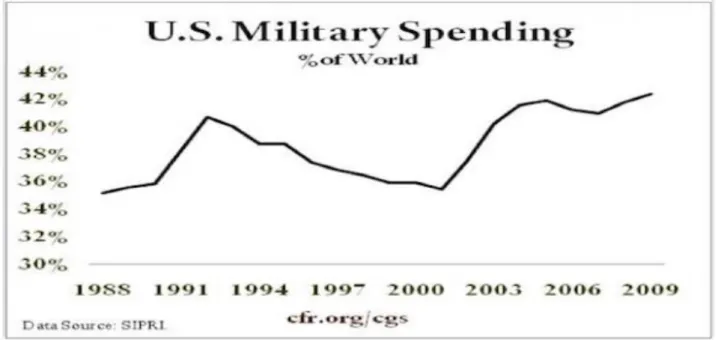
Fig. 3. U.S. Defense Spending Compared to Worldwide Spending.
Source:“Budget and Hardware Myths, Part I.” Project On Government Oversight, 1 Oct. 2012, www.pogo.org/investigation/2012/10/budget-and-hardware-myths-part-i.
The graph in figure 2 which is comparing the spending of U.S. on military shows that the U.S. through years spends nearly the half spending of the whole world countries and this
stats clearly the U.S. military financial side and how U.S. put huge budget to develop this field.
Iraq and United States were at many points in contact and this contact differed from time to time. At its early ages under Saddam’s rule, Iraq was not that important country for U.S. interests in the Gulf region, however after the Iranian revolution the situation had changed and Iraq started to be a U.S. balance card in the region. After a period of settling and mutual relationship between the two countries which even reached the point that U.S. helped Iraq in its war and aided it during the economy collapse, then came the turning point event which inversed the mutual relationship into a total enmity, the Iraq invasion of Kuwait in 1990 or what Known as The Gulf War.
Iraq after invading Kuwait turned to be U.S. number one enemy and the ultimate source of terrorism. The Gulf War ended by the defeating of Iraq by U.S. collation forces, and Iraq was put under a series of UN and U.S. sanctions that tortured its economy for a period of almost a decade which led to its collapse. The end of these sanctions was more catastrophic than the period of sanction itself, since it ended in the invasion of 2003 by U.S. and its allies.
Chapter Three
Sanctions against Iraq: Costs and Failures.
The period of sanctions marked a very crucial and critical era for Iraq, U.S. and for the International Society as well. Different challenges were brought; Iraq faced a high level of humanitarian issues and moved to be a disabled country that needed international funds and help. U.S. in other side got what it was a vital policy for its view to Iraq which highlighted in Economic Sanctions regardless to the international opinion in which many were against this move and sided with the Iraqi people miserable situation.
I. The Outcome of the Sanctions on the Iraqi Side
The distraction brought to Iraq by the 1991 war following the invasion of Kuwait led to an almost total collapse of Iraq economic foundations. This destruction however, was followed by a series of sanctions of high costs to the Iraqi nation. These sanctions were imposed as a payback to compensate the Kuwait losses after the Iraq aggression. Sanctions were also a punishment imposed by United Nations against Iraq for not cooperating with it as an international organization.
Iraq was accused of assaulting another country that has a total sovereignty, violating UN Charters through the use of chemical weapons and not accepting the Resolutions of supervising the removal of the weapons by the UN officials (Cortright). A nine consecutive years of trade embargo and sanctions put a huge burden either on the Iraq as a government, which had the responsibility of feeding and taking care of its people, or on the people
themselves fighting to get enough to live (United Nations International Children's Emergency Fund).
I.1.The Long Going Process of Sanctions
During a nine years of trade embargo and economic sanctions imposed by United Nations and United States that started from 1991, Iraq the country was reconsidering its position after the Gulf War loss during the invasion of Kuwait and facing the coalition forces led by U.S. The coalition resulted on massive distraction of almost the country’s
infrastructure, and followed by a series of sanctions that were economically shocking the government. Iraq suffered to reform itself as the country and the government that was before; the sanctions made it too hard for the government to reutilize and have a total access and sovereignty of its resources such as oil production and exporting which was limited
(Alnasrawi). This disability resulted on the lack for the government to give its people the right conditions, in which it guaranties their worth of living properly.
The conditions of the citizens under the years of sanctions were at a catastrophic scale, unemployment and poverty made people not able to have even the basic leaving needs
(Popal). The limitation of imports that UN committee had issued made it difficult to import goods into Iraq as well as the destroyed roads form the bombing during the Gulf war in addition to the limitation of the means of transportation put another burden for managing to distribute food along the country vast area. These difficulties put the people of Iraq under critical situation. Many organizations estimated that by the long going limitations a famine and humanitarian disaster is on the go for the Iraqi people (Ahtisaari). These difficulties put the people of Iraq under critical situation with no clear solution.
The Iraqi Government also refused the United Nations Security Council “Resolution 706” in which it allowed it to sell only a portion of its oil to import goods as well as to pay for the compensation of Kuwait lost. The refusal came after Saddam claimed that the resolution questions Iraq sovereignty of its properties (Alnasrawi). The complexity of the situation opened the door for a new resolution to be issued.
Later on, April 14th,1995 United Nations Security Council issued “Resolution 986”
under what was known as “Oil for Food Program”, the purpose of this resolution was to help the un-humanitarian conditions and the long going suffering of the people. The resolution was passed after a worldwide call from many non-governmental organizations that put a pressure and called to change this misery(International Committee of the Red Cross). Later on 1996 Iraq signed a memorandum of understanding to assure the work of the Resolution.
Before the Program took place, Iraq government used a system of free food rations, consisting on providing an equilibrate amount of calories per person or its minimum daily requirements and this was a vital for nearly 60% of the people who were depending totally on small portion for their living (International Committee of the Red Cross). Therefore, the limitation of funds and products was always an obstacle to assure that the people are always provided by their necessary requirements of daily minimum needs.
The Oil for Food Program that started in December 1996, was slowly allowing the Iraqi government under a restricted United Nation supervision, to import necessary things like food and other human use merchandise, while things that contained chemical substance which were suspected to be used for chemical weapons production were denied (UN Office of the Iraq Program – Oil-for-Food). 53$ billion of worth Iraqi oil was sold over the period, 46$ billion was used to cover the program of humanitarian needs for the people and a portion was given as compensation of the Gulf War (U.N. defends oil-for-food letter).
The oil revenues that came under the Program, however, were held by United Nation controlled escrow account and was not available for the regime of Saddam (U.N. defends oil-for-food letter). The Program also faced different abuse and misapplication during the long process such as the amplification of payment as Aqila al-Hashimi, a formal senior bureaucrat with the Oil-for-Food Program in Iraq , stated : “65% of program's total was basically put to
aid” (Nutt 149). These difficulties put Saddam regime and its government on a critical
position mainly economic since the government was not the one who take the income and this led to its inability to serve the people needs.
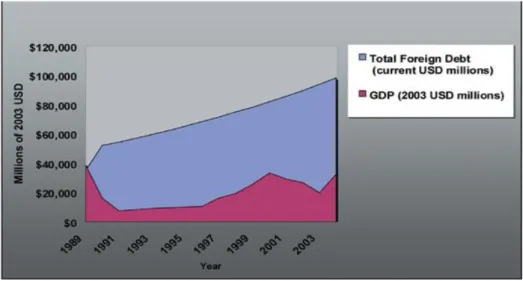
Figure.4. Foreign Debt Compared to the Gross Domestic Product.
Source: “Regime Finance and Procurement — Central Intelligence Agency.” CIA,
www.cia.gov/library/reports/general-reports-1/iraq_wmd_2004/chap2.html. Accessed 20 Oct. 2020.
Figure 3 shows that Iraqi foreign debts increased dramatically since the Gulf War due to the war costs and the sanctions. Gross domestic product therefore failed to match with the heavy debts which put the country under economic failure.
I.2. The Aftermath of Sanctions on Iraq
Until May 22, 2003 the day on which United Nations Security Council voted to lift the sanctions, the process of the sanctions and embargo highly crippled the country enabling it to provide the simplest requirements to the citizens or to maintain its sovereignty all over the
country. Iraq faced a catastrophic collapse that affected all country sensitive parts from economy to military moving to social and health scales. In addition to the sanctions, during that period Iraq suffered also from the United States and United Kingdom interventions and assaults in a series of bombing during 12 years. As mentioned by Jonathan Power in an article of July 6, 2000 “said by The Pentagon that more than 280,000 sorties had been flown in a matter of a decade” (Shah article 1 ). The bombing effect was highly costly for Iraq. In addition to the almost total distraction of the infrastructure which they were at a critical situation during the Gulf War with Kuwait, the bombings destroyed most of the country manufactures that the people depend on for the living (Shah article 2). The destruction
brought by bombing assaults was critically weakening the Saddam regime and putting it under a helpless situation to aid the people.
Figure. 5. Infant (under 1 year) and Child Mortality (under 5 years) rates (per 1,000/year) for Iraq.

![[PDF] Conception des systèmes d’information par la Méthode de conception Merise | Formation informatique](data:image/gif;base64,R0lGODlhAQABAIAAAP///wAAACH5BAEAAAAALAAAAAABAAEAAAICRAEAOw==)