Publisher’s version / Version de l'éditeur: APT Bulletin, 10, 1, pp. 20-34, 1978
READ THESE TERMS AND CONDITIONS CAREFULLY BEFORE USING THIS WEBSITE. https://nrc-publications.canada.ca/eng/copyright
Vous avez des questions? Nous pouvons vous aider. Pour communiquer directement avec un auteur, consultez la première page de la revue dans laquelle son article a été publié afin de trouver ses coordonnées. Si vous n’arrivez pas à les repérer, communiquez avec nous à [email protected].
Questions? Contact the NRC Publications Archive team at
[email protected]. If you wish to email the authors directly, please see the first page of the publication for their contact information.
NRC Publications Archive
Archives des publications du CNRC
This publication could be one of several versions: author’s original, accepted manuscript or the publisher’s version. / La version de cette publication peut être l’une des suivantes : la version prépublication de l’auteur, la version acceptée du manuscrit ou la version de l’éditeur.
Access and use of this website and the material on it are subject to the Terms and Conditions set forth at
Roman stone and other decorative artificial stones
Ritchie, T.
https://publications-cnrc.canada.ca/fra/droits
L’accès à ce site Web et l’utilisation de son contenu sont assujettis aux conditions présentées dans le site LISEZ CES CONDITIONS ATTENTIVEMENT AVANT D’UTILISER CE SITE WEB.
NRC Publications Record / Notice d'Archives des publications de CNRC: https://nrc-publications.canada.ca/eng/view/object/?id=9367f793-2895-48c5-9fbe-369a23e57525 https://publications-cnrc.canada.ca/fra/voir/objet/?id=9367f793-2895-48c5-9fbe-369a23e57525
Ser
TH1
N21d
no. 785 National Research Conseil national
C . 2
1
#
Council Canada de recherchesCanada
AN
ALYROMAN STONE AND OTHER DECORATIVE
ARTWICIAL ST*ONES
by T. Ritchie 5
Reprinted, with permission, from
The Association for Preservation Technology Bulletin VoL X, No. 1, 1978
p. 20 34
DBR Paper No. 785
Division of Building Research
SOMMA I R E Au Canada, l a f a b r i c a t i o n d e p i e r r e a r t i f i c i e l l e 3 p a r t i r de b 6 t o n d a t e du d g b u t du s i s c l e . L'un d e s t y p e s , l a p i e r r e romaine, 6 t a i t beaucoup employ6 e t on l u i d o n n a i t d e s formes e t d e s t e x t u r e s
trss
d 6 c o r a t i v e s . L ' a r t i c l e d 6 c r i t l a t e c h n i q u e d e f a b r i c a t i o n p a r c o u l a g e d u b 6 t o n dans un moule e n s a b l e e t f o u m i t d e s exemples d e son u t i l i s a t i o n e n c o n s t r u c t i o n .ROMAN STONE AND OTHER DECORATIVE ART1 FICI AL STONES by
T. R i t c h i e
*
The p o r t l a n d cement and concrete i n d u s t r i e s t h a t became such an important p a r t o f construction and b u i l d i n g i n the e a r l y years of t h i s century had t h e i r beginning i n t h e experimental work o f Joseph Aspdin, t h e English b r i c k l a y e r , i n making a r t i f i c i a l stone. I n 1824 a p a t e n t was issued t o him f o r h i s i n e n t i o n o f "an improvement i n the modes of producing an
'8
Y
a r t i f i c i a l stone
.
The m a t e r i a l Aspdin made he c a l l e d p o r t l a n d cement, a f t e r the n a t u r a l Portland stone i t resembled. It was, i n h i s words,". .
.a cement o r a r t i f i c i a l stone f o r stuccoing bui 1 dings, waterworks, c i s terns o r any o t h e r purpose t o whi ch i t may be appl i cable.. . .
"
A r t i f i c i a l Stone i n CanadaA decade a f t e r Aspdin's patent was granted, a Canadian p a t e n t was issued f o r a h y d r a u l i c cement developed by Frederick ~addely,2 an o f f i c e r o f the Royal Engineers s t a t i o n e d a t Quebec. Subsequently i n Canada, t h e r e was s u f f i c i e n t i n t e r e s t i n t h e manufacture of h y d r a u l i c cements and i n t h e products made from them t h a t when the Universal E x h i b i t i o n was he1 d i n Paris i n 1855 several displays o f cement and cement products were included i n the Canadian e x h i b i t . 3 For example, P i e r r e Gauvreau, a r e s i d e n t o f Quebec who had patented i n 1854 h i s
".
..
new and useful cement, t o be c a l l e d by him Gauvreau's Canadian h y d r a u l i c cement,"4 sent samples o f t h e stone from which he made h i s cement, some a r t i f i c i a l stone formed from i t , as w e l l asa pipe made from the cement. Other samples o f hardened h y d r a u l i c cement were displayed by Thomas C. Keefer, the prominent engineer.
I n s p i t e o f t h i s e a r l y Canadian i n t e r e s t i n a r t i f i c i a l stone, i t s extensive manufacture and use d i d n o t come about f o r another ha1 f-century, when i n the l a s t decade o f t h e 19th century a Canadian p o r t l a n d cement
i n d u s t r y was established. Engineers began t o employ concrete i n l a r g e q u a n t i t i e s , t o the e x t e n t t h a t i n 1896 t h e Canadian Engineer noted t h a t
"Of l a t e , m o n o l i t h i c works o f g r e a t importance have been c a r r i e d o u t and every day concrete as b u i l d i n g m a t e r i a l i s creeping t o a foremost place."5
Concrete's impact on t r a d i t i o n a l masonry c o n s t r u c t i o n was a1 so noted i n a r e p o r t by the Ontario Bureau o f Mines prepared i n 1904; "The use o f limestone i n the form o f blocks f o r b u i l d i n g and s t r u c t u r a l purposes has been considerably a f f e c t e d during the l a s t ten years o r so by the
*
M r . R i t c h i e i s a Research Officer, D i v i s i o n o f B u i l d i n g Research, National Research Counci 1 o f Canada.s u b s t i t u t i o n o f concrete
-
crushed stone and cement. Formerly, f o rinstance, dimension stone was used exclusively i n bridge work and for locks and other canal structures
. .
.
(but). . .
concrete i s being used i n place o f stone... .
"
The new materi a1 was also being appl i e d t o bui 1 dingconstruction ; "some 1 arge bui 1 dings i n the Province are bui 1 t of concrete..
.
(and).
.
.
concrete blocks, whi ch resemble those o f stone, are a1 so coming i n t o use."6
I n summary, by the t u r n o f the century, a r t i f i c i a l stone had been introduced t o the Csnadian b u i l d i n g industry and had been accepted by it;
". .
.cement i s proving a formidable competitor t o stone f o r uses i n which the l a t t e r was f o r long employed almost exclusively. Quarrymen lookaskance a t the new material which i s rep1 acing t h e i r product i n bridge work, foundations and construction work o f various kinds, contending t h a t i t w i l l prove less durable and more 1 ia b l e t o destruction by f r o s t when exposed t o the action o f water. Time only w i l l show whether these imputations are warranted, but i n the meantime there i s l i t t l e doubt t h a t cement f o r many
uses i s pressing hard on stone.
"7
The Roman Stone Company
As a r e s u l t o f the demand f o r concrete, by the f i r s t decade o f t h i s century a l l l a r g e Canadian communities, and many small ones, were served by a concrete block factory. There were also a few manufacturers o f orna- mental a r t i f i c i a l stone, the l a r g e s t the Roman Stone Company of Toronto. This firm, established i n 1903, produced a decorative stone c a l l e d "Roman
Stone" by a process developed and patented i n the United States by C.W. Stevens j u s t before the t u r n o f the century.8
The Stevens Process
I n the Stevens process, the f o l l o w i n g f atures o f which were recorded by the c h i e f engineer o f the Roman Stone Co.8, a r t i f i c i a l stone was manu- factured by casting concrete i n a sand mould, j u s t as molten i r o n i s cast i n such a mould. The absorptiveness o f the mould was an important factor i n the qua1 i t y o f the product obtained from the Stevens process. As soon as the wet concrete was poured i n t o i t , water from the concrete was drawn i n t o the sand. The concrete, accordingly, was compacted, but there re- mained s u f f i c i e n t water i n i t t o hydrate the cement, and the moist sand surrounding the concrete provided i t w i t h i d e a l curing conditions
.
The process, therefore, appl i e d t o concrete manufacture two conditions t h a t only much l a t e r became generally recognized as essential f o r the production o f good q u a l i t y concrete: a low water cement r a t i o and moist curing.A1 though sand moul ds were more expensive than the usual wooden o r i r o n moulds, because a separate one was required f o r each piece cast, the Stevens process y i e l d e d a much f i n e r product than could be obtained from other moulds. It was denser, more uniform i n colour, and i t possessed a
more n a t u r a l t e x t u r e than t h e a r t i f i c i a l stone formed i n o t h e r moulds. The c a s t a r t i c l e was sometimes l e f t w i t h i t s as-moulded f i n i s h , s i n c e a n a t u r a l stone t e x t u r e c o u l d be o b t a i n e d by veneering t h e p a t t e r n w i t h t h i n s t r i p s o f wood, b u t i t was f r e q u e n t l y f u r t h e r f i n i s h e d by hand c a r v i n g t o enhance t h e d e t a i l i n g .
Qua1 i t y Control
I n making Roman Stone, t h e qua1 i t y o f t h e aggregate was c a r e f u l l y
c o n t r o l l e d , as was i t s p r o p o r t i o n i n g w i t h cement and water. Various
n a t u r a l stones provided a v a r i e t y o f colours. Thus, f o r w h i t e stone, Niagara limestone and a w h i t e marble from Tweed were used; whereas t o
produce stones o f o t h e r colours, gray, brown, r e d and 01 i ve sandstones
were selected. Each type o f stone was d r i e d , crushed and s i e v e d i n t o t h r e e p a r t i c l e - s i ze f r a c t i o n s , t h e l a r g e s t p a r t i c l e s b e i n g about corn- kernel s i z e . These f r a c t i o n s were recombined i n t h e concrete mix i n pro- p o r t i o n s t h a t produced a dense m a t e r i a l .
The p r o p o r t i o n i n g of t h e cement and aggregate was c l o s e l y c o n t r o l l e d , as w e l l as t h e gauging of t h e amount o f water, which was drawn from a tank maintained a t constant temperature. The m a t e r i a l s were mixed i n a mechanical mixer, a f t e r which t h e concrete was run o f f i n t o l a r g e tubs
c a r r i e d by a t r a v e l l i n g crane t o t r a n s p o r t i t t o t h e c a s t i n g shop. The tubs
were f i t t e d w i t h s p i r a l paddles t o a g i t a t e t h e concrete, thus m a i n t a i n i n g
a uniform mix u n t i l i t was poured i n t o t h e moulds. The concrete was k e p t
i n t h e moulds f o r t h r e e o r f o u r days b e f o r e t h e y were opened, and t h e casts were then s t o r e d i n a temperature-constant room f o r seasoning u n t i l shipped.
One-piece stones as l o n g as 20 f e e t were manufactured, and stones were c a s t w i t h s e t t i n g hooks i n place. Those t h a t would be s u b j e c t e d t o t e n s i l e s t r e s s i n use were r e i n f o r c e d w i t h s t e e l . The products of t h e Roman Stone Company were nevertheless considered t o be re1 a t i v e l y cheap,
since i t was claimed t h a t a column i n Roman Stone c o s t o n l y s l i g h t l y more
than one o f wood.
The crushing s t r e n g t h o f Roman Stone, depending on t h e aggregate and t h e mix p r o p o r t i o n s , was between 2000 and 4000 pounds p e r square i n c h a t
s i x months, and i n excess of 7000 pounds a t two years. I t s s t r e n g t h was
s l i g h t l y g r e a t e r than t h a t o f Ohio sandstone and was much g r e a t e r than
t h a t o f Indiana limestone. I t s s t r e n g t h a l s o g r e a t l y exceeded t h a t of
concrete made by the d r y process, used i n t h e manufacture of c e r t a i n concrete blocks. The water a b s o r p t i o n o f Roman Stone, l e s s than 1 p e r cent, was exceeded by t h a t o f Ohio sandstone and I n d i a n a limestone, a t 5 p e r c e n t each, and was g r e a t l y exceeded by t h a t o f d r y process concrete, i n excess of 12 p e r cent.
A p p l i c a t i o n o f Roman Stone
D e t a i l s o f t h e a p p l i c a t i o n o f Roman Stone t o a p a r t i c u l a r b u i l d i n g p r o j e c t have been recorded i n an account o f t h e I m p e r i a l Trusts Company
B u i l d i n g on Richmond S t r e e t i n ~ o r o n t o . 1 0 This s t r u c t u r e , designed by the a r c h i t e c t s Chadwick and Beckett and constructed i n 1909, now houses the Premier T r u s t Company (Figure 1 )
.
I t s e n t i r e f r o n t was made of Roman Stone, i n c l u d i n g t a l l columns, a r c h i t r a v e , f r i e z e , cornice and parapet. The moulding o f i t s p a r t s was entrusted t o the f i r m o f Adamson and Wicks, who prepared wooden patterns from c l a y models o f t h e various p a r t s . A l lt h e stones of t h e b u i l d i n g were carved a f t e r c a s t i n g t o sharpen the a r r i s e s and t o expose t h e marble aggregate.
The columns o f t h e b u i l d i n g , 4 f e e t i n diameter a t t h e base and over 33 feet high, were formed i n 3-foot-high hollow sections w i t h an 18-inch diameter hole t o reduce t h e weight f o r handling; even so, each o f the 1 ower col umn sections wei ghed 23 tons. But the end pieces o f the corni ce were even heavier, weighing over 3 tons each. The stone o f the main architrave, spanning about 20 f e e t between the two middle columns, was r e i n f o r c e d w i t h a s t e e l I-beam c a s t w i t h i n it.
The Roman Stone o f t h i s b u i l d i n g was made from Tweed marble and Dyckerhoff cement i n proportions of about 33:l. The cement, o f German manufacture, c o s t twice as much as l o c a l cement, b u t was used because o f the excel l e n t and uniform product i t y i e l d e d .
The present b u i l d i n g d i f f e r s i n several respects fkom the o r i g i n a l . For example, a parapet, p a r t l y w a l l and balustrade, has been removed from over t h e c o m i ce. The o r i g i n a l entrance, framed i n massive and ornate Roman Stone, has a l s o been removed, w i t h e n t r y now gained through a
modern a d d i t i o n b u i l t alongside t h e o r i g i n a l b u i l d i n g . A t h i r d change i s the rep1 acement o f t h e o r i g i n a l windows
,
whi ch had been topped w i t h semi-
c i r c u l a r stone arches.Other Exam~les o f Roman Stone
Many b u i l d i n g s o f Roman Stone have been mentioned i n accounts o f Canadian b u i l d i n g . The Ivey Warehouse on We1 1 in g t o n Street, Toronto, i n s u r v i v i n g the great f i r e o f 1904 though surrounded by b u i l d i n g s t h a t
perished, was c i t e d as an example o f Roman Stone's f i r e p r o o f qua1 i t i e s . ll A good example o f Roman Stone c a s t i n t o h i g h l y decorative c l a s s i c a l
a r c h i t e c t u r a l forms was the Carnegie P u b l i c L i b r a r y i n St. Catharines (Figure 2), described as having been b u i l t e n t i r e l y o f Roman stone9. Constructed i n 1903, i t was demo1 ished i n 1965. Demolition was the fate a l s o o f t h e Canada Permanent Mortgage Corporation b u i l d i n g (Figure 3)
constructed i n 1905 i n Regina, Saskatchewan; an e a r l y example o f r e i n f o r c e d concrete frame construction, i t was faced w i t h Roman Stone, w i t h a backing o f t e r r a c o t t a l z .
Other a p p l i c a t i o n s o f Roman Stone i n c l u d e the Screen House o f the Ontario Power Company p l a n t a t Niagara F a l l s and t h e Canadian Bank o f Comnerce b u i l d i n g i n ~ o n d o n l 2 . I t was employed by a r c h i t e c t G.M. M i l l e r t o t r i m the brickwork o f t h e Central Methodist Church, Bloor Street,
Fig. 1 ( a ) Imperial
Trusts
Company B u i l d i n g (now Premier T r u s t Company), c o n s t r u c t e d i n 1909; l a t e r a d d i t i o n on r i g h t .,'< k . 3 % * * * a v * > e * s * 0 8 8 a r 8 1 , . " .' . . * V Y W V * r 9 f 8 V $ 2 ' 8 l d l l U ~ ~ I ~ 8 - I I I W W B ' ~ + % Y ~ , ~ * % >, $+>? <,,<, , ,,& > , , A . * * . * ? I > $ ? ' . ""..: :*::, ", "*"A ,, . " , * , ' I , , - , " , , , , * . I , , , , , $ , , , ,,, ,,, , , : ,,,, I * , , + A I * , , I , , l i i l < > . * * ,, < , A ",* *w-wm-" 8% x
-
, . . ",," ", -- ~ A d > - , , I I rl&r.Trs> 8 8 8 8 8 8 T 8 8 8 B r 6 r T<alls:~i'aihilp 8 4 8 8 B 8 a 8 4 r W2 a l I I,ll<i&Za.&b $ 8 s B L $ 8 8 % 88 I*'Ik"aC**S%P81HHYHH# " M m % * a % % * % * ~ ? " - * * < * 8 L \ % * % ? 5 % % , > + ? & > + ? > + + ? ? * A , 8 *' I IF i g . l ( b ) D e t a i l o f column cap, I m p e r i a l T r u s t s Company B u i l d i n g .
0 w
rta
~ o r o n t o l 3 , and was used i n two o t h e r b u i l d i n g s constructed i n 1903, a branch bank o f t h e Canadian Bank of Commerce i n Parkdale, Toronto,
designed by D a r l i n g and Pearson, and i n the Westmount, Montreal, Branch o f t h e Royal Bank, designed by H.C. ~ t o n e l 4 .
Three n o t a b l e examples o f t h e use o f Roman Stone i n Toronto,
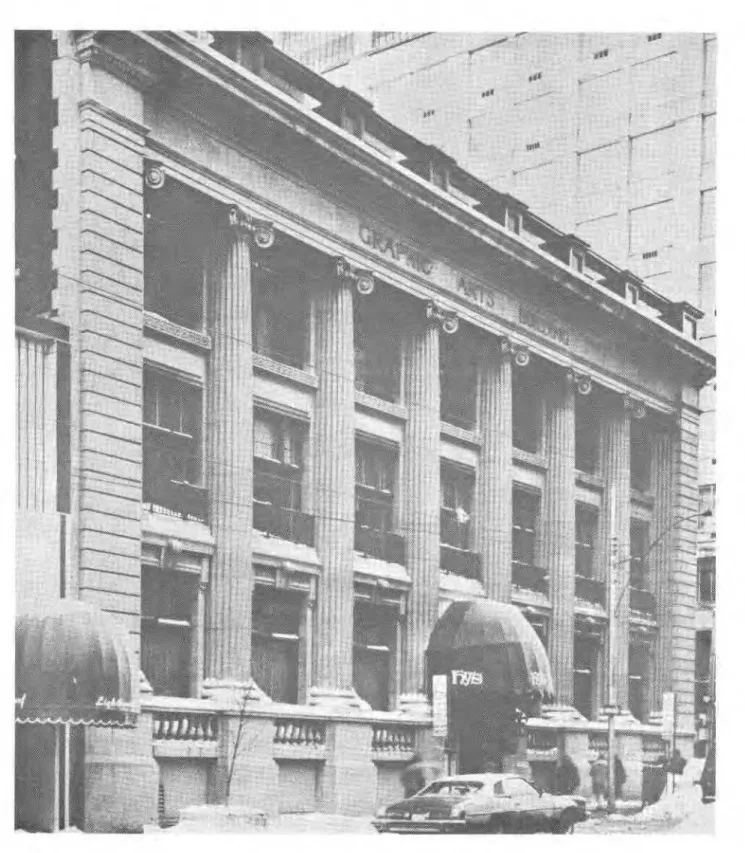
described and p i c t u r e d i n a 1916 issue of C O ~ C ~ - e t e magazine14, i n c l u d e the Graphic A r t s B u i l d i n g (Figure 4) a t Richmond and Sheppard Streets, housing t h e pub1 is h e r s o f Saturday f i g h t and G r i p magazines. The balustrade over t h e cornice now lacks i t s balusters, probably f a i l e d from weathering; t h i s has a l s o cracked b a l u s t e r s e l sewhere i n t h e b u i l d i n g . A second example,
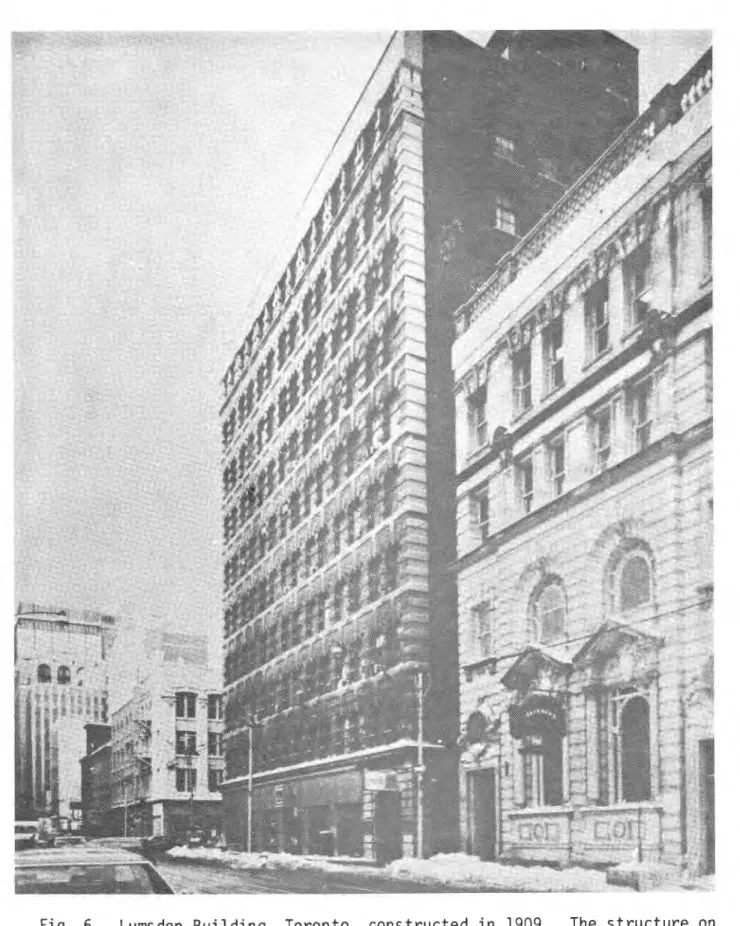
S t . Paul ' s Church (Figure 5 ) on Bl o o r S t . E., designed by E. J. Lennox and opened i n 1913, has Roman Stone as a t r i m f o r t h e e x t e r i o r stone masonry as we1 1 as f o r i n t e r i o r use. An a r c h i t e c t u r a l feature o f the b u i l d i n g i s a rose window 27 f e e t i n diameter o f Roman Stone t r a c e r y . The t h i r d example, t h e ten-storey s t e e l -frame Lumsden Bui l d i n g (Figure 6) a t Yonge and Adel aide Streets, designed by J.A. Mackenzie and constructed i n 190916, ill u s t r a t e s t h e use of Roman Stone i n e a r l y h i g h - r i s e construction. Except f o r t h e ground f l o o r where g r a n i t e was used, i t s s t r e e t - f a c i n g w a l l s were f i n i s h e d w i t h Roman Stone c a r r i e d on the s t e e l frame a t each f l o o r and backed w i t h hard b r i c k , which was i t s e l f 1 in e d w i t h porous hollow b r i c k . The o t h e r w a l l s were faced i n b r i c k .
A1 though no c o n f i r m a t i o n has been obtained on the matter, i t appears probable t h a t s t i 11 another appl i c a t i o n o f Roman Stone was contempl ated when t h e p r e s i d e n t o f t h e Roman Stone Company, m i l l i o n a i r e (and l a t e r , S i r ) Henry M. P e l l a t t , had plans drawn by E. J. ~ e n n o x fo r h i s famous residence, t h e 98-room "Casa Loma," a p r o j e c t t h a t was completed i n 1913. Decl i ne o f Roman Stone
The extensive use o f Roman Stone i n the decade f o l l o w i n g the s t a r t o f i t s manufacture apparently d i d n o t continue a f t e r t h e F i r s t World War, perhaps as a r e s u l t o f t h e economic e f f e c t s o f t h e war. Changes i n a r c h i t e c t u r a l s t y l e , which reduced t h e demand f o r h i g h l y decorative and e l a b o r a t e ornamentation, probably affected t h e market f o r t h e products o f the Roman Stone Company, as would have t h e competition from o t h e r firms, n o t a b l y the Canadian Benedict Stone Ltd. o f Montre 1, manufacturers of Benedi c t Stone, a product a l s o c a s t i n sand moulds77. Many examples o f t h e use o f t h i s m a t e r i a l d u r i n g the 1920's are given i n The Contractor; they i n c l u d e T r i n i t y College School, P o r t Hope, t h e Caron and Keefer B u i l d i n g s i n Montreal, and Acadia U n i v e r s i t y , W o l f v i l l e , Nova ~ c o t i a l 8 . Concl us i on
Roman Stone provided Canadian a r c h i t e c t s and b u i 1 ders w i t h a h i g h l y decorative a r t i f i c i a l stone t h a t was e x t e n s i v e l y used i n t h e f i r s t decade o f t h i s century. O f t h e many b u i l d i n g s i n which Roman Stone was employed, a t l e a s t two have been demolished, whether from obsolescence, "redevelop- ment," o r advanced weathering decay o f t h e m a t e r i a l
.
Another has beenI
I
I
I
Fig. 6 Lumsden B u i l d i n g , Toronto, c o n s t r u c t e d i n 1909. The s t r u c t u r e on
t h e r i g h t i s t h e B i rkbeck B u i l d i n g , c o n s t r u c t e d from a r t i f i c i a 1
a l t e r e d from i t s o r i g i n a l design as a r e s u l t o f enlargement and p o s s i b l y a l s o because of t h e decay o f p a r t s t h a t were f r e e l y exposed t o t h e
weather.
The b u i l d i n g s o f Roman Stone t h a t stand, whether i n t h e o r i g i n a l o r a1 t e r e d c o n d i t i o n , provide examples n o t o n l y o f t h e e a r l y a p p l i c a t i o n 3f
decorative a r t i f i c i a l stone t o Canadian b u i l d i n g , b u t a l s o o f an i m p o r t a n t t e c h n i c a l i n n o v a t i o n i n the manufacture o f concrete. I n a d d i t i o n , they provide a g l impse o f t h e a r c h i t e c t u r a l s t y l e s important t o Canadian b u i 1 ders and a r c h i t e c t s o f a ha1 f - c e n t u r y ago.
I
I
Footnotes1 H.C. Badder, "The i n v e n t i o n and e a r l y development of P o r t l a n d Cement,"
Concrete, Vol
,
25, NO. 4, Oct. 1924.I
2 Patents of Canada from 1824 t o 1849, Love1 1 and Gibson, Toronto, 1860.3 Canada a t the U n i v e r s a l E x h i b i t i o n of 1855, Toronto, John Love1 1,
1856.
4 Patent No. 449, 1854; Patents of Canada from 1849 t o 1855, Love1 1 and Gibson
,
Toronto, 1865.5 "Experiments on concrete made a t McGill University," Cmadian
Engineer, Vo1. I V , NO. 8, Dec. 1896, p'. 221.
6 W i l l e t G. M i l l e r , ~ i m e s t o n e s of Ontario, Report of t h e Bureau of Mines (Ontario), Vol. X I I I , P a r t 11, 1904.
7 I b i d , P a r t 1 of k p o r t , S t a t i s t i c a l Review, p . 14.
8 H.P. G i l l e t t e and C.S. H i l l , Concrete constructionmethods and cost,
New York, Clark P u b l i s h i n g Co., 1908, pp. 644-646.
9 Char1 es D. Watson, "Decorative cement products,
"
Canadian A r c h i t e c t and B u i l d e r ,V Q ~
.
X V I I , No. 193, Jan. 1904, pp. 19-21.10 " O f f i c e b u i l d i n g of t h e Imperial Trusts Co," Canadian Cement and Concrete R e v i m , Vo1
.
3, No. 2, Feb.
1909.11 "The Toronto fire," Canadiun A r c h i t e c t and B u i l d e r , Val
.
X V I I,No. 197, May 1904.
12 Charles D. Watson, "Report o f t h e Comni t t e e on A r t and Architecture," National Association o f Cement Users, Proceedings, Vo1. I I I, 1907. 13 Canadian A r c h i t e c t and B u i l d e r , June 1906.
14 Canadian Architect and Builder, Feb
.
1906.15 Concrete, Vol. 9, No. 6 , December 1916, p p . 186-188.
16 "The Lumsden Bui 1 di ng
,
Toront o ,
"
Canadian Cement and Concrete Review, Vol. 3, No. 12, Dec. 1909.17 J . C1