Proceedings of IFAC '87, Munich, Germany, July 1987, Pergamon Press, Oxford, England
Distributed Asynchronous Relaxation Methods
for Linear Network Flow Problems*
by
Dimitri P. Bertsekas and Jonathan Eckstein Laboratory for Information and Decision Systems
and Operations Research Center Massachusetts Institute of Technology
Cambridge, Mass. 02139
The dual function value q(p) at a vector p is obtained by
Abstract minimizing L(f, p) over all f satisfying the capacity constraints
(2). This leads to the dual problem We propose a new, massively parallelizable algorithm for
the minimum cost network flow problem. We formulate a dual maximize q(p) (4)
problem which is unconstrained, piecewise linear, and involves
a dual variable for each node. Our algorithm solves the dual by subject to no constraint on p, an approach resembling a Gauss-Seidel relaxation method. At
each iteration a single node is chosen, and its dual variable and with the dual functional q given by its incident arc flows are changed in an attempt to improve the
dual cost. In a distributed implementation, each node is a q(p) = minf(L(f, p) I bij < fji ci. (i, j) E A) processor adjusting its own dual variable on the basis of local
information communicated by adjacent nodes. We show finite = A qij(pi - Pj) - ,e N siPi ((ij)E (5a) convergence of a totally asynchronous (chaotic), distributed
version of the algorithm whereby some processors compute where faster than others, some processors communicate faster than
others, and there can be arbitrarily large communication delays. qij(pi-Pj) = min {(aij + pj -Pi)fi I b3j fi cCi (5b)
A scaled version of the algorithm is shown to have fi
O(N31og(NC)) sequential complexity, where N is the number
of nodes and C the maximum absolute value of the arc costs. The function qii is shown in Fig. 1. This formulation of the This bound is competitive with the best bounds for existing dual problem ilsconsistent with
sequential methods. These methods, however, are not well suited for distributed implementation.
Key Words: Network flows; relaxation; distributed Primal
algorithms; complexity; asynchronous algorithms. for arc
*Supported by Grant NSF-ECS-8217668. Thanks are due to (ij) Paul Tseng for his helpful comments.
1. Introduction
Consider a directed graph with set of nodes N and set of
arcs A. Each arc (i, j) has associated with it an integer aiI slope aij
referred to as the cost coeficient of (i, j). Let fii be the flIw of
the arc (i, j), and consider the classical min cost flow problem - .
([17], Ch.7) bij C f i
minimize (ij)EA aijfij (MCF)
Dual
subject to cost
Z(ji)EA fji (iJeA f s V i N (1)
for
arcj)
bij 5 fi r cij 'V (i, j) E A, (2) slope - b
where ai, b, cii and si, are given integers. We assume
throughSut that there exists at most one arc in each direction between any pair of nodes, but this assumption is made for notational convenience and can be easily dispensed with. The
numbers of nodes and arcs are denoted N and A respectively. a _
We first formulate a dual problem associated with (MCF) slope - c
Pi
by associating a Lagrange multiplier pi with the ith
conservation of flow constraint (1). By denoting by f and p the vectors with elements f-i, (i, j) e A, and pi, i e N
respectively, we can write the corresponding Lagrangian
function as Figure 1: Primal and dual costs for arc (i, j).
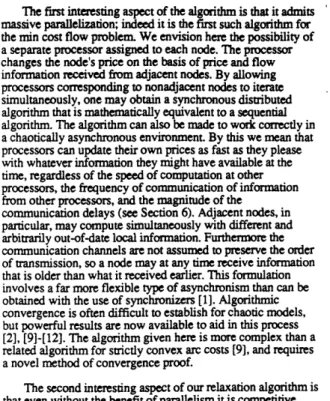
classical duality frameworks [18], but can also be obtained via The first interesting aspect of the algorithm is that it admits linear programming duality theory [16], [17]. We henceforth massive parallelization; indeed it is the first such algorithm for refer to (MCF) as the primal problem, and note that, based on the min cost flow problem. We envision here the possibility of
standard duality results, the optimal primal cost equals the a separate processor assigned to each node. The processor optimal dual cost. The dual variable Pi will be referred to as the changes the node's price on the basis of price and flow
price of node i. information received from adjacent nodes. By allowing processors corresponding to nonadjacent nodes to iterate The form of the dual cost (5) motivates solution by simultaneously, one may obtain a synchronous distributed Gauss-Seidel relaxation (or coordinate ascent methods). A algorithm that is mathematically equivalent to a sequential number of methods of this type have been developed recently, algorithm. The algorithm can also be made to work correctly in and have led to remarkably successful computer codes [5], [7], a chaotically asynchronous environment. By this we mean that [8], [19]. The idea is to choose a single node i and change its processors can update their own prices as fast as they please price pi in a direction of improvement of the dual cost, while with whatever information they might have available at the keeping the other prices unchanged. Unfortunately there is a time, regardless of the speed of computation at other fundamental difficulty; the dual cost q is piecewise linear, and processors, the frequency of communication of information the relaxation idea may encounter difficulty at some "corner from other processors, and the magnitude of the
points" as illustrated in Fig. 2. The problem is that there are communication delays (see Section 6). Adjacent nodes, in nonoptimal price vectors at which the dual cost cannot be particular, may compute simultaneously with different and improved by changing any single node price, arbitrarily out-of-date local information. Furthermore the
communication channels are not assumed to preserve the order The main idea of this paper is to allow single node price of transmission, so a node may at any time receive information changes even if these worsen the dual cost. The rationale is that that is older than what it received earlier. This formulation if the cost deterioration is small, then the algorithm can involves a far more flexible type of asynchronism than can be eventually approach the optimal solution (see Fig. 3). Indeed obtained with the use of synchronizers [1]. Algorithmic we will show that not only this is so, but in fact an exact convergence is often difficult to establish for chaotic models, solution of the problem can be obtained in afinite (indeed, a but powerful results are now available to aid in this process
priori bounded) number of iterations owing to the integer [2], [9]-112]. The algorithm given here is more complex than a nature of the problem data. As will be discussed in Section 3, a related algorithm for strictly convex arc costs [9], and requires key idea is that each price change improves the dual function of a novel method of convergence proof.
a perturbed problem where some of the arc cost coefficients are
modified by a "small" amount e. Implementation of this idea is The second interesting aspect of our relaxation algorithm is based on the notion of e-complementary slackness first used in that even without the benefit of parallelism it is competitive
[4], and more formally introduced in [7] and [8]. The with the alternatives for some classes of problems. An example corresponding algorithm was first proposed in Sept. 1986 and is the max-flow problem for which an O(N3) worst case published in [3]. Special cases of this algorithm for the complexity is proved (see Section 5). When applied to this
assignment problem date to 1979; see [4], [6]. problem in a special way the algorithm resembles a max-flow algorithm developed (without reference to duality or e-complementary slackness) in [ 14]. The latter algorithm is
nP Isomewhat more complicated than ours in that it requires two
2 A separate phases to obtain an optimal primal solution; ours
requires only one, and furthermore admits a simpler proof of the complexity bound. Our algorithm also allows arbitrary initial node prices (this is useful in sensitivity studies involving reoptimization); in tl4] the initial prices are in effect required to
be zero. For general min cost flow problems the relaxation algorithm is pseudopolynomial, being sensitive to the arc cost coefficients.
Surfaces An important contribution of the present paper is a new of
equal
version of the main min cost flow algorithm that uses cost dual cost scaling. The worst case complexity of the scaled version isO(N31og(NC)), where C is the largest absolute value of the arc costs. This bound is better than any bound that has been obtained up to now for min-cost flow problems using simply P1 implementable algorithms that do not employ complex data
structures. It is likely that the bound can be somewhat improved for sparse networks through the use of sophisticated Figure 2: At the indicatd point, it is impossible to data structures such as dynamic trees, but we have not pursued improve the cost by changing any single price. the matter further. A result of this type has been claimed in [15]
for a scheme that embeds our main algorithm in a different scaling procedure. The practical performance of the algorithms of this paper is currently being evaluated.
P2 i / - | 2. Optimality Conditions and
e-Complementary Slackness
The necessary and sufficient conditions for a pair (f, p) to be an optimal primal and dual solution pair are primal feasibility and complementary slackness. To state these conditions, we / / C Zurfaces first introduce some terminology. For any price vector p we of equal say that an arc (i, j) is
- dual cost
Inactive if i <aij +Pj (6a)
eP Balanced if Pi = aij +Pj (6b)
Figure 3: By making small changes in the coordinate Active if pi > aj + pj (6c)
directions, it is possible to approach the optimal
solution even if each step does not result in a dual cost For any flow vector f and node i the scalar
improvement. The method eventually stays in a small
neighborhood of the optimal solution.
gi = ji)EA fji ' (ij)EA fij - Si
7is called the surplus of node i. It represents the difference of
total flow imported and total flow exported by the node. 3. Sequential Versions of the Algorithm
The primal feasibility and complementary slackness The pure form of the algorithm, first proposed in [3], uses conditions for a vector pair (f, p) are: a fixed value of e > 0, and starts with any pair (f, p) satisfying
i-CS. A possible starting procedure is to arbitrarily choose the
gi' =°. for all i E N (8a) vectorp,andtoset f = bif(i, j) is inactive or balanced, and
fii =cii otherwise. ite flnow vector f is taken integer initially, fij =bij, for all inactive arcs (i, j) (8b) a'd the algorithm preserves the integrality of f throughout. At
the start of each iteration a node i with positive surplus gi is bij fij - cij, - for all balanced arcs (i, j) (8c) chosen. (If all nodes have zero surplus the algorithm
terminates; then f is primal feasible and, together with p, fij = ci., for all active arcs (i, j). (8d) satisfies c-CS.) At the end of the iteration, the surplus gi is
driven to zero, while another pair (f, p) satisfying E-CS is For any price vector p, and E£ O we say that an arc (i, j) is obtained. During an iteration, all node prices stay unchanged
except possibly for the price of the chosen node i. Similarly all e-Inactive if i <aij +pj - (9a) arc flows stay unchanged except for the flows of some of the
arcs incident to node i. As a result of these flow changes, the e--Balanced if Pi =aij +
Pj - 9b) surplus of some of the nodes adjacent to i is increased.
e-Balanced if aij + pj - < Pi <
aij + Pj + (9c) Positive Surplus Node Iteration (or Up Iteration): e+-Balanced if Pi =aij +P + (9d) Let (f, p) satisfy e-CS, and let i be a node with gi>
0. £-Active if Pi > aij + Pi + e (9e) Step 1: (Scan incident arc) Select a node j such that (i, j) is an
e+-unblocked arc and go to Step 2, or select a node j such that An £-- balanced arc for which b.- < fi is called c- unblocked; (j, i) is an e-unblocked arc and go to Step 3. If no such node an e+- balanced arc for which' f.< c i is called e+
- unblocked. can be found go to Step 4. Given e 2 O we say that a vecto"pair(f, p) satisfies
e-complementary slackness (e-CS for short) if for each arc (i, j) Step 2: (Decrease surplus by increasing fij) Set
fij = bij if (i, j) is e-inactive (10a) fij := fij + 6
bijl fij cij if (i, j) is e-balanced (10b) gi:= gi -8, gj := gj +
fij = Cij if (i, j) is e-active (1c) where 8= min{gi, cij - fij}. If gi = 0 stop; else go to Step 1. An equivalent statement of the e-CS conditions is that the flows Step 3: (Decrease surplus by reducing fji) Set
fij satisfy the capacity constraints (2), and that := fj 8 fij <cij X Pi - Pj ' aij +
E (10d) gi:= gi g := g +
gi :=gi-8, gj:=gj+8
bij < fij pi -pj > aij -e (10e) where 8 = mingi, fji - bji). If gi = 0 stop; else go to Step 1. The algorithm described in the next section maintains at all
times a price vector p and an integer flow vector f satisfying e-CS. It terminates when the flow vector f satisfies the primal
feasibility condition gi = 0 for all i e N. A key fact is that ife Pi:=in {Pj aij + e I (i,j) E A and fij <
cij),
is sufficiently small then the final flow vector f is optimal. A and b
{pj
- aji+
I 0, i) e A and bji < fji)} (12) Proposition 1: If e < 1/N and the flow vector f together Go to Step 1. (Note: If the set over which the minimum in (12) with the price vector p satisfy c-CS and primal feasibility (gi = is taken is empty, the problem is infeasible and the algorithm 0 for all i E N ), then f is optimal for (MCF). terminates - see the comments below.)Proof: If f is not optimal then there must exist a simple T t
directed cycle along which flow can be increased while the To see that (12) leads to a price increase note that when primal cost is improved. Let Y+ and Y' be the sets of arcs of ep we have
the cycle that are positively and negatively oriented,
respectively. Then we must have fi = all (i, ) such
(ij)Ey+ aUj - £(ij)e aij< (11) bji=fji for all (j, i) such thatpi >
pji- aji + e.
fii <cij for (i, D) + Therefore, when Step 4 is entered we have
bij < fij for (i, j)e Y. pi < min(pj + aij +e I (i,j) A and fii <cij
By using (lOd-e), we have Pi < min(pj -aji + I (j, i) e A and bji < fji}
+ilp:+aijE for (ij) Y+ It follows that pi must be increased via (12). Another issue is Pi < pj + aij + c for (i, D) Y that, for Step 4 to be well defined, we must exclude the case
where fi = ci- for all (i, j) outgoing from i, and bi- = fli for all pj S Pi - aij + e for (i Ie ,(j,D i) incominA to i. In this case, maximal flow is going out of i
while minimal flow is coming in, and since we have gi >
0 which by adding and using the hypothesis e < 1/N yields when Step 4 is executed, it follows that the problem must be
infeasible. Therefore, when the minimum in Step 4 is taken
(i j)eY+ aij - ';(ij)Ey· aij 2 - £ > -. * over an empty set, we can terminate the algorithm with an indication that the problem is infeasible.
Since the aij are integer, we obtain a contradiction of (11).
Q. E. D. It is possible to show that, at the end of the iteration, the
price of the node i equals c plus the smallest value that maximizes the dual cost with respect to Pi with all other prices kept fixed. This can be done by calculating the directional derivatives of the dual cost along the coordinate directions
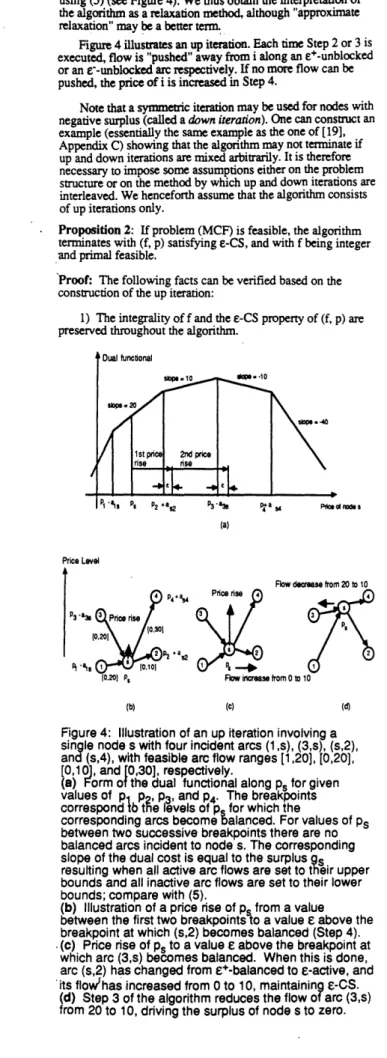
using (5) (see Figure 4). We thus obtain the interpretation of
the algorithm as a relaxation method, although "approximate 2) The prices of all nodes ar monotonically
relaxation" may be a better term. nondecrasing during the algorithm.
Figure 4 illustrates an up iteration. Each time Step 2 or 3 is 3) Once a node gets nonnegative surplus, its surplus stays executed, flow is "pushed" away from i along an e+-unblocked nonnegative thereafter. (This follows from the fact that an up or an e-unblocked arc respectively. If no more flow can be iteration at some node i cannot drive the surplus of i below pushed, the price of i is increased in Step 4. zero, and can only increase the surplus of adjacent nodes.) Note that a symmetric iteration may be used for nodes with 4) If at some time a node has negative surplus it must negative surplus (called a down iteration). One can construct an never have been iterated upon up to that time, and therefore its example (essentially the same example as the one of [19], price must be equal to its initial price. (This a consequence of Appendix C) showing that the algorithm may not terminate if 3) above and the fact that only nodes with positive surplus are up and down iterations are mixed arbitrarily. It is therefore iterated upon by up iterations.)
necessary to impose some assumptions either on the problem
structure or on the method by which up and down iterations are Based on 2) above there are two possibilities; either a) the interleaved. We henceforth assume that the algorithm consists prices of a nonempty subset No of N diverge to +o, or else
of up iterations only. b) the prices of all nodes in N stay bounded from above.
Proposition 2: If problem (MCF) is feasible, the algorithm Suppose that case a) holds. Then, since N- is nonempty, terminates with (f, p) satisfying e-CS, and with f being integer it follows that the algorithm never terminates, implying that at
and primal feasible. all times there must exist a node with negative surplus which,
by 4) above, must have a constant price. It follows that N- is a Proof: The following facts can be verified based on the strict subset of N. To preserve e-CS, we must have after a
construction of the up iteration: sufficient number of iterations
1) The integrality of f and the £-CS property of (f, p) are fij =cij for all (i,j)e A with i N,je N-preserved throughout the algorithm.
fji =bji for all (j, i) e A with i E No, j ~ N °
Dual functiobI
while the sum of surpluses of the nodes in No is positive. This means that even with as much flow as arc capacities allow coming out of N" to nodes j e N", and as little flow as arc
~Skpa./0
I
I
I\
capacities allow coming into No from nodes j e N-, the total/ slope--40 , \ surplus
£({gi
Ii e No}of nodes in N- is positive. It follows that there is no feasible flow vector, contradicting the hypothesis. Therefore case b) holds (all prices of nodes in N/ 1st pic
aid
2pric'me \ stay bounded).
We now show by contradiction that the algorithm terminates. If that were not so, then there must exist a node
P1 , P - P34 Pta i e N at which an infinite number of iterations are executed. s1.4r P1S P366 2 PZ4~~ PtS s4 Cadn~s There must also exist an adjacent e'-balanced arc (j, i), or
(a) e+-balanced arc (i, j) whose flow is decreased or increased
(respectively) by an integer amount during an infinite number of iterations. For this to happen, the flow of (j, i) or (i, j) must
Price Level be increased or decreased (respectively) an infinite number of
times due to iterations at the adjacent node j. This implies that
Flow decrease from 20 to 10 the arc (j, i) or (i, j) must become e+-balanced or £e-balanced
Pn+~:c p4 s from e-balanced or e+-balanced (respectively) an infinite
P3 3 rice rise number of times. For this to happen, the price of the adjacent
\ 30)1 /1° \ / / P. \node j must be increased by at least 2£ an infinite number of
1 020) \ / \ It follows that p.ioo which contradicts the/ / \,,times.
P2 +a
A)
boundedness of all noed prices shown earlier. Therefore the4 S42 lo(l
dalgorithm
must terminate. Q.E.D.[0,20l P, Flow inmcrase from 0 10
Note that Proposition 2 holds for all e > O0. If e < 1/N,
(b) (C) (d) however, we see, by combining Propositions 1 and 2, that the
algorithm terminates with an optimal flow vector. Note also that the integrality of ai- was not needed for the proof of
Figure 4: Illustration of an up iteration involving a Proposition 2, while th' integrality of bi, ci, s, and the
single node s with four incident arcs (1 ,s), (3,s), (s,2), starting flow vector were only needed to estblish that the flow
and (s,4), with feasible arc flow ranges [1,20], 10,20], change increments are bounded from below during the course 0, 1 0], and [0,30], respectively. of the algorithm. The integrality assumptions are essential,
(a) Form of the dual functional along ps for given however, for the complexity analysis of the next section.
values of pi p,, p3, and p4. The breakpoints
correspond tb the levels of p for which the Proposition 2 applies without modification to the variation
corresponding arcs become balanced. For values of Ps of the algorithm where up iterations are not necessarily carried
between two successive breakpoints there are no to completion. In this variation, it is permissible to execute balanced arcs incident to node s. The corresponding only partial up iterations, in which the algorithm may select a
slope of the dual cost is equal to the surplus gs new node for iteration immediately following the completion of
resulting when all active arc flows are set to their upper any Step 2, 3, or 4, even if the current node surplus is not yet
bounds and all inactive arc flows are set to their lower zero.
bounds; compare with (5).
(b) Illustration of a price rise of p5from a value In other types of relaxation methods for network flow
between the first two breakpoints to a value E above the problems [5], [7], [8], a price change never degrades the dual
breakpoint at which (s,2) becomes balanced (Step 4). cost. This is not true for the price changes effected in Step 4 of ·(c) Price rise of ps to a value e above the breakpoint at the up iteration. However, there is still an interesting
which arc (3,s) becomes balanced. When this is done, interpretation of Step 4 as a dual cost improvement. It can be
arc (s,2) has changed from £+-balanced to e-active, and shown by calculating the directional derivative of the dual cost its flowvhas increased from 0 to 10, maintaining e-CS. in the direction of any single price change (or by using results
(d) Step 3 of the algorithm reduces the flow of arc (3,s) of [5], [7]), that price changes in Step 4 yield a dual cost
coefficients of some e-balanced arcs are changed by e to make at2 ° them balanced. In effect, the algorithm improves, with each
price change, a slightly perturbed dual cost and ends up with a range fr as:
slightly suboptimal dual solution. The corresponding primal Arc (1,2): [0,2]
solution, however, is optimal thanks to the rounding 13 c Arc (2,3): 1C,1]
introduced by the integer nature of the problem data. Arc (3,1):
[0,1
A final issue has to do with detection of infeasibility. By
using the argument of the proof of Proposition 2, it follows (a) Prolm Data
that for an infeasible problem the prices of some nodes diverge to A. In Section 5 we derive a precomputable upper bound for the prices when the problem is feasible [cf. (26)]. Once this
bound is exceeded, we know that the problem is infeasible. P=0 1
p0
pThe Scaled Version of the Algorithm pQ PI
The running time of the method just described is sensitive
to the arc cost coefficients, as illustrated in Figure 5. It is )
therefore natural to consider cost scaling procedures [20] - [23] p.O p=O
in which one solves a sequence of approximations to the
original problem ("subproblems"), gradually increasing the (b) Initial flows and prices (c) Fows and prices after lst
accuracy of the input data. iteration at node 1
Consider the problem (SMCF) obtained from (MCF) by
multiplying all arc costs by N+I, that is, the problem with arc ptI f -0 p=2tE f cost coefficients
aij'= (N+l)aij for all (i, j). f, fO f=O
If the pair (f ', p') satisfies 1-CS (namely e-CS with e = 1)
with respect to (SMCF), then clearly the pair P0
(f, p)=(f', p/(N+I)) (d) Flows and prices after 2nd (e) Flows and prices after 3rd
iteration at node 2 iteration at node 1 satisfies (N+Il)-l-CS with respect to (MCF), and hence f' is
optimal for (MCF) by Proposition 1. In the scaled algorithm, Figure 5: Example showing that the computation we seek a 1-CS solution to (SMCF). required by the pure form of the algorithm can be
proportional to the cost-dependent factor C. Here, up
Let iterations at node 1 alternate with up iterations at node
2 until the time when pi rises to the level C-1 +e and arc
C max(ij)eAlaijl (13) (3,1) becomes C-balanced, so that a unit of flow can be
pushed back along that arc. At this time, the optimal M = Llog2(N+I)CJ + 1 = O(log(NC)) . (14) solution is obtained. Since prices rise by increments of
no more than 2E, the number of up iterations is Q(C/e).
In the scaled algorithm we solve M subroblems. The mth subproblem is a minimum cost flow problem where the cost coefficient of each arc (i, j) is
aij(m) = Trunc( aij'/ (2M -m) ), (15) is obtained from ft(m) by setting
where Trunc( * ) denotes integer rounding in the direction of f0ij(m+l) = ftij(m) for all balanced arcs (i, j), zero, that is, down for positive and up for negative numbers.
Note that aii(m) is the integer consisting of the m most fij(m+l) = cij for all active arcs (i, j), significant bits in the M-bit binary representation of ai'.. In
particular each a;i(l) is 0, +1, or -1, while a;i(m+l) is obtained fij(m+1) = bij for all inactive arcs (i, j). by doubling aii(An) and adding (subtracting) 6ne if the (m+l)st
bit of the M-bit representation of aij' is a one and aij' is positive Note that this implies that there will be no 1+ - unblocked and
(negative). Note also that 1- - unblocked arcs initially for the rm+l)st problem, and this
turns out to be significant for the complexity analysis of the
aij(M) = aij', next section.
so the last problem of the sequence is (SMCF).
4. Complexity Analysis For each subproblem, we apply the unscaled version of the
algorithm with C = 1, yielding upon termination a pair (ft(m), We derive worst-case complexity bounds for two pt(m)) satisfying 1-CS with respect to the cost coefficients algorithms. The first is the unscaled algorithm where the cost
aiN(m). coefficients are fixed at their given values. We refer to this as
the pureform of the algorithm to distinguish it from the scaled
The starting price vector for the (m+l)st problem (m = 1, form of the algorithm, which is the pure form embedded in the
2 . ., M-1) is scaling procedure just described. Our analysis assumes that:
p0(m+1) = 2pt(m). (16) (a) There exists at least one feasible solution of (MCF).
Doubling pt(m) as above roughly maintains complementary (b) All arc cost coefficients are integer multiples of e. slackness since ai(m) is roughly doubled when passing to the
(m+l)st problem.Indeed it can be seen that every arc that was (C) All starting prices are integer multiples of C, all 1 - balanced (1 - active, 1 - inactive) upon termination of the starting flows are integer, and together they satisfy e-CS. algorithoi for the mth problem will be 3 - balanced (1 - active, Furthermore, initially there are no e+-unblocked or 1 - inactive, respectively) at the start of the (m+l)st problem. ec-unblocked arcs. (Note that these conditions hold for all
subproblems of the scaled form of the algorithm, provided that The starting flow vector f0(m+l) for the (m+l)st problem they hold for the original pair (f0(1), p0(1)).)
(d) For the scaled algorithm only, the starting price In order to get the sharpest possible complexity bounds we differentials for the first subproblem (p i(l) - puj(l) ) are 0(1) need a restriction in the way the algoithms are opated. We
for all arcs (i, j). introduce an order for choosing nodes in iterations. A cycle is a
set of iterations whereby all nodes are chosen once in a given (e) A special procedure -- to be described shortly -- is order, and an up iteration is executed at each node having used to select the nodes on which up iterations are performed. positive surplus at the time its turn comes. The order in which
nodes are taken up may change from one cycle to the next. This To simplify the subsequent presentation we introduce some node order is maintained in a linked list that is traversed from notation and terminology. For any path H we denote by s(H) its first to last element in each cycle. Each time a node i changes and t(H) the start and end nodes of H, respectively, and by H+ price as a result of its up iteration within a cycle, node i is and H- the sets of arcs that are positively and negatively removed from its present list position, and is placed in the first oriented, respectively, as the path is traversed in the direction list position. (This does not change the order in which the from s(H) to t(H). We call a path simple if it is not a circuit and remaining nodes are taken up in the current cycle; only the has no repeated nodes. For any price vector p and simple path order for the subsequent cycle is affected.) The initial list is
H we define arbitrary.
dH(p) = max(O, 5(iJ. H+ (Pi -Pj - aij) -1(iJ)EH-(Pi -Pj-aij)) In the next section we will prove the following proposition:
= max{O, Ps(H -t() ' ij)E +ai + (ij)e H aij) (17) Proposition 3: Under Assumptions (a) - (e) the complexity of the pure form of the algorithm opelated in cycles as described above is bounded by O(N2([B(pO)/E + N)), where p0 Note that the second term in the maximum above may be described above is bounded by 0ctp N, whr p viewed as a "reduced cost length of H" being the sum of the
reduced costs (Pi - p. - aii) over all arcs (i, j)e H+minus the
An upper bound for O(p) is given by (N-1)C + p+ - p-sum of (Pi - pi - ai) over all arcs (i, j)e H-. For any flow where
vector f satisfying the capacity constraints (2) we say that a
simple path H is unblocked with respect tof if we have fij < cij+ = maxIp° I is N (21)
for all arcs (i, j) e H+, and we have f.i > b. for all arcs (21)
(i, j) e H-. In words, H is unblocked Wbith iespect to f if there p. = min 0 I isN). (22) is margin for sending positive flow along H (in addition to f) =m in
from s(H) to t(H) without violating the capacity constraints. Assuming that p+ -p- = 0(1), we obtain the complexity bound O(N3C). The algorithm is indeed sensitive to C as shown in the For any price vector p, and flow vector f satisfying both example of Figure 5. The example of Figure 6 demonstrates the conservation of flow and the capacity constraints (1) and that assumption (c) concerning the initial conditions is
(2) denote necessary, for otherwise a factor relating to the arc flow
bounds must be included in the complexity estimate. D(p, f) -- max(dH(p) I H is a simple unblocked (18)
For classes of problems with special structure a better path with respect to f}. estimate of B(pO) may be possible. As an example, consider the
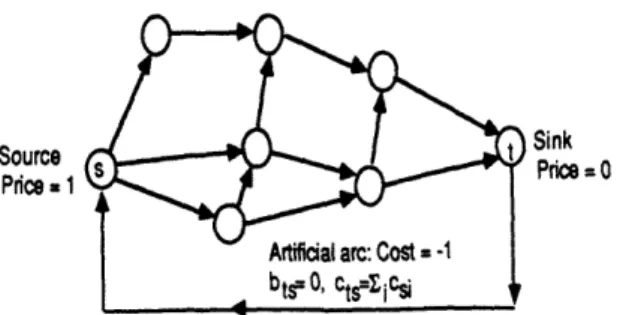
max-flow problem formulation shown in Figure 7. The In the exceptional case where there is no simple unblocked path artificial arc (t, s) connecting the sink t with the source s has with respect to f we define D(p, f) = O. In this case we must cost coefficient -1, and flow bounds bs = 0 and ct, = 1-c .
We assume a =0 and bii =0< cithat i e Tor all other ar& , have b. = c; for all (i, j) since any arc (,j) with b < c, gives Wea tha t 1 0 ai = andpb=Occ tForaxi algothmr wit
rise to one-arc unblocked path with respect to f.et cJ i and that si = forll i. We allly the iaxation algorithm with initial prices and arc flows satisfying e-C~, where e = 1/(N+l) 3(p) = min(D(p, f) I f satisfies constraints (1) and (2)) (19) and p+ - p' = 0(1). Then we obtain dT4(pu) - 0(1) for all paths
H, 3(p) = 0(1), and an O(N0 3) compIexity bound.
Since, for a given p, there are only a finite number of values Based on Proposition 3 and the fact , the complexity that D(p, f) can take it follows that the minimum in (19) is
actually attained by some f. The following lemma shows that of the scaled form of the algorithm is O(N2B + N3M) where
lB(p) provides a measure of suboptimality of the price vector p. B v' 0 (23)
The computational complexity estimate to be obtained shortly is B = m=l,...,M [m(P(m))
proportional to t(pO), where p0is the initial price vector. and 03(e) is defined by (17) - (19) but with the modified cost Lemma 1: (a) If there exists a flow vector f satisfying the coefficients aij(m) replacing ajj in (17). We will show that constraints (1), (2), and satisfying y-CS together with p for
some
y
2 0 then [3m(p0(m)) = O(N) for all m0 _ 13(p) < (N-l)y. (20)
(b) p is dual optimal if and only if 3(p) = O. s
Proof: (a) For each simple path H which is unblocked with 1
respect to f and has IHI arcs we have, by adding the y-CS Feas. Fbw Rum l
conditions given by (10d-e) along H and using (17), C 2 e w Few PM". -(0 ,R
dH(p) < IHly < (N- 1)y,
..-and the result follows from (18) ..-and (19).
Co- a. Flbw Rang. I0- .1
(b) If p is optimal then it satisfies complementary slackness Col. 2
together with some primal optimal vector f, so from (20) (with
y = 0) we obtain 3(p) = O. Conversely if 3(p) = O, then from R: Large Integer (19) we see that there must exist a primal feasible f such that 1l e=
D(p, f) = 0. Hence d4(p) = 0 for all unblocked simple paths H ~ 5
with respect to f. Applying this fact to single-arc paths H and
using the definition (17) we obtain thatf together with p satisfy Figure 6: Example showing that assumption (c) on the
complementary slackness. It follows that p and f satisfy all the initial conditions is essential for polynomial complexity.
optimaity conditions (8), and p is optimal. Q. E. D. Initially, we choose f=O, psO, which do satisfy 1-CS, but not (c). The algorithm will push one unit of flow R times around the cycle 2-3-2, implying Q(R) complexity.
.ps0- p0- (ij)H+ aij + "(ij)eH aij 5 * (24)
Also using E-CS we have p. + ai- Pi + e for all (i, j)E H+and p/ . p. +ai. +e for all (i, j)i H'. By adding these conditions
/Source Sink alongTH we obtain
Source
a1
Price
Price 21
U-ps
+ Pt t- +1(ij +H aij g(ij)W aij<
IHI £<
(N- )e (25)Artifitiall
arc: CoSt, -1 where IHI is the number of arcs of H. We have Ps0= Ps since the condition gs < 0 implies that the price of s has not yet bts4 0, Cts, iCsi changed. Therefore, by adding (24) and (25) we obtain
Figure 7: Formulation of the max-flow problem. pt pptO<+(N-I) (26)
throughout the algorithm for all nodes t with gt >O. Since all
thereby ) complexity bound. We obtaining an N3g(N the starting prices and arc cost coefficients are integer multiples thereby obta g an (Nlog(NC)) complexity bound. We of E, it follows that the size of a price increase is a positive note that the same bound has been claimed for a scheme that integer multiple of £, and we see from (26) that the number of embeds the pure form of the algorithm in a different scaling price increases of each node is 0(13/ + N). Q. E. D.
procedure [15]. However this bound has not been proved thus
far, and its correctness is unclear.far, and its correctness is unclear. Note that the price bound (26) ensures that an infeasible problem instance can be detected by checking whether the total Proposition 4: Under Assumptions (a) - (e), the complexity
Proposition 4: Under Assumptlons (a) - (e), the complexity price rise of any node exceeds a known upper bound to of the scaled form of the algorithm, operated in cycles as pc rise of any nade exceeds a known upper bound to described above, is bounded by O(N log(NC)).
We now proceed with the proof of Proposition 3. The
Proof: Since initially we have dominant computational requirements are:
pi -Pj= 0(1), aij(l)= 0(1) for all arcs (i, j), 1) The computation required for price increases in Step 4.
we obtain dH(p0(l)) = O(N) for all H, and IBl(p0(l)) = O(N). 2) The computation required for Steps 2 or 3 for which the We also have that the final flow vector ft(m) obtained from the flow of the corresponding arc is set to its upper or its lower m-th problem satisfies constraints (1) and (2), and together bound.
with p0(m+l) it may be easily seen to satisfy 3-CS. It follows
from Lemma l(a) that 3) The computation required for Steps 2 or 3 for which the
flow of the corresponding arc is set to a value strictly between
1m(pO(m+l)) < 3(N-1) = O(N) its upper and its lower bound.
and the result is obtained from (23) as discussed above. Since there are O(13/ + N) price increases for each node,
Q. E. D. the requirements in 1) above are O(A(13/ + N)) operations.
Whenever an arc flow is set to either the upper or the lower bound due to an iteration at one of the end nodes, it takes a
5. Proof of Proposition 3 price increase of at least 2e by the opposite end node before the
arc flow can change again. Therefore there are O(1/s + N) To economize on notation, we write
1
in place of 3(pO). steps 2 or 3 per arc for which the flow of the arc is set to itsWe first show the following: upper or lower bound, and the total requirements for 2) above
are O(A(3/s£ + N)) operations. Lemma 2: Under the conditions of Proposition 3, the number
of price increases at each node is O(3/se + N). There remains to estimate the computational requirements for 3) above. At this point we will use the fact that the Proof: Let f0be a flow vector attaining the minimum in the algorithm is operated in cycles with the node order in each definition (19) of 3(p0). To explain the main argument better cycle determined by a linked list that is restructured in the we assume that fo is the zero vector. This can be done without course of the algorithm as described earlier. We will loss of generality because we can transform the problem by demonstrate an O(N(3/s + N)) estimate for the number of replacing c;, b, fi. and si by c; -f.° b. -f. °, f.. -f. °and 0 cycles up to termination. Given this, the proof of Proposition 3
respectively. The ransformatin ds n chgethe 'surplus can be completed as follows: For each cycle there can be only of any node, and does not change the sequence of prices or one arc flow per node set to a value strictly between the upper flow increments generated by the algorithm. Let (f, p) be a and lower arc flow bound in Step 2 or 3. Therefore the total vector pair generated by the algorithm. If gt > 0 for some node number of operations required for these steps [cf. 3) above] is
t, there must exist a node s with g < 0 and a simple path H O(NZ(I3/ + N)). Adding the computational requirements for 1) with s(H) = s, t(H) = t, and such that fi > 0 for all (i, j) e H+ and 2) calculated earlier we obtain an O(N2(13/E + N)) + and fi. < 0 for all (i, j) e H-. (This folPows from the O(A(3/e + N)) or O(N2(5/e + N)) worst case complexity Confdrmal Realization Theorem, [18], p. 104. It can also be bound.
shown quickly from first principles: Take To= (t}, and given
Tk, define To show that the number of cycles up to termination is
Tk, define O(N(3/S + N)) we argue as follows: At any given stage in the
Tk+l = Tk T( I there is a node i e Tk, algorithm consider the subgraph G* = (N, A*) where an arc (i, j) belongs to A* if and only if it is possible to "push" flow and either an arc (i, j) such that fij < 0, from i to j according to the rules of the algorithm in Step 2 or 3.
In other words A* contains (i, j) whenever (i, j) e A and (i, j) or an arc (j, i) such that f > 0). is e+-unblocked, or (j, i) e A and (j, i) is Cs-unblocked. A node
"1 i is called a predecessor of node j if a directed path from i to j If none of the negative surplus nodes belongs to any of the sets exists in G*.
Tk, then the total surplus of the nodes in uTk is positive, while
the forward arcs of the cut separating uTk and its complement First, we claim that immediately following aprice rise at have nonnegative flow and the backward arcs have nonpositive nodej, the in-degree of j in G is 0, and hencej has no flow. This is a contradiction, showing that a node s with gs < predecessors. To see this, note that if (i, j) eA is E+-baanced and the aforementioned properties can be found.) safter the price change, it must have been E-active beforehand,
;r~~~~~~~~~~
~~~~and
hence fi; =c;-, implying that (i, j) is not in A*. TheThe conclusion is that the path H is unblocked with respect e--balanced ase
vs
similar, establishing the claim. We next to f0. Hence, from (18) we must have d 0@ ) D(p0, f0) =1B,
claim that G* is always acyclic. This is true initially becauseremove arcs from A*, so G* can acquire a cycle only
remove arcs from
A*,*°s~o
SG*
can acquire and3)
cycl only
pi(t),
pj(i, t), j e Fiu Bi, fj(i, t), j e Fi, fji(i, t), j E Bi,
immediately after a price rise at some node j, and the cycle must and accordingly changes include that node. But since j must then have in-degree 0, no
such cycle is possible. This establishes the second claim. p1(t), ff(i, t)
j
F1, fj(i, t),j
e Bi.Finally, we claim that the node list maintained by the algorithm
will always be compatible with the partial order induced by Event 3. Node i receives, from one or more adjacent G*, in the sense that every node will always appear in the list nodes j E Fi u B. a message containing the corsponding after all its predecessors. Again, this is initially true because prce and arc flo (pe(t'), f(, t')) (in the case j a E Fi), or A* starts out empty. Furthermore a flow change operation (p'), f (, t')) (in thJe casej B) stored at j at some earlier does not create new predecessor relationships, while after a
it
t't.
tiprice rise at some node i, i can have no predecessors and is
moved to the head of the list, before any possible descendants. Pj(t')< p(i t), This establishes the last claim.
node i discards the message and does nothing further. Let N+ be the set of nodes with positive sutplus that have Otherwise, node i stores the received value pn(t') in place of no predecessor with positive surplus, and let N" be the set of
nodes with nonpositive surplus that have no predecessor with i, t). In addition, if
j
F node i stores ) in place of positive surplus. Then, as long as no price increase takes place, ii t) ifall nodes in N°remain in NO, and execution of a complete up p(t) (t')+a and fj(j t)
<fi
(it) iteration at a node ie N+ moves i from N+ to NO. If no nodechanged price during a cycle, then all nodes of N+ will be and otherwise leaves f.(i, t) unchanged; in the case j E Bi,
added to NO by the end of the cycle, which implies that the node i stores f t') ipc of f(i t
)
algorithm terminates. Therefore there will be a node price
change during every cycle except possibly for the last cycle. P(t') p(t) + a and f i(j t) fji(i,t) Since the number of price increases per node is O([/e + N),
this leads to an estimate of a total of O(N([3/e + N)) cycles, and and otherwise leaves f..(i, t) unchanged. (Thus, in case of a an O(NW(P/e + N)) overall worst case complexity based on the balanced arc, the "tie" Ys broken in favor of the flow of the start argument given earlier. The proof is complete. node of the arc.)
6. The Distributed Asynchronous (Chaotic) Version Let Tibe the set of times for which an update by node i as
of the Algorithm in # 2 above is attempted, and let T'(j) be the set of times when
a message is received at i from j as in # 3 above. We assume In this section, we assume that each node i is a processor the following:
that updates its own price and incident arc flows, and
exchanges information with its "forward" adjacent nodes Assumption 1. Nodes never stop attempting to execute an up iteration, and receiving messages from all their adjacent
FPi= {j I (i, j) e A }, nodes, i.e., T' and T'(j) have an infinite number of elements for
all i and j E Fiq Bi .
and its "backward" adjacent nodes
Assumption 2. Old information is eventually purged
Bi = {j I (j, i) e A). from the system, i.e., given any time tk, there exists a time
The following distributed asynchronous implementation applies t > tk such that the time of generation of the price and flow to both the pure algorithm and to the subproblems of the scaled o exceived at any node after tm (i.e., the time t' in 3 method. The information available at node i for any time t is as
follows: Assumption 3. For each i, the initial arc flows f i(i, to),
~~pi~~(t):
of node~
The price j E Ftogether with pi(tf) and pj(i, tO), j e Fi, and f.ii(i, t0), j e Biare integer, and satisfy e-CS iu Bi .Furthermorepf(i, t): The price of node j e F u B there holds
communicated by j at some earlier time Pto) 2 Pj to) for all j e Fi u Bi
fij(i, t): The estimate of the flow of are (i, j), for allj i Fi
j e Fi, available at node i at time t
One possible set of initial conditions satisfying Assumption f, t):
The estimate of the flow of at (j, ), 3 but requiring very little cooperation between processors is j e Bi, available at nodei at time t pj(i, to) - oo for all i and j e Fi u Bi, fij(i, to)= cij and
gi(t): The estimate of the surplus of node i at - fii( to) = bj for all i and j Fi.
time t given by The choice of initial conditions in Assumption 3 guarantees
that for all t > to gi(t)= 0i)e A fji( i, t- (j)EA fji(, t) - si (27)
A more precise description of the algorithmic model is i pi(t) > p(j, t"), < for all j E Fiu B1, t" t (28)
possible, but for brevity we will keep our description To see this, note that p.(t) is monotonically nondecreasing in t, somewhat informal. We assume that, for every node i, the and p(j, t") equals pi(t5for some t' < t".
quantities above do not change except possibly at an increasing
sequence of times to, t1... , with tm -- o. At each of these An important fact is that for all nodes i, and times t, fi(i, t)
times, generically denoted t, and at each node i, one of three and f-i(i, t) are integer, and satisfy e-CS together with p1(tJ and
events happens: p.(i, t, j
E
F. u Bi . This is seen from (28), the logic of the upiteration, and the riles for accepting information from adjacent nodes.
Event 1. Node i does nothing. Another important fact is that for all i, and t >
b
Event 2. Node i checks gi(t). If gi(t) < 0, node i doesnothing further. Otherwise node i executes either a complete or fj(i, t> fj(j, t), for allj E F
partial up iteration based on the available price and flow i.e., the start node of an arc has at least as high an estimate of i arc flow as the end node. For a given (i, j) e A, condition (29)
holds initially by Assumption 3, and it is preserved by up node of a balanced or active arc will eventually accept the tlow iterations since an up iteration at i cannot decrease f.i(i, t), of the start node.)
while an up iteration at j cannot increase f.i(j, t). Th&efore (29)
can first be violated only at the time of a fiessage reception. To We assume therefore the contrary, i.e., that up iterations show that this cannot happen throughout the algorithm we are executed indefinitely, and hence for every t there is a time t' argue by contradiction: Suppose (29) first fails to hold at some > t and a node i such that gi(t') > 0. There are two possibilities:
time t, implying The first is that pi(t) converges to a finite value Pi for every i.
In this case we assume without loss of generality that there is at fi(ip, t) < fi(j, t). (30) least one node i at which an infinite number of up iterations are
executed, and an adjacent arc (i, j) whose flow f1i(i, t) is
Let r be the last time up to or including t that i accepted a changed by an integer amount an infinite number'of times with message from j that reduced i's flow estimate for (i, j), and let (i, j) being e+-balanced. For this to happen there must be a r' be the time that this message originated atj. Similarly, let s reduction of f.i(i, t) through communication from j an infinite be the last time up to or including t that j increased its flow number of ti'eas. This means that f-i(j, t) is reduced an infinite estimate for (i, j), and s' be the time the message responsible number of times which can happen only if an infinite number was sent from i. Using Assumption 3, it may be easily shown of up iterations are executed at j with (i, j) being e-balanced. that both these times must exist, for otherwise the violation But this is impossible since, when pi and p. converge, arc (i, j) (30) cannot have occurred (note also that t = max[r, s)). The cannot become both e+-balanced ande-baAnced infinitely acceptance of these messages at times r and s implies often.
pi(r) < pj(r') + aij (31) The second possibility is that there is nonempty subset of
nodes N" whose prices increase to ed From (34) it is seen that Pi(s') > pj(s) + aij . (32) there is at least one node that has negative surplus for all t, and
therefore also a constant price. It follows that N" is a strict It also follows that r' < s and s' < r, or, again, the violation at subset of N. Since the algorithm maintains e-CS, we have for time t could not have occurred. By the monotonicity of prices, all sufficiently large t that
it then follows that
fij(i, t) = fij(j, t) = cij for all (i, j) E A with i E No, j e N Pi( r')< Pi(s ), Pi(S' )< Pi(r )'
Substituting these into (31) and (32), respectively, one obtains fj'(i, t=(j') = bJ for all (ji)A with i N",
j
. Note now that all nodes in N" have nonnegative surplus, andpi(r) < pj(s) + aij each must have positive surplus infinitely often. Adding (27)
(33) for all i in No, and using both (29) and the above relations, we
pi(r) 2 pj(s) + aij, find that the sum of ci. over all (i, j) e A with i e N",
j e N", plus the sum- f s. over i E No is less than the sum of a contradiction. Thus, (29) must always hold for all (i, j) EA. b., over all j, i) e A wit i E N, j e N". Therefore, there
can be no feasible solution, violating the hypothesis. It follows Note that once a node i gets nonnegative surplus gi(t) > 0, that the algorithm must terminate. Q.E.D.
it maintains a nonnegative surplus for all subsequent times. The reason is that an up iteration at i can at most decrease gi(t) to
zero, while in view of the rules for accepting a communicated References arc flow, a message exchange with an adjacent node j can only
increase gi(t). Note also that from (29) we obtain [1] Awerbuch, B., "Complexity of Network
Synchronization", Journal of the ACM, Vol. 32, 1985, pp. Eigi(t) < 0, for all t > t o . (34) 804-823
[2] Baudet, G. M., "Asynchronous Iterative Methods for This implies that, at any time t, there is at least one node i with Multiprocessors", Journal of the ACM, Vol. 15, 1978, pp. negative surplus gi(t) if there is a node with positive surplus. 226-244
This node i must not have executed any up iteration up to time [3] Bertsekas, D. P., "Distributed Relaxation Methods for t, and therefore its price pi(t) must still be equal to the initial Linear Network Flow Problems", Proceedings of25th IEEE
price pi(to). Conference on Decision and Control, Athens, Greece, 1986,
pp. 2101-2106
We say that the algorithm terminates if there is a time tk [4] Bertsekas, D. P., "A Distributed Algorithm for the
such that for all t > tkwe have Assignment Problem", Unpublished LIDS Working Paper,
M. I. T., March 1979
gi(t) = 0 for all i e N (35) [5] Bertsekas, D. .P., "A Unified Framework for Primal-Dual Methods in Minimum Cost Network Flow Problems", Math. fi(i, t) = fij(J, t) for all (i, j) e A (36) Programnuing, Vol. 32, 1985, pp. 125-145
[6] Bertsekas, D. P., "A Distributed Asynchronous Relaxation pj(t) = pj(i, t) for all j e Fiu Bi. (37) Algorithm for the Assignment Problem", Proc. 24th IEEE
Conference on Decision and.Control, Ft Lauderdale, Fla., Dec.
Termination can be detected by using an adaptation of the 1985, pp. 1703-1704
protocol for diffusing computations of Dijkstra and Sholten [7] Bertsekas, D. P., and Tseng, P., "Relaxation Methods for
[13]. Our main result is: Minimum Cost Ordinary and Generalized Network Flow
Problems", LIDS Report P-1462, M. I. T., May 1985, to Proposition 5: If problem (MCF) is feasible and appear in Operations Research Journal
Assumptions 1, 2, and 3 hold, the distributed, totally [8] Bertsekas, D. P., Hossein, P., and Tseng, P., "Relaxation asynchronous version of the algorithm terminates. Methods for Network Flow Problems with Convex Arc
Costs", LIDS Report P-1523, Dec. 1985, to appear in SIAM J. Proof: Suppose no up iterations are executed at any node on Control and Optimization
after some time t*. Then (35) must hold for large enough t. [9] Bertsekas, D. P., and E1l Baz, D., "Distributed
Because no up iterations occur after t*, all the pi(t) must Asynchronous Relaxation Methods for Convex Network Flow
thenceforth remain constant, and Assumption 1, (28), and the Problems", LIDS Report P-1417, M. I. T., Oct. 1984, to message acceptance rules imply (37). After t*, furthermore, no appear in SIAM J. on Control and Optimization flow estimates may change except by message reception. By [10] Bertsekas, D. P., "Distributed Asynchronous
(37), the nodes will eventually agree on whether each arc is Computation of Fixed Points", Math. Programming, Vol. 27, active, inactive, or balanced. The message reception rules, 1983, pp. 107-120
(29), Mssumption 1, and Assumption 2 then imply the eventual [11] Bertsekas, D. P., Tsitsiklis, J. N., and Athans, M., agreement on arc flows (36). (The start node of each inactive "Convergence Theories of Distributed Asynchronous arc will eventually accept the flow of the end node, and the end Computation: A Survey", LIDS Report P-1412, M I. T., Oct.
1984; also in Stochastic Programming, by F. Archetti, G. Di Pillo, and M. Lucertini (eds.), Springer-Verlag, N.Y., 1986, pp. 107-120
[12] Chazan, D., and Miranker, W., "Chaotic Relaxation",
Linear Algebra and its Applications, Vol. 2, 1969, pp. 199-222
[13] Dijkstra, E. W., and Sholten, C.S., '"Termination Detection for Diffusing Computations", Information
Processing Letters, Vol. 11, 1980, pp.-1-4.
[14] Goldberg, A. V., "A New Max-Flow Algorithm", Tech. Mem. MITILCS/TM-291, Laboratory for Computer Science,
M. I. T., 1985
(15] Goldberg, A. V., "Solving Minimum-Cost Flow Problems by Successive Approximations", extended abstract, submitted to STOC 87, Nov 1986
[16] Luenberger, D. G., Linear and Nonlinear Programming, Addison-Wesley, Reading, MA, 1984
[17] Papadimitriou, C. H., and Steiglitz, K., Combinatorial
Optimization: Algorithms and Complexity, Prentice-Hall,
Englewood Cliffs, N.J. 1982
[18] Rockafellar, R. T., Network Flows and Monotropic
Programming, J. Wiley, N. Y., 1984
[19] Tseng, P., "Relaxation Methods for Monotropic Programming Problems", PhD Thesis, Dept. of Electrical Engineering and Computer Science, M. I. T., May 1986.
[20] Bland, R. G., and Jensen, D. L., "On the Computational Behavior of a Polynomial-Time Network Flow Algorithm", Tech. Report 661, School of Operations Research and Industrial Engineering, Cornell University, June 1985
[21] Edmonds, J. and Karp, R. M., "Theoretical
Improvements in Algorithmic Efficiency for Network Flow Problems", Journal of the ACM, Vol. 19, 1972, pp. 248-264 [22] Orlin, J. B., "Genuinely Polynomial Simplex and Non-Simplex Algorithms for the Minimum Cost Flow Problem", Working Paper No. 1615-84, Sloan School of Management, M. I. T., Dec. 1984
[23] Rock, H., "Scaling Techniques for Minimal Cost Network Flows", in Discrete Structures and Algorithms, by V. Page (ed.), Carl Hansen, Munich, 1980