Connecting Language and Vision
Conceptual Semantics
by
John R. Bender
Using a
MASSACHUSETTS INSTITUTE OF TECHNOLOGYJUL
3
1
2002
LIBRARIES
Submitted to the Department of Electrical Engineering and Computer
Science
in partial fulfillment of the requirements for the degree of
Master of Engineering in Computer Science and Engineering
at the
MASSACHUSETTS INSTITUTE OF TECHNOLOGY
May 2001
@
John R. Bender, MMI. All rights reserved.
The author hereby grants to MIT permission to reproduce and
distribute publicly paper and electronic copies of this thesis document
in whole or in part.
A uthor
...
....
...
Depa
ent "Ectrical Engineering and Computer Science
May 23, 2001
Certified by..
.. ....
..
. .t.r.i. . . . .. . .. .. .. .. ..Patrick H. Winston
Ford Professor of Artificial Intelligence and Computer Science
Thesis Supervisor
Accepted by.
... ... ... . .. . .s...Arthur C. Smith
Chairman, Department Committee on Graduate Students
Connecting Language and Vision Using a Conceptual
Semantics
by
John R. Bender
Submitted to the Department of Electrical Engineering and Computer Science on May 23, 2001, in partial fulfillment of the
requirements for the degree of
Master of Engineering in Computer Science and Engineering
Abstract
In an effort to better understand how language and vision connect, I have implemented theories of the human capacity for description and visualization. A visually-inspired representation for language termed Lexical-Conceptual Semantics (LCS), invented
by Ray Jackendoff, is key to these theories and the resulting programs. The first
program, called VISUALIZE, maps a sentence to an image or movie. VISUALIZE demonstrates that
" LCS simplifies the visualization task.
" Visualization can be performed by incremental composition.
" Common-sense questions can be answered by reading off the visualized image,
rendering symbolic rules unnecessary.
Program DESCRIBE inverts VISUALIZE, generating sentences from an image or movie. DESCRIBE v.1 shows that matching by hallucination can work when there is a strong "top-down" model and few hallucinations to consider. It uses bi-directional search to bring fragments of LCS structure into correspondence with parts of an image. DESCRIBE v.2 demonstrates that LCS frames can be filled using the results of surprisingly few visual predicates computed on the image.
Taken together, these programs indicate that LCS holds promise as a description language for vision.
Thesis Supervisor: Patrick H. Winston
Acknowledgments
I am grateful to Nick Cassimatis for our countless conversations about Al and for
introducing me to under-appreciated cognitive science work, particularly Ray Jack-endoff's. I thank Tim Chklovski for showing me to Al.
I thank Ray Jackendoff, whom I have never met but upon whose work this thesis
squarely rests.
I thank Marvin Minsky for his inspiring aphorisms.
Finally, I thank my advisor Patrick Winston for teaching me how to evaluate Al research, both others' and my own.
Contents
1 Introduction 13
2 Lexical-Conceptual Semantics 17
2.1 Jackendoff's Novel Representation for Language . . . . 17
2.1.1 Lexical-Conceptual Semantics . . . . 18
2.2 Previous Representations for Language . . . . 19
2.2.1 Logical Form (LF) . . . . 19
2.2.2 Role Frames and Conceptual Dependency . . . . 21
2.3 The Complete LCS Formalism . . . . 24
2.4 Much of natural language is spatial . . . . 25
2.5 LCS is extensible . . . . 28
2.6 What LCS represents . . . . 29
2.7 Sum m ary . . . . 30
3 VISUALIZE: From Sentence to Image 31 3.1 From sentence to image . . . . 32
3.2 Exam ple Run . . . . 32
3.3 The Complete Mapping . . . . 35
3.4 The mapping is made in parallel with syntax . . . . 36
3.5 Problems encountered . . . . 37
3.6 VISUALIZE answers questions . . . . 39
4.1 DESCRIBE: From image to sentence ... ... 44
4.2 Classical Vision Problems . . . . 45
4.3 DESCRIBE assumes object recognition . . . . 45
4.4 DESCRIBE v.1: Matching by Hallucination . . . . 46
4.5 DESCRIBE v.2: Filling LCS Frames Retinotopically . . . . 49
4.5.1 STATE example . . . . 50
4.5.2 EVENT example . . . . 52
4.6 Computing PATH- and PLACE-FUNCs . . . . 54
5 Contributions 59 5.1 V ISU A LIZE . . . . 59
5.2 DESCRIBE . . . . 60
5.2.1 DESCRIBE v.1 . . . . 60
5.2.2 DESCRIBE v.2 . . . . 60
A The Evidence for Paths 63 A.1 Psychological Evidence for Paths . . . . 64
A.1.1 Human Experiments . . . . 64
A.1.2 Animal Experiments . . . . 65
List of Figures
3-1 Flow of control in VISUALIZE. . . . . 34 4-1 Flow of control in DESCRIBE v.1. Heavy arrows indicate a successful
m atch . . . . 48
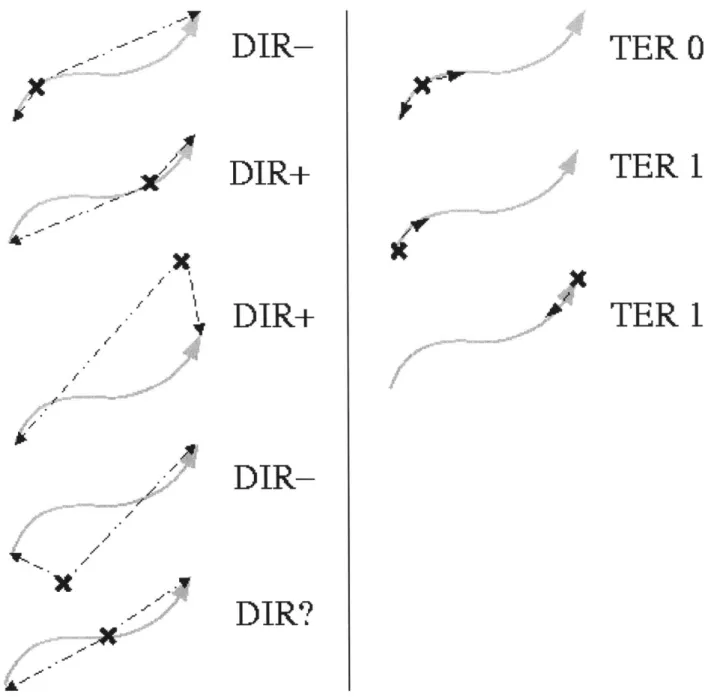
4-2 Example computations of DIR and TER visual predicates. A path is directed at a point (DIR+) when the time to saccade from that point
to the head of the path is less than the time to saccade to the tail.
Conversely for DIR-. When the times are equal, DIR? results, meaning
the path is VIA the point (if the point is on path). . . . . 56 A-1 Example violations of Spelke's principles of object motion. . . . . 64
List of Tables
2.1 Exam ple role fram e . . . . 21
2.2 100 most frequent English words. . . . . 26
2.3 Most frequent words after removing filler words. . . . . 27
4.1 STATE example Exists? and Moving? bits . . . . 50
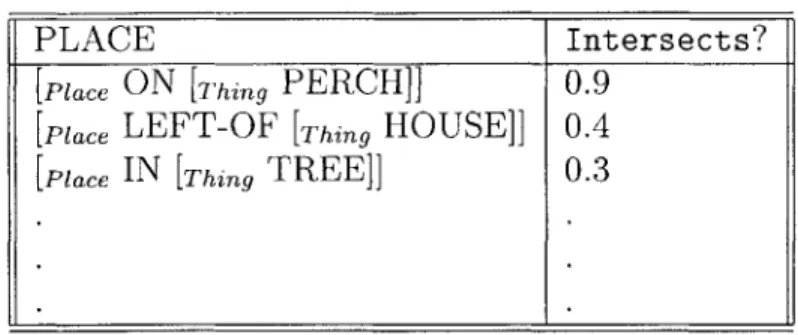
4.2 STATE example Intersects? bits . . . . 51
4.3 STATE example Intersects? for other objects . . . . 51
4.4 EVENT example Exists? and Moving? bits . . . . 52
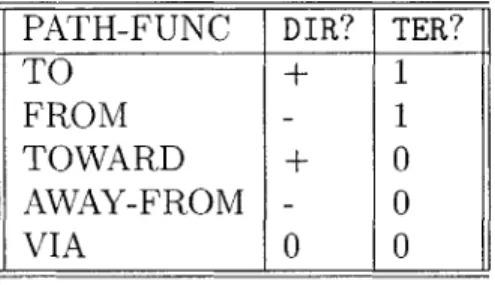
4.5 Determining PATH-FUNC from DIR and TER . . . . 52
4.6 EVENT example Intersects? bits (1) . . . . 53
4.7 EVENT example Intersects? bits (2) . . . . 53
Chapter 1
Introduction
Two simple questions motivate this thesis: 1. How do we talk about what we see?
2. How do we visualize what others say?
Answering both questions will require a better understanding of how human lan-guage and vision connect. Through such an understanding, it is my hope that we make progress toward two goals: an explanation of physical thinking (scientific goal) and simulating such thought in a machine (engineering goal). It is my belief that these two goals are not separate but, in fact, joined at the hip. Creating a human-level
Al will require understanding human thinking and, conversely, a full explanation of
human cognition will take the form of a computational model.
As a step toward these goals, In have chosen to focus on visualization and de-scription because I believe these reveal how we conceptualize and reason about the physical world. I have implemented and tested theories of how language and vision connect in computer programs. Central to these programs is a representation for language created by Ray Jackendoff called Lexical-Conceptual Semantics (LCS) [13]. Introduced in 1990, this representation has yet to be recognized by Al researchers. The LCS makes possible what previous representations could not.
Chapter 2 introduces Jackendoff's representation and compares it with previous representations for language. Logical Form (LF) and Conceptual Dependency (CD)
are shown to lack several important features which LCS possesses. In particular, LCS
" Represents what is in our minds, not what is in the world; it is a cognitive
representation.
" Includes the contribution of syntax to semantics.
* Makes explicit notions like PATHs and PLACEs which are absent in LF and
CD.
" Extends readily to domains other than the spatial-temporal which it specializes
in.
In chapter 3 I describe program VISUALIZE which uses the LCS to map sentences to images. Humans perform visualization effortlessly, as part of a more general ca-pacity for physical simulation. VISUALIZE partly models that performance. The program takes as input an LCS structure and outputs an image or movie depicting the state or event described. From these images, VISUALIZE can answer questions about the event simply by reading off the answer from the image. No symbolic rules are required, making VISUALIZE a more realistic model of human question-answering than rule-based systems.
Chapter 4 presents program DESCRIBE which performs the inverse operation of VISUALIZE: mapping an image to a sentence. This inverse operation is considerably more difficult because it is a many-to-many relation whereas VISUALIZE's task was many-to-one.
DESCRIBE uses a strategy that can be summarized as "Only see what you can say" in order to constrain visual interpretation. It searches for an image descrip-tion in the small space of LCS representadescrip-tions, not the larger space of geometric configurations.
I've written two versions of DESCRIBE.
DESCRIBE v.1 matches images to sentences by aggressively hallucinating possi-ble matches and then testing them against the image. It uses a bi-directional search
method to bring the elements of the image and the constituents of the LCS represen-tation into correspondence.
DESCRIBE v.2 answers the question "What minimal information must vision supply to language in order to fill the LCS structures?" The short answer is "not much." By computing a few simple visual predicates on the image, DESCRIBE v.2 can fill LCS frames. These predicates can be computed retinotopically, using the same operations Ullman describes in his Visual Routines
[32].
I leave for appendix A the psychological and neurological evidence for the Jack-endoff representation. This evidence assures us that the representation is on the right track.
The final chapter reviews the contributions of this thesis. Briefly, they are:
VISUALIZE
* Jackendoff's representation simplifies the visualization task. * The process of visualization parallels syntactic parsing.
* Question-answering using images and movies obviates the need for symbolic rules and is more cognitively plausible.
DESCRIBE v.1
* Matching by hallucination can work when there is a strong top-down model and
few hallucinations to consider.
" The LCS is a useful description language for vision because it collapses the usual
geometric description-space.
* Visual scene recognition can be accomplished by incremental, bi-directional composition rather than the more common one-shot, uni-directional filter meth-ods.
DESCRIBE v.2
9 LCS frames can be filled using the results of visual predicates computed on an
* Visual predicates can be computed using only retinotopic routines which fixate,
Chapter 2
Lexical-Conceptual Semantics
Chapter SummaryIn this chapter I describe a novel representation for language invented
by Ray Jackendoff which is core to the programs presented in succeeding
chapters. The representation is termed Lexical- Conceptual Semantics
(LCS). I compare LCS to previous representations for language,
in-cluding Logical Form and Conceptual Dependency, showing how LCS
improves upon them because it is cognitive and syntax-driven. Al-though the LCS centers on spatial language, it easily extends to other domains like time and possession.
2.1
Jackendoff's Novel Representation for Language
This work is inspired by and depends heavily upon a new representation for language
invented by linguist Ray Jackendoff [13]. Jackendoff decomposes a wide swath of
natural language into a set of primitive features and functions. What's most surprising
about this decomposition is how much of language can be satisfyingly decomposed into so few primitives. In this regard, LCS is to natural language what machine
instructions are to source code.
For a more complete introduction to Jackendoff's representation than I will present
here, see Chapter 9 of his Semantics and Cognition or, for the most thorough
Jackend-off's work only in enough detail to make my own work comprehensible.
2.1.1 Lexical-Conceptual Semantics
Jackendoff terms his representation Lexical-Conceptual Semantics (LCS). It is lexical because it is intended to be included in every lexical entry, alongside phonology and syntax. The fact that this representation is lexical has some important implications. First, it implies that each word has an isolated meaning apart from other words in the sentence. This contrasts with Logical Form (LF) - the classical semantics used
by linguists - in which there is no clear correspondence between individual words and their meaning. In LCS, there is a direct mapping. Each part of speech corresponds to a conceptual entity: nouns correspond to THINGS, verbs to EVENTS and STATES, prepositional phrases to PATHS and PLACEs.
Second, lexicalness implies that semantic structures are constructed in parallel with syntax. So, for example, the prepositional phrase in the house has a direct cor-respondence in semantics, [Place IN [Thing HOUSE]], which is built from the meanings
of the individual words IN and HOUSE. This lexicalness also stands in contrast to LF and other representations.
Because LCS is lexical, constructing an LCS structure from natural language is as straightforward as parsing syntax. For example,
"John walked into the room." -+
[s [np [n John]] [vp [v walk] [pp [p into] [n room]]]] -+
[Event GO [Thing JOHN] [Path TO [Place IN [Thing ROOM]]]]
Note how each syntactic constituent corresponds to a conceptual entity. I'll explain why this is important by way of comparing LCS to other representations.
2.2
Previous Representations for Language
To fully appreciate the advantages of the LCS representation, I will describe tradi-tional representations for sentences, indicate their problems, and show how the LCS representation remedies them.
2.2.1
Logical Form (LF)
Traditionally, linguists represent sentences using a semantics called Logical Form (LF) [2]. Not surprisingly, LF has its roots in classical logic.
In a sense, LF is not strictly comparable to LCS. LF is meant to represent what is true of the world; it is, like any logic, a "science of statements" [34]. In contrast,
LCS is a mental representation, meant to to represent what is true in our minds. As
a mental representation, the LCS primitives map to concepts, not sets of possible worlds. As Jackendoff put it, "unlike propositions of the standard truth-conditional logic, LCS expressions refer not to the real world or to possible worlds, but rather to the world as we conceptualize it" (italics his) [12].
As an example of LF, consider "Bob broke a glass", which might be represented:
3 x (glass (x) & broke(Bob, x))
Immediately, we see several problems with this formulation. First, "a glass" corre-sponds to no constituent in the formula. Instead, we roughly have "there exists some
thing which is made of glass". Second, the "a", which is the most embedded and least
meaningful element of "Bob broke a glass, " is at the highest, least embedded level in the formula, the existential quantifier.
If the above formulation is incorrect, then what is the correct one? We cannot
say because LF has no theory of how to map a sentence's syntax to a logical formula. In the literature, LF semanticists debate which of several possible formulae is best for a given sentence. There is even debate over the meaning of primitive relations like or (is it the truth-conditional inclusive or or is it exclusive or, as in "is it the
mapping syntax to semantics, LF cannot account for the contribution syntax makes to semantics. Indeed, as "Bob broke the glass" demonstrates, the mapping is the reverse of what would be expected.
To see some the problems in interpreting LF formulas, consider how LF would represent the simple sentence "A is in B ". Intuitively, it as a relation, IN (A,B). Indeed, past AI researchers have treated prepositions this way [4]. But this intuitive treatment actually convolves two entities which ought to be kept separate: a place, IN(B), and
a state, BE(A, IN(B)). Convolving IN and BE is a mistake because the place IN(B)
can be more that just a location for A - it could also be:
" A point along A's path, e.g. "The water went in the bucket and out the hole in the bottom."
" A place where A is kept, e.g. "The dishes stayed in the cupboard."
But in LF, IN(B) can only mean all possible worlds where "B is IN", which is not meaningful. This gets at the crux of the problem with LF: all statements evaluate to true/false for a set of possible worlds. To determine which worlds those are requires
knowing the meaning of the sentence, which is what LF was supposed to represent
to begin with!
Fundamentally, LF is circular because it does not decompose words to primitive features and functions as LCS does. In LF, every word is its own primitive. Even
though fly, walk and slither are all verbs of motion, each has its own incomparable
predicate: fly(x,y,z), walk(x,y,z) and slither(x,y,z). This of course leads to a profusion of incomparable predicates. In LCS, by contrast, similar verbs decompose similarly.
For instance,
BUTTER: [Event GO [Thing BUTTER] [Path TO [Place ON [Thing X]]]]
HAMMER: [Event GO [Thing HAMMER] [Path TO [Place ON [Thing X]]]]
In both cases, we have one object taking a path onto another. This similarity is
Table 2.1: Example role frame SEND AGENT Bob PATIENT Mary OBJECT bomb INSTRUMENT plane
make this same decomposition in LF, but then we'd actually be simulating LCS in LF.
To summarize, the problems with LF as a representation for language are:
" LF represents what is in the world, not what is in our heads, thereby failing to
capture how we think about language.
" LF has no consistent method for mapping from syntax to semantics.
" LF does not decompose word meanings into primitive features and functions,
but must be interpreted using a circular "possible worlds" model
2.2.2
Role Frames and Conceptual Dependency
Al researchers have made attempts to represent natural language for the purpose of
manipulating language in computers. Role frames, which were invented by linguists, were quickly adopted by Al [6, 21]. Role frames reveal that syntax does indeed carry semantic information: the position of a noun with respect to the verb indicates its role in the action. Role frames use linguistic roles like agent, patient and instrument to fill verb-specific frame slots. For example, "Bob sent the bomb to Mary by plane." would fill the SEND frame shown in table 2.1.
Different verbs have frames with different slots, depending on what linguistic roles the verb takes. Some verbs have slots pre-filled with default values. For instance, the
INSTRUMENT of the verb shot is usually gun.
Roger Schank augmented role frames with his Conceptual Dependency (CD) the-ory [26]. CD includes the usual role frame slots, but adds new ones like PTRANS
(physical transfer), ATRANS (change of attribute) and MTRANS (change of mem-ory).
CD theory was an important first step in decomposing verbs into primitive features
and functions. For instance, the verbs 'give', 'receive' and 'exchange' all decompose into variants of PTRANS. Schank's purpose in making this decomposition was to allow a series of sentences (a 'story') to be connected via the primitives, with the goal being to understand the story as a whole. That goal was met only for a few idealized stories, but nevertheless CD was a milestone because it represented sentence semantics
conceptually, as its name implies.
However, as a conceptual semantics, CD is rife with problems. First, several of its 'primitives' are not really primitive. For instance,
" GRASP
" INGEST (put into mouth) " EXPEL (send out of body)
all ought to be decomposed into more primitive elements '. Siskind gives a full treatment of GRASP in terms of contact, support and attachment, which I won't repeat here [28]. INGEST and EXPEL are both verbs of motion. In LCS, they are:
INGEST: [Event GO [Thing X] [Path TO [Place IN [Thing MOUTH]]]] EXPEL: [Event GO [Thing X] [Path FROM [Place IN [Thing BODY]]]]
The 'primitives' ATRANS (example: give) and PTRANS (example: go) are also only variants of GO. And MOVE and PROPEL are considered primitive in CD, but doesn't PROPEL just mean cause to MOVE? In the LCS,
MOVE: [Event GO [Thing X] [Path ...]]
PROPEL: [Cause CAUSE Y [Event GO [Thing X] [Path ...]1]
'Schank may have invented INGEST and EXPEL because they were useful for the restaurant story which motivated his work.
The lack of orthagonality in Schank's primatives can be traced to his neglect of paths. Paths are at the core of at least seven of his primatives: PTRANS, ATRANS,
MTRANS, MOVE, PROPEL, INGEST, EXPEL. The consquences of this neglect
are clearer when we consider what PTRANS, for example, can and cannot represent. PTRANS will capture "The boat sailed from Boston to New York" but not any of these paths:
1. The boat sailed along the river.
2. The boat sailed toward shore.
3. The boat sailed away from port.
4. The boat sailed through the strait.
In all cases there is motion without point-to-point 'physical transfer', which PTRANS cannot account for. Nor can CD account for cases of PATHs without motion, such as:
1. The road extends along the river. (extension)
2. The sign pointed toward California. (orientation) In LCS these are,
[State EXTEND [Thing ROAD] [Path ALONG [Thing RIVER]]]
[State ORIENT [Thing SIGN] [Path TOWARD [Place CALIFORNIA]]]
A practical theory of semantics must say how syntax is mapped onto the semantic
representation, but CD does not do this. Instead, Schank dismisses syntax as a 'surface' representation and takes pride in CD's independence from syntax. The consquences of not deriving semantics from syntax are apparent in the examples above.
1. CD does not decompose language down to the most cognitively basic features
and functions, although it takes a step in that direction 2. CD does not include syntax's contribution to semantics
3. CD primatives are not orthagonal because they don't factor out paths
2.3
The Complete LCS Formalism
For completeness, here is the full LCS formalism:
" [THING]
" [PLACE] - PLACE-FUNC( [THING])
PLACE-FUNC E (AT, ON, IN, ABOVE, BELOW, BEHIND, ...)
* [PATH] - PATH-FUNC( [PLACE] I [THING] )
PATH-FUNC E (TO, FROM, TOWARD, AWAY-FROM, VIA, ALONG,
" [EVENT]
+-GO ([THING], [PATH]) I
STAY ([THING], [PLACE])
" [STATE]
+-BE ([THING], [PLACE]) I ORIENT ([THING], [PATH]) I
EXTEND ([THING], [PATH])
Bear in mind that these entities themselves decompose into even more primative features and functions. In his Semantic Structures, Jackendoff likens this representa-tion to John Dalton's atomic theory of chemistry [13]. Dalton's theory bottomed-out at atoms, not the electrons or protons which, it would later be discovered, comprise them. Still, Dalton's rules for combining atoms remained true even after his 'atoms' were resolved into finer particles. Similarly, Jackendoff expects that his entities
-PATH, THING, etc. - will someday be resolved into more primative elements, but this will not negate those larger entities. Indeed, since creating the LCS representa-tion, he has already decomposed some of the entities himself [10].
What is the exact meaning of PLACE-FUNCs and PATH-FUNCs?
PLACE-FUNCs map a THING to a PLACE. Similarly, PATH-PLACE-FUNCs map PLACEs or THINGs to PATHs. Jackendoff writes that these are functions of 3D object models (in particular, he imagines 3-D Marr-like models) [25]. But I will show in the final chapter of this thesis that many of Jackendoff's PLACE- and PATH-FUNCs do not require a 3D model, but can instead be computed retinotopically.
2.4
Much of natural language is spatial
Jackendoff's representation centers on the physical world, as opposed to social or abstract domains. One might therefore challenge the representation's generality by asking, "Just how much of langauge is spatial?".
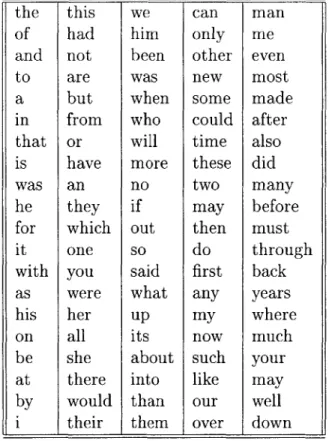
One crude method to answer this question is to examine the most frequently occuring words in English. Table 2.2 lists the 100 most frequently occuring words in English, ranked in desceding order of frequency. Keep in mind that these are computed from written and not spoken material, mainly newspaper articles [7].
After removing all articles, conjunctions, pronouns, possesives, and helping verbs we have a list that includes mostly words about space/time (*) and quantity (**),
shown in table 2.3.
This crude assessment indicates that, indeed, spatial/temporal and quantitative words comprise the bulk of natural language.
Table 2.2: 100 most frequent English words the this we can man
of had him only me and not been other even to are was new most a but when some made in from who could after that or will time also is have more these did was an no two many he they if may before for which out then must it one so do through with you said first back as were what any years his her up my where on all its now much be she about such your at there into like may
by would than our well i their them over down
Table 2.3: Most frequent words after removing filler words.
of what after *
to * up * did
in * about * many ** for into * before *
with than through *
as other back * on * new * years * at * time * where *
by * these much **
not two ** well
from * do down * one ** first ** all ** any ** there * now * when * out * who over * more ** man no even out * most ** said made indicates space/time words
2.5
LCS is extensible
Although all the LCS examples presented so far are in the spatial domain, the repre-sentation readily extends to other domains. "Until 10 o'clock" locates an interval of time just as "until the road ends" represents a path segment; "at/by/around noon" is
like "at/by/around the park". The path
[Path FROM [Place AT [2:00]], TO [Place AT [3:00]]]
specifies the interval of time between 2:00 and 3:00. All PLACE-FUNCs and PATH-FUNCs used in the spatial domain keep their same meaning in the time do-main. Time is simply the 1-dimensional case. Some more complicated examples:
1. "The meeting will begin at midnight." -+
[Event GO [Thing MEETING] [Path FROM [Place AT [time MIDNIGHT]]]] 2. "The presentation was during the day." --+
[State EXTEND [Thing PRESENTATION] [Path ALONG [time DAY]]] 3. "I was at the office until 9:00." -+
[State BE [State STAY [Thing I] [Place AT [Thing OFFICE]]] [Path TO [time 9:00]]] The LCS also readily extends to verbs of possesion. In possession-space, the meaning of GO becomes transfer of possession:
[Event GO [Thing MONEY] [Path FROM [Thing TOM], TO [Thing HARRY]]] Physical proximity equates with ownership. Again, the meanings of all PATH-FUNCs and PLACE-PATH-FUNCs are preserved.
The LCS appears at first incapable of representing social and emotional state-ments. However, Leonard Talmy has shown that many social and emotional sentences can be analyzed in terms of "Force Dynamics", a notation like LCS [31]. For instance,
[Cause CAUSE [Thing SHE] [Event GO [Thing MONEY] [Path TO [Thing JOHN]]]]
Talmy shows that verbs like pressured and forced behave according to the same rules whether applied to physical or social situations.
These mappings from physical space onto other spaces are not analogies. Instead, the claim is that we necessarily make this mapping (even if unconsciously) every time we think in those "abstract" spaces [17, 8]. Many more examples of how ab-stract domains map onto physical ones are presented in Lakoff and Johnson's book Metaphors We Live By [17].
2.6
What LCS represents
It is important to be clear about what the LCS representation is meant to capture and what it leaves out. Obviously, the symbols [Path TO [Place ON [Thing TABLE]]]
do not represent the particular contour of the path itself. The actual path contour is represented in vision. But to describe that contour with words, we need PATH-FUNCs which reference points in the visual domain. That is what language is for and what LCS represents: a method of referring to what we see.
Tokens in the LCS like BALL are meant to be pointers to information in visual agencies which store shape, color, size, etc. The LCS leaves these features to vision.
Although the LCS is representation is closely tied to language, it is invariant to some aspects of language:
e Some word choices: "Bill walked into the room" and "Bill came into the room"
are both represented by [Event GO [Thing BILL] [Path TO [Place IN([Thing ROOM])]]] e Word order: "Bill walked into the room" and "Into the room came Bill" are
represented the same
2.7
Summary
To summarize, the benefits of the LCS representation are that it is:
Lexical : It decomposes the meaning of words into primitive features and functions. Cognitive : It represents what is in our heads, not what is in the world.
Syntax-driven : It comes with a method of mapping syntax to semantics which takes syntax's contribution to semantics into account.
Extensible : It maps readily to more abstract domains like time and possession. Specific : It captures exactly the information a language system needs to produce
Chapter 3
VISUALIZE: From Sentence to
Image
Chapter Summary
In an effort to model human visualization ability, program VISUAL-IZE maps sentences to images. The LCS representation makes visual-izing sentences straightforward. The process of visualization is
compo-sitional, executed in same order that the sentence is syntacticly parsed.
Once the sentence is visualized, questions about it can be readily an-swered by reading off the generated image(s). Thus the need for sym-bolic rules is obviated.
So far I have described Jackendoff's representation and compared it to other rep-resentations for language, in order to highlight its benefits. To a linguist, the very fact that Jackendoff's representation satisfyingly captures many example sentences is ev-idence enough of its power. But to an Al researcher, the power of any representation ultimately hinges on the question, "What problems can it be used to solve?". To an-swer that question, I have written several programs that use the LCS representation.
I will discuss them in the remainder of this thesis.
The first program, named VISUALIZE, takes as input an LCS representation and outputs a 3D image or short movie. The goal of the program is to make a correspondence between what we say and what we see. The program demonstrates
how this correspondence can be made by incremental composition which pays strict attention to the syntactic embedding of the sentence.
Once a sentence has been visualized, the program can answer simple questions about what the sentence means. This is accomplished simply by reading off the answer from the image. No symbolic rules are required.
3.1
From sentence to image
Program VISUALIZE models a task humans perform effortlessly: visualization of a sentence, or more poetically "seeing in the mind's eye". Brain scan experiments demonstrate that during a visualization task the same regions are active as are used in normal vision, indicating that visualization is to some extent a controlled halluci-nation. We do not yet know how these hallucinations are kept separate from reality; perhaps they are isolated by a mechanism akin to how the brain stem cuts off signals to the body during dreaming.
Psychological evidence indicates that visualization is true to reality. Mentally ro-tating an object takes as much time to perform as would be required to rotate the object in reality [27]. Thus visual hallucination simulates reality not in an abbrevi-ated, symbolic fashion but with high physical fidelity.
The goal of VISUALIZE is to partially model human visualization. It takes as input a sentence, given in LCS, and produces as output an image or movie (series of images) corresponding to the sentence. Past visualization programs began with explicit machine instructions for constructing the visual representation, rather than natural language, and represented only static relations, not motion [3]. VISUALIZE begins with natural language, as given by the LCS representation, and can represent both static scenes (images) as well as motion events.
3.2
Example Run
"Bill went into the room." represented in LCS as
[Event GO [Thing BILL] [Path TO [Place IN [Thing ROOM]]]]
Given this input, VISUALIZE returns a scene giving the coordinates of all objects or, for moving objects, their position as a function of time. This function can be 'expanded' into a series of images locating Bill along his path into the room. The movie can then be used to answer common-sense questions about the event, such as
"Where is Bill after he came into the room?".
The procedure for constructing a visual representation for this example is:
1. Imagining [Thing ROOM] by recalling its object model from a database.
2. Computing the PLACE [Place IN [Thing ROOM]] by applying the IN operator to
the room object.
3. Computing the PATH [Path TO [Place IN [Thing ROOM]]] by imagining a vector
which terminates at the PLACE [Place IN [Thing ROOM]].
4. Imagining [Thing BILL] by recalling his object model from the database.
5. Creating a function of time which gives Bill's location along the PATH computed
in step 3.
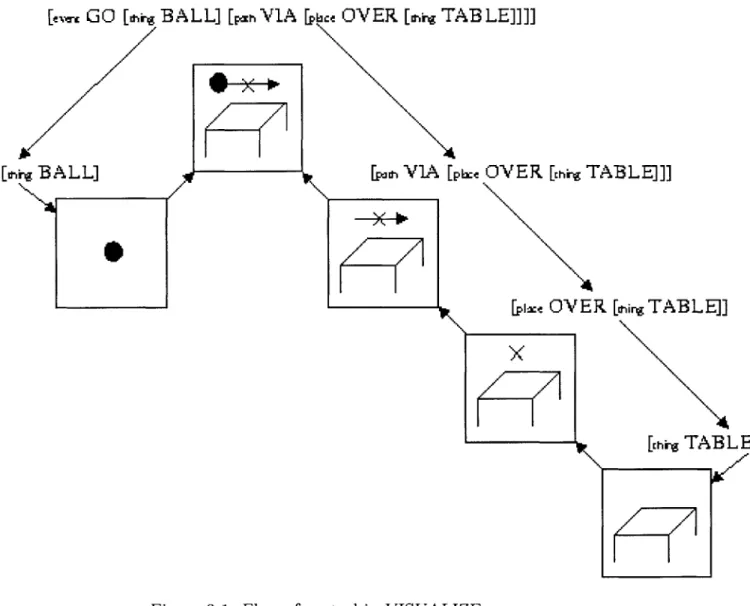
Figure 3.2 shows the flow of control in VISUALIZE. First the sentence is decom-posed to its primitive constituents, then those constituents are visualized, and finally reassembled into the final image.
The result is a 3-dimensional, viewer-independent model of the scene(s). To verify that VISUALIZE's output is correct, I wrote a utility to draw the final image or "play" the movie on screen.
To accomplish its task, VISUALIZE requires a database of object models for objects like Bill, room, table, cup, etc. These models are extremely course but do
[e:cG 0 [mig B A L L] [pah V1A [ipce OVER [u-g TAB LE]]]]
[t BALL] [pat VlA [pbxe OVER [chnir TABLE]]]
[pixe OVER [ting TABL E]]
[hing TABLE]
capture the relative sizes and dimensions of the objects. Visualizing a THING just means recalling its object model from the database.
Visualizing PLACEs is more complicated than THINGs. PLACE-FUNCs for prepositions like IN, ON, ABOVE have been implemented. Each takes a THING as its argument and outputs a point (example: AT), surface (example: ON) or space (example: IN).
PATH-FUNCs for prepositions like TO, FROM, VIA, etc. take PLACEs as input and generate vectors representing a path.
Verbs of motion like GO take an object and path vector as input and return the object's location as a function of time.
VISUALIZE has a small lexicon of verbs and corresponding LCS representations.
For example, the verbs walk and butter are represented in the lexicon as:
WALK: [Event GO [Thing X] [Path Y]]
BUTTER: [Event GO [Thing BUTTER] [Path TO [Place ON([Thing X])]]]
Obviously VISUALIZE can only accept sentences containing objects in its database, verbs in its lexicon, and prepositions given by implemented PLACE- and PATH-FUNCs. However, there is no reason why, in principle, VISUALIZE could not easily scale up to include a wider breadth of language, simply by filling the object database and lexicon. No changes need be made to VISUALIZE itself.
3.3
The Complete Mapping
For completeness, here is a detailed description of the full mapping made by VISU-ALIZE:
THING -+ Object: A 3D model, which may be a singe prism or, in the case of objects composed of parts, a hierarchy of prisms.
PLACE -+ Space: A point, line, area or volume, depending on what the
PLACE-FUNC is (for example, ID: a road, 2D: a baseball field or 3D: the interior of a
PATH - Function f(t): Gives (x,y,z) at t, where t ranges over the time interval
the object moved or, in the case of ORIENT and EXTENT, t is a dummy variable. By using a generalized function rather than a linear vector, PATHs can represent any trajectory or contour, not only straight lines. In the case where f(t) represents motion, it also implicitly represents the velocity and acceleration of the object along its path, though VISUALIZE does not make use of this information.
EVENT -+ Movie: a series of sets of objects and their locations. The number of 'scenes' in the movie can vary depending on the granularity of the time step of f(t) 1.
STATE -4 Image: a set of objects and their locations.
CAUSE -+ Pair: (THING, EVENT) where THING is the agent.
3.4
The mapping is made in parallel with syntax
The mapping from sentence to image follows the same embedding pattern as the sentence's syntax. Most embedded are visualized first, least embedded last. Why is this important? Because, by visualizing sentences in the order they are parsed, we implicitly account for cognitive constraints on visualization. To see why this is the case, consider:
1. The bike is in front of the house.
2. The house is behind the bike.
Though both sentences convey the same information about the relative positioning of the bike and the house, people presented with both prefer (1) to (2). The reason for this preference should be obvious. In (1), the light, mobile bike is being located
'The ability to vary the granularity of the simulation is important. Sometimes a course simulation is sufficient to answer a question, such as "Where is Bill after entering the room?". Other times a finer-grained simulation is required, such as "Did Bill touch the wall as he entered the room?"
with reference to the heavy, immobile house. Syntax parallels physics: first locate the immobile objects, then locate the mobiles with respect to them. In (2), however, syntax and physics conflict, and this is why (2) is judged awkward: the syntax signals that the bike be placed first but physics says the heavy, immobile house ought to be. This preference indicates that we place objects not with regard to which is
intro-duced first in the sentence, but rather which is parsed first. Put differently, syntax
directs the order in which a visualization is constructed.
3.5
Problems encountered
In writing VISUALIZE, I encountered several problems which are interesting in their own right and ought to be taken into consideration in any future version of VISUAL-IZE.
VISUALIZE's place-functions (i.e. prepositions) compute PLACEs in an object-independent manner but this is not always the case in natural language. For example,
VISUALIZE computes
* [Place IN [Thing ROOM]] by averaging the dimensions of the room
* [Place ON [Thing TABLE]] by choosing an arbitrary point on the surface of the
table
Thus place-functions compute places independent of the object they operate on. But in natural language, prepositions sometimes modify nouns in a noun-dependent manner. For instance, "in the room" takes the conventional meaning of the interior space bounded by the room's walls, but "in bed" does not pick out a space inside the mattress. "In bed" refers to the space between the mattress and cover. To account for noun-dependencies like this, VISUALIZE would either require that its place-functions be sensitive to the object operated on, or that its objects come attached with non-default interpretations.
A second problem is that prepositions have variable interpretations depending on
pos-sible interpretations: viewer-centered ("deictic"), object-centered ("intrinsic"), which can be either along the canonical axis or motion axis, and absolute ("basic") [5]. For instance, "in front of the car" could mean:
1. The space in front of the headlights (object-centered along canonical axis)
2. The space between the car and the speaker, which depends on the location of the speaker (viewer-centered)
3. The space in front of whichever direction the car happens to be moving, which
could even be canonical "behind the car" if the car were moving in reverse (object-centered along axis of motion)
Which of these applies in a given situation depends also on the particular object.
"In front of the car" is more tightly bound to the canonical axis interpretation than
"in front of the rock" because cars have a well-defined canonical axis whereas rocks do not.
To fully account for preposition ambiguity, VISUALIZE would need to know the location of the speaker, the canonical axis of the objects involved and the direction of motion of the objects at the time of the utterance. There are psychology experiments showing which of the several interpretations is preferred for different values of these variables. There is also considerable work attempting to pin down exactly what "on" or "above" mean without regard to context [5].
A third issue encountered involves the physical constraints on visualization.
Vi-sualizing "the box is on the table" seems like a simple matter of locating the box at the place given by [Place ON [Thing TABLE]]. But if the table is already covered with
other items, we must be sure that the box isn't placed on those items and that there is enough table surface remaining to place the box without it falling off.
I added a check to VISUALIZE to prevent such object inter-penetrations and,
if necessary, randomly choose another point "on the table" (there are many such points) where the box will not inter-penetrate other objects. I also added a simple mechanism for "bending" paths around obstacles to prevent inter-penetration when an object moves along a path.
But these workarounds only begin to address the full range of physical constraints on visualization, which include object stability, friction and gravity. I have little doubt that a complete physics simulator could be built to account for all these con-straints, but the more difficult problem of how humans selectively apply them or find alternatives to satisfy them is still an open question.
3.6
VISUALIZE answers questions
VISUALIZE can answer common sense questions by reading off answers from the
image. The advantage of a visual representation over a purely symbolic one like logic is that visual representations make a large number of inferences immediately available, without requiring multistep deductions and the combinatorial explosions which can come with them [1].
The following example situations and questions can be answered by VISUALIZE:
1. Given: "Jan buttered the toast." "Jan put the the toast on her plate."
Q:
Is the butter above the plate?A: Yes.
2. Given: "The cup and the plate are on the table."
Q:
How many THINGs are on the table?A: Two.
3. Given: "John walked into the room."
Q:
Is John's nose in the room?A: Yes.
In (1), a CYC-like system would require a "Transitivity of ON" rule to answer the question [18]. VISUALIZE instead generates an image for the situation and then tests weather or not the BUTTER's z coordinate is greater than the PLATE's.
Situation (2) requires the ability to count, which can be reduced to two operations: mark and increment. As we visit each object which is on the table, we mark it and increment the counter. Ullman points out in "Visual Routines" that mark is generally a useful operation for visual tasks like testing if a contour is bounded [32]. For that task, mark stores the start of tracking the contour and, if that mark is reached again during tracking, the contour is bounded.
For (3), a CYC-like system would need a rule: IF (AND (IN A B) (PART-OF C A)) -+
THEN (IN C B)
But a system which can perform physical simulation need only imagine A being in B and then test if C, which happens to be a part of A, is also in B. No special rules like the one above are required.
Another way to see the advantage of images over symbolic representations is to consider the amount of information required to symbolicly represent the information contained in an image. Consider an image of N objects. We can make at least one statement about the relative positions of every pair of objects, such as "A is above B" or "B is left of C". There are N! such pairs, so N! symbolic sentences are needed to capture the same information implicitly contained in the image. A picture is indeed worth 1000 words or, in this particular case, a picture of only seven objects would be worth 5040 symbolic statements.
In addition to using images to answer questions about static scenes, VISUALIZE can use movies to answer questions about the STATE of affairs at various times during an EVENT. For instance, given that "Bill walked into the room", the program can answer the common-sense question "Is Bill now in the room?" by finding that, in the final scene of the movie, Bill is indeed in the room.
This is accomplished by a procedure which takes an EVENT as input and "ex-pands" it into a series of scenes which are then each visualized. The last several scenes in the sequence will show Bill in the room. More difficult questions questions like "Did
for intersection through the plane bounded by the doorway, but VISUALIZE's object models are currently too primitive to accomplish this.
Jackendoff, in a 1976 paper [11], writes inference rules for his LCS representation to answer questions like "Is Bill in the room?":
IF [Event GO [Thing X] [Path TO([piace Y)]] from time T to T2 THEN [State BE [Thing X1 [Place AT([piace Y])] at time T2
VISUALIZE demonstrates how the same inference can be made without such a rule. Jackendoff later downplays his early work as cognitively implausible, in favor of
Chapter 4
DESCRIBE: LCS for Vision
Chapter Summary
Program DESCRIBE tackles the inverse problem of VISUALIZE: it maps images to sentences. Two versions of describe have been imple-mented. The first demonstrates that matching by hallucination can succeed using the LCS to restrict the number of hallucinations (i.e. the size of the 'description-space') under consideration. The program uses bi-directional search to bring the hallucinations, coming from the top-down direction, into correspondence with LCS structures gener-ated from the image, coming in the bottom-up. The second version of DESCRIBE takes a very different approach by filling LCS frames using primitive visual predicates computed on the image. The surprising find-ing is that the results of computfind-ing only a few simple predicates suffices to fill the LCS frames. Both versions of DESCRIBE demonstrate that
LCS holds promise as a description language for vision.
The overarching goal of this thesis is to better understand how human language and vision connect. Having explored the language -+ vision direction of that
connec-tion in VISUALIZE, I next turn to the opposite direcconnec-tion, vision -+ language.
In "How do we talk about what we see?", Macnamara points out that in order to talk about what we see, information provided by the visual system must be translated into a form compatible with the information used by the language system [20]. In this
chapter, I present a program called DESCRIBE which uses the LCS representation to make that translation.
Traditionally, the problem of mapping an image to its description would be con-sidered a Vision project, but DESCRIBE bears little resemblance to classical vi-sion systems. DESCRIBE does not take raw image input and does not perform object recognition, line detection, or any of the usual image processing techniques. DESCRIBE assumes that object segmentation, recognition, and tracking are solved problems.
The program is given the identities and location(s) of objects. The program's goal is to use this information to construct a sentence describing the path or other spatial relations between the objects involved. A second version of DESCRIBE is given less information; indeed, its purpose is to fill LCS frames using a minimum of information from vision.
4.1
DESCRIBE: From image to sentence
DESCRIBE faces a considerably harder task than VISUALIZE. VISUALIZE began with a symbolic representation (the LCS) and mapped it to any one of many correct analogical representations (3D images or movies). Thus VISUALIZE made a one-to-many mapping. DESCRIBE, however, must make a many-one-to-many mapping. For example, there are infinitely many images satisfying "A is above B". A could be two feet above B, ten feet, 100 feet, etc. Furthermore, there are potentially N! statements that can be made about an image containing N objects, as explained in the last chapter. Finally, agent and patient roles can often be reversed, as in "A is above B" vs. "B is below A". Considering all these dimensions of variation, how will DESCRIBE decide what to say?
The first version of DESCRIBE does not decide, but simply generates all possible sentences involving A and B, then matches them piecewise and returns all matches. The second version does not generate all possible sentences, but instead fills in LCS frames which can later be used to generate any sentence. This second version is a
more cognitively plausible model of how human vision might inform language.
4.2
Classical Vision Problems
To appreciate the task facing DESCRIBE, we must review the "vision problem". Vision researchers frame their field's problem as one of "inverse optics" [9]. The goal is to invert a 2D pixel array to recover the 3D geometry which generated it. This problem, framed as it is, is known to be under-constrained. A single 2D image can be generated by a potentially infinite number of 3D scenes.
Knowing that vision is an under-constrained problem, the obvious remedy is to add a constraint. That is effectively what DESCRIBE does; it constrains a poten-tially infinite number of scene descriptions to only LCS representations. In effect, its strategy is to take "Only see what we can say".
The goal of any vision system is to produce a description of an image [9]. In practice, description has almost always meant the identity of the objects in the scene and their positions and orientations in 3-space. DESCRIBE does not produce such a geometric description but rather outputs a sentence - in the LCS representation
-describing the image. Because a sentence covers many particular geometries (recall that "A is above B" covers infinitely many positionings of A and B), the geometric "description-space" is effectively collapsed. More importantly, it is collapsed along exactly the categories which humans care most about: "A is above B", not "A is at
(1.3, 4, 7) and B is at (1.3, 4, 9)".
4.3
DESCRIBE assumes object recognition
Object recognition has historically been the centerpiece of vision research, to the detriment of motion processing and higher-level vision. DESCRIBE, however, as-sumes object recognition is a solved problem and focuses instead on motion and the relations between objects. Is this a fair assumption?
ignored feature), object recognition is greatly simplified. Jeffrey Siskind, for example, has put inexpensive CCD cameras and fast processors to good use in an active vision system
[29].
Siskind has demonstrated that object segmentation can be achieved with stunning accuracy using only motion and color to segment objects. Once segmented,object recognition is easier.
Some researchers take issue with Siskind's methods, believing they are somehow "unfair." But, if such criticisms hold, nature could also be accused of cheating. For, as Shimon Ullman points out, motion and color are extracted at the lowest levels
of vision, in parallel units which cover the entire visual field, both in humans and
animals [32].
Siskind's work suggests that earlier vision systems built in a static, colorless world may have tackled some artificially difficult problems. Given the progress he has made, along with the ever-increasing feasibility of brute-force object recognition [22], it seems reasonable for DESCRIBE to assume that object recognition is solved.
4.4
DESCRIBE v.1: Matching by Hallucination
The first version of DESCRIBE uses the generate-and-test paradigm to match an image to a sentence. The program generates LCS structures, VISUALIZEs them and then matches those visualizations against the input image. This version is obviously not meant to model human performance, as humans do not hallucinate ad hoc until coming upon a match. But DESCRIBE v.1 does demonstrate that "matching by hal-lucination" is possible and feasible when the LCS representation limiting the number of matches under consideration.
To guide the search for a match between the hallucinations and the actual image, I implemented the bidirectional search method described by Ullman [32]. This method is inspired by neurological findings suggesting that object recognition succeeds when top-down and bottom-up processing streams, both operating in parallel, meet at an intermediate point. Computationally, this method has the benefit of halving the depth of uni-directional search.
In DESCRIBE, the "top" of top-down corresponds to the hallucinated LCS repre-sentation, while the "bottom" is the input image. The program simulates parallelism
by having the top and bottom streams take turns deepening their respective search
trees. At each iteration, either the top or bottom will expand a node in its search tree. Coming from the top, expansion means "select one constituent from a larger
LCS structure". Coming from the bottom, expansion means "select one constituent
from the image".
All nodes at the frontiers of the search trees are marked primed. Primed nodes
are preferentially expanded at the next iteration. This way, when either the top or bottom stream encounters a node already primed by the other, the search quickly terminates. One stream will immediately retrace a path already laid down by the other, and a match is then declared. See figure 4.4 for an example of how a match is made.
If the top is a complete LCS structure and the bottom an image, what then are the intermediate nodes? They are partial LCS structures - THINGs, PLACEs, PATHs
- or parts of the image. Recall that the LCS representation is heavily embedded. DESCRIBE v.1 takes advantage of this by, for instance, applying all PLACE-FUNCs (e.g. "ON", "UNDER") to a THING in the bottom-up direction. Top-down, it begins with completed LCS structures like EVENTs and STATEs which are decomposed into smaller units to be matched against the image.
DESCRIBE v.1 demonstrates how scene recognition can be compositional. In contrast, neural nets and other uni-directional image processing techniques recognizes a whole scene in one-shot or not at all. DESCRIBE v.1 instead recognizes the scene in an incremental, piecewise fashion, with processing shifting direction between source and target. For example, an object in the image first spurs the generation of a larger structure, like a PLACE relative to that object. This is the bottom-up direction. Next, a full LCS structure at the top (a hallucination) is decomposed into smaller pieces which seek a match in the image. Eventually, all fragments generated bottom-up come into correspondence with the pieces of larger LCS structures coming from the top down, and a complete match is made.
. [GO [BALL] [VlA [OVER [TAB LE]]]] [GO [BALL] [ViA [UNDER [TABLE]]]] ...
[BALL] .. [VIA [UNDER [TABLE]]] [TO [Ut
[FROM [OV
00
ER ABLE]]] [VIA [OVER [TABLE]]] -. .
[OVER
[TAB LE]] [UNDER [TABLE]] [LEFT-Oe -L
NDER [TABLE]]]