READ THESE TERMS AND CONDITIONS CAREFULLY BEFORE USING THIS WEBSITE. https://nrc-publications.canada.ca/eng/copyright
Vous avez des questions? Nous pouvons vous aider. Pour communiquer directement avec un auteur, consultez la première page de la revue dans laquelle son article a été publié afin de trouver ses coordonnées. Si vous n’arrivez pas à les repérer, communiquez avec nous à [email protected].
Questions? Contact the NRC Publications Archive team at
[email protected]. If you wish to email the authors directly, please see the first page of the publication for their contact information.
NRC Publications Archive
Archives des publications du CNRC
This publication could be one of several versions: author’s original, accepted manuscript or the publisher’s version. / La version de cette publication peut être l’une des suivantes : la version prépublication de l’auteur, la version acceptée du manuscrit ou la version de l’éditeur.
Access and use of this website and the material on it are subject to the Terms and Conditions set forth at Effect of train-induced vibrations on houses - a case study
Rainer, J. H.; Pernica, G.; Maurenbrecher, A. H. P.; Law, K. T.; Allen, D. E.
https://publications-cnrc.canada.ca/fra/droits
L’accès à ce site Web et l’utilisation de son contenu sont assujettis aux conditions présentées dans le site LISEZ CES CONDITIONS ATTENTIVEMENT AVANT D’UTILISER CE SITE WEB.
NRC Publications Record / Notice d'Archives des publications de CNRC:
https://nrc-publications.canada.ca/eng/view/object/?id=71ed2126-2a96-4726-9819-622980ce9ace https://publications-cnrc.canada.ca/fra/voir/objet/?id=71ed2126-2a96-4726-9819-622980ce9ace
Ser
Z r R l
Natlonal Research Consell natlonal
b + ~
Coundl Canada de recherche8 Canadano. 1550
I
c. 2I BLDG Institute for lnstitut de
Research in recherche en
Construction construction
Effect of Train-Induced Vibrations on
Houses
-
A
Case Study
by J.H. Rainer, G. Pernica et al
Appeared in
Proceedings, SymposiumANorkshop on Serviceability of Buildings (Movements, Deformations, Vibrations) Ottawa, Ont. 16
-
18 May 1988Vol. 1, p. 603-614 (IRC Paper No. 1550)
Reprinted with permission
NRCC 291 23 -I NRC
-
CISTI I R C LIBRARYQ E C
is
1938I
I
IR
C CNRC-
IC19TI
On a CtudiC l'effet des vibrations produites par les trains sur des maisons et des maisons mobiles de Kamloops, en Colombie-Britannique, afin de determiner si ces vibrations auraient pu causer des dommages aux habitations situks pr5s des voies. Une investigation dktaillee a rev616 que la resonance des bltiments pouvait provoquer des dommages architecturaux jusqu'h 250 m des voies et qu'un tassement dii aux vibrations pouvait se produire dans le cas de certaines fondations de maisons mobiles reposant sur des remblais humides meubles. Le criti3re de dornmages architecturaux possibles au stuc et aux revetements intCrieurs fragiles a CtC fix6 la vitesse maximale de 5 mrnfs, mesurbe au niveau du plafond des maisons d'un Ctage. Sur la base de cette investigation, on prCsente des recommandations gCnCrales concernant les mdthodes employCes pour Ctudier les prc>bli?mes senibliibles de vibrations produites par le passage des trains.
EFFECT OF TRAIN-INDUCED VIBRATIONS ON HOUSES
-
A CASESTUDY
J.H. Rainer, G. Pernica, A.H.P. Maurenbrecher, K.T. Law, and D.E. Allen Institute for Research in Construction
National Research Council of Canada Ottawa, Canada KIA OR6
ABSTRACT: Train-induced vibrations of houses and mobile homes in Kamloops, British Columbia, were investigated to determine whether the vibrations could have resulted in damage to residences near the tracks. A detailed investigation showed that building resonance could result in architectural damage up to 250 m from the tracks and that vibration-induced settlement could occur for certain mobile home foundations located on loose wet fill. The criterion for possible architectural damage to stucco and brittle interior finishes was taken as 5 d s peak velocity, measured at the ceiling level of the one-storey houses. As a result of this study, general recommendations are presented regarding the methods employed in investigating similar train vibration problems.
1.
THE
PROBLEMThe Canadian National Railways (CN) main line has passed through the Brocklehurst and Rayleigh areas of the city of Kamloops, British Columbia since the early part of this century. In the fall of
1984, a second track was added adjoining the existing one. Immediately complaints were registered by homeowners regarding excessive vibrations in houses nearby as a result of trains travelling on the new track.
The complaints precipitated two investigations in the residential areas abutting the railway tracks. These studies concluded that although the vibrations exceeded acceptable perception levels, they would not be high enough to cause damage to the houses. The findings were rejected by the Citizen's Committee of homeowners. A subsequent investigation by the Institute for Research in Construction (IRC) of the National Research Council of Canada (NRC), requested by Transport Canada, determined that the rejection of damage claims was premature, since two possible damage mechanisms, horizontal house resonance and vibration-induced soil settlement, had not been L
sufficiently investigated. Although these mechanisms are not part of most traffic vibration studies,
I they were considered to play a major part in this particular case.
This paper briefly describes the investigations carried out by IRC and the resulting conclusions reached, it also contains recommendations on the methods that are used to study similar train- induced vibration problems.
2. THE INVESTIGATION
The purpose of the investigation was to establish whether vibrations from trains in Kamloops, B.C. are a valid cause of damage to nearby buildings, notably those for which damage claims had been submitted to CN. Two possible damage mechanisms
-
horizontal house resonance and vibration- induced soil settlement-
were to be investigated. The following measurements were undertaken: 2.1 Dynamic Pro~erties of Houses: The lowest horizontal natural frequencies and damping ratioswere determined for six one-storey wood frame houses with basements in the Brocklehurst area. I
See Figure 1 for locations. Excitations employed for these measurements were impacts from door closures and ambient vibrations. The following results were obtained:
(a) fundamental frequencies of six typical houses in the Brocklehurst area of Kamloops, B.C. ranged from 7.0 to 8.9 Hz, with an average of 7.8 Hz,
(b) damping ratios for the fundamental mode of the six houses range h m 3.5 to 7.5% of critical, with an average of 4.8%.
2.2 Ground Vibrations From Trains: Ground vibrations produced by passing trains were measured at three locations along the track at 1160 Bentley Place, and at various distances from the track along Lines 1 and 2 as shown in Fig. 1. Vibrations were measured in both horizontal and vertical directions. Train speeds were measured by "radar guns" located near Line 1 and Line 2.
Ground vibrations from a number of trains were monitored on Line 1 under the then current operating conditions, namely 50 mph (80 km/h) speed limit on the old track and 20 mph (32 kmh) speed limit on the new track. The speed limit on the latter had been reduced from 50 mph (80 kmh) as a result of the homeowners' complaints. To provide a range of train speeds for purposes of this study the speed limit on the new track was raised in stages from 20 to 50 mph over a two-day period.
The measurements of ground vibrations from train passages showed the following:
I
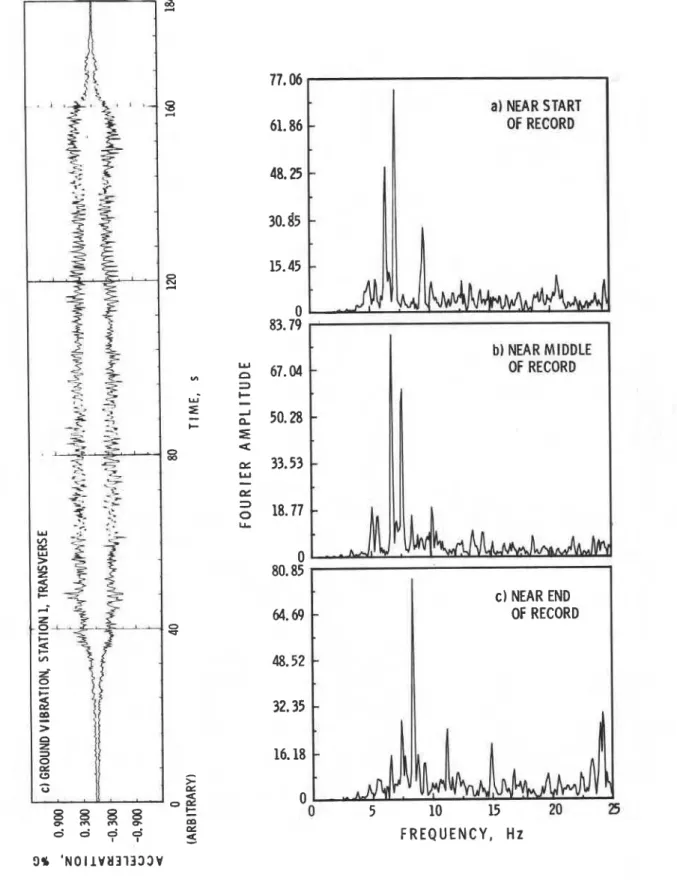
(a) The ground vibrations emanating from trains on the new track consisted of 1 ormore predominant sinusoidal waves (Fig. 2).
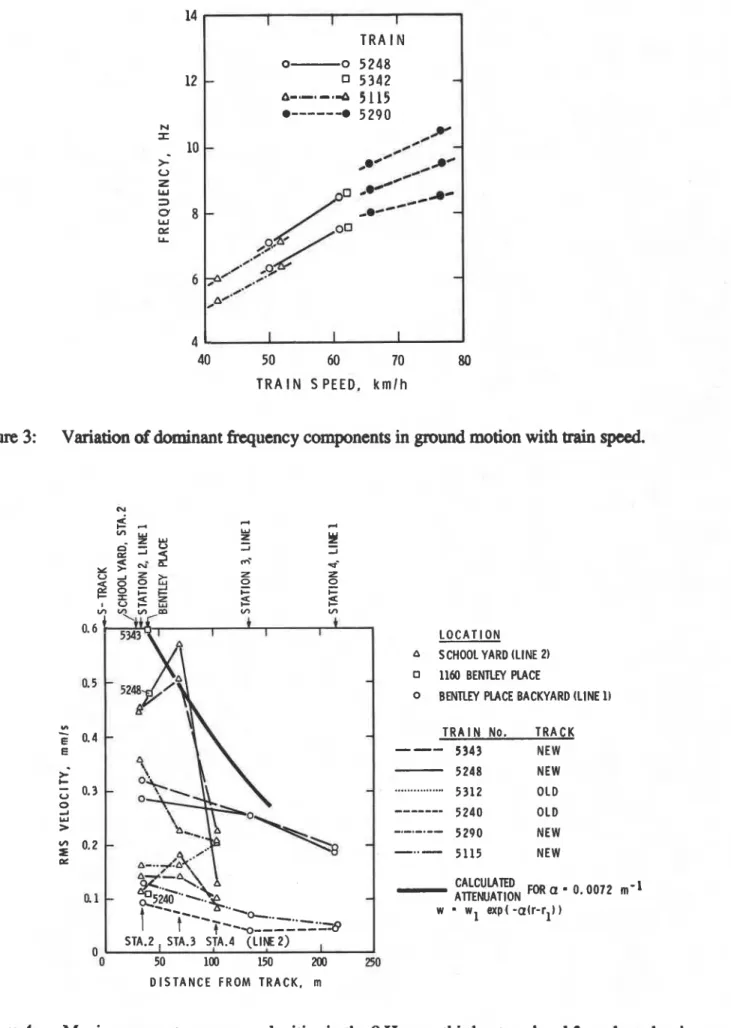
(b) The frequencies of the dominant ground vibration components generated from loaded freight trains travelling on the new track increased linearly with train speed,
with a dominant frequency ranging from 6 Hz at 42 km/h train speed to 10 Hz at 70 km/h (Fig. 3).
(c) The maximum ground vibration amplitudes varied along the track and with distance from the track, depending on train speed and train load (Fig. 4).
(d) The vibration amplitudes produced by trains on the old track were approximately
one-third those produced from the new track; this agrees with the results from previous investigations.
2.3 House Res~onse to Train-Induced Ground Vibrations: The horizontal vibration response of a single-storey house with basement, 1160 Bentley Place (Fig. 2), was monitored on the basement slab, at the first floor level, and at ceiling level at the same time as the ground vibrations were measured during train passage as described in 2.2. Typical results of the measurements are presented in Fig. 5 in the form of envelopes of peak accelerations.
The results demonstrated that large resonant response in a house as a result of trains travelling on the new track produced amplifications of 9 to 10 times between the ground and the first floor ceiling of the house under investigation. The maximum response recorded at the fmt floor ceiling level in the house tested was 4.0% g acceleration or 8.0 mm/s velocity.
2.4 Evaluation
of Soil Behaviour: To determine the effect of ground vibration on foundation
settlement the following investigations were carried out on soil in the Brocklehurst area, Kamloops, B.C. (Fig. 1):(a) A comprehensive picture of the type and geological history of the soil was obtained from borehole information, air photo interpretation, soil analyses for grain size distribution and other relevant data supplied by CN and the City of Kamloops. (b) Vertical ground shaker tests were carried out in the field under both dry and wet
soil conditions to determine the effect of vertical cyclic loading on settlement. (c) Laboratory tests were carried out to determine the compression of the soil, under
dry or wet conditions, due to static and cyclic loading. Most tests were on undisturbed natural soil samples obtained by means of a new double tube sampler, whereas some samples were reconstituted to represent loosely compacted fill that may be found in the area.
The results of these investigations are as follows:
(a) Previous studies have shown that the silty soil present in the area under investigation has high strength and low compressibility while dry, but its strength becomes reduced when the soil is wet, whereupon the grain structure collapses. No information on behaviour of this type of soil under vibrations could be found in the literature.
(b) Air photo interpretation and borehole information showed that the surficial deposits are composed of floodplain sediments of loose silt and sand. The soil samples obtained from the top two metre surface layer are composed mainly of angular silt size particles with 20 to 75% mica and the rest quartz. No appreciable amount of calcium carbonate, a possible cementing agent, was found.
(c) Tests on naturally-deposited soil showed that the soil at its natural moisture content does not undergo appreciable settlement for static loading intensity associated with one- to two-storey residential buildings and trailer homes, or for dynamic loading of an amplitude induced by the passage of trains at houses 40
m
from the tracks. The tests showed that wetting the soil produces an additional settlement of about 5mm
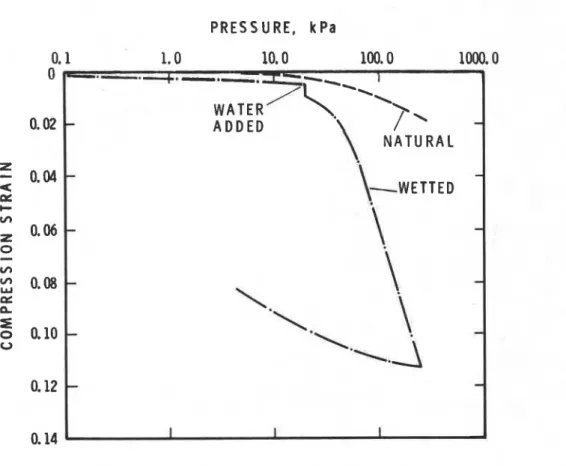
per metre of soil under the same static loading and that this settlement is further increased slightly under cyclic loading. This increase, however, is not sufficient to give rise to appreciable settlement under footings of one- to two-storey houses.(d) Tests on reconstituted soil samples showed that loosely compacted fill consisting of the silty material present in Brocklehurst will, when wetted, settle substantially more than the naturallydeposited wetted soil (Fig. 6). Vibrations of amplitudes as
stated above will cause little additional settlement when the void ratio of the soil is less than 1.25.
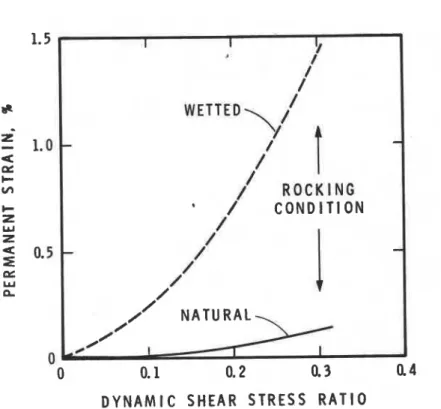
(e) Foundations supporting trailer homes may rock under train-induced ground vibrations (Fig. 7). This rocking motion can cause a high concentration of dynamic stresses under small footings. If such footings rest on loose and wetted fill, at a void ratio 1.25 or higher, some appreciable settlements
may
occur (Fig. 8).3. DAMAGE SUSCEPTIBILITY OF HOUSES
3.1 Damatre Criteriq: Damage criteria for continuous vibrations for the types of houses considered in this investigation are scarce. Previous investi.gations reported in the literature have shown that I damage to interior and exterior finishes such a s plaster and stucco can occur at low vibration
amplitudes of 2 to 3 mm/s, since locked-in stresses may already be present. The vibrations then provide the small additional loading needed to cause cracking or extensions of existing mcks. It
was felt that for the frequency range and the brittle finishes under consideration, 5 mrn/s represented a realistic criterion, below which architectural damage was unlikely to occur. While failure strain would provide for a more direct criterion, this is not usually done in practice due to nummus complexities and uncertainties. Rather, an upper limit of velocity as a damage criterion is chosen based on empirical data. For some special circumstances, however, a strain calculation is possible and this was carried out for basement walls for which the strains induced by travelling ground waves were found to be well below the cracking strength of concrete.
It has been common practice in previous damage investigations to measure vibration levels at or near the foundation level and to relate criteria to these measurements. This location is satisfactory for short-term excitations and non-resonant conditions for which the amplification from foundation to upper storey is close to 1.0. At resonance, however, the amplification may be 10 or more, resulting in much greater deformations between the footing and the top of the building than those referred to the ground measurements. The criterion of possible damage of 5 mm/s therefore should be applied over the full height of a one-storey building. This is also the position taken in the German vibration standard for buildings, DIN 4150 (1983).
Since it was predominantly ground motion measurements that were carried out here, the ground motion amplitudes that correspond to the criterion for possible damage of 5 mm/s vibration velocity
of the supersmcture have to
k
divided by the msonant amplification factor of up to 10. Thus the horizontal ground motion that corresponds to the resonant damage criterion of 5 mm/s is 0.5 mm/s. 3.2 ODerative Mechanisms Causing Possible Damage: For a damage mechanism to be considered operative or valid, the response of the structure has to meet or exceed the applicable damage criterion. On the basis of theoretical and experimental investigations conducted here, the following emerged as possible damage mechanisms from train-induced vibrations in the Brocklehurst area:(a) Horizontal resonance amplifications in houses from ground motion due to trains travelling on the new track at more than 30 mph (50 km/h);
(b) Settlement of mobile home foundations of narrow configuration set on loose wet fill, as a result of train-induced rocking of the footings.
3.3 Distance From
Track
for Possible VibrationDamage:
The ground vibration measurements indicated local variations in ground motion. Attenuation of ground vibration amplitudes with distance from the track takes place due to material damping in the soil. A mathematical model which incorporates this reduction is described in Richart, Hall and Woods, 1970. With this attenuation relationship, the distance was calculated at which the maximum ground velocity observed at 1160 Bentley Place (0.6 mm/s rms-
see Figure 4) decreases to the 0.5 mm/s peak ground vibration amplitude. This calculation and an evaluation of area-wide measurements from aprevious investigation (Barron and Associates, 1985) showed that, based on the 0.5 mm/s ground velocity criterion, the affected area can be divided into three zones:
-
Zone 1: up to 100 m from the track, where exceedance of the 0.5 mm/s ground velocity criterion is likely and relatively widespread,-
Zone 2: from 100 to 250 m from the track, where exceedance of the 0.5 mm/s ground velocity criterion is possible in isolated pockets;-
Zone 3: more than 250 m from the track, where exceedance of the 0.5 mmls ground velocity criterion is unlikely.Within Zones 1 and 2, however, damage due to train vibrations need not necessarily have occurred because of variations of material strengths and local attenuations observed along the track and at various distances h m the track. Furthermore, not all houses have the same dynamic properties as
those measured in this investigation and therefore may not reach the same response level. An on- site inspection and evaluation of each damage claim was therefore required.
4. APPLICABILITY OF
RESULTS
TO ADJACENT AREASThis investigation centred mainly on the ground and house responses to train-induced vibrations south of the CN tracks in the Brocklehurst area of Karnloops, B.C. The phenomena of house resonance and soil settlement also apply to the adjacent areas of Rayleigh where excitation and house and soil properties are similar.
4.1 Rayleigh Area of Karnloops, B.C.: It was decided not to take any new measurements of vibrations or soil properties in Rayleigh until the under1 g phenomena were better understood. The findings at Brocklehurst were transferred to Rayleigh
r"
or the following reasons.From previous measurements, the vibration intensities generated at Rayleigh by trains on the new track were similar to those on the new track at Brocklehurst. Soil conditions are similar to those at Brocklehurst, both in geologic origin, and type and depth of layering; and the type of wooden houses are comparable, so that the anticipated range of dynamic properties would be similar.
4.2 Other Geoaaphic Locations: The fmdings of this investigation are applicable only to the
Brocklehurst area, and by extension, the Rayleigh area of Kamloops, B.C. since the ground properties, characteristics of track and trains, and building properties can vary from one site to
another. However, the methods employed and the mechanisms identified may be applicable elsewhere.
5. RECOMMENDATIONS FOR
FUTURE
INVESTIGATIONSThis case study demonstrates that commonly used procedures and assumptions employed in investigations of ground-induced vibrations are not always adequate for the following reasons:
-
It is common practice to measure only vertical vibrations in the ground and in houses and to virtually ignore the presence of horizontal components. Both can be significant since either can cause resonance; thus both should be measured.-
It is often assumed for attenuation, that ground vibrations originate from a point source. While this may be justified for blasting and other localized sources, for long freight trains a line source is more appropriate. In a perfectly elastic medium a line source does not attenuate with distance h m the source, whereas those from a point source attenuate with the square root of the distance.-
Damage criteria for traffic vibrations are often selected from dissimilar types of excitation, e.g. blasting. These do not apply to train-induced vibrations since the frequency ranges and the durations are different, both of which affect the likelihood of achieving resonance.-
Resonance of buildings or their components is rarely considered explicitly. The planning of a program of investigation should deal with the possibility of resonance response.-
The properties of the subsoil are seldom studied. Such a study can produce deformational and damping characteristics which are useful in analysis of the results.In addition, certain analysis procedures and criteria, which are employed routinely for Mi-
induced vibrations, are not always adequate. These include:
-
One-third octave band analyses of measured ground and house vibrations should be supplemented by nmw-band spectra. The latter can provide important information about signal characteristics such as frequency shifts.-
Peak vibration amplitudes rather than broadband or third-octave band r.m.s. amplitudes should be used for assessing damage; cracking is a result of excdance of material strength which is more closely represented by peak vibration amplitudes than r.m.s. or mean value.-
Operative damage mechanisms should be identified in order to understand the problem better and develop strategies about how to avoid it.These considerations should be taken into account in the assumptions and procedures contained in
6. CONCLUSIONS
Investigations of train-induced vibrations in buildings should consider the following:
(1) Unexpectedly large house response can result from train-induced vibrations due to resonance effects.
(2) Horizontal and vertical vibrations of ground motion and building response need to
be considered in investigating traffic-induced vibrations.
(3) Commonly used criteria for vibration damage need to be examined for applicability and suitability. Consideration should be given to frequency range, and duration of excitation, type of structure and materials, and signal description (r.m.s., peak).
(4) One-third octave band analysis should be supplemented by narrow-band spectra for additional information on signal characteristics.
In addition, there is a need for development of improved damage criteria.
7. ACKNOWLEDGEMENT
This investigation was carried out under a contract from Transport Canada and the results
are
published with their permission.
The cooperation and assistance of the following individuals and organizations is gratefully acknowledged: Railway Freight Policy Branch of Transport Canada, the many home owners and residents in the Brocklehurst area of Kamloops, B.C., who provided access to their properties;
CN
Rail in Kamloops and Edmonton, who cooperated fully with coordination and schedulin requirements; the City of Kamloops for information on soil conditions; the Agriculture Researc
%
Station of Kamloops for roviding a "staging area" for the investigating team; and Dr.P.E.
Grattan- Bellew of the Institute!
or Research in Construction (IRC) for mineralogical examination of soil samples. The geological history of the Kamloops area was analyzed by Mr. Roy van Ryswyk, geotechnical engineer, of Delta B.C. The technical assistance by R. Glazer, E.C. Luctkar,T.J.
Hoogeveen, A. Laberge, J. Turcotte, and R. Laplante is gratefully acknowledged. 8.REFERENCES
Barron and Associates. 1985. Private communication.
DIN 4150-1983, Part 3: Vibrations in buildings
- influence on constructions. German standard,
Berlin.Richart, F.E., Hall, J.R. and Woods, R.D. 1970. Vibrations of soils and foundations. Prentice-Hall Inc., Englewood Cliffs, New Jersey.
77.06 61.86 48.25 30. $5 15.45 0 83.79 b) NEAR MIDDLE 67.04 3 I-
-
50.28 E a cr 33.53 W-
e 18.77 L 0 80.85 64.69 48.52 32.35 16.18 0 0 5 10 15 20 F R E Q U E N C Y , H z 3% ' N O l l V Y 3 1 3 3 3 Va) Time Envelope b) Fourier Amplitude Spectra
Figure 2: Transverse ground vibrations at Station 2, Line 1, from Train 5248.
I
T R A l NI
-,
40 50 60 70 80
T R A I N S PEED, k m l h
Figure 3: Variation
of
dominant frequency components in ground motion withtrain
speedL O C A T I O N
A SCHOOL YARD (LINE 2)
0 1160 BENTLEY PLACE
0 BENTLILY PLACE BACKYARD (LINE 1)
T R A I N No. T R A C K
---
5 3 4 3 NEW 5 2 4 8 NEW .. .
. . .. . . ...
5 3 1 2 OLD---
5 2 4 0 OLD-.-.-.--
5 2 9 0 NEW-..-
5 1 1 5 NEW-
CALCULATED FOR a = 0 . 0 0 7 2 m - l ATTENUATION w = wl exp( -a(r-rl)) - 0 50 100 150 200 250 D I S T A N C E F R O M T R A C K , mFigure 4: Maximum
nns
transverse velocities in the 8 Hz one-third octave band for s e l d trainpasses.
P R E S S U R E , k P a
Figure 6: Static pressure-compression curves for soil sample from Bentley Place.
W I / T R A I L E R F R A M E - 0.05 W
-
I ' S P A C E R A N D S H I M S C O N C R E T E B L O C K S O R P O S T(
[-BLOCK O R R A I L W A Y T I E S T A T I C S O l L S T R E S S ( I D E A L I Z E D )--
D Y N A M I C S O l L S T R E S S-
&
( I D E A L I Z E D )Figure 7: Static and dynamic soil pressure under mobile home footing.
1.5 I# 2
-
1 . 0 - u P: I- m I- Z I 1 II
/'
wmEDb/
'
R O C K I N G1
-
/ C O N D I T I O N W Z 4 0 . 5 --
I P: W a 0-
o
0.1 0.2 a3 a4 D Y N A M I C S H E A R S T R E S S R A T I OFigure 8: Permanent deformations measured in triaxial test on soil sample from
Orchard
TrailerT h i s paper is being d i s t r i b u t e d i n r e p r i n t form by t h e I n s t i t u t e f o r Research i n . C o n s t r u c t i o n . A l i s t of b u i l d i n g p r a c t i c e and r e s e a r c h p u b l i c a t i o n s a v a i l a b l e from t h e I n s t i t u t e may be o b t a i n e d by w r i t i n g t o t h e P u b l i c a t i o n s S e c t i o n , I n s t i t u t e f o r Research i n C o n s t r u c t i o n , N a t i o n a l Research C o u n c i l of C a n a d a , O t t a w a , O n t a r i o , KlA 0R6.
Ce document e s t d i s t r i b u 6 sous forme de t i r 6 - 3 - p a r t p a r 1' I n s t i t u t de r e c h e r c h e en
c o n s t r u c t i o n . On peut o b t e n i r une l i s t e d e s p u b l i c a t i o n s de 1 ' I n s t i t u t p o r t a n t s u r les t e c h n i q u e s ou les r e c h e r c h e s e n matisre
d e batiment e n Gcrivant