IDOCUMENT
OFFICE
&p!~
T OOM 36n4IZ0
RESEARCH LABORATORY OF FqLECTRONICS
MASSACHUSETTS INSTITUTE OF TCHOLOY
I
COMMUNICATION OVER NOISY CHANNELS WITH NO A PRIORI
SYNCHRONIZATION INFORMATION
DAVID CHASE
REPORT 463
FEBRUARY 29, 1968
MASSACHUSETTS INSTITUTE OF TECHNOLOGY
RESEARCH LABORATORY OF ELECTRONICS
CAMBRIDGE, MASSACHUSETTS 02139
L______
The Research Laboratory of Electronics is an interdepartmental laboratory in which faculty members and graduate students from numerous academic departments conduct research.
The research reported in this document was made possible in part by support extended the Massachusetts Institute of Tech-nology, Research Laboratory of Electronics, by the JOINT SER-VICES ELECTRONICS PROGRAMS (U.S. Army, U.S. Navy, and U.S. Air Force) under Contract No. DA 28-043-AMC-02536(E); additional support was received from the National Aeronautics and Space Administration (Grant NsG-334).
Reproduction in whole or in part is permitted for any purpose of the United States Government.
MASSACHUSETTS INSTITUTE OF TECHNOLOGY RESEARCH LABORATORY OF ELECTRONICS
Technical Report 463 February 29, 1968
COMMUNICATION OVER NOISY CHANNELS WITH NO A PRIORI SYNCHRONIZATION INFORMATION
David Chase
This report is based on a thesis submitted to the Department of Electrical Engineering, M. I. T., June 1967, in partial fulfillment of the requirements for the degree of Doctor of Philosophy.
(Revised manuscript received November 6, 1967)
Abstract
This work is concerned with determining how a lack of synchronization affects the minimum probability of error obtainable when information is transmitted over a noisy communication channel.
The channel capacity for discrete memoryless nonsynchronized channels is shown to be the same as the capacity for synchronized channels. For all rates below capacity, the minimum probability of error for the nonsynchronized channel decreases exponen-tially with the code block length. The exponent in the upper bound on the probability of error for the nonsynchronized channel is the same as the corresponding exponent for
the synchronized channel for rates near channel capacity. For low rates, the best
exponent obtained for the nonsynchronized channel with conventional block coding is
inferior to the exponent obtained for the synchronized channel. By introducing a new
form of coding, which allows for a Markov dependency between successive code words, one is able to show that for certain channels the exponents for the nonsynchronized and synchronized channels are equivalent for all rates.
For binary channels, bounds on the minimum probability of error are obtained for unconstrained binary codes, as well as for several classes of parity-check codes. These bounds are also used to obtain asymptotic distance properties for the various
classes of unsynchronized binary codes. These distance properties are considerably
stronger than just statements on the existence of comma-free codes. In particular, we show that for a certain range of rates there exist codes whose minimum distance, in the comma-free sense, is not only greater than one, but actually is proportional to the block length.
TABLE OF CONTENTS
I. Introduction 1
II. Behavior of Codes Having Synchronizing as well as
Error Correcting Capabilities 3
2. 1 Source, Channel, and Lack of Synchronization 3
2. Z Error Criterion 4
2 .3 Decision Rule 7
2. 4 Decomposition of Error Probability 9
2. 5 Derivation of the Random-Coding Bound 16
2. 6 Discussion of the Random-Coding Bound 40
2. 7 Application of the Random-Coding Bound to
Generalized Parity-Check Codes 53
2. 8 Random-Coding Bound for Channels with
Input Constraints 59
2. 9 Derivation of the Expurgation Bound 68
2. 10 Discussion of the Expurgation Bound 90
III. Summary of Results and Suggestions for Future Research 99
Appendix A Decision Rules for P(eJ) and P(e) 103
Appendix B Choosing and p for Pe(f, all m*a,b) 107
Appendix C Properties of the Bound on Pe(k, m=a) 109
Appendix D. Proof that Esx(p) > Ex(P) for the BSC and BEC 112
Acknowledgment 114
References 115
I. INTRODUCTION
Significant insight into the problem of transmitting information over a physical com-munication link has been gained by studying mathematical models of comcom-munication sys-tems. The noisy communication link is modeled by a communication channel where there is a given set of input symbols, a given set of output symbols, and for each input symbol there is a probability measure on the set of output symbols. Information is transmitted over this noisy communication channel by first passing the data through a coder that maps the information into a sequence of code words, with each code word containing a certain amount of redundancy. This amount of redundancy is quite critical, since the pro-tection against the channel noise offered by the redundancy can be accomplished only by limiting the maximum possible data rate.
Coding theorems have been proved which state that information can be transmitted over a noisy communication channel with an arbitrarily low probability of error,
providing that the data rate is below the capacity of the channel. For rates above
channel capacity the theorems state that it is impossible to make the probability of error arbitrarily small. 1,2
These coding theorems enable the communication engineer to make intelligent pre-dictions about what he can and cannot accomplish when confronted with the problem of
transmitting data over a given communication link. Furthermore, the unexpected, and
indeed promising, results given by these theorems have provided the motivation, as well as some of the insight, which has led to the discovery of several quite novel and
practical coding schemes3 6 offering considerable improvement in performance over
conventional systems.
One of the assumptions made for arriving at the channel models on which these theorems are based is that the receiver already has the timing information required to decode the received noisy version of the transmitted code word. The object of this work will be to remove this assumption and find the new forms of the coding theorems. While the establishment of coding theorems for a nonsynchronized channel has gen-erally been a neglected topic, there has been considerable interest, recently, in the topic of synchronization. One school of thought, which departs from the well-known procedure of inserting a synchronizing sequence7 periodically in the data stream, has been con-cerned with finding comma-free codes. These codes have the property that, for a block length N, all sequences of N letters, composed of portions of two adjacent code words, differ in at least one place from the actual set of code words.8 This requirement does not say anything about the error-correcting capabilities of these codes, nor whether the resulting code will be a parity-check code, or equivalently a linear code. Thus, there is no guarantee that a comma-free code can be used over a noisy channel or whether such a code possesses any properties that can lead to efficient encoding or decoding. More recently, research efforts have been devoted to modifying known linear codes
in order to obtain error-correcting capabilities, as well as some synchronizing
capabilities.9, 10 When investigating problems of this sort it is of considerable interest to know how reliable a linear code can be made. The coding theorems presented here are, of course, directly related to questions of this nature.
In particular, for a broad class of channels, we shall be concerned with how a lack of synchronization affects the minimum probability of error that can be obtained for any
possible code. The channels considered here include discrete amplitude channels, such
as the binary symmetric channel, as well as continuous amplitude channels with input
constraints such as the additive Gaussian noise channel. For binary input channels,
results will be obtained for codes that are constrained to be parity-check codes, as well as for unconstrained binary codes.
By obtaining bounds involving the relation between the probability of error and the rate of communication, we shall be able to answer questions such as What is the maxi-mum rate at which the probability of error can be arbitrarily small?, or equivalently, What is the channel capacity of a nonsynchronized channel? Also, and perhaps more important, we shall be able to obtain fairly tight bounds on how the probability of error behaves for rates below channel capacity.
The results to be obtained will somewhat parallel the results obtained by Gallager1
for the synchronized channel. A random-coding bound, as well as several different
types of expurgation bounds, will be obtained for the nonsynchronized channel. An
interesting feature of these bounds will be obtained by considering their behavior as the channel becomes noiseless. Under this limiting condition, the error bounds will reveal some rather fundamental minimum distance properties of unsynchronized codes.
II. BEHAVIOR OF CODES HAVING SYNCHRONIZING AS WELL AS ERROR CORRECTION CAPABILITIES
The main philosophy of this work will be to use the redundancy in code words for synchronization, as well as for error correction. The problem of deciding which mes-sage was transmitted will be treated jointly with the problem of deciding where the transmitted message actually begins. By not isolating these two closely related prob-lems, one is able to obtain a considerable improvement in error performance over methods in which the transmitted message is decoded by first obtaining synchronization without the use of code-word information.
2. 1 SOURCE, CHANNEL, AND LACK OF SYNCHRONIZATION
The source will be viewed as transmitting one of a possible M messages every T seconds. The code word used to represent a given message will be transmitted over a time-discrete memoryless channel. Thus, a code word of length T sec is viewed as a
sequence of N code letters. The mt h code word is represented by the sequence Xm =
X, Xm. .. X , where each letter of the code word takes on some value x contained
in the set of allowable channel inputs. Since a new message is transmitted every T sec, a continuous stream of code letters are transmitted over the channel.
The channel is described by the set of transition probabilities P(y x), which gives the probability of receiving a particular output letter y when the channel input is x. Since the channel is memoryless, the output letter y is dependent only upon the input at that time x.
For the time being, both x and y will range over a finite set of values. The results will also be extended to amplitude-continuous channels that are described by a condi-tional probability density, p(yl x).
The lack of synchronization will be reflected by the receiver having no a priori information about which sequence of N channel output letters corresponds to a complete code word.
The receiver will attempt to determine what the source is transmitting by working
with the sequence Y = Y...Yq. . .Yq+N1 . . Y of channel output letters. The N letter
sequence Yq .. Y q+N1 denotes a set of channel output letters depending on a complete code word. Since the receiver has no information concerning the starting time of a code
word, q can range over a set of N consecutive integers. Thus, with q unknown, the
problem that the receiver now faces becomes quite a bit more involved than the usual decoding problem of deciding which of the possible code words correspond to the
sequence Y ... Y
The length of the sequence Y, denoted by the integer z, will be pinned down later
when the decision rule is discussed. In formulating the decision rule we shall surely
be concerned with keeping z reasonably small, so as to justify the assumption that this sequence suffers no further disruptions in timing.
When the value of q is determined we shall say that the receiver has obtained
code-word-sync. While in some systems this may be all that is required in the way of timing
information, other systems may also require the knowledge of the position of the code
word; that is, does Y correspond to the first letter of the 1 4 9th code word transmitted
th q
or the 150h ? When both code-word-sync and the position of the code word are obtained,
we shall say that the receiver has achieved absolute-sync.
In order to achieve absolute-sync, a coding scheme enabling one to distinguish the
relative position of the code word is required. But before we can decide on the coding
scheme we must decide on how many positions must be distinguished. Even after a long fade, upon the resumption of communication, the receiver will still have some idea
about which code word is responsible for the present signal. This coarse knowledge of
the position of the code word can be stated by saying that the receiver knows absolute-sync within LT sec or LN letters. Note that as long as L a 1, this coarse knowledge of sync supplies no information relating to code-word-sync.
If L = 1, then the determination of code-word-sync also yields absolute-sync. When L is some integer greater than 1, absolute-sync can be determined by using the following coding scheme. Instead of starting with a code of M code words, a code with
LM words is used. This code is divided into L sections of M words, with each
suc-cessive section being used as the code for sucsuc-cessive messages. Since the same
sec-tion is not used again until L messages are transmitted, knowledge of code-word-sync and the code word, with its corresponding section, is sufficient to determine absolute-sync.
The particular coding scheme that is to be analyzed will consist of a code of 2M
words which will enable us to determine absolute-sync for L < 2. The code will be
divided into two sections, with the code word Xa (a= 1, 2... M) being in the first section,
and the code word Xb (b= M+ 1, ... 2M) being in the second section. Now if the mth
mes-sage is transmitted twice in a row, the first time it will be coded as Xa, with a= m, and
the second time it will be coded as Xb, with b = m + M.
The procedure is similar for any arbitrary L > 2, so that once the
anal-ysis is completed for L = 2, the results for any L > 2 can easily be obtained.
For L = 1, or when the same set of M code words is used to code
succes-sive messages, the analysis becomes more involved because when the same
mes-sage is transmitted twice in a row, a different treatment from the one for the
more typical cases is required. 2.2 ERROR CRITERION
The performance of the receiver will be evaluated for two different cases. The
dif-ference will be that the event that is called an error will not be identical in each case. For both situations the criterion for judging the performance of the receiver will be the value of the probability associated with the event called an error, or simply the prob-ability of error.
a. Joint Event
For this case a joint estimate of a particular code word and its starting position will
be made. The code word to be determined will be the first one that starts after N]
letters are received. (The brackets around N/Z should be taken to mean "the
integer part of," or equivalently, when N is odd, it is replaced by (N-1)/2.)
Thus, in the sequence Y= Y Yq . Yq+ N-.Y .. Yz the value of q will be in
the range
[L
1] q {i+ N (1)An error will be made if either the value of q or the code word starting in this
posi-tion is determined incorrectly. In order to decode correctly, it is necessary for the
receiver to make a decision on a starting time in the predetermined range above. The
probability of an error on the joint event will be denoted P(eJ).
b. Single Event
For the case described in section 2. Za the receiver was required to determine
code-word-sync and the corresponding code word. In many systems, however, the real
con-cern of the receiver is not with the precise starting time of the code word, but with the actual value of the code word. Taking this point of view, we shall assume that the sys-tem can tolerate the situation in which the code word is determined correctly
some-where within ±
[N]
letters of its true sync position. Thus, it will be perfectly acceptableif the receiver decodes successive messages correctly, even though some of the mes-sages may be decoded as much as [N/2] letters early or late.
At the present time, we shall not be concerned with how well the receiver can do with a sequence of code words, but just with the probability of error on the first word
decoded. In order for the receiver to decode correctly, two requirements will be
imposed. Not only must the decoded word be within ± [N/Z] letters of an identical code
word actually transmitted but also the receiver will be required to decode a word in
one of the N positions given by (1). This restriction forces the receiver to make a
deci-sion over a predetermined range of N positions, as was required previously.
It is now possible to make a decision in any of the positions given by (1) and still be
correct. For example, consider the case shown in Fig. 1, where q = N + N], with Xa
denoting the code word starting in position q, and Xb denoting the code word preceding
it. In the region from position N+ 1] to position Z , no error is made if Xb is
decoded, while in the region covered by positions N to + N ,no error is made if
Xa is decoded. Needless to say, for an efficiently designed system, the receiver is
5
--INPUT SEQUENCE FOR q=[ N + N]: ----OUTPUT SEQUENCE : Y1 --xb .0 [yNi 2F RANGE OF q: POSSIBLE STARTING POSITIONS REGION WHERE b I X I CAN BE DECODED: REGION WHERE Xa CAN BE DECODED [ + N] Xa Y
Fig. 1. Decoding regions for P(e).
I I
~XN
N I I ---XN~7
I
very likely to decode Xa in its correct position. Nevertheless, since the other events are possible, the actual position where a decision is made cannot alone determine an error, as was possible for the case in section 2. 2a.
The probability of error for this "single event" of determining a code word correctly will be distinguished from the previous case by being written as P(e).
2. 3 DECISION RULE
The form of the decision rule to be used by the receiver for the two previous cases
will now be given. In order to proceed forward in the most direct manner, the
partic-ular decision rules will just be stated. Some of the motivation leading to the form of
these rules is given in Appendix A. a. For P(eJ)
A sequential test will be performed by the receiver in an effort to determine the
desired joint event. The first position to be tested will be q = + 1]. If the test fails
at this position, the receiver assumes that -N + 1 is not the correct starting position
and moves on to test position
L-N+
Z], and so forth. The receiver will be correct if thefirst successful test occurs when q = q and also when the code word estimated at this position is the correct one.
The basic function used in performing these tests is
q'-1 q'+N-1 z
D(Y I X+, q' P (Yi Xmii -q( , ~I )
i=q' i=q'+N
where P(Yi) is the probability of receiving a particular output letter Yi, taken over all possible inputs that occur according to a distribution given by P(x). In terms of the channel transition probabilities and the input distribution, we can write
P(Yi) = P P (Yi I x). (3)
x
The function P(Yi Im+l-q') is the channel transition probability of receiving Yi when
the channel input is X m ,. X m , denotes the (i+ 1 q' )th letter of the code word Xm,
i+l-q, i+l-q'
which is placed in the starting position given by q'.
For an assumed starting position of q, the test is considered successful if and only if
max D(YX, X q) > max max D(YlXm q), (4)
m q Ill m
where the maximization of m is taken over all ZM code words, and the maximization of q' is taken over the values
q+ 1, q+2,... q
q= (5)
q - , q - 2, 2
If a q is found that satisfies the test, the receiver will say that the code word's
starting time is q and the code word corresponding to the sequence Y, . .. Y is
q q+N-1
the one that maximizes the left side of (4).
th a
With the code word starting in the q position denoted Xa, we note that the receiver
will be correct if the test is unsuccessful for all q in the range [Z+ 1 q < q and,
furthermore, when q = q we have
max D(YIX q) D(YIXa, q) > max D(YIm, q (6)
m - m
where, as given by (5), q' ranges over the IN2 positions before and after q.
Since the starting position of the code word in question is a variable, the number of tests required by the receiver in order to decode correctly will vary with q. For
q N+ 1j, a correct decision can be made on the first try, while for q = N + N], N
tests are required. Under any circumstances, a decision will be made somewhere in
the range given by (1). The decision made by the receiver for the case when N
succes-sive tests have failed will be that an error has occurred, since the position when q = q
had to be passed over. This type of detected error is just one of the possible errors
that are included in the calculation of our error criterion given by P(eJ).
The minimum length z of the sequence Y = Y1. .. Yq ... Yq+N-i' ' Yz required for
a decision will also depend on the value of q. In our decision rule we shall require z
to be long enough so that the portion of D(YIXm, q') involving the channel transition probabilities is always included. This will be the case, as long as z is at least N - 1
letters greater than the maximum value of q' in (5). Having a longer z will not change
the results of the test, since the added product of P(Yi)'s will be the same for all m
and q'. Thus, we can conclude that the minimum value of z required for the receiver
to make a correct decision is
Zmin = q + + N-
,
(7)with the range of q given by (1).
When choosing the length of Y on which a decision will be based, the receiver can
take the optimistic point of view and pick z = 2 [N + N. If the test fails, however, the
receiver must increase z by 1 and recalculate the function given by (2) in order to test
the next position. The pessimistic receiver will pick z = 2 N + 2N - 1 from the start,
-being the same function, regardless of the assumed starting positions. In either case, the maximum waiting time for a decision will be less than three block lengths. This decoding delay can be compared with the usual waiting time of one block length required for a receiver that already has synchronization.
b. For P(e)
The decision rule for this event will be very much like the previous one. Again, a
sequential test will be used in order to determine the desired event. The first test will
occur in position [-N+ 1], with the receiver moving to successive positions if the test is
unsuccessful.
The test at a given position will be considered successful if and only if
max m /> max max
Dm(YIX ,q ) D(Y m, q) D(Y q ), q(8)
where the range of m and q' is the same as before. Xm is used to denote the code word
that maximizes the left side of (8). For this rule, Xm is not included in the
maximiza-tion on the right side of (8).
If the test is satisfied at some position over the range given by (1), the receiver
will say that the transmitted code word is X . If the test is not satisfied for any of the
N possible positions, an error will have occurred, because of the imposed restriction
on the range of q. This restriction insures us that a decision will be made within less
than three block lengths, as was true previously.
The difference between the two decision rules is that, in this case, m is omitted from the maximization on the right side of (8). This omission makes the newer decision rule somewhat easier to satisfy. We no longer require the estimated word to compete
with shifts of itself. Hence, in this case, the receiver will make more decisions that
are considered correct than is possible for the previously described joint event. This is as it should be, since for any worthwhile set of decision rules P(e) should be less than P(eJ). This intuitive notion is brought out more formally in section 2. 6.
2.4 DECOMPOSITION OF ERROR PROBABILITY
We shall be concerned with obtaining an upper bound on the probability of error for the two events previously described. The upper bounds will be a function of a given code and thus depend on the particular choice of the 2M code words that make up the code under consideration. In the following section the bounds will be evaluated by using random coding techniques.l
The probability of error will be upper-bounded by a sum of terms that are relatively
easy to handle individually. Extensive use of the union bound, overbounding the
prob-ability of a union of events by the sum of the probabilities of each event, will be made in this section. The tightness of these bounds will be confirmed in section 2. 6, which includes a comparison of the upper bounds with a lower bound.
9
a. Upper Bound on P(eJ)
The probability of an error on this joint event can be written
P(eJ) = E P(seq) P(ejI seq), (9)
all seq
where P(eJI seq) is the probability of an error taken over all possible outputs for a given input sequence of source messages. This source sequence will consist of message a in
position q: j (that is, the corresponding code word Xa will start in position q and will be
from the jth (j = 1 or 2) section of the code), as well as the relevant messages preceding and succeeding message a.
Our present concern will be, first, to obtain a bound on P(eJI seq) that is applicable
for all source sequences, regardless of the particular value of q: j, or the particular
sequence of source messages. Once this bound is obtained, a bound for P(ej) can be obtained by averaging over all possible source sequences. Fortunately, when the behav-ior of a randomly selected code is studied, we shall be able to obtain one bound on
P(eJI seq) that is valid for any source sequence. Thus, the bound will also be a valid
bound on P(eJ).
The first step in bounding P(e I seq) will be obtained in the following manner. A sufficient condition will be found in order for no error to occur. Since this condition will not be a necessary condition, the probability of this condition being true will only be a lower bound on the probability of no error or on 1 - P(eJ I seq). Thus, an upper
bound on P(e I seq) can be obtained by finding the probability that this sufficient
condi-tion is false.
The first part of the condition in mind is the requirement that the test given by (4) be satisfied at the true sync position and that the code word that maximizes the left side
of (4) be the correct one. Mathematically, this requirement is written out by (6).
This condition alone is not sufficient to insure that the receiver will not make an
error for those values of q greater than 2 -1 + 1. Note that the test range given by q'
only extends back to the position [q -N2 so that when q is large enough it is possible
for the receiver to make an early decision over the range + 1 to [q-- 1.
In order to insure that a decision is not made prematurely, a further requirement
will be imposed. It is that
max D(YXm, q - N)= D(YXb q-N) > max max D(YIX m qf), (10)
m q-- m
where Xb is the code word preceding Xa and starting in position q - N as shown in Fig. 2.
The range of m is as before, and the range of q" is from N + 1 to q-N - . This
INPUT SEQUENCE
FOR q =2 +N]:
VAUE OF [b [X - - - - - -x b > | < xa VALUES OF max D (Xjq ) OUTPUT SEQUENCE: Y, D(Y 1x%-N)t
t
D (YIX q )rtt
qq
Y -[] 2 ] ·-- RANGE OF q VALUES OF max m D (YIXq )-mq't
_ _ _ _ _ _
- y
zFig. 2. Example: with Xm = Xa and q = q.
11
' I ' I I I · . . .
really necessary to guarantee that no early decision is made.
Combining the conditions given by (6) with that given by (10), we obtain a
sufficient condition for the receiver to decode correctly. Thus, an upper bound
on P(ej|seq) is given by the probability that either (6) or (10) is false. The
probability of the union of these two events can now be upper-bounded by their sum to give
P(eJ Iseq) P1(ej seq) + Po(eJI seq), (11)
with Pl(eJI seq) the probability that (6) is false, and Po(eJI seq) the probability that (10)
is false. Even though P(e
I
seq) is only required for those q > 2j
+ 1, it will stillbe carried along so that eventually a bound on ( 1l) can be obtained which is valid for any source sequence and thus for any q.
Equation 11 will be upper-bounded further by bounding P1(eJ seq). This probability
can be written
P1 (eJIseq) = Prob (Y Xa q) ma D(YX , q) max or
D(YXa ,q)_ max D(YIXm , q') for some q. (12)
The probability (12) is taken over all outputs Y that are possible for the given input sequence.
Pl(eJI seq) can be simplified by using the union bound, which enables us to treat separately the comparisons between position q and each value of q' given by (5). By
letting = q-q', the upper bound on (12) becomes
Pl(eJ seq) Pe(0, all m a) + I Pe(, all m), (13)
all q' where
max
m I
Pe(, all m) = Prob D(XYIXa, q) max D(Yxm, ,q')] (14)
and
Pe(0, all m*a) = Prob[D(YoI Xa, q) max D(YXm'q)j. (15)
Note that as q' varies over the range given by (5), will vary over the range 1 to
twice. Generally, for a given code Pe(Q, all m)will not be the same for q' =q+Q and q'=q-Q.
In (14), Y is replaced by Y, since only a portion of Y is really relevant in the
probability that is being calculated. Y denotes the N + letters of Y that are in phase
with Xa, starting at position q and X at position q' (see Fig. 3). The remaining
INPUT SEQUENCE: - - aN]
xa
._ xb
TEST CODE WORD AT POSITION q OUTPUT SEQUENCE USED FOR A DECISION: [xm-- xm] Xm e Y --q Yq Y Yq+ N-- - -- Yz Y -4
---i
YFig. 3. Relevant output for Pe(L, all m).
13 -. . Y1 -, P 0 - -1 I
--because it is the same for both D(YIXa, q) and max D(YIXJm , q').
m a
In (15), the relevant part of Y is just Yo' the N letters in phase with Xa starting
in position q. Since the entire product of P(Yi)'s cancel, the function used in our
deci-sion rule reduces to
D(Yo x1a,q) = P(YoXaq), (16)
the conditional probability of receiving Yo given Xa__, or the function used in
maximum-likelihood decoding. Thus (15) is very much like the probability of error for the
syn-chronized channel. The minor difference is that there are 2M- 1 code words involved
in the maximization in (15) rather than M- 1 code words.
While (15) is in a form that can readily be bounded, Eq. 14 still requires some
modification. The cases in which the test code word XM (see Fig. 3) is equal to X a or
xb have certain code-word dependencies that will require special treatment. These
cases can be pulled out of (14) by the use of the union bound to give
Pe(2, all m) Pe(f, all m *a, b) + Pe(Q, m= a) + Pe(2, m= b), (17)
whe re
Pe( , all m*a, b)= Prob D(Y Xa, q) max D(Y m
q)
(18)mza, b
-with
Pe(, m=a) = Prob[D(YXa, q) -- D(Y1xa,q) xa (19)
and
Pe (, m= b) = Prob D(Y IXa, q) D(YI Xb, q')j. (20)
When q' > q, (17) still holds, as long as Xb is interpreted as the code word succeeding
Xa rather than preceding it.
The decomposition of P1(eJ seq) is the desired form, regardless of the input
sequence. We point out that when a code with just M words is used, one would use the
decomposition above for the typical input sequences when Xa is not equal to Xb . As we
have mentioned, however, this case has the analytical disadvantage that a different
treatment is required to obtain a bound when the input sequence is such that X = Xa .
The desired decomposition of P (eJ I seq) is very similar to that used for P1 (eJ seq).
Note that Po(eJ
I
seq) can be writtenPbFDYIb max~~ D(YXm,
~l~i
"] (21)P(eJ seq) - Prob[D(Y Xb, q - N) max D(Yx m q) , for some (
which differs from (12) only in that the range of q" from
[N+
1 to q-N- 1 is smallerthan the range aof q', and a are interchanged.the roles of Xb than the range of q', and the roles of Xb and Xa are interchanged.
Thus, a bound on P(e I seq) can be obtained once a procedure is found to bound the
functions given by (15), (18), (19), and (20). In the rest of this section we shall show
that some of these same functions can be used to bound P(e).
b. Upper Bound on P(e)
As before, we concentrate on bounding P(e seq) with P(e) given by
P(e) = I P(seq) P(eI seq). (22)
all seq
The first part of a sufficient condition required for the receiver to decode correctly is that the test given by (8) be satisfied at position q, and that the word chosen at this
position Xm be the correct one, Xa . Once this part of the condition is satisfied, we can
rest assured that for q 2 Ni + , Xa will be chosen somewhere in the range from
L+
1 to q.For q > 2 N2 + 1, it is necessary to impose a further constraint in order to insure
that a correct decision will be made if a decision is made before [q N2 . The form of
this condition is
max max -Xm ... (23)
m D(YI X , q-N)= D(Y1X b, q-N) > max max D(YIXm (23)
m - q"
where the range of m is over all 2M code words, and q" ranges between N+
1I
and[q- N-i
When (23)holds, the only possible decision that can be made in the range from
LN+
1]to q-N- 1 is that Xb was sent. Since Xb would then be decoded within letters of its
true position, no error would occur. Similarly, when (8) is satisfied at position q by
Xa, we are assured that, if no previous decision has been made, Xa will be chosen
somewhere in the range from q - N to q. Thus, the combination of the two conditions
above is sufficient to insure that an error will not occur.
Now P(e seq) can be upper-bounded by calculating the probability that the sufficient
condition above is false. The probability that either of the two parts is false is
upper-bounded by the sum of their probabilities to give
P(e I seq) P1(el seq) + Po(el seq) (24)
with
P1(el s e q ) = Prob D(YIXa,, m q) or
q) max D(YX m , q') for some q (25)
D(lIa
- moa
X_%
q)
(25 )15
and Po(el seq) the probability that (23) is false.
Using the union bound again, we bound P1 (e
I
seq) byPl(el seq) s P(0, all mAa) + E Pe(f, all mka), (26)
q'
where = Iq-q'j and Pe(0, all mAa) is given by (15). The terms in the summation can
be upper-bounded by
Pe(e, all m*a) < Pe(f, all m*a, b) + Pe(2, m=b), (27)
where Pe(2, all mta, b) is given by (18), and Pe(2, m=b) is given by (20). Since P(e seq) can be written
P (eI seq) = Prob D(Y Xb, q-N) - mab D(Y 1X, q") for some qj (28)
it can also be decomposed in the same manner as that used for Pl(e seq).
Thus P(e I seq) can be bounded, once a bound is found for the function given by (15),
(18) and (20). Since in the decomposition of P(e seq) the function given by (19) does not
appear, not only will P(eI seq) be less than P(ej] seq), but also P(e seq) will be easier to bound.
2.5 DERIVATION OF THE RANDOM-CODING BOUND
Thus far, we have established that both P(e I seq) and P(el seq) can be bounded by a
sum of terms that are functions of the particular code under consideration. While it is
difficult, and generally impossible when M is large, to evaluate the bound for a given
code, it is possible to evaluate the average probability of error over an ensemble of
codes. Having a bound on the average behavior for a given ensemble of codes also gives us a valid bound on at least one code in the ensemble. Thus, the following bound can be viewed either as the bound on the best codes in the given ensemble of codes or as a bound on the expected probability of error resulting when a code is selected at random from this ensemble.
The ensemble of codes to be considered is the one generated when code words and code letters are selected independently according to some distribution P(x) on the channel input letters. Thus, the probability of selecting a particular code of 2M words
is 2M P(code) = n P(xm), (29) m=l where N P(Xm)=
f:
P(Xm), (30) i= 1input alphabet.
Since the average of a sum of terms is equal to the sum of the averages, we shall
be able to bound P(e
I
seq) and P(e I seq) by separately bounding the functions given byEqs. 15, 18, 19, and 20. The bound for (15) is already known and takes the form
Pe(0, all m*a) 2P e-NE(R) (31)
where (31) differs from the probability of error for the synchronized channel only by the
factor of 2P in front, which results because the code contains 2M, rather than M, code
words. The exponent E(R) is given by
E(R) = Eo(p) - pR. (32)
The rate, R, is given in terms of the number of messages M, and the code length N, by
R nM (33)
N
Eo(p) is a function of the transition probabilities of the channel P(yj x), and the
distribu-tion on the input letters, P(x). Its form is
E0 (p) = -n
(
P(x) P(yl x) /(l+P))+ (34)
To get the tightest bound, E(R) is maximized over P(x) and p in the range 0 -- p - 1.
The optimization of p, as in the synchronized case, gives a parametric relation
between E(R) and R. The optimization over P(x) cannot be performed yet, since the
P(x) in(34) is also involved in the other terms required to bound P(eJI seq) and P(ej seq). Since (31) is only one of the sum of positive terms used to bound the probability of error, we can be assured that the bound on the probability of error for the
nonsynchro-nized channel will be larger than that for the synchrononsynchro-nized case. Our goal now will be
to find out how much larger the bound is, by obtaining similar bounds on the other
func-tions required to bound P(eJI seq) and P(e Iseq).
a. Bound on Pe(Q, all m~a, b)
Equation 18 can be written in terms of the conditional probability for a given input sequence as
Pe(Q, all ma, b) = P(Yj lseq) (Y[), (35)
Yi where (Y[) is defined as
17
if D(Y I Xa q ) - max D(Y Xm, q')
(Y{)
=(
(36)
0(1 o othe rwise
and P(Y|I seq) is given by (see also Fig. 3)
q-1 q+N-1
P(YpIseq) =
LI
P(YiIXb++Nq) I P(YijXa+1 q)(37)for q' < q.
Since the probability of selecting a particular code can be written
P(code) = P(Xa) p(Xb)
i
P(X m ), (38)all mia, b
we can write the average probability of an error over the ensemble of codes as
Pe(2, all m*a, b)= p(Xa P(Xb) P(Y J seq) (Y , (39
ab Y
x
a, x
b_
y
where the bar over the last term denotes the average over all codes, the code words Xa
and Xb being excluded from the average.
The last term (Y,) denotes the probability of an error for a given Y, Xa Xb, q,
and q'. The probability in this case is taken over all possible choices of Xm for all
m a, b. This conditional probability of error can be overbounded, with the aid of the
union bound, by the sum of the probabilities that for some m* a, b an Xm is chosen such that
D(Y I xm , q' ) D(YIX, q) (40)
to give
(Y ) " ! P(x m) (Xt m ). (41)
m~a, b Xm
In (41), (XM) is 1 when (40) is satisfied and 0 otherwise.
When (40) is satisfied, O(Xm) can be overbounded by
D(Y X m, q')
e(Xm ) .. (42)
D(Y Ixa, q)
where -c is an arbitrary non-negative number. Since the bound on O(Xn) is always
positive, it is also valid when (40) is not satisfied. Thus the conditional probability of an error given by (41) can be upper-bounded by
'(Y ) < min
E
E P(X
)
m:a, b Xm D(Y Ixm, qt) D(Y xa, q ) 1which can be upper-bounded further for any p, over the range 0 p < 1, by
m a,b xm
P(Xm)
D(Yj Xm, q')
D (YjqXaq)
(44)
If the upper term in (43) is smaller than 1, then raising it to the p power just increases it. If the upper term in (43) is greater than 1, the bound still holds, since (44) will be an upper bound on 1.
Finally, by noting that the inner summation of (44) is independent of m, and bounding 2M- 2 by 2M, we obtain the desired bound on the conditional probability:
Xm
qb(Yl ) ) -M
D(Y Xm , q')
D(Y 2 Ixa, q)
J
The procedure used to obtain this bound is a modification of one recently used by Gallager to bound the probability of error on a synchronized channel.
Before using the bound on 4(Y2) given above, we note that the conditional probability
of Y when averaged over Xb becomes
N q-1 q+N-1
I7 )P P(Y Iseq) I= . P )i (Yi Xi+1 q) = D(YI Xa,q ) (46)
i=l (ii=q' i=q
which is one of the desirable features of the chosen decision rule. To obtain (46), we assume that the P(x) used in our decision rule is the same P(x) used in generating the ensemble of codes.
Substituting (45) and (46) in (39) gives
Pe([,all m*a,b) (2M)P E P(Xa) D(Y IXa), q P(Xm)D(Y Xml)], (47)
YI na m
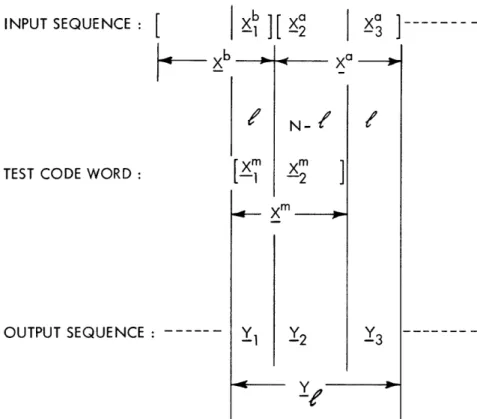
In order to get this bound on a per letter basis, Y[ will be broken up into three parts
19
(43)
(45)
INPUT SEQUENCE :
TEST CODE WORD:
OUTPUT SEQUENCE :
.9
ye
Fig. 4. Grouping of input and output letters for Pe(f, all mta, b).
[
x- ][x
E_
r
N- /-1rxm
1-1x'
]
xa ]____ Y3 xm . xa 0.as shown in Fig. 4. The I letter portion of Xm which is in phase with Y is denoted
X 1 . a
Xim. The N- I letter portion of Xa and Xm which is in phase with YZ is denoted Xa and
X , with X3 denoting the letter portion of Xa in phase with Y3. The bound can now
be rewritten
Pe(2, all mta, b) < (2M) P P(Y l-lcrp
(X)
P( X ))-1-_
j
PQX~a) ( 3 X) 3P(Y)r P, (48)Y3 a
where D(YIXa, q) and D(Y X, q') are rewritten
D(YjXa, q) = P(Y1) P(y 2 X)
P(
3 I X3) (49)and
D(Y 12xm q ') = P(Y1 ) P(Y 1 X2 ) P(Y (50)
The three terms in brackets in (48) are independent, and each involves a product of
independent one-dimensional probabilities. This enables us to reduce the bound to one
involving the same probability functions that are involved in the bound for the synchro-nized channel. Its form is
Pe(, all mia, b) (2M)P [ p(y)l-P ( P(x) p(yI x) P
P(y)P P(x) P(PYx)PYxx) (51)
To write the bound in exponential form, the terms in the brackets are used to define the following exponents:
EO(p,) = -2n E (P(yIx) P) (P(y x) ) (52)
y and
Es(, ) = -In i( (y)p p(y)x)l p(y)l-p (p(ylx))) (53)
in which, for convenience, a bar is used to denote the average over the set of input lette rs.
NR
With M = e , (51) can be rewritten
Pe(l, all ma, b)s 2P e [ N Es(p, (-) + N E(P, )-pR , (54)
where the tightest bound for a given P(x) is obtained by optimizing over > 0 and p over the range O< p < l.
For p = 1, it is shown in Appendix B, that a = 1/2 gives a stationary point for any given set of code letter probabilities. For p, in the range O< p < 1, it is shown for cer-tain channels, such as the doubly symmetric ones, 2 that a stationary point exists for
a = 1/(l+p). For other channels, however, such as the binary erasure channel, the choice of r = l/(l+p) does not give a stationary point for p in the range 0<p< 1. For these channels, a = 1/(l+p) cannot be the best choice, since it is not a point on the boundary defined by >0 and O<p < 1. Nevertheless, if we still choose G = /(l+p) for all channels, we find that this choice is sufficient to provide an upper bound on Pe(2, all mfa, b) that is no greater than for the already known case given by Pe(O, all mfa).
To prove this result, it is first necessary to show that
Es(PIf4 l+F) = Es(P) Eo(P) E(pi= o, (55)
where Eo(p) is the same function involved in the exponent for the synchronized channel, and is given by (34).
For convenience, we define
a(y) = P(ylx)1/(l+p), (56)
which enables us to write
e = p(y)P/(l+P) a(y) p(y)l/(l+p) a(y)p' (57)
Y Y
Now (57) can be upper-bounded by a double application of Holder's inequality,1 3 to give
"1 P 1 -E (P)l+p X e -< kP(y) a y y Py) 11 2 y p P()
I
Y
(y) 2 y yI-~~~P
1where 0< 1 < 1, and O< < 1. Choosing 1 = +p and 2 = l+p gives
_ 1 1
e -V P(y> Eay + a(y)
, ,l+p -Eo(P)
a( + = e ( (59)
y
which is the desired result.
The two exponents are equal when Holder' s inequality becomes an equality, or when
p(y)P/(l+p) cc a(y) (60)
and
p(y)l /(l +p) c (y)p. (61)
To satisfy both (60) and (61) for any p, O<p< 1, both P(y) and a(y) must be
indepen-dent of y. This follows by assuming that (60) is true, which implies that p(y)1/(l+p) c
a (y)1/, so that (61) can only be true if both P(y) and a(y) are independent of y.
Further-more, if a(y) is independent of y for all p, then P(y) must also be constant, since a(y) approaches P(y) as p-0.
These results give the following lemma.
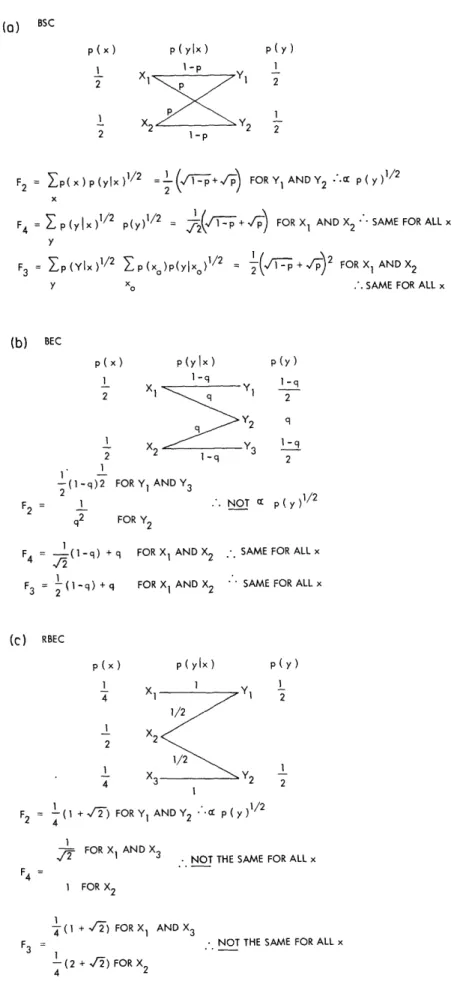
Lemma 1: Es(p) > Eo(p) for all p in the range O< pl 1. For p in the range 0< p < 1, the
exponents are equal if and only if the following condition holds:
Condition 1:
L
P(x) P(ylx)/(1+P) is the same for all y. (62)x
For p = 0 we always have equality, and for p = 1 we have equality if and only if
Condition : E P(x) P(ylx)1/Z cc p(y)1/2 (63)
x is true.
It is interesting to note that the necessary and sufficient condition for equality given by (62) is also shown in Appendix B to be a sufficient condition for a = 1/(l+p) to give a
23
1 -x
-stationary point. Thus, for those channels for which the choice of a = /(l+p) does not yield a stationary point, we find that the choice is still good enough to give the result E s(p) > E (P)
We can view Eo(p) as the in-phase exponent, and Es(p) as the out-of-phase exponent.
The in-phase portion corresponds to the N- letters of overlap between Xa, the correct
word, and Xm, the test word. The out-of-phase portion corresponds to the two letter
portions that straddle the in-phase portion.
The large class of channels that do not satisfy condition 1 are rather interesting, since the out-of-phase exponent is larger than the in-phase exponent. Roughly, the
rea-son for this is that the calculation of Es(p) involves Y Y, X, and X (see Fig. 4 and
a m
Eq. 48), while the calculation of Eo(p) involves Yz, X and X2 . The extra degree of
randomness given by the two independent y's involved in calculating Es(p) provides us with an exponent that is larger than Eo(p) for channels such as those whose output is not uniformly distributed. An example of a channel like this is the BEC (see Fig. 7), where the two independent y' s offer two independent sets of erasures on which a decision will be based.
The bound on Pe(f, all mta, b) can be summarized in the following theorem.
Theorem 1: The probability of selecting some code word Xm (ma, b) at letters
off sync, rather than selecting the correct code word Xa at sync, is bounded by
Pe(2, all ma, b) 2P exp[-N Es(P a + N E(P) -PR]] (64)
for all discrete memoryless channels. The exponents Es(p, a-) and Eo(p, a-) are given by
(52) and (53). This expression can be further upper-bounded by
-N[Eo(p) -p R]
Pe(, all mPa, b) ZP e , (65)
where Eo(p) is given by (52), with -r = /(l+p).
The bounds given by (64) and (65) apply to all time discrete memoryless channels
with both x and y ranging over a finite set of values. For amplitude continuous
chan-nels the same bounds apply, with the exponents being modified by changing the channel transition probabilities to conditional probability densities, changing the input and out-put probabilities to probability densities, and changing the sums to integrals.l4
The exponents then become
Eo(p, r) = -n [S dy (p(y x) -) (p(yj x) (66)
and
Es(p, ) = -n Pn[| dy p((ylx) (y)x)), l-P p(y (67)
For channels with a discrete set of inputs and a continuous output the bar is taken to mean the average over the discrete set of code letter probabilities, P(x).
The bound on P(eJI seq) (as well as P(eI seq)) is not complete, since we have still not included the cases in which m= a and m = b. Nevertheless, the vast majority of the
cases in which an error can occur have been considered. Intuitively, one would feel
that the two cases not yet considered would have a negligible effect on the probability of error, since we have already considered ZM- 2 cases. Indeed, this will be shown to be
true for some classes of channels. Unfortunately, for other classes of channels, the
issue is not quite as clear when the rate is low enough. Thus, completing the bound on
the probability of error is more relevant than just carrying out a necessary detail.
b. Bound on Pe(f, m=a)
To bound the function given by Eq. 19, we first rewrite it as
Pe(f, m=a) = E P(XY Iseq) (Y,), (68)
Ye
if D(Y Ixa, q) D(YIXa, q')
otherwise and P(Y seq) is given by Eq. 37.
When 4(Y,) is upper-bounded by
D(Y X , q')
D(Yx Xa q)
cr-O
the following upper bound on (68) is obtained.
D(Y Xa q')
Pe(Q, m=a)s < P(Y
I
seq) Yj(71)
D(Y Ixa, q)
Averaging this bound over the given ensemble of codes gives
Pe(Q, m=a) •< I Xa b _ , _ P(Xa) P(Xb) P(Y seq) Yk D(Y Xa, (q)
which, with the aid of (46), can be rewritten
25 where
(Y)
=o
(69) (70) (72) . .. ... ... .... ... .... .... ... .... .... ..Pe(f, m=a)$ X p(a)
z
D(YXaq)
D(Y 1Xa, q) (73)Xa Y
In Appendix C this bound is shown to be a Chernoff bound, 15, 16 which is tightest when 0 = 1/2.
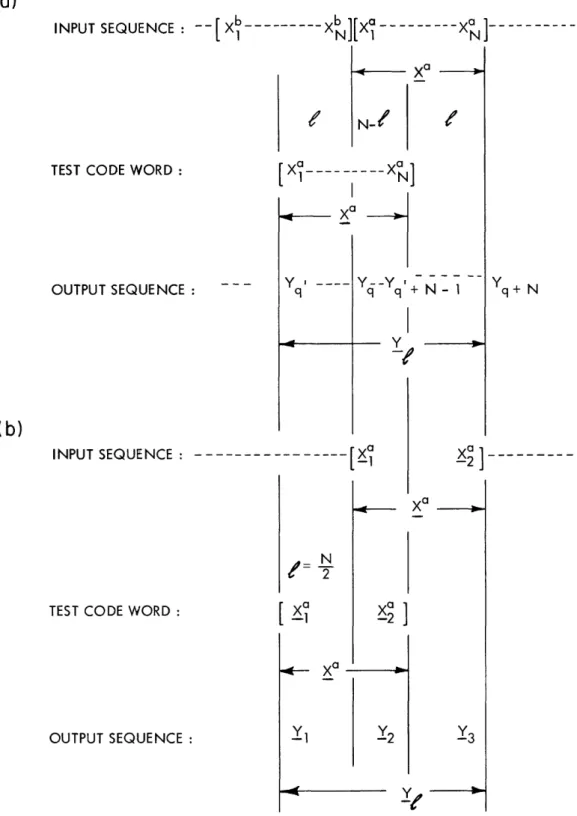
The bound can be written in terms of one dimensional probabilities (see Fig. 5a):
Pe(2, m=(X Pi ) P( /2 P(YiXa+ 1 )
Xa Y i
Eq E P( i ( i+l-q) P(i Xi+ -q' )
i=q
q+N-l Ci ' lili+l-q P(Yi) (74)
i=q'+N P(Y X a )/2
which is generally difficult to evaluate because many of the output letters and code let-ters are linked together. For example, consider the case when = 1 or when the test code
word is just one letter off in position. For this case all N+ 1 output letters are linked
together with the N code word letters. The first letter of Xa at position q' = q- 1 is
related to Yq1 yet Xa is also related to Yq, since it is the first letter of Xa
at
posi-q-1' I a q
tion q. Thus far, we have linked X, Yq-1 and Yq together. We cannot stop yet,
how-a
ever, since Y is also linked to X2a, which is linked to Yq+1 which ... etc.
Generally, for larger values of the amount of dependency between code letters is
N
not as great. As a matter of fact, for > N- the bound on Pe(2, m=a) can be written in
N
a relatively simple form. The form of this bound for = -will be of interest, since it
is applicable in our case when N is even.
For this particular situation Y can be broken up into three parts and Xa is broken
up into two parts, as shown in Fig. 5b. Now we have the case in which two code letters are linked together with three output letters. This is considerably simpler that the
case with = 1, but is still more complicated than the synchronized case, in which two
code letters are linked to one output letter.
N The bound given by (74) can now be rewritten in terms of the blocks of N digits defined by Fig. 5b as
pe(N' a) P (Xa) P(Y-1)/2 P 1 x1 / 2
aa Y
X a, Xa Y1
I X -1
E , 1xl)
PI-
X a) X Xa1a/2 p(y P (75)(a)
INPUT SEQUENCE: -- Xb ][Xa
---
XIIYT I 3~VI ILLI I, N I
Xa
TEST CODE WORD: --
OUTPUT SEQUENCE:
(b)
Xa Y q _Yq INPUT SEQUENCE: -- ---- [ X N?I :-
TEST CODE WORD:
OUTPUT SEQUENCE:
[ XL
-Y I q+N--X Xa I- X - 0 Y1 -Y2 Y_I
>Fig. 5. Grouping of input and output letters for Pe(2, m=a).
27 Yq+ N __(_II_ _ ___ - ---·--_I-I -l
N
Since (75) involves the product N independent one-dimensional probability functions, the bound can be written
P(x2) A P(Y21
2 Y3
xz)1/2 P(y 3 x2)1/2 P(y3)l/2 I
which can be written in exponential form by defining
E a 2 In P(x) P(y'|I x) /2 a Z ' so that (76) becomes -
~N
=a4-N(E ) a Pe(N- m=a)e a Y p(y)l/2 P(Ylx)1/ 2)2 yOne can readily establish that the exponent Ea is a legitimate positive exponent by
using Schwartz' inequality in (77) to bound
Z
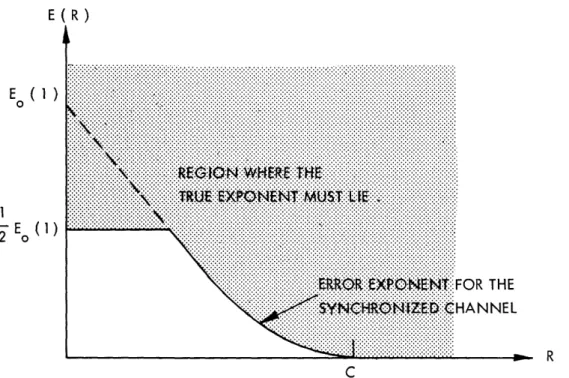
p(y)l/2 P(yl y = 1, (79) thereby giving e a < I y' x P(x) P(yl I x)1/2) = Eo( ) (80) so that Eo(1 ) E (1) a 2 (81)where Eo(1) is the well-known intercept in the exponent-rate curvel for a randomly selected code.
This bound is particularly useful because of its simplicity and generality. The bound is applicable for all memoryless channels; for amplitude-continuous channels,
the exponent given by (77) is modified in exactly the same manner as that used to obtain (66) and (67). Also, in Appendix C, it is shown that this bound is exponentially tight or, in other words, there exists a lower bound on Pe(-, m=a) which has the same exponent as in the upper bound. These properties make this bound important enough to be put in theorem form. (76) (77) (78) -ge (N, M=a _< 2 X) 1/2 _< (Y) I
~y
IX) I/
I
C
P(xI
C
p(yj) '/2 P(yII xII/Z
(ZIX)/Theorem 2: The probability of selecting Xa at N letters off sync, rather than at sync, is upper-bounded by
-NE a
Pe(N , m=a) e a(82)
for all memoryless channels, and also lower-bounded by a function whose exponent is
E.
a
While Theorem 2 will be used subsequently to provide some rather interesting results, it cannot be used alone to bound the probability of error, since it is only
appli-N
cable for = N. Our concern now will be to obtain a bound that is applicable for all in
the range from 1 to N2 j.
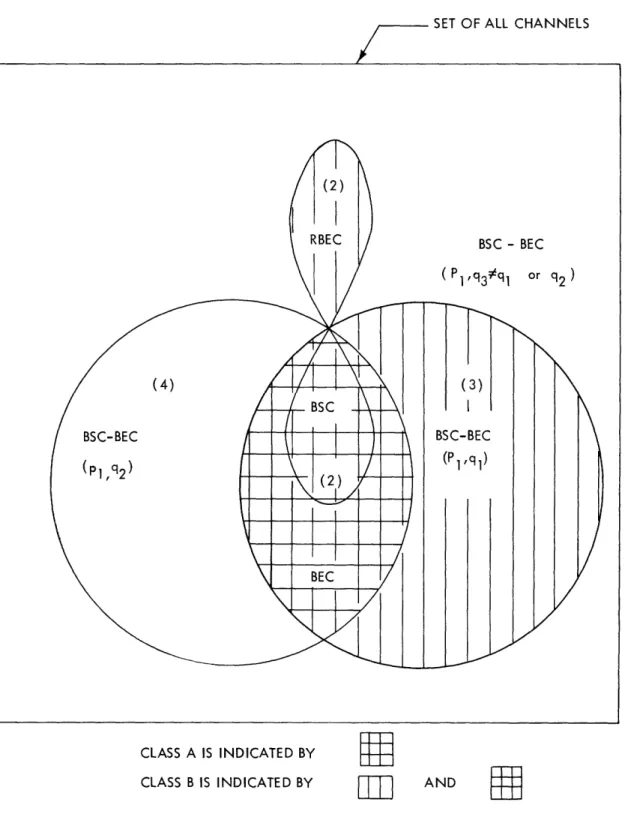
We shall first show that for certain channels the bound given by (74) can be
sim-plified for all . A channel will be considered to be in class A if the two conditions
hold.
Condition 3:
j
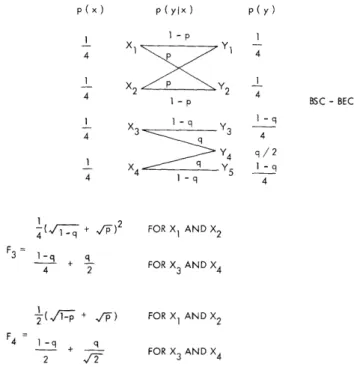
P(y x)1/2 E P(x') P(yIx')/2 is the same for all x (83)y x'
and
Condition 4: E P(ylx)1/2 p(y)1/2 is the same for all x. (84)
y
For channels in class A the bound given by (74) becomes
Pe(, m=a)I( P(yIx)1/2 P(y)1/2I PKylx)/ Z P(x') P(ylx')l/z
N-(85) Condition 4 enables us to pull out the terms ranging from i = q' to q - 1 and those in the
range i = q' + N to q + N - 1 without averaging over x. Condition 3 enables us to
sequen-tially pull out the terms from i= q to q' + N- 1 by using only one x in the average. For example, we can start in position i= q and average with only P(xl) to obtain a term that is independent of all remaining terms.
When conditions 3 and 4 are satisfied, we can identify the first term in the brackets
-E s(1) -E (1)
as e and the second term as e . Eo(1) and Es(1) are given by (52) and (53),
with ao = 1/2 and p = 1. The form of the bound now becomes
N Es N -NE (1)
Pe(Q, m=a) < e < e , (86)
where the last inequality above follows from Lemma 1.
29
While (86) is indeed in a very simple form, its use is restricted to those channels in class A. We are now concerned with obtaining a bound on Pe(2, m=a) that is appli-cable for a wider class of channels. As a matter of fact, the only restriction that will be imposed is that one choose the P(x) satisfying
Condition 5: P(yx)/(+P)( P(x') P(yIx') /(I+P) is the same for all x,
y x/
(87)
where p, 0- p 1 is to be identified as the parameter relating E(R) and R in (32). This
condition has been shown to be the necessary and sufficient condition that a set of non-zero P(x)must satisfy in order to obtain the tightest exponent for the synchronized case. Thus, requiring the channel to be used in such a way that condition 5 is satisfied does not impose any restriction on the channel, and only imposes a constraint on P(x) which will be shown to be a desirable one.
The bound now obtained will depend on p, as will generally the P(x) that satisfies (87). For certain channelsl P(x) will not depend on the value of p. For these special channels the bound that is to be derived will be tightest when we set p = 1, regardless of the value of p in (32).
When p = 1, condition 5 becomes equivalent to condition 3. While the class of
chan-nels that satisfies condition 3 is indeed larger than class A, it is still a restrictive class, since the choice of P(x) at p = 1 will not, in general, be the most desirable choice. Thus, we find that the bound on Pe(2, m=a) which is valid for all channels is generally dependent on the rate that the channel is used through the value of p.
To derive this new bound, we start with (68) and now bound p(Y2) by
P
p 0, (88)
4(Yl) <_
so that Pe(2, m=a) can be bounded by
Pe(, m=a) P(Xa) E D(Y' Ixa q) [D(Y ) 1/(+P] (89)
xa Y
Pe(,m=a) -< P(Xa) q-1 i= Xa i (yi) /(1 +P) p(yiXla 1 /( +P) P(Yi1 \l /-q ) q'+N-1 r y. 1 q+N-1 i=q' +N y. 1 /(+p) p
P(yi, Xai+ IP(Yil~~/l P ) I1/(i +P) p
With the aid of Holder's inequality i=q+N-1 by
we can bound each term in the range i = q' + N to
1 1 1k PYi+l-q) l~~pl-XP~~~i 1 P(Yi) I + P , (91) which equals 1 when X is chosen as p/(l+p). Now starting from i= q' + N- 1 and working backward, we can pull out all of the terms ranging back to i= q, by first using convexity to bring the average over Xia inside the brackets and then noting that, by (87), the termsng the average over Xi+l-q'
terms
(92)
I
I
(yil
P(YjiXil-q)a
1/(l+p)
IY. a
1 Xi+ -q'
are independent of Xa The i+ 1 -q'
independent and they present no again to bring the average over on (90) now becomes
remaining terms from i= q' problem. For these terms
Xa inside the brackets. i+1-q'
to q- 1 are now convexity is used The upper bound
(93)
The first term in brackets is upper-bounded further by the methods used in Lemma 1 to give 31 (90) Yi1 P(Yi) P / (l+p) ·<i Yi _ I ___
_1_11
1
__·__________·_·1__11
'/('+p)
P(Yi
iXl-P·y I
X)1/'+P)
P(XI)fly I '/(+p
P
'/('+P)
1/('+p) P
piIXa i+ I -) I (Y lX il-qp(XaI-' p(yil Xa·)' "
y
(x
3 y~
x
)<
(94) Since (87) is assumed true, the second term in brackets does not change its value when
averaged over x. Thus we have
(95)
= P(X) P(y
X)
,y x
i
P(ylx)l/(l+P P(x) P(ye X)i/(I+P)Pwhich when combined with (94) gives
-N N Eo(P) + N Eo(P)]
Pe( , m=a) -- e
-N[E (P) (1N 1+]
, (96)
1 where Eo(P) is given by (52) with cr l+p'
As we have mentioned, when the channel is such that condition 3 is true the bound above is evaluated at p = 1 in order to obtain the largest exponent.
The bounds on Pe(2, m=a) which are valid for all , 1 < -. < , are combined in the following theorem.
Theorem 3: The probability of selecting Xa at letters off sync, rather than at sync, is bounded by
-Na) P N E(1m=a) + N E(1)
a) Pe(Qm=a) e
-NEo(l )
(97)
for those channels in class A; that is, the channels satisfying both condition 3 and
condi-tion 4 given by (83) and (84). The exponents are given by (52) and (53) with = 1/2 and
p= 1.
-N E 0() j
b) Pe(2, m=a) e (98)
for channels that just satisfy condition 3.
_<e
-E
.(P)
o 1+2p)
e~~~(lp -N [E(p) (1 l N
c) Pe(Q, m=a) e (99)
for all channels, providing P(x) is chosen to satisfy condition 5 given by (87).
1
nent Eo(P) 0 is given by (52), when o = +p+
The
expo-The last inequalities in (98) and (99) follow by noting that the minimum exponent over all occurs at =



![Fig. 6. Grouping of input and output letters for Pe(Q, m=b).rXaXb-2'-2 ax 3a/ b ] / Y 4CC·------II ____Ib-- - x](https://thumb-eu.123doks.com/thumbv2/123doknet/14389342.507891/40.933.187.830.96.444/fig-grouping-input-output-letters-pe-rxaxb-cc.webp)