Ministry of Higher Education and Scientific Research
Djillali Liabes University – Sidi Bel Abbes
Faculty of Letters, Languages and Arts
Department of English
Thesis submitted to the department of English in candidacy for the degree
of Doctorate in ESP
Presented by: Supervised by:
Ms. Asma MERINE Prof. Mohamed Yamin BOULENOUAR
Board of Examiners
Dr. Belkacem BENSEDDIK MC ‘A’ President University of S. Belabbes Prof. Mohamed Yamin BOULENOUAR Prof Supervisor University of S. Belabbes Dr. Mohamed KIES MC ‘A’ Internal Examiner University of S. Belabbes Dr. Mohamed DIB MC ‘A’ External Examiner University of Mascara Dr. Mohamed GRAZIB MC ‘A’ External Examiner University of Saida Dr. Abdelkader BENSAFA MC ‘A’ External Examiner University of Tlemcen
Academic Year: 2019
Needs Analysis of English Communicative Skills of Hotel
Receptionists and Future Steps towards Possible Solutions:
The Case of Sheraton, Royal and Meridien Hotels in Oran
Declaration of Originality
I, Asma MERINE, declare that my doctorate thesis entitled, “Needs Analysis of English Language Communicative Skills of Hotel Receptionists and Future Steps towards Possible Solutions: The Case of Sheraton, Royal, and Meridien Hotels in Oran”, is my own work and that, it contains no material that has been submitted previously, in whole or in part, for the qualification of any other academic degree or diploma of a university or other institution. I also certify that the present work contains no plagiarism and it is the result of my own investigation, except where otherwise indicated and stated.
Ms. Asma MERINE Date: 15/11/2019
I
Dedications
To the memory of my grandfathers
To my parents for their continuous encouragement and support
without whom this thesis might not have been achieved.
To my sweet sisters: Malika, Meriem, Fatima, Souhila, Imane, Safia
and my brother Mohamed El Amine
To Lakhal, Mokhtaria, Amira, Mohamed, Reda and Abdelhak
To Omar
To my aunts and cousins
To all my friends
II
Acknowledgements
I would like to express my immense gratitude to many people who have supported me and encouraged me along the way in the achievement of this work. This thesis could not have been completed without their help.
I am extremely grateful to my supervisor Prof. Mohamed Yamin BOULENOUAR, for his encouragement, guidance, valuable comments, pieces of advice and support at every single stage of this dissertation.
My sincere thanks should go to the honorable board of examiners: Dr. Belkacem BENSEDDIK, Dr. Mohamed KIES, Dr. Mohamed DIB, Dr. Mohamed GRAZIB and Dr. Abdelkader BENSAFA for offering their time and efforts to read this work and bringing their insightful and valuable comments.
My deepest gratitude goes to Prof. Samira REFASS for her everlasting and unconditional support.
A special thank goes to Mr. Mohamed BENBOUHA (Royal Hotel), Mrs. Amel NAKKACHE (Meridien Hotel) and Mr. Soufi BELMOURI ( Sheraton Hotel) who participated in the accomplishment of this study and helped me to enter the three hotels and conducted my study.
I need also to express my sincere appreciation to the hotel receptionists working in Royal, Meridien and Sheraton hotels in Oran-Algeria who accepted to take part in this study and provided me with useful insights.
III
Abstract
ESP came to existence as an approach to teaching and learning English as a foreign language based on the specific needs of target learners. To this end, various disciplines implied fundamental changes so that the significance of ESP becomes a must that can hardly be ignored either academically or occupationally. The current study attempts to help hotel receptionists to perform their job effectively in their target language environment. To meet this end, an exploratory research was conducted to investigate hotel receptionists’ needs and problems while dealing with foreign clients coming from different countries. The researcher obtained data regarding employees’ needs and problems by multiplying the research instruments and sources. First, two questionnaires were distributed; one was for the hotel receptionists working in Meridien, Royal and Sheraton hotels and the second questionnaire was designed for the hotel clients. Additionally, a semi-structured interview with the hotel receptionists and a semi-structured interview with the hotel managers were other two methods of data collection to collect the necessary data. Therefore, this work includes hotel receptionists, hotel clients and hotel managers. The data were analysed both quantitatively and qualitatively. As a matter of fact, the results revealed that hotel receptionists greatly need the English language communicative skills in their job. Such results called for the implementation of in-service training to cope with employees’ present and target needs and then to reach high service quality in the field of tourism and hotels in Algeria.
Key Words: English for Specific Purposes, English for Hotel, Needs Analysis, Hotel
IV
Table of Contents
Dedications………. Acknowledgements……….. Abstract ………..…. Table of Contents………... List of Tables……… List of Figures………..……..……… List of Bar-Graphs, Pie-Charts and Diagrams ……… List Abbreviations and Acronyms ……….. General Introduction………..………Chapter One: ESP: Theoretical Perspective
1.1. Introduction……….. 1.2. English as a Global Language……….…...………… 1.3. English Language Teaching………. 1.3.1. ELT Varieties………. 1.3.1.1. English as a Mother Tongue (EMT) ……….. 1.3.1.2. English as a Second Language (ESL)………... 1.3.1.3. English as a Foreign Language (EFL)……… 1.4. Teaching English for Special Purposes………. 1.5. ESP Interpretations……… 1.5.1. Characteristics of ESP………... 1.5.1.1. Absolute Characteristics………..………. 1.5.1.2. Variable Characteristics………..…………. 1.6. Historical Development and Reasons behind the Emergence of ESP …….… ………… 1.6.1. Demands of the Brave New World………... 1.6.2. Revolution in Linguistics……….. 1.6.3. Focus on the Learner………..…………. 1.7. ESP Branches………... 1.7.1. English for Academic Purposes ……..……….……… 1.7.2. English for Occupational Purposes ……….. 1.7.3. English for Hotel and Hospitality ……….. 1.8. English Language Skills in ESP………...
I II III IV IV IV XII IV 01 10 10 13 14 14 14 15 16 18 20 20 20 21 21 22 23 23 23 25 28 33
V 1.8.1. Reading in ESP………... 1.8.2. Writing in ESP……….. 1.8.3. Listening in ESP………. 1.8.4. Speaking Skill in ESP……… 1.9. Language Issues in ESP………. 1.9.1. Vocabulary in ESP……….. 1.9.1.1. Vocabulary of English for the Hotel Industry………. 1.9.2. Grammar in ESP………. 1.9.3. Translation in ESP……….. 1.9.4. Culture in ESP……….…. 1.10. Conclusion………...
Chapter Two: Needs Analysis in ESP
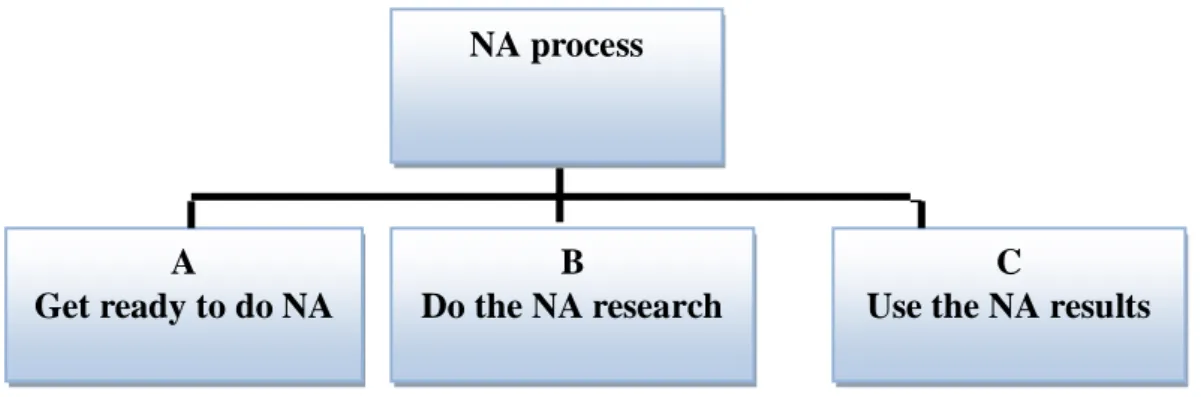
2.1. Introduction ………. 2.2. Major Problem Areas and Challenges in ESP ……… 2.2.1. English Language Communicative Needs of the 21st- Century Workforce……… 2.2.2. Lack of Training ………. 2.2.3. Qualifications of ESP Teachers……… 2.2.4. Inadequate Teaching Material and Resources………. 2.2.5. Lack and Deficiencies in ESP Textbooks……….. 2.2.6. Inadequate Teaching Methodology……… 2.2.7. Problems of Administration and Lack of Realistic Evaluation Procedures. 2.3. Needs Analysis in the Realm of ESP………. 2.4. Needs Analysis: Main Definitions………. 2.5. Significance of Needs Analysis in ESP Course Design………..…… 2.6. Needs Analysis: Different Approaches……… 2.6.1. Target-Situation Analysis (TSA) ……….. 2.6.2. Present-Situation Analysis (PSA)……… 2.6.3. Deficiency Analysis……….………. 2.6.4. Strategy Analysis (Learning Needs Analysis) ………..……… 2.6.5. Means Analysis or Constraints Analysis……… 2.6.6. Language Audits……… 2.6.7. Pedagogic Needs Analysis………. 2.7. Instrumentation in Needs Analysis………..…………. 2.7.1. Questionnaires………..……… 34 34 36 37 41 43 43 46 47 50 51 54 57 57 58 59 61 63 646 6 34 35 36 40 42 42 44 46 49 50 53 56 56 57 58 60 62 63 65 65 66 67 70 73 74 76 78 78 79 80 81 83 83
VI 2.7.3. Group Discussions……… 2.7.4. Meetings……….. 2.7.5. Observations……… 2.7.6. Document Review………. 2.7.7. Case Studies………... 2.8. Needs Analysis Implications for the Present Study………. 2.9. ESP Course Design ……….. 2.9.1. Approaches to Course Design……… 2.9.1.1. Language-Centred Approach………. 2.9.1.2. Skill-Based Approach……… 2.9.1.3. Learning-Centred Approach/ Learner-Centred Approach………. 2.10. Conclusion………..
Chapter Three: Situation Analysis and Research Methodology
3.1. Introduction……… 3.2. Situation Analysis in Algeria………. 3.2.1. Tourism in Algeria……… 3.2.2. Status and Functions of English Language in Algeria……… 3.2.3. ESP in the Arab World……… 3.2.3.1. Situation of ESP and its Drawbacks in Algeria ……….. 3.3. Research Methodology……….. 3.3.1. Research Design………... 3.3.1.1. Case Study……… 3.4. The Research Approach……… ………. 3.4.1. Quantitative Approach……….. 3.4.2. Qualitative Approach………. 3.5. Sampling………..………. 3.6. Research Participants……….. 3.7. Research Settings………... 3.8. Research Instruments……… 3.8.1. Questionnaire……… 3.8.1.1. Hotel Receptionists’ Questionnaire………... 3.8.1.1.1. Questionnaire Sample………. 3.8.1.1.2. Questionnaire Design………. 84 84 84 84 85 86 86 88 89 90 91 92 95 95 95 98 100 102 103 104 105 108 109 111 113 117 118 119 121 122 123 123
VII 3.8.1.1.4. Developing and Piloting the Questionnaire………..……… 3.8.1.1.5. Questionnaire Administration………... 3.8.1.2. Customers’ Questionnaire………. 3.8.2. Measuring Reliability………. 3.8.3. Interview………... 3.8.3.1. Hotel Receptionists’ Semi-Structured Interview ………...……….. 3.8.3.2. Hotel Managers’ Semi-Structured Interview……… 3.9. Ethical Considerations………..…. 3.10. Conclusion………..….
Chapter Four: Data Analysis and Interpretation
4.1. Introduction ……….……… 4.2. Data Analysis Methods………... 4.2.1. Quantitative Data Analysis………. 4.2.2. Qualitative Data Analysis………. 4.3. Data Analysis and Interpretation………...……… 4.3.1. Hotel Receptionists’ Questionnaire Results……….. 4.3.2. Hotel Receptionists’ Semi-Structured Interview Results……….. …………. 4.3.3. Customers’ Questionnaire Results………...………. 4.3.4. Hotel Managers’ Semi- Structured Interview Results………..… 4.4. Discussion of the Main Findings……….... 4.5. Conclusion………...
Chapter Five: Suggested Implications and Practical Recommendations
5.1. Introduction ………... 5.2. Important Considerations for ESP Instruction for Hotel Receptionists………. 5.2.1. Recommendations for Developing Listening Skill in ESP………. 5.2.2. Recommendations for Developing Speaking Skills in ESP………. 5.3. Implications for Hotel English Teaching……… 5.3.1. Considering ESP Teachers (Trainers)……….……… 5.3.2. ESP Teachers’ Qualifications and Roles……….………….. 5.3.3. A Suggested Teacher Training Programme……….………….. 5.4. In-Service Training for Hotel Receptionists………. 5.4.1. Some Guidelines towards Effective In-Service Training………. 5.5. Role of ICT in Teaching English for Hotels ……….
127 129 130 132 133 135 140 143 143 146 147 147 149 149 150 171 189 199 207 210 212 212 212 220 224 225 225 230 236 238 243
VIII 5.7. Classroom Activities and Methodologies……… 5.8. Promote Grammar……… 5.9. Recommendations and Techniques to Promote Culture………. 5.10. Integrating Reading and Writing for Hotel Receptionists……….… 5.11. Some Recommended Books………. 5.12. A Proposal for Hotel English Course……… 5.13. Sample Courses………... 5.14. Conclusion………. General Conclusion………..……….. Definition of Key-Concepts……….. References………..………. Appendices
Appendix ‘A’: Hotel Receptionists’ Questionnaire ……… ………..………… Appendix ‘B’: Hotel Receptionists’ Questionnaire (Arabic Version) ………... Appendix ‘C’: Hotel Receptionists’ Semi- Structured Interview……….. Appendix ‘D’: Customers’ Questionnaire………...……… Appendix ‘E’: Hotel Managers’ Semi-Structured Interview………. Appendix ‘F’: Authorisation………..……….. Appendix ‘G’: Royal Hotel Permission………. Appendix ‘H’: English Courses………... Appendix ‘I’: Hotel Vocabulary (A Glossary)……….. Appendix ‘J’: SPSS Results……….……….. Appendix ‘K’: Tourism and Hotels in Algeria………...………
249 251 254 256 260 261 266 288 290 296 300 324 330 336 339 342 344 345 346 349 370 383
IX
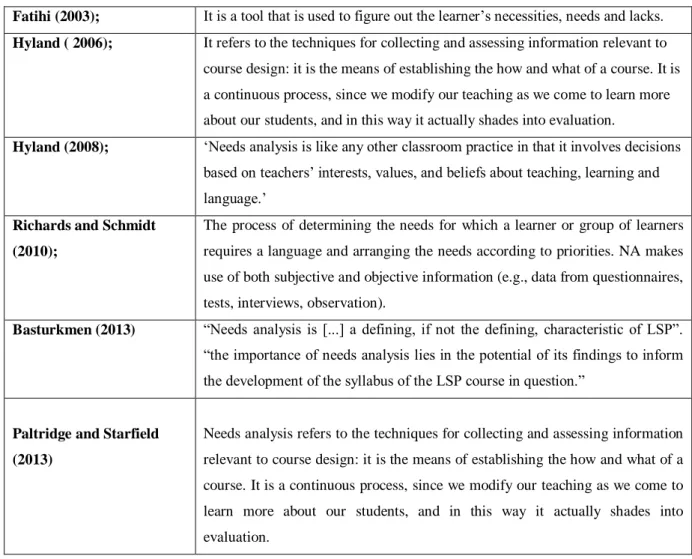
Table 1.1. Spread of English Language ……….……….. Table 1.2. Extracts from Phillipson’s Table ……….. Table 1.3. Areas of ESP Teaching……… Table 1.4. ESP Curriculum Model for Tourism and Hospitality English……….. Table 1.5.The Commercial Arrival-Departure Hospitality Cycle……… Table 2.1. Main Definitions and Contribution of Scholars about Needs Analysis……….. Table 2.2. Model of TSA……… Table 2.3. Necessities, Lacks and Wants………...… Table 2.4: Evolution of Needs Analysis ……… Table 3.1. Annual Income from Tourism Industry………. Table 3.2. Evolution of Tourism Flows, 2004-2013……… Table 3.3. Goals of Exploratory, Descriptive and Explanatory Research……….. Table 3.4. Differences between Quantitative and Qualitative Data Collection………… Table 3.5. Main Types of Probability Sampling Techniques……… Table3.6. Sample Involved in the Study………...………. Table 3.7. Sources and Instruments Used for the Study………... Table 3.8. Measuring Reliability………... Table 4.1. Investigation Process……….... Table 4.2. Importance of English Language Skills at the Workplace………. Table 4.3. Level of Needs and Problems of Using English in Listening Skill………….. Table 4.4. Level of Needs and Problems of Using English in Speaking Skill……… Table 4.5. Level of Needs and Problems of Using English in Reading Skill………...…. Table 4.6. Level of Needs and Problems of Using English in Writing Skill……….. Table 4.7. Level of Needs and Problems of Using English in Grammar……….. Table 4.8. Level of Needs and Problems of Using English in Vocabulary………. Table 4.9. Hotel Receptionists’ level of English Language Skills………...……. Table 4.10: Personal Data of the Clients………..………… Table 4.11. Native and Non-native English Speakers……….…… Table 4.12.Clients’ Expectations and Satisfaction towards Communicative Skills……… Table 4.13. Clients’ Expectations and Satisfaction towards Hospitality Language……. Table 4.14. Customers’ Expectations and Perceptions towards Intercultural
Communication………. 11 12 27 31 32 70 75 79 82 96 97 108 112 116 118 120 133 146 157 158 160 161 162 163 164 166 189 190 191 193 193
X
Table 4.16. Summary of Clients’ Expectations and Satisfaction towards Service
Quality……….
Table 4.17. Clients’ Satisfaction with Communicative Skills……….……..… Table 4.18. Clients’ Satisfaction with Hospitality Skills………...……… Table 4.19. Clients’ Satisfaction with Intercultural Communication……… Table 4.20. Clients’ Satisfaction with Speech-acts………...… Table 5.1. Pre-Listening Activities for a Listening Lesson………...……. Table 5.2. While-Listening Activities for a Listening Lesson………... Table 5.3. After-Listening Activities for a Listening Lesson………...…. Table 5.4. Activities for Speaking Practice……… Table 5.5. Three Cs Model of ESP Teacher Performance………. Table 5.6 A Suggested Teacher Training Program for Hotel English ……… Table 5.7. Pedagogical and Andragogical Assumption about Learners……… …… Table5.8. SSLG Specific Items………...…….. Table 5.9.Integration of Culture through the Four Language Skills……….. Table 5.10. Examples of the Language Functions……….
196 197 198 200 200 201 201 218 219 221 227 232 239 246 256 259 263 195 197 197 198 198 215 216 218 224 229 235 242 252 255 260
XI
List of Figures
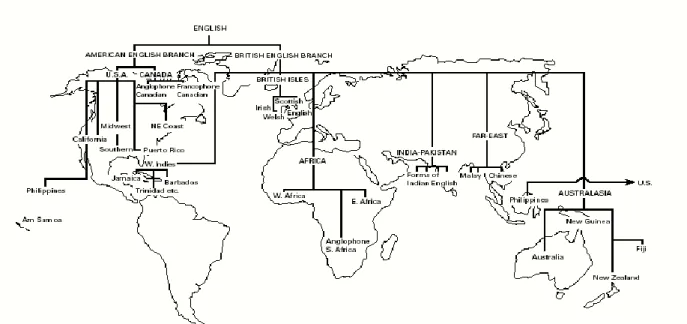
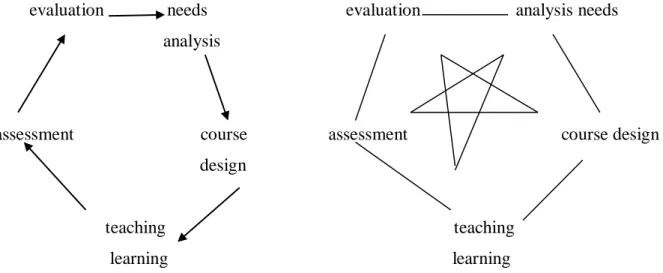
Figure 1.1. Strevens’s World Map of English………..………… Figure 1.2. Departments in a Hotel………. Figure 1.3. Classification of Hotel………... Figure 1.4. Product Approach ………..……….………….. Figure 2.1. Teachers’ Qualifications………... Figure 2.2. A Framework for Doing NA………. Figure 2.3. Cyclical Process……… Figure 2.4. Aspects of Present Situation Analysis………...………. Figure 2.5. What Needs Analysis Establishes……….…... Figure 2.6. Methods of Collecting Data for Needs Analyses………. Figure 2.7. A Language- Centred Approach to Course Design………... Figure 3.1. ESP Teaching in Algeria……….. Figure 3.2. Process of Inductive Approach………. Figure 3.3. Process of Deductive Approach……….….………. Figure 3.4. Questionnaire Design………..……….. Figure 3.5. Types of Interview………..…….……… Figure 5.1. Speaking Activity……… Figure 5.2. Speaking Practice………..226 Figure 5.3. Role of ESP Teacher……….………..
11 28 29 35 61 72 73 77 82 85 89 103 110 110 124 135 223 223 226
XII
List of Bar-Graphs, Pie-Charts and Diagrams
Bar-Graph 4.1. Hotel Receptionists’ Gender Distribution……… Bar-Graph 4.2. Hotel Receptionists’ Age Distribution……….. Bar-Graph 4.3. Hotel Receptionists’ Educational Background……….. Bar-Graph 4.4. Duration of Work……….. Bar-graph 4.5. Frequency of the Use of English at the Workplace………. Bar-Graph 4.6. Importance of Acquiring a High Level of English Proficiency………. Bar-Graph 4.7. Hotel Receptionists’ Language Levels……….. Bar-Graph 4.8. Hotel Receptionists’ Knowledge of English before Joining the
Workplace………
Bar-graph 4.9. Distribution of the Relevancy between the English Language
Courses at the College and Present Needs………...
Pie-Chart 4.1. Importance of English………...………. Pie-Chart 4.2. Attendance of English Courses………...……… Diagram 3.1. Research Design………..&
151 152 153 154 155 156 166 167 168 155 169 142
XIII
List of Abbreviations and Acronyms
BASE:
British Academic Spoken English corpusBE:
Business EnglishCNP:
Communicative Needs ProcessorCTH: Tourism and Hotel Management Centre DA: Deficiency Analysis
EAP:
English for Academic PurposesEBP:
English for Business PurposesEFL:
English as a Foreign LanguageEGAP:
English for General Academic PurposesEGOP:
English for General Occupational PurposesEGHP:
English for General Hospitality PurposesEGP:
English for General PurposesEGPP:
English for General Professional PurposesEHI:
English for the Hospitality IndustryEHR:
English for Hotel ReceptionistsEIAL: English as an International Auxiliary Language
ELFA:
English as a Lingua Franca in Academic Settings corpusELP:
English for Legal PurposesELT:
English Language TeachingEMFE:
English for Management, Finance, and EconomicsEMP:
English for Medical PurposesEMT:
English as a Mother TongueENST: National Institute of Tourism
EOP:
English for Occupational PurposesEPP:
English for professional purposesESAP:
English for Specific Academic PurposesXIV
ESOP:
English for Specific Occupational PurposesESP:
English for Specific PurposesESPP:
English for Specific Professional PurposesEST:
English for Science and TechnologyEVP:
English for Vocational Purposes.FO:
Front Office.GE:
General EnglishICT:
Information and Communication TechnologyIELTS:
International English Language Testing ServiceINTH: National Institute of Tourism and Hotel Management
L1:
First LanguageL2:
Second LanguageLMD:
Licence, Master, DoctorateLSP:
Language for Special PurposesMBA:
Master of Business AdministrationMICASE:
Michigan Corpus of Academic Spoken EnglishNA:
Needs AnalysisPSA:
Present-Situation AnalysisSA:
Strategy AnalysisSL:
Second LanguageTESOL:
Teaching English to the Speakers of other LanguagesTOEFL:
Test of English as a Foreign LanguageTSA:
Target Situation Analysis1
General Introduction
The 21st century has experienced an incredible technological advancement in different fields, rapid international trade, and vast expansion in economic, educational, scientific and technical activities. Such enormous developments led to an urgent call for a global language as a medium of interaction to ensure the countless exchanges in all areas; a language that is understood and recognised in the global community. Undoubtedly, the choice was fallen on the English Language as it is the most popular language worldwide throughout its historical background.
English becomes the predominant means for communication and for understanding and exchanging ideas among people all over the world. It is required for external purposes, i.e. to be up to date with the rapid advances in the field of business and to communicate with people from different cultures. Thus, learning English becomes a necessity that is highly required to be used in different domains. Apparently, the above mentioned issues led to the beginning of a well established movement from simply teaching English as a Second/Foreign Language (ESL/EFL) to teaching English for Specific Purposes or ESP which was strongly apparent by the 1960s to meet the communication needs of a new category of people willing to learn English not for prestige or pleasure but rather as a key to success in different academic or occupational settings.
In fact, one of the main important industries in the world that demands a highly developed communication skills from its employees is the hotel industry. It results in communication between employees and guests with different languages, cultural and ethnic backgrounds. As English is the language of the world, effective and excellent communication and adequate English language competency is highly recommended for better guest experience and hence better efficiency, productivity and , in the long run, profitability of the hotel industry. In other words, the more the hotel industry is outstanding worldwide, the more English skills are needed at the workplace. There is therefore a growing worldwide need for a front-line staff in the hospitality industry who is able to communicate with guests especially the foreigners who need a proper accommodation from the hotel staff.
2 Obviously, people all over the world are using this global language for communication and no one could deny the fact that communication can be a big problem for those who do not communicate effectively when they use English. In fact, the front office is the nerve center of a hotel property; the hotel receptionists have to master English skills as they are always engaging in conversations with foreigners from different countries. The lack of the English language ability prevents them from conducting their jobs effectively.
Based on the findings of the research work which is entitled ‘‘The English Language Communicative Needs of Receptionists: The Case of Royal Hotel in Oran” that was conducted by the researcher during the period (2012- 2014), a set of difficulties and limitations have been identified at different levels. Firstly, the study was carried out in only one hotel despite the fact that there are many other famous hotels in Oran. Secondly, the needs analysis had been identified at only two levels namely listening and speaking skills. Thirdly, the sample population consisted of all employees working in Royal hotel so that the number of population who speak English was not enough to make generalisation. In this respect, the researcher decided to conduct needs analyses in three hotels and at different levels to analyse and evaluate the needs, lacks and wants of the hotel receptionists and therefore to suggest some hopefully beneficial recommendations to cope with the needs of this category of workers.
Back to the significant role of English as a global language which gave birth to a new branch in the world of ELT namely ESP which in its turn gave birth to a heated debate and many contrasting viewpoints amongst educators. Serious and deep investigations conducted by many scholars claim that there must be programmes designed to meet learners and employees’ needs in terms of English use. Obviously, successful and effective learning depends on the quality of teaching and the amount of exposure to the target language inside and outside the classroom. So, good language learners practice the target language, and the more they communicate in this language, the higher level of proficiency they reach. In addition to the amount of exposure, the target language must be taught by language specialists with developed materials to motivate learners.
However, in non-speaking English countries, exactly in Algeria, English starts to be learnt at the middle school. Such delay in learning English and the little exposure to this language make learners much influenced by their first language Arabic or by the French
3 language because Algeria is a meeting ground for three main languages which compete one another. While Arabic is a statutory and symbolic official language, Tamazight is a symbolic official language. French, which is politically regarded as a foreign language, is instead a working language that echoes a covert official status. The heated linguistic competition is obviously between Arabic and French. On the other hand, English is regarded as a difficult language for two reasons. First, it is not used in daily life activities outside the classroom. Second, English belongs to a foreign culture that it has little or no exposure to. As a result, most students pass the English language requirement by memorizing vocabulary and mechanical grammar drills. They will not have enough English proficiency to communicate in English which will form a barrier to their professional activities and careers; this is the case of the vast majority of the hotel receptionists who finish their higher studies and would be recruited without any training and with low standards of English.
In fact, the hotel receptionists are supposed to be engaged in dealings with foreigners who master English to respond constructively to their needs. Further, they are invited to welcome the customers, answer their questions, listen to them carefully and understand them, define the problems concerning clients’ complaint and so many other tasks. To perform such tasks, English proficiency becomes a necessity in the hotel industry to survive in today’s competitive business world. However, being ill-prepared in addition to the lack of training knowledge in this field may lead to failure and customers’ dissatisfaction. It could have a negative psychological effect on the hotel receptionists once they find themselves not able to perform their job appropriately.
Teaching EFL is always a challenging task when it comes to countries where most of the focus is on General English and less on ESP. It should be borne in mind that teaching English in Algeria is still inadequate. No serious decisions and solutions have been taken in this field so far according to several studies that are conducted in Algeria. Since English is absolutely required, the authorities can do much to exploit this global language and integrate ESP in several sectors, notably business, banking, universities, scientific and technical institutions, vocational schools, hotels and many other fields forming the basis of the Algerian economy. The hotel industry, in particular, has been and still a neglected area of research in comparison to the bulk of the studies in other fields such as economics, science, medicine, law, etc.
4 Furthermore, in the Algerian context, English courses are generally introduced to the learners and a ‘one-size-fits-all’ philosophy is imposed with no regard for individual differences and background. The central concern guiding this current study is first to investigate the situation of English in three hotels in Oran city by finding out how and when English is used by the receptionists. Since needs analysis has a vital role in the process of designing and carrying out any language course, whether it be ESP or a General English course, this study seeks to explore the hotel receptionists’ needs and discover which English language and other essential skills are lacking and need attention; at the same time, to gain further insight into the problems and difficulties faced by the employees in the actual situation and therefore helping the receptionists who are already engaged in dealing with foreigners in different situations once they use English in their communication. To this end, it is of great importance to critically analyse the existing situation and training programmes if they are really related to the actual linguistic needs, wants and lacks of the hotel receptionists or not.
As this issue is worthy of close investigation, proposing solutions, designing new courses and adopting new methods which should respond more adequately to the actual needs of the hotel receptionists may help workers improve the current situation and teaching practices. So, the main purpose of the current study is to add valid suggestions regarding the programmes and methodology in designing ESP courses for hotel receptionists. Also, it tries to tackle the relationship between ESP and culture, which is denied strongly by many scholars. That is, to deal with the main aspects of language use in the hotel’s reception, the receptionists’ language needs and their problems with regards to interpersonal as well as intercultural communication skills. The results yielded by this analysis would be used as a basis for recommendations to ameliorate the current situation through providing in-service training programme for those employees to function effectively in their discipline and target situation in order to satisfy and meet the customers’ expectations.
Being the language which opens doors into the world, countries all over the world, including Algeria, require efficient access to this prestigious language through which they could achieve great advancements in different fields. The need for English in countless settings has led to the emergence of ESP as a branch of ELT. Nowadays, ESP is regarded as one of the core realms of applied linguistics that has been applied in education for many decades. Actually, English becomes a requirement for professional employment; this is the
5 case in the hotel industry. The hotel receptionists must be highly qualified, highly professional and well-equipped with a set of competencies and skills to handle different situations with foreigners.
Based on the above discussion and by taking the aim of the study into account, the current study attempts to set out to investigate the following research questions:
1. What are the present needs and problems of the hotel receptionists when
using English to perform their job?
2. Are the hotel receptionists well prepared and qualified in terms of their
English language ability to meet their current communication needs?
3. To what extent does providing the hotel receptionists with specialised
in-service training help them communicate appropriately in their target situation?
These questions led to the formulation of the following hypotheses:
a. The hotel receptionists seem to come across different kinds of needs and
problems while using English.
b. The hotel receptionists are not well prepared and qualified in terms of
their English language ability to meet their current communication needs.
c. In- service training is essential in providing the hotel receptionists with
the right skills for their present and future jobs to reach international standards.
The study is believed to be significant in several directions. The basic premise of this research work turns around the idea that in spite of the fact of introducing various researches in the field of ESP, most of the linguistic researches that are conducted in Algeria focused in particular on the formal aspect of a language especially in the academic field .They emphasised the specialised language which helps the students within the confines of the specialisation only, and neglected the needs of the situational settings. So, it can be said that very little work is available which has been oriented towards the investigation of the use of language at work even though employees in many industries have been facing with the vast increase of English use in a variety of their domain-related areas. The actual study tackles an important area of ESP, the hotel industry, which has very limited relation to the former studies. More precisely, the study derives more significance
6 from the fact that it is needed even more urgently, to provide some important insights into the ESP course design, teaching skills, materials selection and training sessions that it would contribute in the field of ESP here in Algeria. At a global level, the design output of the study can become a useful model for researchers in the future.
As it is mentioned previously, the current project acts as an extension of a research work that is conducted few years ago. The earlier work was a Magister thesis that was based on needs analysis of the employees working in Royal Hotel. It tackled communication and English language skills in general with no reference to ESP. However, the actual work seeks to conduct needs analysis in other hotels in Oran by focusing on the position of English language skills and language issues in ESP. Based on the results, possible solutions will be introduced to cover the weaknesses of the hotel receptionists so that to contribute to the improvement of the quality of English in occupational settings. Additionally, the research will come up with results that help in the conclusion whether ESP can or should have a cultural dimension or whether it can be culture-free when dealing with foreigners in the hotel industry.
Further, based on the conceptual ESP framework, the study is a significant endeavour to improve the status of ESP teaching at the hotel industry and to bridge the gap between the employees’ educational and occupational needs. Thus, the major motive of the study responded to the specific English language needs of the hotel receptionists including lacks, wants and goals. In other words, the employees could have the tailored English course and recommendations for their needs, which could, in turn, satisfy their demands, enhance their motivation, and consolidate their basic domain knowledge in English and therefore meeting customers’ expectations.
As a whole, the research work is essentially composed of two main parts; theoretical and practical with a total number of five chapters. The first two chapters represent the theoretical grounding of this research in that it introduces to the reader with an overview of the basic concepts. Further, the first chapter reviews relevant literature; it provides an overview about ESP and language skills. It also surveys some other guiding concepts which serve as an overall theoretical framework for the dissertation. Regarding the second chapter, it addresses the major issues related to Needs Analysis to set about its nature, origins and developments in the realm of ESP. In this regard, needs analysis was
7 highlighted including its major definitions, characteristics, theoretical rationales, and main approaches. It also deals with the major approaches to ESP course design, materials.
The following chapter, with its analytical nature, depicts the situation analysis of English in Algeria, ESP in the Arab World and then in Algeria. It traces research design and the methodological approach adopted in the study. In order to enrich the data from different perspectives, mixed-method design was employed. The research instruments, target population, the procedures undertaken for the selection of the sample, the research instruments implementation that have been used while collecting and then analysing the available data are all well explained within this chapter; for instance, two questionnaires and two semi-structured interviews have been used as research instruments. On the other hand, the fourth chapter aims to analyse, describe, report and interpret the results that have been collected from the target population by reflecting on the research questions and hypotheses being posed. So, it presents key findings along with discussion.
Finally, chapter five includes more discussion about the findings of the research work and then recommends a number of implications and suggestions for future studies that should be taken into account for better communication in the hotel industry and to improve the receptionists’ abilities and skills particularly listening and speaking skills. It suggests a scenario for the receptionists training that has become an indispensible requirement in any ESP profession.
Chapter One
9
ESP: Theoretical Perspective
1.1. Introduction………... 1.2. English as a Global Language ……… 1.3. English Language Teaching………..…...
1.3.1. ELT Varieties………... 1.3.1.1. English as a Mother Tongue (EMT) ………... 1.3.1.2. English as a Second Language (ESL)……… 1.3.1.3. English as a Foreign Language (EFL)………...
1.4. Teaching English for Special Purposes………..………… 1.5. ESP Interpretations……….……...
1.5.1. Characteristics of ESP……….………..…...
1.5.1.1. Absolute Characteristics………. ………. 1.5.1.2. Variable Characteristics………...
1.6. Historical Development and Reasons behind the Emergence of ESP ……...
1.6.1. Demands of the Brave New World……… 1.6.2. Revolution in Linguistics……….. 1.6.3. Focus on the Learner……….……..
1.7. ESP Branches………...……..
1.7.1. English for Academic Purposes ……….………... 1.7.2. English for Occupational Purposes ………...…… 1.7.3. English for Hotel and Hospitality………...………..
1.8. English Language Skills in ESP……….……….
1.8.1. Reading in ESP……….………... 1.8.2. Writing in ESP……….……… 1.8.3. Listening in ESP………....……. 1.8.4. Speaking Skill in ESP………..
1.9. Language Issues in ESP……….…...
1.9.1. Vocabulary in ESP………..….…...
Chapter One
10 10 13 14 14 14 15 16 18 20 20 20 21 21 22 23 23 23 25 28 33 34 35 36 40 42 421.9.1.1. Vocabulary of English for the Hotel Industry……….………... 1.9.2. Grammar in ESP………... 1.9.3. Translation in ESP……….…... 1.9.4. Culture in ESP………... 1.10. Conclusion……….…... 44 46 49 50 53
10
1.1. Introduction
From the 1960’s onwards, there has been an increasing need to use the English language for different purposes within specific occupational and educational fields. Consequently, there was a call for real efforts to provide and deliver courses in English and more precisely English for Specific Purposes (henceforth ESP) that would meet the needs of this new challenging world. In view of that, chapter one aims to delineate the ESP framework, categorising and defining its major various sub-domains that belong to the study. It then offers a comprehensive historical orientation of the ESP movement and distinguishes its emergence into five distinct reasons; each dealing with a particularly salient feature of ESP that also characterised the development of the whole of ELT. Current trends in ESP research are also discussed and the chapter ends with a brief but comprehensive chronology of the major language issues in ESP.
1.2. English as a Global Language
For the past several decades, English has grown into the primary language for international communication. As a result of the growth of trade, technology, culture and economy, English has become a global language and it is used worldwide among all world languages. It is considered as a symbol of prestige in many societies by heading science, technology and commerce and there has never been a language as widely used all over the world as English. It was originally the language of England and it became a tool of imperial expansion and ends up by gaining a special place in many countries. Through the historical events of the British Empire, it has mainly become the primary or secondary language of many former British Colonies such as Canada, Australia, the United States, India and Nigeria…etc. Actually, the rise of English can be studied from a number of perspectives. So, it makes a great sense to provide a short historical sketch of how this global language spread through the following table:
11
Date Facts
17th and 18th centuries English spread as a result of British colonialism 18th and 19th centuries English spread as the language of British leadership
in the Industrial Revolution
Late 19th and early 20th c. English spread as the language of American economic superiority and political leadership.
Second half of 20th c. English spread as a consequence of American technological domination.
Table 1.1. Spread of English Language
Since the incredible expansion of the English language worldwide, it has been referred to by linguists as an ‘International Language’ (Mckay, 2002), ‘World Englishes’ ( Kachru & Nelson, 2009), ‘Lingua Franca’ (El Kadri, 2010), ‘World English’ (Rajagopalan, 2012), and ‘Global Language’ (Crystal, 2012). Actually, the importance of English is absolutely linked to globalisation and it is used in professional activities: advertising, education and mainly for international communication. In this sense, many attempts have been made to conceptualise the incredible spread of English through the proposition and aid of different maps, models and diagrams. The oldest model of the spread of English is that of Strevens (1980); it shows a map of the world.
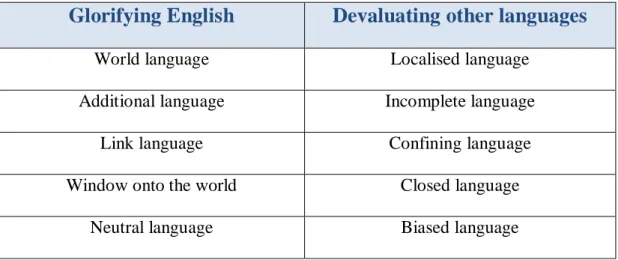
12 Today, the number of people using English in their communication is extremely increasing on an unprecedented scale and the spread of this global language shows no signs of stopping. At the same time, non-native English speakers outnumber native ones. Not surprisingly, English becomes the main language of international trade and commerce in the world where these fields have the great dominance. In this respect, Phillipson (1992) gives a list of terms that have been used to promote English and devaluate other languages.
Glorifying English
Devaluating other languages
World language Localised language
Additional language Incomplete language
Link language Confining language
Window onto the world Closed language
Neutral language Biased language
Table 1.2. Extracts from Phillipson’s Table (Adapted from Phillipson, 1992: 282)
Moreover, Graddol (1997) summarised the British Council’s English project about the position of English as follows:
World-wide, there are over 1,400 million people living in countries where English has official status. One out of five of the world’s population speak English to some level of competence. ….By the year 2000 it is estimated that over one billion people will be learning English. English is the main language of books, newspapers, airports, international business and academic conferences, science technology, diplomacy, sport, advertising and international competition.
In recent years, the growth of English has been further accelerated by a startling expansion in the quantity and speed of international communication. Consequently, English gains dominance over other languages and plays a crucial role in promoting globalisation. Hence, English proficiency is required in all professional areas and it becomes essential in several industries because of its specific characteristics.
13
1.3. English Language Teaching
English has been accepted as an international language all over the world; it is used extensively everywhere. Totally, more than a quarter of the whole world speaks English and this reflects the greatest importance of this language in comparison to other languages. Previously, the reasons behind learning English had not been well defined. Knowledge of a foreign language had been generally regarded as a sign of education and prestige. However, in terms of globalisation, it becomes necessary to learn English language for academic and professional success. English today has a unique status, as a consequence of the role it plays around the world and its function as the ‘world language’; it is seen as the language of commerce, technology and science etc. Thus, new generation of learners had appeared who knew specifically why they were learning the language.
Furthermore, English is taught worldwide and there is an increasing demand for competent English language teachers, as well as for language programmes that can deliver the English language skills and competencies needed by today’s global students. Communication in English language should be the first goal of teaching English to cope with the continuous progress of the world. In this vein, it is important to say that ELT in Britain refers to ‘English Language Teaching’. In North American usage, this is often referred to as TESOL ‘Teaching English to the Speakers of other Languages’. ELT differs according to the differences of its contexts and communities and thus it is learnt as the first language in some countries; as a second language in other countries; or as a foreign language in countries that do not speak English and have to learn it to be up to date (non-native English speakers).
Indeed, there is no doubt that this global language serves the entire world in different disciplines and fields. Since English has become the language of technology in a very industrial planet, its role is to prepare learners from all over the world with different needs to acquire proficiency in English. As a matter of fact, the large number of non-native speakers of English goes hand in hand with the process of re-evaluating and developing new models and courses for teaching English such as ESP and EGP courses.
14
1.3.1. ELT Varieties
English Language Teaching has developed many different acronyms associated with the teaching and learning process of English. According to Quirk et al. (1985: 3), ELT is divided into three main streams:
English as a Mother Tongue (EMT)
English as a Second Language (ESL)
English as a Foreign Language (EFL)
ELT can be considered as the parent body and EMT, ESL and EFL can be considered as subsidiaries.
1.3.1.1. English as a Mother Tongue (EMT)
Today, large numbers of people speak English language as the first language/mother
tongue in Britain, USA, Canada, Australia, New Zealand, South Africa as well as many other countries. This language was the mother tongue of only the people living in the British Isles, numbering between 5 and 7 million, as it is stated by crystal (1997). Between 1588 and 1952, the speech community of English as a mother tongue has experienced a rapid expansion exactly after the end of the reign of Elizabeth I (Elizabeth the first), and the beginning of the reign of Elizabeth II (Elizabeth the second) which finally took the language outside the British Isles. It is worth noting that the introduction of English to the New World (USA) was a landmark in the history of that language.
1.3.1.2. English as a Second Language (ESL)
ESL is used to refer to the non-native speakers of English. It is greatly used for a wide range of purposes as it has an official status within a country after the mother tongue. ESL complements the first language in many countries in the world like: Ghana, India, Nigeria, Singapore, India, Bangladesh, Cameroon, Kenya, Malawi, Pakistan, etc. ESL is used extensively in everyday life and in numerous fields of politics, economics, mass media, commerce and trade and in the educational system as well. Thus, it is necessary that the individual learns the second language in order to be well equipped with an instrument of communication.
15
1.3.1.3. English as a Foreign Language (EFL)
So far we have been considering English as a second language but in the rest of the world, English is a foreign language. It is agreeable that English as a foreign language means a language used by foreigners. It is taught in schools, often widely, but it does not play an essential role in national or social life and has no official status. It is applied in many countries all over the world like in the Arab World. It is not used as a medium of instruction or as a language of communication within these countries. English is a foreign language if,
It is taught as a school subject or at an adult level solely for the purpose of giving the student a foreign language competence which he may use in one of several ways- to read literature, to read technical works, to listen to the radio, to understand dialogue in the movies, to use language for communication. (Marckwardt, 1963)
The most influential model and widely used is Kashru’s Three Circles of English (1986). It is divided into three concentric circles: the inner circle refers to English as it originally takes place (UK, US and Canada); the outer circle (Malaysia, Singapore, India, Ghana, Kenya and others) and the expanding circle which includes much of the rest of the world. English speakers are described by Kachru in terms of belonging to one of three concentric circles.
Traditionally, there was a clear distinction among English as a native language (ENL), English as a second language (ESL) and as a foreign language (EFL). Within Kachru’s model, ENL was replaced by inner circle, ESL by the outer circle and EFL by the expanding circle. Moreover, in what Kachru (1986) calls ‘‘the inner circle, the outer circle and the expanding circle’’ of world Englishes, there are about two billion people speaking English as the first or second language and as Bill Bryson states, “the rest of the world are trying1”.
However, his model is not sufficiently dynamic to reflect the reality of English use in the world. In fact, the three-circle model fails to consider the growth of English in the world. It cannot account for the growing use of English, namely English as a lingua franca between speakers who do not share a first language (Mollin, 2006: 41-42). Additionally, it
16 is difficult to define which one owns English as the first language and which one knows English as a second language as Crystal (1997) states: “there are several countries where population movement, language loss, divergent language attitudes, and massive shifts in language use have made it difficult to answer the question: What is your first language?”
1.4. Teaching English for Special Purposes
Recently, there has been a major shift in the world of ELT away from teaching of literacy studies towards teaching of a language that is no more related to aspects of culture but related to the specific purposes and needs of the learner and the worker. ‘English for Special Purposes’ is a name that is usually given to this kind of courses and it is generally used in circumstances in which the command of English being related to a specific purpose, job or subject. Consequently, there have been significant developments of ESP studies in different professional, academic and occupational settings.
Since ESP is growing at a great pace, special syllabuses and materials should be prepared in addition to a competent staff who will be recruited to teach these specialised aims. In this regard, Strevens (1977: 89) points out that there are three aspects of ESP which specialists should concentrate on. Firstly, for the great diversity of courses which come under the general heading of ESP, classification and analysis of such courses must be done to prepare courses that fit learners’ needs. Secondly, the nature of ‘Scientific English’ must be studied from different perspectives. Thirdly, specialists should consider the principle that ESP should be concerned with the ‘communicative purposes’ of the learner. It is argued that within ‘English for Special Purposes’ the crucial word is ‘purpose’. Teachers and specialists must be clear about what that purpose is and to consider the ways to achieve this end. In other words, teachers have to design a syllabus that will meet students’ needs and adapt an appropriate methodology to teach the necessary skills. In fact, the methodology of ESP has been a controversial issue among scholars and ESP instructors because ESP is different from ELT in terms of the content, syllabus and presentation but the question that needs to be posed is whether or not there is a special methodology of ESP and whether such a methodology is needed. Hutchinson and Waters (1987) point out that there is no specific methodology for ESP. This view is supported by that of Hyland (2002) who states that some scholars did not provide sufficient reasons to justify the need for implementing a special methodology for ESP as: ‘‘the subject – matter domain requires a
17 higher level of English proficiency so the learners first need to acquire general English at the appropriate level.’’
On the other hand, some scholars argue that the methodology of ELT differs to some extent from the methodology of ESP as Robinson (1991) states that only two characteristic aspects of ESP can be identified:
ESP activities derive from the students’ specialism (nevertheless, it is not a sine qua non condition),
ESP activities can (but may not) have an authentic purpose derived from the students’ target needs.
Robinson’s view was supported by Watson’s view (2003: 147-156), who declares that the only distinguishing factor between ESP and ELT is team teaching, i.e., there is cooperation among teachers and what remains such as the integration of teaching and technology, learner autonomy, use of authentic materials and tasks and so many other approaches can also be found in general ELT.
Conversely to the earlier proponents, Dudley-Evans and St. John (1998) believe that specific ESP teaching has its own methodology by which they mean that:
all ESP teaching should reflect the methodology of the disciplines and professions it serves,
the activities the students need to carry out, generate and depend on registers and genres associated with the language that students need to be able to manipulate in order to carry out the activity,
the interaction between students and teacher may differ from that which occurs in the general English class.
ESP specialists have not strongly privileged a specific method to teach ESP so that it is suggested that ESP methodology is not much different from the methodology of GE teaching. The only difference is that teachers have to be flexible, open and tolerant for they are not subject matter experts in the specialty shared by the professionals in their class.
To put it differently, it can be proclaimed that it is difficult to present an explicit statement as to whether or not ESP borrowed ideas from ELT or ELT borrowed ideas from ESP. ESP specialists who deliver practical courses must maintain update data and in
18 addition to methodology, more attention must also be given to issues such as needs analysis, course design, material developments as well as assessment.
1.5. ESP Interpretations
For the past several decades, the reasons behind learning English have not been well defined. After being accepted and introduced as an international language, today’s generation become greatly aware of the importance of English. People who want to buy and sell products abroad, receptionists who want to communicate with foreigners in the hotel, mechanics who have to read instruction manuals, students in different disciplines who need to be up to date with the developments in their fields (economy, medicine, computing, …etc), all these and many other demands and requirements had a positive effect on the expansion of one particular broad diverse field of ELT namely ‘ESP’. In fact, the highly demand of English in almost all fields made ESP more common and recommended than the others. So, it is of great importance to ask the two forthcoming questions, what is ESP? And what does it refer to?
English for Specific Purposes or English for Special Purposes arose as a term in the 1960s. It has brought specialists to heated debates as it became increasingly aware that GE did not meet the specific needs of learners. Actually, countless definitions and views have been proposed by different scholars. Therefore, to know what this term really means, various interpretations relevant to the ESP context should be presented. ESP is described simply as teaching English that is used in specific areas, i.e., Academic Studies or Professional Purposes. This new approach is specially designed for people or in other words adult learners who are learning English so that they will be able to use it in specific practical situations, to communicate appropriately and to perform particular job-related functions.
Mackay and Mountford (1978) define ESP as: ‘‘a form of teaching English for a utilitarian purpose and as a pragmatic response to a developing situation.’’ They suggested three kinds of purposes for which ESP is taught: i) Occupational requirements E.g.: for international telephone operators, civil airline pilots, etc. ii) Vocational training programs e.g., for hostel and catering staff, technical trades, etc. iii) Academic or Professional study e.g., engineering, medicine, law, commerce, etc. Moreover, Robinson (1980: 3) offers a clear definition to this term, “ESP is an enterprise involving education, training and
19 practice, and drawing upon three major realms of knowledge: language, pedagogy, and the students’/participants’ specialist areas of interests.”
Moving further, she proclaims that: “An ESP course is purposeful and is aimed at the successful performance of occupational or academic roles.” This may underline the fact that ESP courses are based on the analysis of learners’ needs and should be tailor-made. An ESP course may be different from the other courses in terms of topics, selection of skills, situations, functions and language as well. Two features are included in her definition: the homogeneity of ESP classes, and the limitedness of ESP classes to adult learners in academic settings or in work settings.
The above definitions are supported by Harmer (1983) who defines ESP as: “situations where the student has some specific reasons for wanting to learn a language.” This statement means that English language is taught to meet learners’ needs in specific situations. For Kennedy and Bolitho (1984: 3), “ESP is based on an investigation of the purposes of the learner and the set of communicative needs arising from these purposes.” In other words, ESP is learning and learner oriented through the analysis of communication needs of the learner.
Moreover, ESP is seen by Hutchinson and Waters (1987) as an ‘approach’ rather than a ‘product’. That is to say, ESP is addressed to meet learners’ needs and it does not involve a particular kind of language, teaching materials or methodology. They assert the forthcoming:
ESP must be seen as an approach not as a product. ESP is not a particular kind of language or methodology, nor does it consist of a particular type of teaching material. Understood properly, it is an approach to language learning, which is based on learner need. The foundation of all ESP is the simple question: why does this learner need to learn a foreign language.
Again, Robinson (1991: 2) writes a thorough review of theoretical positions and what ESP means. She proclaims that: “ESP is for study in a specific discipline or as a school subject.” Further, she describes ESP as a type of ELT and defines it as ‘Goal Oriented Language Learning’. However, for many ESP subject specialists, ESP is regarded as a set of grammar rules and vocabulary used by learners in specific situations and contexts. In this vein, Mackay and Mountford (1978: 4) view ESP as: “a restricted repertoire of words
20 and expressions selected from the whole language because that restricted repertoire covers every requirement within a well defined context, task or vocation.”
1.5.1. Characteristics of ESP
Having all the above definitions in mind, Strevens (1988) makes a distinction between four absolute and two variable characteristics to define ESP.
1.5.1.1. Absolute Characteristics
According to Strevens (1988), English language teaching is designed to meet specified needs of the learner; related in content (i.e., themes and topics) to particular disciplines, occupations and activities; centered on the language appropriate for those activities in syntax, lexis, discourse and semantics; and in contrast with GE.
1.5.1.2. Variable Characteristics
As far as the variable characteristics of ESP are concerned, Strevens (1988) theorises that it may be but is not necessarily restricted to the learning skills to be learnt; and may not be taught according to any pre-ordinate methodology.
As each of these definitions has validity but also weaknesses, there have been heated debates about what does ESP really mean. In this respect, Dudley-Evans and St. John (1998) have modified Strevens’ original definition by adopting a much broader view of ESP and applying a chain of characteristics: absolute characteristics and variable characteristics.
In terms of absolute characteristics: a) ESP is designed to meet specific needs of the learner; b) ESP makes use of the underlying methodology and activities of the disciplines it serves; and c) ESP is centered on the language (grammar, lexis, register), skills, discourse and genres appropriate to these activities.
In terms of variable characteristics: a) ESP may be related or designed for specific disciplines; b) ESP may use, in specific teaching situations, a different methodology from that of GE; c) ESP is likely to be designed for adult learners, either at a tertiary level institution or in a professional work situation; it could be used for learners at secondary school level; d) ESP is generally designed for intermediate or advanced learners; and e)
21 Most ESP courses assume basic knowledge of the language system, but it can be used with beginners. (Dudley Evans et al, 1998: 4-5).
Obviously, Dudley Evans and St. John have removed the absolute characteristic that “ESP is contrast with GE”. In comparison to Strevens’ model, Dudley Evans and St. John have updated and added more variable characteristics and affirm that ESP is not necessarily linked to a specific discipline. Furthermore, ESP is to be used with adult learners although it could be used with young adults in likely a secondary school setting.
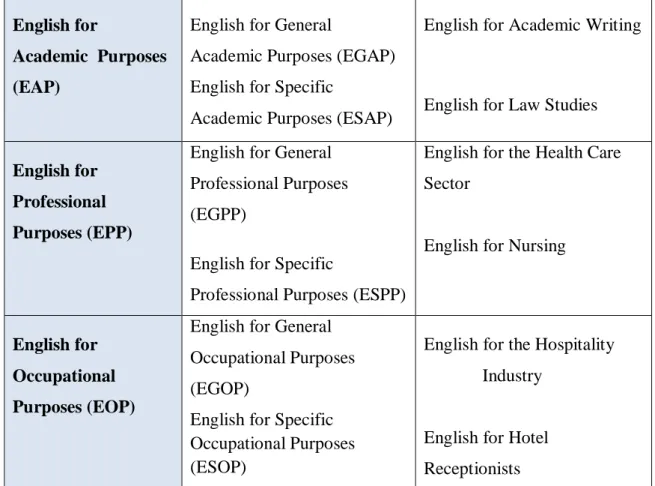
Above all and despite the various definitions of ESP, no one could describe ESP in a couple of sentences because the term is extremely complicated as Strevens (1980) writes: “…..it is not easy to produce a definition of ESP which is simple and water weight.” Generally, ESP is viewed as an approach to language teaching which is characterised by prioritizing learner needs as the main objective through the use of needs analysis as the basis for curriculum development. ESP is considered as a broad umbrella term embracing a number of sub-divisions and it is often divided up into two main sub-branches: 1) English for Academic Purposes (EAP) under which various disciplines fall: tourism, law, medicine, business and science. 2) English for Occupational Purposes (EOP) which is divided into English for Professional Purposes and English for Vocational Purposes. Even though various aspects of ESP have invited specialists to heated discussions, the demand for English for Specific Purposes continues to expand throughout the world.
1.6. Historical Development and Reasons behind the Emergence of ESP
Certainly, several books and essays have been written about the origins and history of ESP. The emergence of this term can be traced back to late 1960s. Instead of learning English for prestige or pleasure, people start learning this global language for work reasons. In this respect, Hutchinson and Waters (1987: 6) state that: “ESP was not a planned and coherent movement, but rather a phenomenon that grew out of a number of converging trends.” Notably, they mention that this development came about specifically due to three reasons common to the emergence of ESP: “the demands of a Brave New World, a revolution in linguistics, and focus on the learner.”
1.6.1. Demands of the Brave New World
As far as the first reason is concerned, many scholars in addition to Hutchinson and Waters declare that the end of the Second World War and the oil crisis of the early 1970s