People’s Democratic Republic of Algeria
Ministry of Higher Education and Scientific Research
8 MAI 1945 UNIVERSITY / GUELMA FACULTY OF LETTERS AND LANGUAGES
DEPARTMENT OF LETTERS & ENGLISH LANGUAGE
The Use of Needs Analysis in English for Specific Purposes Courses
between Reality and Myth: Case Study of Master O
Biology at 8 MAI 45 University
A Dissertation Submitted to the Department of Letters and English Language in Partial Fulfillment of the Requirements for the Degree of Master in Language and Culture Submitted by:
TOURCHE Lamia.
Chairwoman: Mrs. BISKRI Yamina
Supervisor: Mr. CHETTIBI Mohammed Walid Examiner: Mrs. LASSOUED
People’s Democratic Republic of Algeria Ministry of Higher Education and Scientific Research
8 MAI 1945 UNIVERSITY / GUELMA ﺔﻤﻟﺎﻗ / 1945
LETTERS AND LANGUAGES تﺎﻐﻠﻟا و بادﻵا ﺔﯿﻠﻛ
DEPARTMENT OF LETTERS & ENGLISH LANGUAGE ﺔﯾﺰﯿﻠﺠﻧﻹا
The Use of Needs Analysis in English for Specific Purposes Courses
and Myth: Case Study of Master One Students of
Biology at 8 MAI 45 University - Guelma
A Dissertation Submitted to the Department of Letters and English Language in Partial Fulfillment of the Requirements for the Degree of Master in Language and Culture
: Supervis
Mr. CHETTIBI Mohammed Walid
BOARD OF EXAMINERS
Yamina - MA/B University of 8 Mai 1945 Mohammed Walid – MA/B University of 8 Mai 1945 LASSOUED Sabrina - MA/B University of 8 Mai 1945
June 2018
Ministry of Higher Education and Scientific Research
/ 1945 يﺎﻣ 8 ﺔﻌﻣﺎﺟ
تﺎﻐﻠﻟا و بادﻵا ﺔﯿﻠﻛ
ﺔﻐﻠﻟا و بادﻵا ﻢﺴﻗ
ﺔﯾﺰﯿﻠﺠﻧﻹا
The Use of Needs Analysis in English for Specific Purposes Courses
ne Students of
Guelma
A Dissertation Submitted to the Department of Letters and English Language in Partial Fulfillment of the Requirements for the Degree of Master in Language and Culture
Supervised by: Mr. CHETTIBI Mohammed Walid
University of 8 Mai 1945- Guelma University of 8 Mai 1945- Guelma University of 8 Mai 1945- Guelma
People’s
Ministry of Higher Education and Scientific Research
8 MAI 1945 UNIVERSITY / GUELMA FACULTY OF LETTERS AND LANGUAGES
DEPARTMENT OF LETTERS & ENGLISH LANGUAGE
The Use of Needs Analysis in English for Specific Purposes Courses
between Reality and Myth: Case Study of Master O
Biology at 8 MAI 45 University
A Dissertation Submitted to the Department of Letters and English Language in Partial Fulfillment of the Requirements for the Degree of Master in Language and Culture Submitted by:
TOURCHE Lamia.
Chairwoman: Mrs. BISKRI Yamina
Supervisor: Mr. CHETTIBI Mohammed Walid Examiner: Mrs. LASSOUED Sabrina
People’s Democratic Republic of Algeria Ministry of Higher Education and Scientific Research
8 MAI 1945 UNIVERSITY / GUELMA ﺔﻤﻟﺎﻗ / 1945
FACULTY OF LETTERS AND LANGUAGES تﺎﻐﻠﻟا و بادﻵا ﺔﯿﻠﻛ
DEPARTMENT OF LETTERS & ENGLISH LANGUAGE ﺔﯾﺰﯿﻠﺠﻧﻹا
The Use of Needs Analysis in English for Specific Purposes Courses
and Myth: Case Study of Master One Students of
Biology at 8 MAI 45 University - Guelma
A Dissertation Submitted to the Department of Letters and English Language in Partial Fulfillment of the Requirements for the Degree of Master in Language and Culture
by: Supervised by Mr. CHETTIBI Mohammed Walid
BOARD OF EXAMINERS
Yamina - MA/B University of 8 Mai 1945 Mr. CHETTIBI Mohammed Walid – MA/B University of 8 Mai 1945 Mrs. LASSOUED Sabrina - MA/B University of 8 Mai 1945
June 2018
Ministry of Higher Education and Scientific Research
/ 1945 يﺎﻣ 8 ﺔﻌﻣﺎﺟ
تﺎﻐﻠﻟا و بادﻵا ﺔﯿﻠﻛ
ﺔﻐﻠﻟا و بادﻵا ﻢﺴﻗ
ﺔﯾﺰﯿﻠﺠﻧﻹا
The Use of Needs Analysis in English for Specific Purposes Courses
ne Students of
Guelma
A Dissertation Submitted to the Department of Letters and English Language in Partial Fulfillment of the Requirements for the Degree of Master in Language and Culture
Supervised by: Mr. CHETTIBI Mohammed Walid
University of 8 Mai 1945- Guelma University of 8 Mai 1945- Guelma University of 8 Mai 1945- Guelma
Dedication
I dedicate this humble work to:
My Life treasure “my Parents”
My amazing Sisters and brothers
My cute lovely nieces and nephews
And to my beloved ONE.
ACKNOWLEDGMENTS
First of all, I ‘m grateful and thankful to Allah, the Most Merciful and the most
Generous one for giving me the patience, power and will to complete this work.
I would like to express my sincere gratitude to my teacher and supervisor Mr. Mohammed Walid Chettibi, who made the realization of this work possible, as well as for his patience, help, advice and guidance.
I would like to thank all the members of the jury who devoted their precious time to the reading and evaluation of this modest piece of research work.
I’m appreciative to the teachers who believed in me and encouraged me to always do my best.
Finally, I would like to express my thankfulness to the friends and colleagues who supported and helped me.
ABSTRACT
Regardless of the growing demand for English for Specific Purposes (ESP) instruction in Algerian Universities, ESP courses still receive less attention to improve their effectiveness. The present research deals with the situation of ESP courses at the department of Biology at 8 Mai 1945 university of Guelma. The purpose of this study is to know the probability of considering students’ needs when designing ESP courses, as well as, students' perceptions toward the efficacy of these courses. The study hypothesizes that English teachers in the Biology department do not consider using Needs Analysis in designing their courses or syllabuses; also, Biology students are not satisfied with the outcomes of their ESP courses. .In order to obtain the needed information, qualitative and quantitative descriptive methods are used; it is qualitative as it examines teacher’s opinions and experiences through interviewing the ESP teacher, and quantitative, in the sense that, it provides data on students’ views and expectations through the use of questionnaire. The findings show that the current ESP courses offered at the department of biology; specifically, specialty of immunology are already pre-designed by the teacher, who did not take into account her students’ needs and propositions. Thus, the module does not satisfy or meet the majority of students’ need, who consider the content of this course as boring. As a result, these courses are not effective; as it is confirmed by the students, and do not offer improvement to their English level. Conclusions drawn from this work led to submit a number of recommendations about preparing ESP teacher to be qualified and competent enough to deal with students' needs, interests, and expectations.
LIST OF ABREVIATIONS
CNP: Communication Needs Processor EAP: English for Academic Purposes EFL: English as Foreign Language EGP: English for General Purposes ELT: English Language Teaching ESP: English for Specific Purposes
EST: English for Science and Technology EOP: English for Occupational Purposes EVP: English for Vocational Purposes GE: General English
NA: Needs Analysis
Nk CELLS: Natural Killer Cells PSA: Present Situation Analysis
PNA: Pedagogic Needs Analysis (PNA). TEFL: Teaching English as a Foreign Language
TSA: Target Situation Analysis TSA: Task-Based Approach
VESL: Vocational English as a Second Language
LIST OF TABLES
Table 1.1: ESP Characteristics by Strevens (1988, pp.1-2)………..…….10
Table 1.2: ESP Characteristics by Dudley-Evans and St. John (1998, pp. 4-5)………..12
Table2.1: Munby’s parameters of CNP (as cited in Bensafa, 2015, pp. 30-31)………..38
Table2.2: Some Common Needs Data Collection Method (Ouraniki, 2011, p. 71)…………41
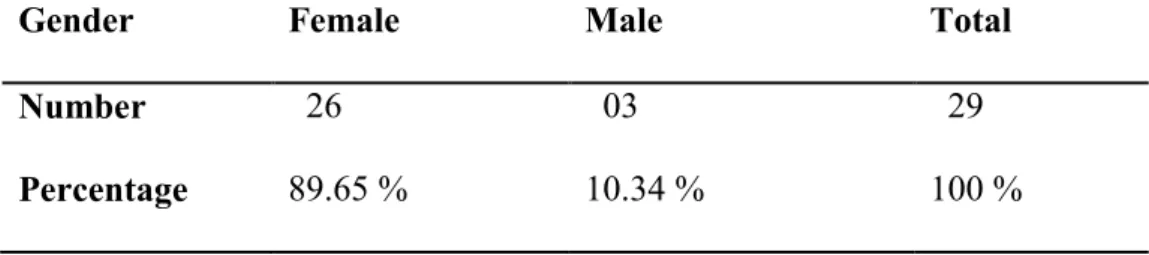
Table 3.1: Students’ Gender……….58
Table 3.2: Students’ Age……….58
Table 3.3: Students’ Experience in Studying English at University………...59
Table 3.4: Students’ English Level before the Entrance to the University……….59
Table 3.5: Students’ English Level after Entrance to University………60
Table 3.6: The Importance of English to Students’ Studies………60
Table 3.7: Students’ Reasons for Studying English……….61
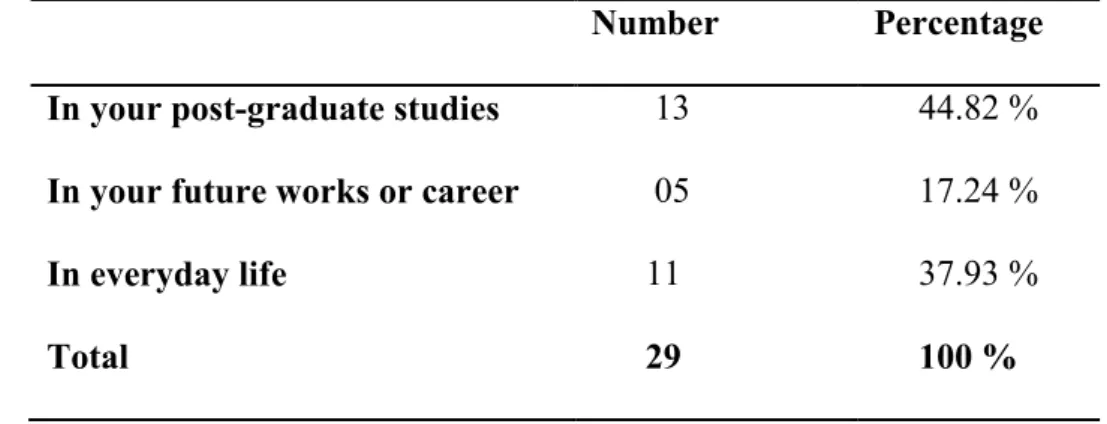
Table 3.8: Students’ Specific Needs………62
Table 3.9: Students’ Interest in Taking ESP Course………63
Table 3.10: Students’ Opinions about Course Contents………..63
Table 3.11: Relevancy of ESP Course Content to Students’ Field of Specialty……….64
Table 3.12: Students’ Needs Analysis……….64
Table 3.13: The Consideration of Students’ Proposition in ESP Syllabus………..65
Table 3.15: ESP Teacher Encouragement………66
Table 3.16: Students’ Use of Books/Documentation in their Own Field in English………...66
Table 3.17: Students’ Perception about the Appropriate Teacher for ESP Module…………67
Table 3.18: Students’ Ability to Communicate in English………..67
Table 3.19: Students’ Course Content Preferences………..68
Table 3.20: Students’ Preference for Classroom Interaction………...69
Table 3.21: Students’ Preferred Learning Styles……….69
Table 3.22: Students’ Preferred Ways of Getting Information………70
LIST OF DIAGRAMS
Diagram 1.1: The difference between ESP and EGP……….15 Diagram 1.2: ESP Classification (adapted from Dudley-Evans and St John (1998, p.6))…..21 Diagram 1.3: Subcategories of EST (adapted from Swales, 1988, p. 89)………...23 Diagram1.4: The Roles of ESP practitioner………23 Diagram2.1: Classification of needs (adopted from Hutchinson and Waters (1987, pp. 54-60)……….31 Diagram 2.2: “The Route” (adopted from Wang as cited in li, 2014, p. 1871)…...…………33 Diagram2.3: Learning needs of ESP learners (adopted from Tahir, 2011, p. 6)……….34 Diagram 2.4: Factors affecting ESP course design (adopted from Hutchinson &Waters, 1987, p. 22)……….44 Diagram2.5: Graves’ Model of Syllabus Design (2000, as cited in Haddam, 2014, p. 50)…45 Diagram 3.1: How NK Cell Attacks the Target Cells (Satchmo, 2000)………..81
CONTENTS Dedication………
i
Acknowledgements………...ii
Abstract………..…….…iii
List of abbreviations………...…iv
List of tables………..……..v
List of diagrams………..…… vi Contents………..… vii GENERAL INTRODUCTION 1. Statement of the Problem……….…...22. Aims of the Study………..…..2
3. Hypothesis………..…….…3
4. Research Methodology and Design……….…....3
4.1 Research Method………...………....……..3
4.2 Population of the Study………4
5. Structure of the Dissertation………..…….4
CHAPTER ONE: GENERAL OVERVIEW ON ENGLISH FOR
SPECIFIC PURPOSES (ESP)
Introduction………...………61.2. The Characteristics of ESP………..8
1.3. ESP vs. GE ………11
1.3.1. The purpose for learning the language………12
1.3.2. The content "what to teach"………12
1.3.3. Motivation………..…..13
1.3.4. The age as well as the mastery of language………..…13
1.3.5. Competence………..14
1.4. The origin of ESP……….14
1.4.1. The Requirements of Modern World………..…..14
1.4.2. Evolution in linguistics………..15
1.4.3. The Shift to The learner as a Focal Point………..15
1.5. Stages of ESP………..…15
1.5.1. Register Analysis………..…16
1.5.2. Rhetorical or Discourse Analysis………..…....16
1.5.3. Target Situation Analysis………..…17
1.5.4. Skills and Strategies………..…17
1.5.5. A Learning-Centered Approach………...18
1.6. Subcategories of ESP ……….18
1.6.1. English for Academic Purposes (EAP)……….…19
1.6.2. English for Occupational Purposes (EOP) ………...19
1.6.3. English for Science and Technology (EST)………..…20
1.7.1. As a teacher ………..…...21
1.7.2. As a course designer and material provider ……….…………..22
1.7.3. As a collaborator……….23
1.7.4. As a researcher………24
1.7.5. As a course and material evaluator……….24
Conclusion………...25
CHAPTER TWO: THE IMPORTANCE OF NEEDS ANALYSIS IN
DESIGNING ESP COURSE.
Introduction……….………272.1. Definition of Needs………..……...27
2.2. Types of Needs ………..……….28
2.2.1. Target Needs……..………28
2.2.2. Learning Needs……..………...…….29
2.3. Definition of Needs Analysis………...…31
2. 4. Types of Needs Analysis ………...…..…..33
2. 4.1. Target Situation Analysis …...33
2. 4.2. Present Situation Analysis……….………..…….35
2.4.3. Pedagogic Needs Analysis ……….…..36
2. 4.3.2. Strategy Analysis / Learning Needs Analysis……….………37
2. 4.3.3. Means Analysis………..………...37
2. 5. Steps of Needs Analysis……….…...38
2. 6. ESP Course Design………..………...39
2.7. Steps in Designing an ESP Course……….41
2.8. The Importance of Needs Analysis to ESP Course Design………46
Conclusion………47
CHAPTER THREE: RESEARCH DESIGN, METHODOLOGY, AND
DATA ANALYSIS.
Introduction………..……49 3.1. Data collection……….49 3.1.1. Questionnaire………..…...49 3.1.2. Interviews………..50 3.2. Participants………..…50 3.2.1. Students………....………51 3.2.2. Teachers……….…..…….…513.3. Description of the students’ questionnaire and teacher’s interview:……….……52
3.3.2. Description of teacher’s interview………..……..…...53
3.4. Analysis and interpretation of the results:………..…..53
3.4.1. Analyses and interpretation of the students' questionnaire………..………...…53
3.4.2. Summary of results and findings from students' questionnaire…………...…….68
3.4.3. Analyses and interpretation of teacher’s interview………..…....….69
3.4.4. Summary of results and findings from teacher’s interview………. 75
3.5. Recommendations………...….77
3.6. Limitations of the study………...86
Conclusion ………....…86
GENERAL CONCLUSION……….….….. 89
References……….….….. 91 Appendices
Appendix (A): Teacher’s Interview Appendix (B): Students’ Questionnaire Appendix (C): بﻼﻄﻠﻟنﺎﯿﺒﺘﺳا
Appendix (D): Syllabus of ESP teacher
French Summary
Introduction
Being competent in English becomes a necessity for people who want to enter the global face. This language proved to be the dominant, since it is used everywhere and it plays a major role in important sectors including: education, economy, technology, sciences, etc. Researchers from all over the world show that cross-border communication is most often conducted in English, as well as, most of the content and the incredible information in the internet are produced in English. Its significance pushed non-speaking English countries to teach English in order to help learners of different specialties cope with the world new changes. As result, many universities attempt to include English in their university programme by making it more specific in order to deal with the special needs of their learners; this kind of English is known as English for Specific Purposes (ESP).
ESP is an important and dynamic area of specialization within the overall field of English language teaching. It aims at meeting the learners’ different professional, social and cultural needs. Therefore, in order to make effective ESP courses, ESP teachers are supposed to follow certain procedures, methodology and activities. One of the essential procedures that must be applied in order to reach learners’ reasons behind taking ESP courses is Needs Analysis (NA).
Needs analysis makes one of the most important contributions to ESP, It is the backbone of effective ESP courses and syllabi; that is why, it should not be neglected by ESP teachers, rather, it should be more emphasized. Needs Analysis is the process undertaken by ESP course designer, where he/ she uses different tools to collect information about learners and their needs in order to set language course objectives and content related to the results of his/her analyses.
1. Statement of the Problem
Most of students at the scientific department of biology are not knowledgeable enough concerning their field vis-à-vis the English language. This may be caused by many factors mainly:
English for Specific purposes’ courses in their departments may not be appropriately applied or may not be applied at all.
The majority of teachers may not be considering the differences between English for Specific Purposes and English for General Purposes, and the methodology adopted in teaching in the majority of cases may be uniform.
Courses which are given by ESP teachers may not be effective.
Lack of prior knowledge by ESP Teacher in students’ field of specialty may be a reason behind the inability of students to express their ideas in English about their field.
Hence, this research addresses the main following question:
Do ESP teachers take into consideration the specific needs of their students when designing the ESP courses or syllabuses?
2. Aims of the Study
English for Specific Purposes (ESP) has become a vital and innovative activity within the Teaching of English as a Foreign or Second Language (TEFL/TESL). Its appropriate application would give the chance to learners to meet their needs and be satisfied, and this only can be achieved through designing effective ESP courses. Hence, the aims of this research are:
To know whether ESP teachers are applying ESP programs.
To provide teachers with recommendations towards considering the analysis of student’s needs.
To know whether students of biology are satisfied with their ESP courses or not. To find out if suitable materials are available for such courses.
To discover whether ESP teachers are given adequate training to teach the different specifications or not.
3. Research Hypothesis
Needs Analysis is an essential step for an effective ESP course, hence neglecting it would lead to the deviation of the course objectives, as a result, students will not be satisfied with the outcome. Thus, this research is based on the following hypotheses:
English teachers in the Biology department do not consider using Needs Analysis in designing their courses or syllabi.
Biology students are not satisfied with the outcomes of their ESP courses.
5. Research Methodology and Design 5.1 Research Method
This research was conducted through the quantitative descriptive and qualitative method. It aims at confirming the research hypothesis through administrating student’s questionnaire and teacher’s interview, which provided different views concerning ESP courses’ effectiveness, students’ satisfaction with these courses, , and the application of Needs Analysis.
5.2 Population of the Study
The sample was chosen conveniently; it consists of Master one students; speciality of immunology, at the Department of biology of 8 Mai 1945 University, Guelma. Master one students are selected as a population of the study; because they are adults who are fully aware of their needs and the kind of materials which should satisfy and interest them. In addition, they are supposed to study ESP, which is relevant to their field of specialty in which its content should be designed for the purpose of helping them later on to conduct their future requirements in English. Following Krejcie and Morgan sampling table, 29 questionnaires have been administered because the whole population of Master one students includes 31 students (as cited in Cohen et al., 2000, p. 94). This aims at making our sample (S) representative of the theoretical population (N).
6. Structure of the Dissertation
This work is divided into three chapters. The first chapter “General Overview on English for Specific Purposes” is devoted to the definition and description of ESP, its emergence, its development, its subcategories, as well as the different roles of ESP practitioner. The second chapter is entitled "The importance of Needs Analysis in Designing ESP Courses", and it explores the term “Needs Analysis”, its major components; it discusses also the steps to conduct this process, ESP course design and its main steps, and it concludes with the importance of Needs Analysis in the design of ESP Course. Chapter three is entitled “Research Design, Methodology, and Data Analysis”. It includes a description of students’ questionnaire and teacher’s interview; then, it analyses data driven from both questionnaire and interview, it interprets the results according to research questions and hypothesis. Finally, recommendations and limitations are concerned.
CHAPTER ONE
GENERAL OVERVIEW ON ENGLISH FOR SPECIFIC
PURPOSES (ESP)
Introduction
1.1. Definition of ESP
1.2. The Characteristics of ESP 1.3. ESP vs. GE
1.4. The origin of ESP 1.5. Stages of ESP
1.6. Subcategories of ESP 1.7. The ESP Practitioner Conclusion
Introduction
The status of the English language as international means of communication places it as a working tool in different fields and various domains, this puts learners in a place where they have to manage the world changes. As result, in 1960’s ESP has emerged as a new field of study to help foreign learners from all over the world to cope with different teaching situations and needs that such position brings about. English for specific purposes (ESP) has grown to become one of the most prominent areas of English as Foreign Language (EFL) enterprise today and of Teaching English as a Foreign Language (TEFL) in particular. This chapter is devoted to provide the literature review concerning the definition, characteristics, ESP vs. general English, emergence, development, subcategories of ESP, as well as the different roles of ESP practitioner.
1.1. ESP: Definition
The term ESP is a broad diverse field of English Language Teaching (ELT) which has many definitions. In that sense, Strevens (1980, p.109) states that “a definition of ESP that is both simple and watertight is not easy to produce”. He also states that “producing a simple and straightforward definition of ESP is not an easy task” (1980, p.109). Giving definition to the term ESP is intricate since a lot of scholars worked to provide an appropriate definition to ESP context i.e. each scholar has his/her own definition, which produces several definitions for ESP. Many have tried to define it in terms of what it is not, rather than in terms of what it really is. Others in terms of what it should be and what it should not be.
ESP is different from General English (GE), which normally addresses general topics; it deals with teaching English to learners who are in need for English language to obtain their aims whether in their studies in specific fields such as science, technology, medicine etc., or in their future job.
Mackay and Mountford (1978, p.2) explain ESP in terms of its purpose as they define it as the teaching of English for a “clearly utilitarian purpose.” This means that the learners' aims to study English language would be for academic, occupational, or scientific purpose. The learners’ needs decide the content and what should be taught and what should be included in ESP curriculum.
Munby (1978, p. 2) tries to define ESP referring to the connection of its courses to the students' communication needs where the content of ESP course is planned through the consideration of those needs, by stating that: “ESP course are those where the syllabus and materials are determined in all essentials by the prior analysis of the communication needs of the learner”
Robinson (1980, as cited in Haddam, 2014, p. 17) explains that the participants of ESP courses have specific goals to obtain, whether academic, occupational or scientific. As she cites strevens (1977), she stresses her idea that the needs of language learners are of great importance, and should be the first thing to be considered when deciding the content of the syllabus. They also limit the materials to be more specific and relevant to the course which help making the curriculum more learner-centered.
In addition to the previously mentioned definitions, Robinson (1980, p. 13) provides a complete definition on how ESP course should be in terms of its content, time limitation, and how it should meet the needs of the learners, etc. She defines it as follows: “an ESP course is purposeful and is aimed at a successful performance of occupational, educational roles, it is based on rigorous analysis of students’ needs & should be tailor-made. Any ESP courses may differ from another in its selection of skills, topics, situations and functions; it is likely to be of limited duration, students are more adults.”
Whereas for Coffey (1984, p. 2), ESP contains a careful analysis of the learners needs who will be introduced to a language, which is chosen carefully to meet their purposes in a way that is uncomplicated and beneficial.
Moreover, Hutchinson and Waters (1987, p.19) consider the learning of English language in ESP situation as a means more than an end. Besides, the learners’ objectives behind attending such kind of courses would dictate what should be included in the ESP syllabus.
Dudley-Evans (2001, p. 9) argues that: “ESP has tended to be a practical affair, most interested in investigating needs, preparing teaching materials, and devising appropriate teaching methodologies.”. He tries to define ESP by mentioning some of its functions such as: analyzing learners’ needs, constructing teaching materials, and formulating suitable ways to teach English for those specific needs.
1.2.The Characteristics of English for Specific Purposes
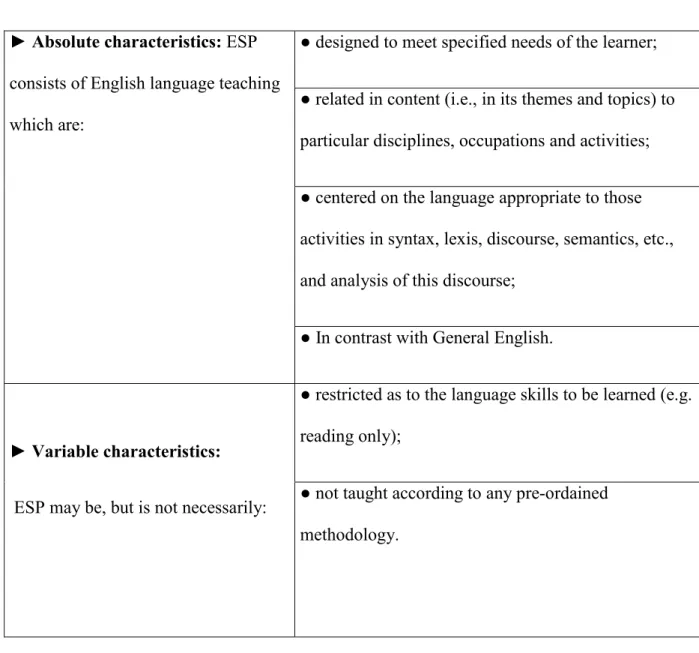
ESP can be best defined through mentioning its characteristics, thus Strevens (1988, pp.1-2) in an attempt to define it, he provides four absolute and two variable characteristics which are as follows:
Table 1.1: ESP Characteristics by Strevens (1988, pp.1-2).
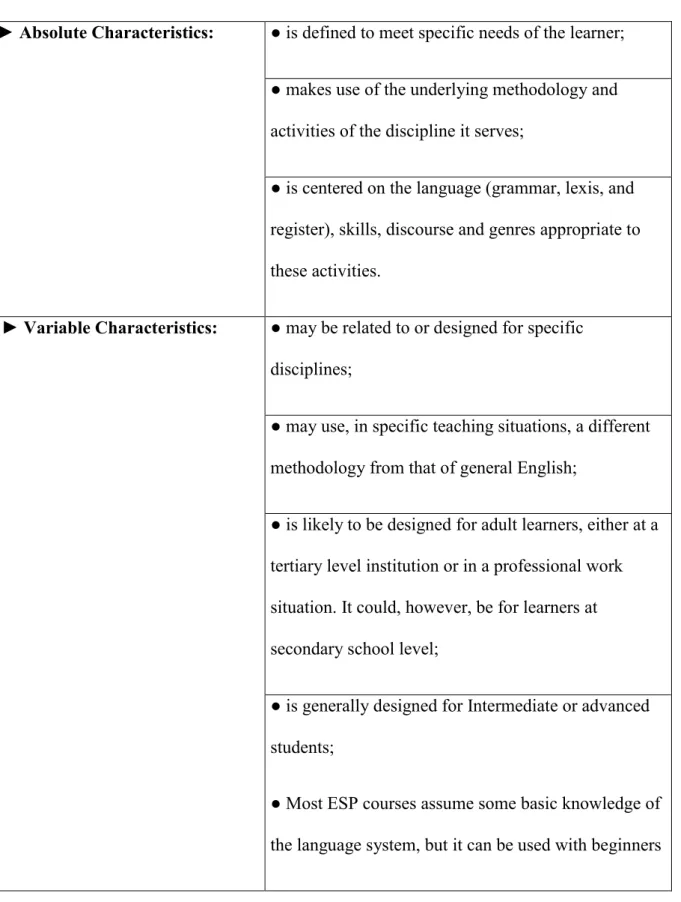
Dudley-Evans and St. John (1998, pp. 4-5) presented a revised version of ESP which also includes absolute and variable characteristics:
► Absolute characteristics: ESP consists of English language teaching which are:
● designed to meet specified needs of the learner; ● related in content (i.e., in its themes and topics) to particular disciplines, occupations and activities; ● centered on the language appropriate to those activities in syntax, lexis, discourse, semantics, etc., and analysis of this discourse;
● In contrast with General English.
► Variable characteristics: ESP may be, but is not necessarily:
● restricted as to the language skills to be learned (e.g. reading only);
● not taught according to any pre-ordained methodology.
► Absolute Characteristics: ● is defined to meet specific needs of the learner; ● makes use of the underlying methodology and activities of the discipline it serves;
● is centered on the language (grammar, lexis, and register), skills, discourse and genres appropriate to these activities.
► Variable Characteristics: ● may be related to or designed for specific disciplines;
● may use, in specific teaching situations, a different methodology from that of general English;
● is likely to be designed for adult learners, either at a tertiary level institution or in a professional work situation. It could, however, be for learners at secondary school level;
● is generally designed for Intermediate or advanced students;
● Most ESP courses assume some basic knowledge of the language system, but it can be used with beginners
Correspondingly, Robinson (1991, p. 23) identifies two different criteria and number of characteristics in order to define ESP. The two criteria, as she mentions, points out to the fact that ESP is "normally goal oriented" and needs analysis is the basis to produce ESP courses (aiming to select as closely as possible what students have to do through the medium of English). Whereas, the general characteristics are as follows:" ESP courses are taught to adults who are in homogeneous classes organized with respect to professional background or field of specialization and the objectives of the courses should be met, even if there is a limited time period."
1.3. English for Specific Purposes vs. General English
As it has been mentioned in the previous definitions, ESP is a subfield within English language teaching, where adult learners are exposed to specific and special courses to fulfill their needs. Whereas, English for General Purposes (EGP) is a general English, where needs cannot be specified but rather learners are exposed to the basic elements of the English language. This idea is reinforced by Widdowson (1981, p.89) who states that: “if a group of learners’ needs for a language can be accurately specified, then, this specification can be used to determine the content of a language programme that will meet these needs.”
Equally, Thomas Orr (1998), in an attempt to differentiate between ESP and EGP, states that:
English for general purposes (EGP) is essentially the English language education in junior and senior high schools. Students are introduced to the sounds and symbols of English, as well as to the lexical/grammatical /rhetorical elements that compose spoken and written discourse […] University instruction that introduces students to common features of academic discourse in the sciences or humanities, frequently called English for Academic Purposes (EAP) is equally ESP. (Para. 3)
It is clear that ESP should be boosted by general English background, because it comes as continuum to GE, where it is taught to mature learners who are supposed to have a background, and should be aware of the need to use English in more specialized way to achieve their goals. In the light of this, Orr (1998) states that: “English for Specific Purposes (ESP) is research and instruction that builds on EGP and is designed to prepare students or working adults for the English used in specific disciplines, vocations, or professions to accomplish specific purposes”. (Para. 4)
Additionally, both fields share the purpose of teaching English to foreign learners, in order to make them competent users of this language: but, when it comes to the application of the teaching/ learning process, different methods, strategies, and content are used. In the light of this, Hutchinson and waters (1987, p. 53) highlight the idea that ESP and EGP are not dissimilar in theory; but, they are in practice. They both differ from one another in the sense that the subject matter and design of syllabuses are more specific for ESP courses rather than in EGP. Further, in (1992), they argue that if the awareness about the need of language is known from the part of learners, sponsors and teachers, this will provide a reasonable and accepted content in the language course.
The essential principles that make ESP vary from EGP can be briefly summed up as follow:
1.3.1. The purpose for learning the language:
ESP and EGP differ from one another in the sense that each has a particular reason behind studying it. The awareness why this language is going to be used and what needs to be fulfilled give a sense of the effectiveness of this learning process, as supported by Harding (2007, p. 6) who presumes that: “The sense of purpose gives the language work immediacy and a relevance which is perhaps not always found in other sectors of ELT, particularly of the ‘General English’ variety.”
1.3.2. The content "what to teach"
On the basis of the purpose of learning English and the identified objectives, the content of EGP and ESP differs. The EGP courses cover general rules and the four skills are stressed equally. But in ESP, learners will be exposed to the skill which they need to be developed the most, which is done through needs analysis, and the syllabus is designed accordingly. As it is stated by Strevens (1980) who introduces ESP’s restriction in the selection of skills “the learners will need; selection of the items of vocabulary, patterns of grammar and functions of language; themes and topics narrowing in order to include only the themes, topics and discourse needed; practice of purposeful communicative needs.” (As cited in Robinson, 1980, pp. 12-13) Moreover, EGP courses deal with teaching grammar and language structure mostly in isolation. This is the opposite when it comes to ESP courses, where the focus is on context and everything is taught in relevance to the learners’ real world.
Language in context → ESP Language in isolation → EGP Diagram 1.1: The difference between ESP and EGP
1.3.3. Motivation
Usually EGP gives a sense of demotivation; because most of the time learners are exposed to materials far from their needs, and there is no practicality in real life. This demotivation extends to ESP courses, where learners expect that these courses could be similar to what they had seen before. This was suggested by Harding (2007, pp. 8-9) where he states that: “the type of ESP learners who come to ESP are often demotivated by courses of general English. These learners have entered ESP courses because they expected that language-based work would not owe to practical or manual skills in lessons.”
But, usually ESP learners are highly motivated because their needs are identified. They are learning the language in order to communicate professionally and to perform some particular job related functions or educational purposes.
1.3.4. The age as well as the mastery of language
The ESP learners are supposed to be mature and adults who pertain a reasonable competence in all areas of the English language and have objectives ahead to be attained. While EGP learners are believed to be young adults who are familiar with or in the process of gaining competence in English language.
1.3.5. Competence
The competences which each of ESP and EGP tries to develop is different. ESP aims at enhancing learners' communicative competence, while GE aims at developing learners' linguistic competence. This confirmed by Widdowson where he says: “a concern with ESP, EST necessary entails a concern with communicative competence”. (As cited in Robinson, 1980, p. 23)
This separation does not put a field in favor of the other one, because both ESP and EGP function differently in certain areas. For instance, learners should develop knowledge in GE first in order to be able to function in specialized area. So EGP is considered the basis toward having ESP knowledge. Barnard and Zemach (2003, as cited in Haddam, 2014, p. 23) express a view that ESP and EGP should not be regarded as discrete divisions of ELT, but ESP is “simply an area (with blurred boundaries) whose courses are usually more focused in their aims and make use of a narrower range of topics.
1.4. The Origin of ESP
ESP came as a response; without any preplanning, to a number of different trends around the world. Hutchinson and Waters (1987, pp. 6-8) identified three common purposes which led to its birth and they are as follow:
1.4.1. The Requirements of Modern World
The end of the second world in 1945 led to the unexpectable evolution in technology and commerce all around the world. This created a need to have an international language which fell onto English language. This created a kind of learners who are aware of their objectives to learn this language; each has his own special needs to fulfill; for instance, as Hutchinson and Waters (1987, p. 6) mention: “such as businessmen and women who wanted to sell their products, mechanics who had to read instruction manuals, doctors who needed to keep up with developments in their field and a whole range of students students whose course of study included textbook only available in English”. Moreover the oil crisis in 1970's quickened the rise of the ESP in the world.
1.4.2. Evolution in Linguistics
Widdowson (as cited in Hutchinson and waters, 1987, pp. 6-8) explains that the need for English courses to be tailor made led to the emergence of new idea in the study of language. Before, the focus was on rules of language (grammar); but with the new studies, the shift turned to how language is used in real communication. Besides, a new finding was that if the language we speak and write varies from one situation to another, this means it is possible to determine the features of specific situations and then make these features the basis of the learner’s course, Hutchinson and Waters (1987, p. 8) states that: “Tell me what you need English for and I will tell you the English that you need”
1.4.3. The Shift to the Learner as a Focal Point
Developments in Educational psychology shifted the attention to the learners' interests, attitudes, and needs; this gave a push to the rise of ESP where courses became learner-centered for the purpose of improving their motivation and learning process itself. The outcome of these three reasons provided headway for the growth of ESP and the need for increased specialization in language learning (Hutchinson & Waters, 1987, pp. 6-8)
1.5. Stages of ESP
ESP is unprecedented phenomenon that is exposed to different analysis by different scholars, Hutchinson and waters (1987) tried to provide a division to its development by splitting it into five phases in relevance to the notion of special language.
1.5.1. The concept of special language (Register analysis)
Register analysis deals with the language form (grammar and vocabulary), it is concluded that English for Science and Technology (EST) uses certain grammatical and lexical forms more frequently than other forms; for example, scientific language uses present simple and passive voice forms more than other grammatical forms.
Register analysis is a new brand which is associated with such scholars such as Halliday, McIntosh, and Strevens, Herbert, Twer and Latoure, who attempt to create a syllabus based on the linguistic features of subject- specific language they present. The aim of Register Analysis is to focus on the language forms that learners would need to use and neglect other forms that are not highly needed. This is highlighted by Hutchinson and Waters (1987, p. 10) who state that: “The aim was to produce a syllabus which gave high priority to the language forms students would meet in their science studies and in turn would give low priority to forms they wouldn’t meet.”
A comparison made by Ewer and Hughes (1971, as cited in Hutchinson & Waters, 1987, p. 10) between language of school textbooks and language of scientific texts student had to read, revealed that there is negligence of some of the scientific language in school textbook. Hutchinson and Waters (1987, p. 10) declare that: “ESP Course should, therefore, give precedence to these forms."
The shortcomings of Register Analysis based syllabus gave birth to another major trend in ESP Development which is Rhetoric also known as Discourse Analysis.
1.5.2. Beyond the sentence (rhetorical or discourse analysis)
Discourse Analysis is concerned with describing the language and its structures that are used in speech or text and which are beyond the sentential level. It examines the communicative context that affects language use. It looks at how the choice of verb tenses or other grammatical features affect the structure of the discourse. It also looks at the relationships between utterances (Jordan, 1997, p. 229, as cited in Bensfa, 2015, p. 60)
With the development of register analysis, the focus of ESP was on the level of the sentence; but with the contribution of discourse analysis, the focus shifted beyond the sentence level. Allen and Widdowson (1974, as cited in Hutchinson & Waters, 1987, pp.10-11) point out that the difficulties students face are not from the incomplete knowledge of
English system; but rather, it is from the ignorance of how English should be used. 1.5.3 Target situation analysis
ESP is based on the reason why learners need to learn the English language. In order to have a kind of syllabus where the needs of learners are considered, the process should start with identifying the target situation, and this is done through the analyses of the linguistic features of the aimed situation. Taking into consideration these needs enables the learners to function adequately in the target situation. Target Situation Analysis is best explained by John Munby model of communicative Syllabus Design (1978) where the learners' need profile is produced in detail in terms of communication purposes, communicative setting, means of communication, language skills, functions, and structures (as cited in Hutchinson & waters, 1987, p.12)
15.4. Skills and strategies
This phase came to overcome the weaknesses of the three previous stages, which they were focusing on the surface forms of the language. While in this stage, there was an attempt to look below the surface by considering the thinking process that underlies language use.
According to Hutchinson and Waters (1987, p. 13), the main idea behind the skills centered approach is that underlying the language use, there are common reasoning and interpreting processes that enable learners to extract meaning from discourse; that is to say, situation or activities differ in which it needs a particular study skill to associate it with it, for this reason, learners’ needs to deal with specific study skills may differ according to the learning environment, required task, and the learner’s level as well.
1.5.5. A learning-centered approach
This stage attempts to consider what the preceding stages did not consider. The focus is on language form, language use, or the underlying processes; but this phase concentrates on the process of language learning (what learners need in order to reach the target situation). As Hutchinson and Waters (1987, p. 14) declares: "we cannot simply assume that describing and exemplifying what people do with language will enable someone to learn it[…] A truly valid approach to ESP must be based on an understanding of the processes of language learning" In other words, the ESP learners’ needs analysis became a cornerstone to this stage of ESP development.
1.6. Subcategories of ESP
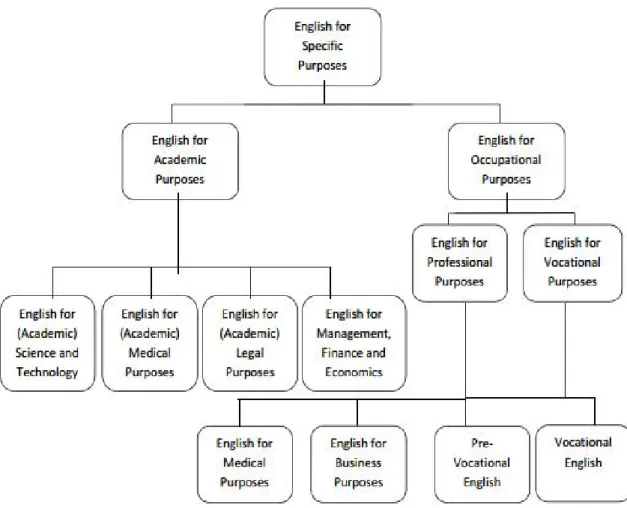
ESP falls into the broad category of ELT. The former in turn has different sub-sections, which are divided by the scholars into three main types: English for Occupational Purposes (EOP), English for Academic Purposes (EAP), and English for Science and Technology (EST) which has been a matter of debate few years ago and it shows an important role in the development of ESP.
Dudley-Evans and St John (1998, p. 6); in their analysis of ESP, tried to resolve the debate of what ESP sections and sub-sections are. The diagram 1.2 illustrates this classification:
Diagram 1.2: ESP Classification (adapted from Dudley-Evans and St John (1998, p.6))
1.6.1. English for Academic Purposes (EAP)
This type refers to studying or teaching of English in Academic contexts in order to fulfill educational Purposes. Kennedy (1984, p. 4); in this vein, points out that: “EAP is taught generally within educational institutions to students reading English in their studies.” EAP may constitute of teaching specific skills such as: reading texts, writing reports etc. in educational institution.
It is also described as the language and associated skills that students need to deal with to study or conduct research through the medium of English language. As Robinson (1984, as cited in Bensafa, 2015, p. 52) who defines it as “English for Academic Purposes or study skills that is how to study through the medium of English”
1.6.2. English for Occupational Purposes (EOP)
EOP is also known as (EVP) English for Vocational Purposes and (VESL) Vocational English as a Second Language (Hutchinson & Waters, 1987, p. 17). EOP can be defined as the use of English to fulfill job, professional, or vocational requirements. A similar, but a more recent definition has been given by Dudley-Evans & St. John (1998, p.7) in which they assert that: “The term EOP refers to English that is not for academic purposes, it includes professional purposes in administration, medicine, law and business and vocational purposes for non-professionals in work or pre-study work”
To make a clear difference between EOP and EAP, a number of scholars attempt to provide a distinction, Robinson (1991, p.100) states: “EAP is thus specific purpose language teaching, differentiated from EOP by the learner: future or practicing student as opposed to employee or worker.”
1.6.3. English for Science and Technology (EST)
EST has a great importance in the development of ESP, and many scholars call attention to its significance; for instance, Swales writes: “It therefore seem to me that because of the predominant position of EST. the major development of ESP as a whole could best be told through it” (1985, p. 10), as well, as Robinson who has the same point of view where he says: “At times it seems that EST is the most prestigious development in ESP”.
But EST has been a matter of debate among researchers to classify it as a branch of its own or a sub-branch shared by both EAP and EOP. Swales(1985, p. 6) considers it as a branch which takes part in both (EAP) and (EOP), by arguing that: “it covers the areas of English written for academic and professional purposes and of English written for occupational (and vocational) purposes, including the often informally written discourse found in trade journals and in scientific and technical materials written for the layman.”
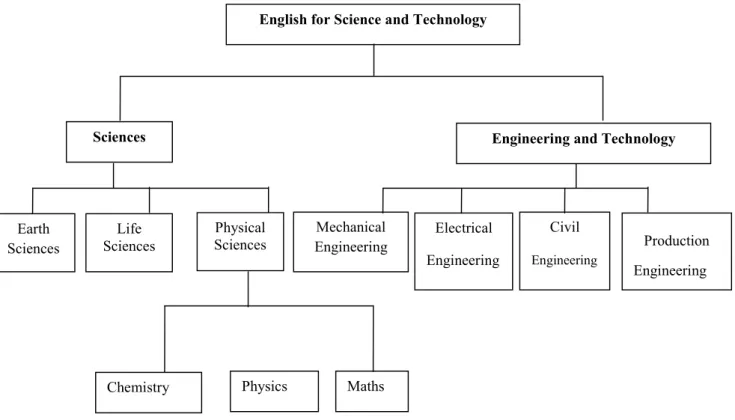
There are two major sub-sections in (EST), which are divided in terms of subject matter, “Science” and “Engineering and Technology” as illustrated in diagram 1.3:
Diagram 1.3: Subcategories of EST (adapted from Swales, 1988, p. 89)
1.7. The Role of the ESP Practitioner
The status of English language saw numerous changes through the previous decades; this switch makes it become a subject to a service industry for other specialism. Moreover, the development of ESP courses which focuses on attaining learners' needs pushed teachers to switch from their traditional role as EGP teachers to ESP one with multiple roles to take. Dudley Evans and St. John (1998, p. 13) prefer the term "ESP practitioner" rather than teacher, as they affirm in their own words “to emphasis that ESP works involve much more than teaching.” Production Engineering Maths Physics Chemistry
Sciences Engineering and Technology
English for Science and Technology
Mechanical Engineering Electrical Engineering Civil Engineering Earth Sciences Life Sciences Physical Sciences
Since the ESP teacher is placed in a situation where s/he should plan the course of his/her module by him/herself, which goes from analyzing his/ her students' needs and considering their wants and lacks, setting the course objectives, searching and collecting the appropriate relevant teaching materials, preparing the best learning environment, ending with evaluating the learners’ achievements, as well, as the teaching materials. In this regard, Dudley-Evans and St John (1998, p. 13) claim that ESP practitioners' role are not limited to providing information only; but rather, it goes beyond that, they state that: "The ESP practitioner has five key roles: Teacher, course designer and material provider, collaborator, researcher and evaluator". These key roles of ESP practitioner are presented in diagram 1.4:
Diagram1.4: The Roles of ESP practitioner.
1.7.1. As a Teacher
Since the content of ESP course is special, this implies that the role of ESP teacher is much more specific than GE teacher. Hence the latter has many duties to take. First, s/he should possess the flexibility to take some risks in his/her teaching by switching different positions to ensure the successfulness of the teaching process. Dudley-Evans and St johns (1998, p. 14) in this sense state that: “The willingness to be flexible and to take risks is one of the keys to success in ESP teaching.” Moreover, ESP teacher is, in some situations, a partner who advises her /his learners to make what is best for them in order to enhance their level in English. In addition, ESP teacher is a communication maker, who makes sure to develop authentic, real communication based on the ability of learners, as well as their willingness to interact successfully. Furthermore, ESP teacher is a facilitator who helps learners with the needed material to facilitate obtaining their goals. These are not only the duties of ESP teacher since s/he has unlimited tasks to do depending on her/his works’ conditions and situations.
1.7.2. As a Course Designer and Material Provider
The role of ESP practitioner is not restricted to teaching only, but they have other duties such as designing, setting up and administering the ESP course, as it has been agreed on by many researchers such as Mackay et al. (1978), Swales (1980), Robinson (1991), and Dudley-Evans et al (1998). Because of the nature of ESP course, the ESP practitioner has to plan for his own course based on the needs of his/her learners, who need to accomplish their goals by the end of the course or programme. Once the objectives are set, s/he could select published material or adapt when the published material is not suitable or when it does not exist, s/he needs to create materials with the help of some experts if possible.
1.7.3. As a collaborator
Since ESP teacher needs to create a suitable material, one of the ways to make it is by cooperating with both subject specialists or/ and learners themselves. The latter are a great source of information; since they have more knowledge on the subject matter, and their needs play a significant role in planning the lessons. This collaboration is done in order to get the required information, design adequate syllabus, and provide tasks needed in their work or business situation. (Dudley-Evans et al, 1998, p. 16)
1.7.4.As a Researcher
In order to cope with new situations, ESP practitioner searches for the subject matter, the needed materials, the target needs of his learners, and s/he also makes himself up-to-date to know about the techniques, strategies, and methodologies to be adapted or adopted in the course. Research process helps ESP practitioner to have a body of knowledge and insights about different pedagogical choices which help him/her to have more effectiveness in accomplishing the course objectives.
1.7.5. As an Evaluator
Evaluation process is not something new in the teaching and learning field, but it is considered as a crucial part to ESP course, where ESP practitioner in addition to evaluating the students ‘progress and teaching effectiveness, s/he also has to examine the course and teaching materials to make sure that his/her learners are grasping the necessary and appropriate knowledge. Dudley-Evans and St John (1998, p. 17) discovered that it would be better if evaluation is done “while the course is being taught, at the end of the course and after the course has finished.” ESP practitioner has to keep an eye on each step his/her learners make, and the effectiveness of the different information s/he is providing. This is achieved through constant evaluation of each aspect of his/her class to ensure the successfulness of his/her teaching process.
The responsibilities of ESP teachers are numerous; they have to take care of many things to guarantee the fulfillment of his/her learners’ need.
Conclusion
In order to cope with the new changes which were happening in the world as result of the commercial and the technological developments, a new field under the general landscape of English language teaching "English for Specific Purposes" emerged to provide help to learners who are in need to use English to fulfill their academic or occupational necessities.
The present chapter displayed a general overview on the concept of ESP, how it emerged, the different phases of its development, its classifications as well the diverse roles of the ESP teacher.
ESP has proved itself to be a learner-centered, where each aspect in the course is devoted to their needs. To plan such effective course, analysis of the learners needs should take place as a first crucial step. Hence, the following chapter will discuss what is meant by the term Needs Analysis (NA), its different components, how the needs analysis is an essential step toward having a successful ESP course, as well as how the ESP course should be designed.
CHAPTER TWO
THE IMPORTANCE OF NEEDS ANALYSIS IN DESIGNING
ESP COURSE.
Introduction
2.1. Definition of Needs 2.2. Types of Needs
2.3. Definition of Needs Analysis 2. 4. Types of Needs Analysis 2. 5. Steps of Needs Analysis 2. 6. ESP Course Design
2.7. Steps in Designing an ESP Course
2.8. The Importance of Needs Analysis to ESP Course Design Conclusion
Introduction
Knowing why learners need to learn English is a crucial step in designing ESP syllabus. In order to know these requirements, it is necessary to go through the procedure of collecting information about learners’ needs and this process is known as "Needs analysis". This chapter presents an overview on the term “Needs Analysis”, its major components; it discusses as well, the steps to conduct this process. In addition, it evokes ESP course design and its main steps. At last, this chapter concludes with the importance of Needs Analysis in the design of ESP Course.
2.1. Definition of Needs
Learners' needs are the backbone of each English language course, considering them serves as an important aspect toward having an effective teaching and learning process. Needs is a large term which encompasses different components including different things related to the learners: their goals, their purposes behind learning the language, their background, and their language capacities.
The meaning of the term “Needs” differs from one scholar to another and each specialist agree that this word can convey different meanings. For instance, Widdowson (1981, p 2) defines the term needs by referring back to the learners' academic and occupational demands. In other words, the objectives they should reach at the end of the course. Others like Robinson (1991, p. 7) defines it in terms of what the learner wants and desires from this learning process, besides his work and study demands, by affirming that: “We can consider what the students themselves would like to gain from the language courses. This view of needs implies that students may have personal aims in addition to or even in opposition to the requirements of their studies or jobs.”
In a similar vein, Mountford (1981, p 27) regards “Needs” as the necessities, which are seen by those who make use of foreign language as needful to be learned. He states that: “what the user, institution or society at large regards as necessary or desirable to be learnt from a programme of language instruction”
From the above definitions, it is noticed that the word "Needs” is understood differently due to the fact that ESP courses are devised by many participants; including the institution which organizes the language courses, the language teacher, the learner, and in some cases the sponsor, and the needs analyst.
2.2. Types of Needs
The earlier definitions and other definitions provided by other scholars imply the existence of two main types of needs that the ESP course designer has to take into consideration, while planning ESP syllabus: target and learning needs. The former indicates what the learner needs to do in the target situation, and the latter denotes what s/he needs to do in order to learn. (Hutchinson & Waters 1987, p. 54)
2.2.1. Target Needs
Target needs are the requirements of learners in the needed situation. These requirements are further divided into different types: Necessities, lacks and wants.
● Necessities
They are the kind of needs required to reach the desired outcomes, as well as the aspects to be learned to communicate effectively in the target situation, these needs are also called “Objective Needs”. Brindley (1989, p. 70) defines objective needs as those "which are derivable from different kinds of factual information about learners, their use of language in real life communicative situations as well as their current language proficiency and language difficulties". Information about these needs is collected from learners' background, and their proficiency in different language skills.
● Wants
This type of needs concerns learners themselves, and has no relation with learners’ proficiency or their background. Rather, it is more about their interests, their desires, their feelings toward their most important needs, their attitudes toward the target language as well as its culture. These needs are known as “subjective needs”. They have great influence on the learners' motivation toward the learning process; because they are considered to be their personal aims behind learning the language. Richterich (1984, p. 29, as cited in Hutchinson & waters, 1987, p. 56) who states that: “a need does not exist independent of a person. It is people who build their images of their needs on the basis of data relating to themselves and their environment.”
●Lacks
Knowing the learners’ personal aims to learn the language, and the aspects needed to be learned to reach the target situation are not enough; but, it is required to know learners’ lacks, which is the gap between the learners' existing proficiency, as well as their target needs (Hutchinson &Waters 1987, p. 56)
2.2.2. Learning Needs
Considering the target needs only in designing ESP programme is not functional, there must be an account of the route toward getting these target needs. This route denotes another kind of needs, which are the "learning needs". These needs involve the answer to the question "How are learners going to the destination?”. Hutchinson & Waters (1987, pp. 60-62) identify two different types of learning needs: the first type is learning strategies, skills, and techniques, which concern the learner himself. The second one is the potential and constraints of the learning situation, which are the external factors related to the teacher or administration that involve teaching methods, materials and time available.
Lacks Necessities
Learning needs
Starting point destination
Diagram 2.2: “The Route” (adopted from Wang as cited in li, 2014, p. 1871)
Learning needs play an important role in needs analysis; since they have, as target needs, a great effect on ESP programme, and syllabus design. They can be also viewed from three main perspectives as illustrated in the following diagram:
Diagram2.3: Learning needs of ESP learners (adopted from Tahir, 2011, p. 6) 2.3. Definition of Needs Analysis
Needs Analysis (NA) is an integral part of ESP, both of them cannot be separated; because ESP course content is based on the information collected from this process. McDonough (1984, p. 29, as cited in Haddam, 2014, p. 30) writes: “The idea of analyzing the language needs of the learner as a basis for course development has become almost synonymous with ESP”. NA leads ESP courses toward successfulness in which everything about the learners are considered prior to any step ESP teachers would imply in their course. It is firstly needed to be looked to the learners and analyze each aspect related to them, in order to provide what is best for them.
In general, NA is the systematic step undertaken, in order to have an idea on particular individuals or institutions. As defined by Richards (2001, p. 51), NA is “the procedures used to collect information about learners’ needs.”
Needs Analysis is a crucial part in any language course, but for ESP course; it is considered its corner stone where ESP course is built upon this reliable information gathered
on learners to create relevant teaching materials. In the same vein, Dudley-Evans and St-John (1998, p. 122) define NA as a means of establishing the “what and how of a course”. They further state that: “Practitioners need to understand professional information about the learners: the tasks and activities learners are/will be using English for; English language information about the learners: what their current skills and language use are” (1988, p. 125) In the same line, McKillip (1987, p. 7) refers to NA as:" value judgments: that a target group has problems that can be solved". NA can also be defined as the assessment of the learners’ needs where the analyst's quest is to evaluate the problems of the identified target population. After identifying the problems, the analyst tries to find solution to their deficiencies by setting relevant objectives to fulfill. Johns (as cited in Songhori, 2002, p. 03) indicates that needs analysis is the first step in course design and it provides validity and relevancy for all subsequent course design activities.
Brown (1995, p. 36, as cited in Mousavi, 2013, p. 1014) defines NA as “the systematic collection and analysis of all subjective and objective information necessary to define and validate defensible curriculum purposes that satisfy the language learning requirements of students within the context of particular institutions that influence the learning and teaching situation”. This definition stresses the idea of the accountability of the course, meeting the requirements and expectations of a particular group of learners and their instructor(s), and learning through analyzing their different needs, which will enhance the quality of the teaching and learning process.
The process of Needs analysis is not something new in teaching and learning field, it has existed before, it was borrowed from other areas of education where needs analysis was not stressed on as an important process and it was conducted in informal traditional ways. However, when ESP emerged more emphasis is put on this process as a fundamental step in syllabus design, in which learners’ needs are conducted formally through systematic steps in
more complex ways; it aims at collecting information about the learners and at defining the target situation and environment of studying ESP for the purpose of defining the objectives of the language syllabus. To this effort, West (1997, p. 68; as cited in Songhori, 2008) states that:
The term was first emerged in the 1920s, but because it referred to determining the needs of the general language learners, who studied English simply for the sake of knowing English, it did not seem very relevant at that time and did not linger; its return is closely associated with the emergence of ESP in the 1970s. By the 1990s, NA appeared in language teaching in many countries. Today, it is widely believed that needs analysis is a prerequisite to the specification of any language course objectives.
2. 4. Types of Needs Analysis
Many scholars, in an effort to fulfill the learner's needs, proposed different types of NA in the learning/ teaching process of second or foreign languages; namely, the main types are: Target Situation Analysis (TSA), Present Situation Analysis (PSA), and Pedagogic Needs Analysis (PNA).
2.4.1. Target Situation Analysis (TSA)
Target Situation Analysis (TSA) refers to the study of the situation where language is going to be used; this helps to select the kind of language to teach in order to meet the learners’ occupational or academic requirements (west as cited in Haddam, 2014, p. 80). In this sense, Robinson (1991, p. 8) argues that: “a needs analysis, which focuses on students’ needs at the end of a language course can be called a TSA”. The term was firstly introduced by Chamber in his article “A Re-Evaluation of Needs Analysis” (1980), who states that: “Needs analysis should be concerned with the establishment of communicative needs